
Category: Sermon
The Future? ~ The Rev. Frank Bellino, OPI
For many of us time is not a friend. We seem to be increasingly busy, rushing from one job to the next, with little time to slow down and reflect on what we are doing. Nevertheless, there are those who find the amount of time stretching out before they are incredibly stressful. One of the most challenging aspects of recovering from an illness or injury is boredom; how do you fill all the hours of the day when you are confined and don’t have the energy for much activities?
This Sunday’s Gospel passage is the middle one of three parables, all of which are concerned with time. The first parable is that of the ten maidens: five foolish and five wise waiting for the bridegroom. The third is the familiar parable of the sheep and the goats; the judgement at the end of time ‘when the Son of man comes in his glory’.
In today’s parable Jesus describes how a man entrusts his property to his servants before going on a journey. Like the first parable, this is a story about waiting; how do we prepare for the return of the Lord and what will his judgement be when he appears in glory?
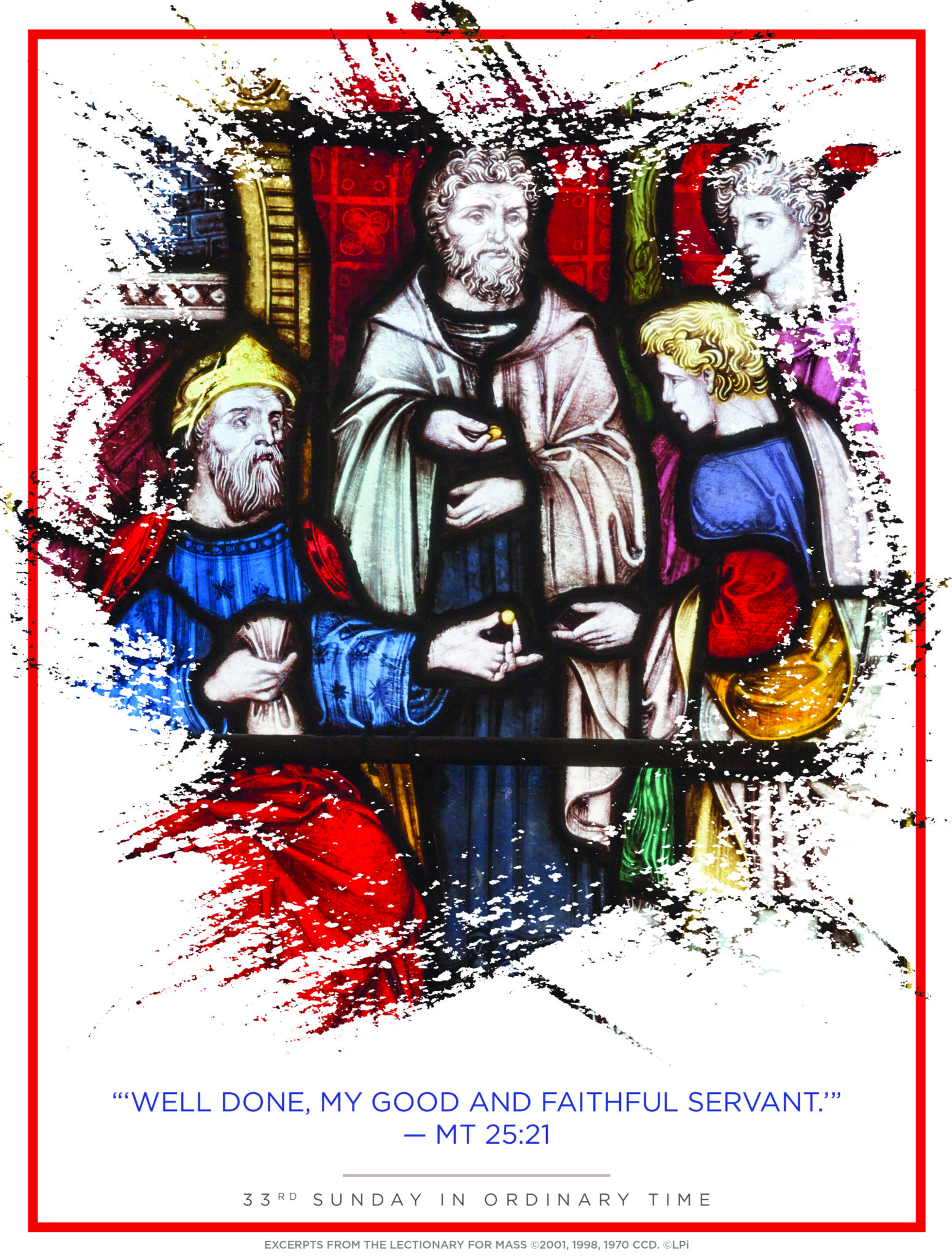
The first two servants are given five talents and two talents, a large amount of money and they go ahead to double them through trade. The third servant, however, who receives one talent, digs a hole and buries it out of fear that he might lose it. The first two servants have used their time well, while the third has made little use of the time given to him as he waits for his master to return.
For the third servant time is not a friend, but each moment is filled with dread and fear at the thought of losing the talent that he has been given. Rather than awaiting the return of the master in joy, seeing each moment as transformed in anticipation of this future happiness, this servant’s life is filled with anxiety about what tomorrow will bring.
In many ways it’s easier to identify with this fearful servant than with the two who make such a great success of things. All of us are anxious about the future. No matter how secure we feel ourselves to be in this life who can say with absolute certainty what tomorrow will bring?
I recently heard that each day the average life expectancy in the US increases by six minutes. We are living longer and have a day-to-day security that our ancestors (and many people today in the world) could only have dreamed about. Yet for all this the future still remains uncertain. So, we battle against time trying to bring it under our control or try to escape it by putting ourselves into a state of oblivion.
Jesus knew what the future held for him:
Behold, we are going up to Jerusalem; and the Son of man will be delivered to the chief priests and the scribes, and they will condemn him to death (Matt 20:18)
However, he did not try to avoid this future, but allowed himself to be delivered to death. The future offered him pain and suffering, yet in his immense courage he embraced this future on the cross, so that we might no longer live in fear of what tomorrow will bring.
We know that no matter what the future brings, the risen Christ is with those who hope in him, leading them to the joy of his eternal kingdom.
Servanthood~The Rev Frank Bellino, OPI
Although he was a great preacher, St Paul did not give up his day job — at least that is his claim. and it is a claim he is proud of:
You remember how hard we worked, brothers and sisters; we worked night and day, so that we might not burden any of you while we proclaimed to you the gospel of God.
Paul continues to assert that his actions were always in keeping with the message he preached, that was his way. He would never have been content to say one thing and do another. His life was a sermon just as much as his words.
In fact, he even went so far as to say:
I urge you to imitate me (1 Cor. 4:16), if you want to understand how to respond to the good news. His message was not ‘watch my lips’ but ‘watch my life’.
That takes a lot of confidence, but confidence was not something that Paul lacked in his early days. As he grew older, he became more conscious of his own failings and perhaps also more patient with the failings of others. But he never lost the confidence that his life as well as his preaching was presenting the Christ who was living in him.
It would be easy to draw parallels from this for Christian life today, but it is probably more appropriate for individuals to draw their own parallels about how their lives can show others what they hold as important.
A more subtle task would be to build for everyone something of that immense confidence that Paul seemed to have. Some of it, I think, came from Paul’s own personality — some people just seem to be more buoyant than others. But most of it seems to have grown out of his love for what he was doing.
He loved the Jesus who had disrupted his life of the road to Damascus. He loved the people among whom he lived and to whom he preached. So deeply do we care for you that we are determined to share with you not only the gospel of God but also our own selves.
Love was his driving force. History is full of examples of people who have done for others they loved things they would never have believed themselves capable of.
But what of Paul’s determination to earn his own keep? The book of the Acts of the Apostles suggests that he was a tent-maker by trade (Acts 18:3) — not a nine to five job, but he would still have had to work hard to make a living.
So, why did he think it was important, part of his expression of love, to continue? Here are just two of the many points that could be made.
Paul’s determination to keep working seems to suggest that he did not believe that working was taking him away from his preaching. Preaching is not something different from living. Everything about life contributes to it. Doing his work well and earning his keep were just as much part of preaching as talking to large crowds in the synagogues or market places.
In Paul’s terms, no one should think they cannot preach, either because they are not good at talking or because they do not have the time after their work. For him the work itself was a sermon, one not beyond the capacity of anyone.
The second point is more of a question. Paul did not expect that his preaching in the more formal sense would take up all his time. He could still continue his trade. And yet we now expect those who preach and minister to the gospel to be available twenty-four hours a day.
I do not suggest that the heroism of many of those who do so is in any way in vain. But in the light of the shortage of volunteers for this total apostolate, it may be worth considering an apostolate which, like St Paul’s, recognizes the workplace as a place of preaching which can be integrated with the more formal or liturgical proclamation of the gospel message.
The Day After Halloween~The Rt Rev Michael Beckett, OPI
Today is the day that drives elementary teachers nuts because most of the kids are on a sugar high. Today is the day that Halloween stuff comes down….and in many instances, Christmas stuff goes up.
And today is a holiday! The entire reason we had Halloween (All Hallows Eve) yesterday. Today we celebrate the Solemnity of All Saints (also called All Saints Day).
All Saints’ Day, All Hallows Day, or Hallowmas is solemnly celebrated on 1 November by many Western Liturgical Churches to honor, literally, all the saints, known and unknown; those individuals who have attained Heaven; all the holy men and women who have lived their lives for God and for his church, who now have attained Beatific vision and their reward of Heaven.
In early Christian history it was usual to solemnize the anniversary of a Martyr’s death for the Lord at the place of their martyrdom. Frequently there were multiple martyrs who would’ve suffered and died on the same day which led to multiple commemorations on the same day. Eventually, the numbers of martyrs became so great that it was impossible for a separate day to be assigned to each individually, but the church feeling that every martyr should be venerated, appointed a feast day to commemorate them all on the same day.
The origin of the festival of All Saints celebrated in the West dates to the month of May in the year 609 or 610, when Pope Boniface IV consecrated the Pantheon at Rome to the Blessed Virgin and all the martyrs. In the 730’s Pope Gregory III moved the Feast of All Saints to 1 November when he founded an oratory in St. Peter’s for the relics of the holy apostles and of all saints, martyrs and confessors, of all the just made perfect who are at rest throughout the world.”
From our Readings today, we hear of the vision of St. John from the Book of Revelation:
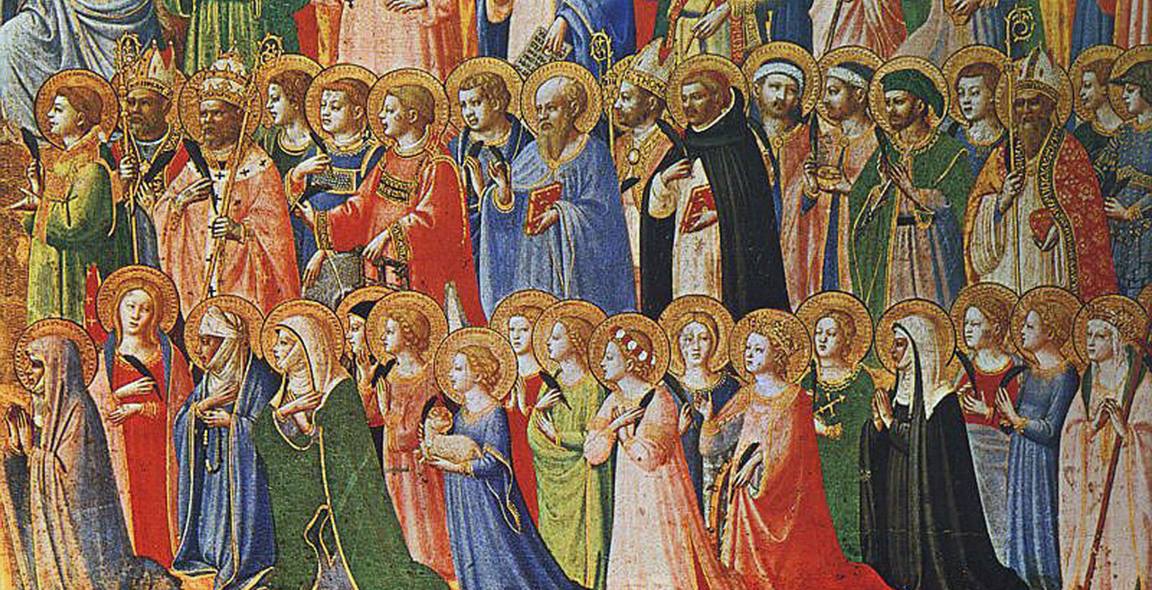
After this, I had a vision of a great multitude, which no one could count, from every nation, race, people, and tongue. They stood before the throne and before the Lamb, wearing white robes and holding palm branches in their hands. They cried out in a loud voice:
“Salvation comes from our God, who is seated on the throne, and from the Lamb.”
All the angels stood around the throne and around the elders and the four living creatures. They prostrated themselves before the throne, worshiped God, and exclaimed:
“Amen. Blessing and glory, wisdom and thanksgiving, honor, power, and might be to our God forever and ever. Amen.”
Then one of the elders spoke up and said to me, “Who are these wearing white robes, and where did they come from?” I said to him, “My lord, you are the one who knows.” He said to me, “These are the ones who have survived the time of great distress; they have washed their robes and made them white in the Blood of the Lamb.”
Who are these nameless saints? Their anonymity teaches us that sainthood is not reached through great achievements or rare acts of bravery. Sainthood comes from simply loving God and doing our best to live our lives in a way consistent with Jesus’ commandment. I would dare say that none of the saints actually set out to be saints. They simply loved God and lived their lives to follow Him.
Revelation goes on to remind us that giving our lives over to God will not protect us or insulate us from hardship. Living in, for, with, and through God, however, will make sure that we can and will endure whatever “great distress” comes our way. In this passage of Revelation, John is speaking specifically of those who have given their lives for their faith. Christians throughout the Middle East are being martyred by forces opposed to Christianity, but in reality, it is very unlikely that any of us will be called upon to sacrifice our lives for our faith.
Our challenge, then, is to live for Christ, rather than to die for Christ. Jesus does ask to lay down our lives for Him. Peter said to the Lord, “I will lay down my life for Your sake,” and he meant it (John 13:37). Has the Lord ever asked you, “Will you lay down your life for My sake?” (John 13:38). It is much easier to die than to lay down your life day in and day out with the sense of the high calling of God. We are not made for the bright-shining moments of life, but we have to walk in the light of them in our everyday ways. For thirty-three years Jesus laid down His life to do the will of His Father. “By this we know love, because He laid down His life for us. And we also ought to lay down our lives for the brethren” (1 John 3:16).
If we are true followers of Jesus, we must deliberately and carefully lay down our lives for Him. It is a difficult thing to do, and thank God that it is, for great is our reward. Salvation is easy for us, however, because it cost God so much. But the exhibiting of salvation in our lives is difficult. God saves a person, fills him with the Holy Spirit, and then says, in effect, “Now you work it out in your life, and be faithful to Me, even though the nature of everything around you is to cause you to be unfaithful.” And Jesus says to us, “…I have called you friends….” Remain faithful to your Friend, and remember that His honor is at stake in your bodily life. We are called to remain faithful, despite the reasons the world gives us to not, despite the “great distresses” in our lives.
Who are these dressed in white robes? It is my prayer to be counted among them. What about you?
What About Love? The Rt Rev Michael Beckett, OPI

Close the border. Build a wall. Use razor wire. Deport those foreigners as soon as possible.
America is a Christian nation. Our faith, the church, should guide our country, our schools.
End social security. Stop ‘entitlement’ programs.
America is a Christian nation. Our faith, the church, should guide our country, our schools.
Higher education loan forgiveness is wrong and not fair.
America is a Christian nation. Our faith, the church, should guide our country, our schools.
The Bible should be taught in schools. Bring back Christian prayer in schools.
Well…..OK.
But……I have a teeny little problem with all of the above coz it kinda seems to me that every one of the above statements are diametrically opposed to each other. Check this out. The scriptures appointed for today include handy dandy little commandments like this:
Thus says the LORD: “You shall not molest or oppress an alien, for you were once aliens yourselves in the land of Egypt. You shall not wrong any widow or orphan. If ever you wrong them and they cry out to me, I will surely hear their cry. My wrath will flare up, and I will kill you with the sword; then your own wives will be widows, and your children orphans. “If you lend money to one of your poor neighbors among my people, you shall not act like an extortioner toward him by demanding interest from him. If he cries out to me, I will hear him; for I am compassionate.” Exodus 22
So there’s that.
And then, Jesus kinda compounds the whole issue when he says problematic things in situations like this:
When the Pharisees heard that Jesus had silenced the Sadducees,they gathered together, and one of them, a scholar of the law tested him by asking, “Teacher, which commandment in the law is the greatest?” He said to him, “You shall love the Lord, your God, with all our heart, with all your soul, and with all your mind. This is the greatest and the first commandment. The second is like it: You shall love your neighbor as yourself. The whole law and the prophets depend on these two commandments.” (Matthew 22)
Now, I certainly don’t claim to be an expert in much of anything, especially theology, politics and current affairs, and I’m certainly not one to take a lot of things in the Bible literally, but…..doesn’t Jesus make it pretty clear as to what he expects of us as Christians, and anyone who would dare to say: “America is a Christian nation. Our faith, the church, should guide our country, our schools.”
Some of the same folks who espouse the “America is a Christian nation” mantra are also all about having the Ten Commandments posted in schools and government buildings and courtrooms. Except for violating the First Amendment’s Establishment Clause, making it illegal, I don’t see the harm. But being me, I gotta ask, if America is a Christian nation, wouldn’t it be more Christ-like to post something that Christ actually said, stressed, and preached about? Like say, the Beatitudes? Especially these:
Blessed are the meek, for they will inherit the earth. Blessed are those who hunger and thirst for righteousness, for they will be filled. Blessed are the merciful, for they will be shown mercy. Blessed are the pure in heart, for they will see God. Blessed are the peacemakers, for they will be called children of God.
Y’all have heard me talk about the United States most definitely NOT being founded as a Christian nation, so I’m not gonna go there right now, but, it would seem to me that, if indeed that were the case, and we actually practiced what is preached when we claim that it is so, the country would be a much better place. Don’tcha think? As it stands now, it would seem that we, all of us, should remember, as Stephen Mattson has said, “Sometimes, being a good Christian meant being a bad Roman. So before you accuse someone of being unpatriotic, ask yourself which empire they’re actually serving.”
Russell Moore, former leader in the Southern Baptist Convention and now Editor of ‘Christianity Today’ told this story in an interview with NPR:
Multiple pastors had told him they would quote the Sermon on the Mount, specifically the part that says to “turn the other cheek,” when preaching. Someone would come up after the service and ask, “Where did you get those liberal talking points?”
“What was alarming to me is that in most of these scenarios, when the pastor would say, ‘I’m literally quoting Jesus Christ,’ the response would not be, ‘I apologize.’ The response would be, ‘Yes, but that doesn’t work anymore. That’s weak,’” Moore said. “When we get to the point where the teachings of Jesus himself are seen as subversive to us, then we’re in a crisis.”
I love this country. I do. But Joshua said it best when he said, ‘As for me and my house, we will serve the Lord.’ Sometimes serving the Lord means making difficult choices. Sometimes serving the Lord means changing our thinking. Sometimes serving the Lord means facing hard truths about ourselves, our beliefs, and our supposed faith. Isn’t it time we start asking ourselves those hard questions? Isn’t it time we decide which empire we’re gonna serve? Amen.
The Feast of Sts Simon and Jude~Br. Milan Komadina

Consequently, you are no longer foreigners and strangers, but fellow citizens with God’s people and also members of his household, built on the foundation of the apostles and prophets, with Christ Jesus himself as the chief cornerstone. In him the whole building is joined together and rises to become a holy temple in the Lord. And in him you too are being built together to become a dwelling in which God lives by his Spirit.
I like this parable from Ephesians 2/19-22. It shows the importance of being a part of the church, a part of the living congregation. It is true that we are saved by grace through our faith in Jesus Christ. But in order to grow we need to be a part of the church. Jesus does not need the church, but we are those who need it. We need the church in order to be stronger in our faith. If we imagine the church as a material building. In that building Jesus himself is the foundation. Then all the members of the church are like stones and all of us have our role to play. Some might be smaller stones, some might be bigger. Some might be ugly stones built somewhere in the middle away from the visible surface. Some stones might be on the front surface, visible, beautifully designed with decorations. What is important is emphasis that all stones matter. In Ephesians is also written that Jesus is a cornerstone. Builders of the house of God (the church) or believers must not throw away any of stones belonging to this temple. We may be wondering what it means. It means that the church might look like the real temple.
There are people who shine. They are front stones full of decoration. They are pious, they pray every day many times, they are considered to be the “best” Christians. There are stones – people who are barely visible. Inner stones. They come to the church once a month or occasionally. Sometimes more often, sometimes more rarely. There are people who are struggling with some temptation of various type. People who are not as shinny as those standing on the front wall. But what would happen with the church if the church lets only the most beautiful stones standing. If we start throwing away stone by stone for this reason and that reason. The entire building would be destroyed to dust. My message today, based on Ephesians chapter that we quote is love one another as a true family. Accept one another with all strength and weaknesses. Respect the differences between each other. And bear of mind that even though we are all different stones, we all have one foundation and that is Jesus. And we all build the perfect body of Christ.
The Feast of St Luke~The Very Rev. Lady Sherwood, OPI
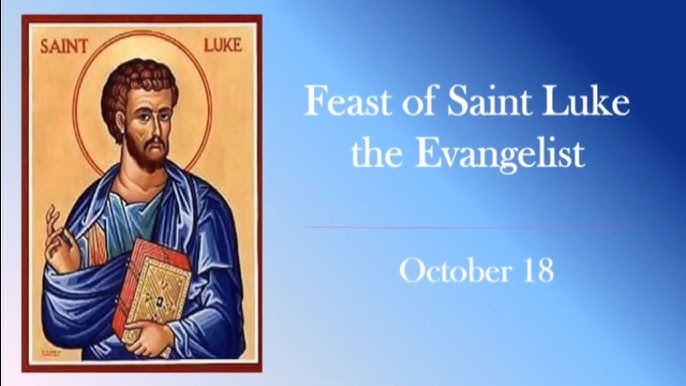
Today we come together as the church to commemorate St. Luke the Evangelist. St Luke is the Patron saint of Physicians. Luke, from his perspective, records for us in his Gospel writings, the life of Jesus=from His birth at Bethlehem, all the wayvthrough His earthly ministry and His many miracles and healings. How Jesus heals the blind, the deaf, and the lame.
Luke tells us of the peace which Jesus speaks to all of us, because Jesus is indeed the saving peace and healing of God, at that time here on earth with us in human form. That is why in Luke 10, Jesus tells the 72, to say, “Peace be with this house”, as he sends them out as apostles of his peace.
Jesus gives us his spiritual healing and peace which forgives our sins, and which reconciles us with God, our Heavenly Father, by His death upon the cross for every single one of us.
Jesus is truly the physician of our Soul! He knows all too well, that we are sick with sin, but it deters him not. Each and every one of us, is precisely why He came to earth to be amongst us, the reason he lived with us upon the earth, and why he suffered, bled, was tortured, and died for all our sakes.
Jesus came down from Heaven to our world, to take from us our dark sickness of sin and of death, and to heal us, to bring us true life and eternal salvation. He took all upon himself for us upon the cross, our sickness and death, died with the Lord, to all who truly believe, love and follow Him. We are forgiven, we are healed, we are saved, we are at peace.
If we truly examine our lives, we will see our constant need for healing of the sins of this world. As with the body, if we are sick, we see our dr for diagnosis and treatment, that’s why today, we give thanks to God for His servant, Luke, the Evangelist. It’s Luke’s role to bring Jesus, His healing and peace to each of us through the living and active word of God.
The word of God is the scalpel of Jesus our physician and saviour. With total precision, Jesus’ laws cuts us and ‘kills’ the sickness of the human condition, so that he can heal us, and give us true life.
Each of the commandments of Jesus is a precise incision of his law. We have failed to fear, love, and trust God above all else as we ought to do. We have failed to use God’s name as we should, and to call upon him as our Father, as his children when in every trouble or need, or to give him worthy thanks and praise. We have ignored God’s Holy word and preaching, we have not loved our neighbour, or helped to eased their needs. We have been bad stewards of earthly material things such as money, or possessions. We have failed in giving kindness and forgiveness to our brothers and sisters.
So indeed, our human sickness of sin is dire=without Jesus as our Lord, our Saviour, and physician, the diagnosis is terminal.
But Jesus is merciful, he does not delight in punishment. Jesus our physician of our soul, cuts with His law in order to heal us with His Gospel. The Lord heals the broken hearted and binds up their wounds (PS 147:3). Jesus has kept on our behalf, all those commandments, which we have failed to truly follow.
If we want to call our doctor, we pick up the phone, and wait for an appointment to become available. But Jesus as our physician for our souls, is contactable 24 hrs per day, every single day with no exception. He is contactable easily anytime, day or night, by the important communication of prayer.
So let’s end today with the simplest but most important prayer of all, to our Saviour and physician of our soul:
Lord Jesus Christ, Son of God, have mercy on me, a sinner.
Amen.
Come to the Wedding! ~ The Rev. Frank Bellino, OPI
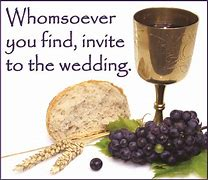
Today’s gospel passage seems straightforward enough to understand, if we compare the characters in the parable to key figures in the history of salvation.
We have the king and his son, who stand for God and Jesus. The wedding can be compared to God’s own invitation to us all to follow him and his way, entering into communion with him just as wedding guests participate in the festivities.
The messengers that were sent out to announce the wedding — they stand for the prophets. Similarly, to many of the prophets working for the Church, these messengers were also badly treated by the people to whom they were sent.
What of the people themselves, those who declined the wedding invitation? They stand for the people to whom the original invitation to follow God was given — and even more people in real life turned away from God for whatever reason so they did in the parable.
So, enter the other people, those who were found at the crossroads. Jesus is referring to any group of people who did not make up a polite society in those days, and letting his listeners know that the message of the Kingdom of God is now open to everyone. After all, we read that the servants went out to collect together ‘everyone they could find, bad and good alike’.
Although the ‘proper’ people had been invited at first, due to their refusal of sinners are now invited. This gives us hope — both for today, when we know ourselves to be at odds with the Gospel message (and therefore sinners) at times, and also in those times — for perhaps there were those hearing the invitation who took it to heart and acted appropriately.
Once we have accepted the call to follow God, we cannot stop there just resting on our laurels, saying, “I have been invited by God to the Kingdom of Heaven. And that’s it!” Once we are in a relationship with God, we are called to go deeper into a relationship with Him, and that implies that we do not and cannot sit still, doing nothing.
Is it fair enough — but what about the other part of the parable? If someone has been called and accepted by God, just as the guests eventually joined the wedding banquet and joined in all the feasting, wouldn’t that be the case? No, no, is the answer.
The key word here is “wedding-garment”. For in the days when this parable was first told, whatever state of life you found yourself to be in carried certain obligations – correct behavior or observance of wedding customs applying to all, no matter what.
This guest has no wedding attire. In other words, he is not bothering to do something fundamental to his state in life, not bothering to observe the customs he should, neither growing nor pursuing a closer relationship with God in his life.
So, it was with the king at the wedding feast. He had put himself out for the guests, but that meant that they should put themselves out for him. Not doing so, and not even addressing or apologizing shows a lack of concern or desire to follow what God has asked us to do.
Compare that with daily life, and you will see that God’s call is clear — it is not enough to be called and accept that call, but there is the obligation to follow it in whatever way we are called to do. We are recognizing what God has done for us, and we are doing whatever we are called to do in return.
In other words, not only have we been called, but also (as a result of our actions) we are being chosen by God to share in his eternal wedding feast in heaven.
Power! ~ The Rev. Frank Bellino, OPI
There is a story of two politicians engaged in conversation, and one asks the other, ‘But how do you know for sure you’ve got power, unless you abuse it?’ It is clear that this story is intended to illustrate a certain image of politicians.
However, it also mentions how we understand the power of God, an issue that is central to Christianity. For Christians to preach a strange Gospel about power: that the power of God was once the most visible in a naked man dying on a tree. If that is the case, then what Christians refer to as ‘power’ must be transformed in the light of this.
What we often understand by ‘power’ is more the misuse of power, using it in ways we should not. The Christian power is that capacity, that openness to love, depicted in the life of Christ, not something to be understood in terms of domination, manipulation, adulation or force. A sign of the depth of our Christianity is how that approach of looking at things has become part of our own lives and how we act.
To love freely and honestly is power because it takes a great deal of effort to not be swayed from loving by circumstances that come our way, or impulses within ourselves. It takes guts. It took immense courage to die on a cross out of love for us. That was powerful. It took immense courage for people throughout the centuries not to give in to inhuman forces.
The history of history is filled with such stories. Edith Stein, a Carmelite nun of Jewish origin, who, when summoned by the Nazis and greeted by the commandant with the words, “Heil Hitler!” replied, “Jesus Christ be praised!” That also was power. It may have caused her delivery to Auschwitz, perhaps the most notorious example we have of how badly we misunderstand what power is.
Today’s Gospel is about the power and the abuse of power. The vineyard is the House of Israel, the servants are the prophets who were sent to Israel; and the delivery of the landowner’s son, referring to the coming of Christ. The tenants are for those who mistreated them, Christ and the prophets, even to the extent of death.
However, the merest reflection should be sufficient to remind us that the themes of this story of violence and abuse of power remain very much part of our present day world. Part of this contemporary story is the power struggles that occur across the globe, as well as the violence we encounter in our neighborhoods and towns.
We must also examine our own attitudes towards the misuse of power. It is easy to shift the attention towards others, as though these issues are not part of our lives. They are. Our lives are filled with the consequences of this: broken and damaged relationships, a loss of ability to hear what others are saying to us, and a deafness to the voice of God in our daily lives.
This may sound sober, but it is actually a story of the greatest hope. It appears depressing when we forget what power really is. When we do this, we consider the tenants in today’s Gospel as powerful. In the light of the Christian faith’s understanding of power, what gives hope is that they are not really powerful, but they are severely weak. They practice the misuse of power, not its exercise. If the consequence of their actions is destruction, then the Christian must respond by proclaiming that the consequence of real power is a victory of the deepest level.
This is to reduce our expectations. However, Christianity does that. At its core, it is the story of a man who died that seemed to be a failure, yet who was vindicated by his Father raising him up. If that is true of Jesus Christ, “the first-born of many brothers and sisters,” then it is true for us also. We view the life of great people like Edith Stein as a triumph, not only because we admire her courage, but because we see in it a powerful overcoming of what is wrong with our world and with ourselves.
What makes this victory an ultimate one, an example of real power, is that we believe that this overcoming will be eternally a result of this victory.
That is our Christian hope, and just one example of how the world looks very different, and for the better, when seen in the light of the death and Resurrection of Jesus Christ.
The Feast of the Guardian Angels~The Rt. Rev. Michael Beckett, OPI
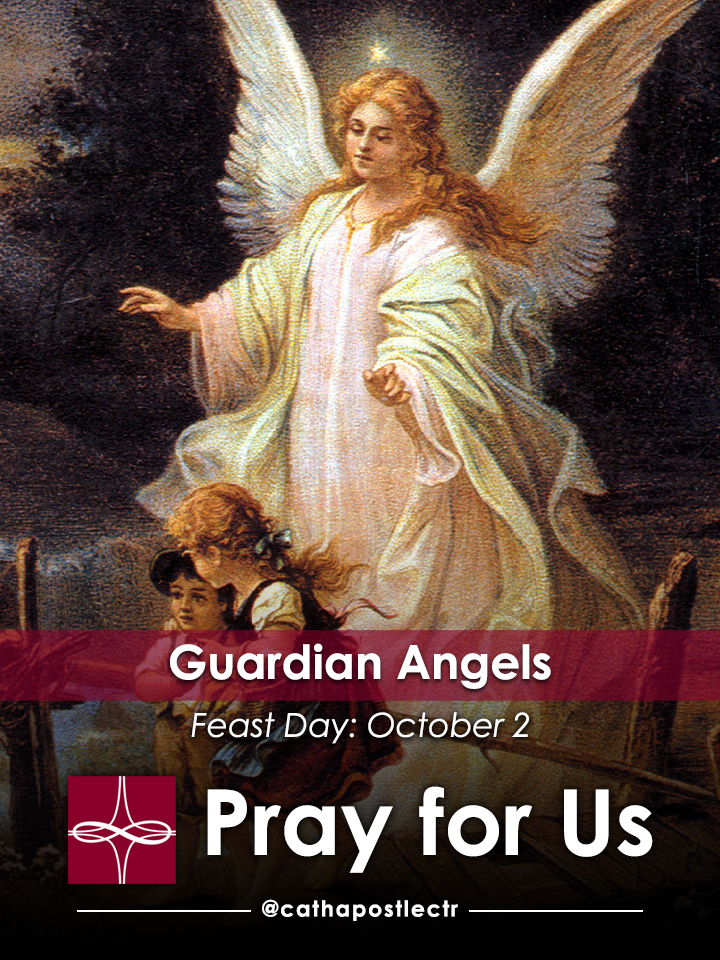
We often think of guardian angels as a special angel only for children, but the truth is that we all have a guardian angel for our entire lives. Our angels are a gift from God. They watch over us, aid us in prayer, enlighten us, guide us and protect us. Angels are mentioned in both the Old and New Testament and many saints have had visions of their guardian angels. We can hope that our Guardian Angel will help us during our journey to eternal happiness in Heaven. The Feast of the Guardian Angels is celebrated on October 2nd. Although Guardian Angels have been venerated since the early days of the Church, it wasn’t until the 17th century that Pope Clement X extended the feast day to the universal Church. It comes just two days after the Feast of the Archangels Gabriel, Michael, and Raphael.
On this Feast of the Guardian Angels in 2011, Pope Benedict XVI said,
“Dear friends, the Lord is always near and active in human history, and follows us with the unique presence of His angels, that today the Church venerates as ‘Guardian,’ in other words those who minister God’s care for every man. From the beginning until death human life is surrounded by their constant protection.”
It is an established Catholic belief that each individual person has their own guardian angel assigned to watch over their soul. There are three important verses in the Catholic Bible from which this belief is drawn:
Psalm 90:11: “For he shall give his angels charge over thee, to keep thee in all thy ways.”
Matthew 18:10: “See that ye despise not one of these little ones; for I say unto you, that in heaven their angels do always behold the face of my Father which is in heaven.”
Hebrews 1:14: “Are they not all ministering spirits, sent forth to do service for the sake of them that shall inherit salvation?”
These verses have led St. Jerome, one of our early Church Fathers, to conclude, “How great the dignity of the soul, since each one has from his birth an angel commissioned to guard it.” Many others wrote about our guardian angels, including St. John Chrysostom, St. Basil, and St. Thomas Aquinas. According to Aquinas, our guardian angels have a good influence over us, but they cannot control our free will. Guardian angels influence or guide us by acting upon our intellect through our senses and our imagination. When they do this, they are influencing our will to do good and avoid evil. So really, their job is to help you get to heaven. Thus guardian angels do not control us by any means, but they do greatly assist us in finding and doing God’s will. Our guardian angels are also able to protect us from danger as well as assist us in prayer and meditation on the divine things of God.
We don’t only have the Scriptures and the Early Fathers of the Church who tell us about our Guardian Angels. We also have the saints, some of which actually witnessed their guardian angel in action. In many cases their Guardian Angel was visible to them. These include St. Padre Pio, who could see his guardian angel, which would often send him on special missions; St. Faustina Kowalska, whose Guardian Angel accompanied her to observe the pains of the Holy Souls in Purgatory; and St. Gemma Galgani, to name a few. St. Gemma Galgani wrote much about her Guardian Angel in her autobiography, including this account:
“One evening, when I was suffering more than usual, I was complaining to Jesus and telling him that I would not have prayed so much if I had known that He was not going to cure me, and I asked Him why I had to be sick this way. My angel answered me as follows: ‘If Jesus afflicts you in your body, it is always to purify you in your soul. Be good.’”
Ask yourself this question today: How is my relationship with my guardian angel? Do I listen to him? Do I say good morning to him in the morning? Do I ask him: Watch over me when I sleep?’ Do I speak with him? Do I ask his advice? He is by my side. We can answer this question today, each of us: How is our relationship with this angel that the Lord has sent to watch over me and accompany me on my journey, and who always sees the face of the Father who is in heaven?” So, today is the day to tell your guardian angel “Thank You” for their daily guidance, and to show gratitude to God for assigning a powerful heavenly protector for your personal care. It is also a good time to make the resolution to pray to your Guardian Angel daily as our Holy Father admonishes us.
As St. Bernard of Clairvoux plainly states in his sermon:
“‘He has given his angels charge over you to guard you in all your ways’. These words should fill you with respect, inspire devotion and instill confidence; respect for the presence of angels, devotion because of their loving service, and confidence because of their protection. And so the angels are here; they are at your side, they are with you, present on your behalf. They are here to protect you and to serve you.
But even if it is God who has given them this charge, we must nonetheless be grateful to them for the great love with which they obey and come to help us in our great need. So let us be devoted and grateful to such great protectors; let us return their love and honor them as much as we can and should. Yet all our love and honor must go to Him, for it is from Him that they receive all that makes them worthy of our love and respect. Even though we are children and have a long, a very long and dangerous way to go, with such protectors what have we to fear? They who keep us in all our ways cannot be overpowered or led astray, much less lead us astray. They are always loyal, prudent, and powerful.
Guardian Angel Novena:
Loving God, you are so good that you gave me a Guardian Angel to protect my body and my soul. Help me to know and follow my angel so that, with their guidance, I will be worthy of being in Heaven with You!
My sweet Guardian Angel, you are my defender every day of my life. Protect me from sin and bodily harm. Help me to learn to defend and protect myself so that I can be the person that God is calling me to be.
You are with me all the time so you already know these my intentions that I ask you to deliver to the Lord. (Mention your intentions here…)
My guardian angel, my defender, protect me!
Gifts ~ The Rev. Frank Bellino, OPI
Can we expect to receive gifts? If a friend, having received a gift, turns to us and says, ‘I was anticipating this,’ will we not be a little hurt? However, there are some gifts that meet our expectations and, if not given, can cause us to be upset.
There are cultures in which the receiving of gifts is arranged by formal rules, often elaborate ones. In our less formal western society, we may like to think that our gift-giving is more spontaneous, less constrained by social expectations, but any parent can tell you how limiting the effort to provide this year’s toy at Christmas can be.
Should we stop giving gifts? Would life without gifts be easier, so that whatever we receive from others is based on what we are owed? The difficulty with this is that in many cultures, modern western culture included, gifts are not included as extras. Perhaps it is too far to discuss our right to receive gifts, but many of us certainly experience a need to have gifts on certain occasions and more importantly from certain individuals. This is due to the fact that a gift can create, express, and maintain something essential in our relationships. In giving someone a gift, we can express to them that they have an intrinsic value beyond the meeting of their basic needs, and that we are giving them this gift not because we owe it to them, but because we love them.
Our giving of gifts reflects and expresses our relationships with each other. Where our relationships are unhealthy, the way we give and receive gifts will also be unhealthy.
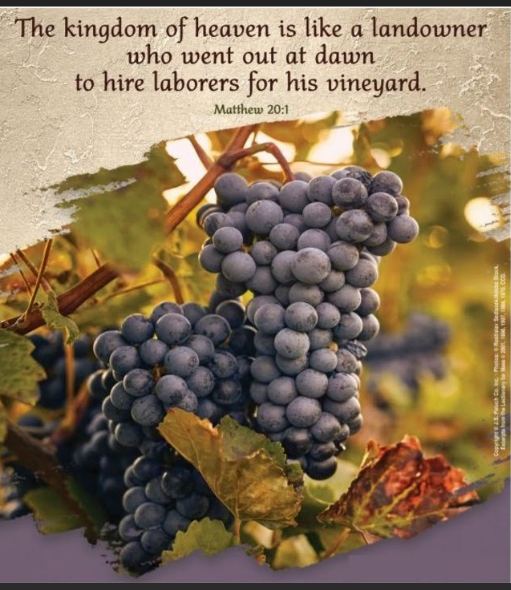
If we turn to the Gospel today, we find Jesus comparing the kingdom of heaven to a householder who went out early in the morning to hire laborer’s for his vineyard.
It is important to bear in mind that this parable, like all the parables we find in the gospels, is not a literal representation of the kingdom of heaven. God can be compared to a householder with a vineyard, but unlike the householder, he has no need of laborers, nor even need to plant and cultivate a vineyard.
The vineyard here stands for Israel, and God had no need to plant and tend Israel in order to provide salvation to all peoples. He had no need to plant or tend any instrument for our salvation. Unlike the householder, God does not hire laborers because he needs their help to cultivate his vineyard. Rather, in love, he wants all individuals to enter his vineyard and thus to receive the reward of eternal life.
The hiring of the laborer’s in the parable is itself a gift. Moreover, once the laborer has been hired, God does not require them to work in his vineyard. Rather, he invites them to share his mission of salvation.
This again is a gift, and although the gift can often be a difficult one for us to accept, especially for those ‘who have borne the burden of the day and the scorching heat’, it is a gift fitting to the dignity of the human person, who was created to ‘fill the earth and subdue it'(Gen 1:28). Through the gift of planting, tending and inviting us to labor in his vineyard, God establishes a relationship of love with us, which acknowledges our inherent worth as human beings and goes beyond this in providing us with a share in his own life.
One of the dangers in our lives as Christians is that we forget that our invitation to labor in God’s vineyard is a gift. This is the danger that the householder and his vineyard illustrate.
Jesus is reminding us that every gift comes from the generosity of his Father, and it is not for us to put any restrictions on this generosity. For while human gifts are often things we expect, even where we don’t take them for granted, the Father’s divine gift in giving us his Son is greater than anything we could expect or imagine.
 The Order of Preachers, Independent
You must be logged in to post a comment.