
Category: Sermon

Render to Caesar…~ Br. Jake Vogel, Aspirant
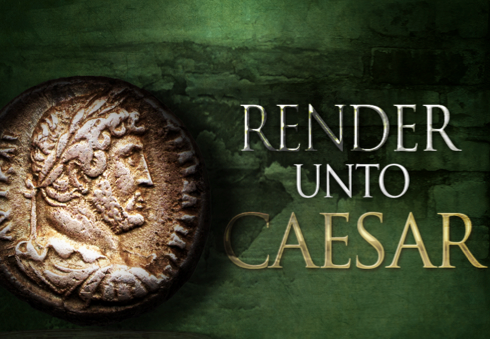
When I first set out to write this sermon I was a little overwhelmed as at first it seemed to me to be one of the more difficult Gospel readings to write about and so I did what I always do when I’m stressed or worried about something; I prayed. It was then that the message itself began to be clearer to me and through the things that I have been going through at work lately, I began to understand What Jesus meant when he said. “Render to Caesar’s the things that are Caesar’s.” This reading began to have very profound meanings for me firstly, that we should only give to those not of our family (Christians) that which they rightfully deserve nothing more and nothing less because as said in Proverbs, “Do not weary yourself to gain wealth, Cease from your consideration of it.” (Proverbs 23:4) We as Christians and as Dominicans should do what we must to satisfy our means to survive in the secular world as we are members of this realm in life, but we should not over exert ourselves to satisfy those of this world because one day this world will cease to exist. We should instead work to do what satisfies the will of our Father through his son Jesus and not let ourselves to be lead astray by the Pharisees of the world.
In this gospel reading the Pharisees are asking Jesus a question about paying taxes to catch him thinking he will either say yes to paying taxes which would not only put doubt on his allegiance to Israel but also could be considered breaking the second commandment as the money (Denarius) used to pay taxes not only had the head of Caesar but also called him ‘Divine’ there by committing idolatry; or that he would say not to pay taxes there by undermining the Roman government which could lead to his arrest. Not only does Jesus immediately sense their intent and scolds them saying, “Why are you testing me, you hypocrites?
Show me the coin that pays the census tax.” He then gives them a lesson of their own by stating in the simple sentence, “…render to Caesar what belongs to Caesar and to God what belongs to God.” (Matthew 22:18-21)
Through Jesus’ scolding of the Pharisees, we learn that we should not question or doubt the will of the Father and to do so is hypocritical because God always does what is right and just and so to question our Father’s will is to put us on the same rank as the Israelites who because, “the Lord’s anger burned against [them], He made them wander in the wilderness forty years, until the entire generation of those who had done evil in the sight of the LORD was destroyed.” (Numbers 23:13) We are shown that if we disobey Him however, that he will further teach us ways to understand his will so that we may reconcile ourselves to him.
Jesus then reminds us that we should not,
“…store up for yourselves treasures on earth, where moth and rust destroy, and where thieves break in and steal. But store up for yourselves treasures in heaven, where moth and rust do not destroy, and where thieves do not break in and steal. For where your treasure is, there your heart will be also.” (Matthew 6:19-21)
In making sure that we only have what we must to survive in the temporal realm and that we obey the law of the land by, ‘rendering to Caesar what is Caesar’s’ we will be able to better serve Him and build up our treasures in heaven rather than trying to cling to that which belongs to Caesar.
We are further reminded that if we want to follow Him we should, “… go, sell [our] possessions and give to the poor… Then come, follow Me.” (Matthew 19:21) As Jesus further explains in Luke if we sell our, “…possessions and give to the poor. [we] Provide [ourselves] with purses that will not wear out, an inexhaustible treasure in heaven, where no thief approaches and no moth destroys.” (Luke 12:33) Through, ‘giving to God’s what is God’s’ we are reminded to not only pay taxes (because it is giving those of this realm the things they are due) but also if possible to be as little involved with earthly riches and wealth as possible as we are reminded in Job that,
“They [who] shut themselves up by day; They do not know the light. For the morning is the same to him as thick darkness, For he is familiar with the terrors of thick darkness. They are insignificant on the surface of the water; Their portion is cursed on the earth… Drought and heat consume the snow waters, So does Sheol [for] those who have sinned.” (Job 24:16-9)
We should however not be discouraged or fear the Wrath of God for all will be forgiven in the end if we,
“deny [ourselves] and take up [our] cross and follow [Him]. For whoever would save his life will lose it, but whoever loses his life for my sake will find it. For what will it profit a man if he gains the whole world and forfeits his soul? Or what shall a man give in return for his soul? For the Son of Man is going to come with his angels in the glory of his Father, and then he will repay each person according to what he has done.” (Matthew 16:24-8)
Heavenly Father,
Continue to guide us in ways that help us denounce those who try to entrap us and lead us in the ways in which we can leave our earthly possessions behind to take up our cross and follow you.
We ask that the power of the Holy Spirit Guide us so that we may be claimed as heirs to your heavenly treasures and Eternal Kingdom by our redemption through your son our savior Jesus Christ.
Amen.

The Lord is My Shepherd!~Rev. Deacon Sister Dollie Wilkinson

Recently, I was talking to a dear friend of mine about a mutual friend of ours who was soon to meet our Lord. I expressed confusion, and doubts, as to why God would call this dear soul home so soon. But mostly, I was angry! It seems here lately too many people, whether casual friends, or those dear to me, are dying or have left us way too soon. Between natural disasters such as hurricanes and earthquakes, to violence inflicted on so many who woke up never realizing today was their last day on earth, the overwhelming emotion I believe many of us are experiencing, besides sadness……is outright anger.
While is would be easy to blame God, for all the tragedy and suffering that seems to be prevelant in the world today. We are cautioned in Ecclesiastes 9:12 (NKJV) ” For man also does not know his time: Like fish taken in a cruel net, Like birds caught in a snare, So the sons of men are snared in an evil time, When it falls suddenly upon them.”
In Exodus 32:1-14 we are also reminded that anger isn’t only a human emotion. Even our Lord expressed anger at His people, yet was reminded of His promise. And, I think it’s this sacred promise we need to remember during these turbulent times.
“When the people saw that Moses delayed to come down from the mountain, the people gathered around Aaron, and said to him, “Come, make gods for us, who shall go before us; as for this Moses, the man who brought us up out of the land of Egypt, we do not know what has become of him.” Aaron said to them, “Take off the gold rings that are on the ears of your wives, your sons, and your daughters, and bring them to me.” So all the people took off the gold rings from their ears, and brought them to Aaron. He took the gold from them, formed it in a mold, and cast an image of a calf; and they said, “These are your gods, O Israel, who brought you up out of the land of Egypt!” When Aaron saw this, he built an altar before it; and Aaron made proclamation and said, “Tomorrow shall be a festival to the LORD.” They rose early the next day, and offered burnt offerings and brought sacrifices of well-being; and the people sat down to eat and drink, and rose up to revel. The LORD said to Moses, “Go down at once! Your people, whom you brought up out of the land of Egypt, have acted perversely; they have been quick to turn aside from the way that I commanded them; they have cast for themselves an image of a calf, and have worshiped it and sacrificed to it, and said, ‘These are your gods, O Israel, who brought you up out of the land of Egypt!'” The LORD said to Moses, “I have seen this people, how stiff-necked they are. Now let me alone, so that my wrath may burn hot against them and I may consume them; and of you I will make a great nation.” But Moses implored the LORD his God, and said, “O LORD, why does your wrath burn hot against your people, whom you brought out of the land of Egypt with great power and with a mighty hand? Why should the Egyptians say, ‘It was with evil intent that he brought them out to kill them in the mountains, and to consume them from the face of the earth’? Turn from your fierce wrath; change your mind and do not bring disaster on your people. Remember Abraham, Isaac, and Israel, your servants, how you swore to them by your own self, saying to them, ‘I will multiply your descendants like the stars of heaven, and all this land that I have promised I will give to your descendants, and they shall inherit it forever.'” And the LORD changed his mind about the disaster that he planned to bring on his people.”
So, during these turbulent times, as natural disasters, senseless shootings, random violence, and political quarrels divide not only our nation, but our world, I think its crucial we pray daily, and reflect on Psalm 23. For in this well known Psalm, there is a never ending source of comfort, peace, and abundant promises.
“The LORD is my shepherd, I shall not want. He makes me lie down in green pastures; he leads me beside still waters; he restores my soul. He leads me in right paths for his name’s sake. Even though I walk through the darkest valley, I fear no evil; for you are with me; your rod and your staff– they comfort me. You prepare a table before me in the presence of my enemies; you anoint my head with oil; my cup overflows. Surely goodness and mercy shall follow me all the days of my life, and I shall dwell in the house of the LORD my whole life long.”

The Rev. Dcn. Brenden Humberdross

Open our ears, O Lord, to hear your word and know your voice. Speak to our hearts and strengthen our wills that we may serve you now and always. Amen.
Throughout the gospels Jesus shared the truths of the Gospels with His Apostles and disciples through parables. In very general terms a parable is a story that’s used to teach a spiritual truth or moral lesson; the parables of Jesus often couched these lessons in terms that the Jewish population of the day would understand. Today’s Gospel is no exception to this and we see Jesus using a story about a vineyard to teach the great truths of the Gospel plan.
I’m sure that when some of us first read this story we may have had difficulty seeing the Gospel truths hidden within it. Often the parables seems confusing and hard to interpret especially given that we’re not first century Jews and the basis of our life is quite different to them. However, if we ask the Spirit to dwell within us and enlighten our minds, and if we do a little study, the parables can easily be opened to us.
As foreign as vineyards and workers wanting to murder and steal an inheritance may be to us today’s parable of the Vineyard holds a surprising message for us. Encapsulated within this parable is the whole mission of Jesus and our part in the plan of salvation. Each character in the story represents “players” in God’s great plan of redemption and I’m sure that the Apostles were as amazed at figuring this parable out as I was when I first realised what it was about.
The parable stares with a man who is preparing a vineyard; in this parable the man represents God and the vineyard refers to his people. Just like a vigneron tends his vines and wants them to mature and reach their full potential God tends to his creation. When the Father placed Adam and Eve in the Garden of Eden He wanted them to be full of Joy and live a life in full communion with Him for all eternity. Sadly we all know how that story goes; however, just like a vigneron wouldn’t abandon his vines God has not abandoned us. He wants to vineyard to prosper and for each and every one of us to return to Him.
As God has tended to the vineyard over the years His chosen people have been tended to by leaders. These leaders, the Jewish establishment, are represented by the vinedressers; these people were chosen by God to tend to the vineyard, to carry out His will and to make sure that His children could obtain salvation. To ensure that this was happening the Lord sent Prophets to His people to ensure that the message of salvation was being heeded by all and taught with fidelity. In the parable these prophets are represented by the servants sent by the Master. One would expect that these heralds of the Lord would be welcomed in the vineyard and their message would be headed however any student of the Bible will know that this wasn’t the case. Those tending the vineyard weren’t keen on having the Masters “spies” in the vineyard reporting back or telling them what to do. So instead of heading the Masters word and be ready for the harvest they killed the servants. This is exactly what Israel did throughout their history; they treated the chosen prophets of God with contempt and rejected their messages choosing to follow their own wills instead of God’s.
It’s for this reason that the Master had to resort to sending his son, just as God had to send His own Son Jesus to the earth. So what did the workers do to the son? They did exactly what the people of Israel did to Jesus. They threw him outside of the walls of the vineyard to be killed. This action has a double meaning in reality; firstly we know that Jesus was killed outside of the walls of Jerusalem and secondly those who tended the Vineyard (the Jews) didn’t actually put Jesus to death, instead the Romans (those outside the vineyard) carried out this task.
The concepts raised in this parable raise an interesting question for me; if humankind was able to be obedient, if we were able to truly follow the will of God from the beginning, how different would love on earth be? Would Jesus have had to sacrifice His life for us? Would there be sickness, disease and death? Many of us have a tendency to blame God for these things; how many times have your hard people say “why does God allow evil?” or “If God was real He wouldn’t allow all this war” or a myriad of other statements. What this parable points out for us here is that none of this is actually God’s will! He created a vineyard for us that was perfect and He has done all that he could to keep it this way. It is the fact that we couldn’t listen and follow the plan that has led to a world full of evil and heartache; God doesn’t perpetrate evil those who tend to the vineyard do!
The parable ends with a dire warning to those of Israel who were listening. The vineyard will be taken away from those who do not tend it correctly or who reject those who are sent to manage it. So who will the vineyard be given to? Who will reap the rewards meant for the vineyard workers? The answer is those who are obedient to God and who bear the fruits of following the path that Christ has laid out.
It is my hope brothers and sisters that we will listen to the Son and not be like the workers in the vineyard. We must try our hardest to work out what it is that God would have us do and follow that path with all of our hearts. If we do so, at the great last day when we stand before the throne God will look into our hearts and welcome us into His kingdom with open arms.
Let us pray:
Lord God, we are grateful that you have prepared this world for us and that you have sent righteous workers to tend to it. We ask that your blessing will fall upon all of those you have called to minister to us that they may reach your word and care for your people. May our hearts always be open to heeding their words and following the paths of righteousness so that on the last day we may be found worthy of our heavenly abode. In Jesus name we pray. Amen.

The Feast of Our Lady of the Rosary ~ Br. Shawn Gisewhite

Gospel: Luke 10:17-24
In the Name of God; +Father, Son and Holy Spirit. Amen.
On October 7th, 1571, Pope Saint Pious V sent a coalition of Christian forces to rescue the Christian outposts in Cyprus that were taken by the Muslims. This small group faced almost certain death when compared to the large Muslin Navy. In response, the Pope called for all of Europe to pray the Rosary for their victory and led a Rosary procession in Rome. After about 5 hours of intense sea battle, the Christian forces were able to stop the Ottoman Navy and prevent the Sultan from invading and capturing Rome. This great victory was attributed to the Virgin Mary. October 7th became the Feast of Our Lady of Victory, now known as Our Lady of the Rosary.
Although a simple string of beads used to help us count our prayers, the Rosary has long been a weapon against the forces of darkness and a shield of protection from harm.
The following inspiring episode from World War II, written by Sr. Mary Sheila O’Neil and reported in the October-December, 1979 issue of Garabandal Magazine illustrates the power of the Rosary:
It was a busy day in March. As a teacher-principal in the 1950’s, I had to make sure that each day provided the time for the two separate roles. On that March fourth, an incident between a teacher and a parent had kept me out of my class for almost an hour that morning, so for the rest of the day, I was desperately trying to make up class time. Hence, the knock on my door at 2:00 p.m. was not welcome.
With relief, I found it was only a salesman who needed my signature and even produced his pen. As he did so, his Rosary had caught onto the pen’s clip and came out as well. I signed as I said indifferently, “So, you are a Catholic.” “Oh no,” he said, “but a lot of us owe our lives to Our Lady, and I promised Her I would always keep my Rosary with me and say it every day.”
Twenty minutes later, I was still at the door listening, fascinated, to the account of one of the wonderful experiences a group of airmen had had with Our Lady. My visitor hesitated to start, for he had noticed my “non welcome” opening of the door. But eager now to hear his story, I assured him that the class was doing an exercise, and I begged him to proceed. He continued:
It was May, 1940, and we had joined the Air Force in late September. At Halifax, we were given an intensive training course, because they needed us overseas, and to us young lads, the whole program was exciting.
We were grouped into squadrons, each of which consisted of six to ten planes, and each was trained to maneuver as a unit. Therefore about thirty to fifty men made up a squadron, along with the squadron leader who gave all the orders and kept the group functioning in unity.
In May, our squadron was told we were going overseas and would be in action at once. We would work on nightly missions over enemy territory until the war was over. We were waiting for our new squadron leader, due to arrive in two days on a 9:00 p.m. air-force flight. Being an officer, he would, we thought, go at once to the officers’ quarters.
We watched the plane, glimpsed him from the distance, and resigned ourselves to waiting until the next day to “size him up.” A couple of hours later, this squadron leader, Stan Fulton, in full uniform, entered our bunk house.
“Well men, we’re going to spend some dangerous hours together, but let’s hope we all meet back here when it’s over. Ah, there’s a free bunk and I am tired! I’ll meet each of you tomorrow.”
With that, he threw his bag on an upper bunk. Our squadron leader, an officer, sleeping here with us! We liked him at once and our liking and our admiration grew each day.
That first night he knelt on the floor and prayed his Rosary in silence. Astounded, we were struck dumb. When he finished, he looked at us with his friendly smile and said, “I hope you guys don’t mind a fellow saying some prayers because where we’re going, we’re going to need them.”
The next day our maneuver practice, under his command, assured us that Fulton was not just our military leader, but our friend. He was one of us; he never tried to intimidate us with his rank.
That night, he repeated his prayer session. Although our group had trained together for six months at least, I had never seen anyone kneel in prayer, and had no idea that any of our group was Catholic; but the third night three of our companions joined Fulton in saying the Rosary. The rest of us did not understand but we kept a respectful silence.
A few nights later — we were quick learners — we all answered the Hail Marys and Our Fathers. Fulton looked pleased, and thus we ended each day in prayer.
On June 1, 1940, we were to leave Halifax to begin a series of night raids from England over Germany. The evening before, Fulton gave each of us a Rosary.
“We shall be in some tight situations, but then, if you agree, we’ll say the Rosary. If you will promise to keep the Rosary with you always throughout your life and to say it, I can promise you that Our Lady will bring you all back safe to Canada.”
We answered, “Sure thing.” Little did we dream we would be in action for four years, many times in dreadful danger with fire all around us. At such times, Fulton’s voice would ring through each plane, “Hail Mary…” How reverently and sincerely did we respond! How many hundreds of Rosaries we must have said.
After two years, it was noted that ours was the only squadron that had not lost a plane nor a single life. We said nothing, but we knew.
Finally, the terrible war was over. During those years, we lost all sense of excitement and adventure. All that concerned us was survival! We did survive, too. All returned to Canada in 1945, fully convinced that Our Lady had taken care of us.
So I never forget to keep my Rosary with me and say it every day although I am not a Catholic. When I change my trousers, the first thing I transfer, even before my wallet, is my rosary.
This Feast day is a special one for me as a Dominican. Tradition holds that the Virgin Mary gave the Rosary to St. Dominic. As a Dominican, my devotion to both Our Lady and the Rosary helps shape who I am as a Christian.
Today as I stand before you a newly ordained Priest in the Church of God, I can’t help but think of all I’ve been through. The hurdles that I had to jump. The mountains I had to climb. The fights I had to fight. Life has not been easy up to this point and I suspect it won’t become any easier now that I have been set apart for service in the Church.
I first felt a call to ordained ministry as a small child…..a calling that I have strived to answer throughout most of my life. No easy task! A Bishop once told me that the closer I get to serving God and serving the Church, the more Satan will up his attacks on me. At first I thought he was a little crazy, but it’s very true indeed. Life has presented me with many challenges. Challenges that most people would not be able to deal with. How did I deal emotionally and spiritually with these many challenges? Where did I turn for a spiritual booster shot? To the Rosary! Well, to my set of Anglican Prayer Beads to be exact, but don’t hold that against me. LOL
Raised Anabaptist, worship aids such as prayer beads were seen as Romish and evil. Prayers to Mary were idol worship. I don’t know why, but I was always drawn to the use of prayer beads and to a deeper relationship with our Heavenly Queen. I explain it as I did not choose her, rather she chose me! Somehow she spoke to me. Spoke to my heart in a way I can not begin to describe. For the longest time, just like the pilot in the story earlier, all I did was carry those beads around with me. I didn’t know how to use them for prayer. I was too afraid to search how to pray the Rosary online for fear that my uber Protestant parents would spaz on me! Although I never used them for prayer, those beads provided me with strength and with comfort. It was as if the love of Mary and of her Son Jesus were in those beads and every time I clutched them in my hand it was as if I was being held in their loving embrace.
After my mother passed in 2011, my relationship with our Holy Mother grew stronger. It was at that time I actually began to use my Rosary with the assigned prayers. And oh what joy it brought to my soul! Whenever I was sad, downtrodden, scared, stressed, worried, or lonely I turned to my Rosary for comfort and encouragement. Through life’s many battles, this little string of beads helped me to win the victory; just as the Christian forces over the Muslim Navy.
In today’s Gospel the Lord tells his disciples that He has given them the power of the enemy. I say this is true in the power of the Rosary. A gift….a spiritual weapon against the forces of evil….given to us by the Mother of God. Through our faith in Jesus, through the intercession of the most blessed Virgin Mary, through the power of the Rosary, we have power and dominion over the forces of darkness.
Amen.

Can’t We All Get Along? A How To Guide ~ The Rev. Dcn. Scott Brown, OPI

Brothers and sisters:
If there is any encouragement in Christ,
any solace in love,
any participation in the Spirit,
any compassion and mercy,
complete my joy by being of the same mind, with the same love,
united in heart, thinking one thing.
Do nothing out of selfishness or out of vainglory;
rather, humbly regard others as more important than yourselves,
each looking out not for his own interests,
but also for those of others.
Have in you the same attitude
that is also in Christ Jesus.
Well you heard it here first, we are told to get along with each other, not fight bicker and quarrel. Lets give this a try and see what happens. I suspect that if everyone gave this a shot we could solve most all of the words problems quickly and easily.
When it comes to getting along with other Christians, the Bible doesn’t waste words. If we’re going to really get along, we’ll have to model the sacrifice of Christ.
We’re about to read a passage that uses the word “if” several times. This tiny Greek word, however, is synonymous with “since.” It’s a “conditional particle,” and it works like this. You might think, “If I’m going to church today, I’d better get out of bed and get dressed.” You’re really saying, “Since I’m going to church today and since the clock tells me I’m already 15 minutes late, I’d better get out of bed and get dressed for church.” Or even more realistic, “If I’m going to be happily married to my wife, I’d better take the garbage out today.” Since you probably want to be happily married, “if” is the same as “since.” And you can replace the word “if” with “since” in any of these opening statements from Philippians 2.
How can you practice unity in an imperfect church? How can it possibly work?
- Eliminate selfishness
What a powerful instruction: “Do nothing out of rivalry or conceit, but in humility consider others as more important than yourselves.” (2:3)
We live in a land that preaches a “Look-out-for-number-1” gospel. The climb up career ladder is so focused, business ethics are often left wanting. The entire nation suffers, at times, from selfish-driven, corporate stock market scandals. Countless individuals suffer in smaller offices, where some career ladders are placed squarely on the backs of fellow employees.
How opposite a message the church proclaims! Our greatest leaders are our greatest servants. We’ve even named our key lay-leaders – deacons – after the Greek word for “servants.” The “diakonos” in the Greek world was the lowest servant on the social totem pole.
- Be subject to Christ
There is more to getting along with one another than simply putting aside selfishness. We must all put aside our personal desires and personal standards, and reach for a higher mark. When we have “fellowship with” or are “united with” Christ (2:1), we find that higher standard. When we are united with Christ, we will be united with the Word of God. Having a sound theology, a sound understanding of what it is to follow Christ, is critically important.
Without a higher standard, each one of us is left to determine the standard of morality on our own. Another phrase for such a lifestyle might be “cultural anarchy,” since there would be no authoritative voice of truth. The church is the last point of reference for ultimate truth in any culture. Armed with the never-changing truth from the Bible, the church has been charged with proclaiming that message without apology.
III. Serve others
Instead of selfish ambition, there is humility (2:3). Instead of vain conceit, there is service to others (2:3-4). It all leads to unity in the entire church, for Christians who forsake selfishness, submit to the authority of Christ, and serve one another will be quickly “focusing on one goal.” (2:2).
What an unusual savior we have. He gave up everything to become nothing. The one who should have been served came to serve. We should have died for him, but he died for us. As a result of his willingness to serve, Jesus was exalted to the highest place in all of creation.
When Christians elect to serve others, they too are exalted. As Jesus promised, the first become last, but the last become first. The greatest leaders? Servants, all of them.
We already know that success and servanthood go hand in hand. Bill Gates became the richest man in America because he developed a software program of “windows” that turned the computer into a servant for millions of people. The most successful companies in America consistently put the customer first, with either their products, their services, their assistance, or both. If excellence in the business world is tied to servanthood, how much more so is it true in the church?
Heavenly Father, give us the ability to love one another, get along with each other, and forgive each other as you have commanded. Help us to put aside selfishness and serve each other as the deacons you desire us to be. Amen
Equal Work/Equal Pay? Grace and Mercy ~ The Very Rev. Lady Sherwood, OPI

Reading 1: IS 55:6-9
R Psalm: PS 145: 2-3, 8-9,17-18
Reading 2: PHIL 1: 20C-24, 27A
Gospel: MT 20:1-16A
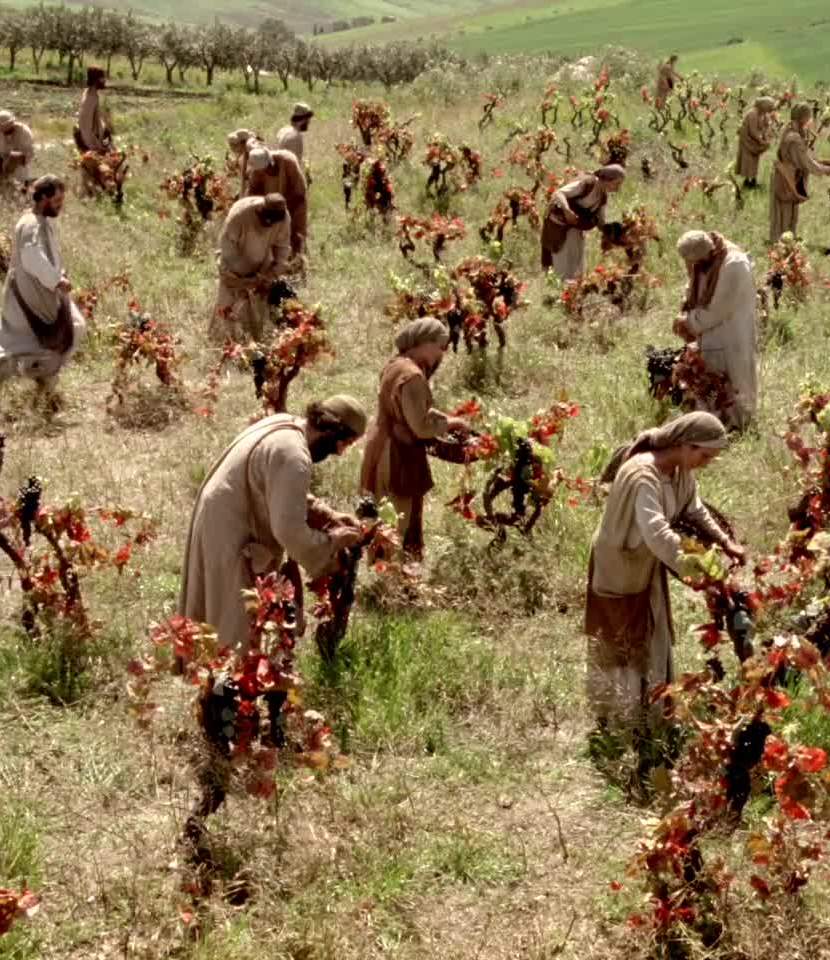
If we look at today’s Gospel reading of MT 20:1-16A, Jesus is telling us about the Parable of the labourers in the vineyard. This was in response to the question asked by Peter in MT 19:27: “We have left everything to follow you! What then will there be for us?” Peter was asking Jesus what reward would be given to those who give up everything in their lives to follow him. Today’s Gospel reading is the response about the truth of His Kingdom.
As you can imagine, working in a vineyard, especially in first century Israel would’ve been extremely hard toil in the heat of the summer and often extra workers were taken on to ensure the work was done. We read in the the Parable today that Jesus is telling us that some of the labourers who had toiled all day, were paid the same as those who were called maybe to work only the last hour of the day.
There was envy and anger about this as the workers who had toiled all day thought they would be paid more. So why did the landowner decide to pay the full day wage to all regardless of when they started work and what is this telling us in our christian lives today?
The landowner was being fair, keeping his promise of reward and was showing mercy to the other workers.
Our Lord God has fairness, keeps his promise and has mercy. God gives his grace and mercy abundantly upon those of his choosing. “For he says to Moses, “I will have mercy on whom I have mercy, and I will have compassion on whom I have compassion’. It does not, therefore, depend on men’s desire or effort, but on God’s mercy” (ROM 9:15-16).
God gives His grace and mercy to those whose self-righteous works could not possibly obtain it. “We are all sinful and fall short of the glory of God” (ROM 3:23), but God’s grace is sufficient to redeem all who believe and serve his ways.
It matters not whether we are called into the Lord’s service either early or later in life to partake of His grace. The glory and praise of our salvation is His and His alone.
As Christians and children of God, we should rejoice in the service which others give to our Lord. He is faithful and will reward us as he has promised.
The message we are being given in verse 16 today, “The last will be first, and the first last,” is telling us that no matter at what stage in life we are called to His service, the reward of eternal life and salvation will be given to all who follow and serve Him. An example of this is the thief on the cross in (LK 23:39-43), whose life was limited to a moment of repentance and confession of faith to our dear Lord Jesus, and he received the same reward of eternal life as given to all the Apostles and saints.
Eternal life shall be granted to all who serve, confess their faith and who follow the ways of the Lord. This is given by the grace and mercy of our Lord and God because of his promise to all who truly serve him. This is the important message that still holds true and is relevant to our lives today.
Hospitality: The Feast of St. Matthew ~ The Very Rev. Lady Sherwood, OPI
Reading 1:EPH 4:1=7,11=13
R Psalm: PS 19:2=3,4=5
Gospel: MT 9:9=13
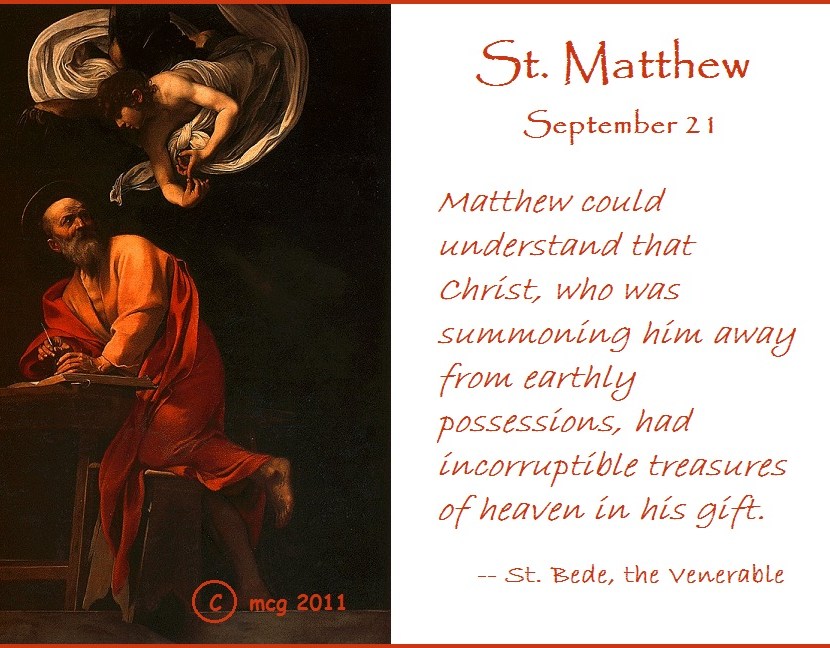
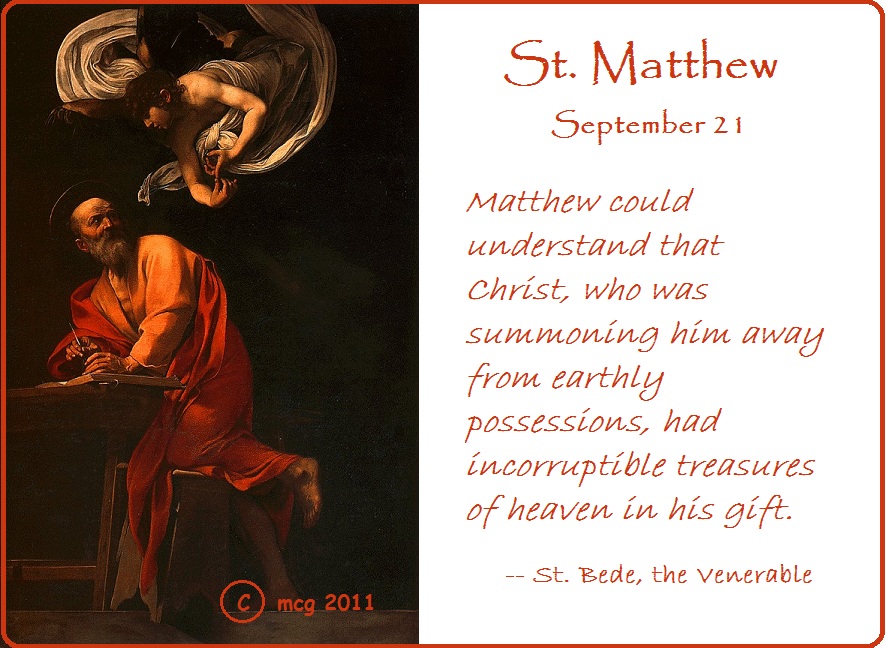
Today we commemorate the Feast of St Matthew the Apostle.
Today’s Gospel reading of the call of Matthew to follow Jesus is fascinating and we can learn much from it that is very applicable to our lives today.
If we look at verse 9, Jesus is walking along when he comes to a tax collector named Matthew who was sat doing his job. Jesus gives him an invitation “to follow him”, and without even a second thought, gets up and immediately follows Jesus. A simple call and a simple and immediate response. There was something in that moment that motivated Matthew to follow Jesus. We don’t know what this was, but we do know that Jesus called and Matthew immediately answered that call.
As the story in today’s Gospel reading unfolds, there is a main point which I feel is very important. This being the Hospitality of Jesus. If we look at verse 10, Jesus was sat having dinner with his disciples and many tax collectors and sinners arrived and we’re welcomed and joined in this dinner. The lesson from this is that Our Lord Jesus is comfortably at home with sinners and with outcasts on all levels and offers all his hospitality.
This is an extremely important message and lesson to each of us, because it clearly shows that Jesus shares his hospitality with us regardless of who we are, of messes and failures we have made in our past or indeed our present circumstances. Jesus does not judge us nor condemns us, he shares himself with us and also invites us to share with him.
Hospitality and love is at the very heart of God’s relationship with us=an essential spiritual gift for any church and every child of God who wants to reflect God in the local community and even thoughout the world.
God in Jesus invited those on the margins of life without judgement and in the same way, we as children and servants of God are to invite people into the home of both our church and our lives also without judgement, following Our Lord’s example, so that we can share hospitality with them and encourage them to partake in the hospitality of Jesus by sharing themselves with us.
Our God is an hospitable God of love=and we as both his church and his children should ensure just as Jesus did, that everyone feels welcome and unturned. Too many churches and Christians sadly only have a tendency to mix with their own kind, or pass judgement on others, making them unwelcome, but Our Lord Jesus’ approach is the exact opposite to this and our approach should mirror the example of Jesus. Some churches and Christians only welcome other others on “conditions” =that they will change their behaviours to fit in with their expectations, for example: “You are welcome at our table =as long as you change and play by our rules”. But the hospitality that Jesus shows is radically different and is how we should be.
Jesus loves everyone, and nobody is asked to change to fulfill expectations and rules at his table. This is truly how we as servants of the Lord should be, following His example and not mankind’s prejudices and rules. We ought to be showing the same the same hospitality, love and acceptance just as our dear Lord Jesus does.
May the Lord bless you on this feast of St Matthew.

The Cost of Forgiveness ~ The Rev. Dcn. Shawn Gisewhite

+In the Name of God; Father, Son and Holy Spirit. Amen.
Pope Francis’ recent homily on today’s Gospel from March 2015 spoke to me.
The Holy Father writes:
“Asking forgiveness is another thing: it’s not the same as simply saying, ‘excuse me.’ Did I make a mistake? ‘Sorry, I made a mistake. But, ‘I have sinned!’ – that is different: the one has nothing to do with the other. Sin is not a simple mistake. Sin is idolatry: it is to worship the idol, the idol of pride, vanity, money, ‘my self’, my own ‘well-being’. So many idols do we have!
Jesus teaches us to pray to the Father in this way: ‘Forgive us our debts as we forgive our debtors.’ If I am not able to forgive, then I am not able to ask for forgiveness. ‘But, Father, I confess, I go to confession ….’. ‘And what do you do before you confess?’ ‘Well, I think of the things I did wrong.’ ‘Alright’ ‘Then I ask the Lord for forgiveness and promise not to do those things again.’ ‘Okay…and then go to the priest? Before you do, however, you’re missing something: have you forgiven those who have hurt you?
This is what Jesus teaches us about forgiveness: first, asking forgiveness is not a simple apology, it is to be aware of the sin, of the idolatry that I have committed, of the many idolatries; second, God always forgives, always – but He asks me to forgive [others]. If I do not forgive, in a sense, I close the door to God’s forgiveness. ‘Forgive us our debts as we forgive our debtors.”
When I was living in Port Royal, PA I was assisting a non-denomination friend of mine with his church plant. I knew this pastor for a while and although we didn’t always agree on theology, we respected the other’s views. One day at a council meeting, the pastor decided that the church would no longer say the Lord’s Prayer during worship service. Needless to say this ruffled quite a few feathers and I must admit I was shocked by such a statement. After the meeting he and I sat for a little and chatted. He explained to me that those in his flock did not fully understand what they were asking God. “Forgive us our sins as we forgive those who sin against us.” AS WE FORGIVE! He went on to explain that unless they are actually forgiving those who have wronged them, then God will not forgive them of their own wrongdoing. At first I thought maybe he lost his marbles, but then I began to realize what he was saying. There was a pretty ugly rift going on in his small congregation and those in the pews were harboring a lot of resentment against others in their church family. Until such time as they could learn to forgive, they should not ask God to forgive them as they forgive others. If He did, their sins would not be forgiven. This theory is echoed again in the above homily by Pope Francis. For God to forgive us, we must first forgive others.
Now I will admit the timing of this homily is rather ironic for me. Lately I have been feeling used by someone close to me. I felt wronged. I felt anger. As I sit here writing this homily, I am forced to not just guide you and direct you my brothers and sisters down the path of righteousness, but to look inward and examine my own faults and shortcomings. I pray the Lord’s Prayer daily. Often many times in one day. Until now, however, I just rattled the words off without weighing the importance of the words. Without realizing that I too am asking God to forgive me the same way I forgive others. That’s a scary thought really!
“But I’m right! I was wronged! I don’t deserve how I am being treated! I did nothing to this person! I do, do, do and in the end I get hurt!” Sound familiar? I’m sure it does. We all think these things from time to time. I know I have and to be honest still do. But God is speaking to us through today’s Gospel and through the words of Pope Francis. Forgive! Forgive! Forgive! How often? Seventy times seventy. Forgiveness is not easy. It hurts. It’s hard. It can make us vulnerable. To be a Christian is to be “Christ like.” No one said it was going to be easy. In fact, the Gospels make it quite clear it will not be. But if we want to be forgiven of our own sins, we must first and foremost forgive those who have sinned against us. Whether they deserve it or not. By this act of mercy, the Lord will be merciful unto us.
Amen.

Get to Work! ~ Br. Chip Noon, Novice

Doesn’t it always seem to happen that when we sit at Mass and listen to the readings, it is as if they are directed straight from the Lectionary to our hearts? Psalms, readings, the Gospel for the day, stories and words we have read or heard many, many times are sharpened, aimed, and strike us as if we had never encountered these messages before.
Today’s Alleluia verse:
God was reconciling the world to himself in Christ
And entrusting to us the message of reconciliation.
Let’s say I read this a year ago, which I probably did…OK, glad to be informed of this…all part of the ongoing message of the Bible…tuck it away with the other interesting things I’ve read.
But today, when it’s coupled with the readings from Ezekiel and Romans, the 95th Psalm, and the Gospel of Matthew, it takes on a new and definitely hortatory message: “Get up, get out, and get cracking!”
So much for sitting in the pew, listening to the Mass, relaxing on a Sunday morning!
I’m reminded of a discussion I had with my mother many years ago. I must have been around 12 years old. (Yes, before electricity was discovered…and the wheel…) She told me that we don’t go to Mass and just sit there. We don’t “attend” Mass. We don’t listen to the Mass. She told me and my siblings that we “assist” at the Mass, an active verb, indicating that we are as much a part of the action as the priest and the altar boys. We were not an audience, but players in a sacred rite of worship and praise.
And every so often, from that time on, she would ask us if we had assisted at Mass that Sunday. I wish you all could have met her. She was something else!
So what are we being asked to do on this Twenty third Sunday of Kingdomtide? I think there’s not much gray area here. It’s pretty black and white. And we really don’t have much choice in the matter.
Ezekiel says it right off: “You, son of man, I have appointed watchman for the house of Israel.” And although this was written about 2,500 years ago, do you really think it does not apply to you, or to me, right now, today?
Now let me ask, are today’s readings just orders for us to get our kit together and hit the road, like Saint Dominic? We are assisting the priest as she performs the rites in memory of Jesus. So in one way, we are told this isn’t just an hour long-show we’re attending. No, today of all days, we are reminded that if we love our neighbor as ourselves we really have to do more than just wish him or her well. Love is an active verb.
Now Martin Luther, and those who ascribed to his new revelations, came up with the realization that to be saved, to be justified, all we had to do is accept Jesus Christ as our lord and savior and believe that he came to earth to save us. “That is why faith alone makes someone just and fulfills the law…. Faith is that which brings the Holy Spirit through the merits of Christ.”
Luther was reacting to the corrupt practices of the Medieval Church which was selling indulgences and, he thought, preaching false doctrine in order to keep control over all Christians.
His preaching and writings on what has been called “sola fide”, by faith alone, is the theological doctrine that distinguishes most Protestant denominations from the Catholic and Eastern Orthodox churches, and led to the variety of “Christian” beliefs that we find today all over the world. Discord, anger, rebellion, and bloodshed, all over two Latin words.
And so, we can find today discussions that say, from one extreme, that even the worst kind of sinner, as long as he or she “believes”, is forgiven and justified, to the other extreme that only those who commit their whole lives to good works are saved.
And so we can interpret today’s readings from one extreme to the other. And many have. But there is at play here just the age-old quest for power, for a desire to control others…to be the one in charge. “Do it this way, or you’re fired!” And to what end? What do we get if we rule the roost?
Now let’s go back and consider again the Alleluia from today:
God was reconciling the world to himself in Christ
And entrusting to us the message of reconciliation.
Entrusting.
Once again, we see that God is not the terrifying presence from some concepts in the Old Testament. God is within us. And part of us. And that still, small voice within.
We are partners with God in the ageless quest to bring us all to peace and love. And yes, though we recognize that we are “children of God” we also know that we are, by our intelligence, our compassion, and our calling to the Order of Preachers, that we are entrusted with the message of reconciliation.
So for me, and perhaps for you, today’s readings are like what sales organizations schedule for their sales crew: a quarterly motivational conference that gets us back on track and gives us a boost for the serious work of preaching the good news of salvation to all the world. Let’s go out and close some deals!
Lord, help us in our efforts to show the world your love and compassion. Let your good spirit flow over us and help us to bring solace to our troubled times.
Amen.

If Your Brother Offends You ~ The Rev. Dcn. Brenden Humberdross, OPI
23rd Sunday in Ordinary Time (10/09/17)

Open our ears, O Lord, to hear your word and know your voice. Speak to our hearts and strengthen our wills that we may serve you now and always. Amen.
When I read the Gospel reading for today in preparing for this homily I was struck with how pertinent it is to some events that have taken place in my life recently and I am sure that when you heard it many of you may have been struck with similar feelings.
Throughout our lives I’m sure that all of us have been confronted with situations where we have felt wronged by others, or where we feel others have sinned against us. From observation, when hurt it seems to be human nature to let it be known to the multitudes that we’re not happy. I’ve seen many a person spread their discontent amongst others and attempt to turn them down the path that they are treading. However, in the reading we have just heard, the righteous Christian needs to curb the natural desire for sympathy from others and support for our position. Christ gives His followers a totally different path to follow that consists of three straight forward steps.
Firstly, if we’re offended we need to go to the person who offended us and talk to them about it. No mention is made of talking to others first, no mention of gossiping or spreading your hurt, instead just a simple civil conversation. It should be the hope of every Christian that through our filial bonds any ill feeling can be resolved in this way; that hearts can be open enough to love to both give an apology and to accept it.
In my mind a key component of this step is to invite God into the conversation; before you go to talk with someone whom you feel has wronged you time should be spent in prayer. We should approach God and ask Him to not only soften the offender’s heart, but to soften our own so that we may be aware of our own role in this process and be ready to listen with a Christlike ear to what’s said. However, as I’m sure you’re aware these things aren’t always so easily solved and so Christ gives a path to follow is this conversation does not bring the satisfaction we think is needed.
The second step in the process of healing the wounds of wrongs or injustices once private civil conversation has been exhausted is to go to one or two friends, tell them of the situation and ask if they will come with you when you talk to the one who has offended you. Again, Christ doesn’t say to talk far and wide or to convince others of the righteousness of our cause; He simply states that we need to take one or two people with us. If the people we take aren’t to support us and “back us up” what are they for? The Gospel today is clear, they are there to listen, to hear both sides, and to bear witness to what was said if further steps to resolution need to be taken. As the scripture says the truth of things need to be established through two or three witnesses, not on the word of one individual against another.
Something that I think is essential to point out about this step is that its purpose is further conversation between the one who feels offended and the supposed offender; it isn’t an opportunity for the witnesses to pass judgement or force an apology. Like the first step this second is based on filial love and affection, on Christian virtue. Love and the Spirit should always be our guide.
If there is no resolution through this conversation with witnesses then the Gospel tells us that we need to take our complaint to the Church. I wonder, does this mean that when we go to Mass we need to tell everyone that person X has hurt us and that they’re a bad person? I would certainly hope that no one reads this scripture this way! Correction of sin and wrongdoing is always a very private matter. Instead to “take it to the Church” means going to talk with our Parish Priest or another official in the Church and seek their assistance in this matter. This of course should be a final step after all other options have been exhausted. Why is it so essential that every effort has been made to reconcile before bringing the Church into the difficulty?
The clue to this answer is in the phrase that follows Christ’s advice to involve the Church; He says:
“If he refuses to listen even to the Church, then treat him as you would a Gentile or a tax collector.”
This may seem like a very innocuous phrase to you and I but for the first century Jews that Christ was talking to this was a heavy sentence. If you were a Jew living at the time one of your many concerns was with purity, both ritual purity and moral purity. It was essential for you that you not be contaminated by the sin and wrongdoing of others; as a faithful Jew you would not want to be associated too closely with the Gentiles (non-Jews) or those Jews in league with Gentiles, such as the Jews employed by Rome to collect their taxes. So Christ is telling us that if our cause is judged righteous by the Church and an offender is not willing to accept their wrong and reconcile then they are to be treated as outsiders; in other words, that we should put them out of our mind and move on.
Wow, what a sentence! But, does this mean that we to stop loving the person or hoping that repentance and reconciliation may occur at another time? Of course it doesn’t; if I know anything about God it is that He is full of love and mercy and always wants us to be likewise. What Christ is asking us to do is not to dwell on the issue. Instead He wants us to move on and get on with life and not to spread hate or draw others away or down into what could turn into our own pits of despair and discontent.
It’s my prayer brothers and sisters, that as followers of Christ, we can keep ourselves from spreading rumours, even if they are true. Christ has given us a righteous process for dealing with the wrongs of others done towards us and it does not include drawing others into the situation.
Please join me as we pray:
Father in Heaven, we ask that you may always be with us to heal our hurts and open our hearts to your righteous process of justice. May our tongues not lead us into sin and offense against you or our brethren and sisters. May our hearts always be open to your love and may we extend the love that you show us to every one of your children. We ask this of you in and through the name of your beloved Son our Saviour Jesus Christ. Amen.
 The Order of Preachers, Independent
You must be logged in to post a comment.