
Category: Sermon
Living for Jesus: The Vocational Life ~ Br. Igor Kalinski, OPI

Are you willing to trust God with everything?
What steps can you take to develop a deeper trust in God’s provision?
As I look in the passage in today’s Gospel and Epistle, I put myself in the same position, how to react and what to do as Christian person who follows Christ.
As a friar living a life of vows, professed totally to God and my superior’s will, and offering prayers for the needs of those who needs me, I must take St. Paul as an example. The Apostle St Paul tells us today in the Epistle to the Thessalonians that with his own hands he provided funding for his existence, for food and for his missions that he must accomplish and traveling to all of those places he must visit.
In following his example, I have prayed a lot for the last two years for a stable job, so I can finance my work within the Dominican Order and the Church, and God answered my prayers for the glory and proclamation of his Kingdom. We as Independent Old Catholic clergy and religious follow this example to supply what we need for our spiritual work, firstly with work that will provide us money so we can invest in those abandoned and marginalized people who often are forgotten from their dominant parishes in our cities and towns. In today’s Gospel we read about all these natural signs from one side and from another side all what occur in today’s world scene full of hatred, criminal benefit of business with weapons making wars, destroying countries, making millions of refugees scattered in every corner in the globe, destroying families and homes into ruins. This all must be fulfilled as a sign that our God will return in this world one more time to give His righteous judgement for all acts of evil to be put in end and give punishment or redemption to those that their names are written in the Book of Life or eternal separation from the light for those that have followed their evil deeds of the devil.
We go back in the old testament where the Prophet Malachi has written this:
“But for you who fear my name, there will arise the sun of justice with its healing rays”
That’s what God desires for us, not because he needs our money or time or whatever else we can offer him, instead, he doesn’t want us to miss the blessing that comes from giving as St Paul showed us. We don’t get paid for our work as clergy because it is not some kind of occupation but it is life of vocation, we don’t get paid by someone higher than us, but we work here or there to provide food for us and those that we take care of, and then after we get home in our oratories we put our habits as visible sign of our dedicated vowed life and we continue with our work in and at our ministry that we are called to serve. This often reminds me that in the 21st century we yet live like in the time of St Apostle Paul. We don’t live or work or ministry so we wait to be paid. Our rewards and provisions come only from God. We are of those who must do our best to accommodate and help our neighbors in need, that is real ministry.
Let me compare another example, like that one when Jesus and his disciples decided to eat the Passover lamb, they payed someone for a rented room, and there in that rented room, we received our most important sacrament: the gift of holy Eucharist, the first mass. This, again, reminds me of my poor humble oratory with altar in the center, few candles, crucifix, one bed, few books. This is how I work for Jesus. There does not come a huge congregation, and I don’t stand up in a huge crowd of people. We minister to those who need us, one or two or three persons at a time, and yet there in between stands Jesus giving us a clear statement that two or three gathered in His name, showing that he remains with us invisible with Holy Spirit or visible in the Altar under the sign of bread and wine.
But let us stand bold, do not get discouraged, having his name written in our hearts, baptized in his name, we belong to Him. As he was seized, persecuted, we must realize that the same could occur to us as today we see how our brothers and sisters face persecutions and martyrdom in Syria, Iraq, Nigeria and many other places.
Praise the Lord for the peace this the places where live and support petitions for the persecuted brothers and sisters as many will be crowned as martyrs, let’s not get discouraged, or to live in fear that comes from the wicked devil, but rejoice, we will inherit Heaven! Let us continue to share the good news to many, so all of us can enter there and share God’s love and eternal life.
As a friar in the Dominican Order, I am called to serve and live by the charism of our father St Dominic de Guzman as preacher of the Gospel and truth, not with preaching long sermons, but that what we share with others to correspond with the way of our life that we daily walk the path of thrones in this valley of tears.
We must not be afraid, but stay bold in Jesus, he is our doctor, physician, healer, our Lord and Redeemer.
I am reminded of the American hymn, “Living for Jesus”:
“Living for Jesus”
Thomas O. Chisholm
Living for Jesus a life that is true, striving to please him in all that I do,
yielding allegiance, glad-hearted and free, this is the pathway of blessing for me.
O Jesus, Lord and Savior, I give myself to thee, for thou, in thy atonement, didst give thyself for me;
I own no other master, my heart shall be thy throne, my life I give, henceforth to live,
O Christ, for thee alone.
Now take few minutes to imagine what Jesus would say about your Christian life to this point. What does he think about your faith, what does he think about your accomplishments for his kingdom, would he describe you as someone growing closer to him every day?
Amen.
The Feast of All Souls ~ The Rev. Dcn. Dollie Wilkinson, OPI

Worshiper Lighting Votive Candle on Altar
Is death the last sleep? No–it is the last and final awakening.
-Sir Walter Scott
We all have lost loved ones, some so early in their life, others who had been with us for a good long while. But for those left behind, the sense of loss can be almost too much to bear. Yet we know in our hearts that we shall see our loved ones again, that we will all be reunited with each other—in our heavenly Father’s kingdom. So until that time, we remember them with love, and offer up prayers for their soul.
Today, November 2nd, we celebrate the Feast of All Souls. On the day after All Saints, the Church reminds us of those who have not yet achieved the goal of their pilgrimage, the Kingdom of Heaven. As part of the communion of saints, they need our prayers. Today’s feast is an opportunity for us to pray in unity for our relatives and friends and for those who have no one to pray for them. All Soul’s Day (sometimes called the “Day of the Dead”) is always November 2 (November 3rd if the 2nd falls on a Sunday).
All Soul’s Day is a Roman Catholic day of remembrance for friends and loved ones who have passed away. This comes from the ancient Pagan Festival of the Dead, which celebrated the Pagan belief that the souls of the dead would return for a meal with the family. Candles in the window would guide the souls back home, and another place was set at the table. Children would come through the village, asking for food to be offered symbolically to the dead, then donated to feed the hungry.
The day purposely follows All Saint’s Day in order to shift the focus from those in heaven to those in purgatory. It is celebrated with Masses and festivities in honor of the dead. While the Feast of All Saints is a day to remember the glories of Heaven and those there, the Feast of All Souls reminds us of our obligations to live holy lives and that there will be purification of the souls of those destined for Heaven.
Upon death, it is believed that souls have not yet been cleansed of sin. Praying for souls of loved ones helps to remove the stain of sin, and allow the souls to enter the pearly gates of heaven. Through prayer and good works, living members of the church may help their departed friends and family. There are three Requiem Masses that are said by the clergy to assist the souls from Purgatory to Heaven: one for the celebrant, one for the departed, and one for the Pope. One such reading for the Mass is included in the Book of Wisdom:
“The souls of the just are in the hand of God
and no torment shall touch them.
They seemed, in the view of the foolish, to be dead;
and their passing away was thought an affliction
and their going forth from us, utter destruction.
But they are in peace.
For if before men, indeed, they be punished,
yet is their hope full of immortality;
chastised a little, they shall be greatly blessed,
because God tried them
and found them worthy of himself.
As gold in the furnace, he proved them,
and as sacrificial offerings he took them to himself.
In the time of their visitation they shall shine,
and shall dart about as sparks through stubble;
they shall judge nations and rule over peoples,
and the Lord shall be their King forever.
Those who trust in him shall understand truth,
and the faithful shall abide with him in love:
because grace and mercy are with his holy ones,
and his care is with his elect.”
The traditions of the Feast of All Souls began independently of the Feast of All Saints. The Feast of All Souls owes its beginning to seventh century monks who decided to offer the mass on the day after Pentecost for their deceased community members. In the late tenth century, the Benedictine monastery in Cluny chose to move their Mass for their dead to November 2, the day after the Feast of all Saints. This custom spread and in the thirteenth century, Rome put the feast on the calendar of the entire Church. The date remained November 2 so that all in the Communion of the Saints might be celebrated together.
Other customs have arisen over time in the celebration of All Souls Day. The Dominicans in the 15th century instituted a custom of each priest offering three Masses on the Feast of All Souls. Pope Benedict XIV in 1748 approved this practice, and it rapidly spread throughout Spain, Portugal and Latin America. During World War I, Pope Benedict XV, recognizing the number of war dead and the numerous Masses that could not be fulfilled because of destroyed Churches, granted all priests the privilege of offering three Masses on All Souls Day: one for the particular intention, one for all of the faithful departed, and one for the intentions of the Holy Father.
Many more customs are associated with The Day of the Dead celebrations. In the home an altar is made with an offering of food upon it. It is believed that the dead partake of the food in spirit and the living eat it later. The offerings are beautifully arranged with flowers such as marigolds, which are the traditional flower of the dead. There is a candle placed for each dead soul, and they are adorned in some manner. Incense is also often used, and mementos, photos, and other remembrances of the dead also adorn the offerings. Traditional Catholics still honor customs related to the relief of the souls suffering in purgatory. One custom is for persons to pray six Our Fathers, Hail Mary’s and Glory Be’s for the intentions of the Pope in a church, and thereby, receive a plenary indulgence for a soul in purgatory. This action may be repeated for another soul, by leaving the church and re-entering it to repeat the prayers.
All Soul’s Day lives on today, particularly in Mexico, where All Hallows’ Eve, All Saint’s Day and All Soul’s Day are collectively observed as “Los Dias de los Muertos” (The Days of the Dead). First and foremost, the Days of the Dead is a time when families fondly remember the deceased. But it is also a time marked by festivities, including spectacular parades of skeletons and ghouls. In one notable tradition, revelers lead a mock funeral procession with a live person inside a coffin.
As we all know, death is never final. We will be reunited with our loved ones. And for those in purgatory, let us pray for their souls to be cleansed, so we shall all live again in our Father’s house.
A prayer for all our departed Brothers and Sisters:
Merciful Father,
hear our prayer
and console us.
As we renew
our faith in Your Son,
whom You raised from the dead,
strengthen our hope
that all our departed brothers and sisters
will share in His resurrection,
who lives and reigns
with You and the Holy Spirit,
one God, for ever and ever.
Amen
Invocation for the Souls in Purgatory:
My God,
bestow Thy blessings and Thy mercies
on all persons
and on those souls in Purgatory,
for whom I am in charity, gratitude, or friendship bound
and have the desire to pray.
Amen

Who Are These in White Robes: The Feast of All Saints ~ The Rt. Rev. Michael Beckett, OPI

Today we celebrate the Solemnity of All Saints (also called All Saints Day).
All Saints’ Day, All Hallows Day, or Hallowmas is solemnly celebrated on 1 November by many Western Liturgical Churches to honor, literally, all the saints, known and unknown; those individuals who have attained Heaven; all the holy men and women who have lived their lives for God and for his church, who now have attained Beatific vision and their reward of Heaven.
In early Christian history it was usual to solemnize the anniversary of a Martyrs death for the Lord at the place of their martyrdom. Frequently there were multiple martyrs who would’ve suffered and died on the same day which led to multiple commemorations on the same day. Eventually, the numbers of martyrs became so great that it was impossible for a separate day to be assigned to each individually, but the church feeling that every martyr should be venerated, appointed a feast day to commemorate them all on the same day.
The origin of the festival of All Saints celebrated in the West dates to the month of May in the year 609 or 610, when Pope Boniface IV consecrated the Pantheon at Rome to the Blessed Virgin and all the martyrs. In the 730’s Pope Gregory III moved the Feast of All Saints to 1 November when he founded an oratory in St. Peter’s for the relics of the holy apostles and of all saints, martyrs and confessors, of all the just made perfect who are at rest throughout the world.”
From our Readings today, we hear of the vision of St. John from the Book of Revelation:
After this I had a vision of a great multitude, which no one could count, from every nation, race, people, and tongue. They stood before the throne and before the Lamb, wearing white robes and holding palm branches in their hands. They cried out in a loud voice:
“Salvation comes from our God, who is seated on the throne, and from the Lamb.”
All the angels stood around the throne and around the elders and the four living creatures. They prostrated themselves before the throne, worshiped God, and exclaimed:
“Amen. Blessing and glory, wisdom and thanksgiving, honor, power, and might be to our God forever and ever. Amen.”
Then one of the elders spoke up and said to me, “Who are these wearing white robes, and where did they come from?” I said to him, “My lord, you are the one who knows.” He said to me, “These are the ones who have survived the time of great distress; they have washed their robes and made them white in the Blood of the Lamb.”
Who are these nameless saints? Their anonymity teaches us that sainthood is not reached through great achievements or rare acts of bravery. Sainthood comes from simply loving God and doing our best to live our lives in a way consistent with Jesus’ commandment. I would dare say that none of the saints actually set out to be saints. They simply loved God and lived their lives to follow Him.
Revelation goes on to remind us that giving our lives over to God will not protect us or insulate us from hardship. Living in, for, with, and through God, however, will make sure that we can and will endure whatever “great distress” comes our way. In this passage of Revelation, John is speaking specifically of those who have given their lives for their faith. Christians throughout the Middle East are being martyred by forces opposed to Christianity, but in reality, it is very unlikely that any of us will be called upon to sacrifice our lives for our faith.
Our challenge, then, is to live for Christ, rather than to die for Christ. Jesus does ask to lay down our lives for Him. Peter said to the Lord, “I will lay down my life for Your sake,” and he meant it (John 13:37). Has the Lord ever asked you, “Will you lay down your life for My sake?” (John 13:38). It is much easier to die than to lay down your life day in and day out with the sense of the high calling of God. We are not made for the bright-shining moments of life, but we have to walk in the light of them in our everyday ways. For thirty-three years Jesus laid down His life to do the will of His Father. “By this we know love, because He laid down His life for us. And we also ought to lay down our lives for the brethren” (1 John 3:16).
If we are true followers of Jesus, we must deliberately and carefully lay down our lives for Him. It is a difficult thing to do, and thank God that it is, for great is our reward. Salvation is easy for us, however, because it cost God so much. But the exhibiting of salvation in our lives is difficult. God saves a person, fills him with the Holy Spirit, and then says, in effect, “Now you work it out in your life, and be faithful to Me, even though the nature of everything around you is to cause you to be unfaithful.” And Jesus says to us, “…I have called you friends….” Remain faithful to your Friend, and remember that His honor is at stake in your bodily life. We are called to remain faithful, despite the reasons the world gives us to not, despite the “great distresses” in our lives.
Who are these dressed in white robes? It is my prayer to be counted among them. What about you?
Moved By Mercy – 31st Sunday in Kingdomtide ~ Br. Michael Marshall, Novice
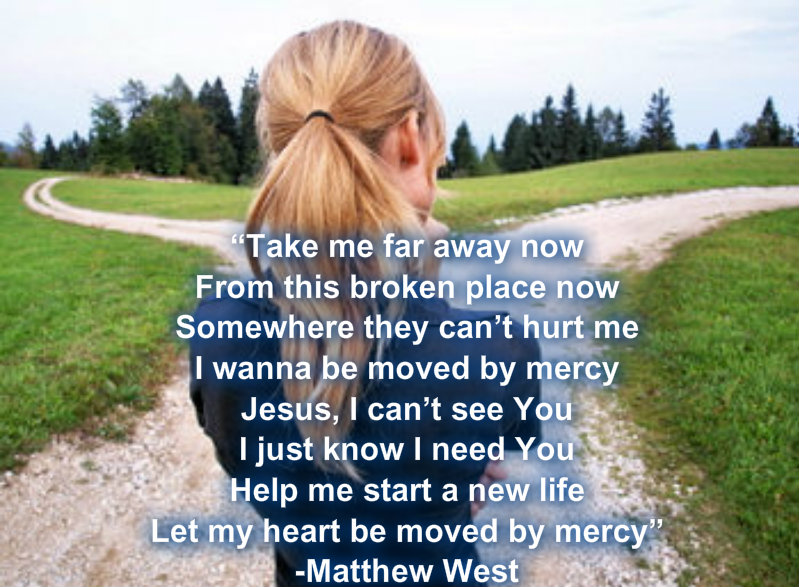
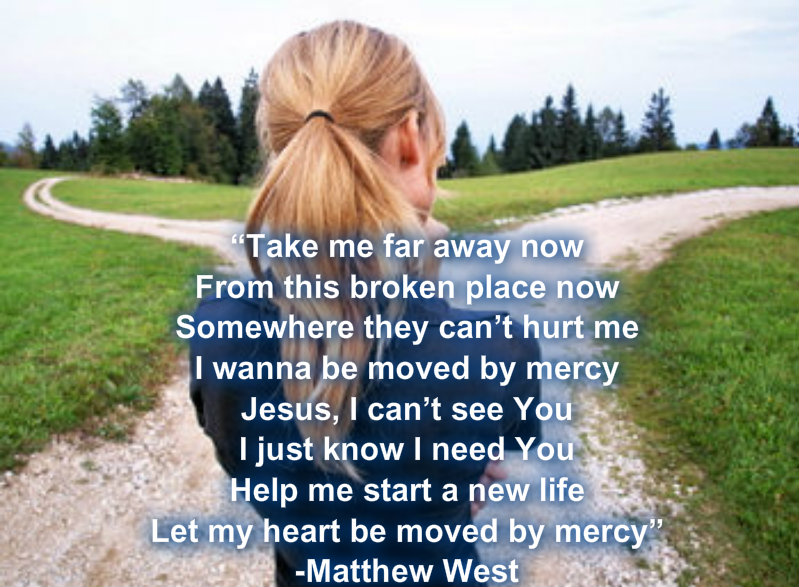
There is a song by Matthew West titled, “Moved By Mercy” in which some lyrics are applicable to today’s readings. In the song, Matthew West coveys that there is a dialogue between a young woman and Jesus, and he tells her that things of the past no longer have to haunt her because she has reached out and asked for mercy. Her plea is stated as follows:
“Take me far away now
From this broken place now
Somewhere they can’t hurt me
I wanna be moved by mercy
Jesus, I can’t see You
I just know I need You
Help me start a new life
Let my heart be moved by mercy.”
Jesus responds by saying:
All the hurt that you hide behind that door
I’m not gonna let it hurt you anymore.
And so later in the song the woman says:
“For so long I felt so unworthy.”
Jesus again responds with:
“I’m the one who began a good work in you
And I’m the one who is gonna see it through,
I’ll see you through.”
As well as:
“But in My arms all your shame is moved by mercy
So here I stand, a child undeserving
Take My hand and let your heart
Be moved by mercy.”
Lyrics: Matthew West
© Sony/ATV Music Publishing LLC, Warner/Chappell Music, Inc.
We see in the Reading from the Book of Wisdom that the author writes:
“But you spare all things, because they are yours, O LORD and lover of souls, for your imperishable spirit is in all things! Therefore you rebuke offenders little by little, warn them and remind them of the sins they are committing, that they may abandon their wickedness and believe in you, O LORD!”
And we see in the Gospel that Jesus looks up at Zacchaeus because he wants to establish a relationship while staying in his home. Zacchaeus is a tax collector, who the town’s people see as a sinful person. Even though it is not explicitly stated in the Gospel Reading, we understand that this relationship has more to do with ministry rather than needing a place to stay while in Jericho. As the town’s people are upset because Jesus wants to stay in Zacchaeus’ home, Zacchaeus understands this purpose; which again is not explicitly stated. Zacchaeus then asks for mercy for what he has committed against God and toward the town’s people by saying:
“Behold, half of my possessions, Lord, I shall give to the poor, and if I have extorted anything from anyone I shall repay it four times over.”
And Jesus shows mercy toward Zacchaeus by saying: “Today salvation has come to this house because this man too is a descendant of Abraham. For the Son of Man has come to seek and to save what was lost.”
How do the story of the young woman and the Readings apply to us??? Well, it is quite simple and straightforward! Unlike Jesus, we were born into the world not free of sin. That does not mean we sin the minute we come out of our mother’s womb, but rather we sometimes get caught up in things of this world which go against God. We follow the bad example of others, even if we know it is wrong. That is simply part of being human, as much as our baptism has washed away our sins. But when we do sin, we go to the Sacrament of Reconciliation to ask for forgiveness. But ultimately what this sermon is about is how we need to truly change our ways and not just ask for mercy, but to follow through with living a pure and holy life after asking for mercy. Just because we ask for mercy, and receive it, does not mean we can go on living with the mentality of “Well, God will forgive me” and return to our old ways. Because we asked for mercy, and we have been granted that mercy, we must strive to not turn back. The priest even says to us, “Your sins have been pardoned, and therefore go forth and sin no more.”
Father, when we ask for mercy, may we truly remember to truly live a holy and pure life because we asked for the mercy. This we ask through Christ, Our Lord. Amen.

Humble Grace ~ The Rev. Dcn. Dollie Wilkinson, OPI

As I read through this week’s Bible readings, I am reminded of an old saying my Grandmother would quote, “The meek shall inherit the earth” (Matthew 5:5). In studying the following passages, we are reminded that “Then everyone who calls on the name of the Lord shall be saved” (Joel 2:32). Those whom He calls, will not only be saved, but shall also carry His message to the rest of the people, for in their meekness and humbleness, they shall be rewarded. In reading Paul’s letter to Timothy hints at this fact. That he has endured persecutions of all kinds that have generated wear and tear on his body, mind and soul, traipsing all over the Roman world preaching the gospel of Jesus Christ. Paul has had many encounters defending the gospel but he realizes that the race was all worth it. He says, “I have fought the good fight, I have finished the race, I have kept the faith.”
2 Timothy 4:6-8, 16-18
“As for me, I am already being poured out as a libation, and the time of my departure has come. I have fought the good fight, I have finished the race, I have kept the faith. From now on there is reserved for me the crown of righteousness, which the Lord, the righteous judge, will give me on that day, and not only to me but also to all who have longed for his appearing. At my first defense no one came to my support, but all deserted me. May it not be counted against them! But the Lord stood by me and gave me strength, so that through me the message might be fully proclaimed and all the Gentiles might hear it. So I was rescued from the lion’s mouth. The Lord will rescue me from every evil attack and save me for his heavenly kingdom. To him be the glory forever and ever. Amen.”
Though Paul did everything required of him, all for the glory of Jesus Christ, we are cautioned by the following parable to guard ourselves against boastfulness.
Luke 18:9-14
“He also told this parable to some who trusted in themselves that they were righteous and regarded others with contempt: “Two men went up to the temple to pray, one a Pharisee and the other a tax collector. The Pharisee, standing by himself, was praying thus, ‘God, I thank you that I am not like other people: thieves, rogues, adulterers, or even like this tax collector. I fast twice a week; I give a tenth of all my income.’ But the tax collector, standing far off, would not even look up to heaven, but was beating his breast and saying, ‘God, be merciful to me, a sinner!’ I tell you, this man went down to his home justified rather than the other; for all who exalt themselves will be humbled, but all who humble themselves will be exalted.” “
We are reminded here that it is not they who seemingly flaunt their righteousness that God calls, but those who may at first appear to be the least deserving of us to receive God’s blessing and grace. “ Then afterward I will pour out my spirit on all flesh; your sons and your daughters shall prophesy, your old men shall dream dreams, and your young men shall see visions. Even on the male and female slaves, in those days, I will pour out my spirit. “ (Joel 2:28-29).
In the parable as told in Luke, we are cautioned to always remember that though we may follow the rules set down by man, or by a certain Church, or even our local pastor, it is no guarantee that we will have a place in Heaven. It is what is truly in our heart, whether we be saint or sinner, prostitute or preacher, homeless vagrant or humble Sister, that assures us the blessings and grace of our loving Father.

Do It Anyway: The Feast of St. Luke ~ Br. Michael Marshall, Novice

There are moments in our lives when our boss entrusts us with a new task which has not been part of our ordinary job duties. Because this task is new to us, it may seem overwhelming at first and we just want to throw our hands up in the air and tell our boss it cannot be done. And there may be times when we demand recognition for taking on the task and expect praise for putting effort into actually accomplishing what was asked of us; and when we do not receive recognition and praise, it leaves us feeling discouraged. But it is important to press on and do our jobs well regardless because that is our responsibility. It might sound a little strange, but being and living as a fully active Christian is much like our work environment. We can see this being the case in early Christianity through the Readings for today.
We see in the Gospel, that Jesus is commissioning his disciples to go out and preach the Good News. Jesus’ instructions indicate that the task will not be easy, and that not everyone will be receptive of the message; yet still put forth the effort at all cost, giving adequate attention to each household. Imaging the disciples thinking about what has just been entrusted to them; some might have been excited, while others might have felt a little hesitant. Yet they all did it!
In Paul’s Second Letter to Timothy, we read about Paul’s lamenting of feeling abandoned by his peers, other than Luke, and pleading to Timothy to bring other disciples for the mission to the Gentiles. Paul also asks Timothy to bring a cloak and papyrus rolls – important items to continue to carry out the mission entrusted to the disciples. As Paul continues to write to Timothy, he states that he has not thrown his hands up in the air, and knows he has been able to press on to fulfill the mission because of the guidance of the Lord.
So… How does this apply to us today??? Scripture is not pertinent to only a specific period in time, but rather is very relevant for ALL generations. Jesus’ Commissioning was not only for his direct disciples, but is also directed toward us. We may not be walking on foot from town to town and entering houses like the early Christian disciples did, but we are to reach out and preach the Good News. But, how do we do this if we do not enter a household??? This task is as simple as the wonderful saying by Saint Francis of Assisi – “Preach the Gospel always, when necessary use words.” It is as simple as loving our neighbor speak or paying it forward at a restaurant, but we must never be shy to speak of Jesus when it deems necessary. There are instances in which we want to mind our “P’s and Q’s” because we might think it is not our place to remind someone of WWJD, BUT sometimes we have to verbally preach! It might fall upon deaf ears, yet it just might also hit home with some people, so we need to keep pressing on and do our job as our boss has asked of us.
Father, may we understand that we have been asked of a great task as followers of Jesus, regardless of how difficult the task is. He has commissioned us, just as he commissioned his disciples, to preach the Good News. Let us answer this call. This we ask through Christ, Our Lord. Amen!
Prayer: What’s the Use? ~ Br. Chip Noon, Novice

Brothers and sisters, once again on this Sunday, the 29th of Kingdomtide, we are faced with the old question: Does God manifest his power to save us and protect us against the foe and the sorrowful times?
There are some who think God can actually interject his will to our benefit. They think that if we follow Scripture, we will be showered with riches and advancement. They pin their hopes on this passage: “For I know the plans I have for you,” declares the Lord, “plans to prosper you and not to harm you, plans to give you hope and a future.” (TNIV, Jeremiah 29:11) In the United States today there are congregations who use this idea as a way to distinguish between the “good” and the “bad” people of the world…the deserving and the undeserving.
But look at the first reading from Exodus. God directly intervened to help the Israelites against the Amalekites. As long as Moses held up his arm, showing faith in God, then the battle went to the armies of Israel. Believe this, do this, act thusly and you will win and prosper. Isn’t that proof of our power to ask God for help and thus receive it?
But Jesus denied that wealth was a sign of God’s favor or that poverty is God’s punishment of sin. Here is what Luke wrote:
19 “There was a rich man who was dressed in purple and fine linen and lived in luxury every day. 20 At his gate was laid a beggar named Lazarus, covered with sores 21 and longing to eat what fell from the rich man’s table. Even the dogs came and licked his sores. 22 “The time came when the beggar died and the angels carried him to Abraham’s side. The rich man also died and was buried. 23 In Hades, where he was in torment, he looked up and saw Abraham far away, with Lazarus by his side. 24 So he called to him, ‘Father Abraham, have pity on me and send Lazarus to dip the tip of his finger in water and cool my tongue, because I am in agony in this fire.’ 25 “But Abraham replied, ‘Son, remember that in your lifetime you received your good things, while Lazarus received bad things, but now he is comforted here and you are in agony. 26 And besides all this, between us and you a great chasm has been set in place, so that those who want to go from here to you cannot, nor can anyone cross over from there to us.’ 27 “He answered, ‘Then I beg you, father, send Lazarus to my family, 28 for I have five brothers. Let him warn them, so that they will not also come to this place of torment.’ 29 “Abraham replied, ‘They have Moses and the Prophets; let them listen to them.’ 30 “‘No, father Abraham,’ he said, ‘but if someone from the dead goes to them, they will repent.’ 31 “He said to him, ‘If they do not listen to Moses and the Prophets, they will not be convinced even if someone rises from the dead.’”
But then, in today’s Gospel we read that Jesus said,
The Lord said, “Pay attention to what the dishonest judge says.
Will not God then secure the rights of his chosen ones
who call out to him day and night?
Will he be slow to answer them?
I tell you, he will see to it that justice is done for them speedily.
But when the Son of Man comes, will he find faith on earth?”
And as long as Moses kept his hand raised, the Israelites won.
And the Psalm says, “The Lord will guard your coming and going, both now and forever.”
And Paul says, “so that one who belongs to God may be competent, equipped for every good work.”
Well, what are we to believe then? Here it is, written in both the Old and New Testaments. If we believe strongly enough, if we pray hard enough, if we do all we are taught from Scripture, then we will succeed.
But didn’t Jesus pray for the cup to be taken from him? Didn’t the Israelites pray for the Babylonians to flee away from them? Didn’t the Jews pray that the Nazis would leave them in peace?
I think we should think again of the two lines we say in the Alleluia today:
- Alleluia, alleluia.
The word of God is living and effective,
Discerning reflections and thoughts of the heart.
- Alleluia, alleluia.
And what then is prayer? Prayer is out act of providing a place in the heart for reflections and thoughts of the word of God. Prayer is for and about us. Prayer is our way of asking God to keep us humble, open, compassionate, and loving. And to be aware, because sometimes our prayers are answered in one way while we are looking the other way.
What does God want from us? “Love the Lord your God with all your heart and with all your soul and with all your mind and with all your strength. The second is this: ‘Love your neighbor as yourself.’ There is no commandment greater than these”
Simple.
Simple.
And yet so difficult.
Let us pray.
Lord, help us to keep our arms raised in supplication. Help us to pray without ceasing. Help us to look for your grace in everything we do, say, or think. And help us to heed your word to love you and love one another.
Amen.
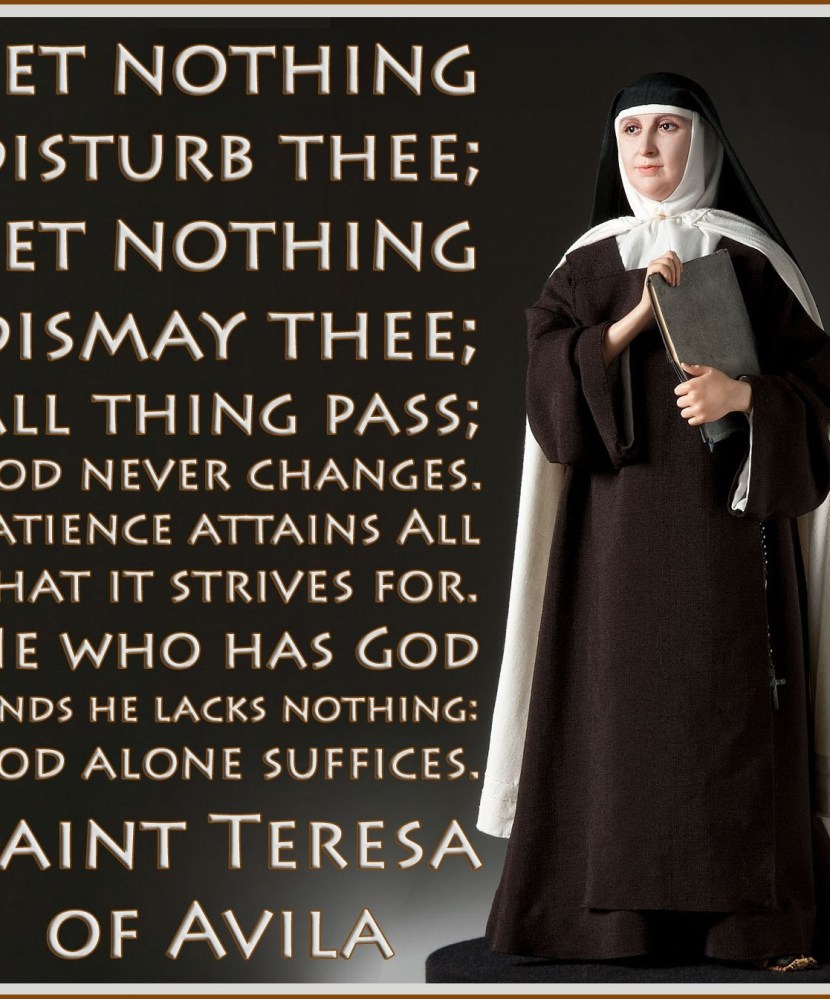
In God’s Hands: St. Teresa of Avila ~ Br. Chip Noon, Novice
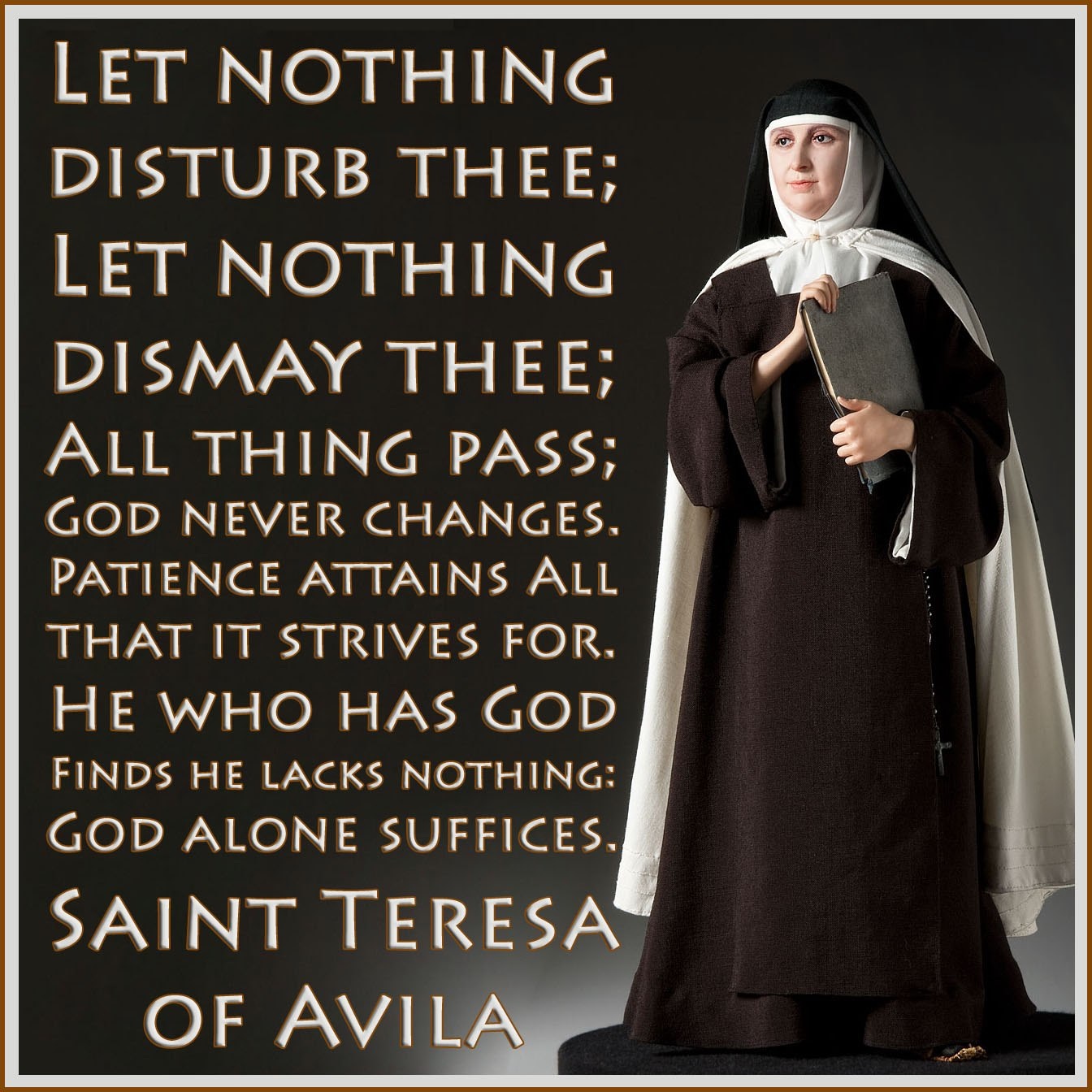
Today is the memorial of St. Teresa of Avila, also known as St. Teresa of Jesus.
Representing the mystical branch of Christianity, St. Teresa embodied and taught that the concept of divine grace is bestowed as a gift. Nothing we do can earn this gift. It is freely given by God.
But she also taught and wrote about being prepared for that gift. And it is in her preparation for God’s blessing that we see her “works”, if we may call them such.
Throughout her teachings, St. Teresa presented the ascent of the soul to God in four stages: 1. Devotion of Heart, devout concentration and contemplation. 2. Devotion of Peace, surrendering to God all our being and all our thought in quiet prayer. 3. Devotion of Union, an ecstatic state of further absorption in God, or rapture. 4. Devotion of Ecstasy, wherein all of our senses and mental faculties are completely entranced by the love of God.
While a true contemplative, St. Teresa was a tireless reformer, teacher, writer, and founder of Carmelite monasteries. So she was out and about, without shoes since she was a discalced religious, working fervently for the unification of the Order and to establish as many houses as she could. She also lived in extreme poverty, renounced property, and practiced flagellation.
In today’s first reading, St. Paul is giving thanks for his brothers and sisters in Ephesus who have shown him their faith in Jesus. And Paul prays that they will receive from God a spirit of wisdom and knowledge of him. This is essentially St. Teresa’s first stage that they are in and Paul is praying for their advancement to a higher level.
The Psalm and the Gospel may be seen as the beginnings of the second stage, the Devotion of Peace, essentially a surrendering. Jesus tells us that when faced with having to defend our beliefs, we need only surrender to the Holy Spirit who will teach us at that moment what we should say.
Let me go back to the idea of preparation.
In another of St. Teresa’s works, The Interior Castle, the saint is recording for us the path to mystical union with God. Like St. Ignatius of Loyola, she is giving us a prescription to follow, in an orderly way, so that we may receive the full majesty of God’s grace and glory. These exercises, as St. Ignatius called them, are work we must do to have the strength to move into the realm of ecstasy.
Yet, as in the readings, and as St. Teresa said time and again, we cannot “earn” God’s grace; it is always freely given. We must only be ready to receive it.
Isn’t this always the conundrum? So embedded in our minds and psyches is the notion that we must earn our daily bread, we must work hard to get ahead, we must never give up, so embedded is this that it seems that all good things come only after struggle and toil. This “valley of tears” is only something to be overcome, to be slogged through, to be endured.
Of course it is. This is real life!
But what Jesus and St. Teresa and all our spiritual teachers are telling us is that no matter how hard we struggle, we can rest easy in the knowledge that we are in God’s hands. And what they are suggesting is that we put ourselves in grace’s way. We pray, we contemplate, we study, we patiently wait, we open the eyes of our hearts that we may be enlightened, as Paul says in the Reading.
And so that is what our daily prayers are. That is what our weekly reading of The Rule does. That is why we have our daily studies and Liturgy to contemplate so that we are prepared. And as Paul says to the Thessalonians, “For you know very well that the day of the Lord will come like a thief in the night.”
Let us pray. Lord, give us the courage to prepare for your presence, give us the stamina to exercise our souls for the day of your coming, and give us the time and the peace to be ready for the manifold distribution of your gifts. We ask this in Jesus’ name.
Amen.

The Broken Ones ~ The Rev. Dcn. Scott Brown, OPI

Today’s Gospel is Luke 17, 11-19
11 On the way to Jerusalem he was passing along between Samaria and Galilee. 12 And as he entered a village, he was met by ten lepers,[a] who stood at a distance 13 and lifted up their voices, saying, “Jesus, Master, have mercy on us.” 14 When he saw them he said to them, “Go and show yourselves to the priests.” And as they went they were cleansed. 15 Then one of them, when he saw that he was healed, turned back, praising God with a loud voice; 16 and he fell on his face at Jesus’ feet, giving him thanks. Now he was a Samaritan. 17 Then Jesus answered, “Were not ten cleansed? Where are the nine? 18 Was no one found to return and give praise to God except this foreigner?” 19 And he said to him, “Rise and go your way; your faith has made you well.”
Jesus heals those who ask. He picks us up when we are down, lifts our spirits when we are depressed and takes away our scars. We are all broken in one way or another; we are all in need of healing of one kind or another; and we are all in need of love and compassion. This is what Jesus will do for you if you only ask him.
Jesus heals all of the lepers who asked him, but only one of them returned to thank him for what he had done for him. Why did the other nine not return to thank Jesus? That may be one of the mysteries we can only have answered when we actually meet Jesus. My thoughts are this: the other nine were so overjoyed to be healed and cleansed that they didn’t see the need to thank the Lord for what he had done for them, or possibly they were so overcome with glee and joy they wanted to rush to their homes and show them what had happened. Regardless of their reasons there was one who acknowledged what Jesus had done for him and felt the need to acknowledge and praise Him for his outpouring of love towards him. We need to keep this in mind and thank and praise Jesus for the blessings he shows to us every day. When your checking account is empty and you get that surprise check in the mail that will carry you through to the next payday, when you are depressed and feeling all alone in the world, an old friend calls you without warning, when your boss gives you a raise at work because you put in that little bit of extra effort on a project; these are all blessings that we need to be thankful for and praise our Lord for his bountiful love and compassion. Our healings may not be as profound as those of the lepers, but we are all blessed and healed one way or another on a daily basis. Praise him and thank him for every little blessing you receive.
Lord in your mercy hear the prayers of the sick, depressed, poor, and anyone who needs your blessings in any way. Let us truly know where our bounties come from and acknowledge those bounties and blessings as yours. In Jesus name we pray. Amen

Living the Life of Faith ~ The Rev. Lady Sherwood, OPI

Gospel reading: Luke 17:5-10
5 The apostles said to the Lord, “Increase our faith!”
6 He replied, “If you have faith as small as a mustard seed, you can say to this mulberry tree, ‘Be uprooted and planted in the sea,’ and it will obey you.
7 “Suppose one of you has a servant plowing or looking after the sheep. Will he say to the servant when he comes in from the field, ‘Come along now and sit down to eat’? 8 Won’t he rather say, ‘Prepare my supper, get yourself ready and wait on me while I eat and drink; after that you may eat and drink’? 9 Will he thank the servant because he did what he was told to do? 10 So you also, when you have done everything you were told to do, should say, ‘We are unworthy servants; we have only done our duty.’”
In today’s Gospel reading, we hear the disciples asking Jesus to increase their faith. I am sure most of us at some point in our lives have asked similarly.
If I had only more faith, we say if things are difficult in our lives. We say things such as, “if only I had more faith, maybe that person wouldn’t have got Ill, or wouldn’t have died” or “if I had more faith, I wouldn’t suffer like this or have that in my life, or I would be a better person”. I admit, there have been times when I have thought exactly as the disciples did in today’s Gospel reading.
However, living by faith is not something that comes in sizes or in measurable quantities. It is not a bargaining chip that we can use to gain favour or our own personal wants from God.
Faith is a true loving relationship that we have with Our Lord and is something which we must live fully each and every day of our lives. Living a faithful life does not mean that we will not suffer hardships and pain within our lives. The righteous are not exempt from suffering, just because a person may be ill or poor does not make them a sinner. We must not confuse wealth with approval of God or illness with sin (see Matt 9:21=22 and Jn 9:2=3).
It is living as one with God in all our daily words and deeds and doing it to our utmost with all that we are. Living a faithful life doesn’t even mean that we have to always agree with everything that our Lord tells us, but that out of love we learn to live as one to the best of our ability.
A good example is if we look at a good marriage or partnership, the two out of love for each other, live as one, they are faithful to each other in all things even if they may not always agree with each other.
Living a faithful life, is living to the best of our ability as Our Lord would live, we are all one in Christ and should strive to live this fully within our daily lives.
It is Loving each other, accepting each other and forgiving each other. It is walking with each other on this path of life and helping our brothers and sisters who stumble along the way.
We know that God will only do what is good for us as his children and that he has plans only for our good as the following scriptures clearly tell us:
And we know that in all things God works for the good of those who love him, who have been called according to his purpose (Rom 8:28).
For I know the plans I have for you” declares the LORD, “Plans to prosper you and not to harm you, plans to give you hope and a future (Jer 29:11).
A true example of living the life of faith can clearly be seen in the story of Job. The story of the life of Job is one of faith, endurance, and of patience winning out against amazing odds.
Job was subjected to three tests=the first was to accept without sinning, the loss of his possessions and offspring (Job 1:6=22). The second was to endure the destruction of his health without blaming anything on God (Job 2:1=10). The third test was to endure false accusation. Most people would respond to the trials of Job by blaming these evils on God’s inaction, but Job showed humility in the sight of God. He tore his robe, shaved his head, and fell down and worshipped God and throughout all his trials Job never resorted to sinning against God. Job’s life and his faith is an excellent example to all of us as Christians.
Thank You, Lord, for the measure of faith You have given me. I refuse to be moved by outward circumstances, but only by what Your Word says. I will trust in the Lord with all my heart and I will not lean upon my own understanding (Proverbs 3:5). Thank You for saving me! Ephesians 2:8 says, “it is by free grace (God’s unmerited favour) that you are saved (delivered from judgement and made partakers of Christ’s salvation) through [your] faith. And this [salvation] is not of yourselves [of your own doing, it came not through your own striving], but it is the gift of God…”. All of the precious gifts You have given me: salvation, healing, prosperity, etc., are connected to my faith, and it’s impossible to please You without it. I will keep Your commandments, walk in love, stay in the Word and live by faith!
 The Order of Preachers, Independent
You must be logged in to post a comment.