
Category: Sermon
What Now? ~ The Rt. Rev. Michael Beckett, OPI
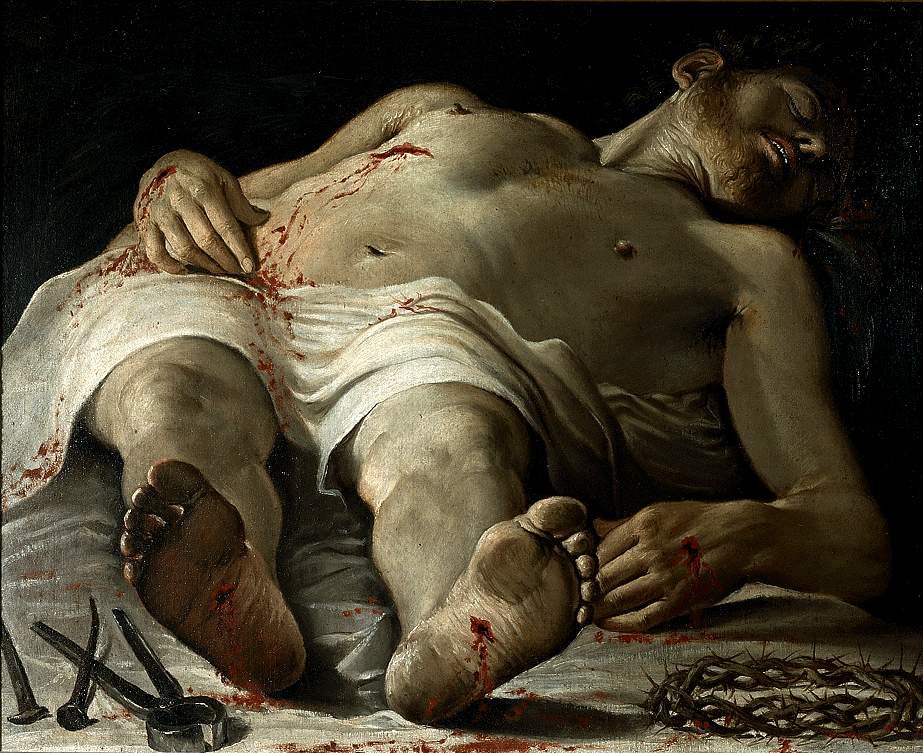
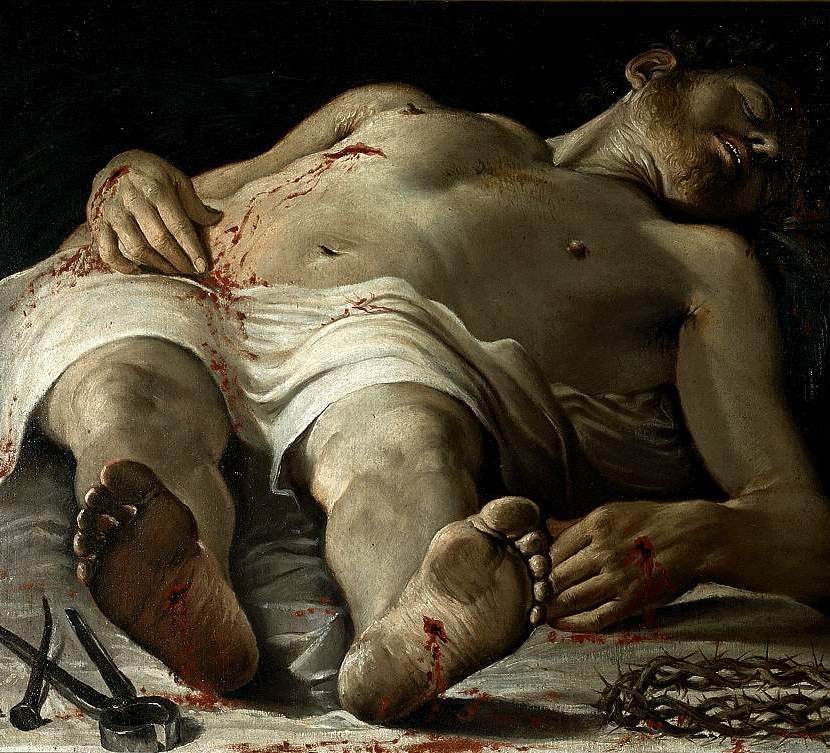
When it was evening, there came a rich man from Arimathea, named Joseph, who was also a disciple of Jesus. He went to Pilate and asked for the body of Jesus; then Pilate ordered it to be given to him. So Joseph took the body and wrapped it in a clean linen cloth and laid it in his own new tomb, which he had hewn in the rock. He then rolled a great stone to the door of the tomb and went away. Mary Magdalene and the other Mary were there, sitting opposite the tomb. The next day, that is, after the day of Preparation, the chief priests and the Pharisees gathered before Pilate and said, “Sir, we remember what that impostor said while he was still alive, ‘After three days I will rise again.’ Therefore command the tomb to be made secure until the third day; otherwise his disciples may go and steal him away, and tell the people, ‘He has been raised from the dead,’ and the last deception would be worse than the first.” Pilate said to them, “You have a guard of soldiers; go, make it as secure as you can.” So they went with the guard and made the tomb secure by sealing the stone. (Matthew 27: 57-66_
I went back to the cemetery the day after Daddy was buried and just sat on the ground beside his grave, trying to absorb the enormity of what had happened. He was gone. This man who had been so strong, so faith filled, so always there to make things better, whose piercing blue eyes communicated for than his voice ever did. He was gone. The man who held the reins in our family, our rock, our hero. Could this have really happened? How could this man die? We thought he was invincible. What now?
How much more so did the Disciples feel, those men and women whose lives had been totally centered around Jesus? How could this have happened? In spite of raising the dead, in spite of healing lepers and changing water into wine and feeding thousands of people with a couple of fish, in spite of the belief that he was the Messiah, that he was believed to be the son of God, that he was supposed to be invincible, he was gone…
Emptiness.
Confusion.
Fear.
Emptiness.
And this is where we are today. All of us have experienced “Holy Saturdays” in our lives.
Holy Saturday is the in between time. The tragedy of the crucifixion is past but the glories of the resurrection are not yet here. We are neither here nor there. We are stuck in the middle. What was is no more and what will be is not yet clear or known. It feels as if there is nowhere to go and nothing to do.
Holy Saturday comes to us in many ways but it always seems to involve death; the death of Jesus, the death of a loved one, the death of a relationship, the death of hopes and dreams. In the church calendar Holy Saturday is only one dreaded day a year. Not so in life. Those of you us who have suffered the death of a loved one know that you do not move from Good Friday to Easter Sunday in just one day. Holy Saturday can last months, years, even a lifetime. Holy Saturday calls us to the tomb. Where else is there to go?
That’s where Mary Magdalene and the other Mary are today. Joseph of Arimathea took Jesus’ body wrapped it in a clean linen cloth, laid it in the tomb, rolled a great stone to the door of the tomb, and went away. He left. Some will do that in the Holy Saturday of life. They will close up the tomb and walk away as if there is nothing there, no possibilities for anything new. The two women, however, Mary Magdalene and the other Mary, are sitting opposite the tomb. They are silent. There is not much to say on Holy Saturday. What can be said? There are no answers.
Emptiness.
Confusion.
Fear.
Emptiness.
Holy Saturday is a day of silence and stillness, waiting and wondering, remembering and hoping. Perhaps that is what faithfulness looks like on Holy Saturday. There is not much to do except be present to what is, to sit beside the tomb.
“Media vita in morte sumus ; quem quaerimus adjutorem, nisi te Domine, qui pro peccatis nostris juste irasceris? Sancte Deus, sancte fortis, sancte et misericors Salvator, amarae morti ne tradas nos.”
“In the midst of life we are in death: of whom may we seek for succour, but of thee, O Lord, who for our sins art justly displeased? Yet, O Lord God most holy, O Lord most mighty, O holy and most merciful Saviour, deliver us not into the bitter pains of eternal death.”
Holy Saturday is a difficult day. We so much want joy to replace sorrow. That’s not what Jesus does. Instead, sorrow is transformed into joy, the tomb becomes a womb, and death gives birth to new life. Christ’s triumph is not apart from death but within death. Christ is trampling down death by death and giving life to those in the tombs.
The two women of Holy Saturday will become the first people Jesus greets on Easter Sunday. So trust the silence and the waiting. Be still. Remember, wonder, hope. Pray. It is Holy Saturday and your Lord who loves you is at work.
The King is Dead. Long Live the King! ~ Br. Michael Marshall, Novice
Gospel during Procession: Luke 19:28-40
First Reading: Isaiah 50:4-7
Second Reading: Philippians 2:6-11
Gospel: Luke:22:14-23:56
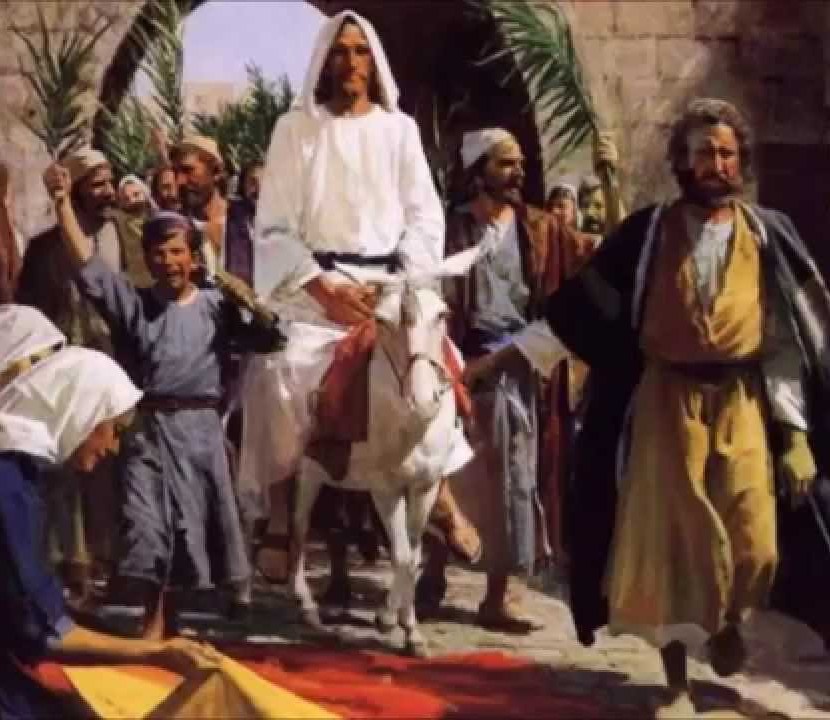
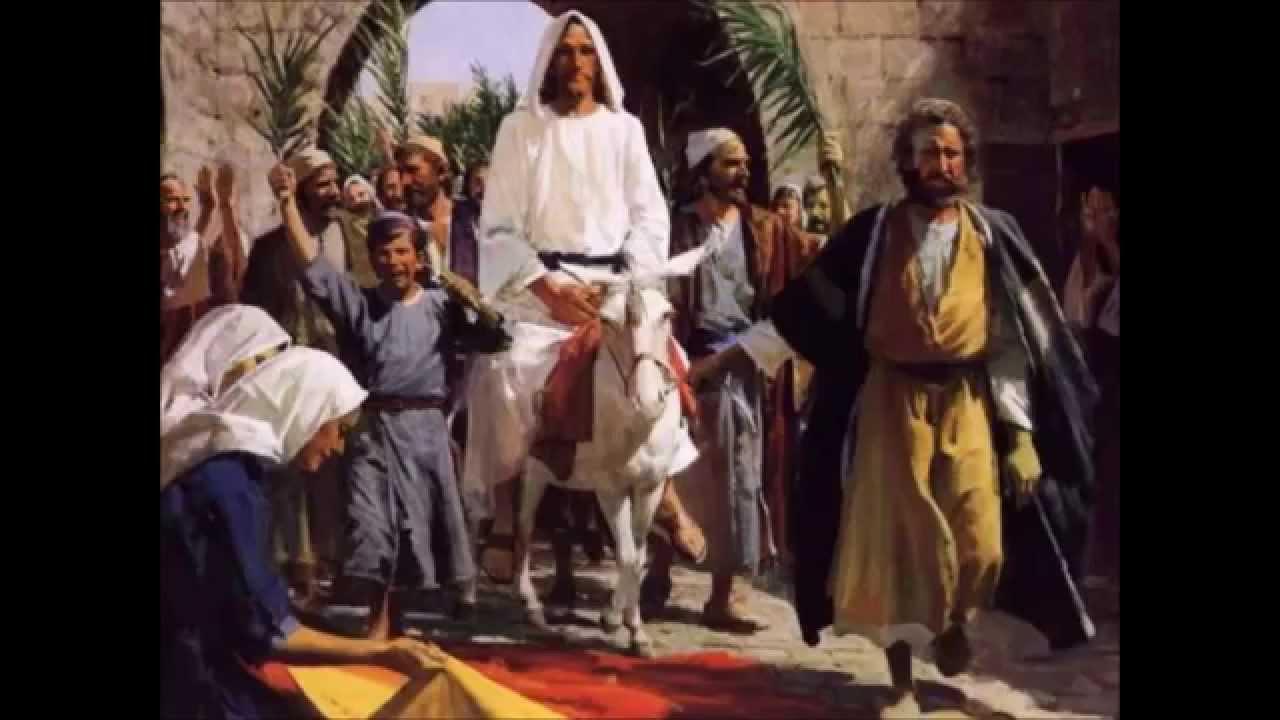
Do you remember your high school or college homecoming? Remember the parade through campus with the homecoming king and queen wearing sashes and riding on the back of a convertible while people are cheering for them? When I listen to the Procession Gospel on Palm Sunday, this image is what comes to mind when I think of Jesus riding on the back of the donkey as he is arriving into Jerusalem. I envision this arrival as more than people laying cloaks down and exclaiming “Blessed is the king who comes in the name of the Lord.” It is a parade of fanfare people acknowledging Jesus as king. But there is a difference between these two celebrations. The homecoming king and queen are elected then appointed to represent the homecoming court, while Jesus’ parade occurs before his passion and resurrection. There is also another major significant difference; when homecoming weekend concludes, the man and woman no longer hold the titles of king and queen, YET Jesus’ kingship lives on forever after his death on the cross.
This theme of kingship after the passion and resurrection carries through into the other readings for today. In the Letter to the Philippians, Paul shares that because Jesus was obedient to the point of death by the cross, “God greatly exalted him and bestowed on him the name which is above every name, that at the name of Jesus every knee should bend, of those in heaven and on earth and under the earth, and every tongue confess that Jesus Christ is Lord, to the glory of God the Father.” In the Gospel after the Second Reading, we read that during Jesus’ passion, the scribes and Pharisees take Jesus before Pilate to be condemned, and the reason was because of the issue regarding whether Jesus was the King of the Jews. Pilate even questions Jesus about this: then we later read that Jesus was mocked by having a crown of thorns placed on his head, and the inscription on the cross stated, “Jesus, King of the Jews.” So in one regard, he was acknowledged as king and praised by the people, yet in another regard condemned to death over the issue by others who felt threatened by him. But we know the victory of eternal kingship is his because of his resurrection.
What does this mean for us today at this current time 2000 years later? Just as Paul stated, “at the name of Jesus every knee should bend, of those in heaven and on earth and under the earth, and every tongue confess that Jesus Christ is Lord, to the glory of God the Father.” it is important to spread that message to others in our daily lives and the various ministries in which we participate. During Jesus’ passion, Judas betrays him and Peter denies knowing him three times, so the thought for us to examine is whether we are really going to spread the Gospel and tell the world that Jesus is king, or whether we will betray or deny knowing Jesus through our negative actions. What are you going to do???
If It Weren’t for Bad Luck… ~ The Rev. Jay Van Lieshout, OPI
“If it weren’t for bad luck, I’d have no luck at all!” Who has not cried this out in a fit of despair at one time or another? How many of us may even be thinking such a thought at this very moment? Feeling at times as if we are plagued by misfortune is really part of being human. Things sometimes just go wrong and, though events sometimes go without a hitch ending on a happy note, we as humans tend to focus on and hold tight to those events that are less than perfect events in our lives. Remembering when our actions produced undesirable results can be a good thing; it is how we learn what to avoid, what not to do or to say, etc; in fact, failures can often lead to successful and rewarding outcomes. Yes, we view our failures as bad luck or feel we are cursed in spite of all the good we have in our lives. Being raised in a Calvinist family I was taught if something goes wrong it was because I was a sinner and God was punishing me. The larger the mishap, the more dreadful a child I was, for what you sow is what you reap. From the smallest paper cut to being in pain with kidney stones, it was all part of God’s plan to punish my wickedness; God was vengeful and mean because of our sins and Jesus came to point that out to us. What a horrible teaching for a child, and what a horrible teaching that still continues today in too many a “Christian” denomination or church.
Such misconceptions of God are not new to modern times; Luke tells us Jesus dealt with similar misguided thoughts and teachings. When asked about Pilate’s slaughter of some Galileans as they were conducting ritual sacrifices (the implication being they might have been guilty in the eyes of God), Jesus asked if they thought the victims were “greater sinners” than the all other Galileans? Without delay, Jesus rebuked them saying “I say to you no! But I tell you, if you do not repent, you will all perish as they did!” (Luke 13:2-3) Similarly, Jesus asked if the deaths of the 18 killed when the tower of Siloam collapsed was the result of the victims indebtedness exceeding that of the rest of the men in Jerusalem? Again without delay, Jesus rebuked them saying “I say to you no! But I tell you, if you do not repent, you will all perish as they did!” (Luke 13:4-5) Two horrendous events: one the murder of innocent people as a result of hate and bigotry, another, the tragic loss of innocent lives as the result of an accident; in neither was God punishing the victims (and Jesus would know if He was), both were just random tragedies, examples of “crap happens”. Yet both revealed the delicate and fleeting nature of human life as well as how easily one can suffer a spiritual death over mundane worldly things; Jesus warns to repent now, for tomorrow may not come.
So is all lost? If we stumble and then quickly die before we can repent and ask for forgiveness, is there no hope? To quote Jesus, “I say to you no!” God is our father, and though He can be stern, His love for us in unchanging, unending and boundless. Luke continues with Jesus telling a parable in which a fig tree has failed to yield fruit for 3 years. The owner has no patience and instructs the gardener to cut it down. The gardener knows that sometimes “crap happens” and offers to tend to the tree for a year using a little manure, a little extra attention and, hence, he is giving the tree another chance to bear fruit (with a little help). This is how God works us in His garden, he sent the Son of Man to be our gardener, to spare us from the saw, to intercede for us, nurture us with the Word of the Creator, cultivate our souls and help us turn the “crap” that happens in life into fruit for the Father’s Harvest.
Yes, bad things happen to me, to you, to everyone. Part of being human and being alive is “crap happens”; this is a fundamental fact of life. What we all must realize is this is not God punishing us, it is not some divine retribution, and it surely is not a canonical license to condemn others or withhold compassion to those suffering “because they are sinners and deserve their misfortune”. I say to you nobody is undeserving of our compassion and forgiveness. In fact, many of those who have suffered some of the most horrendous crap life can muster, have turn out to be our most beloved and respected saints-and one even died so that all of humanity could, in turn, live! So the next time you feel you are getting more than your share of manure just remember, the only difference between a saint and a sinner is a saint will not sling the manure at others, but instead, they use it as fertilizer for the tree of Jesse so that it might bare the largest and sweetest of fruit.

Shhhhh!!! ~ Br. Chip Noon, Novice
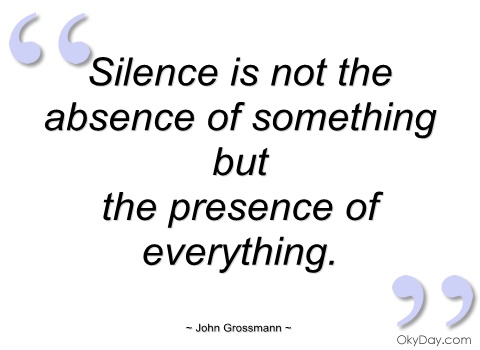

“Filled with the Holy Spirit, Jesus returned from the Jordan
and was led by the Spirit into the desert for forty days…”
In today’s Gospel, Jesus has just been baptized in the Jordan River by John. Next, he goes into the desert to fast and pray. These are two very visible actions, which all can see. They are meant for public observation. They are symbols of piety and faith.
But then, Jesus goes alone into the desert.
How then do we reconcile the first reading, bringing the first fruits and presenting them publicly in the Temple, with our Lord’s teaching:
“Whenever you fast, do not look dismal, like the hypocrites, for they disfigure their faces so as to show others that they are fasting.” (Mt. 6:16)
And:
“So when you give to the needy, do not announce it with trumpets, as the hypocrites do in the synagogues and on the streets, to be honored by men. I tell you the truth, they have received their reward in full.”
And:
And when you pray, do not be like the hypocrites, for they love to pray standing in the synagogues and on the street corners to be seen by men. I tell you the truth, they have received their reward in full. But when you pray, go into your room, close the door and pray to your Father, who is unseen. Then your Father, who sees what is done in secret, will reward you.
There is a time for everything under the heaven, we are told, but the time that we spend in Lent should be between us and our Lord. And the prayer, fasting, and almsgiving that we are taught to perform are to help us to learn to speak more directly, more honestly with God. It is not just a period of giving something up or performing certain acts, but a time when we can learn to hear the word of God.
And as the Quakers say, the word of God is a still, small voice within…and sometimes we are being spoken to but cannot hear because of the intrusions of the world.
In the second reading, Paul tells us that “the word is near you, in your mouth and in your heart.” Again, a solitary state of being…us and God. And what do we have to do to be saved and justified? Confess with our mouths and believe with our hearts. Alone, meaning with no one around; and alone, meaning that’s all that’s necessary.
During this Lenten season we can take up the time-honored practices and abstain, give, and pray. These are disciplines that are done in preparation. Practices that resemble an athlete’s muscle-memory exercises to train the body to strive more completely.
But we can also stop, concentrate, focus, and search for that still, small voice within that is the voice of God.
For that is what Lent is about in one sense: teaching us how to be athletes of our Lord, able to bear hardships, pain, trials and tribulations so that we can win the laurel wreath of peace and salvation. For hardships do and will come and our time in the desert of these 40 days will train our souls, our bodies, our minds to persevere even unto death as we await the blessed hope and the coming of our Savior, Jesus Christ.
Today Lord, help us to train ourselves for your resurrection, that we can experience it with all the joy that your followers knew when they saw the fulfillment of your promise on the Sunday of Easter. Amen.

From Death to Ashes to Abundance ~ Br. Michael Marshall, Novice

Reading 1: Joel 2:12-18
Even now, says the LORD, return to me with your whole heart, with fasting, and weeping, and mourning; Rend your hearts, not your garments, and return to the LORD, your God. For gracious and merciful is he, slow to anger, rich in kindness, and relenting in punishment. Perhaps he will again relent and leave behind him a blessing, Offerings and libations for the LORD, your God.
Blow the trumpet in Zion! proclaim a fast, call an assembly; Gather the people, notify the congregation; Assemble the elders, gather the children and the infants at the breast; Let the bridegroom quit his room and the bride her chamber. Between the porch and the altar let the priests, the ministers of the LORD, weep, And say, “Spare, O LORD, your people, and make not your heritage a reproach, with the nations ruling over them! Why should they say among the peoples, ‘Where is their God?’”
Then the LORD was stirred to concern for his land and took pity on his people.
Reading 2: 2 Corinthians 5:20 – 6:2
Brothers and sisters: We are ambassadors for Christ, as if God were appealing through us. We implore you on behalf of Christ, be reconciled to God. For our sake he made him to be sin who did not know sin, so that we might become the righteousness of God in him. Working together, then, we appeal to you not to receive the grace of God in vain. For he says:
In an acceptable time I heard you, and on the day of salvation I helped you.
Behold, now is a very acceptable time; behold, now is the day of salvation.
Gospel: Matthew 6:1-6, 16-18
Jesus said to his disciples: “Take care not to perform righteous deeds in order that people may see them; otherwise, you will have no recompense from your heavenly Father.
When you give alms, do not blow a trumpet before you, as the hypocrites do in the synagogues and in the streets to win the praise of others.
Amen, I say to you, they have received their reward. But when you give alms, do not let your left hand know what your right is doing, so that your almsgiving may be secret.
And your Father who sees in secret will repay you.
“When you pray, do not be like the hypocrites, who love to stand and pray in the synagogues and on street corners so that others may see them.
Amen, I say to you, they have received their reward. But when you pray, go to your inner room, close the door, and pray to your Father in secret. And your Father who sees in secret will repay you.
“When you fast, do not look gloomy like the hypocrites. They neglect their appearance, so that they may appear to others to be fasting. Amen, I say to you, they have received their reward.
But when you fast, anoint your head and wash your face, so that you may not appear to be fasting, except to your Father who is hidden. And your Father who sees what is hidden will repay you.”
I recently went to a funeral for the father of a family friend out of respect for our friend, even though I never met the gentleman. He was cremated, and as I am sitting in the pew looking at the urn, I am trying to picture the man through the few stories I heard about him during the eulogy and pastor’s sermon, yet I was also thinking about that there were just ashes in that beautiful wood box, while the memories in those stories lived on. The body became ashes… a box full of charred particles in a form of dust after the gentleman passed away. Thinking about the ashes did not mean I was not listening to the stories about the man. Everything that was shared by the family and pastor spoke to how the gentleman exemplified the word and action of love. He was always helping those in need, even up to the day that his health no longer permitted him to be active. People around him saw that he was loving and helping not because he expected anything in return or wanted to be noticed, but rather merely doing it because it was the right thing to do. This is what the Gospel for today is all about. Jesus instructs his disciples to live and carry out their faith without having to boast about what they are doing, because God already sees the actions. Going to the funeral helped me understand Ash Wednesday a little differently, as it was roughly two weeks away.
When ashes are placed on our forehead by the priest or deacon, the words that are usually said are “Remember that dust you are, and to dust you shall return.” (Coming from Genesis 3:19) Humanity was created out of dust, and just like the father of our family friend, we will become dust regardless of being buried or cremated. Sure, placing ashes in the shape of a cross on our forehead is an outward sign showing others we profess our faith. That might seem in contradiction with what we are instructed by Jesus, but it really is not! That cross is also a reminder for our selves. Certain aspects of our self must die in order to truly follow Jesus. Ash Wednesday is the beginning of Lent; a season of preparation and conversion, and a time when those ashes cause us to think about becoming a better person. Hopefully at the end of those forty days of Lent, it has not been about giving up candy or just praying more because it is Lent, but hopefully become a better person forever.
I recognize areas in which I need to change and grow, and I can only hopefully become more like the father of our family friend through this growth process. When receiving ashes on my forehead, I am going to think about that gentleman who was all about love, instead of it just being a cross on my forehead for others to see that I am beginning my Lenten journey. When you receive those ashes, what will it be about for you? Will it be an outward sign, or a reminder that some aspects of us must die in order to more closely follow Jesus?
“So let us pray… Father, as we embark on our Lenten journey, help us wear our ashes as symbols of desiring to more closely follow your Son. Through that same Son, Jesus Christ, who lives and reigns with You and the Holy Spirit, now and for ever; Amen.”
Evangelism 101: Parts is Parts. ~ The Rev. Jay Van Lieshout, OPI

“Have you been saved?” “Are you born again?” “Have you found Jesus?” “Have you accepted Jesus as your personal savior?” I think we all have been addressed by such “evangelistic” greetings while we were at work or shopping or even at social gatherings. I may be alone in this, but I find these phrases to be cliché, disingenuous, annoying and counterproductive. It is not that I am embarrassed to be a follower of Christ, or to proclaim His Gospel out in the world (after all I do wear a habit as a sign of my faith and God has all but given me a tonsure), it is more that such phrases imply that you do not know Jesus or the good news. To my ears they are saying “I know Jesus better than you do, let me save you or you will go to hell”. Now, I know this is a bit crass, but conversations that begin with “Have you…” always seem to progress to stories of how great their church is, how Paul said this or that, how they are helping the lost sinners like homosexuals or how they helped bring some poor family over from a developing nation and let them cut their lawn or work on the church. And during these “conversations” I often wonder, “where is the good news? Where is the Gospel of God’s love for everyone, and our call to love each other?”
Jesus asked us to go out to the entire world and spread the good news, teach the Gospel to all people; this is the call to evangelize. But asking someone if they are “saved”, or “found Jesus”, this seems to miss the point. The Gospels tell us that God so loved us His children He sent the Son of Man to fulfill the old law, establish a new covenant based on altruism and forgiveness, to preach the truth and then to be sacrificed so that All HUMANITY should be saved. If the Gospels were a Hallmark card they would read “I love you, I forgive you, all I ask is you do the same to each other as a sign that you love Me too. Love, your Creator”.
There are many places throughout the Word of God where the faithful to whom the light of the word is given and are blind to it, while those “not chosen” see it as bright as day. This season of Epiphany exemplifies such realization of the Messiah to the “gentiles” amidst the ignorance of the chosen people. John so poetically tells us:
“He was in the world, and though the world was made through him, the world did not recognize him. He came to that which was his own, but his own did not receive him. Yet to all who did receive him, to those who believed in his name, he gave the right to become children of God— children born not of natural descent, nor of human decision or a husband’s will, but born of God. The Word became flesh and made his dwelling among us. We have seen his glory, the glory of the one and only Son, who came from the Father, full of grace and truth.” (John 1:10-14) What a glorious message, the Son came not for those chosen by race, or by declaration of man nor even lineage (for we are all God’s children), but for all those who open their hearts to the truth and live the Word. In another example, Luke tells us that Jesus read from Isaiah in His home town synagogue:
“The Spirit of the Lord is upon me, because he has anointed me to bring glad tidings to the poor. He has sent me to proclaim liberty to captives and recovery of sight to the blind, to let the oppressed go free, and to proclaim a year acceptable to the Lord.” And said to those present: “Today this Scripture passage is fulfilled in your hearing.” (Luke 4: 18-19, 21) Again what great news Jesus shared to those who proclaim to believe in the word, and how said such news fell on deaf ears and whose eyes had been blind to his light.
A few days ago, while shopping at the local big box grocery, a lady came up and inquired about my habit. She said “I know you are a man of God, please tell me what this means and about your church”. And so I shared about being a Dominican, about being an Old Catholic, about our church’s foundation being the Gospels, about how we strive to accept everyone and anyone just as Jesus did. She then asked “what about homosexuals?” I replied “We are all children of God, EVERYONE is accepted, especially those marginalized by the mainstream. We do not judge others as that is NOT our job, only God knows what is in a person’s heart and we trust that God will take care of His own.” She then asked “Do you believe that people who commit suicide go to hell?” I said “I believe in God’s grace and mercy, He knows what is in the heart of those suffering, those with mental illness, those in the dark depths of depression and pain, He would not forsake one of His own”. She finally smiled and told me her husband took his own life, she and her son were the ones who found him. She struggles with a rare neurological condition, she has tried to end it many times, her children are struggling with it all and she feels now that God is calling her to share her trials, her message to help others. I agreed and encouraged her to find a place, any place and to share her journey and her discoveries not only to help her heal, but to help others find a path to healing and that this is what God wants and this is why she is still here.
A moment of my time to listen, a few words exclaiming the good news to one who really needed it, an acknowledgement of her pain, suffering and stumbles in life with a reassuring it’s ok, that’s a lot for anyone to deal with, followed by the guarantee of God’s grace, forgiveness and love, and rounding it up with a firm “you matter, you have a gift and calling from God and you will make a difference in someone else’s life”. For me, this is evangelism as Jesus would have it done: to live s Paul says, we are all of one body, no single part is the body, but the body is made of all the parts, and if one part is sick, the body is sick; to heal the part is to heal the whole body. No body can be complete without all its parts and, therefore, no part is any greater or lesser than the other. Hence, evangelization is not saying “I am already part of a magnificent body, don’t you think you should join me and be great too”, but, instead the message is “Truly you are valued part of a magnificent and great body, we are blessed by you and hope that you too are blessed by us. Come; let us rejoice with all other parts so that none may ever be forgotten.”

An Address from the Presiding Bishop: Out of the Ashes ~ The Rt. Rev. Michael R. Beckett, OPI

In Greek mythology, a phoenix is a long-lived bird that is regenerated or reborn. Associated with the sun, a phoenix obtains new life from the ashes of its predecessor. According to some sources, the phoenix dies in a show of flames and combustion, and a young bird arises, new, strong, and vibrant from the ashes. The Phoenix is also an important Christian symbol which symbolizes the death of Christ and His resurrection from the dead. The following reference to the Phoenix as a symbol is in the Bible:
“Then I thought, ‘I shall die in my nest, and I shall multiply my days like the phoenix.’ ”
(Job 29:18)
Also, Clement of Alexandria uses the phoenix as a symbol of the resurrection of Christ in his First letter to the Corinthians when the church there was having difficulties. He told the Corinthian church that out of strife comes growth. I believe that this applies to The Unified Old Catholic Church.
Through many trials and tribulations, hurt and bewilderment, and out of the ashes of broken relationships, a year ago today The Unified Old Catholic Church emerged. In the course of the past year, we have experienced rebirth, resurrection if you will, and have become an example of what can happen when a group of people is truly focused on our Lord and Savior, Jesus Christ.
Because we are truly ‘unified’ in our purpose, we touch more lives that we can possibly imagine. According to the “End of Year Statistics Report for 2015,” our posts have reached over 14,000 people in 112 countries. We have members and clergy in 22 states and 13 countries. The message of Christ’s love is preached in English, Spanish, French, Macedonian, Bulgarian, and Swedish.
We have several active Facebook groups, each of whose posts touch lives daily, not to mention those posts of our individual members. Our Franciscan and Dominican Orders are actively involved in teaching, preaching, and seeking justice for all in the name of Christ, and we are blessed with both podcast and video ministries.
Our motto is “One Vision.” In that vision, we believe in the unity of all Christian believers and part of our vocation is to help others understand and grow in a direction that they may see the love that God has for all of us. We are a church where all of God’s children are welcome. Working together for our Lord, and keeping in mind that we pray ‘that we all may be one,’ we are in an intercommunion agreement with 4 other jurisdictions through Transfiguration Sacramental Community. We have signed a Concordat with The Self-Ruled Old Catholic Church, the Church of Ireland in the Americas, The Anglican Church of the Caribbean and Granada, and The United States Old Catholic Church. We have friends in many other jurisdictions, and we live as proof that jurisdictions in the Independent Catholic Movement can, indeed, work together.
While all of the above is certainly wonderful, and we have reached many milestones on our collective journeys, and it truly sounds as if we have a very successful church, we must ask ourselves, “Have we arrived? Have we ‘made it’ to where we need and want to be?” Hardly. While we have had our successes, we are certainly not where we need to be.
In our secular lives, most of the “milestones’ that one reaches in life are not signals of arrival, but signals of new beginnings: a baby’s first steps; entrance into Kindergarten or First Grade; a driver’s license; a first job; high school graduation and going to college. If our successes are seen as “having arrived,” and if this kind of thinking is mistaken as success as regards normal everyday life, it is even more mistaken when applied to the religious life. Religious life, to be lived to its fullest, is one of ongoing formation, no matter how old one may be, regardless of one’s experiences or education. There is never a time when we are fully formed. Milestones mark the roads that we have traveled in our lives on our journey. The journey to where? Why, to the next major milestone, of course! What then, is that “next major milestone?” For some of us, it will be ordination into Holy Orders, planting a church, becoming fully a professed religious, going into full time ministry, developing our own personal ministries. And then, will we have “arrived’? Hardly.
Living a life fully devoted to Christ, following Him in this gift of our vocation, our faith, this way of life that we have been given, is full of milestones. Do we ever “arrive?” No. The gift of this life is a gift that must be continually renewed and offered, again and again, daily, over the course of a lifetime. It is this constant renewal which brings us joy, for we are daily new creatures in Him.
Over the past year, we have made mistakes. Over the past year we have all learned much. We have learned to love more completely, to trust our Lord more fully, and have come to realize that we have much, much more to learn. We have come to learn that we have much, much more to do.
So where do we go from here? We continue to take this journey of milestones, praying for and with each other, holding each other’s hands along the way, and sharing our joys, sorrows, successes, and failures. We continue to build each other up, to help each other in our Christian walks of faith, and above all, continue learning from, leaning on, loving and trusting our Lord and Savior Jesus Christ.
I close with the words of Henry Wadsworth Longfellow:
“As torrents in summer, Half dried in their channels, Suddenly rise, though the Sky is still cloudless,
For rain has been falling Far off at their fountains;
So hearts that are fainting Grow full to o’erflowing, And they that behold it Marvel, and know not
That God at their fountains Far off has been raining!
“Stronger than steel Is the sword of the Spirit; Swifter than arrows The light of the truth is,
Greater than anger Is love, and subdueth!
“The dawn is not distant, Nor is the night starless; Love is eternal! God is still God, and
His faith shall not fail us; Christ is eternal!” (As Torrents In Summer)
Thank you, my brothers and sisters, for taking this journey of milestones with me, for your prayers, your dedication, for holding my hand along the way, and for being a part of my world. I ask your continued prayers for me, for our church, and for each other. Amen.

Born Again??? ~ Br. Michael Marshall, Novice

Reading 1: Isaiah 42:1-4, 6-7
Thus says the LORD: Here is my servant whom I uphold, my chosen one with whom I am pleased, upon whom I have put my spirit; he shall bring forth justice to the nations,
not crying out, not shouting, not making his voice heard in the street. a bruised reed he shall not break, and a smoldering wick he shall not quench, until he establishes justice on the earth;
the coastlands will wait for his teaching.
I, the LORD, have called you for the victory of justice, I have grasped you by the hand; I formed you, and set you as a covenant of the people, a light for the nations,
to open the eyes of the blind, to bring out prisoners from confinement, and from the dungeon, those who live in darkness.
Responsorial Psalm: Psalm 29:1-2, 3-4, 3, 9-10
- (11b) The Lord will bless his people with peace.
Give to the LORD, you sons of God, give to the LORD glory and praise, Give to the LORD the glory due his name; adore the LORD in holy attire.
R. The Lord will bless his people with peace.
The voice of the LORD is over the waters, the LORD, over vast waters. The voice of the LORD is mighty; the voice of the LORD is majestic.
R. The Lord will bless his people with peace.
The God of glory thunders, and in his temple all say, “Glory!” The LORD is enthroned above the flood; the LORD is enthroned as king forever.
R. The Lord will bless his people with peace.
Reading 2: Acts 10:34-38
Peter proceeded to speak to those gathered in the house of Cornelius, saying: “In truth, I see that God shows no partiality. Rather, in every nation whoever fears him and acts uprightly
is acceptable to him. You know the word that he sent to the Israelites as he proclaimed peace through Jesus Christ, who is Lord of all, what has happened all over Judea,
beginning in Galilee after the baptism that John preached, how God anointed Jesus of Nazareth with the Holy Spirit and power. He went about doing good and healing all those oppressed by the devil, for God was with him.”
Gospel: Luke 3:15-16, 21-22
The people were filled with expectation, and all were asking in their hearts whether John might be the Christ. John answered them all, saying, “I am baptizing you with water,
but one mightier than I is coming. I am not worthy to loosen the thongs of his sandals. He will baptize you with the Holy Spirit and fire.”
After all the people had been baptized and Jesus also had been baptized and was praying, heaven was opened and the Holy Spirit descended upon him in bodily form like a dove.
And a voice came from heaven, “You are my beloved Son; with you I am well pleased.”
It seems so strange to have celebrated Epiphany last Sunday; a part of the story of Jesus as an infant, and now here we are celebrating the Baptism of the Lord when Jesus was an adult. We do have the story of Jesus as a boy sitting in the Temple, which we cannot discount as important in the life of Christ, but this fast forward to his baptism as an adult is very significant because it is the event which transpires at the very beginning of Jesus’ active ministry. It was not THE BEGINNING of the Christ-story, but a beginning of its own sort.
Most Catholics do not remember their baptism because it happened shortly after birth, yet some of us do remember our baptism if baptized later in life. Baptism is a Sacrament which connects us to God, yet many of our Protestant Brothers and Sisters associate baptism as washing away sins, wiping the slate clean and righting our relationship with God. Baptism is definitely part of salvation, and a turning point in which we say yes to following God by living a new life; something which some Christians refer to as being “born again” which I think has something to teach us. As I stated earlier, baptism is a Sacrament and sometimes just seen as part of the initiation into Catholicism, but baptism is SO MUCH MORE, and I think that is why our Protestant Brothers and Sisters got it right. It is not just a Sacrament of Initiation… It is a “born again” experience, a beginning to follow Jesus. Our baptism is just like Jesus’ in the sense that our birth is the beginning of our life, yet our baptism is our first call to follow the Lord; the beginning of our active ministry whether we want to acknowledge it or not.
In most cases, the Prophetic Books speak about what is to come; what the Lord has planned for humanity, essentially pointing to the coming of Jesus. Yet in the Reading from Isaiah for today, we see more than just a prophecy. We see that the Lord tells the people that they are chosen as servants, called to do good works and bring people out of darkness. They are to be of ministry to others. By our baptism we are called just as the Israelites in the time of Isaiah were called; our calling is to help our neighbor, show the love of God through our thoughts and actions. Our baptism is not just part of some checklist to become fully initiated as Catholics. Thinking in such a way is not living as God intends. We read in the Gospel that when Jesus was baptized, God was pleased by what took place; and from that moment, the ministry of Jesus started. Jesus did not get baptized, and then nothing else happened. So, how should we think about our baptism? If we think of it as part of a checklist, might we change what we think by actually believing it is our “born again” experience that is the start of our ministry? Just as God was pleased with Jesus, should we want God to be pleased in the fact we are baptized, and choosing to do minister to our neighbor?
Where Is He? ~ The Rt. Rev. Michael Beckett, OPI
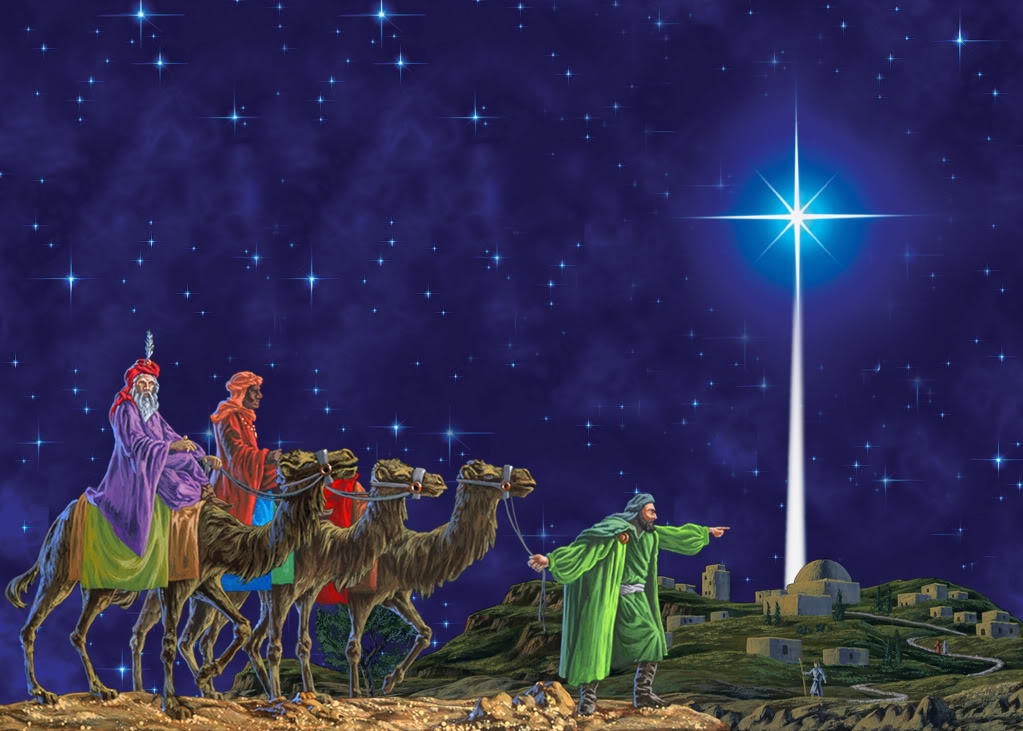
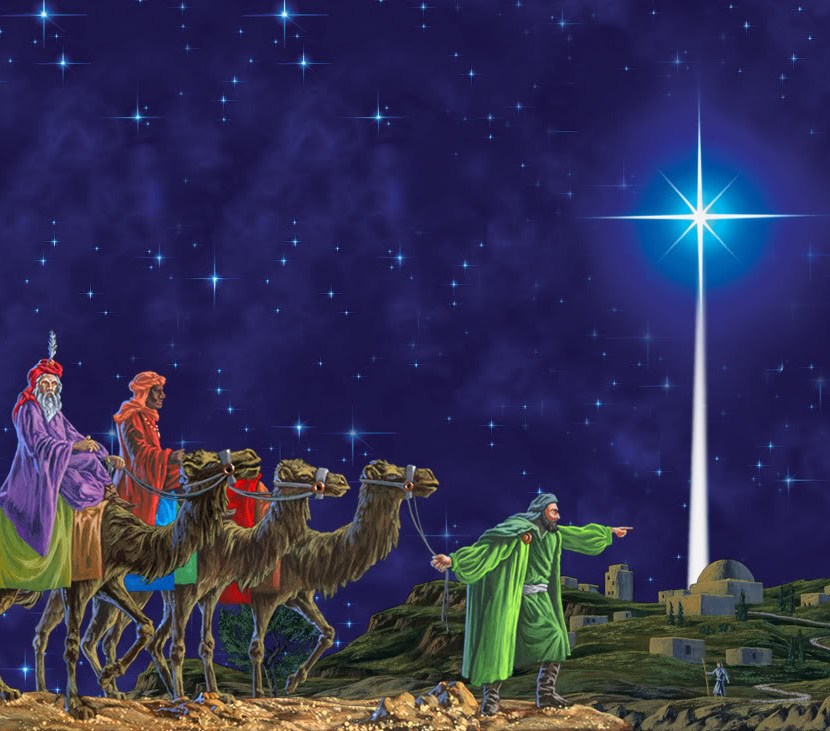
In the time of King Herod, after Jesus was born in Bethlehem of Judea, wise men from the East came to Jerusalem, asking, “Where is the child who has been born king of the Jews? For we observed his star at its rising, and have come to pay him homage.” When King Herod heard this, he was frightened, and all Jerusalem with him; and calling together all the chief priests and scribes of the people, he inquired of them where the Messiah was to be born. They told him, “In Bethlehem of Judea; for so it has been written by the prophet: ‘And you, Bethlehem, in the land of Judah, are by no means least among the rulers of Judah; for from you shall come a ruler who is to shepherd my people Israel.'” Then Herod secretly called for the wise men and learned from them the exact time when the star had appeared. Then he sent them to Bethlehem, saying, “Go and search diligently for the child; and when you have found him, bring me word so that I may also go and pay him homage.” When they had heard the king, they set out; and there, ahead of them, went the star that they had seen at its rising, until it stopped over the place where the child was. When they saw that the star had stopped, they were overwhelmed with joy. On entering the house, they saw the child with Mary his mother; and they knelt down and paid him homage. Then, opening their treasure chests, they offered him gifts of gold, frankincense, and myrrh. And having been warned in a dream not to return to Herod, they left for their own country by another road. Matthew 2:1-12 (NIV)
Today we mark the end of the Christmas season – the Day of Epiphany. We celebrate this day to reflect on the visit of the Magi – the wise men – to Jesus and the giving of their gifts. We reflect on the meaning of this visit of those wise ones to see Jesus.
Epiphany is about Jesus and his message being available and relevant to people of every age and race. Jesus isn’t just a Jewish prophet with an exciting message, but God made present amongst us and available to all of us to worship and follow. God’s love reaches beyond the everyday barriers of race and class; something the Magi didn’t quite get at first.
So Who Were the Magi?
We don’t know much about the Magi from Scripture. All Saint Matthew tells us is that they were “Magi from the East”. Some translations have “Wise men from the East”. The word in Greek refers to priests of the Zoroastrian religion. They came from Persia, the countries now known as Iran and Iraq, and they saw meaning in the movement of the stars. Their visit fits an Eastern pattern of great births being accompanied by momentous events in the sky. Certainly we know of a comet in 11BCE in Gemini with its head towards Leo, seen by many as a symbol of Judah. We also know of planetary conjunctions in both 7 BCE and 6 BCE which would have added to a sense that momentous happenings were on the way. The Magi would have noticed these things and taken them seriously. But who were they?
One commentator, Brian Stoffregen puts it like this;
“Originally in Persia, Magi were dream- interpreters. By Jesus’ time, the term referred to astronomers, fortune-tellers, or star-gazers. They were horoscope fanatics – a practice condemned by Jewish standards. We might compare them to people in fortune – telling booths, or people on the “psychic hotline” or other “occupations” that foretell the future by stars, tea leaves, Tarot cards etc. They were magicians, astronomers, star-gazers, pseudo-scientists, fortune tellers…”
Another writer, Nathan Nettleton, puts it like this;
“They were the speakers of the sacred words at the pagan sacrifices. At worst, the term referred to a magician or sorcerer, or even a deceiver. Magi were people whose activities were repeatedly condemned and prohibited throughout the scriptures and were completely anathema to the people of Israel.”
Whilst in English we get the words “magic” and “magician” from Magi, the Zoroastrian religion forbade sorcery. They clearly were looking for a new king and had found meaning in the movement of the planets and stars which led them to come to Israel to greet the new-born king. They journeyed from their homes in Persia to Bethlehem in search of this baby. Instead of angels and visions, we have the image of the Magi following a sign in the skies – in nature – and for a long period of time. The magi see the intentions of God in the skies. This is not new: Psalm 19 tells us that the heavens themselves declare who God is, and that his handiwork is seen in created nature. “We observed his star at its rising”. The magi know that there is something significant happening.
When did they come?
The Gospel of Saint Luke doesn’t mention the Magi and holds that the Holy Family returned to Nazareth after the presentation of Jesus at the Temple where he was circumcised. It’s probable that Saint Luke didn’t know of this episode in Jesus’ early life. Saint Matthew seems to place the visit of the Magi some time after Jesus’ birth. The Holy Family are in a “house” not in the stable of the inn. Herod kills all the newborn boys under the age of two years. So it’s likely that the Holy Family had stayed for some time in Bethlehem and the Magi came some time after Jesus’ birth, perhaps as long as two years after.
WHY did they come?
Clearly, the Magi were searching. The Magi recognized much of the truth of Jesus, who he was and what he would become. The Magi had a general idea of this God and this King of the Jews, but they didn’t really know who or what they were looking for. Bono and U2 were criticized some years ago by some supposedly orthodox Christians when they produced a song entitled, “I Still Haven’t Found What I’m Looking For,” which is about searching for fulfillment. You see, the example of the Magi was that they were searchers, not really knowing what or who they were looking for. They didn’t claim to have it all but they saw their lives as a journey of discovery. And in that they are an example to us. We don’t know it all. But if we, like them, are prepared to be diligent seekers, then, like them, we may be graced by God’s light, by our own Epiphany. When the wise men finally found Jesus, we are told that their first response was joy – “they were overwhelmed with joy”. That is what happens when we find Jesus. This is what awaits us at the end of the journey. Next, they paid him homage – they worshiped him and acknowledged Him as King. After the joy comes the worship. That means acknowledging Jesus as King. Jesus as the center. Jesus as Lord. And then, after joy and after worship, comes offering of their gifts. In response to who Jesus is and the joy He gives, we offer ourselves and our gifts to Him.
So my message for today is to dare, like them, to take the risk of seeking, and God may well bless us with our own Epiphanies which transform us, as doubtless the Magi were transformed by what must have been a surprising experience for them as they knelt before the infant Jesus.
So how do you find Jesus? Maybe you can start out like the Magi – with a general idea of God, and a general idea that He is guiding you. Like the Magi, we need to turn to the scriptures. If you don’t read them, you will never really get the specific directions that God is trying to give you. Approach them with the right spirit, the right purpose. Ask for help along the way – the church, we, God’s people, are meant to help you along that way. The wise men knew when they needed to ask someone else for help. And pray. Ask God. When you find Jesus, rejoice. After all, He is God. Put Him in the center of your life. Ask yourself whether what you are doing honors him a King. Offer to him what you have, who you are.
Where can this Jesus be found? He is with you now. Won’t you seek Him? Won’t you recognize Him? Won’t you let Him fill YOUR life with joy? Amen.
The Solemnity of the Blessed Virgin ~ Br. John Carson, Postulant
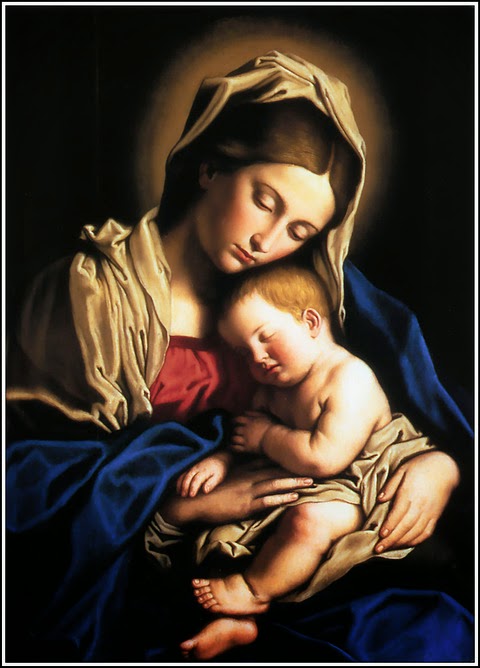
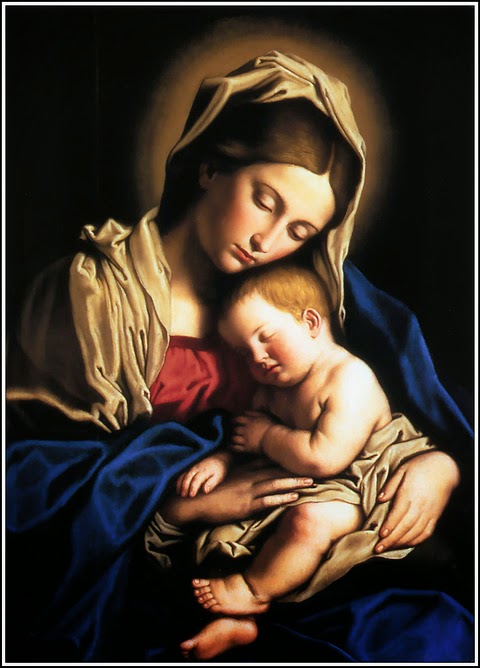
The shepherds went in haste to Bethlehem and found Mary and Joseph, and the infant lying in the manger. When they saw this, they made know the message that they had been told them about this child. All who heard it were amazed by what had been told them by the shepherds. And Mary kept all these things, reflecting on them in her heart. Then the shepherds returned, glorifying and praising God for all they had heard and see, just as it had been told to them.
In the Gospel reading today we read that the shepherds came to pay homage to the Child Jesus and they told Mary and Joseph of the message the angels told them, after paying homage they returned glorifying and praising God.
What can we give to the Child Jesus in our personal homage, a homage that we can give him every day?
We can be angels spreading the message of Christ to those who want to listen to us.
We are also shepherds who give Jesus our homage. We can give Jesus homage in many different ways, by our example, by our way of live and the way we talk and by being true followers of Christ and let Christ take control of our lives, because that is the best homage we can give, our whole self’s.
When Jesus takes control of our lives we can do anything even those things we think is impossible to do.
In the second reading, we read at God sent His son, born of a woman, born under the Law, to ransom those under the law.
Sometimes we are blinded by manmade rules and we forget the laws of Christ, and we are so busy following manmade laws and the law of the Church that we forget to live for God, and worship him with all our hearts.
Churches have so much gold and magnificent statues and pictures and other things, and I keep saying too many churches, that in the simplicity of things God is also glorified.
Some church families are so wrapped up with rules that they do not worship God with their whole being.
As a religious order we have to follow he rule of Holy Father Dominic, but this rule is a simple rule and it can help us to be true followers of Christ.
I would like to finish this sermons with the words of the first reading.
The Lord bless you and keep you.
The Lord let his face shine upon you, and be gracious to you.
The Lord look upon you kindly and give you peace. Amen.
 The Order of Preachers, Independent
You must be logged in to post a comment.