
Category: Sermon

Born Again??? ~ Br. Michael Marshall, Novice

Reading 1: Isaiah 42:1-4, 6-7
Thus says the LORD: Here is my servant whom I uphold, my chosen one with whom I am pleased, upon whom I have put my spirit; he shall bring forth justice to the nations,
not crying out, not shouting, not making his voice heard in the street. a bruised reed he shall not break, and a smoldering wick he shall not quench, until he establishes justice on the earth;
the coastlands will wait for his teaching.
I, the LORD, have called you for the victory of justice, I have grasped you by the hand; I formed you, and set you as a covenant of the people, a light for the nations,
to open the eyes of the blind, to bring out prisoners from confinement, and from the dungeon, those who live in darkness.
Responsorial Psalm: Psalm 29:1-2, 3-4, 3, 9-10
- (11b) The Lord will bless his people with peace.
Give to the LORD, you sons of God, give to the LORD glory and praise, Give to the LORD the glory due his name; adore the LORD in holy attire.
R. The Lord will bless his people with peace.
The voice of the LORD is over the waters, the LORD, over vast waters. The voice of the LORD is mighty; the voice of the LORD is majestic.
R. The Lord will bless his people with peace.
The God of glory thunders, and in his temple all say, “Glory!” The LORD is enthroned above the flood; the LORD is enthroned as king forever.
R. The Lord will bless his people with peace.
Reading 2: Acts 10:34-38
Peter proceeded to speak to those gathered in the house of Cornelius, saying: “In truth, I see that God shows no partiality. Rather, in every nation whoever fears him and acts uprightly
is acceptable to him. You know the word that he sent to the Israelites as he proclaimed peace through Jesus Christ, who is Lord of all, what has happened all over Judea,
beginning in Galilee after the baptism that John preached, how God anointed Jesus of Nazareth with the Holy Spirit and power. He went about doing good and healing all those oppressed by the devil, for God was with him.”
Gospel: Luke 3:15-16, 21-22
The people were filled with expectation, and all were asking in their hearts whether John might be the Christ. John answered them all, saying, “I am baptizing you with water,
but one mightier than I is coming. I am not worthy to loosen the thongs of his sandals. He will baptize you with the Holy Spirit and fire.”
After all the people had been baptized and Jesus also had been baptized and was praying, heaven was opened and the Holy Spirit descended upon him in bodily form like a dove.
And a voice came from heaven, “You are my beloved Son; with you I am well pleased.”
It seems so strange to have celebrated Epiphany last Sunday; a part of the story of Jesus as an infant, and now here we are celebrating the Baptism of the Lord when Jesus was an adult. We do have the story of Jesus as a boy sitting in the Temple, which we cannot discount as important in the life of Christ, but this fast forward to his baptism as an adult is very significant because it is the event which transpires at the very beginning of Jesus’ active ministry. It was not THE BEGINNING of the Christ-story, but a beginning of its own sort.
Most Catholics do not remember their baptism because it happened shortly after birth, yet some of us do remember our baptism if baptized later in life. Baptism is a Sacrament which connects us to God, yet many of our Protestant Brothers and Sisters associate baptism as washing away sins, wiping the slate clean and righting our relationship with God. Baptism is definitely part of salvation, and a turning point in which we say yes to following God by living a new life; something which some Christians refer to as being “born again” which I think has something to teach us. As I stated earlier, baptism is a Sacrament and sometimes just seen as part of the initiation into Catholicism, but baptism is SO MUCH MORE, and I think that is why our Protestant Brothers and Sisters got it right. It is not just a Sacrament of Initiation… It is a “born again” experience, a beginning to follow Jesus. Our baptism is just like Jesus’ in the sense that our birth is the beginning of our life, yet our baptism is our first call to follow the Lord; the beginning of our active ministry whether we want to acknowledge it or not.
In most cases, the Prophetic Books speak about what is to come; what the Lord has planned for humanity, essentially pointing to the coming of Jesus. Yet in the Reading from Isaiah for today, we see more than just a prophecy. We see that the Lord tells the people that they are chosen as servants, called to do good works and bring people out of darkness. They are to be of ministry to others. By our baptism we are called just as the Israelites in the time of Isaiah were called; our calling is to help our neighbor, show the love of God through our thoughts and actions. Our baptism is not just part of some checklist to become fully initiated as Catholics. Thinking in such a way is not living as God intends. We read in the Gospel that when Jesus was baptized, God was pleased by what took place; and from that moment, the ministry of Jesus started. Jesus did not get baptized, and then nothing else happened. So, how should we think about our baptism? If we think of it as part of a checklist, might we change what we think by actually believing it is our “born again” experience that is the start of our ministry? Just as God was pleased with Jesus, should we want God to be pleased in the fact we are baptized, and choosing to do minister to our neighbor?
Where Is He? ~ The Rt. Rev. Michael Beckett, OPI
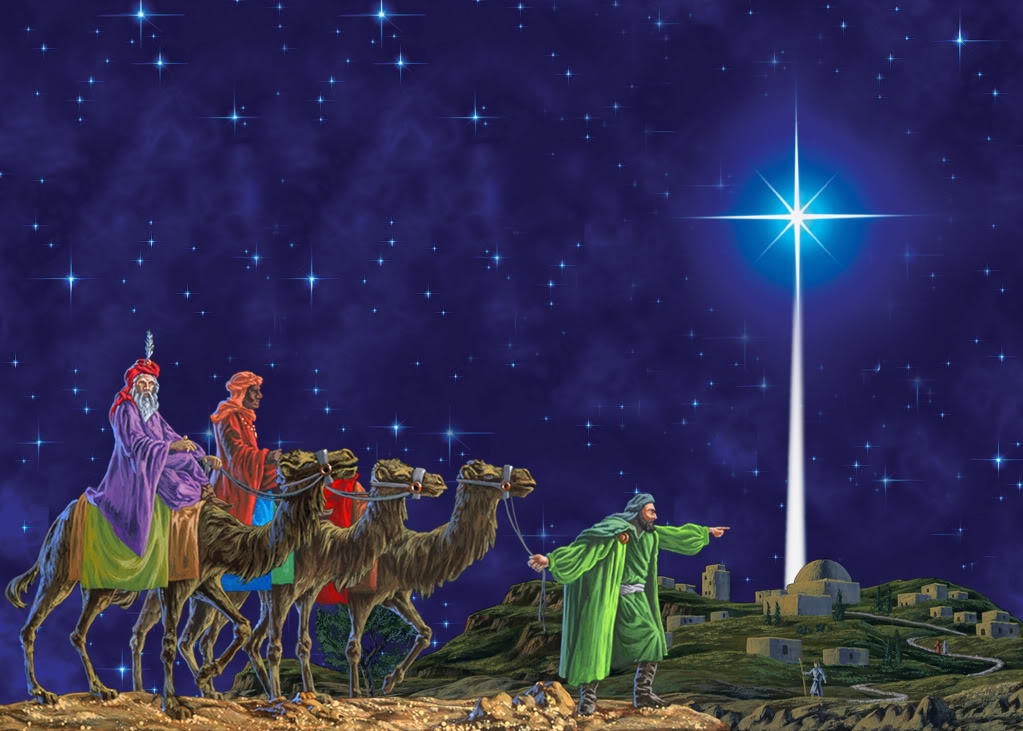
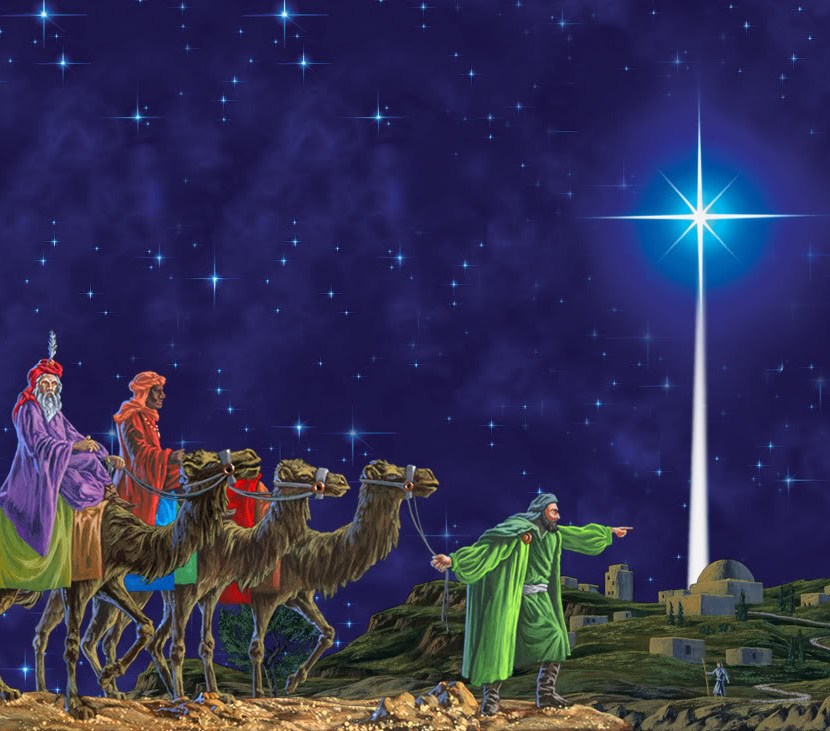
In the time of King Herod, after Jesus was born in Bethlehem of Judea, wise men from the East came to Jerusalem, asking, “Where is the child who has been born king of the Jews? For we observed his star at its rising, and have come to pay him homage.” When King Herod heard this, he was frightened, and all Jerusalem with him; and calling together all the chief priests and scribes of the people, he inquired of them where the Messiah was to be born. They told him, “In Bethlehem of Judea; for so it has been written by the prophet: ‘And you, Bethlehem, in the land of Judah, are by no means least among the rulers of Judah; for from you shall come a ruler who is to shepherd my people Israel.'” Then Herod secretly called for the wise men and learned from them the exact time when the star had appeared. Then he sent them to Bethlehem, saying, “Go and search diligently for the child; and when you have found him, bring me word so that I may also go and pay him homage.” When they had heard the king, they set out; and there, ahead of them, went the star that they had seen at its rising, until it stopped over the place where the child was. When they saw that the star had stopped, they were overwhelmed with joy. On entering the house, they saw the child with Mary his mother; and they knelt down and paid him homage. Then, opening their treasure chests, they offered him gifts of gold, frankincense, and myrrh. And having been warned in a dream not to return to Herod, they left for their own country by another road. Matthew 2:1-12 (NIV)
Today we mark the end of the Christmas season – the Day of Epiphany. We celebrate this day to reflect on the visit of the Magi – the wise men – to Jesus and the giving of their gifts. We reflect on the meaning of this visit of those wise ones to see Jesus.
Epiphany is about Jesus and his message being available and relevant to people of every age and race. Jesus isn’t just a Jewish prophet with an exciting message, but God made present amongst us and available to all of us to worship and follow. God’s love reaches beyond the everyday barriers of race and class; something the Magi didn’t quite get at first.
So Who Were the Magi?
We don’t know much about the Magi from Scripture. All Saint Matthew tells us is that they were “Magi from the East”. Some translations have “Wise men from the East”. The word in Greek refers to priests of the Zoroastrian religion. They came from Persia, the countries now known as Iran and Iraq, and they saw meaning in the movement of the stars. Their visit fits an Eastern pattern of great births being accompanied by momentous events in the sky. Certainly we know of a comet in 11BCE in Gemini with its head towards Leo, seen by many as a symbol of Judah. We also know of planetary conjunctions in both 7 BCE and 6 BCE which would have added to a sense that momentous happenings were on the way. The Magi would have noticed these things and taken them seriously. But who were they?
One commentator, Brian Stoffregen puts it like this;
“Originally in Persia, Magi were dream- interpreters. By Jesus’ time, the term referred to astronomers, fortune-tellers, or star-gazers. They were horoscope fanatics – a practice condemned by Jewish standards. We might compare them to people in fortune – telling booths, or people on the “psychic hotline” or other “occupations” that foretell the future by stars, tea leaves, Tarot cards etc. They were magicians, astronomers, star-gazers, pseudo-scientists, fortune tellers…”
Another writer, Nathan Nettleton, puts it like this;
“They were the speakers of the sacred words at the pagan sacrifices. At worst, the term referred to a magician or sorcerer, or even a deceiver. Magi were people whose activities were repeatedly condemned and prohibited throughout the scriptures and were completely anathema to the people of Israel.”
Whilst in English we get the words “magic” and “magician” from Magi, the Zoroastrian religion forbade sorcery. They clearly were looking for a new king and had found meaning in the movement of the planets and stars which led them to come to Israel to greet the new-born king. They journeyed from their homes in Persia to Bethlehem in search of this baby. Instead of angels and visions, we have the image of the Magi following a sign in the skies – in nature – and for a long period of time. The magi see the intentions of God in the skies. This is not new: Psalm 19 tells us that the heavens themselves declare who God is, and that his handiwork is seen in created nature. “We observed his star at its rising”. The magi know that there is something significant happening.
When did they come?
The Gospel of Saint Luke doesn’t mention the Magi and holds that the Holy Family returned to Nazareth after the presentation of Jesus at the Temple where he was circumcised. It’s probable that Saint Luke didn’t know of this episode in Jesus’ early life. Saint Matthew seems to place the visit of the Magi some time after Jesus’ birth. The Holy Family are in a “house” not in the stable of the inn. Herod kills all the newborn boys under the age of two years. So it’s likely that the Holy Family had stayed for some time in Bethlehem and the Magi came some time after Jesus’ birth, perhaps as long as two years after.
WHY did they come?
Clearly, the Magi were searching. The Magi recognized much of the truth of Jesus, who he was and what he would become. The Magi had a general idea of this God and this King of the Jews, but they didn’t really know who or what they were looking for. Bono and U2 were criticized some years ago by some supposedly orthodox Christians when they produced a song entitled, “I Still Haven’t Found What I’m Looking For,” which is about searching for fulfillment. You see, the example of the Magi was that they were searchers, not really knowing what or who they were looking for. They didn’t claim to have it all but they saw their lives as a journey of discovery. And in that they are an example to us. We don’t know it all. But if we, like them, are prepared to be diligent seekers, then, like them, we may be graced by God’s light, by our own Epiphany. When the wise men finally found Jesus, we are told that their first response was joy – “they were overwhelmed with joy”. That is what happens when we find Jesus. This is what awaits us at the end of the journey. Next, they paid him homage – they worshiped him and acknowledged Him as King. After the joy comes the worship. That means acknowledging Jesus as King. Jesus as the center. Jesus as Lord. And then, after joy and after worship, comes offering of their gifts. In response to who Jesus is and the joy He gives, we offer ourselves and our gifts to Him.
So my message for today is to dare, like them, to take the risk of seeking, and God may well bless us with our own Epiphanies which transform us, as doubtless the Magi were transformed by what must have been a surprising experience for them as they knelt before the infant Jesus.
So how do you find Jesus? Maybe you can start out like the Magi – with a general idea of God, and a general idea that He is guiding you. Like the Magi, we need to turn to the scriptures. If you don’t read them, you will never really get the specific directions that God is trying to give you. Approach them with the right spirit, the right purpose. Ask for help along the way – the church, we, God’s people, are meant to help you along that way. The wise men knew when they needed to ask someone else for help. And pray. Ask God. When you find Jesus, rejoice. After all, He is God. Put Him in the center of your life. Ask yourself whether what you are doing honors him a King. Offer to him what you have, who you are.
Where can this Jesus be found? He is with you now. Won’t you seek Him? Won’t you recognize Him? Won’t you let Him fill YOUR life with joy? Amen.
The Solemnity of the Blessed Virgin ~ Br. John Carson, Postulant
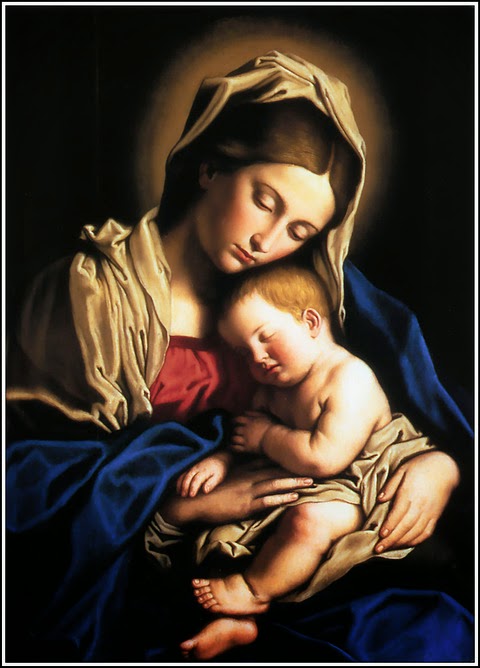
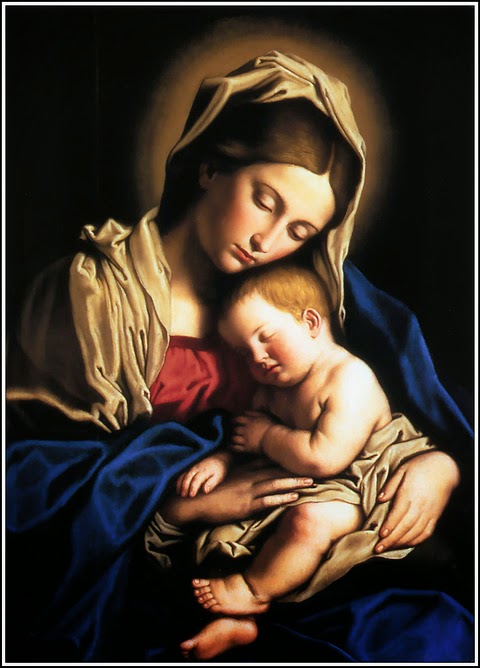
The shepherds went in haste to Bethlehem and found Mary and Joseph, and the infant lying in the manger. When they saw this, they made know the message that they had been told them about this child. All who heard it were amazed by what had been told them by the shepherds. And Mary kept all these things, reflecting on them in her heart. Then the shepherds returned, glorifying and praising God for all they had heard and see, just as it had been told to them.
In the Gospel reading today we read that the shepherds came to pay homage to the Child Jesus and they told Mary and Joseph of the message the angels told them, after paying homage they returned glorifying and praising God.
What can we give to the Child Jesus in our personal homage, a homage that we can give him every day?
We can be angels spreading the message of Christ to those who want to listen to us.
We are also shepherds who give Jesus our homage. We can give Jesus homage in many different ways, by our example, by our way of live and the way we talk and by being true followers of Christ and let Christ take control of our lives, because that is the best homage we can give, our whole self’s.
When Jesus takes control of our lives we can do anything even those things we think is impossible to do.
In the second reading, we read at God sent His son, born of a woman, born under the Law, to ransom those under the law.
Sometimes we are blinded by manmade rules and we forget the laws of Christ, and we are so busy following manmade laws and the law of the Church that we forget to live for God, and worship him with all our hearts.
Churches have so much gold and magnificent statues and pictures and other things, and I keep saying too many churches, that in the simplicity of things God is also glorified.
Some church families are so wrapped up with rules that they do not worship God with their whole being.
As a religious order we have to follow he rule of Holy Father Dominic, but this rule is a simple rule and it can help us to be true followers of Christ.
I would like to finish this sermons with the words of the first reading.
The Lord bless you and keep you.
The Lord let his face shine upon you, and be gracious to you.
The Lord look upon you kindly and give you peace. Amen.
Looking for Jesus ~ Feast of the Holy Family ~ Br. John Carson, Postulant
The Gospel for today:
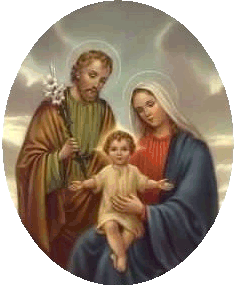
Each year Jesus’ parents went up to Jerusalem for the feast of Passover, and when he was twelve years old, they went up according to festival custom. After they had completed its days, as they were returning, the boy Jesus remained behind in Jerusalem, but his parents did not know it. Thinking that he was in the caravan, they journeyed for a day and looking for him among their relatives and acquaintances, but not finding him, they returned to Jerusalem to look for him. After three days they found him in the temple, sitting in the midst of the teachers, listening to them and asking them questions, and all who heard him were astounded at his understanding and his answers. When his parents saw him, they were astonished, and his mother said to him, “Son, why have you done this to us? Your father and I have been looking for you with great anxiety”. And he said to them, “Why where you looking for me? Did you not know that I must be in my Father’s house?” But they did not understand what he said to them. He went down with them and came to Nazareth, and he was obedient to them; and his mother kept all these things in her heart. And Jesus advanced in wisdom and age and favour before God and man. Amen.
Today we read in the Gospel the familiar story about the Holy family going to Jerusalem for the Passover. The Gospel tells us that after the Passover, the Holy Family were on their way back to Nazareth, but the Child Jesus stayed behind without his parents knowing, when his parents found that Jesus was not with their relatives or acquaintances, they looked everywhere for him and they found him in the Temple three days later. Mary said to Jesus that they have been looking for him and Jesus replies, “Did you not know that I was must in my Father’s house,”
How do we fit this story into our daily lives?
We are on a journey where our Jesus is to celebrate the Passover in heaven with the whole company of heaven, with the Holy Family at the right hand of God.
We are also sometimes nowhere to be found when Jesus looks for us and sometimes we close the door so Jesus can’t get through. We are sometimes the ones searching for something and sometimes it is Jesus himself that we are look for.
We find Jesus everywhere, but especially in the Father House, the Church. And also in the Sacraments.
Are we going to be found in our Father’s house or as some Bibles say “dealing with my Father’s affairs?” are we like Jesus, are we dealing with our Father’s affairs, we as Dominican’s are dealing with our Father’s affairs every time we are doing our ministry, every time we say Mass, preaching, helping the poor, visiting the sick and also praying for the needs of the world.
Our Father’s house is everywhere we do our ministry.
At the end of the Gospel we read that Jesus went back to Nazareth, and was obedient to them.
And that is what we are called to do, be obedient unto death.
Finally, let us pray for each other in the world that we live in, and by the example of the Holy Family and the Child Jesus, be obedient to the teaching of the Church and the our Dominican Rule and our Superiors. Amen.
Peace, Peace ~ Br. Chip Noon, Novice

“In the tender compassion of our God
the dawn from on high shall break upon us,
to shine on those who dwell in darkness and the shadow of death,
and to guide our feet into the way of peace.”
Years ago, I was sitting with my mother in her assisted living apartment, reading the Liturgy of the Hours. My mother, who was the most spiritual and “faithful” person I’ve ever known, wanted to hear what I was reading. So I read Zecharaiah’s canticle, “Blessed be the Lord, the God of Israel…”
When I finished she said, “That is beautiful.”
I had never thought of it like that. Leave it to mothers to show us the way!
In my memory, Christmas Eve is a calm, comfortable, warm…perfect night. From the time I was a young child, quivering in anticipation, through my youth, until now in my old age, Christmas Eve has always…well, almost always…had this aura for me. Cozy, some would call it.
O Holy Night! The stars are brightly shining,
It is the night of the dear Saviour’s birth.
Long lay the world in sin and error pining.
Till He appeared and the soul felt its worth.
A thrill of hope the weary world rejoices,
For yonder breaks a new and glorious morn.
Fall on your knees! Oh, hear the angel voices!
O night divine, o night when Christ was born;
O night, O Holy Night, O night divine!
O night, O Holy Night, O night divine!
Except for one Christmas Eve.
That was not cozy…nor anything comforting.
I remember vividly, to this day, banging on the dining room window with a wooden block, the kind that had letters and numbers on it, banging so hard my mother was afraid I’d break the glass. I can see my father’s car pulling out of the driveway and going up the street, off to the bar, or the liquor store, or wherever he shouted that he was going. My mother, brother, sister, and I were alone on Christmas Eve. I was crying and bereft. And my mother was comforting us.
My father came back from the infantry in World War II a full-blown alcoholic, as my mother told it. And to tell the truth, Christmas Eve was not always calm, comfortable, warm, nor perfect. But as a child, I fell back on the blessings of the season and willed myself into a Currier and Ives depiction of what I wanted in my life.
I made it comfortable. Today I believe that the Holy Spirit helped us through those difficult times, those Christmas holidays that were so fraught with terror for little kids. Because my mother could see what was beautiful in the world around her. She made it comfortable for all of us.
What’s past is past. And as my wife recently said to me of difficult people, “One way to look at them is that they are just doing the best they can.”
As an aside here, it’s unnerving to think that you have married a woman just like your mother!
There’s a faith that can bring us peace. A faith in God, as with my mother, and a faith in humanity, as with my wife. Faith. We know that on Christmas Eve, the baby Jesus will be born again in all our minds. And that the promise we have heard will be fulfilled. And we know that our children, family, and friends will either be with us or thinking of us this night. And we know the thrill of hope in the new and glorious morn.
So we fall on our knees. We rejoice in the peace of God, which passeth all understanding. And we find comfort in the dark night, the sounds of the carols, the anticipation of friends, family, and the coming of the infant in the manger.
For no matter what we are facing, we can take comfort in the knowledge that God has said to us that we will have no burden that we cannot bear, that there is a calm in our souls, and that tomorrow will bring a new dawn of love and peace.
Merry Christmas!
Lord, thank you for coming to our help in our times of happiness and our times of sorrow. Thank you for giving us the splendor of your presence in the form of a little child. Thank you for the peace which passeth all understanding. Amen.

Rejoice! Rejoice! ~ The Rev. Lady Sherwood, OPI

Rejoice! Rejoice! Our Gift from God is Born!
The Christmas tree stands proudly and ladened with beautiful decorations. Christmas gifts of all shapes and sizes surround the tree, all prettily wrapped in fancy paper, tied with an array of colourful ribbons and bows.
The faces of happy children all aglow with excitement as they tear open these gifts on Christmas morning. Oh what Joy!
But the true gift which came from God Our Father, to every single one of us didn’t come wrapped in fancy paper, this precious gift was not fastened with ribbons and bows.
This true gift of pure love and salvation was born in a lowly stable in Bethlehem and his bed was a feeding trough for animals.
This perfect, wondrous and precious gift came down to us from the heavens to free us from the damnation of sin and to be our salvation.
All this he did for us because of the love Our heavenly Father has for us. Our dear Lord! Who left his throne on high to be born lowly on earth amongst us and who would love us to teach us the ways of righteousness. He loves us to the extent that this lowly yet heavenly babe would later give himself willingly up to death upon the cross to atone for our sins, he did this to save us!
Oh such a truly wonderful gift to us from Our Father, even though we are unworthy sinners! A Holy gift of such perfect love!
This is the true gift of Christmas! The gift of God to you, to me, to everyone.
Let us rejoice! Rejoice! Let us offer the Lord praise and thanksgiving!
Let us accept anew in our hearts and in our lives this wonderful and incomprehensible gift of pure love and let us with all the heavenly hosts-Rejoice!!

What’s in a Name? ~ Br. Chip Noon, Novice

Is his name Jesus or Emmanuel?
I always had this question growing up, and it fueled many other contradictory statements that I found in the Bible and the Gospels I heard at Mass.
Jesus? Emmanuel? And why is it sometimes spelled Immanuel? And why also is he Jesus Christ or Jesus or, as in Paul’s writings, Christ Jesus?
For a young child, and even for some of us adults, these name switches can be unnerving. (And for now, we’ll leave out all that bit about not having Joseph as his real father…some things are a little too much for kids.)
But wait. Now that I think of it, isn’t that the whole point of the differences between then and now, between good catechesis and the stuff some of us were served up in Sunday school and in homilies? These differences, and sometimes contradictions, confuse us if we are interpreting them from our present lives and experiences…and if we are not taught from an early age that the original language of the Bible was not English, or French, or even Latin.
Let me give an example for a minute: do you remember the exercise where there is a room full of people and one person is told a story. Then she must pass that story, in secret, to the next person, who in turn passes it on, until everyone is filled in. Then the last person tells the whole room the story out loud, and then the first does the same. Usually, there are two very different stories related, to much laughter and some embarrassment.
Now let’s go back to Jesus and Emmanuel.
First of all, his name was Yehoshua, which became Yeshua, which became Yesous in Greek, which became Jesus in English. And of course, there were many variations from the time of his birth to modern English. It means “God saves.” And the angel of the Lord said he should be named this “because he will save them from their sins.”
And then—Emmanuel. This means “God is with us” according to the Gospel for today. This is the same kind of name that we read in Isaiah: “And he will be called Wonderful, Counselor, Mighty God, Everlasting Father, Prince of Peace.
So what are we to do? Unlike in the example of the different stories I just mentioned, we have written records, translated and interpreted as they have been for two thousand years. What we call our Savior is not the issue, though, is it?
Just like children waiting for Christmas and the presents under the tree, the man’s name, the name of the holiday, the narrative, the celebration just gives us some touchstone to refer to when we really mean God will save us from our sins. And when we really mean on this day God came to live among us to show that he is with us.
As we hear in today’s Responsorial Psalm, this is the story we are being told, no matter how many translations there are:
For he shall rescue the poor when he cries out,
and the afflicted when he has no one to help him.
He shall have pity for the lowly and the poor;
the lives of the poor he shall save.
Much of our daily lives are taken up with the surface things. We skim over the underlying meanings because we have context through which to understand them. And sometimes it seems at this time of year we just skim over the “true meaning of Christmas.”
But isn’t this quite natural, since we grow up knowing that Christmas means presents and lots of food and wonderful music. Truly a magical time…for most of us, that is.
So while today is just a week away from Christmas Day, and while if we were kids we’d be looking forward to school recess and all those presents, let’s just take a moment to dig deeper. To think of the name the angel gave: God will save us from our sins. To think of the name Isaiah prophesied: God is with us.
Think of these names for a moment. Here are presents and celebrations enough to give us thought every day of our lives. Saved from our sins by God who is right here. The heavens don’t have to open for us to be in the company of angels and in the bosom of our Lord. We are already with them and he is in us and we are in him.
As the Lord lives, we have arrived and we know him as he is. It just takes the heart of a child.
Today Lord, help us in our anticipation to know that the wait is over and the fire is lit, the feast is on the table, and the candle is in the window.

Follow Me ~ The Rev. Deacon Jay Van Lieshout, OPI
Gaudete, praeparari faceret quem tu praedicas.

Be prepared, the Lord is coming. This is the recurrent cry heard in the readings in this advent season. Be prepared, make the mountains low, raise up the valleys and make the paths straight for the coming of the Lord. What a poetic image these words create on the importance of being prepared. And today, the 3rd Sunday of advent we hear the introit exclaiming “Gaudete in Domino semper: iterum dico, gaudete! (Rejoice in the Lord always; again I say, rejoice)!” The King of Israel is near and it is time to celebrate the arrival of a mighty savior. Yes, the Messiah is at hand, just 12 more shopping days until Christmas: are you ready for the festivities? Is your tree up? Are all the lights lit? Do you have the fixings for the feast, the stuffing, the peas and the roast beast? Are your gifts wrapped, and stockings hung and have you made that pudding with the plums? Have you readied all for this big affair, surely this is how to be prepared. Or is it?
We all grasp what it means to be ready for the holiday festivities, yet this has little to do with the being prepared for the joy, the gladness and ecstasy found in this most humble of nativities. How does one prepare for the coming of the messiah, the King of Kings, the Lord and Savior, the one who brings the peace, the joy and the love of the Creator to all of humanity? How does one shop and cook for the alpha and omega; do you get Him a tie, make Him cookies and milk? What do we DO to prepare ourselves for this auspicious arrival of the most Sacred and Holy One?
It’s a very good question, and one asked by the people to whom John the Baptist preached. And the answer John gave was simple: Practice what you Preach and do the good your faith would have you do. The good news John brought to the people ahead of Jesus was not novel or revolutionary; it is the message found in the sacred texts, proclaimed by the prophets and promised to man by the Creator from the dawn of time. John proclaimed the coming of the Word made Flesh, the manifestation of the truth in their faith here on earth. John told the crowds that the Christ is the living expression of this truth, the light of creation, the living example of God’s truth. To be prepared to meet the word made flesh, one must live the word; share what you have with those who do not have, take no more than you are due, do not be greedy, do not steal cheat or lie; practice your faith in all aspects of your life and you will be prepared.
We all should be practicing our faith in everything we do and say. Practice your faith, it probably sounds strange to your ears; we think of practice as something one does in sports, like throwing a ball, or in the arts like singing or playing the piano, and faith is like the thoughts we have in our heart or mind. When I was in college, I had a theology professor who said “faith is something you DO, not something you have”. Those words have stuck with me these many years and they are the key to being prepared. We must practice,( ie apply, perform, do over and over) our faith (the things God has told us He wants us to do). Jesus was the living embodiment of the word: He walked, talked and acted according to how God wants each of us to live and act. He lived out His obligation, His part, OUR part of the covenant with the Creator. God promises that by living, breathing and acting according to His commands we would always be prepared, and in being prepared the Lord will always be at hand, we will be known for all the good we do, our hearts will for ever rejoice in the Lord and our prayers will be answered. When we walk the walk, and talk the talk, we will have no fear; no anxiety, for the Lord God will rejoice over us and, as St Paul so adeptly said, “The peace of God that surpasses all understanding will guard our hearts and minds in Christ Jesus.” Today, Gaudete Sunday, let us be prepared to practice our faith in our home, our work, our places of worship, out on the streets and in the alleys and throughout all aspects of our life. As you go forth remember, the spirit of the Lord is upon each of you and you have been anointed to bring glad tidings to the poor, the needy, the outcast and the suffering; live the word, practice your faith, be the good news and you will always be prepared. Amen.

Leap of Faith – Feast of Our Lady of Guadalupe ~ Br. Michael Marshall, Novice

Our Lady of Guadalupe is known as the Patroness of the Americas. In December of 1531, the Blessed Virgin appeared to an Aztec Indian Man by the name of Juan Diego on Tepeyac Hill outside of what is now known as Mexico City. This was a very significant event in the history of religion in Latin America because the Aztec culture and religion was centered on the gods, while the Conquistadors brought Catholicism; and there was a clash between the two for a number of years, eventually the Indian religions disappeared. Many Indian folks converted to Catholicism due to missionary presence in Latin America.
Our Lady of Guadalupe appeared to Juan Diego, as an indigenous woman, asking that a church be built at that location. She told Juan Diego to go to his bishop to tell of this request, only his story to be believed after the fourth apparition. Castilian roses were on the hill which do not grow in that region, or in December for that matter. To prove that the Virgin had appeared again, he cut the roses and put them in his cloak to show the bishop. When Juan Diego addressed the bishop, the image of Our Lady of Guadalupe appeared in the cloak after the roses fell on the ground. The fifth and last apparition was to Juan Diego’s uncle who was ill. Juan Diego was worried about his uncle and the Virgin told him that his ill uncle who was on his deathbed would return to good health.
Images of Our Lady of Guadalupe show her wearing a dress with jasmine flowers and a mantle which has stars. These have reference to the Aztec culture and the Winter Solstice, as she appeared to Juan Diego as an indigenous woman. The impact on her apparition was huge because this was a turning point in which the people connected with Catholicism, instead of through the influence from the Europeans.
The tradition which happens on the Feast of Our Lady of Guadalupe is the Mexican people wake up very early and go to church, and they serenade Mary and pray. Boys dress up as Juan Diego. This tradition is referred to as Las Manañitas. It lasts for several hours. This Feast is a time for the Mexican people, and immigrants to connect with Mary from their own context.
First Reading: Revelation 11:19a; 12:1-6a, 10ab
God’s temple in heaven was opened,
and the ark of his covenant could be seen in the temple.
A great sign appeared in the sky, a woman clothed with the sun,
with the moon under her feet,
and on her head a crown of twelve stars.
She was with child and wailed aloud in pain as she labored to give birth.
Then another sign appeared in the sky;
it was a huge red dragon, with seven heads and ten horns,
and on its heads were seven diadems.
Its tail swept away a third of the stars in the sky
and hurled them down to the earth.
Then the dragon stood before the woman about to give birth,
to devour her child when she gave birth.
She gave birth to a son, a male child,
destined to rule all the nations with an iron rod.
Her child was caught up to God and his throne.
The woman herself fled into the desert
where she had a place prepared by God.
Then I heard a loud voice in heaven say:
“Now have salvation and power come,
and the Kingdom of our God
and the authority of his Anointed.”
Responsorial Psalm: Judith 13:18bcde, 19
- (15:9d) You are the highest honor of our race.
Blessed are you, daughter, by the Most High God,
above all the women on earth;
and blessed be the LORD God,
the creator of heaven and earth.
R. You are the highest honor of our race.
Your deed of hope will never be forgotten
by those who tell of the might of God.
R. You are the highest honor of our race.
Gospel: Luke 1:26-38
The angel Gabriel was sent from God
to a town of Galilee called Nazareth,
to a virgin betrothed to a man named Joseph,
of the house of David,
and the virgin’s name was Mary.
And coming to her, he said,
“Hail, full of grace! The Lord is with you.”
But she was greatly troubled at what was said
and pondered what sort of greeting this might be.
Then the angel said to her,
“Do not be afraid, Mary,
for you have found favor with God.
Behold, you will conceive in your womb and bear a son,
and you shall name him Jesus.
He will be great and will be called Son of the Most High,
and the Lord God will give him the throne of David his father,
and he will rule over the house of Jacob forever,
and of his Kingdom there will be no end.”
But Mary said to the angel,
“How can this be,
since I have no relations with a man?”
And the angel said to her in reply,
“The Holy Spirit will come upon you,
and the power of the Most High will overshadow you.
Therefore the child to be born
will be called holy, the Son of God.
And behold, Elizabeth, your relative,
has also conceived a son in her old age,
and this is the sixth month for her who was called barren;
for nothing will be impossible for God.”
Mary said, “Behold, I am the handmaid of the Lord.
May it be done to me according to your word.”
Then the angel departed from her.
In the Gospel we find Mary confused as to why she would be chosen to be the mother of the Son of God, but she recognized it was her calling from the Lord. She embraced what the Lord asked of her instead of refusing. Let’s use the saying, “You tell God your plans, and He laughs.” It is often very true because we have hopes and ambitions for ourselves, and what you desire does not always jive with what God desires for you, and sometimes it does jive. Although when your plans do not match God’s, it can be very hard to submit to His will. Yet it takes faith and trust in the Lord that He knows what is best.
I know a fellow who felt called to be a priest, and he entered seminary with the local diocese. Everything felt right during his first year of seminary, and then when he was home for vacation during the summer, he met a gal who he was very attracted to more than being friends. He knew he was in formation so did not act upon those feelings. He returned to seminary in the Fall, and through spiritual direction and prayer, he realized he had to leave formation. The fellow was very confused and torn because he felt called to the priesthood; or at least thought God called him. But he put trust in God because he knew he had to. When returning home, he started to really have a hard time comprehending what happened despite putting trust in God. The gal found out that he had left seminary, so took a shot at asking him out. They dated for some time, and finally got married. As much as leaving seminary was hard for the fellow, he his trust led him to his true calling in life; the calling to be a husband and a father. He is happier in those capacities more than when he was pursuing the priesthood.
When God presents you with something, or asks you to do something, are you going to say no because you have your own desires, or will you trust that God knows what is best? Are you going to accept the task, as Mary did? Are you going to be willing to change directions if God desires it, just as the fellow did? It is not easy to take such a leap of faith… But take that leap because good will come out of it.

A Joy-Filled Prayer ~ Sister Dollie Wilkinson, OPI

Just a few shorts days ago, we celebrated Thanksgiving. It is a time to reflect on every thing we have to be thankful for: family, good friends, yummy foods, and all the other things that we take for granted throughout the year, We may also turn our thoughts to those less fortunate, and resolve to donate to a worthy cause, volunteer at a soup kitchen, or drop some coins in those Salvation Army red kettles. Now we are in the season of Advent. It is a time for quiet reflection. A time to clear out the mental clutter, so that we may have a deeper relationship with God, the Father.
As I was reading over the scripture for today, the letter from Paul, to the Philippians, really hit home. Now remember, Paul wrote to the Philippians from prison in Rome in approximately A.D. 61 or 62, about ten years after Paul, Silas, Timothy, and Luke first arrived in Philippi with the gospel message. At the end of Acts, we read about Paul being in prison in Rome awaiting trial. Philippians seems to have been written after the close of Acts but before Paul’s release from his first Roman imprisonment. As Paul writes, he is hopeful of being released soon. Certain statements in Philippians hint that Paul’s trial may have already concluded and that he was only awaiting the verdict of life or death at the time he wrote this scripture. Although the verdict could call for him to be executed, Paul was hopeful, expecting to be released from prison soon.
In Philippians 1:3-11, Paul describes his love for the people of Phillipi, and especially his congregation.
“I thank my God every time I remember you, constantly praying with joy in every one of my prayers for all of you, because of your sharing in the gospel from the first day until now. I am confident of this, that the one who began a good work among you will bring it to completion by the day of Jesus Christ. It is right for me to think this way about all of you, because you hold me in your heart, for all of you share in God’s grace with me, both in my imprisonment and in the defense and confirmation of the gospel. For God is my witness, how I long for all of you with the compassion of Christ Jesus. And this is my prayer, that your love may overflow more and more with knowledge and full insight to help you to determine what is best, so that in the day of Christ you may be pure and blameless, having produced the harvest of righteousness that comes through Jesus Christ for the glory and praise of God.”
During his imprisonment, Paul frequently remembered the church and always offered up prayers with joy. Here is a man, in prison, but his thoughts are not about himself, nor whether he will live another day. Besides his love of the heavenly Father, his thoughts, love, and prayers are always for his people. The prayer life that Paul exemplifies puts most of us to shame. You may wish you could pray like he does. Surprisingly, it may not be as hard as you might think. Paul cultivates the discipline of “remembering” (1:3). He consciously and continually trains his mind to reflect on God’s people. This is a discipline, just like working out or eating healthy. But it works wonders in prayer. Here are a couple examples. When you see a little boy on a bike, instead of just thinking, “What a cute kid,” let this boy remind you to pray for the children in your church, or school. When you see a young couple in the mall or in a restaurant, don’t just think: “I wish my marriage was like theirs”, or “I wish I was married”. Or a popular one I hear some days, “I wish I wasn’t married.” Instead, pray for this family, or pray for your own family members.
When you see someone with gray hair, instead of thinking, “I hope I don’t turn gray or get old.” Instead pray for the seniors citizens in your neighborhood who may live alone. Pray for widows and widowers, who are lonely and in need, to experience God’s provisions. When you hear a different dialect, instead of thinking to yourself, “Hmm, that’s odd sounding”. Or especially with the current events in the world, mumble under your breath, “Oh, its one of those people, the ones who are causing the immigrant crisis”. Instead pray for them and the persecuted church in other countries. Pray that God would strengthen these brothers and sisters as they courageously live for Christ and His gospel. When we practice the discipline of remembering, we can be effective in our prayers.
How we pray for one another will sometimes determine how we treat one another. If we only pray when the person we are praying for is having problems, how will we view that person when we see them? We will think they always have problems, and they become a burden and not a blessing to us. However, if we are frequently praying prayers of thanksgiving and faith, then we will have a positive view of other people. As Christians, especially for those of us who work in ministry, its may be easy to become cynical or burned out because we deal with so many problems. People come to us when their marriage is in crisis, their child has run away, or they have an illness like cancer. They secretly hope that we can solve their problems. Instead of being pessimistic and irritated, we should thank the Lord for the person’s character, spiritual gifts, their uniqueness. If we can do this, we will then be able to view others the way the apostle Paul does. His joyful prayer to the Philippians, his outpouring of love and concern, should serve as an example, and reminder, that everyone you meet is your congregation, your Church. How will you minister to them? How will you pray for them? We hope with a thankful and joy-filled heart!


You must be logged in to post a comment.