
Category: Uncategorized
Tending Sheep and Growing Grapes ~ Br. Michael Marshall, Postulant
A young man felt called to be a priest, and was in formation with a religious order. As time passed, his vision changed however. It was no longer about ministering to the people whom his order served. He was lost in a fantasy of what it would be like to be a priest, and bought clerical shirts to play dress-up. He said he possessed generosity, yet was rather selfish. What happened to this man? His calling to the priesthood was questioned and eventually was asked to leave the order.
In the Book of the Prophet Ezekiel, Ezekiel tells the people that the Lord says, “Woe to the shepherds of Israel who are pasturing themselves. Should not shepherds, rather, pasture their sheep? (34:2-3) The shepherds attended to their own needs by benefitting from what the sheep provide yet are not responsible in caring for the sheep. The sheep are scattered rather than in a flock to be eaten by beasts. (34-5) The Lord says that since the shepherds have been irresponsible for not tending their sheep he will tend the sheep. “For thus says the Lord GOD: I myself will look after and tend my sheep. As a shepherd tends his flock when he finds himself among scattered sheep, so will I find my sheep. I will rescue them from every place where they were scattered when it was cloudy and dark. (34:11-12).
This Scripture passage is a parable fore-telling of what was to come: Jesus being born into this world to save people who were lost. The people are the sheep, and the shepherds are the religious leaders who had been more concerned about their status rather than helping the people foster a relationship with God.
In the Gospel of Matthew, Jesus shares a parable with his disciples about how the kingdom of heaven is like a vineyard. This vineyard is tended by laborers hired by a landowner who pays each laborer a usual daily wage which he believes is just. “You too go into my vineyard, and I will give you what is just.” (20-4) The landowner hired laborers five times throughout the day, and each laborer received the usual daily wage. The last group of laborers only worked an hour because nobody had hired them until the vineyard landowner saw them. Not every laborer was happy about this because the laborers assumed the wage would be according to the amount of time worked. “And on receiving it they grumbled against the landowner saying, ‘These last ones worked only one hour, and you have made them equal to us, who bore the day’s burden and the heat. (20:11-12) The landowner retorted their grumbling by saying, “Did you not agree with me for the usual daily wage? Take what is yours and go. (20:13-14) He later continues with, “Are you envious because I am generous?” (20:15) After telling the parable, Jesus says, “Thus, the last shall be first, and the first shall be last.” (20:16)
This is where I often hear the “It’s not fair!” homily introduction. The priest tries to explain to the folks sitting in the pews that life is not always fair, especially to the children. Then the priest goes onto shame the wealthy in the world who don’t help the poor. The message is not about what is fair and what is not. It is not about receiving reward for what you do.
So what are these stories speaking to sheep and labor all about??? These stories are about commitment and responsibility to what is yours, and what you do with it. The shepherds in the first reading were not committed to what God had provided to them. They only reaped the benefits of what was given without any care to the sheep. On the other hand, the landowner of the vineyard took care of his vineyard, even though it was by laborers. The landowner was generous enough to treat each laborer equally no matter how long the laborer worked, and because of that he put the laborers before himself.
How does this apply to us as clergy and folks in ministry? We are not to become that young man who was asked to leave his order due to his irresponsibility! After all, it is so easy to turn on TV and watch our favorite program, wasting time, and yet to not take the time to pray in order to be spiritually grounded. We may take too much “me time” which may be avoidance of our responsibilities. There might be a person at our place of ministry who rubs us the wrong way so we do not interact with them as we do with others. Instead of avoiding that person, we need to recognize they are a child of God and love them. We should make that effort to reach out, not with hopes we can change them, but rather let them know we care about them. We may become complacent in ministry and choose not to grow in our ministry. In this case, we need to pray about whether it is time to enhance what we do, or find another ministry to which we are called.
It is our responsibility to be committed to our ministries on an emotional and spiritual level. Work without prayer will not help in any ministry. Work without love will not help in any ministry. That man I spoke about who was more concerned about the priesthood went to Morning and Evening Prayer every day, only going through the motions. Going through the motions wasn’t feeding his spiritual life. There is a Christian music artist who has a song titled, “The Motions” and there is a phrase in which asks, “What if I had given everything?” Giving everything fulfills that emotional and spiritual need.
We are called to love others and treat each other with respect and dignity. If we see someone out in the fray and lost, we need to reach out to them so they know God’s love. If we do not know, or understand their situation, we need to ask in order to be able to help them, or to at least understand what they are doing. As Christians, we need to forget about the titles, forget about the superficial, and to place ourselves in the position of acting with love. We need to tend our sheep, and to make sure our vineyards are in good shape. So, I ask, where are your sheep? In what state are your vineyards?
Father God, make us ever diligent in our work in your vineyards and ever mindful as we tend your sheep. Amen.
Blessed James of Mevania
Very early in life, prodigies surrounded Blessed James, for on the day of his birth three brilliant stars, each containing the image of a friar preacher, appeared in the sky over Bevagna. Children ran through the streets crying : “To the schools! To the schools! behold the new masters heaven is sending us !” The three preachers were later understood to be James, Blessed Ambrose of Siena, and St. Thomas Aquinas.
James was given a good education and was carefully trained in the ways of holiness. The power of his prayers was seen early. When still a small child, he brought about peace between two quarreling families. At the age of sixteen, he met the Dominicans. Two friars had come to preach in his native city during Lent. Deciding, after much prayer, that God was calling him to the Dominican apostolate, he went home with the two missioners and began his novitiate.
The early promises of his great learning were well fulfilled. In and age that shone with the brilliance of Albert, Thomas and Bonaventure, the preaching of James of Bevagna was still remarkable. He was particularly gifted at reconciling enemies and bringing peace to warring families and cities.
James was very severe with himself, particularly in the matter of poverty. On one occasion, his mother, shocked at the poor condition of the habit he was wearing, gave money to buy a new one. As he wanted very much more to get a crucifix for his cell, he did so. His mother reminded him that the money was given for clothing. James replied with the text, “Put ye on the Lord Jesus Christ,” assuring her that this was the garment he had bought with her gift.
At another time, praying before the same crucifix, James was overcome with a sense of his own unworthiness and begged of God some sign that his soul was to be saved. Blood gushed from the hands and side of the figure on the cross, and a voice from heaven told him that his token of God’s favor would reassure him. Some of the miraculous blood was preserved for more than two centuries. Kept at the tomb of Blessed James, it worked many miracles, but it was stolen by heretics.
Forewarned of the hour of his death, James was assured that Our Lady would come to meet him, because he had often sacrificed to adorn her altars. She came at the time foretold, and James went happily with her into the presence of God.
Born: Bevagna in Umbria, Italy in 1220
Died: 1301 at Mevania, Italy of natural causes
Beatification: 1400 (Cultus confirmed) by pope Boniface IX; again on May 18, 1672 (cultus confirmed) by Pope Clement X
SAINT BERNARD OF CLAIRVAUX ABBOT, DOCTOR OF THE CHURCH
Bernard, son of Tescelin Sorrel, and Aleth, daughter of the lord of Montbard, was born in the family castle of Fontaines, near Dijon, in Burgundy. His pious French mother offered all her seven children—six sons and one daughter—to God at birth and devoted herself to their upbringing. According to the standards of that day, they were very well educated, the sons learning Latin and verse-making even before being trained in the profession of arms. Bernard was sent to Chatillon-on-the-Seine, to study in a college of secular canons. At school he gave evidence of a strong intellect as well as of a genuinely religious nature. During this period the death of his mother, to whom he was deeply attached, threw him into a state of prolonged and acute depression.
When Bernard finished his schooling at nineteen or thereabouts, he had, in addition to the advantages of noble birth and natural talent, the sweetness of temper, wit, and personal charm that make for popularity. Subject to strong temptations of the flesh, he often considered giving up the world, and even forsaking the study of literature, which was one of his greatest pleasures. He felt attracted to the Benedictine monastery at Citeaux,[1] founded fifteen years before by Robert of Molesme, Alberic, and Stephen Harding. One day Bernard knelt in prayer in a wayside church, to ask God’s guidance as to his future. On arising all doubt had vanished and he was resolved to follow the strict Cistercian way of life. His uncle, Gaudry, a valiant fighting man, and Bernard’s younger brothers, Bartholomew and Andrew, declared they would accompany him, and an appeal was made to their eldest brother, Guy. He, however, had a wife and two children; but when his wife soon after entered a convent, he also joined them. Gerard, another brother, was a soldier, engrossed in his calling; still, after being wounded and taken prisoner, he also heard God’s call, and on his release followed the others. Hugh of Macon was also won over, and others who had previously given no thought to the religious life. Such was Bernard’s eloquence that within a few weeks he had succeeded in persuading thirty-one Burgundian nobles to go with him to Citeaux. Bernard and his brothers gathered to bid their father farewell and ask his blessing. Only one son was left behind, Nivard, the youngest, and as the party rode away, Guy called to him, “Farewell, little Nivard! You will have all our lands and estates for yourself.” “Oh,” answered the boy, “then you are taking Heaven and leaving me only the earth! The division is too unequal!” Such was the pervasive spiritual atmosphere of this age of faith.
When they at length arrived at Citeaux near Easter, 1112, there had been no new novices for several years, and Stephen Harding, the abbot, received them with open arms. Bernard, now twenty-two, wished to live hidden and forgotten, concerned only with God. From the start, he trained himself to obey the command he later gave to all postulants, “If you desire to live in this house, leave your body behind; only spirits can enter here.” At the end of a year, he and his companions—all save one—made their profession and continued their cloistered life. When Bernard was unable to reap the grain as fast as the others, he was assigned to lighter work, but he prayed God to give him strength to use a scythe properly, and soon did as well as the best. He used to say, “Our fathers built their monasteries in damp, unwholesome places, so that monks might have the uncertainty of life more sharply before their eyes.” The Cistercians had in fact chosen swampy, unproductive lands, but their diligence was rapidly transforming them into fertile fields, gardens, and pastures. In 1113 Stephen founded the monastery of La Ferte, and in 1114 that of Pontigny. The Count of Troyes offered a site on his great estates for a third new monastery Stephen, aware of Bernard’s exceptional abilities, appointed him abbot, and ordered him to take twelve monks, including his own brothers, and found a house in the diocese of Langres, in Champagne. They settled in the Valley of Wormwood, which had once been a retreat for robbers. Here they cleared a piece of land, and, with the help of the people round about, built themselves a plain dwelling.
The land was poor and the monks lived through a period of extreme hardship. Their bread was of the coarsest barley; wild herbs or boiled beech leaves sometimes served as vegetables. Also, Bernard was at first so severe in his discipline that the monks, though obedient, began to be discouraged. Their apathy made him realize his fault, and as a penalty he condemned himself to a long silence. At length he was bidden by a vision to start preaching again. He now took care that food should be more plentiful, though it was still coarse and simple. The fame of the house and its holy abbot soon spread through that part of France. The number of monks grew to one hundred and thirty. The monastery was given the name of Clairvaux.
Bernard, a prey to many anxieties, suffered from stomach trouble, but he never complained or took advantage of an indulgence for the sick. In 1118 he became so ill that his life was in danger. One of the powerful ecclesiastics of the time, William of Champeaux, bishop of Chalons, recognized in the ailing abbot a predestined leader. He obtained from the Cistercian chapter held in that year at Citeaux the authority to govern him for twelve months as his superior. Knowing that Bernard required rest and quiet, he placed him in a little house outside the monastic enclosure at Clairvaux, with orders not to follow the rule and to free his mind from all concerns of the community.
Bernard, after living on a special diet and under a physician’s care for this period, returned to the monastery in improved health. His old father and young Nivard had by then followed him there, and received their habits at his hands.
The four first daughter houses of Citeaux, namely, La Ferte, Pontigny, Clairvaux, and Morimond, founded in their turn other houses, Clairvaux having the most numerous offshoots. In 1121 Bernard performed his first miracle. While singing Mass he restored to Josbert de la Ferte, a relative of his who had been stricken dumb, the power of speech. The man was enabled to confess before he died, three days later, and to make retribution for many acts of injustice. There are also accounts of sick persons whom Bernard cured by making the sign of the cross over them, all attested to by truthful eyewitnesses. Another story has to do with the church at Foigny which was infested with pestilential flies; Bernard pronounced an excommunication upon them, at which all died. This occurrence gave rise to the old French saying, “the curse of the flies of Foigny.”
Because of his continued poor health, the general chapter relieved Bernard of work in the fields and directed him to devote himself to preaching and writing. The change gave him an opportunity to produce a treatise on Degrees of Humility and Pride, which contains an excellent analysis of human character. In 1122, at the request of the archbishop of Paris, he went up and preached to the university students who were candidates for Holy Orders. Some of them were so deeply impressed by his preaching that they accompanied him back to Clairvaux. A band of German knights who stopped to visit at Clairvaux returned later to ask admission to the order. Their conversion was the more remarkable as their main interest in life up to that time had been wars and tournaments. Centuries later, in his Art of Preaching, Erasmus wrote, Bernard is an eloquent preacher, much more by nature than by art; he is full of charm and vivacity, and knows how to reach and move the affections.” Bernard was always willing to receive monks who came from other orders or to release any of his who wished to transfer to another religious institution in the hope of attaining greater perfection.
Notwithstanding his longing for a retired life, for years on end Bernard was traveling about Europe on missions connected with the Church. His reputation for learning and sanctity and his talent as a mediator became so famous that princes called on him to decide their disputes, bishops asked his opinion on problems involving their churches, and popes accepted his counsel. It was said that he governed the churches of the West from his isolated monastery at Citeaux. Once he wrote that his life was “overrun everywhere by anxieties, suspicions, cares. There is scarcely an hour free from the crowd of discordant applicants, and the troubles and cares of their business. I have no power to stop their coming and cannot refuse to see them, and they do not leave me even time to pray.”
The election of unworthy men to the episcopacy and to other Church offices troubled Bernard deeply, and he fought it with all his might. A monk, his enemies said, should stay in his cloister and not bother himself with such matters. A monk, he replied, was as much a soldier of Christ as other Christians were, and had a special duty to defend the He of God’s sanctuary. Bernard’s outspoken censures had their effect in changing the way of life of several high churchmen. Henry, archbishop of Sens, and Stephen, bishop of Paris, renounced their attendance at court and their secular style of living.
Abbot Suger of St. Denis,[2] who as regent of France lived for a time in great state, now gave up his worldly habits, resigned his secular posts, and busied himself reestablishing discipline in his own abbey. Bernard wrote to the dean of Languedoc: “You may imagine that what belongs to the Church belongs to you, while you officiate there. But you are mistaken; for though it is reasonable that one who serves the altar should live by the altar, yet it must not be to promote either his luxury or his pride.
Whatever is taken beyond what is needed for bare nourishment and simple plain clothing is sacrilege and theft.” Bernard also had a sharp exchange with Peter the Venerable, archabbot of Cluny, in which he criticized Peter’s way of life and that of the Cluniacs.[3]
Bernard was obliged to assist at many important synods. He also helped to found the celebrated order of the Knights Templars.[4] A serious schism followed the death of Pope Honorius II in 1130. Innocent II was chosen pope by a majority of the cardinals, but simultaneously a minority faction elected one of their number, Cardinal Peter de Leone, who took the name of Anacletus. An ambitious and worldly man, Anacletus succeeded in getting the strongholds of Rome into his hands, and Pope Innocent fled to Pisa. A council of bishops was held soon afterwards at Etampes. Bernard attended and as a result of his vigorous defense, Innocent was recognized by the council. The new Pope soon went to France, where he was splendidly received by King Louis VI.
Bernard went with him to Chartres, and there he met King Henry of England, who was also persuaded to acknowledge Innocent; then the party continued on to Germany, and Bernard was present at Innocent’s; meeting with the Emperor Lothaire II, who offered recognition if he were given the right to invest new bishops. Bernard’s remonstrances caused Lothaire to withdraw his condition, which, indeed, Innocent had already promptly rejected.
In 1131 Pope Innocent visited Clairvaux. He was received by a simple procession of monks. At table the food consisted of coarse bread, vegetables and herbs, with one small fish for the Pope, which the others, writes the chronicler, had to view from a distance. The following year Bernard accompanied the Pope back to Italy, reconciled him with several cities, and went on with him to Rome. Innocent then made him legate to Germany, and along the way north Bernard preached in the Pope’s behalf and converted sinners. Having brought more harmony to the Church in Germany, Bernard returned to Italy to assist at the council of Pisa. There it was voted to excommunicate schismatics. Later he went to Milan and persuaded the people to become reconciled with both Innocent and the emperor. The citizens helped him to establish at nearby Chiaravalle the first Cistercian monastery in Italy. Returning to Clairvaux, he took with him a number of postulants for admission, among them a young canon of Pisa, Peter Bernard, later to become Pope Eugenius III. As his first task after arriving at the monastery, the future pontiff was asked to stoke the fire in the calefactory.[5]
A year before Bernard had been called into Aquitaine, where William, the duke of that province, was persecuting the adherents of Pope Innocent, and had expelled the bishops of Poitiers and Limoges. William was a prince of great wealth, gigantic stature, and exceptional ability, who from his youth on had been irreverent and aggressive.
Bernard’s prayers and persuasion having failed to prevail on William to restore the bishops, he used a more powerful weapon. He went to the church to say Mass, while the duke and other schismatics stood at the door, as under excommunication. The kiss of peace before the Communion had been given, when suddenly Bernard laid the wafer of the Host on the paten, turned, and holding it high advanced with it to the door, his eyes flashing and his countenance all on fire. “Hitherto,” he said, “I have entreated and besought you, and you have despised me. Other servants of God have joined their prayers to mine, and you have not regarded them. Now the Son of the Virgin, the Lord and Head of that Church which you persecute, comes in person to see if you will repent. He is your judge, at whose name every knee bows, in Heaven, in Earth, and in Hell. Into His hands your obstinate soul will one day fall. Will you despise Him? Will you scorn Him as you have done His servants?” Unable to bear more, the terrified duke fell on his face. Bernard lifted him up, and bade him salute the bishop of Poitiers. The duke did as bidden, abandoned the schism, and restored the bishop to his see. William afterwards founded a new Cistercian monastery and went on pilgrimage to Compostella,[6] in the course of which he died.
Through Bernard’s efforts other schisms were healed. The death of Anacletus in 1138 opened the way to peace, for though his adherents elected a successor, Bernard’s preaching in Rome won them over to Innocent. After these valiant labors, Bernard returned to Clairvaux. He refused five bishoprics which were offered to him in order to concentrate on preaching to his own monks; his sermons on the Song of Songs became particularly famous.
We now come to one of the famous controversies of medieval times. Bernard was recognized as the most eloquent and influential man of his age. Next to him in stature was the brilliant and unfortunate teacher, Peter Abelard,[7] who was a far greater scholar than Bernard. It was perhaps inevitable that the two should clash, for they represented opposite currents of thought. Bernard was a defender of traditional authority, of “faith not as an opinion but as a certitude”; Abelard spoke for the new rationalism, represented by Anselm, and for the free exercise of human reason. In 1121 Abelard’s orthodoxy had been questioned, and a synod had condemned him to burn his book on the Trinity. Forced to keep away from Paris, where he enjoyed great popularity as a teacher, he had lived as a hermit for many years. He had returned to resume his lectures, and in 1139 William of St. Thierry, a Cistercian, denounced him as a heretic to the legate of the Holy See, and also to Bernard, saying they were the only men powerful enough to crush the error. Bernard had three private talks with Abelard, in which the latter promised to withdraw what was dangerous in his views, but he remained defiant. In 1141 at a council at Sens, Abelard was formally arraigned, charged with heresy on a number of counts. Bernard was at first unwilling to appear; but when Abelard’s supporters claimed that he was afraid to meet the recalcitrant teacher face to face, he felt obliged to attend. Abelard listened to the charges drawn up by Bernard, and refused to make a defense, though told he might do so. He felt that the bishops were solidly massed against him, so with an appeal to the Pope he left the assemblage.
The bishops then condemned as heretical seventeen propositions taken from Abelard’s writings, sentenced him to silence, and wrote an account of the proceedings for Pope Innocent, who confirmed the sentence. Stopping off at the monastery of Cluny on his way to Rome, Abelard heard of the Pope’s confirmation. By this time he was completely broken in health and spirit; his death followed in April, 1142. Bernard has been severely criticized for his uncompromising attitude, but he felt that Abelard’s brilliance made him extremely dangerous. He wrote to the Pope that Abelard was “trying to reduce to nothing the merits of Christian faith, since he seems himself able by human reason to comprehend God altogether.”
One of Bernard’s great friends was the Irish bishop, Malachy (Maelmhaedhoc l’Morgair), a zealous reformer of monasticism in his native isle. After retiring from the see of Armagh, Malachy came to Clairvaux, and died there some years later in Bernard’s arms. He had brought a number of young men with him from Ireland to be trained under Bernard, and in 1142 the first Cistercian monastery was established in Ireland. In 1145 that same Peter Bernard of Pisa who had followed Bernard to Clairvaux in 1138 was elected Pope, taking the name of Eugenius III. Bernard felt a fatherly concern for Eugenius, a shy and retiring man, unaccustomed to public life. For his guidance he wrote the most important of his works, <On Consideration>. In it he impressed on Eugenius the varied obligations of his office, but reminded him to reserve time every day for self-examination and contemplation, a duty more vital than any official business. There was danger, he wrote, of becoming so preoccupied as to fall into forgetfulness of God; the reformation of the Church must begin at the very top, for if the Pope fails, the whole Church is dragged down. This book has been in high repute with the clergy ever since Bernard’s time.
Arnold of Brescia, a pupil of Abelard, now attracted Bernard’s notice—and his flaming opposition. Arnold had been condemned with Abelard by the council of Sens, but four years later, in Rome, he led a movement of the commune of citizens to overthrow the Pope and set up a government on the model of the ancient Roman republic. His stirring up of the populace compelled Eugenius to flee the city for a time. There were uprisings elsewhere against the temporal authority of the bishops, but the whole movement was confused and badly organized. Arnold was tried and condemned by the Church, and later executed by Emperor Frederick Barbarossa.
During this time the Albigensian heresy,[8] with all its startling social and moral implications, had been making alarming progress in the south of France. In 1145 the papal legate to France, Cardinal Alberic, asked Bernard to go down to Languedoc. III and weak though he was, Bernard obeyed, stopping to preach along the way Geoffrey, his secretary, accompanied him, and relates various miracles to which he was an eyewitness. At a village in Perigord Bernard blessed with the sign of the cross some loaves of bread, saying, “By this you shall know the truth of our doctrines and the falsehood of what the heretics teach, if such as are sick among you recover their health on eating these loaves.” The bishop of Chartres, who stood near Bernard, afraid of the possible outcome, added, “That is, if they eat with a right faith, they will be cured.” But Bernard insisted on his own statement, “whoever tastes will be cured.” And a number of sick persons were, in fact, made well after eating the bread. Although the supporters of the heresy were stubborn and violent, especially at Toulouse and Albi, in a short time he had apparently restored orthodoxy. Twenty-five years later, however, the Albigensians had a stronger hold on the country than ever. The great St. Dominic, whose story appears later in this volume, then came to win back the country once more.
On Christmas Day, 1144, the Seljuk Turks captured Edessa, chief city of one of the Christian principalities set up by the First Crusade. Appeals for help went at once to Europe, for the position of all Christians in Syria was jeopardized. King Louis VII of France announced his intention of leading a new crusade, and the Pope commissioned Bernard to preach the Holy War. Bernard began at Vezelay on Palm Sunday, 1146.
Queen Eleanor and a company of nobles, the first to take the cross, were followed by such a throng that the supply of cloth badges[9] was exhausted and Bernard tore strips from his own habit to make more. Having roused France, he wrote to the rulers and peoples of England, Italy, Sicily, Spain, Poland, Denmark, Moravia, Bohemia, and Bavaria, and went in person to Germany. Bernard had to deal there with a half-crazy monk, who in his name was inciting the populace to massacre Jews. He then made a triumphant tour through the Rhineland. The Emperor Conrad III took the cross, and set out in May, 1147; Louis of France soon followed.
This Second Crusade was a miserable failure. Conrad’s army was cut to pieces crossing the mountains of Asia Minor. Louis was diverted to the East and his forces were exhausted by a futile siege of Damascus. The chief reason for the collapse of the great enterprise lay within the crusaders themselves. Many were led by sordid motives; they committed every kind of lawless act on their march. Bernard, because he had seemed to promise success, was bitterly criticized. In reply he declared that he had trusted the Divine mercy to bless a crusade undertaken for the honor of His Name, but that the army’s sins had brought catastrophe; yet who could judge of its true success or failure?
“How is it,” he asked, “that the rashness of mortals dares condemn what they cannot understand?”
Soon after the return of the defeated crusaders, Bernard started to organize a third expedition to deliver the Holy Land from the Turks, working this time with Abbot Suger, who had opposed the previous venture. But early in 1151 Suger died; France was again on the verge of civil war and the project was dropped. Pope Eugenius died in 1153, and that same year Bernard was taken with his last illness. He had long dwelt in Heaven in desire, though he had ascribed his desire to weakness rather than piety.
“The saints,” he said, “were moved to pray for death out of a longing to see Christ, but I am driven hence by scandals and evil.” In the spring of 1153 the archbishop of Trier implored him to go to Metz and try to make peace between the citizens of Metz and the duke of Lorraine, who had subjugated them. Forgetting his infirmities, Bernard set out for Lorraine, and there prevailed on both sides to lay down their arms and later to accept the treaty he drew up for them.
Back at Clairvaux after performing this final work of mediation, the abbot’s health failed rapidly. With his spiritual sons gathered round him, he received the Last Sacraments. He comforted them, saying that the unprofitable servant should not occupy a place uselessly, that the barren tree should be rooted up. On August 20 God took him. Bernard was sixty-three years old, had been abbot for thirty-eight years, and had seen sixty-eight monasteries established by his men from Clairvaux. According to one historian, he had “carried the twelfth century on his shoulders.” Doctor Mellifluus, the Honey-Sweet Doctor, as he was called for his eloquence, had been the counselor of prelates and the reformer of disciplines; his writings have continued to inspire the faithful. Although he lived after Anselm of Canterbury, the great scholastic who used reason as a means to clarify faith, Bernard was on the side of the ancient doctors who trusted wholly to Scripture and faith and mystical experience. For the outstanding excellence of his life and works he is reckoned the last of the Church Fathers. He was canonized in 1174, twenty-one years after his death. His relics are at Clairvaux, his skull in the cathedral of Troyes; his emblems are a pen, bees, and instruments of the Passion.
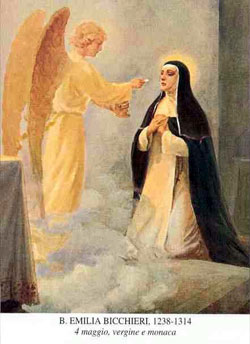
Blessed Emily Bicchieri
Direct ancestor of thousands of Dominican sisters, who today are engaged in all the active charities of the Order, was Blessed Emily Bicchieri. She built the first convent for conventual Third Order Sisters in 1256.
Emily was born in 1238, the fourth of seven daughters. Before her birth, her mother was privileged to see in a dream something of the future work of her daughter. She saw a magnificent church-one that she had never seen before-and a beautiful young girl wearing white robes and a veil with a wreath of white roses. Around the young woman gathered other girls, all dressed in the same fashion, and, as the good woman watched, enthralled by the beauty of the scene, they formed into a procession and marched singing around the church. An old Dominican to whom she related the dream explained to her it concerned the child she was bearing, and that this child, a daughter, would be a saint.
Emily grew up among her sisters and received, for that time, a good education. They were all taught to read and embroider, and Emily very early developed a talent for seeking out the poor and the troubled, using her talents to relieve miseries. She was her father’s favorite, in spite of the fact that she emptied her purse as fast as he could fill it. While her three older sisters were concerning themselves about making advantageous marriages, she was already planning her future, she would be a nun-just what kind, she did not know.
When Emily was seventeen, the first and the greatest grief of her life came to her- her father died. She had been his constant companion for several years, and she had dreaded breaking the news to him that she wanted to enter a convent. However, faced with death, he had quite easily given her the permission she desired, and, after his estate was settled and her mother provided for, Emily set about accomplishing her desire. Her portion of the sizeable estate she used to build a convent for sisters of the Third Order Conventual of Saint Dominic. It is not known that any such institution existed before her time, but it must have been both in mind of Saint Dominic and in the plans of his successors, because the Dominican fathers of Vercelli enthusiastically supported her in her project.
The papal brief authorizing the new foundation, the Convent of Saint Margaret, bears the date 1256. On the feast of Saint Michael, Emily and her companions- who now numbered more than thirty-were dressed for their bridal day in white gowns, with veils and wreaths of white roses. Emily’s mother, coming into the church for the first time to attend the ceremony, was amazed to see the details of her dream worked out in actuality. The young aspirants were questioned concerning their intentions, and then were taken out and dressed in the Dominican Habit. A Dominican nun from the Second Order has been appointed by the Cardinal to train in the tradition of the Order, and their novitiate began.
It was perhaps inevitable that the band of young novices would recognize Emily as their natural superior. She had all the qualities of leadership that one hopes for in a superior, as well as being the foundress of the convent. Consequently, when the borrowed novice mistress completed her work and saw them all professed, Sister Emily, in spite of her youth, was unanimously named superior. She was called “Mother Emily,” which was a great trial to her.
We wish that we knew more about this interesting household. We know that it was designed for good works as well as prayer, which indicates that the cloister was not strict as it was in the Second Order houses of the time, though even Second Order nuns traveled considerably in the late thirteenth century. One of the differences, and it may well be one of the principal differences, between the Convent of St. Margaret and the Second Order foundations, was that Blessed Emily’s house had no lay sisters; all the sisters were of the same category and shared in the work of the house. The Divine Office was said, though we do not know whether the sisters rose at midnight Matins. Blessed Emily herself discouraged the contact with seculars which was to bring so many religious houses to ruin, and set up her horarium so that the sisters would have time and privacy for the life they were expected to lead. The rich gifts that she and the other sisters received from friends and relatives were promptly given out to those who came seeking help at the alm’s gate.
Blessed Emily was not spared the agonies of spiritual doubt. Anxious as she was to receive Holy Communion frequently, the practice at the time was to go only rarely to the altar rail. Overly conscientious about her small faults, and battered about by the opinions of people less fervent that she was, she entered upon a long period of worry. Finally, our Lord Himself came to relieve her of it, and assured her that it was much more pleasing to Him for her to receive Him through love than for her to abstain from receiving through fear of unworthiness.
One of the convent tasks that Blessed Emily particularly enjoyed was that of infirmarian. This gave her the double joy of helping the sick and of mortifying herself. Once, in the exercise of this office, she had to make a difficult choice. It was Christmas Day, the time when she wanted with all her heart to receive Communion. There were three very sick sisters in the infirmary, and one of them could not be left alone. Emily had to remain with her during Mass, only hurrying out to receive her Lord and rushing back again, without time for the long thanksgiving that she felt the occasion demanded. However, as she came back to the infirmary and glanced at the three sick sisters, she acted on divine inspiration and said to them, ” I am not alone, my sisters; see. I bring Jesus to bless you.” Whereupon, our Lord chose that moment to cure the three sick sisters. They promptly rose up and joined in the celebration of the feast. On another day, Emily arrived in the chapel too late for Communion. Sad and regretful, she knelt in prayer. An angel came and gave her Holy Communion, miraculously.
Emily had always been a devotee of mortification. She made use of the usual medieval methods of conquering self-fastings, disciplines, hairshirts- and added others as she thought of them. Her special devotion was to the Holy Crown of Thorns. This famous relic had been brought from the Holy Land in the year that Emily was born, and, although she could hardly have seen it, she must have heard a great deal about it. She meditated often on it and on the terrible pain that it caused our Lord. One day she bravely asked our Lord to let her share this pain, and He granted this request. The stigmata of the crown of thorns was impressed on her head for three days of intolerable suffering, and during that time she was visited by several of the saints associated with our Lord’s Passion. At the end of three days, the pain disappeared, but she retained her great devotion to the Crown of Thorns all her life.
Blessed Emily was a strict superior, but a beloved one. Many times she saved her sisters from grief of one kind or another by her parents in their behalf, and her corrections were so gentle that they had great power over the culprit.
At least twice Our Lady is said to have come to see Blessed Emily, both times to teach her prayer. Miracles were worked by the prayers of the Blessed on the occasion of a disastrous flood, and also when a fire broke out inside the convent. She cured many sick people by her prayers, but she was always embarrassed at this sort of thing, as though she had somehow committed a fault.
Born: in Vercelli, Italy, c. 1238
Died: She died in1314 after a half century of prayer and good works in the convent which she had founded.
Beatified: She was beatified in 1769 by Pope Clement XIV
Let us Pray: O God who, who didst give unto Blessed Emily, Thy Virgin, grace to despise all earthly things, grant through her merits and intercession that, despising all perishable allurements, we may love Thee with our whole heart. Through Christ our Lord. Amen.
Blessed Aimo Taparelli
Aimo was one of the few inquisitors in the Piedmont who lived to die in peace at about 100 years of age. One of his first tasks on assuming the office was to give honorable burial to two of his predecessors, who had been martyred. Why is it that we only seem to think of the cruelties of the Inquisition, but rarely of the wrongs of the opposing forces? Could it be that we assume that representatives of the holy Catholic Church will always act like angels?
In any case, Aimo, scion of the counts of Lagnasco, became a Dominican in his hometown at an early age. He was a good student and made such rapid strides in his studies that he was asked to teach at the University of Turin. Much of his life was spent preaching and teaching.
He served for a time as confessor at the court of Blessed Amadeus of Savoy, but did not like that life. So, he was offered the even less attractive position of inquisitor-general of Lombardy and Liguria when he was 71 years old. He replaced Blessed Bartholomew Cerverio, who had just been martyred.
It had taken all the strength of the young and vigorous, 46-year- old Bartholomew to hold such a position; therefore, Aimo went to the Piedmont with considerable misgivings. Nevertheless, he seems to have been a great success in the difficult office. He converted many of his listeners by the sincerity and sweetness of his preaching. His example was a beacon of hope to the Catholics of the area, who had sometimes been embarrassed by the affluence of Church authorities and the obvious poverty of the heretics.
One of Aimo’s first acts was to arrange for the relics of Blessed Anthony of Pavoni to be brought home to Savigliano and interred in the Dominican church there.
Born: in Savigliano, Piedmont, Italy, c. 1395
Died: 1495
Beatified: cultus confirmed in 1856 by Pope Pius IX
earth, we may merit to enjoy a reign eternal with him in heaven. Through Christ our Lord. Amen.
SAINT CLARE, VIRGIN, FOUNDRESS OF THE POOR CLARES 1193-1253
The Lady Clare, “shining in name, more shining in life,” was born in the town of Assisi about the year 1193. Her mother was to become Blessed Ortolana di Fiumi. Her father is said to have been Favorino Scifi, Count of Sasso-Rosso, though whether he came of that noble branch of the Scifi family is not certain. Concerning Clare’s childhood we have no reliable information. She was eighteen years old when St. Francis, preaching the Lenten sermons at the church of St. George in Assisi, influenced her to change the whole course of her life. It is likely that a marriage not to her liking had been proposed; at any rate, she went secretly to see Friar Francis and asked him to help her to live “after the manner of the Holy Gospel.” Talking with him strengthened her desire to leave all worldly things behind and live for Christ. On Palm Sunday of that year, 1212, she came to the cathedral of Assisi for the blessing of palms, but when the others went up to the altar-rails to receive their branch of green, a sudden shyness kept Clare back. The bishop saw it and came down from the altar and gave her a branch.
The following evening she slipped away from her home and hurried through the woods to the chapel of the Portiuncula, where Francis was then living with his small community. He and his brethren had been at prayers before the altar and met her at the door with lighted tapers in their hands. Before the Blessed Virgin’s altar Clare laid off her fine cloak, Francis sheared her hair, and gave her his own penitential habit, a tunic of coarse cloth tied with a cord. Then, since as yet he had no nunnery, he took her at once for safety to the Benedictine convent of St. Paul, where she was affectionately welcomed.
When it was known at home what Clare had done, relatives and friends came to rescue her. She resisted valiantly when they tried to drag her away, clinging to the convent altar so firmly as to pull the cloths half off. Baring her shorn head, she declared that Christ had called her to His service, she would have no other spouse, and the more they continued their persecutions the more steadfast she would become. Francis had her removed to the nunnery of Sant’ Angelo di Panzo, where her sister Agnes, a child of fourteen, joined her. This meant more difficulty for them both, but Agnes’ constancy too was victorious, and in spite of her youth Francis gave her the habit. Later he placed them in a small and humble house, adjacent to his beloved church of St. Damian, on the outskirts of Assisi, and in 1215, when Clare was about twenty-two, he appointed her superior and gave her his rule to live by. She was soon joined by her mother and several other women, to the number of sixteen. They had all felt the strong appeal of poverty and sackcloth, and without regret gave up their titles and estates to become Clare’s humble disciples. Within a few years similar convents were founded in the Italian cities of Perugia, Padua, Rome, Venice, Mantua, Bologna, Milan, Siena, and Pisa, and also in various parts of France and Germany. Agnes, daughter of the King of Bohemia, established a nunnery of this order in Prague, and took the habit herself.
The “Poor Clares,” as they came to be known, practiced austerities which until then were unusual among women. They went barefoot, slept on the ground, observed a perpetual abstinence from meat, and spoke only when obliged to do so by necessity or charity. Clare herself considered this silence desirable as a means of avoiding the innumerable sins of the tongue, and for keeping the mind steadily fixed on God. Not content with the fasts and other mortifications required by the rule, she wore next her skin a rough shirt of hair, fasted on vigils and every day in Lent on bread and water, and on some days ate nothing. Francis or the bishop of Assisi sometimes had to command her to lie on a mattress and to take a little nourishment every day.
Discretion, came with years, and much later Clare wrote this sound advice to Agnes of Bohemia: “Since our bodies are not of brass and our strength is not the strength of stone, but instead we are weak and subject to corporal infirmities, I implore you vehemently in the Lord to refrain from the exceeding rigor of abstinence which I know you practice, so that living and hoping in the Lord you may offer Him a reasonable service and a sacrifice seasoned with the salt of prudence.”
Francis, as we know, had forbidden his order ever to possess revenues or lands or other property, even when held in common. The brothers were to subsist on daily contributions from the people about them. Clare also followed this way of life. When she left home she had given what she had to the poor, retaining nothing for her own needs or those of the convent. Pope Gregory IX proposed to mitigate the requirement of absolute poverty and offered to settle a yearly income on the Poor Ladies of St. Damien. Clare, eloquent in her determination never to break her vows to Christ and Francis, got permission to continue as they had begun. “I need,” she said, “to be absolved from my sins, but I do not wish to be absolved from my obligation to follow Jesus Christ.” In 1228, therefore, two years after Francis’ death, the Pope granted the Assisi sisterhood a Privilegium paupertatis, or Privilege of Poverty, that they might not be constrained by anyone to accept possessions. “He who feeds the birds of the air and gives raiment and nourishment to the lilies of the field will not leave you in want of clothing or of food until He come Himself to minister to you for eternity.” The convents in Perugia and Florence asked for and received this privilege; other convents thought it more prudent to moderate their poverty. Thus began the two observances which have ever since been perpetuated among the Poor Clares, as they later came to be called. The houses of the mitigated rule are called Urbanist, from the concession granted them in 1263 by Pope Urban IV. But as early as 1247 Pope Innocent IV had published a revised form of the rule, providing for the holding of community property. Clare, the very embodiment of the spirit and tradition of Francis, drew up another rule stating that the sisters should possess no property, whether as individuals or as a community. Two days before she died this was approved by Pope Innocent for the convent of St. Damian.
Clare governed the convent continuously from the day when Francis appointed her abbess until her death, a period of nearly forty years. Yet it was her desire always to be beneath all the rest, serving at table, tending the sick, washing and kissing the feet of the lay sisters when they returned footsore from begging. Her modesty and humility were such that after caring for the sick and praying for them, she often had other sisters give them further care, that their recovery might not be imputed to any prayers or merits of hers. Clare’s hands were forever willing to do whatever there was of woman’s work that could help Francis and his friars. “Dispose of me as you please,” she would say. “I am yours, since I have given my will to God. It is no longer my own.” She would be the first to rise, ring the bell in the choir, and light the candles; she would come away from prayer with radiant face.
During her life and after her death there was disagreement at intervals between the Poor Clares and the Brothers Minor as to their correct relations. The nuns maintained that the friars were under obligation to serve their needs in things both spiritual and temporal. When in 1230 Pope Gregory IX forbade the friars to visit the convents of the nuns without special license, Clare feared the edict might lead to a complete severing of the ties established by Francis. She thereupon dismissed every man attached to her convent, those who served their material needs as well as those who served them spiritually; if she could not have the one, she would not have the other. The Pope wisely referred the matter to the minister general of the Brothers Minor to adjust. After long years of sickness borne with sublime patience, Clare’s life neared its end in the summer of 1253. Pope Innocent IV came to Assisi to give her absolution, remarking, “Would to God I had so little need of it!” To her nuns she said, “Praise the Lord, beloved daughters, for on this most blessed day both Jesus Christ and his vicar have deigned to visit me.” Prelates and cardinals gathered round, and many people were convinced that the dying woman was truly a saint. Her sister Agnes was with her, as well as three of the early companions of Francis-Leo, Angelo, and Juniper. They read aloud the Passion according to St. John, as they had read it at the death-bed of Francis twenty-seven years before. Someone exhorted Clare to patience and she replied, “Dear brother, ever since through His servant Francis I have known the grace of our Lord Jesus Christ, I have never in my whole life found any pain or sickness that could trouble me.” To herself she was heard to say, “Go forth without fear, Christian soul, for you have a good guide for your journey. Go forth without fear, for He that created you has sanctified you, has always protected you, and loves you as a mother.”
Pope Innocent IV and his cardinals assisted at the funeral of the abbess. The Pope would have had her canonized immediately had not the cardinals present advised against it. His successor, Alexander IV, canonized her after two years, in 1255, at Anagni. Her body, which lay first in the church of St. George in Assisi, was translated to a stately church built to receive it in 1260. Nearly six hundred years later, in 1850, it was discovered, embalmed and intact, deep down beneath the high altar, and subsequently removed to a new shrine in the crypt, where, lying in a glass case, it may still be seen. In 1804 a change was made in the rule of the Poor Clares, originally a contemplative order, permitting these religious to take part in active work. Today there are houses of the order in North and South America, Palestine, Ireland, England, as well as on the Continent. The emblem of St. Clare is a monstrance, and in art she is frequently represented with a ciborium.
Saint Clare, Virgin, Foundress of the Poor Clares. Celebration of Feast Day is August 12th by the pre-1970 liturgical calendar and August 11th (the actual date of her death) by the present one.
Feast of our Holy Father Saint Dominic
“A man who governs his passions is master of his world. We must either command them or be enslaved by them. It is better to be a hammer than an anvil.”
– Saint Dominic
Founder of the Order of Preachers, commonly known as the Dominican Order; born at Calaroga, in Old Castile, c. 1170; died 6 August, 1221. His parents, Felix Guzman and Joanna of Aza, undoubtedly belonged to the nobility of Spain, though probably neither was connected with the reigning house of Castile, as some of the saint’s biographers assert. Of Felix Guzman, personally, little is known, except that he was in every sense the worthy head of a family of saints. To nobility of blood Joanna of Aza added a nobility of soul which so enshrined her in the popular veneration that in 1828 she was solemnly beatified by Leo XII. The example of such parents was not without its effect upon their children. Not only Saint Dominic but also his brothers, Antonio and Manes, were distinguished for their extraordinary sanctity. Antonio, the eldest, became a secular priest and, having distributed his patrimony to the poor, entered a hospital where he spent his life minis ministering to the sick. Manes, following in the footsteps of Dominic, became a Friar Preacher, and was beatified by Gregory XVI.
The birth and infancy of the saint were attended by many marvels forecasting his heroic sanctity and great achievements in the cause of religion. From his seventh to his fourteenth year he pursued his elementary studies tinder the tutelage of his maternal uncle, the archpriest of Gumiel d’lzan, not far distant from Calaroga. In 1184 Saint Dominic entered the University of Palencia. Here he remained for ten years prosecuting his studies with such ardour and success that throughout the ephemeral existence of that institution he was held up to the admiration of its scholars as all that a student should be. Amid the frivolities and dissipations of a university city, the life of the future saint was characterized by seriousness of purpose and an austerity of manner which singled him out as one from whom great thin might be expected in the future. But more than one he proved that under this austere exterior he carried a heart as tender as a woman’s. On one occasion he sold his books, annotated with his own hand, to relieve the starving poor of Palencia. His biographer and contemporary, Bartholomew of Trent, states that twice he tried to sell himself into slavery to obtain money for the liberation of those who were held in captivity by the Moors. These facts are worthy of mention in view of the cynical and saturnine character which some non-Catholic writers have endeavoured to foist upon one of the most charitable of men. Concerning the date of his ordination his biographers are silent; nor is there anything from which that date can be inferred with any degree of certainty. According to the deposition of Brother Stephen, Prior Provincial of Lombardy, given in the process of canonization, Dominic was still a student at Palencia when Don Martin de Bazan, the Bishop of Osma, called him to membership in the cathedral chapter for the purpose If assisting in its reform. The bishop realized the importance to his plan of reform of having constantly before his canons the example of one of Dominic’s eminent holiness. Nor was he disappointed in the result. In recognition of the part he had taken in converting its members into canons regular, Dominic was appointed sub-prior of the reformed chapter. On the accession of Don Diego d’Azevedo to the Bishopric of Osma in 1201, Dominic became superior of the chapter with the title of prior. As a canon of Osma, he spent nine years of his life hidden in God and rapt in contemplation, scarcely passing beyond the confines of the chapter house.
In 1203 Alfonso IX, King of Castile, deputed the Bishop of Osma to demand from the Lord of the Marches, presumably a Danish prince, the hand of his daughter on behalf of the king’s son, Prince Ferdinand. For his companion on this embassy Don Diego chose Saint Dominic. Passing through Toulouse in the pursuit of their mission, they beheld with amazement and sorrow the work of spiritual ruin wrought by the Albigensian heresy. It was in the contemplation of this scene that Dominic first conceived the idea of founding an order for the purpose of combating heresy and spreading the light of the Gospel by preaching to the ends of the then known world. Their mission having ended successfully, Diego and Dominic were dispatched on a second embassy, accompanied by a splendid retinue, to escort the betrothed princess to Castile. This mission, however, was brought to a sudden close by the death of the young woman in question. The two ecclesiastics were now free to go where they would, and they set out for Rome, arriving there towards the end of 1204. The purpose of this was to enable Diego to resign his bishopric that he might devote himself to the conversion of unbelievers in distant lands. Innocent III, however, refused to approve this project, and instead sent the bishop and his companion to Languedoc to join forces with the Cistercians, to whom he had entrusted the crusade against the Albigenses. The scene that confronted them on their arrival in Languedoc was by no means an encouraging one. The Cistercians, on account of their worldly manner of living, had made little or no headway against the Albigenses. They had entered upon their work with considerable pomp, attended by a brilliant retinue, and well provided with the comforts of life. To this display of worldliness the leaders of the heretics opposed a rigid asceticism which commanded the respect and admiration of their followers. Diego and Dominic quickly saw that the failure of the Cistercian apostolate was due to the monks’ indulgent habits, and finally prevailed upon them to adopt a more austere manner of life. The result was at once apparent in a greatly increased number of converts. Theological disputations played a prominent part in the propaganda of the heretics. Dominic and his companion, therefore, lost no time in engaging their opponents in this kind of theological exposition. Whenever the opportunity offered, they accepted the gage of battle. The thorough training that the saint had received at Palencia now proved of inestimable value to him in his encounters with the heretics. Unable to refute his arguments or counteract the influence of his preaching, they visited their hatred upon him by means of repeated insults and threats of physical violence. With Prouille for his head-quarters, he laboured by turns in Fanjeaux, Montpellier, Servian, Béziers, and Carcassonne. Early in his apostolate around Prouille the saint realized the necessity of an institution that would protect the women of that country from the influence of the heretics. Many of them had already embraced Albigensianism and were its most active propagandists. These women erected convents, to which the children of the Catholic nobility were often sent-for want of something better-to receive an education, and, in effect, if not on purpose, to be tainted with the spirit of heresy. It was needful, too, that women converted from heresy should be safeguarded against the evil influence of their own homes. To supply these deficiencies, Saint Dominic, with the permission of Foulques, Bishop of Toulouse, established a convent at Prouille in 1206. To this community, and afterwards to that of Saint Sixtus, at Rome, he gave the rule and constitutions which have ever since guided the nuns of the Second Order of Saint Dominic.
The year 1208 opens a new epoch in the eventful life of the founder. On 15 January of that year Pierre de Castelnau, one of the Cistercian legates, was assassinated. This abominable crime precipitated the crusade under Simon de Montfort, which led to the temporary subjugation of the heretics. Saint Dominic participated in the stirring scenes that followed, but always on the side of mercy, wielding the arms of the spirit while others wrought death and desolation with the sword. Some historians assert that during the sack of Béziers, Dominic appeared in the streets of that city, cross in hand, interceding for the lives of the women and children, the aged and the infirm. This testimony, however, is based upon documents which Touron regards as certainly apocryphal. The testimony of the most reliable historians tends to prove that the saint was neither in the city nor in its vicinity when Béziers was sacked by the crusaders. We find him generally during this period following the Catholic army, reviving religion and reconciling heretics in the cities that had capitulated to, or had been taken by, the victorious de Montfort. it was probably I September, 1209, that Saint Dominic first came in contact with Simon de Montfort and formed with him that intimate friendship which was to last till the death of the brave crusader under the walls of Toulouse (25 June, 1218). We find him by the side of de Montfort at the siege of Lavaur in 121 1, and again in 1212, at the capture of La Penne d’Ajen. In the latter part of 1212 he was at Pamiers labouring, at the invitation of de Montfort, for the restoration of religion and morality. Lastly, just before the battle of Muret. 12 September, 1213, the saint is again found in the council that preceded the battle. During the progress of the conflict, he knelt before the altar in the church of Saint-Jacques, praying for the triumph of the Catholic arms. So remarkable was the victory of the crusaders at Muret that Simon de Montfort regarded it as altogether miraculous, and piously attributed it to the prayers of Saint Dominic. In gratitude to God for this decisive victory, the crusader erected a chapel in the church of Saint-Jacques, which he dedicated, it is said, to Our Lady of the Rosary. It would appear, therefore, that the devotion of the Rosary, which tradition says was revealed to Saint Dominic, had come into general use about this time. To this period, too, has been ascribed the foundation of the Inquisition by Saint Dominic, and his appointment as the first lnquisitor. As both these much controverted questions will receive special treatment elsewhere in this work, it will suffice for our )resent purpose to note that the Inquisition was in operation in 1198, or seven years before the saint took part in the apostolate in Languedoc, and while ie was still an obscure canon regular at Osma. If he was for a certain time identified-with the operations of the Inquisition, it was only in the capacity of a theologian passing upon the orthodoxy of the accused. Whatever influence he may have had with the judges of that much maligned institution was always employed on the side of mercy and forbearance, as witness the classic case of Ponce Roger.
In the meantime, the saint’s increasing reputation for heroic sanctity, apostolic zeal, and profound learning caused him to be much sought after as a candidate for various bishoprics. Three distinct efforts were made to miss him to the episcopate. In July, 1212, the chapter of Béziers chose him for their bishop. Again, the canons of Saint-Lizier wished him to succeed Garcias de l’Orte as Bishop of Comminges. Lastly, in 1215 an effort was made by Garcias de l’Orte himself, who had been transferred from – Comminges to Auch, to make him Bishop of Navarre. But Saint Dominic absolutely refused all episcopal honours, saying that he would rather take flight in the night, with nothing but his staff, than accept the episcopate. From Muret Dominic returned to Carcassonne, where he resumed his preaching with unqualified success. It was not until 1214 that he returned to Toulouse. In the meantime the influence of his preaching and the eminent holiness of his life had drawn around him a little band of devoted disciples eager to follow wherever he might lead. Saint Dominic had never for a moment forgotten his purpose, formed eleven years before, of founding a religious order to combat heresy and propagate religious truth. The time now seemed opportune for the realization of his plan. With the approval of Bishop Foulques of Toulouse, he began the organization of his little band of followers. That Dominic and his companions might possess a fixed source of revenue Foulques made him chaplain of Fanjeaux and in July, 1215, canonically established the community as a religious congregation of his diocese, whose mission was the propagation of true doctrine and good morals, and the extirpation of heresy. During this same year Pierre Seilan, a wealthy citizen of Toulouse, who had placed himself under the direction of Saint Dominic, put at their disposal his own commodious dwelling. In this way the first convent of the Order of Preachers was founded on 25 April, 1215. But they dwelt here only a year when Foulques established them in the church of Saint Romanus. Though the little community had proved amply the need of its mission and the efficiency of its service to the Church, it was far from satisfying the full purpose of its founder. It was at best but a diocesan congregation, and Saint Dominic had dreamed Of a world-order that would carry its apostolate to the ends of the earth. But, unknown to the saint, events were shaping themselves for the realization of his hopes. In November, 1215, an ecumenical council was to meet at Rome “to deliberate on the improvement of morals, the extinction of heresy, and the strengthening of the faith”. This was identically the mission Saint Dominic had determined on for his order. With the Bishop of Toulouse, he was present at the deliberations of this council. From the very first session it seemed that events conspired to bring his plans to a successful issue. The council bitterly arraigned the bishops for their neglect of preaching. In canon X they were directed to delegate capable men to preach the word of God to the people. Under these circumstances, it would reasonably appear that Dominic’s request for confirmation of an order designed to carry out the mandates of the council would be joyfully granted. But while the council was anxious that these reforms should be put into effect as speedily as possible, it was at the same time opposed to the institution of any new religious orders, and had legislated to that effect in no uncertain terms. Moreover, preaching had always been looked upon as primarily a function of the episcopate. To bestow this office on an unknown and untried body of simple priests s seemed too original and too bold in its conception to appeal to the conservative prelates who influenced the deliberations of the council. When, therefore, his petition for the approbation of his infant institute was refused, it could not have been wholly unexpected by Saint Dominic.
Returning to Languedoc at the close of the council in December, 1215, the founder gathered about him his little band of followers and informed them of the wish of the council that there should be no new rules for religious orders. Thereupon they adopted the ancient rule of Saint Augustine, which, on account of its generality, would easily lend itself to any form they might wish to give it. This done, Saint Dominic again appeared before the pope in the month of August, 1216, and again solicited the confirmation of his order. This time he was received more favourably, and on 22 December, 1216, the Bull of confirmation was issued.
Saint Dominic spent the following Lent preaching in various churches in Rome, and before the pope and the papal court. It was at this time that he received the office and title of Master of the Sacred Palace, or Pope’s Theologian, as it is more commonly called. This office has been held uninterruptedly by members of the order from the founder’s time to the present day. On 15 August, 1217, he gathered the brethren about him at Prouille to deliberate on the affairs of the order. He had determined upon the heroic plan of dispersing his little band of seventeen unformed followers over all europe. The result proved the wisdom of an act which, to the eye of human prudence at least, seemed little short of suicidal. To facilitate the spread of the order, Honorius III, on 11 Feb., 1218, addressed a Bull to all archbishops, bishops, abbots, and priors, requesting their favour on behalf of the Order of Preachers. By another Bull, dated 3 Dec., 1218, Honorius III bestowed upon the order the church of Saint Sixtus in Rome. Here, amid the tombs of the Appian Way, was founded the first monastery of the order in Rome. Shortly after taking possession of Saint Sixtus, at the invitation of Honorius, Saint Dominic begin the somewhat difficult task of restoring the pristine observance of religious discipline among the various Roman communities of women. In a comparatively short time the work was accomplished, to the great satisfaction of the pope. His own career at the University of Palencia, and the practical use to which he had put it in his encounters with the Albigenses, as well as his keen appreciation of the needs of the time, convinced the saint that to ensure the highest efficiency of the work of the apostolate, his followers should be afforded the best educational advantages obtainable. It was for this reason that on the dispersal of the brethren at Prouille he dispatched Matthew of France and two companions to Paris. A foundation was made in the vicinity of the university, and the friars took possession in October, 1217. Matthew of France was appointed superior, and Michael de Fabra was placed in charge of the studies with the title of Lecturer. On 6 August of the following year, Jean de Barastre, dean of Saint-Quentin and professor of theology, bestowed on the community the hospice of Saint-Jaques, which he had built for his own use. Having effected a foundation at the University of Paris, Saint Dominic next determined upon a settlement at the University of Bologna. Bertrand of Garrigua, who had been summoned from Paris, and John of Navarre, set out from Rome, with letters from Pope Honorius, to make the desired foundation. On their arrival at Bologna, the church of Santa Maria della Mascarella was placed at their disposal. So rapidly did the Roman community of Saint Sixtus grow that the need of more commodious quarters soon became urgent. Honorius, who seemed to delight in supplying every need of the order and furthering its interests to the utmost of his power, met the emergency by bestowing on Saint Dominic the basilica of Santa Sabina.
Towards the end of 1218, having appointed Reginald of Orléans his vicar in Italy, the saint, accompanied by several of his brethren, set out for Spain. Bologna, Prouille, Toulouse, and Fanjeaux were visited on the way. From Prouille two of the brethren were sent to establish a convent at Lyons. Segovia was reached just before Christmas. In February of the following year he founded the first monastery of the order in Spain. Turning southward, he established a convent for women at Madrid, similar to the one at Prouille. It is quite probable that on this journey he personally presided over the erection of a convent in connexion with his alma mater, the University of Palencia. At the invitation of the Bishop of Barcelona, a house of the order was established in that city. Again bending his steps towards Rome he recrossed the Pyrenees and visited the foundations at Toulouse and Paris. During his stay in the latter place he caused houses to be erected at Limoges, Metz, Reims, Poitiers, and Orléans, which in a short time became centres of Dominican activity. From Paris he directed his course towards Italy, arriving in Bologna in July, 1219. Here he devoted several months to the religious formation of the brethren he found awaiting him, and then, as at Prouille, dispersed them over Italy. Among the foundations made at this time were those at Bergamo, Asti, Verona, Florence, Brescia, and Faenza. From Bologna he went to Viterbo. His arrival at the papal court was the signal for the showering of new favours on the order. Notable among these marks of esteem were many complimentary letters addressed by Honorius to all those who had assisted the Fathers in their vinous foundations. In March of this same year Honorius, through his representatives, bestowed upon the order the church of San Eustorgio in Milan. At the same time a foundation at Viterbo was authorized. On his return to Rome, towards the end of 1219, Dominic sent out letters to all the convents announcing the first general chapter of the order, to be held at Bologna on the feast of the following Pentecost. Shortly before, Honorius III, by a special Brief, had conferred upon the founder the title of Master General, which till then he had held only by tacit consent. At the very first session of the chapter in the following spring the saint startled his brethren by offering his resignation as master general. It is needless to say the resignation was not accepted and the founder remained at the head of the institute till the end of his life.
Soon after the close of the chapter of Bologna, Honorius III addressed letters to the abbeys and priories of San Vittorio, Sillia, Mansu, Floria, Vallombrosa, and Aquila, ordering that several of their religious be deputed to begin, under the leadership of Saint Dominic, a preaching crusade in Lombardy, where heresy had developed alarming proportions. For some reason or other the plans of the pope were never realized. The promised support failing, Dominic, with a little band of his own brethren, threw himself into the field, and, as the event proved, spent himself in an effort to bring back the heretics to their allegiance to the Church. It is said that 100,000 unbelievers were converted by the preaching and the miracles of the saint. According to Lacordaire and others, it was during his preaching in Lombardy that the saint instituted the Militia of Jesus Christ, or the third order, as it is commonly called, consisting of men and women living in the world, to protect the rights and property of the Church. Towards the end of 1221 Saint Dominic returned to Rome for the sixth and last time. Here he received many new and valuable concessions for the order. In January, February, and March of 1221 three consecutive Bulls were issued commending the order to all the prelates of the Church-. The thirtieth of May, 1221, found him again at Bologna presiding over the second general chapter of the order. At the close of the chapter he set out for Venice to visit Cardinal Ugolino, to whom he was especially indebted for many substantial acts of kindness. He had scarcely returned to Bologna when a fatal illness attacked him. He died after three weeks of sickness, the many trials of which he bore with heroic patience. In a Bull dated at Spoleto, 13 July, 1234, Gregory IX made his cult obligatory throughout the Church.
The life of St. Dominic was one of tireless effort in the, service of god. While he journeyed from place to place he prayed and preached almost uninterruptedly. – His penances were of such a nature as to cause the brethren, who accidentally discovered them. to fear the effect upon his life. While his charity was boundless he never permitted it to interfere with the stern sense of duty that guided every action of his life. If he abominated heresy and laboured untiringly for its extirpation it was because he loved truth and loved the souls of those among whom he laboured. He never failed to distinguish between sin and the sinner. It is not to be wondered at, therefore, if this athlete of Christ, who had conquered himself before attempting the reformation of others, was more than once chosen to show forth the power of God. The failure of the fire at Fanjeaux to consume the dissertation he had employed against the heretics, and which was thrice thrown into the flames; the raising to life of Napoleone Orsini; the appearance of the annals in the refectory of Saint Sixtus in response to his prayers, are but a few of the supernatural happenings by which God was pleased to attest the eminent holiness of His servant. We are not surprised, therefore, that, after signing the Bull of canonization on 13 July, 1234, Gregory IX declared that he no more doubted the saintliness of Saint Dominic than he did that of Saint Peter and Saint Paul.
Born: 1170 at Calaruega, Burgos, Old Castile
Died: August 6, 1221 at Bologna
Beatified: July 13, 1234 by Pope Gregory IX at Rieti, Italy
Patronage: astronomers; astronomy; prelature of Batanes-Babuyanes, Philippines; diocese of Bayombong, Philippines; Dominican Republic; falsely accused people; scientists
Representation: chaplet, Dominican carrying a rosary and a tall cross; Dominican holding a lily; Dominican with dog and globe; Dominican with fire; Dominican with star shining above his head; rosary; star
Be Transformed! ~ by Fr. Bryan Wolf
“After six days Jesus took with him Peter, James and John the brother of James, and led them up a high mountain by themselves. There he was transfigured before them. His face shone like the sun, and his clothes became as white as the light. Just then there appeared before them Moses and Elijah, talking with Jesus. Peter said to Jesus, “Lord it is good for us to be here. If you wish, I will put up three shelters- one for you, one for Moses and one for Elijah.” While he was still speaking, a bright cloud covered them, and a voice from the cloud said, “This is my Son, whom I love; with him I am well pleased. Listen to him!” When the disciples heard this, they fell facedown to the ground, terrified. But Jesus came and touched them. “Get up,” he said. “Do not be afraid.” When they looked up, they saw no one except Jesus.” Matthew 17:1-8
Today we celebrate the Feast of the Transfiguration. This is an important event in Christianity which extends into most of the major branches; Catholicism, Anglicanism, Orthodoxy and even some Protestant churches (Episcopal, Lutheran and Presbyterian). It is an event of which Saint Thomas Aquinas considered “the greatest miracle”, in that with His Transfiguration; Jesus demonstrated His true divinity. In fact, by His Transfiguration the Holy Trinity is revealed. God the Father is present in the voice of God, Jesus the Son of God is present in His being transformed and God the Holy Spirit is thought to be present in the enveloping cloud which enables the disciples to witness the miracle. This event is one of only a handful of documented personal occurrences to Jesus himself. (The others being His Baptism, Crucifixion, Resurrection and Ascension.) Appearing together with Moses, the great law giver; and Elijah, the great prophet; serves to provide testimony as to the validity of Christ. (Listen to him!) This is important, for it is in the previous chapter of Matthew (Matthew 16: 13 et.seq.) that Jesus asks his disciples who he is thought to be and who they believe him to be.
There is no doubt that the Transfiguration of Jesus finally provides a solid foundation from which to build, as to Christ’s true nature and divinity. (Except maybe for Thomas.) We who were not present, or even alive at this time, can take from Scripture this account that Jesus truly was the Christ. But what more subtle and realistic lesson can we take from the account of the Transfiguration, and use today?
We must use our faith in Christ, our personal declaration that we are Christians- to make a personal transformation of our own! As Jesus himself was transfigured, so too must we be in the attributes of Christ. To assume His compassion and charity. Not to judge people based upon our own opinions and beliefs. To extend to others; family, friends and strangers alike, a kind word and comforting hand. To attempt to live fully “Christ-like”. This is after all, why we are here and why we live as Christians. Not just to enjoy the love of our Lord and His promise of eternal life, but to give the love He gives to us and give it away to others. In doing so, Christ lives among us here and now!
So, be transformed! Free yourself from prejudice and preconceptions. Embrace Christ fully and His message of love and forgiveness, and pass it forward onto others. Let your own personal transformation be reason enough for someone to ask: What is up with you? Why are you so happy? So helpful? And then share with them, The Good news!
Almighty God. Create within me a new heart- a new spirit. Help me to see Your potential within me and within others. As Jesus was transfigured before the disciples for Your glory, so too grace upon us the resolve to transform ourselves- to proclaim Your glory! Be Transformed! Amen.
St. John Vianney
John Vianney was born as Jean-Baptiste-Marie Vianney on 8 May 1786 in Dardilly in France and was baptized on the day of his birth. John was the fourth of six children to his parents Matthieu Vianney and Marie Beluze, who were both devout Catholics. Matthieu and Marie helped the poor and even gave hospitality to St. Benedict Joseph Labre, the patron saint of tramps, who passed through Dardilly whilst on his pilgrimage to Rome. In 1770, due to the French Revolution many priests had to hide to do the sacraments in their parishes because of the government. Even thought it was illegal, the Vianneys would travel to distant farms to pray and attend mass in secret. Because of the risks taken daily by priests, John Vianney began to look upon them as heroes. John had his first Communion lessons carried out by three priests in a public home, and he made his First Communion at the age of 13. During this mass and the lessons for communion, all the windows had to be covered so that the light from the candles couldn’t be seen from the outside. The Catholic Church was re-established in France in 1802, resulting in religious peace throughout the country. By this time, Vianney was worried about his future vocation and yearned for education. He was 20 when his father allowed him to leave the farm to be taught at a “presbytery-school” in the neighbouring village of Écully, conducted by the Abbé Balley. The school taught the subjects of arithmetic, history, geography, and Latin. Because Vianney had previously had his education interrupted by the French Revolution, he struggled at the school, especially with the Latin but he perservered because of his deep desire to join the priesthood. Vianney continued to study until his studies were interrupted again when he was drafted into Napoleon’s armies in 1809. The exemption Vianney should have had with being an ecclesiastical student was withdrawn in certain dioceses because of the need of soldiers for Napoloeon to fight against Spain. Vianney became ill only two days after having to report at Lyons and was hospitalised. This meant the other drafted soldiers left without him but he was redrafted on his release from hospital on Jan 5th. He went to a church to pray and so fell behind the group. He met a man who offered to guide him back to the group but who then led him deep into the mountains of Le Forez, to the village of Les Noes, where deserters had gathered, and where he lived hidden in a farmhouse for the next fourteen months under the care of Claudine Fayot, a widow with four children. Vianney assumed the name Jerome Vincent, and under that name he opened a school for village children and because of the harsh weather they were isolated from trouble from the army. In the warmer weather, the army would search regularly for him so Vianney would hide inside stacks of fermenting hay in the barn. An imperial decree in March 1810 granted amnesty to all deserters, which enabled Vianney to go back legally to Ecully, where he resumed his studies. He was tonsured in 1811, and in 1812 he went to the minor seminary at Verrières-en-Forez. In autumn of 1813, he was sent to major seminary at Lyons. Considered too slow, he was returned to Abbe Balley. However, Balley persuaded the Vicars General that Vianney’s piety was great enough to compensate for his ignorance, and the seminarian received minor orders and the subdiaconate on 2 July 1814, was ordained a deacon in June 1815, and was ordained priest on 12 August 1815 in the Couvent des Minimes de Grenoble. He said his first Mass the next day, and was appointed assistant to Balley in Écully.n 1818, shortly after the death of Balley, Jean-Marie Vianney was appointed parish priest of the parish of Ars, a town of 230 inhabitants. When Vianney’s bishop first assigned him to Ars, he got lost trying to find the town. Two young men tending flocks in the fields pointed him in the right direction.With Catherine Lassagne and Benedicta Lardet, he established La Providence, a home for girls. As parish priest, Vianney realized that the Revolution’s aftermath had resulted in religious ignorance and indifference, due to the devastation wrought on the Catholic Church in France. At the time, Sundays in rural areas were spent working in the fields, or dancing and drinking in taverns. Vianney spent time in the confessional and gave homilies against blasphemy and dancing. If his parishioners did not give up dancing, he refused them absolution. Abbe Balley had been Vianney’s greatest inspiration, since he was a priest who remained loyal to his faith, despite the Revolution. Vianney felt compelled to fulfill the duties of a curé, just as did Balley, even when it was illegal. Vianney came to be known internationally, and people from distant places began traveling to consult him as early as 1827.”By 1855, the number of pilgrims had reached 20,000 a year. During the last ten years of his life, he spent 16 to 18 hours a day in the confessional. Even the bishop forbade him to attend the annual retreats of the diocesan clergy because of the souls awaiting him yonder”. He spent at least 11 or 12 hours a day in the confessional during winter, and up to 16 hours during the summer. Vianney had a great devotion to St. Philomena. Vianney regarded her as his guardian and erected a chapel and shrine in honor of the saint. During May 1843, Vianney fell so ill he thought that his life was coming to its end. He asked St Philomena to cure him and promised to say 100 Masses at her shrine. Twelve days later, Vianney was cured and he attributed his cure to her intercession. Vianney yearned for the contemplative life of a monk, and four times ran away from Ars, the last time in 1853. He was a champion of the poor as a Franciscan tertiary and was a recipient of the coveted French Legion of Honour, which, he sold, donating the money to the orphanage. On 4 August 1859, Vianney died at age of 73. The bishop presided over his funeral with 300 priests and more than 6,000 people in attendance. Before he was buried, Vianney’s body was fitted with a wax mask. Biographers recorded miracles performed throughout his life, obtaining money for his charities and food for his orphans; he had supernatural knowledge of the past and future, and could heal the sick, especially children. The body of Saint John Mary Vianney was found to be incorrupt by the Catholic Church. The body is entombed above the main altar in the Basilica at Ars, France. On 3 October 1874 Pope Pius IX proclaimed him “venerable”; on 8 January 1905, Pope Pius X declared him Blessed and proposed him as a model to the parochial clergy. In 1925 John Marie Vianney was canonized by Pope Pius XI, who in 1929 made him patron saint of parish priests. In 1928 his feast day was inserted into the General Roman Calendar for celebration on 9 August. Pope John XXIII’s 1960 revision, in which the Vigil of Saint Lawrence had a high rank, moved the feast to 8 August. Finally, the 1969 revision placed it on 4 August, the day of his death. In 1959, on the 100th anniversary of his death, Pope John XXIII issued Sacerdotii Nostri Primordia, an encyclical on Vianney. St. John Paul II himself visited Ars in 1986 at the 200th anniversary of Vianney’s birth and referred to the great saint as a “rare example of a pastor acutely aware of his responsibilities…and a sign of courage for those who today experience the grace of being called to the priesthood. St. John Vianney is the Patron Saint of Priests.
Weeds Among the Wheat ~ Sister Dollie Wilkinson, OPoc
For any one who has attempted to have a decent garden, they know there is much work involved. From preparing the soil, to digging rows in which to plant, to the actual sowing of seeds, it seems the work is never done. And this is only the beginning. There is then the constant attention a well-tended garden requires, including adding fertilizer to feed the new crops, the plucking of stubborn weeds, and then in the case of a vegetable garden, the time comes for finally harvesting the fruits of our labors. With all this work, one might ask why do this—when often the results are less than perfect, if the garden bears fruit at all. But I believe the beauty of having a garden is not the end product, but the process of creating and cultivating a precious, living thing.
Having recently experienced the laborious process of having a garden, one which includes flowers and vegetables, I can attest to the fact that it does require a lot of work. Even the small one of mine, has been a trial and error process, resulting in lessons learned. As I battle random weeds and pesky pests, I often am surprised at what actually sprouts up out of the earth. Where once was dead grass, and rocky soil, now grows beautiful lilies and bulging tomato plants. I am also surprised by the random plant which sprouts, and when I let grow instead of plucking it like the weed I assume it is, grows in to a beautiful yellow flower. Had I pulled this dear plant from my garden, I never would have known the beauty of this gift from Mother Nature.
I imagine this is the reason for the following parable in Matthew 13:24-30, 36-43
“He put before them another parable: “The kingdom of heaven may be compared to someone who sowed good seed in his field; but while everybody was asleep, an enemy came and sowed weeds among the wheat, and then went away. So when the plants came up and bore grain, then the weeds appeared as well. And the slaves of the householder came and said to him, ‘Master, did you not sow good seed in your field? Where, then, did these weeds come from?’ He answered, ‘An enemy has done this.’ The slaves said to him, ‘Then do you want us to go and gather them?’ But he replied, ‘No; for in gathering the weeds you would uproot the wheat along with them. Let both of them grow together until the harvest; and at harvest time I will tell the reapers, Collect the weeds first and bind them in bundles to be burned, but gather the wheat into my barn Then he left the crowds and went into the house. And his disciples approached him, saying, “Explain to us the parable of the weeds of the field.” He answered, “The one who sows the good seed is the Son of Man; the field is the world, and the good seed are the children of the kingdom; the weeds are the children of the evil one, and the enemy who sowed them is the devil; the harvest is the end of the age, and the reapers are angels. Just as the weeds are collected and burned up with fire, so will it be at the end of the age. The Son of Man will send his angels, and they will collect out of his kingdom all causes of sin and all evildoers, and they will throw them into the furnace of fire, where there will be weeping and gnashing of teeth. Then the righteous will shine like the sun in the kingdom of their Father. Let anyone with ears listen!”
So we ask ourselves, why allow weeds (or in the case of the previous passage “children of the evil one”) to even sprout up at all? I believe our Father has another message here, which goes beyond describing the “kingdom of heaven”, and detailing the difference between weeds and wheat, (or good and bad seed). If you will notice, the Son of Man is advised to wait until harvest time to collect the weeds to be burned, and then the wheat is cultivated, thus the “righteous will shine like sun”. So why wait? Why not pluck out the offending weed as soon as it sprouts? Maybe this is to allow the bad seed or weed, a chance to grow in to something good, something beautiful. Just as in the case of the random green shoot which sprouted unexpectedly in my garden, maybe our dear Father is giving all things, the good and bad seed, a chance to grow in to something precious, good, beautiful. To grow in to something worth cultivating at harvest time, to become righteous and pleasing to our Lord.
This particular parable really struck home with me. Often I lament the fact that I feel more like a weed most days, than the precious wheat. Not because I feel evil, but because some days I feel I am unworthy to be welcomed in to “the kingdom of their Father”. But if God cautions us to be patient, and He allows weeds to grow amongst the wheat. Is He not then sending the message that with patience, and loving care, as with a garden, all things have the potential to be good, and beautiful?!


You must be logged in to post a comment.