
Category: Uncategorized
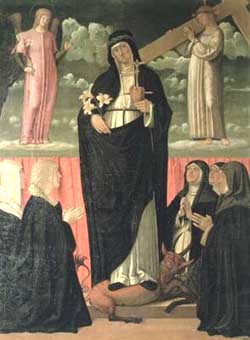
Blessed Osanna of Mantua
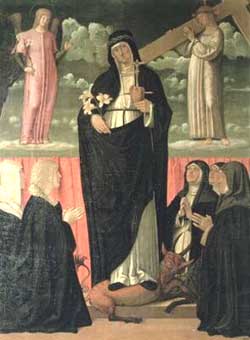
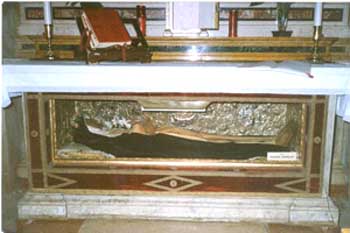
Osanna Andreassi was the daughter of the wealthy patrician Andreasio. She experienced visions from her early childhood, but kept the experiences to herself. At the age of six, she saw the Child Jesus carrying a cross and wearing a crown of thorns. He told her that He has a special love of children and purity. She was so impressed, as we all would be, that she immediately consecrated her entire life to God.
Osanna begged her father to allow her to learn to read so that she might be able to pray the Divine Office. He refused her request because it was a waste for a woman who was expected simply to raise a family. Osanna couldn’t explain why she wanted to learn; she couldn’t reveal her plans to him. When she was 14 and knew that he was arranging a marriage for her, she furtively went to the Dominican church and received the habit of its tertiaries. When she appeared at home in her religious garb, she explained that she had made a vow and must wear it until she had fulfilled her promise.
Now, this should not be understood as condoning deceit, but it served God’s purpose. Her pious father accepted her explanation for a time. As the months passed he began to suspect what had happened. He had already refused to give her permission to enter the convent, and he was displeased that she should try to live as a tertiary in his own home. Eventually, his father’s heart melted and he allowed Osanna to continue her routine of prayer, penance, and charity for the rest of her life. She was not professed until a few months before her death forty-two years later.
After the early death of both her parents, Osanna spent her fortune in the service of the poor. Her house became a center for people to discuss spiritual matters, for the needy and the sick, for the wealthy and the noble.
It is said that like Saint Catherine, she miraculously learned to read. One day she saw a piece of paper with two words and said, “Those words are ‘Jesus’ and ‘Mary.'” From that time she could read anything pertaining to spiritual matters. By the same sort of favor, she also learned to write.
At age 28 (1477), Osanna received the mark of the wound in Jesus’ side, caused by a long nail. For the next year various of the sacred wounds would appear, including the crown of thorns. Others saw them only on Wednesdays, Fridays, and during Holy Week, but it appears that they were visible to her and caused both pain and joy.
At this time Osanna felt the need for a spiritual director and prayed for one with wisdom, patience, and understanding. She found him during Mass when an interior voice said to her, “That’s the one you need, the one who is saying Mass.” Osanna thought he was too young, but, upon meeting him in the confessional a few days later, all doubts were erased.
Before her death, the soul of Blessed Columba of Rieti, another Dominican tertiary, appeared to her and told Osanna to prepare for death.
Born: January 17, 1449 at Mantua, Italy
Died: 1505 of natural causes
Beatified: November 24, 1694 Pope Innocent XII (cultus confirmed)
Representation: In art, Osanna is a Dominican tertiary wearing a crown of thorns, surrounded by rays of light (not the halo of a saint), a lily, a broken heart with a crucifix springing from it, the devil under her feet, two angels (one with a lily, one with a cross). This is similar to the image of Saint Catherine of Siena, who has a halo. Osanna is the patroness of school girls.
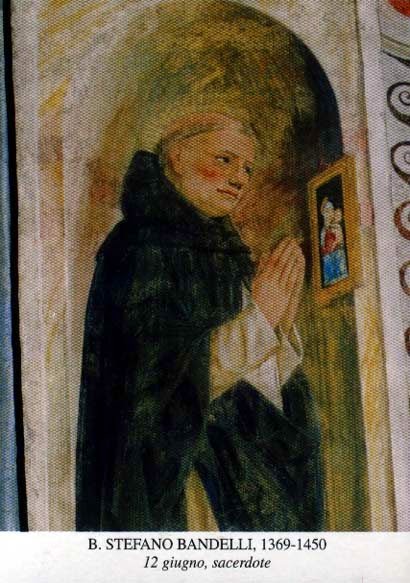
Blessed Stephen Bandelli
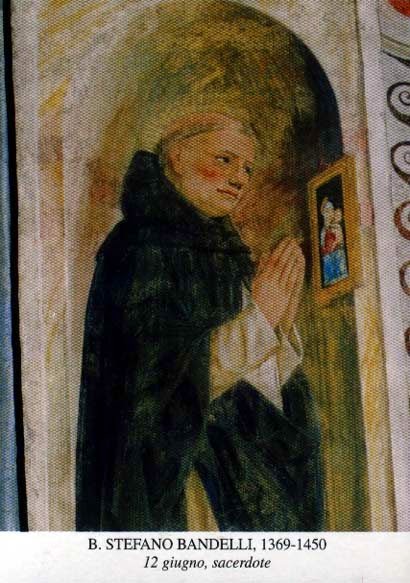
Stephen Bandelli was born into a noble family. Little is known of his early years except that he applied for admission to the Dominicans in his hometown and received the habit while still very young.
Stephen earned a degree in canon law and a master’s degree in theology, and lectured at the University of Pavia. He was a man of superior intellect and a careful student. Tradition holds that he was “another Saint Paul,” and that his sermons were effective in bringing many Christians to a more fervent life and many sinners back into the fold. Aside from this, one reads only the traditional assurances–that he was prayerful, penitential, had a spirit of poverty, was charitable, and was a model religious.
When Stephen died, he was buried in the Dominican church of Saluzzo. Many miracles were worked at his tomb, and the citizens of Saluzzo invoked him, in 1487, when the town was attacked by one of their neighbors. Their preservation was attributed to Stephen’s intercession, as it was claimed that he had appeared in the sky above them while they were fighting. An annual feast was kept there in his honor for many years.

Blessed Peter Sanz, & Companions

The viceroy of Peking wrote this about the five martyrs that included Peter Sanz: “What are we to do with these men? Their lives are certainly irreproachable; even in prison they convert men to their opinions, and their doctrines so seize upon the heart that their adepts fear neither torments nor captivity. They themselves are joyous in their chains. The jailors and their families become their disciples, and those condemned to death embrace their religion. To prolong this state is only to give them the opportunity of increasing the number of Christians.”
Peter Sanz was among the first group of martyrs in Tonkin, which also included Bishop Francis Serrano, Father Joachim Royo, Father John Alcober, and Father Francis Diaz.
Peter Sanz was professed a Dominican at Lerida when he was 18 (1697). He was ordained in 1704, volunteered for the Chinese missions, and was sent to Manila, The Philippines, in 1713. After studying the language for two years, he entered China where he spent 31 years evangelizing the Chinese before he was captured. In 1730, he was nominated vicar apostolic of Fukien and titular bishop of Mauricastro. When a renewed persecution of Christians flared up in 1746, he was accused of breaking the laws by converting thousands to Christianity by a man to whom he had refused to lend money, according to one account.
The five men, bound together by their vows and their work, were brought more closely together during their imprisonment at Foochow. Fathers Serrano, Alcober, and Diaz were captured first, and tortured to reveal the whereabouts of Bishop Sanz. They did not break down, but the bishop and Father Royo, hearing about the torture, surrendered in the hope of sparing their brothers’ suffering, says another account.
The five priests were dragged in chains to the emperor’s court, where they were subjected to frightful torments. All of them, with a catechist named Ambrose Kou, were sentenced to death in December 1746. During the long imprisonment, a Dominican, Father Thomas Sanchez, managed to see them. He brought them some clothes and a little money, and all the news he could find.
On May 25, 1747, Bishop Sanz was beheaded at Fu-tsheu. Even the pagans were impressed with his gentle demeanor as he was led out to die, and a fellow prisoner who had been converted in prison, followed him closely through the mob, openly proclaiming his sanctity. As the headsman prepared to swing the axe, the venerable bishop looked at him and said, “Rejoice with me, my friend; I am going to heaven!”
“I wish I were going with you!” blurted out the unhappy man.
Laying his head upon the block, the bishop preached his last sermon: “If you want to save your soul, my friend, you must obey the law of God!” Pagan friends of the priests scurried through the crowd, gathering up the relics which they saved for the Christians. Many of these people, including the executioner, were later baptized.
On October 20, 1747, after the death of Sanz, word arrived that Father Serrano was had been appointed titular bishop of Tipsa and coadjutor to Blessed Peter Sanz. At that point, he and the others were summarily executed at Fukien.
Born: September 22, 1680 in Ascó, Catalonia, Spain
Died: beheaded on May 26, 1747 in Fuzou, China
Beatified: May 14, 1893 by Pope Leo XIII

Saint Servatius, Bishop & Confessor, Protector of the Dominican Order

Saint Servatius was of noble birth, and he was renewed alike for his learning and sanctity. He became Bishop of Tongres in Belgium, which then formed part of Gaul, and in that capacity assisted at the Council of Sardica, where he strenuously defended the Catholic Faith against the Arians. He likewise stoutly resisted these heresies at the Council of Rimini, and labored to prevent the ill consequences which threatened the Church through their frauds and the weakness of the Bishops. Being sent by the tyrant Magnentius, together with Saint Maximin, Bishop of Treves, as ambassador to the Emperor Constantius, he was honorably entertained by Saint Athanasius at Alexandria.
Saint Gregory of Tours states that Saint Servatius foretold the invasion of Gaul by the Huns and implored the Divine mercy by watching. fasting, prayers and many tears to avert so great a calamity from the flock entrusted to his care. For this intention he undertook a penitential pilgrimage to the tomb of Saint Peter in Rome. As he was weeping and praying there, the Prince of the Apostles appeared to him and thus addresses him: “Wherefore dost thou importune me? The Lord has decreed that the Huns should enter Gaul and lay it waste in a terrible manner. Take my counsel, therefore; lose no time; set thy house in order, prepare thy grave, make ready a clean winding-sheet. Behold , thou shalt depart this life and shalt not witness the evils which the Huns are to bring upon Gaul, as the Lord our God hath spoken.”
The holy Bishop, therefore returned in all haste to his diocese, and with many tears imparted the sad tidings to his heart-broken flock. “Holy Father , do not abandon us,” they exclaimed; “Good Shepherd, forget us not.” Very shortly afterwards he fell ill, as Saint Peter had foretold, and closed his saintly life by a holy death on May 13th, 384 A.D., after an episcopate of thirty-seven years. It is recorded that when all the country round was white with snow his tomb at Maestricht always remained free from it until the time a church was raised over his holy remains.
Saint Servatius was declared Protector of the Dominican Order in consequences of the following circumstances. In the fourteenth century the Church and the Order of Preachers were suffering bitter persecution from the schismatical Emperor, Lewis of Bavaria. Learning that the General Chapter was convoked to meet in his dominions , at the city of Cologne, 1330, A.D., this prince secretly plotted the death of the capitular Fathers. They had just assembled, when Saint Servatius appeared in a dream to one of their number, a very holy religious, warned him of the danger which threatened himself and his brethren , and bade them to flee to Maestricht. This they accordingly did, thus escaping the snares which had been laid for them. And though their coming to Maestricht was wholly unexpected, God disposed the hearts of the inhabitants to receive them with the utmost kindness.
In gratitude for this providential intervention, the Fathers decreed that the festival of Saint Servatius should henceforth be celebrated in the Order to the end of time. But, as it was at first instituted only under the rite of a Feast of the Three Lessons, the great increase of festivals of higher rank caused it, after the lapse of years, to fall into disuse. To preserve the memory of so great a benefit, the Fathers, therefore, obtained permission from Pope Leo XII that the festival of Saint Servatius should be henceforth celebrated throughout the entire Order with the rank of a Totum Duplex, or Greater Double.
Born: Armenia, unknown date
Died: May 13th 384 at Tongres, Belgium of fever
Canonized: Pre- Congregation
Patronage: against foot problems, against lameness, against leg problems, against mice/rats, against rheumatism, success
Representation: bishop holding a key and accompanied by an angel meeting burghers at a city gate, bishop holding a key in one hand while placing his crozier on a dragon, bishop reading desk where nearby sits a shield with three wooden shoes, bishop with three wooden shoes, man striking water with a staff, pilgrim sleeping in the sun while an eagle fans him
The Faith of Our Mothers ~ The Rev. Dcn. Dollie Wilkinson, OPI

Last Sunday, I attended a baby shower for my niece. It was a bittersweet day because while my niece is thrilled to be expecting her first born child, a little girl, her pregnancy has been fraught with health issues. Also, her own Mom passed away shortly after she was born. So she never knew her Mom, and is sad that her daughter will never know her Grandmother. I also imagine today, being Mother’s Day, will be a joyful, but bittersweet day, for her as well.
Mother’s Day is always a happy day for those who are blessed to have their Mom near, or for Moms who enjoy spending time with their children. The origin of Mother’s Day dates back centuries. The ancient Greeks held an annual festival to honor the goddess Rhea, wife of Cronus and mother of many deities of Greek mythology. Ancient Romans held a spring festival in honor of Cybele, a mother goddess. Early Christians held a festival on the fourth Sunday of Lent in honor of the Virgin Mary, Mother of Christ. In the U.S., Mother’s Day is a more recent holiday, born of a daughter’s desire to honor the legacy of her mother.
Ann Reeves Jarvis was the mother of eleven children living in West Virginia. She was active in church and civic affairs. Concerned about poor health and sanitary conditions in her community that contributed to the high mortality rate of children, in the 1850s she organized Mothers Day Work Groups at local churches to provide women to care for families with tubercular mothers, inspect milk for children, and procure medicine for the indigent. The work groups also tended to wounded Union and Confederate soldiers returning from the Civil War. After the war ended, Jarvis and other women organized Mother’s Friendship Day picnics and other events as pacifist activities in the hope of uniting former Civil War foes.
In 1905, Ann Reeves Jarvis died. Three years later, on May 10, 1908, through the efforts of Jarvis’ daughter, Anna Marie, families gathered at events held at Ann Reeves Jarvis’ hometown church in Grafton, West Virginia. These events spread to other cities and states until 1914 when President Woodrow Wilson declared the second Sunday in May as Mother’s Day in the U.S. These early celebrations were a time when families gathered at their homes with their mothers. The purposeful designation of “Mother’s” rather than the plural “Mothers’” Day was intended to stress that the holiday is more about honoring your own mother than the collective mom. We all know that none of us would be here without our Moms (obviously), but I also feel that no one of us would be who we are today with out the positive influence of a loving, caring mother. Even for those who lost their Moms way too soon, the impact these women have had on their children will be felt throughout their lives.
As we celebrate Mother’s Day, I cannot help but think about the Mary, mother of our blessed Jesus, who is really the mother of us all. The word “mother” or “mothers” appears in the Bible almost 300 times. A mother’s influence is also stressed in Ezekiel 16:44 where we read the phrase, “As is the mother, so is her daughter.” The love of children was deep in the hearts of the Hebrew women, and the mother was regarded with the deepest reverence. When I think of biblical mothers, the first two who come to mind are Mary and Elizabeth. The world’s most revered mother is Mary, mother of Jesus. Her cousin Elizabeth was also a godly person, who in her old age gave birth to John the Baptist. Mary visited Elizabeth for about three months while both were approaching motherhood. With this common experience their age differences became insignificant as they joyfully planned for the birth of their sons, who were to be so near the same age. They found much joy in each other because they loved and understood each other and had the same strong belief in God.
Another New Testament mother was Salome, mother of the disciples James and John. A few scholars suggest that she was a sister of Mary, the mother of Jesus. Certainly, she and her sons were very close to Jesus. We think of her as an ambitious person. She was so desirous for her sons to enjoy extra prestige during Jesus’ ministry that she made a special public request to him. (Matthew 20:21 “Grant that these my two sons may sit, the one on thy right hand, and the other on the left, in thy kingdom.”) Jesus rebuked her gently, (Matthew 20:23 “To sit on my right hand, and on my left, is not mine to give, but it shall be given to them for whom it is prepared of my Father.”) We should not be too severe on her, for she remained one of the most faithful followers of Jesus to the end. And evidently she handed down a rich spiritual legacy to her sons. It was to her son John that Jesus entrusted His own mother at the end. Another mother spoke about in the Bible is Rachel. She was the mother of Joseph and Benjamin, and was the first woman on record to lose her life in childbirth. Rachel died when Benjamin was born. Benjamin must have heard a great deal about his mother because Jacob loved her dearly. These are just a few of the Mothers in the Bible. May we be inspired by their lives and the lives of their children.
The Bible never states that every woman should be a mother. However, it does say that those whom the Lord blesses to be mothers should take the responsibility seriously. Mothers have a unique and crucial role in the lives of their children. Motherhood is not a chore or an unpleasant task. Just as a mother bears a child during pregnancy, and just as a mother feeds and cares for a child during infancy, so mothers also play an ongoing role in the lives of their children, whether they are adolescents, teenagers, young adults, or even adults with children of their own. While the role of motherhood must change and develop, the love, care, nurture, and encouragement a mother gives should never cease.
A PRAYER for YOUNG MOTHERS
Our heavenly Father, we thank thee for the gift of motherhood.
Help us as young mothers to seek thy guidance for our children.
Grant us wisdom, strength, patience, faith and love.
Create in us the willingness to dedicate ourselves and our children to Thee.
In the name of thy Son, Jesus Christ,
Amen.

Saint Vincent Ferrer
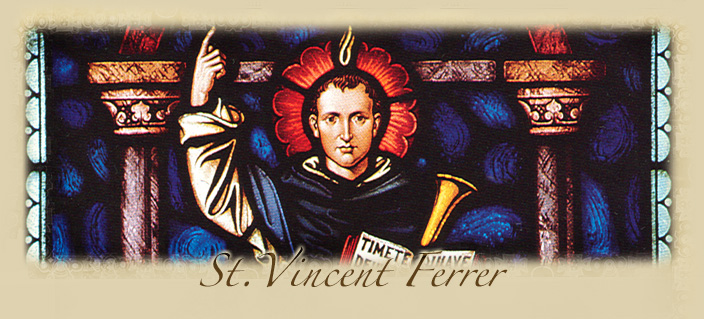
Born into a noble, pious family headed by the Englishman William Ferrer and the Spanish woman Constantia Miguel, Saint Vincent’s career of miracle-working began early. Prodigies attended his birth and baptism on the same day at Valencia, and, at age 5, he cured a neighbor child of a serious illness. These gifts and his natural beauty of person and character made him the center of attention very early in life.
His parents instilled into Vincent an intense devotion to our Lord and His Mother and a great love of the poor. He fasted regularly each Wednesday and Friday on bread and water from early childhood, abstained from meat, and learned to deny himself extravagances in order to provide alms for necessities. When his parents saw that Vincent looked upon the poor as the members of Christ and that he treated them with the greatest affection and charity, they made him the dispenser of their bountiful alms. They gave him for his portion a third part of their possessions, all of which he distributed among the poor in four days.
Vincent began his classical studies at the age of 8, philosophy at 12, and his theological studies at age 14. As everyone expected, he entered the Dominican priory of Valencia and received the habit on February 5, 1367. So angelic was his appearance and so holy his actions, that no other course seemed possible to him than to dedicate his life to God.
No sooner had he made his choice of vocation than the devil attacked him with the most dreadful temptations. Even his parents, who had encouraged his vocation, pleaded with him to leave the monastery and become a secular priest. By prayer and faith, especially prayer to Our Lady and his guardian angel, Vincent triumphed over his difficulties and finished his novitiate.
He was sent to Barcelona to study and was appointed reader in philosophy at Lerida, the most famous university in Catalonia, before he was 21. While there he published two treatises (Dialectic suppositions was one) that were well received.
In 1373, he was sent to Barcelona to preach, despite the fact that he held only deacon’s orders. The city, laid low by a famine, was desperately awaiting overdue shipments of corn. Vincent foretold in a sermon that the ships would come before night, and although he was rebuked by his superior for making such a prediction, the ships arrived that day. The joyful people rushed to the priory to acclaim Vincent a prophet. The prior, however, thought it would be wise to transfer him away from such adulation.
Another story tells us that some street urchins drew his attention to one of their gang who was stretched out in the dust, pretending to be dead, near the port of Grao: “He’s dead, bring him back to life!” they cried.
“Ah,” replied Vincent, “he was playing dead but the, look, he did die.” This is how one definitely nails a lie: by regarding it as a truth. And it turned out to be true, the boy was quite dead. Everyone was gripped with fear. They implored Vincent to do something. God did. He raised him up.
In 1376, Vincent was transferred to Toulouse for a year, and continued his education. Having made a particular study of Scripture and Hebrew, Vincent was well-equipped to preach to the Jews. He was ordained a priest at Barcelona in 1379, and became a member of Pedro (Peter) Cardinal de Luna’s court–the beginning of a long friendship that was to end in grief for both of them. (Cardinal de Luna had voted for Pope Urban VI in 1378, but convinced that the election had been invalid, joined a group of cardinals who elected Robert of Geneva as Pope Clement VII later in the same year; thus, creating a schism and the line of Avignon popes.)
After being recalled to his own country, Vincent preached very successfully at the cathedral in Valencia from 1385-1390, and became famed for his eloquence and effectiveness at converting Jews–Rabbi Paul of Burgos, the future bishop of Cartagena was one of Vincent’s 30,000 Jewish and Moorish converts–and reviving the faith of those who had lapsed. His numerous miracles, the strength and beauty of his voice, the purity and clarity of his doctrine, combined to make his preaching effective, based as it was on a firm foundation of prayer.
Of course, Vincent’s success as a preacher drew the envy of others and earned him slander and calumny. His colleagues believed that they could make amends for the calumny by making him prior of their monastery in Valencia. He did withdraw for a time into obscurity. But he was recalled to preach the Lenten sermons of 1381 in Valencia, and he could not refuse to employ the gift of speech which drew to him the good and simple people as well as the captious pastors, the canons, and the skeptical savants of the Church.
Peter de Luna, a stubborn and ambitious cardinal, made Vincent part of his baggage, so to speak; because from 1390 on, Vincent preached wherever Peter de Luna happened to be, including the court of Avignon, where Vincent enjoyed the advantage of being confessor to the pope, when Peter de Luna became the antipope Benedict XIII in 1394.
Two evils cried out for remedy in Saint Vincent’s day: the moral laxity left by the great plague, and the scandal of the papal schism. In regard to the first, he preached tirelessly against the evils of the time. That he espoused the cause of the wrong man in the papal disagreement is no argument against Vincent’s sanctity; at the time, and in the midst of such confusion, it was almost impossible to tell who was right and who was wrong. The memorable thing is that he labored, with all the strength he could muster, to bring order out of chaos. Eventually, Vincent came to believe that his friend’s claims were false and urged de Luna to reconcile himself to Urban VI.
He acted as confessor to Queen Yolanda of Aragon from 1391 to 1395. He was accused to the Inquisition of heresy because he taught that Judas had performed penance, but the charge was dismissed by the antipope Benedict XIII, who burned the Inquisition’s dossier on Vincent and made him his confessor.
Benedict offered Vincent a bishopric, but refused it. Distressed by the great schism and by Benedict’s unyielding position, he advised him to confer with his Roman rival. Benedict refused. Reluctantly, Vincent was obliged to abandon de Luna in 1398. The strain of this conflict between friendship and truth caused Vincent to become dangerously ill in 1398. During his illness, he experienced a vision in which Christ and Saints Dominic and Francis instructed him to preach penance whenever and wherever he was needed, and he was miraculously cured.
After recovering, he pleaded to be allowed to devote himself to missionary work. He preached in Carpetras, Arles, Aix, and Marseilles, with huge crowds in attendance. Between 1401 and 1403, the saint was preaching in the Dauphiné, in Savoy, and in the Alpine valleys: he continued on to Lucerne, Lausanne, Tarentaise, Grenoble, and Turin. He was such an effective speaker that, although he spoke only Spanish, he was thought by many to be multilingual (the gift of tongues?). His brother Boniface was the prior of the Grande Chartreuse, and as a result of Vincent’s preaching, several notable subjects entered the monastery.
Miracles were attributed to him. In 1405, Vincent was in Genoa and preached against the fantastic head-dresses worn by the Ligurian ladies, and they were modified–“the greatest of all his marvelous deeds, reports one of his biographers. From Genoa, he caught a ship to Flanders. Later, in the Netherlands, an hour each day was scheduled for his cures. In Catalonia, his prayer restored the withered limbs of a crippled boy, deemed incurable by his physicians, named John Soler, who later became the bishop of Barcelona. In Salamanca in 1412, he raised a dead man to life. Perhaps the greatest miracle occurred in the Dauphiné, in an area called Vaupute, or Valley of Corruption. The natives there were so savage that no minister would visit them. Vincent, ever ready to suffer all things to gain souls, joyfully risked his life among these abandoned wretches, converted them all from their errors and vices. Thereafter, the name of the valley was changed to Valpure, or Valley of Purity, a name that it has retained.
He preached indefatigably, supplementing his natural gifts with the supernatural power of God, obtained through his fasting, prayers, and penance. Such was the fame of Vincent’s missions, that King Henry IV of England sent a courtier to him with a letter entreating him to preach in his dominions. The king sent one of his own ships to fetch him from the coast of France, and received him with the greatest honors. The saint having employed some time in giving the king wholesome advice both for himself and his subjects, preached in the chief towns of England, Scotland, and Ireland. Returning to France, he did the same, from Gascony to Picardy.
The preaching of Saint Vincent became a strange but marvelously effective process. He attracted to himself hundreds of people–at one time, more than 10,000–who followed him from place to place in the garb of pilgrims. The priests of the company sang Mass daily, chanted the Divine Office, and dispensed the sacraments to those converted by Vincent’s preaching. Men and women travelled in separate companies, chanting litanies and prayers as they went barefoot along the road from city to city. They taught catechism where needed, founded hospitals, and revived a faith that had all but perished in the time of the plague.
The message of his preaching was penance, the Last Judgment, and eternity. Like another John the Baptist–who was also likened to an angel, as Saint Vincent is in popular art–he went through the wilderness crying out to the people to make straight the paths of the Lord. Fearing the judgment, if for no other reason, sinners listened to his startling sermons, and the most obstinate were led by him to cast off sin and love God. He worked countless miracles, some of which are remembered today in the proverbs of Spain. Among his converts were Saint Bernardine of Siena and Margaret of Savoy.
He returned to Spain in 1407. Despite the fact that Granada was under Moorish rule, he preached successfully, and thousands of Jews and Moors were said to have been converted and requested baptism. His sermons were often held in the open air because the churches were too small for all those who wished to hear him.
In 1414 the Council of Constance attempted the end the Great Schism, which had grown since 1409 with three claimants to the papal throne. The council deposed John XXIII, and demanded the resignation of Benedict XIII and Gregory XII so that a new election could be held. Gregory was willing, but Benedict was stubborn. Again, Vincent tried to persuade Benedict to abdicate. Again, he failed. But Vincent, who acted as a judge in the Compromise of Caspe to resolve the royal succession, influenced the election of Ferdinand as king of Castile. Still a friend of Benedict (Peter de Luna), King Ferdinand, basing his actions on Vincent’s opinion on the issue, engineered Benedict’s deposition in 1416, which ended the Western Schism.
(It is interesting to note that the edicts of the Council of Constance were thrown out by the succeeding pope. The council had mandated councils every ten years and claimed that such convocations had precedence over the pope.)
His book, Treatise on the Spiritual Life is still of value to earnest souls. In it he writes: “Do you desire to study to your advantage? Let devotion accompany all your studies, and study less to make yourself learned than to become a saint. Consult God more than your books, and ask him, with humility, to make you understand what you read. Study fatigues and drains the mind and heart. Go from time to time to refresh them at the feet of Jesus Christ under his cross. Some moments of repose in his sacred wounds give fresh vigor and new lights. Interrupt your application by short, but fervent and ejaculatory prayers: never begin or end your study but by prayer. Science is a gift of the Father of lights; do not therefore consider it as barely the work of your own mind or industry.”
It seems that Vincent practiced what he preached. He always composed his sermons at the foot of a crucifix, both to beg light from Christ crucified, and to draw from that object sentiments with which to animate his listeners to penance and the love of God.
Saint Vincent also preached to Saint Colette and her nuns, and it was she who told him that he would die in France. Indeed, Vincent spent his last three years in France, mainly in Normandy and Brittany, and he died on the Wednesday of Holy Week in Vannes, Brittany, after returning from a preaching trip to Nantes. The day of his burial was a great popular feast with a procession, music, sermons, songs, miracles, and even minor brawls.
Born: 1350 at Valencia, Spain
Died: April 5th in 1419 at Vannes, Brittany , France
Canonized: 1458
Patronage: brick makers; builders; Calamonaci, Italy; construction workers; pavement workers; plumbers; tile makers
Representation: cardinal’s hat; Dominican preacher with a flame on his hand; Dominican preacher with a flame on his head; Dominican holding an open book while preaching; Dominican with a cardinal’s hat; Dominican with a crucifix; Dominican with wings; flame; pulpit; trumpet
Washing Feet ~ Br. Chip Noon, Novice
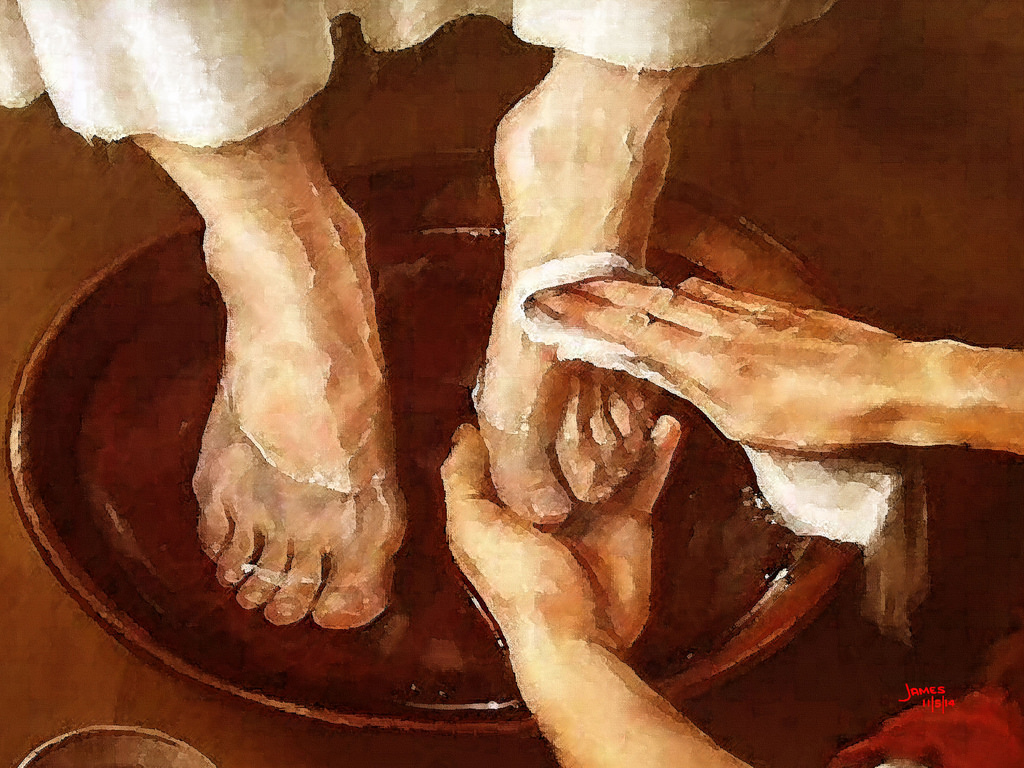
“Ecce Agnus Dei, ecce qui tollit peccata mundi. Beati qui ad cenam Agni vocati sunt” (Behold the Lamb of God, behold him who takes away the sins of the world. Blessed are those called to the supper of the Lamb).
The first reading for the Mass of the Lord’s Supper is from Exodus. In it we find explicit instructions the Lord gives to Moses about what became known as The Feast of the Passover. The Lord also says:
“This day shall be a memorial feast for you, which all your generations shall celebrate with pilgrimage to the LORD, as a perpetual institution.”
And St. Paul quotes Jesus in the second reading: “This is my body that is for you. Do this in remembrance of me.”
In the same way also the cup, after supper, saying, “This cup is the new covenant in my blood. Do this, as often as you drink it, in remembrance of me.”
The Verse Before the Gospel in today’s mass is from John 13: I give you a new commandment, says the Lord: love one another as I have loved you.
Holy Thursday is sometimes called Maundy Thursday, Maundy coming from the Latin word mandare, to command. Today we learn about three commandments: one from God to the Hebrews in the Old Testament about the Passover Feast and the sacrificial lamb, and the other two from Jesus who commands us to love one another and celebrate the Eucharist in his memory. And in Jesus’ command to love one another, we hear the echo of his first command to his disciples: “Love the Lord your God with all your heart and with all your soul and with all your mind.”
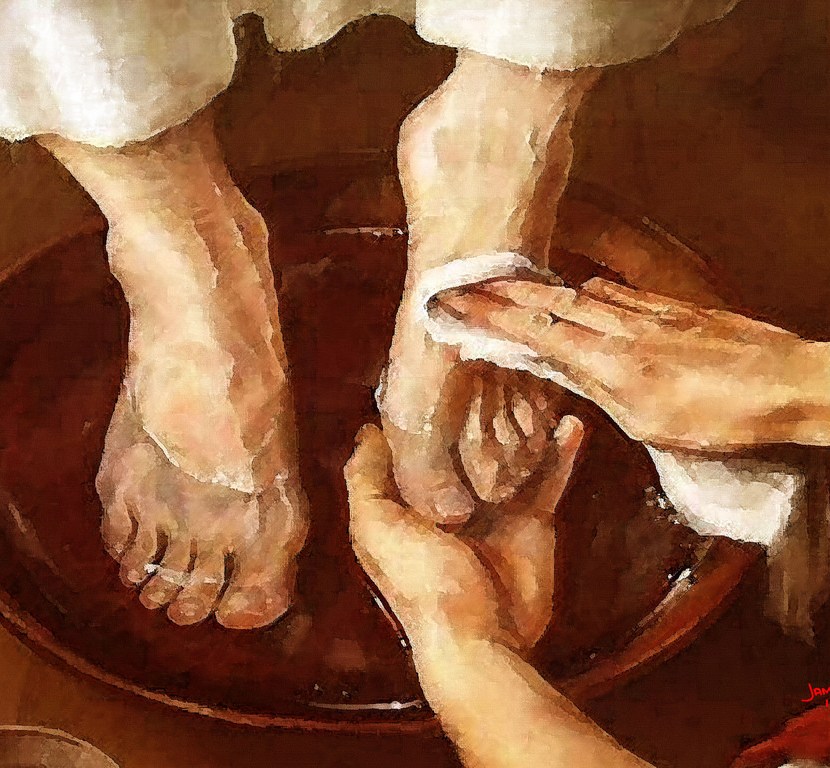
So who gives commands? The boss, the general, the supervisor, the police…in this case, it’s God. But what, besides the Eucharist is an important part of this story? God reminds everyone that he is going to be sacrificed to save them from their sins, and then proceeds to wash the feet of his disciples! The master becomes the servant and tells us that we should all be servants to our neighbors.
Of course, then there is a discussion about who among them is considered to be the greatest, they being the rude bunch of disciples that they are. Jesus says to them:
“The kings of the Gentiles lord it over them; and those who exercise authority over them call themselves Benefactors. But you are not to be like that. Instead, the greatest among you should be like the youngest, and the one who rules like the one who serves. For who is greater, the one who is at the table or the one who serves? Is it not the one who is at the table? But I am among you as one who serves.”
It seems to me that the whole of the establishment of the Eucharist embodies this idea of servanthood, along with the bread and wine. Sometimes we just forget this part of our Lord’s last day as a free man.
But maybe we ought to reflect upon that significant act, washing feet, and the reminder by Jesus that he is “among [us] as one who serves.”
“Do this in remembrance of me.” Eat the bread, drink the wine, serve our fellows. That reminder is not an integral part of the mass, but perhaps it should be. Wouldn’t a weekly or daily reminder at the feast of the Eucharist that we are all to act as servants, wouldn’t that reminder be a transformative event in our lives? After all, we are just dust, and will return to dust. But living for, and being remembered as servants of, our fellows…isn’t that a greater honor than being the boss, or first at the table? Being like Jesus. Isn’t that the greatest honor of all?
Lord, as we approach the time of your passion, help us to remember every day that you came to us as a servant and gave your life for us on the cross, so that at daybreak on Easter, we can rejoice in your resurrection as your friends. Amen.

Jesus In The Bookstore ~ The Rev. Deacon Dollie Wilkinson, OPI

While out and about today, running errands and having lunch with my daughter, we decided to stop in a local coffee shop/bookstore. I happened to notice a gentleman sitting at a table, not with a cup of coffee in front of him, but with a small cart which seemed filled with random bags and other things. He also had a couple tote bags sitting on the floor beside him. While I do not know his story, I just assumed he was homeless, or maybe an individual who was down on his luck.
What circumstances led to this person being in the bookstore? Because it was rather chilly out, I assumed maybe he was just looking for a warm place to sit awhile, before deciding on how he would spend the rest of the day, and night. While I cannot imagine what challenges this man faces, I often wondered what circumstances led to him being without a place to live, or even to spend the night.
Then I began to think about Jesus, who traveled quite a bit, spreading his Father’s message of hope, love, of grace. Did He spend time in public places like this? We know He did, as well as visiting in people’s homes. Such as He did in the home of Lazarus, as described in John 12:1-8:
“Six days before the Passover Jesus came to Bethany, the home of Lazarus, whom he had raised from the dead. There they gave a dinner for him. Martha served, and Lazarus was one of those at the table with him. Mary took a pound of costly perfume made of pure nard, anointed Jesus’ feet, and wiped them with her hair. The house was filled with the fragrance of the perfume. But Judas Iscariot, one of his disciples (the one who was about to betray him), said, “Why was this perfume not sold for three hundred denarii and the money given to the poor?” (He said this not because he cared about the poor, but because he was a thief; he kept the common purse and used to steal what was put into it.) Jesus said, “Leave her alone. She bought it so that she might keep it for the day of my burial. You always have the poor with you, but you do not always have me.” “
We know Jesus was warmly welcomed, maybe because He was already known by most of the people in the home. But we also know that there were those (such as Judas Iscariot), who did not believe in treating Jesus as the blessed Savior He was. Of course Judas ends up betraying Jesus, but at this time, we are unsure why he feels it a waste to use the good perfume or oil, to bathe Jesus’ feet. But Mary does so anyway. Jesus recognizes this, and states this same oil will also be used for his burial.
Now, imagine Jesus in our time. Just as the homeless person I noticed today, He would probably have been seen as such. Of course Jesus carried very little with Him, but if the gentleman I saw today, showed up at your door, would you welcome him in to your home? Would you use your best china, serve Him your favorite dishes? Would you be comfortable with Him wishing to use your bathroom, maybe even to take a shower? If this homeless person knocked at your door, would you be like Martha and serve Him a delicious meal, open your finest bottle of wine, and maybe even call a few friends over to share this wonderful occasion? Or would you turn Him away, too quickly judging Him by His appearance, deciding that He isn’t worth the time or effort?
I imagine many folks who saw the homeless gentleman in the bookstore today, would have quickly walked passed him without much thought, too busy with their own concerns. But what if he were Jesus, and He was just resting a bit before continuing on His travels, spreading His message of salvation, of love and hope? Would you be like Mary, and quickly rush to wash this man’s feet, or offer your most expensive oil or perfume, so He may refresh himself? I often wonder what would happen if Jesus walked among us today. Would we even recognize Him? We know many in the gospels did not, but many more did. Would we welcome Him in to our homes, our businesses, our schools? Would we gladly share everything we owned, knowing like Mary, that all we have is because of our blessed Savior?
Just as we are remind of in Matthew 25:40, ““The King will reply, ‘Truly I tell you, whatever you did for one of the least of these brothers and sisters of mine, you did for me.’ “ We must always remember that though Jesus, the Son, does not walk among us today as a man, He still walks among us. Just as Mary and Martha did so many years ago, we need to always welcome Him in to our homes, our lives. Giving Him the best we have to offer, giving Him our all.

And Now, For a Change… ~ The Rev. Dcn. Dollie Wilkinson, OPI

As we first entered the Lenten season, the focus almost always seemed to be about change. Questions such as, “What am I to give up for Lent?” or even, “What task or new habit can I incorporate in to my daily life?”. As we all know, change, though scary at times, is almost always good. Just as the change that came over Jesus in Luke 9:28-36.
“Now about eight days after these sayings Jesus took with him Peter and John and James, and went up on the mountain to pray. And while he was praying, the appearance of his face changed, and his clothes became dazzling white. Suddenly they saw two men, Moses and Elijah, talking to him. They appeared in glory and were speaking of his departure, which he was about to accomplish at Jerusalem. Now Peter and his companions were weighed down with sleep; but since they had stayed awake, they saw his glory and the two men who stood with him. Just as they were leaving him, Peter said to Jesus, “Master, it is good for us to be here; let us make three dwellings, one for you, one for Moses, and one for Elijah” — not knowing what he said. While he was saying this, a cloud came and overshadowed them; and they were terrified as they entered the cloud. Then from the cloud came a voice that said, “This is my Son, my Chosen; listen to him!” When the voice had spoken, Jesus was found alone. And they kept silent and in those days told no one any of the things they had seen.”
Peter, John and James witnessed a rare sight, the Transfiguration or change, of Jesus. Just as we experience change during these days of Lent, so did Jesus on top of the mountain. But what I find interesting is that these men still recognized Jesus as, well, Jesus. Though He was clothed in “dazzling white”. He was the same teacher, and friend, that these gentlemen had always known. They recognized Him still, and were humbled by the change that manifested in Him at the time.
Often times we fear change because we wonder, “Will my friends and family still love me?”. Or those around us may even question the changes, fearing this new person we have become, will not be as welcoming to those around us. But Jesus changed, and did Peter, John or James flee in fear? No, actually after Peter witnessed Jesus speaking with Moses and Elijah, he wanted to literally roll out the welcome mat. Not entirely understanding what was happening, but trusting Jesus, Peter wanted to build a dwelling for all three. He was so excited to be a witness to this special occasion, he sought some way to preserve the moment. If such an occurrence happened now, I can almost guarantee every one of us would want to do the same. But instead of constructing tents, we would quickly be updating our status on Facebook, or posting like a gazillion pics on Instagram. Or just as likely, our fingers would quickly be flying across our keyboards, sending out Tweets about what an awesome time we had hanging out with Jesus.
So, we know Peter, John and James had this life-changing experience on the mountain. They witnessed Jesus’ Transfiguration, as well as a booming voice in the cloud declaring exactly who Jesus is, and are instructed to listen to Him. When I first became a Christian, and was walking on wobbly stones in my faith, I often asked God, “Give me a sign, show me you are You”. Well as you can imagine, that didn’t happen. And honestly, if it had, I wouldn’t be so sure that I could have even believed my own eyes. Yet, don’t we all strive too witness the true face of God, to see with our own eyes that He really is just who He says He is, and can do what He unequivocally declares to be done? Yet as we read in the Bible, true visitations by our heavenly Father are rare. But, He is still just as real to us today as He was so long ago on top of that mountain.
As we use this time to manifest changes in ourselves, as we strive to develop a deeper relationship with our blessed Father, let us never forget that He is right here with us. He is sitting at the kitchen table as you sip that first cup of coffee. He is standing in the check out line at the store. He is in the car on our daily commute home in the evening. And, He is there when we finally decide to put our daily cares to rest, and before we close our eyes at night, whispering “Thank you God for another day.”.
Transfiguration Prayer:
Lord,
You met with Moses on the top of a mountain,
And when he descended his face was shining
And in your power he brought your laws to a needy people.
You met with Christ on top of a mountain
And he was transformed with brightness
And descended with renewed strength.
Lord, we want to meet with you and be transformed by you
And to bring your transformation to the world around us.
Help us to bring your presence to the lives of those burdened with sickness or pain,
And those weighed down with confusion or grief.
Bring your healing touch to those lives today,
And let us support those we know in need with a constant friendship.
Help us to bring your change to a troubled society,
Where people are unsure of so much and where change comes so fast.
Give us the grace to understand people’s problems and anxieties
And the strength to tackle difficult issues head on.
Help us to work together to transform a needy world,
Whether through giving or educating or leading by example.
Give us the wisdom to see through big and complex issues
And the love that will keep us going when problems are overwhelming.
Help us to always be a beacon for you,
Individually and together.
We don’t stand on any lofty mountain
But we have a God who is changing us every day
And through whom we can reach out to change a broken world.
Be with us today Lord and help us take whatever step is next for us.
We ask this through the power of your love.
Amen
Blessed Alvarez of Cordova
Blessed Alvarez is claimed by both Spain and Portugal. He received the habit in the convent of Saint Paul in Cordova in 1368, and had been preaching there for some time in Castile and Andalusia when Saint Vincent Ferrer began preaching in Catalonia. Having gone to Italy and the Holy Land on a pilgrimage, Alvarez returned to Castile and preached the crusade against the infidels. He was spiritual advisor to the queen-mother of Spain, Catherine daughter of John of Gaunt, and tutor to her son John II. Alvarez had the work of preparing the people spiritually for the desperate effort to banish the Moors from Spain. He also opposed the Avignon pope Peter de Luna.
Blessed Alvarez is probably best remembered as a builder of churches and convents, an activity which was symbolic of the work he did in the souls of those among whom he preached. He founded, in one place, a convent to shelter a famous image of Our Lady, which had been discovered in a miraculous manner. Near Cordova he built the famous convent of Scala Coeli, a haven of regular observance. It had great influence for many years. His building enterprises were often aided by the angels, who, during the night, carried wood and stones to spots convenient for the workmen.
The austerities of Alvarez were all the more remarkable in that they were not performed by a hermit, but by a man of action. He spent the night in prayer, as Saint Dominic had done; he wore a hairshirt and a penitential chain; and he begged alms in the streets of Cordova for the building of his churches, despite the fact that he had great favor at court and could have obtained all the money he needed from the queen. He had a deep devotion to the Passion, and had scenes of the Lord’s sufferings made into small oratories in the garden of Scala Coeli.
On one occasion, when there was no food for the community but one head of lettuce left from the night before, Blessed Alvarez called the community together in the refectory, said the customary prayers, and sent the porter to the gate. There the astonished brother found a stranger, leading a mule; the mule was loaded with bread, fish, wine, and all things needed for a good meal. The porter turned to thank the benefactor and found that he had disappeared.
At another time, Blessed Alvarez was overcome with pity at a dying man who lay untended in the street. Wrapping the man in his mantle, he started home with the sufferer, and one of the brothers asked what he was carrying. “A poor sick man,” replied Alvarez. But when they opened the mantle, there was only a large crucifix in his arms. This crucifix is still preserved at Scala Coeli.
Blessed Alvarez died and was buried at Scala Coeli. An attempt was made later to remove the relics to Cordova, but it could not be done, because violent storms began each time the journey was resumed, and stopped when the body was returned to its original resting place.
Founded Escalaceli (Ladder of Heaven), a Dominican house of strict observance in the mountains around Cordova; it became a well known center of piety and learning. Alvarez spent his days there preaching, teaching, begging alms in the street, and spending his nights in prayer. In the gardens of the house he set up a series of oratories with images of the Holy Lands and Passion, similar to modern Stations of the Cross.
A bell in the chapel of Blessed Alvarez, in the convent of Cordova, rings of itself when anyone in the convent, or of special not in the order, is about to die (Benedictines, Dorcy).
There are many wonderful stories attached to Alvarez, which include:
|
||
|
||
|
||
|
||
|
Born: Born about the middle of the 14th century in Cordova, Spain
Died: 1420
Beatified: Cultus confirmed September 22 by Benedict XIV in 1741


You must be logged in to post a comment.