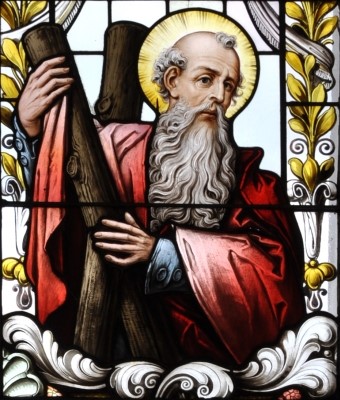
The Feast of St Andrew, Apostle~The Very Rev Lady Sherwood, OPI

Today we come together to celebrate the feast day  of St. Andrew the Apostle.   Andrew was Jesus’ very first disciple. Let us reflect on one of the qualities of Andrew:  that quality being his of∙his readiness to respond to our Lord Jesus Christ’s call to follow him.

We hear Andrew’s call story today in today’s Holy Gospel reading of MT 4:18=22. As Jesus walks along the shore of the Sea of Galilee, he notices two brothers, Simon Peter & Andrew, who were engrossed in their daily work of fishing. As Andrew & Peter cast their nets into the sea, Jesus calls to them, “Follow me, and I will make you fishers of men!”

This call must have caught the brothers’ attention. – They must’ve wondered what Jesus could possibly have meant by saying, to be fishers of men. However, Andrew responded wholeheartedly to Jesus’ call.

Andrew followed Jesus – without any reservations or any hesitation – Most likely with a lot of curiosity, but never the less, with total devotion – Andrew immediately left his fishing nets, perhaps letting them sink into the water.

Andrew had a heart which was prepared to hear & to heed Jesus’ call, with all that he had & all that he was. Because Andrew’s heart was prepared for Jesus, he did not have to be in a holy place like in a Church to hear his call, neither did he need to have been going about particularly holy work to perceive Jesus’ call to him. Andrew heard Jesus call in the midst of his ordinary daily  life’s work,  during his usual  routine day, at a moment when he was casting his fishing net out into the waters of the sea.

Andrew was held near to the word as summarized in the 10 Commandments.

The word as condensed by Jesus into the two great commandments,

Love the Lord your God with all your heart, with all your soul, and with all your mind. And love your neighbour as yourself.

This word – this instruction for living in a way that brings both self & neighbours closer to God – was alive within Andrew’s life – it was on his lips & in his heart.

Jewish people living in Andrew’s time & for centuries before had studied God’s word – they had engaged God’s Holy Scripture – in very active, dynamic, & relational ways:

by reciting it out loud to one another & in groups;

by soaking up the spoken words & paying close attention;

by the struggle that is teaching & learning;

by discussing what this word meant for them in lively, curious, creative, & probing ways.

This encounter with God through the Word — through the living of Scripture in everyday life— enabled Andrew to perceive so much more than the written word which had come to life in him. Andrew was able to perceive the Word made Flesh, Our Lord Jesus Christ, in the midst of an ordinary, routine day. The word is very near to all of us as Christians and followers of Our Lord Jesus Christ. The word should be in our mouths and on our lips, & in our heart, our soul, and  in our minds for us to observe.

The Word made Flesh, Jesus the Christ, is very near us.. calling us through our sacred scripture…through the bread & the wine of The Holy Eucharist … through the our which share the Peace…through our voices lifted in song, prayer, and praise…through our faces & our personalities in church and in our everyday lives.

 May each of us together… learn from Andrew how near these words of God are…how they seek unceasingly to engage & to dwell with us…that we may respond wholeheartedly to Jesus when he calls us…that we may participate together, in community, in the life everlasting.

Let us pray:

O Glorious St. Andrew, you were the first to recognize and follow the Son of God. With your friend, St. John, you remained with Jesus, for your entire life, and now throughout eternity. Just as you led your brother, St Peter, to Christ and many others after him, draw us also to Him. Teach us how to lead them, solely out of love for Jesus and dedication to His service. Help us to learn the lesson of the Cross and carry our daily crosses without complaint, so that they may carry us to God the Almighty Father. Amen.

What’s the Price?~The Rev. Frank Bellino,OPI

It is possible to win all the battles and yet in a certain manner, the war will be lost. I have come to see this, but it has been a long time. I recall being a teenager, causing a family feud because I wanted to watch a film that no one else wanted to see. I got my way, and I enjoyed the movie, but did I? However, even in the absence of a loving family, there was a price to pay, the aftermath of a small family dispute. Was it worth it? The movie was excellent, but I can barely recall it now. Memories of the dispute remain much stronger. Like many trivial battles, when one is caught in the midst of it, it appears to be so important. Once one takes a step back, the victory appears to be very small.

It is easy to think of dominant individuals as victorious. They get what they want pretty much all the time. Lives are carefully constructed for personal comfort. However, this lacks the amount that usually must be paid. The price is love, whether it is the ability to love or the condition of being loved. People tend to avoid those who always insist on their way; family members visit out of a sense of obligation. Even if cherished, there is not the same trust, the same desire to be in their company, who would have been otherwise. That is a loss, a serious loss. It is a loss that is often not recognized. Haven’t they got everything they want? However, it is possible to win all the battles and yet lose the war. Despite all the victories, victories that occur in the end of the day rarely exceed much.

In the meeting of Pilate and Jesus, we meet the representative of Imperial Rome with Christ the Universal King. To convey Christ as Universal King is, among other things, to be reminded that while there is a kind of kingship that is built on power and domination, the true kingship, that of Christ, is not like that. However, if we understand that it can be difficult to understand as a cliché and do not convey the profound truth at its center.

A good way to enter the mystery of the Kingship of Christ is to observe as best we can on the nature of power as it works in reality. Think about our own lives, or, more dramatically, about the lives of some of the important figures of history. Did their splendor or admiration show them really provide genuine peace or happiness? Is it more an attempt to calm down without never-ending desires? To ask questions like these is not to adopt a plan to make us feel more confident about our meagre state. It is to ask challenging questions about what is essential to us, where our priorities should be, and what it is to be truly human.

The Feast of Christ as Universal King is, among other things, a reminder of a profound truth about our lives, about where true happiness is to be found and where it is not to be found. When Christ asserts that his kingdom is not of this world, he is not only telling us that to put our trust in power and domination is emptiness and folly, but also providing us with an alternative. The alternative is love. That may sound stale, and it can be presented as stale, but nothing could be further from the truth.

This is something that is not always easy to see. It can be much easier to acknowledge the Kingship of Christ in our daily lives than deep in our hearts. I believe most of us are like that at times, if we’re honest about it.

When we take a step back from our lives, when we reflect and pray, is there a deep understanding of where true happiness is to be found and where it is not to be found? It may be a sense that the daily grind of life may try to drown, that we may even try to extinguish, but it is a sense that refuses to go away. It refuses to go away because it reveals a profound understanding of God’s plan for us. We may not always perceive it, but if we reflect on what true victory and power really are, as revealed in the loving Kingship of Christ, we can see that there is a kind of victory that makes such complete sense that we might well wonder why we so often fail to see it.

I Don’t Understand~The Rev Frank Bellino, OPI

We’ve all had that experience of joining a group of friends who are mid-conversation, and finding that, at least at first, what they’re saying makes no sense to us. Without the context of what they have been saying, it is difficult to understand the meaning of the words they are saying.

Perhaps we are feeling that way about our lives a lot of the time. Instead of making sense, our lives appear disjointed and confusing, and it’s difficult to find a meaning in the things that happen.

People say, “Everything happens for a reason”, but that’s precisely because it doesn’t look that way. If the reasons behind the things that happen in our lives were clear, we wouldn’t spend any time at all trying to persuade ourselves that things happened for a reason. But it isn’t so obvious.

One way of responding to this lack of meaning is to try to create meaning for us. A lot of people nowadays think it’s up to us to create the meaning in our lives. We must decide on a purpose for our lives, heroically make something of ourselves. I don’t think that works, and it’s all very exhausting!

Part of what Jesus is talking about in today’s Gospel is the idea that our lives, indeed the whole history of humanity, the whole universe, already has a meaning and a purpose: we’re just ignoring it. He seems to think that the meaning is pretty clear, as openly obvious as the coming of summer, the signs which herald the passing of the seasons.

Sometimes, it’s difficult to accept that the way things are going in the world has nothing to do with God. Our news is filled with tragedy and suffering. It doesn’t feel like God is in charge. However, even in the darkest stories, there is often a sign of hope. There are people fleeing their countries and people trying to stop them coming here, but there are also individuals working to make them feel welcomed and to care for them.

In our own lives, I think we often see, especially looking back, a story to our own lives which was not our making. When I think of the various events in my life that nudged me towards joining the Dominicans, it’s quite unnerving, because I begin to realize that all my own decisions, some of them made for good reasons, but some even made for rather selfish ones, took me down a path I had not planned to be on.

I say “unnerving” because I have to come to realize that my life and its meaning and purpose are not my own. I can try all I like to give meaning to my life, I can have as many plans as I want, but ultimately none of that amounts too much. The meaning of my life, the story I find there, is being told, not by me, but by God. I don’t mean he says that story in a way that makes my choices irrelevant, but even when I make bad choices, God can use them to move the story in the direction he wants.

Understanding our lives, then, is not about heroically creating meaning. It’s about discovering the meaning that is already there, our part in the greatest story ever told, the history of the whole universe, as told by its Creator, the God who loves us.

Making sense of what’s going on involves seeing things more and more in the light of the revelation that God has given us in Jesus. Things can seem confusing and disjointed, a bit like arriving in a conversation part way through. In that conversation, of course, the people talking have no difficulty knowing what’s going on, and the more we listen and adopt their perspective, the more it makes sense to us too.

Something similar happens in our lives. The more we come to share the perspective of God, particularly in prayer, the more the story becomes our story, and the more we see the sense of it. I’m not sure we will ever know fully this side of eternity, and knowing the meaning sometimes doesn’t make it any less difficult. However, the glimpses we have now give us hope that one day, we will be able to understand as fully as we are known, and love will be all in all.

Love God, Love Your Neighbor~The Rev Frank Bellino, OPI

God loves us.  We see this in Jesus, “For God so loved the world that he gave his only Son, so that everyone who believes in him might not perish but have eternal life” (John 3:16).  God’s love for us has no limitations.

In return, we are called to love the Lord our God with our heart, with our soul, mind, and strength. We are called to love God with our entire being. As part of this we are called to love what God has created.  That means loving our neighbor for everyone is God’s creation.

God loves us when we are conceived in our mother’s womb and for eternity. It is our choice to respond in love.  This weekend we have who seek God’s love in a new way in their lives. 

At baptism we asked six questions.  The first three ask if we “reject Satan” and “his empty promises.”  Then we are asked if we believe in God the Father as our creator.  Do we believe in Jesus his Son who was crucified for us?  Do we believe in the Holy Spirit?

When we hear these questions, we respond “I do” but how much do you think about what it means to say I do?  Are there ways in which we do not love God with all our heart, soul, mind, and strength?  Do we always love our neighbor?

Let’s face it.  It is not easy to love at this level.  Sometimes I wonder if we even know what it means to “love”?

Is “love” a noun or a verb?

As a noun we can think of the love that God gives us.  We can think of the love that we share with each other.

Then, is love just a thing?

No, if we have love, then we are going to love not just in saying we love but to show our love in our actions.  In this sense, love is a verb.  Love is something we do.

Love means caring about people.  We see God’s love in giving his Son Jesus for us.  God also loves us in giving us commandments.  God does not give us commandments to get us to do things for him.  God gives us commandments that are good for us, that will lead us to have a “long life” and to “grow and prosper.”

God’s commandments are good for us.  Are we willing to listen?  Do we strive to follow them, knowing we can trust in God’s perfect love?

The first three of the Ten Commandments point us to know what it means to love God, to have no other gods and to keep the Sabbath holy.  The remaining seven Commandments point out to us to know what it means to love our neighbor.  If we love our neighbor, we respect what they have to say.  We do not steal from them or look at them as objects of lust.  We don’t kill or hurt them.  We do not covet their property or family.

God loves us.  Knowing this we need let go of trying to be our own saviors in this material world and recognize God as the source of true strength and to make him our rock and fortress knowing that He is our deliverer.

The Feast of All Saints~The Rt Rev Michael Beckett, OPI

Today is the day that drives elementary teachers nuts because most of the kids are on a sugar high.  Today is the day that Halloween stuff comes down….and in many instances, Christmas stuff goes up.

And today is a holiday!   The entire reason we had Halloween (All Hallows Eve) yesterday is because we celebrate the Solemnity of All Saints (also called All Saints Day) today.

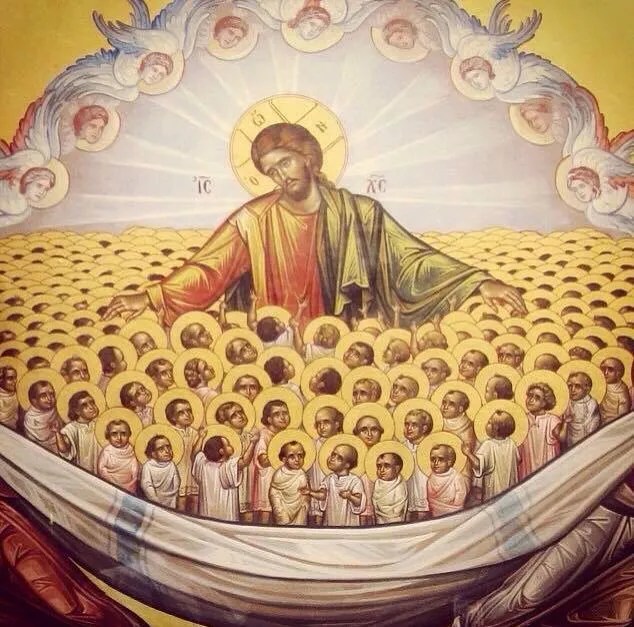
All Saints’ Day, All Hallows Day, or Hallowmas is solemnly celebrated on 1 November by many Western Liturgical Churches to honor, literally, all the saints, known and unknown; those individuals who have attained Heaven; all the holy men and women who have lived their lives for God and for his church, who now have attained Beatific vision and their reward of Heaven.

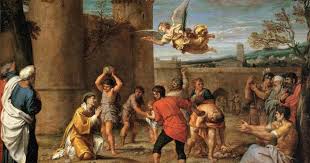
In early Christian history it was usual to solemnize the anniversary of a Martyr’s death for the Lord at the place of their martyrdom. Frequently there were multiple martyrs who would’ve suffered and died on the same day which led to multiple commemorations on the same day. Eventually, the numbers of martyrs became so great that it was impossible for a separate day to be assigned to each individually, but the church feeling that every martyr should be venerated, appointed a feast day to commemorate them all on the same day.

The origin of the festival of All Saints celebrated in the West dates to the month of May in the year 609 or 610, when Pope Boniface IV consecrated the Pantheon at Rome to the Blessed Virgin and all the martyrs.  In the 730’s Pope Gregory III moved the Feast of All Saints to 1 November when he founded an oratory in St. Peter’s for the relics of the holy apostles and of all saints, martyrs and confessors, of all the just made perfect who are at rest throughout the world.”

From our Readings today, we hear of the vision of St. John from the Book of Revelation:

After this, I had a vision of a great multitude, which no one could count, from every nation, race, people, and tongue.  They stood before the throne and before the Lamb, wearing white robes and holding palm branches in their hands.  They cried out in a loud voice:

“Salvation comes from our God, who is seated on the throne, and from the Lamb.”

All the angels stood around the throne and around the elders and the four living creatures.  They prostrated themselves before the throne, worshiped God, and exclaimed:

“Amen. Blessing and glory, wisdom and thanksgiving, honor, power, and might be to our God forever and ever. Amen.”

Then one of the elders spoke up and said to me, “Who are these wearing white robes, and where did they come from?” I said to him, “My lord, you are the one who knows.” He said to me, “These are the ones who have survived the time of great distress; they have washed their robes and made them white in the Blood of the Lamb.”

Who are these nameless saints?  Their anonymity teaches us that sainthood is not reached through great achievements or rare acts of bravery.  Sainthood comes from simply loving God and doing our best to live our lives in a way consistent with Jesus’ commandment.  I would dare say that none of the saints actually set out to be saints.  They simply loved God and lived their lives to follow Him.

Revelation goes on to remind us that giving our lives over to God will not protect us or insulate us from hardship.  Living in, for, with, and through God, however, will make sure that we can and will endure whatever “great distress” comes our way.  In this passage of Revelation, John is speaking specifically of those who have given their lives for their faith.  Christians throughout the Middle East are being martyred by forces opposed to Christianity, but in reality, it is very unlikely that any of us will be called upon to sacrifice our lives for our faith.

Our challenge, then, is to live for Christ, rather than to die for Christ.  Jesus does ask to lay down our lives for Him. Peter said to the Lord, “I will lay down my life for Your sake,” and he meant it (John 13:37). Has the Lord ever asked you, “Will you lay down your life for My sake?” (John 13:38). It is much easier to die than to lay down your life day in and day out with the sense of the high calling of God. We are not made for the bright-shining moments of life, but we have to walk in the light of them in our everyday ways.  For thirty-three years Jesus laid down His life to do the will of His Father. “By this we know love, because He laid down His life for us. And we also ought to lay down our lives for the brethren” (1 John 3:16).

If we are true followers of Jesus, we must deliberately and carefully lay down our lives for Him. It is a difficult thing to do, and thank God that it is, for great is our reward.  Salvation is easy for us, however, because it cost God so much. But the exhibiting of salvation in our lives is difficult. God saves a person, fills him with the Holy Spirit, and then says, in effect, “Now you work it out in your life, and be faithful to Me, even though the nature of everything around you is to cause you to be unfaithful.” And Jesus says to us, “…I have called you friends….” Remain faithful to your Friend, and remember that His honor is at stake in your bodily life.  We are called to remain faithful, despite the reasons the world gives us to not, despite the “great distresses” in our lives.

Who are these dressed in white robes?  It is my prayer to be counted among them.  What about you?

The Feast of Sts Simon and Jude~The Very Rev Lady Sherwood, OPI

The Feast of Sts Simon and Jude.

My dearest Brothers and sisters-in-Christ:

Today we come together as the church to celebrate the feast day of Saints Simon and Jude. Little is known about either of these saints apart from the fact that they were called by Jesus to be among his band of disciples and were later named amongst the Apostles.

Let us first take a look at St. Simon:

Simon was a simple Galilean, a brother of Jesus, as the ancients called close relatives in those times, including such as uncles and first cousins. He was one of the Saviour’s four first cousins, together with James, Jude and Joseph. These were all sons of Mary, the wife of Alpheus, or Cleophas, both names being a derivative of the Aramaic Chalphai. According to tradition Cleophas was the brother of Saint Joseph, Jesus earthly father. All the sons of this family were raised at Nazareth, close neighbours of the Holy Family.

All were called by Our Lord to be Apostles: pillars of his Church. Saint Mark tells us that Simon was born in Cana, the place, according to Saint John, of Jesus’ first miracle. Some traditions identify Simon as the bridegroom at that wedding and suggest that he became a disciple as a direct response to witnessing that miracle, a miracle that was, after all, performed, at the request of Mary, to get the newly-weds out of a somewhat embarrassing predicament.

Saint Simon is not mentioned anywhere in the New Testament except in lists of the Apostles’ names.

Tradition has it that Saint Simon preached in Mauretania (an area which approximated to present day north-west Africa and southern Spain), in Egypt and in Libya, leaving behind him the fertile hills of Galilee, where he had been engaged in cultivation of the vineyards and olive gardens. He later rejoined his brother Jude in Persia (modern day Iran) where they laboured and died together, probably martyred, hence the change to a red altar frontal in their honour on this their feast day. At first the Persian king respected them, for they had manifested power over two ferocious tigers that had terrorised the land. With their king, sixty thousand Persians became Christians, and churches rose over the ruins of the idolatrous temples. However, when they visited other parts of the Persian kingdom unconverted, pagan hordes commanded them to offer sacrifices to the Sun god. They prayed for mercy and offered their lives to the living God but the idolaters fell on the two Apostles and massacred them, while they blessed God and prayed for their murders.

Now let us take a look at Saint Jude:

Saint Jude is also known by a variety of other names. He is called Lebbaeus in Matthew chapter ten and Thaddaeus in Mark chapter three.

In the end of our Bibles, we find The Epistle of Jude. It is a short work of only one chapter containing just 25 verses. Here we are warned against corrupt influences that have crept into the church.

St. Jude is often and popularly referred to as the patron saint of desperate or lost causes, the one who is asked for help when all else fails. Possibly due to prayers for intercession, to be asked of the other Apostles first. Hence, Jude has come to be called ‘the saint of last resort’, the one whom we ask only when desperate.

What, then, can we in today’s world learn from the lives of these two relatively unknown Apostles?  Firstly, they, like the rest of the twelve, ‘forsook all and followed Jesus. Can we be accused of doing that? Could we, and should we, give up some of our modern comforts and privileges and live our lives more like our Lord? Secondly, if tradition tells us, St Simon was the recipient of Jesus’ first miracle. We should be reminded that, even two thousand years later, that miracles still happen. We must always be aware that the Holy Spirit is at work in the world and he does not always do things in the way in which we would have him do them.

Thirdly, judging by his epistle, Saint Jude proved to be an avid supporter of gospel truths.

So then, are we truly passionate enough about the tenets and doctrines of our faith? Do we hold fast to the creedal affirmations of the Church?

Both Sts Simon and Jude, spent their lives preaching the gospel to a very pagan world and it is believed that they died a martyr’s death for their faith. We may not be called to be martyrs like they were (hopefully), but we shall be called to make other sacrifices. Are we ready to suffer for the sake of our Lord and Saviour Jesus Christ?

Let us, thank God for the lives of his Apostles Saint Simon and Saint Jude.

Let us pray:

Father, you revealed yourself to us through the preaching of your apostles Simon and Jude.  By their prayers, give your Church continued growth and increase the number of those who believe in you.

Through our Lord Jesus Christ, your Son, who lives and reigns with you in the unity of the Holy Spirit,one God, for ever and ever.

Amen.

Seeing Jesus~The Rev Frank Bellino, OPI

This Sunday’s Gospel passage tells us of the physical healing of a blind man. The gift of sight.  Yet it also sets out for us a journey of insight which the man undergoes as he comes into contact with Christ and which leads not just to his being healed of a bodily handicap, but to his becoming a full disciple of Christ, to his following Jesus ‘on the way,’ that ancient phrase for being a Christian.  It is as a story of insight that the man born blind becomes a model for all of us as we look to understand what it means for us to be ‘on the way’ to and with Christ.

We see this journey of insight unfold in the different names the blind man uses for Christ, as he calls on Christ with ever increasing determination and as he becomes known to Christ.

At the beginning, the blind man is named Bar Timaeus. Not just a blind man, but someone known. Although Bar Timaeus was known to the early Church as a disciple of Christ, one of the Church’s own members.

At the beginning of the Gospel story, he is just a blind beggar on the roadside from Jericho to Jerusalem. A man who hears that Jesus of Nazareth, the famous healer, is passing by. Now, it is his own chance to get his own physical sight back.

What he cries out is, ‘Jesus son of David, have mercy on me.’ What does he mean? Is it just an honorable title, a way to get attention, or does he recognize Jesus as the Messiah? At least, when others around him try to shut him up, he keeps on ever more loudly and insistently, ‘Jesus, Son of David, have mercy on me.’

The blind beggar has the words of recognition, but if he is aware of their significance, it is another thing. He wants the gift of sight, but at the same time, he is also on the way to understand who the Jesus of Nazareth truly is, but how far he is away from this situation is uncertain. It is at this point that the blind man encounters Christ. He has received Christ’s attention, and, in his enthusiasm, the blind man casts off his cloak and rushes to where Jesus is.

When Christ asks him what he wishes to do for him, the blind man changes the way he addresses Christ. No longer, ‘Son of David, but ‘Master’ – a more intimate and committed term, a term no longer of distant recognition, but of one who confesses himself to be a disciple.  In fact, the English of the RSV does not do full justice to the significance of the term being used, for the Greek text preserves the Aramaic ‘Rabbuni,’ ‘My master, my rabbi,’ the same term preserved in encounter between Mary Magdalene and the Risen Christ.  ‘My master,’ the one to whom I come to for teaching and insight, the one in whom I have placed my trust and love.

The blind man has shifted to a greater recognition of who the Jesus of Nazareth is. How much he understands the term he is using at this point, again we do not know. He is using the term and is right to do so. Certainly, some changes, some deepening in his understanding of Christ, have occurred. When Christ asks him what he wants, even though he clearly still wants physical sight, he begins to prove that he is open to the gift of insight.

And, thus, when the passage ends, as the man is healed and sees again, he also comes to have the insight that Christ is more than just the miracle worker, more than someone who meets his immediate physical needs, that Christ is the master from whom he wants to know and experience the truth about human life and flourishing.  Not to go on his own way, but to follow Christ on Christ’s way, the way of discipleship.  The blind man has become the Bar Timaeus of the Church, one who in his encounter with Christ and in his own enthusiastic response to Christ has also to be recognized himself as more than a blind beggar, and as a human being with a distinct identity and value in the sight of God and his fellow human beings.

This journey of insight Bar Timaeus is a model for us.  In our own encounter with Christ, we also embark on a journey of increasing recognition of who Christ is and a corresponding purification of our desires. As with Bar Timaeus, it is only when we make demands on Christ and come closer to him and he to us that we discover ourselves confronted with the question of who we truly believe Christ is and what we do desire Christ to do for us. Are we using titles for him without any real grasp of their significance?  Or, is Christ the one who teaches us about the proper meaning and reality of human life – and who offers the realization of it.

When we make demands of Christ and as we ask these question, our ideas about him and desires are challenged and purified, as Christ becomes more than a figure of the past or of ancient texts or religious traditions, and becomes, ‘My master.’ And it is at that point that we ourselves start to follow him on ‘his way,’ not ‘our own way.’

Who Are You?~The Rev Frank Bellino, OPI

There is a tendency for us to define ourselves by what we do, and not by what we are. ‘What do you do?’ is not just the question; it is part of ordinary small talk. To a certain extent, what we do does indeed define what we are. But at the same time, what we have a certain priority over what we do. I know an educator that when you address her as Mrs., corrects people and says “that is Doctor”. The man who steals is a thief, but he is more than a thief to begin with, and even after the theft he can become something more. He can become a forgiven thief, a restorer of stolen goods.

This temptation to prize doing over being manifests itself in our words. We start to use the word ‘useful’ as a synonym for ‘good.’ We say, ‘I hope you find this useful,” when what we mean is ‘I hope this is good for you.’

An overemphasis on our actions leads us to value our jobs. People are proud of being a manager, a supervisor, a boss, a director. Indeed, the term ‘manager’ has mostly been emptied of its original meaning because of euphemistic over usage. And it is overused precisely because rank and status are confused with our identity, and because they are valued.

No one wants to be the lackey, the understudy, the pee-on. The mistake is to think that important jobs make us important people. They do not. Nor does the lack of such importance make us unimportant. The mistake is to believe that one is either a somebody or one is a nobody.

A similar confusion exists in the Gospels. The rulers among the Gentiles, Jesus says, lord it over them, and their great one’s exercise authority over the lesser ones. The exercise of power to serve one’s needs, no matter how good, is often a terrible thing. But worse is the desire for power as an end in itself. The desire to be a lord – a signor {Italian) – is a misplaced desire. St Catherine of Siena wrote to a particularly pompous prince, saying, ‘You desire lordship (signoria) over others, but have no lordship over yourself.’ There is no point in ‘managing’ other people when we cannot even ‘manage’ ourselves properly. And good intentions cannot justify our bossiness; in fact, it is a greater corruption to boss people around out of good intentions, because we will then make good look evil, and portray love as something hateful and hateworthy.

Jesus offers himself as a model for his disciples. The Son of Man ‘came not to be served but to serve, and to give his life as a ransom for many.’ The words he uses here mean ‘for many,’ in Greek, hoi polloi – for the riffraff, the general ordinary people of humanity. Indeed, it is for ‘the many’ that Jesus sheds his Precious Blood, as the new translation of the Mass conveys to us.

Jesus, who dies for the ordinary people, warns us against seeking lordship, and reminds us that he – Our Lord – came to serve us, the riffraff. He does not remind us of this to humiliate us, but to remind us of how much he loves us. Although he is Lord, he has shared our life with us, as the second reading says, ‘For we have not a high priest who is unable to sympathize with our weaknesses, but one who in every respect has been tempted as we are, yet without sin.’

Our dignity is not drawn from the things we do or can do. We are not valued for our quality of life. Instead, our dignity and value come from what we are, (human beings – rational creatures made in the image of God) and from what we are being made into (the children of God by adoption through grace). The lordship we Christians have is one of service to each other, just like the lordship of Jesus who came to save us, to save the hoi polloi.

The Feast of St Luke,  Evangelist~The Very Rev Lady Sherwood, OPI

Today we come together as the church to commemorate St. Luke the Evangelist, Patron saint of Physicians. Luke, from his perspective, records for us in his Gospel writings, the life of Jesus=from His birth at Bethlehem, through His ministry and His many healings. How Jesus heals the blind, the deaf, and the lame.

Luke tells us of the peace which Jesus speaks to all, because Jesus is indeed the peace and healing of God, then in human form. That is why in Luke 10, Jesus tells the 72, to say, “Peace be with this house”, as he sends them out as apostles of his peace.

Jesus gives us spiritual healing and peace which forgives our sins, and which reconciles us with God, our Heavenly Father, by His death upon the cross for us.

Jesus is truly the physician of our Soul. He knows all too well, that we are sick with sin, but it deters him not. Each and every one of us, is precisely why He came to earth to be amongst us, the reason he lived with us upon the earth, and why he suffered, bled, was tortured, and died for all our sakes.

Jesus came down from Heaven to our world, to take from us our dark sickness of sin and of death, and to heal us, to bring us true life and salvation. He took all upon himself for us upon the cross, our sickness and death, died with the Lord, to all who truly believe, love and follow Him. We are forgiven, we are healed, we are saved, we are at peace.

If we truly examine our lives, we will see our constant need for healing of the sins of this world. As with the body, if we are sick, we see our dr for diagnosis and treatment, that’s why today, we give thanks to God for His servant, Luke, the Evangelist. It’s Luke’s role to bring Jesus, His healing and peace to each of us through the living and active word of God.

The word of God is the scalpel of Jesus our physician and saviour. With total precision, Jesus’ laws cuts us and ‘kills’ the sickness of the human condition, so that he can heal us, and give us true life.

Each of the commandments of Jesus is a precise incision of his law. We have failed to fear, love, and trust God above all else as we ought to do. We have failed to use God’s name as we should, and to call upon him as our Father, as his children when in every trouble or need, or to give him worthy thanks and praise. We have ignored God’s Holy word and preaching, we have not loved our neighbour, or helped to eased their needs. We have been bad stewards of earthly material things such as money, or possessions. We have failed in giving kindness and forgiveness to our brothers and sisters.

So indeed, our human sickness of sin is dire=without Jesus as our Lord, our Saviour, and physician, the diagnosis is terminal.

But Jesus is merciful, he does not delight in punishment. Jesus our physician of our soul, cuts with His law in order to heal us with His Gospel. The Lord heals the broken hearted and binds up their wounds (PS 147:3). Jesus has kept on our behalf, all those commandments, which we have failed to truly follow.

If we want to call our doctor, we pick up the phone, and wait for an appointment to become available. But Jesus as our physician for our souls, is contactable 24 hrs per day, every single day with no exception. He is contactable easily anytime, day or night, by the important communication of prayer.

So let’s end today with the simplest but most important prayer of all, to our Saviour and physician of our soul:

Lord Jesus Christ, Son of God,  have mercy on me, a sinner.

Amen.

Give of Your Best~The Rt Rev Michael Beckett, OPI

 Ya know, sometimes Jesus says stuff that is difficult.  Sometimes it’s difficult to understand.  Sometimes it’s difficult to hear.  Usually, it’s difficult to do.  Like the Gospel appointed for today:  Today’s Gospel relates the story of “The Rich Young Ruler.”  It seems this guy kinda had it all.  He was a good person, had done well in life, did everything he was supposed to do, and on top of everything else, he was rich!  He had it goin’ on!  And then, he up and asks Jesus what he needed to do to get into Heaven…….and here’s the upshot.  Jesus said to him, he said, “Go, sell what you have, and give to the poor (Jesus sure had a thing for poor folks) and you will have treasure in heaven; then come, follow me.”  Well….the dude was NOT best pleased and went away sorrowing, coz, you know, he was rich, and he wanted to stay that way.

So what gives with this?   I have to believe that what Jesus is saying to us is this:  If we are going to walk with Jesus, we have a price to pay. Sacrifice and suffering and making difficult choices are part of the journey.  Jesus is demanding His rightful place in the hearts of His people.  Us.   We must love Him more than all others, more than anything.  Any thing.  More than our possessions, more than our bank accounts, more than our precious and dear little sins, and more than our political beliefs.  AND, to boot, we have to demonstrate that this is true, especially if we are forced to make a choice.

Jesus does not say “do not love” those other people—or those things, or beliefs, or whatever.  What He says is that we ought to love God more.  And in so loving God more, in following his path, we sometimes have to be willing to lose those things, whether it be savings accounts, connection to their family members, friends, political party,  or long and strongly held beliefs or feelings, in order to continue to follow Jesus and acknowledge to others that He is the Christ.  Jesus has to come first.

Loving others is the second greatest commandment, but it is behind the first: to love God with everything we have (Matthew 22:34–40). In making this statement, Jesus continues to make the claim that He is God. Love and obedience to Him must come before obedience to any other person or group (Acts 5:29).

And how do we show that love?  That willingness to sacrifice it all for Jesus?  Be merciful.  Be kind.  Show love.  It’s pretty much one of the key recurring factors of Jesus’s ministry.  Love God.  Love people.  Love God.  Love people.   Especially those who are less.  The poor.  The immigrant.  The homeless.  The downtrodden.  Those who are “other.”

In Matthew 25, Jesus was pretty explicit about this “love God, Love people” thing.  He said, “34 “Then the King will say to those on his right, ‘Come, you who are blessed by my Father; take your inheritance, the kingdom prepared for you since the creation of the world. 35 For I was hungry and you gave me something to eat, I was thirsty and you gave me something to drink, I was a stranger and you invited me in, 36 I needed clothes and you clothed me, I was sick and you looked after me, I was in prison and you came to visit me.’ 37 “Then the righteous will answer him, ‘Lord, when did we see you hungry and feed you, or thirsty and give you something to drink? 38 When did we see you a stranger and invite you in, or needing clothes and clothe you? 39 When did we see you sick or in prison and go to visit you?’  40 “The King will reply, ‘Truly I tell you, whatever you did for one of the least of these brothers and sisters of mine, you did for me.’  41 “Then he will say to those on his left, ‘Depart from me, you who are cursed, into the eternal fire prepared for the devil and his angels. 42 For I was hungry and you gave me nothing to eat, I was thirsty and you gave me nothing to drink, 43 I was a stranger and you did not invite me in, I needed clothes and you did not clothe me, I was sick and in prison and you did not look after me.’  44 “They also will answer, ‘Lord, when did we see you hungry or thirsty or a stranger or needing clothes or sick or in prison, and did not help you?’

45 “He will reply, ‘Truly I tell you, whatever you did not do for one of the least of these, you did not do for me.’  46 “Then they will go away to eternal punishment, but the righteous to eternal life.”

Isn’t it time that we, as Christians, start putting Christ first, start putting his people first?  Isn’t it time that we as true followers of the Jesus that we proclaim learn to treasure what we have been given?   Work for justice.  Work for peace.  Work for understanding. 

The second verse of that dear old hymn by Howard B Grose, “Give of Your Best to the Master,” sums this up pretty well:  

Give of your best to the Master;

Give Him first place in your heart;

Give Him first place in your service;

Consecrate every part.

Every part.  All of it.  Even when it’s hard.  Even when it hurts.  Love God.  Love people.  Amen.