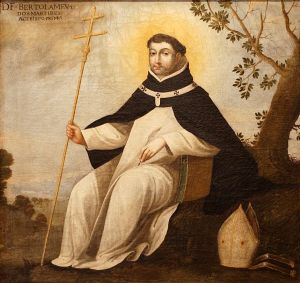
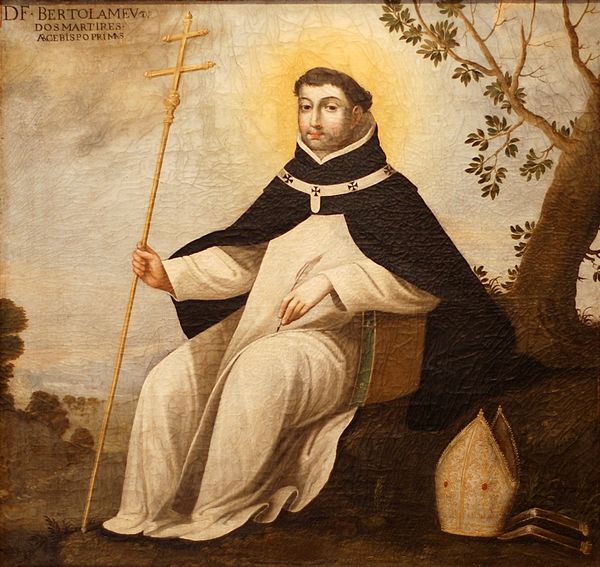
The historians of Vicenza agree with those of the Order of Preachers in placing Blessed Bartholomew di Braganza among the first and most illustrious of Saint Dominic’s disciples. As a matter of fact, he was a noted man in many ways. Nature endowed him with splendid gifts which he developed by tireless industry. The services that he rendered the Church as an apostolic preacher, as master of the Sacred Palace in Rome, as bishop, and as legate of the Holy See make him worthy of an honorable place in ecclesiastical history. An exceptional purity of heart and eminent piety gave the finishing touches, so to express it, to his grand character.
More than one Pope honored Bartholomew with implicit confidence. Saint Louis, king of France, held him in the highest esteem. His virtues endeared him to those placed under his charge. Italy reaped many and signal benefits from his preaching. He brought numbers into the Church, while the fervor of the faithful was increased by his example and labors.
The memory of such a man, our readers will doubtless agree, should not be suffered to die. Fortunately, he left a memoir or memorandum in the form of a last will and testament. Thanks to this document, one can write a part of his history and, to a certain extent, place the principal events of his life in their proper chronological setting. Such an order in these occurrences is the more important because historians have confused them to an astonishing degree.
Vicenza, an episcopal city of Italy forty miles west of Venice, and beautifully situated at the confluence of the Retrone and Bacchiglione, is where Bartholomew first saw the light of day. The precise date of his birth is not known; but it was in 1200 or 1201. He made a part of his studies at Padua. Anthony Godi, an author of the thirteenth century, tells us that he belonged to the family of the counts di Braganza long celebrated in Lombardy. Several other Italian writers make the same statement. Only the continuers of the Acta Sanctorum, begun by Father John Van Bolland, S. J., seem disposed to question the blessed’s ancient nobility.(1) Their doubt, however, led to a consultation of the Società Palatina of Milan, which had Godi’s Cronica della Città di Vicenza published in its great collection known as Writers of Italian History (Rerum Italicarum Scriptores). Signore Argelati, director of that learned and far-famed society, replied that old manuscripts prove to a certainty that Blessed Bartholomew, O. P., bishop of Vicenza, belonged to the line of the counts di Braganza, lords of the manor of the same name.(2)
It was during his studies at Padua, which he took care to season with the practice of piety, that the future bishop bad the good fortune to make the acquaintance of Saint Dominic, as well as to hear some of his sermons. The apostolic man inspired our student with so strong a dislike for the vanities of the world that he determined to devote his talents to the service of the Church. Nay, he made up his mind to follow the life which he saw exemplified in the founder of the Friars Preacher, and received the habit of the Order from the saint himself.(3)
Bartholomew must have been very young at this time. At least, he himself tells us that he was trained under the fatherly care of Saint Dominic and nourished in his Order from childhood.(4) From the beginning, he applied himself whole-heartedly to the studies of his new life and the development of the rare talent which nature bestowed upon him. In this way, through the assistance of divine grace and under the guidance of experienced teachers, he was soon regarded as a model religious, an able theologian, and a faithful exponent and defender of the word of God.
Immediately after his ordination the new priest was sent out to preach the Catholic faith to the people and to combat libertinage and heresy. At the same time, he labored for the pacification of the serious disturbances which were then prevalent in the cities of Italy, particularly in those of Lombardy. In this latter work, which took much of his time, he was associated with a number of other celebrated preachers of, his Order. Bishop Henry de Sponde speaks highly in praise of these men in his Annales Ecclesiastici, or epitome of the famed Annals of Cesare Baronio.(5)
Bartholomew, however, was not content to labor with tireless zeal for the suppression of the spirit of discord, and for the reconciliation of individuals, families, and communities. He felt that a standing remedy was necessary to hold in check the unhappy dissensions which continually disturbed the public peace. He was persuaded that, unless some such antidote was found, the preaching of the fathers could not bear the fruit they desired. Accordingly, he established a congregation, or new order, to which he gave the name of Chevaliers of Sancta Maria Gloriosa.
The end of this institute was the preservation or the restoration of peace and tranquility among the people. Its members were to carry the message of reconciliation everywhere. They were to employ all the means that Christian charity could suggest to put an end to dissensions, quarrels, enmities — in a word, to all that had led to the civil wars in which so much Italian blood had been shed, and treasure sacrificed. De Sponde, the bishop of Pamiers mentioned above, speaks of the establishment of this quasi military order. It soon met with approbation from the Holy See, and in 1261 was confirmed by a bull of Urban IV.(6)
Divine intervention was necessary to render the people of Italy docile to the earnest exhortations, prayers, and counsels of those who labored to bring about peace and harmony among them. Only punishment from on high could touch the hearts of the seditious whom nothing seemed able to bring to a sense of their duty. For this reason, de Sponde proceeds to say, God visited the country with scourge after scourge. First, there were destructive earthquakes. Then came unproductive seasons, followed by famine. To these succeeded pestilence and extraordinary cold weather. Finally, great floods brought desolation to the cities as well as to the country.(7)
These catastrophes, coming one after another, disposed the people to penance. What the greater number of them would probably not have done solely out of fear of God’s judgment, that they all did in order to avert the manifestations of His wrath whereby they were overwhelmed. Religious processions were held everywhere, in which persons of every age, sex, and condition took part. They walked in their bare feet, carried a crucifix or torch, and sang the praises of God. They practised every kind of mortification. All this caused 1233 to be called in Italy “the year of general devotion” (1’anno della devozion generale). Happy were the faithful whose contrite hearts and genuine humility rendered these outward expressions of penance and religion acceptable to God.(8)
Our pious Friar Preacher was busily engaged in explaining the nature and the necessity of interior sacrifice to the people in place after place, when the Pope summoned him to Rome to be his theologian.(9) Those who state that he was the immediate successor of Saint Dominic as master of the Sacred Palace overlook the fact that Bartholomew di Braganza was only twenty or twenty-one years of age at the time of the patriarch death. Besides, it was Gregory IX, not Honorius III (in whose reign Saint Dominic died), who conferred that honorable position on the subject of our sketch. The date of the appointment was about 1235. Ile continued to bold it under Innocent IV, whom he followed to Lyons in December, 1244,’ or the year after that Pontiff ascended the papal throne.
Whatever time was left him from the labors of this charge Bartholomew employed in writing. The old manuscripts of the convent at Vicenza long showed divers works of piety, some commentaries on Sacred Scripture and on the books formerly attributed to Denis the Areopagite, and a number of other treatises from his busy pen. Both the historians of Vicenza and Father James Echard, O. P., give a list of his works; but lack of space prevents us from reproducing it here, or making comments on their merit.(10)
Just how or when Saint Louis, king of France, became cognizant of the illustrious Friar Preacher’s accomplishments we do not know. It might have been through Bartholomew’s wide-spread fame.(11) Possibly, too, he was sent by the Pope on some commission to the French monarch. However it came to pass, it is certain that his majesty selected the learned and saintly son of Saint Dominic as his confessor. It is believed, and not without reason, that Bartholomew held this position when he wrote his little treatise on the education of princes (De Informatione Regiae Prolis), which he dedicated to Margaret of Provence, consort of Saint Louis.
Most likely Bartholomew was thus employed at Paris when Innocent IV appointed him bishop of Nemosia (or Nimesia), in the Isle of Cyprus. Ferdinand Ughelli, the Cistercian historian, places this event in 1250; but the opinion of the Bollandists, who date it from 1248, is more probable. In fact, Bartholomew himself tells us that the Holy Father nominated him bishop of that see at the time Saint Louis undertook his journey to the orient for the recovery of the Holy Land.(12) Quite probably the Friar-Preacher bishop accompanied the sainted French monarch as far as Cyprus; and we know that it was on September 17, 1248, that Louis reached the island.(13)
When the king left Cyprus, in the month of May, 1249, to lay siege to Damietta, Egypt, Bartholomew had taken possession of his diocese. Here he spent the next five or six years of his life in the fulfillment of the duties of a vigilant bishop. He applied himself heart and soul to the instruction of his flock, the regulation of the lives of his clergy, and the succor of the poor. For all he was a perfect example of Christian piety arid observance. He was regular and scrupulous in the visitation of the parishes of his see. With care did he correct the abuses that had crept in among the faithful, uproot superstition, reform religious practices, and restore the discipline of the Church.
While he was thus busily engaged with the affairs of his diocese, more pressing needs Of religion tore the pious bishop from his beloved people. The Pope ordered him to go immediately to King Louis in Palestine. However, it is not known whether he went on a secret mission, or to aid the French monarch with his advice after the disastrous defeat of the Christian army by the Saracens at Mansura, Egypt, subsequently to the capture of Damietta by Louis. Father Vincent Fontana, O. P., is of the opinion that Bartholomew was sent to Palestine in the capacity of legate a latere, and that he there again acted as the king’s confessor.(14) But we know that another Friar Preacher, Geoffrey de Beaulieu, was then Louis’ confessor, while Cardinal Eudes of Châteauroux was with the monarch as legate of the Holy See.
Bishop Bartholomew himself tells us, in his own brief memoir of his life, that he was with Saint Louis in Jaffa, Sidon, and Ptolemais. He also says that the king and queen, when they were about to sail for France, pressed him to come to see them in Paris, where he would receive new proofs of their royal favor.(15) We may place the prelate’s journey to Syria in 1254, the last year of King Louis’ stay in Palestine. Doubtless he advised and helped the saintly monarch in his efforts in behalf of religion and charity in the places of the Holy Land still under Christian domination.
If the bishop then returned to his see in Cyprus, he could not have remained there long. Alexander IV, who ascended the throne of Peter on December 12, 1254, felt that he was more needed in Italy, and appointed him bishop of his native city of Vicenza. In this new charge Bartholomew set to work with the same energy that characterized his whole life, accomplishing much good in a short time. Earnestly did he labor for the conversion of the Manicheans. His rare virtue won the admiration of all the well-meaning. His firmness threw the wicked into confusion. Indeed, it was not long before men of this character started a violent persecution against the holy prelate. The leader in this iniquity was one Ezzelino da Romano, a declared enemy of religion and a virulent oppressor of the Catholic clergy. Unable to withstand the tyranny of a man as powerful as he was cruel, Bartholomew withdrew to Rome, there to await an abatement in the dangers which confronted him in his diocese.(16)
Alexander IV now sent him as papal legate to Great Britain and France on matters of religion. From London he accompanied the English king and queen to Paris. There he was present at the conference between the two sovereigns. Having happily concluded this mission by the time the death of Ezzelino da Romano put an end to the long persecution carried on by that tyrant, Bartholomew started at once for Italy that he might rejoin his beloved people. Before he left Paris, Saint Louis made good his promise given in Palestine by bestowing on the legate some precious gifts. Among these were a portion of the true cross and a thorn from the crown of our Lord. The better to show the authenticity of the relics, Louis had an act of donation written and stamped with the royal seal. In this document the monarch declared that he had given them to Bartholomew di Braganza as a proof of the tender affection he bore him.(17)
Vicenza’s bishop, carrying the spiritual treasures which he placed beyond value, reached his episcopal city in 1260. Both clergy and people went out to welcome him. As they marched along in procession, they carried candles and olive branches, and often cried out in delight: “Blessed is he who cometh in the name of the Lord.” The holy man responded to these manifestations of joy and reverence with fatherly affection.(18) He began at once to restore his beloved church to its former beauty. With energy did he set about the restoration of the practice of religion, good order, and peace throughout the diocese, and to repair the ravage and devastation caused by the heretics or their abetters during his absence.
God blessed Bartholomew’s zeal. Indeed, his efforts met with a success far greater than he could have expected. In a short time the people of his diocese enjoyed the happiness of peace and tranquility, while their neighbors were continually in the turmoil of agitation and disturbance. The citizens of Vicenza, therefore, wished both to assure themselves of the continuance of the fortunate quiet in their city and to show their gratitude to their beloved chief pastor. Accordingly, they begged him, for the future, not only to be their guide in spiritual things as their bishop, but even in temporal affairs as their signor or podestà.(19)
Until this time the fathers of the Order to which the bishop belonged had had but one house in Vicenza. Blessed Bartholomew now induced them to build another convent, together with a magnificent temple of worship called the Church of the Crown. In this were placed the thorn from the crown of our Lord and the piece of the true cross which he brought from France. The historians of Vicenza tell us of the veneration of the faithful for these holy relics. In the same way we learn of the large gifts made in a spirit of emulation for the construction and decoration of the new church. This house of prayer was erected on an eminence which had long been profaned by the meetings of the Manicheans, that God might be perpetually and specially honored and served in a place which had been the rendezvous of sacrilege and impiety.(20)
While the people were engaged in building a material temple to God, the holy prelate tirelessly and successfully occupied himself with the erection of a more spiritual and worthy one by bringing sinners to repentance and sectarians into the fold of Christ. Many were benefited by his instructions. Some tried his zeal sorely; but they could not exhaust his patience. One of the would-be bishops of the heretics, called Jeremiah, and a doctor or minister, by the name of Gallo, resisted for a long time. The latter particularly, in several conferences with the man of God, defended the teaching of his sect with not a little obstinacy. However, the light of truth finally prevailed over the darkness of error. The defeat and conversion of Gallo practically put an end to the Catharists and other enemies of the Church in the City of Vicenza.(21)
Another action of the pious bishop in behalf of his country deserves mention here. A misunderstanding bad arisen between the people of Padua and those of Vicenza, which was equally baleful to both communities. It was a difficult problem to handle. However, through tact and diplomacy, Bartholomew effected a reconciliation that pleased both parties to the controversy.
For the sake of historical accuracy, attention should be called to a mistake of Father Ferdinand Ughelli. The Cistercian abbot and historian states that Bartholomew of Vicenza and the patriarch of Aquileia were appointed vicars of what was then known as the Roman Empire for all Italy. He places this event in 1262, and attributes the selection of these two men to Rudolf I.(22) But this prince did not become emperor until 1273, eleven years later, and at least three years after the death of our noted Friar Preacher.
It is more difficult to decide whether or not the distinguished divine was actually raised to the dignity of patriarch, as is held by some authors. The epitaph on his tomb might give a foundation for this opinion. Father Daniel von Papenbroeck (better known as Papebroch), S. J., follows it in his list of the patriarchs of Jerusalem. According to this learned critic, Urban IV appointed Bartholomew to this patriarchate in 1264, and he departed for the Holy Land at once to assume his new charge. However, says the same author, he returned to Italy after two years, resigned the higher position in the hands of Clement IV, and was reappointed to the See of Vicenza, which became vacant in 1266.(23) So much in favor of the subject of our sketch having held the dignity of patriarch.
On the other hand, it must be stated, we have been able to find no bull of Urban IV or Clement IV which shows this double transfer from Vicenza to Jerusalem and from Jerusalem back to Vicenza. The greater number of historians who have written of Blessed Bartholomew make no mention of such a fact. These, it is true, are arguments from silence. But to them must be added the difficulties which led other writers to decide against the opinion of Father von Papenbroeck. Taken as a whole, these reasons dispose one to consider it very doubtful that Bishop di Braganza was ever patriarch of Jerusalem.(24)
Furthermore, the metropolitan of Ravenna and the other bishops of that ecclesiastical province were at Bologna for the second translation of the relies of Saint Dominic. Bartholomew di Braganza also honored the occasion with his presence. He preached the sermon for the event, and announced to the people the indulgences granted by the archbishop and each of his suffragans. Both during the ceremonies and in the act testifying to the translation of the relics, which he himself drew up, he takes only the rank and title of Bishop of Vicenza. Similarly, in his last will and testament, which bears the date of September 23, 1270, and in which we have a faithful outline of his life, he simply calls himself bishop of Vicenza. However, he does not forget to state that the Holy See had successively appointed him to the dioceses of Nemosia (or Nimesia) and Vicenza.(25) He makes no mention whatever of the Patriarchate of Jerusalem. All this, again, constitutes a strong argument against his ever having had charge of the Holy City.
The precise date of the holy man’s death is not known. But it is agreed that he died a short time after writing his will and testament, which, as has been said, is dated September 23, 1270. Widows, orphans, and the poor were not the only ones who wept over his demise. His loss was universally regretted by those who loved their religion, as well as by those who knew how to esteem virtue and merit. His keen faith, his ardent zeal for the things of God and the salvation of souls, his gentle disposition, and his Christian humility were the virtues especially admired and praised in him. The practice of humility he ever knew well how to combine with rare learning and the most brilliant employments. His memory has always been held in benediction in the city and diocese of Vicenza.(26)
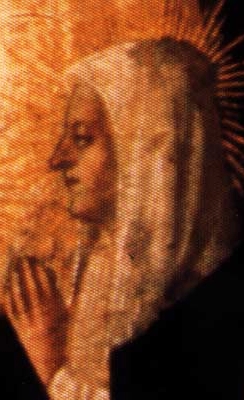
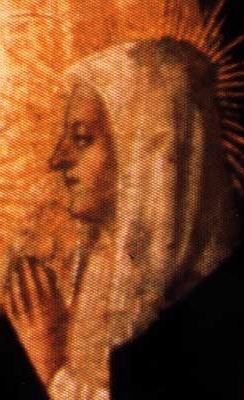
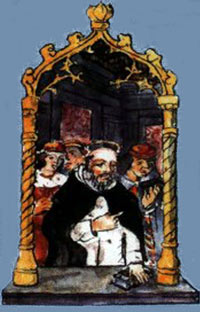
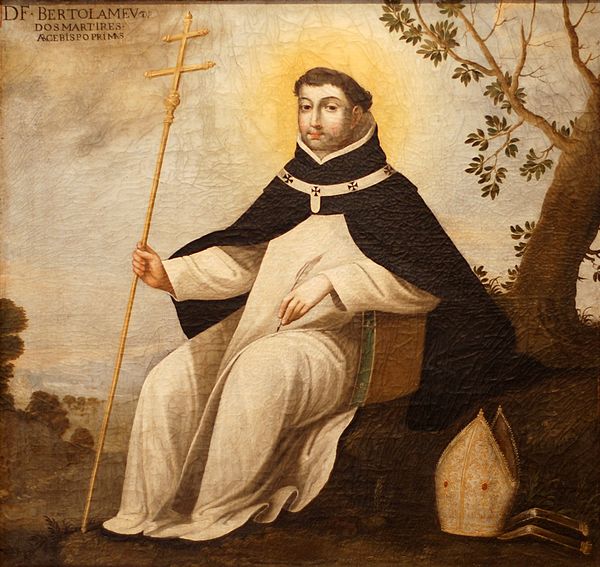
Historians assure us that, from the time of his death, the faithful not only held our Friar Preacher in veneration, but also gave him the title of blessed. The Bollandists have likewise proved this not only by the testimony of those who wrote on the spot, but also by other indications which serve to verify the fact.(27) Such, for instance, are the lamp which was burned before his relies and his likeness painted with rays of light around his head and placed in the Church of the Crown. The miracles said to have been wrought at Bartholomew’s grave induced the people of Vicenza to ask for a solemn translation of his remains. On this occasion, though he had been dead for eighty years, his body was found to have undergone no corruption. Quite naturally, this circumstance greatly increased the devotion of a people who were already accustomed to invoke his aid in their necessities.
So lived, labored, and died the saintly bishop of Vicenza. He was one of the earliest and greatest of Saint Dominic’s disciples, as well as one of the most learned. Such were the love and veneration in which the people held him. The devotion towards him may be said to have continued to grow until, more than five centuries after his death, and many years after Father Anthony Touron wrote his book, Pius VI granted the Order of Preachers and the clergy of the Diocese of Vicenza the favor of reciting the divine office and saying mass in his honor. His feast falls on the twenty-third day of October.
Born: at Vicenza, Ityaly towards the close of the 12th century
Died: September 23, 1270
Beatified: Pope Pius VI confirmed his cult in 1793




 The Order of Preachers, Independent
You must be logged in to post a comment.