The Ladder of Success???? ~ Br. Chip Noon, Novice

POSTER_20B

POSTER_20B

How fitting that today, as the Bishop of Rome, Pope Francis, takes his leave of the richest country on earth…and in the history of the world…the second reading from today’s Mass is from James 5: 1-6:

You have lived on earth in luxury and pleasure;  you have fattened your hearts for the day of slaughter.

In fact, all of this passage has at one time or another in Francis’ Papacy been addressed by him and flung out to the world as a warning and as a criticism. “It is easier for a camel to go through the eye of a needle than for someone who is rich to enter the kingdom of God.”

And the world has flocked to him – Roman Catholics and non-Catholics alike. But his message, as some think, including the young man Jesus told to sell all, is a hard one. How are we to give up all we have and still live in this world? Does Francis, like St. Francis, really mean to give away our inheritance and live in hair shirts? Are we supposed to go without shoes, even in the winter? What about when we get old, if we haven’t “saved up” how will we live?

But if we look at the first reading and at the Gospel, we see a nuanced story that is at the heart of what Jesus taught, and what Francis is proclaiming.

I think what we are seeing here is more profound than simply saying “the poor are better than the rich.” I think we are examining how Jesus viewed what we love, not what we have. In both the reading and the Gospel, the Holy Spirit is giving us the message that we are all equal, we are all children of God, and whether we are officially entitled or we are acting on our own, if what we are doing is loving God and our neighbor as ourselves, we are following the word of God…and we will enter the Kingdom.

Isn’t our life a constant sizing up? We compare ourselves with each other, with celebrities, with kings and queens – and don’t we usually find ourselves wanting? Moses asked Joshua, “Are you jealous for my sake?” And in that question, we can see the hierarchy that Joshua, and probably the whole people of the Exodus, had formed in his mind and tried to enforce: There’s Moses, then Aaron, then the 70 Elders…then maybe Joshua, then the heads of households, then the male children, etc., etc. Everyone was to know his or her place and act accordingly. And anyone who got out of line was to be censured, and of course Joshua and the other top dogs would do the censuring or meet out the punishments. The big guys vs. the little guys, or the worthy vs. the lesser beings.

Didn’t we read in Wisdom 2:11 “But let our strength be our norm of righteousness; for weakness proves itself useless.”? Again and again, God is telling us that no one is more worthy than any other. But further on in Wisdom we read: “Let us lie in wait for the righteous one, because he is annoying to us; he opposes our actions, Reproaches us for transgressions of the law and charges us with violations of our training.” This is echoed in the second reading:

You have condemned; you have murdered the righteous one;

he offers you no resistance.

And of course Jesus is the real subject here. But so also is St. Francis, and Pope Francis, both of whom have been reviled for speaking the words God has said to us in the Bible. And so have most reformers and seekers of justice for all. Reviled and condemned because they are really kicking away the ladder so many of us stand on. The higher the rung, the closer to…to what? Heaven, the giant’s castle in the clouds, the envy of our neighbors?

It’s really a simple message: there is one God and then there are the rest of us. Scrambling up the ladder of wealth and prestige will get us no closer to him.

And so should we really sign over our bank accounts and have a yard sale of all our possessions and put that money in the poor box? I suppose we should, if that would remove the beam from our eye. Still, that’s the same line of thought in reverse: the less we have, the better we are. It still precludes infatuation with hierarchy and position.

So what is the real answer? We know what it is. 1 Timothy 6:10 alludes to it. “For the love of money is the root of all evil: which while some coveted after, they have erred from the faith, and pierced themselves through with many sorrows.”

The real answer is “Love the Lord your God with all your heart and with all your soul and with all your mind and with all your strength. The second is this: Love your neighbor as yourself. There is no commandment greater than these.”

Lord, today as we contemplate these words and think on the poor and suffering, help us to remember that simply loving them and showing them the love of God is what they need most. Then, with differences of wealth and position aside, and in a spirit of your servants, we can begin to bestow what riches we may have on those who need them.

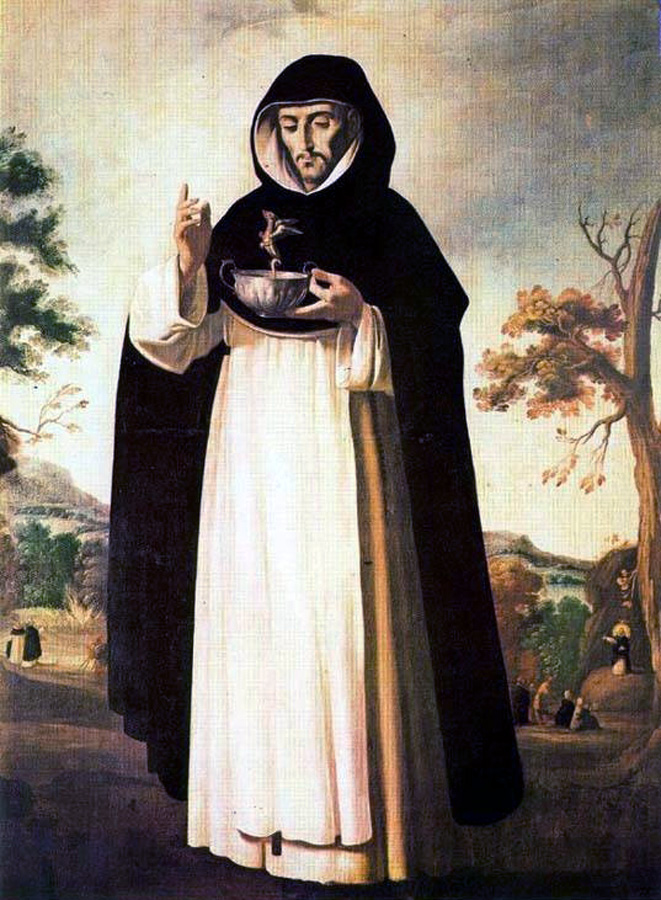
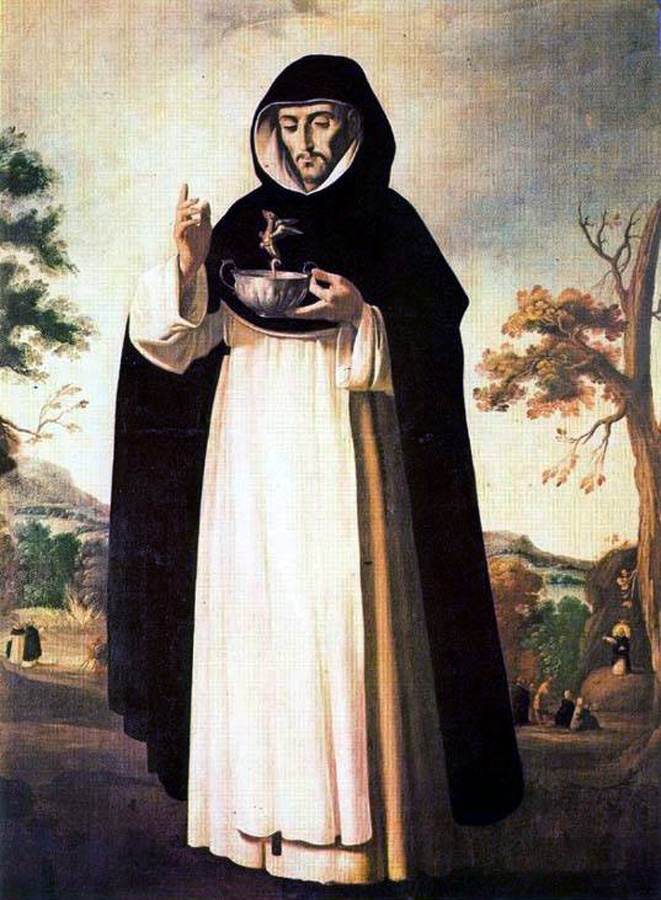
Blessed Dalmatius Moner

download

This Dominican Blessed, who was noted particularly for his observance of poverty, lived in the early years of the Order and helped to establish the high reputation of the Spanish religious.

Blessed Dalmatius was born in Aragon, in 1291, and we know nothing else about his life before he entered the Order. He was a member of the province of Aragon and gave a perfect example of strict observance of the rule and the spirit of religious detachment from things of earth. All that we know about him, are a few anecdotes, none of which can be fixed with certainty as to date or place.

We read that his spirit of poverty was so extreme that he never wore a habit or cappa that was not in tatters. He picked up his wardrobe from the cast-offs of his brethren, and, since the spirit of poverty was quite rigid in this providence, the cast-off clothes must have looked a sight. Dalmatius seemed to make a virtue of this, since all the records we have make mention of it. As to food, he never ate fish or eggs, and lived on a diet of hard bread and unseasoned vegetables, to which he added a few ashes during Lent. The beds in the house were hard enough for most people, but not for him. He slept on the bare earth when he could not get into the church to pray and take an occasional nap, his head rested on the altar step.

Dalamtius is credited with several miracles, which included healing and spiritual assistance. At one time, a novice was tempted to leave the Order. Dalmatius, going about it without being told, sought out the novice and solved his difficulties. At another time, a mother whose small child had a serious eye disease came looking for Dalmatius to heal her child. The friar refused, because, he said, this affliction would save her child from serious sin, and that God was waiting till some time in the future to heal him.

During the last forty years of his life, Dalmatius lived in the cave of Saint Mary Magdalene, in the south of France, where he had gone on a pilgrimage of devotion. Here he was favored with numerous ecstasies and great spiritual insight. One time, while he was in the cave, a group of friars from his own province where lost in the woods in a bad storm. They prayed to him to help them, and a young man came with a lantern and guided them home.

Dalmatius died in his own convent in the presence of all the friars and provincials who had gathered for a chapter. He was declared blessed in 1721.

Born: in 1291 near Gerona in Spain

Died: 1341

Beatified: Pope Innocent XIII confirmed his cult in 1721

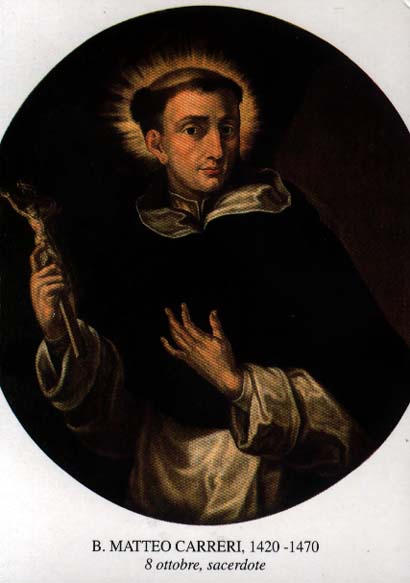
Blessed Mark of Modena

83087-01

Mark was born in Modena and entered the convent of the order there in young manhood. He observed the rules with great fidelity, and became noted both for his learning and his holiness, which is a sentence that would fit into nearly every Dominican biography written, and tells us nothing in particular about Mark as a person. However, when we recall the times in which he lived , it becomes clearer to us that anyone who kept the Dominican Rule in its entirety is truly to our notice . The abuses which stirred Savonarola to thundering speech in the pulpits of Ferrara and Florence could not have been absent from all of Italy. It look solid virtue to hold out against the opulent worldliness of the times, and Mark of Modena apparently did a thorough job of it, since he has been beatified.

Mark was made prior of the convent of Pesaro, and the only miracle we have on record (he is supposed to have performed many) took place at his convent. A woman’s little boy had died, and she pleaded with Mark to restore the child’s life. After praying for awhile, Mark turned to her and said, “Madam, your little boy is in paradise. Do not try to get him back again, for his second loss will be worse than this one.” However, she insisted on his working the miracle, and he did so. The child returned to life, and, ten years later, covered with disgrace and opprobrium, died a second time, leaving his mother in worse grief than ever.

Mark of Modena died in 1498, the year that the city of Florence burned Savonarola at the stake. It was a time of terrible happenings in Italy and all Europe. The people of Modena mourned the death of Mark, and went to pray at his tomb. Many of their needs were answered there, and a number of prodigies were reported in connection with the translation of his relics to the Rosary chapel of the church. The bells were said to have rung by themselves, and sweet perfume filled the air. Until recently, his relics were still exposed yearly for veneration during the week of Whitsunday.

Born: in Modena at the beginning of the 15th century

Died: in at Pesaro in 1498

Beatified: by Pope Pius IX in 1857

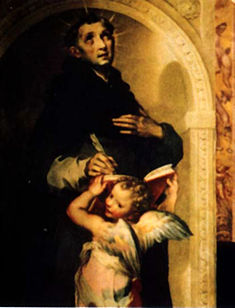
St Mathew, Apostle, Evangelist ~ The Rev. Lady Sherwood, OPI

download

When our Lord Jesus called him to follow him, Mathew was a tax collector by profession for the Romans. His profession was hated by the devout Jews as it reminded them of their subjection and also the Pharisees saw his profession which was classed as publican, as work for the typical sinner.

St Mathew is one of the Lord Jesus’ twelve apostles and by christian tradition is also seen as one of the four Evangelists. He was the first to put down in writing as his Gospel the Lord’s teachings and the account of our Lord Jesus’ life. Mathew wrote his Gospel in Aramaic, which is the language which was spoken by Jesus himself.

No one was shunned more than a publican by the devout Jews because a publican was a Jew who worked for their enemy, the Romans and who robbed their own people making themselves large personal profits. Publicans were despised to the extent that they were not allowed to trade, eat or even to pray with other Jews.

One day when Mathew was seated at his table of books and money, Jesus looked at him and said unto him two words, “follow me”. For Mathew, these two words were all it took for him to immediately rise, leaving all his pieces of silver to follow our Lord Jesus Christ.

Mathew’s original name was ‘Levi’ which in Hebrew signified ‘Adhesion’ whilst his new name given to him by our Lord Jesus of Mathew means ‘Gift of God’.

The only other major mention of Mathew in the Gospels is regarding the dinner party for Jesus and his companions to which Mathew invited his fellow tax collectors.

The Jews showed surprise at seeing our Lord Jesus eating in the company of a publican, but Jesus explained to the Jews that he had come “not to call the just, but sinners.”

Not much else is known about the life of Mathew but according to tradition, he is reported to have preached in such places as Egypt, Ethiopia and other further Eastern areas.

Some say Mathew lived into his nineties before dying a natural death, but other Christian traditions say he died the death of a martyr.

The Gospel according to Matthew is one of the four canonical gospels, one of the three synoptic gospels, and is the first book of the New Testament. The narrative tells how Messiah, our Lord Jesus was rejected by Israel, and how he finally sends his disciples to preach his Gospel to the whole world. Most Scholars believe the Gospel of Matthew was composed between 80 and 90 CE, with the possibility of between 70­110 CE. The Gospel of Matthew is a creative reinterpretation of Mark, stressing Jesus’ teachings as much as his acts, making subtle changes to reveal Jesus’ divine nature­ for example, Mark’s “young man” who appears at Jesus’ tomb becomes a radiant angel in the Gospel of Matthew. The Gospel of Matthew shows Jesus as the Son of God from his birth, the fulfillment of the Old Testament. The Gospel of Matthew was the favourite Gospel of St.Dominic de Guzman, who always would carry it wherever he went.

Let us pray to St Mathew to ask him to intercede on our behalf:

O Glorious St Mathew, in your Gospel you portray Jesus as the longed-for Messiah who fulfilled the prophets of the Old Covenant and as the new lawgiver who founded a church of the New Covenant. Obtain for us the grace to see Jesus living in his church and to follow his teachings in our lives on earth so that we may live forever with him in heaven. Amen.

Living the Call to Greatness – 25th Sunday of Kingdomtide ~ Br. Michael Marshall, Novice

8531186_origWisdom 2:12, 17-20

The wicked say:
Let us beset the just one, because he is obnoxious to us;
he sets himself against our doings,
reproaches us for transgressions of the law
and charges us with violations of our training.
Let us see whether his words be true;
let us find out what will happen to him.
For if the just one be the son of God, God will defend him
and deliver him from the hand of his foes.
With revilement and torture let us put the just one to the test
that we may have proof of his gentleness
and try his patience.
Let us condemn him to a shameful death;
for according to his own words, God will take care of him.

James 3:16-4:3

Beloved:
Where jealousy and selfish ambition exist,
there is disorder and every foul practice.
But the wisdom from above is first of all pure,
then peaceable, gentle, compliant,
full of mercy and good fruits,
without inconstancy or insincerity.
And the fruit of righteousness is sown in peace
for those who cultivate peace.

Where do the wars
and where do the conflicts among you come from?
Is it not from your passions
that make war within your members?
You covet but do not possess.
You kill and envy but you cannot obtain;
you fight and wage war.
You do not possess because you do not ask.
You ask but do not receive,
because you ask wrongly, to spend it on your passions.

Mark 9:30-37

Jesus and his disciples left from there and began a journey through Galilee,
but he did not wish anyone to know about it.
He was teaching his disciples and telling them,
“The Son of Man is to be handed over to men
and they will kill him,
and three days after his death the Son of Man will rise.”
But they did not understand the saying,
and they were afraid to question him.

They came to Capernaum and, once inside the house,
he began to ask them,
“What were you arguing about on the way?”
But they remained silent.
They had been discussing among themselves on the way
who was the greatest.
Then he sat down, called the Twelve, and said to them,
“If anyone wishes to be first,
he shall be the last of all and the servant of all.”
Taking a child, he placed it in the their midst,
and putting his arms around it, he said to them,
“Whoever receives one child such as this in my name, receives me;
and whoever receives me,
receives not me but the One who sent me.”

Donald Trump… Bill Gates… They are probably the most well-known extremely wealthy people in the world. They are where they are because they worked hard and possibly made extremely risky decisions, yet both are necessarily the most popular people with some socio-economic classes of folks. Donald Trump has been thought to have trampled upon others to acquire more and more of his wealth, and his arrogance shows he is not concerned for anybody but himself. On the other hand, Bill Gates is a little different. He has taken a computer software company from infancy to becoming the only real competitor to Apple; to the point that a PC not only runs Windows but other programs are so integrated into Windows, where Microsoft essentially has a monopoly within the computer world. In light of the success of Bill Gates, he has given to charity. He has been part of community service, helping those in need. Both individuals possess success because of what they have accomplished, yet what sets them apart is what they have done with that success.

We read in the Gospel that Jesus has been listening into the conversation between his Apostles; a conversation about who is the greatest, yet Jesus does not scold them for having the conversation. He does not tell his Apostles that it is wrong to strive for greatness and success, wanting to excel. He says it is only human nature to possess those desires, but it is what they do, or how they carry out actions, that truly determine greatness. He explains that following what God has instructed is what greatness is all about. One is to make a positive difference in the world by being a witness of God’s love, to give of oneself rather than focusing on the material and stature greatness.

How many times have we dreamt about wanting a little more money, wanting a better job with distinction, thinking that we would be happier in life? It is human nature to have those thoughts, and it is not wrong or sinful to have those things. It is just what we do in life with what resources we DO have that truly brings happiness, happiness to us AND God. Is it our purpose to be like Donald Trump, to acquire more and more, and to push others around? Or should we help our neighbor in need, using part of what we have for others? God commanded us to love one another, and that living that way is where greatness lies.

So… How can we go about doing this???  Here are some examples… Volunteer to read to home-bound folks, buy lunch for the next person in line at McDonald’s, be the ear for someone who needs to talk about tough issues in their life, but even better yet, it can be a smile and a hello as you walk past someone one on the sidewalk.  We are called to greatness through actions such as these!

Blessed Francis Posadas

81755-01

Few Dominicans have had more difficulty getting into the Order than Blessed Francis de Posadas, and he was one of the glories of the convent of the Scala Coeli, in Cordova. It is embarrassing for us to read that the reason for his exclusion was plain and simple snobbery on the part of the superiors of the convent of St. Paul, in Cordova.

Francis was born of a poor young couple who were war refugees, and who had been shunted from place to place until, when Francis was very small, his father’s health failed, and he died in Cordova. The young widow tried several types of work, and finally she was reduced to selling eggs and vegetables at a street stand. She tried to educate her child, for she knew he was very talented, but, without money, it simply was not possible to send him to school. She encourage him to go to the Dominican Church of St. Paul, and he served Mass there every morning from the time he was six or seven years old.

While he was still a very tiny child, he used to gather the other children together for rosary processions or other devotions. The smile of God seemed to rest upon him. For all his poverty, he was a very happy and attractive child, like by everyone; and he was a natural leader among his fellows. Twice during his childhood, he was miracuously saved from death. This fact and his undoubted piety, should have seemed sufficient reason for admitting him into a religious order. However, by the time Francis was old enough, there were two reasons to make his entry difficult: his mother had remarried, and the step-father would not permit him to enter. The Dominicans, moreover, would not have him. They said that they did not want the son of a street peddler.

Francis had friends in the Order, but the prior of the house he wished to enter took a violent dislike to him. It was several years before the young man could overcome the resistance of this man, who, having some influence with the provincial, was stubbornly determined that Francis should not be allowed to enter. Even when the fathers in the convent of Scala offered to take the boy and train him in Latin- so that he could qualify for clerical studies-the vindictive dislike of the prior followed him and almost prevented his acceptance.

Francis was finally accepted, made his novitiate, and gradually overcame all dislike and distrust by his charming manner and his unquestioned talents as student and preacher. After his ordination, he was sent out to preach, and he earned the reputation of being a second St, Vincent Ferrer. His talents as a preacher were rivaled only by his gifts as a confessor. He not only could read hearts and discover sins that had been willfully concealed, but sometimes he was called to one place or another by an interior spirit and shown someone badly in need of the sacraments.

Francis hated the thought of holding authority in the Order. When appointed prior of one of the convents, he remarked that he would much sooner be sentenced to the galleys. He twice refused a bishopric, and he skillfully eluded court honors.

Several remarkable conversions are credited to Francis Posadas. His last tears were a series of miracles wrought in the souls of his penitents. People followed him about to hear him preach, regarding him as a saint and miracle worker. One of his most noted converts was a woman more than one hundred years old- a Moor- with no intention of deserting Mohammedanism.

Francis of Posadas was the author of a number of books which he wrote to assist him in his apostolate. One was a life of St. Dominic. and several were biographies of other saintly people.

After a life filled with miracles, Francis died in 1713. Being forewarned of his death, he made private preparations, but to the last minute he was busy in the confessional before dying suddenly. By the time of his death, not only the Dominicans of Cordova, but the people of all Spain were happy to have him as a fellow countryman. He was beatified a century after his death, in 1818.

Born: Cordona in Spain in 1644

Died: In 1713 of natural causes

Beatified: He was declared Blessed by Pius VII in 1818

Blessed John of Massias

918juan8

John Masias was born in Ribera, in Spain, and, when very small, he was left as orphan. He was adopted by a kindly uncle who set him to herding his sheep. The little boy was naturally pious, and passed his spare time in sayingthe Rosary. Our Lady and the Christ Child appeared to him several times, and he was often visited by his patron, St. John the Eveangelist, who once showed him a vision of heaven, telling him: “This is my country.”

When John was about twenty, he went to Mass in the church of the Dominicans in a neighboring city. For the moment, it seemed to him that vocation was joining the Friars Preachers now, but St. John appeared to him, telling him he must go elsewhere. In 1619 he embarked for the Indies, where many Spaniards were going, either to convert the natives or to seek a fortune. After a long and hazardous journey, he arrived in Lima.

There were at the time four convents of the Friar Preachers in Lima: the College of St. Thomas; the house of St. Rose, where Sister Rose of St. Mary had died just five years before; Santo Domingo or Holy Rosary, where the holy lay brother, Martin de Porres, was performing such astounding miracles; and the convent of St. Mary Magdalen, which was small and poor. John decided to enter St. Mary Magdalen and, in 1622, he received the habit of a lay brother there. On the night of his profession, devils appeared to tempt and reproach him. He was attacked bodily, and, although he was called on Jesus, Mary and Joseph for help, the demons continued what was to become twelve years of torture, by actually throwing him from one cloister to another.

John was appointed assistant to the porter, and lived in the gatehouse. There the poor came for food, and the rich for advice. He became adept at begging for the poor, always managing to find enough for the more than two hundred people who came daily for help. He had little use for the wealthy and curious, and would sometimes baffle them by simply disappearing while they were looking at hi,. Also, legend relates that he had a little burro that he would send out by itself, with a note asking for what was needed in one of the empty panniers on its back. Told where to go, the burro made his route faithfully; and if the rich man on whom he called was ungracious, or even hid himself to avoid giving alms, the little burro made quite a noise, and it quickly brought the desired results.

Rays of light streamed from the blessed’s face as he taught the catechism to the poor, or prayed by himself in the gatehouse. He said an amazing number of rosaries and made no less than twenty daily visits to the Blessed Sacrament. He is said to have liberated more than a million souls in purgatory, many of whom came back , while he was at prayer , to thank him for his help.

One day a certain ship captain came to the gatehouse and asked to look around. John took him by the arm and led him to the crucifix, warning him to look well on it and think of his sin. Terrified, the captain fell to his knees, confessing that he was an apostate religious, thirty years away from the sacraments, and he begged for a priest. On another occasion, the brothers were building a flight of steps and, having measured a beam wrong, they were annoyed because it did not fit. John took the beam in his hands and stretched it to fit their needs. These, and many other miracles, led people to venerate him as a saint during his lifetime. His recreation was to talk of the things of God with the other holy lay brother, Martin de Porres

At the time of his death, Our Lady, St. Dominic, his patron, St. John and many other saints, came to accompany him to heaven. They were seen by some of the brothers.

Born: March 2, 1585 at Ribera del Fresno, Estramadura, Spain

Died: September 16, 1645 in Lima, Peru of natural causes

Beatified: In 1837 by Pope Gregory XVI

Our Lady of Sorrows ~ Br. Chip Noon, Novice

our_lady_of_sorrows


Is it nothing to you, all you that pass by? Behold, and see if there be any sorrow like unto my sorrow.

This familiar passage from Lamentations is so appropriate for today, isn’t it? Today is the Memorial of Our Lady of Sorrows. Mater Dolorosa. What a whirlwind of feelings she must have embodied! First, the loss of a child, one of the most heart-wrenching things that can happen to a parent…a child of any age.

Second, what, at the foot of the Cross, looked to be the contradiction of all that had gone before with such promise.

Third, the desertion by most of the Apostles while she and John and the women were left alone.

Our Lady of Sorrows.

But wasn’t she prepared for this? Wasn’t she told by Rabbi Simeon, as we hear in today’s Gospel,

“Behold, this child is destined

for the fall and rise of many in Israel,

and to be a sign that will be contradicted

and you yourself a sword will pierce

so that the thoughts of many hearts may be revealed.”

Artists through the ages have depicted Mary in her sorrow, some even with seven swords embedded in her representing her Seven Sorrows. And many musicians have set the sorrows to music, especially the Marian hymn:

Stabat mater dolorosa
juxta Crucem lacrimosa,
dum pendebat Filius.

At the Cross her station keeping,
stood the mournful Mother weeping,
close to her Son to the last.

Isn’t this heartbreaking?

What are we to make of this devotion to a sorrowing mother? We Christians who are invited to incomparable joy with our Lord, how are we to fall to weeping with Mary? Isn’t this its own contradiction for us?

But are we not human? Are we not allowed at times to fall into self-pity, sorrow, despair?

Then maybe that’s the value of the phenomenon of Our Lady of Sorrows. Here is a way to experience these feelings that will not bring us down into the pit, she is a safe haven for us to mourn, and to experience the catharsis of deep, deep sorrow.

We have only to read our Bible to find many cues to us that it is time to mourn: over the death of Absalom, over the Holy Innocents, over the martyrdom of John the Baptist. And we can mourn the losses in our own lives: our friends, our parents, and so sadly, yes, our child. And especially we can mourn with Mary over the torture and death of her son, our Lord.

And sorrowing with Mary, we can feel the pain in her heart and her hands and her feet and her brow as she contemplates the wounds inflicted on her son. We can let ourselves go and weep along with her, and for her, and for us and our own many sorrows.

The sorrows of everyday life that we all experience.

We can cry until our throats hurt and our body is wracked with despair.

With Mary.

And then, as we are in the midst of our lamentations, we can feel the hand of Mary. We can imagine the comfort that she can bring us. And we can see her as she intercedes for us with her son. She is our Blessed Mother and we can surrender ourselves to her comfort just as we used to with our own mothers.

Because that is the message we were given, and that we hope to give to others. As George Fox heard, “There is one, even Christ Jesus, that can speak to thy condition.” And as John says in his Gospel, “Peace I leave with you, my peace I give to you; not as the world gives do I give to you. Let not your heart be troubled, neither let it be afraid.”

Wasn’t Mary joyful as she heard these words from her risen son? Didn’t all her sorrow come to fruition with the Resurrection and Ascension?

So it can be with us, today and all our days. We can remember Mary’s sorrow and we can rest comforted. We can remember our own sorrow and we can go out and comfort others. Because we have Jesus and Mary as pure examples of how sorrow can and will turn to joy when we open our hearts to God and his promises.

Father, as you comforted Mary and your Son, comfort us as we go through the world. Help us to sustain others in their sorrow and help us to bring the light of gladness to all we meet today and into the future. In Jesus’ name, Amen.

The Triumph of the Cross ~ The Rev. Deacon Joshua Hatten, OPI

trimph-of-the-cross

Today the celebrates the Feast of the Triumph of the Cross.   Now, some of you may be asking what in the world is triumphant about an instrument of torture and death and WHY are we celebrating it?

What we celebrate today is the triumph of eternal life over death, infinite love over overwhelming evil.  The VICTORY of our Lord, through humility, over the arrogance of Satan.

It seems so easy for us to make small sacrifices in small areas of our lives.  We give up that candy bar, coffee, or profanity for the 40 days of Lent.  We need to drop five pounds, so we don’t “biggie size” our burger and fries for a few weeks.  We really want to see that particular movie next weekend, so we save up this week.  But what about the bigger picture??

We do seem to have trouble, usually, of making, in the much more important and far greater purpose of our earthly existence… which is where we wind up AFTER it ends.  The answer to WHERE we wind up AFTER starts in our here and now – in our daily life – in how we fight or give in to those daily spiritual battles.  What our response, here and now, to the occasions of sin, innumerable temptations and other potential woes that are laid before us OFTEN, daily.

Do we value the things of the world over the values of God’s Kingdom?  What aspects and pieces of our lives are we willing to nail to the cross, as often as is necessary, and let die so that we may live with victory?  Are we willing to put on the humility, as our Lord did, to make us capable of bearing, overcoming and triumphing over these earthly parts of our lives to bring ourselves, through our faith in Christ Jesus, to life everlasting?

It all begins with the first step of KNOWING that we cannot do it of our own accord.   WE MUST HUMBLE OURSELVES before ALMIGHTY GOD, assured that alone we are doomed to failure, and ask for his saving grace and guidance and Fatherly Love.  It is only after taking this step, WITH FAITH,  that we can even find ourselves on the beginning of the right path.  It is a choice, and I encourage all of us to begin TODAY, EVERYDAY, AS OFTEN AS IS NECESSARY, to examine our spiritual states and take the hammer and nails to anything separating us from living life as a true disciple of Christ.

Is it easy?  NO!!   Is it worth it??  YES; the rewards are far beyond what we can begin to comprehend.  We must be humble enough to trust God to be God and KNOW that His promises and assurances of recompense for living for him will not and cannot return void.

Let’s face it… none of us are getting out of this earth alive.  Our days will end will a last breath or the return of our Blessed Lord, Jesus Christ.  Either way, shall we be judged and rewarded as victors and receive a crown of eternal glory, or will we continue to live our here and now, falling into Satan’s snares, and have our days in this world end with eternal separation from God Almighty??

CHOOSE, HERE and NOW… take up your crosses and CARRY THEM TO VICTORY, to a TRIUMPHANT FINISH, through a humble way of living for and in GOD.  Only this, through faith in our Blessed Lord, can we turn our woes into WOWS and our death into an eternal existence of heavenly happiness.

Food…Not Only for the Soul… ~ The Rev. Deacon Scott Brown, OPI

food-for-the-body-is-not-enough-there-must-be-food-for-the-soul-quote-1

From the Epistle of St. James, 2:14-17

14 How does it help, my brothers, when someone who has never done a single good act claims to have faith? Will that faith bring salvation?

15 If one of the brothers or one of the sisters is in need of clothes and has not enough food to live on,

16 and one of you says to them, ‘I wish you well; keep yourself warm and eat plenty,’

without giving them these bare necessities of life, then what good is that?

17 In the same way faith, if good deeds do not go with it, is quite dead.

Our jobs as Christians is to give those without faith, those who are doubting their faith, and those who have lost their faith, the spiritual necessities to regain that faith they once had by our actions and deeds. Pray with and for those who doubt their faith or have lost their faith. Feed the hungry, both nutritionally and spiritually. Clothe the naked, both physically and spiritually. Comfort the sick and dying, both physically and spiritually. And last but not least, open your homes to the homeless, both spiritually and physically.

Matthew 25:31-40 says:

“When the Son of Man comes in his glory, and all the angels with him, then he will sit on his glorious throne.

32Before him will be gathered all the nations, and he will separate people one from another as a shepherd separates the sheep from the goats.

33And he will place the sheep on his right, but the goats on the left.

34Then the King will say to those on his right, ‘Come, you who are blessed by my Father, inherit the kingdom prepared for you from the foundation of the world.

35For I was hungry and you gave me food, I was thirsty and you gave me drink, I was a stranger and you welcomed me,

36I was naked and you clothed me, I was sick and you visited me, I was in prison and you came to me.

’ 37Then the righteous will answer him, saying, ‘Lord, when did we see you hungry and feed you, or thirsty and give you drink?

38And when did we see you a stranger and welcome you, or naked and clothe you?

39And when did we see you sick or in prison and visit you?’

40And the King will answer them, ‘Truly, I say to you, as you did it to one of the least of these my brothers, you did it to me.

The instructions are pretty clear here: we are our brothers’ keepers. Jesus has instructed us to take care of each other both physically and spiritually. It is up to each of us to fulfill Jesus’s instruction in order to inherit the kingdom of Heaven.

If we don’t follow the above instructions then we can expect the following as stated in Matthew 25:41-46

41Then he will say to those on his left, ‘Depart from me, you cursed, into the eternal fire prepared for the devil and his angels.

42For I was hungry and you gave me no food, I was thirsty and you gave me no drink,

43I was a stranger and you did not welcome me, naked and you did not clothe me, sick and in prison and you did not visit me.’

44Then they also will answer, saying, ‘Lord, when did we see you hungry or thirsty or a stranger or naked or sick or in prison, and did not minister to you?’

45Then he will answer them, saying, ‘Truly, I say to you, as you did not do it to one of the least of these, you did not do it to me.’

46And these will go away into eternal punishment, but the righteous into eternal life.”

The instructions seem clear and the rewards are truly wonderful. Just as the consequences of not following the teachings of the Lord are quite clear and not nearly as wonderful.

Step back and take a look at your Christian life and evaluate yourself. Have you followed the teachings, have you clothed, fed, prayed, or visited? Or do you shun and ignore the people who need your spiritual help and guidance. Today would be a good time to start looking a little closer at those who most of us feel are “beneath us” or “unreachable”. Even the smallest act of kindness and true love might be just enough to touch the hearts of those in need.