Bread~The Rt Rev Michael Beckett, OPI

Carbs.  Ugh!  Carbs!  YUM!  Carbs!  Not so very many years ago, I lost a heap of weight by cutting out most carbs.  THAT didn’t last.  Pasta!  How can anyone live without pasta?  And yes, I know all about spaghetti squash and zoodles and wheat pasta (major yuk) and anything else that can be substituted for the honest to goodness yumminess that is pasta.  And then there’s bread!  BREAD!  We have three bread machines and Scott has become a true Bread Guru.  Egg bread, white bread, rye bread, oat bread, honey bread, and the list goes on and on and on.  And very rarely does any of said bread go to waste.  We like bread. 

Sadly, though, no matter how much or how often we eat bread, or pasta, or bread, or cake, or bread, we get hungry again.  Our bodies crave that fuel that keeps us going.  Not feeling like yourself?  Eat.  Have something to celebrate?  Eat.  And hey, in SO many restaurants, what do they bring to the table as soon as you’re seated?  Yup.  Bread. 

So, what is bread? Basically, it’s a paste of flour and water, cooked over or surrounded by heat.

According to history, the earliest bread was made in or around 8000 BC in the Middle East, specifically Egypt. The quern was the first known grinding tool. Grain was crushed and the bakers produced what we now commonly recognize in its closest form as chapatis (India) or tortillas (Mexico). 

And we all of us know about manna, the bread from heaven the slaves from bondage in Egypt ate whilst they meandered in the desert looking for the Promised Land.  In fact, bread is mentioned at least 492 times in the Bible beginning in Genesis and continuing right through Revelation with a variety of meanings and symbolism.

So.  Bread.  We know our bread.  Jesus even talked about bread.  Several times.  In the single most important sacrament we have, that of the Eucharist, bread becomes the body of Christ. 

In today’s Gospel, John 6:41-51, Jesus says, “I am the bread of life.  Your ancestors ate the manna in the desert, but they died; this is the bread that comes down from heaven so that one may eat it and not die. I am the living bread that came down from heaven; whoever eats this bread will live forever; and the bread that I will give is my flesh for the life of the world.”

So what’s up with this?  What does Jesus mean?  At that point in history, especially in Jesus’ culture, bread would have been understood as a nutritional necessity.  Bread was one of the most accessible foods for people of all wealth and social status, even the poor had bread. 

Now, for Jesus to say He IS bread?  What’s up with that?  Jesus is explaining to the crowds gathered around Him, and to us, just who He is.  And a lot of folks weren’t exactly impressed.  The Bible tells us of  the people complaining, and even some of His disciples leaving, unable to understand the metaphor, or unwilling to accept Jesus’s explanation of who He is.  So what DOES Jesus mean?  Simply put, if we put our faith in Him, then we will have eternal life.  When Jesus says He is the bread of life, He is saying that He is essential to our salvation.  Salvation is essential to human existence and necessary for eternity. When Jesus says He is the bread of life, He is saying He is essential, that HE is the means to our Salvation and eternal life. 

Jesus identified Himself as the bread of life, the way. He did not present Himself *A* source of salvation but as THE only way to salvation. Without Him, without the bread of life, there is no hope for salvation. By identifying Himself as the source of forgiveness, Jesus makes the path to repentance and a relationship with God, plain, simple, and available for everyone. 

So what do we do?  You say to me, “But I’m a good person.  I try to do the right thing.”  Well, yeah.  OK.  But ya see, the trick is, if Jesus is to be our “bread,” not only do we have to believe it, we have to live it.  And therein, as Mr. Shakespeare said, “lies the rub.”  The Bread of Life will sustain the us, we who believe.  In our daily lives, in order to continue to be fed by Him, we must pray regularly.  We must study the Word (“the Word” being  Jesus, not necessarily the Bible as some believe.)

We must do our best to live according to what Jesus has taught us.  And reckon wonder, how do we do that?  Love as Jesus loved.  As I have said over and over and over again, ad infinitum, you are the only Bible some folks will ever read, the only Jesus some folks will ever see.  And I’m gonna add a new one:

For some folks, you are the only server who brings the Bread of Life to the table. 

As Jesus said to Peter in John 21:15-17:     So when they had eaten breakfast, Jesus said to Simon Peter, “Simon, son of Jonah, do you love Me more than these?” He said to Him, “Yes, Lord; You know that I love You.” He said to him, “Feed My lambs.”  He said to him again a second time, “Simon, son of Jonah, do you love Me?” He said to Him, “Yes, Lord; You know that I love You.” He said to him, “Tend My sheep.” He said to him the third time, “Simon, son of Jonah, do you love Me?” Peter was grieved because He said to him the third time, “Do you love Me?” And he said to Him, “Lord, You know all things; You know that I love You.” Jesus said to him, “Feed My sheep.””

Can we be, or do, less?  Again, for those in the back, for some folks, you are the only server who brings the Bread of Life to the table.  Know what you’re saying. Speak only the truth and do not, for the love of all that is holy, repeat or post misinformation.  Love without judgement. Recognize your own faults and work to correct them.  Give freely to those who are in need.  Love.  Love.  Love.

In the closing prayers of many church services we hear, “Let us serve Him with gladness and singleness of heart.”

So let us do that.  Let us “serve” Him, the Bread of Life, with gladness and singleness of heart.   Amen.

Are we Getting Our Priorities Right?~ The Memorial of Sts Martha, Mary and Lazarus~The Very Rev Lady Sherwood, OPI

Today my brothers and sisters in Christ, we come together as the church to commemorate the memorials of three siblings, these being Sts Martha, Mary and Lazarus.

Sts Mary, Martha, and Lazarus were very close friends with and were very devout followers of The Lord Jesus. Together they hosted Jesus in their home on many occasions. Yet, on one such visit from Jesus, they Martha and Mary chose two very different actions, and the way that Jesus reacted to their choices is a very valuable lesson for us today. Let’s review the story (Luke 10:38-42):

Martha is worried

Martha was rushing around, serving and doing her best to make everything good for their beloved guest. And where was Mary when Martha needed a hand? She chose to sit at Jesus’ feet, listening as He spoke.

It’s pretty easy to imagine how that made Martha feel. Irritated, frustrated, resentful. Why should she be doing all the work? Wasn’t it only righteous for Mary to be helping out? In fact, Martha felt so justified in her indignation that she went and talked to Jesus about it. “Lord, do You not care that my sister has left me to serve alone? Therefore tell her to help me,” she said to Him.

But, instead of backing her up in her demand, Jesus rebuked her! “Martha, Martha, you are worried and troubled about many things. But one thing is needed, and Mary has chosen that good part, which will not be taken away from her.”

This must have felt like a slap in the face for Martha. Here she was, doing everything in her power to be hospitable and make it good. And Mary just sat there, and what she was doing was the right thing?

Sound familiar?

It can become so easy for us to get wrapped up in all the things we need to do and the things that need to be accomplished that we lose sight of what the most important thing is. Isn’t it possible that we can get too wrapped up in the cares of life? Jesus makes this even more clear in the parable He told about the sower. “He who received seed among the thorns is he who hears the word, and the cares of this world and the deceitfulness of riches choke the word, and he becomes unfruitful.” Matthew 13:22.

The highest priority in our lives needs to be choosing the good part, as Mary did: to learn of Jesus so that we can become like Him. It’s a love and devotion to Him that makes everything else of secondary importance. It is to seek the riches of wisdom and understanding that are in Him. If we don’t do this, how can we follow Him, how can we be His disciples? A disciple learns of the Master.

This is not an excuse to be lazy, and not take responsibility for anything. That is another trap entirely. We are to be doers of the Word, and not hearers only! (James 1:22) But what we do has to be led by the Spirit, whose voice we learn to hear by choosing the good part. There is no blessing in running our own lives based on our human understanding of what is important. Mary understood that she needed to learn more of her Master and to seek the things that have eternal value. It’s when we do that that we can be a blessing, because then all of our works are Spirit-driven. Love causes us to listen, to learn, and to keep His commandments. (1 John 5:3)

“My sheep hear My voice, and I know them, and they follow Me.” John 10:27.

Take heed to yourself

We can be in danger of falling into the same trap that Martha did. We can be so troubled by what we perceive as negative behavior in others, and become so self-righteous in our good works that we start to judge others for not doing as we do. Satan is the one behind these kinds of thoughts. He whispers lies and accusations, trying to create as much conflict as he can. His aim is to lead people as far in the opposite direction of “the good part” as he possibly can – to lead them away from Jesus. To listen to him and agree with him leads to all kinds of unrest and trouble and worry. We need to slam the door on his deceitfulness!

“Take heed to yourself and to the doctrine. Continue in them, for in doing this you will save both yourself and those who hear you,” it’s written in 1 Timothy 4:16. Only that will do us any good in life. The wrong choice that Martha made wasn’t that she was serving and doing good. It was that in her work she had demands and criticism on Mary, rather than doing what Jesus taught herself! If we are living before the face of God, we have no cause to look around at what others are doing and feel that we have a right to pass judgement on them. We live in obedience to the Spirit’s promptings in our own lives, and what others do is none of our business. We don’t know how He is leading others.

Let’s rise above all the noise and pursuits of this world and seek those things which have eternal value. Like Mary, let’s find that fellowship with the Master and with those who follow Him so that we can learn of Him and become like Him. Through the Word of God, fellowship, and prayer we become rich in our spirit, and God will give us everything we need in abundance.

 “Finally, dear brethren, whatever things are true, whatever things are noble, whatever things are just, whatever things are pure, whatever things are lovely, whatever things are of good report, if there is any virtue and if there is anything praiseworthy—meditate on these things.” Philippians 4:8.

Let us pray:

Saints Martha, Mary, and Lazarus, you befriended Jesus as your Lord and God, and as the Son of Man, to Whom you opened your home and your lives. Please pray for us, that we will also open the home of our souls so as to befriend Him Who is my God and is the Resurrection and the Life. Saints Martha, Mary, and Lazarus, pray for us. Jesus,

In Jesus holy name we pray,

Amen.

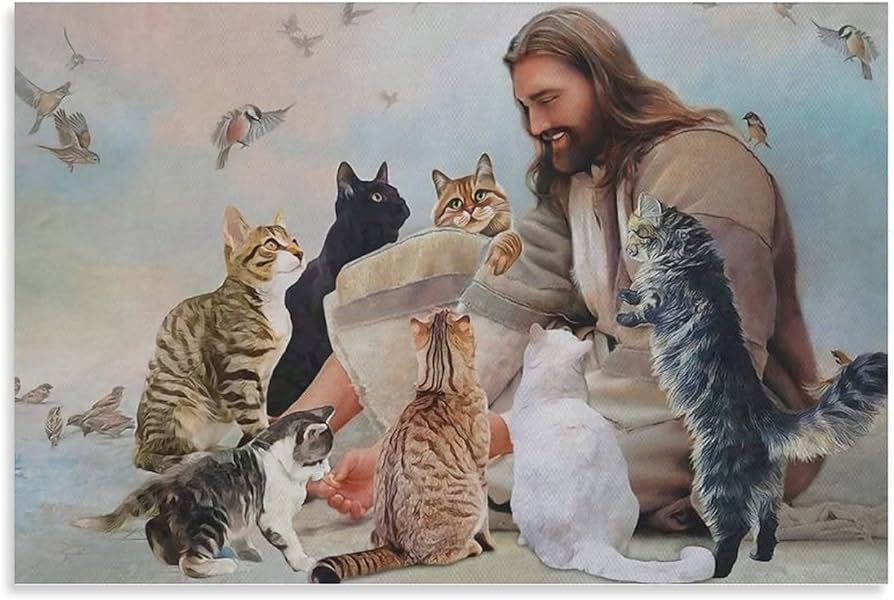
Cats, Consumption, and Jesus~The Rt Rev Michael Beckett, OPI

Y’all…..  In keeping with the times we live in, and the phrases du jour, I must announce that I am……A Childless Cat Lady.  But our poor cats.   I starve them.  Or, according to THEM, I starve them.  Only one inch of food in their bowl?  Heaven forbid!!!  There must be at least two inches or Binx will howl, meow, and otherwise fuss until said bowl is at the proper cat food level.  And canned food?  It’s not like they get canned food every morning of their lives.  All four of them will peer at me shamelessly every morning until they each have their allotted portion of Ocean Whitefish, which seem to be the favorite of the moment.  So…Nope.  Scott and I are terrible providers for our critters.  Bless their furry little hearts.  Ha!  Funny, isn’t it, that no matter how much they have, even when they have enough, they want more.  

So….  What about us?  How much is enough?  The answer to that question is usually, “Just a little bit more.”  Or just, “More.”  And once we get that “More” we still want “just a little bit more.”  And when THAT happens, whilst we are well provided for, what do we frequently do?  We want more and look down on those who have not reached that “more” status.

This kinda presents a problem for those of us who profess to love Jesus.  In the Gospel appointed for today, we hear of Jesus feeing the 5000.  We know now that there were many more than 5000, coz the Bible tells us there were about 5000 MEN.  There had to be women and children there as well.   That’s a heap of folks to feed with 5 loaves and two fish.  The story of Jesus feeding the 5000 is one that’s puzzled sceptics and believers too. Sceptics dismiss the miracle story or explain it away. Perhaps what ‘really’ happened, they say, is that many people had brought food with them to the event and realized that others hadn’t – so the ‘real’ miracle was the miracle of sharing.  Personally, what do I think?  I really think I’m not smart enough to explain the ”hows” of Jesus’s miracles, but I think I AM smart enough to believe that Jesus accomplished what He set out to do. 

However….. (Isn’t there always a “however” when I write stuff like this???)  However, what we CAN take away from this is Jesus fed folks.   It has been said and written over and over and over again, that Jesus will give us what we need.  And I believe this with all my heart.  And again, in this day and age Jesus will accomplish what He sets out to do.  Now, the trick is, just how does Jesus accomplish this taking care of needs and things when He isn’t right on hand to pass out the goods?  Uh oh. 

Jesus also said, “So send I you.”  In Matthew 25 we read: 

“When the Son of Man comes in his glory, and all the angels with him, he will sit on his glorious throne.  All the nations will be gathered before him, and he will separate the people one from another as a shepherd separates the sheep from the goats.  He will put the sheep on his right and the goats on his left.

 “Then the King will say to those on his right, ‘Come, you who are blessed by my Father; take your inheritance, the kingdom prepared for you since the creation of the world.  For I was hungry and you gave me something to eat, I was thirsty and you gave me something to drink, I was a stranger and you invited me in, I needed clothes and you clothed me, I was sick and you looked after me, I was in prison and you came to visit me.’

“Then the righteous will answer him, ‘Lord, when did we see you hungry and feed you, or thirsty and give you something to drink?  When did we see you a stranger and invite you in, or needing clothes and clothe you?  When did we see you sick or in prison and go to visit you?’

 “The King will reply, ‘Truly I tell you, whatever you did for one of the least of these brothers and sisters of mine, you did for me.’

So……  Jesus isn’t here walking on this earth in da flesh any more….  And it would seem that with the “So send I you” thing He has goin’ on….  Well, folx, looks like it’s up to us to be feeding the hungry, and clothing those who are in need.  It’s up to us to continue the Lord’s work here.  Once again, I will say, sometimes you are the only Jesus some folks will ever see.  You are the only Bible some folks will ever read. 

So many times we hear folks talking about the homeless.  Sure, I’ll grant you that many of them are homeless due to addiction to one thing or another, or could do something about their situation, or could reach out for help, or….  or…..  or……..   But I don’t know these people as individuals, I don’t know their stories, and who am I to judge?   My Daddy….oh how I miss him…  Daddy was always giving out a five here or a buck there to those who were “less fortunate” than he and Momma.  Many years ago, someone once said to him, “Bill, you know they are just gonna buy alcohol or drugs with that money.”  Daddy’s reply???  He said, “Well, ya know, that says more about them than it does me.  Jesus told me to give,  not to tell folks what to do with what I give them.”  That stuck with me.

No, we can’t provide for everyone we meet.  But we can donate to a homeless charity or a program that feeds the less fortunate.  We can volunteer at one of those organizations.  We can do a lot of things to alleviate the problems these folks face. 

The question isn’t “should we?,”  it’s will we?  

So y’all, there ya have it.  My thoughts on one of Jesus’s great miracles.  Now, if you’ll excuse me, I have cats to feed.

Are We of Ambition, or of Service?~ The Feast of St James the Apostle~The Very Rev Lady Sherwood, OPI

We all know of those certain people who have very high
ambitions in life. These can range from wanting to win the lottery, or in
obtaining that certain perfect job. Maybe their ambition is for a top-class
sports car, or maybe a mansion with lots of rooms and it’s own personal
swimming pool. Maybe it’s  being rich
with wealth and possessions. Even within some churches, I have personally seen
those whose only ambition is to become a Bishop, when nothing less is good
enough for them,the ambition of power and status, having mitre fever as I call
it.

Whilst to have some ambition is a good thing, if you are setting goals for yourself or for an organisation, it is when those ambitions
lose their balance and ignores the consequences for others, that ambition can
become very toxic and corrupt.We have an excellent example of over ambition in our Gospel
reading today from Matthew. James and his brother John, who together with Peter
are the three favoured apostles, approached Jesus together with their mother.
According to Matthew, it was indeed their mother who asks Jesus to promise her
sons would get the highest places in His heavenly Kingdom. Jesus responds
directly to James and John and Jesus recognising the possibility of corruption
in their ambition, Jesus puts a stop to it by asking them, “Can you drink the
chalice that I am going to drink?” Without truly understanding what they had
agreed to, they replied that they could. Jesus knowing full well what awaited
them, concurred with their agreement. Just like a good parent will give their
teenage children a realistic picture of what to expect in Adult life, Jesus
tells them that indeed they will have much to suffer.James the Apostle that we celebrate today, became the first
Martyr amongst the apostles. Jesus knew that ambition wasn’t a bad thing in
itself, and he didn’t wish to extinguish his apostles enthusiasm, indeed it’s
an enthusiasm about eternal life, it’s a goal that each and every one of is
should indeed have as great things are rarely achieved without both enthusiasm
and suffering. Jesus just needed to refocus their ambition, so that they would
truly understand not just the goal of eternal life, but also the true nature of
the pathway that that is required to achieve this goal. Jesus knowing that the
Apostles could possibly succumb to the temptations of personal ambition, gave
the Twelve apostles a lecture on power and authority to remind them that
authority in the kingdom must not imitate the authority that is ever so present
in the world.Jesus tells them that their role as his apostles =the first
shepherds of His church, was not to rule but instead was to serve. Jesus didn’t
only tell them to serve only each other and the lowly of the world, but offers
himself as an example -revealing to them that he will go so far as to sacrifice
his very life for the sake of all humanity. “The Son of Man did not come to be
served but to serve and to give his life as a ransom for the many”. Jesus is
telling James, John and the other apostles that the ambitious are blessed, but
that their ambition must not be driven by self=assertion, but by
self=extinction. This message also goes the same for us today, that we always
act with Thanksgiving and praise :Thanksgiving because all that we have, all
that we are, all that we achieve =all of this is solely given to us by the
Grace of God, and praise because all that we do must be for the Glory of God
and not for ourselves.Let us pray :O Gracious God,We remember before you today thy servant and Apostle James,
the first amongst the Twelve to suffer martyrdom for the name of Jesus Christ ;
and we pray that you will pour out upon the leaders of your Church that Spirit
of self=denying service by which alone they may have true authority amongst thy
people, through the same Jesus Christ our Lord,Who lives and reigns with you and the Holy Spirit, One God,
for ever and ever.Amen.


The Feast of Saint Mary Magdalene, Patroness of The Order of Preachers~The Very Rev Lady Sherwood, OPI

Today, we come together to reflect and remember the life and Devotion to Christ of The Apostle to The Apostles, St Mary Magdalene, our Patroness.

There are several Marys accounted in the Holy Bible-the New Testament mentions six of them! The Mary we know as Mary Magdalene whose feast we celebrate today, draws her name from Magdala, her city of origin. Luke tells us that Jesus cast seven demons out of her (Luke 8:2). Afterward, she became His follower.

There are lessons we all can take from Mary Magdalene’s life that we can use within our own lives of walking with Christ.  Let us take a look at some of these:

Lesson 1. We don’t have to be defined by our past.

There’s an awful lot of speculation about Mary’s background. People have tied Mary to the sinful woman in Luke 7:36-50. Many assume that Mary was a prostitute or woman of ill repute. But there really isn’t any biblical basis for portraying her this way.

As Luke tells us, Mary had seven demons cast out of her. Whatever her background had been, she suffered before meeting her Saviour. But Mary isn’t defined by who she was before she met  Jesus. All that matters is who she became after discovering Him.

Like Mary, we don’t have to let our past dictate how we see ourselves. Paul explains it this way, “Therefore, if anyone is in Christ, the new creation has come: The old has gone, the new is here” (2 Corinthians 5:17, NIV)!

Lesson 2… Jesus should be the center of our world.

After Mary’s first encounter with Jesus, He becomes the sun that her life revolves around. Luke tells us:

“After this, Jesus traveled about from one town and village to another, proclaiming the good news of the kingdom of God. The Twelve were with him, And also some women who had been cured of evil spirits and diseases: Mary (called Magdalene) from whom seven demons had come out; Joanna the wife of Chuza, the manager of Herod’s household; Susanna; and many others. These women were helping to support them out of their own means” (Luke 8:1-3, NIV).

Not only did Mary follow Jesus and the disciples from town to town, but she and some other women helped to support Christ and the disciples financially. This role continued throughout His ministry.

Matthew tells us that they were present at the crucifixion, and followed Jesus all the way to Galilee to take care of Him:

“Many women were there, watching from a distance. They had followed Jesus from Galilee to care for his needs. Among them were Mary Magdalene, Mary the mother of James and Joseph, and the mother of Zebedee’s sons” (Matthew 27:55-56, NIV).

It’s no surprise that she would find herself center stage at the resurrection, too.

We should follow Mary’s example. When we encounter Jesus, we shouldn’t simply return to the life we left. He changes everything. Our whole life becomes about following and serving Him until-like Mary-our story becomes intertwined and indistinguishable from His own.

Lesson 3…Jesus uses the weak things of the world to shame the strong.

In his first letter to the Corinthians, Paul talks about the gospel as being foolishness. The world doesn’t understand it, so they discount and dismiss it.

According to Paul, God did that on purpose:

“But God chose the foolish things of the world to shame the wise; God chose the weak things of the world to shame the strong. God chose the lowly things of this world and the despised things-and the things that are not-to nullify the things that are, so that no one may boast before him” (1 Corinthians 1:27-29).

We see a perfect example of this principle in Jesus’ relationship with Mary Magdalene. In a time when women were seen as secondary citizens with no real autonomy, Jesus demonstrated a special tenderness and care for women. We see this in His choice to reveal Himself to Mary first after the resurrection.

This is the most critical event in history, and Jesus made a woman the first witness. He even encourages her to tell the disciples (John 20:17). The irony is that they don’t believe Mary and the other women (Luke 24:11).

We need to be careful not to dismiss things that don’t follow our expectations, because Jesus doesn’t always do what we expect. He delights in working out His plan in the most unlikely of ways. He did that through Mary, and if we’ll let Him, He’ll do it through us, too!

Let us pray:

Grant to us, most merciful Father, that as the blessed St Mary Magdalene, by loving Our Lord Jesus Christ above all things, won the forgiveness of her sins, so may she obtain for us, through Your mercy, everlasting happiness. Through Our Lord Jesus Christ Your Son, who lives and reigns with You in the unity of the Holy Spirit, one God, forever and ever. Amen.

Order of Preachers,  pray for us…

Teacher?~The Rev Frank Bellino, OPI

If we do not see the first time, Mark repeats Jesus’ suggestion to the Apostles that they go by themselves ‘to a wilderness place’ to get a break from the crowds (Mark 6:31, 32). By the time they get there a great crowd has arrived and they are like sheep without a shepherd. Moved with compassion — this is one of the places where Mark uses a characteristic term — Jesus begins to teach them ‘many things’.

The desert is where many things are learned, and it is where the sheep are likely to become lost. The prophets spoke about the need for a new kind of shepherd. In today’s first reading, for example, Jeremiah says that God will set shepherds over them who will care for the sheep (23:4). Ezekiel says that God himself will come to seek out and to look after the straying sheep (34:11). The same desert, where the lost sheep wander, and from which they need to be rescued, is also where Israel will learn again what it means to be faithful to her Lord (Hosea 2:14-15).

Is Jesus here setting a trap for the Apostles in order to teach them something about teaching? Just before this, in sending them out two by two, he had not told them to teach or to preach (Mark 6:7-12). He gave them authority over unclean spirits and directions about their lifestyle on the road. We are told, however, that ‘they preached that men should repent’ (6:12) and on their return told Jesus ‘All they had done and taught’ (6:30). They are keen to be like him, and to do all that he is doing, not just casting out demons and healing the sick but, more importantly, teaching people.

Perhaps we can understand what happens next as Jesus saying, ‘you want teaching? I’ll show you teaching’. Leading them away to a desert place by themselves brings them slap bang into the middle of human distress: a great multitude awaits them, whose need evokes in Jesus the divine compassion. Jesus sets about teaching them many things and then says to the Apostles, ‘you give them something to eat’ (Mark 6:37). Their powerlessness is clear for all to see. They do not know what to do. They are unable to meet the needs of the people and have nothing to offer. They cannot be the teachers they want to be. They cannot be the shepherds the people need.

So, what is to happen first? Jesus must teach them the lesson of the cross and they must learn it. Jesus must give them his Spirit and then send them out to preach in the power of that Spirit.

Is it true that to teach people is ‘more profound’ than to cast out demons or to heal the sick? It certainly appears less dramatic, but does that mean it is more effective? Saint Augustine of Hippo believed that only God could properly be said to teach because it involves doing something within human hearts, not just presenting people with what is true but also enabling them to appreciate and to Jesus it as true. Saint Thomas Aquinas asserts that Jesus of Nazareth is ‘the most excellent of teachers’, greater than Socrates, because he can teach interiorly, not just outside as other human teachers do.

When Jeremiah says (again in the first reading) that ‘the Lord is our righteousness’ we can understand this to mean ‘the Lord is the one who gives us our hold on wisdom, justice, and truth’. The Lord is the one who enables or empowers us in regard to these things.

Jesus is the ‘righteous branch’ foretold by Jeremiah who makes peace between Jew and Gentile. He did this by promoting peace to those who were far off and peace to those who were near, the second reading states. That peace, shalom, is made up of wisdom, justice and truth. What made his preaching effective when the preaching of so many others are still ineffective? It is because he is love. When he completes this lesson on the cross it represents the love in His teachings, by dying he breathed forth his spirit’, the spirit of truth who leads those who follow him into all truth, the spirit of love poured into humanity.

Saint Augustine says that on the cross Jesus is like a professor on his chair. The lonely place where the scattered sheep are finally gathered is around the cross of Jesus. The lonely place where ‘many things’ are learned is at the foot of the cross of Jesus. The lesson is about love and truth, but not just as ideas, as reality. In today’s gospel, leading his Apostles to a wilderness place where a restless crowd need teaching, Jesus teaches them that there is a lot more involved in being a teacher like him than they yet realize.

Trust and Dust~The Rev Frank Bellino, OPI

Is it fear that pressures us to rely on modern technological advances to communicate? An intriguing question, perhaps. Are we too afraid to depend on the gift of memory? Is this the “power” mentioned in the passage from Mark’s gospel?

Mark writes about the power gave by Jesus upon those he sent out. However, he also instructed them on how important it was not to be restricted by unnecessary ‘baggage’. No extra tunic, one pair of sandals; little, presumably, in the way of food or money.

To be able to trust in the generosity of others is a great virtue, particularly in a society that nowadays rarely goes anywhere without a cell phone or laptop. Is it fear that we are relying more and more on artificial methods of communication? Is it true that we can no longer rely on memory, one of the greatest gifts of the Holy Spirit? The Twelve Apostles had no such restrictions or concerns in their preaching, going out to the entire world to share the Good News.

Remembering the great Christian preachers of the past, Paul & Barnabas, Dominic & Francis of Assisi, Vincent McNabb, Billy Graham, Martin Luther King, and, in more recent times, our own contemporaries, what inspires the preaching of the Good News is the News itself. The gospels never cease to inspire, regardless of how often we visit them – in fact, the more often we approach the ‘Word’, the greater the impact it should have on our lives, the more Christ’s power is working.

Jesus sent his disciples, his preachers, out into the world with a clear message: “Tell the world the Good News that I have given you.” Nothing else was necessary; no advertising, no TV commercials, no computerized back-ups; simply the word as it is given to them should be passed on without adding ‘baggage’.

The ability to preach the gospel, therefore, depends not only on externals but on a desire to convince one’s listeners of the validity, the truth, of the message one preaches. The impact of healing powers given by Christ and through faith can be varied, and no doubt was, and still is.

The Acts of the Apostles tells us that Christ sent his ambassadors into the world; however, Mark tells us that the Twelve set out and preached repentance, casting out demons, and anointing and healing many who were sick. St. Paul’s letters provide a more detailed & graphic overview of the impact of his early preaching.

The current ambassadors of the Word have a distinct legacy to cherish in their bringing the Good News to the world of today. Modern technology should help in that task, as it allows the message to reach beyond the boundaries of conventional church. Moreover, we should recognize the power that goes with the preaching of the Good News. Even the poorest of preachers can produce a powerful outcome in the minds of those who listen.

There is a warning: if there are people who refuse to listen, then we should not be afraid to shake off the dust from the feet, and leave the task to another person, possibly at another time.

They seem to listen but messages in this Passage from Mark tell us two things; one, that Christ’s church must not allow itself to get clogged down with too much “baggage”, too many irrelevant additional rules that may detract from the preaching message; and two that they must be prepared for those who refuse to listen, but stay determined to continue to preach the Good News in the same way that Christ himself continually preached.

Lacking Faith~The Rev Frank Bellino, OPI

Have you ever wondered what it would have been like to meet Jesus? Or perhaps wondered about what it would have been like to be in front of him as he spoke his words and explained them? It would have been a privilege to have heard him, to have seen the things that he did.

Yet time and again in the Gospel, we find that when Jesus speaks to people, or when he teaches and preaches, people simply didn’t get it. It is easy to get frustrated when we read or listen to the Gospel, because people don’t understand who Jesus is. They don’t seem to understand what the message is about, and the power that the message might have. How could they be so blind?

Today’s Gospel is just such a frustrating passage. Jesus is acclaimed as one with wisdom and an ability to work wonders that does not match with his background as the simple carpenter, the son of Mary. The people are so distracted by their own ideas about who and what Jesus is and cannot allow themselves to really listen to what he says and look closely at what he does. They are not attentive enough to be able to truly see, and through seeing, truly believe.

If we are frustrated by this passage and by similar Gospel passages, we must take care that we do not fall into a trap. It would be all-too-tempting to pity these poor people who could not understand who Jesus was and come to believe in him. In doing so we might end up thinking that we are so much better than them. This would be to succumb to pride, something which St. Augustine refers to as the ‘love of our own excellence’.

Pride is certainly not good news, because it gives us the illusion that we already know it all and prevents us being disposed towards receiving from God. We may think we know all about Jesus, about who he was, and about the message that he preached, yet how often do our lives fall short of the demands that following Jesus makes of us? We may think that we get the message, but our lives so often suggest otherwise.

So, what are we to do? Well, we should take heart from our second reading. Paul had a dramatic conversion experience when he saw the risen Lord on his way to Damascus. This one profound experience was sufficient to change the whole course of his life, from being a person who persecuted the Church to being one of the greatest preachers and Church leaders.

Yet he understood that what he knew of Jesus might lead him to pride, and that God had his own way of keeping him in check. Paul’s weakness was God’s way of reminding Paul of who and what he was. The reality of Paul’s weakness shaped this energetic man into one who was truly zealous for the things of the Lord. It kept him humble, kept him in need of God’s grace.

And so, it is for us too. The word humility comes from the Latin word for earth, or soil. To be good Christians we need to have our feet firmly on the ground, and this means knowing who and what we really are. This is important, because we are then open to looking more closely at Jesus, and recognizing who and what he was. Then we can start living Christian lives that are shaped by God, attentive to his word, and open to the change that the Gospel message calls us to.

The next time we are tempted to think that we know all there is to know about Jesus, let us pause for a moment and think again. Let us dare to take a second look and strive to live the Gospel at a deeper level, asking that we might receive that life which Christ has promised us.

Healing~The Rev Frank Bellino, OPI

In today’s Gospel, we see the power of God at work in him, with the healing of the woman with the issue of blood and the return to life of the little girl. Sickness and death are part of our weakened human condition. I have been able to see the same experiences in the Gospel as more than just religious stories. Our modern-day equivalent is the miraculous cures in response to the prayers of the Saints, or the same experienced in places such as Lourdes.

It is perhaps a reflection of our modern illnesses, that more is done of the healing of mental illness than of physical illness. If we consider the most recent saints, they reflect the needs of our times. Mother Theresa, what she did for the poorest of the poor in their sickness and eventual death. Padre Pio, with the healings attributed to his work in the Sacrament of Confession, after the manner of St John Vianney, the Curé d’Ars. The healing of body and soul was facilitated by Jesus. What was more difficult to see and be aware of: ‘Your sins are forgiven’ or ‘Rise take up your bed and walk’?

To the individuals that reached out to Jesus for healing and those of us that pray today requires faith. We see the witness to this in the Word of God in scripture, and in the gifts, he gave us in his body the Church, particularly the gift of himself in the sacraments of initiation. To believe, hope and love in baptism; the strengthening with the gifts of the Spirit in Confirmation; above all the gift of himself as spiritual food that we celebrate in the Eucharist. He reveals the sacraments of return, Reconciliation and Anointing. We are supported and become a community through the sacraments of Matrimony and Holy Orders. The sacramental imagery is further enhanced when we speak of the Church as the ‘Sacrament’ of Christ and the humanity of Jesus as the sacrament of God.

We see this enacted in today’s Gospel with the healing of long-standing illness, and the bringing back to life of one who has passed away. We will all eventually experience the death of a loved one and while the grieving process may take a long time or different to most individuals, we must keep the faith the same faith that the woman experienced by touching His robe. However, the effects of the emotional, and physical reactions of the death of a close family member or friend may eventually come to us and test this very faith.

This was as true for the closest followers of Jesus, witnessed to in the events of his passion, death and resurrection. As he leaves them again to return to the Father in the Ascension, there is a sense of sadness, loss and apprehension as they return to the upper room, to await the promised sending of the Holy Spirit at Pentecost. The Spirit comes as teacher, comforter and advocate. As the depths of the revelation of God in Christ is communicated to us at the deepest levels of our being.

In today’s second reading, St. Paul reminds us that the love of God must be seen in the way we relate to each other, both as individuals and as communities. The economic crisis and the scandal of politicians’ expenses bring back to mind my grandfather’s old political slogan, ‘Fair share for all and priority for the needy’. It might seem old-fashioned but is surely a closer approximation to Gospel values than our present culture based on desires rather than genuine need. Surely the sacraments provide us with a model for the ‘Healing of the Nations’, in our own time, as we anticipate our sharing in the life of the Trinity in the future.

The Nativity of St John The Baptist~The Very Rev Lady Sherwood, OPI

Today, we as a church come together to commemorate the birth of St John the Baptist, often called the ‘Forerunner’. John was the son of Zechariah and Elizabeth. In the Gospel of Luke, we are told that Zechariah was told beforehand about the birth, and that he was to be named John. The name John means “God is Gracious” (LK 1 :8=2:3). John whilst still within his mother’s womb, instantly recognised the presence of Our Lord Jesus, who was also still in his mother’s womb, when Mary went to visit her cousin Elizabeth (LK 1 :41). John leapt for joy in Elizabeth’s womb as soon as Mary and Elizabeth met, and this is when John was cleansed of original sin. This came to pass just as the Angel Gabriel had previously promised Zechariah in LK 1 :15. When John was older, he left the home of his parents and went to live his life in the desert. He wore only a garment made from camel skin and only had Locusts and wild honey to eat. John would preach in the desert (MK 1:6; Matt 3:4). John went about preaching and proclaiming about the Kingdom of God and of a time of upcoming judgement. He invited those who wanted to repent, to allow him to baptise them as a sign of their repentance. John, just like the prophets, disturbed the comfortable and gave much comfort to the disturbed. The message of John soon spread far and wide. The Gospel of Mark tells us that all peoples of both Jerusalem and Judea travelled to him to confess their sins as John baptised them in the river Jordan (MK 1:5). John shows his humility clearly to us because he never wanted any attention for himself, he always directed people to Jesus. Some wondered if John was the Messiah, but John reassured them that indeed he wasn’t the messiah, and he declared that his ministry was merely a preparation for the coming of the Messiah. John said, “I have baptised you with water, but He will baptise you with the Holy Spirit.” (MK 1:8) Then Jesus himself came to John to be baptised and John immediately recognised Jesus as the Messiah and he declared, “This is the Lamb of God who takes away the sins of the world”. (JN 1 :29). This statement from John is still used in Mass prayer today, when the Priest holds up the sacred Host as we prepare for the Holy Eucharist, as the Priest says, “This is the Lamb of God who takes away the sins of the world…”. It was after being baptised by John, that our Lord Jesus began his Earthly ministry. When John had been baptised by John, John again showed his humility as again, he turned his attention to Jesus, declaring, “He must increase, I must decrease”(JN 3:30). St John the Baptist is an excellent example that we as Christians should take much notice of within our lives of faith. Just as John always showed his humility by turning his attention away from himself and towards our Lord Jesus, we too, also need to show this same humility if we are truly to serve and follow the Lord. We also, must turn attention away from ourselves and towards Jesus. Just as John himself declared, “He must increase, I must decrease”. Let us pray: O glorious St John the Baptist, greatest prophet among those born of woman, although you were sanctified in your mother’s womb and lived a most innocent life, nevertheless, it was your will to live in the wilderness of the desert, there to devote yourself to the practice of austerity, penance and humility; Obtain for us by your intercession, the grace of the Lord to be wholly detached within our hearts, from earthly goods and self attention. Increasing our humility and service, by making ourselves far lesser and in the never ending increasing, to be ever greater within our hearts and lives. Amen.