Saint Catherine of Alexandria

According to the traditional story, Catherine was the daughter of Costus, a pagan governor of Alexandria, where she was born. She is said to have announced to her parents that she would only marry someone who surpassed her in beauty, intelligence, wealth, and social status. This has been interpreted as an early foreshadowing of her eventual discovery of Christ. “His beauty was more radiant than the shining of the sun, His wisdom governed all creation, His riches were spread throughout all the world.” Though raised a pagan, she converted to Christianity in her late teens. It is said that she visited her contemporary, the Roman Emperor Maximinus Daia, and attempted to convince him of the moral error in persecuting Christians. She succeeded in converting his wife, the Empress, and many pagan philosophers whom the Emperor sent to dispute with her, all of whom were subsequently martyred. Upon the failure of the Emperor to win Catherine over, he ordered her to be put in prison; and when the people who visited her converted, she was condemned to death on the breaking wheel, an instrument of torture. According to legend, the wheel itself broke when she touched it, so she was beheaded.

stcatherine

According to Christian tradition, angels carried her body to Mount Sinai, where, in the 6th century, the Eastern Emperor Justinian established Saint Catherine’s Monastery, Mount Sinai, the church being built between 548 and 565 in Saint Catherine, Egypt, on the Sinai peninsula. Saint Catherine’s Monastery survives, a famous repository of early Christian art, architecture and illuminated manuscripts that is still open to visiting scholars. The historian Harold T. Davis says that Catherine’s story dates only from the 10th century AD, and that “assiduous research has failed to identify Catherine with any historical personage”; Davis suggests that the invention of Catherine may have been inspired by the story of the martyred pagan philosopher Hypatia of Alexandria. She did certainly form an exemplary counterpart to Hypatia in the medieval mindset; and it has been suggested that she was invented specifically for that purpose. Like Hypatia, she is said to have been highly learned (in philosophy and theology), very beautiful, sexually pure, and to have been brutally murdered for publicly stating her beliefs. The story of Catherine is placed a hundred years before Hypatia’s death, but there are no contemporary sources for her life.

Because of the fabulous character of the account of her martyrdom and the lack of reliable documentation, the Roman Catholic Church in 1969 removed her feast day from the Calendar. But she continued to be commemorated in the Roman Martyrology on November 25. In 2002, her feast was restored to the General Roman Calendar as an optional memorial.

The 1908 Catholic Encyclopedia describes the historical importance of the belief in her as follows:

Ranked with St Margaret and St Barbara as one of the fourteen most helpful saints in heaven, she was unceasingly praised by preachers and sung by poets. It is believed that Jacques-Benigne Bossuet dedicated to her one of his most beautiful panegyrics and that Adam of St. Victor wrote a magnificent poem in her honour: Vox Sonora nostri chori, etc. In many places her feast was celebrated with the utmost solemnity, servile work being suppressed and the devotions being attended by great numbers of people. In several dioceses of France it was observed as a Holy Day of Obligation up to the beginning of the seventeenth century, the splendor of its ceremonial eclipsing that of the feasts of some of the Apostles. Numberless chapels were placed under her patronage and her statue was found in nearly all churches, representing her according to medieval iconography with a wheel, her instrument of torture. Meanwhile, owing to several circumstances in his life, Saint Nicholas of Myra was considered the patron of young bachelors and students, and Saint Catherine became the patroness of young maidens and female students. Looked upon as the holiest and most illustrious of the virgins of Christ after the Blessed Virgin Mary, it was natural that she, of all others, should be worthy to watch over the virgins of the cloister and the young women of the world. The spiked wheel having become emblematic of the saint, wheelwrights and mechanics placed themselves under her patronage. Finally, as according to tradition, she not only remained a virgin by governing her passions and conquered her executioners by wearying their patience, but triumphed in science by closing the mouths of sophists, her intercession was implored by theologians, apologists, pulpit orators, and philosophers. Before studying, writing, or preaching, they besought her to illumine their minds, guide their pens, and impart eloquence to their words. At the beginning of the fifteenth century, it was rumored that she had spoken to Joan of Arc and, together with St. Margaret, had been divinely appointed Joan’s adviser.

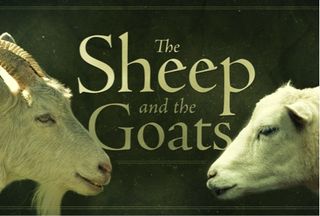
Good Sheep and Baaahd Goats???

sheep and goats

Ezekiel 34:11-16, 20-24
34:11 For thus says the Lord GOD: I myself will search for my sheep, and will seek them out.  12 As shepherds seek out their flocks when they are among their scattered sheep, so I will seek out my sheep. I will rescue them from all the places to which they have been scattered on a day of clouds and thick darkness.  13 I will bring them out from the peoples and gather them from the countries, and will bring them into their own land; and I will feed them on the mountains of Israel, by the watercourses, and in all the inhabited parts of the land.  14 I will feed them with good pasture, and the mountain heights of Israel shall be their pasture; there they shall lie down in good grazing land, and they shall feed on rich pasture on the mountains of Israel.  15 I myself will be the shepherd of my sheep, and I will make them lie down, says the Lord GOD.  16 I will seek the lost, and I will bring back the strayed, and I will bind up the injured, and I will strengthen the weak, but the fat and the strong I will destroy. I will feed them with justice.  20 Therefore, thus says the Lord GOD to them: I myself will judge between the fat sheep and the lean sheep.  21 Because you pushed with flank and shoulder, and butted at all the weak animals with your horns until you scattered them far and wide, 22 I will save my flock, and they shall no longer be ravaged; and I will judge between sheep and sheep.  23 I will set up over them one shepherd, my servant David, and he shall feed them: he shall feed them and be their shepherd.
24 And I, the LORD, will be their God, and my servant David shall be prince among them; I, the LORD, have spoken.

Psalm 95:1-7a
95:1 O come, let us sing to the LORD; let us make a joyful noise to the rock of our salvation!  2 Let us come into his presence with thanksgiving; let us make a joyful noise to him with songs of praise!  3 For the LORD is a great God, and a great King above all gods.  4 In his hand are the depths of the earth; the heights of the mountains are his also.  5 The sea is his, for he made it, and the dry land, which his hands have formed.  6 O come, let us worship and bow down, let us kneel before the LORD, our Maker!  7a For he is our God, and we are the people of his pasture, and the sheep of his hand.

Ephesians 1:15-23
1:15 I have heard of your faith in the Lord Jesus and your love toward all the saints, and for this reason 16 I do not cease to give thanks for you as I remember you in my prayers.  17 I pray that the God of our Lord Jesus Christ, the Father of glory, may give you a spirit of wisdom and revelation as you come to know him, 18 so that, with the eyes of your heart enlightened, you may know what is the hope to which he has called you, what are the riches of his glorious inheritance among the saints, 19 and what is the immeasurable greatness of his power for us who believe, according to the working of his great power.  20 God put this power to work in Christ when he raised him from the dead and seated him at his right hand in the heavenly places, 21 far above all rule and authority and power and dominion, and above every name that is named, not only in this age but also in the age to come.  22 And he has put all things under his feet and has made him the head over all things for the church, 23 which is his body, the fullness of him who fills all in all.

Matthew 25:31-46
25:31 “When the Son of Man comes in his glory, and all the angels with him, then he will sit on the throne of his glory.  32 All the nations will be gathered before him, and he will separate people one from another as a shepherd separates the sheep from the goats, 33 and he will put the sheep at his right hand and the goats at the left.  34 Then the king will say to those at his right hand, ‘Come, you that are blessed by my Father, inherit the kingdom prepared for you from the foundation of the world; 35 for I was hungry and you gave me food, I was thirsty and you gave me something to drink, I was a stranger and you welcomed me, 36 I was naked and you gave me clothing, I was sick and you took care of me, I was in prison and you visited me.’  37 Then the righteous will answer him, ‘Lord, when was it that we saw you hungry and gave you food, or thirsty and gave you something to drink?  38 And when was it that we saw you a stranger and welcomed you, or naked and gave you clothing?  39 And when was it that we saw you sick or in prison and visited you?’  40 And the king will answer them, ‘Truly I tell you, just as you did it to one of the least of these who are members of my family, you did it to me.’  41 Then he will say to those at his left hand, ‘You that are accursed, depart from me into the eternal fire prepared for the devil and his angels; 42 for I was hungry and you gave me no food, I was thirsty and you gave me nothing to drink, 43 I was a stranger and you did not welcome me, naked and you did not give me clothing, sick and in prison and you did not visit me.’  44 Then they also will answer, ‘Lord, when was it that we saw you hungry or thirsty or a stranger or naked or sick or in prison, and did not take care of you?’  45 Then he will answer them, ‘Truly I tell you, just as you did not do it to one of the least of these, you did not do it to me.’  46 And these will go away into eternal punishment, but the righteous into eternal life.”


What a lot of sheep in the scriptures for today!  In spite of what many people think, West Virginia is not made up totally of backwoods hillbillies who have farm animals running in and out of their houses.  In fact, West Virginia DOES have some major metropolitan areas.  I’ve lived in one of those metropolitan  areas my entire life.  It is for that reason I never really “got” the parable of the sheep and the goats.  Yes, I was in 4-H, and no, I didn’t raise any kind of critter for the County Fair.  The amount of knowledge I have about most farm animals comes to me second hand from reading books and watching television.  I have no experience with sheep or goats, and what I know about them could really fit into a thimble.


I know that we get wool from sheep, and some people get milk from goats.  Female sheep are called ewes, male sheep are rams, and baby sheep are lambs and are cute.  Lambs show up on cue in the spring around Easter time, and Jesus is the Lamb of God.  One serves mint jelly when serving lamb.  When someone is called a “lamb” it is considered to be a compliment.  Goats have horns and beards and are said to be stubborn.  A female goat is a nanny, a male a buck, and a baby a kid.  Sheep and goats can mate and produce (usually sterile) offspring.  There are pigmy goats (cute too), and fainting goats (weird.)  Sheep and goats are often in the same fields and herds, being watched by a shepherd.


Because of my lack of knowledge of animal husbandry, I had to do some research when commenting on the scriptures appointed for Christ the King Sunday.   From my childhood on, it has always seemed to me that the goats in the Scriptures got the raw end of the deal, and I wanted to find out just why this is.  I mean, what’s wrong with the goats?  This is what I learned:


Sheep are gentle, quiet, animals and do not give their shepherds a lot of problems.  They are not aggressive; they are very docile animals. The word “docile” as described in the Webster’s dictionary means, “easily managed or handled, readily trained or taught.” Sheep love to follow the shepherd, and can often be quite affectionate.


Goats, on the other hand, tend to be more independent, are rather aggressive and quarrelsome, and goats are pushy, self-sufficient, and headstrong.  They rear and butt in order to establish dominance.  Goats will easily revert back to their wild conditions if given the chance.  Goats are naturally smelly animals.

Overall, a goat’s reputation is less than positive. Even goat metaphors are negative. For instance, “Look at the old goat” refers to an old fool or dirty old man. “You get my goat!” applies to a person who irritates another. The nursery rhyme, “Mary had a little lamb, its fleece was white as snow; and everywhere that Mary went, the lamb was sure to go” gives a positive view of the little lamb, but when the gypsy girl, Esmeralda, in The Hunchback of Notre Dame, has a pet goat that performs tricks, the people want to hang the girl because they presume she’s using witchcraft.  The Jewish Heritage Online magazine reports: While goat’s milk was reported to have some medicinal benefits, goats were regarded as “armed robbers who would jump over people’s fences and destroy their plants.” The ancient rabbis were said to have told this story:

There was once a certain pious person who suffered from heart trouble, and the physicians said the only hope for his recovery was for him to drink warm milk every morning. A cow was not available to this fellow but his family was able to come up with a goat. After some days the sick man’s colleagues came to visit him, but as soon as they noticed the goat they turned back and said:  An armed robber is at the house of this man, how can we come to see him?  They then sat down and inquired into their friend’s conduct, but they did not find any fault in him except this sin of the goat….

Anyway you look at it; goats tend to be seen in a negative way.


So what about the shepherd?  The shepherd is the man or woman who takes care of the sheep and goats.  It’s that simple, and even I knew that.  Christ as shepherd is a pretty easy analogy to understand.  We are his flock and he takes care of us.  What I didn’t realize or know is that the analogy runs deep in the literature of the ancient world. In Mesopotamia, the region along the Tigris and Euphrates rivers, the model for kings was the shepherd. The king-as-shepherd was to “rule kindly, counsel and protect the people,” and “guide them through every difficulty.” Babylon’s Hammurabi, credited with the world’s first written law code, was described as a shepherd of his people. In ancient Egypt, the shepherd’s crook was used “as an insignia of kings, princes, and chieftains.” In the Iliad and the Odyssey from ancient Greece, ship captains are called “shepherds of ships.” Plato uses the shepherd analogy to define justice in the Republic, and in the “Statesman” uses the shepherd to symbolize the work of a good ruler.  And of course today, the shepherd’s crook is a symbol of our bishops, representing them as the shepherds of Christ’s flocks.


Having learned all of this, what then, does the parable of the sheep and the goats mean for us?    How do we apply this to our lives?  Remember, all the nations are gathered before the judge, before the throne of the Son of Man, before the King, THE Shepherd, and the Shepherd separates them

– the right from the left, the sheep from the goats,

and he judges them

– and those on the right are saved, and those on the left are

condemned.


The judgment is made on the basis of the compassion, the love, or the

lack of it, that is shown by those who are gathered before the throne of judgment.


“I was hungry and you gave me food, I was thirsty and you gave   me drink, I was a stranger and you took me in” the Son of Man    tells those on his right.  To those on his left  he says the  exact opposite.   “I was naked” he tells them, “and you did not  give me clothing, I was sick and in prison and you did not visit me.”


Awesome words these.  Words of great clarity.  Words with a powerful message for those who have ears to hear it.


Yet, in the end, despite our knowledge of the story and of its message,  the message about the vital importance of our acts of sharing and caring, especially with those who are numbered among the least of us – the poor, the hungry, the imprisoned, despite our knowledge of this parable there are elements to it that are not often talked about, or if talked about which are glossed over.


I speak of course, about the surprise expressed by the sheep and the goats when they hear the Son of Man say – “I was hungry and you fed me.  I was thirsty and you gave me drink.” or “I was naked and you did not clothe me” and “I was in prison and you did not visit me”


Why is that?  Why are they surprised?


What is it that both the sheep and the goats seem to be missing when they perform their good works – or when they fail to?


I think that they are missing a sense of how the sacred penetrates and is interwoven in the ordinary – indeed in the less than the ordinary, in those places – those persons – that we might consider far from holy – far from being a part of  Christ, much less Christ embodied.


Remember the words that Jesus uses.


He doesn’t talk about how blessed are we when we visit our friends who are sick, or how wonderful it is when we give good things to our family members and our fellow believers, or how nice it is when we clothe the folks who are just like us.


No. Jesus talks about the least among us – the least within this world, those whom conventional wisdom might even regard as accursed,

– the poor,

– the thirsty,

– the sick in the wards and in the deserts and jungle floors,

-those who are in prison

– perhaps sex offenders

– perhaps murderers

– perhaps only those who have stolen so that their families may eat.


We don’t know.  But we do know that they are the least amongst us.  Those persons whom we might think don’t count.  Those people whose opinions we might regard as unimportant or invalid, because of their age – or their sex, their gender identity, their socio-economic status, educational level, or sexual orientation.  Those people whose cries we might ignore because of their race.


And that the Son of Man, that Jesus the Christ, claims to be among them – indeed IN them.  And that is surprising is it not – at least to most of us?   In fact, it might even be considered to be outrageous.


There is no question raised in this parable of what creed either the sheep or the goats  had believed; or whether they had sworn allegiance to one whom the Bible calls the Son of Man – the Good Shepherd – the King of Kings and the Lord of Lords.


There is only the surprise that this exalted one – who is – in fact – Christ Jesus himself –  has been present in every person they had ever met, and most especially, in the needy ones and the least important ones – the ones that Jesus calls “the least.”


And that judgment is based on whether we treat this king, this son of man, present in these the least, well; or ignore him in his suffering and his want and his need.


That is – to say the least – a bit disconcerting.  We sometimes think that religion is about believing “stuff”, and that if we believe the right “stuff” we are safe.


But it seems not to be so.  Rather our faith seems to be about awareness,

about having our eyes opened to the real world, and responding compassionately to it.   Whether or not we are “aware” that the Christ is there.


The parable is calling to us to see the Christ in the squalling child who is getting in our way, and to hear God in the voice of the beggars who so often come and sit with us on Sunday in their dirty and smelly clothes – waiting for a chance to get a free lunch.  The parable is calling us to see the Christ in those who irritate us, who have done us wrong.  In those whom we don’t particularly care for.  The parable is alerting us to the importance of compassion and to the fact that the Son of Man is present in the needy of our world, that Christ is present in each and every human being with whom we come into contact, regardless of who they are, how they act, how they have treated us, or what they believe.


To encounter the least of the brothers and sisters of the Son of Man, however, we don’t need to go to Calcutta, or the Sudan or to one of the

overcrowded prisons in our land do we??  Aren’t there many who are marginalized, many whom we are regarded of little significance of not being equal to those close to us right here amongst us – here in our hometowns, in our parishes,  or even in our own families?


Remember the first and the greatest commandment – the one about how we are to love God with all our heart, soul, strength and mind?


Consider what John the Divine, John the Apostle, the disciple of Christ says about that love in his First Letter.  He writes in Chapter three, verse seventeen:


If anyone has material possessions and sees his brother in

need, but has no pity on him, how can the love of God be in

him?


and again in the 4th chapter,  verses 20 and 21:


Anyone who does not love his brother, whom he has seen,

cannot love God, whom he has not seen.  And he has given us

this command: Whoever loves God must also love his brother.


The sheep – those on the right – have shown love for their brothers and sisters, and in doing so they have shown love to God, and so they enter the kingdom prepared for them.  Their faith is alive – even if they have not grasped the fullness of  it.  Even if they have not recognized how the Son of Man is everywhere about them.  One might say the law has been written on their hearts and guided their actions, if not their thoughts and words.


But think of it.  Think of the fullness of it.  If our eyes were opened to the depth of the real world and not the shallow world of conventional wisdom, then we would see God present in everyone and everything, especially in the needy and the least important ones.


And that would be even more transforming, – not only for the sheep, for those who are doing good, and for those to whom they are showing the compassion of God, – but also for the goats, for those who may have the right creed and doctrine but who may have judged the least among us as not being deserving of their love and care, as not being people in whom the Holy One dwells.


What a priceless thing if the sheep are not surprised – by the presence of the Son of Man in everyone – and in joy remind those who may risk being judged as goats that all people are wonderfully made and all need to be treated as we would treat the Son of Man.


Provocative isn’t it?  It raises a thousand questions in your minds I am sure.


How far should we go in our caring?  Whom should we care for – and whom, if any, should we not care for?  How can we prioritize our caring so that the truly needy get what they need while those who would suck us dry do not.  Or should we even worry about that?


I can’t answer these questions for you.  It is something that each of us needs to struggle with on a case-by-case, day by day basis.


But I can tell you that Christ is all around us.  That Christ is in the least among us. In the single welfare mothers – and the AIDS patients, and in the prisoners in our jails and in the homeless upon our streets.


Think about this one last time with me.  Think of it some 2000 years ago when the Son of Man – the one who is King of King and Lord of Lords, wandered as a poor preacher in a poor land, having no home to call his own, much less a throne of righteousness.


Think of when the Son of Man was tried for blasphemy and flogged 39 times as a common criminal and then was hung on a cross to die as one who was accursed.  Think about how the Son of Man came among us – that first time – as we prepare for his coming with Advent starting next week.  Think about the circumstances of his life and his death.


The prophet Isaiah, some 700 years before the birth of Christ puts it

this way:


He had no form or majesty that we should look at him,

nothing in his appearance that we should desire him.  He was

despised and rejected by others; a man of suffering and

acquainted with infirmity; and as one from whom others hide

their faces he was despised – and we held him of no account.


Where is Christ to be found today?  Where is the Son of Man?  He is most certainly here among us, and in you my brothers and sisters.  But he is also here in ways we do not so easily grasp.


I understand the surprise of those sheep on the right of the Son of Man – and of the goats on the left.  I understand because it is so easy to not see him in those who are reckoned to be the least among us.  I understand because I have some decisions to make.


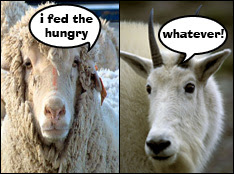
Do I want to be a sheep or a goat?   I most definitely want to be a sheep, and I can think I am a sheep, but literally act like a goat. Am I feeding the hungry? Giving drink to the thirsty? Taking in a stranger? Clothing the naked? Visiting the sick and imprisoned? Recognizing the Christ in every person?  Respecting every person?  Looking for the good in every person?  If I am not, then who am I?  Clearly the goat, not the sheep.


If we think we are sheep, we should be acting like sheep. We have all talked and talked about serving Christ in some way, but like goats we often have gone our own way, too caught up in our own needs and desires. The buck stops here (pun intended!)


As we  celebrate Christ as King, and prepare for Christ’s coming during the season of Advent,  the beginning of the liturgical year, let us make a new (liturgical) year’s resolution, to love and care for our fellow human beings, to treat every person with whom we come into contact with dignity and respect, to serve our Lord with gladness, to exorcise our individual goats, and to truly become the sheep of Christ’s pasture.  Amen.
sheep-goat

A New Novice!!!

cropped-black-st-dominic.jpg

It is with great happiness that we have the privilege of announcing that our dear Brother Michael Austin Marshall has successfully completed his studies for the Postulancy of the Order of Preachers,  Independent, and has been admitted to the Order as a Novice.  We ask your continued prayers for our dear brother, as he strives to become the best Dominican he can be, and to serve the Lord in all aspects of his life.  Br. Michael will continue with his studies, daily interactions with the members of the Order, and work towards his Simple Profession.

Are You Ready??? ~ The Rev. Lady Sherwood, OPI

Are you ready?

Concerning times and seasons, brothers and sisters, you have no need for anything to be written to you. For you yourselves know very well that the day of the Lord will come

like a thief at night. When people are saying, “Peace and security, ” then sudden disaster comes upon them, like labour pains upon a pregnant woman, and they will not escape.

But you, brothers and sisters, are not in darkness, for that day to overtake you like a thief.  For all of you are children of the light and children of the day.  We are not of the night or of darkness.

Therefore, let us not sleep as the rest do, but let us stay alert and sober.  1 Thes. 5: 1 – 6

As it tells us in 1 THES 5:1-6,, we know the that the Lord shall indeed come again and that as “Children of the light” we must stay “alert and sober”. We are not in darkness and should not let that day take us by surprise ,as it indeed shall for all those still in darkness and without the Lord truly in their lives. We must ensure then that we are fully prepared for the day of the Lord’s return in Glory. We need to remain watchful as the Lord’s children, so how is it that we truly can be prepared?

We need to be aware of our thoughts in our daily lives -(2 Cor 10:5). Many of us as humans seem to find it difficult to bring our thoughts into the “obedient captivity of God”. When we encounter evil or negative thoughts, we must fight against and rebuke them, instead filling all our thoughts with only the things that are good in the sight of God (Phil. 4:8).

We must be aware of all the unholy things which we may hear in the world, especially all the things that are against God, or are hateful or discriminatory in nature to our brothers and sisters. And “we must apply our hearts to instruction and our ears to words of knowledge”-(Prov. 23:12).

We must watch the way in which we speak in our lives because each of us at some point in our lives has spoken, even accidentally , in a way that has caused upset, hurt, or pain to others and this will be all taken into account on the Lord’s return. ” Everyone will have to give account on the day of judgment for every empty word they have spoken. For by your words you will be acquitted, and by your words you will be condemned.” (Matt. 12:36-37).

We must watch our actions and our works, ensuring that they are done only for God, with all our hearts and make sure that they are works that are Gloryifying to Him (Col. 3:23; I Cor. 10:31) Our works and actions speak far louder than words, so our works will be “heard” even more than our words. It is important that both work hand in hand for the Father’s Glory.

All of these things are vital if we are truly to be prepared for the return of the Lord. Let us correct any of these ways in which we are not fully prepared, ensuring that in His loving Grace and mercy, we may then live and serve him in eternity to his Glory.

With these things in mind, If the Lord returned today or tomorrow, would you be ready???

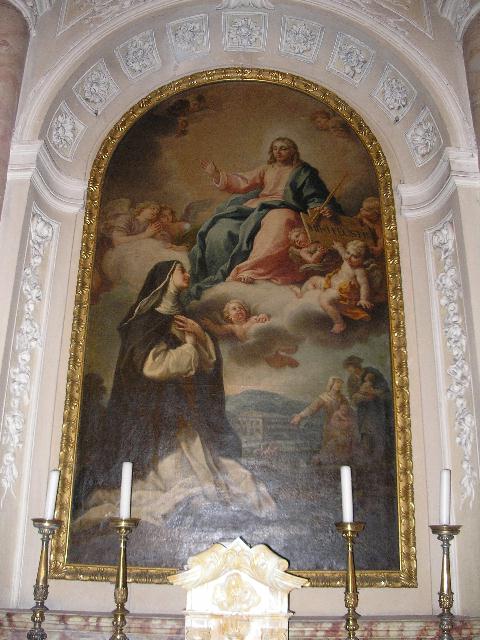
Blessed Lucy of Narni

Blessed Lucy of Narni was the eldest of eleven children of Bartolomeo Broccadelli and Gentilina Cassio. When she was only five years old, she had a vision of the Virgin Mary. Two years later, she had another vision, this time of the Virgin Mary accompanied by Saint Dominic. Dominic is said to have given her the scapular at this time. When she was twelve years old, Lucy made a private vow of chastity, and determined to become a Dominican nun.

OLYMPUS DIGITAL CAMERA

Circumstances, however, changed to make doing so difficult. The next year her father died, leaving her in the care of an uncle. This uncle determined that the best course of action he could take would be to get Lucy married as quickly as possible.

He made several attempts to do so. One of these included holding a large family party. He had invited the man he had chosen as Lucia’s husband to the party, with the intention of having the couple publicly betrothed. He however had not informed Lucia of his intentions. The suitor made an attempt to put a ring on Lucia’s finger, only to be slapped repeatedly for his efforts by Lucia.

A later attempt involved Count Pietro de Alessio of Milan, an acquaintance of the family. Lucia was actually quite fond of him, but felt her earlier vow to become a nun made the possibility of marriage impossible. The strain Lucia felt as a result of the conflicting feelings made her seriously ill. During this time, the Virgin Mary and Saint Dominic again appeared to her, this time accompanied by Catherine of Siena. They reportedly advised Lucia to contract a legal marriage to Pietro, but to explain that her vow of virginity would have to be respected and not violated. Pietro agreed to the terms, and the marriage was formalized.

In 1491 Lucia became Pietro’s legal wife and the mistress of his household, which included a number of servants and a busy social calendar. Despite her busy schedule, Lucia made great efforts to instruct the servants in Christianity and soon became well known locally for her charity to the poor.

Pietro observed Lucia’s behavior, and occasional quirks, quite indulgently. He never objected when she gave away clothing and food nor when she performed austere penances, which included regularly wearing a hair shirt under her garments and spending most of the night in prayer and acting to help the poor. He also seemed to have taken in stride the story he was told by the servants that Lucia was often visited in the evenings by Saint Catherine, Saint Agnes, and Saint Agnes of Montepulciano who helped her make bread for the poor.

However, when one of the servants came up to him one day and told him that Lucia was privately entertaining a handsome young man she appeared to be quite familiar with, he did react. He took up his sword and went to see who this person was. When he arrived, he found Lucia contemplating a large crucifix. The servant told him that the man he had seen Lucia with looked like the figure on the crucifix.

Lucia left one night for a local Franciscan monastic community, only to find it closed. She returned home the following day, stating that she had been led back by two saints. That was enough for Pietro. He had her locked away for the bulk of one Lenten season. She was only visited by servants who brought her food. When Easter arrived, however, she managed to escape from Pietro back to her mother’s house and on 1494 May 8 became a Dominican tertiary. Pietro expressed his disapproval of this in a rather dramatic form, by burning down the monastery of the prior who had given her the habit.

In 1495 Lucia went to Rome and joined a group of Third order Dominican tertiaries. The next year she was sent to Viterbo and here she found she was frequently the object of unwanted attention. It was here, on February 25, 1496 that she is reported to have received the stigmata. Lucia did her best to hide these marks, and was frequently in spiritual ecstasy. The house had a steady stream of visitors who came to speak to Lucia, and, often, just look at her. Even the other nuns were concerned about her, and at one point called in the local bishop who watched Lucia go through the drama of the Passion for twelve hours straight.

The bishop would not make a decision on Lucia, and called in the local inquisition. Reports here vary, some indicating that he referred the case directly to the Pope, who is said to have spoken with her and, with the assistance of Columba of Rieti, ultimately decided in her favor, telling her to go home and pray for him. Other sources question the accuracy of these reports.

At that time Pietro also came to her, making a final plea to persuade Lucia to return with him as his wife. She declined, and Pietro left alone. He would himself later become a Franciscan monk and a famous preacher.

When Lucy returned to the convent in Viterbo, she found that the Duke of Ferrara, Ercole d’Este I, had determined to build a convent in Ferrara and that, having heard of her, he determined that she would be its prioress. In summer of 1497, he invited her to be the founder of this new monastery. Lucia herself, the Dominican order, and the Pope all agreed quickly to the new proposal. The municipal council of Viterbo, however, objected, not wanting to lose Lucy. Lucia had been praying for some time for a way to create a new convent of strict observance, and agreed to go to the new convent.

Lucia’s departure precipitated a conflict between Ferrara and Viterbo which would continue for two years. Viterbo wanted to keep the famous mystic for themselves, and the duke wanted her in Ferrara. After extensive correspondence between the parties, on April 15, 1499 Lucia escaped secretly from Viterbo and was officially received in Ferrara on May 7, 1499. Thirteen young girls immediately applied for admission to her new community; the construction of the monastery began in June and was completed two years later, in August 1501. It contained 140 cells for sisters and the novices, but to fill it with suitable vocations proved to be very difficult. Lucia expressed the wish to have there some of her former friends from Viterbo and Narni. Duke Ercole, in September 1501 sent his messenger to Rome asking for the help of the pope’s daughter Lucrezia Borgia, who was preparing to marry Duke’s son Alfonso. She collected all eleven candidates Lucia had indicated and sent them, as a special wedding present to Lucia and to the Duke, a few days ahead of her bridal party. She herself solemnly entered Ferrara on February 2, 1502.

The Duke petitioned the local bishop for some help for Lucia in governing her new community, and he sent ten nuns from another community to join Lucia’s convent. Unfortunately, these ten nuns were members of the Dominican second order, who were canonically permitted to wear black veils, something Lucia and the members of the Dominican third order community were not allowed to do.

Tensions were heightened when one of these veiled outsiders, Sister Maria da Parma, was made the prioress of the convent on September 2, 1503. When Duke Ercole died on January 24, 1505 the new prioress quickly found Lucia to be guilty of some unrecorded transgression, most probably of the support for the Savonarolan church reform, and placed her on a strict penance. Lucia was not allowed to speak to any person but her confessor, who was chosen by the prioress. The local provincial of the Dominican order would also not permit any member of the order to see Lucia. There are records that at least one Dominican, Catherine of Racconigi, did visit her, evidently by bilocation, and that Lucia’s earlier visitation by departed saints continued. In response to Lucia’s insistent prayer her stigmata eventually disappeared, which caused some of the other nuns to question whether they had ever been there at all. When Lucia finally died, in 1544, many people were surprised to find that she had not died years earlier.

Then suddenly everything changed. When her body was laid out for burial so many people wanted to pay their last respects that her funeral had to be delayed by three days. Her tomb in the monastery church was opened four years later and her perfectly preserved body was transferred to a glass case. When Napoleon in 1797 suppressed her monastery the body was transferred to the Cathedral of Ferrara; and on 1935 May 26 – to the Cathedral of Narni.

Lucia was beatified by Pope Clement XI on March 1, 1710

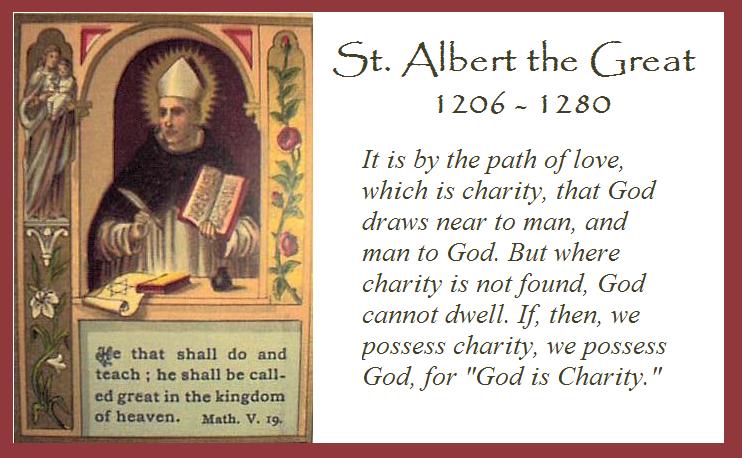
Saint Albert the Great

Card_267-albert-the-great-front

Saint Albert the Great was born sometime between 1193 and 1206, to the Count of Bollstädt in Lauingen in Bavaria. Contemporaries such as Roger Bacon applied the term “Magnus” to Albertus during his own lifetime, referring to his immense reputation as a scholar and philosopher. Albertus was educated principally at Padua, where he received instruction in Aristotle’s writings. A late account by Rudolph de Novamagia refers to Albertus’ encounter with the Blessed Virgin Mary, who convinced him to enter Holy Orders. In 1223 (or 1221) he became a member of the Dominican Order, against the wishes of his family, and studied theology at Bologna and elsewhere. Selected to fill the position of lecturer at Cologne, Germany, where the Dominicans had a house, he taught for several years there, at Regensburg, Freiburg, Strasbourg and Hildesheim. In 1245 he went to Paris, received his doctorate, and taught for some time as a master of theology with great success. During this time Thomas Aquinas began to study under Albertus.

In 1254, Albertus was made provincial of the Dominican Order, and fulfilled the arduous duties of the office with great care and efficiency. During his tenure he publicly defended the Dominicans against attacks by the secular and regular faculty of the University of Paris, commented on St. John, and answered what he perceived as errors of the Arabian philosopher Averroes.

In 1260, Pope Alexander IV made him Bishop of Regensburg, an office from which he resigned after three years. During the exercise of his duties he enhanced his reputation for humility by refusing to ride a horse—in accord with the dictates of the Dominican order—instead walking back and forth across his huge diocese. This earned him the affectionate sobriquet, “boots the bishop,” from his parishioners. After his stint as bishop, he spent the remainder of his life partly in retirement in the various houses of his order, yet often preaching throughout southern Germany. In 1270, he preached the eighth Crusade in Austria. Among the last of his labors was the defense of the orthodoxy of his former pupil, Thomas Aquinas, whose death in 1274 grieved Albertus. After suffering a collapse of health in 1278, he died on November 15, 1280, in Cologne, Germany. His tomb is in the crypt of the Dominican church of St. Andreas in Cologne, and his relics at the Cologne Cathedral.

Albertus was beatified in 1622. He was canonized and proclaimed a Doctor of the Church in 1931 by Pope Pius XI. St Albert’s feast day is celebrated on November 15.

1115-st-albert-the-great

Blessed John Licci

John Licci

Blessed John Licci, born to a poor farmer, his mother died in childbirth. His life from then on, all 111 years, was a tale of miracles. His father, who fed the baby on crushed pomegranates, had to work the fields, and was forced to leave the infant alone. The baby began crying, and a neighbor woman took him to her home to feed him. She laid the infant on the bed next to her paralyzed husband – and the man was instantly cured. The woman told John’s father of the miracle, but he was more concerned that she was meddling, and had taken his son without his permission. He took the child home to feed him more pomegranate pulp. As soon as the child was removed from the house, the neighbor’s paralysis returned; when John was brought back in, the man was healed. Even John’s father took this as a sign, and allowed the neighbors to care for John.

A precocious and emotional child, John began reciting the Daily Offices before age 10. While on a trip to Palermo, Italy at age 15, John went to Confession in the church of Saint Zita of Lucca where his confession was heard by Blessed Peter Geremia who suggested John consider a religious life. John considered himself unworthy, but Peter pressed the matter, John joined the Dominicans in 1415, and wore the habit for 96 years, the longest period known for anyone.

He founded the convent of Saint Zita in Caccamo, Italy. Lacking money for the construction, John prayed for guidance. During his prayer he had a vision of an angel who told him to “build on the foundations that were already built.” The next day in the nearby woods he found the foundation for a church called “Saint Mary of the Angels,” a church that had been started many years before, but had never been finished. John assumed this was the place indicated, and took over the site.

During the construction, workmen ran out of materials; the next day at dawn a large ox-drawn wagon arrived at the site. The driver unloaded a large quantity of stone, lime and sand – then promptly disappeared, leaving the oxen and wagon behind for the use of the convent. At another point a well got in the way of construction; John blessed it, and it immediately dried up; when construction was finished, he blessed it again, and the water began to flow. When roof beams were cut too short, John would pray over them, and they would stretch. There were days when John had to miraculously multiply bread and wine to feed the workers. Once a young boy came to the construction site to watch his uncle set stones; the boy fell from a wall, and was killed; John prayed over him, and restored him to life and health.

John and two brother Dominicans who were working on the convent were on the road near Caccamo when they were set upon by bandits. One of the thieves tried to stab John with a dagger; the man’s hand withered and became paralyzed. The gang let the brothers go, then decided to ask for their forgiveness. John made the Sign of the Cross at them, and the thief‘s hand was made whole.

One Christmas a nearby farmer offered to pasture the oxen that had come with the disappearing wagon-driver. John declined, saying the oxen had come far to be there, and there they should stay. Thinking he was doing good, the layman took them anyway. When he put them in the field with his own oxen, they promptly disappeared; he later found them at the construction site, contentedly munching dry grass near Father John.

While he did plenty of preaching in his 90+ years in the habit, usually on Christ’s Passion, he was not known as a great homilist. He was known, however, for his miracles and good works. His blessing caused the breadbox of a nearby widow to stay miraculously full, feeding her and her six children. His blessing prevented disease from coming to the cattle of his parishioners. A noted healer, curing at least three people whose heads had been crushed in accidents, he was Provincial of Sicily, and Prior of the abbey on several occasions.

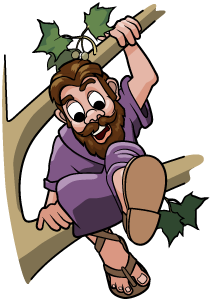
Cleaning House With A Wee Little Man ~ Br. Chip Noon, Postulant

Zac

19 Jesus entered Jericho and was passing through. 2 A man was there by the name of Zacchaeus; he was a chief tax collector and was wealthy. 3 He wanted to see who Jesus was, but because he was short he could not see over the crowd. 4 So he ran ahead and climbed a sycamore-fig tree to see him, since Jesus was coming that way.  5 When Jesus reached the spot, he looked up and said to him, “Zacchaeus, come down immediately. I must stay at your house today.” 6 So he came down at once and welcomed him gladly.  7 All the people saw this and began to mutter, “He has gone to be the guest of a sinner.”  8 But Zacchaeus stood up and said to the Lord, “Look, Lord! Here and now I give half of my possessions to the poor, and if I have cheated anybody out of anything, I will pay back four times the amount.”  9 Jesus said to him, “Today salvation has come to this house, because this man, too, is a son of Abraham. 10 For the Son of Man came to seek and to save the lost.”     Luke 19:1-10

There’s something in the Gospel today that is quite significant, but we usually skip right past it, since it’s in the first sentence: “Jesus entered Jericho and was passing through the town.”

Jericho.

Why should this Gospel story have meaning for us, aside from the salvation of the house of Zacchaeus, that clever little tax collector?   First, tax collectors were collaborators with the might and power of Rome. They were seen as traitors to their people, stealing from them their hard earned gold and goods, unclean, sinners. And yet here was Jesus, once again, deigning to consort with this malefactor, even to the point of going into his house and staying there. The people began to complain and mutter at this effrontery of Jesus.

Second, Jesus grants salvation to this low-life! How can that be? Once again we find our Lord taking up with the worst classes of society, even disdaining the “good people” of the town. What did the tax collector do to gain salvation?

So in this little passage, we find that God’s grace was freely given and Zacchaeus acknowledges Jesus by given half of what he owns to the poor and paying back fourfold anyone he cheated.

But weren’t the walls of Jericho torn down by Joshua and the trumpets? What does Jericho have to do with this passage?

If we remember today’s other readings from Catholic Online, we find that they are about holy sites, the dwelling place of the Lord, God’s field and building, the foundation. Sturdy as the walls of Jericho were, they were no match for God’s people who forced them to crumble at the shout of the people. This is a foreshadowing of the message Jesus imparts time and time again: the place of worship does not matter…we are already in the courts of the house of the Lord. “The Son of man has nowhere to lay his head,” Jesus says in another passage. But he will stay in Jericho, at the home of a sinner, because “the Son of man has come to seek out and save what is lost.”

Isn’t this the message? Foundations made by humankind do not last. Temples made for the worship of God are not sufficient if Jesus is not the foundation, and finally as St. Paul says to the Corinthians, “Do you not realize that you are a temple of God with the Spirit of God living in you?”

Our job today is not to destroy the walls of Jericho, or build a pillar to the Lord, or polish up the handle on the big front door of the church. Because we are the church. We are the temple. Our job is to clean out our attics and basements, vacuum the floors of our soul, clean the windows and throw them open to the glory and the love of God and our neighbor. Jesus has told us that we are his temple. We are his house. What can we do today to make that house ready for him? How can we give him a place to lay his head in our hearts? We can love him.

Lord, we pray that today we meet each person as your temple, the holy of holies you have formed us into. We pray that we can keep our own temple spotless, worthy to welcome you into our presence, sinners though we are. We ask this in your Name. Amen.


Blessed Peter Cambiano of Ruffia

img-Saint-Peter-Cambiano

Peter’s father was a city councilor, his mother was from a noble family, and the boy was raised in a pious household. He received a good education, and was drawn early to religious life, with a personal devotion to Our Lady of the Rosary. He joined the Dominicans in Piedmont, Italy at age 16. He continued his studies, and was ordained at age 25, and was a noted preacher throughout northern Italy. He worked to bring the heretical Waldensians back to the Church, and was appointed inquisitor-general of the Piedmont.

In January 1365 Peter and two Dominican brothers went on a preaching mission through the mountains between Italy and Switzerland, working from the Franciscan friary at Susa, Italy. Peter’s preaching brought many back to the faith, which earned him the anger of the Waldensians. Three of the heretics came to the friary, asked to see Peter, and then murdered him at the gate.

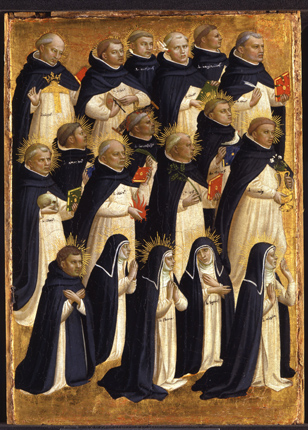
Feast Day of the Domican Saints of our Order

“arms-of-the-dominican-order

Blessed are the pure in heart, for they shall see God.”

(Mt. 5:8)

Why do we celebrate our Saints?

We come together as one Domican Family today to celebrate not only Our Saints, but also our many Blesseds, Holy Friars, Nuns, sisters and Laity who have lived over the past 800 years.

We are so priviledged to celebrate them as they provide us with an example by which we follow in our religious lives, by their wondorous fellowship in their communion and in their much needed aid to us by their intercessions to God on our behalf.

We include in our celebrations also all the “forgotten” saints because according to the General Chapter of Valencia in 1337, there were 13,370 martyrs between 1234 and 1335. There were another 26,000 in the 16th century alone. Martyrs, confessors, virgins, and holy men and women all have their place of honour in the Order. Friars, worn down through constant contemplation, study, and preaching; nuns who lived lives of great prayer, silence, and penance; sisters who educated 1000s of souls; and third order members who sanctified the world.

We celebrate our thanks to God on this Important feast day for our Order and turn to the examples of our Saints, their lives and their intercessions for us so that they may guide us on our spiritual Dominican lifes journey.

Our Order Father, Saint Dominic left us a wonderous legacy of teaching and preaching by word and example of how we should live our lives.It is, then, joyous and encouraging that so many of our Dominican brothers and sisters have been beatified and canonized.

Let us pray then in the example we have been taught to ask our dear saints to intercede for us, and to thank our God for all the saints of our Dominican Order and for the fruits of our order to be pleasing in his sight…..

God, the heavenly Father

have mercy on us.

God, the Son, Redeemer of the world

have mercy on us.

God, the Holy Spirit

have mercy on us.

Holy Trinity, one God

have mercy on us.

Holy Mary

pray for us.

Holy Mother of God

pray for us.

Holy Virgin of Virgins

pray for us.

All you holy angels and archangels

pray for us.

All you holy Patriarchs and Prophets

pray for us.

All you holy Apostles and Evangelists

pray for us.

All you holy martyrs

pray for us.

All you holy virgins and widows

pray for us.

All you holy men and women

pray for us.

Saint Michael

pray for us.

Saint Gabriel

pray for us.

Saint Raphael

pray for us.

Saint Joseph

pray for us.

Saint John the Baptist

pray for us.

Saint Mary Magdalen

pray for us.

Holy Father Augustine

pray for us.

Holy Father Francis

pray for us.

Blessed Jane of Aza

pray for us.

Blessed Reginald

pray for us.

Holy Father Dominic

pray for us.

Holy Father Dominic

pray for us.

Blessed Bertrand

pray for us.

Blessed Mannes

pray for us.

Blessed Diana

pray for us.

Blessed Jordan of Saxony

pray for us.

Blessed John of Salerno

pray for us.

Blessed William and Companions

pray for us.

Blessed Ceslaus

pray for us.

Blessed Isnard

pray for us.

Blessed Guala

pray for us.

Blessed Peter Gonzalez

pray for us.

Saint Zdislava

pray for us.

Saint Peter of Verona

pray for us.

Blessed Nicholas

pray for us.

Saint Hyacinth

pray for us.

Blessed Gonsalvo

pray for us.

Blessed Sadoc and Companions

pray for us.

Blessed Giles

pray for us.

Saint Margaret of Hungary

pray for us.

Blessed Batholomew of Vincenza

pray for us.

Saint Thomas Aquinas

pray for us.

Saint Raymond of Penyafort

pray for us.

Blessed Innocent V

pray for us.

Blessed Albert of Bergamo

pray for us.

Saint Albert the Great

pray for us.

Blessed John of Vercelli

pray for us.

Blessed Ambrose

pray for us.

Blessed Cecilia

pray for us.

Blessed Benvenuta

pray for us.

Blessed James of Varazze

pray for us.

Blessed James of Bevagna

pray for us.

lessed Jane of Orvieto

pray for us.

Blessed Jordan of Pisa

pray for us.

Saint Emily

pray for us.

Blessed James Salomonio

pray for us.

Saint Agnes of Montepulciano

pray for us.

Blessed Simon

pray for us.

Blessed Margaret of Castello

pray for us.

Blessed Augustine Kazotic

pray for us.

Blessed James Benefatti

pray for us.

Blessed Imelda

pray for us.

Blessed Dalmatius

pray for us.

Blessed Margaret Ebner

pray for us.

Blessed Villana

pray for us.

Blessed Peter Ruffia

pray for us.

Blessed Henry

pray for us.

Blessed Sibyllina

pray for us.

Blessed Anthony of Pavonio

pray for us.

Saint Catherine of Siena

pray for us.

Blessed Marcolino

pray for us.

Blessed Raymond of Capua

pray for us.

Blessed Andrew Franchi

pray for us.

Saint Vincent Ferrer

pray for us.

Blessed Clara

pray for us.

Blessed John Dominic

pray for us.

Blessed Alvarez

pray for us.

Blessed Maria

pray for us.

Blessed Peter of Castello

pray for us.

Blessed Andrew Abellon

pray for us.

Blessed Stephen

pray for us.

Blessed Peter Geremia

pray for us.

Blessed John of Fiesole

pray for us.

Blessed Lawrence of Ripafratta

pray for us.

Blessed Anthony della Chiesa

pray for us.

Saint Antoninus

pray for us.

Blessed Anthony Neyrot

pray for us.

Blessed Margaret of Savoy

pray for us.

Blessed Bartholomew of Cerverio

pray for us.

Blessed Matthew

pray for us.

Blessed Constantius

pray for us.

Blessed Christopher

pray for us.

Blessed Damian

pray for us.

Blessed Andrew of Peschiera

pray for us.

Blessed Bernard

pray for us.

Blessed Jane of Portugal

pray for us.

Blessed James of Ulm

pray for us.

Blessed Augustine of Biella

pray for us.

Blessed Aimo

pray for us.

Blessed Sebastian

pray for us.

Blessed Mark

pray for us.

Blessed Columba

pray for us.

Blessed Magdalen

pray for us.

Blessed Osanna of Mantua

pray for us.

Blessed John Liccio

pray for us.

Blessed Dominic Spadafora

pray for us.

Blessed Stephana

pray for us.

Saint Adrian

pray for us.

Blessed Lucy

pray for us.

Blessed Catherine Racconigi

pray for us.

Blessed Osanna of Kotor

pray for us.

Saint Pius V

pray for us.

Saint John of Cologne

pray for us.

Blessed Maria Bartholomew

pray for us.

Saint Louis Bertrand

pray for us.

Saint Catherine de Ricci

pray for us.

Blessed Robert

pray for us.

Blessed Alphonsus and Companions

pray for us.

Saint Rose

pray for us.

Saint Dominic Ibanez and Companions

pray for us.

Blessed Agnes of Jesus

pray for us.

Saint Lawrence Ruiz and Companions

pray for us.

Saint Martin de Porres

pray for us.

Blessed Peter Higgins

pray for us.

Blessed Francis de Capillas

pray for us.

Saint Juan Macias

pray for us.

Blessed Terence

pray for us.

Blessed Ann of the Angels

pray for us.

Blessed Francis de Posadas

pray for us.

Saint Louis de Montfort

pray for us.

Blessed Francis Gil

pray for us.

Saint Matteo

pray for us.

Blessed Peter Sanz and Companions

pray for us.

Saint Vincent Liem

pray for us.

Saint Hyacinth Castaneda

pray for us.

Blessed Marie

pray for us.

Blessed George

pray for us.

Blessed Catherine Jarrige

pray for us.

Saint Ignatius and Companions

pray for us.

Saint Dominic An-Kham and Companions

pray for us.

Saint Joseph Khang and Companions

pray for us.

Saint Francis Coll

pray for us.

Blessed Hyacinthe Cormier

pray for us.

Blessed Pier Giorgio

pray for us.

Blessed Bartolo

pray for us.

Blessed Michael Czartoryski

pray for us.

Blessed Julia Rodzinska

pray for us.

All holy Dominican brothers and sisters

pray for us.

Lamb of God, who takes away the sins of the world,

spare us, O Lord.

Lamb of God, who takes away the sins of the world,

graciously hear us, O Lord.

Lamb of God, who takes away the sins of the world,

have mercy on us.

Let us pray.–

God, source of all holiness, you have enriched your Church

with many gifts in the saints of the Order of Preachers.

By following the example of our brothers and sisters,

may we come to enjoy their company

for ever in the Kingdom of our Lord Jesus Christ,

Your Son, who lives and reigns with You

and the Holy Spirit, one God, for ever and ever.

Amen.