Blessed Jerome, Valentine, Francis, Hyacinth & Companions (Martyrs of Tonkin)

martyrs of tonkin

Between the arrival of the first Portuguese missionary in 1533, through the Dominicans and then the Jesuit missions of the 17th century, the politically inspired persecutions of the 19th century, and the Communist-led terrors of the twentieth, there have been many thousands upon thousands murdered for their faith in Vietnam. Some were priests, some nuns or brothers, some lay people; some were foreign missionaries, but most were native Vietnamese killed by their own government and people.

Jerome Hermosilla, a Dominican missionary to Manila, Philippines, and a priest, he went as a missionary to Vietnam in 1828 where he was the Vicar Apostolic of Eastern Tonking, Vietnam and titular bishop of Miletopolis. H was martyred with Saint Valentin Faustino Berri Ochoa.

Valentin Faustinao Berri Ochoa. Born in the Basque country, and ordained on June 14, 1851, Valentin was a missionary to the Philippines and then to Vietnam. He was appointed coadjutor vicar apostolic of Central Tonking, (the modern diocese of Bùi Chu) Vietnam and titular bishop of Centuria on December 25, 1857. He was martyred with Saint Jerome Hermosilla.

Francis Gil de Frederich was educated in Barcelona, Spain where he joined the Dominicans. He was a missionary to the Philippines first and then a missionary to Vietnam in 1732. He spent nine years in prison for his faith during which time he converted fellow prisoners and supervised evangelists on the outside.

Hyacinth Castaneda was a Dominican Priest and missionary to China. He then was sent as a missionary to Vietnam. He was beheaded for his faith in 1773 in Vietnam

Blessed Simon Ballachi

Blessed Simon Ballachi was born to the nobility in 1240, the son of Count Ballachi. His family had a close association with the Church clergy; two of his uncles became archbishops of Rimini, Italy, and a younger brother was a priest. Trained as a soldier and in administration, he was expected to take over the family estates. Against his family wishes, he joined the Dominicans as a lay brother at age 27.

Assigned to work in the garden of his friary, something he knew nothing about but which he loved instantly. He saw God in everything, and prayed constantly as he worked. Noted for his simple life, his strict adherence to the Dominican Rule, and his excellent work as a catechist to children. A visionary, Simon was visited by the devil, by Saint Catherine of Alexandria, Saint Dominic de Guzman, Saint Peter Martyr, and the Blessed Virgin Mary; other brothers saw his cell glowing, and heard angelic voices. Blinded at age 57, he was nearly helpless during the last years of his life; he never despaired, and used the extra free time for prayer. He died on 5 November in 1391.

Simon Biocci

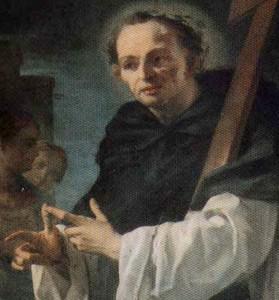
Saint Martin de Porres

Saint Martin de Porres was born in the city of Lima, in the Viceroyalty of Peru, on December 9, 1579, the illegitimate son of a Spanish nobleman and a black former slave. He grew up in poverty; when his mother could not support him and his sister, Martin was confided to a primary school for two years, and then placed with a barber/surgeon to learn the medical arts. This caused him great joy, though he was only ten years old, for he could exercise charity to his neighbor while earning his living. Already he was spending hours of the night in prayer, a practice that increased rather than diminished as he grew older.

martin_de_porres

At the age of 15, he asked for admission to the Dominican Convent of the Rosary in Lima and was received first as a servant boy; as his duties grew, he was promoted to almoner. Eventually he felt the call to enter the Dominican Order, and was received as a tertiary. Years later, his piety and miraculous cures led his superiors to drop the racial limits on admission to the friars, and he was made a full Dominican. It is said that when his convent was in debt, he implored them: “I am only a poor mulatto, sell me.” Martin was deeply attached to the Blessed Sacrament, and he was praying in front of it one night when the step of the altar he was kneeling on caught fire. Throughout all the confusion and chaos that followed, he remained where he was, unaware of what was happening around him.

When he was 34, after he had been given the habit of a Coadjutor Brother, Martin was assigned to the infirmary, where he was placed in charge and would remain in service until his death at the age of sixty. His superiors saw in him the virtues necessary to exercise unfailing patience in this difficult role, and he never disappointed them. It was not long before miracles were attributed to him. Saint Martin also cared for the sick outside his convent, often bringing them healing with only a simple glass of water. He begged for alms to procure necessities the Convent could not provide, and Providence always supplied.

One day an aged beggar, covered with ulcers and almost naked, stretched out his hand, and Saint Martin, seeing the Divine Mendicant in him, took him to his own bed. One of his brethren reproved him. Saint Martin replied: “Compassion, my dear Brother, is preferable to cleanliness.”

When an epidemic struck Lima, there were in this single Convent of the Rosary sixty friars who were sick, many of them novices in a distant and locked section of the convent, separated from the professed. Saint Martin is said to have passed through the locked doors to care for them, a phenomenon which was reported in the residence more than once. The professed, too, saw him suddenly beside them without the doors having been opened. Martin continued to transport the sick to the convent until the provincial superior, alarmed by the contagion threatening the religious, forbade him to continue to do so. His sister, who lived in the country, offered her house to lodge those whom the residence of the religious could not hold. One day he found on the street a poor Indian, bleeding to death from a dagger wound, and took him to his own room until he could transport him to his sister’s hospice. The superior, when he heard of this, reprimanded his subject for disobedience. He was extremely edified by his reply: “Forgive my error, and please instruct me, for I did not know that the precept of obedience took precedence over that of charity.” The superior gave him liberty thereafter to follow his inspirations in the exercise of mercy.

Martin would not use any animal as food—he was a vegetarian.

In normal times, Saint Martin succeeded with his alms to feed 160 poor persons every day, and distributed a remarkable sum of money every week to the indigent. To Saint Martin the city of Lima owed a famous residence founded for orphans and abandoned children, where they were formed in piety for a creative Christian life. This lay brother had always wanted to be a missionary, but never left his native city; yet even during his lifetime he was seen elsewhere, in regions as far distant as Africa, China, Algeria and Japan. An African slave who had been in irons said he had known Martin when he came to relieve and console many like himself, telling them of heaven. When later the same slave saw him in Peru, he was very happy to meet him again and asked him if he had had a good voyage; only later did he learn that Saint Martin had never left Lima. A merchant from Lima was in Mexico and fell ill; he said aloud: “Oh, Brother Martin, if only you were here to care for me!” and immediately saw him enter his room. And again, this man did not know until later that he had never been in Mexico.

Martin was a friend of both Saint John de Massias and Saint Rose of Lima. When he died in Lima on November 3, 1639, Martin was known to the entire city. Word of his miracles had made him known as a saint throughout the region. As his body was displayed to allow the people of the city to pay their respects, each person snipped a tiny piece of his habit to keep as a relic. It is said that three habits were taken from the body. His body was then interred in the grounds of the monastery.

Pope Gregory XVI beatified Martin de Porres in 1837. Nearly one hundred and twenty-five years later, Blessed Martin was canonized in Rome by Pope John XXIII on May 6, 1962. His feast day is November 3. He is the Patron Saint of people of mixed race, innkeepers, barbers, public health and more besides.

In iconography, Martin de Porres is often depicted as a young mulatto friar (he was a Dominican brother, not a priest, as evidenced by the black scapular and capuce he wears, while priests of the Dominican order wear all white) with a broom, since he considered all work to be sacred no matter how menial. He is sometimes shown with a dog, a cat and a mouse eating in peace from the same dish.

The Feast of All Souls

Is death the last sleep? No–it is the last and final awakening.  -Sir Walter Scott

     “As (Saint) Dominic lay on his deathbed surrounded by his sorrowful brethren, he consoled them saying, “Do not weep. I will be of more use to you in Heaven.” Dominic’s words offered deep hope, extending beyond his death to the death of each member of the Order. “

     We all have lost loved ones, some so early in their life, others who had been with us for a good long while. And though, for those left behind, the sense of loss can be almost too much to bear. But we know in our hearts that we shall see our loved ones again, that we will all be reunited with each other—in our heavenly Father’s kingdom. So until that time, we remember them with love, and offer up prayers for souls.

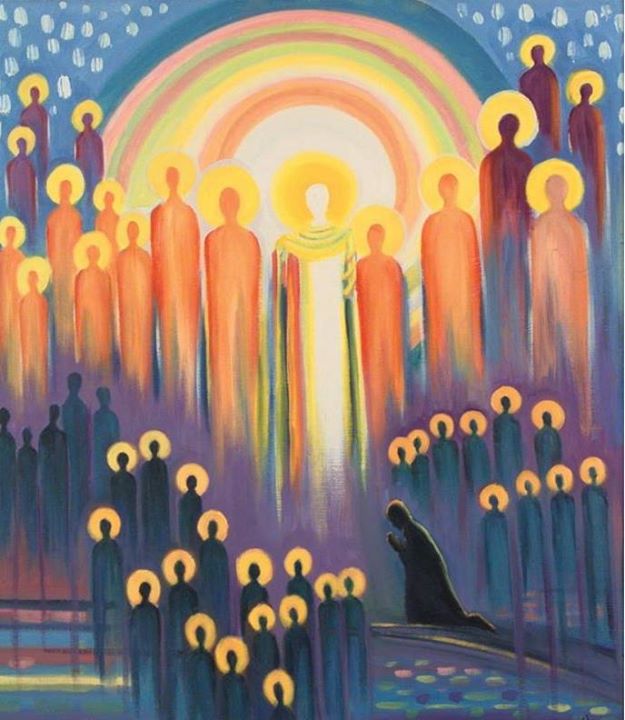
All souls image

     Today, November 2nd, we celebrate the feast of All Souls. On the day after All Saints, the Church reminds us of those who have not yet achieved the goal of their pilgrimage, the Kingdom of Heaven. As part of the communion of saints, they need our prayers. Today’s feast is an opportunity for us to pray in unity for our relatives and friends and for those who have no one to pray for them. All Soul’s Day (sometimes called the “Day of the Dead”) is always November 2 (November 3rd if the 2nd falls on a Sunday).
All Soul’s Day is a Roman Catholic day of remembrance for friends and loved ones who have passed away. This comes from the ancient Pagan Festival of the Dead, which celebrated the Pagan belief that the souls of the dead would return for a meal with the family. Candles in the window would guide the souls back home, and another place was set at the table. Children would come through the village, asking for food to be offered symbolically to the dead, then donated to feed the hungry.
The day purposely follows All Saint’s Day in order to shift the focus from those in heaven to those in purgatory. It is celebrated with masses and festivities in honor of the dead. While the Feast of All Saints is a day to remember the glories of Heaven and those who are there, the Feast of All Souls reminds us of our obligations to live holy lives and that there will be purification of the souls of those destined for Heaven.

     Upon death, it is believed that souls have not yet been cleansed of sin. Praying for souls of loved ones helps to remove the stain of sin, and allow the souls to enter the pearly gates of heaven. Through prayer and good works, living members of the church may help their departed friends and family. There are three Requiem Masses that are said by the clergy to assist the souls from Purgatory to Heaven: one for the celebrant, one for the departed, and one for the pope. One such reading for the Mass is included in the Book of Wisdom:

“The souls of the just are in the hand of God
and no torment shall touch them.
They seemed, in the view of the foolish, to be dead;
and their passing away was thought an affliction
and their going forth from us, utter destruction.
But they are in peace.
For if before men, indeed, they be punished,
yet is their hope full of immortality;
chastised a little, they shall be greatly blessed,
because God tried them
and found them worthy of himself.
As gold in the furnace, he proved them,
and as sacrificial offerings he took them to himself.
In the time of their visitation they shall shine,
and shall dart about as sparks through stubble;
they shall judge nations and rule over peoples,
and the Lord shall be their King forever.
Those who trust in him shall understand truth,
and the faithful shall abide with him in love:
because grace and mercy are with his holy ones,
and his care is with his elect.”


The traditions of the Feast of All Souls began independently of the Feast of All Saints. The Feast of All Souls owes its beginning to seventh century monks who decided to offer the mass on the day after Pentecost for their deceased community members. In the late tenth century, the Benedictine monastery in Cluny chose to move their mass for their dead to November 2, the day after the Feast of all Saints. This custom spread and in the thirteenth century, Rome put the feast on the calendar of the entire Church. The date remained November 2 so that all in the Communion of the Saints might be celebrated together.

     Other customs have arisen over time in the celebration of All Souls Day. The Dominicans in the 15th century instituted a custom of each priest offering three Masses on the Feast of All Souls. Pope Benedict XIV in 1748 approved this practice, and it rapidly spread throughout Spain, Portugal and Latin America. During World War I, Pope Benedict XV, recognizing the number of war dead and the numerous Masses that could not be fulfilled because of destroyed Churches, granted all priests the privilege of offering three Masses on All Souls Day: one for the particular intention, one for all of the faithful departed, and one for the intentions of the Holy Father.
Many more customs are associated with The Day of the Dead celebration. In the home an altar is made with an offering of food upon it. It is believed that the dead partake of the food in spirit and the living eat it later. The offerings are beautifully arranged with flowers such as marigolds, which are the traditional flower of the dead. There is a candle placed for each dead soul, and they are adorned in some manner. Incense is also often used, and mementos, photos, and other remembrances of the dead also adorn the offerings. Traditional Catholics still honor customs related to the relief of the souls suffering in purgatory. One custom is for persons to pray six Our Fathers, Hail Mary’s and Glory Be’s for the intentions of the Pope in a church, and thereby, receive a plenary indulgence for a soul in purgatory. This action may be repeated for another soul, by leaving the church and re-entering it to repeat the prayers.
All Soul’s Day lives on today, particularly in Mexico, where All Hallows’ Eve, All Saint’s Day and All Soul’s Day are collectively observed as “Los Dias de los Muertos” (The Days of the Dead). First and foremost, the Days of the Dead is a time when families fondly remember the deceased. But it is also a time marked by festivities, including spectacular parades of skeletons and ghouls. In one notable tradition, revelers lead a mock funeral procession with a live person inside a coffin.

     As we all know, death is never final. We will be reunited with our loved ones. And for those in purgatory, let us pray for their souls to be cleansed, so we shall all live again in our Father’s house.

A prayer for all our departed brothers and sisters:


Merciful Father,
hear our prayer
and console us.
As we renew
our faith in Your Son,
whom You raised from the dead,
strengthen our hope
that all our departed brothers and sisters
will share in His resurrection,
who lives and reigns
with You and the Holy Spirit,
one God, for ever and ever.

Amen

Invocation for the Souls in Purgatory:

My God,
bestow Thy blessings and Thy mercies
on all persons
and on those souls in Purgatory,

for whom I am in charity, gratitude, or friendship bound
and have the desire to pray.

Amen


Blessed Benvenuta Bojani

BenvenutaBoiani

Benvenuta was the last of seven daughters. Her parents, too, must have been amazing people in comparison with so many in our time. When the silence of the midwife proclaimed that her father had been disappointed once again in his desire for a son, he exclaimed, “She too shall be welcome!” Remembering this she was christened by her parents Benvenuta (“welcome”), although they had asked for a son. A vain older sister unsuccessfully tried to teach the pious little Benvenuta to dress in rich clothing and use the deceits of society. Benvenuta hid from such temptations in the church where she developed a tender devotion to the Blessed Virgin. By the age of 12, Benvenuta was wearing hairshirts and a rope girdle. As she grew the rope became embedded in her flesh. When she realized the rope must be removed, she couldn’t get it off, so she prayed and it fell to her feet. For this reason she is often pictured in art holding a length of rope in her hands.

Having become a Dominican tertiary at an early age, she added the penances practiced by the sisters to those she had appropriated for herself. All her disciplines, fasting, and lack of sleep soon caused her health to fail and she was confined to bed for five years. Thereafter, she was too weak to walk, so a kind older sibling carried her to church once a week for Compline (Night Prayer) in the Dominican church, her favorite liturgy after the Mass.

After evening prayer on the Vigil of the Feast of Saint Dominic, Dominic and Saint Peter Martyr appeared to Benvenuta. Dominic had a surprise for her. The prior was absent at the Salve procession, but at the beginning of Compline she saw Dominic in the prior’s place. He passed from brother to brother giving the kiss of peace, then went to his own altar and disappeared. At the Salve procession, the Blessed Virgin herself came down the aisle, blessing the fathers while holding the Infant Jesus in her arms.

Benvenuta spent her whole life at home in Cividale busy with her domestic duties, praying, and working miracles. She was often attacked by the devil, who sometimes left her close to discouragement and exhaustion. When someone protested against the death of a promising young child, Benvenuta commented, “It is much better to be young in paradise than to be old in hell.” The devil often appeared to her in horrifying forms but was banished when Benvenuta called upon the Virgin.

Benvenuta’s companions called her “the sweetest and most spiritual of contemplatives, so lovable in her holiness that her touch and presence inspired gladness and drove away temptations.” This is amazing in light of the severe penances that she imposed upon herself–and another sign of blessedness that she didn’t judge others by her standards for herself (Benedictines, Dorcy).

Born: May 4, 1254 at Cividale, Friuli, Italy

Died: October 30, 1292 at Cividale, Friuli, Italy of natural causes

Beatified: February 6, 1763 by Pope Clement XIV (cultus confirmed)

Name Meaning: welcome (from her father’s statement at her birth: “She too shall be welcome!”)

Representation: holding a length of rope

Blessed Damian of Finario

Damian-of-Finale-sm

One of the bright lights of the fifteenth century was Damian of Finario. Unfortunately we know very little about him, expect that he lived at a time and place not noted for sanctity, and he was known as a holy man.

Damian was born in Finario, near Genoa, at the end of the fourteenth century. His people were ich and noble, and also pious. We know nothing of his youth, except the not-too-revealing fact that when he was a baby he was kidnapped by a lunatic. His parents prayed to Our Lady, and the baby was returned unharmed.

Damian entered the order at Genoa and became a diligent student and a model Dominican. He was to be known especially for his preaching. The field of his endeavors was Italy. He seems never to have left the country. By the force of his preaching, he inspired many hundreds of sinners to repentance; and, since the fifteenth century produced many sinners who needed such preaching, he was kept supplied with works for a long lifetime.

Damian died in a little village near Modena, in 1884, and immediately became the object of much pious speculation, because of the miracles worked at his tomb. He was not, however, beatified until 1848, though his relics were by that time widely distributed and his cult well known.

Born: at Fulcheri, Liguria, Italy

Died:1484 at Modena, Reggio d’Emilia, Italy

Beatified: August 4, 1848 by Pope Pius IX (cultus confirmed)

And the Winner Is??? ~ Br. Chip Noon, Postulant

Greatest Commandment

According to the Gospel Reading for today, Matthew 22: 36-40, when the Pharisees heard that Jesus had silenced the Sadducees, they gathered together, and one of them, a scholar of the law tested him by asking, “Teacher, which commandment in the law is the greatest?”
He said to him, “You shall love the Lord, your God, with all your heart, with all your soul, and with all your mind.  This is the greatest and the first commandment.  The second is like it: You shall love your neighbor as yourself.
The whole law and the prophets depend on these two commandments.”

So the Pharisees said, “OK  then, Rabbi, what’s the THIRD greatest commandment? Hmmmm?”

You know them. They are all around us: people who want to win an argument rather than come to a mutual understanding of the truth. It’s probably ingrained into us from an early age: be sure to get your facts in a row and overpower your adversaries with words, with questions, with challenges.

“OK Rabbi, you won those…but what about the EIGHTH greatest commandment? What about THAT one?”

And now we’re in a game that nobody is going to win.

But we argue in that fashion too, don’t we? “Listen, God, I’m with you on all this, but what about that passage in First Timothy where Paul says ‘I permit no woman to teach or to have authority over men?’…  How do I reconcile that?” Isn’t that what we’re saying today? Hasn’t that kind of questioning gotten a secure foothold in our minds?

Now we’re in “the silly season.” It will end on Election Day in November, but the echoes will reverberate for weeks after. Don’t you just dread it? Day after day of political commercials where the candidates say to each other, “Sure, but what about your position on the 47th greatest law? What do you say to that?” There’s no end. And there’s rarely a satisfactory answer, because we are not arguing to solve a problem or to help each other in this society. We’re arguing to score points with…with…with whom? “The Base.” “The Donors.” “That minority group.” “This constituent.”

I’ll tell you the worst politician of the last century: Mother Teresa. She said, “Never worry about numbers. Help one person at a time and always start with the person nearest you.” She’d lose an election by a record number; and probably a theological argument, too. Because she wasn’t in it to score points, but to sooth souls and bodies.

But what are we to do? Surely there will be those who want to assail us, to win us over, to knock us down. This isn’t a fairy tale; it’s real life. How are we to stand against those tempests?

“I love you, O LORD, my strength, O LORD, my rock, my fortress, my deliverer.” This is our faith. Is it not protection enough?

“For from you the word of the Lord has sounded forth…but in every place your faith in God has gone forth…” This is our hope. That we will all go forth with the Lord’s words on our lips.

“If you take your neighbor’s cloak as a pledge, you shall return it to him before sunset…” This is the love that we are enjoined to give and to show.

Because what is the right answer to reply with in the debate? Do we keep a Bible and a concordance by our side so that we can immediately find the right answer? Do we have our “talking points” all memorized and even on file cards so we can win any argument?

If you really want to have the final word on the subject…any subject…and you feel you need to express it, then what better quote to pull out of your Biblical quiver than the one we heard this morning: “You shall love the Lord, your God, with all your heart, with all your soul, and with all your mind. This is the greatest and the first commandment. The second is like it: You shall love your neighbor as yourself. The whole law and the prophets depend on these two commandments.”

“For this reason I bow my knees before the Father, from whom every family in heaven and on earth is named, that according to the riches of his glory he may grant you to be strengthened with power through his Spirit in your inner being, so that Christ may dwell in your hearts through faith—that you, being rooted and grounded in love, may have strength to comprehend with all the saints what is the breadth and length and height and depth, and to know the love of Christ that surpasses knowledge, that you may be filled with all the fullness of God.”  Amen  Ephesians 3:14-19

Blessed Bartholomew de Braganza

our_saints_and_blessedsThe historians of Vicenza agree with those of the Order of Preachers in placing Blessed Bartholomew di Braganza among the first and most illustrious of Saint Dominic’s disciples. As a matter of fact, he was a noted man in many ways. Nature endowed him with splendid gifts which he developed by tireless industry. The services that he rendered the Church as an apostolic preacher, as master of the Sacred Palace in Rome, as bishop, and as legate of the Holy See make him worthy of an honorable place in ecclesiastical history. An exceptional purity of heart and eminent piety gave the finishing touches, so to express it, to his grand character.

More than one Pope honored Bartholomew with implicit confidence. Saint Louis, king of France, held him in the highest esteem. His virtues endeared him to those placed under his charge. Italy reaped many and signal benefits from his preaching. He brought numbers into the Church, while the fervor of the faithful was increased by his example and labors.

The memory of such a man, our readers will doubtless agree, should not be suffered to die. Fortunately, he left a memoir or memorandum in the form of a last will and testament. Thanks to this document, one can write a part of his history and, to a certain extent, place the principal events of his life in their proper chronological setting. Such an order in these occurrences is the more important because historians have confused them to an astonishing degree.

Vicenza, an episcopal city of Italy forty miles west of Venice, and beautifully situated at the confluence of the Retrone and Bacchiglione, is where Bartholomew first saw the light of day. The precise date of his birth is not known; but it was in 1200 or 1201. He made a part of his studies at Padua. Anthony Godi, an author of the thirteenth century, tells us that he belonged to the family of the counts di Braganza long celebrated in Lombardy. Several other Italian writers make the same statement. Only the continuers of the Acta Sanctorum, begun by Father John Van Bolland, S. J., seem disposed to question the blessed’s ancient nobility.(1) Their doubt, however, led to a consultation of the Società Palatina of Milan, which had Godi’s Cronica della Città di Vicenza published in its great collection known as Writers of Italian History (Rerum Italicarum Scriptores). Signore Argelati, director of that learned and far-famed society, replied that old manuscripts prove to a certainty that Blessed Bartholomew, O. P., bishop of Vicenza, belonged to the line of the counts di Braganza, lords of the manor of the same name.(2)

It was during his studies at Padua, which he took care to season with the practice of piety, that the future bishop bad the good fortune to make the acquaintance of Saint Dominic, as well as to hear some of his sermons. The apostolic man inspired our student with so strong a dislike for the vanities of the world that he determined to devote his talents to the service of the Church. Nay, he made up his mind to follow the life which he saw exemplified in the founder of the Friars Preacher, and received the habit of the Order from the saint himself.(3)

Bartholomew must have been very young at this time. At least, he himself tells us that he was trained under the fatherly care of Saint Dominic and nourished in his Order from childhood.(4) From the beginning, he applied himself whole-heartedly to the studies of his new life and the development of the rare talent which nature bestowed upon him. In this way, through the assistance of divine grace and under the guidance of experienced teachers, he was soon regarded as a model religious, an able theologian, and a faithful exponent and defender of the word of God.

Immediately after his ordination the new priest was sent out to preach the Catholic faith to the people and to combat libertinage and heresy. At the same time, he labored for the pacification of the serious disturbances which were then prevalent in the cities of Italy, particularly in those of Lombardy. In this latter work, which took much of his time, he was associated with a number of other celebrated preachers of, his Order. Bishop Henry de Sponde speaks highly in praise of these men in his Annales Ecclesiastici, or epitome of the famed Annals of Cesare Baronio.(5)

Bartholomew, however, was not content to labor with tireless zeal for the suppression of the spirit of discord, and for the reconciliation of individuals, families, and communities. He felt that a standing remedy was necessary to hold in check the unhappy dissensions which continually disturbed the public peace. He was persuaded that, unless some such antidote was found, the preaching of the fathers could not bear the fruit they desired. Accordingly, he established a congregation, or new order, to which he gave the name of Chevaliers of Sancta Maria Gloriosa.

The end of this institute was the preservation or the restoration of peace and tranquility among the people. Its members were to carry the message of reconciliation everywhere. They were to employ all the means that Christian charity could suggest to put an end to dissensions, quarrels, enmities — in a word, to all that had led to the civil wars in which so much Italian blood had been shed, and treasure sacrificed. De Sponde, the bishop of Pamiers mentioned above, speaks of the establishment of this quasi military order. It soon met with approbation from the Holy See, and in 1261 was confirmed by a bull of Urban IV.(6)

Divine intervention was necessary to render the people of Italy docile to the earnest exhortations, prayers, and counsels of those who labored to bring about peace and harmony among them. Only punishment from on high could touch the hearts of the seditious whom nothing seemed able to bring to a sense of their duty. For this reason, de Sponde proceeds to say, God visited the country with scourge after scourge. First, there were destructive earthquakes. Then came unproductive seasons, followed by famine. To these succeeded pestilence and extraordinary cold weather. Finally, great floods brought desolation to the cities as well as to the country.(7)

These catastrophes, coming one after another, disposed the people to penance. What the greater number of them would probably not have done solely out of fear of God’s judgment, that they all did in order to avert the manifestations of His wrath whereby they were overwhelmed. Religious processions were held everywhere, in which persons of every age, sex, and condition took part. They walked in their bare feet, carried a crucifix or torch, and sang the praises of God. They practised every kind of mortification. All this caused 1233 to be called in Italy “the year of general devotion” (1’anno della devozion generale). Happy were the faithful whose contrite hearts and genuine humility rendered these outward expressions of penance and religion acceptable to God.(8)

Our pious Friar Preacher was busily engaged in explaining the nature and the necessity of interior sacrifice to the people in place after place, when the Pope summoned him to Rome to be his theologian.(9) Those who state that he was the immediate successor of Saint Dominic as master of the Sacred Palace overlook the fact that Bartholomew di Braganza was only twenty or twenty-one years of age at the time of the patriarch death. Besides, it was Gregory IX, not Honorius III (in whose reign Saint Dominic died), who conferred that honorable position on the subject of our sketch. The date of the appointment was about 1235. Ile continued to bold it under Innocent IV, whom he followed to Lyons in December, 1244,’ or the year after that Pontiff ascended the papal throne.

Whatever time was left him from the labors of this charge Bartholomew employed in writing. The old manuscripts of the convent at Vicenza long showed divers works of piety, some commentaries on Sacred Scripture and on the books formerly attributed to Denis the Areopagite, and a number of other treatises from his busy pen. Both the historians of Vicenza and Father James Echard, O. P., give a list of his works; but lack of space prevents us from reproducing it here, or making comments on their merit.(10)

Just how or when Saint Louis, king of France, became cognizant of the illustrious Friar Preacher’s accomplishments we do not know. It might have been through Bartholomew’s wide-spread fame.(11) Possibly, too, he was sent by the Pope on some commission to the French monarch. However it came to pass, it is certain that his majesty selected the learned and saintly son of Saint Dominic as his confessor. It is believed, and not without reason, that Bartholomew held this position when he wrote his little treatise on the education of princes (De Informatione Regiae Prolis), which he dedicated to Margaret of Provence, consort of Saint Louis.

Most likely Bartholomew was thus employed at Paris when Innocent IV appointed him bishop of Nemosia (or Nimesia), in the Isle of Cyprus. Ferdinand Ughelli, the Cistercian historian, places this event in 1250; but the opinion of the Bollandists, who date it from 1248, is more probable. In fact, Bartholomew himself tells us that the Holy Father nominated him bishop of that see at the time Saint Louis undertook his journey to the orient for the recovery of the Holy Land.(12) Quite probably the Friar-Preacher bishop accompanied the sainted French monarch as far as Cyprus; and we know that it was on September 17, 1248, that Louis reached the island.(13)

When the king left Cyprus, in the month of May, 1249, to lay siege to Damietta, Egypt, Bartholomew had taken possession of his diocese. Here he spent the next five or six years of his life in the fulfillment of the duties of a vigilant bishop. He applied himself heart and soul to the instruction of his flock, the regulation of the lives of his clergy, and the succor of the poor. For all he was a perfect example of Christian piety arid observance. He was regular and scrupulous in the visitation of the parishes of his see. With care did he correct the abuses that had crept in among the faithful, uproot superstition, reform religious practices, and restore the discipline of the Church.

While he was thus busily engaged with the affairs of his diocese, more pressing needs Of religion tore the pious bishop from his beloved people. The Pope ordered him to go immediately to King Louis in Palestine. However, it is not known whether he went on a secret mission, or to aid the French monarch with his advice after the disastrous defeat of the Christian army by the Saracens at Mansura, Egypt, subsequently to the capture of Damietta by Louis. Father Vincent Fontana, O. P., is of the opinion that Bartholomew was sent to Palestine in the capacity of legate a latere, and that he there again acted as the king’s confessor.(14) But we know that another Friar Preacher, Geoffrey de Beaulieu, was then Louis’ confessor, while Cardinal Eudes of Châteauroux was with the monarch as legate of the Holy See.

Bishop Bartholomew himself tells us, in his own brief memoir of his life, that he was with Saint Louis in Jaffa, Sidon, and Ptolemais. He also says that the king and queen, when they were about to sail for France, pressed him to come to see them in Paris, where he would receive new proofs of their royal favor.(15) We may place the prelate’s journey to Syria in 1254, the last year of King Louis’ stay in Palestine. Doubtless he advised and helped the saintly monarch in his efforts in behalf of religion and charity in the places of the Holy Land still under Christian domination.

If the bishop then returned to his see in Cyprus, he could not have remained there long. Alexander IV, who ascended the throne of Peter on December 12, 1254, felt that he was more needed in Italy, and appointed him bishop of his native city of Vicenza. In this new charge Bartholomew set to work with the same energy that characterized his whole life, accomplishing much good in a short time. Earnestly did he labor for the conversion of the Manicheans. His rare virtue won the admiration of all the well-meaning. His firmness threw the wicked into confusion. Indeed, it was not long before men of this character started a violent persecution against the holy prelate. The leader in this iniquity was one Ezzelino da Romano, a declared enemy of religion and a virulent oppressor of the Catholic clergy. Unable to withstand the tyranny of a man as powerful as he was cruel, Bartholomew withdrew to Rome, there to await an abatement in the dangers which confronted him in his diocese.(16)

Alexander IV now sent him as papal legate to Great Britain and France on matters of religion. From London he accompanied the English king and queen to Paris. There he was present at the conference between the two sovereigns. Having happily concluded this mission by the time the death of Ezzelino da Romano put an end to the long persecution carried on by that tyrant, Bartholomew started at once for Italy that he might rejoin his beloved people. Before he left Paris, Saint Louis made good his promise given in Palestine by bestowing on the legate some precious gifts. Among these were a portion of the true cross and a thorn from the crown of our Lord. The better to show the authenticity of the relics, Louis had an act of donation written and stamped with the royal seal. In this document the monarch declared that he had given them to Bartholomew di Braganza as a proof of the tender affection he bore him.(17)

Vicenza’s bishop, carrying the spiritual treasures which he placed beyond value, reached his episcopal city in 1260. Both clergy and people went out to welcome him. As they marched along in procession, they carried candles and olive branches, and often cried out in delight: “Blessed is he who cometh in the name of the Lord.” The holy man responded to these manifestations of joy and reverence with fatherly affection.(18) He began at once to restore his beloved church to its former beauty. With energy did he set about the restoration of the practice of religion, good order, and peace throughout the diocese, and to repair the ravage and devastation caused by the heretics or their abetters during his absence.

God blessed Bartholomew’s zeal. Indeed, his efforts met with a success far greater than he could have expected. In a short time the people of his diocese enjoyed the happiness of peace and tranquility, while their neighbors were continually in the turmoil of agitation and disturbance. The citizens of Vicenza, therefore, wished both to assure themselves of the continuance of the fortunate quiet in their city and to show their gratitude to their beloved chief pastor. Accordingly, they begged him, for the future, not only to be their guide in spiritual things as their bishop, but even in temporal affairs as their signor or podestà.(19)

Until this time the fathers of the Order to which the bishop belonged had had but one house in Vicenza. Blessed Bartholomew now induced them to build another convent, together with a magnificent temple of worship called the Church of the Crown. In this were placed the thorn from the crown of our Lord and the piece of the true cross which he brought from France. The historians of Vicenza tell us of the veneration of the faithful for these holy relics. In the same way we learn of the large gifts made in a spirit of emulation for the construction and decoration of the new church. This house of prayer was erected on an eminence which had long been profaned by the meetings of the Manicheans, that God might be perpetually and specially honored and served in a place which had been the rendezvous of sacrilege and impiety.(20)

While the people were engaged in building a material temple to God, the holy prelate tirelessly and successfully occupied himself with the erection of a more spiritual and worthy one by bringing sinners to repentance and sectarians into the fold of Christ. Many were benefited by his instructions. Some tried his zeal sorely; but they could not exhaust his patience. One of the would-be bishops of the heretics, called Jeremiah, and a doctor or minister, by the name of Gallo, resisted for a long time. The latter particularly, in several conferences with the man of God, defended the teaching of his sect with not a little obstinacy. However, the light of truth finally prevailed over the darkness of error. The defeat and conversion of Gallo practically put an end to the Catharists and other enemies of the Church in the City of Vicenza.(21)

Another action of the pious bishop in behalf of his country deserves mention here. A misunderstanding bad arisen between the people of Padua and those of Vicenza, which was equally baleful to both communities. It was a difficult problem to handle. However, through tact and diplomacy, Bartholomew effected a reconciliation that pleased both parties to the controversy.

For the sake of historical accuracy, attention should be called to a mistake of Father Ferdinand Ughelli. The Cistercian abbot and historian states that Bartholomew of Vicenza and the patriarch of Aquileia were appointed vicars of what was then known as the Roman Empire for all Italy. He places this event in 1262, and attributes the selection of these two men to Rudolf I.(22) But this prince did not become emperor until 1273, eleven years later, and at least three years after the death of our noted Friar Preacher.

It is more difficult to decide whether or not the distinguished divine was actually raised to the dignity of patriarch, as is held by some authors. The epitaph on his tomb might give a foundation for this opinion. Father Daniel von Papenbroeck (better known as Papebroch), S. J., follows it in his list of the patriarchs of Jerusalem. According to this learned critic, Urban IV appointed Bartholomew to this patriarchate in 1264, and he departed for the Holy Land at once to assume his new charge. However, says the same author, he returned to Italy after two years, resigned the higher position in the hands of Clement IV, and was reappointed to the See of Vicenza, which became vacant in 1266.(23) So much in favor of the subject of our sketch having held the dignity of patriarch.

On the other hand, it must be stated, we have been able to find no bull of Urban IV or Clement IV which shows this double transfer from Vicenza to Jerusalem and from Jerusalem back to Vicenza. The greater number of historians who have written of Blessed Bartholomew make no mention of such a fact. These, it is true, are arguments from silence. But to them must be added the difficulties which led other writers to decide against the opinion of Father von Papenbroeck. Taken as a whole, these reasons dispose one to consider it very doubtful that Bishop di Braganza was ever patriarch of Jerusalem.(24)

Furthermore, the metropolitan of Ravenna and the other bishops of that ecclesiastical province were at Bologna for the second translation of the relies of Saint Dominic. Bartholomew di Braganza also honored the occasion with his presence. He preached the sermon for the event, and announced to the people the indulgences granted by the archbishop and each of his suffragans. Both during the ceremonies and in the act testifying to the translation of the relics, which he himself drew up, he takes only the rank and title of Bishop of Vicenza. Similarly, in his last will and testament, which bears the date of September 23, 1270, and in which we have a faithful outline of his life, he simply calls himself bishop of Vicenza. However, he does not forget to state that the Holy See had successively appointed him to the dioceses of Nemosia (or Nimesia) and Vicenza.(25) He makes no mention whatever of the Patriarchate of Jerusalem. All this, again, constitutes a strong argument against his ever having had charge of the Holy City.

The precise date of the holy man’s death is not known. But it is agreed that he died a short time after writing his will and testament, which, as has been said, is dated September 23, 1270. Widows, orphans, and the poor were not the only ones who wept over his demise. His loss was universally regretted by those who loved their religion, as well as by those who knew how to esteem virtue and merit. His keen faith, his ardent zeal for the things of God and the salvation of souls, his gentle disposition, and his Christian humility were the virtues especially admired and praised in him. The practice of humility he ever knew well how to combine with rare learning and the most brilliant employments. His memory has always been held in benediction in the city and diocese of Vicenza.(26)

Historians assure us that, from the time of his death, the faithful not only held our Friar Preacher in veneration, but also gave him the title of blessed. The Bollandists have likewise proved this not only by the testimony of those who wrote on the spot, but also by other indications which serve to verify the fact.(27) Such, for instance, are the lamp which was burned before his relies and his likeness painted with rays of light around his head and placed in the Church of the Crown. The miracles said to have been wrought at Bartholomew’s grave induced the people of Vicenza to ask for a solemn translation of his remains. On this occasion, though he had been dead for eighty years, his body was found to have undergone no corruption. Quite naturally, this circumstance greatly increased the devotion of a people who were already accustomed to invoke his aid in their necessities.

So lived, labored, and died the saintly bishop of Vicenza. He was one of the earliest and greatest of Saint Dominic’s disciples, as well as one of the most learned. Such were the love and veneration in which the people held him. The devotion towards him may be said to have continued to grow until, more than five centuries after his death, and many years after Father Anthony Touron wrote his book, Pius VI granted the Order of Preachers and the clergy of the Diocese of Vicenza the favor of reciting the divine office and saying mass in his honor. His feast falls on the twenty-third day of October.

Born: at Vicenza, Ityaly towards the close of the 12th century

Died: September 23, 1270

Beatified: Pope Pius VI confirmed his cult in 1793

Show Me Thy Glory ~ The Rev. Dcn. Sr. Dollie Wilkinson, OPI

Show me Your GloryHave you ever argued with your boss at work, demanding better pay or possibly better working conditions? If you are a parent, how many times has your child come to you, complaining about their chores, or maybe what they are having for dinner, or most definitely, asking why they cannot spend more time playing with friends? Or how many complaints do you imagine our President hears in a day? Well,  this is what is happening here in Exodus 33:12-23. Moses had a difficult job assignment that he was given by the Lord. His duty was to lead a rebellious, self-centered, stubborn people through a desert to the promised land. To get this job accomplished, Moses needed a close relationship with the Lord. Now, when we come to chapter 33, Moses has just received the 10 Commandments and the Law from the Lord. He was gone for 40 days and nights while he received the Law’ and while he was away, the people made a golden calf, began to worship it as a god, and committed terrible sins of immorality. When Moses came down from the mountain, he saw what they were doing and threw down the stone tablets containing the Law and broke them. The Lord became angry with the people and He refused to go with them into Canaan, Exodus 33:1-3. Moses responded by reminding the Lord that the Israelites are God’s people and that if the Lord didn’t go with them, then Moses isn’t going either. So Moses and the Lord discuss the matter and God decides to go with them and to bring them into the land of promise.

“Moses said to the LORD, “See, you have said to me, ‘Bring up this people’; but you have not let me know whom you will send with me. Yet you have said, ‘I know you by name, and you have also found favor in my sight.’ Now if I have found favor in your sight, show me your ways, so that I may know you and find favor in your sight. Consider too that this nation is your people.” He said, “My presence will go with you, and I will give you rest.” And he said to Him, “If your presence will not go, do not carry us up from here. For how shall it be known that I have found favor in your sight, I and your people, unless you go with us? In this way, we shall be distinct, I and your people, from every people on the face of the earth.” The LORD said to Moses, “I will do the very thing that you have asked; for you have found favor in my sight, and I know you by name.” Moses said, “Show me your glory, I pray.” And He said, “I will make all my goodness pass before you, and will proclaim before you the name, ‘The LORD’; and I will be gracious to whom I will be gracious, and will show mercy on whom I will show mercy. But,” He said, “you cannot see my face; for no one shall see me and live.” And the LORD continued, “See, there is a place by me where you shall stand on the rock; and while my glory passes by I will put you in a cleft of the rock, and I will cover you with my hand until I have passed by; then I will take away my hand, and you shall see my back; but my face shall not be seen.””

When these things happened, it put Moses in a place of discouragement and doubt. He needed something from the Lord if he was to continue to lead these people, and so he asked the Lord to show him His glory. Moses has nerve, there is no doubt about it. He’s not afraid to use the Lord’s own words against Him. In effect, he is telling the Lord, “Look, you tell me, ‘Lead this people,’ but you don’t let me know whom you’re going to send with me. You tell me, ‘I know you well and you are special to me.’ If I am so special to you, let me in on your plans. That way, I will continue being special to you. Don’t forget, this is your people, your responsibility.” Pretty persuasive argument, don’t you think?!

As a parent, a boss, the President, or church leader, sometimes decisions need to be made that may not always go over well with those entrusted in our care. Of course, none of us have ever been given an assignment quite like the one Moses received, but we have been called to follow the Lord and to represent Him in this world. At times, this task becomes difficult and discouraging, and we need something from the Lord. Something we cannot do on our own, something that will recharge our spiritual batteries and that will rekindle the old flames of excitement and passion for the Lord. And once again, the Lord understood Moses’ plea, and sends him a sign of His Glory – “I will make all my goodness pass before you, and will proclaim before you the name, ‘The LORD’; and I will be gracious to whom I will be gracious, and will show mercy on whom I will show mercy.” Exodus 33-17

Moses asked for a sign from the Lord, and thus receives God’s Glory. Often times we wish we could be so fortunate, to be given a sign that we do indeed find favor with the Lord, that our presence matters. A clear sign that we are on the right path, following His commandments. As Moses learned, it does not hurt to ask. And though we may not receive such a stupendous showing of God’s favor and mercy, I do feel that if we just listen, look around with an open heart and mind, the signs of the Lord’s Glory, will most definitely present themselves.


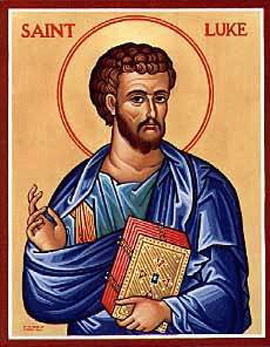
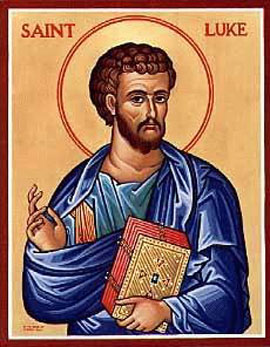
The Feast of St. Luke ~ Br. Igor Kalinski, Novice

St_Luke_imageSaint Luke was born a Greek and a Gentile in Antioch , Syria. He was a physician and it is believed that he may also been a slave, as it was not uncommon in his day for slaves to be educated in medicine so the family would have a resident-physician. Luke became a close companion of Saint Paul of Tarsus and acompanied him on his missionary journeys.It is very possible that Luke provided medical assistance to Paul when he had been beaten, stoned, or nearly drowned while evangelizing to the Western Roman Empire. Luke is the only Gentile to have written books in the Bible. He is the writer of the third Gospel and the Acts of the Apostles and his writings have been proven to the historically accurate.

In the third Gospel  is the Hymn of Blessed Virgin Mary of God, which is very special to me.  What a beautiful sparkle of light for us to follow her example of how she followed Christ her Son!  In his Gospel Luke writes very beautifully of the Nativity of our Lord Jesus Christ, and  Luke emphasizes Christ´s compassion for sinners and for all those who suffer, with a strong emphasizes  of the role woman played in Christ´s ministry.

By the Christian Tradition we know that he is the first one who painted icons of the Holy Mother. Saint Luke has made known to us a way how to follow Christ with examples of and adoration and veneration giving honor to the Mother that gave us her Son to be the salvation of all humanity. It is only of the Gospel of Luke that contains the stories of Mary´s Annunciation, her visit to Elizabeth; The Magnificat; The presentation, and Jesus remaining in Jerusalem. In Luke´s Gospel we learn the words to pray ” Hail Mary full of grace” and Elizabeth´s words to Mary “Blessed are you and blessed is the fruit of your womb, Jesus”.

It is believed that Luke lived a long life and died in c.74 in Greece. He is patron saint of physicians, surgeons, artists, doctors, painters, sculptors and unmarried men.

Prayer to Saint Luke:

Most charming and saintly Physician, you were animated by the heavenly Spirit of Love, In faithfully detailing the humanity of Jesus, you also showed his divinity and his genuine compassion for all human beings. Inspire our physicians with your professionalism and with the divine compassion for the patients. Enable them to cure the ills of both body and spirit and afflict so many in our day.Amen