Saint Mary Magdalene~Br. Milan Komadina

Feast Patroness of Our Order

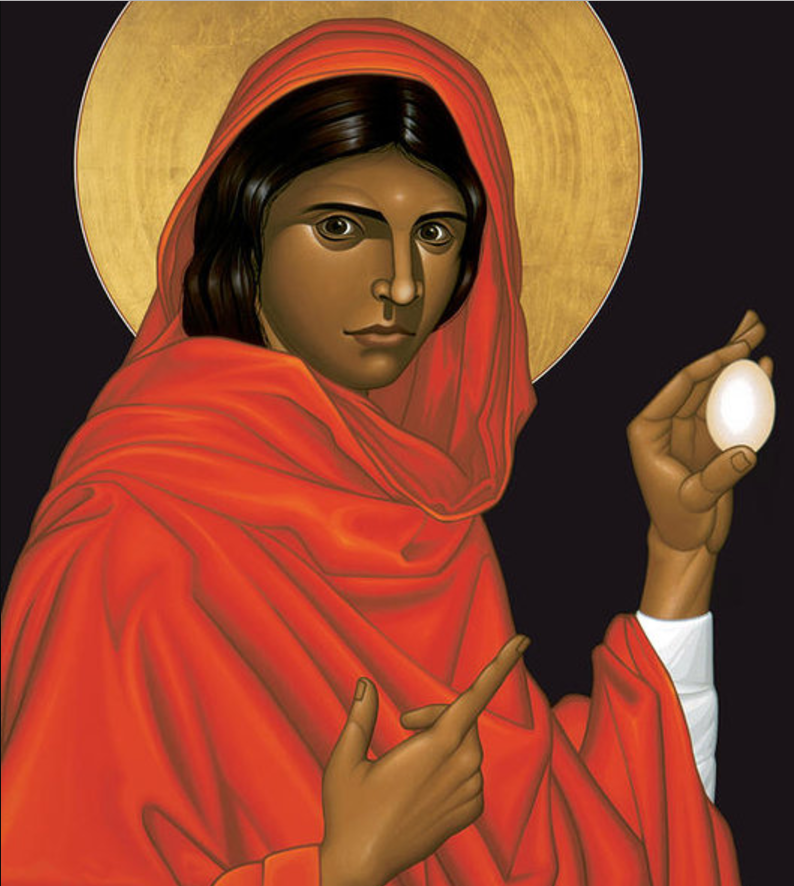
Mary of Magdala, Latin Mary Magdalene – the evangelists mention her as a companion of Jesus and a witness to his crucifixion and resurrection . There is also a series of writings that were rediscovered from the 19th century and in which Mary Magdalene is mentioned. The figure of Mary Magdalene was later embellished with legends. In it her importance was increased, or she was identified as the (nameless) foot-washing sinner in Luke’s Gospel. She has been interpreted as a prostitute or as a lover of Jesus. In fact, little is said about her or her life in the New Testament. It is striking that, according to the Gospel of John, she is said to have been the first to meet the resurrected Jesus. Her epithet refers to the location of Magdala on the Sea of ​​Galilee in the Holy Land.

Today we read in the Gospel about the person who was the first to come to the tomb and see the resurrected Jesus alive. As meet Jesus he was very just person and did not like to make differences between male and female. Any discussion of women’s roles in the church must begin with these two facts: It was a woman, not a man, to whom the Risen Christ first chose to appear. And it was a woman who, for a time, was the sole recipient, carrier and proclaimer of the Good News of the Resurrection. There is a discrimination against women in many Christian denominations, especially in traditional Western Roman Catholic Church and Eastern Orthodox Church. As mainstream churches are famous in their supremacy of white and male dominant people. It is sad that church (that supposed to be a body of Christ) forgets that the words that Jesus personally said to a woman (Mary of Magdala) were:

“Do not hold on to me, for I have not yet ascended to the Father. Go instead to my brothers and tell them, ‘I am ascending to my Father and your Father, to my God and your God.’” John 20/17

Mary was the first person who was invited to be the preacher. The preacher of the Resurrected Jesus, the preacher of the Gospel. At that time, women did not have many rights. They did not have the right to talk freely and the men were those who had authority of preaching. Sadly today in many churches, despite the Gospel’s obvious blessing for equal treatment of men and women there are many churches that are not allowing women to be preachers. There are also many churches that are not allowing gay men to be preachers either. Sadly the dark period of the church is still not finished since the mid-century. Just it has a new form. Church does not kill any more in the name of Christianity as it used to be doing in mid-century but it blesses discrimination and persecution of LGBT+ individuals still treating the women as not worthy enough to be preachers. While some people doubt that Mary was in an emotional relationship with Jesus, others doubt that he was in emotional relationship with another apostle who he loved in a special way as we read in today’s Gospel John 20:1/2:

Early on the first day of the week, while it was still dark, Mary Magdalene went to the tomb and saw that the stone had been removed from the entrance. So she came running to Simon Peter and the other disciple, the one Jesus loved, and said, “They have taken the Lord out of the tomb, and we don’t know where they have put him!”

What we read next is the invitation to preach Gospel, the invitation to preach about Resurrected Jesus. As you read, sisters and brothers, in the Gospel we did not have discussion about Lord’s sexual identity and whether he was in emotional relationship with Mary of Magdala or with the disciple, the one Jesus loved (as it is written in the Bible). God’s Word put the focus not onto our gender, sexual orientation, race and nationality. It puts its focus onto preaching. Preaching the Word about the Living Resurrected Jesus, Our Savior. I would like to let you think about that. I would like you to be also focused on Jesus and the forgiveness of sins that was given to us as a free gift. And my today’s prayer for all those discriminative brothers and sisters is that God may enlighten their hearts to see and feel the real love of God and to understand the real Gospel and the fact that we are all equal in Jesus. And let us all put our entire focus on the Resurrected Lord. Amen.

Song of Songs 3:1-4

1 All night long on my bed
    I looked for the one my heart loves;
    I looked for him but did not find him.

I will get up now and go about the city,
    through its streets and squares;
I will search for the one my heart loves.
    So I looked for him but did not find him.
The watchmen found me
    as they made their rounds in the city.
    “Have you seen the one my heart loves?”
Scarcely had I passed them
    when I found the one my heart loves.
I held him and would not let him go
    till I had brought him to my mother’s house,
    to the room of the one who conceived me.

Open My Eyes~Br. Christian Ventura, OPI

“But blessed are your eyes because they see, and your ears because they hear. For truly I tell you, many prophets and righteous people longed to see what you see but did not see it, and to hear what you hear but did not hear it.”

In the ✠ Name of the Father, and of the Son, and of the Holy Spirit.

Amen.

Historically, when Dominicans are taught to preach, we are generally told not to view Holy Scripture as historical documents that necessitate eloquent interpretation. Likewise, we are not supposed to read the Holy Gospels with the intention of discovering a hidden meaning or a novel theological epiphany that hasn’t already been debated by biblical scholars and theolo-gicians throughout the ages. While at first glance this might appear seemingly contrary to the very nature of preaching, it calls us to be attentive to the text in a rather mystically intimate way.

When we prepare to preach at the pulpit, our heart is set on discerning how the living Word is speaking to us in the context of today. The Spirit kindles our heart, and our heart informs our mind to articulate aspects of the divine essence in human words. This is the same Spirit that bestowed the gift of speaking the language of the people on the day of Pentecost. The Dominican is first called to contemplate, and then consequently, has a responsibility to share the fruits of our contemplation for the salvation of souls.

The United Church of Christ in particular does an excellent job of nurturing this truth that “God is still speaking”. Furthermore, not only do we interact with the living Word, we believe every Christian has an apostolic call to bear witness to how God authors the Gospel in our everyday life as an extension of our shared priesthood gifted to us at baptism.

Aside from preaching, we have already iterated that a prerequisite to faithful speech is to start by actively listening with open ears, a curious mind, and a softened heart. On the Feast of Thomas the Apostle, you might even recall that we previously discussed how listening to God requires a risky leap of faith that flies in the face of societal norms. It has become normative to subject Christ unto our own desires as opposed to submitting ourselves fully unto Christ’s subjection. “Unless I see the nail marks in his hands and put my finger where the nails were, and put my hand into his side, I will not believe.”

We also discussed how taking this leap of faith is inherently sacrificial. By rejecting the world and submitting ourselves to the will of God, we die to the world and increase in God’s abounding merciful grace.

Each day we discern God’s will and make a considerable attempt to choose Him over the world,  “we offer and present ourselves, our souls and bodies, to be a reasonable, holy, and living sacrifice.” That we might be filled with His grace and heavenly benediction, and made one body with Him, that He may dwell in us, and we in Him. In fact, we affirm this every Sunday in the ultimate Holy Sacrifice of the Mass.

Indeed, seeing and hearing are choices we make using our freewill. In doing so, we look intently towards the heavens, and we lift up our hearts to listen to the Word that comes from the mouth of God. My beloved siblings in Christ, God is speaking to you every single day. Are you listening?

Prayer Attributed to St. Dominic

May God the Father, who made us, bless us.

May God the Son, who redeemed us, send healing into our midst.

May God the Holy Spirit, who gives us life, move within us.

May God give us eyes to see to God, ears to hear God, and hands to bring God’s work into the world.

May we walk with God and preach the word of God to all. May the angel of peace watch over us and lead us at last by God’s grace to the eternal Kingdom.

It’s Simple Really~The Rev. Frank Bellino, OPI

‘Come to me, all who labor and are heavy laden, and I will give you rest. Take my yoke upon you and learn from me; for I am gentle and lowly in heart, and you will find rest for your souls.’ (“Matthew 11:29 ESV – Take my yoke upon you, and learn from – Bible Gateway”)

Karl Marx notably wrote that religion was the ‘sigh of the oppressed creature, the heart of a heartless world, just as it was the spirit of a spiritless situation’. At first glance, Jesus’ words in the gospel of this Sunday may seem to offer a rather simplistic and strange way to follow. Come to me, all who labor and are oppressed, and I will give you rest. Take my yoke, and you will find rest.

In fact, we would not be far from Marx’s view if we were to interpret these words as an invitation to accept our labor and predicament without complaint, as oppressed people accepting everything in the hope of finding the pie in the sky!

So, how could we properly understand these words? Christianity does not invite us to accept any kind of yoke like oppressed creatures. Rather, Christianity is a call to simplicity and authenticity.

Jesus’ words are first of all a call to simplicity: as human beings living in society, we build our lives on principles, rules and laws, and we think that this will help us to grow. Yet, these laws and rules are necessary, but their existence cannot lead us to lose sight of the only reason why we need them: to reinforce our love for God and for our neighbors.

What Jesus invites us to discover is to do by love what we have been taught to do by duty, and this is simplicity, because, in this way, our only rule is the Love of God. Too often, however, we fulfil our duties simply by duty, like religious petty bureaucrats without freedom who forget the spirit of our rules and laws. This is precisely the reproach Jesus made to the Pharisees: to lose sight of the center implies to make things more difficult.

Therefore, against the Pharisees who made the ancient law more oppressive, difficult and heavy, Jesus invites his disciples to take upon themselves his yoke, which is simple and light: the spirit of the law, which is Love. Deeper than the letter, which may seem heavy, lies the Spirit, which invites us in a life of freedom, aware of our boundaries and limits.

Jesus invites us, then, to take his yoke and to be simple by having only rule: his rule of love, hidden to the wise and understanding. Jesus invites us to live in the spirit, and to discern the Spirit behind the letter of the principles of our lives. As Paul reminds us in the second reading, we are not in the flesh, but we are in the Spirit, if in fact the Spirit of God dwells in us?

Therefore, we are invited today not to make our rules more oppressive, complicated but more accessible, like true children of God. Of course, it does not mean that everything can be done, but rather that we do not have to be fettered by principles only but bound first and foremost by love for God and our neighbors.

We are invited not to be ‘religious petty bureaucrats’, who follow exact rules because they have to be followed, but to discern the spirit of love which underlies them. Too often, we are likewise bright people, unable to discern what is simple and essential in our lives. We focus on details and on the letter of our principles – which can enslave ourselves – rather than on the spirit of the letter, which may set them free.

Jesus’ words are therefore a call to authenticity. He invites us to be spontaneous and authentic, with an undivided heart. As the Son knows and is one with the Father, we must be one in mind and not to have individualist Christianity. Let us learn from their mutual love how to be fully ourselves, without transforming our rules and principles into a fence cutting us off from what we truly are and what we have to do.

One Nation Under…Who?~The Rt. Rev. Michael Beckett, OPI

Y’all, today is our nation’s birthday.  The United States is 247 years old.  And never since the Civil War has our country been more divided.  We frequently hear certain politicians claiming to be “Christian” and actively espousing the desire to ‘take the country back’ and to ‘put God first,’ and to make sure that the United States follows only their brand of “Christianity.”  These are the folks who have declared a War on Woke.”  These are also the folks who distort the Constitution, and the Scriptures, using selective editing and mental gymnastics to claim these documents say things they don’t say.  Often they insist on a literal reading of Scripture and an originalist interpretation of the Constitution; other times they claim the Bible doesn’t mean what it says or they ignore the explanations given by the Constitutional framers. This is hypocrisy, something Jesus repeatedly condemns.

Jesus taught us to love our neighbors — no exceptions. (How very “woke” of him!)  The Gospels emphasize this commandment in dozens of different verses about love (particularly in the Gospel of John) and lay out specific blueprints about what love in action looks like throughout Matthew 25, the Sermon on the Mount in Matthew, the Sermon on the Plain in Luke, the beginning of his ministry in Luke 4:18, Mary’s song about the rich and the lowly in Luke 1, and more.

There are those who claim  that America was founded to be – and should remain – a so-called “Christian nation,” despite the clear intent of the Constitution to separate church and state and to honor religious liberty for all.   It most assuredly was not.  Many of our Founding Fathers were not Christian.  Many of them were Deists, among them were Benjamin Franklin, Thomas Jefferson and George Washington.  (Yes, I know some of you will disagree with me.  However, check out the “Jefferson Bible” before you say anything.    Heck, check out your own Bible, in a direct translation and proper context, before you say anything.)     These are also the people who advocate for oppressive legislation — rooted in far-right religious beliefs — that strips away equal rights the LGBTQ community, non-Christians, women, people of color, and immigrants, among others.   Where is God in all this?  Where is the love that Jesus has said that we are to show to all?

I am weary of hearing about how evil those of our brothers and sisters are who “woke.”  I am even more weary of hearing things like  “Pray for America,” and “Jesus Heal Our Nation,” and “Let God Fix It.”  I mean, really?  “Let God Fix It?”  What kind of warped theology is that?  God is not Zeus and He will not send lightning bolts to the earth to ‘fix things.’  God is not some genii who is going to magically go “POOF” and all will be right with the world.  God is not some fairy who will grant your wish.  There is not a thing that God will do to make our world a better, more just, happier, more loving place.  He has done it already.  However, what He has done has been ignored for centuries now.  He gave that power to us, we’ve blown it, and it’s catching up with us.

We were, all of us, created with that pesky little thing called ‘free will,’ that allows us to choose how to behave, how to act.  God is not going to force any of us to do anything, just as He does not force us to believe in Him, worship Him, or follow Him. 

It is time to stop giving lip service to our faith and actually live it.  It is time for us to, as they say, “put up or shut up.”   It is up to each of us to conduct ourselves in a manner fitting our faith.  By all means, pray for America.  But don’t you DARE then sit back and do nothing to heal our nation. 

We are taught in Galatians 3:28 that “There is neither Jew nor Greek, there is neither slave nor free, there is no male and female, for you are all one in Christ Jesus.”  That also means, by extension, no race, no nationality.  Isn’t it time we act like it?  Isn’t it time that we hold those in power accountable if this is what we wish?  We are taught in the book of James to “ show no partiality as you hold the faith in our Lord Jesus Christ, the Lord of glory. For if a man wearing a gold ring and fine clothing comes into your assembly, and a poor man in shabby clothing also comes in, and if you pay attention to the one who wears the fine clothing and say, “You sit here in a good place,” while you say to the poor man, “You stand over there,” or, “Sit down at my feet,” have you not then made distinctions among yourselves and become judges with evil thoughts?” James 2:1-26   Further, we are taught, again in James, that faith without works is dead. In other words, if the faith inside of us doesn’t get expression through our actions and words, it will no longer be alive. If we don’t use it, we will lose it, so to speak. We have to step out in faith in order to keep faith alive.  (James 2:26:  For as the body apart from the spirit is dead, so also faith apart from works is dead.  But be doers of the word, and not hearers only, deceiving yourselves.)

It is up to us, each of us, every one of us who profess to be followers of Christ, to BE the change, to work for the change, we so desperately need in this world.  Again from James:  But be doers of the word, and not hearers only, deceiving yourselves. For if anyone is a hearer of the word and not a doer, he is like a man who looks intently at his natural face in a mirror. For he looks at himself and goes away and at once forgets what he was like. But the one who looks into the perfect law, the law of liberty, and perseveres, being no hearer who forgets but a doer who acts, he will be blessed in his doing.  James 1:22-25  I have said, over and over again, that WE are the only Bible some folks will ever read.  WE are the only Jesus some folks will ever see. 

I think we all of us are familiar with the song, “Let There Be Peace on Earth.”  And what is the next line?  Yep.  “And let it begin with me.”  Isn’t it time we lived up to that?   What are we doing to bring about change?  To bring about equality?  To bring about that healing this country so desperately needs? 

Let there be peace on earth
And let it begin with me
Let There Be Peace on Earth
The peace that was meant to be

With God as our Father
Brothers all are we
Let me walk with my brother
In perfect harmony.

Let peace begin with me
Let this be the moment now.

With ev’ry step I take
Let this be my solemn vow
To take each moment and live
Each moment in peace eternally
Let there be peace on earth
And let it begin with me

Source: LyricFind

Songwriters: Jill Jackson / Sy Miller

Let There Be Peace on Earth lyrics © Music Copyright Consultant Grp

The Feast of Thomas the Apostle~Br. Christian Ventura, OPI

Feast of Thomas the Apostle; John 20: 24-29

03 July 2023

Br. Christian Ventura, OPI

Priory of St. Symeon and St. John

Order of Preachers Independent

Baltimore, MD

Now Thomas (also known as Didymus), one of the Twelve, was not with the disciples when Jesus came. So the other disciples told him, “We have seen the Lord!” But he said to them, “Unless I see the nail marks in his hands and put my finger where the nails were, and put my hand into his side, I will not believe.” A week later his disciples were in the house again, and Thomas was with them. Though the doors were locked, Jesus came and stood among them and said, “Peace be with you!” Then he said to Thomas, “Put your finger here; see my hands. Reach out your hand and put it into my side. Stop doubting and believe.” Thomas said to him, “My Lord and my God!” Then Jesus told him, “Because you have seen me, you have believed; blessed are those who have not seen and yet have believed.”

In the ✠ Name of the Father, and of the Son, and of the Holy Spirit.

Amen.

As members of the human family, it is safe to say that we have all been a “Doubting Thomas” at some point in our own spiritual journey, even if we regret to admit it. I certainly have been there, and frequently have my own theological inquiries with seemingly no clear answers. It appears normative of today’s society to become increasingly secular and atheistic. In some ways, however, it might be a foreign concept to some that doubt can actually be very healthy, if we yield to the Spirit and allow ourselves to be vulnerable in our discernment.

In today’s Holy Gospel, we see doubt as something inherently negative. Hence why the Church for many years has villainized “Doubting Thomas”, framing doubt as something to be irrefutably ashamed of. Thomas is doubtful of Jesus’ resurrection from the dead, the momentous highlight of our Christian faith. That is, until Jesus appears before him and renders tangible evidence of his divinity.

We ought to ponder, however, whether the issue here is actually skepticism, or, being stubbornly relentless. It might be worth wondering whether St. Thomas’ misstep was his natural thought process, or his persistent rejection of Christ until his own criteria for belief was fulfilled.

My brothers and sisters, worry not if doubt crosses your mind. Be gentle with yourself, and pray. Hold mercy that Christ holds for you. Faith is a gift from God that He is so eager to grace us with. It matters whether we choose to accept this faith.

Doubt coupled with sincere inquiry is not sinful, rather, perfectly organic in many ways. In fact, this is what we call theology! Some even say that “theology is how we love God with our minds”, although the original author of this claim is unknown. Furthermore, it only becomes irreverent when we subject Christ unto our own than allow for ourselves to be subject unto Christ.

Dominicans have affirmed throughout centuries the belief that God desires us to know Him in His true essence. This is even captured in St. Catherine’s prayer “Love Undefiled” as attached below. Fr. James Martin, SJ beautifully puts in his book Learning How to Pray “…that which you seek is causing you to seek it”. If there is an inkling in your heart that desires to know God more, be assured that this is of God.

Taking a leap of faith is supposed to be risky, and even in some cases, sacrificial. It is a mere act of bravery to place your eternal salvation in the hands of a God who no one has seen except for the Son. Furthermore, it can be even more difficult to subscribe to the Christian faith in particular when Christians have an infamous reputation for bearing unfaithful fruit. Thankfully, God is his mercy and omniscience knows this, and yet still continues to impart the gift of faith to all those who ask with a sincere heart.

Dearly beloved, the next time you encounter doubt, know that you are not far from God. Quite the opposite, really. Earnestly ask, and be open to His response. Many times we believe God to be absent, because we are out of practice with our listening skills. As our sister Catherine remarks so perfectly, “God is closer to us than water is to fish”!

Love Undefiled

“Eternal God, eternal Trinity, You have made the Blood of Christ so precious through His sharing in Your Divine nature. You are a mystery as deep as the sea; the more I search, the more I find, and the more I find the more I search for You. But I can never be satisfied; what I receive will ever leave me desiring more. When You fill my soul I have an ever-greater hunger, and I grow more famished for Your light. I desire above all to see You, the true light, as you really are. Amen.” – Sr. Catherine of Siena, TOSD

Loving Jesus More Than…~The Rt. Rev. Michael Beckett, OPI

Ya know, sometimes Jesus says stuff that is difficult.  Like the Gospel appointed for today:  Matthew 10:37-39  (NIV)

“Anyone who loves their father or mother more than me is not worthy of me; anyone who loves their son or daughter more than me is not worthy of me.  Whoever does not take up their cross and follow me is not worthy of me.  Whoever finds their life will lose it, and whoever loses their life for my sake will find it.

Say what?  Whatever does this mean?  You say to me, you say, “But Jesus taught us to love and respect and honor our parents!  It’s even one of the Ten Commandments!”  And I’d say right back to you, “Yep.”

 So what gives with this?   I have to believe that what Jesus is saying to us is this:  If we are going to walk with Jesus, we have a price to pay. Sacrifice and suffering and making difficult choices are part of the journey.

Earlier, Jesus has warned His disciples that He had come to bring a sword of division to Israel. This wasn’t a reference to violence or revolution, but to the separations that the gospel can cause. Those who refuse to accept Christ and his message of love and acceptance will hate and persecute those who believe (John 15:18–21). The division will take place even between immediate family members. Fathers and sons will turn on each other, as well mothers and daughters. The issue will be belief in Jesus Himself. Is He the Messiah, the Son of God? Is what he says right and true and good?  Those who refuse to acknowledge Him will reject those of their own family, who put their faith in Jesus and begin to follow His ways (1 Peter 4:3–4).

Jesus is demanding His rightful place in the hearts of His people.  Us.   We must love Him more than all others and demonstrate that  this is true, especially if we are forced to make a choice. This does not change Scripture’s demand that children honor their parents (Ephesians 6:2) and that parents provide for their children (Ephesians 6:4; 1 Timothy 5:8). Jesus does not say “do not love” those other people—what He says is that we ought to love God more.  And in so loving God more, in following his path, will folks bewilling to lose connection to their family members, friends,  or political party in order to continue to follow Jesus and acknowledge to others that He is the Christ? 

Loving others is the second greatest commandment, but it is behind the first: to love God with everything we have (Matthew 22:34–40). In making this statement, Jesus continues to make the claim that He is God. Love and obedience to Him must come before obedience to any other person or group (Acts 5:29).

And how do we show that love?  That willingness to sacrifice it all for Jesus?  Be merciful.  Be kind.  Show love.  It’s pretty much one of the key recurring factors of Jesus’s ministry.  Love God.  Love people.  Love God.  Love people.

Jesus tells us in John 13:34-35, “A new commandment I give to you, that you love one another: just as I have loved you, you also are to love one another.  By this all people will know that you are my disciples, if you have love for one another.”    How do we show that love?  Again, Jesus tell us, and again, very specifically in Matthew 25:35-45:   For I was hungry and you gave me something to eat, I was thirsty and you gave me something to drink, I was a stranger and you invited me in,  I needed clothes and you clothed me, I was sick and you looked after me, I was in prison and you came to visit me.’   “Then the righteous will answer him, ‘Lord, when did we see you hungry and feed you, or thirsty and give you something to drink?  When did we see you a stranger and invite you in, or needing clothes and clothe you?  When did we see you sick or in prison and go to visit you?’  “The King will reply, ‘Truly I tell you, whatever you did for one of the least of these brothers and sisters of mine, you did for me.’  “Then he will say to those on his left, ‘Depart from me, you who are cursed, into the eternal fire prepared for the devil and his angels.  For I was hungry and you gave me nothing to eat, I was thirsty and you gave me nothing to drink,  I was a stranger and you did not invite me in, I needed clothes and you did not clothe me, I was sick and in prison and you did not look after me.’   “They also will answer, ‘Lord, when did we see you hungry or thirsty or a stranger or needing clothes or sick or in prison, and did not help you?’

45 “He will reply, ‘Truly I tell you, whatever you did not do for one of the least of these, you did not do for me.’

The least of these….who then, are ‘the least of these’ in today’s society?   Probably those who make many of us uncomfortable.  The homeless?  People who are of a different color?  Sexual orientation?  Gender identity? Ethnicity? Who are “the least of these” to you? 

Throughout his ministry, Jesus showed that he did, indeed, love everyone, even to the point of dying for their sins, but you know,  he went out of his way to intentionally help specific groups of people — the alienated, mistreated, and those facing injustice. 

We as Christians must recognize that our society today is filled with numerous groups and communities facing systemic oppression, and we must act. We must be willing to admit and address the complex realities within our world that create such problems, and avoid the spiritual laziness that tempts us to rely on generic excuses and solutions.  Loving as Jesus loved us is hard.   Loving Jesus more than anything and anyone is harder.

Christians do a disservice to the gospel message by removing the cultural context from Jesus’s ministry and watering down his message to one of religious platitudes. We like to generalize the words of Jesus and transform his life into a one-size-fits-all model that can apply to all of humanity.  He intentionally, purposefully, and passionately addressed very specific causes. He radically addressed the diverse and complicated conflicts of the time and shattered the status quo.  Are we, as Christians, not called to do the same?  By addressing racism, immigration, gender equality, gender expression, and a litany of other issues, we are following in the steps of Jesus.

Justice.  Mercy.  Kindness.  Love God.  Love people.

Amen.

Forgiveness and Fear~Br Milan Komadina

In today`s reading we learn two very important things for all of us who are Christians. The first one is about the sin, and the fact the sin has no power upon us if we are washed with the blood of Jesus through our faith. That does not mean that we are now sinless and that we will never sin again. But it means that God does not see us anymore as sinful and God sees us through His Son Jesus Christ who died for us. Those things many Christians nowadays do not understand. Being forgiven does not mean that we will never sin again. We have sinful nature which we inherited from Adam. But we, who are saved also have the forgiveness of our sins which was gifted as a free gift from Jesus. As we read in Romans 5:12-15 through one man the sin had entered the world. And that man was Adam. We all, a human creatures inherited this sin and our nature became sinful. And since the sin was an obstacle and barrier between God and man there was a necessity for something to happen in order to break this barrier. Centuries after Adam brought the sin into this material world, God gave Moses the Law. And again, there were many centuries needed to let people aware that the Law cannot be fulfilled and that every single person is a sinner and should be always separated from God. Unfortunately it seems that even today in some Christian denominations people do not believe in this gift and are trying to earn their own salvation. They do not feel secure in mercy which God promised but they are trying to be very pious and through religious rituals try to earn forgiveness of their sins. They light candles, incense, they donate money to the church, give charity, pray a lot and pray rosaries etc. I must say that all of these things are good but they should be result of being saved. Not to do all those things aiming to earn what cannot be earned and it is precious and uncountable gift of God`s eternal mercy and gift of salvation. And then God decided to send into the world our Savior, Jesus Christ. The only man who was sinful, the only man who was able to put away the sin of humankind. And as the sin step into the world through one man (Adam), also the sin stepped out from this world through one man (Jesus). And this is how it happened, we are now able to have a close relationship with God, not because of our own deeds or merits but because we believe in Jesus and through that faith and love God sees us sinless, free from sins and saved. This is why we know we are saved by grace. This is how great is God`s grace and mercy.

The second thing that we learnt today is that we should not be afraid. Even though it could sometimes be very difficult. People usually tend to believe their own feelings and thoughts. When we think that something negative is going to happen we often lack the faith in God and we lack the awareness that everything is happening with the will of God. If we have problems at work, or bad communication with our colleagues, financial problems, health issues or even emotional problems with our loving partner or our marriage seems to be broken. We should raise awareness that there are no coincidences in our life and that everything can be a new lesson or a new door that needs to be closed for another door and another possibilities to be opened. What we read today is from Matthew 10:29-31 – `Are not two sparrows sold for a penny? Yet not one of them will fall to the ground outside your Father’s care. And even the very hairs of your head are all numbered. So don’t be afraid; you are worth more than many sparrows.` This sentence is so amazing and so full of hope. God is aware even how many hairs we have. And he cares literally about all the things about us even some of them that we are not conscious. Our God is awesome. In our God we have forgiveness of sins, a loving relationship and he cares about us. My prayer today is that you all could feel such a great love and security in God. Amen.

The Nativity of St. John the Baptist~The Very Rev Lady Sherwood, OPI

Reading I: Is 49:1-6

Responsorial Psalm: 139:1b-3, 13-14ab, 14c-15

Reading II: Acts 13:22-26

Alleluia: See Lk 1:76

Gospel: Lk 1:57-66, 80

Liturgical Colour: White

Today, we as a church come together to commemorate the birth of St John the Baptist, often known as the ‘Forerunner’.

John was the son of Zechariah and Elizabeth. In the Gospel of Luke, we are told that Zechariah was told beforehand about the birth, and that he was to be named John. The name John means “God is Gracious” (LK 1 :8=2:3).

John whilst still within his mother’s womb, instantly recognised the presence of Our Lord Jesus, who was also still in his mother’s womb, when Mary went to visit her cousin Elizabeth (LK 1 :41). John leapt for joy in Elizabeth’s womb as soon as Mary and Elizabeth met, and this is when John was cleansed of original sin. This came to pass just as the Angel Gabriel had previously promised Zechariah in LK 1 :15.

When John was older, he left the home of his parents and went to live his life in the desert. He wore only a garment made from camel skin and only had Locusts and wild honey to eat. John would preach in the desert (MK 1:6; Matt 3:4).

John went about preaching and proclaiming about the Kingdom of God and of a time of upcoming judgement. He invited those who wanted to repent, to allow him to baptise them as a sign of their repentance.

John, just like the  prophets, disturbed the comfortable and gave much comfort to the disturbed. The message of John soon spread far and wide. The Gospel of Mark tells us that all peoples of both Jerusalem and Judea travelled to him to confess their sins as John baptised them in the river Jordan (MK 1:5).

John shows his humility clearly to us because he never wanted any attention for himself, he always directed people to Jesus. Some wondered if John was the Messiah, but John reassured them that indeed he wasn’t the messiah, and he declared that his ministry was merely a preparation for the coming of the Messiah. John said, “I have baptised you with water, but He will baptise you with the Holy Spirit.” (MK 1:8)

Then Jesus himself came to John to be baptised and John immediately recognised Jesus as the Messiah and he declared, “This is the Lamb of God who takes away the sins of the world”. (JN 1 :29). This statement from John is still used in Mass prayer today, when the Priest holds up the sacred Host as we prepare for the Holy Eucharist, as the Priest says, “This is the Lamb of God who takes away the sins of the world…”.

It was after being baptised by John, that our Lord Jesus began his Earthly ministry. When John had been baptised by John, John again showed his humility as again, he turned his attention to Jesus, declaring, “He must increase, I must decrease”(JN 3:30).

St John the Baptist is an excellent example that we as Christians should take much notice of within our lives of faith. Just as John always showed his humility by turning his attention away from himself and towards our Lord Jesus, we too, also need to show this same humility if we are truly to serve and follow the Lord. We also, must turn attention away from ourselves and towards Jesus. Just as John himself declared, “He must increase, I must decrease”.

Let us pray:

O glorious St John the Baptist, greatest prophet among those born of woman, although you were sanctified in your mother’s womb and lived a most innocent life, nevertheless, it was your will to live in the wilderness of the desert, there to devote yourself to the practice of austerity, penance and humility;

Obtain for us by your intercession, the grace of the Lord to be wholly detached within our hearts, from earthly goods and self attention. Increasing our humility and service, by making ourselves far lesser and in the never ending increasing, to be ever greater within our hearts and lives.

Amen.

Helpless and Harrassed~Br. James Taylor

Matthew 9:36 =  

“He had compassion on them because they were harassed and helpless, like sheep without a shepherd. 

When he looked out over the crowds, his heart broke. So confused and aimless they were, like sheep with no shepherd. “What a huge harvest!” He said to his disciples. “How few workers! On your knees and pray for the harvest hands.” (The Message) 

One of my favorite Saturday afternoon things to do during the Spring and Summer is to escape to the nearby park and just vegetate. Do not get me wrong, I like to mostly listen to the sounds of nature and to watch folks try their hand at fishing in the man-made pond which is usually freshly stocked just as the hint of Spring is beginning.  I often get a kick out of watching newly hatched ducks or geese waddling around the lake just before they take their very first dip in the water.  They are helpless and they are seemingly without someone to lead them; that is until Momma squawks that familiar sound that tells that little one to get themselves back in line so as not wonder off.   

All too often, we find ourselves on that path of self-discovery and control.  We think that we got all the answers and can make it just fine without an “adult” assuring us or comforting us to get back in line.   

Ever since I can remember, and for no apparent reason, I found myself being harassed and bullied.  On more than one occasion, the thought of suicide crept into my mind and found a quick exit, too.  There was a whole lot going on at home that I was afraid to talk to anyone about and I always felt as if the guys who were teasing and bullying me with their harsh remarks at school somehow knew because their comments were always right on point.  I had no one to confide in or to talk to and I felt extremely helpless.  I was lost and clearly, I was harassed for different reasons no matter where I went.  My dad, who by the time I was in high school had been separated from my mom for several years and when I would visit him mostly after school, I was harassed to behave in a way that I really was not wanting to. When I was at home, my stepfather seemed to pick up on where my father left off and so I was once again forced to do things that clearly were not in my way of thinking or living.   

When I went to church, the folks who were sent to minister to me had great difficulty addressing the issue because they “did not have any children and didn’t understand.”  So, for several years, I was a misguided teenager who was lost and always lived a life of fear, and no one honestly knew this to be the case.  I tried to tell my mom, but she was so in love with her new husband that I felt like an afterthought even when she told me that she wished I wasn’t born.  I know that she said this in anger, but it stung deeply and painfully.   

As my life would continue, the right people eventually started to come into my life, and I was able to find my place.  Oddly enough and with a great deal of my own questioning, I was brought to the Lord and shown where He would eventually call me to serve Him.  Who was I that He would choose me and want to use me…but why, when, where, and how?  Even I knew that I was on the outskirts of what He was looking for.  I could never fit in to the mold of what He was looking for as a “fisher of men”.  I hated fishing and I do not like seafood, so we had a problem.  But then I was introduced to prayer and shown the way to look deep into myself and find what it was that was keeping me from stepping out of the margins, those areas where I felt helpless.  I was taken back to the Old Testament and to the very short look into the life of Jabez (1 Chron. 4:9-12), “bless me and enlarge my territory (border).  Jabez wanted to be liberated from the consequences of his birth, like I did, and he was relentless in his prayer to God in faith believing that one day God would hear and answer his prayer.  I cannot begin to tell you the number of times I (we) have become frustrated with waiting for God to answer my (our) prayers, to take me out of a bad situation and help me to see the truth waiting for me.  Sometimes the trust was already revealed to me amid that struggle, and I was just too stubborn to see what He was trying to show me. But doesn’t this speak to us all?   

Just a few days ago, I was reading leisurely a book by Henri Nouwen, “The Way of the Heart”, ‘The Spirituality of the Desert Fathers and Mothers’. The final paragraph of the book speaks well to our role as ministers in reaching those in the harvest and in the margins and beyond. 

“The prayer of the heart is indeed the way of the purity of heart that gives us eyes to see the reality of our existence. This purity of heart allows us to see more clearly, not only our own needy, distorted, and anxious self but also the caring face of our compassionate God.  When that vision remains clear and sharp, it will be possible to move into the midst of a tumultuous world with a heart at rest.  It is this restful heart that will attract those who are groping to find their way through life.  When we have found our rest in God, we can do nothing other than minister.  God’s rest will be visible wherever we go and whoever we meet.  And before we speak any words, the Spirit of God, praying in us, will, make his presence known and gather people into a new body, the body of Christ himself.” 

May the Spirit of Almighty God move and have His being in our lives today and always.  God bless you. 

The Sacred Heart~The Rt Rev Michael Beckett, OPI

I try really hard to put a note in Scott’s lunchbox every morning to remind him of how much I love him.  (Yes, we are one of “those” couples who are all schmaltzy and lovey-dovey even after almost 18 years.)  We remind each other constantly that we love each other, by doing, showing, and saying “I love you,” in about a million ways ever day.  There is a lot of love in our house.  He has my heart as I know I have his. 

Today is a day that celebrates love.  Not, however, the ‘hearts and flowers’ kind of love that Scott and I share, but the love that comes from the heart of Jesus.

All of you have seen one…..a picture or a statue of Jesus, heart exposed. All of you have heard the phrase: the sacred heart of Jesus. Today is the Solemnity of the Sacred Heart of Jesus. What is this all about? Why do we see pictures and statues of Our Lord with his internal organs exposed???

We, as Christians, continually talk about ‘the love of God,’ and that is specifically what this Feast Day is all about: The love of God. The fact that we are, all of us, held in the heart of Jesus, who loved us so much that he chose to become one of us to save us from sin, from death, and from ourselves.

According to Wikipedia, that bane of all researchers everywhere, devotion to the Sacred Heart of Jesus can be clearly traced back at least to the eleventh century. It marked the spirituality of Saint Bernard of Clairvaux in the twelfth century and of Saint Bonaventure and St. Gertrude the Great in the thirteenth. The beginnings of a devotion toward the love of God as symbolized by the heart of Jesus are found even in the fathers of the Church, including Origen, Saint Ambrose, Saint Jerome, Saint Augustine of Hippo, Saint Hippolytus of Rome, Saint Irenaeus, Saint Justin Martyr and Saint Cyprian, who used in this regard John 7:37-39 and John 19:33-37.

When you see a picture, or a statue of the Sacred Heart of Jesus, a picture or a statue of Our Lord, heart exposed, I want you to stop for just a second, and really look at it. Think about it. And look for yourself in that picture or statue. You are there. For you see, YOU are in the very heart of Jesus. YOU are the reason that he has exposed his heart; to give you a home, to give you a hope, to give you joy.

Jesus has given you his heart, his most precious and sacred heart……Won’t you give Him yours?