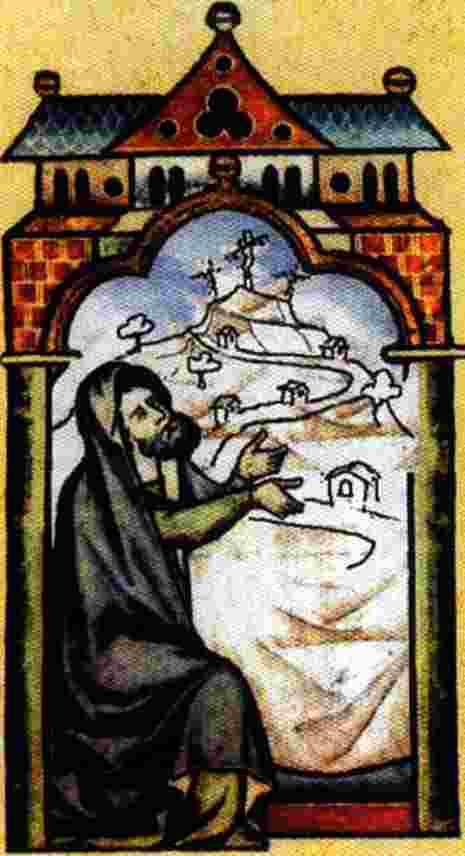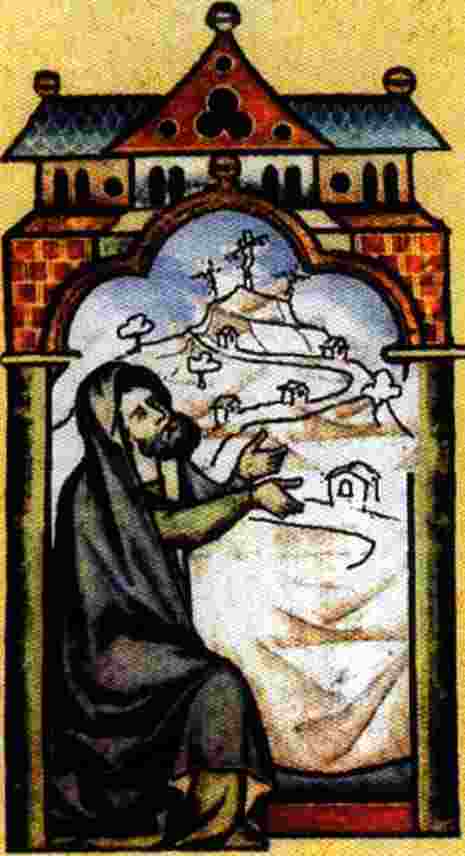
Saint Catherine of Ricci

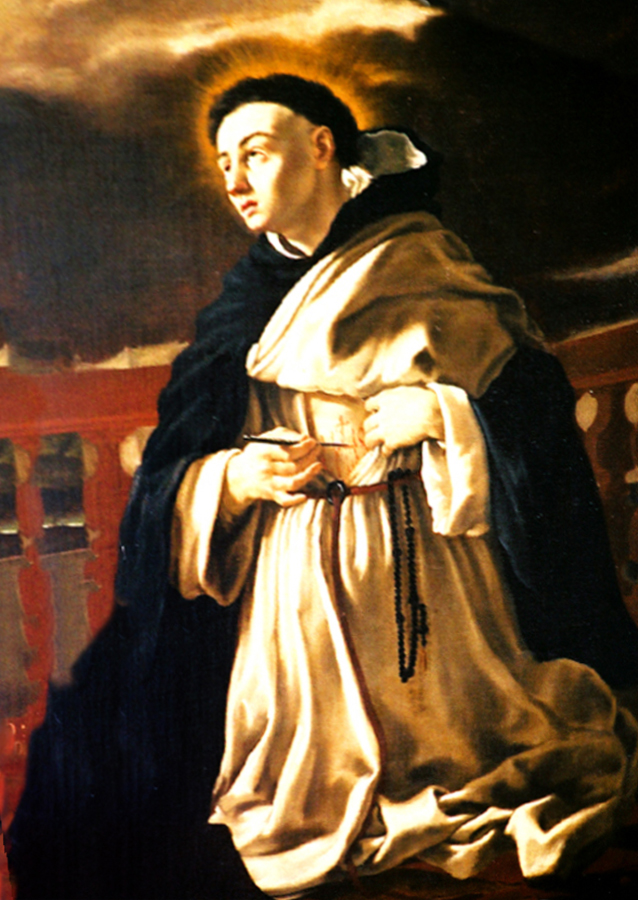
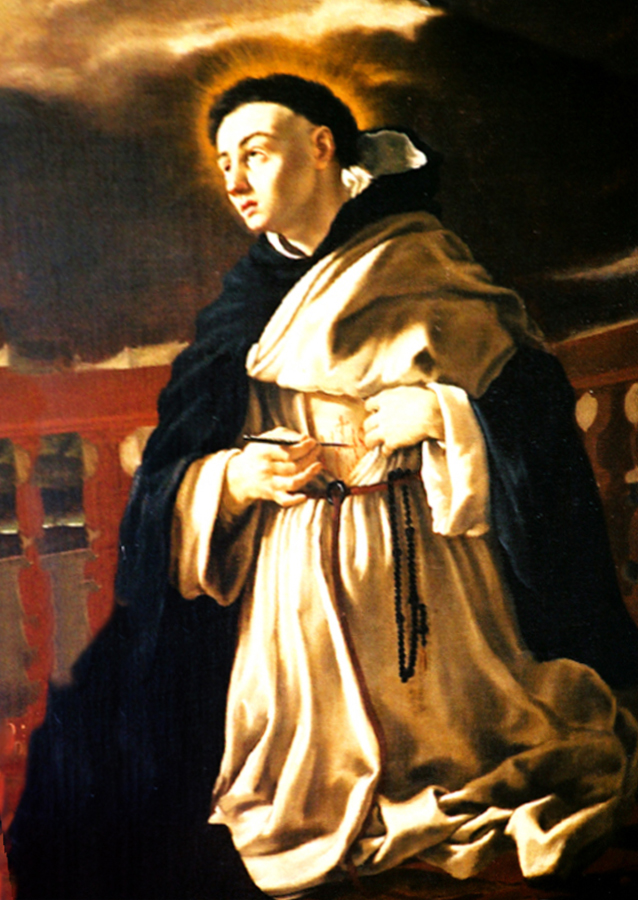
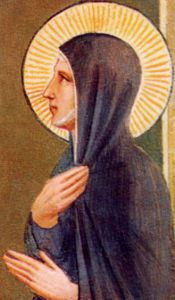
Alexandrina dei Ricci was born of a patrician family, but Catharine Bonza died leaving her motherless in her infancy. She was trained in virtue by a very pious godmother. The little girl took Our Lady as her mother and had for her a tender devotion. The child held familiar conversations with her guardian angel, who taught her a special manner of saying the rosary and assisted her in the practice of virtue.

As soon as Alexandrina was old enough to go away from home (age 6 or 7), she was sent to the convent school of Monticelli, where her aunt, Louisa dei Ricci, was the abbess. Besides learning her lessons for which she was sent, the little girl developed a great devotion to the Passion. She prayed often before a certain picture of Our Lord, and at the foot of a crucifix, which is still treasured as “Alexandrina’s crucifix.” Returning from the monastery when her education was completed according to the norm for girls, she turned her attention to her vocation.

In her plans to enter a monastery of strict observance, she met with great opposition from her father Peter. She loved the community life that had allowed her to serve God without impediment or distraction. She continued her usual exercises at home as much as she was able, but the interruptions and dissipations that were inseparable from her station, made her uneasy.

Finally, Peter allowed her to visit St. Vincent’s convent in Prato, Tuscany, which had been founded by nine Third Order Dominicans who were great admirers of Savonarola. Alexandrina begged to remain with them; however, her father took her away, promising to let her return. He did not keep his promise, and the girl fell so ill that everyone despaired of her life. Frightened into agreement, her father gave his consent; Alexandrina, soon recovering, entered the convent of Saint Vincent.

In May 1535, Alexandrina received the habit from her uncle, Fr. Timothy dei Ricci, who was confessor to the convent. She was given the name Catherine in religion, and she very happily set about imitating her beloved patron. Lost in celestial visions, she was quite unaware that the sisters had begun to wonder about her qualifications for the religious life: for in her ecstasies she seemed merely sleepy, and at times extremely stupid. Some thought her insane. Her companions did not suspect her of ecstasy when she dozed at community exercises, spilled food, or broke dishes.

Neither did it occur to Sister Catherine that other people were not, like herself, rapt in ecstasy. She was about to be dismissed from the community when she became aware of the heavenly favors she had received. From then on there was no question of dismissing the young novice, but fresh trials moved in upon her in the form of agonizing pain from a complication of diseases that remedies seemed only to aggravate. She endured her sufferings patiently by constantly meditating on the passion of Christ, until she was suddenly healed. After her recovery, she was left in frail health.

Like Saint John of Egypt and Saint Antony, Catherine met Philip Neri in a vision while he was still alive and in Rome. They had corresponded for a long time and wanted to meet each other but were unable to arrange it. Catherine appeared to Philip in a vision and they conversed for a long time. Saint Philip, who was also cautious in giving credence to or publishing visions, confirmed this. This blessed ability to bilocate, like Padre Pio, was confirmed by the oaths of five witnesses. Also like those desert fathers, Antony and John, she fasted two or three times weekly on only bread and water, and sometimes passed an entire day without taking any nourishment.

Like Saint Catherine of Siena, she is said to have received a ring from the Lord as a sign of her espousal to him–a mysterious ring made of gold set with a diamond, invisible to all except the mystic. Others saw only a red lozenge and a circlet around her finder.

Sister Catherine was 20 when she began a 12-year cycle of weekly ecstasies of the Passion from noon each Thursday until 4:00 p.m. each Friday. The first time, during Lent 1542, she meditated so heart-rendingly on the crucifixion of Jesus that she became seriously ill, until a vision of the Risen Lord talking with Mary Magdalene restored her to health on Holy Saturday.

She received the sacred stigmata, which remained with her always. In addition to the five wounds, she received, in the course of her Thursday-Friday ecstasies, many of the other wounds which our Lord suffered. Watching her face and body, the sisters could follow the course of the Passion, as she was mystically scourged and crowned with thorns. When the ecstasy was finished, she would be covered with wounds and her shoulder remained deeply indented where the Cross had been laid.

Soon all Italy was attentive and crowds came to see her. Skeptics and the indifferent, sinners and unbelievers, were transformed at the sight of her. Soon there was no day nor hour at which people did not come, people in need and in sin, people full of doubt and tribulation, who sought her help, and, of course, the merely curious. Because of the publicity that these favors attracted, she and her entire community asked our Lord to make the wounds less visible, and He did in 1554.

Her patience and healing impressed her sisters. While still very young, Catherine was chosen to serve the community as novice- mistress, then sub-prioress, and, at age 30, she was appointed prioress in perpetuity, despite her intense mystical life of prayer and penance. She managed the material details of running a large household well, and became known as a kind and considerate superior. Catherine was particularly gentle with the sick. Troubled people, both within the convent and in the town, came to her for advice and prayer, and her participation in the Passion exerted a great influence for good among all who saw it. Three future popes (Cardinals Cervini later known as Pope Marcellus II, Alexander de Medici (Pope Leo XI), and Aldobrandini (Pope Clement VIII)) were among the thousands who flocked to the convent to beseech her intercession.

Of the cloister that Catherine directed, a widow who had entered it observed: “If the world only knew how blessed is life in this cloister, the doors would not suffice and the thronging people would clamber in over all the walls.”

A contemporary painting of Catherine attributed to Nardini (at the Pinacoteca of Montepulciano) shows a not unattractive, though relatively plain woman. Her eyes protrude a bit too much and her nose is too flared to account her a classic beauty, but she possessed high cheekbones, dark hair, widely spaced eyes, and full lips. Her mein is that of a sensitive woman who has experience pain and now has compassion.

Catherine’s influence was not confined within the walls of her convent. She was greatly preoccupied by the need for reform in the Church, as is apparent from her letters, many of them addressed to highly-placed persons. This accounts, too, for her reverence for the memory of Savonarola, who had defied the evil-living Pope Alexander VI and been hanged in Florence in 1498. Saint Catherine was in touch with such contemporary, highly-orthodox reformers as Saint Charles Borromeo and Saint Pius V.

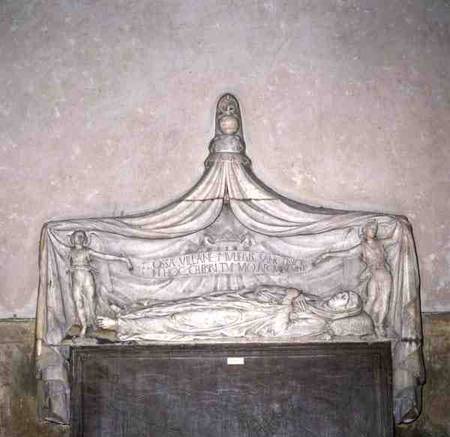
After Catherine’s long and painful death in 1589, many miracles were performed at her tomb. Her cultus soon spread from Prato throughout the whole of Italy and thence to the whole world. The future Pope Benedict XIV, the “devil’s advocate” in Catherine’s cause for canonization, critically examined all relevant claims. As in the case of her younger contemporary, Saint Mary Magdalene de’Pazzi, canonization was not granted because of the extraordinary phenomenon surrounding her life, but for heroic virtue and complete union with Christ (Attwater, Benedictines, Bentley, Dorcy, Encyclopedia, Farmer, Husenbeth, Schamoni, Walsh).

Born: April 23rd 1522 at Florence, Italy

Died: February 2, 1590 at Prato, Italy

Beatified: November 23, 1732 by Pope Clement XII

Canonized: June 29, 1746 by Pope Benedict XIV

Patronage: bodily ills; illness; sick people; sickness

Let Down Your Net Into the Water ~ The Rev. Dcn. Scott Brown, OPI

Gospel      LK 5:1-11

While the crowd was pressing in on Jesus and listening
to the word of God,
he was standing by the Lake of Gennesaret.
He saw two boats there alongside the lake;
the fishermen had disembarked and were washing their nets.
Getting into one of the boats, the one belonging to Simon,
he asked him to put out a short distance from the shore.
Then he sat down and taught the crowds from the boat.
After he had finished speaking, he said to Simon,
“Put out into deep water and lower your nets for a catch.”
Simon said in reply,
“Master, we have worked hard all night and have caught nothing,
but at your command I will lower the nets.”
When they had done this, they caught a great number of fish
and their nets were tearing.
They signaled to their partners in the other boat
to come to help them.
They came and filled both boats
so that the boats were in danger of sinking.
When Simon Peter saw this, he fell at the knees of Jesus and said,
“Depart from me, Lord, for I am a sinful man.”
For astonishment at the catch of fish they had made seized him
and all those with him,
and likewise James and John, the sons of Zebedee,
who were partners of Simon.
Jesus said to Simon, “Do not be afraid;
from now on you will be catching men.”
When they brought their boats to the shore,
they left everything and followed him.


As Christians we face many challenges in these uncertain times. We want to enjoy life, we want to do things that provide us pleasure and act as if we answer to no one. Unless we are spiritually dead we also experience that vague feeling that we should be doing something that makes a difference in the world, something that lightens someone else’s burden or somehow indicates that we are Christians and care about our fellow man.  Our drive to enjoy life and our drive to help our fellow man come together and challenge us to think about what is important to us. On the surface Luke’s story is about fishing, but I believe it is telling us to move out of our comfort zone and sail into uncharted waters for the sake of Christ and his Kingdom. Jesus instructed the fishermen to take their boats to deeper water and cast their nets out for a catch. These fishermen have been fishing all night with nothing to show for their effort, they were tired, and the last thing they needed was fishing advice from a carpenter. These times were much simpler than today, no fish meant no food to these people. They obeyed Jesus and were pleasantly surprised to catch so many fish that their nets were starting to tear. We assume they were greatly pleased.

You may think of this as one of Jesus’s miracles, but in reality, this is more of a physical lesson than a miracle. The lesson I believe he wished to teach us is that we need to leave our comfort zone (the shallow waters) and venture out into the deeper waters to bring people to Jesus. We like to fish in the shallow familiar waters, seeking like minded people, people who have similar experiences, and share our thoughts and feelings. Jesus wants us to venture into the deeper waters and minister to the people who are on the edge of society, those who are under water and feel as if they are drowning in life. As the song “Let Down Your Net, Down into The Water” says:

Verse: 1
There is some of you diseased and afflicted
and sickness reigns in your mind,
you’ve let the prophets of doubt and unbelief convince you
that Jesus don’t heal the sick and blind. 

Jesus does heal the sick and the blind, we just need to find them, take their hands and lead them to the Lord. Where do we find the sick and the blind? Look around you while swimming in the deeper water. You can most likely find them already in your everyday life, at work, at school, or even in your church. Yes some people are just going through the motions, and hoping they are doing it correctly by attending church. Take their hands, answer their questions, listen to their concerns and lead them to our Lord.

Verse: 2
Your soul is so thirsty, your so battle weary
your body’s weak and tired from the pain,
well it’s time to get up stand up on the bible
he’s pouring out that latter rain. 

Come to the lord and be refreshed, be rejuvenated, and be replenished. The Lord will fill your soul with joy and peace, quench that thirst and take away your pain once and for all.

Don’t worry about the water being too deep, Jesus is your lifesaver!

Lord, in your mercy guide us to the deeper water so that we, with your guidance, may bring others to know your love and peace. Allow us to make ourselves available to you so that you can work miracles through us. Help us to make your church flourish by making us into a lighthouse in our community, guiding others to you. Amen

Blessed Bernard Sammacca

Born in Catania, Sicily; died 1486; cultus approved 1825. Born of wealthy and pious parents, Bernard was given a good education. In spite of this good training, he spent a careless youth. Only after he was badly injured in a duel was he brought back to his senses. His long convalescence gave him plenty of time to think, and once he was able to go out of the house, he went to the Dominican convent of Catania and begged to be admitted to the order.

Bernard, as a religious, was the exact opposite of what he had been as a young man. Now he made no effort to obtain the things he had valued all his life, but spent his time in prayer, solitude, and continual penance. There is little recorded of his life, except that he kept the rule meticulously, and that he was particularly kind to sinners in the confessional. Apparently, he did not attain fame as a preacher, but was content to spend his time in the work of the confessional and the private direction of souls.

One legend pictures Bernard as having great power over birds and animals. When he walked outside in the gardens, praying, the birds would flutter down around him, singing; but as soon as he went into ecstasy, they kept still, for fear they would disturb him. Once, the porter was sent to Bernard’s room to call him, and saw a bright light shining under the door. Peeking through the keyhole, he saw a beautiful child shining with light and holding a book, from which Bernard was reading. He hurried to get the prior to see the marvel.

Bernard had the gift of prophecy, which he used on several occasions to try warning people to amend their lives. He prophesied his own death. Fifteen years after his death, he appeared to the prior, telling his to transfer his remains to the Rosary chapel. During this translation, a man was cured of paralysis by touching the relics (Benedictines, Dorcy).

Born: Catania, Sicily (year unknown)

Died: 1486

Canonized: Leo XII confirmed cultus in 1825


Blessed Jordan of Pisa

At a time when scholars believed that no colloquial tongue could ever replace Latin as a gentleman’s language, Jordan worked to make Italian the beautiful tongue that it is today. That’s not the reason he was beatified by the Church but it’s interesting and sometimes overlooked.

Jordan attended the University of Paris where he first encountered the Dominican friars in 1276. Four years later, probably after obtaining his degrees, he returned to Italy and took the habit. He began a long teaching career there as soon as he was qualified to do so.

Because of the excellence of his preaching in Florence, Jordan was appointed first lector there in 1305. He seems to have been fascinated with the whole question of preaching as an apostolic tool, and to have been one of the first to make a scientific study of it. He pointed out that the Greek church was “invaded by a multitude of errors,” because the Greeks had no preachers; he could never say enough in praise of Saint Dominic’s farsightedness in establishing an order specifically for preaching.

Jordan studied methods of making sermons more effective, both by using examples that would reach the people, and by the use of the vernacular. This latter was a much-disputed subject in his day (they had Dan Amon’s then, too); Jordan was considered a daring innovator. Because it was controversial, he strove to make Italian a beautiful instrument on which he could play the melodies of the Lord.

Blessed with an extraordinary memory, Jordan is supposed to have known the breviary by heart, as well as the missal, most of the Bible (with its marginal commentary), plus the second part of the Summa. This faculty of memory he used in his sermons, but he was quick to point out to young preachers that learning alone can never make a preacher. By the holiness of his own life he made this plain, and continually preached it to those he was training to preach.

Jordan of Pisa had two great devotions–to Our Blessed Mother and to Saint Dominic. Once he was favored with a vision of Our Lady; she came into the fathers’ refectory and served at table. Jordan, who was the only one who could see her, could barely eat for excitement. He spoke often of her in his sermons, and also of Saint Dominic. He founded a number of confraternities in Pisa, one of which has lasted until now.

Jordan died on his way to Paris to teach at Saint Jacques. His body was returned from Piacenza, where death overtook him, to rest in the church at Pisa (Benedictines, Dorcy).

Born:1255 at Pisa, Italy

Died: August 19, 1311 at Piacenza of natural causes while on his way to teach in Paris; relics venerated at the church of Saint Catalina at Pisa, Italy

Beatified: August 23, 1833 (cultus confirmed) by Pope Gregory XVI; 1838 (beatification)


Blessed Jordan of Saxony

Men prayed for strength to resist Jordan’s burning eloquence, and mothers hid their sons when Master Jordan came to town. Students and masters warned each other of the fatal magnetism of his sermons. The sweetness of his character and the holiness of his life shone through his most casual words in a flame that drew youth irresistibly to the ideal to which he had dedicated his own life. In his 16 years of preaching, Jordan is said to have drawn more than a thousand novices to the Dominican Order, among whom were two future popes, two canonized saints (e.g., Albert the Great), numerous beati, and countless intellectual lights of his dazzling century.

Of Jordan’s childhood, nothing is known, except that he was born of a noble family. He was drawn to the order in 1220 by the preaching of Blessed Reginald, the beloved son of Dominic, brought back from death by Dominic’s and Our Lady’s prayers. Jordan was at that time about 30, a student at the University of Paris, and his reputation for sanctity had preceded him into the order.

He had worn the habit for only two months when he was sent to Bologna as a delegate to the first general chapter of the order. The following year he was elected provincial of Lombardy, Italy, and on the death of Saint Dominic, succeeded him as master general.

The Order of Preachers was only six years old when Jordan became master general. He carried out the yet untried plans of Dominic, who had hurried off to heaven when many of his dreams were just beginning to open out into realization, and still more vistas beckoned beyond. Under him the new order advanced apace, spreading throughout Germany and into Denmark. Jordan will always be remembered for his work in increasing the manpower of the order, but his contribution to its quality should never be forgotten.

He added four new provinces to the eight already in existence; he twice obtained for the order a chair at the University of Paris and helped found the University of Toulouse; and he established the first general house of studies of the order. He was a spiritual guide to many, including Blessed Diana d’Andalo; and somewhere in his busy lifetime he found time to write a number of books, including a life of Saint Dominic.

Jordan was regarded as a menace by the professors of universities where he recruited novices. He emptied classrooms of their most talented students, stole their most noted professors. Young men by the hundreds besieged the order for admittance. Some were mere children, some famous lawyers and teachers, and some were the wealthy young bearers of the most famous names in Christendom. One and all, they were drawn to a life of perfection by this man who preached so well, and who practiced what he preached with such evident relish.

All the old writers speak of the kindness and personal charm of Jordan. He had the ability to console the troubled and to inspire the despondent with new hope. At one time, a discouraged student was busily saying the Office of the Dead when Master Jordan sat down beside him and began alternating verses with him. When he came to the end of Psalm 26, Jordan said the verse with emphasis: “Oh, wait for the Lord!” Wherewith the sorrows of the young man departed. Another student was rid of troubled thoughts by the mere imposition of Jordan’s hands. To bring peace to the brothers who were being annoyed by the devil, Jordan established the beautiful custom of singing the Salve Regina after Compline each night.

Jordan was shipwrecked and drowned when returning from a pilgrimage to the Holy Land (Benedictines, Dorcy).

Born: 1190 at Padberg Castle, diocese of Paderborn, Westphalia, old Saxony; rumoured to have been born in Palestine while his parents were on a pilgrimage, and named after the River Jordan, but this is apparently aprochryphal

Died: Drowned 1237 in a shipwreck off the coast of Syria while on a pilgrimage to the Holy Land

Beatified: 1825 (cultus confirmed) by Pope Leo XII

Canonized: University of Santo Tomas Faculty of Engineering

Easy Yoke, Light Burden ~ Br. Chip Noon, Novice

Today’s Readings and Gospel follow a specific pattern that speaks to us as Christians and particularly as Dominicans.

The First Reading is God’s hortatory address to Jeremiah but is to be accepted as directed to us as keepers of the flame, or simply as messengers of God’s word…as prophets to the nations. So who are we to hold back? Why do we quaver? “…for I am with you to deliver you, says the Lord.”

The Responsorial Psalm describes how we are to imitate Jesus. Having accepted the mission to spread the Gospel, this is a prayer to our Master to give us the strength, tools, and courage we need to go forth and relay his message. In the psalm, we pray to God that we will be worthy of the task because he is with us, protecting and guiding us. It is like a pep-talk before the big game, a sales meeting before we hit the road.

The Second Reading is a run-through of our mission, touching all the bases, but most especially the whole point of our work: to show the world that God is Love, that we revel in that Love, and that we are passing on the means to our own and the world’s salvation: Love. We, along with Jesus, put up the demons and one-by-one knock them down to replace them with the one honest-go-God’s Truth: Love. And as a bonus, we are given, and we give, the gifts of Faith and Hope, the companions and the servants of Love.

The Alleluia reminds us, in no uncertain terms, that while we are bestowing God’s message we really ought to remember to whom we are truly speaking: the poor, captives, those who most need God’s grace.

And finally, in the Gospel, Jesus tells us exactly what’s probably going to happen to us. We are going to be reviled and rejected. But, like Jesus, if we are true to our calling, and with God’s grace, we will pass through the midst of our tormentors and go on to those who will benefit from our teaching, and thank us for bringing it.

Well. There we are. An easy yoke and a light burden.

Wait a minute, though. Let me go back and think this through again. In today’s Mass we have the preacher’s lesson: God is on our side, we acknowledge our task and pray for success, we give our message as best we can, not forgetting who may need it most, and we prepare ourselves not only for people to heed God’s word, but also for people to scoff at us and drive us away.

These are the readings that we need to memorialize and memorize. I do, anyway.

These are the readings that lay out the simple mission and that show us exactly how it is to be accomplished.

Not bad.

But in fact, frightening as all get-out at times.

And that is exactly why we are expected to become completely familiar with Holy Scripture. Because therein, hidden as well as in plain sight, we have all we need to represent Jesus on earth. In fact, he’s not asking us to perform healing mysteries or loaves and fishes miracles. If we just take today’s Mass to heart, and to soul, we will have all we need to fulfill our vows.

Yes, there will be stumbling blocks. I’ve climbed over (and honestly gone around) many so far. But just as Jesus showed us, we can and we will walk through the negativity and away from the precipice over which some would like to toss us.

So yes, it can be, at times, a frightening path.

For have we not been told in Psalm 126, “ Those who go out weeping, carrying seed to sow, will return with songs of joy, carrying sheaves with them.

Lord may it be so for us, that with your help, we will reap a rich harvest. In Jesus’s name.

Amen.

Jesus the Light of the World! The Presentation of The Lord. (Candlemas). ~ The Very Rev. Lady Sherwood, OPI

Reading 1: MAL 3:1-4

Responsorial Psalm: PS 24:7, 8, 9, 10

Reading 2: HEB 2:14-18

Gospel:  LK 2:22-40 or LK 2:22-32

Today, the church celebrates The Presentation of The Lord. This feast is also known as Candlemas, and this always falls on February 2nd:  40 days after Christmas.

Let us first look at what we are told in the Holy Gospel today in LK 2:22-40 (NABRE):

The Presentation in the Temple. 22 When the days were completed for their purification according to the law of Moses, they took him up to Jerusalem to present him to the Lord,

23 just as it is written in the law of the Lord, “Every male that opens the womb shall be consecrated to the Lord,” 24 and to offer the sacrifice of “a pair of turtledoves or two young pigeons,” in accordance with the dictate in the law of the Lord.

25 Now there was a man in Jerusalem whose name was Simeon. This man was righteous and devout, awaiting the consolation of Israel, and the holy Spirit was upon him. 26 It had been revealed to him by the holy Spirit that he should not see death before he had seen the Messiah of the Lord. 27 He came in the Spirit into the temple; and when the parents brought in the child Jesus to perform the custom of the law in regard to him, 28 he took him into his arms and blessed God, saying:

29 “Now, Master, you may let your servant go

in peace, according to your word,

30 for my eyes have seen your salvation,

31     which you prepared in sight of all the peoples,

32 a light for revelation to the Gentiles,

and glory for your people Israel.”

33 The child’s father and mother were amazed at what was said about him; 34 and Simeon blessed them and said to Mary his mother, “Behold, this child is destined for the fall and rise of many in Israel, and to be a sign that will be contradicted 35 (and you yourself a sword will pierce) so that the thoughts of many hearts may be revealed.” 36 There was also a prophetess, Anna, the daughter of Phanuel, of the tribe of Asher. She was advanced in years, having lived seven years with her husband after her marriage, 37 and then as a widow until she was eighty-four. She never left the temple, but worshipped night and day with fasting and prayer. 38 And coming forward at that very time, she gave thanks to God and spoke about the child to all who were awaiting the redemption of Jerusalem.

The Return to Nazareth. 39 When they had fulfilled all the prescriptions of the law of the Lord, they returned to Galilee, to their own town of Nazareth. 40 The child grew and became strong, filled with wisdom; and the favour of God was upon him.

Today is a day of light. Jesus is the saving light of our often dark world of shadows. Shadow and light are the reality of our earthly lives and of our materialistic world. I feel sure we could all tell a story to some extent, of what it was like to live in the shadowy places of life, some with experience of it more than others. Sometimes we go there by our own choice or by our own actions, but at other times, it may be as a result of someone else’s actions or  through the circumstances of life.

Sometimes we choose to hide ourselves away in the darkness avoiding the light because of our feelings of shame or guilt. We do not want to admit the truth of our lives to ourselves and we do not want others to see that truth about us – our thoughts,  the things we have done, or the things we have left undone. The shadows, we tell ourselves, will cover and hide us. Other times we live in the dark night of fear not knowing what will come next or how we will handle it. There is the sense of powerlessness and life seems out of control. There are those times when the darkness and shadow of sorrow and grief sucks out the life and the light of our world and we seem unable to escape the darkness at that moment. Sometimes we may experience the darkness of ignorance and of confusion. We may be blind to our own identity, lost on the path of our life, wandering seemingly without meaning or direction.

Even when we choose to be in the shadowy places of life, they are always uncomfortable to live in. That discomfort is because of the eternal light of Our Lord and Saviour, Jesus, shining in the darkness. No matter how large the shadows or how dark the night may seem to be, the light of Jesus is still present and can never be extinguished. This is symbolized today  in the candlelight procession of the feast of Candlemas which is held by some churches. That little flickering flame of the candles that are carried are the reminder that Christ – “a light for revelation” – is with you, me, and each of us! When we extinguish those candles the light did not and will not go away. It remains within us and it always has been and always will be. But we must begin to see this light with different eyes.

Sacred Tradition says that Simeon was 270 years old when he met Jesus in the temple and that he was blind. Yet Simeon himself declares to God, “My eyes have seen your salvation.” We could debate about the factual accuracy of Tradition and Scripture. Could Simeon really have been that old? Was he really blind and, if so, how did he see? Such debate and questions will surely miss the truth held before us in both the Scriptures and the Tradition. Yes, Simeon was blind. Yes, Simeon saw salvation. But he did not see with physical eyes. He saw with the eyes of his heart. Simeon experienced an inner seeing. He saw Jesus as the light of Salvation for the world that he is.

That Light of Jesus is revelatory.  It reveals to us mercy and forgiveness in the worldly dark shadows of guilt and shame,  it is the light of presence and courage in the night of fear, of compassion and hope in the darkness of sorrow and loss, a way forward in the blindness of our ignorance and confusion, and is eternal life in the darkness of death. The flame of God’s love consumes the darkness,  it fills us! It frees us to go in peace just as God promised. We have seen salvation and Simeon’s song now becomes our song.

Let us pray:

God, our Father, hear our prayer

and let the radiance of your love

scatter the gloom of our hearts and of our lives.

The light of heaven’s love has restored us to life –

free us from the desires that belong to darkness.

We ask this through our Lord Jesus Christ, your Son,

who lives and reigns with you and the Holy Spirit,

one God, for ever and ever. AMEN

Blessed Mary Mancini of Pisa

Catherine Mancini was born in Pisa in 1355, of noble parentage, and from infancy began enjoying the miraculous favors with which her life was filled. At the age of three, she was warned by some heavenly agency that the porch on which she had been placed by a nurse was unsafe. Her cries attracted the nurse’s attention, and they had barely left the porch when it collapsed. When she was five, she beheld in an ecstasy the dungeon of a place in Pisa in which Peter Gambacorta, one of the leading citizens, was being tortured. At Catherine’s prayer, the rope broke and the man was released. Our Lady told the little girl to say prayers every day for this man, because he would one day be her benefactor.

Catherine would have much preferred the religious life to marriage, but she obeyed her parents and was married at the age of twelve. Widowed at sixteen, she was compelled to marry again. Of her seven children, only one survived the death of her second husband, and Catherine learned through a vision that this child, too, would soon be taken from her.  Thus she found herself, at the age of twenty five, twice widowed and bereft of all her children. Refusing a third marriage, she devoted herself to prayers and works of charity.

She soon worked out for herself a severe schedule of prayers and good works, fasting and mortifications. She tended the sick and the poor, bringing them into her own home and regarding them as Our Lord Himself. She gave her goods to the poor and labored for them with her own hands. Our Lord was pleased to show her that He approved of her works by appearing to her in the guise of a poor young man, sick, and in need of both food and medicine. She carefully dressed his wounds, and she was rewarded by the revelation that it was in reality her redeemer whom she had served.

St. Catherine of Siena visited Pisa at about this time, and the two saintly women were drawn together into a holy friendship. As they prayed together in the Dominican church one day, they were surrounded by a bright cloud, out of which flew a white dove. They conversed joyfully on spiritual matters, and were mutually strengthened by the meeting.

On the advice of St. Catherine of Siena, Catherine (Mary Mancini) retired to an enclosed convent of the Second Order. In religion, she was given the name Mary, by which she is usually known. She embraced the religious life in all its primitive austerity, and, with Blessed Clare Gambarcota and a few other members of the convent, she founded a new and much more austere house, which had been built by Peter Gambacorta. Our Lady’s prophecy of his benefactions was thus fulfilled.

Blessed Mary was favored with many visions and was in almost constant prayer. She became prioress of the house on the death of her friend Blessed Clare Gambacorta, and ruled it with justice and holiness until her death.

She died in 1431 and was beatified by Pius IX in 1855.


Saint Thomas Aquinas

Perhaps the most famous of all the Dominican saints, today is the feast day of St. Thomas Aquinas.

Thomas was born in Roccasecca circa 28 January 1225, in the castle of his father, Count Landulf of Aquino, in Roccasecca, from which the great Benedictine abbey of Montecassino is not quite visible, midway between Rome and Naples, in what is now Sicily.  Through his mother, Theodora, Countess of Theate, Thomas was related to the Hohenstaufen dynasty of Holy Roman emperors.  His family was related to the Emperors Henry VI and Frederick II, and to the Kings of Aragon, Castile, and France. Calo relates that a holy hermit foretold his career, saying to Theodora before his birth: “He will enter the Order of Friars Preachers, and so great will be his learning and sanctity that in his day no one will be found to equal him.”  Landulf’s brother, Sinibald, was abbot of the original Benedictine abbey at Monte Cassino. While the rest of the family’s sons pursued a military career, Thomas was intended to follow his uncle into the abbacy; this would have been a normal career path for the younger son of southern Italian nobility.

At the age of five, Thomas began his early education from the Benedictine monks at Monte Cassino.  Diligent in study, he was thus early noted as being meditative and devoted to prayer, and his preceptor was surprised at hearing the child ask frequently: “What is God?”However, after a military conflict broke out between the Emperor Frederick II and Pope Gregory IX spilled into the abbey in early 1239, Landulf and Theodora had Thomas enrolled at the University of Naples, which had been recently established by Frederick.

At Naples his preceptors were Pietro Martini and Petrus Hibernus. The chronicler says that he soon surpassed Martini at grammar, and he was then given over to Peter of Ireland, who trained him in logic and the natural sciences. The customs of the times divided the liberal arts into two courses: the Trivium, embracing grammar, logic, and rhetoric; the Quadrivium, comprising music, mathematics, geometry, and astronomy. Thomas could repeat the lessons with more depth and lucidity than his masters displayed. The youth’s heart had remained pure amidst the corruption with which he was surrounded, and he resolved to embrace the religious life.

It was here that Thomas was introduced to the words of Aristotle, Averroes and Maimonides, all of which would later influence his theological philosophy.  It was also during his studies in  Naples that Thomas came under the influence of John of St. Julian, a Dominican preacher in Naples, who was part of the active effort by the Dominican order, which had only recently been established, to recruit devout followers.

At the age of nineteen, Thomas resolved to join the Dominican Order. Thomas’s decision to do so did not please his family, who had expected him to become a Benedictine monk.   Some time between 1240 and August, 1243, he received the habit of the Order of St. Dominic, being attracted and directed by John of St. Julian, a noted preacher of the convent of Naples. The city wondered that such a noble young man should don the garb of poor friar. His mother, with mingled feelings of joy and sorrow, hastened to Naples to see her son.

In an attempt to prevent Theodora’s interference in Thomas’s choice, the Dominicans arranged for Thomas to be removed to Rome, and then to Paris.  However, on the  way to Rome, his brothers who were soldiers under the Emperor Frederick, following their mother’s instructions, seized him as he was drinking from a spring near the town of Aquapendente and took him back to his parents, who were then at the castle of Monte San Giovanni Campano. He was held for in the family homes at Monte San Giovanni and Roccasecca in an attempt to prevent him from assuming the Dominican habit, and to convince him to become a Benedictine.   Political concerns prevented the Pope from ordering Thomas’s release, which extended his detention, during which he spent tutoring his sisters and communicating with members of the Dominican Order.  Family members became desperate to dissuade Thomas, who remained determined to join the Dominicans. At one point, two of his brothers hired a prostitute to seduce him, but he drove her away, wielding a burning stick.   According to legend, that night two angels appeared to him as he slept and strengthened his resolve to remain celibate.

The time spent in captivity was not lost. His mother relented somewhat, after the first burst of anger and grief; the Dominicans were allowed to provide him with new habits, and through the kind offices of his sister he procured some books — the Holy Scriptures, Aristotle’s Metaphysics, and the “Sentences” of Peter Lombard. After eighteen months or two years spent in prison, either because his mother saw that the hermit’s prophecy would eventually be fulfilled or because his brothers feared the threats of Innocent IV and Frederick II, he was set at liberty, being lowered in a basket into the arms of the Dominicans, who were delighted to find that during his captivity “he had made as much progress as if he had been in a studium generale.

Thomas immediately pronounced his vows, and his superiors sent him to Rome. Innocent IV examined closely into his motives in joining the Friars Preachers, dismissed him with a blessing, and forbade any further interference with his vocation.  In 1245, Thomas was sent to study at the University of Paris’s Faculty of Arts where he met Dominican scholar Albertus Magnus, then Chair of Theology at the College of St. James.


The theological program Thomas entered in Paris was a grueling one, with the master’s typically attained in the early thirties. Extensive and progressively more intensive study of the scriptures, Old and New Testament, and of the summary of Christian doctrine called the Sentences which was compiled by the twelfth century Bishop of Paris, Peter Lombard. These close textual studies were complemented by public disputations and the even more unruly quodlibetal questions. With the faculty modeled more or less on the guilds, Thomas served a long apprenticeship, established his competence in stages, and eventually after a public examination was named a master and then gave his inaugural lecture.

When Albertus was sent by his superiors to teach at the new studium generale at Cologne in 1248, Thomas followed him, declining Pope Innocent IV’s offer to appoint him as  abbot of Monte Cassino as a Dominican. Albertus then appointed the reluctant Thomas magister studentium. In the schools Thomas’s humility and taciturnity were misinterpreted as signs of dullness, but when Albert had heard his brilliant defense of a difficult thesis, he exclaimed: “We call this young man a dumb ox, but his bellowing in doctrine will one day resound throughout the world.”

Thomas taught in Cologne as an apprentice professor, instructing students in the books of the Old Testament and writing Expositio super Isaiam ad litteram (Literal Commentary on Isaiah), Postilla super Ieremiam (Commentary on Jeremiah), and Postilla super Threnos (Commentary on Lamentations). Then in 1252, he returned to Paris to study for a master’s degree in theology. He lectured on the Bible as an apprentice professor, and upon becoming a baccalaureus Sententiarum (bachelor of the Sentences); he devoted his final three years of study to commenting on Peter Lombard’s Sentences. In the first of his four theological syntheses, Thomas composed a massive commentary on the Sentences entitled Scriptum super libros Sententiarium (Commentary on the Sentences). Aside from his master’s writings, he wrote De ente et essentia (On Being and Essence) for his fellow Dominicans in Paris.

In the spring of 1256, Thomas was appointed regent master in theology at Paris, and one of his first works upon assuming this office was Contra impugnantes Dei cultum et religionem (Against Those Who Assail the Worship of God and Religion), defending the mendicant orders which had come under attack by William of Saint-Amour.   During his tenure from 1256 to 1259, Thomas wrote numerous works, including Questiones disputatae de veritate (Disputed Questions on Truth), which was a collection of twenty-nine disputed questions on aspects of faith and the human condition and which was prepared for the public university debates he presided over on Lent and Advent.  He also wrote   Quaestiones quodlibetales (Quodlibetal Questions), a collection of his responses to questions posed to him by the academic audience;  and both Expositio super librum Boethii De trinitate (Commentary on Boethius’s De trinitate) and Expositio super librum Boethii De hebdomadibus (Commentary on Boethius’s De hebdomadibus), commentaries on the works of 6th century philosopher Anicius Manlius Severinus Boethius.  By the end of his regency, Thomas was working on one of his most famous works, Summa contra Gentiles.

Around 1259, Thomas returned to Naples where he lived until he went to in Orvieto in  September 1261. In Orvieto, he was appointed conventual lector, in charge of the education of friars unable to attend a studium generale. During his stay in Orvieto, Thomas completed his Summa contra Gentiles, and wrote the Catena Aurea (The Golden Chain). He also wrote the liturgy for the newly created feast of Corpus Christi and produced works for Pope Urban IV concerning Greek Orthodox theology, e.g. Contra errores graecorum (Against the Errors of the Greeks).  In 1265 he was ordered by the Dominican Chapter of Agnani to establish a studium for the Order in Rome at the priory of Santa Sabina.  He remained there from 1265 until he was called back to Paris in 1268.   It was while in Rome that Thomas began his most famous work, Summa Theologica, and wrote a variety of other works, such as his unfinished Compendium Theologiae and Responsio ad fr. Ioannem Vercellensem de articulis 108 sumptis ex opere Petri de Tarentasia (Reply to Brother John of Vercelli Regarding 108 Articles Drawn from the Work of Peter of Tarentaise).   In his position as head of the studium, he conducted a series of important disputations on the power of God, which he compiled into his De potentia.

In 1268 the Dominican Order assigned Thomas to be regent master at the University of Paris for a second time, a position he held until the spring of 1272. Part of the reason for this sudden reassignment appears to have arisen from the rise of “Averroism” or “radical Aristotelianism” in the universities. “Averroisms” was the belief that there is no God, that the soul has two parts, one individual and one eternal; the world is eternal; the soul is not eternal.  (During this period in history, Averroism was virtually synonymous with atheism.)  In response to these perceived evils, Thomas wrote two works, one of them being De unitate intellectus, contra Averroistas (On the Unity of Intellect, against the Averroists) in which he blasts Averroism as incompatible with Christian doctrine.   During his second regency, he finished the second part of the Summa and wrote De virtutibus and De aeternitate mundi, the latter of which dealt with controversial Averroist and Aristotelian beginninglessness of the world.   Disputes with some important Franciscans such as Bonaventure and John Peckham conspired to make his second regency much more difficult and troubled than the first. A year before Thomas re-assumed the regency at the 1266–67 Paris disputations, Franciscan master William of Baglione accused Thomas of encouraging Averroists, calling him the “blind leader of the blind”. Thomas called these individuals the murmurantes (Grumblers). In reality, Thomas was deeply disturbed by the spread of Averroism and was angered when he discovered Siger of Brabant teaching Averroistic interpretations of Aristotle to Parisian students.  On 10 December 1270, the bishop of Paris, Etienne Tempier, issued an edict condemning thirteen Aristotlelian and Averroistic propositions as heretical and excommunicating anyone who continued to support them. Many in the ecclesiastical community, the so-called Augustinians, were fearful that this introduction of Aristotelianism and the more extreme Averroism might somehow contaminate the purity of the Christian faith. In what appears to be an attempt to counteract the growing fear of Aristotelian thought, Thomas conducted a series of disputations between 1270 and 1272: De virtutibus in communi (On Virtues in General), De virtutibus cardinalibus (On Cardinal Virtues), De spe (On Hope).

In 1272 Thomas took leave from the University of Paris when the Dominicans from his home province called upon him to establish a studium generale wherever he liked and staff it as he pleased. He chose to establish the institution in Naples, and moved there to take his post as regent master.  He took his time in Naples to work on the third part of the Summa while giving lectures on various religious topics. On 6 December 1273 Thomas was celebrating the Mass of St. Nicholas when, according to some, he heard Christ speak to him.

Christ asked him what he desired, being pleased with his meritorious life. Thomas replied “Only you Lord. Only you.”  After this exchange something happened, but Thomas never spoke of it or wrote it down. Because of what he saw, he abandoned his routine and refused to dictate to his secretary, Reginald of Piperno.  When Reginald begged him to get back to work, Thomas replied: “Reginald, I cannot, because all that I have written seems like straw to me,”    And he seemed to be seriously ill.  What exactly triggered Thomas’s change in behavior is believed to be some kind of supernatural experience of God. After taking to his bed, he did, however, recover some strength.

Looking to find a way to reunite the Eastern Orthodox churches with the Catholic Church (the Eastern Orthodox were excommunicated by the Roman Catholic Church in A.D. 1054 over doctrinal disputes) Pope Gregory X convened the Second Council of Lyon to be held on 1 May 1274 and summoned Thomas to attend.  At the meeting, Thomas’s work for Pope Urban IV concerning the Greeks, Contra errores graecorum, was to be presented.  On his way to the Council, riding on a donkey along the Appian Way, he struck his head on the branch of a fallen tree and became seriously ill again. He was then quickly escorted to Monte Cassino to convalesce.  After resting for a while, he set out again, but stopped at the Cistercian Fossanova Abbey after again falling ill. The Cistercian monks of Fossa Nuova pressed him to accept their hospitality, and he was conveyed to their monastery, on entering which he whispered to his companion: “This is my rest for ever and ever: here will I dwell, for I have chosen it” (Psalm 131:14).  The monks nursed him for several days, and as he received his last rites, he prayed: “I receive Thee, ransom of my soul. For love of Thee have I studied and kept vigil, toiled, preached and taught…” He died on 7 March 1274.

When the devil’s advocate at his canonization process objected that there were no miracles, one of the cardinals answered, “Tot miraculis, quot articulis“—”there are as many miracles (in his life) as articles (in his Summa).” Fifty years after the death of Thomas, on 18 July 1323, Pope John XXII, seated in Avignon, pronounced Thomas a saint.

In a monastery at Naples, near the cathedral of St. Januarius, a cell in which he supposedly lived is still shown to visitors. His remains were placed in the Church of the Jacobins in Toulouse in 1369. Between 1789 and 1974, they were held in Basilique de Saint-Sernin, Toulouse. In 1974, they were returned to the Church of the Jacobins, where they have remained ever since.

In the General Roman Calendar of 1962, in the Roman Catholic Church, Thomas was commemorated on 7 March, the day of death. However, in the General Roman Calendar of 1969, even though the norm in the Roman Catholic Church is to remember saints on the day of their death, Thomas’s memorial was transferred to 28 January, the date of the translation of his relics to Toulouse.

Saint Thomas Aquinas is honored with a feast day on the liturgical of the Episcopal Church in the United States of America on 28 January.


Swimming in the Deep End ~ The Rt. Rev. Michael R. Beckett, OPI

I love the pool!  I love to people watch!  We live at the beach in a vacation community. During the summer there are lots of folks here, and there is a buzz of excitement and laughter and shouting and just noise.  A good chunk of that noise comes from the folks in the pool and the pool is a great place to watch people.  In the shallow end of the pool there is the sound of all those excited children of different ages and abilities and sometimes it can be deafening.  They laugh, they yell, they run.  They cry.  There are no inside voices in the shallow end of the pool.  It’s loud!

Funny thing, though, the only sounds coming from the deep end of the pool are the sounds of experienced swimmers, swimming with discipline and confidence. There is no yelling, no crying, no complaining, no evidence of fear or frustration. They seem to know what they are doing, and are doing it well.

This leads me to believe that all the noise that comes from the shallow end of the pool comes from those who haven’t learned to swim with confidence or are not secure enough to venture into the deep water.

Sadly, many Christians reflect this clearly. The noise comes from the shallow end, not the deep end. Think about it.  The American church-attending public is very style conscious, politically conscious, quite vocal about political issues, and is basically made up of consumers of religion.

In any city there are churches saying in like manner:

“Come to our church. Our preacher doesn’t wear a tie. Our preacher wears golf shirts and jogging shoes.”
“Come to our church! We wear shorts and sandals.”
“We’re fundamental.”
“We’re liturgical.”
“We’re liberal.”
“We’re moderate.”
“We’re denominational.”
“We’re mainline.”
“We’re dispensational.”
“We have video.”
“We have snare drums and screens.”
“We’re into political reform.”
“We have a religious superstar preaching today.”

“We use the King James version.”

Everyone is out front, just like carnival barkers, pushing their style, their religious product, but when we get inside those churches, we find, just like at the carnival, that no one knocks out the balloons or knocks down the bottles. No one wins the prize. No lives are changed. The church of the big idea, the church of the big action, the church of politics, and the church of the big deal somehow leave us empty. Something is missing.  We find that those folks who are the most vocal about issues and politics are often those who reflect very little Jesus.

I have realized in recent years that all we do to establish our niche in the church market may be a cover for an empty heart, a shallow commitment, and a secular mindset. Let’s start the other way. Let’s build on a foundation, a strong commitment to Jesus Christ and see what happens.

Unless a church’s foundation is Jesus Christ, there is no substance, no power. It is sound and fury. It is chaff. If Jesus Christ is the foundation, walks the halls, sits in the pews, and is in our classes, if he interprets the Bibles and sings our hymns, preaches our sermons, then we will know and do our mission effectively. If we do not realize that EVERY person is a part of the body of Christ, we will continue to be ineffective and to divide the church, the nation, and the world.

The Epistle from this morning makes it clear that the church is Christ’s body on earth.

God gives different gifts to different people.  Some, a passion for peace; Others,  a passion for political freedom.  Some,  a passion for life and its sacredness, Others, a passion for forgiveness and mercy.  Some, a passion for a more closed interpretation of the Bible, Others, a passion for a more open interpretation of the Bible.  Some, a passion for evangelism, Others, a passion for justice.  All of these people believe they are working for the common good.  Each and every one of these people  are inspired by the one and same Spirit, the Spirit who gives to each person their unique and different perspective.  For just as the human body is a unified whole, composed of millions of different parts, so is Christ and his body.  The upshot here, though, is that we must be the body of Christ, who taught us to love our neighbors as ourselves.  The Christ who taught us to do unto others as we would have them do unto us.  The Christ who taught us to love and to pray for our enemies.

Each of us needs a passionate commitment to Jesus, not a passionate commitment to political, ideological, or stylistic ideas. We don’t need to focus on consumer desires or even on one frame of reference theologically. We have lost our focus.  We are concentrating on everything and everyone except our Lord.

We have to change this.  We have to rediscover our faith, our Jesus.  When we rediscover Jesus Christ, our lives will be revitalized. We must rediscover the beauty, the majesty, and the power of a strong commitment to Jesus Christ. When that happens, we will not get bent out of shape about walls and politics. The central question will be, “Did we meet Jesus?” not “Was my opinion supported today?”

To say that Jesus Christ is the root and foundation, the cornerstone, the vine, is not a way of evading issues. This is calling the church to understand that we are Jesus people. We are members of his body, and the church in all of its power and strength needs to rediscover Jesus.  Yes, issues are important.  Yes, we should be politically aware. However, if we do not view issues through the lens of the Gospel, if we are not acting on our political awareness with love, we are nothing, will be nothing, and certainly will not be effective.  If we do not work for those political and social issues while demonstrating the love of Christ, our love FOR Christ, then we have nothing, are nothing.

If you have these passions in your heart, these workings, but if you don’t have love inside of you for your brothers and sisters who think and feel differently than you, you are nothing. The greatest gift that God has for you is love. Love for people who don’t think like you. Love for people who do not share your point of view on specific issues. You are to make love, your goal, your aim, your greatest purpose for life.

When we rediscover Jesus Christ, our belief will be strengthened and focused. When the church rediscovers Jesus Christ, the people will come for the show, but they will stay to grow. The only noise we will hear in a church, on our streets, in our Facebook feeds, will be people swimming from the shallow end to the deep end of the pool because they feel safe in deep water.