Blessed Jordan of Pisa

img-blessed-jordan-of-pisa

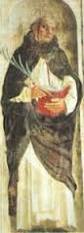
At a time when scholars believed that no colloquial tongue could ever replace Latin as a gentleman’s language, Jordan worked to make Italian the beautiful tongue that it is today. That’s not the reason he was beatified by the Church but it’s interesting and sometimes overlooked.

Jordan attended the University of Paris where he first encountered the Dominican friars in 1276. Four years later, probably after obtaining his degrees, he returned to Italy and took the habit. He began a long teaching career there as soon as he was qualified to do so.

Because of the excellence of his preaching in Florence, Jordan was appointed first lector there in 1305. He seems to have been fascinated with the whole question of preaching as an apostolic tool, and to have been one of the first to make a scientific study of it. He pointed out that the Greek church was “invaded by a multitude of errors,” because the Greeks had no preachers; he could never say enough in praise of Saint Dominic’s farsightedness in establishing an order specifically for preaching.

Jordan studied methods of making sermons more effective, both by using examples that would reach the people, and by the use of the vernacular. This latter was a much-disputed subject in his day (they had Dan Amon’s then, too); Jordan was considered a daring innovator. Because it was controversial, he strove to make Italian a beautiful instrument on which he could play the melodies of the Lord.

Blessed with an extraordinary memory, Jordan is supposed to have known the breviary by heart, as well as the missal, most of the Bible (with its marginal commentary), plus the second part of the Summa. This faculty of memory he used in his sermons, but he was quick to point out to young preachers that learning alone can never make a preacher. By the holiness of his own life he made this plain, and continually preached it to those he was training to preach.

Jordan of Pisa had two great devotions–to Our Blessed Mother and to Saint Dominic. Once he was favored with a vision of Our Lady; she came into the fathers’ refectory and served at table. Jordan, who was the only one who could see her, could barely eat for excitement. He spoke often of her in his sermons, and also of Saint Dominic. He founded a number of confraternities in Pisa, one of which has lasted until now.

Jordan died on his way to Paris to teach at Saint Jacques. His body was returned from Piacenza, where death overtook him, to rest in the church at Pisa (Benedictines, Dorcy).

Born:1255 at Pisa, Italy

Died: August 19, 1311 at Piacenza of natural causes while on his way to teach in Paris; relics venerated at the church of Saint Catalina at Pisa, Italy

Beatified: August 23, 1833 (cultus confirmed) by Pope Gregory XVI; 1838 (beatification)

Blessed Henry of Suso ~ Servant of the Eternal Wisdom

st-henry-suso-blessed

His father belonged to the noble family of Berg; his mother, a holy woman from whom he took his name, to a family of Sus (or Süs). When thirteen years of age he entered the Dominican convent at Constance, where he made his preparatory, philosophical, and theological studies.

From 1324 to 1327 he took a supplementary course in theology in the Dominican studium generale at Cologne, where he sat at the feet of Johann Eckhart, “the Master”, and probably at the side of Tauler, both celebrated mystics. Returning to Constance, he was appointed to the office of lector, from which he seems to have been removed some time between 1329 and 1334. In the latter year he began his apostolic career. About 1343 he was elected prior of a convent, probably at Diessenhofen. Five years later he was sent from Constance to Ulrn where he remained until his death.

Suso’s life as a mystic began in his eighteenth year, when giving up his careless habits of the five preceding years, he made himself “the Servant of the Eternal Wisdom”, which he identified with the Divine essence and, in a concrete form, with the personal Eternal Wisdom made man. Henceforth a burning love for the Eternal Wisdom dominated his thoughts and controlled his actions. He had frequent visions and ecstasies, practised severe austerities (which he prudently moderated in maturer years), and bore with rare patience corporal afflictions, bitter persecutions and grievous calumnies.

He became foremost among the Friends of God in the work of restoring religious observance in the cloisters. His influence was especially strong in many convents of women, particularly in the Dominican convent of Katherinenthal, a famous nursery of mysticism in the thirteenth and fourteenth centuries, and in that of Toss, where lived the mystic Elsbeth Stagel, who turned some of his Latin into German, collected and preserved most of his extant letters, and drew from him the history of his life which he himself afterwards developed and published.

In the world he was esteemed as a preacher, and was heard in the cities and towns of Swabia, Switzerland, Alsace, and the Netherlands. His apostolate, however, was not with the masses, but rather with individuals of all classes who were drawn to him by his singularly attractive personality, and to whom he became a personal director in the spiritual life.

It has often been incorrectly said that he established among the Friends of God a society which he called the Brotherhood of the Eternal Wisdom. The so-called Rule of the Brotherhood of the Eternal Wisdom is but a free translation of a chapter of his “Horologium Sapientiae”, and did not make its appearance until the fifteenth century.

HIS WRITINGS

The first writing from the pen of Suso was the “Büchlein der Wahrheit”, which he issued while a student at Cologne. Its doctrine was unfavourably criticized in some circles — very probably on account of its author’s close relations with Eckhart, who had just been called upon to explain or to reject certain propositions — but it was found to be entirely orthodox.

As in this, so in his other writings Suso, while betraying Eckhart’s influence, always avoided the errors of “the Master”. The book was really written in part against the pantheistic teachings of the Beghards, and against the libertine teachings of the Brethren of the Free Spirit. Father Denifle considers it the most difficult “little book” among the writings of the German mystics.

Whereas in this book Suso speaks as a contemplative and to the intellect, in his next, “Das Büchlein der ewigen Weisheit”, published early in 1328, he is eminently practical and speaks out of the fullness of his heart to “simple men who still have imperfections to be put off”. Bihlmeyer accepts Denifle’s judgment that it is the “most beautiful fruit of German mysticism”, and places it next to the “Homilies” of St. Bernard, and the “Imitation of Christ” by Thomas à Kempis. In the second half of the fourteenth and in the fifteenth century there was no more widely read meditation book m the German language.

In 1334 Suso translated this work into Latin, but in doing so added considerably to its contents, and made of it an almost entirely new book, to which he gave the name “Horologium Sapientiae”. Even more elevating than the original, finished in language, rich in figure, rhythmic in movement, it became a favourite book in the cloisters at the close of the Middle Ages, not only in Germany, but also in the Netherlands, France, Italy, and England.

To the same period of Suso’s literary activity may belong “Das Minnebüchlein” but its authenticity is doubtful.

After retiring to Ulm Suso wrote the story of his inner life (“Vita” or “Leben Seuses”), revised the “Büchlein der Wahrheit”, and the “Büchlein der ewigen Weisheit”, all of which, together with eleven of his letters (the “Briefbüchlein”), and a prologue, he formed into one book known as the “Exemplar Seuses”.

Suso is called by Wackernagel and others a “Minnesinger in prose and in the spiritual order.” The mutual love of God and man which is his principal theme gives warmth and colour to his style. He used the full and flexible Alamannian idiom with rare skill, and contributed much to the formation of good German prose, especially by giving new shades of meaning to words employed to describe inner sensations. His intellectual equipment was characteristic of the schoolmen of his age. In his doctrine there was never the least trace of an unorthodox tendency.

For centuries he exercised an influence upon spiritual writers. Among his readers and admirers were Thomas à Kempis and Bl. Peter Canisius.

The Catholic Encyclopedia, Volume VII
Nihil Obstat, June 1, 1910, Remy Lafort, S.T.D., Censor
Imprimatur. +John Cardinal Farley, Archbishop of Ne

Born: March 21, 1295 at Uberlingen, Germany as Heinrich von Berg

Died: January 25, 1361 at Ulm, Germany

Beatified: 1831 by Pope Gregory XVI

Representation: Dominican with the Holy Name on his chest

Works: Book of the Eternal Wisdom, The Thirst of God

Ashes Thou Art ~ Ash Wednesday ~ Br. Brent Whetstone

2017020141col_ash_wednesday_1200x550
Lack of proper catechesis is killing the church. Today begins a season of self-reflection on our mortality. It is supposed to be a time where we focus inwardly on who we are as Christians, demonstrated by one act, one ancient act of repentance and holiness:  the act of the imposition of ashes. This one act shows the world that we are followers of Christ. It is not to draw attention to ourselves…but to the sacrifice he made for us.

Sadly, however, this incredibly holy day in the church year, like most things in the church, has been hijacked. It has been hijacked by attention seekers and the one-uppers. From glitter ash…. apparently made from the souls of dead unicorns and used to promote an agenda, to ashes to go, and drive-through services, the solemnity of the observance of Ash Wednesday has been thrown out the window to make way for special interest groups to have the spotlight thrust upon themselves for all the world to see.

It bothers me greatly to see that this solemn day is being used as a day to draw attention away from Christ. Don’t get me wrong, there is some good that can come from ministers being out in the town square with ashes to go. I know that some, like my friend David and his church are out doing ministry and meeting people where they need to be met, but there must be limits, and this holy day should not be used for secular purposes.

Now that we know what Ash Wednesday is not, I want to talk a little bit about what Ash Wednesday is and why Lent is 40 days long.  According to the Gospels, Jesus spent the 40 days in the desert fasting. It was there that he was tempted by Satan and overcame those temptations. As Christians, we make preparations for Easter by fasting for the 40 days of Lent. To begin this 40 day fast we have a service called the Ash Wednesday service, where palms from the previous year’s Palm Sunday are burned and the ash is used by the priest to mark our foreheads with the sign of the cross.

But why ashes? Ashes being used as a sign of repentance or of sorrow actually have a biblical basis at its roots. In the Old Testament, we see several examples of this.  From the book of Job: ” I have heard of thee by the hearing of the ear: but now mine eye seeth thee. Wherefore I abhor myself, and repent in dust and ashes.”  The prophet Jeremiah calls for repentance by saying: “O daughter of my people, gird on sackcloth, roll in the ashes.” Both of these instances are outward signs of repentance using ashes.  Ashes as a sign of repentance is not only something found in the Old Testament.  We see ashes used in the New Testament as well; as a matter of fact, both in the Gospel of Saint Matthew and the Gospel of Saint Luke, Jesus speaks of the practice, “If the mighty works done in you had been done in Tyre and Sidon, they would have repented long ago (sitting) in sackcloth and ashes.”

Ashes are an important sign of our repentance. Ash Wednesday is the day that we mark our 40 day journey of repentance with a simple of act that has so much power and meaning behind it. When the priest or minister takes his thumb and dips it in the ashes and makes the sign of the cross on our foreheads we are acknowledging our willingness to start the journey to the cross with Christ. To reflect on our own faults, to strive to be better Christians, to outwardly say we are sinners in need of a savior. There is nothing political about Ash Wednesday. The only focus should be on those words, “you are dust and to dust you will return.”

Let us pray: Almighty God, you have created us out of the dust of the earth: Grant that these ashes may be to us a sign of our mortality and penitence, that we may remember that it is only by your gracious gift that we are given everlasting life; through Jesus Christ our Savior. Amen.


Blessed Villana

545

Blessed Villana was the daughter of Andrew de’Botti, a Florentine merchant, and was born in 1332. When she was thirteen she ran away from home to enter a convent but her attempts were unsuccessful and she was forced to return. To prevent any repetition of her flight, her father shortly afterwards gave her in marriage to Rosso di Piero. After her marriage she appeared completely changed; she gave herself up to pleasure and dissipation and lived a wholly idle and worldly life. One day, as she was about to start for an entertainment clad in a gorgeous dress adorned with pearls and precious stones, she looked at herself in a mirror. To her dismay, the reflection that met her eyes was that of a hideous demon. A second and a third mirror showed the same ugly form.

Thoroughly alarmed and recognizing in the reflection the image of herself sin-stained soul, she tore off her fine attire and, clad in the simplest clothes she could find, she betook herself weeping to the Dominican Fathers at Santa Maria Novella to make a full confession and to ask absolution and help. This proved the turning point of her life, and she never again fell away. Before long Villana was admitted to the Third Order of St. Dominic, and after this she advanced rapidly in the spiritual life. Fulfilling all her duties as a married woman, she spent all her available time in prayer and reading. She particularly loved to read St. Paul’s Epistles and the lives of the saints. At one time, in a self-abasement and in her love for the poor, she would have gone begging for them from door to door had not her husband and parents interposed. So completely did she give herself up to God that she was often rapt in ecstacy, particularly during Mass or at spiritual conferences; but she had to pass through a period of persecution when she was cruelly calumniated and her honor was assailed.

Her soul was also purified by strong pains and by great bodily weakness. However, she passed unscathed through all these trials and was rewarded by wonderful visions and olloquies with our Lady and other saints. Occasionally the room in which she dwelt was filled with supernatural light, and she was also endowed with the gift of prophecy. As she lay on her deathbed, she asked that the Passion should be read to her, and at the words “He bowed His head and gave up the ghost”, she crossed her hands on her breast and passed away. Her body was taken to Santa Maria Novella, where it became such an object of veneration that for over a month it was impossible to proceed with the funeral.

People struggled to obtain shreds of her clothing, and she was honored as a saint from the day of her death. Her bereaved husband use to say that, when he felt discouraged and depressed, he found strength by visiting the room in which his beloved wife had died.

Born: 1332 in Florence, Italy

Died: December of 1360 of natural causes; body taken to Santa Maria Novella; the Fathers were unable to bury her for a month due to the constant crowd of mourners

Beatified: March 27 1824 (cultus confirmed) by Pope Leo XII


Birds and Flowers and Faith ~ Br. Chip Noon, Novice

birdsinthesky

Do not worry about tomorrow; tomorrow will take care of itself.
Sufficient for a day is its own evil.” This is from today’s Gospel.

The last several weeks have been a particular trial for me…physically and emotionally. It has seemed like there is no anchorage. I felt helplessly adrift, even having fleeting thoughts of calling my mother for advice…my mother who has been gone these last six years.

I, who usually know exactly what I’m doing and what I will do, I who have been asked innumerable times during my life, “So what is your advice here, Chip?”

Adrift and alone in an endless ocean with no lighthouses, harbor buoys, or navigation by the stars.

And then, in preparation for this homily, I turn to the USCCB site for the readings for February 26th and what do I find? “I will never forget you,” says the Lord.

He only is my rock and my salvation, my stronghold.”

Therefore do not make any judgment before the appointed time…”

The word of God is living and effective;
discerning reflections and thoughts of the heart.”

Do not worry about tomorrow; tomorrow will take care of itself.
Sufficient for a day is its own evil.”

And as has happened so many times before, a mantel of serenity descended upon me and left me comforted.

Every single one of today’s readings has the same message: I am loved and all I need do is trust in God.

Then why do we kick against the traces? How is it we are lured down the path of worry and anxiety? What does being ill at ease gain us?

Well, in my case, if I examine the past few weeks, I think, and erroneously, that that path will lead me to something or someone who will say, “It’s OK, Chip.” I suppose when times get tough, we may get going but we also look for comfort from external sources: spouses, parents, friends, strong leaders. We can’t help it…we’re human, after all. I remember reading several biographies of General George S. Patton from World War II. He was tough, competent, aggressive, and yet he constantly had to tell himself, “Do not take counsel of your fears.” We are all children at our core.

But that’s a biological truth. We are all children. Even to our dying day. We are all seeking comfort, peace, protection. So if that’s the case, that we are all like this, then it must be a gift…or a curse…from God. A curse if we don’t pay attention to what God tells us time and time again: “Quit worrying…I’ve got your back.”

But a gift if we do pay attention, if we adopt a daily exercise of admitting our childhood state, then it’s a part of that exercise to ask God for help. “I’m your child. I need your help.”

There, how hard is that? “I’m your child. I need your help.”

Oh…there’s one other part of the exercise…we have to wait for God’s help with all trust and anticipation. Because as he tells us, “…for behold, the kingdom of God is within you.”

Lord, make us like little children who want to be held. Help us to turn our will over to you who provide all things for all of us. And Lord, help us to seek first your kingdom and find it everywhere we are.

Amen.

Blessed Constantius

constantius-of-fabriano

Constantius Bernocchi is as close to a ‘sad saint’ as it’s possible for a Dominican to get; he is said to have had the gift of tears. However, that is not his only claim to fame. Constantius had a remarkable childhood, not only for the usual signs of precocious piety, but also for a miracle that he worked when he was a little boy. Constantius had a sister who had been bedridden most of her nine years of life. One day, the little boy brought his parents in to her bedside and made them pray with him. The little girl rose up, cured, and she remained well for a long and happy life. Naturally, the parents were amazed, and they were quite sure it had not been their prayers that effected the cure, but those of their little son.

Constantius entered the Dominicans at age 15, and had as his masters Blessed Conradin and Saint Antoninus. He did well in his studies and wrote a commentary on Aristotle. His special forte was Scripture, and he studied it avidly. After his ordination, he was sent to teach in various schools in Italy, arriving eventually at the convent of San Marco in Florence, which had been erected as a house of strict observance. Constantius was eventually appointed prior of this friary that was a leading light in the reform movement. This was a work dear to his heart, and he himself became closely identified with the movement.

Several miracles and prophecies are related about Constantius during his stay in Florence. He one day told a student not to go swimming, because he would surely drown if he did. The student, of course, dismissed the warning and drowned. One day, Constantius came upon a man lying in the middle of the road. The man had been thrown by his horse and was badly injured; he had a broken leg and a broken arm. All he asked was to be taken to some place where care could be given him, but Constantius did better than that–he cured the man and left him, healed and astonished.

Constantius was made prior of Perugia, where he lived a strictly penitential life. Perhaps the things that he saw in visions were responsible for his perpetual sadness, for he foresaw many of the terrible things that would befall Italy in the next few years. He predicted the sack of Fabriano, which occurred in 1517. At the death of Saint Antoninus, he saw the saint going up to heaven, a vision which was recounted in the canonization process.

Blessed Constantius is said to have recited the Office of the Dead every day, and often the whole 150 Psalms, which he knew by heart, and used for examples on every occasion. He also said that he had never been refused any favor for which he had recited the whole psalter. He wrote a number of books; these, for the most part, were sermon material, and some were the lives of the blesseds of the order.

On the day of Constantius’s death, little children of the town ran through the streets crying out, “The holy prior is dead! The holy prior is dead!” On hearing of his death, the city council met and stated that it was a public calamity.

The relics of Blessed Constantius have suffered from war and invasion. After the Dominicans were driven from the convent where he was buried, his tomb was all but forgotten for a long time. Then one of the fathers put the relics in the keeping of Camaldolese monks in a nearby monastery, where they still remain (Benedictines, Dorcy, Encyclopedia).

Born: Born in the early part of the 15th century in Fabriano, Marches of Ancona, Italy

Died: 1481 of natural causes; the local senate and council assembled at the news of his death, proclaimed it a “public calamity”, and voted to pay for the funeral

Beatified: 1821 (cultus confirmed) by Pope Pius VII

St. Polycarp: Counting the Cost ~ The Very Rev. Lady Sherwood, OPI


polycarp-miracle

Reading 1: SIR 5:1-8

R psalm: PS 1:1-2, 3, 4+6

Gospel: MK 9:41-50

Do not be afraid of those who kill the body but cannot kill the soul. Rather, be afraid of the one who can destroy both body and soul in hell.(MT 10:28 NIV)

We are not of this world if we are of Christ, and are only temporarily passing through. The world does not understand us and has hate for us. To be truly of Christ means that like he did, we must take up our crosses and follow him no matter what the world thinks of us. The minimum we are likely to get is to be called heretic, but at the worst, we could be called to suffer death to follow our Lord, and this is what happened to St Polycarp who we commemorate today.

Polycarp was a disciple of John the Apostle and it was John who consecrated Polycarp as Bishop of Smyrnia. Together with Clement of Rome and Ignatius of Antioch, Polycarp is regarded as one of the three chief Apostolic Fathers.

Polycarp was 86 years old when he was called to give his life for the Lord. It was a time in Rome, when the Roman Emperor was seen as a God and was worshipped, but Polycarp refused to denounce Christ and to follow this false God.

Polycarp was threatened by the men of Caesar that he would be thrown into a pit of wild animals if he did not denounce Christ, but Polycarp refused to budge. He escaped and hid on a farm and it was there that he had a dream about his pillow catching fire, and he knew it meant the Lord’s will for him was to be burned alive. Polycarp was resigned to his fate and in prayer, he even thanked God and praised him.

Polycarp was found, arrested, tied, and the fire was lit to burn him, but the flames formed an arch over him and his body was untouched. Instead of the expected look and smell of burning flesh, Polycarp glowed like golden baking bread and the fragrance was sweet like perfume. Because the fire didn’t touch him, they then stabbed Polycarp with a dagger, he succumbed to bodily death, and his blood poured and extinguished the flames of the fire.

After the death of Polycarp, his bones were stolen from the remains of the fire to celebrate his martyrdom. Polycarp gained the Crown of martyrdom on February 23rd 156.

Polycarp is an excellent example of living for God, accepting his will and trusting in him completely. He knew that Christ by giving his own earthly life for our salvation, meant that whilst the body may be harmed, the Spirit is eternal for a true follower of God and that there is nothing to fear.

Let us take the example of Polycarp into our lives, and fully live the will of God without complaint and with joy of thanks and praise to our heavenly Father.

Let us pray:

Saint Polycarp, sometimes Christ seems so far away from us. Centuries have passed since he and the Apostles walked upon the earth. Help us to realize that he is close to us always and that we keep him close by imitating his life as you did.

Amen.

Blessed Alvarez of Cordova

bl-alvarez-ofcordoba-sm

Blessed Alvarez is claimed by both Spain and Portugal. He received the habit in the convent of Saint Paul in Cordova in 1368, and had been preaching there for some time in Castile and Andalusia when Saint Vincent Ferrer began preaching in Catalonia. Having gone to Italy and the Holy Land on a pilgrimage, Alvarez returned to Castile and preached the crusade against the infidels. He was spiritual advisor to the queen-mother of Spain, Catherine daughter of John of Gaunt, and tutor to her son John II. Alvarez had the work of preparing the people spiritually for the desperate effort to banish the Moors from Spain. He also opposed the Avignon pope Peter de Luna.

Blessed Alvarez is probably best remembered as a builder of churches and convents, an activity which was symbolic of the work he did in the souls of those among whom he preached. He founded, in one place, a convent to shelter a famous image of Our Lady, which had been discovered in a miraculous manner. Near Cordova he built the famous convent of Scala Coeli, a haven of regular observance. It had great influence for many years. His building enterprises were often aided by the angels, who, during the night, carried wood and stones to spots convenient for the workmen.

The austerities of Alvarez were all the more remarkable in that they were not performed by a hermit, but by a man of action. He spent the night in prayer, as Saint Dominic had done; he wore a hairshirt and a penitential chain; and he begged alms in the streets of Cordova for the building of his churches, despite the fact that he had great favor at court and could have obtained all the money he needed from the queen. He had a deep devotion to the Passion, and had scenes of the Lord’s sufferings made into small oratories in the garden of Scala Coeli.

On one occasion, when there was no food for the community but one head of lettuce left from the night before, Blessed Alvarez called the community together in the refectory, said the customary prayers, and sent the porter to the gate. There the astonished brother found a stranger, leading a mule; the mule was loaded with bread, fish, wine, and all things needed for a good meal. The porter turned to thank the benefactor and found that he had disappeared.

At another time, Blessed Alvarez was overcome with pity at a dying man who lay untended in the street. Wrapping the man in his mantle, he started home with the sufferer, and one of the brothers asked what he was carrying. “A poor sick man,” replied Alvarez. But when they opened the mantle, there was only a large crucifix in his arms. This crucifix is still preserved at Scala Coeli.

Blessed Alvarez died and was buried at Scala Coeli. An attempt was made later to remove the relics to Cordova, but it could not be done, because violent storms began each time the journey was resumed, and stopped when the body was returned to its original resting place.

Founded Escalaceli (Ladder of Heaven), a Dominican house of strict observance in the mountains around Cordova; it became a well known center of piety and learning. Alvarez spent his days there preaching, teaching, begging alms in the street, and spending his nights in prayer. In the gardens of the house he set up a series of oratories with images of the Holy Lands and Passion, similar to modern Stations of the Cross.

A bell in the chapel of Blessed Alvarez, in the convent of Cordova, rings of itself when anyone in the convent, or of special not in the order, is about to die (Benedictines, Dorcy).

There are many wonderful stories attached to Alvarez, which include:

Angels are reported to have helped built Escalaceli, moving stone and wooden building materials to the site during the night, placing them where workmen could easily get them during the day.
Once when the entire food stocks for the house consisted of a single head of lettuce, he gathered all the brothers at table, gave thanks for the meal, and sent the porter to the door; the porter found a stranger leading a mule loaded with food. After unloading the mule, the stranger and the animal disappeared.
Alvarez once found a beggar dying alone in the street. He wrapped the poor man in his own cloak, and carried him back to Escalaceli. When he arrived at the house and unwrapped the cloak, instead of man, he found a crucifix. It still hangs in Escalaceli.
A bell in the chapel with Alvarez’s relics rings by itself just before the death of anyone in the house.
Attempts were made to move Alvarez’s relics to Cordova, but each try led to violent storms that kept the travelers bottled up until they gave up their task, leave the bones where they are.

Born: Born about the middle of the 14th century in Cordova, Spain

Died: 1420

Beatified: Cultus confirmed September 22 by Benedict XIV in 1741


Perfection Through Perfect Love ~ Br. Brenden Humberdross, Novice

magnasco_alessandro_-_hermit_in_the_desert_-_google_art_project

Open our ears, O Lord, to hear your word and know your voice. Speak to our hearts and strengthen our wills that we may serve you now and always. Amen.

Anyone perusing the stories of the Old Testament for the first time will quickly come to realise that the history of Israel is full of stories of violence, revenge and bitter rivalries. In numerous places Israel is allowed to take revenge for the wrongs done to them and in today’s Gospel reading Jesus highlights this fact twice by saying:

“You have heard that it was said,
An eye for an eye and a tooth for a tooth” and

“You have heard that it was said,
You shall love your neighbor and hate your enemy”

To the Jew of Christ’s time these would have been familiar ideas, and principles that their lives have been lived by. In hearing Christ use these words those listening would have likely been awaiting to hear a discourse of the righteous judgements of Israel and their right to punish those who have wronged them and to resists the evils perpetrated against them. However, in His typical style the message that the Saviour delivers to the gathered crowd is absolutely counter to their cultural experience.

In the words of Jesus those of us who are called to follow His path are called not to lives of vengeance and righteous retribution but to love, and this love extends to all of humanity, friend and enemy alike. This life of love is not only transformative for the world and people around us but is an essential part of the path that will lead to our salvation.

I’m sure that each and every one of us has been faced with a situation where we’ve been treated badly or someone’s done something to hurt us. If we allow our minds to wonder through these events and are honest with ourselves I’m sure we’d find that our first thoughts are often of how to even the score, how to get our own back and level the playing field. It seems that there’s nothing more natural than for a person to want what’s often seen as natural justice to occur, for the thief to have to return their spoils and have their freedom stolen through imprisonment, for the violent individual to be the recipient of violence or for the murderer to receive the punishment of State sanctioned execution.

I‘ve even heard Christians justify their convictions in these matters by quoting the very Old Testament scriptures that Jesus did in today’s Gospel. It seems that when we’re faced with hurt that the most natural human state is revenge, however, Jesus clearly points out to us that this seeking of revenge and “natural justice” is far from natural at all and is in fact part of our fallen condition.

In fact the Saviour points out to us that the most natural and perfect state for the hurt and the wronged is the exact opposite of revenge and hate; it’s love! In the reading this morning Jesus tells us directly that when we encounter evil we’re not to resist it, that we should welcome it and “turn the other cheek” to take a double portion of the evil being delivered.

It seems so counter intuitive to me to do this, why on earth would we ever let someone strike us a second time? Why would we let a thief not only take the expensive watch from our wrist but, unprompted, take the wallet from our pocket and give that to them to? It’s because of that higher law that I spoke of last week, the law of love. I have heard our Eastern Brethren share a story of the Desert Fathers to illustrate this point.

One day a Desert Father is away from his shack wandering the deserted paths, praying and contemplating. When he returns home he finds that there are strangers there stripping his dwelling of what few possessions he has. The Father is perturbed and concerned and falls to his knees in the corner of his small dwelling and instead of praying for deliverance, he begins to pray for the thieves, their safety and their wellbeing. At this the thieves are confused and worried, so they grab the last of the things from the dwelling and get out of there.

The story doesn’t end here though, on rising from his prayers for the thieves the Father notices that his walking stick has been left behind. He moves over to it, picks it up, and sets off out the door. Instead of going to find one of his fellow hermits and lament his position he sets off in pursuit of the thieves. It takes the Desert Father many days to catch up to the thieves and when he does, instead of chastising them he hands them his walking stick and tells them they forgot it.

The thieves are perplexed by this ragged old man of the desert and his actions but they are touched by his love. Instead of fighting them off, he prayed for them, instead of chasing them and demanding the return of his possessions the Desert Father gives them his last earthly good. The Desert Father has given himself over totally to loving humanity as God does and through this action these thieves are converted to Christ.

And so it can be with each and every one of us; loving our neighbours and our enemies isn’t about flowery, abstract feelings, it’s about real life decisions and actions. It’s about deciding to look on our fellow human beings through the eyes of God. It’s about taking the love that God has given us and letting it well up and overflow through us onto fallen humanity.

If each and every one of us committed to freeing ourselves from hate, sadness and anger can you imagine the impact that we could have on the world? How many of those that come in contact with us would be touched by the transformative love of God if we chose to reject evil and its outward manifestations and impacts? Now don’t get me wrong, I’m not saying that this is an easy path, or one that I have even begun to master, but it’s the path that each and every one of us, as followers of Christ are called to tread.

Each one of us is called to be a vessel of the perfect Love of God; one of Jesus’ greatest wishes was that we could all be perfect as God is perfect. The start of the path that leads to this perfection is the rejection of the resistance of evil that Christ speaks about today. If we can begin now to empty ourselves of hate, of sadness and of our anger we can begin to be filled with the perfect love of God and be ready to unite ourselves with God and become one with him in the perfect bonds of salvation!

It’s my prayer this day, for each and every one of us, that we can recognise within ourselves those times when we are giving ourselves over to hate and anger and begin to deliver ourselves from these and create a world of love paving the way for not only our own salvation but for the salvation of the whole world.

In the name of the Father, and of the Son and of the Holy Spirit. Amen.

Blessed Reginald

reginald_orleanourladysintercession_a

In calling the subject of this sketch Reginald of Saint Gilles, as he himself admits, Father Touron only follows the custom of his day, which was established by Anthony of Sienna, a native of Guimaraens, Portugal, Anthony stated in his Chronicles that Reginald was born at Saint Gilles, a small town in the Department of Gard, southern France. Most later writers think this honor more probably belongs to Orleans, and therefore give our blessed the name of Reginald of Orleans. In so designating him, we follow these authors rather than Touron, who also says that some are of the opinion that the early Friar Preacher first saw the light of day at Orleans. Mortier (I, 96) gives the year 1183 as the date of his birth.(1)

Few of the early members of the Order are mentioned so often, or in terms of such high praise, as Blessed Reginald. No doubt the historians take their cue from Blessed Jordan of Saxony, who knew him personally. Albeit, it is certain that he was one of the most distinguished among Saint Dominic’s first disciples. He sanctified his great learning and rare talent by prayer and an insatiable zeal for the salvation of his fellowman. Renowned canonist and forceful, eloquent preacher though he was, he gloried only in being an ambassador of Christ and a harvester of souls. Doubtless these qualities helped to bring Reginald and Dominic together so quickly and to unite them so closely.

Our future Friar Preacher was sent to the University of Paris in early manhood, where he not only met with signal success in his studies, but also (in 1206) obtained the doctor’s degree with applause. Then he taught canon law for some five years in his alma mater, being considered one of the bright lights of the institution. The high esteem which all showed him did not cause him to be any the less a man of God. His great devotion to the Blessed Virgin stood him in good stead; for, we are told, it acted as a safeguard against the snares of pride, luxury, and ambition. He gave much time to meditation on things divine. One of his pronounced traits was love for the poor; another was humility. Whilst kind to others, he practised great austerity with himself. Thus we are not surprised to learn that his progress in virtue was as rapid as that which he made in knowledge; or that, when the post of dean for the canons at Saint Aignan’s, Orleans, became vacant, all eyes were turned towards the model professor as the best man for the place.

The canons elected Reginald their dean without delay. One of the things which specially recommended him for the position was the fact that he did not desire it. Just when he received this promotion we do not know. But (on page 82 of his Antiquities of the Church and Diocese of Orleans — Antiquities de 1’Eglise et Diocese d’Orleans) Francis Lemaire says that the subject of our sketch was dean of Saint Aignan’s in 1212. Here he found himself bound to the service of God and His altar by new bonds, which gave a fresh impulse to his zeal to walk in the path of justice and to carry on his good works.

History tells us that the life of our dean was most edifying. It was hidden, as the apostle expresses it, in that of Christ our Lord. His charity towards those in need was almost boundless. He showed himself a model in all things. Yet he felt that something more was demanded of him. He feared the malediction which our Lord placed on the rich, reflected on the number of those who die impenitent after lives spent in sin, or without a knowledge of God’s justice, and trembled lest he should be condemned for burying the talent given him. Without any suspicion of the designs of heaven on him, the holy man longed to dispose of all he possessed and to go about the world poor and preaching Christ crucified. This he believed was his vocation; and he doubled his prayers and penances that he might learn the divine will.

At this juncture, providence came to Reginald’s assistance. The Right Rev. Manasses de Seignelay, bishop of Orleans, determined to visit Rome and the Holy Land. As the prelate was a close friend of the young dean, and enjoyed his enlightened conversation, he requested Reginald to accompany him on this journey. The subject of our sketch readily accepted the invitation, for it would give him an opportunity of satisfying his devotion at the places rendered sacred by the tread of our Lord and the blood of His martyrs.

The two travelers arrived in the Eternal City shortly before Easter, or in April, 1218. In a conversation with Cardinal Ugolino di Segni Reginald spoke of his ardent desire to imitate the apostles, and to go from place to place as a poor ambassador of Christ preaching the Gospel. As yet, however, he did not know how he was to put his wish into execution. His eminence (later Gregory IX) then proceeded to tell the pious dean that the way was already open to him; that a new religious order had just been instituted for that very purpose; and that its founder, who was renowned for his miracles, was actually in Rome, where he preached every day with marvelous effect. Filled with joy at the prospect of realizing his design in the near future, Reginald made haste to meet the harvester of souls, of whom he had been told. Charmed with Dominic’s personality and sermons, he determined to become one of his disciples without delay.

Indeed, the attraction between the two holy men was mutual. Meantime, however, Reginald became so ill that the physicians despaired of his life. In this extremity Dominic had recourse to his usual remedy, prayer; and in a few days his new friend was again in perfect health. In their piety both attributed the miraculous cure to the intercession of the Mother of God. Jordan of Saxony assures us that the Blessed Virgin appeared to Reginald in his sickness, told him to enter the new Order, and showed him the distinctive habit which the Friars Preacher should wear. Until this time they had dressed like the Canons Regular of Osma, of whom Dominic had been a member. Practically all the historians tell us that, in consequence of Reginald’s vision, the saint now adopted the garb which his followers have worn ever since, and that the former dean of Saint Aignan’s was the first to receive it from his hands.

Reginald was clothed in the religious habit immediately after the recovery of his health. At the same time, or very shortly afterwards, he made his profession to Dominic. However, this new allegiance did not prevent his journey to the Holy Land; for the saint permitted him to continue his way with Bishop de Seignelay. On his return to Italy from Jerusalem, perhaps in the middle fall of 1218, Dominic, who was still at Rome, sent the former dean to Bologna, which he reached in December. The high opinion which the patriarch had conceived of Reginald is shown by the fact that he appointed him his vicar (some say prior) over the incipient convent in that university city.

More than one thing evidently contributed to this immediate promotion to leadership. The house in Bologna had been started in the spring of the same year. While the first fathers stationed there were very cordially received, and were given Santa Maria della. Mascarella for a convent by Bishop Henry di Fratta, they found it hard to make the rapid headway which both they and Dominic evidently desired to see in the noted educational center. Reginald’s reputation, ability, eloquence, and experience at the University of Paris, it was felt, would combine with his rare virtue to bring about this desideratum. Nor were these expectations disappointed.

Hardly, indeed, had the former dean of Saint Aignan’s arrived at his destination, before the entire city was flocking to hear him preach. The effect of his sermons was marvellous. Hardened sinners gave up their evil ways; inveterate enemies buried their differences of long standing; the religion and moral tone of the people changed notably for the better. None seemed able to resist the attraction of the orator’s personality, or the persuasion of his burning eloquence. All felt that a new Elias had come among them. He held the place, as it were, in the palm of his hand. No one could doubt but that he had found his vocation.

Reginald drew the clergy as well as the laity; those of the university, whether professors or students, as well as the citizens. His example quickened the zeal of his confrères, for he preached every day-sometimes twice or even thrice. Vocations to the Order were so frequent that, within a few weeks, Santa Maria della Mascarella was overcrowded. They came from every walk in life. The university contributed a large number of both students and masters, some of whom were among the brightest lights of the institution with worldwide fame.

Bishop di Fratta and the papal legate, Cardinal Ugolino di Segni, were so pleased with the good effected by Reginald and his Friars Preacher that they gave him the Church of Saint Nicholas of the Vines, in order to enable him to receive more subjects. This was in the spring of 1219. Here a much larger convent was built at once. Rudolph of Faenza, the zealous pastor of Saint Nicholas, not content with surrendering his church to the Order, also received the habit from our blessed Reginald that he might join in the harvest of souls. He helped to erect the Convent of Saint Nicholas, now known as Saint Dominic’s, to which the community was transferred as soon as ready for occupation.

In his government of the large Bolognese community Blessed Reginald combined great charity and gentleness with a wise strictness. He did not suffer even slight transgressions to go uncorrected. Yet he was so skillful in his management of men and in his administration of punishment that his confrères, for they knew he ever acted for their good, held him in even greater affection than those not of the Order. All regarded him as a true man of God seeking to lead them to heaven. His every word, his very silence, bespoke virtue. With profound humility and a rare spirit of recollection he joined an extreme personal austerity.

The days the holy man spent in preaching to the people and spiritual conferences to his religious. The nights he gave largely to prayer. God blessed his efforts. Scarcely nine months had he been superior. Within that brief time Saint Nicholas’ had become not merely a large community; it was a famed sanctuary of prayer, the zeal of whose members recalled that of the apostles. Far and wide they bore the message of salvation with wonderful effect.

Such was the status, in point of size, discipline, and labors, in which Saint Dominic found the Bolognese institution on his arrival in the city, after his return from Spain, via Prouille, Toulouse, and Paris. This was late in the summer of 1219. The patriarch’s heart rejoiced at the sight of what had been accomplished. At Paris, owing to a strong opposition, the crooked paths had not yet been straightened, nor the rough ways made smooth. If, thought Dominic, Reginald had done so well in Bologna, why would he not be invaluable to Matthew of France in ironing out the difficulties at Paris. Besides, the saint had determined to make the Italian city the center of his own spiritual activities. So off to the French capital the subject of this sketch now went. His departure was keenly regretted by the community which he had governed so happily. But the voice of God spoke through the Order’s founder, and all bowed in humble submission. To Reginald’s brief sojourn in those far-flung days is due, in no small measure, the bond of regard that has ever since existed between the citizens of Bologna and the Friars Preacher.

Reginald’s arrival in Paris was a source of great joy to his confrères there — especially to the superior, Matthew of France. The newcomer bad been one of the university’s most beloved professors, and had had the only Friar-Preacher abbot as a pupil. Much was expected of his virtue, personality, and eloquence. Unfortunately, these hopes were realized only in part. As he had done in Bologna, so in Paris he began to preach incessantly. Together with this apostolate, he taught at the Convent of Saint James, whilst he relaxed not in the least his penances, or his nightly vigils.

Zeal for the salvation of souls, all the writers assure us, simply consumed the holy man. Enormous numbers flocked to his sermons. Vocations to the Order increased. Many came from among the students at the university. But such labors and mortification were too much for his strength. His health began to fail, and kindly Matthew of France ventured to warn him that he should be more moderate. Yet, as no positive order was given, the relaxation was not sufficient. http://www.willingshepherds.org/Dominican Saint February.html – 8 Possibly Matthew afterwards intervened more sternly. However, it was too late. The fire of life had burned out, and Reginald surrendered his pure soul to God in the first days of February, 1220. In his death the Friars Preacher nearly everywhere mourned the loss of one whom they considered, next to its founder, the strongest support of their new Order.

Had he lived, Reginald would most likely have succeeded Saint Dominic as Master General. In the language of Jordan of Saxony, Reginald lived a long life in the span of a few years. He spent less than two years in the Order; yet he left a memory that still seems fresh after a lapse of more than seven centuries. One of the things which continued to be denied the fathers by the ecclesiastical circles of Paris, at the time of his death, was the right of burial for the community in their Church of Saint James. Accordingly, his remains were laid to rest in that of Our Lady of the Fields (Notre Dame des Champs). The faithful soon began to visit and pray at his grave. Several miracles were reported. When, between 1605 and 1608, his body was taken up to be placed in a shrine, it was found to be incorrupt. This served to increase the devotion towards the man of God.

A few years later (1614), Our Lady of the Fields became the property of the Carmelite Sisters. Thus the tomb of Saint Dominic’s early disciple, because in their cloistered church, ceased to be visited by the people at large, who had been accustomed to seek his intercession for nearly four hundred years. The holy sisters, however, held him in the deepest veneration, and poured out their hearts in prayer before his sacred remains. In 1645, they had Father John Francis Senault, general of the Oratorians, write his life. His relics remained in this secluded place, ever an object of devotion for Christ’s cloistered spouses, until they were desecrated and destroyed by the villains of the terrible French Revolution.

Fortunately, as is proved in the process of his beatification, devotion to Reginald had become too deeply rooted to be annihilated by even such a catastrophe. This was particularly the case in the Order of Preachers, whose members had ever cherished an undying affection and veneration for him. In 1875, Pius IX, after a thorough examination of the matter by the Sacred Congregation of Rites, approved his cult, and granted the divine office and mass of Reginald to the Friars Preacher and the dioceses of Paris and Orleans. http://www.willingshepherds.org/Dominican Saint February.html – 9 February 12 was set aside as his feast, but in late years it has been transferred to the seventeenth day of the same month.

Born: at Saint-Gilles, Languedoc, France, c. 1183

Died: 1220

Canonized: Pius IX confirmed his cult in 1875.