In calling the subject of this sketch Reginald of Saint Gilles, as he himself admits, Father Touron only follows the custom of his day, which was established by Anthony of Sienna, a native of Guimaraens, Portugal, Anthony stated in his Chronicles that Reginald was born at Saint Gilles, a small town in the Department of Gard, southern France. Most later writers think this honor more probably belongs to Orleans, and therefore give our blessed the name of Reginald of Orleans. In so designating him, we follow these authors rather than Touron, who also says that some are of the opinion that the early Friar Preacher first saw the light of day at Orleans. Mortier (I, 96) gives the year 1183 as the date of his birth.(1)
Few of the early members of the Order are mentioned so often, or in terms of such high praise, as Blessed Reginald. No doubt the historians take their cue from Blessed Jordan of Saxony, who knew him personally. Albeit, it is certain that he was one of the most distinguished among Saint Dominic’s first disciples. He sanctified his great learning and rare talent by prayer and an insatiable zeal for the salvation of his fellowman. Renowned canonist and forceful, eloquent preacher though he was, he gloried only in being an ambassador of Christ and a harvester of souls. Doubtless these qualities helped to bring Reginald and Dominic together so quickly and to unite them so closely.
Our future Friar Preacher was sent to the University of Paris in early manhood, where he not only met with signal success in his studies, but also (in 1206) obtained the doctor’s degree with applause. Then he taught canon law for some five years in his alma mater, being considered one of the bright lights of the institution. The high esteem which all showed him did not cause him to be any the less a man of God. His great devotion to the Blessed Virgin stood him in good stead; for, we are told, it acted as a safeguard against the snares of pride, luxury, and ambition. He gave much time to meditation on things divine. One of his pronounced traits was love for the poor; another was humility. Whilst kind to others, he practised great austerity with himself. Thus we are not surprised to learn that his progress in virtue was as rapid as that which he made in knowledge; or that, when the post of dean for the canons at Saint Aignan’s, Orleans, became vacant, all eyes were turned towards the model professor as the best man for the place.
The canons elected Reginald their dean without delay. One of the things which specially recommended him for the position was the fact that he did not desire it. Just when he received this promotion we do not know. But (on page 82 of his Antiquities of the Church and Diocese of Orleans — Antiquities de 1’Eglise et Diocese d’Orleans) Francis Lemaire says that the subject of our sketch was dean of Saint Aignan’s in 1212. Here he found himself bound to the service of God and His altar by new bonds, which gave a fresh impulse to his zeal to walk in the path of justice and to carry on his good works.
History tells us that the life of our dean was most edifying. It was hidden, as the apostle expresses it, in that of Christ our Lord. His charity towards those in need was almost boundless. He showed himself a model in all things. Yet he felt that something more was demanded of him. He feared the malediction which our Lord placed on the rich, reflected on the number of those who die impenitent after lives spent in sin, or without a knowledge of God’s justice, and trembled lest he should be condemned for burying the talent given him. Without any suspicion of the designs of heaven on him, the holy man longed to dispose of all he possessed and to go about the world poor and preaching Christ crucified. This he believed was his vocation; and he doubled his prayers and penances that he might learn the divine will.
At this juncture, providence came to Reginald’s assistance. The Right Rev. Manasses de Seignelay, bishop of Orleans, determined to visit Rome and the Holy Land. As the prelate was a close friend of the young dean, and enjoyed his enlightened conversation, he requested Reginald to accompany him on this journey. The subject of our sketch readily accepted the invitation, for it would give him an opportunity of satisfying his devotion at the places rendered sacred by the tread of our Lord and the blood of His martyrs.
The two travelers arrived in the Eternal City shortly before Easter, or in April, 1218. In a conversation with Cardinal Ugolino di Segni Reginald spoke of his ardent desire to imitate the apostles, and to go from place to place as a poor ambassador of Christ preaching the Gospel. As yet, however, he did not know how he was to put his wish into execution. His eminence (later Gregory IX) then proceeded to tell the pious dean that the way was already open to him; that a new religious order had just been instituted for that very purpose; and that its founder, who was renowned for his miracles, was actually in Rome, where he preached every day with marvelous effect. Filled with joy at the prospect of realizing his design in the near future, Reginald made haste to meet the harvester of souls, of whom he had been told. Charmed with Dominic’s personality and sermons, he determined to become one of his disciples without delay.
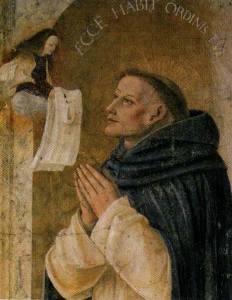
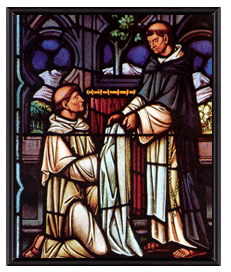
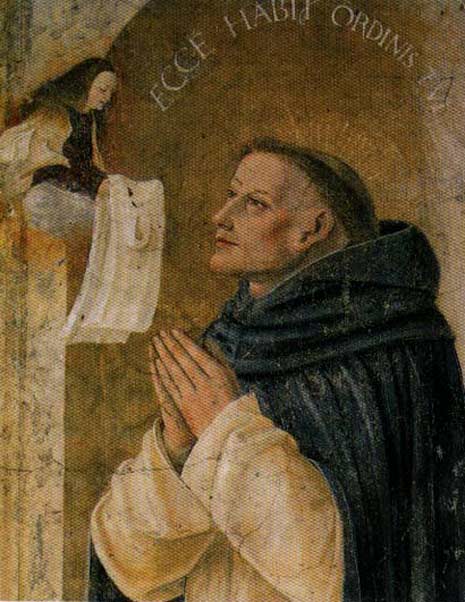
Indeed, the attraction between the two holy men was mutual. Meantime, however, Reginald became so ill that the physicians despaired of his life. In this extremity Dominic had recourse to his usual remedy, prayer; and in a few days his new friend was again in perfect health. In their piety both attributed the miraculous cure to the intercession of the Mother of God. Jordan of Saxony assures us that the Blessed Virgin appeared to Reginald in his sickness, told him to enter the new Order, and showed him the distinctive habit which the Friars Preacher should wear. Until this time they had dressed like the Canons Regular of Osma, of whom Dominic had been a member. Practically all the historians tell us that, in consequence of Reginald’s vision, the saint now adopted the garb which his followers have worn ever since, and that the former dean of Saint Aignan’s was the first to receive it from his hands.
Reginald was clothed in the religious habit immediately after the recovery of his health. At the same time, or very shortly afterwards, he made his profession to Dominic. However, this new allegiance did not prevent his journey to the Holy Land; for the saint permitted him to continue his way with Bishop de Seignelay. On his return to Italy from Jerusalem, perhaps in the middle fall of 1218, Dominic, who was still at Rome, sent the former dean to Bologna, which he reached in December. The high opinion which the patriarch had conceived of Reginald is shown by the fact that he appointed him his vicar (some say prior) over the incipient convent in that university city.
More than one thing evidently contributed to this immediate promotion to leadership. The house in Bologna had been started in the spring of the same year. While the first fathers stationed there were very cordially received, and were given Santa Maria della. Mascarella for a convent by Bishop Henry di Fratta, they found it hard to make the rapid headway which both they and Dominic evidently desired to see in the noted educational center. Reginald’s reputation, ability, eloquence, and experience at the University of Paris, it was felt, would combine with his rare virtue to bring about this desideratum. Nor were these expectations disappointed.
Hardly, indeed, had the former dean of Saint Aignan’s arrived at his destination, before the entire city was flocking to hear him preach. The effect of his sermons was marvellous. Hardened sinners gave up their evil ways; inveterate enemies buried their differences of long standing; the religion and moral tone of the people changed notably for the better. None seemed able to resist the attraction of the orator’s personality, or the persuasion of his burning eloquence. All felt that a new Elias had come among them. He held the place, as it were, in the palm of his hand. No one could doubt but that he had found his vocation.
Reginald drew the clergy as well as the laity; those of the university, whether professors or students, as well as the citizens. His example quickened the zeal of his confrères, for he preached every day-sometimes twice or even thrice. Vocations to the Order were so frequent that, within a few weeks, Santa Maria della Mascarella was overcrowded. They came from every walk in life. The university contributed a large number of both students and masters, some of whom were among the brightest lights of the institution with worldwide fame.
Bishop di Fratta and the papal legate, Cardinal Ugolino di Segni, were so pleased with the good effected by Reginald and his Friars Preacher that they gave him the Church of Saint Nicholas of the Vines, in order to enable him to receive more subjects. This was in the spring of 1219. Here a much larger convent was built at once. Rudolph of Faenza, the zealous pastor of Saint Nicholas, not content with surrendering his church to the Order, also received the habit from our blessed Reginald that he might join in the harvest of souls. He helped to erect the Convent of Saint Nicholas, now known as Saint Dominic’s, to which the community was transferred as soon as ready for occupation.
In his government of the large Bolognese community Blessed Reginald combined great charity and gentleness with a wise strictness. He did not suffer even slight transgressions to go uncorrected. Yet he was so skillful in his management of men and in his administration of punishment that his confrères, for they knew he ever acted for their good, held him in even greater affection than those not of the Order. All regarded him as a true man of God seeking to lead them to heaven. His every word, his very silence, bespoke virtue. With profound humility and a rare spirit of recollection he joined an extreme personal austerity.
The days the holy man spent in preaching to the people and spiritual conferences to his religious. The nights he gave largely to prayer. God blessed his efforts. Scarcely nine months had he been superior. Within that brief time Saint Nicholas’ had become not merely a large community; it was a famed sanctuary of prayer, the zeal of whose members recalled that of the apostles. Far and wide they bore the message of salvation with wonderful effect.
Such was the status, in point of size, discipline, and labors, in which Saint Dominic found the Bolognese institution on his arrival in the city, after his return from Spain, via Prouille, Toulouse, and Paris. This was late in the summer of 1219. The patriarch’s heart rejoiced at the sight of what had been accomplished. At Paris, owing to a strong opposition, the crooked paths had not yet been straightened, nor the rough ways made smooth. If, thought Dominic, Reginald had done so well in Bologna, why would he not be invaluable to Matthew of France in ironing out the difficulties at Paris. Besides, the saint had determined to make the Italian city the center of his own spiritual activities. So off to the French capital the subject of this sketch now went. His departure was keenly regretted by the community which he had governed so happily. But the voice of God spoke through the Order’s founder, and all bowed in humble submission. To Reginald’s brief sojourn in those far-flung days is due, in no small measure, the bond of regard that has ever since existed between the citizens of Bologna and the Friars Preacher.
Reginald’s arrival in Paris was a source of great joy to his confrères there — especially to the superior, Matthew of France. The newcomer bad been one of the university’s most beloved professors, and had had the only Friar-Preacher abbot as a pupil. Much was expected of his virtue, personality, and eloquence. Unfortunately, these hopes were realized only in part. As he had done in Bologna, so in Paris he began to preach incessantly. Together with this apostolate, he taught at the Convent of Saint James, whilst he relaxed not in the least his penances, or his nightly vigils.
Zeal for the salvation of souls, all the writers assure us, simply consumed the holy man. Enormous numbers flocked to his sermons. Vocations to the Order increased. Many came from among the students at the university. But such labors and mortification were too much for his strength. His health began to fail, and kindly Matthew of France ventured to warn him that he should be more moderate. Yet, as no positive order was given, the relaxation was not sufficient. http://www.willingshepherds.org/Dominican Saint February.html – 8 Possibly Matthew afterwards intervened more sternly. However, it was too late. The fire of life had burned out, and Reginald surrendered his pure soul to God in the first days of February, 1220. In his death the Friars Preacher nearly everywhere mourned the loss of one whom they considered, next to its founder, the strongest support of their new Order.
Had he lived, Reginald would most likely have succeeded Saint Dominic as Master General. In the language of Jordan of Saxony, Reginald lived a long life in the span of a few years. He spent less than two years in the Order; yet he left a memory that still seems fresh after a lapse of more than seven centuries. One of the things which continued to be denied the fathers by the ecclesiastical circles of Paris, at the time of his death, was the right of burial for the community in their Church of Saint James. Accordingly, his remains were laid to rest in that of Our Lady of the Fields (Notre Dame des Champs). The faithful soon began to visit and pray at his grave. Several miracles were reported. When, between 1605 and 1608, his body was taken up to be placed in a shrine, it was found to be incorrupt. This served to increase the devotion towards the man of God.
A few years later (1614), Our Lady of the Fields became the property of the Carmelite Sisters. Thus the tomb of Saint Dominic’s early disciple, because in their cloistered church, ceased to be visited by the people at large, who had been accustomed to seek his intercession for nearly four hundred years. The holy sisters, however, held him in the deepest veneration, and poured out their hearts in prayer before his sacred remains. In 1645, they had Father John Francis Senault, general of the Oratorians, write his life. His relics remained in this secluded place, ever an object of devotion for Christ’s cloistered spouses, until they were desecrated and destroyed by the villains of the terrible French Revolution.
Fortunately, as is proved in the process of his beatification, devotion to Reginald had become too deeply rooted to be annihilated by even such a catastrophe. This was particularly the case in the Order of Preachers, whose members had ever cherished an undying affection and veneration for him. In 1875, Pius IX, after a thorough examination of the matter by the Sacred Congregation of Rites, approved his cult, and granted the divine office and mass of Reginald to the Friars Preacher and the dioceses of Paris and Orleans. http://www.willingshepherds.org/Dominican Saint February.html – 9 February 12 was set aside as his feast, but in late years it has been transferred to the seventeenth day of the same month.
Born: at Saint-Gilles, Languedoc, France, c. 1183
Died: 1220
Canonized: Pius IX confirmed his cult in 1875.







 The Order of Preachers, Independent
You must be logged in to post a comment.