Twins often share the same interests and ideas with an equal intensity. Therefore, it is no surprise that Scholastica and her twin brother, Benedict, established religious communities within a few miles from each other. Born in 480 of wealthy parents, Scholastica and Benedict were brought up together until he left central Italy for Rome to continue his studies. Little is known of Scholastica’s early life. She founded a religious community for women near Monte Cassino at Plumbariola, five miles from where her brother governed a monastery.
Scholastica had been consecrated to God from her earliest years. She was accustomed to visiting her brother once a year. He would come down to meet her at a place on the monastaryproperty, not far outside the gate. One day she came as usual and her saintly brother went with some of his disciples; they spent the whole day praising God and talking of sacred things. As night fell they had supper together. Their spiritual conversation went on and the hour grew late. The holy nun said to her brother, “Please do not leave me tonight; let us go on until morning talking about the delights of the spiritual life.” “Sister,” he replied, “What are you saying? I simply cannot stay outside my cell.”
When she heard her brother refuse her request, the holy woman joined her hands on the table, laid her head on them and began to pray. As she raised her head from the table, there were such brilliant flashes of lightning, such great peals of thunder and such a heavy downpour of rain that neither Benedict nor his brethren could stir across the threshold of the place where they had been seated. Sadly, he began to complain. “May God forgive you, sister. What have you done?” “Well, she answered, “I asked you and you would not listen; so I asked my God and he did listen. So now go off, if you can, leave me and return to your monastery.”
So it came about that they stayed awake the whole night, engrossed in their conversation about the spiritual life. Three days later, Benedict was in his cell. Looking up to the sky, he saw his sister’s soul leave her body in the form of a dove, and fly up to the secret places of heaven. Rejoicing in her great glory, he thanked almighty God with hymns and words of praise. He then sent his brethren to bring her body to the monastaryand lay it in the tomb he had prepared for himself.– from Dialogues by Pope Saint Gregory the Great
Scholastica and Benedict gave themselves totally to God and gave top priority to deepening their friendship with him through prayer. They sacrificed some of the opportunities they would have had to be together as brother and sister in order better to fulfill their vocation to the religious life. In coming closer to Christ, however, they found they were also closer to each other. In joining a religious community, they did not forget or forsake their family but rather found more brothers and sisters.
Saint Scholastica is the Patron Saint of:
Nuns
Prayer:
Father,
To show us where innocence leads, you made the soul of your virgin Saint Scholastica soar to heaven like a dove in flight. Grant through her merits and her prayers that we may so live in innocence as to attain to joys everlasting. This we ask through our Lord.
In the beginning, when God created the heavens and the earth,
the earth was a formless wasteland, and darkness covered the abyss,
while a mighty wind swept over the waters.
Then God said,
“Let there be light,” and there was light.
God saw how good the light was.
God then separated the light from the darkness.
God called the light “day,” and the darkness he called “night.”
Thus evening came, and morning followed–the first day.
Then God said,
“Let there be a dome in the middle of the waters,
to separate one body of water from the other.”
And so it happened:
God made the dome,
and it separated the water above the dome from the water below it.
God called the dome “the sky.”
Evening came, and morning followed–the second day.
Then God said,
“Let the water under the sky be gathered into a single basin,
so that the dry land may appear.”
And so it happened:
the water under the sky was gathered into its basin,
and the dry land appeared.
God called the dry land “the earth,”
and the basin of the water he called “the sea.”
God saw how good it was.
Then God said,
“Let the earth bring forth vegetation:
every kind of plant that bears seed
and every kind of fruit tree on earth
that bears fruit with its seed in it.”
And so it happened:
the earth brought forth every kind of plant that bears seed
and every kind of fruit tree on earth that
bears fruit with its seed in it.
God saw how good it was.
Evening came, and morning followed–the third day.
Then God said:
“Let there be lights in the dome of the sky,
to separate day from night.
Let them mark the fixed times, the days and the years,
and serve as luminaries in the dome of the sky,
to shed light upon the earth.”
And so it happened:
God made the two great lights,
the greater one to govern the day,
and the lesser one to govern the night;
and he made the stars.
God set them in the dome of the sky,
to shed light upon the earth,
to govern the day and the night,
and to separate the light from the darkness.
God saw how good it was.
Evening came, and morning followed–the fourth day.
Gospel – Mark 6:53-56
After making the crossing to the other side of the sea,
Jesus and his disciples came to land at Gennesaret
and tied up there.
As they were leaving the boat, people immediately recognized him.
They scurried about the surrounding country
and began to bring in the sick on mats
to wherever they heard he was.
Whatever villages or towns or countryside he entered,
they laid the sick in the marketplaces
and begged him that they might touch only the tassel on his cloak;
and as many as touched it were healed.
Not until I was in seminary in Chicago, did I learn about a little bit of the history of Christianity in Japan; as I became a little familiar because of a course on world mission. Yet I had not encountered someone from Japan who is a Christian until seminary. In fact, prior to seminary, when I thought of religion in Japan, the beautiful pagodas and temples with ornate flower gardens stuck out in my mind. These structures are traditionally places of worship for the Shinto and Buddhist religions, so the idea of Christianity in Japan never crossed my mind. Nor did I ever think I would meet a Japanese Christian, but I met Toshio who was a fellow seminarian and a member of a different religious order than the one to which I belonged; and I truly wish I could have talked with him more about Christianity in Japan because there is more history than I ever learned in that world mission course, but never got the chance to learn more from him.
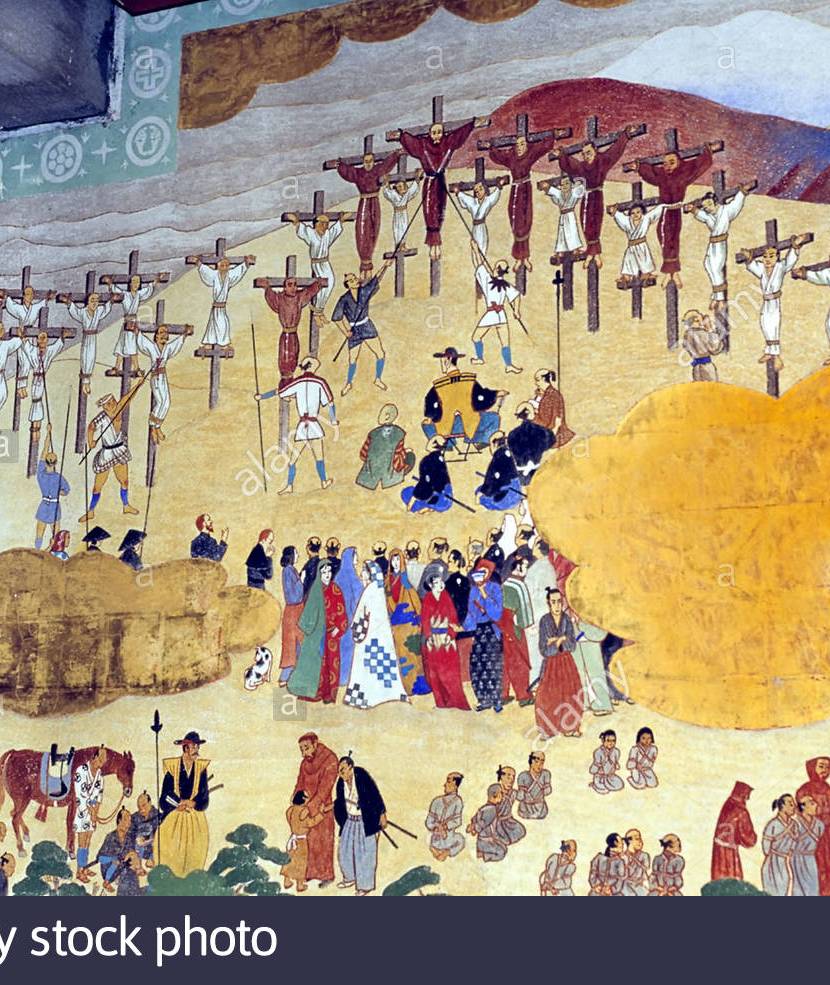
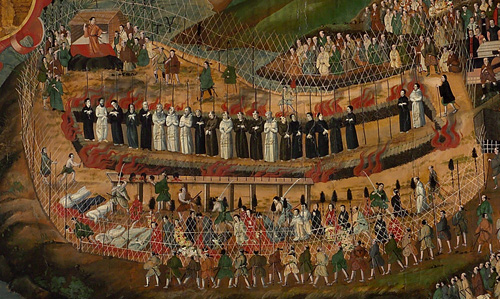
When doing some research about Saint Paul Miki and the other Martyrs, I learned that Christianity in Japan dates back to the mid-16th century with Saint Xavier bringing Catholicism to Japan. Initially, Christianity was rather well received in Japan because the government felt it would assist in the trade with Spain and Portugal, as well as limit the power that the Buddhist monks had within society. Unfortunately, this support did not last long because the government saw how the Spanish gained control of the Philippines through colonialization, and the local government had no real power. Practicing Christianity in Japan was banned in the 17th century and if anyone refused to give up their faith would be executed. In turn, Christianity became an underground religion until the return of missionaries in the 19th century. During the time of the persecution over 200 people were killed in a forty year span, and they came from various walks of life; some laity including children, while others were diocesan priests or belonged to the Jesuit, Franciscan, and Dominican religious orders.
Even though there were a large number of Japanese Christian martyrs who were beatified in 1867 and 1981, Saint Paul Miki and his companions belong to a group of 26 martyrs who were canonized by Pope Pius IX in 1862. What makes Paul Miki special is that he was the first Japanese Christian to belong to any religious order – the Jesuits. Along with the other 25, he was crucified one month prior to his ordination.
As we see in the reading from Genesis, God has started to create things of this Earth and each has its specific purpose. We do not get to see the part of the Creation story where God creates humans, but we are part of that story. EVERYTHING, including humans, has a purpose intended of us by God. We are to be stewards of Creation, and be evangelists of the Gospel. These are part of our mission, regardless if others reject and persecute us for our faith; just as the Japanese government persecuted Christians and those defending their faith were executed for not abandoning the faith.
Saint Paul Miki and his companions mirrored the Gospel reading. As missionaries, they ministered to the people of Japan, doing whatever had been called of them by God. We see in the Gospel that people from all over sought care and healing from Jesus. We know how the story ends, yet Jesus had His purpose; he was on Earth to preach the Good News of God, even until death on the cross.
We as Christians today, do not face a banning of our faith by our governments, yet there are times in which we need to stand up for our faith because of persecution of non-believers. We may even be attacked by other Christians because of certain beliefs about social issues. It may seem so easy to just give in and “follow the masses” to avoid the persecution, but we need to defend the faith and hold to our principles when they teach the Gospel. The life and mission Saint Paul Miki and all of the Christian martyrs is the example we should look to in our everyday Christian life.
Father, provide us with the strength and courage to defend the faith every day of our lives, especially when it seems so easy to just give in to avoid persecution. This we ask through Christ, Our Lord. Amen.
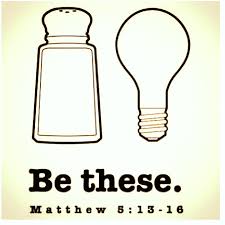
MT 5:13-16 Jesus said to his disciples:”You are the salt of the earth. But if salt loses its taste, with what can it be seasoned? It is no longer good for anything but to be thrown out and trampled underfoot. You are the light of the world. A city set on a mountain cannot be hidden. Nor do they light a lamp and then put it under a bushel basket; it is set on a lampstand, where it gives light to all in the house. Just so, your light must shine before others, that they may see your good deeds and glorify your heavenly Father.”
Ready? OK – here goes!
In Jesus’ first parable he compares us to salt. “You are the salt of the earth, but if salt loses its taste, with what can it be seasoned?” This means that although salt has many uses, its primary use is as a seasoning to enhance the flavor of other foods. Jesus is telling us here that we are the seasoning that enhances the rest of the world. People put salt on watermelon and tomatoes, however they very seldom ever say “That watermelon makes that salt taste great.” The job of salt is to make you realize how great the salt is, but how great the salted food is.
Some other uses of salt:
1: Antiseptic to cleanse wounds. We can be the antiseptic for the world and cleanse the wounds of those who are hurting, broken or damaged. The only problem with using salt as an antiseptic is that it can be painful. Hence the phrase “pouring salt in an open wound”. Salt has a bite to it, but sometimes that is what we need to help us heal from the infection of sin.
2: Preservative to keep foods fresh. As Christians, we can be the preservative of our faith. By preserving our faith, we keep it attractive so that others are not put off by it and are drawn to it.
3: Fertilizer to condition soil and help crops grow healthy and strong. Jesus would want us to cultivate or faith as if it were a crop that farmers grow for sustaining life. One of the myths that surround fertilizers is that the salts they contain are “harsh” on the biology of the soil. The reality is that salt is essential to all of life. Either too much or too little can harm.
4: Catalyst: cat·a·lyst (Websters definition)
noun
a substance that increases the rate of a chemical reaction without itself undergoing any permanent chemical change.
a person or thing that precipitates an event.
We should be the catalysts that Jesus wanted us to be. We should precipitate events that direct souls to our Lord.
Can you live without salt? This is the answer from the Johns Hopkins website:
No, life cannot exist without salt. It’s the sodium in salt that causes most of the problems. The human body can’t live without some sodium. It’s needed to transmit nerve impulses, contract and relax muscle fibers (including those in the heart and blood vessels), and maintain a proper fluid balance.
In verse 14-16 Jesus says, “You are the light of the world. A city set on a mountain cannot be hidden. Nor do they light a lamp and then put it under a bushel basket.” This one is very simple – we are to spread the light of His love to the rest of the world. Sin is dark and keeps the world smothered in darkness. Jesus commands us to cover up that dark sin with the light of his love and forgiveness. The world is lost and without direction without the light of Jesus’s love. Imagine this – you are blindfolded and taken to a place you have never been before. When the blindfold is removed, you find yourself in a totally dark room, but you don’t know what else is in the room. There could be furniture, but you don’t know for sure. There could be stairs, but you don’t know for sure. There could be windows, but you don’t know for sure because you can’t see anything. You are going to have a hard time moving around safely and confidently because you can’t see where you are headed, or what is in front of you. You are given instructions to find your way out of the dark room. This would be a daunting task since you have no idea where the door is, where anything is. Imagine the chaos as you bump into furniture and chairs, as you trip over small objects. As you are feeling your way around the dark room, you find what feels like a flashlight and switch it on. The dark room is the world full of sin, and the we as Christians are the flashlight. Once the flashlight is switched on we have a path to follow and we know where all the obstacles are.
“A city set on a hill cannot be hidden” In Jesus’ day there was no air conditioning. The only air conditioning they had was the breeze. Anybody who has ever lived in West Virginia knows that when you live in a valley there is no breeze, but when you put your single wide on the top of the hill you always have a nice breeze blowing. They built their cities on top of the hills for this reason, and because cities are on hills are easier to defend than ones built in valleys. Jesus’ point, however, is not a city’s defense, but its visibility because of its elevated position. Most cities in Jesus’ day were constructed largely of white limestone and placed on a hilltop to reflect the bright sun rays, allowing visibility from miles away. At night, the white marble mirrored both the moonlight and burning lamps, acting as a beacon for directing travelers toward the city. Similarly, as disciples our light ought to make it easier for people to find their way to God. We are a city set on a hill that should be elevated and easily visible so that all the world can see the Jesus in us.
“Nor do they light a lamp and then put it under a bushel basket; it is set on a lampstand, where it gives light to all in the house. Just so, your light must shine before others, that they may see your good deeds and glorify your heavenly Father.” This needs little explanation but I will try to elaborate as much as I can here. You wouldn’t turn on a lamp in a dark room and then cover it with a basket and block out the light. That would be a waste of time, energy, and electricity. In Jesus’ day lamp oil was very expensive and was not to be wasted, much like electricity today. So, what Jesus meant was that we should be beacons of His love in all that we do. Don’t hide the fact that we are Christians, proclaim it in everything we do and everywhere we go. In our daily lives at work, in school, and in our social situations we should be showing our God off to everyone we meet.
Lord: in your mercy please show us how to be better Christians, brighter lights of your love, and cities with open and welcoming gates. Show us how to remove the basket from our lights so that our beams may shine farther and brighter. In Jesus name, Amen.
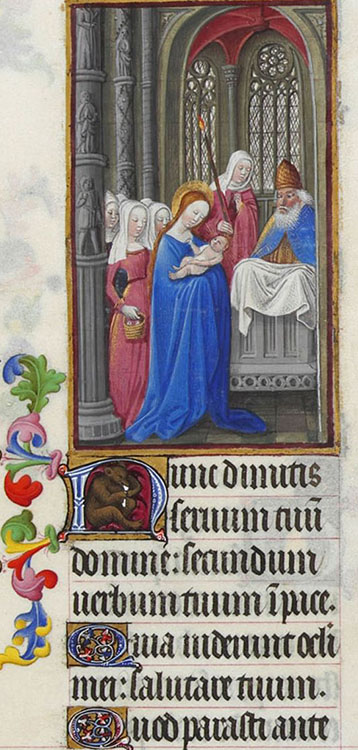
In today’s feast, we have a recently born baby being recognized as the Light of the World by a man who will soon depart this life. And we have the first real acknowledgment of the end of the old order and the beginning of the new.
How is this?
Jesus was presented in the temple on this day, 40 days after his birth, in fulfillment of the Mosaic law as we read in Exodus 13:13–16: “Every firstborn of man among your sons, you shall redeem.” This act was supposed to occur on the 31st day after the birth, but for various reasons the Church Fathers attributed it to the 40th day. The first born was to be “redeemed.” That is, through the payment of 5 shekels, the firstborn male child was to be freed from his obligation to serve the Lord as a priest, according to ancient Hebrew practice.
You’ll have to read about the Golden Calf and the refusal of the Tribe of Levi to participate in this abomination to get the full meaning of this idea.
But here, we have Mary and Joseph obliged by the Law of Moses coming to Jerusalem to present their son in the temple. Which is contrary to what the author of Hebrews tells us in today’s second reading:
…therefore, he had to become like his brothers and sisters
in every way,
that he might be a merciful and faithful high priest before God
to expiate the sins of the people.
So even though Jesus had been redeemed from priestly functions shortly after his birth, we now know him as a priest, one who redeemed us from our sin by becoming a sacrifice himself. Why did he become a high priest? Wasn’t he redeemed from this obligation by the ceremony celebrated today?
The Feast of the Presentation of the Lord acts as a crossroads for us and for the world. It is foretold in today’s second reading from Malachi: “But who will endure the day of his coming? And who can stand when he appears….Then the sacrifice of Judah and Jerusalem will please the Lord.” It is where Simeon realizes that God’s promise to him that he would not come to the end of his days before seeing the Messiah, who is a newborn baby just starting his life, has been fulfilled. And Anna, also in the temple that day, prophesies the redemption of Jerusalem. And the law is upended since the redeemed firstborn of Mary and Joseph is actually a high priest in the line of Melchizedek. And the world is made new now and forever, as we read in 2 Corinthians 5:17: “Therefore, if anyone is in Christ, the new creation has come: The old has gone, the new is here!”
And by this, I think St. Paul means that with each person coming to Jesus, there is a new creation and a further erosion of the old order.
So although all this is not realized until the establishment of the Eucharist and the Resurrection, it is here, on this feast day, The Presentation of the Lord in the temple that the funnel of the old world closes down to its narrowest point and the trumpet of the new creation sounds out the clarion call for us all: “Repent! The Kingdom of God is at hand.”
Let me go back to Simeon’s idea that Jesus was to be a sign that will be contradicted. Listen to Psalm 24 from today:
Lift up your heads, O ye gates; and be ye lift up, ye everlasting doors; and the King of glory shall come in.
Who is this King of glory? The LORD strong and mighty, the LORD mighty in battle.
Lift up your heads, O ye gates; even lift them up, ye everlasting doors; and the King of glory shall come in.
Who is this King of glory? The LORD of hosts, he is the King of glory.
On the one hand, we have Jesus, gentle and mild. On the other, Jesus the lord of armies. If this isn’t a contradiction, what is?
My brothers and sisters, this will also have to wait for another sermon. Along with references to Candlemas and Groundhog Day which are also celebrated today.
But finally, we know that Jesus was taken back to Nazareth by his mother and father and there he grew in wisdom and strength. In one month we will enter the Lenten season. Then we shall know the real meaning of the end of today’s second reading:
Because he himself was tested through what he suffered,
he is able to help those who are being tested.
Lord, help us to recognize our salvation which you have prepared in our sight. Help us to revel in his glory and bring that light to the rest of our world.
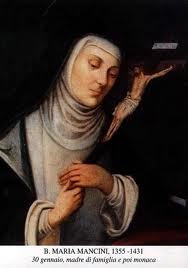
Catherine Mancini was born in Pisa in 1355, of noble parentage, and from infancy began enjoying the miraculous favors with which her life was filled. At the age of three, she was warned by some heavenly agency that the porch on which she had been placed by a nurse was unsafe. Her cries attracted the nurse’s attention, and they had barely left the porch when it collapsed. When she was five, she beheld in an ecstasy the dungeon of a place in Pisa in which Peter Gambacorta, one of the leading citizens, was being tortured. At Catherine’s prayer, the rope broke and the man was released. Our Lady told the little girl to say prayers every day for this man, because he would one day be her benefactor.
Catherine would have much preferred the religious life to marriage, but she obeyed her parents and was married at the age of twelve. Widowed at sixteen, she was compelled to marry again. Of her seven children, only one survived the death of her second husband, and Catherine learned through a vision that this child, too, would soon be taken from her. Thus she found herself, at the age of twenty five, twice widowed and bereft of all her children. Refusing a third marriage, she devoted herself to prayers and works of charity.
She soon worked out for herself a severe schedule of prayers and good works, fasting and mortifications. She tended the sick and the poor, bringing them into her own home and regarding them as Our Lord Himself. She gave her goods to the poor and labored for them with her own hands. Our Lord was pleased to show her that He approved of her works by appearing to her in the guise of a poor young man, sick, and in need of both food and medicine. She carefully dressed his wounds, and she was rewarded by the revelation that it was in reality her redeemer whom she had served.
St. Catherine of Siena visited Pisa at about this time, and the two saintly women were drawn together into a holy friendship. As they prayed together in the Dominican church one day, they were surrounded by a bright cloud, out of which flew a white dove. They conversed joyfully on spiritual matters, and were mutually strengthened by the meeting.
On the advice of St. Catherine of Siena, Catherine (Mary Mancini) retired to an enclosed convent of the Second Order. In religion, she was given the name Mary, by which she is usually known. She embraced the religious life in all its primitive austerity, and, with Blessed Clare Gambarcota and a few other members of the convent, she founded a new and much more austere house, which had been built by Peter Gambacorta. Our Lady’s prophecy of his benefactions was thus fulfilled.
Blessed Mary was favored with many visions and was in almost constant prayer. She became prioress of the house on the death of her friend Blessed Clare Gambacorta, and ruled it with justice and holiness until her death.
She died in 1431 and was beatified by Pius IX in 1855.
Last week was marked by a momentous occasion. A new, and very controversial president was sworn in. I cannot remember any past President being the target of so much hate. His family (including his children) has also been the targets of rumors, innuendos, and blasting from the media. While I do not agree with his policies, his plans for our country, or his stance on many key issues, I cannot reconcile the behavior and hateful words that have been shared on social media. Even a few of my fellow clergy have gone so far as to spread messages of hate. But this is not the message we get from the teachings of Jesus Christ. In His Sermon on the Mount (Matthew 5:1-12), He offers to reassure His disciples that though they face hardships and trials, theirs is the kingdom of heaven.
5:1 When Jesus saw the crowds, he went up the mountain; and after he sat down, his disciples came to him.
5:2 Then he began to speak, and taught them, saying:
5:3 “Blessed are the poor in spirit, for theirs is the kingdom of heaven.
5:4 “Blessed are those who mourn, for they will be comforted.
5:5 “Blessed are the meek, for they will inherit the earth.
5:6 “Blessed are those who hunger and thirst for righteousness, for they will be filled.
5:7 “Blessed are the merciful, for they will receive mercy.
5:8 “Blessed are the pure in heart, for they will see God.
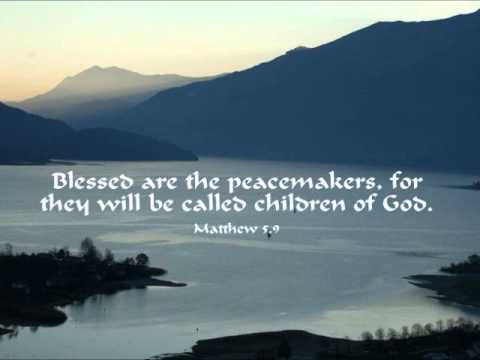
5:9 “Blessed are the peacemakers, for they will be called children of God.
5:10 “Blessed are those who are persecuted for righteousness’ sake, for theirs is the kingdom of heaven.
5:11 “Blessed are you when people revile you and persecute you and utter all kinds of evil against you falsely on my account.
5:12 Rejoice and be glad, for your reward is great in heaven, for in the same way they persecuted the prophets who were before you.
As we read through these teachings of Jesus to His disciples, we learn much about what is not only awaiting us in the future, but also what we can expect now. For those who have lost hope, like so many did after the recent election, we are reassured that the kingdom of heaven (God’s love and comfort), is with us right now (“Blessed are the poor in spirit, for theirs is the kingdom of heaven.”). Jesus then goes on to describe the blessings for those who are sad, who are humble in spirit, who may be down on their luck, who always tries to do whats right, and who always strives to treat others fairly. While not promising riches or fame, Jesus is offering something more precious.
In this time of turmoil in our country, Jesus teaches us to be peacemakers. “Blessed are the peacemakers, for they will be called children of God. Blessed are those who are persecuted for righteousness’ sake, for theirs is the kingdom of heaven.” (Matthew 5:9-10). We are also cautioned to hold our tongue ( “Blessed are you when people revile you and persecute you and utter all kinds of evil against you falsely on my account). Though we may disagree with the policies and practices of the new President, we should not use this time as an opportunity to spread poison, whether in our speech or through our actions.
Instead of spreading hate, we should be spreading hope. Instead of pushing people away (because we may disagree with their ideals), we should be pulling people in to our faith, teaching them about the love of Christ. Instead of teaching our children its ok to hate someone because of the color of their skin, their sex, their choice of partner, or their religion, we should be setting an example of love for all human kind. Peace begins with us, the children of God.
A Prayer for Our Country:
Almighty God, bless our nation and make it true to the ideas of freedom and justice and brotherhood for all who make it great.
Guard us from war, from fire and wind, from compromise, fear, confusion.
Be close to our president and our statesmen; give them vision and courage, as they ponder decisions affecting peace and the future of the world.
Make me more deeply aware of my heritage; realizing not only my rights but also my duties and responsibilities as a citizen.
Make this great land and all its people know clearly Your will, that they may fulfill the destiny ordained for us in the salvation of the nations, and the restoring of all things in Christ.
The Church is faced with a dilemma. We are losing people to modernism in droves and the church has a decision to make: change who you are to conform to society or hold fast to the teachings of the Faith. Unfortunately may mainline denominations are doing the latter, they are changing to conform to the pressures that society is putting on them to change. They have stopped talking about the crucifixion, the resurrection, and the redemptive power of Christ. They deny the miracles we are told of in sacred scripture and have compromised the very foundations of Christianity. Bishops and Archbishops are on television preaching universalism and offering alternatives to salvation, through everything from Wicca to Islam to nothing at all. So the church has a choice. Change who you are or hold fast to the Faith. As a Dominican the answer is crystal clear to me. We hold on to the Faith and teach the Faith like our lives depended on it, because not only do our lives depend on it, but our souls do as well, and what better an appropriate time to talk about faith, and reason, than on the feast day of our Holy Brother and Teacher Saint Thomas Aquinas.
At the young age of five, Thomas was sent to live at the Benedictine monastery at Monte Cassino, as was the custom of the time. His parents’ hope was that he would chose the Benedictine life and eventually become abbot. In 1239 he was sent to Naples where he was to complete his studies and it was then that he was introduced to Aristotle’s philosophy. By 1243, however Thomas abandoned his family’s plans for him and it is then that he joined the Dominicans.
Once with the Dominicans Thomas traveled to Paris where he would finish his studies under Albert the Great, and he would live at the court of Pope Urban IV. He would direct the Dominican school in Rome, but his greatest contribution to the Church was the fact that he showed us that we could reconcile faith and reason. Because even then people were struggling with how this was possible and Saint Thomas was able to give us timeless teachings that we as Christians can use today.
Thomas believed that the existence of God could be proven in five ways. First by observing movement in the world as proof of God, the “Immovable Mover.” Second by observing cause and effect and identifying God as the cause of everything. Third by concluding that the impermanent nature of beings proves the existence of a necessary being, God, who originates only from within himself. Fourth by noticing varying levels of human perfection and determining that a supreme, perfect being must therefore exist, and fifth by knowing that natural beings could not have intelligence without it being granted to them it by God..
Thomas used faith and reason to establish his arguments, something that we must do as well. As Christians we are called to evangelize, a task that is met with much criticism and one that many people shy away from simply because they are not prepared to counter some of the very same arguments that Saint Thomas has already provided us with a foundation to argue.
As a Dominican I am committed to sharing the Word of God, I am committed to sharing it boldly and I am committed to sharing it from a place of faith and reason, being able to meet people where they are on their journey. But the greatest gift that we have because of Aquinas is that when we wrestle with doubt and when we wrestle with uncertainty, we have the example that he has set for us. We know that we can approach faith with reason to find our answers, we know that they complement each other not cancel each other out. Because of that we can grow stronger in our faith and be bold to proclaim the saving message of Christ.
We do not need to change who we are as a Church, we do not need to deny basic tenets of the Faith to be popular with the skeptics, instead we need to meet our skeptics with knowledge not only of faith but faith combined with reason so that their eyes may be opened to the truth of God. Let us pray:
O God, who made Saint Thomas Aquinas outstanding in his zeal for holiness
and his study of sacred doctrine, grant us, we pray, that we may understand what he taught
and imitate what he accomplished. Through our Lord Jesus Christ, your Son,
who lives and reigns with you in the unity of the Holy Spirit, one God, for ever and ever. Amen.
*Another great hymn from the great St. Thomas Aquinas. This version of the hymn does not include the 3rd or 4th verses. The art is “The temptation of St. Thomas Aquinas” by Diego Velazquez; “Triumph of St. Thomas Aquinas over the heretics” by Filippino Lippi; “The Apotheosis of Thomas Aquinas” by Francisco de Zurbaran. License Standard YouTube License Music “Adoro Te Devote” by Richard Proulx





 The Order of Preachers, Independent
You must be logged in to post a comment.