Blessed Augustine of Lucera

KAŽOTIĆ-001

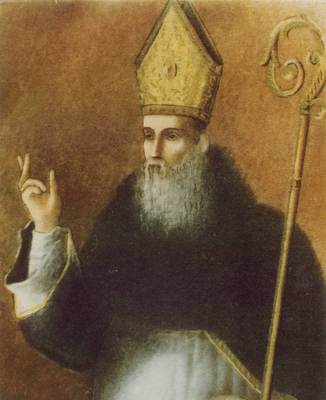
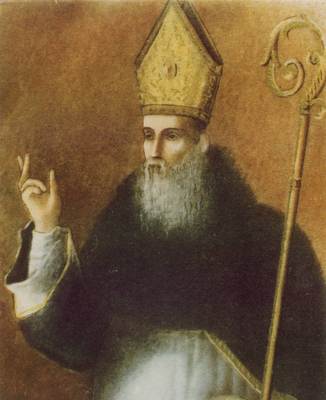
Augustine was born into a wealthy family who provided him with an excellent education. At 18, he and an Italian friend headed to the Dominican novitiate in France. Near Pavia, Italy, they were attacked by enemies of his family, who left the bodies of the two boys in the snow by the side of the road. Augustine was badly injured; his friend died. When he recovered from his injuries, Augustine continued to the novitiate. Augustine spent most of his life battling heresy: In his native Dalmatia, he fought the Manichæen heresy; in Sicily, Islam; in Hungary both. In every situation in which he found himself, Augustine gave proof of his virtue and good judgment. When Cardinal Boccasini came to Hungary as legate, he noted the wisdom and tact of his brother Dominican, and when he himself ascended the papal throne as Benedict XI, he appointed Augustine bishop of Zagreb in Croatia in 1303.

This diocese was in chaos when Augustine assumed the cathedra. His three predecessors had all tried, but failed, to repair the ravages of heresy, plague, and schism. The new bishop began by reforming the clergy. He finished building the cathedral and made a complete visitation of his diocese. His work was to bring him into violent conflict with the government, but, spiritually, he restored the entire see during his episcopacy.

Several charming miracles are related about Augustine. The river water of Zagreb was unfit to drink, so the Dominican fathers asked Augustine to pray for a new supply. At his prayer a fountain sprang up in the yard of the convent, abundantly supplying their needs. Another time he planted a tree in a little village and the leaves turned out to have healing properties. On one occasion, when Bishop Augustine was dining with Benedict XI, the pope, feeling that a missionary bishop must eat well to preach well, had a dish of partridge set before Augustine, who never ate meat. Because he did not want to offend the pope, he prayed for a resolution to the situation. The legend says that God turned the partridges into fish!

Augustine was transferred from Zagreb to Lucera (Nocera), Sicily. Here he continued his holy government, using his characteristic gentleness and his gift of healing. He promoted devotion to Saints Dominic, Thomas Aquinas, and Peter Martyr–all brother Dominicans. Feeling that he was near death, he returned to the Dominican convent in Nocera to die among his brethren. Under his statue in the cathedral of Nocera is the legend, “Sanctus Augustine Episcopus Lucerinus Ordinis Praedicatorum,” an indication of the veneration in which he is held.

Born: in Trau, Dalmatia, c. 1260-1262

Died: 1323

Beatified: cultus reconfirmed by Pope Clement XI in 1702

Got Stuff? ~ The Rev. Dcn. Dennis Klinzing, Novice

6434762

Someone in the crowd said to Jesus, “Teacher, tell my brother to share the inheritance with me.”  He replied to him, “Friend, who appointed me as your judge and arbitrator?”
Then he said to the crowd, “Take care to guard against all greed, for though one may be rich, one’s life does not consist of possessions.”
Then he told them a parable.   “There was a rich man whose land produced a bountiful harvest.   He asked himself, ‘What shall I do, for I do not have space to store my harvest?’
And he said, ‘This is what I shall do:  I shall tear down my barns and build larger ones.   There I shall store all my grain and other goods and I shall say to myself, “Now as for you,
you have so many good things stored up for many years, rest, eat, drink, be merry!”’
But God said to him, ‘You fool, this night your life will be demanded of you;  and the things you have prepared, to whom will they belong?’  Thus will it be for all who store up treasure for themselves but are not rich in what matters to God.”  Luke 12:13-21

At this point, a man in the crowd interrupted Jesus and asked Him to solve a family problem (feud). Rabbis were expected to help settle legal matters, but Jesus refused to get involved. Why? Because He knew that no answer He gave would solve the real problem, which was covetousness in the hearts of the two brothers. As long as both men  were greedy no settlement would be satisfactory. Their greatest need was to have their hearts changed. Like too many people today, they wanted Jesus to serve them, but not save them.

Covetousness is an unquenchable thirst for getting more and more of something we think we need in order to be truly satisfied. It may be a thirst for money or the things that money can buy, or even a thirst for position and power. Jesus made it clear that true life does not depend on an abundance of possessions. He did not deny that we have certain basic needs. He only affirmed that we will not make life richer by acquiring more of these things.

Mark Twain once defined ‘civilization’ as ‘a limitless multiplication of unnecessary necessities,” and he was right. In fact, many Christians are infected with covetousness and do not know it. They think that Paul’s admonition in 1 Timothy 6 applies only to the ‘rich and famous.’ Measured by the living standards of the rest of the world, most believers in America are indeed wealthy people.

Jesus told this parable to reveal the dangers that lurk in a covetous heart. As you read it, test your own responses to this farmer’s various experience.

How do you respond to the wealthy farmer’s dilemma? Here was a man who had a problem with too much wealth! If we say, “I certainly wish I had that problem! we may be revealing covetousness in our hearts. If suddenly you inherited a great deal of wealth, would it create a problem for you? Or would you simply praise God and ask Him what He wanted you to do with it?

There are perils to prosperity. Wealth can choke the Word of God, create sinners and temptations, and give you a false sense of security. People say that money does not satisfy, but it does satisfy if you want to live on that level. People who are satisfied only with the things that money can buy are in great danger of losing the things that money cannot buy.

This farmer saw his wealth as an opportunity to please himself. He had no thoughts of others or of God.

How do you respond to the decisions of the rich man? Are you saying, “Now that is a shrewd business!”Save and have it ready for the future!” But Jesus saw selfishness in all that this man did, and He said the man was a fool. The world’s philosophy is “Take care of Number One!” But Jesus does not endorse that philosophy.

There is certainly nothing wrong with following good business principles, or even with saving for the future. Jesus does not encourage waste. But neither does Jesus encourage selfishness motivated by covetousness.

How do you respond to the farmer’s desires? Are you saying, “This is the life! The man has success, satisfaction, and security! What more could he want?” But Jesus did not see this farmer enjoying life; He saw him facing death! Wealth cannot keep us alive when our time comes to die, nor can it buy back the opportunities we missed while we were thinking of ourselves and ignoring God and others.

Jesus has made it clear that true life does not come from an abundance of things, nor does true success or security. This man had a false view of both life and death. He thought that life came from accumulating things and that death was far away.

Finally, how do you respond to the death of the boastful farmer? We are prone to say, “Too bad this fellow died just when he had everything going for him! How tragic that he could not finish his great plans.” But the greatest tragedy is not what the man left behind, but what lay before him; eternity without God! The man lived without God and died without God, and his wealth was but an incident in his life. God is not impressed with our money.

Blessed Mannes de Guzman

81760064_132351446672

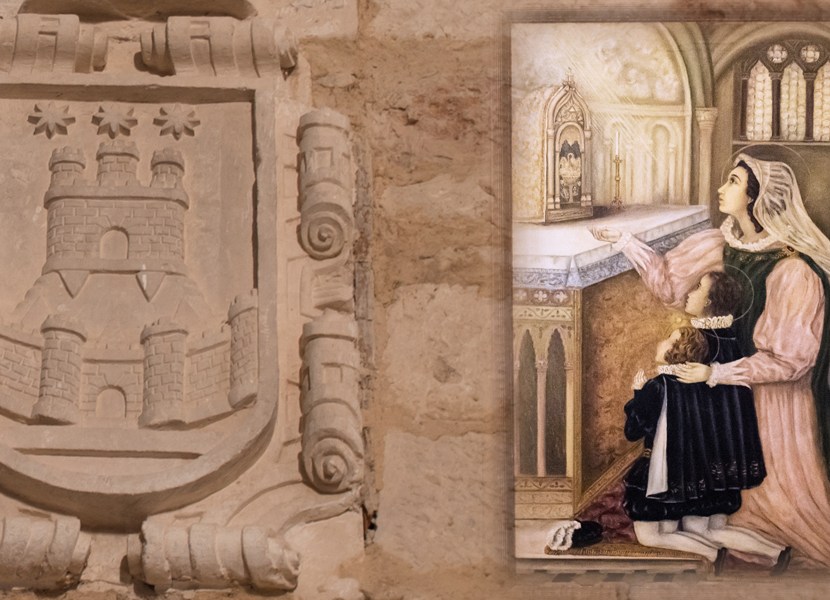
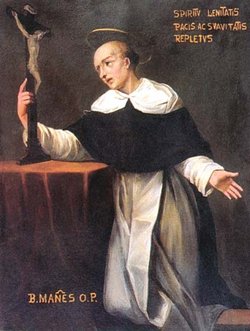
None of the early historical writers of the Order fail to mention Blessed Mannes. His stock was not the least noble among the grandees of Catholic Spain. His parents were Felix Guzman and Jane of Aza, in whose veins also ran some of the best blood of Old Castile. On both sides Mannes could count brave defenders of his country. But what was of infinitely greater importance to him were the holy lives of his own immediate family. His father was a splendid type of the Christian gentleman. His mother has been raised to the honors of the altar under the name of Blessed Jane. His eldest brother, Anthony, became a model priest, who devoted his life to the care of souls, the welfare of the poor, and the aid of the sick, and died with a great reputation for sanctity. Dominic, the youngest and perhaps the only other child, became the founder of the Friars Preacher. He is canonized. Surely this is a record of which any one might well be proud.

Blessed Mannes first saw the light of day in the ancestral castle, Caleruega, Old Castile. The date of his birth can only be estimated from that of Saint Dominic (1170), than whom, we are told, he was a number of years older. Like Anthony, he chose the ecclesiastical state at an early age. Of his ordination to the priesthood and where he made his studies we know nothing. However, Spain was most likely the theater of both. The earlier writers of the Order, while reticent about these things, all tell us that he was of a retiring disposition, and much given to prayer and contemplation.

Yet an apostolic zeal evidently burned in his breast. Almost immediately after the return to Spain of the Right Rev. Didacus (or Diego) de Azebes (often called de Azevedo), bishop of Osma, whom Saint Dominic had accompanied to Rome, Mannes set out for France. From the bishop he learned the need of missionaries in Languedoc, where Dominic had been left to combat the errors of the Albigenses. Possibly de Azebes, for he was a saintly prelate, suggested that Mannes should also take up this work. At any rate, we find him with his younger brother before the close of 1207. From this time the two men, for they were cast in the same spiritual mold, toiled hand in hand for nearly ten years that they might free the Church of southern France from the poison and turmoil of heresy, and restore it to its former peace and beauty.

Not once in all this time did Mannes take a vacation, or pay a visit to his native land, which he loved none the less because he had dedicated himself to the service of God. He felt that his place was where religion needed his attention so sadly. His zeal was tireless; his efforts unceasing. Perhaps on no other did Dominic depend so much. Doubtless, if the full truth were known, history would have to associate Mannes more closely with the saint’s success, as well as give him more credit for the part he played in the conversion of the Albigenses. No danger or hardship could cause him to falter in his labors. He was a splendid preacher. Like Dominic, he intermingled prayer with his sermons and instructions. By his shining virtues and mortified life he wielded a stronger influence for good, whether among the faithful or those who had wandered from the path of truth, than by his eloquence.

One of Blessed Mannes’ most striking traits seems to have been his humility. He knew not the meaning of the word pride or jealousy. The one thing he sought was the glory of God and the salvation of souls. Although older in years, he obeyed his brother as a dutiful son does the will of his father. When Saint Dominic established his Order, Mannes was among the first to place himself under his standard, and to receive the habit. Thus we find him among the “sixteen” zealous men whom God selected as the foundation stones on which to build the Order of Friars Preacher. One would be perfectly safe in the assertion that, when (August 15, 1217) the chosen little band took their religious vows on bended knees before the patriarch, not one of them entered into the ceremony with a better heart, or in more of a spirit of self-sacrifice, than Blessed Mannes.

This event took place in the conventual church of the Dominican Sisters, Prouille, southern France. The annals of Prouille are very explicit in the matter. From their statement and that of Father John of Navarre about the time of his entrance into the Order, which he made in his testimony to the holy life of Dominic to the papal commission appointed to examine the saint’s cause for canonization, it would seem that the sixteen brethren had taken their vows at Saint Romanus’, Toulouse, after Innocent III sanctioned the foundation of the Order. However, after its confirmation by Honorius III, Dominic had them renew their profession. Such was his love for Prouille, around which so much of his work centered, that he chose this place for the ceremony, and as the point of their departure for the various countries to which he sent them.

Blessed Mannes was chosen as one of those who were to start a house of the new Order in Paris. He had six companions — Matthew of France, who was the superior; Bertrand of Garrigue, so called from the place of his birth, a little town in southern France; Lawrence of England; the two Spaniards, John of Navarre and Michael de Fabra; and Oderic of Normandy. The last mentioned has the distinction of being the Order’s first lay brother. They travelled in two parties. That composed of Mannes, Michael, and Oderic reached their destination first, September 12, 1217, being the day of their arrival in the great French capital.

For a while the fathers were obliged to live in a house near Notre Dame Hospital, in the center of the city. But their zeal, eloquence, and model lives soon won them many friends. Among these was John de Barastre, a celebrated master of the University of Paris, dean of Saint Quentin, and a royal chaplain. The noted ecclesiastic had established a hospice for strangers near the gate of the city called “Porte d’Orleans.” The hospice bore the name of Saint James. This he now conferred on the homeless Friars Preacher, and they took possession of it August 6, 1218. It became the famed Saint James’ Convent and Studium, than which none is more celebrated in the Order.

Thus Blessed Marines was one of the founders of this well-known institution, which played a conspicuous part in the history of the University of Paris. His sermons are said to have borne rich fruit in the French capital, for he had a splendid gift of oratory. Besides, he was endowed with an extraordinary personal magnetism; while his kindly, open, and friendly disposition exercised a strong influence over souls. Few could resist his appeals for a better life.

Just when the subject of this sketch left Paris, where he was much beloved, the writers do not tell us. But it is known that Saint Dominic himself sent him from there to Madrid, Spain; and from this we can form a most reasonable conjecture as to the time when Mannes returned to his native land, which he does not appear to have seen since 1207. While in Spain in connection with affairs of his Order, Dominic found Peter of Madrid organizing some pious ladies for a religious community in that city. The saint gave them the habit, admitted them to their vows, and started the construction of a convent for them. This was early in 1219. From Spain he made his way to Paris. While in this city, which he reached before the middle of the same year, he evidently appointed Blessed Mannes to take charge of the sisters in Madrid, and sent him to the Spanish capital; for we find him there shortly afterwards.

Several things, no doubt, conspired to bring about the choice of Mannes for this position. He was growing old, and long years of hard missionary labor must have begun to tell upon his strength. He was a most spiritual, devout, and prudent man, which recommended him for such a charge. His disposition led him to prefer a quiet, retired life, in which he could give himself more to prayer and contemplation, to one of activity among the people. Besides, his practical turn of mind rendered him a suitable person to superintend the temporal affairs of the sisters, whose cloistered state made this difficult for themselves. The holy man called their convent Saint Dominic of Silos, which he doubtless did because his own brother was named after the Cistercian abbot.

From Madrid Blessed Mannes attended the second general chapter of the Order, which was held at Bologna in 1221. Through him, on his return, Saint Dominic sent a letter to the youthful community of Spanish sisters, which is of no little interest because it is the only authentic writing of the saint which has survived the ravages of time. In it he tells them, briefly, of the joy it gave him to hear, through his brother Mannes, of their piety and of the completion of their convent. Both the one and the other are largely due to Mannes’ exertions. He is, therefore, constituted their ecclesiastical superior, with almost plenary powers.

Very probably the holy man held this position the rest of his days, for we find no record of him elsewhere. With this work, we doubt not, he combined no little preaching in and around Madrid. At times perhaps his confrères took his place at the sisters’ convent, while he labored in more distant localities. His life as a religious is said ever to have been edifying to his brethren and useful to his fellow man. Some place his death in 1230. Others say that he died about this time (“circiter 1230″).

But the Année Dominicaine informs us that Roderic “de Cerrate,” a Spanish Dominican of the thirteenth century, states (in his Vitae Sanctorum) that, after Saint Dominic’s canonization, Mannes went to Caleruega and persuaded the people to erect a church in honor of his brother; that he told them a modest edifice would do for the time being, for Dominic would see that a larger one should be built later; and that this prophecy was fulfilled some thirty years later. This would make the holy Friar Preacher die, at the earliest, in 1234 or 1235. It would also explain how he came to be buried in the Church of Saint Peter attached to the Cistercian monastery near Gumiel de Izan. The monastery is not far from the birthplace of Dominic and Mannes, whose ancestors were laid to rest in its temple of prayer. Most probably, therefore, Mannes became sick while engaged in this work of piety, died with the Cistercians, and was buried in their church, for the simple reason that his own Order had no house in that part of Spain.

During life the missionary bad been considered a saintly man and a perfect imitator of the virtues of his brother, Saint Dominic. Not long after his death, miracles began to be wrought at his tomb in such numbers that it became a place of pilgrimage. Because of this his relics were transferred to a more honorable place. Strange to say, Father Chrysostom Henriquez, a Cistercian writer, (in his Menologium Cistersiense) represents the Friar Preacher as a Cistercian. However, this author has been criticized more than once for inaccuracies and carelessness. Not only did Dominican writers correct him in this instance; for Mamachi, who says that Henriquez could not have read the epitaph on Blessed Mannes’ tomb, informs us that another Cistercian author, Father Angelus Manrique, states most positively (in his Annales Cistercienses) that he was a Dominican and a brother of Saint Dominic Guzman.

Reports of the cures obtained through intercession to the man of God soon became widespread. Devotion towards him grew particularly pronounced throughout Spain. In the Diocese of Osma, and especially around Caleruega, he was considered one of the popular saints. More than once petitions for at least his beatification were forwarded to Rome. Although these were not acted upon, the veneration in which Mannes was held rather waxed stronger than decreased with the course of time. For this reason, some six hundred years after his death, the former Camaldolese monk, Mauro Cappellari, who ascended the throne of Peter in 1831 under the name of Gregory XV1, beatified him, and granted his office and mass to the Order of Preachers. July 30 was set apart as his feast day.

Born: in Calaruega, Burgos, Spain

Died: at Saint Peter’s Monastery, Gumiel d’Izan, near Calaruega, in 1230 (there is a possibility that he may not have died until 1235)

Beatified: cultus approved by Pope Gregory XVI in 1834.

 

Service: The Feast of St. Martha ~ The Rev. Lady Sherwood, OPI

3026b17ba8d3243b015b2635cb6ea407

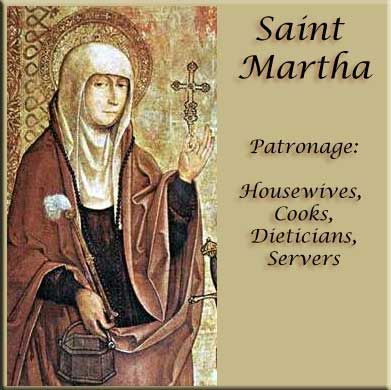
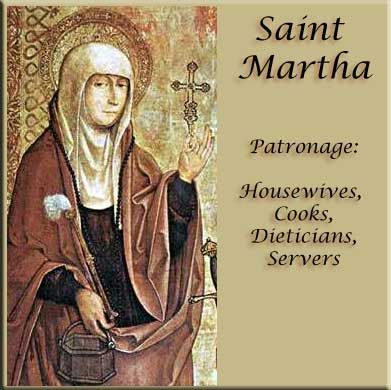
Today we come together to commemorate the life of St Martha.

We should all have knowledge about the story of Martha and Mary who welcomed Jesus into their home. Martha busies herself with the hospitality needs of our Lord Jesus whilst Mary sits at the feet of Jesus listening to his words. Martha complains to Jesus because she wanted Mary’s help but Jesus replies to her, “Martha, Martha, you are worried and distracted by many things; there is need of only one thing. Mary has chosen the better part, which will not be taken away from her.” (Lk 10:38-42)

Jesus’ reply was all about listening to his message. We can then see in ourselves and in our lives, what Jesus points out in Martha – is that we can be easily distracted and worried by worldly tasks and Through Martha’s story, Jesus is reminding us that there is one thing that is of importance: that is to follow Jesus’ message and his individual calling that he has for each of us.

In John 11:17-27, Martha meets Jesus as soon as she learns he is coming after hearing that her brother Lazarus had died. Immediately we see a change in Martha. She purposefully goes to Jesus and when he asks her about his belief in him she responds, “Yes, Lord, I believe that you are the Messiah, the Son of God, the one coming into the world.”

Martha has the opportunity to serve Jesus again.

Six days after the Passover (John 12:1-8). She does so with quiet humility. We come to understand Martha’s role is a different calling than that of Mary and this is much like it is in our own lives. we are each called into different service for the Lord’s glory, we each are blessed with different skills and talents with which to serve him. Martha chose to serve with love instead of with bitterness and arrogance.

Martha’s story gives us hope and is a good example for our own lives.  Even though we can fall into the trap of trying to complete tasks without God’s assistance, there is opportunity in the Grace of the Lord to retry. When Jesus speaks to Martha, he is not unkind. His response is one of love.  As the sinners we each are, we can only strive to learn and grow from our mistakes to make the next opportunity filled with Christ.

Martha is known as the patron saint of cooks, homemakers, and servants, St. Martha reminds us to thank all in our lives who serve us in whatever way. This can be our parents or those who cook for us, those who work in public service, our friends, our church clergy or even indeed anyone at all.  As a way to celebrate St. Martha’s feast day today, we can pray to serve Jesus better:

Saint Martha, pray for us that we might serve Jesus better. Help us to overcome any distractions and worries that we may face in this world and to listen to his words and be present to him in our daily lives. May we remember that although we are called and blessed in different ways, that we are still all members of the same one body of our Lord Jesus Christ.

Amen.

Blessed Antony Della Chiesa

download

Antony was born into the nobility, the family of the Marquis della Chiesa, and a collateral ancestor of Pope Benedict XV. He was well educated. Showing a taste early in life for he things of God, he grew up with the hope of becoming a religious. His father, who was a man of some importance, opposed this wish. Not until Antony was 22 was he able to make the break with his family and enter the monastery at Vercelli.

Here he distinguished himself for both sanctity and learning. Being a good preacher, he was for some years the companion of Saint Bernardine of Siena, in his missionary journeys through Italy. Antony was prior at the friaries of Como, Savona, Florence, and Bologna.

Antony gives us a picture of one who followed the Dominican life perfectly, managing, most of the time, to escape public notice. There is in his life very little of the glamorous or the unusual. He kept the rule, was a good superior, and a just administrator. Shunning applause, he was always serene.

The legends mention that he was particularly devoted to Our Lady, which is something one takes for granted in a Dominican, and that he conversed with her, in ecstasy, several times. He had the gift of reading hearts and was a sought-after director of souls. He also healed many sick people with his blessing. However, if any miracles are ordinary ones, these may be so described; they could be given as typical of most of early Dominicans.

At one time, Antony was on a ship that was captured by pirates, but at his prayer, the pirates spared the passengers and brought them safely to land. One of the very few things of unusual nature that in Antony’s life is a legend told of him when he was prior of Savona. It makes a lovely ghost story, and it also provides food for thought.

According to the story, Antony was praying one night in the church. Disturbed by the sound of horses hooves clattering on the flagstones outside, he went to see who could possibly be there at such a late hour. There were several horsemen, all mounted on black horses. He addressed them, but received no answer. Thinking that they might be foreigners, he tried several languages, and still there was no response.

Aware, then, that something was wrong, he commanded them in the name of the Lord to tell him who they were and where they were going. They said that they were devils, and that they were on their way to meet the soul of a dying sinner, a usurer, and escort him to hell. “I will pray for him,” said Antony. The demons laughed and told him he was too late. “Then at least come back and tell me whether you succeed or not,” said the prior.

A short while later, the group returned, and they had succeeded. They held the unhappy usurer captive, and, while the prior watched in horror, they bore him off. The man was screaming. The next day, the usurer’s relatives came to arrange an elaborate funeral. “You would do much better to have Masses said for yourselves and other poor sinners,” he said.

Antony died at Como and was buried there in the Dominican church Miracles at his tomb led to his beatification.

Born: in San Germano, near Vercelli, the Piedmont, Italy, in 1395;

Died: Como, Italy, January 22, 1459;

Beatified: 1819 by Pope Pius VII


Contradictions and Commitment ~ Br. Chip Noon, Novice

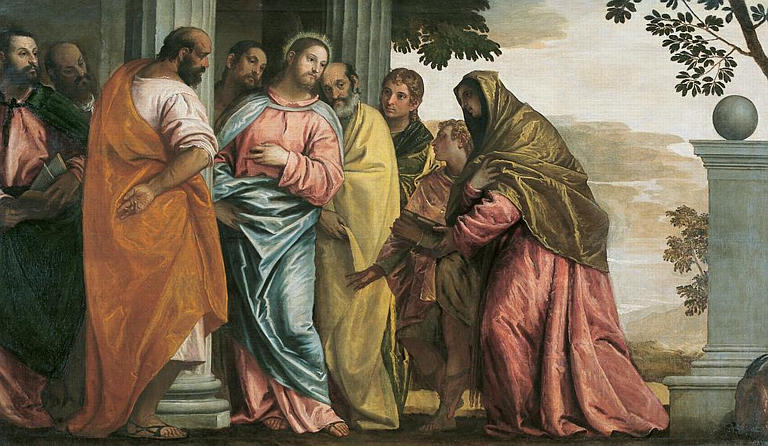
jesus-meeting-mother-of-james-and-john

“So the last shall be first, and the first last.”

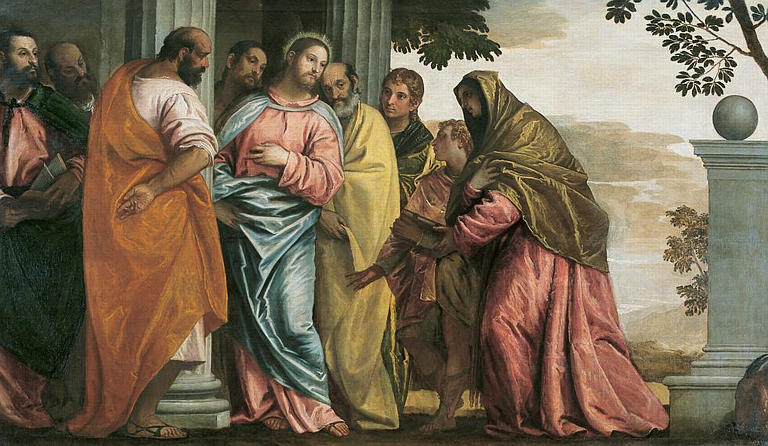
In Saint James, whose feast we celebrate today, we have a complex character and an important lesson. The Gospel today recounts the incident where the Apostle’s mother, Salome, beseeches Jesus for a favor: that her sons, James and John, be seated at his right hand and left hand in the kingdom.

If Jesus were to answer in today’s vernacular he might say, “You still don’t get it!”

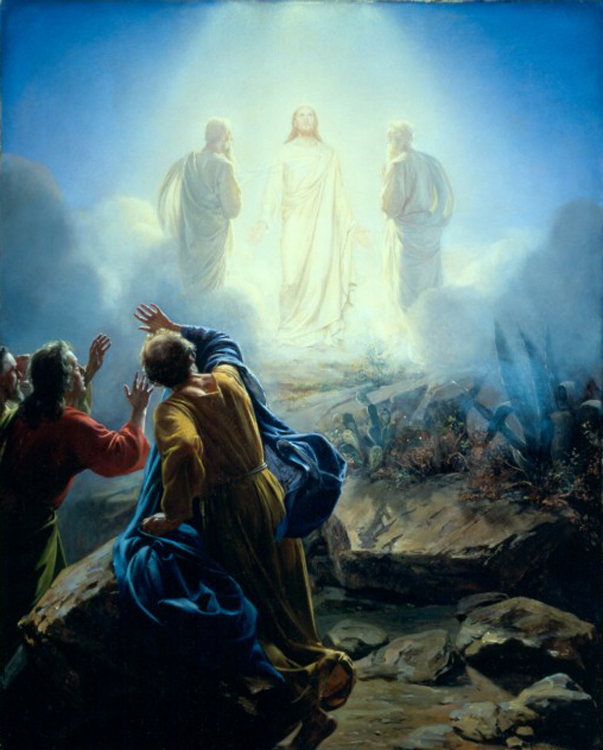
Yes, James was a fisherman who, along with his brother John, was called by the Lord to drop everything and follow him. But he was not so poor, because we know that his father was successful in the family business and his mother was one of the women who were financiers of Jesus’ mission. So perhaps he felt a little superior to some of the other disciples? He did get to witness the Transfiguration, he offered to call down fire on a Samaritan town, he was the first Apostle to be martyred, and he and his brother were called “Sons of Thunder,” probably for his fiery temper. So he was something of a big deal.

But he was also trying to put himself first. He and his brother put his mother up to asking Jesus for a favored position, probably because he knew it was bold and misguided. Jesus rebuffs the request.

James was also the target of one of the Eight Rebukes of Jesus in the incident of offering to destroy the Samaritan town mentioned before.

And yet even though he still didn’t “get it,” he was one of the twelve Apostles and important to the mission of Jesus. And so he is an important lesson to us: nobody’s perfect, but we are still loved by the Lord – and even given great responsibility to spread his word.

Throughout the Gospels, we learn that your station in life, your wealth or lack of it, your talents or lack of them make no difference in the final calling. And what proof do we have of this teaching? It is the life of Jesus…and his suffering and death. Time and again we are taught that we must be servants, even those of us who are of the highest station, and we must be willing to sacrifice ourselves for others, rather than seek glory and riches. Because that is exactly what our Lord did: he sacrificed himself on the cross for our sins and our redemption. His was the ultimate commitment, and he asks no less of us.

Just as Saint James embodies contradictions of pride and humility, so we find Paul, in the first reading, telling us that we will also be faced with, and live within, contradictions. Our weak bodies, breakable earthen vessels, will be

afflicted in every way, but not constrained;
perplexed, but not driven to despair;
persecuted, but not abandoned;
struck down, but not destroyed;
always carrying about in the body the dying of Jesus,
so that the life of Jesus may also be manifested in our body.


The last shall be first, and the first last.

Paul says, “We who live are constantly being given up to death for the sake of Jesus.” In other words we may fall over and over, we may succeed over and over, but what we are living is the spirit of redemption every hour of every day. And so if we fall, we know intimately that we will be raised up if we ask for it, because God’s mercy is everlasting.

Although this life may seem like the life of Sisyphus, constantly pushing a boulder uphill only to have it roll to the bottom time after time, when we really contemplate our lot, we can always remember that Jesus told us the truth: our yoke is easy and our burden is light.

Lord, help us today to renounce our pride or our consternation, our smugness or our fears, our complacency or our anxiety and remind us that everything is for you and you are everything for us. And like Saint James, though we may at times deserve rebuke, we can be assured of our salvation.

Amen.

ABC’s and Priorities: Prayer ~ The Rev. Dcn. Scott Brown, OPI

ABC-Prayer-Ftr-iStock_000067483609Large-300x200

When you pause to consider that God is infinitely strong and can do all that he pleases; that he is infinitely righteous so that he only does what is right, and that he is infinitely good so that everything he does is perfectly good; that He is infinitely wise so that he always knows perfectly what is right and good, and that he is infinitely loving so that in all his strength and righteousness and goodness and wisdom He raises the eternal joy of His loved ones as high as it can be raised — when you pause to consider this, then the lavish invitations of this God to ask Him for good things, with the promise that He will give them, is unimaginably wonderful.

Everyone seeks something.

We are all by nature seeking people. Some people seek for money, others for fame, others for pleasure, others for self-validation, others for worldly power. We may seek a husband or a wife or we may seek children or a new job or a better education or a new home or new friends or a new church. The tragedy of our time is that so many people are wasting their lives chasing after three things that can never satisfy—money, possessions and power.

There is an easy test to find out what you seek in life.

There is a simple test to help you discover what you truly seek in life. This test is absolutely foolproof. You tell me how you spend your time and your money and I’ll tell you what you are seeking. You can say anything you like, you can come to church and look very religious, but your time and your money don’t lie. Time is life and money is nothing but the time it takes to make the money. Show me your calendar and your checkbook and I’ll know the truth about your priorities.

Whatever righteous thing you seek in the spiritual realm, you can have it, if you want it badly enough.

“Blessed are those who hunger and thirst for righteousness, for they will be filled” (Matthew 5:6). This is one of the most stupendous promises in the Word of God. If you are hungry and thirsty for the righteousness that God provides, you will be filled.

If you want it, you can have a close walk with God.

If you want it, you can have a better marriage.

If you want to, you can do God’s will.

If you want to, you can witness for Christ.

If you want to, you can learn to pray.

If you want to, you can grow spiritually.

If you want to, you can walk in the Spirit.

If you want to, you can become a man of God or a woman of God.

If you want to, you can change deeply ingrained habits.

If you want to, you can break destructive patterns of behavior.


A: Ask God for what you want in life – if it is in his plans, you will receive.

B: Be patient, God doesn’t work on your time schedule. When He is ready it will happen.

C: Constantly pray: ask once and you may receive, but continuous prayer lets God know that you are serious about this.

One final thought. Jesus’ appeal is always personal. He never says, “Come and join the church” or “Come and be baptized” or “Come and give money.” He simply says, “Come unto me.” When Jesus says, “You will be filled,” he means, “You will be filled with Jesus himself!”

If you are hungry, come and eat of the Bread of Life.

If you are thirsty, come and drink of the Water of Life.

If you are weary, come and find rest.

If you are guilty, come and be forgiven.

If you are far from God, come back home again.

Blessed Augustine Fangi of Biella

200px-Agostinobiella

Miracles around the tomb of Augustine of Biella led to his beatification in 1878, after he had long been forgotten by everyone, except the residents of the little town at the foot of the Alps where he lived. His is another example of a life noted for piety and regularity, but quite unremarkable for unusual events or venturesome projects.

Augustine’s father was a member of the Fangi family, who were wealthy and noble, and, because of this, he had planned a secular career for his son. But when the Dominicans came to Biella, his plans were changed, for Augustine was completely charmed by their way of life and begged to be admitted. He entered, while quite young, the new convent that the Dominicans had built at Biella.

Augustine’s had a reputation for penance, even at a time when people were not as squeamish as they are today. Not only did he inflict harsh penances upon himself, he also bore with patience whatever pain and annoyance life granted him gratuitously. At one time he was required to undergo a surgical operation without, of course, any anesthetic. He did so without making the slightest outcry. In fact, he said afterwards that his mind was so intensely focused on something else that he hardly noticed what was being done to him. His mind was on that “something else” most of the time, for he prayed continually.

In 1464, Augustine was made prior at Soncino. Several of his best known miracles were performed there. At one time, a deformed child, who had died without baptism, was restored to life, by Augustine’s prayer, long enough to be baptized. At another time, when he was passing down the street, he met a little boy who was crying bitterly, because he had broken a jug of wine. Augustine gathered up the shards and put them back together again. Then, with a prayer, he refilled the jug and handed it back to the startled child. Still another time, through his intercession, a woman was delivered from possession of five devils.

Augustine spent his last ten years in the convent in Venice, and he died there on the Feast of Saint Mary Magdalene. He was buried in a damp place. Forty years later, on the occasion of some repairs to the church, his coffin, found floating on water, was opened. His body and habit were still intact. This did much to promote interest in his cause. Nevertheless, it was more than three centuries before he was finally beatified.

Born: at Biella, Italy, 1430

Died: feast of Saint Mary Magdalen 1493 at Venice, Italy; in the 1530s, workmen found his coffin floating in the water that had seeped into the burial chamber – when opened, Augustine’s body and clothing were found to be incorrupt

Cultus Confirmed: in 1872 by Pope Pius IX

Beatified: in 1878 by Pope Leo XIII


Blessed Jane of Orvieto

Beata_Giovanna_da_Orvieto

One of the stigmatists of the Order who deserves to be better known is Blessed Jane of Orvieto, whose marvel-filled life was the edification of Umbria in the latter half of the thirteenth century. Jane was born near Orvieto, in 1264, and both parents died when she was very small. Left to the care of casual neighbors, the little girl gre up with a special reliance of her guardian angel. She was a pious and intelligent child, , spending her time in prayer , even when very young.

Since it was necessary for her to earn her living , Jane studied dressmaking and became proficient at it. For several years she worked at this trade , prayerful and happy and undisturbed about her future. However, she had a number of unhappy experiences on the street on her way to work, for young men were attracted by her beauty. It became apparent to her that she must make some public declaration of her intentions if she wanted any peace. She decided to enter the Third Order of St. Dominic. Dressed in the habit of the mantellate, she would be safe from rude remarks and from any misunderstandings.

Jane’s friends opposed her plans, because they had already helpfully chosen a husband for her, and were trying to arrange a meeting of Jane and the man they had selected. Because of her youth, the Dominicans delayed in accepting her. Only after a long period of prayer and fasting was she able to win the privilege of putting on the Third Order habit and living with the other members of the Tertiary chapter. Once a member of the Order she so much desired , she set her goal at the highest sanctity and worked at attaining it. She prayed all morning and part of the afternoon, leaving herself only time to do enough work to care for her few needs and some alms to give the poor. She soon reached a remarkable state of prayer; she participated bodily in whatever she was contemplating. Her director learned not to say anything that would send her into ecstasy until he was through instructing her. Once he mentioned the martyrdom of Catherine of Alexandria and said piously, “Arise, O blessed Catherine,” and Jane arose, in ecstasy, and remained suspended in the air for an hour. If he talked about the Crucifixion her arms would go out in the form of a cross, and she would rise in the air like a figure on a crucifix. On Good Fridays she experienced the terrible agony of the Passion, and one could hear her bones cracking and see the bloody sweat. She received the stigmata, but it was not always visible.

Along with her remarkable life of prayer, Jane had to contend with physical pain. Once she was cured of a serious illness by a miraculous appearance of our Lord on the cross. He appeared to her in the midst of a bright light and gave her a cup of wine to drink. She obediently drank it, and she was instantly cured. Another time, when she was too ill to go to church to receive Communion , Our Lady came and brought the Holy Child to her.

One of Jane’s principal crosses was the lack of privacy. The whole town knew about her ecstasies. As soon as she fell into one, people came running to look. Jane tired to persuade the prioress to keep them out, but the prioress was interested herself, and saw no reason why anybody should object to being watched if they were not doing anything wrong. Jane wept with embarrassment when people asked for her blessing, and assured them over and over that she was not a saint but a wicked sinner, a diagnosis which nobody believed but herself.

Blessed Jane died, in 1306, and was buried in the Third Order cemetery in Orvieto. The following year her body was transferred to the chapel of the Three Kings, and many prodigies occurred at that time, giving impetus to the process for beatification, which, however, was not completed until more than 400 years later, in 1754.

Born: c.1264 at Carniola, near Orvieto

Died: 1306

Beatified: September 11, 1754 by Pope Benedict XIV (cultus confirmed)


Saint Mary Magdalen, Protectress of the Order

st-mary-magdalene-de-pazzi-01

Epistle: Canticle 3:2-5; 8:6,7

I will rise and will go about the city; in the streets and the broad ways I will seek him whom my soul loveth; I sought him and I found him not. The watchmen who keep the city found me: Have you seen him whom my soul loveth? When I had a little passed by them, I found him whom my soul loveth. I held him; and I will not let him go till I bring him into my mother’s house, and into the chamber of her that bore me. I adjure you, O daughters of Jerusalem, by the roes and the harts of the fields, that you stir not up, nor awake my beloved till she please. Put me as a seal upon thy heart, as a seal upon thy arm, for love is strong as death; jealousy as hard as hell; the lamps thereof are fire and flame. Many waters cannot quench charity, neither can the floods drown it; if a man should give all the substance of his house for love, he shall despise it as nothing.

The soul that, following the direction of the watchmen, that is, the priests, teachers, and rulers of the Church, seeks Jesus, He goes to meet, gives Himself up to, takes up His abode in, with all His love, with all His treasures. The soul which has found Christ for delight forgets all outward things, and no longer has love or joy but for and in Christ. How should it be otherwise? What can be wanting to him who truly possesses Christ? This love for Him Who loved us unto death shows itself by outward acts that are heroic. So Mary Magdalen loved Jesus. Follow her example.

St. Mary Magdalene is one of the greatest saints of the Bible and a legendary example of God’s mercy and grace. The precise dates of her birth and death are unknown, but we do know she was present with Christ during his public ministry, death and resurrection. She is mentioned at least a dozen times in the Gospels.

Mary Magdalene has long been regarded as a prostitute or sexually immoral in western Christianity, but this is not supported in the scriptures. It is believed she was a Jewish woman who lived among Gentiles, living as they did.

The Gospels agree that Mary was originally a great sinner. Jesus cast seven demons out of her when he met her. After this, she told several women she associated with and these women also became followers.

There is also debate over if Mary Magdalene is the same unnamed women, a sinner, who weeps and washes Jesus’ feet with her hair in the Gospel of John. Scholars are skeptical this is the same person.

Despite the scholarly dispute over her background, what she did in her subsequent life, after meeting Jesus, is much more significant. She was certainly a sinner whom Jesus saved, giving us an example of how no person is beyond the saving grace of God.

During Jesus’ ministry, it is believed that Mary Magdalene followed him, part of a semi-permanent entourage who served Jesus and his Disciples.

Mary likely watched the crucifixion from a distance along with the other women who followed Christ during His ministry. Mary was present when Christ rose from the dead, visiting his tomb to anoint his body only to find the stone rolled away and Christ, very much alive, sitting at the place they laid Him. She was the first witness to His resurrection.

After the death of Christ, a legend states that she remained among the early Christians. After fourteen years, she was allegedly put into a boat by Jews, along with several other saints of the early Church, and set adrift without sails or oars. The boat landed in southern France, where she spent the remaining years of her life living in solitude, in a cave.

St. Mary Magdalene’s feast day is July 22. She is the patroness of converts, repentant sinners, sexual temptation, pharmacists, tanners and women, and many other places and causes.