Today is the Memorial of my Dominican Order Name Saint, that being St. Elizabeth Ann Seton.
This particular Saint was given as my order Name Saint because my Bishop noticed there seemed to be many similarities between the life of St Elizabeth Ann Seton and the life of myself. We both share the fact that we have both overcome many life traumas and adversities, but yet, we both always have remained strong of faith regardless of the things life has thrown at us.
Mother Seton founded the first American religious community for women, named the sisters of charity, and so she was a keystone of the American Catholic church. Mother Seton also opened the first American parish school, and the first American Catholic orphanage. All this, she had accomplished by the age of 46, whilst also raising her own five children.
Mother Seton is a true daughter of the American Revolution, she was born on Aug 28th 1774, which was only two years prior to the declaration of Independence.
By both birth and marriage, Mother Seton was linked to the first families of New York and enjoyed the rich fruits of high society, but this situation wasn’t to last.
Mother Seton suffered the early deaths of both her mother in 1777, and of her baby sister in 1778, but far from letting it get her down, she faced each new ‘holocaust’ as she called it, with a hopeful cheerfulness.
At only aged 19, she married a handsome wealthy businessman named William Magee Seton and they had five children together. But William’s business failed, and he died of Tuberculosis when Elizabeth was aged 30, leaving her widowed, penniless and with five young children to support. Many of her family and friends rejected her when she converted to the Catholic faith in March 1805.
As a means to support her children, mother Seton opened a school in Baltimore which always followed a religious community pathway and her religious order of the sisters of charity was officially founded in 1807.
The thousands of letters of Mother Seton reveal the development of her Spiritual life from that of a person of Ordinary goodness, to one of heroic sanctity. She suffered many great trials within her life yet with her strong faith, she overcame them all. Trials of sickness, of misunderstanding, the deaths of her loved ones (mother, baby sister, husband, and even two of her own children), and the heartache of having a wayward son.
St Elizabeth Anne Seton died on January 4th 1821, she became the first American=born citizen to be beatified in 1963, then Canonized in 1975. She is buried in Emmitsburg in Maryland.
Let us pray:
O Father, the first rule of our dear Saviour’s life was to do your will. Let His Will of the present moment be the first rule of our daily life and work, with no other desire but for it’s complete accomplishment. Help us to follow it faithfully, so that doing your Will may be pleasing in your sight.
Today, we come together as churches and as children of the Lord to celebrate the Feast of the Holy Family. The Holy family of the Blessed Mary, of Joseph her spouse, and of course of our Lord Jesus Christ together as a full family. Now, we all come from families and we know as about both the joys and issues and difficulties family life can bring. Families are made of individuals, and individuals often have crosses to bear. Even as part of a family, even in the church family, we all have our crosses in life to carry. The Holy family, though indeed very blessed and Holy, were also still human and had their crosses of life to carry.
The crosses that were borne by the Holy family come to mind when reading the scriptures. Now just imagine what it must’ve been like when Mary and Joseph had to tell others how Mary had been conceived by the Holy Spirit alone? I sincerely doubt many people at first sincerely believed and accepted the truth of the situation. Yes, there was probably talking behind their backs, mocking, and those who would’ve just seen it as merely untruthful. How misunderstood both Mary and Joseph indeed must have been! Can you can you imagine how they would feel? We have all been misunderstood or not believed at times and it isn’t a good feeling at all! Even Mary, at the beginning of her pregnancy, was misunderstood by Joseph who was considering putting her away quietly, before an Angel intervened in a dream and reassured Joseph of the truth of the situation. At that time Mary’s pregnancy would have been seen as acceptable by others, and Joseph was concerned how it would be seen and how it would be taken. Can you imagine how this must have felt to both Mary, and indeed to Joseph?
When Mary and Joseph arrived in Bethlehem for Jesus’s birth, there was no room and all they could find was an animal’s shelter because Bethlehem at that time was so crowded. Can you imagine not finding anywhere to give birth? Not nice at all! After the birth of Jesus, Both Mary and Joseph had to flee because Jesus’s life was in danger from King Herod, who was killing all newborn babies and those very young in an attempt to kill Jesus as Herod saw him as a very severe threat. How this must’ve felt to both Mary and to Joseph! The fear for their son’s safety, the sadness, the confusion…the suffering!!
Mary and Joseph suffered the awful experience of losing Jesus for three days when he was twelve years old and the only satisfaction they got from him was that he had to be about his Father’s business.
We do not hear of Joseph any more so we presume that before Jesus began his public ministry in Galilee Joseph had died – The Holy Family suffering the greatest pain of all families, the pain of bereavement and separation through death.
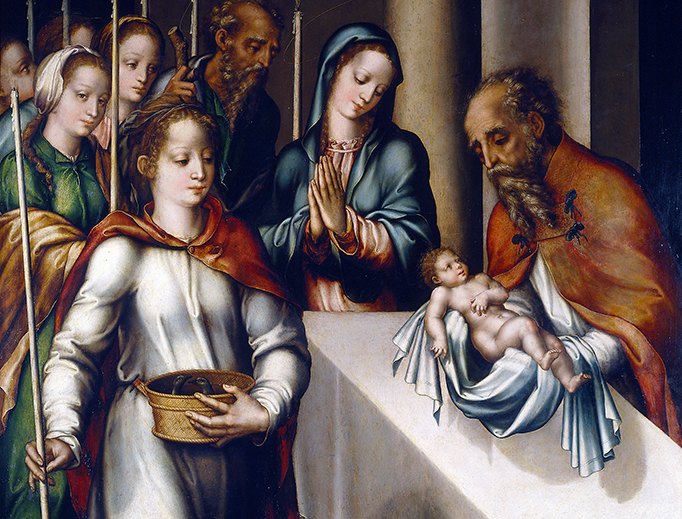
Jesus’ public ministry must have taken its toll on Mary. Simeon had predicted in the Temple that a sword of sorrow would pierce Mary’s soul. We can imagine one such occasion as we read in Mark 3:21 that when Jesus returned to Nazareth. One day his relatives came to take him by force, convinced that he was out of his mind. Not a very pleasant experience for any family, no matter how holy.
There were so many other crosses this Holy family had to endure, but the saddest and the one which must’ve felt like Mary’s heart was being torn from her chest, was when Mary had to watch her only son die by crucifixion upon the cross for our salvation…oh what pain and sorrow!!!
All this suffering, pain and sadness this family has had to endure yet they stayed together and extremely strong throughout, and even kept their sanity…but how?
It was their sheer strength in their never-ending love both for God our Heavenly Father, and for each other, and for their endless faith and trust in God that enabled them to come through absolutely. So what holds us and our own families together in times of trauma, or suffering? We usually stay together because of our love and forgiveness of each other. We may at times have disagreements or words, but in the end true love keeps us in good stead. We should take notice always in the way we live our lives in the message that we get from the lives of the Holy Family, and that message is that no matter how hard we may feel our lives become, we must give all our love, faith, and trust to the Lord who will never ever fail us!! Let us pray to ask that we and all our families may live with the love, faith and true trust of the Lord in our lives!!
Let us pray:
Jesus, Mary and Joseph, teach us the sublime dignity and the vital duty of fostering vocations. Give us one heart and one soul. Give us the grace to be ever aware of our tremendous responsibility for setting a good example in our own relations so as to act as a magnet for drawing vocations.
We are eternally grateful for your numerous graces in the past, the present, and the future. Help us always to be aware of God’s presence within us.
Lord, Child of Nazareth, teach us!
Blessed Mother of Jesus, guide us!
Faithful guardian of Mary, protect us!
Holy Family of Nazareth, bless us all and our with numerous different but valuable vocations to do your work.
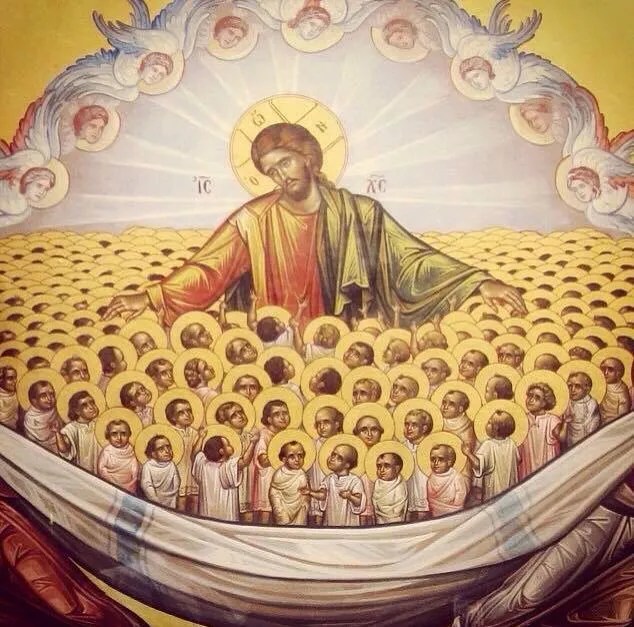
Today, we as a church remember The Holy Innocents, those infant boy martyrs all aged 2 years and under. This liturgical season has such a huge contrast. Only 3 days ago, we were celebrating the joyous celebration of the birth of Our dear Lord and Saviour, Jesus. Then the very next day, our thoughts turn To st Stephen and his Martyrdom for Christ. Now, we are remembering these Innocent young child martyrs, and how they were slaughtered on the orders of King Herod.
Let us first look at The Gospel reading for today of Mt 2:13-18:
When the magi had departed, behold, the angel of the Lord appeared to Joseph in a dream and said, “Rise, take the child and his mother, flee to Egypt, and stay there until I tell you. Herod is going to search for the child to destroy him.”
Joseph rose and took the child and his mother by night and departed for Egypt. He stayed there until the death of Herod, that what the Lord had said through the prophet might be fulfilled, Out of Egypt I called my son.
When Herod realized that he had been deceived by the magi, he became furious. He ordered the massacre of all the boys in Bethlehem and its vicinity two years old and under, in accordance with the time he had ascertained from the magi. Then was fulfilled what had been said through Jeremiah the prophet:
A voice was heard in Ramah, sobbing and loud lamentation; Rachel weeping for her children, and she would not be consoled, since they were no more.
It’s extremely difficult to imagine that anyone could see a little baby as such a great threat, yet that is exactly what is recounted in our gospel today. When Jesus was born, the shepherds and magi see in the Christ Child a Lord and Saviour. King Herod, however, sees the baby Jesus as merely a rival that has to be feared and to be eliminated. The “Holy Innocents” we celebrate today are all those little babies that Herod had murdered in Bethlehem in an attempt to kill this child Jesus. Sadly, this event is not the first such occurrence of this nature in the Scriptures. When the Israelites grew numerous in Egypt, Pharaoh also sensed a rival and thus ordered all the babies to be thrown into the river. Despite this attempt, Moses, like Jesus, escaped the plot against them. The important point in these stories is that we need to recognize that God’s plan was brought about even in spite of these murderous efforts to thwart it. Many babies died in Egypt and Bethlehem and yet Moses and Jesus remained safe and sound. God’s plan was accomplished.
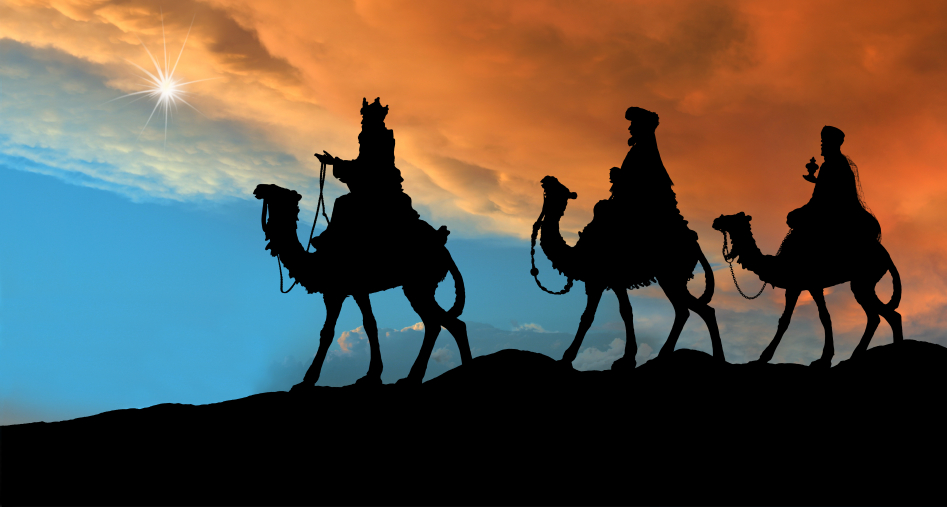
The readings tell us today about light and about darkness. The magi are in darkness, and yet they see the star and follow the guiding light it which it shines. They are willing to go out of their way, to change their lives to conform to God’s guidance. The magi find their way to that light. We too are often given the choice between being in light or in darkness.
This day which commemorates the sad slaughter of so many innocent children in Bethlehem is somewhat ironically also a feast day on which is for celebrating. Whilst we remember the horror of the deaths of these little babies, and the traumatic suffering their families obviously suffered by their slaughter, We also celebrate the fact that King Herod’s plan failed. Not only did Jesus survive, but the lives of the little babies were not snuffed out eternally as Herod had planned. Rather, these children now live forever in God’s heavenly Kingdom, where they intercede for us. Yes, we rejoice to see that God’s plan is triumphant even in the face of great opposition and evil. Light will always be triumphant over darkness. The only question that remains is, will we live in the darkness of this world, or will we follow the light and live in the Lord our God and Saviour, and he in us?
Let us pray:
We remember today, O God, the slaughter of the holy innocents of Bethlehem by King Herod. Receive, we pray, into the arms of your mercy all innocent victims; and by your great might frustrate the designs of evil tyrants and establish your rule of justice, love and peace; through Jesus Christ our Lord, who lives and reigns with you, in the union of the Holy Spirit, one God, for ever and ever. Amen.
So now our Lord and Saviour is born! All the Turkey and trimmings have been eaten, and many people head to the stores, looking for the latest cheap bargains. Around the world, there will be people buying things in boxes. And so today we celebrate The Feast of St Stephen the Martyr, this also has the alternate name of ‘Boxing day’. Boxing day is not about shopping, it is a day where we give boxes of gifts and food to the poor and needy in our society. It is a day of showing the Lords love to the less fortunate. But what has all this talk about boxes got to do with today’s feast of St Stephen?
St. Stephen was called by the Apostles at the dawn of the church from among seven Greek men who were of good reputation, who were filled with Spirit and who had wisdom. They were the first Deacons of the Church. They oversaw the welfare of the members of the church, they gave care to the poor, for widows and for orphans. This is the link that I see with the true meaning of the alternative name of ‘Boxing day’, about giving care and welfare.
According to tradition, Stephen was a young man, most likely still in his teen years. He was full of grace and power. He performed many miracles amongst the people in the name of our Lord Jesus Christ. This however, did not go down well with those of senior rank in the temple court, and various synagogues would challenge Stephen with many debates and arguments, however, Stephen would always come out of them on top every time due to being filled with the wisdom of the Holy Spirit. This led to anger and before much time had passed, Stephen was charged with blasphemy, taken to the Sanhedrin to defend his case, which he did with great eloquence.
Stephen began with the promises given to Abraham and went all the way to the building of the temple during Solomon’s reign, before then directing his sights on the Sanhedrin itself. ‘How stubborn you are, heathen still at heart and deaf to the truth! You always fight against the Holy Spirit. Like Fathers like sons! Was there ever a Prophet your fathers did not prosecute? They killed those who foretold the coming of the righteous one, and now you have betrayed him and murdered him, you who have received the law as God’s angels gave it to you, and yet have not kept it! ‘ (Acts 7:51=53).
This led to a fit of anger and fury and the council dragged Stephen to the edge of the city to stone him to death, he had no true trial nor verdict. But Stephen still kept his faith until the finish, having a vision of the heavens being torn open with Jesus standing there at Gods right hand.
Stephen’s last mortal words were pleas to God for the forgiveness for his persecutors, that those sin would not be held against them. St Stephen is the Proto=Martyr, This is because he was the first victim of persecution of the church that is mentioned after the ascension of Jesus into heaven.
Life’s fulfilment =the eternal heavenly banquet rests squarely in God’s hands. This leaves us as children of God to love our neighbour, to care for this world, and to seek those things which make for peace, for joy, and for salvation. Stephen is such an excellent example for us to follow in our daily Christian lives, both in the way he cared for the poor and needy, and also by the way he forgave his persecutors and even prayed for them. May we strive to imitate the values in the life of St Stephen, for the glory of God within our own lives.
Let us pray:
Grant, Lord, we pray that we imitate the truth of the Christian life we lead following the example of St Stephen the Martyr, who we celebrate today. Mav we, as he did, love and care for the needy in our society in your ever=loving name and to your glory, and that also like St, Stephen, we can forgive and pray for forgiveness for all who may harm us. Through the Lord Jesus Christ, your Son, who lives and reigns with you in the unity of the Holy Spirit, one God, for ever and ever. Amen.
After 2000 years of Christmas sermons, in hundreds of languages, in different countries throughout the world, and by way of innumerable faith traditions, is there anything new or original left to be said about Christmas, and what it means, that hasn’t been said before? Perhaps not. However, like re-reading that favorite book for the 17th time, or watching that favorite movie or television show for the 358th time, even when you know exactly what comes next, what the very next word is going to be, often we find a new meaning or a new slant on something that is as tried and true as Christmas itself.
And so it is with me this year. The author of St. Luke’s gospel recalls the story of the angels bringing the news of Christ’s birth to the shepherds. Now, we all know that story. We’ve heard it many times over, and those of us who cherish “A Charlie Brown Christmas” will always, in some ways, always hear Linus quoting from Luke 2, no matter who is reading that passage of the Bible to us.
8And there were in the same country shepherds abiding in the field, keeping watch over their flock by night. 9And, lo, the angel of the Lord came upon them, and the glory of the Lord shone round about them: and they were sore afraid.
10And the angel said unto them, Fear not: for, behold, I bring you good tidings of great joy, which shall be to all people. 11For unto you is born this day in the city of David a Saviour, which is Christ the Lord.
12And this shall be a sign unto you; Ye shall find the babe wrapped in swaddling clothes, lying in a manger. 13And suddenly there was with the angel a multitude of the heavenly host praising God, and saying,
14Glory to God in the highest, and on earth peace, good will toward men.
15And it came to pass, as the angels were gone away from them into heaven, the shepherds said one to another, Let us now go even unto Bethlehem, and see this thing which is come to pass, which the Lord hath made known unto us. 16And they came with haste, and found Mary, and Joseph, and the babe lying in a manger.
17And when they had seen it, they made known abroad the saying which was told them concerning this child. 18And all they that heard it wondered at those things which were told them by the shepherds.
19But Mary kept all these things, and pondered them in her heart. 20And the shepherds returned, glorifying and praising God for all the things that they had heard and seen, as it was told unto them. Luke 2:8-20 King James Version (KJV)
We know the story. We SEE the story in every Nativity scene we pass by. There is almost always a shepherd near the manger carrying a lamb on his shoulders and another lamb or sheep to be seen somewhere hanging around. It’s always seemed to me that the sheep and the shepherds were just THERE, minor players in a Christmas play, the “extras” assigned to the kids who didn’t quite measure up to the roles of Mary or Joseph; they enter stage left, ooh and aah over the baby, and exit stage right, singing “Go tell it on the mountain”, singularly unimportant and taking secondary roles to the more illustrious wise men (who in reality weren’t there at all) and most definitely playing supporting roles to the Holy Family, or just standing around as so much scenery, contributing to the mood and filling up the bare spots in the Nativity scene. I overheard a conversation recently that made me really think about the shepherds. While visiting some friends, their cat jumped into the midst of the family crèche and knocked over the obligatory shepherd. It was chipped. The younger daughter of the family was somewhat distressed, and to make the little girl feel better, the mother said to her, “Don’t worry about it, Honey. It’s just the shepherd. He’s not all that important.” I didn’t think much about it at the time, but when reading the Scripture appointed for today, it struck me. Not all that important? But weren’t they? Who WERE these shepherds? Why were they there in the first place? Why did THEY get the news of Christ’s birth in such a spectacular way? Who were they that they should be eyewitnesses of God’s glory and receive history’s greatest birth announcement?
In Christ’s day, shepherds stood on the bottom rung of the Palestinian social ladder. They shared the same unenviable status as tax collectors and dung sweepers. Only Luke mentions them. When the twelve tribes of Israel migrated to Egypt, they encountered a lifestyle foreign to them. The Egyptians were agriculturalists. As farmers, they despised shepherding because sheep and goats meant death to crops. Battles between farmers and shepherds are as old as they are fierce. The first murder in history erupted from a farmer’s resentment of a shepherd. Smug religious leaders maintained a strict caste system at the expense of shepherds and other common folk. Shepherds were officially labeled “sinners”—a technical term for a class of despised people.
Into this social context of religious snobbery and class prejudice, God’s Son stepped forth. How surprising and significant that God the Father handpicked lowly, unpretentious shepherds to be the first to hear the joyous news: “It’s a boy, and He’s the Messiah!” What an affront to the religious leaders who were so conspicuously absent from the divine mailing list. Even from birth, Christ moved among the lowly. It was the sinners, not the self-righteous, He came to save. So is it really all that surprising that the first announcement of Christ’s birth was to the lowly shepherds on Bethlehem’s hillsides?
Consider the events leading up to Christ’s birth. Mary was barely 15. Christ was born to an unwed mother, Mary, a servant girl; Mary the young woman who delivered while only betrothed to Joseph. He was born in a stable, a cave! A holy God being born to a couple no different than immigrants, far from home and in a strange city, in a place where animals were kept. A couple who couldn’t even find a place to stay, turned out of every inn! It’s all too bizarre.
Yet this is the God we experience. This is our claim; This is the meaning of his very name: Immanuel, meaning “God with us” — with us not just in nice times, but most especially in the times of our lives when we are in the caves, and stables of our lives, when we are turned out of the places we’d like to be, when we are at the lowest of low points, when we are out in the dark, and in the cold like the shepherds.
Our God, the God who comes to us in the person of Jesus Christ, is the God of the oppressed, the repressed, the depressed; the God of the sad, the grieving, the sorrowful; the God of the lonely, the lowly, the poor, the God of the Shepherds; the God of the despised, the destitute, the dejected. Our God is the God of Abraham, Isaac, and Jacob, the God who stood with the enslaved Hebrews in Egypt, who led them out of Egypt to a promised land of freedom. Our God is the God of widows and orphans and stranded travelers. Our God is the God who doesn’t stay neat and tidy and spotless, but comes and stands beside us in our times of deepest need, who comes among us as the child in the dirty manger and the God of the shepherds on the hillside. The God we’re speaking of dares to join the unsuccessful, the failures, the dispossessed, and the downtrodden; the God of the Shepherds.
Wherever there is suffering, our God is there. He stands with Zacchaeus, the despised tax collector, and with Bartimaeus, the blind beggar. He is with us when we face cancer, chemotherapy, and radiation treatments. He is with us when we face amputations, operations, loneliness, the loss of a loved one, or even death itself. The God of the manger and the Shepherd is Immanuel, God with us. At our deepest times of loss and need, in the dirtiest and most embarrassing parts of our lives, God is with us, His rod and His staff, they comfort us. It is God who glues us back together when we become, like that figure in my friends’ Nativity scene, chipped, flawed, and much less than perfect.
And it is up to us, to demonstrate the love of God, the God of the lowly, the downtrodden, to the world. We, like the shepherds in the Christmas story, are to be the ones who are to proclaim the good news “which shall be to all people” to all the people of the world. It is our responsibility as Christians to be the instruments through which God can work in this world. As was most famously stated more than four centuries ago by Saint Theresa of Avila:
Christ has no body but yours, no hands, no feet on earth but yours, Yours are the eyes with which he looks with compassion on this world, Yours are the feet with which he walks to do good, Yours are the hands, with which he blesses all the world. Yours are the hands, yours are the feet, Yours are the eyes, you are his body. Christ has no body now but yours, no hands, no feet on earth but yours, Yours are the eyes with which he looks with compassion on this world. Christ has no body now on earth but yours.
My very favorite Christmas carol, “In the Bleak Midwinter,” includes the lines, “What, then, shall I bring him, empty as I am? If I were a shepherd, I would bring a lamb. If I were a wise man I would do my part. What can I give Him? I can give Him my heart.”
Won’t you, this Christmas, give Him your heart? Won’t you, like the shepherds in the children’s plays of the Christmas story, be one to “go tell it on the mountain, over the fields and everywhere” that Jesus Christ is born? Amen.
Have you ever had a religious experience? I wonder what that question brings to mind for you. Do you envision something extraordinary, like angels in the sky or a voice from the clouds? If so, perhaps you’ve never had an experience like that. Maybe it makes you feel sad or even frustrated that you haven’t.
Part of what I love about the Christmas story is that it breaks this idea of God-elsewhere in pieces. God is not God-elsewhere. He is God-with-us.
The story from today’s Gospel prepares us for this life-changing story of God-with-us, God in the everyday. On one level, the story is as ordinary as we might like. Mary goes to visit her cousin Elizabeth. One pregnant woman visits another. Of course, part of the reason for Mary’s visit is presumably to tell the extraordinary news she has received from the angel Gabriel, but presumably part of the reason is also simply to support her cousin and to receive support.
You may say the story is very much a story of the extraordinary: Elizabeth’s son, even in the womb, begins his role as the prophet of God, announcing the coming of God into our world. Yes, certainly. But it is not because Mary goes somewhere far away or does something unusual. Pregnant, she visits a pregnant relative. But God acts in that ordinary visit, and something remarkable happens.
We may feel that nothing remarkable ever happens in our lives, but that is not true. Every situation we are in, good or bad, God is there ahead of us, ready to do there his marvelous deeds. For one thing, every situation we find ourselves in is an opportunity for us to act with love, and real love is always from God, our cooperation with God acting in our lives. However quiet and small an act of real love may seem, it is always something extraordinary, in its way even more extraordinary than a sky full of angels.
And the world we live in is a holy place. It’s not just that God is everywhere, though he is, but that the holy, all-powerful God has made our world his home. That is what we celebrate at Christmas. God isn’t God-elsewhere. He is God-with-us. Every part of our world, however dull or ordinary it may seem, has been sanctified, made holy, because God chose to walk this Earth.
Perhaps we feel sometimes not only that our lives are dull and ordinary, but that they are filled with difficulty and sorrow. That can be especially hard at Christmas, when we miss those, we’ve loved and lost, when we feel that everyone else is having such a happy time, and we too should be joyful. If you feel that way, please get in touch: the Church is there for you, and we are not too busy to love and support you in your loss. But when God became one of us, he promised that even those who mourned would find comfort. Even sorrow and loss can be a time when we meet God, times of the extraordinary.
We can lose the importance of Christmas in two ways. It’s easy to get caught up in the ordinary. I think it’s part of what makes even an explicitly Christian Christmas acceptable in our society: everyone can delight in the birth of a child, love the baby Jesus. But equally, we can marvel at the extraordinary and forget that it all came about because God acted in and through many ordinary moments of care, in the midst of the difficult and dangerous political situation of first century Palestine, and he can do the same in your life and in mine. We can forget the divine dimension of Christmas, but it’s equally easy to forget that the events we celebrate are the best kind of good news in whatever dull or even distressing circumstance we may find ourselves.
So maybe we don’t find ourselves filled with Christmas joy. Maybe we don’t feel we have used our time in Advent well and prepared ourselves. But Christ is coming anyway, not a long time ago in a place far, far away, but right here, right where we find ourselves. Whether we are ready or not, God-with-us is coming, and if we welcome him, our lives will be extraordinary.
What kind of things do you enjoy? Everyone will have things that come to mind in answer to that question, but I suspect for most of us they will be experiences of some kind or other which make us feel good, from playing sport to reading books to seeing our family happily spending time together. That is the primary meaning of enjoyment, and it’s not surprising that those are the kinds of answers we give. It’s what makes some of the other senses of ‘enjoyment’ sound a bit strange. After all, we can talk about enjoying good health, or even enjoying someone’s 50th Wedding Anniversary, where it’s clear we’re not talking about an emotional response to pleasant experiences.
We wouldn’t describe our attitude to the second situation as one of joy – perhaps quiet contentment at best – but then, maybe that’s because, in the grand scheme of things, we have not lived the trials and the joys and disappointments in a long marriage. What these different senses of enjoyment can provide us with, however, is that the meaning of joy is connected to our response to something good that is present.
Thus, in today’s first reading, Zephaniah calls on the daughter of Zion to shout for joy because ‘the Lord, the king of Israel, is in your midst’ (Zeph 3:15). It is the news of God’s present amongst his people that is to be for them the source of joy. In the responsorial “psalm” too (in fact, a passage from the prophet Isaiah), the people of Zion are to ‘sing and shout for joy, for great in your midst is the Holy One of Israel’ (Is 12:6).
The question that springs to mind is why joy at God’s presence should be the theme of the liturgy of this Third Sunday of Advent, or Gaudete (‘Rejoice’) Sunday, as it’s known. Of course, from the perspective of 2024 we know that the Incarnation, God’s coming to dwell among us, is something that has already happened, but isn’t Advent meant to be a time of anticipation, of learning that longing for the Messiah before we get to celebrate the fulfilment of that longing at Christmas? Wouldn’t hope – our attitude to a good which we do not yet enjoy – be a more obvious theme for this season?
A first answer might be that these passages of Scripture speaking of joy at God’s presence among his people are both from the Old Testament. In the case of Isaiah, the words form part of a prophecy: they are what the people ‘will say in that day’ (Is 12:3) when the shoot comes forth from the stock of Jesse (cf. Is 11:1). The words of Zephaniah come amid his prophecy of the day of the Lord. As we prepare to celebrate that day when the Word of God took flesh and dwelt amongst us, we call to mind the joy which the prophets foretold with anticipation as the response of God’s people to his coming to redeem them.
More than simply preparing us for Christmas, though, Advent also reminds us of the in-between situation we find ourselves in, after Christ’s first coming but awaiting his second coming, redeemed by his saving Incarnation, Death and Resurrection, but awaiting the full working out of all that that entails for humanity and for the whole of creation. We rejoice at his presence in the Sacraments and in the Holy Spirit given to the Church, even as we wait and hope to hear those words, ‘well done, good and faithful servant … enter into the joy of your master’ (Mt 25:21). In the reading we heard from St Paul’s letter to the Philippians, he instructs them always to rejoice even as he reminds them the Lord is at hand (Phil 4:4,5). It is what God has already given to us, what already now we can rejoice in, that enables us to prepare with hope for that day on which, as St John the Baptist’s words in the Gospel remind us, he will ‘gather the wheat into his barn; but the chaff he will burn in a fire that will never go out’ (Lk 3:17).
On this Sunday, when the priest’s rose-colored vestments mix the darkness of penitential purple with festive white, that color expresses the joy which is already ours even as we still recognize the struggles and fears of this life in anticipation of that fullness of joy which God’s coming among us teaches to await ‘with blessed hope’ (Titus 2:13).
Our trees are up, our halls are decked, and the house is relatively clean. I mean, maybe we’re not quite ready for Charles and Camilla to visit, but I’d not be embarrassed if, say, William and Catherine or Joe and Jill popped in. For all practical purposes, we are ready for Christmas.
What about y’all? Shopping done? Decorating finished? Parties planned? What does “being ready for Christmas” really mean?
Today is the Second Sunday in Advent. I’m about certain that every one of us has seen an “Advent Calendar.” Those cute little things that count down until Christmas. Whilst they can be fun and exciting, they really have nothing to do with “Advent” though. Not really even close. So, one might ask, “What is Advent?” And, as is my custom, I’m gonna tell ya.
Since the 900s, Advent has marked the beginning of the church year, and is a season of great anticipation, preparation, and excitement, traditionally focusing on the Nativity of the Christ Child, when Jesus came as our Savior. During Advent, we as Christians also direct our thoughts to His second coming as judge.
The word Advent is from the Latin adventus, meaning coming,” and is celebrated during the four weeks of preparation for Christmas. Advent always contains four Sundays, beginning on the Sunday nearest the feast of St. Andrew the Apostle, (November 30) and continuing until December 24. It blends together a penitential spirit, very similar to Lent, a liturgical theme of preparation for the Second and Final Coming of the Lord, called the Parousia, and a joyful theme of getting ready for the Bethlehem event.
Advent is a time of preparation that is marked by prayer. Advent’s prayers are prayers of humble devotion and commitment, prayers of submission, prayers for deliverance, prayers from those walking in darkness who are awaiting and anticipating a great light (Isaiah 9).
So whilst we are preparing our homes for Christmas, should we not also be preparing our hearts and minds? We all of us know that Christmas is on 25 December, and that’s when we celebrate Jesus’s birth. What we don’t know, however, is when Jesus is coming back.
In the Gospel appointed for today, St. John the Baptist says to his disciples, and to us:
” as it is written in the book of the words of the prophet Isaiah:
A voice of one crying out in the desert:
“Prepare the way of the Lord,
make straight his paths.
Every valley shall be filled
and every mountain and hill shall be made low.
The winding roads shall be made straight,
and the rough ways made smooth,
and all flesh shall see the salvation of God.”
As we go about “getting ready” for Christmas, let us not forget what, and more importantly, WHO, we are really ‘getting ready” for. I invite each of you to have a most blessed, holy, and prayerful Advent. Amen.
Well folks….Today is one of those days…..You know, one of those days that folks forget about during this season. One of those days that folks fuss about or one of those days that folks ignore completely. “HUH?” you might ask. “Has Bishop Michael lost his mind?” (Perhaps. Those of you who know me well can answer that one later, but anyway….) Today is one of those days that are included in the much misaligned greeting, “Happy Holidays!” Yep, today is a holiday.
Today we celebrate the Feast of St. Nicholas, aka the person upon which our dear Santa Claus was modeled. Now, just who was this guy? Imma tell ya.
The true story of Santa Claus begins with Nicholas, who was born during the third century in the village of Patara. At the time the area was Greek and is now on the southern coast of Turkey. His wealthy parents, who raised him to be a devout Christian, died in an epidemic while Nicholas was still young. Obeying Jesus’ words to “sell what you own and give the money to the poor,” Nicholas used his whole inheritance to assist the needy, the sick, and the suffering. He dedicated his life to serving God and was made Bishop of Myra while still a young man. Bishop Nicholas became known throughout the land for his generosity to those in need, his love for children, and his concern for sailors and ships.
Under the Roman Emperor Diocletian, who ruthlessly persecuted Christians, Bishop Nicholas suffered for his faith, was exiled and imprisoned. The prisons were so full of bishops, priests, and deacons, there was no room for the real criminals—murderers, thieves and robbers. After his release, Nicholas attended the Council of Nicaea (from which we get the Nicene Creed) in AD 325. He died December 6, AD 343 in Myra and was buried in his cathedral church, where a unique relic, called manna, formed in his grave. This liquid substance, said to have healing powers, fostered the growth of devotion to Nicholas. The anniversary of his death became a day of celebration, St. Nicholas Day, December 6th.
Now, how did St. Nicholas transform into Santa Claus? It’s in the language. The Dutch brought St. Nicholas to the US with them. Yep, in Dutch, St. Nicholas is “Sinterklaas.” Get it? Pretty awesome how languages work!
For those of you who are interested, there is a very rich history that one can find of the process in which this holy man, St. Nicholas, became our Santa Claus. Google is an awesome thing!
So, I wish you a very blessed and happy Feast of St. Nicholas today!
A small private plane was flying with three passengers on board: an old priest, a rich businessman and a boy scout. Suddenly, the engine sputtered and stopped altogether. They all rushed to get their parachutes. They were alarmed to realize that there were not enough parachutes for all of them. One of them will be left without one. The pilot took one, saying, “I have a wife and two kids. They need me.” And off he jumped. The businessman, seeing that the boy was holding a parachute, grabbed it away from him, saying, “I am a very important person in this world. I must not die!’ And putting the straps on his shoulders, he quickly jumped out of the plane. Only the priest and the boy were left on the plane. The priest told the boy, “Son, take the last parachute. I am old and I have no family. I’m ready to leave this world. You are still young and have a great future. Save your life.” The boy, with a naughty smile, said, “Don’t worry, Father. There are still two parachutes left. The ‘very important man in the world’ just jumped out wearing my backpack.”
We are now in the new liturgical period, and this is the first Sunday of Advent. The Season of Advent is a period of four Sundays in anticipation of Christmas. The readings are not about chestnuts roasting on an open fire and Santa Claus or instructing us to begin decorating our homes for Christmas, or about the forthcoming parties and vacations. Instead, they are referring to the terrible events occurring at the end of the world. Jesus explains the events in the Gospel with clarity: the frightening signs in the sun, the moon and the stars, the roaring of the sea and the waves, and people will die of fright. Some of us may even wonder: Is Jesus such a party pooper who likes to spoil the fun? The Gospel, far from spoiling the enjoyment, sets everything in a proper perspective. St. Luke is not trying to deceive us with such devastating words. He is just telling the truth and reality of our existence: everything in this world is going to end. Nothing is permanent. This world and everything in it going to stop. Our life, our body is gone. Rather than frightening us, these are words of hope. Amidst life’s fragility and the uncertainties of the world, Jesus, referred to as the Son of Man, is said to arrive “in a cloud with power and great glory.” “When these signs begin to happen, stand erect and raise your heads because your redemption is at hand” (Lk 21:28).
The message is very clear. We will surely be disappointed if we are putting our hopes on anything in this world. This is like the man in our story who jumped out of the airplane, not with a parachute on his back, but with the boy’s backpack. This is what is truly terrifying: to confront all these tribulations without God, and to put everything in the hands of an earthly object or person. Let us therefore look to Jesus. In the aftermath of all these passing circumstances, He is our only assurance and hope for eternity and fullness of life. Hence, Jesus admonishes us: “Be vigilant at all times and pray that you have the strength to overcome the tribulations that are imminent and to stand before the Son of Man” Tribulations, troubles and disasters are already present. These are clear signs of the unreliable nature of our planet and how limited these worldly realities are. We must be vigilant and ask God in prayer so that despite all these, we will still be able to stand before the Son of Man and be saved. Becoming too absorbed in worldly worries, being intoxicated with our selfish ambitions and thirst for power, being occupied in fleeting pleasures and luxury are definitely not the proper ways to “be able to stand before the Son of Man.”
Unfortunately, this is precisely what people are into. Jesus referred to this when he said, “But when the Son of Man returns, will he find faith on earth?” (Lk 18:8). Let it be a Year of Faith and be a time of renewed commitment and embracing God, reinforcing our faith in God, and proclaiming the Good News of God’s love with joy to our contemporary society. The Advent Season is a time for preparation: for Christmas, for the rebirth of things, and for our own death. The readings are not spoilers; they are reminders. They remind us that everything is passing away, and so let us look up to Jesus. He is not just the backpack; he is the parachute of salvation. If we stay faithful and obedient to Him, we are assured of eternal happiness and glory. As we begin the Advent Season, let it be our firm resolve to heed seriously the call of St. Paul in the second reading: love one another more than ever, conduct yourselves to be pleasing to the Lord, and be blameless in His sight (1Thes 3:12).
You must be logged in to post a comment.