Feast of the Translation of our Holy Father Saint Dominic

dominics-tomb

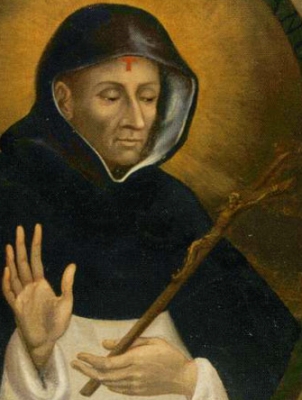
The body of the holy patriarch, Saint Dominic, had been laid to rest, according to his own desire, in the Church of Saint Nicholas at Bologna, beneath the feet of his Brethren, and, in spite of continual prodigies and Divine favors granted to the faithful who prayed day and night at his tomb, his children allowed the sacred deposit to remain under the plain flagstone originally laid over it and took no steps for obtaining his canonization. Lest they should be thought to be seeking their own emolument under the appearance of piety, the Friars even broke and threw away the votive offerings brought by the people and would not permit any exterior marks of devotion to be exhibited. It was necessity which at length compelled them to undertake the first translation of the sacred relics. The ever-increasing numbers of the Community obliged them to enlarge the Convent, and to pull down the old church and build a new and more spacious one. To do this the tomb of Saint Dominic would have to be disturbed. They accordingly applied for the requisite permission to Pope Gregory IX., who was no other than the Saint’s old friend, Cardinal Ugolino. He joyfully granted the petition, at the same time administering a sharp rebuke to the Friars for their long negligence.

The solemn translation accordingly took place on Whit-Tuesday, May 24, 1233 A.D., during the General Chapter, which was held that year at Bologna. The Pope wished to have attended in person, but, being prevented from doing so, he deputed the Archbishop of Ravenna to represent him, in company with a number of other distinguished prelates. Three hundred Friars Preachers from all countries assembled to assist at this function, not without a secret fear on the part of some as to the state in which the sacred remains might be found, as they had long been exposed to rain and heat, owing to the dilapidated condition of the church. The opening of the tomb took place before daybreak, in the presence of Blessed Jordan, then Master-General of the Order, and the fathers of the Chapter, together with the Bishops, Prelates and Magistrates who were to assist at the ceremony. All stood round in silence while the Procurator, Father Rodolph of Faenza, raised the stone. Hardly had he begun to remove the earth and mortar that lay beneath an extraordinary odor became perceptible , which increased in power and sweetness as they dug deeper, until at length, when the coffin appeared and was lifted out of the grave , the whole church was filled with the perfume as though from the burning of some rich and precious gums. The bystanders knelt on the pavement, shedding tears and emotion as the lid was raised, and the exposed to their eyes.

It was the Master-General who raised the body of his beloved father and reverently laid it in a new coffin. The faithful were then admitted, and the Archbishop of Ravenna sang the Mass of the day, while the fragrance diffused from the open coffin flooded the whole of the sacred edifice. Blessed Jordan in his circular letter to the Order thus described the solemn function: “As the choir intoned the Introit, ‘Receive the joy of your glory, giving thanks to God, who was called you to the celestial kingdom,’ the Brethren in their gladness of heart took the words as if spoken from heaven. The trumpets sounded, the people displayed a countless multitude of tapers; and, as the procession moved along, there everywhere resounded the words, ‘Blessed be Jesus Christ!” He goes on to speak of the vast number of miraculous graces which were poured forth both before and after the ceremony. ‘Sight “he says , “was granted to the blind, power of walking to the lame, soundness to the paralyzed, speech to the dumb…..I myself saw Nicholas, an Englishman, who had long been paralyzed, leaping at this solemnity.”

The coffin was then laid in the marble tomb prepared for it. But eight days later, to satisfy the devotion of some distinguished persons who had not been present on the previous occasion. The holy remains were again exposed to view. Then it was that Blessed Jordan, taking the sacred head between his hands, kissed it, while tears of tenderness flowed from his eyes; and, so holding it, he desired all the fathers of the Chapter to approach and gaze at it for the last time. One by one they came and kissed the venerable relics. All were conscious of the same extraordinary fragrance; it remained on the hands and clothes of those who touched or came near the body. Nor was this the case merely when the grave was first opened. The tomb remained unclosed for fifteen days, during which interval it was guarded by officers appointed by the city magistrates; and all this times the same exquisite odor was sensible to all who visited the spot; and Flaminius, who lived three hundred years later, thus writes (1527 A.D.): “This divine odor adheres to the relics even to the present day.”

A second translation of Saint Dominic’s relics took place in the year 1267 A.D., when the holy body was removed to amore richly ornamented tomb. This translation, like the first, was made at a time of the General Chapter; and the head of the Saint, after being devoutly kissed by the Brethren and several Bishops who were present, was exposed to the veneration of the people from a lofty stage erected outside the Church of Saint Nicholas. The tomb was again opened in 1383 A.D., when apportion of the head was placed in a silver reliquary, in order the more easily to satisfy the devotion of the faithful. Finally, 1469 A.D., the remains of the Saint were deposited in the magnificently sculptured shrine in which they now rest, which is regarded as the masterpiece of Nicholas Pisano.

Saint Servatius, Bishop & Confessor, Protector of the Dominican Order

servatius

Saint Servatius was of noble birth, and he was renewed alike for his learning and sanctity. He became Bishop of Tongres in Belgium, which then formed part of Gaul, and in that capacity assisted at the Council of Sardica, where he strenuously defended the Catholic Faith against the Arians. He likewise stoutly resisted these heresies at the Council of Rimini, and labored to prevent the ill consequences which threatened the Church through their frauds and the weakness of the Bishops. Being sent by the tyrant Magnentius, together with Saint Maximin, Bishop of Treves, as ambassador to the Emperor Constantius, he was honorably entertained by Saint Athanasius at Alexandria.

Saint Gregory of Tours states that Saint Servatius foretold the invasion of Gaul by the Huns and implored the Divine mercy by watching. fasting, prayers and many tears to avert so great a calamity from the flock entrusted to his care. For this intention he undertook a penitential pilgrimage to the tomb of Saint Peter in Rome. As he was weeping and praying there, the Prince of the Apostles appeared to him and thus addresses him: “Wherefore dost thou importune me? The Lord has decreed that the Huns should enter Gaul and lay it waste in a terrible manner. Take my counsel, therefore; lose no time; set thy house in order, prepare thy grave, make ready a clean winding-sheet. Behold , thou shalt depart this life and shalt not witness the evils which the Huns are to bring upon Gaul, as the Lord our God hath spoken.”


The holy Bishop, therefore returned in all haste to his diocese, and with many tears imparted the sad tidings to his heart-broken flock. “Holy Father , do not abandon us,” they exclaimed; “Good Shepherd, forget us not.” Very shortly afterwards he fell ill, as Saint Peter had foretold, and closed his saintly life by a holy death on May 13th, 384 A.D., after an episcopate of thirty-seven years. It is recorded that when all the country round was white with snow his tomb at Maestricht always remained free from it until the time a church was raised over his holy remains.


Saint Servatius was declared Protector of the Dominican Order in consequences of the following circumstances. In the fourteenth century the Church and the Order of Preachers were suffering bitter persecution from the schismatical Emperor, Lewis of Bavaria. Learning that the General Chapter was convoked to meet in his dominions , at the city of Cologne, 1330, A.D., this prince secretly plotted the death of the capitular Fathers. They had just assembled, when Saint Servatius appeared in a dream to one of their number, a very holy religious, warned him of the danger which threatened himself and his brethren , and bade them to flee to Maestricht. This they accordingly did, thus escaping the snares which had been laid for them. And though their coming to Maestricht was wholly unexpected, God disposed the hearts of the inhabitants to receive them with the utmost kindness.


In gratitude for this providential intervention, the Fathers decreed that the festival of Saint Servatius should henceforth be celebrated in the Order to the end of time. But, as it was at first instituted only under the rite of a Feast of the Three Lessons, the great increase of festivals of higher rank caused it, after the lapse of years, to fall into disuse. To preserve the memory of so great a benefit, the Fathers, therefore, obtained permission from Pope Leo XII that the festival of Saint Servatius should be henceforth celebrated throughout the entire Order with the rank of a Totum Duplex, or Greater Double.


Born: Armenia, unknown date

Died: May 13th 384 at Tongres, Belgium of fever

Canonized: Pre- Congregation

Patronage: against foot problems, against lameness, against leg problems, against mice/rats, against rheumatism, success

Representation: bishop holding a key and accompanied by an angel meeting burghers at a city gate, bishop holding a key in one hand while placing his crozier on a dragon, bishop reading desk where nearby sits a shield with three wooden shoes, bishop with three wooden shoes, man striking water with a staff, pilgrim sleeping in the sun while an eagle fans him


Relationships ~ Br. Michael Marshall, Novice

The-Holy-Trinity-in-Stained-Glass

Relationship… What is a relationship?  What is the purpose of a relationship?  A relationship is a connection and interaction between two or more people.  The purpose of a relationship is to share with and learn from others.  Today is about relationships.  The Holy Trinity is a relationship of one God in three persons working in different ways but with one purpose.  What is that purpose???  That purpose is to be in relationship with US!!!

Throughout the Old Testament, we find Scripture which speaks to God seeking a relationship with humanity, even though there were many occasions of falling away from God through negative actions and sin.  The devil tried to step in and destroy the relationship, but failed.  After all, God created us in His own image, so he was not going to abandon us despite our errors of judgment because He loves us unconditionally.  And out of His love for humanity, even though we did not “get it,” He sent us his Son to live among us and try to teach us what this relationship with humanity was all about; the relationship was all about love!  Humanity is to love God, ourselves, and our neighbor.  God made the ultimate sacrifice to save us from our sins, by dying on the cross as the Son.  How much more love could there be for humanity than that???  Even though Jesus died, was buried, and was ascended; our relationship with God still remains because we have the Holy Spirit with us, and is all around us. At the Last Supper, Jesus tells his disciples that there would be more to learn, but it would come from the Spirit of truth, which we would call the Holy Spirit.  So God as the Holy Spirit is all around us, and working through others to teach us over and over about His love for humanity.

So as we make the sign of the cross and say, “In the name of the Father, the Son, and the Holy Spirit,” let us remember that is a relationship of a triune God for the purpose to be in relationship with us.  We need to recognize that the relationship has a purpose, more than to just know us as His creation, but we are to share in that relationship by taking what have been taught through Scripture, and still learning today through the Holy Spirit.  The relationship with Him is about building relationships with others and loving others just as much as God has loved us, to teach others about God’s love.

“Lord, as we pray with the sign of the cross, may we keep in mind the relationship that we share and remember your great love for us, which we are to spread in our ministry.”  Amen.

Book Review: In This House of Brede ~ Br. Chip Noon, Novice

img_5499

Rumer Godden
Loyola Press
1969 by The Viking Press, Inc.
ISBN-13: 978-0-8294-2128-6
Introduction by Phyllis Tickle © 2005 Loyola Press

A strange peace settled over me as I began to read Rumer Godden’s In This House of Brede. From the first page to the last, amid all the turmoil and joy to be found in this cloistered community, this peace settled down and never left me. And more than that, it took me by surprise, I who subsist mostly on exciting and adventuresome literature.

I admire contemplatives. I loved, and continue to love, reading Thomas Merton; and about our saints and blesseds. But for myself, I have this nagging voice that tells me to get up and get going, and any time spent reading and relaxing is stolen from the important works and days of my life. And then the bell rings for nones and I am settled as a mist in the quiet valley.

Philippa Talbot, successful, professional, talented, approaching middle age, is the protagonist of In This House of Brede. She has risen up the ranks of England’s civil service to be one of the first and most influential women in her department. Well-educated, well-traveled, and well-heeled, Philippa has settled in to a life that many aspire to but few achieve. She is widowed (he died in the Second World War), and while she has a platonic and satisfying friendship with a sympathetic and charming married man, they were once lovers. All this is hers, and then she gives it up to live the life of a cloistered nun in a Benedictine abbey.

While it may seem sudden, her entrance to this new life is a long, inexorable progress to fulfillment through loss, and gain through abnegation.

Those of us who have never visited an abbey may imagine this life as serene, ordered, and deliberate…maybe what we have read about or seen in films. But I should have known that we may leave the world, but the world doesn’t leave us. All the human frailties can be found at Brede…even so can all the human perfections be found there as well. The running of an abbey of 90 nuns is as complicated as any corporation, and so it is with Brede: kitchen, bakery, sewing rooms, fields, orchards, buildings, living quarters, offices. And accomplished with what a corporation might have for petty cash.

Then Godden interweaves the story of a seeker just entering, showing all the fears and expectations she experiences. Then Godden throws real-life personalities into the mix and what a story it becomes! Jealousy, envy, love, admiration, skill, failure, success, tragedy, bliss…and woven through all of that, the love of God and God’s love for us, and how it can frighten or embolden us. While this may be a novel about religious life, the “religious” part is not a shield from the “life” part. But it is a guiding part and a goal as well.

I still find it hard to describe, this “strange peace” that permeates this book and which settles me down every time I pick it up. But part of what came to me is that religious life, contemplative and cloistered life is not “entered in to.” It’s more like the tide. There is a slow and progressive rising, sudden incursions of waves and their retreat, rising to the spring tide level and then just as deliberately falling away until the disorder of the ocean’s floor is visible…and back again. So while there may be joy, there will also be pain. Here, the fulfillment of Ecclesiastes is fully present, and its inevitability is part of what I see as comforting. So the only way to escape is to run full speed into the life.

For a Dominican, there is no more apt description. To be a Dominican means to voyage full speed into life, with God as the wind in your sails.

In This House of Brede is a sea voyage like Melville’s or Dana’s with shoals and deep water, wind and rain, sun and breeze. Its depiction of monastic life is inspiring. Its foundation in the changes within the Roman Catholic Church is brilliant. Its characterization is encyclopedic.

Rumer Godden has given us a book that will certainly prove a beacon in everyone’s quest within their own order, religious or lay or secular. As many reviewers have said, it is one of the few books they go back to time after time. It should be required reading for all monastic orders.

Blessed Columba of Rieti

Columba_of_Rieti

Blessed Colomba of Rieti is always called after her birthplace, though she actually spent the greater part of her life away from it. Her celebrity is based — as it was even in her lifetime — mainly on two things: the highly miraculous nature of her career from its very beginning, and her intense devotion to the Blessed Sacrament. She was one amongst a number of saintly Dominican women who seem to have been expressly raised up by God in protest against, and as a sharp contrast to, the irreligion and immorality prevalent in Italy during the fifteenth and sixteenth centuries. These women, nearly all of the Third Order, had an intense devotion to St. Catherine of Siena, and made it their aim to imitate her as nearly as possible. Many seculars, men as well as women, shared this devotion, amongst these being Ercole I, Duke of Ferrara, who had a deep admiration for Colomba and for some other holy Dominican religious, her contemp oraries, the most notable of whom were Blessed Osanna of Mantua and Blessed Lucy of Narni.


For the latter Ercole’s veneration was so great that he never rested until he had got her to come with some of her nuns to live in Ferrara, where he built her a convent and where she died after many troubles. She began when quite a girl to practice austere penances and to subsist almost entirely on the supernatural food of the Holy Eucharist, and continued this for the greater part of her life. At nineteen she joined the Dominican Tertiaries, of whom there were many in town, though still living at home; and she soon won the veneration of her fellow townspeople by her personal holiness as well as by some miracles that she worked. But Colomba was not destined to remain in Rieti. In 1488 she left home and went to Perugia, where the inhabitants received her as a saint, and in the course of time built her the convent of St. Catherine, in which she assembled all the Third Order Dominicanesses, who desired her as superior in spite of her youth. In 1494, when a terrible plague was raging in Perugia, she offered herself as victim for the city. The plague was stayed, but Colomba herself was struck down by the scourge. She recovered only to save her sanctity severely tried by widely spread calumnies, which reached Rome, whence a commission was sent to examine into her life. She was treated for some time as an imposter, and deposed from her office of prioress; but finally her innocence triumphed.


In 1495 Alexander VI, having heard of Colomba’s holiness and miracles from his son the Cardinal Caesar Borgia, who had been living in Perugia, went himself to the city and saw her. She is said to have gone into ecstasy at his feet, and also to have boldy told him of all personal sins. The pope was fully satisfied of her great sanctity, and set the seal of approval on her mode of life. In the year of 1499 she was consulted, by authorities who were examining into the manner, concerning the stigmata of Blessed Lucy of Narni, and spoke warmly in favor of their being genuine, and of her admiration for Blessed Lucy’s holiness. Her relics are still venerated at Perugia, and her feast is kept by her order on 20 May.


Born: February 2, 1467 at Rieti, Umbria, Italy as Angelella Guardagnoli

Died: May 20, 1501 at Perguia, Italy of natural causes; at the moment of her death, her friend, Blessed Osanna Andreasi, saw Columba’s soul as a radiance rising to heaven; the whole city turned out for her funeral, which was paid for by the city fathers

Beatified: February 25, 1625 by Pope Urban VIII

Patronage: against sorcery; against temptation and Perugia, Italy

Representation: Dominican tertiary receiving the Eucharist from a hand reaching down from heaven; Dominican tertiary receiving the Eucharist from an angel; Dominican tertiary with a dove, lily, and book; Dominican tertiary with a wreath of roses, cross, lily, and rosary


Blessed Andrew Abellon

Blessed+Andrew+Abellon

Blessed Andrew was born near the world-famous shrine of Mary Magdalen. His entire life was centered around the shrine, and it is greatly due to his efforts that devotion to the great penitential has become so well established.

As a young man, Andrew may have heard the stirring sermons of Saint Vincent Ferrer, who was at that time preaching in France. Perhaps the purity and penitential zeal for which this great preacher was renowned gave the young Andrew the pattern for his own life. He soon demonstrated his choice of purity and penance by joining the Dominicans in his home town. After a happy and holy novitiate, he made his profession and was ordained. In a few years, a preacher and a guide for souls, he turned his attention to the neglected shrine of Saint Mary Magdalen.

This rugged and penitential region of France had been honored from the time of the Apostles as the chosen retreat for Mary Magdalen, who did penance there for the sins of her youth. From earliest days, it had been a place of pilgrimage, but had no definite arrangements for the care of pilgrims, nor any way of supplying their spiritual needs. In Blessed Andrew’s time, Dominican fathers from Saint-Maximin had taken over the spiritual care of the pilgrims as a mission work, but without financial help, and in the face of great trials.

Seeing the need of a permanent foundation at the shrine, Andrew set about creating one. He interested the queen in his project, and obtained enough money from her to build a monastery, which was a gem of architecture as well as a source of spiritual power. Andrew had studied art before his entry into the order, and he used his talents in building, beautifully and permanently, whatever he was called upon to do.

A lover of great beauty in the physical order, Andrew was the same in the spiritual. He was famous as a confessor, and his wise government as prior gave help to the spiritual growth of the new convent. A practical man as well as deeply spiritual, Andrew established two mills near the shrine that would provide the people with a means of earning a living while remaining there. Quite naturally, a priest who interested himself in the welfare of the people to this extent could hope for great influence with them, and this he had, both at Saint Maximin and at Aix, where an altarpiece he painted may still be seen.

After his death, Blessed Andrew was buried in the Church of the Magdalen. His tomb soon became a place of pilgrimage; his help especially was sought in the cure of fevers.

Born: 1375 at Saint Maximin, Provence, France

Died: May 15, 1450 at Aix-en-Provence, France of natural causes; buried in the Church of the Magdalen; his tomb became known as a site of miraculous cures.

Beatified:1902 (cultus confirmed) by Pope Leo XIII

Patronage: against fever

Come Holy Spirit! ~ Guest Post ~ Jarred Smith

ComeHolySpirit

Today is the Church’s birthday! Happy birthday, Church!!! We accredit today as the birth of the church because this marks the day that the disciples and those gathered received for the first time the Holy Spirit. For many of us this may have happened at baptism or confirmation and maybe for some of us later on. I remember my confirmation day.  For me it happened rather quickly. I had already by that time discerned a vocation to the priesthood in the Roman Catholic Church. It was a joyous day and my pastor was my sponsor before the Bishop. As the Bishop made the sign of the cross with balm and welcomed me into the fold, I knew then that I had had an inner change.

I had been baptized when I was young, around the age of 8, but this was different. I knew what I was doing and what I desired the most. It was my choice, but a choice I did not necessarily make on my own. As the second reading today says, the Holy Spirit, even when I had strayed away from faith or religious beliefs for the most part, had begun in me a calling to come home, to return to a life of faith.  But this time the Spirit was calling me to more than just a simple conversion. The Spirit required action on my part in confessing Christ my Lord over all my life, changing from my sinful nature to a nature seeking God in everything, and He called me to a life of service in the priesthood.

Often in our lives we get caught up in being busy about the tasks we have, whether it is serving, working, or with family, so that too often we miss out on everyday miracles. In our first reading, those who were gathered were understanding everything being said.  Those speaking were not of the same language of the listeners, or even speaking multiple languages, yet they all could understand in their own individual language. At first they might have missed this miracle that the Holy Spirit had done, but once they realized it and acknowledge that great miracle that God had done before them, they took notice. We need to take time to slow down in our own lives to see the miracles taking place before us and to take part in them.

Back at Easter I had a gentleman who had not received communion or been in church much for about fifteen years. On that particular Sunday he asked if I cared if he joined me for a communion service, and of course I obliged. During the service and at the time of communion, the gentleman began to weep, which, in turn, caused me to weep. He explained to me that He had been angry with himself and been angry with churches for so long. That today was the first time he had taken communion because he no longer attended church but felt the need to receive communion. This gentleman needed something in his life. He need restoration and he needed Christ to break down the walls that he had built up. The Holy Spirit had to have prompted him to make such a request and the Holy Spirit is the one who moved in him to realize such a need.

The Holy Spirit gives us gifts and each of us have a different gift. Some have a gift of words, some a gift of healing, and others maybe a gift of prophecy. Now when I say a gift of prophecy I do not mean seeing the future or something like that, but rather the type of prophecy which refers to speaking truth into someone’s life, the ability, like the great prophet Samuel who spoke the Holy Spirit into the life of David. For me there have been a few people who spoke truth into my life, like Father Kurt Fohn who helped foster my vocation, Bishop Michael who revived that vocation in a new way and helped me get to know myself, and Deacon Matt who pushed me to learn as much as I could. These are just a few who have played the vital role of using their gift of prophecy in my life.

We all have a gift when we allow the Spirit into our lives. If we pray and truly listen to the quiet voice within us, He will show us our gifts. We have to use those gifts that we have been given to help others. You may say, “Well I have a gift but I’m not sure how to use it,” or “I’m not that good at it.” Well you have to practice and hone your gifts. It is like almost anything we do, the more you use those skills and study, the better you become. We have to allow practice and the Holy Spirit to perfect those gifts, which requires us to, every day when we wake up, say first thing,  “Yes, Lord I am here.  Send me.” We have to give our lives completely to God, for God to use us.

Maybe the Holy Spirit is prompting you to become a missionary in your work place, or a missionary in your own family. If so, it takes prayer, studying scripture, and completely saying “yes” to the Spirit at all moments. I heard it said best, “You become good at only what you practice,” and if we do not take ourselves to the spiritual gym, then we will become overweight Christians. The Spirit calls us to get fit which is done by praying, studying, and believing.  We need to work out in that gym, then go, as He calls us, to go out and live it.

The world is in turmoil, seeking love and hope today more so than ever in history, I believe. The church has the best opportunity to be all those things the world so needs, yet we have become so hung up on what we are against, that we forgot Who we are for. Jesus said in the Gospel reading that, “Whoever loves me keeps my word…” yet in our society we have not kept His word. We have forgotten what that word is today in the church. What is the message of Christ? Christ came to teach love, mercy, and grace. He dined with sinners and drank water with adulterers. He became friends with prostitutes and entered houses of tax collectors. He hugged the lepers and gave hope to the blind. Shared food with the poor and welcomed the gentiles. He was beaten, crucified, and died for you and me. What was Jesus’ word? Get out and love everyone and make no excuses for why you cannot speak or fellowship with anyone. If we act in the Spirit, we will do these things, yet, if we ignore the Spirit, we will not.

In an age where people have become so disconnected due to all the technology and being the selfie generation, it is time we rise up and ask the Spirit to descend upon us anew, so that we can ascend to the place Christ has for us. A place to be that beacon in a sea of darkness and a hope in a world in despair. Do we love him? If so, we have to keep His words, and if the Spirit has instilled in us to call Him Lord, then we need to begin to act like it. Right now is the time to do so as we look out amongst so much violence and intolerance coming from both sides of the aisle. Hate is poured into many baptisteries and fonts, yet that water has no anointing because the Spirit is a spirit of love and mercy, not one of ignorance or intolerance. We are a holy people, a chosen people gifted by God through the Holy Spirit to love, show mercy, and grace. If you want to emulate the One you profess to follow, then these should be the hallmarks of your life.

In the first reading you saw that they spoke to all the people there at the time, in all the languages known at that time. I do not think this was pointed out just to show the power of the Spirit alone, but it was written to remind us to reach out to everyone. To go a step further.  It was so that we would get the hint to reach out to everyone, but in a way that was uniquely suited to that person. It is saying for us to speak in a language that the person will understand. You may ask, “Well, how do I do that?”  Simply by asking the Spirit to come upon you and to abide within you so that you may become an instrument in the lives of those around you.

Lastly but not least, I want to explain that in doing all of this you will face criticism and threats from the world and other so called Christians, but you do not have to fear because the Spirit is also an Advocate and a great protector. He will advocate on your behalf and, like he has to so many, He will give you strength and power even in the things you are not strong in.

He has been given to us from the Father to provide us with all we need and to pass messages on to us from the Father through the Son. Though life may come against us, the Peace He gives and that is His peace becomes our peace. His wisdom, our wisdom, and His power becomes our power. We just have to be willing to say yes to Him and He will work mightily in our lives and those around us.

My prayer today on this feast of Pentecost, as the sequence psalm we recited rings true, “Lord, send out your Spirit, and renew the face of the earth”. Would that today we receive the Spirit and renew the face of the Earth in such a way that the Earth is a pure reflection of Heaven.

+Amen.

Blessed Giles of Portugal

tumblr_inline_mg2t55OMQp1rceiuh

So many romantic legends intertwine themselves with the story of Blessed Giles that it is difficult to see the man himself. His life, even stripped of its legend, however, is the story of the triumph of grace in the human soul.

He was the son of Rodrigues de Vagliaditos, governor of Coimbra under King Sancho the Great. From his childhood, Giles was destined for the priesthood for which he studied at Coimbra. He was ordained at an early age, but with no good intention, for he saw in the priesthood only a chance to wield power. His father’s influence gained for him a number of rich benefices, which he used sinfully for power and pleasure.

Being a brilliant student, he advanced rapidly in his chosen field of medicine, an art that was at the time often linked with necromancy or black magic. He neglected his priestly duties and seemed bent only on the pleasures of life.

Thoroughly irreligious and pleasure-seeking young man, set out for Paris to work for higher degrees in medicine. On the advice of a stranger he met on the way, he went to Toledo instead and became a student of the black arts. According to one story, he met the devil and signed a contract with him, in which he promised his soul in return for a universal knowledge of medicine. Thereupon he spent seven years in bondage to his evil master, learning all his arts.

Having gained the highest degrees in medicine, Giles went to Paris and became a successful physician. At the peak of worldly success, he began to have horrible visions. He saw himself in a cemetery of a monastery of which he enjoyed the revenues. There he saw a specter who carried a skull and an hourglass. The specter knocked at one and then another of the tombs, calling out, “Arise, faithful monk!” At each summons another fearful specter appeared, until at one tomb there was no answer.

“Giles,” he called. “What–not there?” He poised the hourglass and murmured, “There are yet a few sands to run!” After this fearful vision, says the legend, Giles repented of his misspent life, destroyed his magic books and potions, and set out in haste for Coimbra on foot.

At Palencia he met the friars of the newly founded Order of Preachers. He was still troubled by diabolical attacks, but they helped him to make his peace with God. Joining them, he spent seven years in terrible penance, after which Our Lady returned to him the fateful scroll he had signed with Satan.

It is known that Giles had spent his youth badly, and that after entering the Dominicans he did fervent penance. By nature he was witty and charming, and he found the silence hard to keep. Actual violence to his natural disposition was necessary to make him into the humble and reserved religious he later became.

Blessed Giles occupied several positions of authority in the order, including provincial of Portugal, and his medical skill proved to be a blessing in the care of his sick brethren. He made a practice of going about the dormitories, cleaning up the students’ rooms while they were at class. His heroic penance did much to undo the scandal he had caused in his early years.

Giles was sent back to Portugal after his early training, and his preaching was noteworthy, even in that age of renowned preachers. He founded a number of monasteries and did much to establish the Dominicans in Portugal. His last years were filled with visions and ecstasies. He lived to be very old, regarded by all but himself as a very great saint.

Born: Born 1185 at Vaozela

Died: 1265 of natural causes

Beatified: May 9, 1748 by Pope Benedict XIV (cultus confirmed)


Blessed Imelda Lambertini

H_BLESSED-IMELDA-1

One of the most charming legends in Dominican hagiography is that of little Imelda, who died of love on her first Communion day, and who is, by this happy circumstance, patroness of all first communicants.

Tradition says that Imelda was the daughter of Count Egano Lambertini of Bologna. Her family was famous for its many religious, including a Dominican preacher, a Franciscan mother foundress, and an aunt of Imelda’s who had founded a convent of strict observance in Bologna.

Imelda was a delicate child, petted and favored by her family, and it was no surprise that she should be religious by nature. She learned to read from the Psalter, and early devoted herself to attending Mass and Compline at the Dominican church. Her mother taught her to sew and cook for the poor, and went with her on errands of charity. When Imelda was nine, she asked to be allowed to go to the Dominicans at Val di Pietra. She was the only child of a couple old enough not to hope for any more children; it was a wrench to let her go. However, they took her to the convent and gave her to God with willing, if sorrowing, hearts.

Imelda’s status in the convent is hard to discern. She wore the habit, followed the exercises of the house as much as she was allowed to, and longed for the day when she would be old enough to join them in the two things she envied most–the midnight Office and the reception of Holy Eucharist. Her age barred her from both. She picked up the Divine Office from hearing the sisters chant, and meditated as well as she could.

It was a lonely life for the little girl of nine, and, like many another lonely child, she imagined playmates for herself–with this one difference–her playmates were saints. She was especially fond of Saint Agnes, the martyr, who was little older than Imelda herself. Often she read about her from the large illuminated books in the library, and one day Agnes came in a vision to see her. Imelda was delighted. Shut away from participation in adult devotions, she had found a contemporary who could tell her about the things she most wanted to know. Agnes came often after this, and they talked of heavenly things.

Her first Christmas in the convent brought only sorrow to Imelda. She had been hoping that the sisters would relent and allow her to receive Communion with them, but on the great day, when everyone except her could go receive Jesus in the Eucharist, Imelda remained in her place, gazing through tears at the waxen figure in the creche. Imelda began to pray even more earnestly that she might receive Communion.

When her prayer was answered, spring had come to Bologna, and the world was preparing for the Feast of the Ascension. No one paid much attention to the little girl as she knelt in prayer while the sisters prepared for the Mass. Even when she asked to remain in the chapel in vigil on the eve of the feast, it caused no comment; she was a devout child. The sisters did not know how insistently she was knocking at heaven’s gate, reciting to herself, for assurance, the prayer that appeared in the Communion verse for the Rogation Days: “Ask and it shall be given to you, seek and you shall find, knock and it shall be opened to you.”

The door was opened for Imelda on the morning of the Vigil of the Ascension. She had asked once more for the great privilege of receiving Communion, and, because of her persistence, the chaplain was called in on the case. He refused flatly; Imelda must wait until she was older. She went to her place in the chapel, giving no outward sign that she intended to take heaven by storm, and watched quietly enough while the other sister went to Communion.

After Mass, Imelda remained in her place in the choir. The sacristan busied herself putting out candles and removing the Mass vestments. A sound caused her to turn and look into the choir, and she saw a brilliant light shining above Imelda’s head, and a Host suspended in the light. The sacristan hurried to get the chaplain.

The chaplain now had no choice; God had indicated that He wanted to be communicated to Imelda. Reverently, the chaplain took the Host and gave it to the rapt child, who knelt like a shining statue, unconscious of the nuns crowding into the chapel, or the laypeople pushing against the chapel grille to see what might be happening there.

After an interval for thanksgiving, the prioress went to call the little novice for breakfast. She found her still kneeling. There was a smile on her face, but she was dead.

The legend of Blessed Imelda is firmly entrenched in Dominican hearts, though it is difficult now to find records to substantiate it. She may have been eleven, rather than ten when she died. The convent where she lived has been gone for centuries and its records with it.

Several miracles have been worked through her intercession, and her cause for canonization has been under consideration for many years. As recently as 1928 a major cure was reported of a Spanish sister who was dying of meningitis. Other miracles are under consideration. The day may yet come when the lovable little patroness of first communicants can be enrolled in the calendar of the saints.

Born: Born in Bologna, Italy, in 1322

Died: died on the Feast of the Ascension, May 13, 1333

Beatified: cultus confirmed in 1826 by Pope Leo VII

Patronage: named patron of first communicants by Pope Pius X.

Representation: In art, Imelda is a very young Dominican novice, kneeling before the altar with a sacred Host appearing above her. She is venerated at Bologna and Valdipietra.


Blessed Jane of Portugal

220px-Retrato_da_Princesa_Santa_Joana_com_o_Menino_-_Joao_Baptista_Pachim

Joanna, a child of many prayers, was born heiress to the throne of her father, King Alphonsus V, at a time when Spain and Portugal had divided the colonial wealth of the earth between them. Her sickly brother Juan was born three years later, and soon after this their mother, Queen Elizabeth of Coimbra, died. Joanna was left to the care of a wise and pious nurse, who cultivated the child’s natural piety. By age five the little princess had exceeded her teacher in penitential practices. She fasted and prayed, rose at night to take the discipline, and wore a hairshirt under her glittering court apparel.

Although Joanna would not inherit the throne of Portugal while her brother was alive, a wise marriage would do much to increase her father’s power. Accordingly, he began early to arrange for her marriage. Joanna, whose knowledge of court intrigue was as good as his own, skillfully escaped several proposed matches. She had treasured the desire to enter the convent, but, in view of her father’s plans, her desires met with violent opposition. She was flatly refused for a long time; finally, her father gave his reluctant consent, but he withdrew it again at her brother’s insistence.

She was regent of Portugal when her father and brother went to war against the Moors, and when they defeated the Moors in 1471, her father, in the first flush of victory, granted her request to take the veil. Joanna and one of her ladies-in-waiting had long planned to enter the Dominican cloister at Aveiro, which was noted for its strict observance. But when her father finally gave consent for her to enter religion, he did not allow her to enter that Dominican convent. She had to go to the nearby royal abbey of the Benedictines at Odivellas. Here she was besieged by weeping and worldly relatives who had only their own interests at heart. After two months of this mental torture, she returned to the court.

The rest of Joanna’s life is a story of obedience and trials. Her obligations of obedience varied. She was required to bend her will to a wavering father, who never seemed able to make a decision and abide by it; to bishops, swayed by political causes, who forced her to sign a paper that she would never take her solemn vows; and to doctors, who prescribed remedies that were worse than the maladies they tried to cure. The trials came from a jealous brother, from ambitious and interfering relatives, from illness, and from cares of state.

After 12 years of praying and hoping, Joanna finally received the Dominican habit at Aveiro in 1485. Once, she was deprived of it by an angry delegation of bishops and nobles, and, at another time, her brother tore the veil from her head. Despite the interruptions of plague, family cares, and state troubles, Joanna lived an interior and penitential life. She became an expert at spinning and weaving the fine linens for the altar, and busied herself with lowly tasks for the love of God. She used all her income to help the poor and to redeem captives.

Her special devotion was to the Crown of Thorns, and, in early childhood, she had embroidered this device on her crest. To the end of her life she was plagued by the ambition of her brother, who again and again attempted to arrange a marriage for her, and continually disturbed her hard-won peace by calling her back to the court for state business.

On one of these trips to court, Joanna was poisoned by a woman–a person she had rebuked for leading an evil life. The princess lived several months in fearful pain, enduring all her sufferings heroically. She died, as it says in an old chronicle, “with the detachment of a religious and the dignity of a queen,” and with the religious community around her.

Born: Born in Lisbon, Portugal, 1452

Died: died at Aveiro, Portugal, in 1490

Beatified: April 4, 1693 by Pope Innocent XII (cultus confirmed)