Blessed Albert of Bergamo

blessed-alberto-da-bergamo

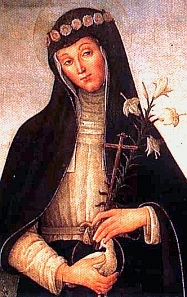
Albert “the Farmer” was a peasant farmer who followed his pious and industrious father’s example. His father taught him many practices of penance and piety that later fructified in a saintly life. At seven, Albert was fasting three days a week, giving the foregone food to the poor. Working at the heavy labor of the fields, Albert learned to see God in all things, and to listen for His voice in all nature. The beauty of the earth was to him a voice that spoke only of heaven. He grew up pure of heart, discreet, and humble–to the edification of the entire village.

Albert married while still quite young. At first his wife made no objection to the generosity and self-denial for which he was known. When his father died, however, she made haste to criticize his every act and word, and made his home almost unbearable with her shrewish scolding. “You give too much time to prayer and to the poor!” she charged; Albert only replied that God will return all gifts made to the poor.

In testimony to this, God miraculously restored the meal Albert had given away over his wife’s objections. Finally, softened by Albert’s prayers, she ceased her nagging and became his rival in piety and charity. She died soon after her conversion, and Albert, being childless, he left his father’s farm to make a pilgrimage to Jerusalem and Rome.

Stopping at Cremona, Italy, at harvest time, Albert went to work in the fields. He soon earned the name of “the diligent worker.” His guardian angel worked beside him in the fields, and, therefore, twice the work was accomplished that might be expected of one man. Weighing in his grain at the end of the day, Albert always received twice as much in wages as the other workers did. Though he gave this to the poor and kept nothing for himself, jealous companions determined to annoy him. Planting pieces of iron in the field where Albert would be working the next day, they watched to see him break or dull his scythe. Miraculously, the scythe cut through iron as it did through the grain, never suffering any harm. In Cremona Albert’s poverty was also a witness to a group of heretics there who boasted of their own poverty.

In all, Albert visited Rome nine times, Santiago de Compostela eight times, and Jerusalem once. He worked his way, giving to the poor every penny he could spare. His pilgrimages were almost unbroken prayer; he walked along singing hymns and chanting Psalms, or conversing on things of God with the people he met along the way.

Appalled at the suffering of pilgrims who fell ill far from home and the penniless, Albert determined to build a hospital for their use. This he actually accomplished by his prayers and diligent work.

In 1256, he met the Dominicans. Attracted by the life of Saint Dominic, Albert joined the Brothers of Penance, which later became the Order of Penance of Saint Dominic, and continued his works of charity in his new state. As a lay brother he was closely associated with the religious but lived in the world so that he was able to continue his pilgrimages. At home, he assisted the Dominican fathers in Cremona, working happily in their garden, cultivating the medicinal herbs so necessary at the time, and doing cheerfully all the work he could find that was both heavy and humble.

Falling very ill, Albert sent a neighbor for the priest, but there was a long delay, and a dove came bringing him Holy Viaticum. When he died, the bells of Cremona rang of themselves, and people of all classes hurried to view the precious remains. It was planned to bury him in the common cemetery, outside the cloister, as he was a secular tertiary, but no spade could be found to break the ground. An unused tomb was discovered in the church of Saint Matthias, where he had so often prayed, and he was buried there. Many miracles were attributed to him after his death, and the farmer- saint became legendary for his generosity to the poor.

Born: Born in Valle d’Ogna (near Bergamo), Italy, in 1214

Died: died in Cremona, Italy, May 7, 1279

Beatified: cultus approved May 9, 1748 by Pope Benedict XIV

Representation: In art, Saint Albert is a farm laborer cutting through a stone with a scythe. He may shown be shown (1) when a dove brings him the viaticum, or (2) with a dove, Host, and censer near him. Albert is the patron of bakers and day-laborers, and is venerated in Cremona, Bergamo, and Ogna.

Saint Antoninus

Sant Antonino Pierozzi 1

The story of Antonino Pierozzi is that of a great soul in a frail body, and of the triumph of virtue over vast and organized wickedness. His father, Niccolo Pierozzi, had been a noted lawyer, notary to the Republic of Florence. He and his wife Thomassina had their only child baptized as Antonio, but because the saint was both small and gentle people called him by the affectionate diminutive ‘Antonino’ all his life.

The world in which he lived was engrossed in the Renaissance; it was a time of violent political upheaval, of plague, wars, and injustice. The effects of the Great Schism of the West, over which Saint Catherine had wept and prayed a generation before, were still tearing Christendom apart when Antoninus was born–in the same year as Cosimo de’Medici. The fortunes of Florence were largely to rest in the hands of these two men.

There are only a few known details about the early life of Antoninus, but they are revealing ones. He was a delicate and lovable child. His stepmother, worried over his frailty, often gave him extra meat at table. The little boy, determined to harden himself for the religious life, would slip the meat under the table to the cats. Kids!

From the cradle his inclination was to piety. His only pleasure was to read the lives of saints and other good books, converse with pious persons, or employ himself in prayer. Accordingly, if he was not at home or at school, he was always to be found at Saint Michael’s Church before a crucifix or in our Lady’s chapel there. He had a passion for learning, but an even greater ardor to perfect himself in the science of salvation. In prayer, he begged nothing of God but His grace to avoid sin, and to do His holy will in all things.

Antoninus hitched his wagon to the star of great austerity and, at 14, discovered the answer to all his questions in the preaching of Blessed John Dominici, who was then the prior of Santa Maria Novella and later became cardinal-archbishop of Ragusa and papal legate. Antoninus went to speak with the preacher and begged to be admitted to the order.

At the time, Blessed John was reforming the Dominican priories of the area according to the wishes of Blessed Raymond of Capua. John planned to build a new and reformed house at Fiesole (near Florence), which he hoped to start again with young and fervent subjects who would revivify the order. It had declined under the plague and the effects of the schism. As yet, he had no building in which to house the new recruits.

Even were the monastery completed, it was to be a house of rigorous observance, and Antoninus looked far too small and frail for such an austere community. John Dominici, not wishing to quench the wick of youthful eagerness, had not the heart to explain all this. He told Antoninus to go home and memorize the large and forbidding book called Decretum Gratiani, supposing that its very bulk would discourage the lad.

Antoninus, however, was possessed of an iron will. He went home and began to read the book straight through. By the end of the year, he had finished the nearly impossible task set before him, and returned to Blessed John to recite it as requested. There was now no further way to delay his reception into the order, so he was received into the Dominican Order “for the future priory of Fiesole” in 1405 by Blessed John.

Due to the unsettled state of the Church, the order, and Italian politics, the training of the young aspirants was conducted at several different locations, including Cortona, and, for a time, the regular course of studies could not be pursued. Antoninus, nothing daunted, studied by himself. He was happily associated during these years with several future Dominican saints and beati, including Lawrence of Ripafratta, the novice master; Constantius of Fabriano; Peter Capucci; and his great friend, the artist, Fra Angelico.

Ordained and set to preaching, Antoninus soon won his place in the hearts of the Florentines. Each time he said Mass, he was moved to tears by the mercy of God, and his own devotion moved other hearts. He was given consecutively several positions in the order. While still very young, he was made prior of the Minerva in Rome (1430). He served the friars in various priories in Italy (including Cortona, Fiesole (1418-28), Naples, Gaeta, Siena, and Florence). As superior of the reformed Tuscan and Neapolitan congregations, and also as prior provincial of the whole Roman province, Antoninus zealously enforced the reforms initiated by John Dominici with a view to restoring the primitive rule. Antoninus became a distinguished master of canon law and assisted popes at their councils. There is evidence that at some point he served as a judge on the Rota. Pope Eugenius IV summoned him to attend the general Council of Florence (1439), and he assisted at all its sessions.

In 1436, he founded the famous priory of San Marco in Florence with the financial aid of Cosimo de’Medici in buildings abandoned by the Silvestrines. Under his guidance and encouragement, the San Marco’s monastery became the center of Christian art. He called upon his old companion, Saint Fra Angelico, and on the miniaturist, Fra Benedetto (Angelico’s natural brother), to do the frescoes and the choir books which are still preserved there. He also ensured that an outstanding library was collected.

Antoninus is still remembered today in the exquisite ‘Cloister of Saint Antoninus’ with its wide arches and beautiful ionic capitals, designed in the saint’s lifetime by Michelozzo for San Marco. In the lunettes of the cloister Bernardino Poccetti and others painted scenes from Antoninus’s life. (When Giambologna restored and altered the church of San Marco in 1588, he built for the saint’s body a superb chapel.)

To his horror, Antoninus’s wisdom and pastoral zeal made him a natural choice by Pope Eugenius IV for archbishop of Florence in 1446. Although Tabor reports that the pope had first chosen Fra Angelico, whose purity and wisdom had become known when he was painting in Rome. The artist entreated the holy father to choose Fra Antoninus instead, who had done great service by his unworldliness and gentle but irresistible power.

Antoninus’s appointment as bishop was a genuine heartbreak to a scholar who could never find enough time to study; in fact, he had been in Naples for two years reforming the houses of the province when he received word of the nomination and confirmation by the Florentines. For a time he tried to escape accepting the dignity by hiding himself on the island of Sardinia. That did not work. So he tried begging the holy father to excuse him because of his weak physical constitution. The pope would accept no excuses; he commanded Antoninus to proceed immediately to Fiesole under the pain of excommunication for disobedience.

While he obeyed with trepidation, it was a blessing for the people of Florence that he was consecrated bishop in March 1446; they were not slow in demonstrating their appreciation of their good fortune. He was the ‘people’s prelate’ and the ‘protector of the poor’ for he discharged his office with inflexible justice and overflowing charity. His love extended to the rich, too. The next year, the dying Pope Eugenius summoned Antoninus to Rome in order to receive the last sacraments from the holy bishop before dying in his arms on February 23, 1447.

For the remainder of his life, Antoninus combined an amazing amount of active work with constant prayer. He allowed himself very little sleep. In addition to the church office, he recited daily the office of our Lady, and the seven penitential psalms; the office of the dead twice a week; and the whole psalter on every festival. His prayer life allowed him to exhibit an exterior of serenity regardless of the situation. Francis Castillo, his secretary, once said to him, bishops were to be pitied if they were to be eternally besieged with hurry as he was. The saint made him this answer, which the author of his vita wished to see written in letters of gold: “To enjoy interior peace, we must always reserve in our hearts amidst all affairs, as it were, a secret closet, where we are to keep retired within ourselves, and where no business of the world can over enter.”

Because of his reputation for wisdom and ability, Antoninus was often called upon to help in public affairs, civil and ecclesiastical. Pope Nicholas V sought his advice on matters of church and state, forbade any appeal to be made to Rome from the archbishop’s judgements, and declared that Antonino in his lifetime was as worthy of canonization as the dead Bernardino of Siena, whom he was about to raise to the altars. Pius II nominated him to a commission charged with reforming the Roman court. The Florentine government gave him important embassies on behalf of the republic and would have sent him as their representative to the emperor if illness had not prevented him from leaving Florence. Yet he also busied himself with the beauty of the chant, and personally attended the Divine Office at his cathedral.

A distinguished writer on international law and moral theology, his best known work is Summa moralis, which is generally thought to have laid the groundwork for modern moral theology. He was conscious of the new problems presented by social and economic development, and taught that the state had a duty to intervene in mercantile affairs for the common good, and to give help to the unfortunate and needy. He was among the first Christian moralists to teach that money invested in commerce and industry was true capital; therefore, it was lawful and not usury to claim interest on it (combine this information with the fact that he was a staunch opponent of usury). All his many books were of a practical nature, including guidance for confessors (Summa confessionis) and a chronicle of the history of the world.

His first concern, however, was always for the people of his diocese, to whom he set an example of simple living and inflexible integrity. He preached regularly, made a yearly visitation of all the parishes in the diocese on foot, put down gambling, opposed both usury and magic, reformed abuses of all kinds, and served as the example of Christian charity. Each day he held an audience for anyone who wished to speak with him. No one appealed for his help, material or spiritual, in vain.

Antoninus was probably best known for his kindness to the poor, and there were many in the rich city of Florence. He pulled up his own flower garden and planted vegetables for the poor. He drove his housekeeper to distraction by giving away even his own tableware, food, clothing, and furniture. He never possessed any small precious objects, such as plates or jewels. His stable generally housed one mule, which he often sold to relieve some poor person. When that happened, some wealthy citizen would buy the animal and offer it as a present to the charitable archbishop. He kept in personal contact with the poor of the city, particularly with those who had fallen from wealth and were ashamed to beg. For their care he founded a society called the “Goodmen of Saint Martin of Tours,” who went about quietly doing much-needed charitable work–much in the fashion of our modern Society of Saint Vincent de Paul. His particular establishment now provides for about 600 families.

His charity did not end with the poor, but also extended to his enemies. A criminal, named Ciardi, who was called before the bishop to answer accusations, attempted to assassinate the archbishop. The saint narrowly escaped the thrust of his poniard, which pierced the back of his chair. Yet Antoninus freely forgave the potential assassin and prayed for his conversion. God answered his prayers so that he had the comfort of seeing Ciardi become a sincere Franciscan penitent.

When the plague again came to Florence in 1448, it was the saintly archbishop who took the lead in almsgiving and care of the sick. Many Dominicans died of the plague as they went about their priestly duties in the stricken city; sad but undaunted, Antoninus continued to go about on foot among the people, giving both material and spiritual aid. During the earthquakes of 1453-1455, he was similarly self-giving. The example of his own charity led many rich persons to likewise provide for the afflicted.

Antoninus’s was a role model in other ways, too. When he learned that two blind beggars had amassed a fortune, he took the money from them and distributed it to others in dire necessity. Was this an injustice? No, he provided for all the needs of the two for the rest of their lives. The bishop tried to hide his virtue from others and himself, until he would see reflections of them in his flock. By accident he discovered one such flame that he had sparked in a poor, obscure handicraftsman who continually practiced penance. The man spent Sundays and holidays in the churches, secretly distributed to the poor all he earned beyond that needed for subsistence, and kept a poor leper in his home, joyfully serving the ungrateful beggar and dressing his ulcers with his own hands. The leper, increasingly morose and imperious, carried complaints against his benefactor to the archbishop, who, discovering this hidden treasure of sanctity in the handicraftsman, secretly honored it, while he punished the insolence of the leper.

Cosimo de’Medici, who did not always have compliments for the Dominicans, admitted frankly, “Our city has experienced all sorts of misfortunes: fire, earthquake, drought, plague, seditions, plots. I believe it would today be nothing but a mass of ruins without the prayers of our holy archbishop.”

After 13 years as bishop, Antoninus died surrounded by his religious brothers from San Marco and mourned by the whole city. His whole life was mirrored in his last words, “to serve God is to reign.” Pope Pius II assisted at his funeral, when he was buried in San Marco’s church. Pius eulogized Antoninus as one who “conquered avarice and pride, was outstandingly temperate in every way, was a brilliant theologian, and popular preacher.”

His hairshirt and other relics were the vehicle for many miracles. It is significant that the canonization of Saint Antoninus was decreed by the short-lived Pope Adrian VI (August 31, 1522, to September 14, 1523), whose ideas for church reform were radical and drastic. His body was found uncorrupted in 1559, when it was translated with pomp and solemnity into a chapel richly adorned by the two brothers.

Born: March 1, 1389 at Florence, Italy

Died: May 2, 1459 at Florence, Italy

Canonized: May 1523 by Pope Adrian VI

Patronage: Fever

Representation: Antonius of Florence is generally portrayed in art as a Dominican bishop with scales. He might be shown (1) weighing false merchandise against the word of God; (2) as a Dominican with a pallium; (3) as a young man giving alms; (4) drifting down a river in a boat; or (5) holding a book in a bag . The likeness of the archbishop was recorded by contemporary artists, as in the bust at Santa Maria Novella and a statue at the nearby Uffizi Gallery in Florence. Antonio del Pollaiuolo’s painting of him at the foot of the Cross survives at San Marco, as does a series of scenes from his life in its cloister of San Antonino, and a portrait by Fra Bartolomeo.

The Faith of Our Mothers ~ The Rev. Dcn. Dollie Wilkinson, OPI

faithmothers-copy-1080x515

Last Sunday, I attended a baby shower for my niece. It was a bittersweet day because while my niece is thrilled to be expecting her first born child, a little girl, her pregnancy has been fraught with health issues. Also, her own Mom passed away shortly after she was born. So she never knew her Mom, and is sad that her daughter will never know her Grandmother. I also imagine today, being Mother’s Day, will be a joyful, but bittersweet day, for her as well.

Mother’s Day is always a happy day for those who are blessed to have their Mom near, or for Moms who enjoy spending time with their children. The origin of Mother’s Day dates back centuries. The ancient Greeks held an annual festival to honor the goddess Rhea, wife of Cronus and mother of many deities of Greek mythology. Ancient Romans held a spring festival in honor of Cybele, a mother goddess. Early Christians held a festival on the fourth Sunday of Lent in honor of the Virgin Mary, Mother of Christ. In the U.S., Mother’s Day is a more recent holiday, born of a daughter’s desire to honor the legacy of her mother.

Ann Reeves Jarvis was the mother of eleven children living in West Virginia. She was active in church and civic affairs. Concerned about poor health and sanitary conditions in her community that contributed to the high mortality rate of children, in the 1850s she organized Mothers Day Work Groups at local churches to provide women to care for families with tubercular mothers, inspect milk for children, and procure medicine for the indigent. The work groups also tended to wounded Union and Confederate soldiers returning from the Civil War. After the war ended, Jarvis and other women organized Mother’s Friendship Day picnics and other events as pacifist activities in the hope of uniting former Civil War foes.

In 1905, Ann Reeves Jarvis died. Three years later, on May 10, 1908, through the efforts of Jarvis’ daughter, Anna Marie, families gathered at events held at Ann Reeves Jarvis’ hometown church in Grafton, West Virginia. These events spread to other cities and states until 1914 when President Woodrow Wilson declared the second Sunday in May as Mother’s Day in the U.S. These early celebrations were a time when families gathered at their homes with their mothers. The purposeful designation of “Mother’s” rather than the plural “Mothers’” Day was intended to stress that the holiday is more about honoring your own mother than the collective mom. We all know that none of us would be here without our Moms (obviously), but I also feel that no one of us would be who we are today with out the positive influence of a loving, caring mother. Even for those who lost their Moms way too soon, the impact these women have had on their children will be felt throughout their lives.

As we celebrate Mother’s Day, I cannot help but think about the Mary, mother of our blessed Jesus, who is really the mother of us all. The word “mother” or “mothers” appears in the Bible almost 300 times. A mother’s influence is also stressed in Ezekiel 16:44 where we read the phrase, “As is the mother, so is her daughter.” The love of children was deep in the hearts of the Hebrew women, and the mother was regarded with the deepest reverence. When I think of biblical mothers, the first two who come to mind are Mary and Elizabeth. The world’s most revered mother is Mary, mother of Jesus. Her cousin Elizabeth was also a godly person, who in her old age gave birth to John the Baptist. Mary visited Elizabeth for about three months while both were approaching motherhood. With this common experience their age differences became insignificant as they joyfully planned for the birth of their sons, who were to be so near the same age. They found much joy in each other because they loved and understood each other and had the same strong belief in God.

Another New Testament mother was Salome, mother of the disciples James and John. A few scholars suggest that she was a sister of Mary, the mother of Jesus. Certainly, she and her sons were very close to Jesus. We think of her as an ambitious person. She was so desirous for her sons to enjoy extra prestige during Jesus’ ministry that she made a special public request to him. (Matthew 20:21 “Grant that these my two sons may sit, the one on thy right hand, and the other on the left, in thy kingdom.”) Jesus rebuked her gently, (Matthew 20:23 “To sit on my right hand, and on my left, is not mine to give, but it shall be given to them for whom it is prepared of my Father.”) We should not be too severe on her, for she remained one of the most faithful followers of Jesus to the end. And evidently she handed down a rich spiritual legacy to her sons. It was to her son John that Jesus entrusted His own mother at the end. Another mother spoke about in the Bible is Rachel. She was the mother of Joseph and Benjamin, and was the first woman on record to lose her life in childbirth. Rachel died when Benjamin was born. Benjamin must have heard a great deal about his mother because Jacob loved her dearly. These are just a few of the Mothers in the Bible. May we be inspired by their lives and the lives of their children.

The Bible never states that every woman should be a mother. However, it does say that those whom the Lord blesses to be mothers should take the responsibility seriously. Mothers have a unique and crucial role in the lives of their children. Motherhood is not a chore or an unpleasant task. Just as a mother bears a child during pregnancy, and just as a mother feeds and cares for a child during infancy, so mothers also play an ongoing role in the lives of their children, whether they are adolescents, teenagers, young adults, or even adults with children of their own. While the role of motherhood must change and develop, the love, care, nurture, and encouragement a mother gives should never cease.

A PRAYER for YOUNG MOTHERS

Our heavenly Father, we thank thee for the gift of motherhood.
Help us as young mothers to seek thy guidance for our children.
Grant us wisdom, strength, patience, faith and love.
Create in us the willingness to dedicate ourselves and our children to Thee.

In the name of thy Son, Jesus Christ,
Amen.

Pope Saint Pius V

St. Pius V vision

People who know nothing else about Pius V are quite apt to remember him as the Pope of the Rosary, recalling his remarkable connection with the Battle of Lepanto.

Antonio Michael was born into the distinguished but impoverished Ghisleri. His parents could not afford to educate their alert little boy, who seemed far too talented to be a shepherd. One day, as he was minding his father’s small flock, two Dominicans came along the road and fell into conversation with him. Recognizing immediately that he was both virtuous and intelligent, they obtained permission from his parents to take the child with them and educate him. He left home at age 12 and did not return until his ordination many years later.

After a preliminary course of studies, he received the Dominican habit at the priory of Voghera at age 14 and, as a novice, was sent to Lombardy. Here, for the first time, he met the well-organized forces of heresy which he was to combat so successfully in later years.

After his ordination in 1528, he went home to say his first Mass, and he found that Bosco had been razed by the French. There was nothing left to tell him if his parents were alive or dead. He finally found them, however, in a nearby town. After he said Mass, he returned to a career that would keep him far from home for the rest of his life. He began as a lector in theology and philosophy for 16 years.

Then he served as novice-master, than as prior of several convents, Michael proved to be a wise and charitable administrator. He was made inquisitor at Como, Italy, where many of his religious brethren had died as martyrs to the heretics. By the time of Michael’s appointment there, the heretics’ chief weapon was the printed word; they smuggled books in from Switzerland, causing untold harm by spreading them in northern Italy. The new inquisitor set himself to fight this wicked traffic, and it was not the fault of the heretics that he did not follow his brethren to martyrdom. They ambushed him several times and laid a number of complicated plots to kill him, but only succeeded in making him determined to explain the situation more fully to the pope in Rome.

He arrived in Rome on Christmas Eve, tired, cold, and hungry, and here it was not the heretics that caused him pain, but his own brothers in Christ. The prior of Santa Sabina saw fit to be sarcastic and inhospitable to the unimportant looking friar, who said he was from Lombardy. The pope knew very well who he was, however, and immediately gave him the commission of working with the heretics in the Roman prisons.

He was a true father to these unfortunates, and he brought many of them back to the faith. One of his most appealing converts was a young Franciscan, a converted Jew of a wealthy family, who had lapsed into heresy through pride in his writing. Michael proceeded to straighten out his thinking, to give him the Dominican habit, and to assure him of his personal patronage, thus securing for the Church a splendid Scripture scholar and writer.

In 1556, Michael was chosen bishop of Nepi and Sutri. The next year he was named inquisitor general against the Protestants in Italy and Spain and was appointed cardinal, in order, as he said, that irons should be riveted to his feet to prevent him from creeping back into the peace of the cloister. In 1559, Pope Pius IV made him bishop of the war-depleted Piedmont see of Mondovi, to which he soon brought order. Insofar as possible, Michael continued to adhere to the Dominican Rule.

He constantly opposed nepotism. Michael opposed Pius IV’s attempt to make 13-year-old Ferdinand de’Medici a cardinal, and defeated the attempt of Emperor Maximilian II of Germany to abolish clerical celibacy.

January 7, 1565, when the papal chair was vacant following the death of Pius IV, the cardinals, chiefly through the influence of Saint Charles Borromeo, elected Cardinal Ghislieri pope. With great grief, he accepted the office and chose the name Pius V. Charles Borromeo had backed Michael during the election, trusting that he would act as a much-needed reformer.

His judgment proved true: on Pius’s coronation, the money usually distributed to the crowds was given to the hospitals and the poor, and money for a banquet for the cardinals and other dignitaries was given to poor convents. When someone criticized this, he observed that God would judge us more on our charity to the poor than on our good manners to the rich. Such an attitude was bound to make enemies in high places, but it endeared him to the poor, and it gave right-thinking men the hope that here was a man of integrity, and one who could help to reform the clergy and make a firm stand against the Lutheran heresy.

There were massive problems of immediate urgency during the brief reign of Pius V. From within, the peace of the Church was disturbed by the several heresies of Luther, Calvin, and the Lombards, and by the need for clerical reform. In addition, England was tottering on the brink of a break with Rome. The Netherlands were trying to break away from Spain and had embraced Protestantism. The missions across the sea needed attention. And all through the Mediterranean countries, the Turkish were ravaging Christian cities, creeping closer to world conquest. In the six years of his reign, Pope Pius V had to deal with all these questions–any one of which was enough to occupy his entire time.

One of Pius’s first actions was to demand that bishops should live in their dioceses and parish priests in their parishes. His efforts at regulating his see embraced issues ranging from the abolition of bullfighting, bear-baiting and prostitution, to cleaning out the Roman curia and eliminating nepotism, to cutting down the activities of bandits. He insisted that Sunday must be hallowed. Once a month he held a special court for anyone who felt they had been treated unjustly. He also brought in shipments of corn during a famine at his own expense.

In his personal life he continued to be a devout mendicant friar; as pope he set himself to enforce the decrees of the Council of Trent with energy and effect. The catechism ordered by the Council of Trent was completed during his rule (1566), and he ordered translations made. The breviary reformed (1568) and missal (1570). He also commissioned the best edition to date of the writings of Saint Thomas Aquinas; it was he who made Thomas a Doctor of the Church in 1567.

His was a rigorous character; he made full use of the Inquisition and his methods of combating Protestantism were ruthless. Pius had hoped to convert Queen Elizabeth of England. The unfortunate Mary Queen of Scots enjoyed his sympathy and encouragement. He sent reassuring letters to her, and once, at a time when no priest was allowed to go near her, he granted her special permission to receive Holy Communion by sending her a tiny pyx that contained consecrated Hosts. It was he who finally had to pronounce excommunication on Elizabeth of England in 1570, after he had given her every possible chance of repentance.

Pope Pius V had a high estimate of papal power in secular matters. When he excommunicated Elizabeth I, he absolved her subjects of the allegiance to her as queen. Some would say that this served only to endanger the Catholics in her realm, but essentially the attempt to save the souls of his flock was the prominent concern, however, many were accused of treason and martyred. That he also came into conflict with Philip II of Spain shows with what consistency he applied his principles.

He encouraged the new society founded by Saint Ignatius of Loyola and established the Jesuits in the Gregorian University. He consecrated three Jesuit bishops for India, gave Saint Francis Borgia his greatest cooperation, and helped to finance missionaries to China and Japan. He built the church of Our Lady of the Angels for the Franciscans and helped Saint Philip Neri in his establishment of the Oratory. Probably the act for which he will be longest remembered in his leadership at the time of the Battle of Lepanto.

In 1565, the Knights of Saint John defended Malta against a tremendous attack by the Turkish fleet and lost nearly every fighting man in the fortress. It was the pope who sent encouragement and money with which to rebuild their battered city. The pope called for a crusade among the Christian nations and appointed a leader who would be acceptable to all. He ordered the Forty Hours Devotion to be held in Rome, and he encouraged all to say the Rosary.

When the Christian fleet sailed out to meet the enemy, every man on board had received the sacraments, and all were saying the Rosary. The fleet was small, and numerically it was no match for the Turkish fleet, which so far had never met defeat. They met in the Bay of Lepanto on Sunday morning, October 7, 1565. After a day of bitter fighting, and, on the part of the Christians, miraculous help, the Turkish fleet–what was left of it–fled in disgrace, broken and defeated, its power crushed forever.

Before the victorious fleet returned to Rome, the pope had knowledge of the victory through miraculous means. He proclaimed a period of thanksgiving; he placed the invocation, “Mary, Help of Christians” in the Litany of Loreto and established the feast in commemoration of the victory. It was almost the last act of his momentous career for he fell victim to a painful illness that killed him in less than a year. He was attempting to form an alliance of the Italian cities, France, Poland, and other Christian nations of Europe to march against the Turks when he died. He is enshrined at Santa Maria Maggiore in Rome.

Although he was criticized for ‘wanting to turn Rome into a monastery,’ Saint Pius had the respect of the Roman people, who knew his personal goodness and concern for everybody’s welfare. He gave large sums to the poor, lived a life of austerity and piety, and personally visited the sick in hospitals. Pius V is remembered as one of the most important popes of the Counter-

Born: in Bosco (near Alessandria), Italy, on January 17, 1504

Died: May 1, 1572

Papal Ascension: elected January 7, 1566; crowned January 17, 1566

Beatified: May 1, 1672 by Pope Clement X

Canonized: On May 22, 1712, Pope Clement XI enrolled him in the catalogue of the Saints

Representation: In art, he is shown reciting a rosary; or with a fleet in the distance; or with the feet of a crucifix withdrawn as he tried to kiss them.


The Neglected Feast ~ The Rt. Rev. Michael Beckett, OPI

Jesus_ascending_to_heaven

While Ascension Day is a Day of Holy Obligation, it is one of the most neglected feast days of the Christian church. This is sad enough in itself, but in ignoring this festival, the opportunity is lost for reflecting on what the Ascension means.  Maybe we tend to ignore Ascension Day because it falls on a weekday.  Is this the reason it doesn’t get the attention it deserves? This is a pity because it is full of significance in the historical life of Jesus when on Earth – and his continuing ministry for us in heaven. As a weekday event it reminds us that Christianity isn’t just something for Sunday – it’s an experience for every day.  As Christians, we are to celebrate Our Lord every day, every second of our being.  If we gloss over its truth we rob ourselves of a most important doctrine, for without the Ascension, the work of Christ would be incomplete.  Because we do not place as much emphasis on the Ascension, we miss its tremendous truth.

St. Augustine, the great fifth century theologian, called the Ascension the most important Christian festival of the year, more important than Christmas, more important than Pentecost, even more important than Easter. For the Ascension reminds us just how high Jesus was raised, and what that means:

This is that festival which confirms the grace of all the festivals together, without which the profitableness of every festival would have perished. For unless the Saviour had ascended into heaven, his Nativity would have come to nothing…and his Passion would have borne no fruit for us, and his most holy Resurrection would have been useless.

What Saint Augustine says here resonates with the passage in Ephesians 4:10, where Saint Paul says that ‘He who descended is he who also ascended far above all the heavens, that he might fill all things’ – i.e.; that by ascending into Heaven, and taking our human nature up with Him into the heavenly places, He completed the process of redemption by reclaiming His place as rightful sovereign of the universe, so that He might be present to us in a different way. If He had not so returned, the process would not have been completed, and as Jesus said in John 16:7, ‘it is to your advantage that I go away, for if I do not go away, the Counselor will not come to you; but if I go, I will send him to you’.

The gospel writer Luke is renowned as a careful historian. When he recorded the birth of Jesus he rooted the event in its historical setting within the Roman Empire. He continues that same preciseness at the end of our Lord’s earthly ministry by recalling the place of the Ascension – at Bethany. He dates the event – 40 days after the resurrection on Easter Day. He emphases the presence of eyewitnesses – the Ascension took place he writes “before their very eyes” (Acts 1:9). Yes, the Ascension was a real event of history.

Some people are puzzled as to why Jesus waited around on Earth 40 days after his resurrection, but that period is no accident, and Jesus had things to do.  Jesus had endured the Devil’s temptation for 40 days in the wilderness at the beginning of his public ministry, but now the tables were turned. In the period after Jesus’ resurrection, He triumphantly paraded his victory over the Satan. During this time, the conqueror of death displayed his supremacy before his faithful followers so that they might share in the joy of his victory. But there was another reason. Those 40 days of his appearing after the resurrection were of immense value to the believers for they established the reality of his lordship. A single sighting of the risen Christ may have been open to question, but his continuous encounters with the disciples would remove the doubts of the most skeptical among them and assure them of his power and authority.

The resurrection of Jesus marked the ending of a chapter in his earthly life. Things could never be the same again and it was essential that there should be a clear-cut event to bring the chapter to a close. It’s true that Jesus was making a series of appearances to his followers, but they couldn’t go on forever.  It would have been odd if Jesus’ post-resurrection appearances had grown fewer until finally they just stopped – that would only cause confusion and even loss of faith. No, there had to be a single, miraculous occurrence, separating the time when the Jesus of Earth would become the Christ of heaven. The Ascension was the only fitting conclusion to the life of Jesus on Earth.

Luke tells us of the disciples with their eyes straining to catch the last glimpse of the cloud bearing up their Lord. But then they were quickly brought back to earth. It would seem that with their eyes heavenward they didn’t notice the two heavenly beings that slipped quietly alongside them until they spoke: “Men of Galilee, why do you stand looking unto heaven?,” as if to remind the disciples of the work that they had been given to do.  The angels, for angels they were, had to tell the disciples to get to business.

And so it is with us.  Ascension Day reminds us of the Mystery of Faith: “Christ has died, Christ is risen, Christ will come again.”  Christ will come again.  And as we await the “coming again” of Christ, we, like the disciples, have a job to do, business to attend to.  Although we live in the time between Jesus’ Ascension and his coming again, we have something to do now.   In Matthew 28:18-20, Jesus says, “Go to the people of all nations and make them my disciples. Baptize them in the name of the Father, the Son, and the Holy Spirit,  and teach them to do everything I have told you. I will be with you always, even until the end of the world.”

Where do we start?   Jesus has the answer for that, too.  In John 13 Jesus says to us, “ But I am giving you a new command. You must love each other, just as I have loved you.  If you love each other, everyone will know that you are my disciples.”  We are to continue to change the world in the work that Jesus has given us to do by helping others to see Jesus through and in us, by showing that love that he demonstrated, by bringing that love to everyone.

Jesus told us to love everyone.  Love.  Everyone.  Period.   Not just those whose politics are the same as ours.  Not only those whose religion is the same as ours, not only those whose lifestyles are the same as ours.

Love.  Everyone.  Period.

We would all of us do well to pray:

“Lord, make me an instrument of thy peace.
Where there is hatred, let me sow love;
Where there is injury, pardon;
Where there is doubt, faith;
Where there is despair, hope;
Where there is darkness, light;
Where there is sadness, joy.

Love.  Everyone.  Period.

Come Lord Jesus.

Amen.

The Feast of Sts. Philip and James ~ The Rev. Lady Sherwood, OPI

Sts Philp and James

Today as a church and as Christians we celebrate the double feast of the Apostles St. Philip and St. James.

St. Philip

Philip was born in Bethsaida, Galilee. He may have been a disciple of John the Baptist and is mentioned as one of the Apostles in the lists of Matthew, Mark, Luke, and in Acts. Aside from the lists, he is mentioned only in John in the New Testament. He was called by Jesus Himself and brought Nathanael to Christ. Philip was present at the miracle of the loaves and fishes, when he engaged in a brief dialogue with the Lord, and was the Apostle approached by the Hellenistic Jews from Bethsaida to introduce them to Jesus. Just before the Passion, Jesus answered Philip’s query to show them the Father, but no further mention of Philip is made in the New Testament beyond his listing among the Apostles awaiting the Holy Spirit in the Upper Room. According to tradition he preached in Greece and was crucified upside down at Hierapolis under Emperor Domitian.

St. James

St. James the Less, the author of the first Catholic Epistle, was the son of Alphaeus of Cleophas. His mother Mary was either a sister or a close relative of the Blessed Virgin, and for that reason, according to Jewish custom, he was sometimes called the brother of the Lord. The Apostle held a distinguished position in the early Christian community of Jerusalem. St. Paul tells us he was a witness of the Resurrection of Christ; he is also a “pillar” of the Church, whom St. Paul consulted about the Gospel.

According to tradition, he was the first Bishop of Jerusalem, and was at the Council of Jerusalem about the year 50. The historians Eusebius and Hegesippus relayed that St. James was martyred for the Faith by the Jews in the Spring of the year 62, although they greatly esteemed his person and had given him the surname of “James the Just.”

Tradition has always recognised him as the author of the Epistle that bears his name. Internal evidence based on the language, style, and teaching of the Epistle reveals its author as a Jew familiar with the Old Testament, and a Christian thoroughly grounded in the teachings of the Gospel. External evidence from the early Fathers and Councils of the Church confirmed its authenticity and canonicity.  The date of its writing cannot be determined exactly. According to some scholars it was written about the year 49 A.D. Others, however, claim it was written after St. Paul’s Epistle to the Romans (composed during the winter of 57-58 A.D.). It was probably written between the years 60 and 62 A.D.

St. James addresses himself to the “twelve tribes that are in the Dispersion,” that is, to Christians outside Palestine; but nothing in the Epistle indicates that he is thinking only of Jewish Christians. St. James realises full well the temptations and difficulties they encounter in the midst of paganism, and as a spiritual father, he endeavours to guide zero direct them in the faith. Therefore, the burden of his discourse is an exhortation to practical Christian living.

Both St. Philip and St. James have their joint feast day on May 3rd.

Let us pray:

As we remember the apostles Philip and James we are reminded that God calls us all and sends us out into the world to be his hands and his feet. We thank you Jesus for the tasks you have entrusted to us. Help us each day to become more aware of our calling to serve you.

Lord in your mercy – hear our prayer

We pray for the needs of the world, remembering particularly those parts of the world where people live in daily fear of violence and oppression. We call to mind those parts of the world particularly on our hearts today.

Lord in your mercy – hear our prayer

We remember that Philip opened the scriptures to the Ethiopian eunuch helping to bring him to Christ.  Let us also bring others to the full knowledge and love of Christ.

Amen.

Saved ~ The Rev. Dcn. Dennis Klinzing, Sr., Novice

home-saved-logo

Unless you are circumcised you cannot be saved. SAY WHAT?!  Moving right along, what do stringent requirements have to do with salvation? Anyone want to take a stab at this? Welcome to suspense, we will get that answer a little later. Do not worry, I am feeling very long winded today, we should have an intermission in about 45 minutes.

In our first reading today, we see that there were some people from Judea that were causing some problems in Antioch. We are able to see that some of the people were insisting on the stringent requirements for salvation (The Mosaic Law). Ultimately what happens is the church in Antioch sends a convoy to Jerusalem, which thankfully an agreement was settled. The church in Jerusalem said, “Uh, guys, no extra burdens are to be laid on the new converts. That is no burdens that are unnecessary.”

Sounds fair enough, right? But what was considered necessary? Abstention from meat sacrifices to idols, the non-consumption of blood and the meat of strangled animals, and yes the avoidance of inappropriate sexual relations (unlawful marriages).

What is rather interesting is, not only for what is mentioned but also for what is not. In trying to be sure, the community of Jerusalem was presupposing dedication to the cause of the Lord Jesus, but they were also rather reluctant to pile on additional obligations on the new  converts. Ya Jerusalem huh?

What about those strangled animals and blood? Are they still prohibited? Now what about idolatry? There just might be a contemporary parallel to this, when animals are slaughtered and sacrificed for the golden calves of money and power? Keep in mind now, that if these practices were currently permissible, there would have been others to take their place in the catalogue of what is strictly necessary?

We read in the First Letter to Timothy that women were not to speak in the church. Then there is the letter to Titus, for its part, directs, that bishops must be of irreproachable character. They should not be heavy drinkers (coffee is the exception) or money grubbers. And, yes, they should only be married once – their children solid believers and respectful. What about today, what are the practices that we have that seem strictly necessary? Inclusive language? Latin Masses? Male priests? Short sermons?

Probably one of the most seductive temptations of the believer is to identify the will of God with the will of the believer, and not the other way around. God’s will is sadly squeezed into patriotism, rightism, capitalism, feminism, hiearchry, civil law, financial success, ecclesiastical tradition, feminism.  Even in extreme cases, the supposed will of God can be harnessed to justify leaving a spouse, breaking a promise, even killing someone, whether communist, criminal or oppressor. As we see today, the supposed will of God is used to hate people who do think like everyone else, or identify as everyone else.

The delusion has occurred when philosophers have mauled the eternal and necessary ‘law of nature’ on behalf of cultural prejudice, class interest, or personal preference. Natural law has sometimes been used to justify the most horrendous of crimes. More often it has been manipulated to legitimate slavery, domination of women, and the exploitation of the poor.

Among the churches, has it ever been heard that a certain practice can never be changed, since it is the will of God? And yet, has the practice been much more significant than the act of circumcision? Clearly circumcision was an important issue. However, some of the antagonists seem to have given it the status of an unchangeable law.

Question of the hour, how do we escape fooling ourselves? How do we avoid servitude to merely human laws while we neglect the law of God? How do we guard against the tendancy to worship our temporal and cultural fabrications?

Jesus, in the fourth Gospel, promises the Holy Spirit to instruct us in everything and  reminds us of all He revealed. Is this what led the Jerusalem community to forswear putting heavy burdens on its new believers?

It is Jesus and His word that we first and always remember. Therefore, the Holy Spirit instructs us. When we look at Christ primarily in Scripture, it is clear what He is saying: We need repentance; salvation is offered us in His redeeming death and resurrection; and we are called to imitate Him in our mission to the world. We likewise encounter Him in our community, under the blessing of the Holy Spirit. So also came our foundational creeds. Moreover, our holy sacramental signs recall and reenact Jesus’ saving power.

One bright truth, we should never forget. All ideologies and requirements, all popes and rituals, all theologians and mystics, all laws and traditions, would mean nothing to us as Catholics, if Christ is not risen and has not saved us.


Saint Peter of Verona

238

Saint Peter’s parents belonged to the heretical sect of the Cathari, theological descendants of the Manichees. Miraculously, he became Catholic, regardless of his heresy believing parents. Because of his Catholic convictions, he was ridiculed for his faith throughout his youth, it was preserved in purity and he became a Dominican. His father sent him to a Catholic school for a good early education, thinking that the heretical environment at home would keep Peter from being “deceived” by the teachings of the Catholic Church.

Nevertheless, one of the first things Peter learned there was the Apostle’s Creed, which the Cathari abhorred. Making conversation on day, his uncle asked him his lesson. The boy recited the creed and explained it in the Catholic sense, especially in those words: Creator of heaven and earth. In vain his uncle tried to persuade him it was false. He said that it was not God, but the evil principle that made all things that are visible; the Cathari viewed the physical world as ugly and bad, which is inconsistent with the concept of an infinitely perfect being. The boy’s resolute steadiness concerned his uncle, but his father laughed at his brother’s fears believing that the world would influence  his son into his beliefs.

When he was 15, Peter was sent to the University of Bologna, a hotbed of licentiousness. There he met Saint Dominic, and instantly threw himself at the saint’s feet to beg admission to the Order of Friar Preachers. Peter was present at the death of the founder soon after, and shared in the primitive zeal and courage of the sons of a saint.

While still a student, Peter experienced a severe trial. He was publicly reprimanded and punished because a brother, passing Peter’s cell late at night, thought he had heard women’s voices in his room. The voices were those of angels, who frequently visited the saint: but in his humility, he thought it better to accept the punishment and say nothing about the favors God had granted him. He was sent to the remote little Dominican convent of Jesi, in the marquisate of Ancona, to do penance, and his ordination was delayed.

Peter found great strength in prayer. Nevertheless, he was human and felt the sting of the disgrace. One day he complained to the Lord: “Lord, You know that I am innocent of this: Why do you allow them to believe it?” A sorrowful voice replied from the crucifix: “And I, Peter, what have I done that they should do this to Me?” Peter complained no more. The truth was eventually discovered, and Peter resumed his studies and was ordained to the priesthood.

Peter soon became a celebrated preacher throughout northern and central Italy, and, in 1232, an inquisitor to fight against the heresy that had infected his family and others in Lombardy. Many miracles (filling 22 pages in folio in the Acta Sanctorum) were worked through his prayers, to the rage of the heretics. Crowds nearly pressed him to death many times: some to ask his blessing, others to offer the sick to him to be cured, others to receive his holy instructions.

In one city, a prominent man had been won to heresy, because the devil, taking the form of the Blessed Virgin, appeared at the heretics’ meetings and encouraged him to join them. Peter, determined to win the man back to the truth, went to the meeting and, when the devil appeared in his disguise, held up a small pox in which he had placed a consecrated Host. “If you are the Mother of God,” cried Peter, “adore your Son!” The devil fled in dismay and many were converted.

Among other miracles, he predicted that he would be murdered by heretics, who indeed waylaid him on the road between Como and Milan. Peter went to his death singing the Easter Sequence, and fell unprotesting beneath the blows of his assassins. Carino cut his head with an ax, and then his companion Dominic stabbed him. As Peter rose to his knees and commended himself to God, Carino killed him with a blow of his axe to Peter’s side. One of his murderers, “Blessed” Carino, was touched by grace at the sight of a saint, was converted, and eventually became a Dominican at Forli. To him as to us, Peter had pointed out the way to heaven when he traced on the dust of the road, in his own blood, the creed that had lighted his path: “Credo in unum Deum.”

Peter’s body was ceremoniously buried in the Dominicans’ church dedicated to St. Eustorgius, in Milan, where he still rests. His head is kept separately in a crystal and gold case. So many miracles were worked at his shrine that many of the Cathari asked to be admitted to the Catholic Church.

Born: Verona, Italy, 1206

Died: Martyred April 6, 1252

Canonized: canonized by Pope Innocent IV in 1253–a single year after his death.

Patronage: Peter is the patron of midwives and inquisitors and venerated in Verona.

Representation: In art, Saint Peter is a Dominican with a gash or knife in his head. Occasionally, the knife is in his shoulder. Sometimes he is portrayed (1) with his finger on his lips; (2) writing credo in unum deum in the dust as he dies; (3) stabbed in the forest with his companion; or (4) with the Virgin and four female saints appearing to him

Saint Catherine of Siena

Catherine_of_Siena

She was the youngest but one of a very large family. Her father, Giacomo di Benincasa, was a dyer; her mother, Lapa, the daughter of a local poet. They belonged to the lower middle-class faction of tradesmen and petty notaries, known as “the Party of the Twelve”, which between one revolution and another ruled the Republic of Siena from 1355 to 1368. From her earliest childhood Catherine began to see visions and to practice extreme austerities. At the age of seven she consecrated her virginity to Christ; in her sixteenth year she took the habit of the Dominican Tertiaries, and renewed the life of the anchorites of the desert in a little room in her father’s house. After three years of celestial visitations and familiar conversation with Christ, she underwent the mystical experience known as the “spiritual espousals”, probably during the carnival of 1366. She now rejoined her family, began to tend the sick, especially those afflicted with the most repulsive diseases, to serve the poor, and to labor for the conversion of sinners. Though always suffering terrible physical pain, living for long intervals on practically no food save the Blessed Sacrament, she was ever radiantly happy and full of practical wisdom no less than the highest spiritual insight. All her contemporaries bear witness to her extraordinary personal charm, which prevailed over the continual persecution to which she was subjected even by the friars of her own order and by her sisters in religion. She began to gather disciples round her, both men and women, who formed a wonderful spiritual fellowship, united to her by the bonds of mystical love. During the summer of 1370 she received a series of special manifestations of Divine mysteries, which culminated in a prolonged trance, a kind of mystical death, in which she had a vision of Hell, Purgatory, and Heaven, and heard a Divine command to leave her cell and enter the public life of the world. She began to dispatch letters to men and women in every condition of life, entered into correspondence with the princes and republics of Italy, was consulted by the papal legates about the affairs of the Church, and set herself to heal the wounds of her native land by staying the fury of civil war and the ravages of faction. She implored the pope, Gregory XI, to leave Avignon, to reform the clergy and the administration of the Papal States, and ardently threw herself into his design for a crusade, in the hopes of uniting the powers of Christendom against the infidels, and restoring peace to Italy by delivering her from the wandering companies of mercenary soldiers. While at Pisa, on the fourth Sunday of Lent, 1375, she received the Stigmata, although, at her special prayer, the marks did not appear outwardly in her body while she lived.

Mainly through the misgovernment of the papal officials, war broke out between Florence and the Holy See, and almost the whole of the Papal States rose in insurrection. Catherine had already been sent on a mission from the pope to secure the neutrality of Pisa and Lucca. In June, 1376, she went to Avignon as ambassador of the Florentines, to make their peace; but, either through the bad faith of the republic or through a misunderstanding caused by the frequent changes in its government, she was unsuccessful. Nevertheless she made such a profound impression upon the mind of the pope, that, in spite of the opposition of the French king and almost the whole of the Sacred College, he returned to Rome (17 January, 1377). Catherine spent the greater part of 1377 in effecting a wonderful spiritual revival in the country districts subject to the Republic of Siena, and it was at this time that she miraculously learned to write, though she still seems to have chiefly relied upon her secretaries for her correspondence. Early in 1378 she was sent by Pope Gregory to Florence, to make a fresh effort for peace. Unfortunately, through the factious conduct of her Florentine associates, she became involved in the internal politics of the city, and during a popular tumult (22 June) an attempt was made upon her life. She was bitterly disappointed at her escape, declaring that her sins had deprived her of the red rose of martyrdom. Nevertheless, during the disastrous revolution known as “the tumult of the Ciompi”, she still remained at Florence or in its territory until, at the beginning of August, news reached the city that peace had been signed between the republic and the new pope. Catherine then instantly returned to Siena, where she passed a few months of comparative quiet, dictating her “Dialogue”, the book of her meditations and revelations.

In the meanwhile the Great Schism had broken out in the Church. From the outset Catherine enthusiastically adhered to the Roman claimant, Urban VI, who in November, 1378, summoned her to Rome. In the Eternal City she spent what remained of her life, working strenuously for the reformation of the Church, serving the destitute and afflicted, and dispatching eloquent letters in behalf of Urban to high and low in all directions. Her strength was rapidly being consumed; she besought her Divine Bridegroom to let her bear the punishment for all the sins of the world, and to receive the sacrifice of her body for the unity and renovation of the Church; at last it seemed to her that the Bark of Peter was laid upon her shoulders, and that it was crushing her to death with its weight. After a prolonged and mysterious agony of three months, endured by her with supreme exultation and delight, from Sexagesima Sunday until the Sunday before the Ascension, she died. Her last political work, accomplished practically from her death-bed, was the reconciliation of Pope Urban VI with the Roman Republic (1380).

Among Catherine’s principal followers were Fra Raimondo delle Vigne, of Capua (d. 1399), her confessor and biographer, afterwards General of the Dominicans, and Stefano di Corrado Maconi (d. 1424), who had been one of her secretaries, and became Prior General of the Carthusians. Raimondo’s book, the “Legend”, was finished in 1395. A second life of her, the “Supplement”, was written a few years later by another of her associates, Fra Tomaso Caffarini (d. 1434), who also composed the “Minor Legend”, which was translated into Italian by Stefano Maconi. Between 1411 and 1413 the depositions of the surviving witnesses of her life and work were collected at Venice, to form the famous “Process”. Catherine was canonized by Pius II in 1461. The emblems by which she is known in Christian art are the lily and book, the crown of thorns, or sometimes a heart–referring to the legend of her having changed hearts with Christ. Her principal feast is on the 30th of April, but it is popularly celebrated in Siena on the Sunday following. The feast of her Espousals is kept on the Thursday of the carnival.

The works of St. Catherine of Siena rank among the classics of the Italian language, written in the beautiful Tuscan vernacular of the fourteenth century. Notwithstanding the existence of many excellent manuscripts, the printed editions present the text in a frequently mutilated and most unsatisfactory condition. Her writings consist of the “Dialogue”, or “Treatise on Divine Providence”; a collection of nearly four hundred letters; and a series of “Prayers”.

The “Dialogue” especially, which treats of the whole spiritual life of man in the form of a series of colloquies between the Eternal Father and the human soul (represented by Catherine herself), is the mystical counterpart in prose of Dante’s “Divina Commedia”.

A smaller work in the dialogue form, the “Treatise on Consummate Perfection”, is also ascribed to her, but is probably spurious. It is impossible in a few words to give an adequate conception of the manifold character and contents of the “Letters”, which are the most complete expression of Catherine’s many-sided personality. While those addressed to popes and sovereigns, rulers of republics and leaders of armies, are documents of priceless value to students of history, many of those written to private citizens, men and women in the cloister or in the world, are as fresh and illuminating, as wise and practical in their advice and guidance for the devout Catholic today as they were for those who sought her counsel while she lived. Others, again, lead the reader to mystical heights of contemplation, a rarefied atmosphere of sanctity in which only the few privileged spirits can hope to dwell. The key-note to Catherine’s teaching is that man, whether in the cloister or in the world, must ever abide in the cell of self-knowledge, which is the stable in which the traveler through time to eternity must be born again.

Born: March 25, 1347 at Siena, Tuscany, Italy

Died: April 29, 1380 of a mysterious and painful illness that came on without notice, and was never properly diagnosed

Canonized: July 1461 by Pope Pius II

Representation:  cross; crown of thorns; heart; lily; ring; stigmata

Patronage:  against fire, bodily ills, diocese of Allentown, Pennsylvania, USA, Europe, fire prevention, firefighters, illness, Italy, miscarriages, nurses, nursing services, people ridiculed for their piety, sexual temptation, sick people, sickness, Siena Italy, temptations


Saint Lewis Mary Grignon De Montfort

428louis16

Louis’ parents were poor, hard-working people who raised eight children, the oldest of whom was Louis. In the normal course of events, Louis would have learned a trade and helped to educate his siblings, but early in his life his mother recognized that he was destined for the priesthood. At the pleading of her and his teacher, he was allowed to begin his studies. Some charitable people provided the funds for his education.

As a very young child, Louis had organized Rosary societies, preached sermons, told stories of the saints, and led the Rosary with groups of neighborhood children. He was particularly devoted to Our Lady, and he took her name in confirmation. As a student with the Jesuits at Rennes, he continued his devotions; he joined the sodality, and became an exemplary member. When he had completed his studies, he left for Paris in 1693 to begin his studies for the priesthood. He walked the 130 miles in the rain, sleeping in haystacks and under bridges, and, on arriving in Paris, he entered a poverty-stricken seminary in which the students had scarcely enough to eat, which caused him serious illness. On the verge of ordination, his funds were withdrawn by his benefactor, and it looked as though Louis would have to return home. He was taken in by a kindly priest, however.

Louis was ordained in 1700, and, after saying his first Mass in the Lady Chapel of Saint Sulpice, he was sent as chaplain to a hospital in Poitiers where mismanagement and quarreling were a tradition. He endeared himself to the patients, and he angered the managers of the hospital when he reorganized the staff. Consequently, he was sent away, but not before he had laid the foundation of what was later to be a religious congregation of women known as the Institute of the Daughters of Divine Wisdom at Poitiers, to nurse the sick poor and conduct free schools.

This rebuff was not the first Louis had to suffer; in the seminary, his superiors had exhausted themselves in trying his patience– making him seem to be a fool. All his life he was to meet the same stubborn opposition to everything he tried to do. Many of the clergy, even some of the bishops, were infected with Jansenism, and they fought him secretly and openly. In his work giving missions, his moving from one place to another was occasioned as often by the persecution of his enemies as it was by the need of his apostolate. Going to Rome, he begged Pope Clement XI to be sent on the foreign missions, but he was refused and sent back to Brittany, France, as missionary apostolic. He returned in his usual spirit of buoyant obedience, even though he knew that several bishops had already forbidden him to set foot in their dioceses.

For the rest of his life, Louis gave flamboyant missions in country parishes, some of which had been without the care of a priest for generations. Ruined churches were repaired, marriages rectified, children baptized and instructed, and Catholicity rebuilt. He joined the third order of Dominicans, and everywhere he went, he established the Rosary devotion. People who came to his missions out of curiosity, remained, and his preaching did much to renew religion in France.

His enemies were as busy as he was, however. They gave false reports to the bishops, drove him from place to place, and, in one case, succeeded in poisoning him. The poison was not fatal, and it had an unforeseen result. While he recuperated from its evil effects, he wrote True devotion to the Blessed Virgin, which he himself prophesied would be hidden away by the malice of men and the devil. After nearly 200 years, the manuscript was rescued from its hiding place, and, only a few years ago, it was given the publicity that it deserved.

In 1715, Louis founded a second religious congregation to train helpers in his forceful methods of preaching called the Missionaries of the Company of Mary.

Born: January 13, 1673 at Montfort-La-Cane, Brittany, France

Died: 1716 at Saint-Laurent-sur-Sovre, France

Canonized:  1947 by Pope Pius XII