Blessed Sybil Biscossis

sybil

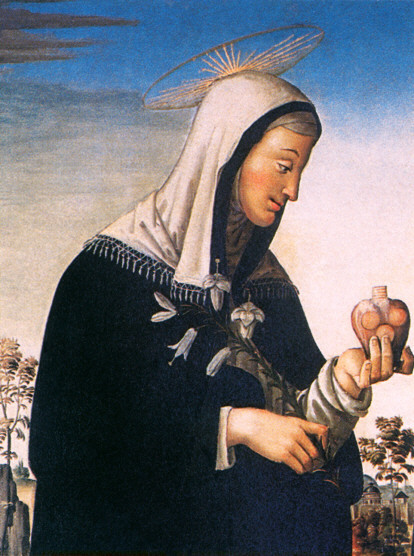
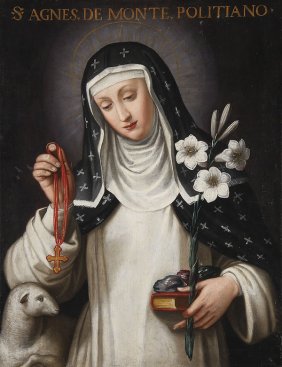
Sybillina’s parents died when she was tiny and as soon as she was old enough to be of use to anyone, the neighbors, who had taken her in at the time she was orphaned, put her out to work. She must have been very young when she started to work, because at the age of 12, when she became blind and could not work any more, she already had several years of work behind her.

The cause of her blindness is unknown, but the child was left doubly destitute with the loss of her sight. The local chapter of the Dominican tertiary sisters took compassion on the child and brought her home to live with them. After a little while of experiencing their kind help, she wanted to join them. They accepted her, young though she was, more out of pity than in any hope of her being able to carry on their busy and varied apostolate.

They were soon agreeably surprised to find out how much she could do. She learned to chant the Office quickly and sweetly, and to absorb their teaching about mental prayer as though she had been born for it. She imposed great obligations of prayer on herself, since she could not help them in other ways. Her greatest devotion was to Saint Dominic, and it was to him she addressed herself when she finally became convinced that she simply must have her sight back so that she could help the sisters with their work.

Praying earnestly for this intention, Sybillina waited for his feast day. Then, she was certain, he would cure her. Matins came and went with no miracle; little hours, Vespers–and she was still blind. With a sinking heart, Sybillina knelt before Saint Dominic’s statue and begged him to help her. Kneeling there, she was rapt in ecstasy, and she saw him come out of the darkness and take her by the hand.

He took her to a dark tunnel entrance, and she went into the blackness at his word. Terrified, but still clinging to his hand, she advanced past invisible horrors, still guided and protected by his presence. Dawn came gradually, and then light, then a blaze of glory. “In eternity, dear child,” he said. “Here, you must suffer darkness so that you may one day behold eternal light.”

Sybillina, the eager child, was replaced by a mature and thoughtful Sybillina who knew that there would be no cure for her, that she must work her way to heaven through the darkness. She decided to become a anchorite, and obtained the necessary permission. In 1302, at the age of 15, she was sealed into a tiny cell next to the Dominican church at Pavia. At first she had a companion, but her fellow recluse soon gave up the life. Sybillina remained, now alone, as well as blind.

The first seven years were the worst, she later admitted. The cold was intense, and she never permitted herself a fire. The church, of course, was not heated, and she wore the same clothes winter and summer. In the winter there was only one way to keep from freezing–keep moving–so she genuflected, and gave herself the discipline. She slept on a board and ate practically nothing. To the tiny window, that was her only communication with the outside world, came the troubled and the sinful and the sick, all begging for her help. She prayed for all of them, and worked many miracles in the lives of the people of Pavia.

One of the more amusing requests came from a woman who was terrified of the dark. Sybillina was praying for her when she saw her in a vision, and observed that the woman–who thought she was hearing things–put on a fur hood to shut out the noise. The next day the woman came to see her, and Sybillina laughed gaily. “You were really scared last night, weren’t you?” she asked. “I laughed when I saw you pull that hood over your ears.” The legend reports that the woman was never frightened again.

Sybillina had a lively sense of the Real Presence and a deep devotion to the Blessed Sacrament. One day a priest was going past her window with Viaticum for the sick; she knew that the host was not consecrated, and told him so. He investigated, and found he had indeed taken a host from the wrong container.

Sybillina lived as a recluse for 67 years. She followed all the Masses and Offices in the church, spending what few spare minutes she had working with her hands to earn a few alms for the poor (Attwater2, Benedictines, Dorcy).

Born: 1287 at Pavia, Lombardy, Italy

Died: 1367 of Natural Causes: Her body remains Incorrupt

Beatified: 1853 (Cultus confirmed); 1854 beautified

Patronage: Children whose parents are not married, illegitimacy, loss of parents

Washing Feet ~ Br. Chip Noon, Novice

Washing feet

“Ecce Agnus Dei, ecce qui tollit peccata mundi. Beati qui ad cenam Agni vocati sunt” (Behold the Lamb of God, behold him who takes away the sins of the world. Blessed are those called to the supper of the Lamb).

The first reading for the Mass of the Lord’s Supper is from Exodus. In it we find explicit instructions the Lord gives to Moses about what became known as The Feast of the Passover. The Lord also says:

“This day shall be a memorial feast for you, which all your generations shall celebrate with pilgrimage to the LORD, as a perpetual institution.”

And St. Paul quotes Jesus in the second reading:  “This is my body that is for you.  Do this in remembrance of me.”

In the same way also the cup, after supper, saying, “This cup is the new covenant in my blood.  Do this, as often as you drink it, in remembrance of me.”

The Verse Before the Gospel in today’s mass is from John 13:  I give you a new commandment, says the Lord:  love one another as I have loved you.

Holy Thursday is sometimes called Maundy Thursday, Maundy coming from the Latin word mandare, to command. Today we learn about three commandments: one from God to the Hebrews in the Old Testament about the Passover Feast and the sacrificial lamb, and the other two from Jesus who commands us to love one another and celebrate the Eucharist in his memory. And in Jesus’ command to love one another, we hear the echo of his first command to his disciples: “Love the Lord your God with all your heart and with all your soul and with all your mind.”

So who gives commands? The boss, the general, the supervisor, the police…in this case, it’s God. But what, besides the Eucharist is an important part of this story? God reminds everyone that he is going to be sacrificed to save them from their sins, and then proceeds to wash the feet of his disciples! The master becomes the servant and tells us that we should all be servants to our neighbors.

Of course, then there is a discussion about who among them is considered to be the greatest, they being the rude bunch of disciples that they are. Jesus says to them:

“The kings of the Gentiles lord it over them; and those who exercise authority over them call themselves Benefactors. But you are not to be like that. Instead, the greatest among you should be like the youngest, and the one who rules like the one who serves. For who is greater, the one who is at the table or the one who serves? Is it not the one who is at the table? But I am among you as one who serves.”

It seems to me that the whole of the establishment of the Eucharist embodies this idea of servanthood, along with the bread and wine. Sometimes we just forget this part of our Lord’s last day as a free man.

But maybe we ought to reflect upon that significant act, washing feet, and the reminder by Jesus that he is “among [us] as one who serves.”

“Do this in remembrance of me.” Eat the bread, drink the wine, serve our fellows. That reminder is not an integral part of the mass, but perhaps it should be. Wouldn’t a weekly or daily reminder at the feast of the Eucharist that we are all to act as servants, wouldn’t that reminder be a transformative event in our lives? After all, we are just dust, and will return to dust. But living for, and being remembered as servants of, our fellows…isn’t that a greater honor than being the boss, or first at the table? Being like Jesus. Isn’t that the greatest honor of all?

Lord, as we approach the time of your passion, help us to remember every day that you came to us as a servant and gave your life for us on the cross, so that at daybreak on Easter, we can rejoice in your resurrection as your friends. Amen.

BLESSED ISNARD OF CHIAMPO

Isnardo-of-Chiampo

Blessed Isnard is another very distinguished and saintly first disciple of Saint Dominic whom Father Touron somehow overlooked. Of Isnard’s life up to the time he entered the Order practically nothing is known with certainty; whilst some of the statements anent his debut as a Friar Preacher are irreconcilable among themselves, and contrary to facts which have been ascertained in later years. Chiampo, a small town not far from Vicenza, Italy, was most likely the place of his birth; yet there are those who give the latter city this honor. Some think he was born of poor parents, and spent his youth in poverty. Others suggest that he belonged to a wealthy family by the name of Isnardi, which has been long extinct.(1)

It is beyond doubt that the future wonder-worker received the habit in Bologna, from Saint Dominic, in 1219; for this is a point on which nearly all the early authors are in accord. This truth seems certainly to prove that he was a student at the university there, and far advanced in his studies, At that time only such applicants were accepted; and this fact is a strong proof that his parents were well-to-do, for only the sons of this kind were given a higher education. Without exception the writers tell us of his singular purity of heart and religious disposition. His mind had been carefully guarded against the evils of the day, and in Bologna he proved faithful to the lessons of his earlier youth. Association with the holy man from Caleruega quickened his efforts for holiness of life and the salvation of souls.

For ten years after he entered the Order of Saint Dominic, we have no positive knowledge of where Isnard made his home. Yet the indications are that he spent this time between Bologna and Milan. In which case, of course, he labored energetically in those parts of Italy. Although a quite corpulent man, we are told, he was endowed with extraordinary energy, and was very gracious in action as well as in word. San Eustorgio, Milan, was most likely his convent for the greater part of this decade. So at least thinks Rudolph Majocchi, Blessed Isnard’s latest hagiographer.(2)

In more than one of our sketches, but especially in that of Saint Peter of Verona, we have seen how the Albigenses and kindred sects overran northern Italy at that date. Milan was one of the centers of Dominican activity against them; and it was from Milan that the convent of the Order in Pavia was founded. At Pavia the heretics were long in the ascendancy. The city was also a stronghold of Frederic II, whose Ghibellines, always opposed to the Holy See, constantly persecuted those who favored the authority of the Church. When, in 1230, zealous Rodobald Cipolla became bishop of Pavia, he found religion in a sad plight in his diocese, and began at once to seek means for a reformation.

Blessed Isnard’s reputation for holiness of life, zeal, eloquence, power over the souls of others, and fearlessness was broadcast. Most likely he had already preached in the Diocese of Pavia — perhaps many times; for the Friars Preacher of Milan carried their work in every direction. Possibly, too, he and Bishop Cipolla, himself an energetic character, had become friends at a prior date. Anyway, one of the new prelate’s first steps for the spiritual betterment of his flock was to invite the subject of our narrative from Milan, that he might establish a house of the Order at Pavia. This was in 1231; and before the close of the year we find the fathers actively engaged in their apostolate under the leadership of the man of God from Chiampo.(3)

The convent, which Rodobald Cipolla generously helped to erect, stood in the little village of Ticino, a short distance outside the walls of Pavia, and was given the name of Saint Mary of Nazareth. Throughout Italy the Friars Preacher were known as an effective aid to the hierarchy against the evils of the day. Thus Bishop Cipolla felt that, at least under Isnard, they would be an immense help to him in putting an end to the inroads of the enemy, and in freeing his diocese from the many ills in which it was enmeshed. He had not long to wait before he saw that his choice of auxiliaries was no mistake.

However, the task proved difficult, trying, and full of danger. On the one hand, the faithful, through long bad associations, had become so cold, careless, and wayward in the practice of their religious duties that it was exceeding hard to arouse them to a sense of their obligations. On the other, the Ghibellines and sectarians, ever of stubborn mood as well as violent in their methods, were even less subject to management. These possessed little or no faith. Besides they were loath to change their views, to amend their lives, or to part with the earthly goods which they had obtained by robbery or dishonesty.

As is ever the case in such conditions, the Friar Preacher’s success began with the poor and the laboring classes. For these he had a special love. He gathered them around him at the conventual church, instructed them in their religion, and inspired them with a love of its practice. Although he met with much opposition at first, it was not long before he had completely changed their lives. Reports of the good thus effected soon spread near and far. Meanwhile, he and his confrères preached throughout the City of Pavia and its environments — in churches, public squares, market places, or wherever they could find a space large enough for an audience. Gradually the wealthier Guelfs, and even not a few of the Ghibellines, began to harken to the call of grace and to receive the sacraments.

Among the little band of missioners Isnard shone with special brilliancy for his saintliness, zeal, and eloquence. The influence which he soon began to wield over the people caused the leaders of the heretics to single him out for their hatred. They mocked and ridiculed him, publicly spurned him, laughed at his corpulent figure, defamed him, threatened him, did everything in their power either to bring him into disrepute or to make him desist from his tireless apostolate. All was in vain. His sermons were incessant. He challenged his enemies wherever he met them. If they undertook to answer him, his inexorable logic put them to shame, or reduced them to silence. Never was he known to be ill natured, or to lose his patience; yet he showed the fire of divine love that glowed within his breast.

No doubt as much to demonstrate the holiness of His faithful servant as for the benefit of those to whom he preached, God blessed Isnard with the gift of miracles. The early writers mention many wrought by him both before and after his death.(4) These, quite naturally, quickened and strengthened the faith of the Catholics. They also gradually undermined the influence and broke the spirit of the heretics, many of whom were brought into the Church. By the time of the holy man’s death, the Diocese of Pavia was free from attacks by Albigenses, Catharists, and similar sects. They bad gone to other parts, been converted, or held their peace. No one could be found who would profess their principles. It was a glorious apostolate brought to a successful termination.

The Ghibellines, or adherents of Emperor Frederic II, gave Christ’s ambassador no end of worry and trouble. These were the rich who were not guided by their consciences in the acquisition of wealth; politicians without scruples; and soldiers of fortune, whose restless spirits ever led them into the service in which they might expect the greatest booty, license, and excitement. The machinations of the German monarch helped to keep them in keen antagonism to ecclesiastical authority and the interests of religion; which, of course, rendered them less responsive to our blessed’s impelling eloquence or the strong influence of his holiness and miracles. We may judge of the contempt of these friends of Frederic for the Holy See from the fact that their acts more than once led to a papal interdict on Pavia.

Still these men, who could laugh at an excommunication and interdict from the highest authority in the Church, perforce loved and admired Father Isnard. His charity, his zeal, his gentle goodness, his purity of heart, his constant efforts for the right, which they witnessed day by day, simply wrung respect from them. His dealings with Frederic II must have been much like those of John of Wildeshausen. Even when Bishop Cipolla was driven into exile, Isnard and his band of missionaries were left to continue their fruitful labors. In the absence of the ordinary, the clergy who still remained in the diocese seem to have gathered around the subject of our sketch for guidance. Possibly the saintly prelate, at the time of his departure, placed him in charge of his spiritual vineyard.(5)

Despite the turbulence and the anti-ecclesiastical spirit of the day, the holy Friar Preacher from Chiampo effected untold good even among this class of citizens. Documents which have escaped the ravages of time show that some, who deferred conversion until on their deathbeds, made him the instrument of their restitution. Others entrusted him with their charity and benefactions. Historians call him an apostle of Pavia, and largely attribute the preservation of the faith in the city to his zeal.

Another proof of the respect and confidence which Isnard enjoyed among all classes, as well as of his reputation abroad, is found in the incident which we have now to tell. From early times the Diocese of Tours, France, possessed landed estates in and around Pavia. Because of the political disturbances and the Ghibelline spirit, to which we have referred, the canons of the Tours cathedral found it impossible to collect their rents. In this dilemma, they appointed our Friar Preacher their agent; for they felt that he was the only man in northern Italy who either could obtain their dues for them, or would dare undertake the task. This was in 1240, the year after the historic excommunication of Frederic 11 by Gregory IX. The affair shows bow wisely Isnard steered his course, how all venerated him at home, and how well his courage and prudence were known even in France.(6)

Like a number of the early disciples of Saint Dominic whose lives we have outlined, the apostle and reformer of Pavia did not feel that he had done his all for the benefit of religion until he established a community of Dominican Sisters. These he placed in the immediate vicinity of his own convent, that he might the better look after their spiritual welfare. Their house bore the same name as that of the fathers — Saint Mary of Nazareth. Although he had perhaps never seen Prouille, his double institution at Pavia must have been much like that with which the Order started in southern France. The dowries of many of these sisters indicate that he founded them, in part, so that wealthy worldly dames, whom he had converted, might have a place in which they could more completely give themselves to the service of God. Saint Dominic, it will be recalled, established the community of Prouille principally with women converted from Albigensianism. When, some years after our blessed’s death, the fathers moved into the city proper, the original Saint Mary of Nazareth was turned over to the sisters.

Isnard had a profound devotion towards the Mother of God. He perpetually preached her protection over the faithful. In every way he propagated love and veneration for her. Father Majocchi thinks that this apostolate was of immense aid to him in his work of reformation; for no other piety seems to be more congenital to the affectionate Italian character. He labored zealously on almost to the very last. At least the Lives of the Brethren (Vitae Fratrum) say his final sickness was a matter of only a few days. The manuscript annals, or chronicles, of the old Friar-Preacher convent at Pavia tell us that he surrendered his pure soul to God on March 19, 1244. He knew that the end was near, prepared for it, and died as holily as he had lived.(7)

We have no account of the funeral of the man of God. Yet the great love and admiration in which he was held justify one in the belief that the Pavians attended it in immense numbers. Perhaps the sad event plunged the city in no less grief than his own community. He was buried in the Church of Saint Mary of Nazareth, where his tomb became at once a place of pilgrimage for the city and province of Pavia. Not a few miracles were wrought in answer to prayers to him. The name Isnard was often given to children at their baptism.

Later, for various reasons, the fathers moved into the city proper. First (1281), they took possession of San Marino, but gave up this place the next year for Saint Andrew’s. There they remained until 1302, when they exchanged Saint Andrew’s for Saint Thomas’, which was better suited to their purposes. At this last location they at once began a splendid temple of prayer, which was completed between 1320 and 1330. The body of Blessed Isnard, which had been brought from the extra-urban Church of Saint Mary of Nazareth to Saint Andrew’s, while the fathers lived in the latter convent, was again translated and enshrined in a marble sarcophagus built for the purpose in a chapel of the new Saint Thomas’ Church. The devotion of the people followed his relies to both of these places of rest. Nor is it any stretch of fancy to imagine that the two translations were times of great fervor for all Pavia.

Unfortunately, in a spirit of zeal and friendship, the fathers gave the use of Blessed Isnard’s Chapel, as it was called, to the University of Pavia for religious functions. Although its walls were afterwards decorated with paintings commemorative of the chief events in his life, these academic associations tended rather to decrease veneration for the saintly Friar Preacher. The misfortunes of Pavia during the Spanish-Austrian reigns of Charles V and Philip III, which lasted almost throughout the sixteenth century, well-nigh caused him (or rather his final resting-place) to be forgotten even by some members of his own Order, and his relies to be scattered to the winds. Happily the researches of Pavian historians helped to avert such a disaster.

In spite of the most thorough identification, however, and to the great sorrow of the fathers, the rector and senate of the university, though without authority in the matter, later compelled our blessed’s sarcophagus to be taken from the chapel and destroyed. This was in 1763. But, before its removal, the community reverently gathered up his relies and placed them in a wooden chest. All this was done in the presence of Cardinal Charles Francis Durini, who then closed the box, and fastened it with his seal. Thence until the suppression of Saint Thomas’ Convent by Emperor Joseph II, in 1785, Isnard’s relies were carefully preserved in the archives. The fathers then took the chest, with its precious contents, to Saint Peter’s. When, in 1799, they were also forced to leave this abode, they gave their spiritual treasure to Bishop Joseph Bertieri, O. S. A. This prelate, after an official examination, not only entrusted Isnard’s relies to the Church of Saints Gervasius and Protasius, but even ordered them to be exposed for public veneration.

It looks providential that, under all these changes and difficulties, popular devotion for Saint Dominic’s early disciple did not completely die out. That it continued to exist shows the unalterable love in which the Pavians held him. Bishop Bertieri’s act gave it new life. In 1850 portions of his relies were given to Chiampo and Vicenza. Old paintings of him here and there, which represented him as a saint, also helped the cause. In 1907 the diocesan authorities of Pavia approved of his cult, and requested the Holy See to accept their decision. The late Benedict XV, of happy memory, after a thorough investigation by the Sacred Congregation of Rites (that is, in 1919), granted his office and mass to the Friars Preacher and the Diocese of Pavia. March 22 was appointed as his feast day.

Isnard is the last of the original disciples of Dominic to be accorded the honors of the altar. The late date of his beatification affords the hope that several others of them may yet he similarly dignified by the Church.

The King is Dead. Long Live the King! ~ Br. Michael Marshall, Novice

maxresdefault

Gospel during Procession: Luke 19:28-40

First Reading: Isaiah 50:4-7


Second Reading: Philippians 2:6-11

Gospel: Luke:22:14-23:56

Do you remember your high school or college homecoming? Remember the parade through campus with the homecoming king and queen wearing sashes and riding on the back of a convertible while people are cheering for them? When I listen to the Procession Gospel on Palm Sunday, this image is what comes to mind when I think of Jesus riding on the back of the donkey as he is arriving into Jerusalem. I envision this arrival as more than people laying cloaks down and exclaiming “Blessed is the king who comes in the name of the Lord.” It is a parade of fanfare people acknowledging Jesus as king. But there is a difference between these two celebrations. The homecoming king and queen are elected then appointed to represent the homecoming court, while Jesus’ parade occurs before his passion and resurrection. There is also another major significant difference; when homecoming weekend concludes, the man and woman no longer hold the titles of king and queen, YET Jesus’ kingship lives on forever after his death on the cross.

This theme of kingship after the passion and resurrection carries through into the other readings for today. In the Letter to the Philippians, Paul shares that because Jesus was obedient to the point of death by the cross, “God greatly exalted him and bestowed on him the name which is above every name, that at the name of Jesus every knee should bend, of those in heaven and on earth and under the earth, and every tongue confess that Jesus Christ is Lord, to the glory of God the Father.” In the Gospel after the Second Reading, we read that during Jesus’ passion, the scribes and Pharisees take Jesus before Pilate to be condemned, and the reason was because of the issue regarding whether Jesus was the King of the Jews. Pilate even questions Jesus about this: then we later read that Jesus was mocked by having a crown of thorns placed on his head, and the inscription on the cross stated, “Jesus, King of the Jews.” So in one regard, he was acknowledged as king and praised by the people, yet in another regard condemned to death over the issue by others who felt threatened by him. But we know the victory of eternal kingship is his because of his resurrection.

What does this mean for us today at this current time 2000 years later? Just as Paul stated, “at the name of Jesus every knee should bend, of those in heaven and on earth and under the earth, and every tongue confess that Jesus Christ is Lord, to the glory of God the Father.” it is important to spread that message to others in our daily lives and the various ministries in which we participate. During Jesus’ passion, Judas betrays him and Peter denies knowing him three times, so the thought for us to examine is whether we are really going to spread the Gospel and tell the world that Jesus is king, or whether we will betray or deny knowing Jesus through our negative actions. What are you going to do???

Ambrose of Siena

a600a72f-e501-455f-8177-07a9ef827a35

Ambrose was born at Siena on 16 April 1220, of the noble family of Sansedoni. When about one year old, Ambrose was cured of a congenital deformity, in the Dominican church of St. Mary Magdalene. As a child and youth he was noted for his love of charity, exercised especially towards pilgrims, the sick in hospitals, and prisoners. He entered the novitiate of the Dominican convent in his native city at the age of seventeen, was sent to Paris to continue his philosophical and theological studies under Albert the Great and had for a fellow-student there, St. Thomas Aquinas.

In 1248 he was sent with St. Thomas to Cologne where he taught in the Dominican schools. In 1260 he was one of the band of missionaries who evangelized Hungary. In 1266 Sienna was put under an interdict for having espoused the cause of the Emperor Frederick II, then at enmity with the Holy See. The Siennese petitioned Ambrose to plead their cause before the Sovereign Pontiff, and so successfully did he do this that he obtained for his native city full pardon and a renewal of all her privileges. The Siennese soon cast off their allegiance; a second time Ambrose obtained pardon for them. He brought about a reconciliation between King Conradin of Germany and Pope Clement IV.

About this time he was chosen bishop of his native city, but he declined the office. For a time, he devoted himself to preaching the Eighth Crusade; and later, at the request of Pope Gregory X, caused the studies which the late wars had practically suspended to be resumed in the Dominican convent at Rome. After the death of Pope Gregory X he retired to one of the convents of his order, whence he was summoned by Innocent V and sent as papal legate to Tuscany. He restored peace there between Florence and Pisa and also between the dogal republics of Venice and Genoa, another pair of commercial rivals within Italy.

He died at Sienna, in 1286. His name was inserted in the Roman Martyrology in 1577. His biographers exhibit his life as one of perfect humility. He loved poetry, and many legends are told of victories over carnal temptations.

He was renowned as a preacher. His oratory, simple rather than elegant, was most convincing and effective. His sermons, although once collected, are not extant

Fra Angelico

Fra_Angelico_074

Born Guido di Pietro, was an Early Italian Renaissance painter described by Vasari in his Lives of the Artists as having “a rare and perfect talent”. He was known to his contemporaries as Fra Giovanni da Fiesole (Brother John from Fiesole) and by Vasari as Fra Giovanni Angelico (Brother John the Angelic One).

Fra Angelico is known in Italy as il Beato Angelico, the term “Il Beato” (“Blessed One”) being already in use during his lifetime or shortly thereafter, in reference to his skills in painting religious subjects. In 1982 Pope John Paul II conferred beatification, in recognition of the holiness of his life, thereby making this title official. Fiesole is sometimes misinterpreted as being part of his formal name, but it was merely the name of the town where he took his vows as a Dominican friar, and was used by contemporaries to separate him from other Fra Giovannis. He is listed in the Roman Martyrology as Beatus Ioannes Faesulanus, cognomento Angelicus—”Blessed Giovanni of Fiesole, nicknamed Angelico”.

Vasari wrote of Fra Angelico:  But it is impossible to bestow too much praise on this holy father, who was so humble and modest in all that he did and said and whose pictures were painted with such facility and piety.

Early life, 1395–1436

Fra Angelico was born Guido di Pietro at Rupecanina,[7] in the Tuscan area of Mugello, near Fiesole towards the end of the 14th century and died in Rome in 1455. Nothing is known of his parents. He was baptized Guido or Guidolino. The earliest recorded document concerning Fra Angelico dates from October 17, 1417 when he joined a religious confraternity at the Carmine Church, still under the name of Guido di Pietro. This record also reveals that he was already a painter, a fact that is subsequently confirmed by two records of payment to Guido di Pietro in January and February 1418 for work done in the church of Santo Stefano del Ponte. The first record of Angelico as a friar dates from 1423, when he is first referred to as Fra Giovanni, following the custom of those entering a religious order of taking a new name. He was a member of the Dominican community at Fiesole. Fra, an abbreviation of frate (from the Latin frater), is a conventional title for a friar or brother.

According to Vasari, Fra Angelico initially received training as an illuminator, possibly working with his older brother Benedetto who was also a Dominican and an illuminator. San Marco in Florence holds several manuscripts that are thought to be entirely or partly by his hand. The painter Lorenzo Monaco may have contributed to his art training, and the influence of the Sienese school is discernible in his work. He had several important charges in the convents he lived in, but this did not limit his art, which very soon became famous. According to Vasari, the first paintings of this artist were an altarpiece and a painted screen for the Carthusian Monastery of Florence; none such exist there now.[2]

From 1408 to 1418 Fra Angelico was at the Dominican friary of Cortona where he painted frescoes, now destroyed, in the Dominican Church and may have been assistant to or follower of Gherardo Starnina. Between 1418 and 1436 he was at the convent of Fiesole where he also executed a number of frescoes for the church, and the Altarpiece, deteriorated but restored. A predella of the Altarpiece remains intact in the National Gallery, London which is a superb example of Fra Angelico’s ability. It shows Christ in Glory, surrounded by more than 250 figures, including beatified Dominicans.

San Marco, Florence, 1436–1445

In 1436 Fra Angelico was one of a number of the friars from Fiesole who moved to the newly-built Friary of San Marco in Florence. This was an important move which put him in the centre of artistic activity of the region and brought about the patronage of one of the wealthiest and most powerful members of the city’s Signoria, Cosimo de’ Medici, who had a large cell (later occupied by Savonarola) reserved for himself at the friary in order that he might retreat from the world. It was, according to Vasari, at Cosimo’s urging that Fra Angelico set about the task of decorating the monastery, including the magnificent Chapter House fresco, the often-reproduced Annunciation at the top of the stairs to the cells, the Maesta with Saints and the many smaller devotional frescoes depicting aspects of the Life of Christ that adorn the walls of each cell.

In 1439 he completed one of his most famous works, the Altarpiece for St. Marco’s, Florence. The result was unusual for its times. Images of the enthroned Madonna and Child surrounded by saints were common, but they usually depicted a setting that was clearly heavenlike, in which saints and angels hovered about as divine presences rather than people. But in this instance, the saints stand squarely within the space, grouped in a natural way as if they were able to converse about the shared experience of witnessing the Virgin in glory. Paintings such as this, known as Sacred Conversations, were to become the major commissions of Giovanni Bellini, Perugino and Raphael.

The Vatican, 1445–1455

In 1445 Pope Eugenius IV summoned him to Rome to paint the frescoes of the Chapel of the Holy Sacrament at St Peter’s, later demolished by Pope Paul III. Vasari claims that at this time Fra Angelico was offered by Pope Nicholas V the Archbishopric of Florence, and that he refused it, recommending another friar for the position. While the story seems possible and even likely, if Vasari’s date is correct, then the pope must have been Eugenius and not Nicholas. In 1447 Fra Angelico was in Orvieto with his pupil, Benozzo Gozzoli, executing works for the Cathedral. Among his other pupils were Zanobi Strozzi.

From 1447 to 1449 he was back at the Vatican, designing the frescoes for the Niccoline Chapel for Nicholas V. The scenes from the lives of the two martyred deacons of the Early Christian Church, St. Stephen and St. Lawrence may have been executed wholly or in part by assistants. The small chapel, with its brightly frescoed walls and gold leaf decorations gives the impression of a jewel box. From 1449 until 1452, Fra Angelico was back at his old convent of Fiesole, where he was the Prior.

Death and beatification

In 1455 Fra Angelico died while staying at a Dominican Convent in Rome, perhaps in order to work on Pope Nicholas’ Chapel. He was buried in the church of Santa Maria sopra Minerva.

When singing my praise, don’t liken my talents to those of Apelles.
Say, rather, that, in the name of Christ, I gave all I had to the poor.
The deeds that count on Earth are not the ones that count in Heaven.

I, Giovanni, am the flower of Tuscany.

—Translation of epitaph

Pope John Paul II beatified Fra Angelico on October 3, 1982 and in 1984 declared him patron of Catholic artists.

Angelico was reported to say “He who does Christ’s work must stay with Christ always”. This motto earned him the epithet “Blessed Angelico”, because of the perfect integrity of his life and the almost divine beauty of the images he painted, to a superlative extent those of the Blessed Virgin Mary.

—Pope John Paul II

From various accounts of Fra Angelico’s life, it is possible to gain some sense of why he was deserving of canonization. He led the devout and ascetic life of a Dominican friar, and never rose above that rank; he followed the dictates of the order in caring for the poor; he was always good-humored. All of his many paintings were of divine subjects, and it seems that he never altered or retouched them, perhaps from a religious conviction that, because his paintings were divinely inspired, they should retain their original form. He was wont to say that he who illustrates the acts of Christ should be with Christ. It is averred that he never handled a brush without fervent prayer and he wept when he painted a Crucifixion. The Last Judgment and the Annunciation were two of the subjects he most frequently treated.

—William Michael Rossetti

Jesus In The Bookstore ~ The Rev. Deacon Dollie Wilkinson, OPI

DSC04363
While out and about today, running errands and having lunch with my daughter, we decided to stop in a local coffee shop/bookstore. I happened to notice a gentleman sitting at a table, not with a cup of coffee in front of him, but with a small cart which seemed filled with random bags and other things. He also had a couple tote bags sitting on the floor beside him. While I do not know his story, I just assumed he was homeless, or maybe an individual who was down on his luck.

What circumstances led to this person being in the bookstore? Because it was rather chilly out, I assumed maybe he was just looking for a warm place to sit awhile, before deciding on how he would spend the rest of the day, and night. While I cannot imagine what challenges this man faces, I often wondered what circumstances led to him being without a place to live, or even to spend the night.

Then I began to think about Jesus, who traveled quite a bit, spreading his Father’s message of hope, love, of grace. Did He spend time in public places like this? We know He did, as well as visiting in people’s homes. Such as He did in the home of Lazarus, as described in John 12:1-8:


Six days before the Passover Jesus came to Bethany, the home of Lazarus, whom he had raised from the dead. There they gave a dinner for him. Martha served, and Lazarus was one of those at the table with him. Mary took a pound of costly perfume made of pure nard, anointed Jesus’ feet, and wiped them with her hair. The house was filled with the fragrance of the perfume. But Judas Iscariot, one of his disciples (the one who was about to betray him), said, “Why was this perfume not sold for three hundred denarii and the money given to the poor?” (He said this not because he cared about the poor, but because he was a thief; he kept the common purse and used to steal what was put into it.) Jesus said, “Leave her alone. She bought it so that she might keep it for the day of my burial. You always have the poor with you, but you do not always have me.”

We know Jesus was warmly welcomed, maybe because He was already known by most of the people in the home. But we also know that there were those (such as Judas Iscariot), who did not believe in treating Jesus as the blessed Savior He was. Of course Judas ends up betraying Jesus, but at this time, we are unsure why he feels it a waste to use the good perfume or oil, to bathe Jesus’ feet. But Mary does so anyway. Jesus recognizes this, and states this same oil will also be used for his burial.

Now, imagine Jesus in our time. Just as the homeless person I noticed today, He would probably have been seen as such. Of course Jesus carried very little with Him, but if the gentleman I saw today, showed up at your door, would you welcome him in to your home? Would you use your best china, serve Him your favorite dishes? Would you be comfortable with Him wishing to use your bathroom, maybe even to take a shower? If this homeless person knocked at your door, would you be like Martha and serve Him a delicious meal, open your finest bottle of wine, and maybe even call a few friends over to share this wonderful occasion? Or would you turn Him away, too quickly judging Him by His appearance, deciding that He isn’t worth the time or effort?

I imagine many folks who saw the homeless gentleman in the bookstore today, would have quickly walked passed him without much thought, too busy with their own concerns. But what if he were Jesus, and He was just resting a bit before continuing on His travels, spreading His message of salvation, of love and hope? Would you be like Mary, and quickly rush to wash this man’s feet, or offer your most expensive oil or perfume, so He may refresh himself? I often wonder what would happen if Jesus walked among us today. Would we even recognize Him? We know many in the gospels did not, but many more did. Would we welcome Him in to our homes, our businesses, our schools? Would we gladly share everything we owned, knowing like Mary, that all we have is because of our blessed Savior?

Just as we are remind of in Matthew 25:40, ““The King will reply, ‘Truly I tell you, whatever you did for one of the least of these brothers and sisters of mine, you did for me.’ “ We must always remember that though Jesus, the Son, does not walk among us today as a man, He still walks among us. Just as Mary and Martha did so many years ago, we need to always welcome Him in to our homes, our lives. Giving Him the best we have to offer, giving Him our all.

Blessed Peter Geremia

83957-01

God has a mission for each of us and has given us the gifts to successfully complete the purpose for which He created us. Our job is to discern our role in His creation. The gifts He has given us can be the instrument of our damnation when used against His purposes; when we discern correctly through prayer and spiritual direction these same talents and abilities can sanctify us and those around us. It’s not too late to seek God’s will for your life–in fact, we should attempt to understand His will for our every action, each day, using all the gifts his has given us.

Peter Geremia was unusually gifted. He was sent early to the University of Bologna, where he passed his studies brilliantly, and attracted the attention and praise of all. On the brink of a successful career as a lawyer, he experienced a sudden and total conversion.

Having retired one night, he was pleasantly dreaming of the honors that would soon come to him in his work, when he heard a knock at the window. As his room was on the third floor, and there was nothing for a human to stand on outside his window, he sat up, in understandable fright, and asked who was there.

A hollow voice responded that he was a relative who had just died, a successful lawyer who had wanted human praise so badly that he had lied to win it, and now was eternally lost because of his pride. Peter was terrified, and acted at once upon the suggestion to turn, while there was still time, from the vanity of public acclaim. He went the next day to a locksmith and bought an iron chain, which he riveted tightly about him. He began praying seriously to know his vocation.

Soon thereafter, God made known to him that he should enter the Dominican Order. He did so as soon as possible. His new choice of vocation was a bitter blow to his father, who had gloried in his son’s achievements, hoping to see him become the most famous lawyer in Europe. He angrily journeyed to Bologna to see his son and demanded that he come home. The prior, trying to calm the excited man, finally agreed to call Peter. As the young man approached them, radiantly happy in his new life, the father’s heart was touched, and he gladly gave his blessing to the new undertaking.

Peter’s brilliant mind and great spiritual gifts found room for development in the order, and he became known as one of the finest preachers in Sicily. He was so well known that Saint Vincent Ferrer asked to see him, and they conversed happily on spiritual matters. He always preached in the open air, because there was no church large enough to hold the crowds that flocked to hear him.

Being prior of the abbey, Peter was consulted one day when there was no food for the community. He went down to the shore and asked a fisherman for a donation. He was rudely refused. Getting into a boat, he rowed out from the shore and made a sign to the fish; they broke the nets and followed him. Repenting of his bad manners, the fisherman apologized, whereupon Peter made another sign to the fish, sending them back into the nets again. The records say that the monastery was ever afterwards supplied with fish.

Peter was sent as visitator to establish regular observance in the monasteries of Sicily. He was called to Florence by the pope to try healing the Greek schism. A union of the opposing groups was affected, though it did not last. Peter was offered a bishopric (and refused it) for his work in this matter.

At one time, when Peter was preaching at Catania, Mount Etna erupted and torrents of flame and lava flowed down on the city. The people cast themselves at his feet, begging him to save them. After preaching a brief and pointed sermon on repentance, Peter went into the nearby shrine of Saint Agatha, removed the veil of the saint, which was there honored as a relic, and held it towards the approaching tide of destruction. The eruption ceased and the town was saved.

This and countless other miracles he performed caused him to be revered as a saint. He raised the dead to life, healed the crippled and the blind, and brought obstinate sinners to the feet of God. Only after his death was it known how severely he had punished his own body in memory of his youthful pride (Benedictines, Dorcy).

Lent and Noah and Reflections ~ The Rev. Jay Van Lieshout

Noah_mosaic

Lent, a time according to the church where we fast, pray, focus on works of love and charity all as a solemn remembrance of the time Jesus spent alone in the wilderness.  A time where we are to prepare ourselves for the ministry of God’s Word and where we prepare ourselves to not only preach the Gospels but to live the Gospels just as Jesus did some 2000 years ago.  For me, lent this year has been less about the fasting, or the prayer, or the contemplative repentance and loving charity and more a wandering in my own wilderness of emotions, changes and preparation of ministry.

My 2015 was a year of dynamic change, growth, accomplishments, tragic losses, grief and renewal.  I began my life as a transitional deacon and my ministry to others and was ordained to priesthood later in the year.  I also progressed from postulate to novice and finally to brother in the Dominican Order.  I watched my partner and soul mate deteriorate both physical and mentally as he lost his battle with mortality.  I cared for my mother as she lay bedridden, her mind becoming confused and spending more and more time in the past until she suddenly and unexpectantly left this plain without saying good bye.  I lost one church family, then another only to renew the prior again.  I sat lonely, grieving losses, to paralyzed to move forward and rebuild, to hurt to let anyone else in.  In the end, I found strength in new beginnings, God gave me someone new to heal my hurt and strength to grow again.  This is all what I have reflected on, relived, grieved and celebrated this Lenten season.

As I ponder my Lenten journey, I do not feel as if I have missed the meaning of or failed to journey “the path” to renewal in the death and resurrection of Jesus.  In fact, I believe I have walked the path that is the essence of the Lenten journey!    Life, like nature’s seasons, is cyclic.  The renewal of spring, the growth, hard work and joy of summer, the bounty of the harvest and celebrations of fall, and winter’s waning of life, ending of festivals and hope of spring’s renewal.  The end of winter is cold, dark, and dreary. The bounties of the harvest dwindle, holidays are fewer, we hunker down in our homes, nesting in the darkness and think of the past as we wait for the break of spring.  Late winter and so too Lent about “me time”; a time to process all that has happen in the previous months, a time to heal, a time to focus on those around us in our nest and a time to plan and change for the new season of growth.

We are told Jesus spent 40 days alone in the wilderness of the desert.  It is hard to say if He was truly alone in the “wasteland” of the desert or if he was perhaps just wandering unknown cities, with unknown people, without His friends, family or support network.  In either case He was alone with His thoughts, alone with His God, alone with His memories, His knowledge, His experiences, His losses, His wins, His experiences and His emotions.  So much learned, so much seen, so many questions, so much hard work to get ready for His ministry;  He was baptized and it was time to begin His work, but what did it all mean?

I wonder if Jesus looked to Noah for inspiration.  Here was a man with a similarly daunting call from the Creator: “Noah, I want you to build a huge ark, the biggest thing ever build by a human.  It must be designed so as to hold a pair of each of the creatures on Earth.  You will have to build it with little help while others mock you and think you are crazy.  You are to give your life to Me for through you I will save many and renew the Earth.”   What torment Noah (and his family) went through to do God’s will, how they must have been derided by others, seen as crazy, trouble makers and even feared by those in power.  The agony Noah must have endured as he closed up ship and watch everyone and everything he knew disappear in the chaotic waters.  The fear and struggles his family faced as they floated on the vast waters, subject to the winds and currents with no control over their journey and no idea of their destination.  The loss of hope as hours became days, days turned into weeks, and weeks extended beyond a month.  The wear of daily drudgeries in caring for the ship, the animals, each other and the ever growing “cabin fever”.   Will we ever reach land?  What will it be like?  How will we restart everything?  Maybe we are just crazy, perhaps God has forgotten us and will end up just dying alone on this ship.  40 days alone, to think, to exist, to possibly loose hope or loose oneself in the darkness of our own souls.

I wonder if Jesus felt akin to Noah as He walked alone in the confusion of His own journey of questioning, growing and establishing His own faith in God.  40 days of struggling, thinking, arguing, looking temptation and despair in the eye over and over again.  Looking out over the chaotic waters of His baptism into the Ministry of God’s word, looking for the simple sign of peace and hope carried in on the wings of the Holy Spirit.  40 long and lonely days and there, on the horizon, hope comes, the sign that God is with Him and His new life is about to begin.  The seeds are ready to plant, the work is ready to be done and the harvest will indeed be the reward.  It will not be easy, life rarely is, but there is hope, purpose and God will take care of the rest.

This is the truth in Lent.  We all struggle, our candle flames flicker in the storms of life, the light seemingly dims as if about to go out but soon flashs back to full brilliance.  Like the seasons, our lives wax and wane and wax again; it is an integral part of being human and no one can escape the ebb and flow of the chaotic waters.  Noah lived it, the Son of Man lived it and we live it; but just like Noah and Jesus, we are never truly alone.  God is always with us, guiding us, caring for us, providing us with people who love us and with whom we can share our lives and who give us hope for the new beginnings.  This is the truth in our Lenten journey, it is the hope given us in the word of God, it is the message written in seasonal changes, and is the significance of our liturgical year.


Blessed Jordan of Pisa

img-Blessed-Jordan-of-Pisa

At a time when scholars believed that no colloquial tongue could ever replace Latin as a gentleman’s language, Jordan worked to make Italian the beautiful tongue that it is today. That’s not the reason he was beatified by the Church but it’s interesting and sometimes overlooked.

Jordan attended the University of Paris where he first encountered the Dominican friars in 1276. Four years later, probably after obtaining his degrees, he returned to Italy and took the habit. He began a long teaching career there as soon as he was qualified to do so.

Because of the excellence of his preaching in Florence, Jordan was appointed first lector there in 1305. He seems to have been fascinated with the whole question of preaching as an apostolic tool, and to have been one of the first to make a scientific study of it. He pointed out that the Greek church was “invaded by a multitude of errors,” because the Greeks had no preachers; he could never say enough in praise of Saint Dominic’s farsightedness in establishing an order specifically for preaching.

Jordan studied methods of making sermons more effective, both by using examples that would reach the people, and by the use of the vernacular. This latter was a much-disputed subject in his day (they had Dan Amon’s then, too); Jordan was considered a daring innovator. Because it was controversial, he strove to make Italian a beautiful instrument on which he could play the melodies of the Lord.

Blessed with an extraordinary memory, Jordan is supposed to have known the breviary by heart, as well as the missal, most of the Bible (with its marginal commentary), plus the second part of the Summa. This faculty of memory he used in his sermons, but he was quick to point out to young preachers that learning alone can never make a preacher. By the holiness of his own life he made this plain, and continually preached it to those he was training to preach.

Jordan of Pisa had two great devotions–to Our Blessed Mother and to Saint Dominic. Once he was favored with a vision of Our Lady; she came into the fathers’ refectory and served at table. Jordan, who was the only one who could see her, could barely eat for excitement. He spoke often of her in his sermons, and also of Saint Dominic. He founded a number of confraternities in Pisa, one of which has lasted until now.

Jordan died on his way to Paris to teach at Saint Jacques. His body was returned from Piacenza, where death overtook him, to rest in the church at Pisa (Benedictines, Dorcy).

Born:1255 at Pisa, Italy

Died: August 19, 1311 at Piacenza of natural causes while on his way to teach in Paris; relics venerated at the church of Saint Catalina at Pisa, Italy

Beatified: August 23, 1833 (cultus confirmed) by Pope Gregory XVI; 1838 (beatification)