Online Ordination-The facts

Online Ordination

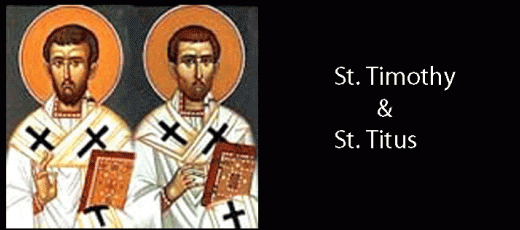
Based on Second Timothy 1:6-8, 13-14

Today I wish to address the subject of online ‘ordination’ and issues that surround the subject.

So sitting at my desk with my laptop or mobile phone in hand it is so easy to see on the internet just how many so-called online ordained ministries there actually are. I find a site and quickly apply by ticking a few boxes. So this means a person who takes all of five minutes is validly ordained then does it? Well in actual fact, online ordinations are NOT valid ordinations and most if not all  true Churches of God would refuse to accept this type of ‘ordination’.

In today’s world of modern technology, it seems all too easy for people who do not have a genuine calling from the Lord Our God in their hearts and in their lives to become online ‘ordained’ via the internet or by simply sending an email.

True ordination is not something to be taken lightly and is a lifelong vocation of service to God and to his people which needs knowledge, formation and discernment and thus ordination takes much time to realise and this can often take years and which is definitely not able to be done online or via email.

When God calls us in our hearts to his service, he is calling all that we are, heart, mind, and our very soul to serve him with our whole lives.

We are called to be shepherds to God’s people, we represent the Lord on earth until he comes again in Glory. We are called to teach and to guide the Lord’s people to have a fuller and loving relationship with God our Father so enabling them to gain the salvation that only God can give.

Online ordination is not done by the laying on of hands in Apostolic Succession and not to be ordained by Apostolic succession means the person is not receiving the necessary gifts of blessing, sanctification and grace that is passed to us through the Holy spirit.

Let us look at what we are told in Second Timothy 1:6-8, 13-14:

6. That is why I am reminding you now to fan into a flame the gift of God that you possess through the laying on of hands. 7. God did not give us spirit of timidity, but the spirit of power, love and self-control. 8. So you are never to be ashamed of witnessing to our Lord, or ashamed of me for being his prisoner; but share in my hardships for the sake of the gospel, relying on the power of God. 13. Keep as your pattern the sound teaching you have heard from me, in the faith and love that are in Christ Jesus. 14. With the help of the Holy spirit who dwells in us, look after that precious thing given in trust. We are given the gift and blessing of the Holy Spirit through the act of the laying on of hands in Apostolic succession in trust and this blessing and gift is most wondrous and must never be belittled or taken for granted and we need to be in a personal place of true readiness to receive this most wonderful blessing and this is why ordination requires knowledge, formation and true devotion before we even attempt this wondrous, trusted and vital role of the service as the voice of God within the world.

Simply getting ‘ordained’ online usually entails either none or very little training and formation and hence does not give the vital preparation that is necessary and is an issue that can cause danger to the people we are sent to serve. Another very dangerous issue with this type of invalid ordination is the fact that we often serve very vulnerable people who it is our duty to care for and to protect and there are no criminal background or other checks in place so that even those with dangerous backgrounds can use their so called `clergy status` to cause harm to those who are most often those who need us most.

If anyone is online ordained and feels they are truly called into the Lord’s service, contact a true church who will help you to do it correctly.


Born Again??? ~ Br. Michael Marshall, Novice

born again 1

Reading 1: Isaiah 42:1-4, 6-7

Thus says the LORD:  Here is my servant whom I uphold, my chosen one with whom I am pleased, upon whom I have put my spirit; he shall bring forth justice to the nations,
not crying out, not shouting, not making his voice heard in the street.  a bruised reed he shall not break, and a smoldering wick he shall not quench, until he establishes justice on the earth;
the coastlands will wait for his teaching.

I, the LORD, have called you for the victory of justice, I have grasped you by the hand; I formed you, and set you as a covenant of the people, a light for the nations,
to open the eyes of the blind, to bring out prisoners from confinement, and from the dungeon, those who live in darkness.

Responsorial Psalm: Psalm 29:1-2, 3-4, 3, 9-10

  1. (11b) The Lord will bless his people with peace.
    Give to the LORD, you sons of God, give to the LORD glory and praise, Give to the LORD the glory due his name; adore the LORD in holy attire.
    R. The Lord will bless his people with peace.
    The voice of the LORD is over the waters, the LORD, over vast waters. The voice of the LORD is mighty; the voice of the LORD is majestic.
    R. The Lord will bless his people with peace.
    The God of glory thunders, and in his temple all say, “Glory!”  The LORD is enthroned above the flood; the LORD is enthroned as king forever.
    R. The Lord will bless his people with peace.

Reading 2: Acts 10:34-38

Peter proceeded to speak to those gathered in the house of Cornelius, saying:   “In truth, I see that God shows no partiality.  Rather, in every nation whoever fears him and acts uprightly
is acceptable to him.  You know the word that he sent to the Israelites  as he proclaimed peace through Jesus Christ, who is Lord of all,  what has happened all over Judea,
beginning in Galilee after the baptism that John preached,  how God anointed Jesus of Nazareth with the Holy Spirit and power.  He went about doing good and healing all those oppressed by the devil, for God was with him.”

Gospel: Luke 3:15-16, 21-22

The people were filled with expectation, and all were asking in their hearts whether John might be the Christ.  John answered them all, saying,  “I am baptizing you with water,
but one mightier than I is coming.  I am not worthy to loosen the thongs of his sandals.  He will baptize you with the Holy Spirit and fire.”
After all the people had been baptized  and Jesus also had been baptized and was praying,  heaven was opened and the Holy Spirit descended upon him in bodily form like a dove.
And a voice came from heaven,  “You are my beloved Son; with you I am well pleased.”

It seems so strange to have celebrated Epiphany last Sunday; a part of the story of Jesus as an infant, and now here we are celebrating the Baptism of the Lord when Jesus was an adult.  We do have the story of Jesus as a boy sitting in the Temple, which we cannot discount as important in the life of Christ, but this fast forward to his baptism as an adult is very significant because it is the event which transpires at the very beginning of Jesus’ active ministry.  It was not THE BEGINNING of the Christ-story, but a beginning of its own sort.

Most Catholics do not remember their baptism because it happened shortly after birth, yet some of us do remember our baptism if baptized later in life.  Baptism is a Sacrament which connects us to God, yet many of our Protestant Brothers and Sisters associate baptism as washing away sins, wiping the slate clean and righting our relationship with God.  Baptism is definitely part of salvation, and a turning point in which we say yes to following God by living a new life; something which some Christians refer to as being “born again” which I think has something to teach us.  As I stated earlier, baptism is a Sacrament and sometimes just seen as part of the initiation into Catholicism, but baptism is SO MUCH MORE, and I think that is why our Protestant Brothers and Sisters got it right.  It is not just a Sacrament of Initiation… It is a “born again” experience, a beginning to follow Jesus.  Our baptism is just like Jesus’ in the sense that our birth is the beginning of our life, yet our baptism is our first call to follow the Lord; the beginning of our active ministry whether we want to acknowledge it or not.

In most cases, the Prophetic Books speak about what is to come; what the Lord has planned for humanity, essentially pointing to the coming of Jesus.  Yet in the Reading from Isaiah for today, we see more than just a prophecy.  We see that the Lord tells the people that they are chosen as servants, called to do good works and bring people out of darkness.  They are to be of ministry to others.  By our baptism we are called just as the Israelites in the time of Isaiah were called; our calling is to help our neighbor, show the love of God through our thoughts and actions.  Our baptism is not just part of some checklist to become fully initiated as Catholics.  Thinking in such a way is not living as God intends.  We read in the Gospel that when Jesus was baptized, God was pleased by what took place; and from that moment, the ministry of Jesus started.  Jesus did not get baptized, and then nothing else happened.  So, how should we think about our baptism?  If we think of it as part of a checklist, might we change what we think by actually believing it is our “born again” experience that is the start of our ministry?  Just as God was pleased with Jesus, should we want God to be pleased in the fact we are baptized, and choosing to do minister to our neighbor?

New Year Resolutions, Earthly or Holy?? ~ The Rev. Lady Sherwood, OPI

shutterstock_62795851

So as we enter the brand new year of 2016, we have the gift from God of another clean chapter in our lives and in our relationship with our heavenly Father and also with each other. A crisp new page in our life and faith story ready for us to write upon.

So what should we do? We could follow the footsteps of many who decide to make earthly resolutions. How about deciding to lose weight? How about stopping smoking? Maybe keeping more fit this year? Well these earthly resolutions are fine, but these tend to sadly be forgotten far too easily.

How about seeing this New year as a completely new chance, a blessing of a new beginning in which we can focus ourselves on that fuller and closer relationship with the Father and with our brothers and sisters.

We can use this new beginning to look closely at our relationships and how to apply them even more fully into our lives.

Do we truly love the Lord our God with all our being? Do we truly follow the Commandments about loving God and our neighbours? When we are wronged, do we totally forgive out of love of Christ as we ought? None of us is perfect, each and every single one of us falls down in our faith and with our relationships both with God and with each other, so we can all use this new year as a new start to further become more as our lord wants us to be by looking at these things within ourselves and improving upon them.

So instead of making an earthly resolution this year, myself and my house will serve the Lord. My resolutions will be holy rather than earthly and will be to gain more fully that true relationship both with God and with each of you, no matter where in the world you may happen to be as true love and faith have no earthly boundaries.

So will it be weight loss? Smoking? Keep fit? Will your resolutions this year be earthly or holy? I will be focusing on what truly matters. Will you join me?

Blessed Gonsalvo

Blessed-Gonsalvo-of-Amarante

Born in 1187 at Vizella, in the diocese of Braga, Portugal, Gonsalvo de Amarante was a true son of the Middle Ages.  In his boyhood Gonsalvo Pereira  gave indications of his holiness. While still small, he was consecrated to study for the Church, and received his training in the household of the archbishop of Braga. After his ordination he was given charge of a wealthy parish.

There was no complaint with Gonsalvo’s governance of the parish of Saint Pelagius. He was penitential himself, but indulgent with everyone else. Revenues that he might have used for himself were used for the poor and the sick. The parish, in fact, was doing very well when he turned it over to his nephew, whom he had carefully trained as a priest, before making a pilgrimage to the Holy Land.

Gonsalvo would have remained his entire life in the Holy Land, but after 14 years his archbishop commanded him to return to Portugal. Upon his arrival, he was horrified to see that his nephew had not been the good shepherd that he had promised to be, the money left for the poor had gone to purchase a fine stable of thoroughbred horses and a pack of fine hounds. The nephew had told everyone that his old uncle was dead, and he had been appointed pastor in his place by an unsuspecting archbishop. When the uncle appeared on the scene, ragged and old, but very much alive, the nephew was not happy to see him. Gonsalvo seems to have been surprised as well as pained.

The ungrateful nephew settled the matter by turning the dogs on his inconvenient uncle. They would have torn him to pieces, but the servants called them off and allowed the ragged pilgrim to escape. Gonsalvo decided then that he had withstood enough parish life, and went out into the hills to a place called Amarante. Here he found a cave and other necessities for an eremitical life and lived in peace for several years, spending his time building a little chapel to the Blessed Virgin. He preached to those who came to him, and soon there was a steady stream of pilgrims seeking out his retreat.

Happy as he was, Golsalvo felt that this was not his sole mission in life, and he prayed for help to discern his real vocation. It is said that the Virgin Mary appeared to him one night as he prayed and told him to enter the order that had the custom of beginning the office with “Ave Maria gratia plena.” She told him that this order was very dear to her and under her special protection. Gonsalvo set out to learn what order she meant, and eventually came to the convent of the Dominicans. Here was the end of the quest, and he asked for the habit.

Blessed Peter Gonzales was the prior, and he gave the habit to the new aspirant. After Gonsalvo had gone through his novitiate, he was sent back to Amarante, with a companion, to begin a regular house of the order. The people of the neighborhood quickly spread the news that the hermit was back. They flocked to hear him preach, and begged him to heal their sick.

One of the miracles of Blessed Gonsalvo concerns the building of a bridge across a swift river that barred many people from reaching the hermitage in wintertime. It was not a good place to build a bridge, but Gonsalvo set about it and followed the heavenly directions he had received. Once, during the building of the bridge, he went out collecting, and a man who wanted to brush him off painlessly sent him away with a note for his wife.

Gonsalvo took the note to the man’s wife, and she laughed when she read it. “Give him as much gold as will balance with the note I send you,” said the message. Gonsalvo told her he thought she ought to obey her husband, so she got out the scales and put the paper in one balance. Then she put a tiny coin in the other balance, and another, and another–the paper still outweighed her gold–and she kept adding. There was a sizeable pile of coins before the balance with the paper in it swung upwards.

Gonsalvo died 10 January 1259, after prophesying the day of his death and promising his friends that he would still be able to help them after death. Pilgrimages began soon, and a series of miracles indicated that something should be done about his beatification. Forty years after his death he appeared to several people who were apprehensively watching a flood on the river. The water had arisen to a dangerous level, just below the bridge, when they saw a tree floating towards the bridge, and Gonsalvo was balancing capably on its rolling balk. The friar carefully guided the tree under the bridge, preserving the bridge from damage, and then disappeared.  He was beatified by Pius IV in 1560.


Memorial of St. Elizabeth Ann Seton

0bec329b32e0a423a5ea6d798646297c

Elizabeth was born Elizabeth Ann Bayley in New York in 1774 and was the second daughter of the distinguished Dr. Richard Bayley and Catherine Charlton.

Her father was the chief medical officer for the port of New York and he attended to the immigrants disembarking from ships onto Staten Island and he also cared for New Yorkers during the Yellow fever outbreak which broke out in the city in 1795, which killed seven hundred people in four months. He later went on to become the first Professor of Anatomy at College.

Elizabeth’s mother, Catherine was the daughter of a Church of England priest and she died when Elizabeth was only three years old.

Elizabeth’s father remarried to Charlotte Amelia Barclay. The new Mrs Bayley was active in her church’s social ministry and would take Elizabeth with her on her charitable rounds, visiting the poor in their homes distributing food and other needed items.

Elizabeth devoted a good deal of her time to working among the poor and in 1797, she joined Isabella M Graham and others in founding the first charitable institution in New York City, the Society for the Relief of Poor Widows who had small children and she also served as their treasurer for seven years.

In 1794,Elizabeth married William M. Seton who was a wealthy in the business trade. Together they had five children, although for much of their married life, William suffered from Tuberculosis and in 1800 because of this William went bankrupt and due to this and his failing health, in 1803 they with their five children travelled to Italy where William died in December that year.

Elizabeth returned to New York City and because of what she had experienced and heard whilst in Italy, she converted to the Roman faith and joined the Roman Catholic Church in 1805. She found it difficult to earn a living because many of her friends and relatives, including her stepmother had shunned her after her conversion.

For a while Elizabeth operated a small school for boys. In 1808, she accepted an invitation from the Reverend William Doubourg, president of St. Mary’s College in Baltimore, Maryland, to open a school in the city for Catholic girls. Several young women joined her in her work and in 1809, she founded a religious community and she together with her companions took vows before Archbishop John Carroll and became sisters of St. Joseph, the first American=based Catholic sisterhood.

Because of her work, Elizabeth was known as Mother Seton and a few months after forming this Catholic sisterhood, Mother Seton and the sisters moved their school and their home to Emmitsburg, Maryland, where they provided free education for the girls of the parish.

In 1812, the order became the sisters of charity of St. Joseph under a modification of the rule of the Sisters of Charity of St. Vincent de Paul. In 1814, houses of the order were opened in Philadelphia and in New York City in 1817.

Mother Seton continued to teach and to work for her community until her death from Tuberculosis on January 4th 1821. By the time of Elizabeth’s death, the order had 20 communities.

In 1856, Seton Hall College (now a university) was named after her.

Elizabeth was beatified by Pope John XXIII on March 17th, 1963 and was Canonized by Pope Paul VI on September 14th, 1975, in a ceremony in St. Peter’s Square.


Blessed Zedislava

Zedislava-Berka

Born of a warrior race to noble parents in the diocese of Litomerici, Bavaria , Zedislava lived in a fortified castle on the borders of Christendom, in an age when the fierce Mongol hordes were the world’s worst menace. Her whole life was spent surrounded by  the sounds of clashing arms, and the moans of the dying. The gentleness and purity of her life stand out in surprising beauty against the dark background of a warlike and materialistic people.

Zedislava learned Christian charity early in life from her mother, who taught her not only the secrets of preparing medicinal herbs but also the healing balm of prayer. Going each day to the castle gates with alms and medicines for the poor and the wretched who crowded there for help, she was soon well acquainted with human misery. Cheerful, prayerful, and alert to see the sorrows of others, the child became a light of hope to the miserable. Because of her sweetness and natural charm, she was able to teach many lessons to those about her.

As a child, she is said to have fled from her home for a time to live as a hermit, but she returned to live a more normal life that included an early marriage to a soldier, the duke of Lemmberk, who, like her own father, was a rich nobleman in command of a castle on the frontier. The couple produced four children. Zedislava cared judiciously for her own family and lavished great care on the poor, especially the fugitives and victims of the Tartar invasions.

Her husband was a good man, but a rough and battle-hardened soldier who liked nothing better than the clash of swords. He may have treated Zedislava badly and he certainly tried his young wife’s patience and obedience in a thousand ways. He insisted that she dress in her finest gowns and attend the long and barbarous banquets that pleased him so. (In return, she tried his patience because of her generosity towards the poor.)

Being of a retiring disposition and much given to prayer–and having a family and a large castle to care for–she found this a real sacrifice. However, obedience and patience had been an important part of her training, and she taught herself to spiritualize the endless trials that would beset the mother of four children in a medieval fortress.

The Polish missionaries, Saint Hyacinth and Blessed Ceslaus, brought Zedislava the first knowledge of the new religious order which had begun but a few years before. Saint Dominic, had met them in Italy, where he had gone to have his order approved. Zedislava was the first Slavic Tertiary of the Dominican Order.

Enchanted with the possibilities of an order that allowed her to share in its benefits and works while caring for her family, Zedislava threw herself into the new project with enviable zeal. She encouraged her husband to build a hostel for the many poor pilgrims who came homeless to the gate. She visited the prisoners in the frightful dungeons, and used her influence to obtain pardons from the severe sentences meted out to them. She fed and cared for the poor, taught catechism to the children of the servants, and showed all, by the sweetness of her life, just what it meant to be a Christian lady and a Dominican Tertiary. On the occasion of a Mongol (Tartar) attack, when homeless refugees poured into the castle stronghold, her calm, invincible charity was a bulwark of strength to all.

With her own funds, Zedislava determined to build a church (Priory of Saint Lawrence) where God might be fittingly worshipped. As an act of zeal and penance, she herself carried many of the heavy beams and materials that went into the building. She did this at night so that no one would know of her hard work. Zedislava experienced visions and ecstasies during this time. She also received Holy Communion nearly every day in an age when this was not customary.

Her death came soon after the completion of the church in 1252. The mourning people who knelt by her deathbed could see evidence of her strong Christian virtues in the monuments she had left: her children, her church, and the inspiration of a saintly wife and mother. She consoled her husband in life and appeared to him in glory after death, which strongly encouraged his desire for conversion. Numerous miracles are ascribed to Saint Zedislava, including the raising of the dead to life.  She was beatified in 1907 by Pope Pius X.


Where Is He? ~ The Rt. Rev. Michael Beckett, OPI

epiphany

In the time of King Herod, after Jesus was born in Bethlehem of Judea, wise men from the East came to Jerusalem, asking, “Where is the child who has been born king of the Jews? For we observed his star at its rising, and have come to pay him homage.”   When King Herod heard this, he was frightened, and all Jerusalem with him; and calling together all the chief priests and scribes of the people, he inquired of them where the Messiah was to be born.  They told him, “In Bethlehem of Judea; for so it has been written by the prophet:  ‘And you, Bethlehem, in the land of Judah, are by no means least among the rulers of Judah; for from you shall come a ruler who is to shepherd my people Israel.'”  Then Herod secretly called for the wise men and learned from them the exact time when the star had appeared.  Then he sent them to Bethlehem, saying, “Go and search diligently for the child; and when you have found him, bring me word so that I may also go and pay him homage.”   When they had heard the king, they set out; and there, ahead of them, went the star that they had seen at its rising, until it stopped over the place where the child was.  When they saw that the star had stopped, they were overwhelmed with joy.  On entering the house, they saw the child with Mary his mother; and they knelt down and paid him homage. Then, opening their treasure chests, they offered him gifts of gold, frankincense, and myrrh.   And having been warned in a dream not to return to Herod, they left for their own country by another road.  Matthew 2:1-12 (NIV)

Today we mark the end of the Christmas season – the Day of Epiphany.  We celebrate this day to reflect on the visit of the Magi – the wise men – to Jesus and the giving of their gifts. We reflect on the meaning of this visit of those wise ones to see Jesus.

Epiphany is about Jesus and his message being available and relevant to people of every age and race. Jesus isn’t just a Jewish prophet with an exciting message, but God made present amongst us and available to all of us to worship and follow. God’s love reaches beyond the everyday barriers of race and class; something the Magi didn’t quite get at first.

So Who Were the Magi?

We don’t know much about the Magi from Scripture. All Saint Matthew tells us is that they were “Magi from the East”. Some translations have “Wise men from the East”. The word in Greek refers to priests of the Zoroastrian religion. They came from Persia, the countries now known as Iran and Iraq, and they saw meaning in the movement of the stars. Their visit fits an Eastern pattern of great births being accompanied by momentous events in the sky. Certainly we know of a comet in 11BCE in Gemini with its head towards Leo, seen by many as a symbol of Judah.  We also know of planetary conjunctions in both 7 BCE and 6 BCE which would have added to a sense that momentous happenings were on the way. The Magi would have noticed these things and taken them seriously. But who were they?

One commentator, Brian Stoffregen puts it like this;

“Originally in Persia, Magi were dream- interpreters. By Jesus’ time, the term referred to astronomers, fortune-tellers, or star-gazers.   They were horoscope fanatics – a practice condemned by Jewish standards. We might compare them to people in fortune – telling booths, or people on the “psychic hotline” or other “occupations” that foretell the future by stars, tea leaves, Tarot cards etc. They were magicians, astronomers, star-gazers, pseudo-scientists, fortune tellers…”

Another writer, Nathan Nettleton, puts it like this;

“They were the speakers of the sacred words at the pagan sacrifices. At worst, the term referred to a magician or sorcerer, or even a deceiver. Magi were people whose activities were repeatedly condemned and prohibited throughout the scriptures and were completely anathema to the people of Israel.”

Whilst in English we get the words “magic” and “magician” from Magi, the Zoroastrian religion forbade sorcery. They clearly were looking for a new king and had found meaning in the movement of the planets and stars which led them to come to Israel to greet the new-born king. They journeyed from their homes in Persia to Bethlehem in search of this baby. Instead of angels and visions, we have the image of the Magi following a sign in the skies – in nature – and for a long period of time. The magi see the intentions of God in the skies. This is not new: Psalm 19 tells us that the heavens themselves declare who God is, and that his handiwork is seen in created nature.  “We observed his star at its rising”. The magi know that there is something significant happening.

When did they come?

The Gospel of Saint Luke doesn’t mention the Magi and holds that the Holy Family returned to Nazareth after the presentation of Jesus at the Temple where he was circumcised. It’s probable that Saint Luke didn’t know of this episode in Jesus’ early life. Saint Matthew seems to place the visit of the Magi some time after Jesus’ birth. The Holy Family are in a “house” not in the stable of the inn.  Herod kills all the newborn boys under the age of two years. So it’s likely that the Holy Family had stayed for some time in Bethlehem and the Magi came some time after Jesus’ birth, perhaps as long as two years after.

WHY did they come?

Clearly, the Magi were searching.  The Magi recognized much of the truth of Jesus, who he was and what he would become.  The Magi had a general idea of this God and this King of the Jews, but they didn’t really know who or what they were looking for.  Bono and U2 were criticized some years ago by some supposedly orthodox Christians when they produced a song entitled, “I Still Haven’t Found What I’m Looking For,” which is about searching for fulfillment.  You see, the example of the Magi was that they were searchers, not really knowing what or who they were looking for.  They didn’t claim to have it all but they saw their lives as a journey of discovery. And in that they are an example to us. We don’t know it all. But if we, like them, are prepared to be diligent seekers, then, like them, we may be graced by God’s light, by our own Epiphany.  When the wise men finally found Jesus, we are told that their first response was joy – “they were overwhelmed with joy”. That is what happens when we find Jesus. This is what awaits us at the end of the journey. Next, they paid him homage – they worshiped him and acknowledged Him as King. After the joy comes the worship. That means acknowledging Jesus as King. Jesus as the center. Jesus as Lord. And then, after joy and after worship, comes offering of their gifts. In response to who Jesus is and the joy He gives, we offer ourselves and our gifts to Him.

So my message for today is to dare, like them, to take the risk of seeking, and God may well bless us with our own Epiphanies which transform us, as doubtless the Magi were transformed by what must have been a surprising experience for them as they knelt before the infant Jesus.

So how do you find Jesus? Maybe you can start out like the Magi – with a general idea of God, and a general idea that He is guiding you. Like the Magi, we need to turn to the scriptures. If you don’t read them, you will never really get the specific directions that God is trying to give you. Approach them with the right spirit, the right purpose. Ask for help along the way – the church, we, God’s people, are meant to help you along that way. The wise men knew when they needed to ask someone else for help. And pray. Ask God. When you find Jesus, rejoice. After all, He is God. Put Him in the center of your life. Ask yourself whether what you are doing honors him a King. Offer to him what you have, who you are.

Where can this Jesus be found?  He is with you now.  Won’t you seek Him?  Won’t you recognize Him?  Won’t you let Him fill YOUR life with joy?  Amen.


Blessed Stephanie of Quinzanis

180px-Quinzani

Born to pious parents in 1457 in Soncino, Italy,  her father became a Dominican tertiary while Stephana was very young. She was taught the catechism by the stigmatic Blessed Matthew Carrieri who lived at the nearby Dominican convent. Even though she was too small to understand, he told her that she was to be his spiritual heiress.  She began receiving visions of Dominican saints from age seven, at which point she made vows of poverty, chastity and obedience.  Carrieri died when Stephana was 14, and soon after he appeared to her in a vision and she received the stigmata.

She became a Dominican tertiary at Soncino at age 15, and was devoted to caring for the poor and sick. She founded a community of Third Order sisters in Soncino, and served as its first abbess. Her counsel was sought by many,  including Saint Angela Merici, Blessed Augustine of Biella, and Blessed Osanna of Mantua.

Although she had no formal theological training, she could discuss mystical theology at the most profound level. She could read the hearts and minds of the people around her, and had the gift of prophesy and healing. She lived in a nearly continuous fast, and inflicted severe penances on herself. Stephana accurately predicted the date of her own death.  She died of natural causes on 2 January 1530, and was beatified 14 December 1740 by Pope Benedict XIV.

The Solemnity of the Blessed Virgin ~ Br. John Carson, Postulant

Mary and the child Jesus

The shepherds went in haste to Bethlehem and found Mary and Joseph, and the infant lying in the manger. When they saw this, they made know the message that they had been told them about this child. All who heard it were amazed by what had been told them by the shepherds. And Mary kept all these things, reflecting on them in her heart. Then the shepherds returned, glorifying and praising God for all they had heard and see, just as it had been told to them.

In the Gospel reading today we read that the shepherds came to pay homage to the Child Jesus and they told Mary and Joseph of the message the angels told them, after paying homage they returned glorifying and praising God.

What can we give to the Child Jesus in our personal homage, a homage that we can give him every day?

We can be angels spreading the message of Christ to those who want to listen to us.

We are also shepherds who give Jesus our homage. We can give Jesus homage in many different ways, by our example, by our way of live and the way we talk and by being true followers of Christ and let Christ take control of our lives, because that is the best homage we can give, our whole self’s.

When Jesus takes control of our lives we can do anything even those things we think is impossible to do.

In the second reading, we read at God sent His son, born of a woman, born under the Law, to ransom those under the law.

Sometimes we are blinded by manmade rules and we forget the laws of Christ, and we are so busy following manmade laws and the law of the Church that we forget to live for God, and worship him with all our hearts.

Churches have so much gold and magnificent statues and pictures and other things, and I keep saying too many churches, that in the simplicity of things God is also glorified.

Some church families are so wrapped up with rules that they do not worship God with their whole being.

As a religious order we have to follow he rule of Holy Father Dominic, but this rule is a simple rule and it can help us to be true followers of Christ.

I would like to finish this sermons with the words of the first reading.

The Lord bless you and keep you.

The Lord let his face shine upon you, and be gracious to you.

The Lord look upon you kindly and give you peace. Amen.


Feast of the Holy Innocents ~ The Rev. Dcn Dollie Wilkinson, OPI

the-holy-innocents   

 Imagine, if you will, that you are a young couple, who, like most young people your age, find out that you are expecting your first child. Whether you have tried to have children, or this is an unexpected gift, doesn’t matter. Just the fact that you will soon welcome a blessed addition to your family, should fill your heart with joy. I have a niece who was told she would never have children, who now has suddenly discovered she is pregnant. I cannot imagine the joy, and fear, this young soon-to-be (hopefully) mother must feel. Yet, I can. After the birth of my first daughter, I suffered a miscarriage. I was blessed to have another child, a daughter, just a couple years later. But I will always remember the loss of my second child, even if I never gazed upon his (or her) sweet face. This is a tragedy that wounds a mother deeply.

     But there is another loss that is even more heart-breaking. I know my niece will welcome her baby boy (or girl) with gratitude and love. Sadly, if this dear child is a boy, he will be taken from her arms before his second birthday. Or he would have, if he had lived during the time of King Herod. Losing a child from miscarriage is hard. But to give birth to a child, then have this precious one snatched away from you, whether by illness, tragedy, or in the case of Jesus’ time, by the decree of a tyrannical king, is almost too terrible to imagine. Yet, it happened to many new parents of this time.

     Today, dearhearts, we celebrate the feast day of those children who were snatched from their Mothers’ arms, as the Gospel tells us, by the very cruel king, Herod. According to Mathew 2:1-18, Herod was “greatly troubled” when astrologers from the east came asking the whereabouts of “the newborn king of the Jews,” whose star they had seen. They were told that the Jewish Scriptures named Bethlehem as the place where the Messiah would be born. Herod cunningly told them to report back to him so that he could also “do him homage.” The Magi found Jesus, offered him their gifts but warned by an angel, avoided Herod on their way home. As detailed in Matthew 2:16, King Herod then ordered all young boys in Bethlehem, who were two years old and under, to be executed in an attempt to kill the baby Jesus. However, an angel warned Jesus’ parents and they fled to safety in Egypt. 

        “Then when Herod saw that he had been tricked by the magi, he became very enraged, and sent and slew all the male children who were in Bethlehem and all its vicinity, from two years old and under, according to the time which he had determined from the magi.”

     Some believe that the children who were killed were the first Christian martyrs. Today, the Feast of the Holy Innocents is celebrated in churches worldwide. It is also called The Innocents’ Day or Childermas or Children’s Mass.

     Today, we offer prayer for those innocent children who were slaughtered. By no fault of their own, by the fact that they were born male, and because a cruel man decided this must be done, these young souls were taken from their parents way too soon. I am thankful every single day for the blessed gift of my daughters. To have a child, whether boy or girl, but to then have someone decree they must be put to death, well I cannot imagine the heartbreak their parents must have experienced. Let us today, and always, remember these young children, the Holy Innocents.

           “Blessed are you, Bethlehem in the land of Judah! You suffered the inhumanity of King Herod in the murder of your babes and thereby have become worthy to offer to the Lord a pure host of infants. In full right do we celebrate the heavenly birthday of these children whom the world caused to be born unto an eternally blessed life rather than that from their mothers’ womb, for they attained the grace of everlasting life before the enjoyment of the present. The precious death of any martyr deserves high praise because of his heroic confession; the death of these children is precious in the sight of God because of the beatitude they gained so quickly. For already at the beginning of their lives they pass on. The end of the present life is for them the beginning of glory. These then, whom Herod’s cruelty tore as sucklings from their mothers’ bosom, are justly hailed as “infant martyr flowers”; they were the Church’s first blossoms, matured by the frost of persecution during the cold winter of unbelief.

St. Augustine