
Category: Dominican Saints
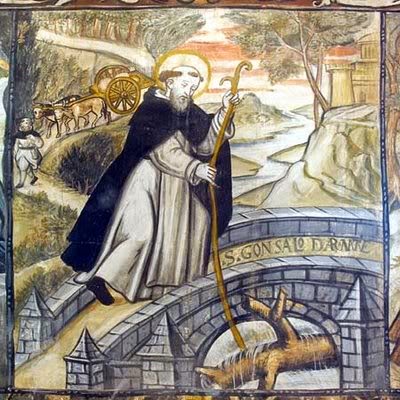
Blessed Gonsalvo
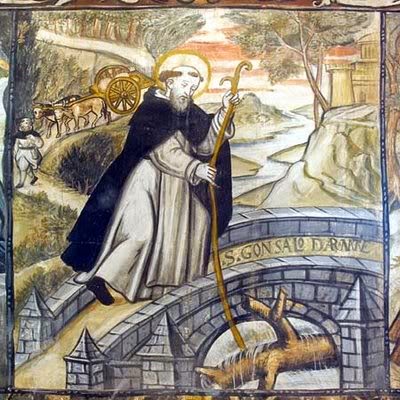
Born in 1187 at Vizella, in the diocese of Braga, Portugal, Gonsalvo de Amarante was a true son of the Middle Ages. In his boyhood Gonsalvo Pereira gave indications of his holiness. While still small, he was consecrated to study for the Church, and received his training in the household of the archbishop of Braga. After his ordination he was given charge of a wealthy parish.
There was no complaint with Gonsalvo’s governance of the parish of Saint Pelagius. He was penitential himself, but indulgent with everyone else. Revenues that he might have used for himself were used for the poor and the sick. The parish, in fact, was doing very well when he turned it over to his nephew, whom he had carefully trained as a priest, before making a pilgrimage to the Holy Land.
Gonsalvo would have remained his entire life in the Holy Land, but after 14 years his archbishop commanded him to return to Portugal. Upon his arrival, he was horrified to see that his nephew had not been the good shepherd that he had promised to be, the money left for the poor had gone to purchase a fine stable of thoroughbred horses and a pack of fine hounds. The nephew had told everyone that his old uncle was dead, and he had been appointed pastor in his place by an unsuspecting archbishop. When the uncle appeared on the scene, ragged and old, but very much alive, the nephew was not happy to see him. Gonsalvo seems to have been surprised as well as pained.
The ungrateful nephew settled the matter by turning the dogs on his inconvenient uncle. They would have torn him to pieces, but the servants called them off and allowed the ragged pilgrim to escape. Gonsalvo decided then that he had withstood enough parish life, and went out into the hills to a place called Amarante. Here he found a cave and other necessities for an eremitical life and lived in peace for several years, spending his time building a little chapel to the Blessed Virgin. He preached to those who came to him, and soon there was a steady stream of pilgrims seeking out his retreat.
Happy as he was, Golsalvo felt that this was not his sole mission in life, and he prayed for help to discern his real vocation. It is said that the Virgin Mary appeared to him one night as he prayed and told him to enter the order that had the custom of beginning the office with “Ave Maria gratia plena.” She told him that this order was very dear to her and under her special protection. Gonsalvo set out to learn what order she meant, and eventually came to the convent of the Dominicans. Here was the end of the quest, and he asked for the habit.
Blessed Peter Gonzales was the prior, and he gave the habit to the new aspirant. After Gonsalvo had gone through his novitiate, he was sent back to Amarante, with a companion, to begin a regular house of the order. The people of the neighborhood quickly spread the news that the hermit was back. They flocked to hear him preach, and begged him to heal their sick.
One of the miracles of Blessed Gonsalvo concerns the building of a bridge across a swift river that barred many people from reaching the hermitage in wintertime. It was not a good place to build a bridge, but Gonsalvo set about it and followed the heavenly directions he had received. Once, during the building of the bridge, he went out collecting, and a man who wanted to brush him off painlessly sent him away with a note for his wife.
Gonsalvo took the note to the man’s wife, and she laughed when she read it. “Give him as much gold as will balance with the note I send you,” said the message. Gonsalvo told her he thought she ought to obey her husband, so she got out the scales and put the paper in one balance. Then she put a tiny coin in the other balance, and another, and another–the paper still outweighed her gold–and she kept adding. There was a sizeable pile of coins before the balance with the paper in it swung upwards.
Gonsalvo died 10 January 1259, after prophesying the day of his death and promising his friends that he would still be able to help them after death. Pilgrimages began soon, and a series of miracles indicated that something should be done about his beatification. Forty years after his death he appeared to several people who were apprehensively watching a flood on the river. The water had arisen to a dangerous level, just below the bridge, when they saw a tree floating towards the bridge, and Gonsalvo was balancing capably on its rolling balk. The friar carefully guided the tree under the bridge, preserving the bridge from damage, and then disappeared. He was beatified by Pius IV in 1560.
Blessed Francis of Capillas
The 17th century was a period of great missionary activity. Many martyrs shed their blood on distant shores. Dominicans and Jesuits contributed a great share to the blood of martyrs. Among this glorious company, the Dominican Francis de Capillas has become the type and exemplar of them.
Francis was born in 1608 in Old Castile, Spain. Nothing is known of his childhood. He entered the Dominicans at Valladolid at age 17. The Spain of his youth was still ringing with the missionary zeal of Saints Louis Bertrand, Philip de las Casas, and Francis Xavier; the report of the martyrdom of Alphonsus Navarette (June 1), in Japan, was news at the time. Perhaps the bravery of these men helped to fire the young Francis with apostolic longing, for he volunteered for the Philippine mission while he was a deacon. In 1631 at the age of 23, he left Spain and was ordained in Manila. Here, at the gateway to the Orient, the Dominicans had founded a university in 1611, and the city teemed with missionaries traveling throughout the Orient.
The young priest labored for 10 years in the province of Cagayan, the Philippines, where heat, insects, disease, and paganism made life very hard. But it was not hard enough for Francis. He begged for a mission field that was really difficult; perhaps, like many of the eager young apostles of that time, he was hoping for an assignment in Japan, where the great persecution was raging. He was sent to Fukien, China, where he worked uneventfully for some years. Then a Tartar invasion put his life in jeopardy. He was captured by a band of Tartars and imprisoned as a spy.
Francis was subjected to a mock trial. Civil, military, and religious officials questioned him, and they accused him of everything from political intrigue to witchcraft. He was charged with disregarding ancestor worship, and, finally, since they could “find no cause in him,” he was turned over to the torturers.
He endured the cruel treatment of these men with great courage. Seeing his calmness, the magistrates became curious about his doctrines. They offered him wealth, power, and freedom, if he would renounce his faith, but he amazed and annoyed them by choosing to suffer instead. They varied the tortures with imprisonment, and he profitably used the time to convert his jailor and fellow prisoners. Even the mandarin visited him in prison, asking Francis if he would renounce his faith or would he prefer to suffer more. Being told that he was glad to suffer for Christ, the mandarin furiously ordered that he be scourged again “so he would have even more to be glad about.”
Francis was finally condemned, and was beheaded on 15 January 1640. He was beatified on 2 May 1919 by Pope Pius X.
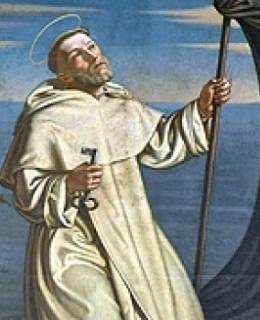
Saint Raymund of Pennafort

From the bull of his canonization, by Clement VIII in 1601, and his life, written by several Spanish, Italian and French authors. See Fleury, b. 78, n. 55, 64, and chiefly Touron Hommes Illustres de l’Ordre de S. Domin. t. 1, p. I
The house of Pegnafort, or, as it is pronounced, Pennafort, was descended from the counts of Barcelona, and nearly allied to the kings of Aragon. Raymund was born in 1175, at Pennafort, a castle in Catalonia, which in the fifteenth century was changed into a convent of the order of St. Dominick. Such was his rapid progress in his studies, that at the age of twenty he taught philosophy at Barcelona, which he did gratis, and with so great reputation, that he began then to be consulted by the ablest masters. His principal care was to instil into his scholars the most perfect maxims of a solid piety and devotion, to compose all differences among the citizens, and to relieve the distressed. He was about thirty years of age when he went to Bologna, in Italy, to perfect himself in the study of the canon and civil law, commenced Doctor in that faculty, and taught with the same disinterestedness and charity as he had done in his own country. In 1219 Berengarius, bishop of Barcelona, who had been at Rome, took Raymund home with him, to the great regret of the university and senate of Bologna; and, not content with giving him a canonry in his church, made him his archdeacon, grand vicar, and official. He was a perfect model to the clergy, by his innocence, zeal, devotion, and boundless liberalities to the poor, whom he called his creditors. In 1222 he took the religious habit of St. Dominick at Barcelona, eight months after the death of the holy founder, and in the forty-seventh year of his age. No person was ever seen among the young novices more humble, more obedient, or more fervent. To imitate the obedience of a Man-God, who reduced himself to a state of subjection to his own creatures, to teach us the dangers and deep wound of self-will, and to point out to us the remedy, the saint would depend absolutely on the lights of his director in all things. And it was upon the most perfect self-denial that he laid the foundation of that high sanctity which he made the object of his most earnest desires. The grace of prayer perfected the work which mortification had begun. In a spirit of compunction he begged of his superiors that they would enjoin him some severe penance, to expiate the vain satisfaction and complacency which he said he had sometimes taken in teaching. They indeed imposed on him a penance, but not such a one as he expected. It was to write a collection of cases of conscience for the instruction and conveniency of confessors and moralists. This produced his Sum the first work of that kind. Had his method and decisions been better followed by some later authors of the like works, the holy maxims of Christian morality had been treated with more respect by some moderns than they have been, to our grief and confusion.
Raymund joined to the exercises of his solitude the functions of an apostolic life, by laboring without intermission in preaching, instructing, hearing confessions with wonderful fruit, and converting heretics, Jews, and Moors Among his penitents were James, king of Aragon, and St. Peter Nolasco, with whom he concerted the foundation of the Order of the B. Virgin of mercy for the redemption of captives. James, the young king of Aragon had married Eleonora of Castile within the prohibited degrees, without a dispensation. A legate was sent by Pope Gregory IX. to examine and judge the case. In a council of bishops of the two kingdoms, held at Tar rayon, he declared the marriage null, but that their son Don Alphonso should be reputed lawfully born, and heir to his father’s crown. The king had taken his confessor with him to the council, and the cardinal legate was so charmed with his talents and virtue, that he associated him in his legation and gave him a commission to preach the holy war against the Moors. The servant of God acquitted himself of that function with so much prudence, zeal, and charity, that he sowed the seeds of the total overthrow of those infidels in Spain. His labors were no less successful in the reformation of the manners of the Christians detained in servitude under the Moors which were extremely corrupted by their long slavery or commerce with these infidels. Raymund showed them, by words full of heavenly unction and fire, that, to triumph over their bodily, they must first conquer their spiritual enemies, and subdue sin in themselves, which made God their enemy. Inculcating these and the like spiritual lessons, he ran over Catalonia, Aragon, Castile, and other countries. So general a change was wrought hereby in the manners of the people, as seemed incredible to all but those who were witnesses of it. By their conversion the anger of God was appeased, and the arms of the faithful became terrible to their enemies. The kings of Castile and Leon freed many places from the Moorish yoke. Don James, king of Aragon, drove them out of the islands of Majorca and Minorca, and soon after, in 1237, out of the whole kingdom of Valentia. Pope Gregory IX. having called St. Raymund to Rome in 1230, nominated him his chaplain, (which was the title of the Auditor of the causes of the apostolic palace,) as also grand penitentiary. He made him likewise his own confessarius, and in difficult affairs came to no decision but by his advice. The saint still reserved himself for the poor, and was so solicitous for them that his Holiness called him their father. He enjoined the pope, for a penance, to receive, hear, and expedite immediately all petitions presented by them. The pope, who was well versed in the canon law, ordered the saint to gather into one body all the scattered decree of popes and councils, since the collection made by Gratian in 1150. Raymund compiled this work in three years, in five books, commonly called the Decretals, which the same pope Gregory confirmed in 1234. It is looked upon as the best finished part of the body of the canon law; on which account the canonists have usually chosen it for the texts of their comments. In 1235, the pope named St. Raymund to the archbishopric of Tarragon, the capital of Aragon: the humble religious man was not able to avert the storm, as he called it, by tears and entreaties; but at length fell sick through anxiety and fear. To restore him to his health, his Holiness was obliged to consent to excuse him, but required that he should recommend a proper person. The saint named a pious and learned canon of Gironne. He refused other dignities with the like constancy.
For the recovery of his health he returned to his native country, and was received with as much joy as if the safety of the whole kingdom. and of every particular person, had depended on his presence. Being restored again to his dear solitude at Barcelona, he continued his former exercises of contemplation, preaching, and administering the sacrament of penance. Except on Sundays, he never took more than one very small refection in the day. Amidst honors and applause he was ever little in his own eyes: he appeared in the schools like a scholar, and in his convent begged the superior to instruct him in the rules of religious perfection, with the humility and docility of a novice. Whether he sung the divine praises with his brethren, or prayed alone in his cell, or some corner of the church, ho poured forth an abundance of tears; and often was not able to contain within himself the ardor of his soul. His mildness and sweetness were unalterable. The incredible number of conversions of which he was the instrument, is known only to Him who, by his grace, was the author of them. He was employed frequently in most important commissions, both by the holy see and by the king. But he was thunderstruck by the arrival of four deputies from the general chapter of his order at Bologna, in 1238, with the news that he was chosen third general, Jordan of Saxony being lately dead. He wept and entreated, but at length acquiesced in obedience. He made the visitation of his order on foot, without discontinuing any of his penitential austerities, or rather exercises. He instilled into his spiritual children a love of regularity, solitude, mortification, prayer, sacred studies, and the apostolic functions, especially preaching. He reduced the constitutions of his order into a clearer method, with notes on the doubtful passages. This his code of rules was approved in three general chapters. In one held at Paris in 1239, he procured the establishment of this regulation, that a voluntary demission of a superior, founded upon just reasons, should be accepted. This he contrived in his own favor; for, to the extreme regret of the order, he in the year following resigned the generalship, which he had held only two years. He alleged for his reason his age of sixty-five years. Rejoicing to see himself again a private religious man, he applied himself with fresh vigor to the exercises and functions of an apostolic life, especially the conversion of the Saracens. Having this end in view he engaged St. Thomas to write his work ‘Against the Gentiles;’ procured the Arabic and Hebrew tongues to be taught in several convents of his order; and erected convents, one at Tunis, and another at Murcia, among the Moors. In 1256, he wrote to his general that ten thousand Saracens had received baptism. King James took him into the island of Majorca. The saint embraced that opportunity of cultivating that infant church. This prince was an accomplished soldier and statesman, and a sincere lover of religion, but his great qualities were sullied by a base passion for women. He received the admonitions of the saint with respect, and promised amendment of life, and a faithful compliance with the saint’s injunctions in every particular; but without effect. St. Raymund, upon discovering that he entertained a lady at his court with whom he was suspected to have criminal conversation, made the strongest instances to have her dismissed, which the king promised should be done, but postponed the execution. The saint, dissatisfied with the delay, begged leave to retire to his convent at Barcelona. The king not only refused him leave, but threatened to punish with death any person that should undertake to convey him out of the island. The saint, full of confidence in God, said to his companion, “A king of the earth endeavors to deprive us of the means of retiring; but the King of heaven will supply them.” He then walked boldly to the waters, spread his cloak upon them, tied up one corner of it to a staff for a sail, and having made the sign of the cross, stepped upon it without fear, while his timorous companion stood trembling and wondering on the shore. On this new kind of vessel the saint was wafted with such rapidity, that in six hours he reached the harbor of Barcelona, sixty leagues distant from Majorca. Those who saw him arrive in this manner met him with acclamations. But he, gathering up his cloak dry, put it on, stole through the crowd, and entered his monastery. A chapel and a tower, built on the place where he landed, have transmitted the memory of this miracle to posterity. This relation is taken from the bull of his canonization, and the earliest historians of his life. The king became a sincere convert, and governed his conscience, and even his kingdoms, by the advice of St. Raymund from that time till the death of the saint. The holy man prepared himself for his passage to eternity, by employing days and nights in penance and prayer. During his last illness, Alphonsus, king of Castile, with his queen, sons, and brother; and James, king of Aragon, with his court, visited him, and received his last benediction. He armed himself with the last sacraments; and, in languishing sighs of divine love, gave up his soul to God, on the 6th of January, in the year 1275, and the hundredth of his age. The two kings, with all the princes and princesses of their royal families, honored his funeral with their presence: but his tomb was rendered far more illustrious by miracles. Several are recorded in the bull of his canonization, published by Clement VIII. in 1601. Bollandus has filled fifteen pages in folio with an account of them. His office is fixed by Clement X. to the 23d of January.
The saints first learned in solitude to die to the world and themselves, to put on the spirit of Christ, and ground themselves in a habit of recollection and a relish only for heavenly things, before they entered upon the exterior functions even of a spiritual ministry. Amidst these weighty employments, not content with reserving always the time and means of frequent retirement for conversing with God and themselves, in their exterior functions by raising their minds to heaven with holy sighs and desires, they made all their actions in some measure an uninterrupted prayer and exercise of divine love and praise. St. Bonaventure reckons it among the general exercises of every religious or spiritual men, “that he keep his mind always raised, at least virtually, to God: hence, whensoever a servant of God has been distracted from attending to him for ever so short a space, he grieves and is afflicted, as if he was fallen into some misfortune, by having been deprived of the presence of such a friend who never forgets us. Seeing that our supreme felicity and glory consists in the eternal vision of God, the constant remembrance of him is a kind of imitation of that happy state: this the reward, that the virtue which entitles us to it. Till we are admitted to his presence, let us in our exile always bear him in mind: every one will behold him in heaven with so much the greater joy, and so much the more perfectly, as he shall more assiduously and more devoutly have remembered him on earth. Nor is it only in our repose, but also in the midst of our employments, that we ought to have him present to our minds, in imitation of the holy angels, who, when they are sent to attend on us, so acquit themselves of the functions of this exterior ministry as never to be drawn from their interior attention to God. As much as the heavens exceed the earth, so much larger is the field of spiritual meditation than that of all terrestrial concerns.”
(Taken from Vol. I of “The Lives or the Fathers, Martyrs and Other Principal Saints” by the Rev. Alban Butler, the 1864 edition published by D. & J. Sadlier, & Company)
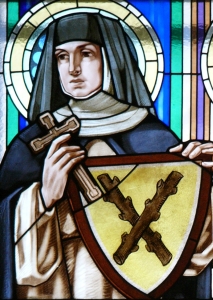
Blessed Zedislava
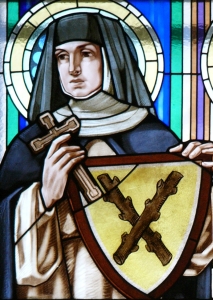
Born of a warrior race to noble parents in the diocese of Litomerici, Bavaria , Zedislava lived in a fortified castle on the borders of Christendom, in an age when the fierce Mongol hordes were the world’s worst menace. Her whole life was spent surrounded by the sounds of clashing arms, and the moans of the dying. The gentleness and purity of her life stand out in surprising beauty against the dark background of a warlike and materialistic people.
Zedislava learned Christian charity early in life from her mother, who taught her not only the secrets of preparing medicinal herbs but also the healing balm of prayer. Going each day to the castle gates with alms and medicines for the poor and the wretched who crowded there for help, she was soon well acquainted with human misery. Cheerful, prayerful, and alert to see the sorrows of others, the child became a light of hope to the miserable. Because of her sweetness and natural charm, she was able to teach many lessons to those about her.
As a child, she is said to have fled from her home for a time to live as a hermit, but she returned to live a more normal life that included an early marriage to a soldier, the duke of Lemmberk, who, like her own father, was a rich nobleman in command of a castle on the frontier. The couple produced four children. Zedislava cared judiciously for her own family and lavished great care on the poor, especially the fugitives and victims of the Tartar invasions.
Her husband was a good man, but a rough and battle-hardened soldier who liked nothing better than the clash of swords. He may have treated Zedislava badly and he certainly tried his young wife’s patience and obedience in a thousand ways. He insisted that she dress in her finest gowns and attend the long and barbarous banquets that pleased him so. (In return, she tried his patience because of her generosity towards the poor.)
Being of a retiring disposition and much given to prayer–and having a family and a large castle to care for–she found this a real sacrifice. However, obedience and patience had been an important part of her training, and she taught herself to spiritualize the endless trials that would beset the mother of four children in a medieval fortress.
The Polish missionaries, Saint Hyacinth and Blessed Ceslaus, brought Zedislava the first knowledge of the new religious order which had begun but a few years before. Saint Dominic, had met them in Italy, where he had gone to have his order approved. Zedislava was the first Slavic Tertiary of the Dominican Order.
Enchanted with the possibilities of an order that allowed her to share in its benefits and works while caring for her family, Zedislava threw herself into the new project with enviable zeal. She encouraged her husband to build a hostel for the many poor pilgrims who came homeless to the gate. She visited the prisoners in the frightful dungeons, and used her influence to obtain pardons from the severe sentences meted out to them. She fed and cared for the poor, taught catechism to the children of the servants, and showed all, by the sweetness of her life, just what it meant to be a Christian lady and a Dominican Tertiary. On the occasion of a Mongol (Tartar) attack, when homeless refugees poured into the castle stronghold, her calm, invincible charity was a bulwark of strength to all.
With her own funds, Zedislava determined to build a church (Priory of Saint Lawrence) where God might be fittingly worshipped. As an act of zeal and penance, she herself carried many of the heavy beams and materials that went into the building. She did this at night so that no one would know of her hard work. Zedislava experienced visions and ecstasies during this time. She also received Holy Communion nearly every day in an age when this was not customary.
Her death came soon after the completion of the church in 1252. The mourning people who knelt by her deathbed could see evidence of her strong Christian virtues in the monuments she had left: her children, her church, and the inspiration of a saintly wife and mother. She consoled her husband in life and appeared to him in glory after death, which strongly encouraged his desire for conversion. Numerous miracles are ascribed to Saint Zedislava, including the raising of the dead to life. She was beatified in 1907 by Pope Pius X.
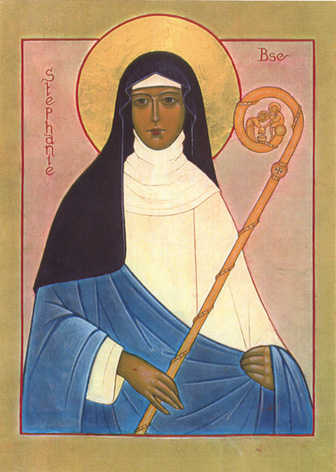
Blessed Stephanie of Quinzanis

Born to pious parents in 1457 in Soncino, Italy, her father became a Dominican tertiary while Stephana was very young. She was taught the catechism by the stigmatic Blessed Matthew Carrieri who lived at the nearby Dominican convent. Even though she was too small to understand, he told her that she was to be his spiritual heiress. She began receiving visions of Dominican saints from age seven, at which point she made vows of poverty, chastity and obedience. Carrieri died when Stephana was 14, and soon after he appeared to her in a vision and she received the stigmata.
She became a Dominican tertiary at Soncino at age 15, and was devoted to caring for the poor and sick. She founded a community of Third Order sisters in Soncino, and served as its first abbess. Her counsel was sought by many, including Saint Angela Merici, Blessed Augustine of Biella, and Blessed Osanna of Mantua.
Although she had no formal theological training, she could discuss mystical theology at the most profound level. She could read the hearts and minds of the people around her, and had the gift of prophesy and healing. She lived in a nearly continuous fast, and inflicted severe penances on herself. Stephana accurately predicted the date of her own death. She died of natural causes on 2 January 1530, and was beatified 14 December 1740 by Pope Benedict XIV.
Blessed James Benefatti
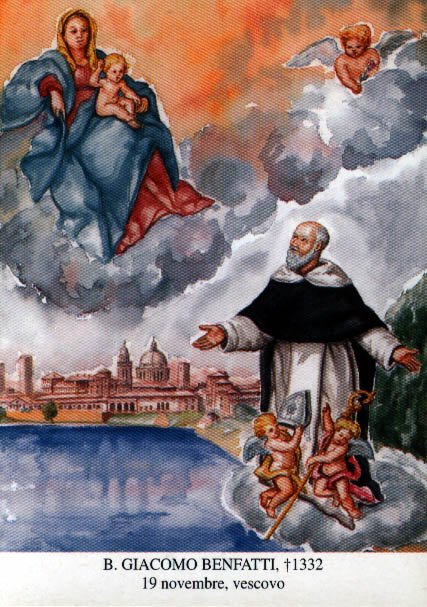
Blessed James Benefatti, James is known as the Father of the Poor. He was a Dominican at Mantua, Italy in 1290, and was a Doctor of theology and a priest. He was also a friend and brother friar of Nicholas Boccasino who later became Pope Benedict XI, and for whom James held several support offices including papal legate. He was the Bishop of Mantua in 1303, and noted for his devotion to the poor. James rebuilt his cathedral and refurbished churches and was appointed Papal legate for Pope John XXII. He died 19 November 1332 at Mantua, Italy of natural causes. His body was found incorrupt when exhumed both in 1480 and 1604. He was beatified in 1859 by Pope Pius IX.
Saint Catherine of Alexandria
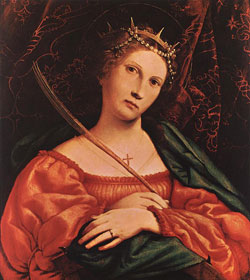
Saint Catherine of Alexandria. According to the traditional story, Catherine was the daughter of Costus, a pagan governor of Alexandria, where she was born. She is said to have announced to her parents that she would only marry someone who surpassed her in beauty, intelligence, wealth, and social status. This has been interpreted as an early foreshadowing of her eventual discovery of Christ. “His beauty was more radiant than the shining of the sun, His wisdom governed all creation, His riches were spread throughout all the world.” Though raised a pagan, she converted to Christianity in her late teens. It is said that she visited her contemporary, the Roman Emperor Maximinus Daia, and attempted to convince him of the moral error in persecuting Christians. She succeeded in converting his wife, the Empress, and many pagan philosophers whom the Emperor sent to dispute with her, all of whom were subsequently martyred. Upon the failure of the Emperor to win Catherine over, he ordered her to be put in prison; and when the people who visited her converted, she was condemned to death on the breaking wheel, an instrument of torture. According to legend, the wheel itself broke when she touched it, so she was beheaded.
According to Christian tradition, angels carried her body to Mount Sinai, where, in the 6th century, the Eastern Emperor Justinian established Saint Catherine’s Monastery, Mount Sinai, the church being built between 548 and 565 in Saint Catherine, Egypt, on the Sinai peninsula. Saint Catherine’s Monastery survives, a famous repository of early Christian art, architecture and illuminated manuscripts that is still open to visiting scholars. The historian Harold T. Davis says that Catherine’s story dates only from the 10th century AD, and that “assiduous research has failed to identify Catherine with any historical personage”; Davis suggests that the invention of Catherine may have been inspired by the story of the martyred pagan philosopher Hypatia of Alexandria. She did certainly form an exemplary counterpart to Hypatia in the medieval mindset; and it has been suggested that she was invented specifically for that purpose. Like Hypatia, she is said to have been highly learned (in philosophy and theology), very beautiful, sexually pure, and to have been brutally murdered for publicly stating her beliefs. The story of Catherine is placed a hundred years before Hypatia’s death, but there are no contemporary sources for her life.
Because of the fabulous character of the account of her martyrdom and the lack of reliable documentation, the Roman Catholic Church in 1969 removed her feast day from the Calendar. But she continued to be commemorated in the Roman Martyrology on November 25. In 2002, her feast was restored to the General Roman Calendar as an optional memorial.
The 1908 Catholic Encyclopedia describes the historical importance of the belief in her as follows:
Ranked with St Margaret and St Barbara as one of the fourteen most helpful saints in heaven, she was unceasingly praised by preachers and sung by poets. It is believed that Jacques-Benigne Bossuet dedicated to her one of his most beautiful panegyrics and that Adam of St. Victor wrote a magnificent poem in her honour: Vox Sonora nostri chori, etc. In many places her feast was celebrated with the utmost solemnity, servile work being suppressed and the devotions being attended by great numbers of people. In several dioceses of France it was observed as a Holy Day of Obligation up to the beginning of the seventeenth century, the splendor of its ceremonial eclipsing that of the feasts of some of the Apostles. Numberless chapels were placed under her patronage and her statue was found in nearly all churches, representing her according to medieval iconography with a wheel, her instrument of torture. Meanwhile, owing to several circumstances in his life, Saint Nicholas of Myra was considered the patron of young bachelors and students, and Saint Catherine became the patroness of young maidens and female students. Looked upon as the holiest and most illustrious of the virgins of Christ after the Blessed Virgin Mary, it was natural that she, of all others, should be worthy to watch over the virgins of the cloister and the young women of the world. The spiked wheel having become emblematic of the saint, wheelwrights and mechanics placed themselves under her patronage. Finally, as according to tradition, she not only remained a virgin by governing her passions and conquered her executioners by wearying their patience, but triumphed in science by closing the mouths of sophists, her intercession was implored by theologians, apologists, pulpit orators, and philosophers. Before studying, writing, or preaching, they besought her to illumine their minds, guide their pens, and impart eloquence to their words. At the beginning of the fifteenth century, it was rumored that she had spoken to Joan of Arc and, together with St. Margaret, had been divinely appointed Joan’s adviser.
Blessed Lucy of Narni
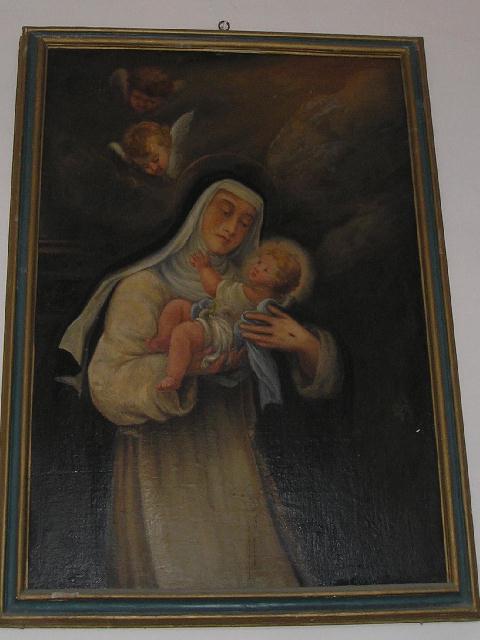
OLYMPUS DIGITAL CAMERA
Blessed Lucy of Narni was the eldest of eleven children of Bartolomeo Broccadelli and Gentilina Cassio. When she was only five years old, she had a vision of the Virgin Mary. Two years later, she had another vision, this time of the Virgin Mary accompanied by Saint Dominic. Dominic is said to have given her the scapular at this time. When she was twelve years old, Lucy made a private vow of chastity, and determined to become a Dominican nun.
Circumstances, however, changed to make doing so difficult. The next year her father died, leaving her in the care of an uncle. This uncle determined that the best course of action he could take would be to get Lucy married as quickly as possible.
He made several attempts to do so. One of these included holding a large family party. He had invited the man he had chosen as Lucia’s husband to the party, with the intention of having the couple publicly betrothed. He however had not informed Lucia of his intentions. The suitor made an attempt to put a ring on Lucia’s finger, only to be slapped repeatedly for his efforts by Lucia.
A later attempt involved Count Pietro de Alessio of Milan, an acquaintance of the family. Lucia was actually quite fond of him, but felt her earlier vow to become a nun made the possibility of marriage impossible. The strain Lucia felt as a result of the conflicting feelings made her seriously ill. During this time, the Virgin Mary and Saint Dominic again appeared to her, this time accompanied by Catherine of Siena. They reportedly advised Lucia to contract a legal marriage to Pietro, but to explain that her vow of virginity would have to be respected and not violated. Pietro agreed to the terms, and the marriage was formalized.
In 1491 Lucia became Pietro’s legal wife and the mistress of his household, which included a number of servants and a busy social calendar. Despite her busy schedule, Lucia made great efforts to instruct the servants in Christianity and soon became well known locally for her charity to the poor.
Pietro observed Lucia’s behavior, and occasional quirks, quite indulgently. He never objected when she gave away clothing and food nor when she performed austere penances, which included regularly wearing a hair shirt under her garments and spending most of the night in prayer and acting to help the poor. He also seemed to have taken in stride the story he was told by the servants that Lucia was often visited in the evenings by Saint Catherine, Saint Agnes, and Saint Agnes of Montepulciano who helped her make bread for the poor.
However, when one of the servants came up to him one day and told him that Lucia was privately entertaining a handsome young man she appeared to be quite familiar with, he did react. He took up his sword and went to see who this person was. When he arrived, he found Lucia contemplating a large crucifix. The servant told him that the man he had seen Lucia with looked like the figure on the crucifix.
Lucia left one night for a local Franciscan monastic community, only to find it closed. She returned home the following day, stating that she had been led back by two saints. That was enough for Pietro. He had her locked away for the bulk of one Lenten season. She was only visited by servants who brought her food. When Easter arrived, however, she managed to escape from Pietro back to her mother’s house and on 1494 May 8 became a Dominican tertiary. Pietro expressed his disapproval of this in a rather dramatic form, by burning down the monastery of the prior who had given her the habit.
In 1495 Lucia went to Rome and joined a group of Third order Dominican tertiaries. The next year she was sent to Viterbo and here she found she was frequently the object of unwanted attention. It was here, on February 25, 1496 that she is reported to have received the stigmata. Lucia did her best to hide these marks, and was frequently in spiritual ecstasy. The house had a steady stream of visitors who came to speak to Lucia, and, often, just look at her. Even the other nuns were concerned about her, and at one point called in the local bishop who watched Lucia go through the drama of the Passion for twelve hours straight.
The bishop would not make a decision on Lucia, and called in the local inquisition. Reports here vary, some indicating that he referred the case directly to the Pope, who is said to have spoken with her and, with the assistance of Columba of Rieti, ultimately decided in her favor, telling her to go home and pray for him. Other sources question the accuracy of these reports.
At that time Pietro also came to her, making a final plea to persuade Lucia to return with him as his wife. She declined, and Pietro left alone. He would himself later become a Franciscan monk and a famous preacher.
When Lucy returned to the convent in Viterbo, she found that the Duke of Ferrara, Ercole d’Este I, had determined to build a convent in Ferrara and that, having heard of her, he determined that she would be its prioress. In summer of 1497, he invited her to be the founder of this new monastery. Lucia herself, the Dominican order, and the Pope all agreed quickly to the new proposal. The municipal council of Viterbo, however, objected, not wanting to lose Lucy. Lucia had been praying for some time for a way to create a new convent of strict observance, and agreed to go to the new convent.
Lucia’s departure precipitated a conflict between Ferrara and Viterbo which would continue for two years. Viterbo wanted to keep the famous mystic for themselves, and the duke wanted her in Ferrara. After extensive correspondence between the parties, on April 15, 1499 Lucia escaped secretly from Viterbo and was officially received in Ferrara on May 7, 1499. Thirteen young girls immediately applied for admission to her new community; the construction of the monastery began in June and was completed two years later, in August 1501. It contained 140 cells for sisters and the novices, but to fill it with suitable vocations proved to be very difficult. Lucia expressed the wish to have there some of her former friends from Viterbo and Narni. Duke Ercole, in September 1501 sent his messenger to Rome asking for the help of the pope’s daughter Lucrezia Borgia, who was preparing to marry Duke’s son Alfonso. She collected all eleven candidates Lucia had indicated and sent them, as a special wedding present to Lucia and to the Duke, a few days ahead of her bridal party. She herself solemnly entered Ferrara on February 2, 1502.
The Duke petitioned the local bishop for some help for Lucia in governing her new community, and he sent ten nuns from another community to join Lucia’s convent. Unfortunately, these ten nuns were members of the Dominican second order, who were canonically permitted to wear black veils, something Lucia and the members of the Dominican third order community were not allowed to do.
Tensions were heightened when one of these veiled outsiders, Sister Maria da Parma, was made the prioress of the convent on September 2, 1503. When Duke Ercole died on January 24, 1505 the new prioress quickly found Lucia to be guilty of some unrecorded transgression, most probably of the support for the Savonarolan church reform, and placed her on a strict penance. Lucia was not allowed to speak to any person but her confessor, who was chosen by the prioress. The local provincial of the Dominican order would also not permit any member of the order to see Lucia. There are records that at least one Dominican, Catherine of Racconigi, did visit her, evidently by bilocation, and that Lucia’s earlier visitation by departed saints continued. In response to Lucia’s insistent prayer her stigmata eventually disappeared, which caused some of the other nuns to question whether they had ever been there at all. When Lucia finally died, in 1544, many people were surprised to find that she had not died years earlier.
Then suddenly everything changed. When her body was laid out for burial so many people wanted to pay their last respects that her funeral had to be delayed by three days. Her tomb in the monastery church was opened four years later and her perfectly preserved body was transferred to a glass case. When Napoleon in 1797 suppressed her monastery the body was transferred to the Cathedral of Ferrara; and on 1935 May 26 – to the Cathedral of Narni.
Lucia was beatified by Pope Clement XI on March 1, 1710
Saint Albert the Great
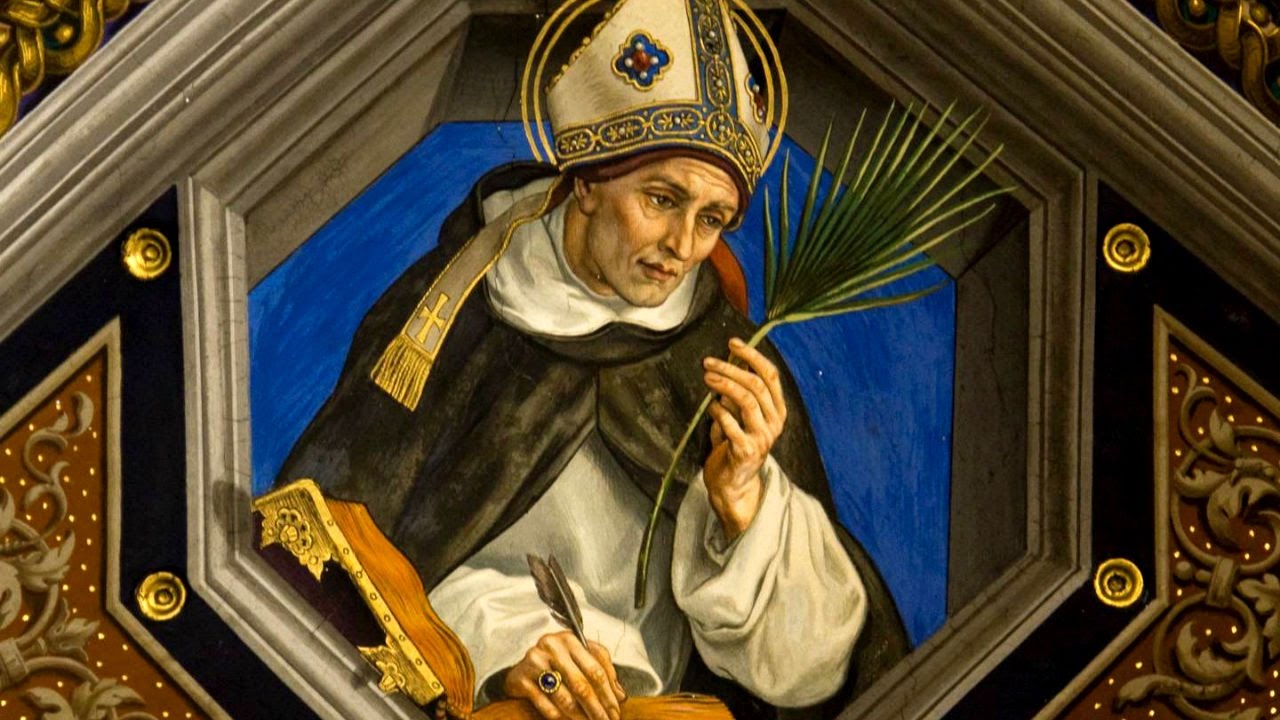
Saint Albert the Great was born sometime between 1193 and 1206, to the Count of Bollstädt in Lauingen in Bavaria. Contemporaries such as Roger Bacon applied the term “Magnus” to Albertus during his own lifetime, referring to his immense reputation as a scholar and philosopher. Albertus was educated principally at Padua, where he received instruction in Aristotle’s writings. A late account by Rudolph de Novamagia refers to Albertus’ encounter with the Blessed Virgin Mary, who convinced him to enter Holy Orders. In 1223 (or 1221) he became a member of the Dominican Order, against the wishes of his family, and studied theology at Bologna and elsewhere. Selected to fill the position of lecturer at Cologne, Germany, where the Dominicans had a house, he taught for several years there, at Regensburg, Freiburg, Strasbourg and Hildesheim. In 1245 he went to Paris, received his doctorate, and taught for some time as a master of theology with great success. During this time Thomas Aquinas began to study under Albertus.
In 1254, Albertus was made provincial of the Dominican Order, and fulfilled the arduous duties of the office with great care and efficiency. During his tenure he publicly defended the Dominicans against attacks by the secular and regular faculty of the University of Paris, commented on St. John, and answered what he perceived as errors of the Arabian philosopher Averroes.
In 1260, Pope Alexander IV made him Bishop of Regensburg, an office from which he resigned after three years. During the exercise of his duties he enhanced his reputation for humility by refusing to ride a horse—in accord with the dictates of the Dominican order—instead walking back and forth across his huge diocese. This earned him the affectionate sobriquet, “boots the bishop,” from his parishioners. After his stint as bishop, he spent the remainder of his life partly in retirement in the various houses of his order, yet often preaching throughout southern Germany. In 1270, he preached the eighth Crusade in Austria. Among the last of his labors was the defense of the orthodoxy of his former pupil, Thomas Aquinas, whose death in 1274 grieved Albertus. After suffering a collapse of health in 1278, he died on November 15, 1280, in Cologne, Germany. His tomb is in the crypt of the Dominican church of St. Andreas in Cologne, and his relics at the Cologne Cathedral.
Albertus was beatified in 1622. He was canonized and proclaimed a Doctor of the Church in 1931 by Pope Pius XI. St Albert’s feast day is celebrated on November 15.
Blessed John Licci
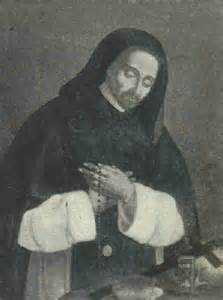
Blessed John Licci, born to a poor farmer, his mother died in childbirth. His life from then on, all 111 years, was a tale of miracles. His father, who fed the baby on crushed pomegranates, had to work the fields, and was forced to leave the infant alone. The baby began crying, and a neighbor woman took him to her home to feed him. She laid the infant on the bed next to her paralyzed husband – and the man was instantly cured. The woman told John’s father of the miracle, but he was more concerned that she was meddling, and had taken his son without his permission. He took the child home to feed him more pomegranate pulp. As soon as the child was removed from the house, the neighbor’s paralysis returned; when John was brought back in, the man was healed. Even John’s father took this as a sign, and allowed the neighbors to care for John.
A precocious and emotional child, John began reciting the Daily Offices before age 10. While on a trip to Palermo, Italy at age 15, John went to Confession in the church of Saint Zita of Lucca where his confession was heard by Blessed Peter Geremia who suggested John consider a religious life. John considered himself unworthy, but Peter pressed the matter, John joined the Dominicans in 1415, and wore the habit for 96 years, the longest period known for anyone.
He founded the convent of Saint Zita in Caccamo, Italy. Lacking money for the construction, John prayed for guidance. During his prayer he had a vision of an angel who told him to “build on the foundations that were already built.” The next day in the nearby woods he found the foundation for a church called “Saint Mary of the Angels,” a church that had been started many years before, but had never been finished. John assumed this was the place indicated, and took over the site.
During the construction, workmen ran out of materials; the next day at dawn a large ox-drawn wagon arrived at the site. The driver unloaded a large quantity of stone, lime and sand – then promptly disappeared, leaving the oxen and wagon behind for the use of the convent. At another point a well got in the way of construction; John blessed it, and it immediately dried up; when construction was finished, he blessed it again, and the water began to flow. When roof beams were cut too short, John would pray over them, and they would stretch. There were days when John had to miraculously multiply bread and wine to feed the workers. Once a young boy came to the construction site to watch his uncle set stones; the boy fell from a wall, and was killed; John prayed over him, and restored him to life and health.
John and two brother Dominicans who were working on the convent were on the road near Caccamo when they were set upon by bandits. One of the thieves tried to stab John with a dagger; the man’s hand withered and became paralyzed. The gang let the brothers go, then decided to ask for their forgiveness. John made the Sign of the Cross at them, and the thief‘s hand was made whole.
One Christmas a nearby farmer offered to pasture the oxen that had come with the disappearing wagon-driver. John declined, saying the oxen had come far to be there, and there they should stay. Thinking he was doing good, the layman took them anyway. When he put them in the field with his own oxen, they promptly disappeared; he later found them at the construction site, contentedly munching dry grass near Father John.
While he did plenty of preaching in his 90+ years in the habit, usually on Christ’s Passion, he was not known as a great homilist. He was known, however, for his miracles and good works. His blessing caused the breadbox of a nearby widow to stay miraculously full, feeding her and her six children. His blessing prevented disease from coming to the cattle of his parishioners. A noted healer, curing at least three people whose heads had been crushed in accidents, he was Provincial of Sicily, and Prior of the abbey on several occasions.
 The Order of Preachers, Independent
You must be logged in to post a comment.