
Category: Dominican Saints
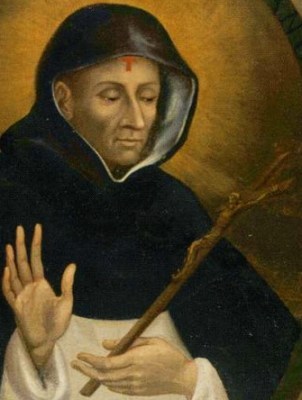
Blessed Jordan of Pisa

At a time when scholars believed that no colloquial tongue could ever replace Latin as a gentleman’s language, Jordan worked to make Italian the beautiful tongue that it is today. That’s not the reason he was beatified by the Church but it’s interesting and sometimes overlooked.
Jordan attended the University of Paris where he first encountered the Dominican friars in 1276. Four years later, probably after obtaining his degrees, he returned to Italy and took the habit. He began a long teaching career there as soon as he was qualified to do so.
Because of the excellence of his preaching in Florence, Jordan was appointed first lector there in 1305. He seems to have been fascinated with the whole question of preaching as an apostolic tool, and to have been one of the first to make a scientific study of it. He pointed out that the Greek church was “invaded by a multitude of errors,” because the Greeks had no preachers; he could never say enough in praise of Saint Dominic’s farsightedness in establishing an order specifically for preaching.
Jordan studied methods of making sermons more effective, both by using examples that would reach the people, and by the use of the vernacular. This latter was a much-disputed subject in his day (they had Dan Amon’s then, too); Jordan was considered a daring innovator. Because it was controversial, he strove to make Italian a beautiful instrument on which he could play the melodies of the Lord.
Blessed with an extraordinary memory, Jordan is supposed to have known the breviary by heart, as well as the missal, most of the Bible (with its marginal commentary), plus the second part of the Summa. This faculty of memory he used in his sermons, but he was quick to point out to young preachers that learning alone can never make a preacher. By the holiness of his own life he made this plain, and continually preached it to those he was training to preach.
Jordan of Pisa had two great devotions–to Our Blessed Mother and to Saint Dominic. Once he was favored with a vision of Our Lady; she came into the fathers’ refectory and served at table. Jordan, who was the only one who could see her, could barely eat for excitement. He spoke often of her in his sermons, and also of Saint Dominic. He founded a number of confraternities in Pisa, one of which has lasted until now.
Jordan died on his way to Paris to teach at Saint Jacques. His body was returned from Piacenza, where death overtook him, to rest in the church at Pisa (Benedictines, Dorcy).
Born:1255 at Pisa, Italy
Died: August 19, 1311 at Piacenza of natural causes while on his way to teach in Paris; relics venerated at the church of Saint Catalina at Pisa, Italy
Beatified: August 23, 1833 (cultus confirmed) by Pope Gregory XVI; 1838 (beatification)
Blessed Jordan of Saxony
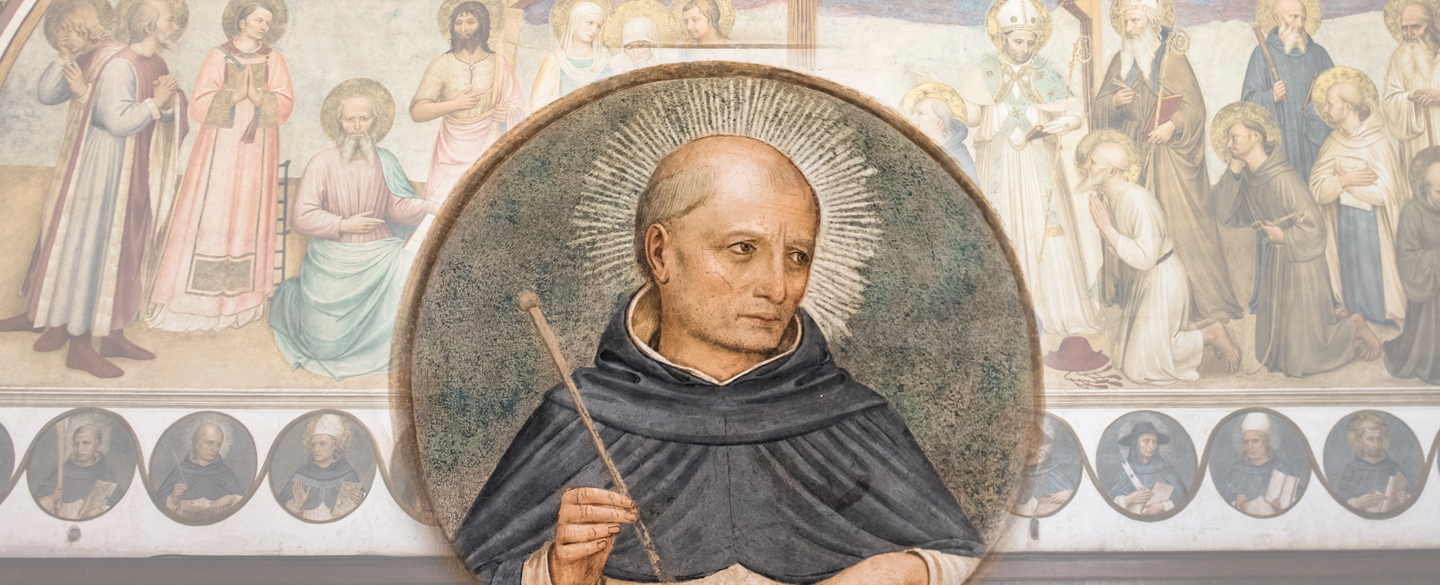
Men prayed for strength to resist Jordan’s burning eloquence, and mothers hid their sons when Master Jordan came to town. Students and masters warned each other of the fatal magnetism of his sermons. The sweetness of his character and the holiness of his life shone through his most casual words in a flame that drew youth irresistibly to the ideal to which he had dedicated his own life. In his 16 years of preaching, Jordan is said to have drawn more than a thousand novices to the Dominican Order, among whom were two future popes, two canonized saints (e.g., Albert the Great), numerous beati, and countless intellectual lights of his dazzling century.
Of Jordan’s childhood, nothing is known, except that he was born of a noble family. He was drawn to the order in 1220 by the preaching of Blessed Reginald, the beloved son of Dominic, brought back from death by Dominic’s and Our Lady’s prayers. Jordan was at that time about 30, a student at the University of Paris, and his reputation for sanctity had preceded him into the order.
He had worn the habit for only two months when he was sent to Bologna as a delegate to the first general chapter of the order. The following year he was elected provincial of Lombardy, Italy, and on the death of Saint Dominic, succeeded him as master general.
The Order of Preachers was only six years old when Jordan became master general. He carried out the yet untried plans of Dominic, who had hurried off to heaven when many of his dreams were just beginning to open out into realization, and still more vistas beckoned beyond. Under him the new order advanced apace, spreading throughout Germany and into Denmark. Jordan will always be remembered for his work in increasing the manpower of the order, but his contribution to its quality should never be forgotten.
He added four new provinces to the eight already in existence; he twice obtained for the order a chair at the University of Paris and helped found the University of Toulouse; and he established the first general house of studies of the order. He was a spiritual guide to many, including Blessed Diana d’Andalo; and somewhere in his busy lifetime he found time to write a number of books, including a life of Saint Dominic.
Jordan was regarded as a menace by the professors of universities where he recruited novices. He emptied classrooms of their most talented students, stole their most noted professors. Young men by the hundreds besieged the order for admittance. Some were mere children, some famous lawyers and teachers, and some were the wealthy young bearers of the most famous names in Christendom. One and all, they were drawn to a life of perfection by this man who preached so well, and who practiced what he preached with such evident relish.
All the old writers speak of the kindness and personal charm of Jordan. He had the ability to console the troubled and to inspire the despondent with new hope. At one time, a discouraged student was busily saying the Office of the Dead when Master Jordan sat down beside him and began alternating verses with him. When he came to the end of Psalm 26, Jordan said the verse with emphasis: “Oh, wait for the Lord!” Wherewith the sorrows of the young man departed. Another student was rid of troubled thoughts by the mere imposition of Jordan’s hands. To bring peace to the brothers who were being annoyed by the devil, Jordan established the beautiful custom of singing the Salve Regina after Compline each night.
Jordan was shipwrecked and drowned when returning from a pilgrimage to the Holy Land (Benedictines, Dorcy).
Born: 1190 at Padberg Castle, diocese of Paderborn, Westphalia, old Saxony; rumoured to have been born in Palestine while his parents were on a pilgrimage, and named after the River Jordan, but this is apparently aprochryphal
Died: Drowned 1237 in a shipwreck off the coast of Syria while on a pilgrimage to the Holy Land
Beatified: 1825 (cultus confirmed) by Pope Leo XII
Canonized: University of Santo Tomas Faculty of Engineering
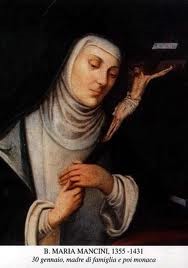
Blessed Mary Mancini of Pisa

Catherine Mancini was born in Pisa in 1355, of noble parentage, and from infancy began enjoying the miraculous favors with which her life was filled. At the age of three, she was warned by some heavenly agency that the porch on which she had been placed by a nurse was unsafe. Her cries attracted the nurse’s attention, and they had barely left the porch when it collapsed. When she was five, she beheld in an ecstasy the dungeon of a place in Pisa in which Peter Gambacorta, one of the leading citizens, was being tortured. At Catherine’s prayer, the rope broke and the man was released. Our Lady told the little girl to say prayers every day for this man, because he would one day be her benefactor.
Catherine would have much preferred the religious life to marriage, but she obeyed her parents and was married at the age of twelve. Widowed at sixteen, she was compelled to marry again. Of her seven children, only one survived the death of her second husband, and Catherine learned through a vision that this child, too, would soon be taken from her. Thus she found herself, at the age of twenty five, twice widowed and bereft of all her children. Refusing a third marriage, she devoted herself to prayers and works of charity.
She soon worked out for herself a severe schedule of prayers and good works, fasting and mortifications. She tended the sick and the poor, bringing them into her own home and regarding them as Our Lord Himself. She gave her goods to the poor and labored for them with her own hands. Our Lord was pleased to show her that He approved of her works by appearing to her in the guise of a poor young man, sick, and in need of both food and medicine. She carefully dressed his wounds, and she was rewarded by the revelation that it was in reality her redeemer whom she had served.
St. Catherine of Siena visited Pisa at about this time, and the two saintly women were drawn together into a holy friendship. As they prayed together in the Dominican church one day, they were surrounded by a bright cloud, out of which flew a white dove. They conversed joyfully on spiritual matters, and were mutually strengthened by the meeting.
On the advice of St. Catherine of Siena, Catherine (Mary Mancini) retired to an enclosed convent of the Second Order. In religion, she was given the name Mary, by which she is usually known. She embraced the religious life in all its primitive austerity, and, with Blessed Clare Gambarcota and a few other members of the convent, she founded a new and much more austere house, which had been built by Peter Gambacorta. Our Lady’s prophecy of his benefactions was thus fulfilled.
Blessed Mary was favored with many visions and was in almost constant prayer. She became prioress of the house on the death of her friend Blessed Clare Gambacorta, and ruled it with justice and holiness until her death.
She died in 1431 and was beatified by Pius IX in 1855.
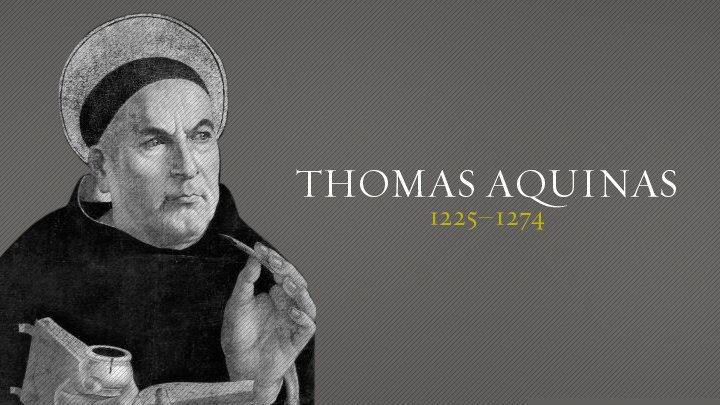
Saint Thomas Aquinas
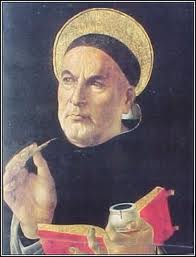
Perhaps the most famous of all the Dominican saints, today is the feast day of St. Thomas Aquinas.
Thomas was born in Roccasecca circa 28 January 1225, in the castle of his father, Count Landulf of Aquino, in Roccasecca, from which the great Benedictine abbey of Montecassino is not quite visible, midway between Rome and Naples, in what is now Sicily. Through his mother, Theodora, Countess of Theate, Thomas was related to the Hohenstaufen dynasty of Holy Roman emperors. His family was related to the Emperors Henry VI and Frederick II, and to the Kings of Aragon, Castile, and France. Calo relates that a holy hermit foretold his career, saying to Theodora before his birth: “He will enter the Order of Friars Preachers, and so great will be his learning and sanctity that in his day no one will be found to equal him.” Landulf’s brother, Sinibald, was abbot of the original Benedictine abbey at Monte Cassino. While the rest of the family’s sons pursued a military career, Thomas was intended to follow his uncle into the abbacy; this would have been a normal career path for the younger son of southern Italian nobility.
At the age of five, Thomas began his early education from the Benedictine monks at Monte Cassino. Diligent in study, he was thus early noted as being meditative and devoted to prayer, and his preceptor was surprised at hearing the child ask frequently: “What is God?”However, after a military conflict broke out between the Emperor Frederick II and Pope Gregory IX spilled into the abbey in early 1239, Landulf and Theodora had Thomas enrolled at the University of Naples, which had been recently established by Frederick.
At Naples his preceptors were Pietro Martini and Petrus Hibernus. The chronicler says that he soon surpassed Martini at grammar, and he was then given over to Peter of Ireland, who trained him in logic and the natural sciences. The customs of the times divided the liberal arts into two courses: the Trivium, embracing grammar, logic, and rhetoric; the Quadrivium, comprising music, mathematics, geometry, and astronomy. Thomas could repeat the lessons with more depth and lucidity than his masters displayed. The youth’s heart had remained pure amidst the corruption with which he was surrounded, and he resolved to embrace the religious life.
It was here that Thomas was introduced to the words of Aristotle, Averroes and Maimonides, all of which would later influence his theological philosophy. It was also during his studies in Naples that Thomas came under the influence of John of St. Julian, a Dominican preacher in Naples, who was part of the active effort by the Dominican order, which had only recently been established, to recruit devout followers.
At the age of nineteen, Thomas resolved to join the Dominican Order. Thomas’s decision to do so did not please his family, who had expected him to become a Benedictine monk. Some time between 1240 and August, 1243, he received the habit of the Order of St. Dominic, being attracted and directed by John of St. Julian, a noted preacher of the convent of Naples. The city wondered that such a noble young man should don the garb of poor friar. His mother, with mingled feelings of joy and sorrow, hastened to Naples to see her son.
In an attempt to prevent Theodora’s interference in Thomas’s choice, the Dominicans arranged for Thomas to be removed to Rome, and then to Paris. However, on the way to Rome, his brothers who were soldiers under the Emperor Frederick, following their mother’s instructions, seized him as he was drinking from a spring near the town of Aquapendente and took him back to his parents, who were then at the castle of Monte San Giovanni Campano. He was held for in the family homes at Monte San Giovanni and Roccasecca in an attempt to prevent him from assuming the Dominican habit, and to convince him to become a Benedictine. Political concerns prevented the Pope from ordering Thomas’s release, which extended his detention, during which he spent tutoring his sisters and communicating with members of the Dominican Order. Family members became desperate to dissuade Thomas, who remained determined to join the Dominicans. At one point, two of his brothers hired a prostitute to seduce him, but he drove her away, wielding a burning stick. According to legend, that night two angels appeared to him as he slept and strengthened his resolve to remain celibate.
The time spent in captivity was not lost. His mother relented somewhat, after the first burst of anger and grief; the Dominicans were allowed to provide him with new habits, and through the kind offices of his sister he procured some books — the Holy Scriptures, Aristotle’s Metaphysics, and the “Sentences” of Peter Lombard. After eighteen months or two years spent in prison, either because his mother saw that the hermit’s prophecy would eventually be fulfilled or because his brothers feared the threats of Innocent IV and Frederick II, he was set at liberty, being lowered in a basket into the arms of the Dominicans, who were delighted to find that during his captivity “he had made as much progress as if he had been in a studium generale.”
Thomas immediately pronounced his vows, and his superiors sent him to Rome. Innocent IV examined closely into his motives in joining the Friars Preachers, dismissed him with a blessing, and forbade any further interference with his vocation. In 1245, Thomas was sent to study at the University of Paris’s Faculty of Arts where he met Dominican scholar Albertus Magnus, then Chair of Theology at the College of St. James.
The theological program Thomas entered in Paris was a grueling one, with the master’s typically attained in the early thirties. Extensive and progressively more intensive study of the scriptures, Old and New Testament, and of the summary of Christian doctrine called the Sentences which was compiled by the twelfth century Bishop of Paris, Peter Lombard. These close textual studies were complemented by public disputations and the even more unruly quodlibetal questions. With the faculty modeled more or less on the guilds, Thomas served a long apprenticeship, established his competence in stages, and eventually after a public examination was named a master and then gave his inaugural lecture.
When Albertus was sent by his superiors to teach at the new studium generale at Cologne in 1248, Thomas followed him, declining Pope Innocent IV’s offer to appoint him as abbot of Monte Cassino as a Dominican. Albertus then appointed the reluctant Thomas magister studentium. In the schools Thomas’s humility and taciturnity were misinterpreted as signs of dullness, but when Albert had heard his brilliant defense of a difficult thesis, he exclaimed: “We call this young man a dumb ox, but his bellowing in doctrine will one day resound throughout the world.”
Thomas taught in Cologne as an apprentice professor, instructing students in the books of the Old Testament and writing Expositio super Isaiam ad litteram (Literal Commentary on Isaiah), Postilla super Ieremiam (Commentary on Jeremiah), and Postilla super Threnos (Commentary on Lamentations). Then in 1252, he returned to Paris to study for a master’s degree in theology. He lectured on the Bible as an apprentice professor, and upon becoming a baccalaureus Sententiarum (bachelor of the Sentences); he devoted his final three years of study to commenting on Peter Lombard’s Sentences. In the first of his four theological syntheses, Thomas composed a massive commentary on the Sentences entitled Scriptum super libros Sententiarium (Commentary on the Sentences). Aside from his master’s writings, he wrote De ente et essentia (On Being and Essence) for his fellow Dominicans in Paris.
In the spring of 1256, Thomas was appointed regent master in theology at Paris, and one of his first works upon assuming this office was Contra impugnantes Dei cultum et religionem (Against Those Who Assail the Worship of God and Religion), defending the mendicant orders which had come under attack by William of Saint-Amour. During his tenure from 1256 to 1259, Thomas wrote numerous works, including Questiones disputatae de veritate (Disputed Questions on Truth), which was a collection of twenty-nine disputed questions on aspects of faith and the human condition and which was prepared for the public university debates he presided over on Lent and Advent. He also wrote Quaestiones quodlibetales (Quodlibetal Questions), a collection of his responses to questions posed to him by the academic audience; and both Expositio super librum Boethii De trinitate (Commentary on Boethius’s De trinitate) and Expositio super librum Boethii De hebdomadibus (Commentary on Boethius’s De hebdomadibus), commentaries on the works of 6th century philosopher Anicius Manlius Severinus Boethius. By the end of his regency, Thomas was working on one of his most famous works, Summa contra Gentiles.
Around 1259, Thomas returned to Naples where he lived until he went to in Orvieto in September 1261. In Orvieto, he was appointed conventual lector, in charge of the education of friars unable to attend a studium generale. During his stay in Orvieto, Thomas completed his Summa contra Gentiles, and wrote the Catena Aurea (The Golden Chain). He also wrote the liturgy for the newly created feast of Corpus Christi and produced works for Pope Urban IV concerning Greek Orthodox theology, e.g. Contra errores graecorum (Against the Errors of the Greeks). In 1265 he was ordered by the Dominican Chapter of Agnani to establish a studium for the Order in Rome at the priory of Santa Sabina. He remained there from 1265 until he was called back to Paris in 1268. It was while in Rome that Thomas began his most famous work, Summa Theologica, and wrote a variety of other works, such as his unfinished Compendium Theologiae and Responsio ad fr. Ioannem Vercellensem de articulis 108 sumptis ex opere Petri de Tarentasia (Reply to Brother John of Vercelli Regarding 108 Articles Drawn from the Work of Peter of Tarentaise). In his position as head of the studium, he conducted a series of important disputations on the power of God, which he compiled into his De potentia.
In 1268 the Dominican Order assigned Thomas to be regent master at the University of Paris for a second time, a position he held until the spring of 1272. Part of the reason for this sudden reassignment appears to have arisen from the rise of “Averroism” or “radical Aristotelianism” in the universities. “Averroisms” was the belief that there is no God, that the soul has two parts, one individual and one eternal; the world is eternal; the soul is not eternal. (During this period in history, Averroism was virtually synonymous with atheism.) In response to these perceived evils, Thomas wrote two works, one of them being De unitate intellectus, contra Averroistas (On the Unity of Intellect, against the Averroists) in which he blasts Averroism as incompatible with Christian doctrine. During his second regency, he finished the second part of the Summa and wrote De virtutibus and De aeternitate mundi, the latter of which dealt with controversial Averroist and Aristotelian beginninglessness of the world. Disputes with some important Franciscans such as Bonaventure and John Peckham conspired to make his second regency much more difficult and troubled than the first. A year before Thomas re-assumed the regency at the 1266–67 Paris disputations, Franciscan master William of Baglione accused Thomas of encouraging Averroists, calling him the “blind leader of the blind”. Thomas called these individuals the murmurantes (Grumblers). In reality, Thomas was deeply disturbed by the spread of Averroism and was angered when he discovered Siger of Brabant teaching Averroistic interpretations of Aristotle to Parisian students. On 10 December 1270, the bishop of Paris, Etienne Tempier, issued an edict condemning thirteen Aristotlelian and Averroistic propositions as heretical and excommunicating anyone who continued to support them. Many in the ecclesiastical community, the so-called Augustinians, were fearful that this introduction of Aristotelianism and the more extreme Averroism might somehow contaminate the purity of the Christian faith. In what appears to be an attempt to counteract the growing fear of Aristotelian thought, Thomas conducted a series of disputations between 1270 and 1272: De virtutibus in communi (On Virtues in General), De virtutibus cardinalibus (On Cardinal Virtues), De spe (On Hope).
In 1272 Thomas took leave from the University of Paris when the Dominicans from his home province called upon him to establish a studium generale wherever he liked and staff it as he pleased. He chose to establish the institution in Naples, and moved there to take his post as regent master. He took his time in Naples to work on the third part of the Summa while giving lectures on various religious topics. On 6 December 1273 Thomas was celebrating the Mass of St. Nicholas when, according to some, he heard Christ speak to him.
Christ asked him what he desired, being pleased with his meritorious life. Thomas replied “Only you Lord. Only you.” After this exchange something happened, but Thomas never spoke of it or wrote it down. Because of what he saw, he abandoned his routine and refused to dictate to his secretary, Reginald of Piperno. When Reginald begged him to get back to work, Thomas replied: “Reginald, I cannot, because all that I have written seems like straw to me,” And he seemed to be seriously ill. What exactly triggered Thomas’s change in behavior is believed to be some kind of supernatural experience of God. After taking to his bed, he did, however, recover some strength.
Looking to find a way to reunite the Eastern Orthodox churches with the Catholic Church (the Eastern Orthodox were excommunicated by the Roman Catholic Church in A.D. 1054 over doctrinal disputes) Pope Gregory X convened the Second Council of Lyon to be held on 1 May 1274 and summoned Thomas to attend. At the meeting, Thomas’s work for Pope Urban IV concerning the Greeks, Contra errores graecorum, was to be presented. On his way to the Council, riding on a donkey along the Appian Way, he struck his head on the branch of a fallen tree and became seriously ill again. He was then quickly escorted to Monte Cassino to convalesce. After resting for a while, he set out again, but stopped at the Cistercian Fossanova Abbey after again falling ill. The Cistercian monks of Fossa Nuova pressed him to accept their hospitality, and he was conveyed to their monastery, on entering which he whispered to his companion: “This is my rest for ever and ever: here will I dwell, for I have chosen it” (Psalm 131:14). The monks nursed him for several days, and as he received his last rites, he prayed: “I receive Thee, ransom of my soul. For love of Thee have I studied and kept vigil, toiled, preached and taught…” He died on 7 March 1274.
When the devil’s advocate at his canonization process objected that there were no miracles, one of the cardinals answered, “Tot miraculis, quot articulis“—”there are as many miracles (in his life) as articles (in his Summa).” Fifty years after the death of Thomas, on 18 July 1323, Pope John XXII, seated in Avignon, pronounced Thomas a saint.
In a monastery at Naples, near the cathedral of St. Januarius, a cell in which he supposedly lived is still shown to visitors. His remains were placed in the Church of the Jacobins in Toulouse in 1369. Between 1789 and 1974, they were held in Basilique de Saint-Sernin, Toulouse. In 1974, they were returned to the Church of the Jacobins, where they have remained ever since.
In the General Roman Calendar of 1962, in the Roman Catholic Church, Thomas was commemorated on 7 March, the day of death. However, in the General Roman Calendar of 1969, even though the norm in the Roman Catholic Church is to remember saints on the day of their death, Thomas’s memorial was transferred to 28 January, the date of the translation of his relics to Toulouse.
Saint Thomas Aquinas is honored with a feast day on the liturgical of the Episcopal Church in the United States of America on 28 January.

Blessed Andrew of Peschiera
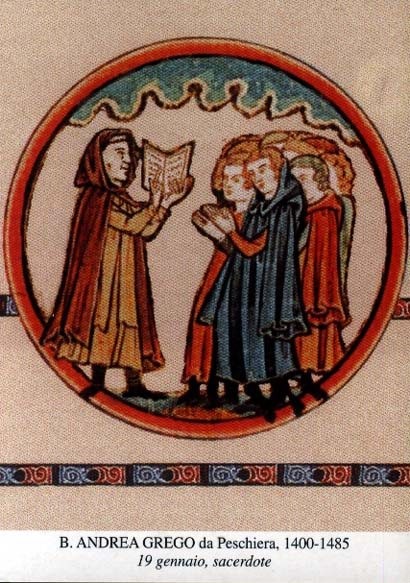
As a child, Andrew Grego lived on the southern shore of Lake Garda, in northern Italy. His training for a life of heroic sanctity began early, with voluntary penances and unquestioning obedience to his father. Andrew’s first desire was to be a hermit, an ambition that was met with ridicule from his brothers. Failing to realize this hope, he made for himself a severe schedule of prayer and penance, and, in his own house, lived the life of one wholly given to God.
After the death of his father, it became increasingly difficult to carry out his plan, so he resolved to enter the cloister. Although his brothers had persecuted him without mercy, he knelt and humbly begged their prayers and forgiveness for having annoyed them. Then he gave them the only possession he had, a walking-stick. This stick, thrown carelessly in a corner by the brothers, was forgotten until, long afterwards, it bloomed like the legendary rod of Saint Joseph in token of Andrew’s holiness.
The 15-year old received the Dominican habit at Brescia and then was sent to San Marco in Florence. This convent was then at its peak of glory, stamped with the saintly personalities of Saint Antoninus and the Blesseds of Lawrence of Riprafratta, Constantius, and Antony della Chiesa. Andrew’s soul caught the fire of their apostolic zeal, and set forth on his mission in the mountains of northern Italy.
Heresy and poverty had combined to draw almost this entire region from the Church. It was a country of great physical difficulties, and, in his travels in the Alps, he risked death from snowstorms and avalanches as often as from the daggers of the heretics. Nevertheless, he travelled tirelessly, preaching, teaching, and building–for his entire lifetime.
Churches, hospitals, schools, and orphanages were built under Andrew’s direction. He would retire from time to time to these convents for periods of prayer and spiritual refreshment, so that he could return with renewed courage and zeal to the difficult apostolate. He was known as “the Apostle of the Valtelline,” because of the district he evangelized.
Blessed Andrew performed many miracles. Probably his greatest miracle was his preaching, which produced such fruits in the face of great obstacles. At one time, when he was preaching to the people, the heretics presented him with a book in which they had written down their beliefs. He told them to open the book and see for themselves what their teachings amounted to. They did so, and a large viper emerged from the book.
Blessed Andrew closed a holy life by an equally holy death, and died in 1485. He was buried in Morbegno. He had labored so long among the poor and the neglected that his place in their hearts was secured. Because of the miracles worked at his tomb, and the persistent devotion of the people, his relics were twice transferred to more suitable tombs. He was beatified in 1820.
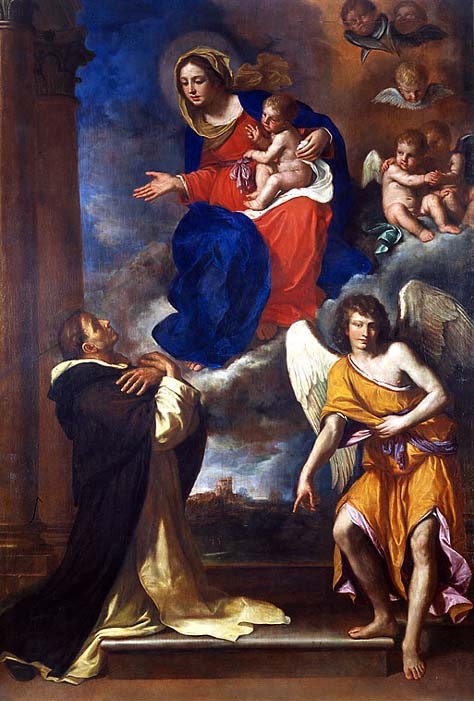
Blessed Marcolinus of Forli
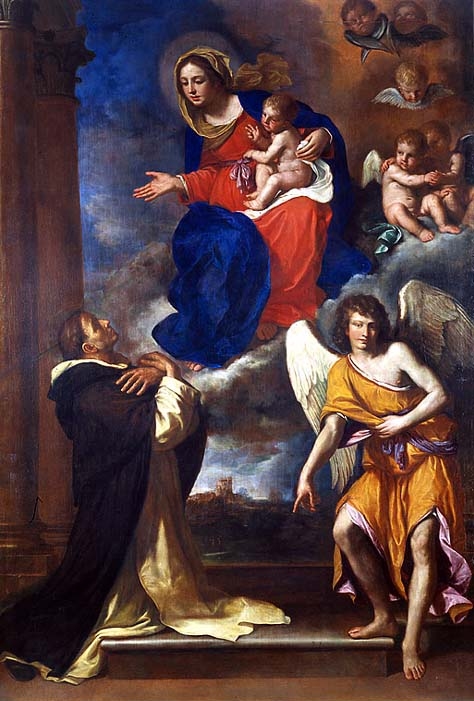
Born in at Forli, Italy in 1317, Marcolino Amanni entered the Dominicans at age 10. He occupies a place unique in Dominican annals because he was almost purely contemplative . There is outwardly little to record of Blessed Marcolino, except that for 70 years he kept the Dominican Rule in all its rigor. That is a claim to sanctity that can be made by very few, and is of itself enough to entitle him to canonization. He did accomplish the reform of several convents that had fallen from their primitive fervor, but this he did by his prayers and his example rather than by teaching or preaching.
It is said that Marcolino was most at home with the lay brothers, or with the neighborhood children who enjoyed talking to him. He seldom went out of his cell, and could not have engaged in any active works; neither did he leave any writings. His work was the unseen labor presided over by the Holy Spirit, the work of contemplation. “To give to others the fruits of contemplation,” is the Dominican motto and one might be curious to know how Blessed Marcolino accomplished this. In order to understand the need for just such a type of holiness, it is well to remember the state of the Church in the 14th century. Devastated by plague and schism, divided and held up to scorn, preyed upon by all manner of evils, the Church militant was in need, not only of brave and intelligent action, but also of prayer. Consistently through the centuries, God has raised up such saints as could best avert the disasters that threatened the world in their day, and Marcolino was one answer to the need for mystics who would plead ceaselessly for the Church.
The interior life of Marcolino was not recorded by himself or by others. He lived the mystical life with such intensity that he was nearly always in ecstasy and unconscious of the things around him. One of his brothers recorded that he seemed “a stranger on earth, concerned only with the things of heaven.” Most of his brethren thought him merely sleepy and inattentive, but actually he was, for long periods, lost in converse with God. Some had heard him talking earnestly to the statue of Our Lady in his cell; some fortunate few had heard Our Lady replying to his questions, with the same simplicity.
At the death of Marcolino, on 2 January, 1397, a beautiful child appeared in the streets, crying out the news to the little town that the saintly friar was dead. As the child disappeared when the message was delivered, he was thought to have been an angel. Many miracles were worked at the tomb of Marcolino. One was the miraculous cure of a woman who had been bedridden for 30 years. Hearing of the death of the blessed, she begged him to cure her so that she could visit his tomb.
He was confirmed as a saint in 1750 by Pope Benedict XIV.
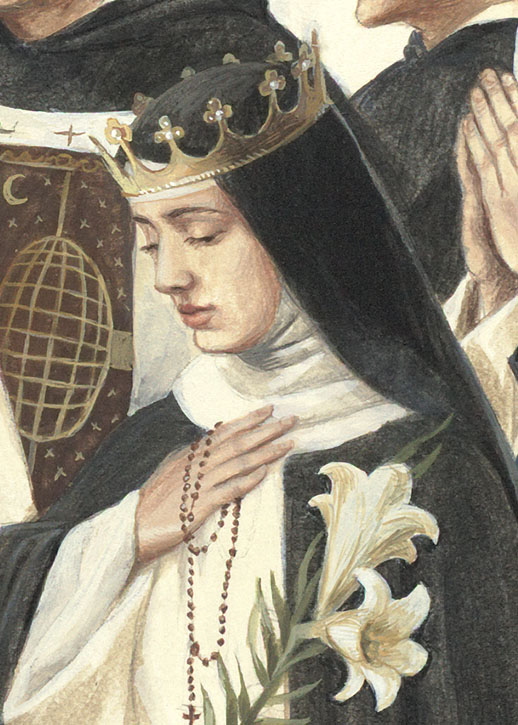
Saint Margaret of Hungary
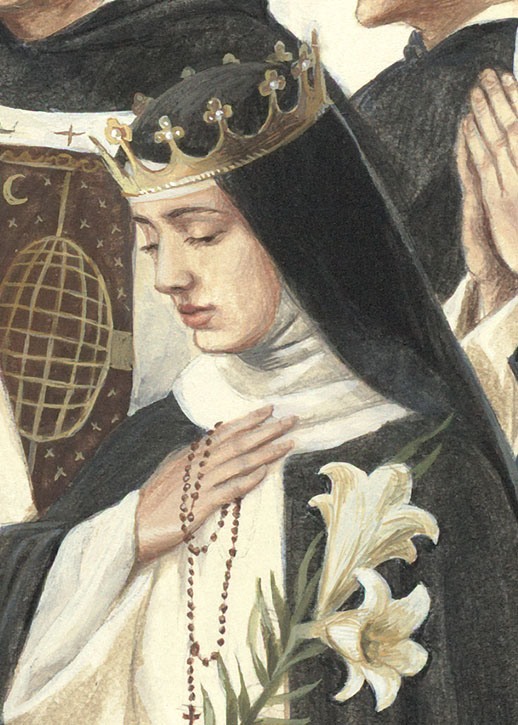
Margaret, the daughter of King Bela IV, and Queen Mary Lascaris of Hungary, was offered to God before her birth, in petition that the country would be delivered from the terrible scourge of the Tartars. The prayer having been answered in 1242, the king and queen made good their promise by placing the rich and beautiful three-year-old in the Dominican convent at Vesprim. Here, in company with other children of nobility, she was trained in the arts thought fitting for royalty.
Margaret was not content with simply living in the house of God; she demanded the religious habit–and received it–at the age of four. Furthermore, she took upon herself the austerities practiced by the other sisters–fasting, hairshirts, the discipline (scourge), and night vigils. She soon learned the Divine Office by heart and chanted it happily to herself as she went about her play. She chose the least attractive duties of the nuns for herself. She would starve herself to keep her spirit humble. No one but Margaret seemed to take seriously the idea that she would one day make profession and remain as a sister, for it would be of great advantage to her father if she were to make a wise marriage.
This question arose seriously when Margaret was 12. She responded in surprise. She said that she had been dedicated to God, even before her birth, and that she intended to remain faithful to that promise. Some years later her father built for her a convent on the island in the Danube between Buda and Pest. To settle the matter of her vocation, here she pronounced her vows to the master general of the order, Blessed Humbert of the Romans, in 1255, and took the veil in 1261.
Again, when Margaret was 18, her father made an attempt to sway her from her purpose, because King Ottokar of Bohemia, hearing of her beauty, had come seeking her hand. He even obtained a dispensation from the pope and approached Margaret with the permission. Margaret replied as she had previously, “I esteem infinitely more the King of Heaven and the inconceivable happiness of possessing Jesus Christ than the crown offered me by the King of Bohemia.” Having established that she was not interested in any throne but a heavenly one, she proceeded with great joy to live an even more fervent religious life than she had before.
Margaret’s royal parentage was, of course, a matter of discussion in the convent. But the princess managed to turn such conversation away from herself to the holy lives of the saints who were related to her by blood–King Saint Stephen, Saint Hedwig, Saint Elizabeth of Hungary, and several others. She did not glory in her wealth or parentage, but strove to imitate the saints in their holiness. She took her turn in the kitchen and laundry, seeking by choice much heavy work that her rank might have excused her from doing. She was especially welcome in the infirmary, which proves that she was not a sad-faced saint, and she made it her special duty to care for those who were too disagreeable for anyone else to tend.
Margaret’s austerities seem excessive to us of a weaker age. The mysteries of the Passion were very real to her and gave reason for her long fasts, severe scourgings, and other mortifications detailed in the depositions of witnesses taken seven years after her death (of which records are still in existence). Throughout Lent she scarcely ate or slept. She not only imitated the poverty- stricken in their manual labor and hunger, but also in their lack of cleanliness–a form of penance at that time. Some of her acts of self-immolation have been described as “horrifying” and verging on fanaticism, and there seems to have been an element of willfulness in her mortifications.
She had a tender devotion to Our Lady, and on the eve of her feasts, Margaret said a thousand Hail Marys. Unable to make the long pilgrimage to the Holy Land, to Rome, or to any of the other famous shrines of Christendom, the saint developed a plan by which she could go in spirit: she counted the miles that lay between herself and the desired shrine, and then said an Ave Maria for every mile there and back. On Good Friday she was so overcome at the thoughts of Our Lord’s Passion that she wept all day. She was frequently in ecstasy, and very embarrassed if anyone found her so and remarked on her holiness.
A number of miracles were performed during Margaret’s lifetime and many more after her death because Margaret had an implicit faith in the power and efficacy of prayer. The princess nun was only 28 when she died. Most of the particulars of her life are recorded in existing depositions of witnesses taken in 1277. Her friends and acquaintances petitioned for her to be acclaimed a saint almost immediately after her death. Among them was her own servant, Agnes, who rightly observed that this daughter of a monarch showed far more humility than any of the monastery’s maids. Although their testimony expressed Margaret’s overpowering desire to allow nothing to stand between her and God, the process of canonization was not complete until 1943. The island where her convent stood, called first the “Blessed Virgin’s Isle,” was called “Isle of Margaret” after the saint. She died 18 January 1271 at Budapest, Hungary. Her remains were given to the Poor Clares at Pozsony when the Dominican Order was dissolved, and most of her relics were destroyed in 1789, but portions are still preserved at Gran, Gyor, Pannonhalma.
She was beatified on 28 July 1789 by Pope Pius XII.
Blessed Gonsalvo, OP
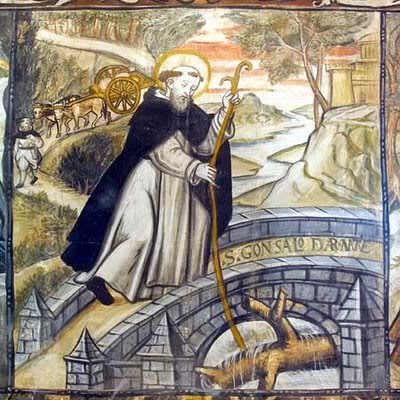
Born in 1187 at Vizella, in the diocese of Braga, Portugal, Gonsalvo de Amarante was a true son of the Middle Ages. In his boyhood Gonsalvo Pereira gave indications of his holiness. While still small, he was consecrated to study for the Church, and received his training in the household of the archbishop of Braga. After his ordination he was given charge of a wealthy parish.
There was no complaint with Gonsalvo’s governance of the parish of Saint Pelagius. He was penitential himself, but indulgent with everyone else. Revenues that he might have used for himself were used for the poor and the sick. The parish, in fact, was doing very well when he turned it over to his nephew, whom he had carefully trained as a priest, before making a pilgrimage to the Holy Land.
Gonsalvo would have remained his entire life in the Holy Land, but after 14 years his archbishop commanded him to return to Portugal. Upon his arrival, he was horrified to see that his nephew had not been the good shepherd that he had promised to be, the money left for the poor had gone to purchase a fine stable of thoroughbred horses and a pack of fine hounds. The nephew had told everyone that his old uncle was dead, and he had been appointed pastor in his place by an unsuspecting archbishop. When the uncle appeared on the scene, ragged and old, but very much alive, the nephew was not happy to see him. Gonsalvo seems to have been surprised as well as pained.
The ungrateful nephew settled the matter by turning the dogs on his inconvenient uncle. They would have torn him to pieces, but the servants called them off and allowed the ragged pilgrim to escape. Gonsalvo decided then that he had withstood enough parish life, and went out into the hills to a place called Amarante. Here he found a cave and other necessities for an eremitical life and lived in peace for several years, spending his time building a little chapel to the Blessed Virgin. He preached to those who came to him, and soon there was a steady stream of pilgrims seeking out his retreat.
Happy as he was, Golsalvo felt that this was not his sole mission in life, and he prayed for help to discern his real vocation. It is said that the Virgin Mary appeared to him one night as he prayed and told him to enter the order that had the custom of beginning the office with “Ave Maria gratia plena.” She told him that this order was very dear to her and under her special protection. Gonsalvo set out to learn what order she meant, and eventually came to the convent of the Dominicans. Here was the end of the quest, and he asked for the habit.
Blessed Peter Gonzales was the prior, and he gave the habit to the new aspirant. After Gonsalvo had gone through his novitiate, he was sent back to Amarante, with a companion, to begin a regular house of the order. The people of the neighborhood quickly spread the news that the hermit was back. They flocked to hear him preach, and begged him to heal their sick.
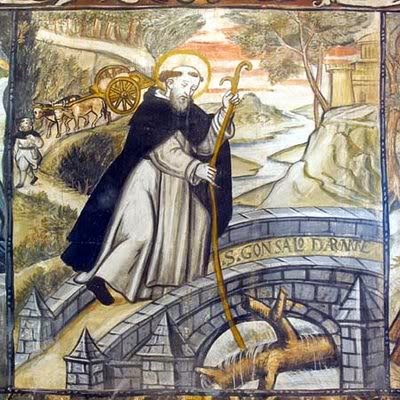
One of the miracles of Blessed Gonsalvo concerns the building of a bridge across a swift river that barred many people from reaching the hermitage in wintertime. It was not a good place to build a bridge, but Gonsalvo set about it and followed the heavenly directions he had received. Once, during the building of the bridge, he went out collecting, and a man who wanted to brush him off painlessly sent him away with a note for his wife.
Gonsalvo took the note to the man’s wife, and she laughed when she read it. “Give him as much gold as will balance with the note I send you,” said the message. Gonsalvo told her he thought she ought to obey her husband, so she got out the scales and put the paper in one balance. Then she put a tiny coin in the other balance, and another, and another–the paper still outweighed her gold–and she kept adding. There was a sizeable pile of coins before the balance with the paper in it swung upwards.
Gonsalvo died 10 January 1259, after prophesying the day of his death and promising his friends that he would still be able to help them after death. Pilgrimages began soon, and a series of miracles indicated that something should be done about his beatification. Forty years after his death he appeared to several people who were apprehensively watching a flood on the river. The water had arisen to a dangerous level, just below the bridge, when they saw a tree floating towards the bridge, and Gonsalvo was balancing capably on its rolling balk. The friar carefully guided the tree under the bridge, preserving the bridge from damage, and then disappeared. He was beatified by Pius IV in 1560.
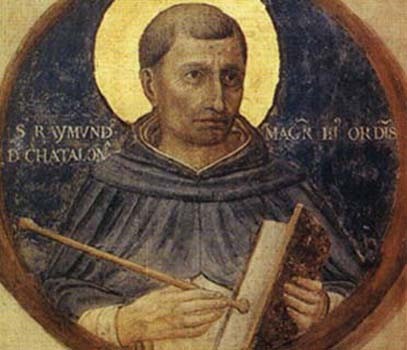
Saint Raymund of Pennafort

From the bull of his canonization, by Clement VIII in 1601, and his life, written by several Spanish, Italian and French authors. See Fleury, b. 78, n. 55, 64, and chiefly Touron Hommes Illustres de l’Ordre de S. Domin. t. 1, p. I
The house of Pegnafort, or, as it is pronounced, Pennafort, was descended from the counts of Barcelona, and nearly allied to the kings of Aragon. Raymund was born in 1175, at Pennafort, a castle in Catalonia, which in the fifteenth century was changed into a convent of the order of St. Dominick. Such was his rapid progress in his studies, that at the age of twenty he taught philosophy at Barcelona, which he did gratis, and with so great reputation, that he began then to be consulted by the ablest masters. His principal care was to instil into his scholars the most perfect maxims of a solid piety and devotion, to compose all differences among the citizens, and to relieve the distressed. He was about thirty years of age when he went to Bologna, in Italy, to perfect himself in the study of the canon and civil law, commenced Doctor in that faculty, and taught with the same disinterestedness and charity as he had done in his own country. In 1219 Berengarius, bishop of Barcelona, who had been at Rome, took Raymund home with him, to the great regret of the university and senate of Bologna; and, not content with giving him a canonry in his church, made him his archdeacon, grand vicar, and official. He was a perfect model to the clergy, by his innocence, zeal, devotion, and boundless liberalities to the poor, whom he called his creditors. In 1222 he took the religious habit of St. Dominick at Barcelona, eight months after the death of the holy founder, and in the forty-seventh year of his age. No person was ever seen among the young novices more humble, more obedient, or more fervent. To imitate the obedience of a Man-God, who reduced himself to a state of subjection to his own creatures, to teach us the dangers and deep wound of self-will, and to point out to us the remedy, the saint would depend absolutely on the lights of his director in all things. And it was upon the most perfect self-denial that he laid the foundation of that high sanctity which he made the object of his most earnest desires. The grace of prayer perfected the work which mortification had begun. In a spirit of compunction he begged of his superiors that they would enjoin him some severe penance, to expiate the vain satisfaction and complacency which he said he had sometimes taken in teaching. They indeed imposed on him a penance, but not such a one as he expected. It was to write a collection of cases of conscience for the instruction and conveniency of confessors and moralists. This produced his Sum the first work of that kind. Had his method and decisions been better followed by some later authors of the like works, the holy maxims of Christian morality had been treated with more respect by some moderns than they have been, to our grief and confusion.
Raymund joined to the exercises of his solitude the functions of an apostolic life, by laboring without intermission in preaching, instructing, hearing confessions with wonderful fruit, and converting heretics, Jews, and Moors Among his penitents were James, king of Aragon, and St. Peter Nolasco, with whom he concerted the foundation of the Order of the B. Virgin of mercy for the redemption of captives. James, the young king of Aragon had married Eleonora of Castile within the prohibited degrees, without a dispensation. A legate was sent by Pope Gregory IX. to examine and judge the case. In a council of bishops of the two kingdoms, held at Tar rayon, he declared the marriage null, but that their son Don Alphonso should be reputed lawfully born, and heir to his father’s crown. The king had taken his confessor with him to the council, and the cardinal legate was so charmed with his talents and virtue, that he associated him in his legation and gave him a commission to preach the holy war against the Moors. The servant of God acquitted himself of that function with so much prudence, zeal, and charity, that he sowed the seeds of the total overthrow of those infidels in Spain. His labors were no less successful in the reformation of the manners of the Christians detained in servitude under the Moors which were extremely corrupted by their long slavery or commerce with these infidels. Raymund showed them, by words full of heavenly unction and fire, that, to triumph over their bodily, they must first conquer their spiritual enemies, and subdue sin in themselves, which made God their enemy. Inculcating these and the like spiritual lessons, he ran over Catalonia, Aragon, Castile, and other countries. So general a change was wrought hereby in the manners of the people, as seemed incredible to all but those who were witnesses of it. By their conversion the anger of God was appeased, and the arms of the faithful became terrible to their enemies. The kings of Castile and Leon freed many places from the Moorish yoke. Don James, king of Aragon, drove them out of the islands of Majorca and Minorca, and soon after, in 1237, out of the whole kingdom of Valentia. Pope Gregory IX. having called St. Raymund to Rome in 1230, nominated him his chaplain, (which was the title of the Auditor of the causes of the apostolic palace,) as also grand penitentiary. He made him likewise his own confessarius, and in difficult affairs came to no decision but by his advice. The saint still reserved himself for the poor, and was so solicitous for them that his Holiness called him their father. He enjoined the pope, for a penance, to receive, hear, and expedite immediately all petitions presented by them. The pope, who was well versed in the canon law, ordered the saint to gather into one body all the scattered decree of popes and councils, since the collection made by Gratian in 1150. Raymund compiled this work in three years, in five books, commonly called the Decretals, which the same pope Gregory confirmed in 1234. It is looked upon as the best finished part of the body of the canon law; on which account the canonists have usually chosen it for the texts of their comments. In 1235, the pope named St. Raymund to the archbishopric of Tarragon, the capital of Aragon: the humble religious man was not able to avert the storm, as he called it, by tears and entreaties; but at length fell sick through anxiety and fear. To restore him to his health, his Holiness was obliged to consent to excuse him, but required that he should recommend a proper person. The saint named a pious and learned canon of Gironne. He refused other dignities with the like constancy.
For the recovery of his health he returned to his native country, and was received with as much joy as if the safety of the whole kingdom. and of every particular person, had depended on his presence. Being restored again to his dear solitude at Barcelona, he continued his former exercises of contemplation, preaching, and administering the sacrament of penance. Except on Sundays, he never took more than one very small refection in the day. Amidst honors and applause he was ever little in his own eyes: he appeared in the schools like a scholar, and in his convent begged the superior to instruct him in the rules of religious perfection, with the humility and docility of a novice. Whether he sung the divine praises with his brethren, or prayed alone in his cell, or some corner of the church, ho poured forth an abundance of tears; and often was not able to contain within himself the ardor of his soul. His mildness and sweetness were unalterable. The incredible number of conversions of which he was the instrument, is known only to Him who, by his grace, was the author of them. He was employed frequently in most important commissions, both by the holy see and by the king. But he was thunderstruck by the arrival of four deputies from the general chapter of his order at Bologna, in 1238, with the news that he was chosen third general, Jordan of Saxony being lately dead. He wept and entreated, but at length acquiesced in obedience. He made the visitation of his order on foot, without discontinuing any of his penitential austerities, or rather exercises. He instilled into his spiritual children a love of regularity, solitude, mortification, prayer, sacred studies, and the apostolic functions, especially preaching. He reduced the constitutions of his order into a clearer method, with notes on the doubtful passages. This his code of rules was approved in three general chapters. In one held at Paris in 1239, he procured the establishment of this regulation, that a voluntary demission of a superior, founded upon just reasons, should be accepted. This he contrived in his own favor; for, to the extreme regret of the order, he in the year following resigned the generalship, which he had held only two years. He alleged for his reason his age of sixty-five years. Rejoicing to see himself again a private religious man, he applied himself with fresh vigor to the exercises and functions of an apostolic life, especially the conversion of the Saracens. Having this end in view he engaged St. Thomas to write his work ‘Against the Gentiles;’ procured the Arabic and Hebrew tongues to be taught in several convents of his order; and erected convents, one at Tunis, and another at Murcia, among the Moors. In 1256, he wrote to his general that ten thousand Saracens had received baptism. King James took him into the island of Majorca. The saint embraced that opportunity of cultivating that infant church. This prince was an accomplished soldier and statesman, and a sincere lover of religion, but his great qualities were sullied by a base passion for women. He received the admonitions of the saint with respect, and promised amendment of life, and a faithful compliance with the saint’s injunctions in every particular; but without effect. St. Raymund, upon discovering that he entertained a lady at his court with whom he was suspected to have criminal conversation, made the strongest instances to have her dismissed, which the king promised should be done, but postponed the execution. The saint, dissatisfied with the delay, begged leave to retire to his convent at Barcelona. The king not only refused him leave, but threatened to punish with death any person that should undertake to convey him out of the island. The saint, full of confidence in God, said to his companion, “A king of the earth endeavors to deprive us of the means of retiring; but the King of heaven will supply them.” He then walked boldly to the waters, spread his cloak upon them, tied up one corner of it to a staff for a sail, and having made the sign of the cross, stepped upon it without fear, while his timorous companion stood trembling and wondering on the shore. On this new kind of vessel the saint was wafted with such rapidity, that in six hours he reached the harbor of Barcelona, sixty leagues distant from Majorca. Those who saw him arrive in this manner met him with acclamations. But he, gathering up his cloak dry, put it on, stole through the crowd, and entered his monastery. A chapel and a tower, built on the place where he landed, have transmitted the memory of this miracle to posterity. This relation is taken from the bull of his canonization, and the earliest historians of his life. The king became a sincere convert, and governed his conscience, and even his kingdoms, by the advice of St. Raymund from that time till the death of the saint. The holy man prepared himself for his passage to eternity, by employing days and nights in penance and prayer. During his last illness, Alphonsus, king of Castile, with his queen, sons, and brother; and James, king of Aragon, with his court, visited him, and received his last benediction. He armed himself with the last sacraments; and, in languishing sighs of divine love, gave up his soul to God, on the 6th of January, in the year 1275, and the hundredth of his age. The two kings, with all the princes and princesses of their royal families, honored his funeral with their presence: but his tomb was rendered far more illustrious by miracles. Several are recorded in the bull of his canonization, published by Clement VIII. in 1601. Bollandus has filled fifteen pages in folio with an account of them. His office is fixed by Clement X. to the 23d of January.
The saints first learned in solitude to die to the world and themselves, to put on the spirit of Christ, and ground themselves in a habit of recollection and a relish only for heavenly things, before they entered upon the exterior functions even of a spiritual ministry. Amidst these weighty employments, not content with reserving always the time and means of frequent retirement for conversing with God and themselves, in their exterior functions by raising their minds to heaven with holy sighs and desires, they made all their actions in some measure an uninterrupted prayer and exercise of divine love and praise. St. Bonaventure reckons it among the general exercises of every religious or spiritual men, “that he keep his mind always raised, at least virtually, to God: hence, whensoever a servant of God has been distracted from attending to him for ever so short a space, he grieves and is afflicted, as if he was fallen into some misfortune, by having been deprived of the presence of such a friend who never forgets us. Seeing that our supreme felicity and glory consists in the eternal vision of God, the constant remembrance of him is a kind of imitation of that happy state: this the reward, that the virtue which entitles us to it. Till we are admitted to his presence, let us in our exile always bear him in mind: every one will behold him in heaven with so much the greater joy, and so much the more perfectly, as he shall more assiduously and more devoutly have remembered him on earth. Nor is it only in our repose, but also in the midst of our employments, that we ought to have him present to our minds, in imitation of the holy angels, who, when they are sent to attend on us, so acquit themselves of the functions of this exterior ministry as never to be drawn from their interior attention to God. As much as the heavens exceed the earth, so much larger is the field of spiritual meditation than that of all terrestrial concerns.”
(Taken from Vol. I of “The Lives or the Fathers, Martyrs and Other Principal Saints” by the Rev. Alban Butler, the 1864 edition published by D. & J. Sadlier, & Company)
Blessed Francis of Capillas, O.P.

The 17th century was a period of great missionary activity. Many martyrs shed their blood on distant shores. Dominicans and Jesuits contributed a great share to the blood of martyrs. Among this glorious company, the Dominican Francis de Capillas has become the type and exemplar of them.
Francis was born in 1608 in Old Castile, Spain. Nothing is known of his childhood. He entered the Dominicans at Valladolid at age 17. The Spain of his youth was still ringing with the missionary zeal of Saints Louis Bertrand, Philip de las Casas, and Francis Xavier; the report of the martyrdom of Alphonsus Navarette (June 1), in Japan, was news at the time. Perhaps the bravery of these men helped to fire the young Francis with apostolic longing, for he volunteered for the Philippine mission while he was a deacon. In 1631 at the age of 23, he left Spain and was ordained in Manila. Here, at the gateway to the Orient, the Dominicans had founded a university in 1611, and the city teemed with missionaries traveling throughout the Orient.
The young priest labored for 10 years in the province of Cagayan, the Philippines, where heat, insects, disease, and paganism made life very hard. But it was not hard enough for Francis. He begged for a mission field that was really difficult; perhaps, like many of the eager young apostles of that time, he was hoping for an assignment in Japan, where the great persecution was raging. He was sent to Fukien, China, where he worked uneventfully for some years. Then a Tartar invasion put his life in jeopardy. He was captured by a band of Tartars and imprisoned as a spy.
Francis was subjected to a mock trial. Civil, military, and religious officials questioned him, and they accused him of everything from political intrigue to witchcraft. He was charged with disregarding ancestor worship, and, finally, since they could “find no cause in him,” he was turned over to the torturers.
He endured the cruel treatment of these men with great courage. Seeing his calmness, the magistrates became curious about his doctrines. They offered him wealth, power, and freedom, if he would renounce his faith, but he amazed and annoyed them by choosing to suffer instead. They varied the tortures with imprisonment, and he profitably used the time to convert his jailor and fellow prisoners. Even the mandarin visited him in prison, asking Francis if he would renounce his faith or would he prefer to suffer more. Being told that he was glad to suffer for Christ, the mandarin furiously ordered that he be scourged again “so he would have even more to be glad about.”
Francis was finally condemned, and was beheaded on 15 January 1640. He was beatified on 2 May 1919 by Pope Pius X.
 The Order of Preachers, Independent
You must be logged in to post a comment.