
Category: Dominican Saints
Different, But Parallel: The Feast of Sts Peter and Paul~The Very Rev Lady Sherwood, OPI

Today we both as a church and as Christian brothers and sisters, come together to commemorate The Apostles Sts Peter and Paul.
Many, when thinking about the early church, mistakenly believe that in the historical times of Peter and Paul, that the church was only filled with love, respect and agreement; but in fact, it was Parallel in many ways to the experiences we have within our own churches even today. It wasn’t all loving Christian actions, there was also turmoil, dissension, and disagreements. In the times of Peter and Paul, it was even more difficult than we have it today to iron these things out, and to come to an agreement that it is for us today, as we have two thousand years of experience to assist us to deal with issues within the church. In the time of Peter and Paul they didn’t have history to draw upon to assist them.
Let us look at Peter and Paul. Both Peter and Paul were very gifted church leaders, however both came from entirely different backgrounds. They each had different educational backgrounds and distinct personalities. Due to this, some of the churches, mostly in Corinth, were divided into rival parties depending on whether they preferred Peter or Paul.
What made them so different from each other, these two great church leaders and Apostles?
Peter was a person who had much less education than Paul. He was a fisherman by trade and was married with a family. Peter had the blessed privilege of having both known and worked alongside Jesus during his earthly ministry. Peter was a simple man, who our Lord Jesus chose to lead the other Apostles, but he was also a rather impulsive by nature and would often speak and act without thinking first.
Peter was passionately sincere in his love of our Lord, but seemed to find it difficult to put things into writing and this can be seen if you compare his letters with those of Paul.
Paul, by contrast, was a graduate of the universities of that day. He had been tutored by Gamaliel, who was a famous leader of a school of Rabbis. Largely due to this, Paul knew the scriptures inside-out and was a person who lived strictly by Jewish law. He was fluent in Greek, and knew enough Latin to get by. Paul had spent his early years persecuting Christians, so because of his experience, he was able to see things both from the Jewish and the Christian perspectives.
Because of their differences, Peter and Paul didn’t always get along of agree with each other and we know from Paul’s letter to the Galatians that the two had a major row in Antioch about the question of whether Jews who had converted to Christianity could eat separately from their Gentile brethren.
Paul was firmly in favour of the principle that both Jews and Gentiles should eat together, because he saw that unless this happened, it would lead to two separate Eucharists, one for the Jews and a separate one for the Gentiles in each church and that from there it would only be a short step to rebuilding the division which Our Lord Jesus, through his cross and resurrection had broken down.
Peter, however, felt differently. He felt sorry for the Jewish Christians because they were expected to leave behind the habits they had done all their lives upon becoming Christian. So, he agreed to eat with the Jews separately and even persuaded Paul’s friend, Barnabas to join him.
So although both Peter and Paul had the best of intentions, they both came to see each other as one who was letting the side down.
However, years later, both Peter and Paul were able to make up their differences.
Even in our churches today we see similar issues. We have the people like St Peter, who are kind and generous, and who want the church to be a welcoming place where everyone gets on happily together, but in doing so, are a bit too lenient and cause the message of Christ’s salvation to be blurred.
Then we have people like St Paul, who realise that if the truth which is in Jesus is allowed to be obscured or rejected in the cause of kindness, generosity and inclusion, that the church could end up more like a club of kind people and less like the living Body of Christ on earth, losing the message of salvation.
From their disagreement, we can see that, regardless of our personal beliefs, there are specific truths to which we must cling in order to fully serve the Lord. As our Lord prayed, so do we: That we all may be one, as Christ and the Father are One.
Both Peter and Paul were put to death in a great persecution that had broken out in Rome under the Emperor Nero, following a great fire in AD 64, which Nero probably started and blamed upon the Christians.
We know that before this, Peter had wrote his second letter and had come to realise the importance of Paul, just as Paul had also realised the importance of Peter.
Grant, we pray, O Lord our God, that we may be sustained by the intercession of the blessed Apostles Peter and Paul, that, as through them you gave your Church the foundations of her heavenly office, so through them you may help her to eternal salvation. Through our Lord Jesus Christ, your Son, who lives and reigns with you in the unity of the Holy Spirit, one God, for ever and ever. Amen
The Feast of The Nativity of St John the Baptist~The Very Rev Lady Sherwood,OPI

Today, we as come together as the church to commemorate the Nativity of St John the Baptist, who is often referred to as the ‘Forerunner’.
John was the son of Zechariah and Elizabeth. In the Gospel of Luke, we are informed that Zechariah was told beforehand about the birth, and that he was to be named John. The meaning of the name John is “God is Gracious” (LK 1 :8=2:3).
John whilst still forming within his mother’s womb, instantly recognised the presence of Our Lord Jesus, who was also still in his mother’s womb, when Mary went to visit her cousin Elizabeth (LK 1 :41). John lept for joy in Elizabeth’s womb as soon as Mary and Elizabeth met, and this is when John was cleansed of original sin. This came to pass just as the Angel Gabriel had previously promised Zechariah in LK 1 :15.When John was older, he left the home of his parents and went to live in the desert. He wore only a garment made of camel skin and only had Locusts and wild honey to eat. John would preach in the desert (MK 1:6; Matt 3:4).
John went about preaching and proclaiming about the Kingdom of God and of a time of coming judgement. He invited those who wanted to repent, to accept him to baptise them as a sign of their repentance.
John, just like the prophets, disturbed the comfortable and gave much comfort to the disturbed. The message of John spread far and wide. The Gospel of Mark tells us that all peoples of both Jerusalem and Judea travelled to him and confessed their sins as John baptised them in the river Jordan (MK 1:5).
John clearly shows his humility because he never wanted attention for himself, he always directed people to Jesus. Some wondered if John was the Messiah, but John reassured them that indeed he wasn’t and he declared that his ministry was merely for to prepare for the coming of the Messiah. John said, “I have baptised you with water, but He will baptise you with the Holy Spirit.” (MK 1:8)
Then Jesus himself came to John to be baptised and John immediately recognised Jesus as the Messiah and he declared, “This is the Lamb of God who takes away the sins of the world”. (JN 1 :29). This statement from John is still used in Mass prayer today, when the Priest holds up the sacred Host as we prepare for the Holy Eucharist, as the Priest says, “This is the Lamb of God who takes away the sins of the world…”.
It was after being baptised by John, that our Lord Jesus began his Earthly ministry. When John had been baptised by John, John again showed his humility as again, he turned his attention to Jesus, declaring, “He must increase, I must decrease”(JN 3:30).
St John the Baptist is an excellent example that we as Christians should take much notice of within our lives of faith. Just as John always showed his humility by turning his attention away from himself and towards our Lord Jesus, we too, also need to show this same humility if we are truly to serve and follow the Lord. We also, must turn attention away from ourselves and towards Jesus. Just as John himself declared, “He must increase, I must decrease”.
Let us pray:
O glorious St John the Baptist, greatest prophet among those born of woman, although you were sanctified in your mother’s womb and lived a most innocent life, nevertheless, it was your will to live in the wilderness of the desert, there to devote yourself to the practice of austerity, penance and humility;
Obtain for us by your intercession, the grace of the Lord to be wholly detached within our hearts, from earthly goods and self attention. Increasing our humility and service, by making ourselves far lesser and in the never ending increasing, to be ever greater within our hearts and lives.
Amen.
The Feast of St Barnabas, the Son of Encouragement~The Very Rev Lady Sherwood, OPI
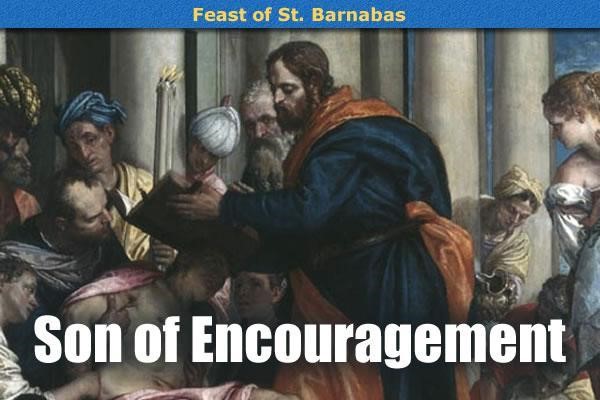
The Book of Acts tells the story of a man called Barnabas, which translates to, “son of Encouragement. We come together as the church today to commemorate his Feast day.” Barnabas’ gift of encouragement shows us five ways in we can encourage others in the world today.
Firstly, Barnabas encouraged others by practicing stewardship.
In Acts 4:36, We read that Barnabas sold his property and then he gave all the profits from that sale to the Church. He decided to meet the needs of others with the resources which God had blessed him, no matter what the personal cost was to himself. Encouragers like Barnabas understand that each and every person has something they are able to give. Encouragers find needy people and enrich them, whether it’s by their money, by giving of their time, or by their service.
Secondly, Barnabas encouraged others by extending the hand of friendship.
After the Apostle Paul’s conversion, Barnabas was despised by his old colleagues, and was feared by his new brothers and sisters in Christ. He was a man who needed a friend; Barnabas found him and became a friend to this very lonely new disciple. A lot of new Christians need somebody to find and to befriend them. We must seek out the lonely and the neglected and the vulnerable, put our outstretched arms around them, and bring them into the Lord’s fold.
Thirdly, Barnabas encouraged others by building partnerships with others.
In Acts 11, the Gospel was spreading quickly, and new believers were sprouting up everywhere. There were some concerns that some of them were not truly sincere. But Barnabas’s encouragement validated and affirmed those who were misunderstood by others.
Fourthly, Barnabas encouraged others by developing leaders within the Lord’s church.
He found the hidden gifts and talents within the new followers of the Lord and he helped them to develop these gifts and talents. Our churches are full of very talented people with abilities vast array of blessed abilities which are waiting to be discovered and to be developed. But it takes a person who encourages such as “Barnabas” to find them.
Finally, Barnabas encouraged others by rebuilding relationships.
After the disciple Mark ran away from his calling, Barnabas sought him out and gave him a second chance. This young disciple went on to write the Gospel of Mark. Thank God for the encouragers in our churches and in our world, who see second chances in us when no one else seems to be able to.
We should apply the examples given to us in the life of Barnabas within our own lives today.
Barnabas was indeed a good man, who was filled with the Holy Spirit; it was God who acted within Him. We can all be encouragers like Barnabas. We need to ask God the Father to fan the Holy Spirit within us to meet the needs of others, to befriend the lonely, to affirm the misunderstood, to develop disciples, and to offer people second chances.
Let us pray:
St. Barnabas, you who were known as the ‘son of encouragement,’ We ask for your intercession. Help us to find strength and perseverance in our faith, especially when we feel discouraged or weary. May we be like you, a source of comfort and hope to others, and may we have the courage to stand up for what is right. Help us to be a beacon of light and love in this world. Pray for us, that we may live a life of faith and devotion, just as you did.
Amen.”
The Feast of Saints Philip and James, Apostles~The Very Rev Lady Sherwood,OPI

My dearest brothers and sisters in Christ, today we come together to celebrate the feast of not just one, but two of Christ’s Twelve Apostles, these being, St. Philip and St. James. Both of these Apostles worked tirelessly for the sake of the people of God, and just as the other Apostles had done, they spread the Good News to many.
St. Philip is also known as Nathanael, he was a learned and a wise man of Israel. He was told he needed to be fluent in Greek, and eventually he went on to preach about the Lord and His truth in regions of Greece and of Roman Asia, he went from city to city, preaching to the masses and he gained for the Church many new converts and members.
St. Philip even managed to convert the wife of the proconsul of a region where he ministered, by his miracles and from his preaching. The proconsul was enraged and ordered St. Philip to be arrested, and he together with the other Apostle, St. Bartholomew, and other disciples were crucified upside down. And St. Philip preached to the crowd gathering there from his execution cross, in such a way, that they wanted to release him, but St. Philip refused to allow this.
The other Apostle which we celebrate today, St. James the Greater, was the brother of St. John the Apostle, a fisherman along the Lake of Galilee, whom Jesus called together with His other Apostles, St. Peter, St. Andrew and St. John his brother. St. James played an important role in the early Church, spreading the Good News of God’s salvation after Christ’s resurrection and ascension into heaven.
St. James went to preach the Good News to faraway regions such as the province of Iberia in what today we know as the country of Spain, where he spread the Gospel to the people there and helped to establish the Church far from its origins in Jerusalem. He was renowned especially in the region known as Santiago de Compostela, where his body lies buried, because it was there where he apparently did his works of evangelisation.
king Herod arrested St. James when he returned to the Holy Land, and in order to please the Jewish authorities, the Pharisees and the chief priests, had him executed. St. James was among the first of the Apostles to meet his end on earth through martyrdom.
The tireless works and commitment to the salvation of mankind of St. James and St. Philip can still be felt as making an impact even today. Like these Apostles of the Lord, we need more and more people who are willing to commit themselves to the Lord’s service, and to walk in His path just as these two Apostles did.
Truly, it will not be an easy task for us, as there is worldly opposition against all those who are faithful in the Lord’s service and who keep their faith. But Jesus reminds us yet again in the Gospel, that we who believe in Him, have seen the Lord Himself through Jesus, and by our faith in Him, we have been justified. And because we know the Lord, we will also be obedient to Him, we would be blessed and saved.
During the last remaining part of the season of Eastertide, let us reflect on our own lives, and on how we have acted in our lives so far. Have we been fully committed to our Lord, and have we been truly faithful to Him? Can we call truly ourselves Christians? Do we not only believe in the Lord through our mere words, but also through our actions?
The examples of the lives and service of the Apostles St. Philip and St. James show us that there are still many things that we can do as the followers of Christ in order to fulfil the commands which our Lord has given us, within our lives in His service. Both these Apostles served with tireless zeal and with vigour, and despite the challenges and the difficulties that faced them, these did not prevent them from carrying out the missions which the Lord had entrusted to them.
Let us all therefore look forward, and as we soon will celebrate the Solemnity of Pentecost Sunday, let us all recommit ourselves, and rediscover the true gifts of the Holy Spirit which have been given to us, and to make use of these gifts in order to help those who are still in darkness, by showing them the love of God manifested through each and every one of us as the faithful servants of our Lord, so that more and more souls may see the light of God and be saved.
The Memorial of St Elizabeth Ann Seton~The Very Rev Lady Sherwood, OPI

Today is the Memorial of my Dominican Order Name Saint, that being St. Elizabeth Ann Seton.
This particular Saint was given as my order Name Saint because my Bishop noticed there seemed to be many similarities between the life of St Elizabeth Ann Seton and the life of myself. We both share the fact that we have both overcome many life traumas and adversities, but yet, we both always have remained strong of faith regardless of the things life has thrown at us.
Mother Seton founded the first American religious community for women, named the sisters of charity, and so she was a keystone of the American Catholic church. Mother Seton also opened the first American parish school, and the first American Catholic orphanage. All this, she had accomplished by the age of 46, whilst also raising her own five children.
Mother Seton is a true daughter of the American Revolution, she was born on Aug 28th 1774, which was only two years prior to the declaration of Independence.
By both birth and marriage, Mother Seton was linked to the first families of New York and enjoyed the rich fruits of high society, but this situation wasn’t to last.
Mother Seton suffered the early deaths of both her mother in 1777, and of her baby sister in 1778, but far from letting it get her down, she faced each new ‘holocaust’ as she called it, with a hopeful cheerfulness.
At only aged 19, she married a handsome wealthy businessman named William Magee Seton and they had five children together. But William’s business failed, and he died of Tuberculosis when Elizabeth was aged 30, leaving her widowed, penniless and with five young children to support. Many of her family and friends rejected her when she converted to the Catholic faith in March 1805.
As a means to support her children, mother Seton opened a school in Baltimore which always followed a religious community pathway and her religious order of the sisters of charity was officially founded in 1807.
The thousands of letters of Mother Seton reveal the development of her Spiritual life from that of a person of Ordinary goodness, to one of heroic sanctity. She suffered many great trials within her life yet with her strong faith, she overcame them all. Trials of sickness, of misunderstanding, the deaths of her loved ones (mother, baby sister, husband, and even two of her own children), and the heartache of having a wayward son.
St Elizabeth Anne Seton died on January 4th 1821, she became the first American=born citizen to be beatified in 1963, then Canonized in 1975. She is buried in Emmitsburg in Maryland.
Let us pray:
O Father, the first rule of our dear Saviour’s life was to do your will. Let His Will of the present moment be the first rule of our daily life and work, with no other desire but for it’s complete accomplishment. Help us to follow it faithfully, so that doing your Will may be pleasing in your sight.
Amen.
From boxes to Martyrdom, The Feast of St Stephen the Martyr~The Very Rev Lady Sherwood, OPI
So now our Lord and Saviour is born! All the Turkey and trimmings have been eaten, and many people head to the stores, looking for the latest cheap bargains. Around the world, there will be people buying things in boxes. And so today we celebrate The Feast of St Stephen the Martyr, this also has the alternate name of ‘Boxing day’. Boxing day is not about shopping, it is a day where we give boxes of gifts and food to the poor and needy in our society. It is a day of showing the Lords love to the less fortunate. But what has all this talk about boxes got to do with today’s feast of St Stephen?
St. Stephen was called by the Apostles at the dawn of the church from among seven Greek men who were of good reputation, who were filled with Spirit and who had wisdom. They were the first Deacons of the Church. They oversaw the welfare of the members of the church, they gave care to the poor, for widows and for orphans. This is the link that I see with the true meaning of the alternative name of ‘Boxing day’, about giving care and welfare.
According to tradition, Stephen was a young man, most likely still in his teen years. He was full of grace and power. He performed many miracles amongst the people in the name of our Lord Jesus Christ. This however, did not go down well with those of senior rank in the temple court, and various synagogues would challenge Stephen with many debates and arguments, however, Stephen would always come out of them on top every time due to being filled with the wisdom of the Holy Spirit. This led to anger and before much time had passed, Stephen was charged with blasphemy, taken to the Sanhedrin to defend his case, which he did with great eloquence.
Stephen began with the promises given to Abraham and went all the way to the building of the temple during Solomon’s reign, before then directing his sights on the Sanhedrin itself. ‘How stubborn you are, heathen still at heart and deaf to the truth! You always fight against the Holy Spirit. Like Fathers like sons! Was there ever a Prophet your fathers did not prosecute? They killed those who foretold the coming of the righteous one, and now you have betrayed him and murdered him, you who have received the law as God’s angels gave it to you, and yet have not kept it! ‘ (Acts 7:51=53).
This led to a fit of anger and fury and the council dragged Stephen to the edge of the city to stone him to death, he had no true trial nor verdict. But Stephen still kept his faith until the finish, having a vision of the heavens being torn open with Jesus standing there at Gods right hand.
Stephen’s last mortal words were pleas to God for the forgiveness for his persecutors, that those sin would not be held against them. St Stephen is the Proto=Martyr, This is because he was the first victim of persecution of the church that is mentioned after the ascension of Jesus into heaven.
Life’s fulfilment =the eternal heavenly banquet rests squarely in God’s hands. This leaves us as children of God to love our neighbour, to care for this world, and to seek those things which make for peace, for joy, and for salvation. Stephen is such an excellent example for us to follow in our daily Christian lives, both in the way he cared for the poor and needy, and also by the way he forgave his persecutors and even prayed for them. May we strive to imitate the values in the life of St Stephen, for the glory of God within our own lives.
Let us pray:
Grant, Lord, we pray that we imitate the truth of the Christian life we lead following the example of St Stephen the Martyr, who we celebrate today. Mav we, as he did, love and care for the needy in our society in your ever=loving name and to your glory, and that also like St, Stephen, we can forgive and pray for forgiveness for all who may harm us. Through the Lord Jesus Christ, your Son, who lives and reigns with you in the unity of the Holy Spirit, one God, for ever and ever. Amen.
The Feast of All Saints~The Rt Rev Michael Beckett, OPI

Today is the day that drives elementary teachers nuts because most of the kids are on a sugar high. Today is the day that Halloween stuff comes down….and in many instances, Christmas stuff goes up.
And today is a holiday! The entire reason we had Halloween (All Hallows Eve) yesterday is because we celebrate the Solemnity of All Saints (also called All Saints Day) today.
All Saints’ Day, All Hallows Day, or Hallowmas is solemnly celebrated on 1 November by many Western Liturgical Churches to honor, literally, all the saints, known and unknown; those individuals who have attained Heaven; all the holy men and women who have lived their lives for God and for his church, who now have attained Beatific vision and their reward of Heaven.
In early Christian history it was usual to solemnize the anniversary of a Martyr’s death for the Lord at the place of their martyrdom. Frequently there were multiple martyrs who would’ve suffered and died on the same day which led to multiple commemorations on the same day. Eventually, the numbers of martyrs became so great that it was impossible for a separate day to be assigned to each individually, but the church feeling that every martyr should be venerated, appointed a feast day to commemorate them all on the same day.
The origin of the festival of All Saints celebrated in the West dates to the month of May in the year 609 or 610, when Pope Boniface IV consecrated the Pantheon at Rome to the Blessed Virgin and all the martyrs. In the 730’s Pope Gregory III moved the Feast of All Saints to 1 November when he founded an oratory in St. Peter’s for the relics of the holy apostles and of all saints, martyrs and confessors, of all the just made perfect who are at rest throughout the world.”
From our Readings today, we hear of the vision of St. John from the Book of Revelation:
After this, I had a vision of a great multitude, which no one could count, from every nation, race, people, and tongue. They stood before the throne and before the Lamb, wearing white robes and holding palm branches in their hands. They cried out in a loud voice:
“Salvation comes from our God, who is seated on the throne, and from the Lamb.”
All the angels stood around the throne and around the elders and the four living creatures. They prostrated themselves before the throne, worshiped God, and exclaimed:
“Amen. Blessing and glory, wisdom and thanksgiving, honor, power, and might be to our God forever and ever. Amen.”
Then one of the elders spoke up and said to me, “Who are these wearing white robes, and where did they come from?” I said to him, “My lord, you are the one who knows.” He said to me, “These are the ones who have survived the time of great distress; they have washed their robes and made them white in the Blood of the Lamb.”
Who are these nameless saints? Their anonymity teaches us that sainthood is not reached through great achievements or rare acts of bravery. Sainthood comes from simply loving God and doing our best to live our lives in a way consistent with Jesus’ commandment. I would dare say that none of the saints actually set out to be saints. They simply loved God and lived their lives to follow Him.
Revelation goes on to remind us that giving our lives over to God will not protect us or insulate us from hardship. Living in, for, with, and through God, however, will make sure that we can and will endure whatever “great distress” comes our way. In this passage of Revelation, John is speaking specifically of those who have given their lives for their faith. Christians throughout the Middle East are being martyred by forces opposed to Christianity, but in reality, it is very unlikely that any of us will be called upon to sacrifice our lives for our faith.
Our challenge, then, is to live for Christ, rather than to die for Christ. Jesus does ask to lay down our lives for Him. Peter said to the Lord, “I will lay down my life for Your sake,” and he meant it (John 13:37). Has the Lord ever asked you, “Will you lay down your life for My sake?” (John 13:38). It is much easier to die than to lay down your life day in and day out with the sense of the high calling of God. We are not made for the bright-shining moments of life, but we have to walk in the light of them in our everyday ways. For thirty-three years Jesus laid down His life to do the will of His Father. “By this we know love, because He laid down His life for us. And we also ought to lay down our lives for the brethren” (1 John 3:16).
If we are true followers of Jesus, we must deliberately and carefully lay down our lives for Him. It is a difficult thing to do, and thank God that it is, for great is our reward. Salvation is easy for us, however, because it cost God so much. But the exhibiting of salvation in our lives is difficult. God saves a person, fills him with the Holy Spirit, and then says, in effect, “Now you work it out in your life, and be faithful to Me, even though the nature of everything around you is to cause you to be unfaithful.” And Jesus says to us, “…I have called you friends….” Remain faithful to your Friend, and remember that His honor is at stake in your bodily life. We are called to remain faithful, despite the reasons the world gives us to not, despite the “great distresses” in our lives.
Who are these dressed in white robes? It is my prayer to be counted among them. What about you?
St Mathew, Apostle, Evangelist~The Very Rev Lady Sherwood, OPI
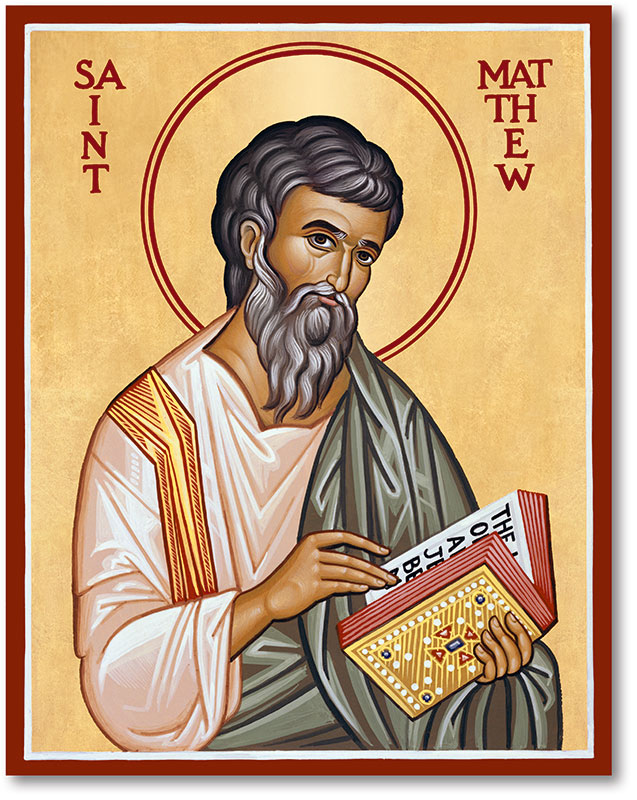
When our Lord Jesus called him to follow him, Mathew was a tax collector by profession for the Romans. His profession was hated by the devout Jews as it reminded them of their subjection and also the Pharisees saw his profession which was classed as publican, as work for the typical sinner.
St Mathew is one of the Lord Jesus’ twelve apostles and by Christian tradition is also seen as one of the four Evangelists. He was the first to put down in writing as his Gospel the Lord’s teachings and the account of our Lord Jesus’ life. Mathew wrote his Gospel in Aramaic, which is the language which was spoken by Jesus himself.
No one was shunned more than a publican by the devout Jews because a publican was a Jew who worked for their enemy, the Romans and who robbed their own people making themselves large personal profits. Publicans were despised to the extent that they were not allowed to trade, eat or even to pray with other Jews.
One day when Mathew was seated at his table of books and money, Jesus looked at him and said unto him two words, “follow me”. For Mathew, these two words were all it took for him to immediately rise, leaving all his pieces of silver to follow our Lord Jesus Christ.
Mathew’s original name was ‘Levi’ which in Hebrew signified ‘Adhesion’ whilst his new name given to him by our Lord Jesus of Mathew means ‘Gift of God’.
The only other major mention of Mathew in the Gospels is regarding the dinner party for Jesus and his companions to which Mathew invited his fellow tax collectors.
The Jews showed surprise at seeing our Lord Jesus eating in the company of a publican, but Jesus explained to the Jews that he had come “not to call the just, but sinners.”
Not much else is known about the life of Mathew but according to tradition, he is reported to have preached in such places as Egypt, Ethiopia and other further Eastern areas.
Some say Mathew lived into his nineties before dying a natural death, but other Christian traditions say he died the death of a martyr.
The Gospel according to Matthew is one of the four canonical gospels, one of the three synoptic gospels, and is the first book of the New Testament. The narrative tells how Messiah, our Lord Jesus was rejected by Israel, and how he finally sends his disciples to preach his Gospel to the whole world. Most Scholars believe the Gospel of Matthew was composed between 80 and 90 CE, with the possibility of between 70110 CE. The Gospel of Matthew is a creative reinterpretation of Mark, stressing Jesus’ teachings as much as his acts, making subtle changes to reveal Jesus’ divine nature for example, Mark’s “young man” who appears at Jesus’ tomb becomes a radiant angel in the Gospel of Matthew. The Gospel of Matthew shows Jesus as the Son of God from his birth, the fulfillment of the Old Testament. The Gospel of Matthew was the favourite Gospel of St.Dominic de Guzman, who always would carry it wherever he went.
Let us pray to St Mathew to ask him to intercede on our behalf:
O Glorious St Mathew, in your Gospel you portray Jesus as the longed-for Messiah who fulfilled the prophets of the Old Covenant and as the new lawgiver who founded a church of the New Covenant. Obtain for us the grace to see Jesus living in his church and to follow his teachings in our lives on earth so that we may live forever with him in heaven. Amen.
St. Bartholomew, The Anonymous Apostle~The Very Rev. Lady Sherwood, OPI
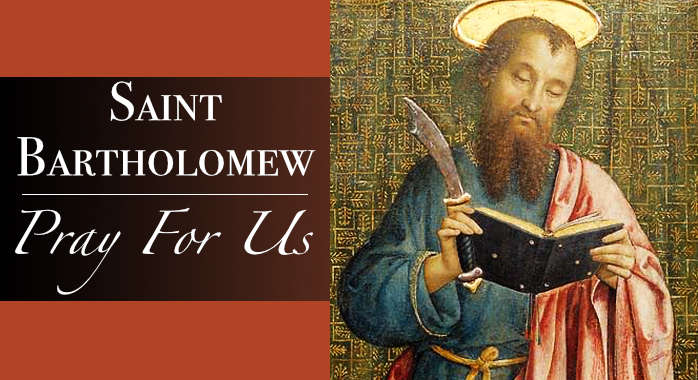
Today, the Church commemorates The Feast of St. Bartholomew the apostle. Bartholomew is a relatively difficult saint to commemorate because we hardly know anything truly about him. There are some who may believe that Bartholomew is the same person as Nathaniel –scholars have been known to argue about the truth or otherwise of this. What we do know is that In the Gospels of Matthew, Mark and Luke, that Bartholomew is listed as being one of the twelve Apostles of the Lord.
Ancient writers on the history of the Christian faith write that Bartholomew was an apostle to India – possibly is the region of Mumbai (Bombay). Along with his fellow apostle Jude, Bartholomew is reputed to have brought Christianity to Armenia in the 1st century. By tradition, Bartholomew is said to have been flayed alive, before being crucified upside down, thus becoming the patron saint of Leather-workers. In painting and sculpture, Bartholomew is often represented as holding a knife, with his own skin neatly draped over his arm. Bartholomew has also always been associated with healing, so there are a number of hospitals which have been named after him.
Bartholomew is also believed to be associated with the small Italian Island of Lipari, where he may have been buried. During World War II, the regime looked for ways to finance its activities, and ordered that a silver statue of Saint Bartholomew from the cathedral in Lipari was to be melted down. But when the statue was weighed, it was found to only actually weigh just a few grams so it was returned to its place in the Cathedral of Lipari. However, In reality, this same statue is made wholly of solid silver and therefore should indeed be very heavy in weight. This is a fairly recent miracle that has been associated with St Bartholomew.
About Bartholomew himself we know almost nothing, except that he was an Apostle of Jesus. Far from being a negative thing, I think this is the most important thing about this rather mysterious and anonymous apostle. For this teaches us that the call to serve is not really anything whatsoever to do with worldly status or fame. If we Look around us today, we will see much evidence of the reign of ego and of worldly fame, perhaps it is media stars and celebrities which tend to be the best known for this. An increasing number of children, when asked what they want to do when they grow up, say that they want to be famous, to be a celebrity or a star– and that the goal of reaching fame has become for them their vocation. Some of our politicians can also seem rather the same way. But the church isn’t entirely exempt either: we see evangelists on religious tv stations, pastors of megachurches, and, unfortunately, some bishops and clergy who just love being in the spotlight, have who love self-publicity. I once heard someone say that their church was OK but it was hard to see God because the Vicar always got in the way. It’s a temptation clergy are aware of and must always resist – our job is to point people to God, not towards ourselves.
So Bartholomew’s anonymity shows us ‘it’s not all about us’. Our job as Christians is to get out of the way and to enable people to catch a glimpse of the God and Father whom we serve. We also know, from the life of this mysterious and anonymous apostle, that we actually don’t need worldly fame, because God loves us, and that is all we need – we ought to need no other adulation than that!!
Each and every one of us eventually will join the ranks of anonymous Christians who have served God throughout the ages. In 2000 years’ time – and most likely long before that – we will all have been forgotten, except perhaps by the odd ancestor hunter who might still be digging our names out of archives and searching church registers to find historical information.
This might seem rather disheartening, but it definitely needn’t be such, because we know we are each p of God’s creation and of his redeeming: we are each loved by God more than we could ever hope imagine! Part of our job as Christians, is to try to discover more of this love as we go about living our lives. When we truly understand even a little bit of this love that God our Father and our creator, truly has for us, our anxieties about worldly status, worldly importance and worldly fame, begin to lose their hold over us. In God’s love we truly have everything we need.
So often we see the lives of the rich and famous descend into tragedy or disaster. Worldly riches and fame often don’t bring true and lasting happiness. The ordinariness of our lives is something which we as Christians should celebrate, if, like Bartholomew, our lives are built on the rock of faith and we have the knowledge of God’s true and eternal love, like a hidden jewel, burning deep inside of us.
So Bartholomew is one of us: he is a follower, he is a disciple, and a servant of Our Lord and Saviour Jesus Christ. An anonymous, unshowy person who gave of his best. Bartholomew may well be Someone we don’t know all that much about, but we do know that his soul is now residing with God where that great love will, at last, be fully known.
That is all that is needed. This is what truly matters. Amen.
Let us pray:
Strengthen in us, O Lord, the faith, by which the blessed Apostle Bartholomew clung wholeheartedly to your Son, and grant that through the help of his prayers your Church may become for all the nations the sacrament of salvation. Through our Lord Jesus Christ, your Son, who lives and reigns with you in the unity of the Holy Spirit, God, for ever and ever.
Amen.
Are we Getting Our Priorities Right?~ The Memorial of Sts Martha, Mary and Lazarus~The Very Rev Lady Sherwood, OPI
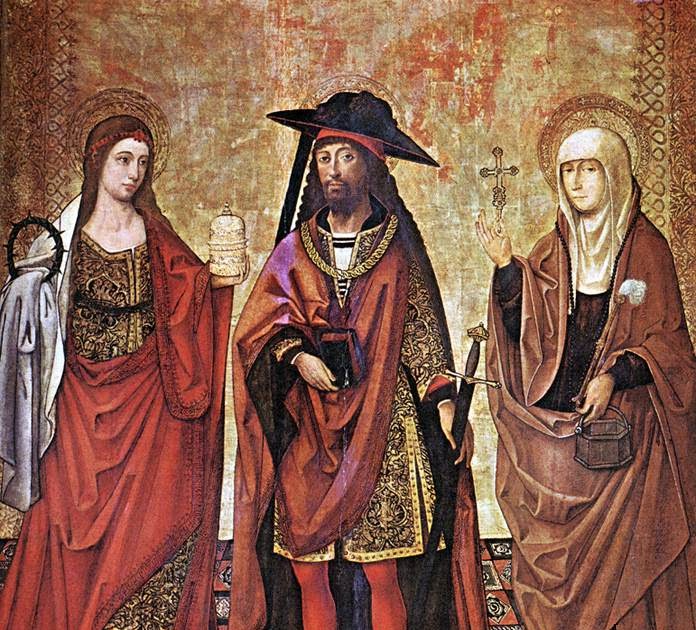
Today my brothers and sisters in Christ, we come together as the church to commemorate the memorials of three siblings, these being Sts Martha, Mary and Lazarus.
Sts Mary, Martha, and Lazarus were very close friends with and were very devout followers of The Lord Jesus. Together they hosted Jesus in their home on many occasions. Yet, on one such visit from Jesus, they Martha and Mary chose two very different actions, and the way that Jesus reacted to their choices is a very valuable lesson for us today. Let’s review the story (Luke 10:38-42):
Martha is worried
Martha was rushing around, serving and doing her best to make everything good for their beloved guest. And where was Mary when Martha needed a hand? She chose to sit at Jesus’ feet, listening as He spoke.
It’s pretty easy to imagine how that made Martha feel. Irritated, frustrated, resentful. Why should she be doing all the work? Wasn’t it only righteous for Mary to be helping out? In fact, Martha felt so justified in her indignation that she went and talked to Jesus about it. “Lord, do You not care that my sister has left me to serve alone? Therefore tell her to help me,” she said to Him.
But, instead of backing her up in her demand, Jesus rebuked her! “Martha, Martha, you are worried and troubled about many things. But one thing is needed, and Mary has chosen that good part, which will not be taken away from her.”
This must have felt like a slap in the face for Martha. Here she was, doing everything in her power to be hospitable and make it good. And Mary just sat there, and what she was doing was the right thing?
Sound familiar?
It can become so easy for us to get wrapped up in all the things we need to do and the things that need to be accomplished that we lose sight of what the most important thing is. Isn’t it possible that we can get too wrapped up in the cares of life? Jesus makes this even more clear in the parable He told about the sower. “He who received seed among the thorns is he who hears the word, and the cares of this world and the deceitfulness of riches choke the word, and he becomes unfruitful.” Matthew 13:22.
The highest priority in our lives needs to be choosing the good part, as Mary did: to learn of Jesus so that we can become like Him. It’s a love and devotion to Him that makes everything else of secondary importance. It is to seek the riches of wisdom and understanding that are in Him. If we don’t do this, how can we follow Him, how can we be His disciples? A disciple learns of the Master.
This is not an excuse to be lazy, and not take responsibility for anything. That is another trap entirely. We are to be doers of the Word, and not hearers only! (James 1:22) But what we do has to be led by the Spirit, whose voice we learn to hear by choosing the good part. There is no blessing in running our own lives based on our human understanding of what is important. Mary understood that she needed to learn more of her Master and to seek the things that have eternal value. It’s when we do that that we can be a blessing, because then all of our works are Spirit-driven. Love causes us to listen, to learn, and to keep His commandments. (1 John 5:3)
“My sheep hear My voice, and I know them, and they follow Me.” John 10:27.
Take heed to yourself
We can be in danger of falling into the same trap that Martha did. We can be so troubled by what we perceive as negative behavior in others, and become so self-righteous in our good works that we start to judge others for not doing as we do. Satan is the one behind these kinds of thoughts. He whispers lies and accusations, trying to create as much conflict as he can. His aim is to lead people as far in the opposite direction of “the good part” as he possibly can – to lead them away from Jesus. To listen to him and agree with him leads to all kinds of unrest and trouble and worry. We need to slam the door on his deceitfulness!
“Take heed to yourself and to the doctrine. Continue in them, for in doing this you will save both yourself and those who hear you,” it’s written in 1 Timothy 4:16. Only that will do us any good in life. The wrong choice that Martha made wasn’t that she was serving and doing good. It was that in her work she had demands and criticism on Mary, rather than doing what Jesus taught herself! If we are living before the face of God, we have no cause to look around at what others are doing and feel that we have a right to pass judgement on them. We live in obedience to the Spirit’s promptings in our own lives, and what others do is none of our business. We don’t know how He is leading others.
Let’s rise above all the noise and pursuits of this world and seek those things which have eternal value. Like Mary, let’s find that fellowship with the Master and with those who follow Him so that we can learn of Him and become like Him. Through the Word of God, fellowship, and prayer we become rich in our spirit, and God will give us everything we need in abundance.
“Finally, dear brethren, whatever things are true, whatever things are noble, whatever things are just, whatever things are pure, whatever things are lovely, whatever things are of good report, if there is any virtue and if there is anything praiseworthy—meditate on these things.” Philippians 4:8.
Let us pray:
Saints Martha, Mary, and Lazarus, you befriended Jesus as your Lord and God, and as the Son of Man, to Whom you opened your home and your lives. Please pray for us, that we will also open the home of our souls so as to befriend Him Who is my God and is the Resurrection and the Life. Saints Martha, Mary, and Lazarus, pray for us. Jesus,
In Jesus holy name we pray,
Amen.
 The Order of Preachers, Independent
You must be logged in to post a comment.