
Category: Dominican Saints

Blessed Andrew Abellon

Blessed Andrew was born near the world-famous shrine of Mary Magdalen. His entire life was centered around the shrine, and it is greatly due to his efforts that devotion to the great penitential has become so well established.
As a young man, Andrew may have heard the stirring sermons of Saint Vincent Ferrer, who was at that time preaching in France. Perhaps the purity and penitential zeal for which this great preacher was renowned gave the young Andrew the pattern for his own life. He soon demonstrated his choice of purity and penance by joining the Dominicans in his home town. After a happy and holy novitiate, he made his profession and was ordained. In a few years, a preacher and a guide for souls, he turned his attention to the neglected shrine of Saint Mary Magdalen.
This rugged and penitential region of France had been honored from the time of the Apostles as the chosen retreat for Mary Magdalen, who did penance there for the sins of her youth. From earliest days, it had been a place of pilgrimage, but had no definite arrangements for the care of pilgrims, nor any way of supplying their spiritual needs. In Blessed Andrew’s time, Dominican fathers from Saint-Maximin had taken over the spiritual care of the pilgrims as a mission work, but without financial help, and in the face of great trials.
Seeing the need of a permanent foundation at the shrine, Andrew set about creating one. He interested the queen in his project, and obtained enough money from her to build a monastery, which was a gem of architecture as well as a source of spiritual power. Andrew had studied art before his entry into the order, and he used his talents in building, beautifully and permanently, whatever he was called upon to do.
A lover of great beauty in the physical order, Andrew was the same in the spiritual. He was famous as a confessor, and his wise government as prior gave help to the spiritual growth of the new convent. A practical man as well as deeply spiritual, Andrew established two mills near the shrine that would provide the people with a means of earning a living while remaining there. Quite naturally, a priest who interested himself in the welfare of the people to this extent could hope for great influence with them, and this he had, both at Saint Maximin and at Aix, where an altarpiece he painted may still be seen.
After his death, Blessed Andrew was buried in the Church of the Magdalen. His tomb soon became a place of pilgrimage; his help especially was sought in the cure of fevers.
Born: 1375 at Saint Maximin, Provence, France
Died: May 15, 1450 at Aix-en-Provence, France of natural causes; buried in the Church of the Magdalen; his tomb became known as a site of miraculous cures.
Beatified:1902 (cultus confirmed) by Pope Leo XIII
Patronage: against fever
Blessed Giles of Portugal
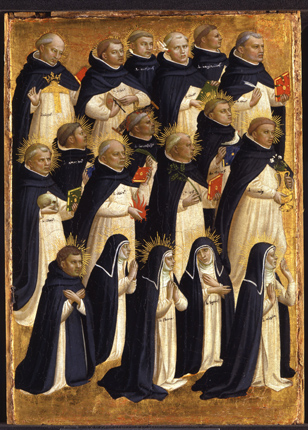
So many romantic legends intertwine themselves with the story of Blessed Giles that it is difficult to see the man himself. His life, even stripped of its legend, however, is the story of the triumph of grace in the human soul.
He was the son of Rodrigues de Vagliaditos, governor of Coimbra under King Sancho the Great. From his childhood, Giles was destined for the priesthood for which he studied at Coimbra. He was ordained at an early age, but with no good intention, for he saw in the priesthood only a chance to wield power. His father’s influence gained for him a number of rich benefices, which he used sinfully for power and pleasure.
Being a brilliant student, he advanced rapidly in his chosen field of medicine, an art that was at the time often linked with necromancy or black magic. He neglected his priestly duties and seemed bent only on the pleasures of life.
Thoroughly irreligious and pleasure-seeking young man, set out for Paris to work for higher degrees in medicine. On the advice of a stranger he met on the way, he went to Toledo instead and became a student of the black arts. According to one story, he met the devil and signed a contract with him, in which he promised his soul in return for a universal knowledge of medicine. Thereupon he spent seven years in bondage to his evil master, learning all his arts.
Having gained the highest degrees in medicine, Giles went to Paris and became a successful physician. At the peak of worldly success, he began to have horrible visions. He saw himself in a cemetery of a monastery of which he enjoyed the revenues. There he saw a specter who carried a skull and an hourglass. The specter knocked at one and then another of the tombs, calling out, “Arise, faithful monk!” At each summons another fearful specter appeared, until at one tomb there was no answer.
“Giles,” he called. “What–not there?” He poised the hourglass and murmured, “There are yet a few sands to run!” After this fearful vision, says the legend, Giles repented of his misspent life, destroyed his magic books and potions, and set out in haste for Coimbra on foot.
At Palencia he met the friars of the newly founded Order of Preachers. He was still troubled by diabolical attacks, but they helped him to make his peace with God. Joining them, he spent seven years in terrible penance, after which Our Lady returned to him the fateful scroll he had signed with Satan.
It is known that Giles had spent his youth badly, and that after entering the Dominicans he did fervent penance. By nature he was witty and charming, and he found the silence hard to keep. Actual violence to his natural disposition was necessary to make him into the humble and reserved religious he later became.
Blessed Giles occupied several positions of authority in the order, including provincial of Portugal, and his medical skill proved to be a blessing in the care of his sick brethren. He made a practice of going about the dormitories, cleaning up the students’ rooms while they were at class. His heroic penance did much to undo the scandal he had caused in his early years.
Giles was sent back to Portugal after his early training, and his preaching was noteworthy, even in that age of renowned preachers. He founded a number of monasteries and did much to establish the Dominicans in Portugal. His last years were filled with visions and ecstasies. He lived to be very old, regarded by all but himself as a very great saint.
Born: Born 1185 at Vaozela
Died: 1265 of natural causes
Beatified: May 9, 1748 by Pope Benedict XIV (cultus confirmed)
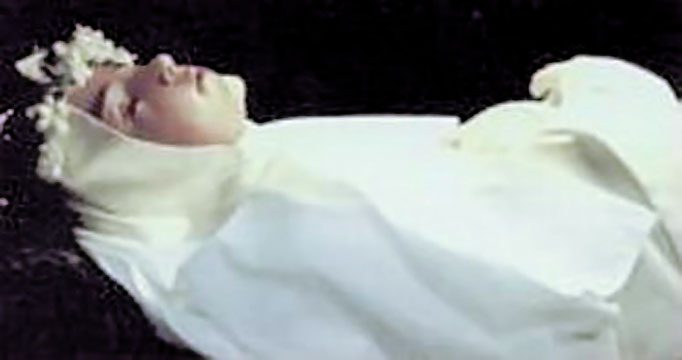
Blessed Imelda Lambertini

One of the most charming legends in Dominican hagiography is that of little Imelda, who died of love on her first Communion day, and who is, by this happy circumstance, patroness of all first communicants.
Tradition says that Imelda was the daughter of Count Egano Lambertini of Bologna. Her family was famous for its many religious, including a Dominican preacher, a Franciscan mother foundress, and an aunt of Imelda’s who had founded a convent of strict observance in Bologna.
Imelda was a delicate child, petted and favored by her family, and it was no surprise that she should be religious by nature. She learned to read from the Psalter, and early devoted herself to attending Mass and Compline at the Dominican church. Her mother taught her to sew and cook for the poor, and went with her on errands of charity. When Imelda was nine, she asked to be allowed to go to the Dominicans at Val di Pietra. She was the only child of a couple old enough not to hope for any more children; it was a wrench to let her go. However, they took her to the convent and gave her to God with willing, if sorrowing, hearts.
Imelda’s status in the convent is hard to discern. She wore the habit, followed the exercises of the house as much as she was allowed to, and longed for the day when she would be old enough to join them in the two things she envied most–the midnight Office and the reception of Holy Eucharist. Her age barred her from both. She picked up the Divine Office from hearing the sisters chant, and meditated as well as she could.
It was a lonely life for the little girl of nine, and, like many another lonely child, she imagined playmates for herself–with this one difference–her playmates were saints. She was especially fond of Saint Agnes, the martyr, who was little older than Imelda herself. Often she read about her from the large illuminated books in the library, and one day Agnes came in a vision to see her. Imelda was delighted. Shut away from participation in adult devotions, she had found a contemporary who could tell her about the things she most wanted to know. Agnes came often after this, and they talked of heavenly things.
Her first Christmas in the convent brought only sorrow to Imelda. She had been hoping that the sisters would relent and allow her to receive Communion with them, but on the great day, when everyone except her could go receive Jesus in the Eucharist, Imelda remained in her place, gazing through tears at the waxen figure in the creche. Imelda began to pray even more earnestly that she might receive Communion.
When her prayer was answered, spring had come to Bologna, and the world was preparing for the Feast of the Ascension. No one paid much attention to the little girl as she knelt in prayer while the sisters prepared for the Mass. Even when she asked to remain in the chapel in vigil on the eve of the feast, it caused no comment; she was a devout child. The sisters did not know how insistently she was knocking at heaven’s gate, reciting to herself, for assurance, the prayer that appeared in the Communion verse for the Rogation Days: “Ask and it shall be given to you, seek and you shall find, knock and it shall be opened to you.”
The door was opened for Imelda on the morning of the Vigil of the Ascension. She had asked once more for the great privilege of receiving Communion, and, because of her persistence, the chaplain was called in on the case. He refused flatly; Imelda must wait until she was older. She went to her place in the chapel, giving no outward sign that she intended to take heaven by storm, and watched quietly enough while the other sister went to Communion.
After Mass, Imelda remained in her place in the choir. The sacristan busied herself putting out candles and removing the Mass vestments. A sound caused her to turn and look into the choir, and she saw a brilliant light shining above Imelda’s head, and a Host suspended in the light. The sacristan hurried to get the chaplain.
The chaplain now had no choice; God had indicated that He wanted to be communicated to Imelda. Reverently, the chaplain took the Host and gave it to the rapt child, who knelt like a shining statue, unconscious of the nuns crowding into the chapel, or the laypeople pushing against the chapel grille to see what might be happening there.
After an interval for thanksgiving, the prioress went to call the little novice for breakfast. She found her still kneeling. There was a smile on her face, but she was dead.
The legend of Blessed Imelda is firmly entrenched in Dominican hearts, though it is difficult now to find records to substantiate it. She may have been eleven, rather than ten when she died. The convent where she lived has been gone for centuries and its records with it.
Several miracles have been worked through her intercession, and her cause for canonization has been under consideration for many years. As recently as 1928 a major cure was reported of a Spanish sister who was dying of meningitis. Other miracles are under consideration. The day may yet come when the lovable little patroness of first communicants can be enrolled in the calendar of the saints.
Born: Born in Bologna, Italy, in 1322
Died: died on the Feast of the Ascension, May 13, 1333
Beatified: cultus confirmed in 1826 by Pope Leo VII
Patronage: named patron of first communicants by Pope Pius X.
Representation: In art, Imelda is a very young Dominican novice, kneeling before the altar with a sacred Host appearing above her. She is venerated at Bologna and Valdipietra.
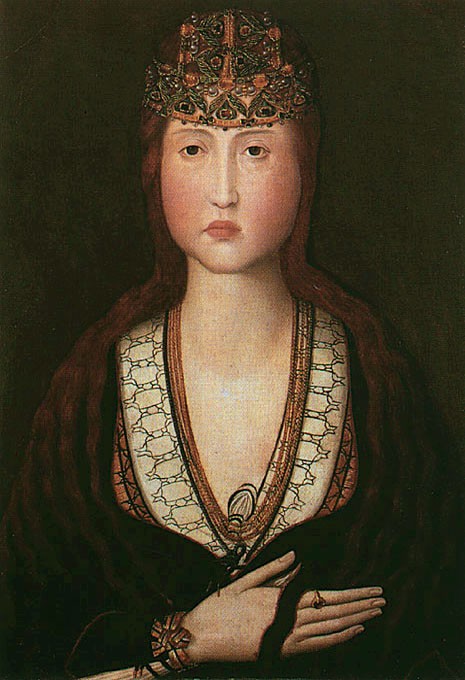
Blessed Jane of Portugal

Joanna, a child of many prayers, was born heiress to the throne of her father, King Alphonsus V, at a time when Spain and Portugal had divided the colonial wealth of the earth between them. Her sickly brother Juan was born three years later, and soon after this their mother, Queen Elizabeth of Coimbra, died. Joanna was left to the care of a wise and pious nurse, who cultivated the child’s natural piety. By age five the little princess had exceeded her teacher in penitential practices. She fasted and prayed, rose at night to take the discipline, and wore a hairshirt under her glittering court apparel.
Although Joanna would not inherit the throne of Portugal while her brother was alive, a wise marriage would do much to increase her father’s power. Accordingly, he began early to arrange for her marriage. Joanna, whose knowledge of court intrigue was as good as his own, skillfully escaped several proposed matches. She had treasured the desire to enter the convent, but, in view of her father’s plans, her desires met with violent opposition. She was flatly refused for a long time; finally, her father gave his reluctant consent, but he withdrew it again at her brother’s insistence.
She was regent of Portugal when her father and brother went to war against the Moors, and when they defeated the Moors in 1471, her father, in the first flush of victory, granted her request to take the veil. Joanna and one of her ladies-in-waiting had long planned to enter the Dominican cloister at Aveiro, which was noted for its strict observance. But when her father finally gave consent for her to enter religion, he did not allow her to enter that Dominican convent. She had to go to the nearby royal abbey of the Benedictines at Odivellas. Here she was besieged by weeping and worldly relatives who had only their own interests at heart. After two months of this mental torture, she returned to the court.
The rest of Joanna’s life is a story of obedience and trials. Her obligations of obedience varied. She was required to bend her will to a wavering father, who never seemed able to make a decision and abide by it; to bishops, swayed by political causes, who forced her to sign a paper that she would never take her solemn vows; and to doctors, who prescribed remedies that were worse than the maladies they tried to cure. The trials came from a jealous brother, from ambitious and interfering relatives, from illness, and from cares of state.
After 12 years of praying and hoping, Joanna finally received the Dominican habit at Aveiro in 1485. Once, she was deprived of it by an angry delegation of bishops and nobles, and, at another time, her brother tore the veil from her head. Despite the interruptions of plague, family cares, and state troubles, Joanna lived an interior and penitential life. She became an expert at spinning and weaving the fine linens for the altar, and busied herself with lowly tasks for the love of God. She used all her income to help the poor and to redeem captives.
Her special devotion was to the Crown of Thorns, and, in early childhood, she had embroidered this device on her crest. To the end of her life she was plagued by the ambition of her brother, who again and again attempted to arrange a marriage for her, and continually disturbed her hard-won peace by calling her back to the court for state business.
On one of these trips to court, Joanna was poisoned by a woman–a person she had rebuked for leading an evil life. The princess lived several months in fearful pain, enduring all her sufferings heroically. She died, as it says in an old chronicle, “with the detachment of a religious and the dignity of a queen,” and with the religious community around her.
Born: Born in Lisbon, Portugal, 1452
Died: died at Aveiro, Portugal, in 1490
Beatified: April 4, 1693 by Pope Innocent XII (cultus confirmed)
Blessed Albert of Bergamo
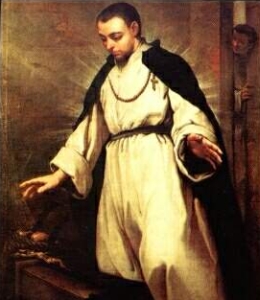
Albert “the Farmer” was a peasant farmer who followed his pious and industrious father’s example. His father taught him many practices of penance and piety that later fructified in a saintly life. At seven, Albert was fasting three days a week, giving the foregone food to the poor. Working at the heavy labor of the fields, Albert learned to see God in all things, and to listen for His voice in all nature. The beauty of the earth was to him a voice that spoke only of heaven. He grew up pure of heart, discreet, and humble–to the edification of the entire village.
Albert married while still quite young. At first his wife made no objection to the generosity and self-denial for which he was known. When his father died, however, she made haste to criticize his every act and word, and made his home almost unbearable with her shrewish scolding. “You give too much time to prayer and to the poor!” she charged; Albert only replied that God will return all gifts made to the poor.
In testimony to this, God miraculously restored the meal Albert had given away over his wife’s objections. Finally, softened by Albert’s prayers, she ceased her nagging and became his rival in piety and charity. She died soon after her conversion, and Albert, being childless, he left his father’s farm to make a pilgrimage to Jerusalem and Rome.
Stopping at Cremona, Italy, at harvest time, Albert went to work in the fields. He soon earned the name of “the diligent worker.” His guardian angel worked beside him in the fields, and, therefore, twice the work was accomplished that might be expected of one man. Weighing in his grain at the end of the day, Albert always received twice as much in wages as the other workers did. Though he gave this to the poor and kept nothing for himself, jealous companions determined to annoy him. Planting pieces of iron in the field where Albert would be working the next day, they watched to see him break or dull his scythe. Miraculously, the scythe cut through iron as it did through the grain, never suffering any harm. In Cremona Albert’s poverty was also a witness to a group of heretics there who boasted of their own poverty.
In all, Albert visited Rome nine times, Santiago de Compostela eight times, and Jerusalem once. He worked his way, giving to the poor every penny he could spare. His pilgrimages were almost unbroken prayer; he walked along singing hymns and chanting Psalms, or conversing on things of God with the people he met along the way.
Appalled at the suffering of pilgrims who fell ill far from home and the penniless, Albert determined to build a hospital for their use. This he actually accomplished by his prayers and diligent work.
In 1256, he met the Dominicans. Attracted by the life of Saint Dominic, Albert joined the Brothers of Penance, which later became the Order of Penance of Saint Dominic, and continued his works of charity in his new state. As a lay brother he was closely associated with the religious but lived in the world so that he was able to continue his pilgrimages. At home, he assisted the Dominican fathers in Cremona, working happily in their garden, cultivating the medicinal herbs so necessary at the time, and doing cheerfully all the work he could find that was both heavy and humble.
Falling very ill, Albert sent a neighbor for the priest, but there was a long delay, and a dove came bringing him Holy Viaticum. When he died, the bells of Cremona rang of themselves, and people of all classes hurried to view the precious remains. It was planned to bury him in the common cemetery, outside the cloister, as he was a secular tertiary, but no spade could be found to break the ground. An unused tomb was discovered in the church of Saint Matthias, where he had so often prayed, and he was buried there. Many miracles were attributed to him after his death, and the farmer- saint became legendary for his generosity to the poor.
Born: Born in Valle d’Ogna (near Bergamo), Italy, in 1214
Died: died in Cremona, Italy, May 7, 1279
Beatified: cultus approved May 9, 1748 by Pope Benedict XIV
Representation: In art, Saint Albert is a farm laborer cutting through a stone with a scythe. He may shown be shown (1) when a dove brings him the viaticum, or (2) with a dove, Host, and censer near him. Albert is the patron of bakers and day-laborers, and is venerated in Cremona, Bergamo, and Ogna.

Saint Antoninus
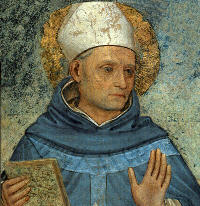
The story of Antonino Pierozzi is that of a great soul in a frail body, and of the triumph of virtue over vast and organized wickedness. His father, Niccolo Pierozzi, had been a noted lawyer, notary to the Republic of Florence. He and his wife Thomassina had their only child baptized as Antonio, but because the saint was both small and gentle people called him by the affectionate diminutive ‘Antonino’ all his life.
The world in which he lived was engrossed in the Renaissance; it was a time of violent political upheaval, of plague, wars, and injustice. The effects of the Great Schism of the West, over which Saint Catherine had wept and prayed a generation before, were still tearing Christendom apart when Antoninus was born–in the same year as Cosimo de’Medici. The fortunes of Florence were largely to rest in the hands of these two men.
There are only a few known details about the early life of Antoninus, but they are revealing ones. He was a delicate and lovable child. His stepmother, worried over his frailty, often gave him extra meat at table. The little boy, determined to harden himself for the religious life, would slip the meat under the table to the cats. Kids!
From the cradle his inclination was to piety. His only pleasure was to read the lives of saints and other good books, converse with pious persons, or employ himself in prayer. Accordingly, if he was not at home or at school, he was always to be found at Saint Michael’s Church before a crucifix or in our Lady’s chapel there. He had a passion for learning, but an even greater ardor to perfect himself in the science of salvation. In prayer, he begged nothing of God but His grace to avoid sin, and to do His holy will in all things.
Antoninus hitched his wagon to the star of great austerity and, at 14, discovered the answer to all his questions in the preaching of Blessed John Dominici, who was then the prior of Santa Maria Novella and later became cardinal-archbishop of Ragusa and papal legate. Antoninus went to speak with the preacher and begged to be admitted to the order.
At the time, Blessed John was reforming the Dominican priories of the area according to the wishes of Blessed Raymond of Capua. John planned to build a new and reformed house at Fiesole (near Florence), which he hoped to start again with young and fervent subjects who would revivify the order. It had declined under the plague and the effects of the schism. As yet, he had no building in which to house the new recruits.
Even were the monastery completed, it was to be a house of rigorous observance, and Antoninus looked far too small and frail for such an austere community. John Dominici, not wishing to quench the wick of youthful eagerness, had not the heart to explain all this. He told Antoninus to go home and memorize the large and forbidding book called Decretum Gratiani, supposing that its very bulk would discourage the lad.
Antoninus, however, was possessed of an iron will. He went home and began to read the book straight through. By the end of the year, he had finished the nearly impossible task set before him, and returned to Blessed John to recite it as requested. There was now no further way to delay his reception into the order, so he was received into the Dominican Order “for the future priory of Fiesole” in 1405 by Blessed John.
Due to the unsettled state of the Church, the order, and Italian politics, the training of the young aspirants was conducted at several different locations, including Cortona, and, for a time, the regular course of studies could not be pursued. Antoninus, nothing daunted, studied by himself. He was happily associated during these years with several future Dominican saints and beati, including Lawrence of Ripafratta, the novice master; Constantius of Fabriano; Peter Capucci; and his great friend, the artist, Fra Angelico.
Ordained and set to preaching, Antoninus soon won his place in the hearts of the Florentines. Each time he said Mass, he was moved to tears by the mercy of God, and his own devotion moved other hearts. He was given consecutively several positions in the order. While still very young, he was made prior of the Minerva in Rome (1430). He served the friars in various priories in Italy (including Cortona, Fiesole (1418-28), Naples, Gaeta, Siena, and Florence). As superior of the reformed Tuscan and Neapolitan congregations, and also as prior provincial of the whole Roman province, Antoninus zealously enforced the reforms initiated by John Dominici with a view to restoring the primitive rule. Antoninus became a distinguished master of canon law and assisted popes at their councils. There is evidence that at some point he served as a judge on the Rota. Pope Eugenius IV summoned him to attend the general Council of Florence (1439), and he assisted at all its sessions.
In 1436, he founded the famous priory of San Marco in Florence with the financial aid of Cosimo de’Medici in buildings abandoned by the Silvestrines. Under his guidance and encouragement, the San Marco’s monastery became the center of Christian art. He called upon his old companion, Saint Fra Angelico, and on the miniaturist, Fra Benedetto (Angelico’s natural brother), to do the frescoes and the choir books which are still preserved there. He also ensured that an outstanding library was collected.
Antoninus is still remembered today in the exquisite ‘Cloister of Saint Antoninus’ with its wide arches and beautiful ionic capitals, designed in the saint’s lifetime by Michelozzo for San Marco. In the lunettes of the cloister Bernardino Poccetti and others painted scenes from Antoninus’s life. (When Giambologna restored and altered the church of San Marco in 1588, he built for the saint’s body a superb chapel.)
To his horror, Antoninus’s wisdom and pastoral zeal made him a natural choice by Pope Eugenius IV for archbishop of Florence in 1446. Although Tabor reports that the pope had first chosen Fra Angelico, whose purity and wisdom had become known when he was painting in Rome. The artist entreated the holy father to choose Fra Antoninus instead, who had done great service by his unworldliness and gentle but irresistible power.
Antoninus’s appointment as bishop was a genuine heartbreak to a scholar who could never find enough time to study; in fact, he had been in Naples for two years reforming the houses of the province when he received word of the nomination and confirmation by the Florentines. For a time he tried to escape accepting the dignity by hiding himself on the island of Sardinia. That did not work. So he tried begging the holy father to excuse him because of his weak physical constitution. The pope would accept no excuses; he commanded Antoninus to proceed immediately to Fiesole under the pain of excommunication for disobedience.
While he obeyed with trepidation, it was a blessing for the people of Florence that he was consecrated bishop in March 1446; they were not slow in demonstrating their appreciation of their good fortune. He was the ‘people’s prelate’ and the ‘protector of the poor’ for he discharged his office with inflexible justice and overflowing charity. His love extended to the rich, too. The next year, the dying Pope Eugenius summoned Antoninus to Rome in order to receive the last sacraments from the holy bishop before dying in his arms on February 23, 1447.
For the remainder of his life, Antoninus combined an amazing amount of active work with constant prayer. He allowed himself very little sleep. In addition to the church office, he recited daily the office of our Lady, and the seven penitential psalms; the office of the dead twice a week; and the whole psalter on every festival. His prayer life allowed him to exhibit an exterior of serenity regardless of the situation. Francis Castillo, his secretary, once said to him, bishops were to be pitied if they were to be eternally besieged with hurry as he was. The saint made him this answer, which the author of his vita wished to see written in letters of gold: “To enjoy interior peace, we must always reserve in our hearts amidst all affairs, as it were, a secret closet, where we are to keep retired within ourselves, and where no business of the world can over enter.”
Because of his reputation for wisdom and ability, Antoninus was often called upon to help in public affairs, civil and ecclesiastical. Pope Nicholas V sought his advice on matters of church and state, forbade any appeal to be made to Rome from the archbishop’s judgements, and declared that Antonino in his lifetime was as worthy of canonization as the dead Bernardino of Siena, whom he was about to raise to the altars. Pius II nominated him to a commission charged with reforming the Roman court. The Florentine government gave him important embassies on behalf of the republic and would have sent him as their representative to the emperor if illness had not prevented him from leaving Florence. Yet he also busied himself with the beauty of the chant, and personally attended the Divine Office at his cathedral.
A distinguished writer on international law and moral theology, his best known work is Summa moralis, which is generally thought to have laid the groundwork for modern moral theology. He was conscious of the new problems presented by social and economic development, and taught that the state had a duty to intervene in mercantile affairs for the common good, and to give help to the unfortunate and needy. He was among the first Christian moralists to teach that money invested in commerce and industry was true capital; therefore, it was lawful and not usury to claim interest on it (combine this information with the fact that he was a staunch opponent of usury). All his many books were of a practical nature, including guidance for confessors (Summa confessionis) and a chronicle of the history of the world.
His first concern, however, was always for the people of his diocese, to whom he set an example of simple living and inflexible integrity. He preached regularly, made a yearly visitation of all the parishes in the diocese on foot, put down gambling, opposed both usury and magic, reformed abuses of all kinds, and served as the example of Christian charity. Each day he held an audience for anyone who wished to speak with him. No one appealed for his help, material or spiritual, in vain.
Antoninus was probably best known for his kindness to the poor, and there were many in the rich city of Florence. He pulled up his own flower garden and planted vegetables for the poor. He drove his housekeeper to distraction by giving away even his own tableware, food, clothing, and furniture. He never possessed any small precious objects, such as plates or jewels. His stable generally housed one mule, which he often sold to relieve some poor person. When that happened, some wealthy citizen would buy the animal and offer it as a present to the charitable archbishop. He kept in personal contact with the poor of the city, particularly with those who had fallen from wealth and were ashamed to beg. For their care he founded a society called the “Goodmen of Saint Martin of Tours,” who went about quietly doing much-needed charitable work–much in the fashion of our modern Society of Saint Vincent de Paul. His particular establishment now provides for about 600 families.
His charity did not end with the poor, but also extended to his enemies. A criminal, named Ciardi, who was called before the bishop to answer accusations, attempted to assassinate the archbishop. The saint narrowly escaped the thrust of his poniard, which pierced the back of his chair. Yet Antoninus freely forgave the potential assassin and prayed for his conversion. God answered his prayers so that he had the comfort of seeing Ciardi become a sincere Franciscan penitent.
When the plague again came to Florence in 1448, it was the saintly archbishop who took the lead in almsgiving and care of the sick. Many Dominicans died of the plague as they went about their priestly duties in the stricken city; sad but undaunted, Antoninus continued to go about on foot among the people, giving both material and spiritual aid. During the earthquakes of 1453-1455, he was similarly self-giving. The example of his own charity led many rich persons to likewise provide for the afflicted.
Antoninus’s was a role model in other ways, too. When he learned that two blind beggars had amassed a fortune, he took the money from them and distributed it to others in dire necessity. Was this an injustice? No, he provided for all the needs of the two for the rest of their lives. The bishop tried to hide his virtue from others and himself, until he would see reflections of them in his flock. By accident he discovered one such flame that he had sparked in a poor, obscure handicraftsman who continually practiced penance. The man spent Sundays and holidays in the churches, secretly distributed to the poor all he earned beyond that needed for subsistence, and kept a poor leper in his home, joyfully serving the ungrateful beggar and dressing his ulcers with his own hands. The leper, increasingly morose and imperious, carried complaints against his benefactor to the archbishop, who, discovering this hidden treasure of sanctity in the handicraftsman, secretly honored it, while he punished the insolence of the leper.
Cosimo de’Medici, who did not always have compliments for the Dominicans, admitted frankly, “Our city has experienced all sorts of misfortunes: fire, earthquake, drought, plague, seditions, plots. I believe it would today be nothing but a mass of ruins without the prayers of our holy archbishop.”
After 13 years as bishop, Antoninus died surrounded by his religious brothers from San Marco and mourned by the whole city. His whole life was mirrored in his last words, “to serve God is to reign.” Pope Pius II assisted at his funeral, when he was buried in San Marco’s church. Pius eulogized Antoninus as one who “conquered avarice and pride, was outstandingly temperate in every way, was a brilliant theologian, and popular preacher.”
His hairshirt and other relics were the vehicle for many miracles. It is significant that the canonization of Saint Antoninus was decreed by the short-lived Pope Adrian VI (August 31, 1522, to September 14, 1523), whose ideas for church reform were radical and drastic. His body was found uncorrupted in 1559, when it was translated with pomp and solemnity into a chapel richly adorned by the two brothers.
Born: March 1, 1389 at Florence, Italy
Died: May 2, 1459 at Florence, Italy
Canonized: May 1523 by Pope Adrian VI
Patronage: Fever
Representation: Antonius of Florence is generally portrayed in art as a Dominican bishop with scales. He might be shown (1) weighing false merchandise against the word of God; (2) as a Dominican with a pallium; (3) as a young man giving alms; (4) drifting down a river in a boat; or (5) holding a book in a bag . The likeness of the archbishop was recorded by contemporary artists, as in the bust at Santa Maria Novella and a statue at the nearby Uffizi Gallery in Florence. Antonio del Pollaiuolo’s painting of him at the foot of the Cross survives at San Marco, as does a series of scenes from his life in its cloister of San Antonino, and a portrait by Fra Bartolomeo.
Pope Saint Pius V

People who know nothing else about Pius V are quite apt to remember him as the Pope of the Rosary, recalling his remarkable connection with the Battle of Lepanto.
Antonio Michael was born into the distinguished but impoverished Ghisleri. His parents could not afford to educate their alert little boy, who seemed far too talented to be a shepherd. One day, as he was minding his father’s small flock, two Dominicans came along the road and fell into conversation with him. Recognizing immediately that he was both virtuous and intelligent, they obtained permission from his parents to take the child with them and educate him. He left home at age 12 and did not return until his ordination many years later.
After a preliminary course of studies, he received the Dominican habit at the priory of Voghera at age 14 and, as a novice, was sent to Lombardy. Here, for the first time, he met the well-organized forces of heresy which he was to combat so successfully in later years.
After his ordination in 1528, he went home to say his first Mass, and he found that Bosco had been razed by the French. There was nothing left to tell him if his parents were alive or dead. He finally found them, however, in a nearby town. After he said Mass, he returned to a career that would keep him far from home for the rest of his life. He began as a lector in theology and philosophy for 16 years.
Then he served as novice-master, than as prior of several convents, Michael proved to be a wise and charitable administrator. He was made inquisitor at Como, Italy, where many of his religious brethren had died as martyrs to the heretics. By the time of Michael’s appointment there, the heretics’ chief weapon was the printed word; they smuggled books in from Switzerland, causing untold harm by spreading them in northern Italy. The new inquisitor set himself to fight this wicked traffic, and it was not the fault of the heretics that he did not follow his brethren to martyrdom. They ambushed him several times and laid a number of complicated plots to kill him, but only succeeded in making him determined to explain the situation more fully to the pope in Rome.
He arrived in Rome on Christmas Eve, tired, cold, and hungry, and here it was not the heretics that caused him pain, but his own brothers in Christ. The prior of Santa Sabina saw fit to be sarcastic and inhospitable to the unimportant looking friar, who said he was from Lombardy. The pope knew very well who he was, however, and immediately gave him the commission of working with the heretics in the Roman prisons.
He was a true father to these unfortunates, and he brought many of them back to the faith. One of his most appealing converts was a young Franciscan, a converted Jew of a wealthy family, who had lapsed into heresy through pride in his writing. Michael proceeded to straighten out his thinking, to give him the Dominican habit, and to assure him of his personal patronage, thus securing for the Church a splendid Scripture scholar and writer.
In 1556, Michael was chosen bishop of Nepi and Sutri. The next year he was named inquisitor general against the Protestants in Italy and Spain and was appointed cardinal, in order, as he said, that irons should be riveted to his feet to prevent him from creeping back into the peace of the cloister. In 1559, Pope Pius IV made him bishop of the war-depleted Piedmont see of Mondovi, to which he soon brought order. Insofar as possible, Michael continued to adhere to the Dominican Rule.
He constantly opposed nepotism. Michael opposed Pius IV’s attempt to make 13-year-old Ferdinand de’Medici a cardinal, and defeated the attempt of Emperor Maximilian II of Germany to abolish clerical celibacy.
January 7, 1565, when the papal chair was vacant following the death of Pius IV, the cardinals, chiefly through the influence of Saint Charles Borromeo, elected Cardinal Ghislieri pope. With great grief, he accepted the office and chose the name Pius V. Charles Borromeo had backed Michael during the election, trusting that he would act as a much-needed reformer.
His judgment proved true: on Pius’s coronation, the money usually distributed to the crowds was given to the hospitals and the poor, and money for a banquet for the cardinals and other dignitaries was given to poor convents. When someone criticized this, he observed that God would judge us more on our charity to the poor than on our good manners to the rich. Such an attitude was bound to make enemies in high places, but it endeared him to the poor, and it gave right-thinking men the hope that here was a man of integrity, and one who could help to reform the clergy and make a firm stand against the Lutheran heresy.
There were massive problems of immediate urgency during the brief reign of Pius V. From within, the peace of the Church was disturbed by the several heresies of Luther, Calvin, and the Lombards, and by the need for clerical reform. In addition, England was tottering on the brink of a break with Rome. The Netherlands were trying to break away from Spain and had embraced Protestantism. The missions across the sea needed attention. And all through the Mediterranean countries, the Turkish were ravaging Christian cities, creeping closer to world conquest. In the six years of his reign, Pope Pius V had to deal with all these questions–any one of which was enough to occupy his entire time.
One of Pius’s first actions was to demand that bishops should live in their dioceses and parish priests in their parishes. His efforts at regulating his see embraced issues ranging from the abolition of bullfighting, bear-baiting and prostitution, to cleaning out the Roman curia and eliminating nepotism, to cutting down the activities of bandits. He insisted that Sunday must be hallowed. Once a month he held a special court for anyone who felt they had been treated unjustly. He also brought in shipments of corn during a famine at his own expense.
In his personal life he continued to be a devout mendicant friar; as pope he set himself to enforce the decrees of the Council of Trent with energy and effect. The catechism ordered by the Council of Trent was completed during his rule (1566), and he ordered translations made. The breviary reformed (1568) and missal (1570). He also commissioned the best edition to date of the writings of Saint Thomas Aquinas; it was he who made Thomas a Doctor of the Church in 1567.
His was a rigorous character; he made full use of the Inquisition and his methods of combating Protestantism were ruthless. Pius had hoped to convert Queen Elizabeth of England. The unfortunate Mary Queen of Scots enjoyed his sympathy and encouragement. He sent reassuring letters to her, and once, at a time when no priest was allowed to go near her, he granted her special permission to receive Holy Communion by sending her a tiny pyx that contained consecrated Hosts. It was he who finally had to pronounce excommunication on Elizabeth of England in 1570, after he had given her every possible chance of repentance.
Pope Pius V had a high estimate of papal power in secular matters. When he excommunicated Elizabeth I, he absolved her subjects of the allegiance to her as queen. Some would say that this served only to endanger the Catholics in her realm, but essentially the attempt to save the souls of his flock was the prominent concern, however, many were accused of treason and martyred. That he also came into conflict with Philip II of Spain shows with what consistency he applied his principles.
He encouraged the new society founded by Saint Ignatius of Loyola and established the Jesuits in the Gregorian University. He consecrated three Jesuit bishops for India, gave Saint Francis Borgia his greatest cooperation, and helped to finance missionaries to China and Japan. He built the church of Our Lady of the Angels for the Franciscans and helped Saint Philip Neri in his establishment of the Oratory. Probably the act for which he will be longest remembered in his leadership at the time of the Battle of Lepanto.
In 1565, the Knights of Saint John defended Malta against a tremendous attack by the Turkish fleet and lost nearly every fighting man in the fortress. It was the pope who sent encouragement and money with which to rebuild their battered city. The pope called for a crusade among the Christian nations and appointed a leader who would be acceptable to all. He ordered the Forty Hours Devotion to be held in Rome, and he encouraged all to say the Rosary.
When the Christian fleet sailed out to meet the enemy, every man on board had received the sacraments, and all were saying the Rosary. The fleet was small, and numerically it was no match for the Turkish fleet, which so far had never met defeat. They met in the Bay of Lepanto on Sunday morning, October 7, 1565. After a day of bitter fighting, and, on the part of the Christians, miraculous help, the Turkish fleet–what was left of it–fled in disgrace, broken and defeated, its power crushed forever.
Before the victorious fleet returned to Rome, the pope had knowledge of the victory through miraculous means. He proclaimed a period of thanksgiving; he placed the invocation, “Mary, Help of Christians” in the Litany of Loreto and established the feast in commemoration of the victory. It was almost the last act of his momentous career for he fell victim to a painful illness that killed him in less than a year. He was attempting to form an alliance of the Italian cities, France, Poland, and other Christian nations of Europe to march against the Turks when he died. He is enshrined at Santa Maria Maggiore in Rome.
Although he was criticized for ‘wanting to turn Rome into a monastery,’ Saint Pius had the respect of the Roman people, who knew his personal goodness and concern for everybody’s welfare. He gave large sums to the poor, lived a life of austerity and piety, and personally visited the sick in hospitals. Pius V is remembered as one of the most important popes of the Counter-
Born: in Bosco (near Alessandria), Italy, on January 17, 1504
Died: May 1, 1572
Papal Ascension: elected January 7, 1566; crowned January 17, 1566
Beatified: May 1, 1672 by Pope Clement X
Canonized: On May 22, 1712, Pope Clement XI enrolled him in the catalogue of the Saints
Representation: In art, he is shown reciting a rosary; or with a fleet in the distance; or with the feet of a crucifix withdrawn as he tried to kiss them.
Saint Catherine of Siena
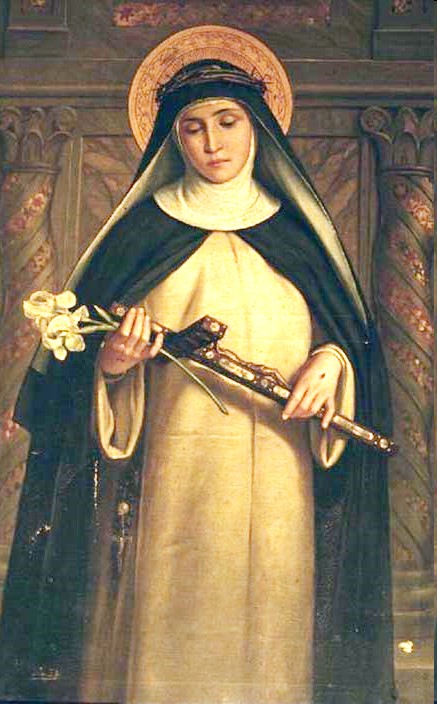
She was the youngest but one of a very large family. Her father, Giacomo di Benincasa, was a dyer; her mother, Lapa, the daughter of a local poet. They belonged to the lower middle-class faction of tradesmen and petty notaries, known as “the Party of the Twelve”, which between one revolution and another ruled the Republic of Siena from 1355 to 1368. From her earliest childhood Catherine began to see visions and to practice extreme austerities. At the age of seven she consecrated her virginity to Christ; in her sixteenth year she took the habit of the Dominican Tertiaries, and renewed the life of the anchorites of the desert in a little room in her father’s house. After three years of celestial visitations and familiar conversation with Christ, she underwent the mystical experience known as the “spiritual espousals”, probably during the carnival of 1366. She now rejoined her family, began to tend the sick, especially those afflicted with the most repulsive diseases, to serve the poor, and to labor for the conversion of sinners. Though always suffering terrible physical pain, living for long intervals on practically no food save the Blessed Sacrament, she was ever radiantly happy and full of practical wisdom no less than the highest spiritual insight. All her contemporaries bear witness to her extraordinary personal charm, which prevailed over the continual persecution to which she was subjected even by the friars of her own order and by her sisters in religion. She began to gather disciples round her, both men and women, who formed a wonderful spiritual fellowship, united to her by the bonds of mystical love. During the summer of 1370 she received a series of special manifestations of Divine mysteries, which culminated in a prolonged trance, a kind of mystical death, in which she had a vision of Hell, Purgatory, and Heaven, and heard a Divine command to leave her cell and enter the public life of the world. She began to dispatch letters to men and women in every condition of life, entered into correspondence with the princes and republics of Italy, was consulted by the papal legates about the affairs of the Church, and set herself to heal the wounds of her native land by staying the fury of civil war and the ravages of faction. She implored the pope, Gregory XI, to leave Avignon, to reform the clergy and the administration of the Papal States, and ardently threw herself into his design for a crusade, in the hopes of uniting the powers of Christendom against the infidels, and restoring peace to Italy by delivering her from the wandering companies of mercenary soldiers. While at Pisa, on the fourth Sunday of Lent, 1375, she received the Stigmata, although, at her special prayer, the marks did not appear outwardly in her body while she lived.
Mainly through the misgovernment of the papal officials, war broke out between Florence and the Holy See, and almost the whole of the Papal States rose in insurrection. Catherine had already been sent on a mission from the pope to secure the neutrality of Pisa and Lucca. In June, 1376, she went to Avignon as ambassador of the Florentines, to make their peace; but, either through the bad faith of the republic or through a misunderstanding caused by the frequent changes in its government, she was unsuccessful. Nevertheless she made such a profound impression upon the mind of the pope, that, in spite of the opposition of the French king and almost the whole of the Sacred College, he returned to Rome (17 January, 1377). Catherine spent the greater part of 1377 in effecting a wonderful spiritual revival in the country districts subject to the Republic of Siena, and it was at this time that she miraculously learned to write, though she still seems to have chiefly relied upon her secretaries for her correspondence. Early in 1378 she was sent by Pope Gregory to Florence, to make a fresh effort for peace. Unfortunately, through the factious conduct of her Florentine associates, she became involved in the internal politics of the city, and during a popular tumult (22 June) an attempt was made upon her life. She was bitterly disappointed at her escape, declaring that her sins had deprived her of the red rose of martyrdom. Nevertheless, during the disastrous revolution known as “the tumult of the Ciompi”, she still remained at Florence or in its territory until, at the beginning of August, news reached the city that peace had been signed between the republic and the new pope. Catherine then instantly returned to Siena, where she passed a few months of comparative quiet, dictating her “Dialogue”, the book of her meditations and revelations.
In the meanwhile the Great Schism had broken out in the Church. From the outset Catherine enthusiastically adhered to the Roman claimant, Urban VI, who in November, 1378, summoned her to Rome. In the Eternal City she spent what remained of her life, working strenuously for the reformation of the Church, serving the destitute and afflicted, and dispatching eloquent letters in behalf of Urban to high and low in all directions. Her strength was rapidly being consumed; she besought her Divine Bridegroom to let her bear the punishment for all the sins of the world, and to receive the sacrifice of her body for the unity and renovation of the Church; at last it seemed to her that the Bark of Peter was laid upon her shoulders, and that it was crushing her to death with its weight. After a prolonged and mysterious agony of three months, endured by her with supreme exultation and delight, from Sexagesima Sunday until the Sunday before the Ascension, she died. Her last political work, accomplished practically from her death-bed, was the reconciliation of Pope Urban VI with the Roman Republic (1380).
Among Catherine’s principal followers were Fra Raimondo delle Vigne, of Capua (d. 1399), her confessor and biographer, afterwards General of the Dominicans, and Stefano di Corrado Maconi (d. 1424), who had been one of her secretaries, and became Prior General of the Carthusians. Raimondo’s book, the “Legend”, was finished in 1395. A second life of her, the “Supplement”, was written a few years later by another of her associates, Fra Tomaso Caffarini (d. 1434), who also composed the “Minor Legend”, which was translated into Italian by Stefano Maconi. Between 1411 and 1413 the depositions of the surviving witnesses of her life and work were collected at Venice, to form the famous “Process”. Catherine was canonized by Pius II in 1461. The emblems by which she is known in Christian art are the lily and book, the crown of thorns, or sometimes a heart–referring to the legend of her having changed hearts with Christ. Her principal feast is on the 30th of April, but it is popularly celebrated in Siena on the Sunday following. The feast of her Espousals is kept on the Thursday of the carnival.
The works of St. Catherine of Siena rank among the classics of the Italian language, written in the beautiful Tuscan vernacular of the fourteenth century. Notwithstanding the existence of many excellent manuscripts, the printed editions present the text in a frequently mutilated and most unsatisfactory condition. Her writings consist of the “Dialogue”, or “Treatise on Divine Providence”; a collection of nearly four hundred letters; and a series of “Prayers”.
The “Dialogue” especially, which treats of the whole spiritual life of man in the form of a series of colloquies between the Eternal Father and the human soul (represented by Catherine herself), is the mystical counterpart in prose of Dante’s “Divina Commedia”.
A smaller work in the dialogue form, the “Treatise on Consummate Perfection”, is also ascribed to her, but is probably spurious. It is impossible in a few words to give an adequate conception of the manifold character and contents of the “Letters”, which are the most complete expression of Catherine’s many-sided personality. While those addressed to popes and sovereigns, rulers of republics and leaders of armies, are documents of priceless value to students of history, many of those written to private citizens, men and women in the cloister or in the world, are as fresh and illuminating, as wise and practical in their advice and guidance for the devout Catholic today as they were for those who sought her counsel while she lived. Others, again, lead the reader to mystical heights of contemplation, a rarefied atmosphere of sanctity in which only the few privileged spirits can hope to dwell. The key-note to Catherine’s teaching is that man, whether in the cloister or in the world, must ever abide in the cell of self-knowledge, which is the stable in which the traveler through time to eternity must be born again.
Born: March 25, 1347 at Siena, Tuscany, Italy
Died: April 29, 1380 of a mysterious and painful illness that came on without notice, and was never properly diagnosed
Canonized: July 1461 by Pope Pius II
Representation: cross; crown of thorns; heart; lily; ring; stigmata
Patronage: against fire, bodily ills, diocese of Allentown, Pennsylvania, USA, Europe, fire prevention, firefighters, illness, Italy, miscarriages, nurses, nursing services, people ridiculed for their piety, sexual temptation, sick people, sickness, Siena Italy, temptations
Saint Peter of Verona

Saint Peter’s parents belonged to the heretical sect of the Cathari, theological descendants of the Manichees. Miraculously, he became Catholic, regardless of his heresy believing parents. Because of his Catholic convictions, he was ridiculed for his faith throughout his youth, it was preserved in purity and he became a Dominican. His father sent him to a Catholic school for a good early education, thinking that the heretical environment at home would keep Peter from being “deceived” by the teachings of the Catholic Church.
Nevertheless, one of the first things Peter learned there was the Apostle’s Creed, which the Cathari abhorred. Making conversation on day, his uncle asked him his lesson. The boy recited the creed and explained it in the Catholic sense, especially in those words: Creator of heaven and earth. In vain his uncle tried to persuade him it was false. He said that it was not God, but the evil principle that made all things that are visible; the Cathari viewed the physical world as ugly and bad, which is inconsistent with the concept of an infinitely perfect being. The boy’s resolute steadiness concerned his uncle, but his father laughed at his brother’s fears believing that the world would influence his son into his beliefs.
When he was 15, Peter was sent to the University of Bologna, a hotbed of licentiousness. There he met Saint Dominic, and instantly threw himself at the saint’s feet to beg admission to the Order of Friar Preachers. Peter was present at the death of the founder soon after, and shared in the primitive zeal and courage of the sons of a saint.
While still a student, Peter experienced a severe trial. He was publicly reprimanded and punished because a brother, passing Peter’s cell late at night, thought he had heard women’s voices in his room. The voices were those of angels, who frequently visited the saint: but in his humility, he thought it better to accept the punishment and say nothing about the favors God had granted him. He was sent to the remote little Dominican convent of Jesi, in the marquisate of Ancona, to do penance, and his ordination was delayed.
Peter found great strength in prayer. Nevertheless, he was human and felt the sting of the disgrace. One day he complained to the Lord: “Lord, You know that I am innocent of this: Why do you allow them to believe it?” A sorrowful voice replied from the crucifix: “And I, Peter, what have I done that they should do this to Me?” Peter complained no more. The truth was eventually discovered, and Peter resumed his studies and was ordained to the priesthood.
Peter soon became a celebrated preacher throughout northern and central Italy, and, in 1232, an inquisitor to fight against the heresy that had infected his family and others in Lombardy. Many miracles (filling 22 pages in folio in the Acta Sanctorum) were worked through his prayers, to the rage of the heretics. Crowds nearly pressed him to death many times: some to ask his blessing, others to offer the sick to him to be cured, others to receive his holy instructions.
In one city, a prominent man had been won to heresy, because the devil, taking the form of the Blessed Virgin, appeared at the heretics’ meetings and encouraged him to join them. Peter, determined to win the man back to the truth, went to the meeting and, when the devil appeared in his disguise, held up a small pox in which he had placed a consecrated Host. “If you are the Mother of God,” cried Peter, “adore your Son!” The devil fled in dismay and many were converted.
Among other miracles, he predicted that he would be murdered by heretics, who indeed waylaid him on the road between Como and Milan. Peter went to his death singing the Easter Sequence, and fell unprotesting beneath the blows of his assassins. Carino cut his head with an ax, and then his companion Dominic stabbed him. As Peter rose to his knees and commended himself to God, Carino killed him with a blow of his axe to Peter’s side. One of his murderers, “Blessed” Carino, was touched by grace at the sight of a saint, was converted, and eventually became a Dominican at Forli. To him as to us, Peter had pointed out the way to heaven when he traced on the dust of the road, in his own blood, the creed that had lighted his path: “Credo in unum Deum.”
Peter’s body was ceremoniously buried in the Dominicans’ church dedicated to St. Eustorgius, in Milan, where he still rests. His head is kept separately in a crystal and gold case. So many miracles were worked at his shrine that many of the Cathari asked to be admitted to the Catholic Church.
Born: Verona, Italy, 1206
Died: Martyred April 6, 1252
Canonized: canonized by Pope Innocent IV in 1253–a single year after his death.
Patronage: Peter is the patron of midwives and inquisitors and venerated in Verona.
Representation: In art, Saint Peter is a Dominican with a gash or knife in his head. Occasionally, the knife is in his shoulder. Sometimes he is portrayed (1) with his finger on his lips; (2) writing credo in unum deum in the dust as he dies; (3) stabbed in the forest with his companion; or (4) with the Virgin and four female saints appearing to him
Saint Lewis Mary Grignon De Montfort
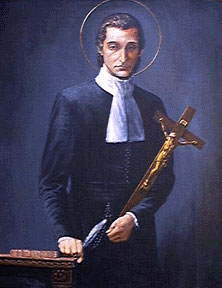
Louis’ parents were poor, hard-working people who raised eight children, the oldest of whom was Louis. In the normal course of events, Louis would have learned a trade and helped to educate his siblings, but early in his life his mother recognized that he was destined for the priesthood. At the pleading of her and his teacher, he was allowed to begin his studies. Some charitable people provided the funds for his education.
As a very young child, Louis had organized Rosary societies, preached sermons, told stories of the saints, and led the Rosary with groups of neighborhood children. He was particularly devoted to Our Lady, and he took her name in confirmation. As a student with the Jesuits at Rennes, he continued his devotions; he joined the sodality, and became an exemplary member. When he had completed his studies, he left for Paris in 1693 to begin his studies for the priesthood. He walked the 130 miles in the rain, sleeping in haystacks and under bridges, and, on arriving in Paris, he entered a poverty-stricken seminary in which the students had scarcely enough to eat, which caused him serious illness. On the verge of ordination, his funds were withdrawn by his benefactor, and it looked as though Louis would have to return home. He was taken in by a kindly priest, however.
Louis was ordained in 1700, and, after saying his first Mass in the Lady Chapel of Saint Sulpice, he was sent as chaplain to a hospital in Poitiers where mismanagement and quarreling were a tradition. He endeared himself to the patients, and he angered the managers of the hospital when he reorganized the staff. Consequently, he was sent away, but not before he had laid the foundation of what was later to be a religious congregation of women known as the Institute of the Daughters of Divine Wisdom at Poitiers, to nurse the sick poor and conduct free schools.
This rebuff was not the first Louis had to suffer; in the seminary, his superiors had exhausted themselves in trying his patience– making him seem to be a fool. All his life he was to meet the same stubborn opposition to everything he tried to do. Many of the clergy, even some of the bishops, were infected with Jansenism, and they fought him secretly and openly. In his work giving missions, his moving from one place to another was occasioned as often by the persecution of his enemies as it was by the need of his apostolate. Going to Rome, he begged Pope Clement XI to be sent on the foreign missions, but he was refused and sent back to Brittany, France, as missionary apostolic. He returned in his usual spirit of buoyant obedience, even though he knew that several bishops had already forbidden him to set foot in their dioceses.
For the rest of his life, Louis gave flamboyant missions in country parishes, some of which had been without the care of a priest for generations. Ruined churches were repaired, marriages rectified, children baptized and instructed, and Catholicity rebuilt. He joined the third order of Dominicans, and everywhere he went, he established the Rosary devotion. People who came to his missions out of curiosity, remained, and his preaching did much to renew religion in France.
His enemies were as busy as he was, however. They gave false reports to the bishops, drove him from place to place, and, in one case, succeeded in poisoning him. The poison was not fatal, and it had an unforeseen result. While he recuperated from its evil effects, he wrote True devotion to the Blessed Virgin, which he himself prophesied would be hidden away by the malice of men and the devil. After nearly 200 years, the manuscript was rescued from its hiding place, and, only a few years ago, it was given the publicity that it deserved.
In 1715, Louis founded a second religious congregation to train helpers in his forceful methods of preaching called the Missionaries of the Company of Mary.
Born: January 13, 1673 at Montfort-La-Cane, Brittany, France
Died: 1716 at Saint-Laurent-sur-Sovre, France
Canonized: 1947 by Pope Pius XII
 The Order of Preachers, Independent
You must be logged in to post a comment.