
Category: Dominican Saints

Fra Angelico
 Fra Angelico (c. 1395 – February 18, 1455), born Guido di Pietro, was an Early Italian Renaissance painter described by Vasari in his Lives of the Artists as having “a rare and perfect talent”. He was known to his contemporaries as Fra Giovanni da Fiesole (Brother John from Fiesole) and by Vasari as Fra Giovanni Angelico (Brother John the Angelic One).
Fra Angelico is known in Italy as il Beato Angelico, the term “Il Beato” (“Blessed One”) being already in use during his lifetime or shortly thereafter, in reference to his skills in painting religious subjects. In 1982 Pope John Paul II conferred beatification, in recognition of the holiness of his life, thereby making this title official. Fiesole is sometimes misinterpreted as being part of his formal name, but it was merely the name of the town where he took his vows as a Dominican friar, and was used by contemporaries to separate him from other Fra Giovannis. He is listed in the Roman Martyrology as Beatus Ioannes Faesulanus, cognomento Angelicus—”Blessed Giovanni of Fiesole, nicknamed Angelico”.
Vasari wrote of Fra Angelico: But it is impossible to bestow too much praise on this holy father, who was so humble and modest in all that he did and said and whose pictures were painted with such facility and piety.
Early life, 1395–1436
Fra Angelico was born Guido di Pietro at Rupecanina,[7] in the Tuscan area of Mugello, near Fiesole towards the end of the 14th century and died in Rome in 1455. Nothing is known of his parents. He was baptized Guido or Guidolino. The earliest recorded document concerning Fra Angelico dates from October 17, 1417 when he joined a religious confraternity at the Carmine Church, still under the name of Guido di Pietro. This record also reveals that he was already a painter, a fact that is subsequently confirmed by two records of payment to Guido di Pietro in January and February 1418 for work done in the church of Santo Stefano del Ponte. The first record of Angelico as a friar dates from 1423, when he is first referred to as Fra Giovanni, following the custom of those entering a religious order of taking a new name. He was a member of the Dominican community at Fiesole. Fra, an abbreviation of frate (from the Latin frater), is a conventional title for a friar or brother.
According to Vasari, Fra Angelico initially received training as an illuminator, possibly working with his older brother Benedetto who was also a Dominican and an illuminator. San Marco in Florence holds several manuscripts that are thought to be entirely or partly by his hand. The painter Lorenzo Monaco may have contributed to his art training, and the influence of the Sienese school is discernible in his work. He had several important charges in the convents he lived in, but this did not limit his art, which very soon became famous. According to Vasari, the first paintings of this artist were an altarpiece and a painted screen for the Carthusian Monastery of Florence; none such exist there now.[2]
From 1408 to 1418 Fra Angelico was at the Dominican friary of Cortona where he painted frescoes, now destroyed, in the Dominican Church and may have been assistant to or follower of Gherardo Starnina. Between 1418 and 1436 he was at the convent of Fiesole where he also executed a number of frescoes for the church, and the Altarpiece, deteriorated but restored. A predella of the Altarpiece remains intact in the National Gallery, London which is a superb example of Fra Angelico’s ability. It shows Christ in Glory, surrounded by more than 250 figures, including beatified Dominicans.
San Marco, Florence, 1436–1445
In 1436 Fra Angelico was one of a number of the friars from Fiesole who moved to the newly-built Friary of San Marco in Florence. This was an important move which put him in the centre of artistic activity of the region and brought about the patronage of one of the wealthiest and most powerful members of the city’s Signoria, Cosimo de’ Medici, who had a large cell (later occupied by Savonarola) reserved for himself at the friary in order that he might retreat from the world. It was, according to Vasari, at Cosimo’s urging that Fra Angelico set about the task of decorating the monastery, including the magnificent Chapter House fresco, the often-reproduced Annunciation at the top of the stairs to the cells, the Maesta with Saints and the many smaller devotional frescoes depicting aspects of the Life of Christ that adorn the walls of each cell.
In 1439 he completed one of his most famous works, the Altarpiece for St. Marco’s, Florence. The result was unusual for its times. Images of the enthroned Madonna and Child surrounded by saints were common, but they usually depicted a setting that was clearly heavenlike, in which saints and angels hovered about as divine presences rather than people. But in this instance, the saints stand squarely within the space, grouped in a natural way as if they were able to converse about the shared experience of witnessing the Virgin in glory. Paintings such as this, known as Sacred Conversations, were to become the major commissions of Giovanni Bellini, Perugino and Raphael.
The Vatican, 1445–1455
In 1445 Pope Eugenius IV summoned him to Rome to paint the frescoes of the Chapel of the Holy Sacrament at St Peter’s, later demolished by Pope Paul III. Vasari claims that at this time Fra Angelico was offered by Pope Nicholas V the Archbishopric of Florence, and that he refused it, recommending another friar for the position. While the story seems possible and even likely, if Vasari’s date is correct, then the pope must have been Eugenius and not Nicholas. In 1447 Fra Angelico was in Orvieto with his pupil, Benozzo Gozzoli, executing works for the Cathedral. Among his other pupils were Zanobi Strozzi.
From 1447 to 1449 he was back at the Vatican, designing the frescoes for the Niccoline Chapel for Nicholas V. The scenes from the lives of the two martyred deacons of the Early Christian Church, St. Stephen and St. Lawrence may have been executed wholly or in part by assistants. The small chapel, with its brightly frescoed walls and gold leaf decorations gives the impression of a jewel box. From 1449 until 1452, Fra Angelico was back at his old convent of Fiesole, where he was the Prior.
Death and beatification
In 1455 Fra Angelico died while staying at a Dominican Convent in Rome, perhaps in order to work on Pope Nicholas’ Chapel. He was buried in the church of Santa Maria sopra Minerva.
When singing my praise, don’t liken my talents to those of Apelles.
Say, rather, that, in the name of Christ, I gave all I had to the poor.
The deeds that count on Earth are not the ones that count in Heaven.
I, Giovanni, am the flower of Tuscany.
—Translation of epitaph
Pope John Paul II beatified Fra Angelico on October 3, 1982 and in 1984 declared him patron of Catholic artists.
Angelico was reported to say “He who does Christ’s work must stay with Christ always”. This motto earned him the epithet “Blessed Angelico”, because of the perfect integrity of his life and the almost divine beauty of the images he painted, to a superlative extent those of the Blessed Virgin Mary.
From various accounts of Fra Angelico’s life, it is possible to gain some sense of why he was deserving of canonization. He led the devout and ascetic life of a Dominican friar, and never rose above that rank; he followed the dictates of the order in caring for the poor; he was always good-humored. All of his many paintings were of divine subjects, and it seems that he never altered or retouched them, perhaps from a religious conviction that, because his paintings were divinely inspired, they should retain their original form. He was wont to say that he who illustrates the acts of Christ should be with Christ. It is averred that he never handled a brush without fervent prayer and he wept when he painted a Crucifixion. The Last Judgment and the Annunciation were two of the subjects he most frequently treated.
Ambrose was born at Siena on 16 April 1220, of the noble family of Sansedoni. When about one year old, Ambrose was cured of a congenital deformity, in the Dominican church of St. Mary Magdalene. As a child and youth he was noted for his love of charity, exercised especially towards pilgrims, the sick in hospitals, and prisoners. He entered the novitiate of the Dominican convent in his native city at the age of seventeen, was sent to Paris to continue his philosophical and theological studies under Albert the Great and had for a fellow-student there, St. Thomas Aquinas.
In 1248 he was sent with St. Thomas to Cologne where he taught in the Dominican schools. In 1260 he was one of the band of missionaries who evangelized Hungary. In 1266 Sienna was put under an interdict for having espoused the cause of the Emperor Frederick II, then at enmity with the Holy See. The Siennese petitioned Ambrose to plead their cause before the Sovereign Pontiff, and so successfully did he do this that he obtained for his native city full pardon and a renewal of all her privileges. The Siennese soon cast off their allegiance; a second time Ambrose obtained pardon for them. He brought about a reconciliation between King Conradin of Germany and Pope Clement IV.
About this time he was chosen bishop of his native city, but he declined the office. For a time, he devoted himself to preaching the Eighth Crusade; and later, at the request of Pope Gregory X, caused the studies which the late wars had practically suspended to be resumed in the Dominican convent at Rome. After the death of Pope Gregory X he retired to one of the convents of his order, whence he was summoned by Innocent V and sent as papal legate to Tuscany. He restored peace there between Florence and Pisa and also between the dogal republics of Venice and Genoa, another pair of commercial rivals within Italy.
He died at Sienna, in 1286. His name was inserted in the Roman Martyrology in 1577. His biographers exhibit his life as one of perfect humility. He loved poetry, and many legends are told of victories over carnal temptations.
He was renowned as a preacher. His oratory, simple rather than elegant, was most convincing and effective. His sermons, although once collected, are not extant
Blessed Peter Geremia
 God has a mission for each of us and has given us the gifts to successfully complete the purpose for which He created us. Our job is to discern our role in His creation. The gifts He has given us can be the instrument of our damnation when used against His purposes; when we discern correctly through prayer and spiritual direction these same talents and abilities can sanctify us and those around us. It’s not too late to seek God’s will for your life–in fact, we should attempt to understand His will for our every action, each day, using all the gifts his has given us.
Peter Geremia was unusually gifted. He was sent early to the University of Bologna, where he passed his studies brilliantly, and attracted the attention and praise of all. On the brink of a successful career as a lawyer, he experienced a sudden and total conversion.
Having retired one night, he was pleasantly dreaming of the honors that would soon come to him in his work, when he heard a knock at the window. As his room was on the third floor, and there was nothing for a human to stand on outside his window, he sat up, in understandable fright, and asked who was there.
A hollow voice responded that he was a relative who had just died, a successful lawyer who had wanted human praise so badly that he had lied to win it, and now was eternally lost because of his pride. Peter was terrified, and acted at once upon the suggestion to turn, while there was still time, from the vanity of public acclaim. He went the next day to a locksmith and bought an iron chain, which he riveted tightly about him. He began praying seriously to know his vocation.
Soon thereafter, God made known to him that he should enter the Dominican Order. He did so as soon as possible. His new choice of vocation was a bitter blow to his father, who had gloried in his son’s achievements, hoping to see him become the most famous lawyer in Europe. He angrily journeyed to Bologna to see his son and demanded that he come home. The prior, trying to calm the excited man, finally agreed to call Peter. As the young man approached them, radiantly happy in his new life, the father’s heart was touched, and he gladly gave his blessing to the new undertaking.
Peter’s brilliant mind and great spiritual gifts found room for development in the order, and he became known as one of the finest preachers in Sicily. He was so well known that Saint Vincent Ferrer asked to see him, and they conversed happily on spiritual matters. He always preached in the open air, because there was no church large enough to hold the crowds that flocked to hear him.
Being prior of the abbey, Peter was consulted one day when there was no food for the community. He went down to the shore and asked a fisherman for a donation. He was rudely refused. Getting into a boat, he rowed out from the shore and made a sign to the fish; they broke the nets and followed him. Repenting of his bad manners, the fisherman apologized, whereupon Peter made another sign to the fish, sending them back into the nets again. The records say that the monastery was ever afterwards supplied with fish.
Peter was sent as visitator to establish regular observance in the monasteries of Sicily. He was called to Florence by the pope to try healing the Greek schism. A union of the opposing groups was affected, though it did not last. Peter was offered a bishopric (and refused it) for his work in this matter.
At one time, when Peter was preaching at Catania, Mount Etna erupted and torrents of flame and lava flowed down on the city. The people cast themselves at his feet, begging him to save them. After preaching a brief and pointed sermon on repentance, Peter went into the nearby shrine of Saint Agatha, removed the veil of the saint, which was there honored as a relic, and held it towards the approaching tide of destruction. The eruption ceased and the town was saved.
This and countless other miracles he performed caused him to be revered as a saint. He raised the dead to life, healed the crippled and the blind, and brought obstinate sinners to the feet of God. Only after his death was it known how severely he had punished his own body in memory of his youthful pride (Benedictines, Dorcy).
Born: Palermo, Sicily, Italy, in 1381
Died: March 7, 1432
Beatified: Pius VI confirmed cultus in 1784
Blessed Jordan of Pisa
 At a time when scholars believed that no colloquial tongue could ever replace Latin as a gentleman’s language, Jordan worked to make Italian the beautiful tongue that it is today. That’s not the reason he was beatified by the Church but it’s interesting and sometimes overlooked.
Jordan attended the University of Paris where he first encountered the Dominican friars in 1276. Four years later, probably after obtaining his degrees, he returned to Italy and took the habit. He began a long teaching career there as soon as he was qualified to do so.
Because of the excellence of his preaching in Florence, Jordan was appointed first lector there in 1305. He seems to have been fascinated with the whole question of preaching as an apostolic tool, and to have been one of the first to make a scientific study of it. He pointed out that the Greek church was “invaded by a multitude of errors,” because the Greeks had no preachers; he could never say enough in praise of Saint Dominic’s farsightedness in establishing an order specifically for preaching.
Jordan studied methods of making sermons more effective, both by using examples that would reach the people, and by the use of the vernacular. This latter was a much-disputed subject in his day (they had Dan Amon’s then, too); Jordan was considered a daring innovator. Because it was controversial, he strove to make Italian a beautiful instrument on which he could play the melodies of the Lord.
Blessed with an extraordinary memory, Jordan is supposed to have known the breviary by heart, as well as the missal, most of the Bible (with its marginal commentary), plus the second part of the Summa. This faculty of memory he used in his sermons, but he was quick to point out to young preachers that learning alone can never make a preacher. By the holiness of his own life he made this plain, and continually preached it to those he was training to preach.
Jordan of Pisa had two great devotions–to Our Blessed Mother and to Saint Dominic. Once he was favored with a vision of Our Lady; she came into the fathers’ refectory and served at table. Jordan, who was the only one who could see her, could barely eat for excitement. He spoke often of her in his sermons, and also of Saint Dominic. He founded a number of confraternities in Pisa, one of which has lasted until now.
Jordan died on his way to Paris to teach at Saint Jacques. His body was returned from Piacenza, where death overtook him, to rest in the church at Pisa (Benedictines, Dorcy).
Born:1255 at Pisa, Italy
Died: August 19, 1311 at Piacenza of natural causes while on his way to teach in Paris; relics venerated at the church of Saint Catalina at Pisa, Italy
Beatified: August 23, 1833 (cultus confirmed) by Pope Gregory XVI; 1838 (beatification)
Blessed Henry of Suso
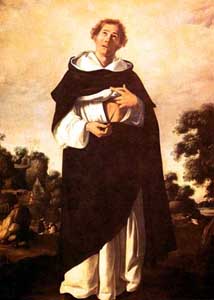 His father belonged to the noble family of Berg; his mother, a holy woman from whom he took his name, to a family of Sus (or Süs). When thirteen years of age he entered the Dominican convent at Constance, where he made his preparatory, philosophical, and theological studies.
From 1324 to 1327 he took a supplementary course in theology in the Dominican studium generale at Cologne, where he sat at the feet of Johann Eckhart, “the Master”, and probably at the side of Tauler, both celebrated mystics. Returning to Constance, he was appointed to the office of lector, from which he seems to have been removed some time between 1329 and 1334. In the latter year he began his apostolic career. About 1343 he was elected prior of a convent, probably at Diessenhofen. Five years later he was sent from Constance to Ulrn where he remained until his death.
Suso’s life as a mystic began in his eighteenth year, when giving up his careless habits of the five preceding years, he made himself “the Servant of the Eternal Wisdom”, which he identified with the Divine essence and, in a concrete form, with the personal Eternal Wisdom made man. Henceforth a burning love for the Eternal Wisdom dominated his thoughts and controlled his actions. He had frequent visions and ecstasies, practised severe austerities (which he prudently moderated in maturer years), and bore with rare patience corporal afflictions, bitter persecutions and grievous calumnies.
He became foremost among the Friends of God in the work of restoring religious observance in the cloisters. His influence was especially strong in many convents of women, particularly in the Dominican convent of Katherinenthal, a famous nursery of mysticism in the thirteenth and fourteenth centuries, and in that of Toss, where lived the mystic Elsbeth Stagel, who turned some of his Latin into German, collected and preserved most of his extant letters, and drew from him the history of his life which he himself afterwards developed and published.
In the world he was esteemed as a preacher, and was heard in the cities and towns of Swabia, Switzerland, Alsace, and the Netherlands. His apostolate, however, was not with the masses, but rather with individuals of all classes who were drawn to him by his singularly attractive personality, and to whom he became a personal director in the spiritual life.
It has often been incorrectly said that he established among the Friends of God a society which he called the Brotherhood of the Eternal Wisdom. The so-called Rule of the Brotherhood of the Eternal Wisdom is but a free translation of a chapter of his “Horologium Sapientiae”, and did not make its appearance until the fifteenth century.
HIS WRITINGS
The first writing from the pen of Suso was the “Büchlein der Wahrheit”, which he issued while a student at Cologne. Its doctrine was unfavourably criticized in some circles — very probably on account of its author’s close relations with Eckhart, who had just been called upon to explain or to reject certain propositions — but it was found to be entirely orthodox.
As in this, so in his other writings Suso, while betraying Eckhart’s influence, always avoided the errors of “the Master”. The book was really written in part against the pantheistic teachings of the Beghards, and against the libertine teachings of the Brethren of the Free Spirit. Father Denifle considers it the most difficult “little book” among the writings of the German mystics.
Whereas in this book Suso speaks as a contemplative and to the intellect, in his next, “Das Büchlein der ewigen Weisheit”, published early in 1328, he is eminently practical and speaks out of the fullness of his heart to “simple men who still have imperfections to be put off”. Bihlmeyer accepts Denifle’s judgment that it is the “most beautiful fruit of German mysticism”, and places it next to the “Homilies” of St. Bernard, and the “Imitation of Christ” by Thomas à Kempis. In the second half of the fourteenth and in the fifteenth century there was no more widely read meditation book m the German language.
In 1334 Suso translated this work into Latin, but in doing so added considerably to its contents, and made of it an almost entirely new book, to which he gave the name “Horologium Sapientiae”. Even more elevating than the original, finished in language, rich in figure, rhythmic in movement, it became a favourite book in the cloisters at the close of the Middle Ages, not only in Germany, but also in the Netherlands, France, Italy, and England.
To the same period of Suso’s literary activity may belong “Das Minnebüchlein” but its authenticity is doubtful.
After retiring to Ulm Suso wrote the story of his inner life (“Vita” or “Leben Seuses”), revised the “Büchlein der Wahrheit”, and the “Büchlein der ewigen Weisheit”, all of which, together with eleven of his letters (the “Briefbüchlein”), and a prologue, he formed into one book known as the “Exemplar Seuses”.
Suso is called by Wackernagel and others a “Minnesinger in prose and in the spiritual order.” The mutual love of God and man which is his principal theme gives warmth and colour to his style. He used the full and flexible Alamannian idiom with rare skill, and contributed much to the formation of good German prose, especially by giving new shades of meaning to words employed to describe inner sensations. His intellectual equipment was characteristic of the schoolmen of his age. In his doctrine there was never the least trace of an unorthodox tendency.
For centuries he exercised an influence upon spiritual writers. Among his readers and admirers were Thomas à Kempis and Bl. Peter Canisius.
The Catholic Encyclopedia, Volume VII
Nihil Obstat, June 1, 1910, Remy Lafort, S.T.D., Censor
Imprimatur. +John Cardinal Farley, Archbishop of Ne
Born: March 21, 1295 at Uberlingen, Germany as Heinrich von Berg
Died: January 25, 1361 at Ulm, Germany
Beatified: 1831 by Pope Gregory XVI
Representation: Dominican with the Holy Name on his chest
Works: Book of the Eternal Wisdom, The Thirst of God
Blessed Christopher of Milan
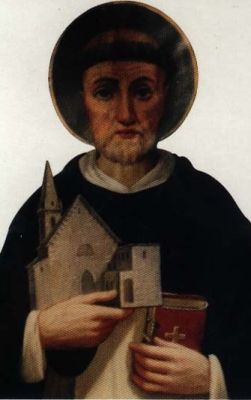 Nothing is known of the early years of Blessed Christopher. He received the Dominican habit in the convent of San Eustorgio in Milan, Italy, in the early 15th century. He is recorded as being “holy and abstemious, humble and studious”–the ordinary virtues that we have come to take for granted among the beati; there is nothing to indicate the type of person Christopher was, or what peculiar circumstances might have led him to the Dominicans. He is noted especially for his preaching and for his gift of prophecy.
The age in which Christopher lived was a rough and dangerous one, and a time for prophets and penitents to thrive. He was himself an apostolic preacher throughout Liguria and the Milanese, famous for the impact of his sermons on sinners. He had a vivid power of description and this, coupled with his gift of prophecy, made his sermons unforgettable.
Christopher worked in many parts of Italy, but his name is particularly venerated in Taggia, where he spent many years. As a result of his preaching, the people of Taggia built a monastery and church dedicated to Our Lady of Mercy and Christopher became its first abbot. A great wave of spiritual revival was felt in Taggia during his tenure, but he was not optimistic about the future.
In a vision he saw that most of the population would be carried off by plague. Twenty years before anyone was paying any attention to the Turks, he told the people of Taggia that Turks would invade the city, and they did, as he had prophesied. A disastrous flood swept the area, fulfilling another of his prophesies. He wrote four volumes of sermon aids, containing scriptural examples and quotations from the Fathers of the Church.
In 1484, when he was absent from Taggia preaching a mission, Christopher fell ill and knew that he was about to die. He insisted on returning to his own monastery at Taggia. There he received the last sacraments and immediately died (Benedictines, Dorcy).
Born: In the early part of the 15th century
Died: 1484 at Our Lady of Mercy convent, Taggia, Italy of natural causes
Beatified: 1875 by Pope Pius IX
Blessed Constantius

Constantius Bernocchi is as close to a ‘sad saint’ as it’s possible for a Dominican to get; he is said to have had the gift of tears. However, that is not his only claim to fame. Constantius had an remarkable childhood, not only for the usual signs of precocious piety, but also for a miracle that he worked when he was a little boy. Constantius had a sister who had been bedridden most of her nine years of life. One day, the little boy brought his parents in to her bedside and made them pray with him. The little girl rose up, cured, and she remained well for a long and happy life. Naturally, the parents were amazed, and they were quite sure it had not been their prayers that effected the cure, but those of their little son.
Constantius entered the Dominicans at age 15, and had as his masters Blessed Conradin and Saint Antoninus. He did well in his studies and wrote a commentary on Aristotle. His special forte was Scripture, and he studied it avidly. After his ordination, he was sent to teach in various schools in Italy, arriving eventually at the convent of San Marco in Florence, which had been erected as a house of strict observance. Constantius was eventually appointed prior of this friary that was a leading light in the reform movement. This was a work dear to his heart, and he himself became closely identified with the movement.
Several miracles and prophecies are related about Constantius during his stay in Florence. He one day told a student not to go swimming, because he would surely drown if he did. The student, of course, dismissed the warning and drowned. One day, Constantius came upon a man lying in the middle of the road. The man had been thrown by his horse and was badly injured; he had a broken leg and a broken arm. All he asked was to be taken to some place where care could be given him, but Constantius did better than that–he cured the man and left him, healed and astonished.
Constantius was made prior of Perugia, where he lived a strictly penitential life. Perhaps the things that he saw in visions were responsible for his perpetual sadness, for he foresaw many of the terrible things that would befall Italy in the next few years. He predicted the sack of Fabriano, which occurred in 1517. At the death of Saint Antoninus, he saw the saint going up to heaven, a vision which was recounted in the canonization process.
Blessed Constantius is said to have recited the Office of the Dead every day, and often the whole 150 Psalms, which he knew by heart, and used for examples on every occasion. He also said that he had never been refused any favor for which he had recited the whole psalter. He wrote a number of books; these, for the most part, were sermon material, and some were the lives of the blesseds of the order.
On the day of Constantius’s death, little children of the town ran through the streets crying out, “The holy prior is dead! The holy prior is dead!” On hearing of his death, the city council met and stated that it was a public calamity.
The relics of Blessed Constantius have suffered from war and invasion. After the Dominicans were driven from the convent where he was buried, his tomb was all but forgotten for a long time. Then one of the fathers put the relics in the keeping of Camaldolese monks in a nearby monastery, where they still remain (Benedictines, Dorcy, Encyclopedia).
Born: Born in the early part of the 15th century in Fabriano, Marches of Ancona, Italy
Died: 1481 of natural causes; the local senate and council assembled at the news of his death, proclaimed it a “public calamity”, and voted to pay for the funeral
Beatified: 1821 (cultus confirmed) by Pope Pius VII
Blessed Alvarez of Cordova
 Blessed Alvarez is claimed by both Spain and Portugal. He received the habit in the convent of Saint Paul in Cordova in 1368, and had been preaching there for some time in Castile and Andalusia when Saint Vincent Ferrer began preaching in Catalonia. Having gone to Italy and the Holy Land on a pilgrimage, Alvarez returned to Castile and preached the crusade against the infidels. He was spiritual advisor to the queen-mother of Spain, Catherine daughter of John of Gaunt, and tutor to her son John II. Alvarez had the work of preparing the people spiritually for the desperate effort to banish the Moors from Spain. He also opposed the Avignon pope Peter de Luna.
Blessed Alvarez is probably best remembered as a builder of churches and convents, an activity which was symbolic of the work he did in the souls of those among whom he preached. He founded, in one place, a convent to shelter a famous image of Our Lady, which had been discovered in a miraculous manner. Near Cordova he built the famous convent of Scala Coeli, a haven of regular observance. It had great influence for many years. His building enterprises were often aided by the angels, who, during the night, carried wood and stones to spots convenient for the workmen.
The austerities of Alvarez were all the more remarkable in that they were not performed by a hermit, but by a man of action. He spent the night in prayer, as Saint Dominic had done; he wore a hairshirt and a penitential chain; and he begged alms in the streets of Cordova for the building of his churches, despite the fact that he had great favor at court and could have obtained all the money he needed from the queen. He had a deep devotion to the Passion, and had scenes of the Lord’s sufferings made into small oratories in the garden of Scala Coeli.
On one occasion, when there was no food for the community but one head of lettuce left from the night before, Blessed Alvarez called the community together in the refectory, said the customary prayers, and sent the porter to the gate. There the astonished brother found a stranger, leading a mule; the mule was loaded with bread, fish, wine, and all things needed for a good meal. The porter turned to thank the benefactor and found that he had disappeared.
At another time, Blessed Alvarez was overcome with pity at a dying man who lay untended in the street. Wrapping the man in his mantle, he started home with the sufferer, and one of the brothers asked what he was carrying. “A poor sick man,” replied Alvarez. But when they opened the mantle, there was only a large crucifix in his arms. This crucifix is still preserved at Scala Coeli.
Blessed Alvarez died and was buried at Scala Coeli. An attempt wads made later to remove the relics to Cordova, but it could not be done, because violent storms began each time the journey was resumed, and stopped when the body was returned to its original resting place.
Founded Escalaceli (Ladder of Heaven), a Dominican house of strict observance in the mountains around Cordova; it became a well known center of piety and learning. Alvarez spent his days there preaching, teaching, begging alms in the street, and spending his nights in prayer. In the gardens of the house he set up a series of oratories with images of the Holy Lands and Passion, similar to modern Stations of the Cross.
A bell in the chapel of Blessed Alvarez, in the convent of Cordova, rings of itself when anyone in the convent, or of special not in the order, is about to die (Benedictines, Dorcy).
There are many wonderful stories attached to Alvarez, which include:
|
||
|
||
|
||
|
||
|
Born: Born about the middle of the 14th century in Cordova, Spain
Died: 1420
Beatified: Cultus confirmed September 22 by Benedict XIV in 1741
Blessed Reginald

In calling the subject of this sketch Reginald of Saint Gilles, as he himself admits, Father Touron only follows the custom of his day, which was established by Anthony of Sienna, a native of Guimaraens, Portugal, Anthony stated in his Chronicles that Reginald was born at Saint Gilles, a small town in the Department of Gard, southern France. Most later writers think this honor more probably belongs to Orleans, and therefore give our blessed the name of Reginald of Orleans. In so designating him, we follow these authors rather than Touron, who also says that some are of the opinion that the early Friar Preacher first saw the light of day at Orleans. Mortier (I, 96) gives the year 1183 as the date of his birth.(1)
Few of the early members of the Order are mentioned so often, or in terms of such high praise, as Blessed Reginald. No doubt the historians take their cue from Blessed Jordan of Saxony, who knew him personally. Albeit, it is certain that he was one of the most distinguished among Saint Dominic’s first disciples. He sanctified his great learning and rare talent by prayer and an insatiable zeal for the salvation of his fellowman. Renowned canonist and forceful, eloquent preacher though he was, he gloried only in being an ambassador of Christ and a harvester of souls. Doubtless these qualities helped to bring Reginald and Dominic together so quickly and to unite them so closely.
Our future Friar Preacher was sent to the University of Paris in early manhood, where he not only met with signal success in his studies, but also (in 1206) obtained the doctor’s degree with applause. Then he taught canon law for some five years in his alma mater, being considered one of the bright lights of the institution. The high esteem which all showed him did not cause him to be any the less a man of God. His great devotion to the Blessed Virgin stood him in good stead; for, we are told, it acted as a safeguard against the snares of pride, luxury, and ambition. He gave much time to meditation on things divine. One of his pronounced traits was love for the poor; another was humility. Whilst kind to others, he practised great austerity with himself. Thus we are not surprised to learn that his progress in virtue was as rapid as that which he made in knowledge; or that, when the post of dean for the canons at Saint Aignan’s, Orleans, became vacant, all eyes were turned towards the model professor as the best man for the place.
The canons elected Reginald their dean without delay. One of the things which specially recommended him for the position was the fact that he did not desire it. Just when he received this promotion we do not know. But (on page 82 of his Antiquities of the Church and Diocese of Orleans — Antiquities de 1’Eglise et Diocese d’Orleans) Francis Lemaire says that the subject of our sketch was dean of Saint Aignan’s in 1212. Here he found himself bound to the service of God and His altar by new bonds, which gave a fresh impulse to his zeal to walk in the path of justice and to carry on his good works.
History tells us that the life of our dean was most edifying. It was hidden, as the apostle expresses it, in that of Christ our Lord. His charity towards those in need was almost boundless. He showed himself a model in all things. Yet he felt that something more was demanded of him. He feared the malediction which our Lord placed on the rich, reflected on the number of those who die impenitent after lives spent in sin, or without a knowledge of God’s justice, and trembled lest he should be condemned for burying the talent given him. Without any suspicion of the designs of heaven on him, the holy man longed to dispose of all he possessed and to go about the world poor and preaching Christ crucified. This he believed was his vocation; and he doubled his prayers and penances that he might learn the divine will.
At this juncture, providence came to Reginald’s assistance. The Right Rev. Manasses de Seignelay, bishop of Orleans, determined to visit Rome and the Holy Land. As the prelate was a close friend of the young dean, and enjoyed his enlightened conversation, he requested Reginald to accompany him on this journey. The subject of our sketch readily accepted the invitation, for it would give him an opportunity of satisfying his devotion at the places rendered sacred by the tread of our Lord and the blood of His martyrs.
The two travelers arrived in the Eternal City shortly before Easter, or in April, 1218. In a conversation with Cardinal Ugolino di Segni Reginald spoke of his ardent desire to imitate the apostles, and to go from place to place as a poor ambassador of Christ preaching the Gospel. As yet, however, he did not know how he was to put his wish into execution. His eminence (later Gregory IX) then proceeded to tell the pious dean that the way was already open to him; that a new religious order had just been instituted for that very purpose; and that its founder, who was renowned for his miracles, was actually in Rome, where he preached every day with marvelous effect. Filled with joy at the prospect of realizing his design in the near future, Reginald made haste to meet the harvester of souls, of whom he had been told. Charmed with Dominic’s personality and sermons, he determined to become one of his disciples without delay.
Indeed, the attraction between the two holy men was mutual. Meantime, however, Reginald became so ill that the physicians despaired of his life. In this extremity Dominic had recourse to his usual remedy, prayer; and in a few days his new friend was again in perfect health. In their piety both attributed the miraculous cure to the intercession of the Mother of God. Jordan of Saxony assures us that the Blessed Virgin appeared to Reginald in his sickness, told him to enter the new Order, and showed him the distinctive habit which the Friars Preacher should wear. Until this time they had dressed like the Canons Regular of Osma, of whom Dominic had been a member. Practically all the historians tell us that, in consequence of Reginald’s vision, the saint now adopted the garb which his followers have worn ever since, and that the former dean of Saint Aignan’s was the first to receive it from his hands.
Reginald was clothed in the religious habit immediately after the recovery of his health. At the same time, or very shortly afterwards, he made his profession to Dominic. However, this new allegiance did not prevent his journey to the Holy Land; for the saint permitted him to continue his way with Bishop de Seignelay. On his return to Italy from Jerusalem, perhaps in the middle fall of 1218, Dominic, who was still at Rome, sent the former dean to Bologna, which he reached in December. The high opinion which the patriarch had conceived of Reginald is shown by the fact that he appointed him his vicar (some say prior) over the incipient convent in that university city.
More than one thing evidently contributed to this immediate promotion to leadership. The house in Bologna had been started in the spring of the same year. While the first fathers stationed there were very cordially received, and were given Santa Maria della. Mascarella for a convent by Bishop Henry di Fratta, they found it hard to make the rapid headway which both they and Dominic evidently desired to see in the noted educational center. Reginald’s reputation, ability, eloquence, and experience at the University of Paris, it was felt, would combine with his rare virtue to bring about this desideratum. Nor were these expectations disappointed.
Hardly, indeed, had the former dean of Saint Aignan’s arrived at his destination, before the entire city was flocking to hear him preach. The effect of his sermons was marvellous. Hardened sinners gave up their evil ways; inveterate enemies buried their differences of long standing; the religion and moral tone of the people changed notably for the better. None seemed able to resist the attraction of the orator’s personality, or the persuasion of his burning eloquence. All felt that a new Elias had come among them. He held the place, as it were, in the palm of his hand. No one could doubt but that he had found his vocation.
Reginald drew the clergy as well as the laity; those of the university, whether professors or students, as well as the citizens. His example quickened the zeal of his confrères, for he preached every day-sometimes twice or even thrice. Vocations to the Order were so frequent that, within a few weeks, Santa Maria della Mascarella was overcrowded. They came from every walk in life. The university contributed a large number of both students and masters, some of whom were among the brightest lights of the institution with worldwide fame.
Bishop di Fratta and the papal legate, Cardinal Ugolino di Segni, were so pleased with the good effected by Reginald and his Friars Preacher that they gave him the Church of Saint Nicholas of the Vines, in order to enable him to receive more subjects. This was in the spring of 1219. Here a much larger convent was built at once. Rudolph of Faenza, the zealous pastor of Saint Nicholas, not content with surrendering his church to the Order, also received the habit from our blessed Reginald that he might join in the harvest of souls. He helped to erect the Convent of Saint Nicholas, now known as Saint Dominic’s, to which the community was transferred as soon as ready for occupation.
In his government of the large Bolognese community Blessed Reginald combined great charity and gentleness with a wise strictness. He did not suffer even slight transgressions to go uncorrected. Yet he was so skillful in his management of men and in his administration of punishment that his confrères, for they knew he ever acted for their good, held him in even greater affection than those not of the Order. All regarded him as a true man of God seeking to lead them to heaven. His every word, his very silence, bespoke virtue. With profound humility and a rare spirit of recollection he joined an extreme personal austerity.
The days the holy man spent in preaching to the people and spiritual conferences to his religious. The nights he gave largely to prayer. God blessed his efforts. Scarcely nine months had he been superior. Within that brief time Saint Nicholas’ had become not merely a large community; it was a famed sanctuary of prayer, the zeal of whose members recalled that of the apostles. Far and wide they bore the message of salvation with wonderful effect.
Such was the status, in point of size, discipline, and labors, in which Saint Dominic found the Bolognese institution on his arrival in the city, after his return from Spain, via Prouille, Toulouse, and Paris. This was late in the summer of 1219. The patriarch’s heart rejoiced at the sight of what had been accomplished. At Paris, owing to a strong opposition, the crooked paths had not yet been straightened, nor the rough ways made smooth. If, thought Dominic, Reginald had done so well in Bologna, why would he not be invaluable to Matthew of France in ironing out the difficulties at Paris. Besides, the saint had determined to make the Italian city the center of his own spiritual activities. So off to the French capital the subject of this sketch now went. His departure was keenly regretted by the community which he had governed so happily. But the voice of God spoke through the Order’s founder, and all bowed in humble submission. To Reginald’s brief sojourn in those far-flung days is due, in no small measure, the bond of regard that has ever since existed between the citizens of Bologna and the Friars Preacher.
Reginald’s arrival in Paris was a source of great joy to his confrères there — especially to the superior, Matthew of France. The newcomer bad been one of the university’s most beloved professors, and had had the only Friar-Preacher abbot as a pupil. Much was expected of his virtue, personality, and eloquence. Unfortunately, these hopes were realized only in part. As he had done in Bologna, so in Paris he began to preach incessantly. Together with this apostolate, he taught at the Convent of Saint James, whilst he relaxed not in the least his penances, or his nightly vigils.
Zeal for the salvation of souls, all the writers assure us, simply consumed the holy man. Enormous numbers flocked to his sermons. Vocations to the Order increased. Many came from among the students at the university. But such labors and mortification were too much for his strength. His health began to fail, and kindly Matthew of France ventured to warn him that he should be more moderate. Yet, as no positive order was given, the relaxation was not sufficient. http://www.willingshepherds.org/Dominican Saint February.html – 8 Possibly Matthew afterwards intervened more sternly. However, it was too late. The fire of life had burned out, and Reginald surrendered his pure soul to God in the first days of February, 1220. In his death the Friars Preacher nearly everywhere mourned the loss of one whom they considered, next to its founder, the strongest support of their new Order.
Had he lived, Reginald would most likely have succeeded Saint Dominic as Master General. In the language of Jordan of Saxony, Reginald lived a long life in the span of a few years. He spent less than two years in the Order; yet he left a memory that still seems fresh after a lapse of more than seven centuries. One of the things which continued to be denied the fathers by the ecclesiastical circles of Paris, at the time of his death, was the right of burial for the community in their Church of Saint James. Accordingly, his remains were laid to rest in that of Our Lady of the Fields (Notre Dame des Champs). The faithful soon began to visit and pray at his grave. Several miracles were reported. When, between 1605 and 1608, his body was taken up to be placed in a shrine, it was found to be incorrupt. This served to increase the devotion towards the man of God.
A few years later (1614), Our Lady of the Fields became the property of the Carmelite Sisters. Thus the tomb of Saint Dominic’s early disciple, because in their cloistered church, ceased to be visited by the people at large, who had been accustomed to seek his intercession for nearly four hundred years. The holy sisters, however, held him in the deepest veneration, and poured out their hearts in prayer before his sacred remains. In 1645, they had Father John Francis Senault, general of the Oratorians, write his life. His relics remained in this secluded place, ever an object of devotion for Christ’s cloistered spouses, until they were desecrated and destroyed by the villains of the terrible French Revolution.
Fortunately, as is proved in the process of his beatification, devotion to Reginald had become too deeply rooted to be annihilated by even such a catastrophe. This was particularly the case in the Order of Preachers, whose members had ever cherished an undying affection and veneration for him. In 1875, Pius IX, after a thorough examination of the matter by the Sacred Congregation of Rites, approved his cult, and granted the divine office and mass of Reginald to the Friars Preacher and the dioceses of Paris and Orleans. http://www.willingshepherds.org/Dominican Saint February.html – 9 February 12 was set aside as his feast, but in late years it has been transferred to the seventeenth day of the same month.
Born: at Saint-Gilles, Languedoc, France, c. 1183
Died: 1220
Canonized: Pius IX confirmed his cult in 1875.
Saint Catherine of Ricci

Alexandrina dei Ricci was born of a patrician family, but Catharine Bonza died leaving her motherless in her infancy. She was trained in virtue by a very pious godmother. The little girl took Our Lady as her mother and had for her a tender devotion. The child held familiar conversations with her guardian angel, who taught her a special manner of saying the rosary and assisted her in the practice of virtue.
As soon as Alexandrina was old enough to go away from home (age 6 or 7), she was sent to the convent school of Monticelli, where her aunt, Louisa dei Ricci, was the abbess. Besides learning her lessons for which she was sent, the little girl developed a great devotion to the Passion. She prayed often before a certain picture of Our Lord, and at the foot of a crucifix, which is still treasured as “Alexandrina’s crucifix.” Returning from the monastery when her education was completed according to the norm for girls, she turned her attention to her vocation.
In her plans to enter a monastery of strict observance, she met with great opposition from her father Peter. She loved the community life that had allowed her to serve God without impediment or distraction. She continued her usual exercises at home as much as she was able, but the interruptions and dissipations that were inseparable from her station, made her uneasy.
Finally, Peter allowed her to visit St. Vincent’s convent in Prato, Tuscany, which had been founded by nine Third Order Dominicans who were great admirers of Savonarola. Alexandrina begged to remain with them; however, her father took her away, promising to let her return. He did not keep his promise, and the girl fell so ill that everyone despaired of her life. Frightened into agreement, her father gave his consent; Alexandrina, soon recovering, entered the convent of Saint Vincent.
In May 1535, Alexandrina received the habit from her uncle, Fr. Timothy dei Ricci, who was confessor to the convent. She was given the name Catherine in religion, and she very happily set about imitating her beloved patron. Lost in celestial visions, she was quite unaware that the sisters had begun to wonder about her qualifications for the religious life: for in her ecstasies she seemed merely sleepy, and at times extremely stupid. Some thought her insane. Her companions did not suspect her of ecstasy when she dozed at community exercises, spilled food, or broke dishes.
Neither did it occur to Sister Catherine that other people were not, like herself, rapt in ecstasy. She was about to be dismissed from the community when she became aware of the heavenly favors she had received. From then on there was no question of dismissing the young novice, but fresh trials moved in upon her in the form of agonizing pain from a complication of diseases that remedies seemed only to aggravate. She endured her sufferings patiently by constantly meditating on the passion of Christ, until she was suddenly healed. After her recovery, she was left in frail health.
Like Saint John of Egypt and Saint Antony, Catherine met Philip Neri in a vision while he was still alive and in Rome. They had corresponded for a long time and wanted to meet each other but were unable to arrange it. Catherine appeared to Philip in a vision and they conversed for a long time. Saint Philip, who was also cautious in giving credence to or publishing visions, confirmed this. This blessed ability to bilocate, like Padre Pio, was confirmed by the oaths of five witnesses. Also like those desert fathers, Antony and John, she fasted two or three times weekly on only bread and water, and sometimes passed an entire day without taking any nourishment.
Like Saint Catherine of Siena, she is said to have received a ring from the Lord as a sign of her espousal to him–a mysterious ring made of gold set with a diamond, invisible to all except the mystic. Others saw only a red lozenge and a circlet around her finder.
Sister Catherine was 20 when she began a 12-year cycle of weekly ecstasies of the Passion from noon each Thursday until 4:00 p.m. each Friday. The first time, during Lent 1542, she meditated so heart-rendingly on the crucifixion of Jesus that she became seriously ill, until a vision of the Risen Lord talking with Mary Magdalene restored her to health on Holy Saturday.
She received the sacred stigmata, which remained with her always. In addition to the five wounds, she received, in the course of her Thursday-Friday ecstasies, many of the other wounds which our Lord suffered. Watching her face and body, the sisters could follow the course of the Passion, as she was mystically scourged and crowned with thorns. When the ecstasy was finished, she would be covered with wounds and her shoulder remained deeply indented where the Cross had been laid.
Soon all Italy was attentive and crowds came to see her. Skeptics and the indifferent, sinners and unbelievers, were transformed at the sight of her. Soon there was no day nor hour at which people did not come, people in need and in sin, people full of doubt and tribulation, who sought her help, and, of course, the merely curious. Because of the publicity that these favors attracted, she and her entire community asked our Lord to make the wounds less visible, and He did in 1554.
Her patience and healing impressed her sisters. While still very young, Catherine was chosen to serve the community as novice- mistress, then sub-prioress, and, at age 30, she was appointed prioress in perpetuity, despite her intense mystical life of prayer and penance. She managed the material details of running a large household well, and became known as a kind and considerate superior. Catherine was particularly gentle with the sick. Troubled people, both within the convent and in the town, came to her for advice and prayer, and her participation in the Passion exerted a great influence for good among all who saw it. Three future popes (Cardinals Cervini later known as Pope Marcellus II, Alexander de Medici (Pope Leo XI), and Aldobrandini (Pope Clement VIII)) were among the thousands who flocked to the convent to beseech her intercession.
Of the cloister that Catherine directed, a widow who had entered it observed: “If the world only knew how blessed is life in this cloister, the doors would not suffice and the thronging people would clamber in over all the walls.”
A contemporary painting of Catherine attributed to Nardini (at the Pinacoteca of Montepulciano) shows a not unattractive, though relatively plain woman. Her eyes protrude a bit too much and her nose is too flared to account her a classic beauty, but she possessed high cheekbones, dark hair, widely spaced eyes, and full lips. Her mein is that of a sensitive woman who has experience pain and now has compassion.
Catherine’s influence was not confined within the walls of her convent. She was greatly preoccupied by the need for reform in the Church, as is apparent from her letters, many of them addressed to highly-placed persons. This accounts, too, for her reverence for the memory of Savonarola, who had defied the evil-living Pope Alexander VI and been hanged in Florence in 1498. Saint Catherine was in touch with such contemporary, highly-orthodox reformers as Saint Charles Borromeo and Saint Pius V.
After Catherine’s long and painful death in 1589, many miracles were performed at her tomb. Her cultus soon spread from Prato throughout the whole of Italy and thence to the whole world. The future Pope Benedict XIV, the “devil’s advocate” in Catherine’s cause for canonization, critically examined all relevant claims. As in the case of her younger contemporary, Saint Mary Magdalene de’Pazzi, canonization was not granted because of the extraordinary phenomenon surrounding her life, but for heroic virtue and complete union with Christ (Attwater, Benedictines, Bentley, Dorcy, Encyclopedia, Farmer, Husenbeth, Schamoni, Walsh).
Born: April 23rd 1522 at Florence, Italy
Died: February 2, 1590 at Prato, Italy
Beatified: November 23, 1732 by Pope Clement XII
Canonized: June 29, 1746 by Pope Benedict XIV
Patronage: bodily ills; illness; sick people; sickness
Saint Thomas Aquinas
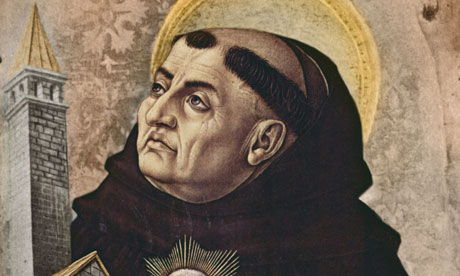
Perhaps the most famous of all the Dominican saints, today is the feast day of St. Thomas Aquinas.
Thomas was born in Roccasecca circa 28 January 1225, in the castle of his father, Count Landulf of Aquino, in Roccasecca, from which the great Benedictine abbey of Montecassino is not quite visible, midway between Rome and Naples, in what is now Sicily. Through his mother, Theodora, Countess of Theate, Thomas was related to the Hohenstaufen dynasty of Holy Roman emperors. His family was related to the Emperors Henry VI and Frederick II, and to the Kings of Aragon, Castile, and France. Calo relates that a holy hermit foretold his career, saying to Theodora before his birth: “He will enter the Order of Friars Preachers, and so great will be his learning and sanctity that in his day no one will be found to equal him.” Landulf’s brother, Sinibald, was abbot of the original Benedictine abbey at Monte Cassino. While the rest of the family’s sons pursued a military career, Thomas was intended to follow his uncle into the abbacy; this would have been a normal career path for the younger son of southern Italian nobility.
At the age of five, Thomas began his early education from the Benedictine monks at Monte Cassino. Diligent in study, he was thus early noted as being meditative and devoted to prayer, and his preceptor was surprised at hearing the child ask frequently: “What is God?”However, after a military conflict broke out between the Emperor Frederick II and Pope Gregory IX spilled into the abbey in early 1239, Landulf and Theodora had Thomas enrolled at the University of Naples, which had been recently established by Frederick.
At Naples his preceptors were Pietro Martini and Petrus Hibernus. The chronicler says that he soon surpassed Martini at grammar, and he was then given over to Peter of Ireland, who trained him in logic and the natural sciences. The customs of the times divided the liberal arts into two courses: the Trivium, embracing grammar, logic, and rhetoric; the Quadrivium, comprising music, mathematics, geometry, and astronomy. Thomas could repeat the lessons with more depth and lucidity than his masters displayed. The youth’s heart had remained pure amidst the corruption with which he was surrounded, and he resolved to embrace the religious life.
It was here that Thomas was introduced to the words of Aristotle, Averroes and Maimonides, all of which would later influence his theological philosophy. It was also during his studies in Naples that Thomas came under the influence of John of St. Julian, a Dominican preacher in Naples, who was part of the active effort by the Dominican order, which had only recently been established, to recruit devout followers.
At the age of nineteen, Thomas resolved to join the Dominican Order. Thomas’s decision to do so did not please his family, who had expected him to become a Benedictine monk. Some time between 1240 and August, 1243, he received the habit of the Order of St. Dominic, being attracted and directed by John of St. Julian, a noted preacher of the convent of Naples. The city wondered that such a noble young man should don the garb of poor friar. His mother, with mingled feelings of joy and sorrow, hastened to Naples to see her son.
In an attempt to prevent Theodora’s interference in Thomas’s choice, the Dominicans arranged for Thomas to be removed to Rome, and then to Paris. However, on the way to Rome, his brothers who were soldiers under the Emperor Frederick, following their mother’s instructions, seized him as he was drinking from a spring near the town of Aquapendente and took him back to his parents, who were then at the castle of Monte San Giovanni Campano. He was held for in the family homes at Monte San Giovanni and Roccasecca in an attempt to prevent him from assuming the Dominican habit, and to convince him to become a Benedictine. Political concerns prevented the Pope from ordering Thomas’s release, which extended his detention, during which he spent tutoring his sisters and communicating with members of the Dominican Order. Family members became desperate to dissuade Thomas, who remained determined to join the Dominicans. At one point, two of his brothers hired a prostitute to seduce him, but he drove her away, wielding a burning stick. According to legend, that night two angels appeared to him as he slept and strengthened his resolve to remain celibate.
The time spent in captivity was not lost. His mother relented somewhat, after the first burst of anger and grief; the Dominicans were allowed to provide him with new habits, and through the kind offices of his sister he procured some books — the Holy Scriptures, Aristotle’s Metaphysics, and the “Sentences” of Peter Lombard. After eighteen months or two years spent in prison, either because his mother saw that the hermit’s prophecy would eventually be fulfilled or because his brothers feared the threats of Innocent IV and Frederick II, he was set at liberty, being lowered in a basket into the arms of the Dominicans, who were delighted to find that during his captivity “he had made as much progress as if he had been in a studium generale.”
Thomas immediately pronounced his vows, and his superiors sent him to Rome. Innocent IV examined closely into his motives in joining the Friars Preachers, dismissed him with a blessing, and forbade any further interference with his vocation. In 1245, Thomas was sent to study at the University of Paris‘s Faculty of Arts where he met Dominican scholar Albertus Magnus, then Chair of Theology at the College of St. James.
The theological program Thomas entered in Paris was a grueling one, with the master’s typically attained in the early thirties. Extensive and progressively more intensive study of the scriptures, Old and New Testament, and of the summary of Christian doctrine called the Sentences which was compiled by the twelfth century Bishop of Paris, Peter Lombard. These close textual studies were complemented by public disputations and the even more unruly quodlibetal questions. With the faculty modeled more or less on the guilds, Thomas served a long apprenticeship, established his competence in stages, and eventually after a public examination was named a master and then gave his inaugural lecture.
When Albertus was sent by his superiors to teach at the new studium generale at Cologne in 1248, Thomas followed him, declining Pope Innocent IV‘s offer to appoint him as abbot of Monte Cassino as a Dominican. Albertus then appointed the reluctant Thomas magister studentium. In the schools Thomas’s humility and taciturnity were misinterpreted as signs of dullness, but when Albert had heard his brilliant defense of a difficult thesis, he exclaimed: “We call this young man a dumb ox, but his bellowing in doctrine will one day resound throughout the world.”
Thomas taught in Cologne as an apprentice professor, instructing students in the books of the Old Testament and writing Expositio super Isaiam ad litteram (Literal Commentary on Isaiah), Postilla super Ieremiam (Commentary on Jeremiah), and Postilla super Threnos (Commentary on Lamentations). Then in 1252, he returned to Paris to study for a master’s degree in theology. He lectured on the Bible as an apprentice professor, and upon becoming a baccalaureus Sententiarum (bachelor of the Sentences); he devoted his final three years of study to commenting on Peter Lombard‘s Sentences. In the first of his four theological syntheses, Thomas composed a massive commentary on the Sentences entitled Scriptum super libros Sententiarium (Commentary on the Sentences). Aside from his master’s writings, he wrote De ente et essentia (On Being and Essence) for his fellow Dominicans in Paris.
In the spring of 1256, Thomas was appointed regent master in theology at Paris, and one of his first works upon assuming this office was Contra impugnantes Dei cultum et religionem (Against Those Who Assail the Worship of God and Religion), defending the mendicant orders which had come under attack by William of Saint-Amour. During his tenure from 1256 to 1259, Thomas wrote numerous works, including Questiones disputatae de veritate (Disputed Questions on Truth), which was a collection of twenty-nine disputed questions on aspects of faith and the human condition and which was prepared for the public university debates he presided over on Lent and Advent. He also wrote Quaestiones quodlibetales (Quodlibetal Questions), a collection of his responses to questions posed to him by the academic audience; and both Expositio super librum Boethii De trinitate (Commentary on Boethius’s De trinitate) and Expositio super librum Boethii De hebdomadibus (Commentary on Boethius’s De hebdomadibus), commentaries on the works of 6th century philosopher Anicius Manlius Severinus Boethius. By the end of his regency, Thomas was working on one of his most famous works, Summa contra Gentiles.
Around 1259, Thomas returned to Naples where he lived until he went to in Orvieto in September 1261. In Orvieto, he was appointed conventual lector, in charge of the education of friars unable to attend a studium generale. During his stay in Orvieto, Thomas completed his Summa contra Gentiles, and wrote the Catena Aurea (The Golden Chain). He also wrote the liturgy for the newly created feast of Corpus Christi and produced works for Pope Urban IV concerning Greek Orthodox theology, e.g. Contra errores graecorum (Against the Errors of the Greeks). In 1265 he was ordered by the Dominican Chapter of Agnani to establish a studium for the Order in Rome at the priory of Santa Sabina. He remained there from 1265 until he was called back to Paris in 1268. It was while in Rome that Thomas began his most famous work, Summa Theologica, and wrote a variety of other works, such as his unfinished Compendium Theologiae and Responsio ad fr. Ioannem Vercellensem de articulis 108 sumptis ex opere Petri de Tarentasia (Reply to Brother John of Vercelli Regarding 108 Articles Drawn from the Work of Peter of Tarentaise). In his position as head of the studium, he conducted a series of important disputations on the power of God, which he compiled into his De potentia.
In 1268 the Dominican Order assigned Thomas to be regent master at the University of Paris for a second time, a position he held until the spring of 1272. Part of the reason for this sudden reassignment appears to have arisen from the rise of “Averroism” or “radical Aristotelianism” in the universities. “Averroisms” was the belief that there is no God, that the soul has two parts, one individual and one eternal; the world is eternal; the soul is not eternal. (During this period in history, Averroism was virtually synonymous with atheism.) In response to these perceived evils, Thomas wrote two works, one of them being De unitate intellectus, contra Averroistas (On the Unity of Intellect, against the Averroists) in which he blasts Averroism as incompatible with Christian doctrine. During his second regency, he finished the second part of the Summa and wrote De virtutibus and De aeternitate mundi, the latter of which dealt with controversial Averroist and Aristotelian beginninglessness of the world. Disputes with some important Franciscans such as Bonaventure and John Peckham conspired to make his second regency much more difficult and troubled than the first. A year before Thomas re-assumed the regency at the 1266–67 Paris disputations, Franciscan master William of Baglione accused Thomas of encouraging Averroists, calling him the “blind leader of the blind”. Thomas called these individuals the murmurantes (Grumblers). In reality, Thomas was deeply disturbed by the spread of Averroism and was angered when he discovered Siger of Brabant teaching Averroistic interpretations of Aristotle to Parisian students. On 10 December 1270, the bishop of Paris, Etienne Tempier, issued an edict condemning thirteen Aristotlelian and Averroistic propositions as heretical and excommunicating anyone who continued to support them. Many in the ecclesiastical community, the so-called Augustinians, were fearful that this introduction of Aristotelianism and the more extreme Averroism might somehow contaminate the purity of the Christian faith. In what appears to be an attempt to counteract the growing fear of Aristotelian thought, Thomas conducted a series of disputations between 1270 and 1272: De virtutibus in communi (On Virtues in General), De virtutibus cardinalibus (On Cardinal Virtues), De spe (On Hope).
In 1272 Thomas took leave from the University of Paris when the Dominicans from his home province called upon him to establish a studium generale wherever he liked and staff it as he pleased. He chose to establish the institution in Naples, and moved there to take his post as regent master. He took his time in Naples to work on the third part of the Summa while giving lectures on various religious topics. On 6 December 1273 Thomas was celebrating the Mass of St. Nicholas when, according to some, he heard Christ speak to him.
Christ asked him what he desired, being pleased with his meritorious life. Thomas replied “Only you Lord. Only you.” After this exchange something happened, but Thomas never spoke of it or wrote it down. Because of what he saw, he abandoned his routine and refused to dictate to his secretary, Reginald of Piperno. When Reginald begged him to get back to work, Thomas replied: “Reginald, I cannot, because all that I have written seems like straw to me,” And he seemed to be seriously ill. What exactly triggered Thomas’s change in behavior is believed to be some kind of supernatural experience of God. After taking to his bed, he did, however, recover some strength.
Looking to find a way to reunite the Eastern Orthodox churches with the Catholic Church (the Eastern Orthodox were excommunicated by the Roman Catholic Church in A.D. 1054 over doctrinal disputes) Pope Gregory X convened the Second Council of Lyon to be held on 1 May 1274 and summoned Thomas to attend. At the meeting, Thomas’s work for Pope Urban IV concerning the Greeks, Contra errores graecorum, was to be presented. On his way to the Council, riding on a donkey along the Appian Way, he struck his head on the branch of a fallen tree and became seriously ill again. He was then quickly escorted to Monte Cassino to convalesce. After resting for a while, he set out again, but stopped at the Cistercian Fossanova Abbey after again falling ill. The Cistercian monks of Fossa Nuova pressed him to accept their hospitality, and he was conveyed to their monastery, on entering which he whispered to his companion: “This is my rest for ever and ever: here will I dwell, for I have chosen it” (Psalm 131:14). The monks nursed him for several days, and as he received his last rites, he prayed: “I receive Thee, ransom of my soul. For love of Thee have I studied and kept vigil, toiled, preached and taught…” He died on 7 March 1274.
When the devil’s advocate at his canonization process objected that there were no miracles, one of the cardinals answered, “Tot miraculis, quot articulis“—”there are as many miracles (in his life) as articles (in his Summa).” Fifty years after the death of Thomas, on 18 July 1323, Pope John XXII, seated in Avignon, pronounced Thomas a saint.
In a monastery at Naples, near the cathedral of St. Januarius, a cell in which he supposedly lived is still shown to visitors. His remains were placed in the Church of the Jacobins in Toulouse in 1369. Between 1789 and 1974, they were held in Basilique de Saint-Sernin, Toulouse. In 1974, they were returned to the Church of the Jacobins, where they have remained ever since.
In the General Roman Calendar of 1962, in the Roman Catholic Church, Thomas was commemorated on 7 March, the day of death. However, in the General Roman Calendar of 1969, even though the norm in the Roman Catholic Church is to remember saints on the day of their death, Thomas’s memorial was transferred to 28 January, the date of the translation of his relics to Toulouse.
Saint Thomas Aquinas is honored with a feast day on the liturgical of the Episcopal Church in the United States of America on 28 January.
 The Order of Preachers, Independent
You must be logged in to post a comment.