
Category: Dominican Saints

Blessed James Benefatti

James is known as the Father of the Poor. He was a Dominican at Mantua, Italy in 1290, and was a Doctor of theology and a priest. He was also a friend and brother friar of Nicholas Boccasino who later became Pope Benedict XI, and for whom James held several support offices including papal legate. He was the Bishop of Mantua in 1303, and noted for his devotion to the poor. James rebuilt his cathedral and refurbished churches and was appointed Papal legate for Pope John XXII. He died 19 November 1332 at Mantua, Italy of natural causes. His body was found incorrupt when exhumed both in 1480 and 1604. He was beatified in 1859 by Pope Pius IX.
Saint Catherine of Alexandria
According to the traditional story, Catherine was the daughter of Costus, a pagan governor of Alexandria, where she was born. She is said to have announced to her parents that she would only marry someone who surpassed her in beauty, intelligence, wealth, and social status. This has been interpreted as an early foreshadowing of her eventual discovery of Christ. “His beauty was more radiant than the shining of the sun, His wisdom governed all creation, His riches were spread throughout all the world.” Though raised a pagan, she converted to Christianity in her late teens. It is said that she visited her contemporary, the Roman Emperor Maximinus Daia, and attempted to convince him of the moral error in persecuting Christians. She succeeded in converting his wife, the Empress, and many pagan philosophers whom the Emperor sent to dispute with her, all of whom were subsequently martyred. Upon the failure of the Emperor to win Catherine over, he ordered her to be put in prison; and when the people who visited her converted, she was condemned to death on the breaking wheel, an instrument of torture. According to legend, the wheel itself broke when she touched it, so she was beheaded.

According to Christian tradition, angels carried her body to Mount Sinai, where, in the 6th century, the Eastern Emperor Justinian established Saint Catherine’s Monastery, Mount Sinai, the church being built between 548 and 565 in Saint Catherine, Egypt, on the Sinai peninsula. Saint Catherine’s Monastery survives, a famous repository of early Christian art, architecture and illuminated manuscripts that is still open to visiting scholars. The historian Harold T. Davis says that Catherine’s story dates only from the 10th century AD, and that “assiduous research has failed to identify Catherine with any historical personage”; Davis suggests that the invention of Catherine may have been inspired by the story of the martyred pagan philosopher Hypatia of Alexandria. She did certainly form an exemplary counterpart to Hypatia in the medieval mindset; and it has been suggested that she was invented specifically for that purpose. Like Hypatia, she is said to have been highly learned (in philosophy and theology), very beautiful, sexually pure, and to have been brutally murdered for publicly stating her beliefs. The story of Catherine is placed a hundred years before Hypatia’s death, but there are no contemporary sources for her life.
Because of the fabulous character of the account of her martyrdom and the lack of reliable documentation, the Roman Catholic Church in 1969 removed her feast day from the Calendar. But she continued to be commemorated in the Roman Martyrology on November 25. In 2002, her feast was restored to the General Roman Calendar as an optional memorial.
The 1908 Catholic Encyclopedia describes the historical importance of the belief in her as follows:
Ranked with St Margaret and St Barbara as one of the fourteen most helpful saints in heaven, she was unceasingly praised by preachers and sung by poets. It is believed that Jacques-Benigne Bossuet dedicated to her one of his most beautiful panegyrics and that Adam of St. Victor wrote a magnificent poem in her honour: Vox Sonora nostri chori, etc. In many places her feast was celebrated with the utmost solemnity, servile work being suppressed and the devotions being attended by great numbers of people. In several dioceses of France it was observed as a Holy Day of Obligation up to the beginning of the seventeenth century, the splendor of its ceremonial eclipsing that of the feasts of some of the Apostles. Numberless chapels were placed under her patronage and her statue was found in nearly all churches, representing her according to medieval iconography with a wheel, her instrument of torture. Meanwhile, owing to several circumstances in his life, Saint Nicholas of Myra was considered the patron of young bachelors and students, and Saint Catherine became the patroness of young maidens and female students. Looked upon as the holiest and most illustrious of the virgins of Christ after the Blessed Virgin Mary, it was natural that she, of all others, should be worthy to watch over the virgins of the cloister and the young women of the world. The spiked wheel having become emblematic of the saint, wheelwrights and mechanics placed themselves under her patronage. Finally, as according to tradition, she not only remained a virgin by governing her passions and conquered her executioners by wearying their patience, but triumphed in science by closing the mouths of sophists, her intercession was implored by theologians, apologists, pulpit orators, and philosophers. Before studying, writing, or preaching, they besought her to illumine their minds, guide their pens, and impart eloquence to their words. At the beginning of the fifteenth century, it was rumored that she had spoken to Joan of Arc and, together with St. Margaret, had been divinely appointed Joan’s adviser.
Blessed Lucy of Narni
Blessed Lucy of Narni was the eldest of eleven children of Bartolomeo Broccadelli and Gentilina Cassio. When she was only five years old, she had a vision of the Virgin Mary. Two years later, she had another vision, this time of the Virgin Mary accompanied by Saint Dominic. Dominic is said to have given her the scapular at this time. When she was twelve years old, Lucy made a private vow of chastity, and determined to become a Dominican nun.
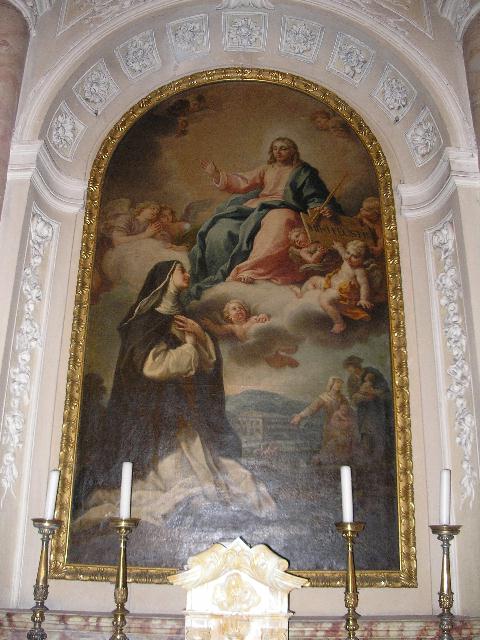
Circumstances, however, changed to make doing so difficult. The next year her father died, leaving her in the care of an uncle. This uncle determined that the best course of action he could take would be to get Lucy married as quickly as possible.
He made several attempts to do so. One of these included holding a large family party. He had invited the man he had chosen as Lucia’s husband to the party, with the intention of having the couple publicly betrothed. He however had not informed Lucia of his intentions. The suitor made an attempt to put a ring on Lucia’s finger, only to be slapped repeatedly for his efforts by Lucia.
A later attempt involved Count Pietro de Alessio of Milan, an acquaintance of the family. Lucia was actually quite fond of him, but felt her earlier vow to become a nun made the possibility of marriage impossible. The strain Lucia felt as a result of the conflicting feelings made her seriously ill. During this time, the Virgin Mary and Saint Dominic again appeared to her, this time accompanied by Catherine of Siena. They reportedly advised Lucia to contract a legal marriage to Pietro, but to explain that her vow of virginity would have to be respected and not violated. Pietro agreed to the terms, and the marriage was formalized.
In 1491 Lucia became Pietro’s legal wife and the mistress of his household, which included a number of servants and a busy social calendar. Despite her busy schedule, Lucia made great efforts to instruct the servants in Christianity and soon became well known locally for her charity to the poor.
Pietro observed Lucia’s behavior, and occasional quirks, quite indulgently. He never objected when she gave away clothing and food nor when she performed austere penances, which included regularly wearing a hair shirt under her garments and spending most of the night in prayer and acting to help the poor. He also seemed to have taken in stride the story he was told by the servants that Lucia was often visited in the evenings by Saint Catherine, Saint Agnes, and Saint Agnes of Montepulciano who helped her make bread for the poor.
However, when one of the servants came up to him one day and told him that Lucia was privately entertaining a handsome young man she appeared to be quite familiar with, he did react. He took up his sword and went to see who this person was. When he arrived, he found Lucia contemplating a large crucifix. The servant told him that the man he had seen Lucia with looked like the figure on the crucifix.
Lucia left one night for a local Franciscan monastic community, only to find it closed. She returned home the following day, stating that she had been led back by two saints. That was enough for Pietro. He had her locked away for the bulk of one Lenten season. She was only visited by servants who brought her food. When Easter arrived, however, she managed to escape from Pietro back to her mother’s house and on 1494 May 8 became a Dominican tertiary. Pietro expressed his disapproval of this in a rather dramatic form, by burning down the monastery of the prior who had given her the habit.
In 1495 Lucia went to Rome and joined a group of Third order Dominican tertiaries. The next year she was sent to Viterbo and here she found she was frequently the object of unwanted attention. It was here, on February 25, 1496 that she is reported to have received the stigmata. Lucia did her best to hide these marks, and was frequently in spiritual ecstasy. The house had a steady stream of visitors who came to speak to Lucia, and, often, just look at her. Even the other nuns were concerned about her, and at one point called in the local bishop who watched Lucia go through the drama of the Passion for twelve hours straight.
The bishop would not make a decision on Lucia, and called in the local inquisition. Reports here vary, some indicating that he referred the case directly to the Pope, who is said to have spoken with her and, with the assistance of Columba of Rieti, ultimately decided in her favor, telling her to go home and pray for him. Other sources question the accuracy of these reports.
At that time Pietro also came to her, making a final plea to persuade Lucia to return with him as his wife. She declined, and Pietro left alone. He would himself later become a Franciscan monk and a famous preacher.
When Lucy returned to the convent in Viterbo, she found that the Duke of Ferrara, Ercole d’Este I, had determined to build a convent in Ferrara and that, having heard of her, he determined that she would be its prioress. In summer of 1497, he invited her to be the founder of this new monastery. Lucia herself, the Dominican order, and the Pope all agreed quickly to the new proposal. The municipal council of Viterbo, however, objected, not wanting to lose Lucy. Lucia had been praying for some time for a way to create a new convent of strict observance, and agreed to go to the new convent.
Lucia’s departure precipitated a conflict between Ferrara and Viterbo which would continue for two years. Viterbo wanted to keep the famous mystic for themselves, and the duke wanted her in Ferrara. After extensive correspondence between the parties, on April 15, 1499 Lucia escaped secretly from Viterbo and was officially received in Ferrara on May 7, 1499. Thirteen young girls immediately applied for admission to her new community; the construction of the monastery began in June and was completed two years later, in August 1501. It contained 140 cells for sisters and the novices, but to fill it with suitable vocations proved to be very difficult. Lucia expressed the wish to have there some of her former friends from Viterbo and Narni. Duke Ercole, in September 1501 sent his messenger to Rome asking for the help of the pope’s daughter Lucrezia Borgia, who was preparing to marry Duke’s son Alfonso. She collected all eleven candidates Lucia had indicated and sent them, as a special wedding present to Lucia and to the Duke, a few days ahead of her bridal party. She herself solemnly entered Ferrara on February 2, 1502.
The Duke petitioned the local bishop for some help for Lucia in governing her new community, and he sent ten nuns from another community to join Lucia’s convent. Unfortunately, these ten nuns were members of the Dominican second order, who were canonically permitted to wear black veils, something Lucia and the members of the Dominican third order community were not allowed to do.
Tensions were heightened when one of these veiled outsiders, Sister Maria da Parma, was made the prioress of the convent on September 2, 1503. When Duke Ercole died on January 24, 1505 the new prioress quickly found Lucia to be guilty of some unrecorded transgression, most probably of the support for the Savonarolan church reform, and placed her on a strict penance. Lucia was not allowed to speak to any person but her confessor, who was chosen by the prioress. The local provincial of the Dominican order would also not permit any member of the order to see Lucia. There are records that at least one Dominican, Catherine of Racconigi, did visit her, evidently by bilocation, and that Lucia’s earlier visitation by departed saints continued. In response to Lucia’s insistent prayer her stigmata eventually disappeared, which caused some of the other nuns to question whether they had ever been there at all. When Lucia finally died, in 1544, many people were surprised to find that she had not died years earlier.
Then suddenly everything changed. When her body was laid out for burial so many people wanted to pay their last respects that her funeral had to be delayed by three days. Her tomb in the monastery church was opened four years later and her perfectly preserved body was transferred to a glass case. When Napoleon in 1797 suppressed her monastery the body was transferred to the Cathedral of Ferrara; and on 1935 May 26 – to the Cathedral of Narni.
Lucia was beatified by Pope Clement XI on March 1, 1710
Saint Albert the Great

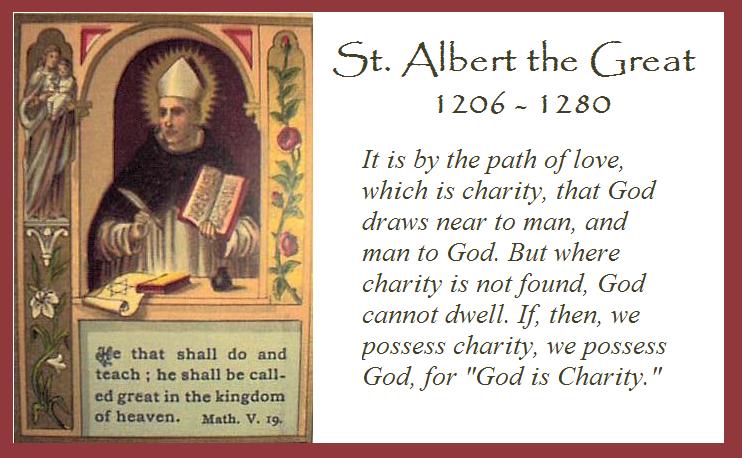
Saint Albert the Great was born sometime between 1193 and 1206, to the Count of Bollstädt in Lauingen in Bavaria. Contemporaries such as Roger Bacon applied the term “Magnus” to Albertus during his own lifetime, referring to his immense reputation as a scholar and philosopher. Albertus was educated principally at Padua, where he received instruction in Aristotle’s writings. A late account by Rudolph de Novamagia refers to Albertus’ encounter with the Blessed Virgin Mary, who convinced him to enter Holy Orders. In 1223 (or 1221) he became a member of the Dominican Order, against the wishes of his family, and studied theology at Bologna and elsewhere. Selected to fill the position of lecturer at Cologne, Germany, where the Dominicans had a house, he taught for several years there, at Regensburg, Freiburg, Strasbourg and Hildesheim. In 1245 he went to Paris, received his doctorate, and taught for some time as a master of theology with great success. During this time Thomas Aquinas began to study under Albertus.
In 1254, Albertus was made provincial of the Dominican Order, and fulfilled the arduous duties of the office with great care and efficiency. During his tenure he publicly defended the Dominicans against attacks by the secular and regular faculty of the University of Paris, commented on St. John, and answered what he perceived as errors of the Arabian philosopher Averroes.
In 1260, Pope Alexander IV made him Bishop of Regensburg, an office from which he resigned after three years. During the exercise of his duties he enhanced his reputation for humility by refusing to ride a horse—in accord with the dictates of the Dominican order—instead walking back and forth across his huge diocese. This earned him the affectionate sobriquet, “boots the bishop,” from his parishioners. After his stint as bishop, he spent the remainder of his life partly in retirement in the various houses of his order, yet often preaching throughout southern Germany. In 1270, he preached the eighth Crusade in Austria. Among the last of his labors was the defense of the orthodoxy of his former pupil, Thomas Aquinas, whose death in 1274 grieved Albertus. After suffering a collapse of health in 1278, he died on November 15, 1280, in Cologne, Germany. His tomb is in the crypt of the Dominican church of St. Andreas in Cologne, and his relics at the Cologne Cathedral.
Albertus was beatified in 1622. He was canonized and proclaimed a Doctor of the Church in 1931 by Pope Pius XI. St Albert’s feast day is celebrated on November 15.
Blessed Peter Cambiano of Ruffia

Peter’s father was a city councilor, his mother was from a noble family, and the boy was raised in a pious household. He received a good education, and was drawn early to religious life, with a personal devotion to Our Lady of the Rosary. He joined the Dominicans in Piedmont, Italy at age 16. He continued his studies, and was ordained at age 25, and was a noted preacher throughout northern Italy. He worked to bring the heretical Waldensians back to the Church, and was appointed inquisitor-general of the Piedmont.
In January 1365 Peter and two Dominican brothers went on a preaching mission through the mountains between Italy and Switzerland, working from the Franciscan friary at Susa, Italy. Peter’s preaching brought many back to the faith, which earned him the anger of the Waldensians. Three of the heretics came to the friary, asked to see Peter, and then murdered him at the gate.
Blessed Simon Ballachi
Blessed Simon Ballachi was born to the nobility in 1240, the son of Count Ballachi. His family had a close association with the Church clergy; two of his uncles became archbishops of Rimini, Italy, and a younger brother was a priest. Trained as a soldier and in administration, he was expected to take over the family estates. Against his family wishes, he joined the Dominicans as a lay brother at age 27.
Assigned to work in the garden of his friary, something he knew nothing about but which he loved instantly. He saw God in everything, and prayed constantly as he worked. Noted for his simple life, his strict adherence to the Dominican Rule, and his excellent work as a catechist to children. A visionary, Simon was visited by the devil, by Saint Catherine of Alexandria, Saint Dominic de Guzman, Saint Peter Martyr, and the Blessed Virgin Mary; other brothers saw his cell glowing, and heard angelic voices. Blinded at age 57, he was nearly helpless during the last years of his life; he never despaired, and used the extra free time for prayer. He died on 5 November in 1391.
Blessed Benvenuta Bojani

Benvenuta was the last of seven daughters. Her parents, too, must have been amazing people in comparison with so many in our time. When the silence of the midwife proclaimed that her father had been disappointed once again in his desire for a son, he exclaimed, “She too shall be welcome!” Remembering this she was christened by her parents Benvenuta (“welcome”), although they had asked for a son. A vain older sister unsuccessfully tried to teach the pious little Benvenuta to dress in rich clothing and use the deceits of society. Benvenuta hid from such temptations in the church where she developed a tender devotion to the Blessed Virgin. By the age of 12, Benvenuta was wearing hairshirts and a rope girdle. As she grew the rope became embedded in her flesh. When she realized the rope must be removed, she couldn’t get it off, so she prayed and it fell to her feet. For this reason she is often pictured in art holding a length of rope in her hands.
Having become a Dominican tertiary at an early age, she added the penances practiced by the sisters to those she had appropriated for herself. All her disciplines, fasting, and lack of sleep soon caused her health to fail and she was confined to bed for five years. Thereafter, she was too weak to walk, so a kind older sibling carried her to church once a week for Compline (Night Prayer) in the Dominican church, her favorite liturgy after the Mass.
After evening prayer on the Vigil of the Feast of Saint Dominic, Dominic and Saint Peter Martyr appeared to Benvenuta. Dominic had a surprise for her. The prior was absent at the Salve procession, but at the beginning of Compline she saw Dominic in the prior’s place. He passed from brother to brother giving the kiss of peace, then went to his own altar and disappeared. At the Salve procession, the Blessed Virgin herself came down the aisle, blessing the fathers while holding the Infant Jesus in her arms.
Benvenuta spent her whole life at home in Cividale busy with her domestic duties, praying, and working miracles. She was often attacked by the devil, who sometimes left her close to discouragement and exhaustion. When someone protested against the death of a promising young child, Benvenuta commented, “It is much better to be young in paradise than to be old in hell.” The devil often appeared to her in horrifying forms but was banished when Benvenuta called upon the Virgin.
Benvenuta’s companions called her “the sweetest and most spiritual of contemplatives, so lovable in her holiness that her touch and presence inspired gladness and drove away temptations.” This is amazing in light of the severe penances that she imposed upon herself–and another sign of blessedness that she didn’t judge others by her standards for herself (Benedictines, Dorcy).
Born: May 4, 1254 at Cividale, Friuli, Italy
Died: October 30, 1292 at Cividale, Friuli, Italy of natural causes
Beatified: February 6, 1763 by Pope Clement XIV (cultus confirmed)
Name Meaning: welcome (from her father’s statement at her birth: “She too shall be welcome!”)
Representation: holding a length of rope
Blessed Damian of Finario

One of the bright lights of the fifteenth century was Damian of Finario. Unfortunately we know very little about him, expect that he lived at a time and place not noted for sanctity, and he was known as a holy man.
Damian was born in Finario, near Genoa, at the end of the fourteenth century. His people were ich and noble, and also pious. We know nothing of his youth, except the not-too-revealing fact that when he was a baby he was kidnapped by a lunatic. His parents prayed to Our Lady, and the baby was returned unharmed.
Damian entered the order at Genoa and became a diligent student and a model Dominican. He was to be known especially for his preaching. The field of his endeavors was Italy. He seems never to have left the country. By the force of his preaching, he inspired many hundreds of sinners to repentance; and, since the fifteenth century produced many sinners who needed such preaching, he was kept supplied with works for a long lifetime.
Damian died in a little village near Modena, in 1884, and immediately became the object of much pious speculation, because of the miracles worked at his tomb. He was not, however, beatified until 1848, though his relics were by that time widely distributed and his cult well known.
Born: at Fulcheri, Liguria, Italy
Died:1484 at Modena, Reggio d’Emilia, Italy
Beatified: August 4, 1848 by Pope Pius IX (cultus confirmed)
Blessed Bartholomew de Braganza
 The historians of Vicenza agree with those of the Order of Preachers in placing Blessed Bartholomew di Braganza among the first and most illustrious of Saint Dominic’s disciples. As a matter of fact, he was a noted man in many ways. Nature endowed him with splendid gifts which he developed by tireless industry. The services that he rendered the Church as an apostolic preacher, as master of the Sacred Palace in Rome, as bishop, and as legate of the Holy See make him worthy of an honorable place in ecclesiastical history. An exceptional purity of heart and eminent piety gave the finishing touches, so to express it, to his grand character.
More than one Pope honored Bartholomew with implicit confidence. Saint Louis, king of France, held him in the highest esteem. His virtues endeared him to those placed under his charge. Italy reaped many and signal benefits from his preaching. He brought numbers into the Church, while the fervor of the faithful was increased by his example and labors.
The memory of such a man, our readers will doubtless agree, should not be suffered to die. Fortunately, he left a memoir or memorandum in the form of a last will and testament. Thanks to this document, one can write a part of his history and, to a certain extent, place the principal events of his life in their proper chronological setting. Such an order in these occurrences is the more important because historians have confused them to an astonishing degree.
Vicenza, an episcopal city of Italy forty miles west of Venice, and beautifully situated at the confluence of the Retrone and Bacchiglione, is where Bartholomew first saw the light of day. The precise date of his birth is not known; but it was in 1200 or 1201. He made a part of his studies at Padua. Anthony Godi, an author of the thirteenth century, tells us that he belonged to the family of the counts di Braganza long celebrated in Lombardy. Several other Italian writers make the same statement. Only the continuers of the Acta Sanctorum, begun by Father John Van Bolland, S. J., seem disposed to question the blessed’s ancient nobility.(1) Their doubt, however, led to a consultation of the Società Palatina of Milan, which had Godi’s Cronica della Città di Vicenza published in its great collection known as Writers of Italian History (Rerum Italicarum Scriptores). Signore Argelati, director of that learned and far-famed society, replied that old manuscripts prove to a certainty that Blessed Bartholomew, O. P., bishop of Vicenza, belonged to the line of the counts di Braganza, lords of the manor of the same name.(2)
It was during his studies at Padua, which he took care to season with the practice of piety, that the future bishop bad the good fortune to make the acquaintance of Saint Dominic, as well as to hear some of his sermons. The apostolic man inspired our student with so strong a dislike for the vanities of the world that he determined to devote his talents to the service of the Church. Nay, he made up his mind to follow the life which he saw exemplified in the founder of the Friars Preacher, and received the habit of the Order from the saint himself.(3)
Bartholomew must have been very young at this time. At least, he himself tells us that he was trained under the fatherly care of Saint Dominic and nourished in his Order from childhood.(4) From the beginning, he applied himself whole-heartedly to the studies of his new life and the development of the rare talent which nature bestowed upon him. In this way, through the assistance of divine grace and under the guidance of experienced teachers, he was soon regarded as a model religious, an able theologian, and a faithful exponent and defender of the word of God.
Immediately after his ordination the new priest was sent out to preach the Catholic faith to the people and to combat libertinage and heresy. At the same time, he labored for the pacification of the serious disturbances which were then prevalent in the cities of Italy, particularly in those of Lombardy. In this latter work, which took much of his time, he was associated with a number of other celebrated preachers of, his Order. Bishop Henry de Sponde speaks highly in praise of these men in his Annales Ecclesiastici, or epitome of the famed Annals of Cesare Baronio.(5)
Bartholomew, however, was not content to labor with tireless zeal for the suppression of the spirit of discord, and for the reconciliation of individuals, families, and communities. He felt that a standing remedy was necessary to hold in check the unhappy dissensions which continually disturbed the public peace. He was persuaded that, unless some such antidote was found, the preaching of the fathers could not bear the fruit they desired. Accordingly, he established a congregation, or new order, to which he gave the name of Chevaliers of Sancta Maria Gloriosa.
The end of this institute was the preservation or the restoration of peace and tranquility among the people. Its members were to carry the message of reconciliation everywhere. They were to employ all the means that Christian charity could suggest to put an end to dissensions, quarrels, enmities — in a word, to all that had led to the civil wars in which so much Italian blood had been shed, and treasure sacrificed. De Sponde, the bishop of Pamiers mentioned above, speaks of the establishment of this quasi military order. It soon met with approbation from the Holy See, and in 1261 was confirmed by a bull of Urban IV.(6)
Divine intervention was necessary to render the people of Italy docile to the earnest exhortations, prayers, and counsels of those who labored to bring about peace and harmony among them. Only punishment from on high could touch the hearts of the seditious whom nothing seemed able to bring to a sense of their duty. For this reason, de Sponde proceeds to say, God visited the country with scourge after scourge. First, there were destructive earthquakes. Then came unproductive seasons, followed by famine. To these succeeded pestilence and extraordinary cold weather. Finally, great floods brought desolation to the cities as well as to the country.(7)
These catastrophes, coming one after another, disposed the people to penance. What the greater number of them would probably not have done solely out of fear of God’s judgment, that they all did in order to avert the manifestations of His wrath whereby they were overwhelmed. Religious processions were held everywhere, in which persons of every age, sex, and condition took part. They walked in their bare feet, carried a crucifix or torch, and sang the praises of God. They practised every kind of mortification. All this caused 1233 to be called in Italy “the year of general devotion” (1’anno della devozion generale). Happy were the faithful whose contrite hearts and genuine humility rendered these outward expressions of penance and religion acceptable to God.(8)
Our pious Friar Preacher was busily engaged in explaining the nature and the necessity of interior sacrifice to the people in place after place, when the Pope summoned him to Rome to be his theologian.(9) Those who state that he was the immediate successor of Saint Dominic as master of the Sacred Palace overlook the fact that Bartholomew di Braganza was only twenty or twenty-one years of age at the time of the patriarch death. Besides, it was Gregory IX, not Honorius III (in whose reign Saint Dominic died), who conferred that honorable position on the subject of our sketch. The date of the appointment was about 1235. Ile continued to bold it under Innocent IV, whom he followed to Lyons in December, 1244,’ or the year after that Pontiff ascended the papal throne.
Whatever time was left him from the labors of this charge Bartholomew employed in writing. The old manuscripts of the convent at Vicenza long showed divers works of piety, some commentaries on Sacred Scripture and on the books formerly attributed to Denis the Areopagite, and a number of other treatises from his busy pen. Both the historians of Vicenza and Father James Echard, O. P., give a list of his works; but lack of space prevents us from reproducing it here, or making comments on their merit.(10)
Just how or when Saint Louis, king of France, became cognizant of the illustrious Friar Preacher’s accomplishments we do not know. It might have been through Bartholomew’s wide-spread fame.(11) Possibly, too, he was sent by the Pope on some commission to the French monarch. However it came to pass, it is certain that his majesty selected the learned and saintly son of Saint Dominic as his confessor. It is believed, and not without reason, that Bartholomew held this position when he wrote his little treatise on the education of princes (De Informatione Regiae Prolis), which he dedicated to Margaret of Provence, consort of Saint Louis.
Most likely Bartholomew was thus employed at Paris when Innocent IV appointed him bishop of Nemosia (or Nimesia), in the Isle of Cyprus. Ferdinand Ughelli, the Cistercian historian, places this event in 1250; but the opinion of the Bollandists, who date it from 1248, is more probable. In fact, Bartholomew himself tells us that the Holy Father nominated him bishop of that see at the time Saint Louis undertook his journey to the orient for the recovery of the Holy Land.(12) Quite probably the Friar-Preacher bishop accompanied the sainted French monarch as far as Cyprus; and we know that it was on September 17, 1248, that Louis reached the island.(13)
When the king left Cyprus, in the month of May, 1249, to lay siege to Damietta, Egypt, Bartholomew had taken possession of his diocese. Here he spent the next five or six years of his life in the fulfillment of the duties of a vigilant bishop. He applied himself heart and soul to the instruction of his flock, the regulation of the lives of his clergy, and the succor of the poor. For all he was a perfect example of Christian piety arid observance. He was regular and scrupulous in the visitation of the parishes of his see. With care did he correct the abuses that had crept in among the faithful, uproot superstition, reform religious practices, and restore the discipline of the Church.
While he was thus busily engaged with the affairs of his diocese, more pressing needs Of religion tore the pious bishop from his beloved people. The Pope ordered him to go immediately to King Louis in Palestine. However, it is not known whether he went on a secret mission, or to aid the French monarch with his advice after the disastrous defeat of the Christian army by the Saracens at Mansura, Egypt, subsequently to the capture of Damietta by Louis. Father Vincent Fontana, O. P., is of the opinion that Bartholomew was sent to Palestine in the capacity of legate a latere, and that he there again acted as the king’s confessor.(14) But we know that another Friar Preacher, Geoffrey de Beaulieu, was then Louis’ confessor, while Cardinal Eudes of Châteauroux was with the monarch as legate of the Holy See.
Bishop Bartholomew himself tells us, in his own brief memoir of his life, that he was with Saint Louis in Jaffa, Sidon, and Ptolemais. He also says that the king and queen, when they were about to sail for France, pressed him to come to see them in Paris, where he would receive new proofs of their royal favor.(15) We may place the prelate’s journey to Syria in 1254, the last year of King Louis’ stay in Palestine. Doubtless he advised and helped the saintly monarch in his efforts in behalf of religion and charity in the places of the Holy Land still under Christian domination.
If the bishop then returned to his see in Cyprus, he could not have remained there long. Alexander IV, who ascended the throne of Peter on December 12, 1254, felt that he was more needed in Italy, and appointed him bishop of his native city of Vicenza. In this new charge Bartholomew set to work with the same energy that characterized his whole life, accomplishing much good in a short time. Earnestly did he labor for the conversion of the Manicheans. His rare virtue won the admiration of all the well-meaning. His firmness threw the wicked into confusion. Indeed, it was not long before men of this character started a violent persecution against the holy prelate. The leader in this iniquity was one Ezzelino da Romano, a declared enemy of religion and a virulent oppressor of the Catholic clergy. Unable to withstand the tyranny of a man as powerful as he was cruel, Bartholomew withdrew to Rome, there to await an abatement in the dangers which confronted him in his diocese.(16)
Alexander IV now sent him as papal legate to Great Britain and France on matters of religion. From London he accompanied the English king and queen to Paris. There he was present at the conference between the two sovereigns. Having happily concluded this mission by the time the death of Ezzelino da Romano put an end to the long persecution carried on by that tyrant, Bartholomew started at once for Italy that he might rejoin his beloved people. Before he left Paris, Saint Louis made good his promise given in Palestine by bestowing on the legate some precious gifts. Among these were a portion of the true cross and a thorn from the crown of our Lord. The better to show the authenticity of the relics, Louis had an act of donation written and stamped with the royal seal. In this document the monarch declared that he had given them to Bartholomew di Braganza as a proof of the tender affection he bore him.(17)
Vicenza’s bishop, carrying the spiritual treasures which he placed beyond value, reached his episcopal city in 1260. Both clergy and people went out to welcome him. As they marched along in procession, they carried candles and olive branches, and often cried out in delight: “Blessed is he who cometh in the name of the Lord.” The holy man responded to these manifestations of joy and reverence with fatherly affection.(18) He began at once to restore his beloved church to its former beauty. With energy did he set about the restoration of the practice of religion, good order, and peace throughout the diocese, and to repair the ravage and devastation caused by the heretics or their abetters during his absence.
God blessed Bartholomew’s zeal. Indeed, his efforts met with a success far greater than he could have expected. In a short time the people of his diocese enjoyed the happiness of peace and tranquility, while their neighbors were continually in the turmoil of agitation and disturbance. The citizens of Vicenza, therefore, wished both to assure themselves of the continuance of the fortunate quiet in their city and to show their gratitude to their beloved chief pastor. Accordingly, they begged him, for the future, not only to be their guide in spiritual things as their bishop, but even in temporal affairs as their signor or podestà.(19)
Until this time the fathers of the Order to which the bishop belonged had had but one house in Vicenza. Blessed Bartholomew now induced them to build another convent, together with a magnificent temple of worship called the Church of the Crown. In this were placed the thorn from the crown of our Lord and the piece of the true cross which he brought from France. The historians of Vicenza tell us of the veneration of the faithful for these holy relics. In the same way we learn of the large gifts made in a spirit of emulation for the construction and decoration of the new church. This house of prayer was erected on an eminence which had long been profaned by the meetings of the Manicheans, that God might be perpetually and specially honored and served in a place which had been the rendezvous of sacrilege and impiety.(20)
While the people were engaged in building a material temple to God, the holy prelate tirelessly and successfully occupied himself with the erection of a more spiritual and worthy one by bringing sinners to repentance and sectarians into the fold of Christ. Many were benefited by his instructions. Some tried his zeal sorely; but they could not exhaust his patience. One of the would-be bishops of the heretics, called Jeremiah, and a doctor or minister, by the name of Gallo, resisted for a long time. The latter particularly, in several conferences with the man of God, defended the teaching of his sect with not a little obstinacy. However, the light of truth finally prevailed over the darkness of error. The defeat and conversion of Gallo practically put an end to the Catharists and other enemies of the Church in the City of Vicenza.(21)
Another action of the pious bishop in behalf of his country deserves mention here. A misunderstanding bad arisen between the people of Padua and those of Vicenza, which was equally baleful to both communities. It was a difficult problem to handle. However, through tact and diplomacy, Bartholomew effected a reconciliation that pleased both parties to the controversy.
For the sake of historical accuracy, attention should be called to a mistake of Father Ferdinand Ughelli. The Cistercian abbot and historian states that Bartholomew of Vicenza and the patriarch of Aquileia were appointed vicars of what was then known as the Roman Empire for all Italy. He places this event in 1262, and attributes the selection of these two men to Rudolf I.(22) But this prince did not become emperor until 1273, eleven years later, and at least three years after the death of our noted Friar Preacher.
It is more difficult to decide whether or not the distinguished divine was actually raised to the dignity of patriarch, as is held by some authors. The epitaph on his tomb might give a foundation for this opinion. Father Daniel von Papenbroeck (better known as Papebroch), S. J., follows it in his list of the patriarchs of Jerusalem. According to this learned critic, Urban IV appointed Bartholomew to this patriarchate in 1264, and he departed for the Holy Land at once to assume his new charge. However, says the same author, he returned to Italy after two years, resigned the higher position in the hands of Clement IV, and was reappointed to the See of Vicenza, which became vacant in 1266.(23) So much in favor of the subject of our sketch having held the dignity of patriarch.
On the other hand, it must be stated, we have been able to find no bull of Urban IV or Clement IV which shows this double transfer from Vicenza to Jerusalem and from Jerusalem back to Vicenza. The greater number of historians who have written of Blessed Bartholomew make no mention of such a fact. These, it is true, are arguments from silence. But to them must be added the difficulties which led other writers to decide against the opinion of Father von Papenbroeck. Taken as a whole, these reasons dispose one to consider it very doubtful that Bishop di Braganza was ever patriarch of Jerusalem.(24)
Furthermore, the metropolitan of Ravenna and the other bishops of that ecclesiastical province were at Bologna for the second translation of the relies of Saint Dominic. Bartholomew di Braganza also honored the occasion with his presence. He preached the sermon for the event, and announced to the people the indulgences granted by the archbishop and each of his suffragans. Both during the ceremonies and in the act testifying to the translation of the relics, which he himself drew up, he takes only the rank and title of Bishop of Vicenza. Similarly, in his last will and testament, which bears the date of September 23, 1270, and in which we have a faithful outline of his life, he simply calls himself bishop of Vicenza. However, he does not forget to state that the Holy See had successively appointed him to the dioceses of Nemosia (or Nimesia) and Vicenza.(25) He makes no mention whatever of the Patriarchate of Jerusalem. All this, again, constitutes a strong argument against his ever having had charge of the Holy City.
The precise date of the holy man’s death is not known. But it is agreed that he died a short time after writing his will and testament, which, as has been said, is dated September 23, 1270. Widows, orphans, and the poor were not the only ones who wept over his demise. His loss was universally regretted by those who loved their religion, as well as by those who knew how to esteem virtue and merit. His keen faith, his ardent zeal for the things of God and the salvation of souls, his gentle disposition, and his Christian humility were the virtues especially admired and praised in him. The practice of humility he ever knew well how to combine with rare learning and the most brilliant employments. His memory has always been held in benediction in the city and diocese of Vicenza.(26)
Historians assure us that, from the time of his death, the faithful not only held our Friar Preacher in veneration, but also gave him the title of blessed. The Bollandists have likewise proved this not only by the testimony of those who wrote on the spot, but also by other indications which serve to verify the fact.(27) Such, for instance, are the lamp which was burned before his relies and his likeness painted with rays of light around his head and placed in the Church of the Crown. The miracles said to have been wrought at Bartholomew’s grave induced the people of Vicenza to ask for a solemn translation of his remains. On this occasion, though he had been dead for eighty years, his body was found to have undergone no corruption. Quite naturally, this circumstance greatly increased the devotion of a people who were already accustomed to invoke his aid in their necessities.
So lived, labored, and died the saintly bishop of Vicenza. He was one of the earliest and greatest of Saint Dominic’s disciples, as well as one of the most learned. Such were the love and veneration in which the people held him. The devotion towards him may be said to have continued to grow until, more than five centuries after his death, and many years after Father Anthony Touron wrote his book, Pius VI granted the Order of Preachers and the clergy of the Diocese of Vicenza the favor of reciting the divine office and saying mass in his honor. His feast falls on the twenty-third day of October.
Born: at Vicenza, Ityaly towards the close of the 12th century
Died: September 23, 1270
Beatified: Pope Pius VI confirmed his cult in 1793
Blessed Peter of Tiferno
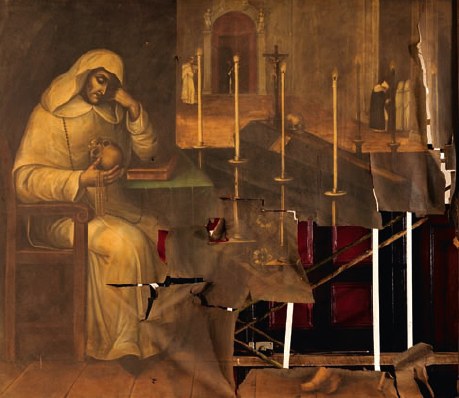 After an uneventful childhood, Peter Capucci applied for admission to the Dominicans. He and the frail, youthful Saint Antoninus were both received into the order on the Vigil of the Feast of the Assumption 1405. Their novice master was Blessed Lawrence of Ripafratta. Peter counted the artist-brothers Fra Angelico and Fra Benedetto as his friends. Peter spent his novitiate at Cortona, remained there when some of his community moved to Fiesole, was ordained, and began his apostolate all in Cortona.
Not much about Peter is truly remarkable when he is viewed in the light of his neighboring luminaries, but he glittered enough to have gained the attention of the Church. He was noted for regularity, patience, and humility–virtues not terribly common in any age. He took upon himself the job of begging for alms as a means of atoning for his noble birth. Of course, just as we might treat the homeless, some treated Peter rudely but that did not disturb him. He quietly persisted in his humble work to ensure that his brothers had food and that there were alms for the poor. We are told that one rich wine merchant refused Peter saying that the barrels in the cellar were all empty. A little later he found to his horror that they were indeed all empty. He immediately sent for the friar, apologized, and begged him to bless the barrels and restore the wine–which Peter did without hesitation.
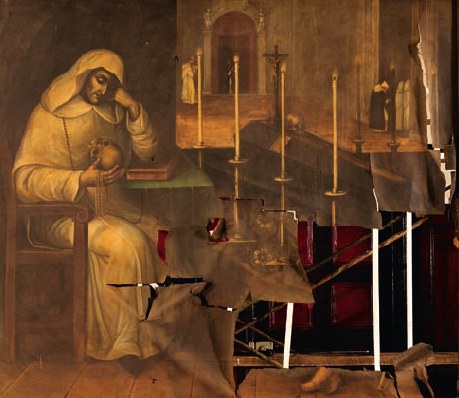
Other miracles were attributed to Peter, too. A woman’s withered hand was restored. Two unjustly condemned men were miraculously preserved from execution. Once, walking through the cloister, Peter came upon a disreputable man. Peter prophesied that the man would day within a day. The man laughed, but died in the middle of the night after having sent for Peter to give him the sacraments. Peter Capucci became known as “the preacher of death,” because he used to preach with a skull in his hands. He apparently had the ability to read hearts and could expertly point out uncomfortable truths to unwilling listeners.
When Peter died, he was buried in a humble grave. Miracles began to occur there; thus, his fame grew. A prominent man who had been paralyzed for three years, received the use of his limbs at the grave, after he had promised to pay the expenses for an annual celebration in Peter’s honor. In 1597, Peter’s relics were moved to a more suitable place (Benedictines, Dorcy).
Born: at Città di Castello (the ancient Tifernum), in 1390
Died: 1445
Beatified: cultus confirmed by Pius VII in 1816
 The Order of Preachers, Independent
You must be logged in to post a comment.