
Category: Lesson
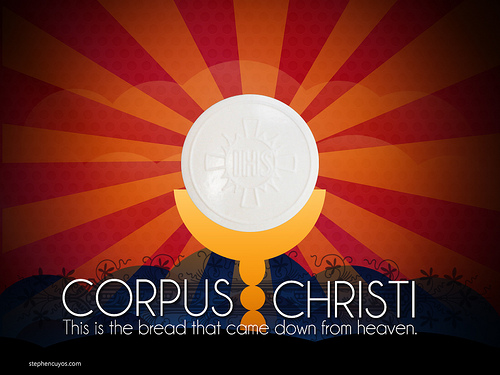
The Body and Blood of Christ – Our Transforming Life ~ The Rev. Dcn. Mark G. Dickson-Patrick, Novice
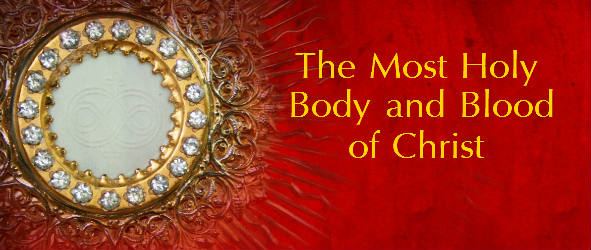
This Sunday we celebrate the great feast of the Body and Blood of Jesus Christ. For Catholics, both Roman and Independent, this Sunday is a feast that celebrates a great spiritual mystery and reality: that the bread and wine of the Eucharist became fully and truly the Body and Blood, Soul and Divinity of Jesus Christ. It is in this gift of the Eucharist that our Lord Jesus truly gives Himself to us, drawing us in to Himself and bringing us together with our brothers and sisters. St. Paschasius Radbertus, a 9th century theologian and abbot, wrestled with the concept of the Eucharist and what it really means in our lives. He says that the gift of the Eucharist allows Christ to more fully dwell in us: “If the Word had become flesh, and we truly consume the Word as flesh in the Lord’s food, how can it not be justly judged that He dwells in us by His nature.” As we regularly participate in the Mass and receive the great gift of Christ’s Body and Blood in the Eucharist, we are transformed by His dwelling within us.
In our world today, we tend to lean toward materialism, believing only what we can experience with our senses. In this case, our senses tell us that it is not the Body and Blood of Jesus Christ that we receive in this great mystery. Rather, our senses tell us, it is mere bread and wine. In our Gospel passage for this great feast, we see Jesus give a more concrete understanding of what it means to have salvation. He said to the people: “unless you eat the flesh of the Son of Man and drink his blood, you do not have life within you.” What a detestable thought to people with such strict dietary laws and practices which forbid the drinking of blood, and here was this man saying that they must eat His flesh and drink His blood to have life! As some of the disciples started to walk away and leave Him, Jesus doubles down, and tells the apostles, His dearest followers, that they can leave too if they’d like. If this was meant as mere symbol or conjecture, He would not have allowed His followers to walk away so easily. Instead of stopping them, He adjures them all the more: “Whoever eats my flesh and drinks my blood remains in me and I in him.”
What a gift this is! The Lord of all creation gives Himself into our hands, at the hands of the priest, to be consumed by us that we might take Him into ourselves and be transformed by Him. What a precious gift!
I urge you, the next time you partake of the Eucharist, to say a prayer asking Jesus to more fully come into your being, and to TRANSFORM you. Transform you into all that you can be in His name, in His person, in His Body and Blood which is within you. As we dwell in the Lord, so too does He dwell in us. Let us not look to materialism, but to Our Lord, who is the source and fount of all life and salvation.
Amen.
Trinity Sunday ~ The Rev. Archdeacon Brent Whetstone

What is the Trinity and why is it important?
As a former youth minister I was always talking about rules. Things the youth group could and couldn’t do, where they could and couldn’t go in the church, and any time we did an overnighter at the church or with the Diocese we would have the students sign a covenant. In this covenant there is a list of rules that the youth must agree to in order to be able to participate. In a sense as members of the One Holy Catholic and Apostolic Church we have a list of covenants that we agree to in order to be part of this particular body of believers.
We are reminded of this covenant every Sunday when we say the Creed and we renew this covenant several times a year when a new member is baptized. We renew this covenant by saying the creed, and despite all of this happening in every almost every church across the country I have found an increasing number of members of certain Christian Denominations that are flat out denying some of the most basic fundamentals of Christianity, and what’s even more alarming is some of these people are our priests and bishops.
This week I was on the Episcopalians on Facebook page on Facebook where I saw a member say that she has to cross her fingers every time she says the creed, in the same group several days later many of the members were promoting reincarnation as an idea that is completely compatible with Christianity. When I questioned them and offered scripture to counter their ideas I was accused of being a fundamentalist.
Last year when I wrote my Trinity Sunday sermon it was in response to my post on the fact that I was preaching on Trinity Sunday. It was a reply with a link to an article. This article was written by a Christian, but a Christian who did not believe in the trinity, and at the end of the article, the author posed the question: why in the modern day church should we believe in a doctrine that does not make sense and has no bearing on how we live our lives as Christians, and most importantly, how we take the words of Jesus out into the world? Well that’s a good question; why do we need to believe in the trinity? Does it really matter?
More and more in the Church I am finding that I have to defend the doctrine of the Trinity and answer the question of is the doctrine of the trinity essential to what we believe as Christians?
In the book Episcopal Questions, Episcopal Answers: Exploring Christian Faith, Ian Markham the Dean and President of Virginia Theological Seminary and C.K Robertson, Canon to the Presiding Bishop of the Episcopal Church answers this very question. They Ask Why Do Episcopalians (and all Christians really) believe in the Trinity? The answer: Belief in the Trinity is a defining characteristic of all Christians. There might be moments when an individual Christian struggles with the doctrine, but the faith of the church remains resolutely Trinitarian.
Today we mark the celebration of the Holy Trinity. The Father, The Son and The Holy Spirit. But what is the Trinity? Is it a symbolic reference? Is it an outdated or unnecessary doctrine that we hang onto because we are a people who love our tradition, and that’s what our parents believed so that that’s what we are going to believe? The answer to all those questions is NO.
From the beginning of the New Testament Church, and the celebration of Pentecost, there has been much misunderstanding surrounding the Trinity. This is in part because of the fact that the word Trinity does not appear anywhere in scripture. However, that does not mean that the early church did not believe or teach that the trinity was real. All throughout the scriptures we see the Trinity being spoken of, from the very beginning of the book of Genesis to the book of Revelation we see the Trinity, the three persons who make up the Trinity, their specific functions and their personalities, all of these are given to us in scripture. Because of this, it is safe to assume that when the church was born on Pentecost, and they started to live out their call as Christians, the doctrine of the Trinity was being taught.
However very early on there was a group of people who did not understand the Trinity for what it was and tried to explain it away in terms of what they could understand and comprehend, these people were known as Arians, and this became known as the Arian Heresy.
Arianism is a nontrinitarian Christian belief that asserts that Jesus Christ, the Son of God, is entirely distinct from and subordinate to the God the Father. Arianism is defined as those teachings attributed to Arius, which are in opposition to current mainstream Christian teachings on the nature of the Trinity and the nature of Christ. It was first attributed to Arius (c. AD 250–336), a Christian presbyter in Alexandria, Egypt. The Arian concept of Christ is that the Son of God did not always exist, but was created by—and is therefore distinct from—God the Father. This belief is grounded in the Gospel of John (14:28) passage: “You heard me say, ‘I am going away and I am coming back to you.’ If you loved me, you would be glad that I am going to the Father, for the Father is greater than I.”
The Arians hold to that one scripture to define what they believe, completely ignoring the rest of the scriptures that affirm the Trinity. To address this, there were two ecumenical councils that were held to clear up any questions that the early church had in regards to the trinity. The first ecumenical council that was held in 321 at Nicaea and the second was subsequently held in Constantinople. From these two councils we have the creed that we say today affirming our belief in the Trinity.
So what is the Trinity?
To answer that, I would like to use a quote from the Didache. The Didache is a brief early Christian treatise, dated by most scholars to the late first or early 2nd century. It was the very first ever catechism, and in it the early church was given the following instructions:
“After the foregoing instructions, baptize in the name of the Father, and of the Son, and of the Holy Spirit, in living [running] water. . . . If you have neither, pour water three times on the head, in the name of the Father, and of the Son, and of the Holy Spirit”
Simply put the Trinity is the The Father, The Son and The Holy Spirit, week after week we are also reminded of what the trinity is when we recite the Nicene Creed.
We believe in one God,
the Father, the Almighty,
maker of heaven and earth,
of all that is, seen and unseen.
We believe in one Lord, Jesus Christ,
the only Son of God,
eternally begotten of the Father,
God from God, Light from Light,
true God from true God,
begotten, not made,
of one Being with the Father.
Through him all things were made.
For us and for our salvation
he came down from heaven:
by the power of the Holy Spirit
he became incarnate from the Virgin Mary,
and was made man.
For our sake he was crucified under Pontius Pilate;
he suffered death and was buried.
On the third day he rose again
in accordance with the Scriptures;
he ascended into heaven
and is seated at the right hand of the Father.
He will come again in glory to judge the living and the dead,
and his kingdom will have no end.
We believe in the Holy Spirit, the Lord, the giver of life,
who proceeds from the Father and the Son.
With the Father and the Son he is worshiped and glorified.
He has spoken through the Prophets.
We believe in one holy catholic and apostolic Church.
We acknowledge one baptism for the forgiveness of sins.
We look for the resurrection of the dead,
and the life of the world to come. Amen.
The Trinity three distinct beings yet one in essence. This past week I was speaking to an Anglican Dominican of the very subject of the Trinity, and he reminded me of Saint Augustine’s defense of the Trinity, which is that:
All persons that we know of are, or are at least describable in terms of, fundamentally relational in a Trinitarian way. As human beings we have a primordial seat of awareness which is in some sense immediate and pre-conceptual, a conceptual awareness of and picture of ourselves as situated in the world (what you might call a logos) and a sense of relation between the two. Critically, all of these elements of our being share in a single consciousness, although they might be considered to be, at least conceptually speaking, separate modules or modes thereof.
Or to put it in my terms, we are all trinities. We all have a body, soul and spirit. Each of those three parts serve a different purpose, yet they are all one in the same. I like to use this example when people say that the trinity cannot exist because three beings cannot occupy the same place simultaneously, while they are correct in the physical sense, they are incorrect in the spiritual, and the human trinity is a great example of that.
Why is the Trinity important?
Some could and do argue that the belief in the Trinity is not necessary… that is more important to reveal the teachings of Jesus, and to make sure we don’t force our doctrinal beliefs on others, because it might offend them, and while they may be correct that it might offend people that we have that belief, especially in the Muslim community, as they believe that we are polytheistic because we believe in the Trinity, I would argue that to deny the Trinity is to deny the very essence of God. If it were not important, we would not see the Trinity all throughout scripture, we would not see Jesus teaching and Paul reaffirming it. The doctrine of the Trinity is the very fundamental basics of what we believe as Christians. But with that being said, if one does not grasp the trinity that does not mean that they are any less of a Christian than you or I, it just means that they have not yet received the grace yet to understand it.
Biblical Proof for the Trinity.
In Bible school we were always taught that in order to make a strong case for our argument, that we need to give scriptural proof, as a matter of fact in Paul’s letter to the Corinthians, he instructs us that it is in the testimony of two or three witnesses that truth is established. Earlier I spoke of how scripture is filled with references to the Trinity, so I am going to share some of those with you.
Genesis 1:26 26 Then God said, o“Let us make man8 in our image, pafter our likeness. And qlet them have dominion over the fish of the sea and over the birds of the heavens and over the livestock and over all the earth and over every creeping thing that creeps on the earth.”
Genesis 3:22 22 Then the Lord God said, q“Behold, the man has become like one of us in knowing good and evil. Now, lest he reach out his hand rand take also of the tree of life and eat, and live forever—”
Genesis 11:7 7 Come, dlet us go down and there confuse their language, so that they may not understand one another’s speech.”
Isaiah 46:18 16 yDraw near to me, hear this: from the beginning I have not spoken in secret,
from the time it came to be I have been there.” And now zthe Lord God has sent me, and his Spirit.
Matthew 3:16-17 16 And when Jesus was baptized, immediately he went up from the water, and behold, othe heavens were opened to him,2 and he psaw the Spirit of God descending like a dove and coming to rest on him; 17 and behold, qa voice from heaven said, r“This is my beloved Son,3 with whom I am well pleased.”
I was reading a text for my course work last week, Christianity: An Introduction and the author was talking about the Trinity and he said, “ At one level, the doctrine emphasizes the sheer immensity of God. There is no way that the fallen and finite human mind is going to be able to comprehend the fullness of God. At another, it provides a framework both for making sense of, and deepening the quality of Christian worship. Christians pray to the father through the son in the Holy Spirit.” I believe this gives us the best understanding of how and why the Trinity is important.
For those of you who have never struggled with this doctrine, I hope that this sermon has been a great reflection for you. I hope that it has been a way for you to renew your faith. For those of you who have struggled or are struggling with this doctrine, rest assured you are loved and cherished by God just as much as anyone. We as the church are here to walk with you in your moments of doubt. We have all been there at some point in our lives on some issue. To me these struggles are the very foundation of who we are as Christians. The Trinity is a great mystery, no one really knows the ins and outs, we can do our best as ministers to provide a road map of how we think the Trinity functions. Much like many things in the church, the belief in the Trinity takes faith. We must place our faith in the teachings of the early church fathers, we must place our faith in the words of the scriptures that try and shed light on the subject, and sometimes we lack the faith necessary to believe. We have doubts on the hows and whys. But I have found that when we have the doubts, and with an open heart, and an open mind, we approach something that we don’t understand, that once we understand it, once we grasp that concept that we struggled with, we come out on the other end firmly believing it.
Let us pray:
Almighty God, you have revealed to your Church your eternal
Being of glorious majesty and perfect love as one God in
Trinity of Persons: Give us grace to continue steadfast in the
confession of this faith, and constant in our worship of you,
Father, Son, and Holy Spirit; for you live and reign, one God,
now and for ever. Amen.
The Visitation of the Blessed Virgin Mary ~ The Very Rev. Lady Sherwood, OPI
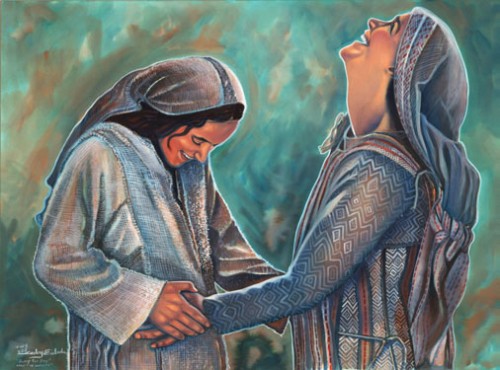
Reading 1: ZEP 3:14=18A or ROM 12:9=16
R psalm: ISAIAH 12:2=3,4BCD,5=6
GOSPEL: LK1:39=56 (NABRE)
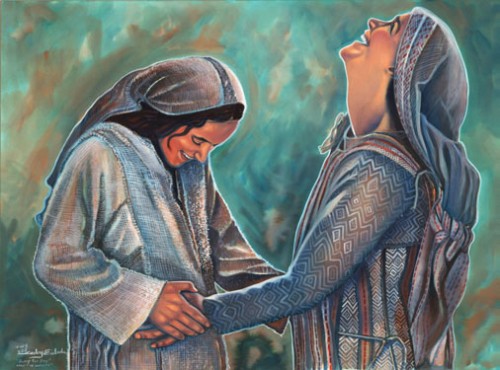
Mary set out and travelled to the hill country in haste to a town of Judah, where she entered the house of Zechariah and greeted Elizabeth. When Elizabeth heard Mary’s greeting, the infant leaped in her womb, and Elizabeth, filled with the Holy Spirit, cried out in a loud voice and said, “Most blessed are you among women, and blessed is the fruit of your womb. And how does this happen to me, that the mother of my Lord should come to me? For at the moment the sound of your greeting reached my ears, the infant in my womb leaped for joy. Blessed are you who believed that what was spoken to you by the Lord would be fulfilled.”
And Mary said: “My soul proclaims the greatness of the Lord;
my spirit rejoices in God my Saviour,
for he has looked with favour on his lowly servant.
From this day all generations will call me blessed:
the Almighty has done great things for me,
and holy is his Name.
He has mercy on those who fear him
in every generation.
He has shown the strength of his arm,
he has scattered the proud in their conceit.
He has cast down the mighty from their thrones,
and has lifted up the lowly.
He has filled the hungry with good things,
and the rich he has sent away empty.
He has come to the help of his servant Israel
for he has remembered his promise of mercy,
the promise he made to our fathers,
to Abraham and his children for ever.”
Mary remained with her about three months and then returned to her home.
If we picture the scene in today’s Holy Gospel reading, we find great joy. Great joy because Mary who was carrying the Lord inside of her, went to visit her cousin Elizabeth, who was also expecting John the Baptist. Joy because the Unborn John the Baptist leapt for joy when Mary arrived, because John knew it was the Lord inside Mary’s womb. Mary was puzzled but no doubt was rejoicing to be chosen as the earthly mother of our dear Lord and Saviour, Jesus.
I can almost imagine this scene in my mind. How wonderful it truly must’ve been.
But just as John leapt for joy as he knew that our Saviour was within Mary, We also can have a share of this rejoicing.
Although we don’t have our Lord physically inside us the same way that the Blessed Virgin Mary did, we like the Unborn John the Baptist, can leap for joy as we indeed know that the Lord our Saviour is inside of us as Spirit, and that we are also inside of Jesus. We are one body in the Lord, so just like John, Mary and Elizabeth, we who truly love and follow Jesus within our hearts and lives, should leap with joy and rejoicing knowing the Lord is ever present to us.
How wonderful it is that we get to share in such joy!
Let us pray:
Wonderful Lord, on this the Feast of of Mary`s visit with Elizabeth, we are reminded that you are a God of joy and that you always fulfill your promises. We ask the Blessed Virgin Mary to intercede for us when we feel discouraged, so that our souls may always magnify you, Our Lord. May Mother Mary remind us of your premises and your faithfulness when difficulties of life cover us with darkness. Give us a spirit that rejoices in you, Our Saviour, for all the great things that you have done for us and will continue to bestow upon us, simply because you love us.
We thank and praise you for all you have done and also for all that you will do.
Blessed Mary, pray for us.
Amen.

A Relationship in a Name ~ The Rev. Dcn. Mark G. Dickson-Patrick – Novice
 What’s in a name?
There is a lot in a name. A name holds the essence of the person, said the ancient philosophers, and can affect many things. A name can evoke fear: “Fear of a name only increases fear of the thing itself” (Hermione Granger, Harry Potter & the Sorcerer’s Stone). A name can evoke feelings of pride or honor: “She was the bravest person I ever knew” (Atticus Finch, To Kill a Mockingbird). A name identifies us: “The virgin will conceive and give birth to a son, and they will call him ‘Immanuel’ (which means ‘God with us’)” (Matthew 1:23). A name draws us into community within a family.
The change of a name can hold significant meaning. For centuries and in countless texts, change of a name usually indicates a change in mission, in outlook, in journey; it symbolizes something that is new in the person while acknowledging all that has come before. In Scripture, Jesus changes the name of Simon, a humble fisherman disciple, to Peter because, He says, “on this rock [petrus or Peter] I will build my Church” (Matthew 16:18). The change of Peter’s name changed his mission, his outlook, his journey. He was now the rock on which the Church was to be built, all the while not forgetting who he was as a fisherman along the shores of the Sea of Galilee not long before.
In our Gospel reading for this 7th Sunday of Easter, we hear Jesus pray these words:
“I revealed your name to those whom you gave me out of the world.
They belonged to you, and you gave them to me,
and they have kept your word.
Now they know that everything you gave me is from you,
because the words you gave to me I have given to them,
and they accepted them and truly understood that I came from you,
and they have believed that you sent me.
I pray for them.”
Jesus tells the Father that He has revealed His name to those whom He called. He reveals the name of God to the disciples, to all of us throughout the centuries who have called upon His name and have desired to follow after Him. He has revealed, in a sense, God’s very self, in revealing His name, in giving us the words that He has to give to us.
What is it about this name? What is it that has made kings fall to their knees and the most raucous grow silent? What is it about the One who created the heavens and the earth, and who formed us in our mother’s womb? What is it about this name? In revealing the name of God, Jesus reveals God’s true desire: to live in relationship with us. What a beautiful thought! That the Lord of all creation, the all-powerful and ever-living God, desires us to know His NAME. He desire us to know His name that He might teach us about who He is, that we might know Him, and grow closer to Him day by day. He reveals to us His name, so that we might love Him, trust in Him, and keep His commandments. This is not found in the name of Buddha, or in the name of Mohammed, or the name of Bahaullah, but in the name of the One True God, the God of Abraham, Isaac, and Jacob, “I AM WHO AM,” the Creator of the world.
The Lord of all creation reveals His name to us. In our modern day, it is hard for us to reveal even the most minute piece of ourselves to anyone else, for fear of judgment, condemnation, to be labelled as a “fanatic,” a “liberal,” a “conservative,” a “broken person,” “unworthy.” In the midst of this, Jesus reveals to us the most intimate thing about God that He can, His name. Let us this day open ourselves to the Father, who reveals His name to us, that we might draw closer to Him. Let us show Him all that we are, all of our sins and failures, and let us allow Him to heal us, to cleanse us, to raise us up to live and love in His name.
Let us pray.
Father,
I am scared of revealing myself. I am worried that if I let a piece of myself be seen and known, that I might be ridiculed or that I might be hurt. Father, help me to open up to You, who have revealed Your name, Your very self, to me. Help me to enter into relationship with You, to love You, and to glory in Your presence. Then, help me to draw closer to others that I might join them in the saving work of the Gospel mission.
In the name of Jesus,
Amen.

The Christian’s Hope ~ Br. Shawn Gisewhite, Novice
John 14:1-3
In the Name of God; Father, Son and Holy Spirit. Amen.
In the Scriptures, the word Hope is used over 200 times. But hope in the Bible is not the same as the word “hope” in our modern English dictionary. We use the word “hope” to describe our wants, desires and dreams. We hope that it will rain… We hope that the weather cools off soon… We hope this soon to be Deacon isn’t longwinded today! But as Christians we have another kind of hope. In fact, we have a better kind of hope. The hope that I speak of is not wishful thinking, rather it is a firm assurance of things to come. Hope is faith in the future tense. When faith looks to the future, it’s called hope.
The reason that we can have full assurance of what is to come, is because of the source of our hope. Our hope comes from the Lord. God alone has the right to promise hope and the power to keep the promise. I would like to take some time today and examine the hope that we possess in Christ and preach on “Hopes of the Christian.”
There are many things that we can have full assurance thanks to our relationship with Christ. I would like to start in verse 1 and see that as Christians:
- WE HAVE THE HOPE OF A REFUGE – v1
A refuge is a place of shelter, a place of protection, a place that we can run when the storms of life begin to rage. This was exactly what the Lord’s disciples needed at this very moment in their lives. In the previous chapter, Jesus told them that He would soon die. They also learned that one of them (Judas) would betray Christ. Peter was told that he would deny Jesus 3 times before the rooster crowed. Their lives had just taken a devastating turn and their hearts were greatly troubled.
Jesus knew how devastated they were and He was concerned about their “troubled hearts”. He said, “Let not your heart be troubled: believe in God, believe also in me”. He spoke words of comfort to them and He encouraged them to trust in Him.
In this life, we will face times of great trouble. Problems will come and as a result we will possess “troubled hearts”. Maybe you are at that point as we speak. I want to remind you of the hope you possess as a child of God. You have a refuge… When trouble comes…TURN TO JESUS!
Jesus made it clear that His followers would face trouble. But HE also reminds us that HE has the power over any circumstance that we face. John 16:33 “In the world you shall have tribulation: but be of good cheer; I have overcome the world”. If you heart is troubled today… you have a refuge and His name is Jesus!
Not only do we have the hope of a refuge… Jesus tells us in verse 2 that:
- WE HAVE THE HOPE OF A RESIDENCE – v2 “In my Father’s house are many mansions: if it were not so, I would have told you.”
Though the Disciples were facing the toughest time of their lives, Jesus promised them of a better day and a better place. As His followers, we can cling to that same promise today. We are given a glimpse into that residence in Revelation 21. There we are told of Golden streets, Jasper walls, Gates of pearl and a crystal river. The foundation of that city is made up of precious gemstones.
The beauty of our Heavenly Home is literally indescribable. Our finite minds cannot comprehend the brief glimpse of this place provided in the scriptures. The indescribable beauty of Heaven is summed up in the story of A little girl who was taking an evening walk with her father. Wonderingly, she looked up at the stars and exclaimed; “Oh, Daddy, if the wrong side of heaven is so beautiful, what must the right side be!” (Source: Charles L. Allen in Home Fires.)
Dear brothers and sisters, you may live in a home that creaks and leaks, rust and rot may have taken its toll, but you can rest assured that there is a home waiting for you on the other side!
Some of you may never own a home of your own in this life, but if you have been born again, YOU HOLD A CLEAR TITLE TO A MANSION! No landlord will ever bother you for the rent. There will be no mortgage to pay and no one will ever foreclose on the home that is waiting for you. The Bible also tells us that we have the hope of rest in the residence that is waiting for us. Revelation 21:4 “And God shall wipe away all tears from their eyes; and there shall be no more death, neither sorrow, nor crying, neither shall there be any more pain: for the former things are passed away.” What is not going to be in that land is just as exciting as what is going to be there!
I am looking forward to that wonderful residence that Jesus has waiting for us in Heaven. Jesus also tells us in verse 1 that:
III. WE HAVE THE HOPE OF REDEMPTION – v2 “I go to prepare a place for you.”
This is one of the most popular passages of scripture in the Bible, but it is also one of the most misunderstood. Jesus was not telling His followers that He was going to “build them a mansion”. He just asserted the fact that the mansions are already there. “In my Father’s house ARE many mansions” We are also told in scripture that when Jesus ascended, He SAT DOWN in His rightful place at the right hand of the Father. Hebrews 1:3 “When he had by himself purged our sins, sat down on the right hand of the Majesty on high.”
When Jesus said, “I go to prepare a place” He was saying I am going to make a way for you. He was referencing the Cross. Our entrance into Heaven was secured by Christ on the Cross at Calvary. He was telling His disciples that HE was going to do what we could not do. Jesus went to Calvary, shed His blood and gave His life as a sacrifice for you and me. Because of His finished work there on the Cross we have the hope of redemption. Without redemption, we would not have hope of the residence or refuge that we have already considered.
– Also, seen in this verse is the fact that:
- WE HAVE THE HOPE OF A RELATIONSHIP – v3 “And if I go and prepare a place for you, I will come again.”
This is a very personal promise. Jesus was saying “what I am about to do, I am doing for you”. What He did for Peter, James, John, Andrew, Matthew and the others… HE DID FOR YOU!
– Luke 19:10 Jesus said in Luke 19:10 that He came “to seek and to save that which was lost”.
– Romans 5:8 also tells us that “God commended his love toward us, in that, while we were yet sinners, Christ died for us”.
Because of Jesus’ work on the Cross we have the blessed privilege of having a personal relationship with Almighty God. And we don’t have to wait for Heaven for this to occur. You can have a personal relationship with Jesus HERE and NOW! Those that have this relationship will tell you that there is nothing any sweeter than communing with the Savior of the World!
– We are also promised that there is coming a day when Jesus will return for His own. This means that:
- WE HAVE THE HOPE OF A RETURN – v3 “And if I go and prepare a place for you, I will come again.”
Jesus told His Disciples that though He may go away for a time, HE WILL COME AGAIN! Jesus has ascended…. He is in Heaven as we speak. But soon and very soon He will split the eastern sky and come for His Children. This is one of the most prominent promises in the Bible. 1 Thessalonians 4:16 “For the Lord himself shall descend from heaven with a shout, with the voice of the archangel, and with the trump of God: and the dead in Christ shall rise first: 17 Then we which are alive and remain shall be caught up together with them in the clouds, to meet the Lord in the air: and so shall we ever be with the Lord. 18 Wherefore comfort one another with these words.”
As Christians, we are to be “Looking for that blessed hope, and the glorious appearing of the great God and our Saviour Jesus Christ.” (Titus 2:13)
Jesus is coming back, this is not wishful thinking on our part, this is our hope… this is a firm assurance of things to come. And when Jesus returns there will be a great reunion. Consider:
- WE HAVE THE HOPE OF A REUNION – v3 “I will come again, and receive you unto myself; that where I am, there ye may be also.”
There is going to be a reunion one day that is beyond anything we can imagine. All those heroes of the faith that we read about on the pages of God’s Word will be there. (Noah, Moses, Abraham, David, Elijah, John, Peter, Paul etc.)
Some of you have parents waiting for you there. Others have spouses who have already gone on. Some have children in that wonderful land. We all have family and friends that have already stepped out into eternity. We are assured that we will see them again and we long for that blessed reunion.
We are all excited about the beauty of Heaven, we are all excited about the residents of Heaven and we look forward to seeing loved ones who have gone on. But greater than the reunion with our loved ones is the fact that one day we will stand face to face with our Heavenly Father. Revelation 22:3 “The throne of God and of the Lamb shall be in it; and his servants shall serve him: 4 And they shall see his face.”
We will spend eternity in the presence of our Heavenly Father. On top of this fact, we are also longing for the day when our Savior wraps His arms around us and welcomes us to our eternal home. We will see our Savior face to face. We will see the scars on His brow, His hands and His feet. We will be reminded that He is the only reason that we made it to that place. On that day, we will shout for joy and we will humbly bow at His precious feet and we will worship Him for making a way for us to enter that promised land.
There is much hope for those who have been born again but for those who are lost, things are much different. Instead of hope, they are living in despair.
One of the most devastating things you will ever hear in this life is “there is no hope”. I am here to tell you, if you are not a child of God you have NO HOPE! You can claim none of the promises that we have examined today.
But I have good news, THERE IS HOPE FOR YOU, and that hope is only found in the Lord and Savior Jesus Christ! If you will surrender to Him and accept his offer of eternal life, then you too can have hope!
1) You can have the Hope of a Refuge
2) You can have the hope of a Residence
3) You can have the hope of Redemption
4) You can have the hope of a Return
5) You can have hope of a Reunion
These are just a few of the facts concerning “The Christian’s Hope”. I pray that you have that hope today. If not, pray now with me.
Oh Lord, for too long I have hoped for the wrong things in this life. I now put my hope fully in You. I hope for a refuge when life is rough, for redemption for all my sins, for your return that I may be taken with You, for a reunion with all those who I have loved and lost, and for a residence in Your Heavenly Kingdom. For all my sins Lord I am sorry. Forgive me Lord, forgive me. Create in me a clean heart oh Lord, and fill me with hope everlasting. Amen.
The Good Pastor ~ Br. Brenden Humberdross, Novice
May the words of my mouth and the meditations of our hearts be always acceptable to you O Lord, our God and Our Creator.
What makes a good pastor? This is a question that is often on the mind of those who feel called to follow the path of Priesthood and leadership in the Church. It’s also one that many theologians and authors have attempted to answer in a plethora of books, seminars and university courses. There are so many models that a leader in the faith can follow depending on their views of leadership, their secular occupations or even their political views. However, there is one model of leadership that has stood the test of time and has the seal of Gospel approval; the model found in the Gospel reading for today.
Throughout the Gospels Christ conveys the deep message of the mysteries of God’s love in ways that would have been very real to his listeners in a practical sense and well known to them through a lifetime of hearing the messages of the Hebrew Scriptures; today is no exception with Christ invoking the image of the Shepherd as the model of gospel leadership.
If you examine a topographical map of Israel it becomes quickly apparent that the area around Jerusalem, Bethlehem and many of the places mentioned in the New Testament were very hilly. I imagine that these places were not well suited to a lot of different agricultural occupations and that this is why we often see Christ speaking of vineyards and shepherds as these would have been amongst the most common agrarian occupations in the area. Those who were listening to the message Christ was delivering today would have easily understood what He was talking about because they were things they were seeing in their daily lives.
There is also another level of understanding that the Jews listening to Christ’s message of what constitutes a good pastor would have had. From the very dawn of time the message of Shepherds being leaders used for God’s purposes was a part of Jewish history; Abel, Adam and Eve’s son found favour with God and was a tender of animals, a Shepherd. Later in the Old Testament we are introduced to what the Jews consider their greatest prophetic leader, Moses. He may have started his career as a Prince but when he met God in the burning bush what was he doing? He was tending his father in law Jethro’s sheep and God called him to shepherd the flock of Israel out of Egypt, give them God’s law and lead then through the winding path to the Promised Land. Later again, once Israel is established in the Promised Land we see the rise of the greatest political and spiritual leader the nation ever had, King David. And what was it that David was doing when the Prophet Samuel discovered him and proclaimed him the Kings anointed chosen to replace King Saul? He was a Shepherd tending his father’s sheep. So we see that Israel, and therefor Christ’s listeners, were used to the greatest of leaders being associated with the lowly task of tending to the flock.
I want to pose a question; are there Shepherds amongst us today? In the Gospel account Christ highlights that a good pastor is the one who cares for the sheep; that enters through the gate of God’s Word (the scriptures and Jesus himself). He tells us that the Shepherd will know his sheep by name, he will care for them as individuals and want to know them personally and deeply. And that through this caring attitude the sheep will recognise their shepherd.
In some parts of the world today is what is called Vocations Sunday; the time that throughout the Churches the people pray that God will touch the hearts and souls of those who are suitable to Shepherd God’s flock and that those so touched will be brave enough to respond to that call. Do you offer prayers like this? Technically every Sunday should be a day to focus on fostering the life of those called to be pastors of God’s flock but this special Sunday (sometimes called Good Shepherd Sunday) is a great day for us all to take a little time to pray that God will bring more vocations to our Church, to expand the ranks of the Clergy so that the Christian community throughout the Church can be served as best suits their needs.
Those who know me and know of my own sense of calling and vocation know that I have a love for sharing the Gospel and spreading the message of Christ through word and deed. If I didn’t I wouldn’t be a member of the Order of Preachers, Independent; the Dominican Religious Order of our Church. I see in today’s reading and its focus on vocations a call and a challenge. Christ is saying to us, you know what, not everyone has heard my voice, not everyone knows that I am their Shepherd and protector and they need to know! I want all people, all of God’s Children, to be in the fold, I want them all to receive the gift of Salvation through belief in my name and my saving grace and I want YOU to help me do it.
All of us who were baptised were called to be a part of Christ’s people, we were called to be a part of the Great Army of Witnesses to Christ’s life, death and resurrection and as such we have been anointed and given the power and authority of the Great Royal Priesthood of all Believers. The responsibility to share the word and works of Christ for the salvation not only of ourselves but others rests on all of our Shoulders, not just the clergy, not just those called to serve in vowed religious life, not just on the missionaries called to foreign lands. We all have a responsibility to share what we have been given; faith in Christ.
Now I am sure that you are all getting tired of hearing this message, but because it’s my passion I think that it is one worth repeating (and I do so frequently) and Christ did too, because nearly every week I hear the call to evangelism and mission in the scriptures being read. Now, as I’ve said before, I’m not asking any of you to start standing on the street corner on market day and wave your bible preaching fire and brimstone, I’m not sure that would help anyone but there are so many little ways we can all contribute to spreading the Gospel, and if we all do a little then a lot will happen…as the song goes “From little things big things grow.
There is one final powerful message that I want to mention before I end and that is sacrifice. In I hope and pray that this week you will take the message of gospel leadership to heart. I pray that you will look into your own life and find those ways that you can be a shepherd to the people around you. Take the times to listen and get to know those you have responsibility for or who are simply “in your life”. If you listen to them, and minister to them where they are in their lives I know that we can all bring more souls to Christ and together be a great band of shepherds leading God’s flock to salvation in Christ.
In the name of the Father, the Son and the Holy Spirit. Amen.
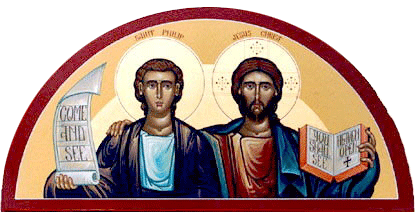
Sts Philip and James, Apostles ~ Br. Chip Noon, Novice
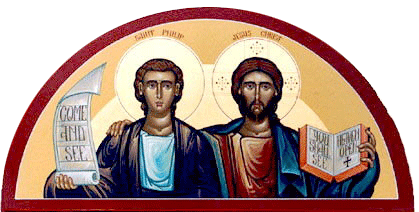
Today is the feast of Saints Philip and James, Apostles.
During this time between Easter and Pentecost, we continue to see that the Apostles still were unsure of what was happening in their lives. At the Last Supper, Philip continues to pester Jesus about his ministry. “Master, show us the Father, and that will be enough for us.” Of course, he lumps the others Apostles in to this plea, perhaps as a way of strengthening his argument. And we do know from other Gospel passages that they really were not sure of their ultimate mission.
But Jesus says to him,
“Have I been with you for so long a time
and you still do not know me, Philip?
Whoever has seen me has seen the Father.
How can you say, ‘Show us the Father’?
Do you not believe that I am in the Father and the Father is in me?”
And let’s look at the first reading from Paul’s Epistle to the Corinthians. He gives them a version of the Creed, and then lists those to whom Jesus appeared after his death, ending with himself. He says, “I am reminding you…” It’s as if he is reciting known facts in order to strengthen his preaching as well as recapping a message, all the better to strengthen his audience’s understanding.
Similarly, in the Responsorial Psalm, there is a teaching from heaven to all the earth, declaring the glory of God.
For me, this day of Saints Philip and James is like the overture to an opera. Little pieces of the whole, presented as a warm-up to the opening of the curtain and the glorious theatrical production. And isn’t that also what this time between Easter and Pentecost is? Time and again, we are told that certain things happened with Jesus and the Apostles after the Resurrection, but it never really takes hold, the Apostles continue to have doubts and anxieties. We hear themes, we get snippets of the whole, we recognize the very beginnings of the church that Jesus is presenting.
We don’t know much about Philip…some stories in the Gospels, some traditions that he preached in Greece, Syria, and Phrygia, that he was martyred on a cross, upside down, and only recently, that his tomb may have been discovered in Turkey. We know that James, called James the Lesser, became the bishop of Jerusalem and wrote one of the epistles in the New Testament.
But we do know, and especially from today’s Gospel, that eventually all the Apostles and many of the disciples all went out into the world after Pentecost and did what Jesus said: “…whoever believes in me will do the works that I do…”
And we do know that we have thirty-two days before Pentecost. And we do know that during this time, we can gather as many of the tools that we can to do what James says in his epistle, that we may have faith, but we also must have good works.
And so, while we listen to the stories of the overture, we can use them all as review sessions for what we have been, as Christians, chosen to do: “Go ye into all the world, and preach the gospel to every creature.”
Lord, help us in these days of Easter to prepare ourselves for your kingdom. Help us to ask of you the things that we need to complete your mission on earth. And help us to store up in heaven the riches of your word and your blessings. In Jesus’ name.
Amen.

Believe! ~ Br. Chip Noon, Novice

Last week, during the Mass of Easter Sunday, we learned that Mary Magdalene came to the tomb where Jesus was buried and found it empty. She went and told Simon Peter and John and returned with them to the tomb. After they left, she stayed behind weeping. She looked again into the tomb and saw two angels who asked her why she was weeping. “They have taken my Lord and I don’t know where they laid him. Then, seeing a person whom she thought was the gardener, she said, “Sir, if you carried him away, tell me where you laid him, and I will take him.”
“Jesus said to her, “Mary!” She turned and said to him in Hebrew, “Rabbouni,” which means Teacher.
“Jesus said to her, “Stop holding on to me, for I have not yet ascended to the Father. But go to my brothers and sisters and tell them, ‘I am going to my Father and your Father, to my God and your God.’”
Mary Magdalene tells the disciples, “I have seen the Lord” and what he told her.
What was their reaction?
They went into a room and locked the door!
Mary was the first person to proclaim the resurrection and she was not believed, even by those who had been told by Jesus what would happen in these times.
What’s with us? Why do we need proof? Why do we always need proof?
Now in this week’s Gospel, Jesus himself comes into the room where the disciples were cowering and says, “Peace be with you” and shows them his hands and his side. Then the disciples rejoiced. Jesus makes no mention that we know of about their fear and hiding, but instead breaths the Holy Spirit upon them and exhorts them to their mission as ministers of the Word. In John’s Gospel, this is all quite matter of fact.
So let me ask you, did they all believe at that time? We know that Thomas didn’t since he wasn’t present on that day and since he was a no-nonsense and fatalistic kind of guy anyway. (Remember when Jesus was going to Judea to raise Lazarus, Thomas says “Let us also go, that we may die with him.”) But what about the others? Don’t we all know some people, who, when presented with the facts, say, “Well, maybe it’s true, but probably not…” I’m thinking specifically about some people and current scientific knowledge.
But back to the disciples…my guess is that it took Thomas to challenge the Lord, the physical Lord, to come and show him his wounds for some of those disciples to come around. “Show it to me in black and white!” How many of us base our beliefs on evidence, like these disciples?
And here is Thomas. This is a comforting person, in my mind. You always know where you stand with him. In the Gospels, he’s always jumping right in and telling you what he thinks. No beating about the bush.
Proof? I’ll give you proof!
And then he believes. Remember that movie that had the line “show me the money!”? That’s Thomas. And unlike those of us, myself included, who hang back, once he is shown the money, he’s off and running. What a gift that must be, to have all your doubts cast aside and then immediately to go out and get on with the job.
So let me ask you about Mary Magdalene. All she has to hear is Jesus speak her name and she knows what’s up. She proclaims the faith, the risen Lord, and does so fearlessly. In the Gospels, she is mentioned more than many of the Apostles. She was a person of some means, since we are told she is one of the women to provide for Jesus and his disciples. And unlike Thomas, she doesn’t demand anything. She simply sees, believes, and acts.
Why isn’t she one of the bigger names in the Bible? Why isn’t she one of the leaders?
Let’s go back to today’s second reading where Peter is proclaiming the new faith. He is talking about Mary Magdalene. Simple, committed, rejoicing, willing to accept trials, and rejoicing with an indescribable and glorious joy.
And the Responsorial Psalm. Mary has recognized Jesus from the beginning as the cornerstone.
And the first reading from Acts. Who provided all the meals and needs of the Apostles and disciples from the beginning, to the time when they set out to preach the good news? Mary Magdalene.
Thomas and Mary Magdalene.
Which one are we imitating? Which one do we resemble? Is it one or the other? Or is it both? Or neither?
I’ll be glad to have either’s way of thinking, because it is plain to see. Plain both before we believe, and plain after we believe. It is a direction. There’s no middle ground.
As someone once told me, being a Dominican Friar is not a matter of taking it up when you think about it. It’s not a matter of study during the week. It’s not a matter of prayer or meditation. It’s everything you do. There’s no time off.
And I believe that person was telling me that to be a Christian, to believe in the death and resurrection of our Lord, Jesus Christ, you must live it every moment. Not in big ways, not in momentous acts, not in fiery exhortations, not in anything that looks like some big deal. Just in the simple day to day experience of knowing that we are attaining the goal of our faith, the salvation of our souls.
We are true brothers and sisters of Jesus who will go with him to his Father and to our Father. And as brothers and sisters today, we say “Rabbouni!”
Lord, teach us today the simple pleasure of membership in your family. Teach us the true meaning of your death, burial, and resurrection. And make us worthy of the coming of the Paraclete so that we may also be comforters to our earthly brothers and sisters.
Amen.
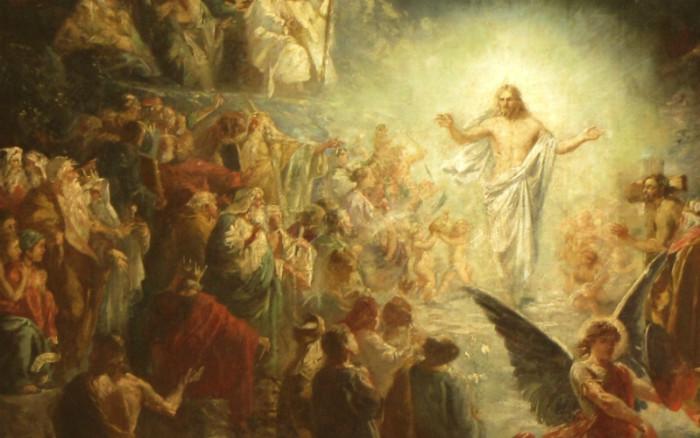
Hell, Vigils, and Lullabys ~ Br. Chip Noon, Novice

Holy Saturday. Sabbatum Sanctum. The day after Good Friday and the day before Easter.
As children, we were taught that on this day, Jesus went down to Hell. It is in the Creed as “He descended into Hell.” As a child myself, this day was one of sadness, fear, and anticipation.
In Sunday School (where we who did not attend a parochial school were forced to go), the nuns depicted this day to us as the time during which Jesus freed all the righteous people who had lived before his time from bondage in darkness and distance from God. We were told that everyone from Adam and Eve was unable to enter heaven because Jesus had not opened it for them.
You can imagine what went through my mind thinking about this day. The nuns in my parish did not always do a good job of explaining what was going on this day and how it affected people in hell. So we kids made up lots of interesting stories. I always thought back to the hymns that sang about our longing for Christ to save us from our sins and the “sins of the world.”
Still, what were those people doing in hell before Jesus came to free them? We were assured that they did not suffer the same fate as sinners, who were tormented by the devil and the fires of hell. Eternal hellfire. That was a pretty scary concept.
It was only later as a youth that I found out about the “harrowing of hell.” Growing up in rural Maryland, I knew what a harrow was. To me, it was always a disc harrow, a bunch of metal discs in a row used to break up clods of dirt after ploughing. And so Jesus used this instrument to open up the soil of hell to let the dead ascend, finally, into heaven. Of course, this was always done in a dark, murky atmosphere suitable to that part of hell that wasn’t on fire.
Holy Saturday…that was quite a fearsome day!
Back then, in the 1950’s, we either didn’t have Easter Vigil as we do today, or my parents never took us to it. Easter Sunday was always THE day for us and Mass was always THE most important ceremony of the year. So from Good Friday to Easter Sunday was a time of agitation.
Of course, the agitation and anticipation was all about the Easter Baskets with colored hard-boiled eggs, candy, and especially jelly beans. And the fact that the solemnity of Lent was at last gone, and maybe the nuns would let up on us…
What must have been going through the minds of the Apostles and the women disciples? I never heard this discussed growing up, but in my adult life, it became one of the things I thought about on Holy Saturday. We know it as anticipation. They experienced it as the utter destruction of their whole world.
Their Teacher was tortured and died a horrible death on a cross. Now what?
For all of the Apostles but John, there must have been intense shame. They had all deserted their Teacher and his mother and had gone into hiding. Imagine their feelings on this day.
What we know today was all taught to them, so there should have been no surprise. But we can say that from the distance of two millennia and the evidence of the empty tomb. This group of grieving souls had none of that.
“But these are written that you may believe that Jesus is the Messiah, the Son of God, and that by believing you may have life in his name.” John 20:31
Written many years after Holy Saturday.
Now what?
Although all of this was presented to them by Jesus, they really didn’t know what was happening.
They weren’t anticipating Easter eggs, baskets, jelly beans, the solemn joy of the Easter Sunday Mass.
They were deserted, bereft, scared, ashamed, and deeply sorrowful.
We get some or all of these feelings at times of crisis in our own lives. I’ve had them during and after a crisis, and believe me, the sinking feeling in my stomach is quite real and quite frightening.
But wait. We were told the Gospel stories so that we might believe that Jesus is the Messiah, the Christ, the Son of God. The disciples thought they had nothing. We have the Word. They had despair. We have triumphant anticipation.
It’s probably a good thing we were never taken to the Vigil. I can’t imagine I’d have done well sitting through all those readings. Seven readings, six psalms, an Epistle, the Gospel…it just goes on forever, doesn’t it?
“When I was a child, I spoke and thought and reasoned as a child.”
Now I know that the Vigil is actually the most calming lullaby God could ever sing to me. It tells our whole story, from the beginning of time to the Resurrection. Everyone is created, everyone goes through bad times, everyone sees glimmers of hope, everyone in some way gets through the troubles, everyone can pray these words from one of those psalms:
O LORD, my God, you are great indeed!
You are clothed with majesty and glory,
robed in light as with a cloak.
Because we know that while now we may shed tears, dawn will bring incomparable gladness.
We have Holy Saturday to teach us how to live through all our times of despair and fear. We have salvation history in all those readings, we have the stories of a small group of terrified disciples who on Sunday will experience that incomparable gladness. We have the anticipation we remember as children and the delight we see in our own children’s eyes on Sunday. And we have the words of John, the disciple who stayed with his Teacher through all the horror and who was told to care for the Blessed Mother:
“But the Advocate, the Holy Spirit, whom the Father will send in my name, will teach you all things and will remind you of everything I have said to you. Peace I leave with you; my peace I give you. I do not give to you as the world gives. Do not let your hearts be troubled and do not be afraid.”
We have come through the dark nights of our souls and we will be able, finally to say Alleluia.
Lord, help us to remember that your son suffered, died, and was buried for our sakes. Help us to remember that even as we face crisis and trouble, the next day will bring incomparable gladness if we trust in you. Help us to remember that Easter comes after Holy Saturday.
Amen.
He Died! The Great Redeemer Died ~ Br. Brenden Humberdross
Good Friday of the Lord’s Passion 2017 Reading: John 18:1 – 19:42
The Great Redeemer Died!
He died; the great Redeemer died,
And Israel’s daughters wept around;
A solemn darkness veiled the sky,
A sudden trembling shook the ground.
Come, saints, and drop a tear or two
For him who groaned beneath your load;
He shed a thousand drops for you,
A thousand drops of precious blood.
Here’s love and grief beyond degree,
The Lord of glory died for men:
(Isaac Watts)
Today, we stand at the centre of the holiest week in the Christian calendar, and of the most important event in human history. Today we remember not only the death of the man Jesus, not only humankind’s rejection of God, but of the opening of the way for all of humanity to a full relationship with God.
In less than 24 hours we have seen Jesus betrayed by one of his closest followers, interrogated, beaten and humiliated, and finally brutally murdered upon the cross of Calvary. At this point, the disciples would have been despairing; their master, who had seemed to promise so much, was gone. What were they to think of his message? Was he really the messiah or were they wrong? I’m sure that doubt and fear would have been at the forefront of their minds as they grieved for their spiritual leader. However, for us, with the hindsight that distance brings these events take on a different meaning. We should be able to see in the events of Good Friday a different message, not one of despair and fear, but one of hope.
On Thursday night, Jesus left the relative security of the Upper Room where the Eucharist had been instituted and went to the Garden of Gethsemane. The gospel reading today makes it clear to us that Judas, the betrayer, was well aware that this was a place that Jesus and His followers frequented, so why go there? This action is the start of a number of signs in today’s reading that point out for the keen observer that Jesus was totally in control of the events surrounding His passion.
Jesus knew very well that Judas would be able to find him and yet still went to the Garden. When the betrayer and the soldiers appeared Jesus didn’t run, He stood his ground. When approached He asked the mob who they were looking for, to which they responded “Jesus the Nazarene”; and it’s here that we see the first miracle of the Passion. Jesus responded with the words “I AM”. These words were so powerful that they caused the mob to turn away and fall to the ground; but why? Jesus was revealing to the mob, to His disciples and to us his true identity; I AM is the very name of God! When God appeared in the Burning Bush to talk to Moses what name did he give? I AM…Jesus was revealing through the power of His name that he was the Lord God and that no matter what was to follow we shouldn’t fear, but have confidence that all was in His control.
When the mob had recovered Jesus handed himself over to them and it was at this point that Peter leapt to his aide and cut off the ear of the servant; was Peter arrested with Jesus? Surely he should have been for such a violent crime? However, we know that he wasn’t; why? The answer is simple, the Lord of the Passion didn’t allow it. Before handing himself over Jesus said to the soldiers, “…so if you are looking for me, let these men go”; and instead of ignoring the “Nazarene criminal” the soldiers obeyed; the Lord of the Passion exerted His will to control the events.
If the Apostles and Disciples were able to see these events through our eyes their attitude towards what followed may have been totally different. Instead of seeing the acts of brutality performed against their friend, their Master, and their Messiah degrading Him and diminishing Him they may have been able to rest in the knowledge that Jesus has revealed himself as the Great I Am. They may have been able to stand firm knowing that He was in control of events and was truly Lord of all that was happening. They may have even had the foresight that in some way, the Messiah would overcome whatever seemingly earth shattering events were overtaking them.
And thus it should be for us; we should mourn, we should feel grief at the rejection of the Saviour of the whole human family however, we should also rest firm in the knowledge that Jesus is the Lord of the Passion and it is all part of the great plan for the redemption of humanity.


You must be logged in to post a comment.