
Category: Lesson

Saint Catherine of Alexandria
According to the traditional story, Catherine was the daughter of Costus, a pagan governor of Alexandria, where she was born. She is said to have announced to her parents that she would only marry someone who surpassed her in beauty, intelligence, wealth, and social status. This has been interpreted as an early foreshadowing of her eventual discovery of Christ. “His beauty was more radiant than the shining of the sun, His wisdom governed all creation, His riches were spread throughout all the world.” Though raised a pagan, she converted to Christianity in her late teens. It is said that she visited her contemporary, the Roman Emperor Maximinus Daia, and attempted to convince him of the moral error in persecuting Christians. She succeeded in converting his wife, the Empress, and many pagan philosophers whom the Emperor sent to dispute with her, all of whom were subsequently martyred. Upon the failure of the Emperor to win Catherine over, he ordered her to be put in prison; and when the people who visited her converted, she was condemned to death on the breaking wheel, an instrument of torture. According to legend, the wheel itself broke when she touched it, so she was beheaded.

According to Christian tradition, angels carried her body to Mount Sinai, where, in the 6th century, the Eastern Emperor Justinian established Saint Catherine’s Monastery, Mount Sinai, the church being built between 548 and 565 in Saint Catherine, Egypt, on the Sinai peninsula. Saint Catherine’s Monastery survives, a famous repository of early Christian art, architecture and illuminated manuscripts that is still open to visiting scholars. The historian Harold T. Davis says that Catherine’s story dates only from the 10th century AD, and that “assiduous research has failed to identify Catherine with any historical personage”; Davis suggests that the invention of Catherine may have been inspired by the story of the martyred pagan philosopher Hypatia of Alexandria. She did certainly form an exemplary counterpart to Hypatia in the medieval mindset; and it has been suggested that she was invented specifically for that purpose. Like Hypatia, she is said to have been highly learned (in philosophy and theology), very beautiful, sexually pure, and to have been brutally murdered for publicly stating her beliefs. The story of Catherine is placed a hundred years before Hypatia’s death, but there are no contemporary sources for her life.
Because of the fabulous character of the account of her martyrdom and the lack of reliable documentation, the Roman Catholic Church in 1969 removed her feast day from the Calendar. But she continued to be commemorated in the Roman Martyrology on November 25. In 2002, her feast was restored to the General Roman Calendar as an optional memorial.
The 1908 Catholic Encyclopedia describes the historical importance of the belief in her as follows:
Ranked with St Margaret and St Barbara as one of the fourteen most helpful saints in heaven, she was unceasingly praised by preachers and sung by poets. It is believed that Jacques-Benigne Bossuet dedicated to her one of his most beautiful panegyrics and that Adam of St. Victor wrote a magnificent poem in her honour: Vox Sonora nostri chori, etc. In many places her feast was celebrated with the utmost solemnity, servile work being suppressed and the devotions being attended by great numbers of people. In several dioceses of France it was observed as a Holy Day of Obligation up to the beginning of the seventeenth century, the splendor of its ceremonial eclipsing that of the feasts of some of the Apostles. Numberless chapels were placed under her patronage and her statue was found in nearly all churches, representing her according to medieval iconography with a wheel, her instrument of torture. Meanwhile, owing to several circumstances in his life, Saint Nicholas of Myra was considered the patron of young bachelors and students, and Saint Catherine became the patroness of young maidens and female students. Looked upon as the holiest and most illustrious of the virgins of Christ after the Blessed Virgin Mary, it was natural that she, of all others, should be worthy to watch over the virgins of the cloister and the young women of the world. The spiked wheel having become emblematic of the saint, wheelwrights and mechanics placed themselves under her patronage. Finally, as according to tradition, she not only remained a virgin by governing her passions and conquered her executioners by wearying their patience, but triumphed in science by closing the mouths of sophists, her intercession was implored by theologians, apologists, pulpit orators, and philosophers. Before studying, writing, or preaching, they besought her to illumine their minds, guide their pens, and impart eloquence to their words. At the beginning of the fifteenth century, it was rumored that she had spoken to Joan of Arc and, together with St. Margaret, had been divinely appointed Joan’s adviser.
Blessed Lucy of Narni
Blessed Lucy of Narni was the eldest of eleven children of Bartolomeo Broccadelli and Gentilina Cassio. When she was only five years old, she had a vision of the Virgin Mary. Two years later, she had another vision, this time of the Virgin Mary accompanied by Saint Dominic. Dominic is said to have given her the scapular at this time. When she was twelve years old, Lucy made a private vow of chastity, and determined to become a Dominican nun.
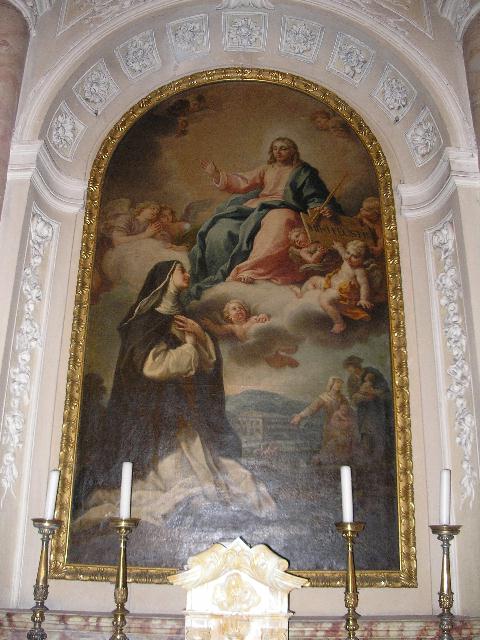
Circumstances, however, changed to make doing so difficult. The next year her father died, leaving her in the care of an uncle. This uncle determined that the best course of action he could take would be to get Lucy married as quickly as possible.
He made several attempts to do so. One of these included holding a large family party. He had invited the man he had chosen as Lucia’s husband to the party, with the intention of having the couple publicly betrothed. He however had not informed Lucia of his intentions. The suitor made an attempt to put a ring on Lucia’s finger, only to be slapped repeatedly for his efforts by Lucia.
A later attempt involved Count Pietro de Alessio of Milan, an acquaintance of the family. Lucia was actually quite fond of him, but felt her earlier vow to become a nun made the possibility of marriage impossible. The strain Lucia felt as a result of the conflicting feelings made her seriously ill. During this time, the Virgin Mary and Saint Dominic again appeared to her, this time accompanied by Catherine of Siena. They reportedly advised Lucia to contract a legal marriage to Pietro, but to explain that her vow of virginity would have to be respected and not violated. Pietro agreed to the terms, and the marriage was formalized.
In 1491 Lucia became Pietro’s legal wife and the mistress of his household, which included a number of servants and a busy social calendar. Despite her busy schedule, Lucia made great efforts to instruct the servants in Christianity and soon became well known locally for her charity to the poor.
Pietro observed Lucia’s behavior, and occasional quirks, quite indulgently. He never objected when she gave away clothing and food nor when she performed austere penances, which included regularly wearing a hair shirt under her garments and spending most of the night in prayer and acting to help the poor. He also seemed to have taken in stride the story he was told by the servants that Lucia was often visited in the evenings by Saint Catherine, Saint Agnes, and Saint Agnes of Montepulciano who helped her make bread for the poor.
However, when one of the servants came up to him one day and told him that Lucia was privately entertaining a handsome young man she appeared to be quite familiar with, he did react. He took up his sword and went to see who this person was. When he arrived, he found Lucia contemplating a large crucifix. The servant told him that the man he had seen Lucia with looked like the figure on the crucifix.
Lucia left one night for a local Franciscan monastic community, only to find it closed. She returned home the following day, stating that she had been led back by two saints. That was enough for Pietro. He had her locked away for the bulk of one Lenten season. She was only visited by servants who brought her food. When Easter arrived, however, she managed to escape from Pietro back to her mother’s house and on 1494 May 8 became a Dominican tertiary. Pietro expressed his disapproval of this in a rather dramatic form, by burning down the monastery of the prior who had given her the habit.
In 1495 Lucia went to Rome and joined a group of Third order Dominican tertiaries. The next year she was sent to Viterbo and here she found she was frequently the object of unwanted attention. It was here, on February 25, 1496 that she is reported to have received the stigmata. Lucia did her best to hide these marks, and was frequently in spiritual ecstasy. The house had a steady stream of visitors who came to speak to Lucia, and, often, just look at her. Even the other nuns were concerned about her, and at one point called in the local bishop who watched Lucia go through the drama of the Passion for twelve hours straight.
The bishop would not make a decision on Lucia, and called in the local inquisition. Reports here vary, some indicating that he referred the case directly to the Pope, who is said to have spoken with her and, with the assistance of Columba of Rieti, ultimately decided in her favor, telling her to go home and pray for him. Other sources question the accuracy of these reports.
At that time Pietro also came to her, making a final plea to persuade Lucia to return with him as his wife. She declined, and Pietro left alone. He would himself later become a Franciscan monk and a famous preacher.
When Lucy returned to the convent in Viterbo, she found that the Duke of Ferrara, Ercole d’Este I, had determined to build a convent in Ferrara and that, having heard of her, he determined that she would be its prioress. In summer of 1497, he invited her to be the founder of this new monastery. Lucia herself, the Dominican order, and the Pope all agreed quickly to the new proposal. The municipal council of Viterbo, however, objected, not wanting to lose Lucy. Lucia had been praying for some time for a way to create a new convent of strict observance, and agreed to go to the new convent.
Lucia’s departure precipitated a conflict between Ferrara and Viterbo which would continue for two years. Viterbo wanted to keep the famous mystic for themselves, and the duke wanted her in Ferrara. After extensive correspondence between the parties, on April 15, 1499 Lucia escaped secretly from Viterbo and was officially received in Ferrara on May 7, 1499. Thirteen young girls immediately applied for admission to her new community; the construction of the monastery began in June and was completed two years later, in August 1501. It contained 140 cells for sisters and the novices, but to fill it with suitable vocations proved to be very difficult. Lucia expressed the wish to have there some of her former friends from Viterbo and Narni. Duke Ercole, in September 1501 sent his messenger to Rome asking for the help of the pope’s daughter Lucrezia Borgia, who was preparing to marry Duke’s son Alfonso. She collected all eleven candidates Lucia had indicated and sent them, as a special wedding present to Lucia and to the Duke, a few days ahead of her bridal party. She herself solemnly entered Ferrara on February 2, 1502.
The Duke petitioned the local bishop for some help for Lucia in governing her new community, and he sent ten nuns from another community to join Lucia’s convent. Unfortunately, these ten nuns were members of the Dominican second order, who were canonically permitted to wear black veils, something Lucia and the members of the Dominican third order community were not allowed to do.
Tensions were heightened when one of these veiled outsiders, Sister Maria da Parma, was made the prioress of the convent on September 2, 1503. When Duke Ercole died on January 24, 1505 the new prioress quickly found Lucia to be guilty of some unrecorded transgression, most probably of the support for the Savonarolan church reform, and placed her on a strict penance. Lucia was not allowed to speak to any person but her confessor, who was chosen by the prioress. The local provincial of the Dominican order would also not permit any member of the order to see Lucia. There are records that at least one Dominican, Catherine of Racconigi, did visit her, evidently by bilocation, and that Lucia’s earlier visitation by departed saints continued. In response to Lucia’s insistent prayer her stigmata eventually disappeared, which caused some of the other nuns to question whether they had ever been there at all. When Lucia finally died, in 1544, many people were surprised to find that she had not died years earlier.
Then suddenly everything changed. When her body was laid out for burial so many people wanted to pay their last respects that her funeral had to be delayed by three days. Her tomb in the monastery church was opened four years later and her perfectly preserved body was transferred to a glass case. When Napoleon in 1797 suppressed her monastery the body was transferred to the Cathedral of Ferrara; and on 1935 May 26 – to the Cathedral of Narni.
Lucia was beatified by Pope Clement XI on March 1, 1710
Saint Albert the Great

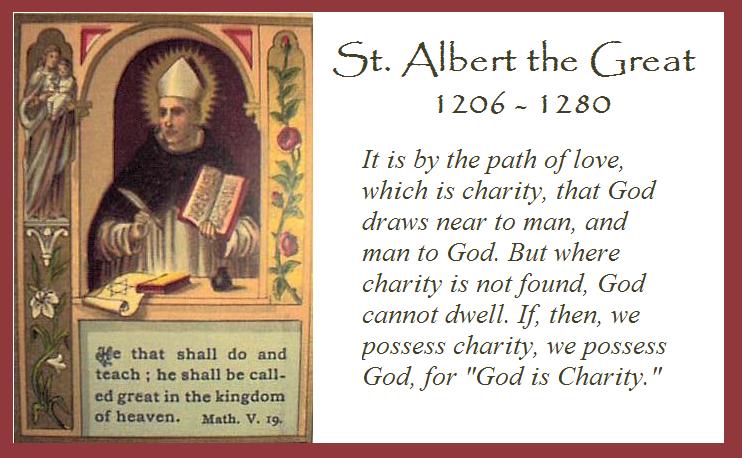
Saint Albert the Great was born sometime between 1193 and 1206, to the Count of Bollstädt in Lauingen in Bavaria. Contemporaries such as Roger Bacon applied the term “Magnus” to Albertus during his own lifetime, referring to his immense reputation as a scholar and philosopher. Albertus was educated principally at Padua, where he received instruction in Aristotle’s writings. A late account by Rudolph de Novamagia refers to Albertus’ encounter with the Blessed Virgin Mary, who convinced him to enter Holy Orders. In 1223 (or 1221) he became a member of the Dominican Order, against the wishes of his family, and studied theology at Bologna and elsewhere. Selected to fill the position of lecturer at Cologne, Germany, where the Dominicans had a house, he taught for several years there, at Regensburg, Freiburg, Strasbourg and Hildesheim. In 1245 he went to Paris, received his doctorate, and taught for some time as a master of theology with great success. During this time Thomas Aquinas began to study under Albertus.
In 1254, Albertus was made provincial of the Dominican Order, and fulfilled the arduous duties of the office with great care and efficiency. During his tenure he publicly defended the Dominicans against attacks by the secular and regular faculty of the University of Paris, commented on St. John, and answered what he perceived as errors of the Arabian philosopher Averroes.
In 1260, Pope Alexander IV made him Bishop of Regensburg, an office from which he resigned after three years. During the exercise of his duties he enhanced his reputation for humility by refusing to ride a horse—in accord with the dictates of the Dominican order—instead walking back and forth across his huge diocese. This earned him the affectionate sobriquet, “boots the bishop,” from his parishioners. After his stint as bishop, he spent the remainder of his life partly in retirement in the various houses of his order, yet often preaching throughout southern Germany. In 1270, he preached the eighth Crusade in Austria. Among the last of his labors was the defense of the orthodoxy of his former pupil, Thomas Aquinas, whose death in 1274 grieved Albertus. After suffering a collapse of health in 1278, he died on November 15, 1280, in Cologne, Germany. His tomb is in the crypt of the Dominican church of St. Andreas in Cologne, and his relics at the Cologne Cathedral.
Albertus was beatified in 1622. He was canonized and proclaimed a Doctor of the Church in 1931 by Pope Pius XI. St Albert’s feast day is celebrated on November 15.
Blessed Peter Cambiano of Ruffia

Peter’s father was a city councilor, his mother was from a noble family, and the boy was raised in a pious household. He received a good education, and was drawn early to religious life, with a personal devotion to Our Lady of the Rosary. He joined the Dominicans in Piedmont, Italy at age 16. He continued his studies, and was ordained at age 25, and was a noted preacher throughout northern Italy. He worked to bring the heretical Waldensians back to the Church, and was appointed inquisitor-general of the Piedmont.
In January 1365 Peter and two Dominican brothers went on a preaching mission through the mountains between Italy and Switzerland, working from the Franciscan friary at Susa, Italy. Peter’s preaching brought many back to the faith, which earned him the anger of the Waldensians. Three of the heretics came to the friary, asked to see Peter, and then murdered him at the gate.
Blessed Simon Ballachi
Blessed Simon Ballachi was born to the nobility in 1240, the son of Count Ballachi. His family had a close association with the Church clergy; two of his uncles became archbishops of Rimini, Italy, and a younger brother was a priest. Trained as a soldier and in administration, he was expected to take over the family estates. Against his family wishes, he joined the Dominicans as a lay brother at age 27.
Assigned to work in the garden of his friary, something he knew nothing about but which he loved instantly. He saw God in everything, and prayed constantly as he worked. Noted for his simple life, his strict adherence to the Dominican Rule, and his excellent work as a catechist to children. A visionary, Simon was visited by the devil, by Saint Catherine of Alexandria, Saint Dominic de Guzman, Saint Peter Martyr, and the Blessed Virgin Mary; other brothers saw his cell glowing, and heard angelic voices. Blinded at age 57, he was nearly helpless during the last years of his life; he never despaired, and used the extra free time for prayer. He died on 5 November in 1391.
The Feast of Ignatius of Antioch ~ Early Church Father
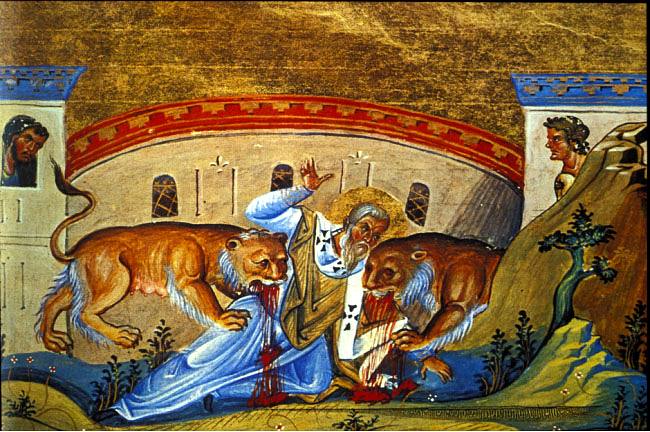 About St. Ignatius’s life little is known. He was born ca. 35 or 50 and died in 107.[i] It is known to be a fact that he was the Bishop of Antioch after Saint Peter and Saint Evodius, and that Peter himself appointed Ignatius to the see of Antioch (as recorded by the author and theologian Theordoret). And it is known that he was a martyr and died in 107 C.E. during the reign of the Emperor Trajan[ii].
Authorities from the 500s C.E. report that Ignatius served as bishop of Antioch for 40 years. Antioch was one of the most important Christian communities of that era, (Acts 11:26) and Ignatius would have been well known in those Christian communities. Antioch was a major metropolitan area; it was the capital of the Roman province of Syria and the second city of the empire, following Rome. If Ignatius were Antioch’s bishop for 40 years, then he would have been a man of tremendous fame.
Besides his Greek name, Ignatius, he also called himself Theophorus (“God Bearer”), and tradition says he was one of the children Jesus took in His arms and blessed. He based his authority on his being a bishop of the Church, living his life in the imitation of Christ. It is believed that St. Ignatius, along with his friend Polycarp, with great probability were disciples of the Apostle St. John. The Eucharistic spirituality of his letters seems to give this credence.
What we know of his martyrdom comes from letters that are attributed to him. St. Ignatius reports his arrest by the authorities and his travel to Rome:
From Syria even to Rome I fight with wild beasts, by land and sea, by night and by day, being bound amidst ten leopards, (meaning guards), even a company of soldiers, who only grow worse when they are kindly treated. —Ignatius to the Romans, 5.
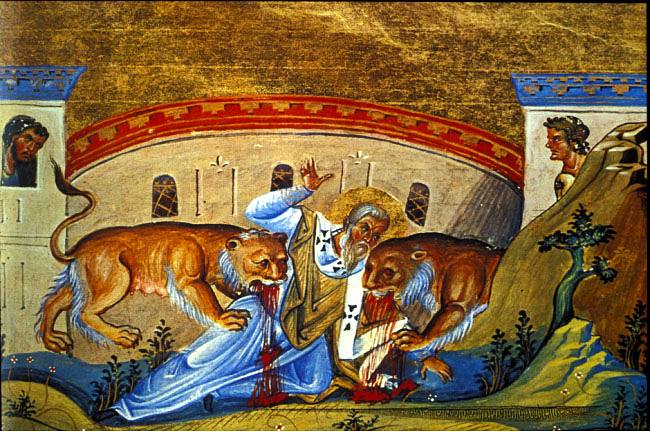
He was sentenced to die, to be devoured by lions. As he approached execution, Ignatius identified himself more and more with the sacrifice of the altar. He wrote:
“I am writing to all the Churches and I enjoin all, that I am dying willingly for God’s sake, if only you do not prevent it. I beg you, do not do me an untimely kindness. Allow me to be eaten by the beasts, which are my way of reaching to God. I am God’s wheat, and I am to be ground by the teeth of wild beasts, so that I may become the pure bread of Christ.” Ignatius to the Romans, 4.
After Ignatius’ martyrdom in the Flavian Amphitheatre, his remains were honorably carried back to Antioch by his companions, and were first interred outside the city gates, then removed by the Emperor Theodosius II to the Tychaeum, or Temple of Tyche, which was then converted into a church dedicated to Ignatius. In 637 the relics were translated to the Church of St. Clement in Rome.
Along the route to his execution, he wrote six letters to the churches in the region, and one to a fellow bishop, his friend, Polycarp. These letters have been preserved as an example of early Christian theology. Important topics addressed in these letters include ecclesiology, the sacraments, and the role of bishops. The letters of Ignatius have proved to be an important testimony to the development of Christian theology, and affect our ecclesiology to this day. They bear signs of being written in great haste and without a proper plan, such as the use of run-on sentences and an unsystematic succession of thought. Ignatius is the earliest known Christian writer to emphasize loyalty to a single bishop in each city (or diocese) who is assisted by both presbyters possibly elders and deacons. Earlier writings only mention either bishops or presbyters, and give the impression that there was usually more than one bishop per congregation. Ignatius is an indisputable witness to the hierarchical constitution of the church at the beginning of the second century. Also, it is in Ignatius’s writings that we first encounter the word, “priest” among orders of the clergy:
“See that you follow the bishop, even as Jesus Christ follows the Father. Follow the priest as you would follow the apostles. And reverence the deacons as you would reverence the command of God. Let no man do anything connected with the Church without the Bishop.” – Smyrnaeans 6-8.
“Take care to do all things in harmony with God, with the bishop presiding in the place of God, and with the priests in the place of the council of the apostles, and with the deacons, who are most dear to me, entrusted with the business of Jesus Christ, who was with the Father from the beginning and is at last made manifest.” —Letter to the Magnesians 2, 6:1.
Ignatius is known to have taught the deity of Christ,:
“There is one Physician who is possessed both of flesh and spirit; both made and not made; God existing in flesh; true life in death; both of Mary and of God; first possible and then impossible, even Jesus Christ our Lord.”
Ignatius stressed the value of the Eucharist, calling it a “medicine of immortality” (Ignatius to the Ephesians 20:2). He also wrote:
“Unless you eat the flesh of the Son of man and drink his blood, you have no life in you. He who eats this bread will live forever.”
The very strong desire for bloody martyrdom in the arena, which Ignatius expresses rather graphically in places, may seem quite odd and disturbing to the modern reader. An examination of his theology of soteriology (his beliefs about salvation) shows that he regarded salvation as one being free from the powerful fear of death and thus to bravely face martyrdom. He wrote:
“Let fire and the cross; let the crowds of wild beasts; let tearings, breakings, and dislocations of bones; let cutting off of members; let shatterings of the whole body; and let all the dreadful torments of the devil come upon me; only let me attain to Jesus Christ.[iii]
Ignatius is claimed to be the first known Christian writer to argue in favor of Christianity’s replacement of the Sabbath with the Lord’s Day:
“Be not seduced by strange doctrines nor by antiquated fables, which are profitless. For if even unto this day we live after the manner of Judaism, we avow that we have not received grace…. If then those who had walked in ancient practices attained unto newness of hope, no longer observing Sabbaths but fashioning their lives after the Lord’s day, on which our life also arose through Him and through His death which some men deny … how shall we be able to live apart from Him? … It is monstrous to talk of Jesus Christ and to practice Judaism. For Christianity did not believe in Judaism, but Judaism in Christianity.” — Ignatius to the Magnesians 8:1, 9:1-2, 10
He is also responsible for the first known use of the Greek word “katholikos” meaning “universal”, “complete” and “whole” to describe the church, writing:
“Wherever the bishop appears, there let the people be; as wherever Jesus Christ is, there is the Catholic Church. It is not lawful to baptize or give communion without the consent of the bishop. On the other hand, whatever has his approval is pleasing to God. Thus, whatever is done will be safe and valid.” — Letter to the Smyrnaeans 8.
It is from the word katholikos (“according to the whole”) that the word catholic comes. When Ignatius wrote the Letter to the Smyrnaeans in about the year 107 and used the word “catholic,” he used it as if it were a word already in use to describe the Church. This has led many scholars to conclude that the appellation “Catholic Church” with its ecclesial connotation may have been in use as early as the last quarter of the 1st century.
On the Eucharist, Ignatius wrote in his letter to the Smyrnaeans:
Take note of those who hold heterodox opinions on the grace of Jesus Christ which has come to us, and see how contrary their opinions are to the mind of God. . . . They abstain from the Eucharist and from prayer because they do not confess that the Eucharist is the flesh of our Savior Jesus Christ, flesh which suffered for our sins and which that Father, in his goodness, raised up again. They who deny the gift of God are perishing in their disputes. — Letter to the Smyrnaeans 6:2–7:1.
In Western and Syriac Christianity Saint Ignatius’s feast is celebrated on 17 October. He is celebrated on 1 February by the Roman Catholics following the General Roman Calendar of 1962.
[i] Brauer, Jerald, (ed.) The Westminster Dictionary of Church History, (Philadelphia: Westminster Press, 1971).
[ii] Aquilina, Mike, The Mass of the Early Christians, (Huntington, IN: Our Sunday Visitor, Inc., 2007) p. 75.
[iii] Aquilina, Mike, The Fathers of the Church, (Huntington, IN: Our Sunday Visitor, Inc., 1999) p. 68.
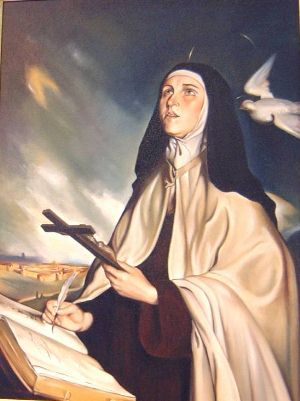
“God Alone Is Enough” — St. Teresa of Avila ~ The Rev. Dcn. Sr. Dollie Wilkinson, OPI
 Saint Teresa of Avila (Saint Theresa of Jesus)
Born in Avila, Spain March 28, 1515; died in Alba de Tormes, October 4 [15], 1582
Foundress of the Discalced Carmelites, 1560-62.
Canonized by Gregory XV, 1622; declared a Doctor of the Church in 1970.
Spanish mystic, writer and reformer of the Carmelite order.
St Terese of Avila was an influential and pivotal figure of her generation.St Teresa (Teresa de Cepeda y Ahumada) was born in Avila, Spain on 28th March 1515. Her parents were both pious Catholics and in some ways inspired their daughter to take up a life of prayer. As a young child Teresa showed signs of a deeply religious nature; she would often retreat into silence for prayer and would enjoy giving alms to the poor. She was very close to her Mother, who provided a warm counterbalance, to the strictness of her father. However in her teens, Teresa’s mother passed away, leaving the young Teresa distraught at the void she felt. The young St Teresa tells of her despair and how she turned instinctively to the Virgin Mary for comfort.
“I threw myself down in despair before an image of the Mother of God. With many tears, I implored the Holy Virgin to become my mother now. Uttered with the simplicity of a child, this prayer was heard. From that hour on, I never prayed to the Virgin in vain.”
During her later teen years Avila lost some of her early piety and religious zeal. She recounted how she became interested in worldly matters and enjoyed the company of a wide circle of friends. She had a natural charm and found it easy to make friends. In return she enjoyed the compliments and friendships of others. However, she was not at peace, considering herself to be a miserable sinner; later she would look back in guilt at her early life. However this sense of being a “miserable sinner” was probably the result of a harsh self-judgment, encouraged by her fathers exacting religious standards. At the age of 16, her father decided to send Teresa to a convent school to be educated.
This re-ignited in Avila an interest in following a spiritual life and after some deliberation resolved to become a nun of the Carmelite Order. At the time the convent rules were not very strict; it was probably more relaxed than living with her father. At the time the convent accepted many people into the order, often for financial reasons. The convent became overcrowded and people were often judged not on the basis of spiritual intensity but on material possessions. In this climate, Teresa struggled to find time for quite reflection; although she did start teaching people on the virtues of mental prayer.
Shortly after becoming a nun, Avila experienced a severe illness (malaria), which left her in great pain for a long period. At one point it was feared that her illness was so severe that she would not be able to recover. However during this period of intense physical pain, she began to increasingly experience divine visions and an inner sense of peace. These inner experiences of joy and peace seemed to transcend the intense physical pain of the body.
When she was a little better she resumed her prayers with renewed vigor. However after telling others of her visions and spiritual experiences, she was dissuaded from persuading them. Certain clergy felt they were just delusions of the devil. As a result, for many years Teresa lost the confidence to pursue her prayers and her spiritual life was almost put on hold. However, when Teresa was 41, she met a Priest who convinced her to go back to her prayers and implore God to come back. Initially, she had some difficulty sitting through prayers. She wryly remarked the end of the hour’s prayer couldn’t come soon enough. However, in the course of time, she became absorbed in deep contemplation in which she felt an ever growing sense of oneness with God. At times she felt overwhelmed with divine love. The experiences were so transforming, she at times felt the illumining grace of God would wash her soul away. She was so filled with divine contemplation it is said at times her body would spontaneously levitate. Teresa, however was not keen on these public displays of “miracles”. When she felt it happening she would ask other nuns to sit on her to prevent her floating away.
Teresa was not a just a quiet, placid saint. She had an endearing, natural quality; her life energy attracted and inspired many who were close. They admired her for both her outer charm and inner serenity. But at the same time her religious ecstasies also caused jealousy and suspicion. Unfortunately she was born into the period of the Spanish inquisition, during this time any deviation from the orthodox religious experience came under the strict observation and scrutiny. On one occasion Teresa complained to God about her mistreatment from so many different people. God replied to her saying “That is how I always treat my friends” with good humour St Teresa replied “That must be why you have so few friends”. St Teresa struggled because there were few who could understand or appreciate her inner ecstasies. However on the one hand she felt these experiences to be more real than ordinary events.
At the age of 43, St Teresa decided she wanted to found a new order recommitting to the values of poverty and simplicity. She wanted to move away from her present convent which made a life of prayer more difficult. Initially her aims were greeted with widespread opposition from within the town of Avila. However, with the support of some priests, the opposition waned and she was allowed to set up her first convent. St Teresa proved to be an influential leader and founder. She guided the nuns not just through strict disciplines, but also through the power of love, and common sense. Her way was not the way of rigid asceticism and self denial. Although she underwent many tribulations herself, to others she stressed the importance of experiencing God’s love.
St Teresa devoted much of the rest of her life to traveling around Spain setting up new convents based along the ancient monastic traditions. Her travels and work were not always greeted with enthusiasm, many resented her reforms and the implied criticism of existing religious orders. She often met with criticism including the papal nuncio who used the rather descriptive phrase “a restless disobedient gadabout who has gone about teaching as though she were a professor” St Teresa also had to frequently contend with difficult living conditions and her frail health. However she never let these obstacles dissuade her from her life’s task. She eventually died on October 4 at the age of 67. In 1566 she wroteCamino de perfeccion (Way of Perfection) in about 1566, to tell the nuns how to reach their goal. In 1580 she wrote what is considered her greatest work; the Castillo interior/ Las moradas(Interior castle/ The mansions) this involved describing the various stages of spiritual evolution leading to full prayer; she wrote Las Fundaciones (Foundations) from 1573 to 1582, so they would remember the early history of their order.
“God alone is enough.”
St. Theresa’s most popularly known writing, is a brief poem, which is known as her “Bookmark”, because it was found in her prayer book after her death in 1582. It has been variously translated into English, and has been very widely circulated.
Let nothing disturb you,
Let nothing frighten you,
All things are passing away:
God never changes.
Patience obtains all things.
Whoever has God lacks nothing;
God alone suffices.
Teresa lived in an age of exploration as well as political, social and religious upheaval. It was the 16th century, a time of turmoil and reform. She was born before the Protestant Reformation and died almost 20 years after the closing of the Council of Trent.
The gift of God to Teresa in and through which she became holy and left her mark on the Church and the world is threefold: She was a woman; she was a contemplative; she was an active reformer.
As a woman, Teresa stood on her own two feet, even in the man’s world of her time. She was “her own woman,” entering the Carmelites despite strong opposition from her father. She is a person wrapped not so much in silence as in mystery. Beautiful, talented, outgoing, adaptable, affectionate, courageous, enthusiastic, she was totally human. Like Jesus, she was a mystery of paradoxes: wise, yet practical; intelligent, yet much in tune with her experience; a mystic, yet an energetic reformer. A holy woman, a womanly woman.
Teresa was a woman “for God,” a woman of prayer, discipline and compassion. Her heart belonged to God. Her ongoing conversion was an arduous lifelong struggle, involving ongoing purification and suffering. She was misunderstood, misjudged, opposed in her efforts at reform. Yet she struggled on, courageous and faithful; she struggled with her own mediocrity, her illness, her opposition. And in the midst of all this she clung to God in life and in prayer. Her writings on prayer and contemplation are drawn from her experience: powerful, practical and graceful. A woman of prayer; a woman for God.
Teresa was a woman “for others.” Though a contemplative, she spent much of her time and energy seeking to reform herself and the Carmelites, to lead them back to the full observance of the primitive Rule. She founded over a half-dozen new monasteries. She traveled, wrote, fought—always to renew, to reform. In her self, in her prayer, in her life, in her efforts to reform, in all the people she touched, she was a woman for others, a woman who inspired and gave life.
Her writings, especially the “Way of Perfection”and “The Interior Castle”, have helped generations of believers.
In 1970, the Church gave her the title she had long held in the popular mind: Doctor of the Church. She and St. Catherine of Siena were the first women so honored.
Ready? Set! What?????? ~Br. Michael Marshall, Postulant

Gospel Matt 22:1-14
1 Jesus again in reply spoke to the chief priests and elders of the people in parables, saying, 2 “The kingdom of heaven may be likened to a king who gave a wedding feast for his son.
3 He dispatched his servants to summon the invited guests to the feast, but they refused to come. 4 A second time he sent other servants, saying, ‘Tell those invited: “Behold, I have prepared my banquet,
my calves and fattened cattle are killed, and everything is ready; come to the feast.”’ 5 Some ignored the invitation and went away, one to his farm, another to his business. 6 The rest laid hold of his servants,
mistreated them, and killed them. 7 The king was enraged and sent his troops, destroyed those murderers, and burned their city. 8 Then he said to his servants, ‘The feast is ready, but those who were invited were not worthy to come.
9 Go out, therefore, into the main roads and invite to the feast whomever you find.’ 10 The servants went out into the streets and gathered all they found, bad and good alike, and the hall was filled with guests.
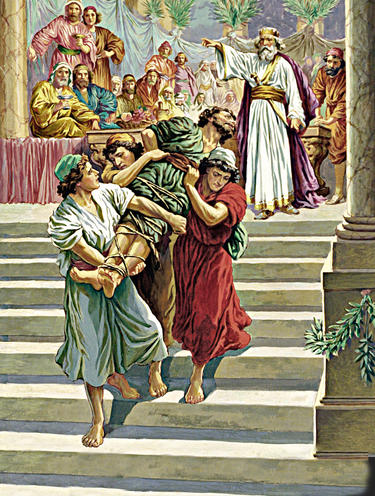
11 But when the king came in to meet the guests, he saw a man there not dressed in a wedding garment. 12 The king said to him, ‘My friend, how is it that you came in here without a wedding garment?’
But he was reduced to silence. 13 Then the king said to his attendants, ‘Bind his hands and feet, and cast him into the darkness outside, where there will be wailing and grinding of teeth.’ 14 Many are invited, but few are chosen.”
A young man entered college to fulfill his dream of becoming an architect, and initially he succeeded in his studies. He really enjoyed college, and made many friends during the first semester. Even though he was only a freshman, he was invited to many parties. Because of attending parties, the second semester ended up not going so well. He was more into socializing with friends instead of studying, and what studying he did was short of cramming. On the day of a mid-term exam, he scurried out of bed to get to there on time. The syllabus stated if a student was late for an exam, the exam would have to be made up with a percentage of the score deducted from 100% based upon the amount of time late. He barely made it to the exam before the materials were passed out.
He figured he would be able to pass the exam because he had showed up to at least half of the class sessions and took decent notes. For this exam he did not study for the exam thinking he could answer the questions based on what he thought he remembered from his notes and other things from the lectures when attending class. Unfortunately, most of the questions on the exam had to deal with material he missed when not attending class. Only a third of the questions pertained to the material in his notes. He recognized those questions, but had not studied enough to answer every question correctly. Needless to say, he failed the exam, and flunked out of college.
The most important events in life take being prepared for them. The Gospel reading from Matthew speaks to being prepared. The man in the street invited to the wedding feast shows up without a wedding garment, which is required to attend the wedding celebration. The man was not prepared for the wedding feast, therefore put back on the street. The college student did not devote the proper amount of time to studying for his courses, and his lack of preparedness resulted in failing exams and flunking out of college after only one year.
Unlike the person in the street and the college student, it is not always easy to be prepared for situations in life, but we should try to be. Not every situation is like an exam. We might be thrown into a situation which catches us off guard, yet when we have the “know how” we will be able to achieve what is supposed to happen. Let’s take the example of someone driving down the road and a tire goes flat. People generally do not check their tires for leaks every time they get into their car to go somewhere, and even if they did they might run over a nail to cause a tire to go flat. So now a tire has gone flat… The “know how” would be understanding how to remove the tire to put on the spare or temporary tire. Learning how to do that would at least be some preparation because the problem would be addressed easier. If the person did not know how to change the tire out for the spare, they would have to get help from someone else or possibly be stranded. Someone with the knowledge of how to change a tire should recognize the person needs help and change the tire for them.
What are you doing to prepare yourself? Have you studied for your exam? Have you checked your tires? Are you ready, prepared, and able to go out into the world and be a witness for Our Lord? Are you dressed in your wedding garments?
What? Where? Why? Who? Our Lady of the Rosary ~ The Rev. Deacon Br. Joshua Hatten, OPI
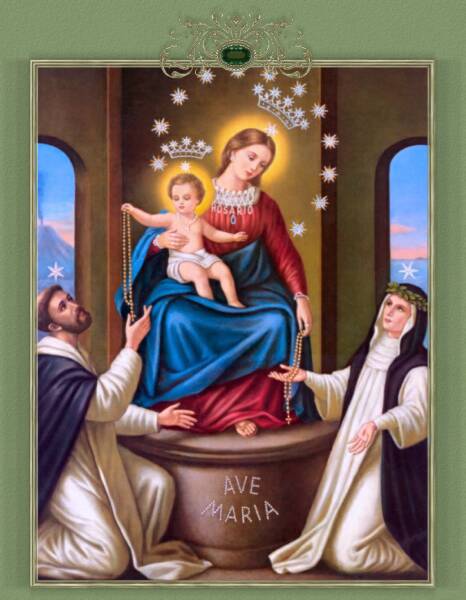
 Today the church celebrates an important Marian Feast, Our Lady of the Rosary. Why do celebrate this feast? Why do we bother with the rosary at all… it is just some ancient prayer of the church, right?? Wrong! Very wrong!
The Rosary is not a repetitious, boring, ‘religious’ activity… we can certainly make it feel like that… boring, words repeated by rote without any meaning. But that isn’t the Rosary. That is a waste of time. The rosary, when properly prayed, with intention – and with whatever YOUR intentions may be – is one of the most powerful and mountain moving forms of active prayer and meditation with which we are blessed. Archbishop Fulton J. Sheen once said, “The rosary is the book of the blind, where souls see and there enact the greatest drama of love the world has ever known; it is the book of the simple, which initiates them into mysteries and knowledge more satisfying than the education of other men; it is the book of the aged, whose eyes close upon the shadow of this world, and open on the substance of the next. The power of the rosary is beyond description.”
But the rosary began quite differently than that we know today. The use of “prayer beads” and the repeated recitation of prayers to aid in meditation stem from the earliest days of the Church and has roots in pre-Christian times. Evidence exists from the Middle Ages that strings of beads were used to count Our Fathers and Hail Marys. Actually, these strings of beads became known as “Paternosters,” the Latin for “Our Father.”
The structure of the rosary gradually evolved between the 12th and 15th centuries. Eventually 50 Hail Marys were recited and linked with verses of psalms or other phrases evoking the lives of Jesus and Mary. During this time, this prayer form became known as the rosarium (“rose garden”), actually a common term to designate a collection of similar material, such as an anthology of stories on the same subject or theme. During the 16th century, the structure of the five-decade rosary based on the three sets of mysteries prevailed.
Tradition does hold that St. Dominic (d. 1221) devised the rosary as we know it. Moved by a vision of our Blessed Mother, he preached the use of the rosary in his missionary work among the Albigensians, who had denied the mystery of Christ.
Originally, people prayed 150 Our Fathers representing the 150 Psalms. Then there was a parallel practice of praying 150 Hail Marys. Later, a mystery of Jesus’ life was attached to each Hail Mary.
Church Tradition and, let’s face it, LEGEND, tells us that St. Dominic (d. 1221) devised the rosary as we know it. Moved by a vision of our Blessed Mother, he preached the use of the rosary in his missionary work among the Albigensians, who had denied the mystery of Christ. Whilst that cannot by proved, and in fact may not be true, the development of the rosary as we know it owes much to the Dominican Order. One of St. Dominic’s Dominican contemporaries, Alan de la Roche, was known as “the apostle of the rosary.” He founded the first Confraternity of the Rosary in the 15th century. In the 16th century the rosary was developed to its present form—with the 15 mysteries (joyful, sorrowful and glorious). In 2002, Pope John Paul II added five Mysteries of Light to this devotion.
Let the rosary become YOUR BOOK, as Archbishop Sheen termed it, the book you ‘open’ when it seems like everything is just too much to bear or when you’re filled with such gratitude for love or when or when it is just a humdrum Wednesday. You will be amazed by the power of this beautiful prayer. The book opens when you realize you’re not merely praying the same words on the same beads every time, but when you actually begin to meditate and place yourself in the corresponding mysteries. You become an active participant in the life and times of Our Lord and His Mother.
Anyone who knows six easy prayers can pray a Rosary; you will also need to know twenty Mysteries to meditate upon as you pray. You do not have to be a Catholic.
The Order of Prayers
The Rosary begins with the Apostles Creed, followed by one Our Father, three Hail Marys (traditionally offered for an increase in faith, hope, and charity for those praying the Rosary), a Glory Be, and, if desired, the Fatima Prayers. Next come five mysteries, each consisting of one Our Father, ten Hail Marys, a Glory Be, and, if desired, the Fatima Prayers. Conclude with the Hail Holy Queen. Please say a few extra prayers after the Hail Holy Queen for the Pope.
Rosary Beads
If you do not have Rosary beads, it is perfectly okay to count with your fingers. Counting beads frees your mind to help you meditate.
Prayers for Praying the Rosary
THE APOSTLE’S CREED
I believe in God, the Father Almighty, Creator of Heaven and earth; and in Jesus Christ, His only Son, Our Lord, Who was conceived by the Holy Ghost, born of the Virgin Mary, suffered under Pontius Pilate, was crucified; died, and was buried. He descended into Hell; the third day He arose again from the dead; He ascended into Heaven, sitteth at the right hand of God, the Father Almighty; from thence He shall come to judge the living and the dead. I believe in the Holy Spirit, the holy Catholic Church, the communion of saints, the forgiveness of sins, the resurrection of the body, and the life everlasting. Amen.
OUR FATHER
Our Father, Who art in heaven, hallowed be Thy name; Thy kingdom come; Thy will be done on earth as it is in heaven. Give us this day our daily bread; and forgive us our trespasses as we forgive those who trespass against us; and lead us not into temptation, but deliver us from evil. Amen.
HAIL MARY
Hail Mary, full of grace. The Lord is with thee. Blessed art thou amongst women, and blessed is the fruit of thy womb, Jesus. Holy Mary, Mother of God, pray for us sinners, now and at the hour of our death, Amen.
GLORY BE
Glory be to the Father, and to the Son, and to the Holy Spirit, as it was in the beginning, is now, and ever shall be, world without end. Amen.
FATIMA PRAYER (OPTIONAL)
O my Jesus, forgive us of our sins. Save us from the fires of hell. Lead all souls into heaven, especially those in most need of thy mercy.
HAIL HOLY QUEEN
Hail, holy Queen, Mother of mercy, our life, our sweetness and our hope. To thee do we cry, poor banished children of Eve: to thee do we send up our sighs, mourning and weeping in this valley of tears. Turn then, most gracious Advocate, thine eyes of mercy toward us, and after this our exile, show unto us the blessed fruit of thy womb, Jesus. O clement, O loving, O sweet Virgin Mary!
Leader: Pray for us O Holy Mother of God,
All: That we may be worthy of the promises of Christ.
(Optional)
Leader: Let us pray.
All: O God whose only begotten Son by his life, death, and Resurrection has purchased for us the rewards of eternal life; grant we beseech thee, that meditating on these mysteries of the Most Holy Rosary of the Blessed Virgin Mary, we may imitate what they contain and obtain what they promise through the same Christ our Lord. Amen.
PRAYER FOR THE HOLY FATHER (FOR PRIVATE DEVOTION)
Leader: Upon this Rock He will build His Church…
All: …and the jaws of death shall not prevail against her.
Leader: O Mother of the Redeemer…
All: …Living Tabernacle of the Eucharist, and Luminous Rose of Heaven, with humble confidence we ask you to bestow upon the Holy Father all the graces and blessings reserved for him by the Holy Trinity from all eternity. Amen.
Leader: Help his friends…
All: …convert his enemies.
Leader: Saint Joseph…
All: …pray for us. Amen.
The Twenty Mysteries
Here is a brief listing and description of all twenty Mysteries.
THE JOYFUL MYSTERIES
- The Annunciation:The Archangel Gabriel “announces” to Mary that she shall conceive the Son of God.
- The Visitation:Mary visits her cousin Elizabeth, who is pregnant with John the Baptist.
- The Nativity:Jesus is born.
- The Presentation:Mary and Joseph “present” Jesus in the Temple where they meet Simeon.
- The Finding in the Temple:After losing Him, Mary and Joseph find young Jesus teaching the Rabbis in the Temple.
THE LUMINOUS MYSTERIES (THE MYSTERIES OF LIGHT)
- The Baptism in the Jordan:The voice of the Father declares Jesus the beloved Son.
- The Wedding at Cana:Christ changes water into wine, his first public miracle.
- The Proclamation of the Kingdom:Jesus calls to conversion (cf. Mk 1:15) and forgives the sins of all who draw near to him.
- The Transfiguration:The glory of the Godhead shines forth from the face of Christ.
- The Institution of the Eucharist:Jesus offers the first Mass at the Last Supper with his apostles, establishing the sacramental foundation for all Christian living.
THE SORROWFUL MYSTERIES
- The Agony in the Garden:Jesus sweats water and blood while praying the night before his passion.
- The Scourging at the Pillar:Pilate has Jesus whipped.
- The Crowning with Thorns:Roman soldiers crown Jesus’ head with thorns.
- The Carrying of the Cross:Jesus meets His mother and falls three times on the way up Calvary.
- The Crucifixion:Jesus is nailed to the cross and dies before His mother and His apostle John.
THE GLORIOUS MYSTERIES
- The Resurrection:Jesus rises from the dead.
- The Ascension:Jesus leaves the Apostles and bodily “ascends” to heaven.
- The Descent of the Holy Spirit:The Apostles receive the Holy Spirit in tongues of fire in the upper room with Mary.
- The Assumption:Mary is taken bodily–assumed–into heaven by God at the end of her life here on earth.
- The Coronation:Mary is crowned Queen of Heaven and Earth.
Mysteries for Certain Weekdays
Traditionally, many people say the Joyful Mysteries on Monday, the Sorrowful Mysteries on Tuesday, the Glorious Mysteries on Wednesday, and start again with the Joyful Mysteries on Thursday, the Sorrowful Mysteries on Friday. The Glorious Mysteries are then prayed on Saturday and Sunday. Now that the Luminous Mysteries have recently been added, the schedule is:
Monday – Joyful
Tuesday – Sorrowful
Wednesday – Glorious
Thursday – Luminous
Friday – Sorrowful
Saturday – Joyful
Sunday – Glorious
Try to place yourself “into” the scene of the particular mystery as you pray, imagining the sights, smells, sounds, and emotions that Jesus, Mary, Joseph, and other participants experienced during the actual events.
It is also okay to meditate on the meaning of the words of the prayers as you pray them, or even to meditate on the person for whom you are offering the Rosary.
GOD BLESS YOU.
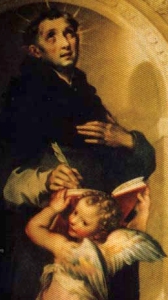
Blessed Raymond of Capua
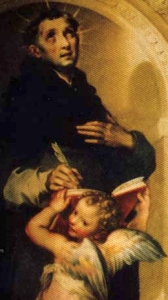 The so called second founder of the Dominican Order. Born at Capua, Italy, in 1330, Raymond delle Vigne entered the Dominicans while attending the University of Bologna and subsequently held several posts, including prior of the Dominican house in Rome and lector in Florence and Siena. While at Siena, he made the acquaintance of St. Catherine of Siena, serving as her spiritual director from 1376 and becoming her closest advisor.
Through the years he was connected with most of Catherine’s important undertakings, including the call for a Crusade against the Turks, the negotiation of peace between the papacy and Florence, and the plea made to Pope Gregory XI to depart Avignon and return to Rome. Raymond also worked to bring aid and comfort to the victims of a plague which struck Siena, and when he fell sick with the disease, Catherine nursed him back to health. Upon the start of the Great Western Schism in 1378, both Raymond and Catherine gave their support to Pope Urban VI against antipope Clement Vll. Raymond traveled to France in an unsuccessful bid to win the support of that kingdom; during the sojourn he was nearly killed by overzealous partisans of Clement VII.
He continued to strive for a peaceful settlement of the crisis in the Church, even after Catherine’s death in 1380, and was elected master general of the Dominicans As head of the order until his death at Nuremberg, he brought reforms to its houses and demanded the strict adherence to the rules laid down by St. Dominic. He also wrote biographies of Catherine of Siena and St. Agnes of Montepulciano.
Born: 1330 at Capua, Italy as Raymond delle Vigne
Died: October 1399 at Nuremberg, Germany of natural causes
Beatified: 1899 by Pope Leo XIII
 The Order of Preachers, Independent
You must be logged in to post a comment.