
Category: Lesson
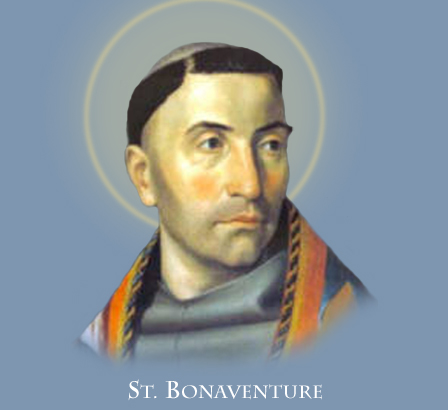
Saint Bonaventure O.F.M Doctor of the Church ~ Mthr. Lady Sherwood, OPI
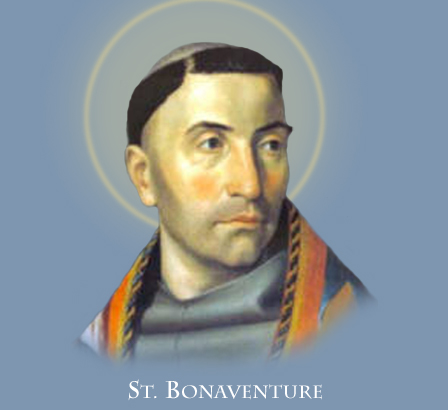
Saint Bonaventure was born Giovanni di Fidanza at Bagnorea in Tuscany in 1221. Almost nothing is known of his childhood, except the names of his parents, Giovanni did Fidanza and Maria Ritella.
He entered the Franciscan Order of Friars Minor in 1243 and studied at the University of Paris. In 1253, he held the Franciscan chair in Paris.
A dispute between seculars and mendicants delayed his reception as Master until 1257, where his degree was taken in company with Thomas Aquinas.
After successfully defending his order against the reproaches of the anti-mendicant party, he was duly elected as Seventh Minister General of the Order of Friars Minor.
On 24th November 1265, he was selected for the post of Archbishop of York; however he was never actually consecrated and he resigned this appointment in October 1266.
Bonaventure was instrumental in procuring the election of Pope Gregory X, who rewarded him with the title of Cardinal Bishop of Albano and who insisted on Bonaventure’s presence at the great second council of Lyon in 1274.
Bonaventure was canonised by Pope Sixtus IV on 14th April 1482 and was declared a Doctor of the Church in the year 1588 by Pope Sixtus V. Bonaventure is known as the “Seraphic Doctor”.
His significant contributions led to a union of the Greek and Latin Churches.
Bonaventure died suddenly in suspicious circumstances on 15th July 1274, with some sources suggesting he was possibly poisoned.
Bonaventure steered the Franciscans on a moderate and intellectual course that made them the most prominent order in the Catholic church until the coming of the Jesuits. His theology was marked by an attempt to completely integrate faith and reason. He thought of our Lord Jesus Christ as the “one true master” who offers humans knowledge that begins in faith, is developed through rational understanding, and is perfected by mystical union with God.
Bonaventure’s Feast day was included in the General Roman Calendar immediately upon his canonisation in 1482. It was first celebrated on the second Sunday in July, but in 1568 his feast was moved to 14th July because the 15th July, the anniversary of his death was at the time taken up by the Feast of Saint Henry. Bonaventure’s Feast day remained on July 14th with the rank of “double” until the year 1960 when it was reclassified as a feast of the third class. In 1969, his feast was again reclassified as an obligatory memorial and was assigned to the date of his death on July 15th.
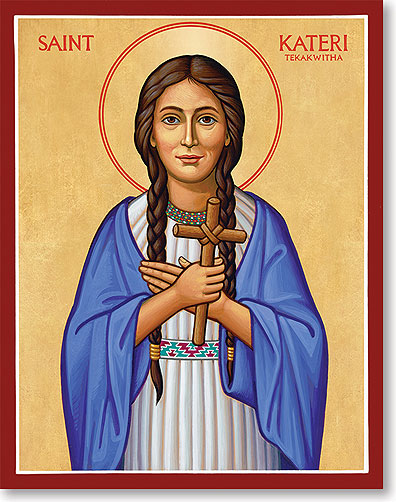
Why Can’t We All Just Get Along? ~ The Feast of St. Keteri Tekkawitha ~ Br. Chip Noon, Novice
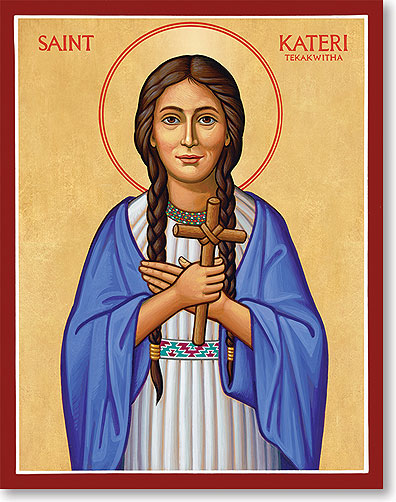
Why can’t we all just get along?
Oh how many times have we heard that trite, yet poignant question? “Why can’t we all just get along?”
The clash of cultures, races, nations – even neighbors – has always been with us. Those who are different from us, who think differently, look different, sound different, dress differently, these are all signs that we should be on our guard. It must be inbred, this fear of “the other.”
How many generations does it take to assimilate? When do we stop noticing the differences? When do we all start getting along? Let me come back to that at the end of this homily…
How fitting is it that on this day of the Feast of St. Kateri Tekakwitha, the reading from Exodus tells the story of the Hebrew Moses and the Egyptian Pharaoh’s daughter, of the Hebrews and the Egyptians. How different can two cultures be? One that worshipped cats and crocodiles and the other that worshipped one God, unknown and unknowable. One people that lorded it over a foreign people, going so far as to kill the male children of those foreigners.
And then, when Moses grows to adulthood, he continues the clash of cultures, killing an Egyptian overseer who was mistreating the Hebrews.
Now let’s examine the time and place where today’s saint, Kateri Tekakwitha, grew and flourished: New York in the late 17th Century. Talk about culture clashes! There were the Mohawks, Mohicans, Hurons, Algonquians, Dutch, French, English, and clans within these tribes. A veritable cauldron of competing desires and aspirations, all quite incapable of “just getting along.”
And here is Tekakwitha (She who bumps into things) the daughter of a Mohawk father and a Roman Catholic Algonquin mother, the very embodiment of the mixture of cultures that marked New York at that time. She was even stricken by an Old World disease that killed almost half of the Native American population of the Northeast, including her family. It left her scarred and almost blind.
And yet, she was given sight by her mother in the form of Christianity, which she embraced with a fervor unknown to most of us. This set her apart from her family and tribe and caused her much grief and loneliness, all of which she bore with the grace that would later mark her as the first female Native American saint.
So are there parallels between the tribe of the Mohawks and the tribe of the Hebrews? Of course: murder, disease, treachery, compassion, love, grace. Everything that the Egyptians and Hebrews faced and suffered could still be found amid the frontier of the New World peoples. But what do we remember? The trials and tribulations are only the scenery of the world that good, gentle, and compassionate people moved among. Three thousand years ago or three hundred years ago, nothing has changed in human interactions. Even today! We have the same clashes, the same pains, and the same joys.
Now let’s get to the Gospel for today: Will you be exalted to heaven? You will go down to the netherworld? Jesus could ask the same of us today, or of the Mohawks and the French of St. Kateri’s time. We have seen the wonders and yet we think we are beyond and above them. We have seen the heartaches and the joys, and yet we think we are beyond reproach, beyond the trials of years ago.
“Woe to you Chorazin! Woe to you Chicago! Woe to you Bethsaida! Woe to you Bethesda!” Is Jesus still calling to us? Is he still warning us? Are we still complaisant?
How can we imitate a young woman ravaged by smallpox, shunned by her family for her faith, yet admired and recognized for her piety and true Christianity? Is Jesus calling to us as he called to St. Kateri? Do we look for the differences or do we look for the consistencies? How long, Oh Lord, how long?
St. Kateri at one time said, “I have deliberated enough. For a long time my decision on what I will do has been made.” We have deliberated enough, haven’t we? We know what decision we need to make. We know already what the path is. Why do we hesitate? Why do we not embrace Jesus and our neighbor as we already know we should? Are we not all made the same? Are we not all capable of “getting along?”
Lord, in your mercy guide us to that land where we work for the good of others and for the glory of God and not for ourselves. Where we bow to the compassion that Jesus showed for us and not for the things that we think set us above and apart. Help us to imitate St. Kateri Tekakwitha in her love for you and her clear determination to follow your footsteps. In Jesus’ name, Amen.
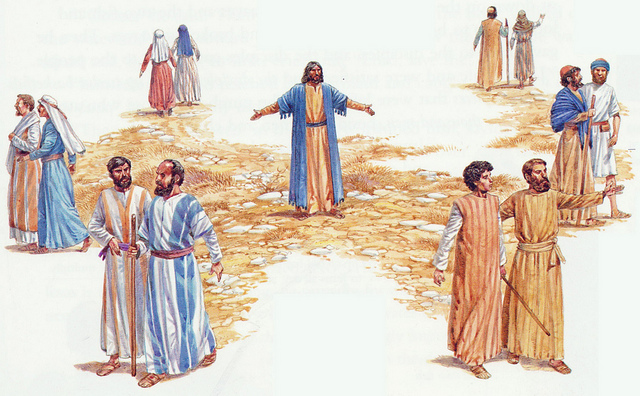
And They Went Out Two by Two ~ The Rev. Deacon M. Scott Brown, OPI

And they went two by two: Not Noah and the Ark – The Apostles silly!
Jesus told the twelve Apostles to go out two by two and proclaim the Gospel of the Lord. How far did they go? How long did it take them? Did they do this until they died? Did they do it for a few years until they got tired? They were to heal the sick, cast out evil spirits, and proclaim the gospel. Doesn’t sound like a lot, but I imagine that would have been a daunting task in those days. Cities were many miles apart, there were no paved roads, no mass transportation, and they were not even allowed to ride a camel per Jesus’s instructions.
We should consider these as our instruction as modern day Christians. We should be proclaiming the gospel of the Lord to everyone we meet, in every situation, and every day. We can heal the sick by helping the homeless and the poor with nutrition and food, we can cast out evil spirits by teaching people about Jesus and the love of our God. Not just on Sundays, but every day of the week; every place we go; and in every situation in which we find ourselves.
Jesus also told the apostles that if any place would not accept them to leave and shake the dust of that place off their feet. By this I believe he meant that only so much can be done in some situations. If someone does not want to listen to what you have to say then move on to the next. Not everyone is going to be open and accepting as we see in our world today in so many other areas such as equal rights and marriage equality. Do the best you can; if they won’t listen or don’t seem open then leave them and go where you are accepted and welcomed. I am sure the apostles were not welcomed with open arms everywhere they went. I highly suspect that they were even run out of some areas before they were even able to speak simply because of who they were. We run into that type of discrimination in our lives every day also. So what do we do when we encounter this type of rejection? We pray for those who are not willing to listen that the Lord will open their hearts and minds. We pray that the Lord will open their ears that they may hear the good news of salvation available to those who believe. I am sure that is how the Apostles handled the rejection they must have faced.
Jesus told the Apostles “You may take along a walking stick, but carry no food or money.” Because Jesus knew that the believers would take care of the Apostle’s needs as they traveled proclaiming the Gospel of the Lord, just as we should be taking care of our brothers and sisters that do this same work in this day and age. Jesus knew that his Apostles’ needs would be met and none of them would suffer while on their journey. Jesus said “When you are welcomed into a home, stay there until you leave that town,”meaning that the Apostles should stay and preach until they felt they had accomplished all they could in that town. Not to just preach one sermon, but stay and listen to and answer questions, minister to the people of that town until the Apostles felt that they had reached every person who was willing to listen, and wanted to hear what they had to say.
Mark tells us that the Apostles healed many sick people and cast out many demons on their journeys. We still don’t know for certain how long it took them, how far they went, or how many people they had contact with. All we have is Church Tradition to fall back on, but I believe they carried out Jesus’s instructions well into their old age or even until their deaths, without ceasing and without fail. As modern day Christians we should pattern our lives in the same way: go and preach the Gospel, heal the sick, and cast out demons. For if we do the Lord will see to it that our spiritual and physical needs will be met. Go on and be a modern day Apostle.

Blessed Pope Benedict XI

Nicholas Boccasini was born into a poor family of which we know little else, though there are several different traditions concerning it. One claims that his father was a poor shepherd. Another that he was an impoverished nobleman. Whichever he was, he died when Nicholas was very small, and the little boy was put in the care of an uncle, a priest at Treviso.
The child proved to be very intelligent, so his uncle had him trained in Latin and other clerical subjects. When Nicholas was ten, his uncle got him a position as tutor to some noble children. He followed this vocation until he was old enough to enter the Dominican community at Venice in 1254. Here, and in various parts of Italy, Nicholas spent the next 14 years, completing his education. It is quite probable that he had Saint Thomas Aquinas for one of his teachers.
Nicholas was pre-eminently a teacher at Venice and Bologna. He did his work well according to several sources, including a testimonial from Saint Antoninus, who said that he had “a vast store of knowledge, a prodigious memory, a penetrating genius, and (that) everything about him endeared him to all.” In 1295, he received the degree of master of theology.
The administrative career of Nicholas Boccasini began with his election as prior general of Lombardy and then as the ninth master general of the Order of Preachers in 1296. His work in this office came to the notice of the pope, who, after Nicholas had completed a delicate piece of diplomacy in Flanders, appointed him cardinal in 1298.
The Dominicans hurried to Rome to protest that he should not be given the dignity of a cardinal, only to receive from the pope the mystifying prophecy that God had reserved an even heavier burden for Nicholas. As papal legate Nicholas traveled to Hungary to try to settle a civil war there.
Boniface VIII did not always agree with the man he had appointed cardinal-bishop of Ostia and dean of the sacred college. But they respected one another, and in the tragic affair that was shaping up with Philip the Fair of France, Cardinal Boccasini was to be one of only two cardinals who defended the Holy Father, even to the point of offering his life.
Philip the Fair, like several other monarchs, discovered that his interests clashed with those of the papacy. His action was particularly odious in an age when the papal power had not yet been separated completely from temporal concerns.
The French monarch, who bitterly hated Boniface, besieged the pope in the Castle of Anagni, where he had taken refuge, and demanded that he resign the papacy. His soldiers even broke into the house and were met by the pope, dressed in full pontifical vestments and attended by two cardinals, one of whom was Cardinal Boccasini. For a short time it looked as though the soldiers, led by Philip’s councilor William Nogaret, might kill all three of them, but they refrained from such a terrible crime and finally withdrew after Nicholas rallied the papal forces and rescued Boniface from Anagni.
Cardinal Boccasini set about the difficult task of swinging public opinion to the favor of the pope. Successful at this, he stood sorrowfully by when the pontiff died, broken-hearted by his treatment at the hands of the French soldiers. On October 22, 1303, at the conclave following the death of Boniface, the prophesied burden fell upon the shoulders of the cardinal-bishop of Ostia, who took the name Benedict XI.
The reign of Benedict XI was too short to give him time to work out any of his excellent plans for settling the troubles of the Church. Most of his reign was taken up with undoing the damage done by Philip the Fair. He lifted the interdict on the French people that had been laid down by his predecessor and made an uneasy peace with Philip. He worked to reconcile warring parties in Europe and the Church and to increase spirituality. His reign, short though it was, was noted for its leniency and kindness.
There are few personal anecdotes regarding Benedict, but at least one worth telling. Once, during his pontificate, his mother came to the papal court to see him. The court attendants decided that she was too poorly dressed to appear in the presence of the Holy Father, so they dressed her up in unaccustomed finery before allowing her to see her son. Benedict, sensing what had happened, told them he did not recognize this wealthy woman, and he asked them where was the little widow, pious and poorly dressed, whom he loved so dearly.
Benedict XI died suddenly in 1304. He had continued to the end with his religious observances and penances. Some people believed that he had been poisoned, but there has never been any evidence that this was the case. Many miracles were performed at his tomb, and there were several cures even before his burial.
Born: Born in Treviso, Italy, 1240
Papal Ascension: 1303
Died: died in Perugia, Italy, April 25, 1304
Beatified: beatified by Pope Clement XII in 1736
Representation: In art, Pope Benedict wears a Dominican habit and papal tiara, while holding the keys. He is venerated in Perugia.

“Perfect in Weakness” ~ Sister Dollie Wilkinson, OPI

Our reading today comes from 2 Corinthians 12:2-10:
“I know a person in Christ who fourteen years ago was caught up to the third heaven–whether in the body or out of the body I do not know; God knows. And I know that such a person–whether in the body or out of the body I do not know; God knows–was caught up into Paradise and heard things that are not to be told, that no mortal is permitted to repeat. On behalf of such a one I will boast, but on my own behalf I will not boast, except of my weaknesses. But if I wish to boast, I will not be a fool, for I will be speaking the truth. But I refrain from it, so that no one may think better of me than what is seen in me or heard from me, even considering the exceptional character of the revelations. Therefore, to keep me from being too elated, a thorn was given me in the flesh, a messenger of Satan to torment me, to keep me from being too elated. Three times I appealed to the Lord about this, that it would leave me, but he said to me, “My grace is sufficient for you, for power is made perfect in weakness.” So, I will boast all the more gladly of my weaknesses, so that the power of Christ may dwell in me. Therefore I am content with weaknesses, insults, hardships, persecutions, and calamities for the sake of Christ; for whenever I am weak, then I am strong.”
In this second letter to the Corinthians, Paul is at first trying to explain why the people should listen to him, and follow his lead, in becoming children of a loving Father. He starts at first by boasting, but quickly realizes that that is not the right way to go. In the process, he learns a couple of valuable lessons. A couple of crucial lessons that are still relevant today.
The Lesson of Humility:
“My grace is sufficient for you, for my power is made perfect in weakness.”
Paul had to learn two lessons. The first was the the lesson of humility. Paul had to learn that grace had to replace ego. This was difficult for Paul. We live in a culture that prizes strength. It was no different in Paul’s time. In spite of this fact, Paul said, “My authority comes because of my weakness.” Paul had revelations from God in which he was taken up into paradise. Paul could have said, “Look at all of these revelations I’ve had. These are my authority.” No, he said he would boast only of his weaknesses. He was a very learned man. He demonstrated great intellectual skills so God gave Paul an infirmity. He called it his thorn in the flesh. Scholars have expended a great deal of time, ink and paper speculating on the nature of the ailment but are not even close to an agreement. Some think it was an inflammation of his eyes that caused swelling, others contend that it was severe headaches or even malaria. While we do not know the precise infirmity we do know that Paul’s opponents used it against him. They argued that if he had enough faith or was truly called to be an apostle, God would have healed him.
Physical health is often used as a sign of God’s blessings. How many times have you heard someone remark, “Why doesn’t God heal me?” “What have I done to deserve this?” We assume that if we live a good life we will be free from chronic physical ailments or that spiritual maturity can be measured by good health. This argument may appear ridiculous to hear now, but how often do we think about this in moments of frustration. Or how often do we use some form of disability or physical ailment as a reason for not doing what we feel God has called us to do? I know, I do….for example, I have hand tremors. How many times have I let this neurological ailment prevent me from doing things? More often than I can count.
God had given Paul a vision so incredible that words could not describe it. Anyone who has had such a mystical experience would be tempted to brag about it. Paul’s thorn prevented that because the severe pain or the physical disfigurement reminded him each day that he was still just a mortal man. He had to rely on the grace of God, not on his good looks or skillful speaking to accomplish God’s work.
Sometimes, fear is what’s holding us back from becoming a better Christian, or from taking a more active role within the church. We are reluctant to try something new because we are afraid of failing. Or we are embarrassed by the quality of our work compared to someone elses. In the back of our mind we are saying that unless we can do an excellent job, then we will not risk doing the project. Of course there are some jobs that this attitude is indeed important. We do not want a NASA scientist doing a less than a precise job on the design and construction of the Space Station. We do not want our doctor saying when writing the prescription for our medication to make us feel better, “Now was that dosage 15mg or 150mg or 1500mg.” Nor do we want to hear the teller at the bank make a mistake in adding up our bank deposit. Those professions require an exactness. But God does not expect that every person will produce an award winning performance in every task, job, project or ministry.
Sometimes, its just showing up, and trying your best, that truly reveals how gifted you really are. You may not be able to teach Sunday School like a trained school teacher, but if you can share your love for Jesus who cares if you follow the lesson plan. You may not be able to heal the sick or say elegant prayers, but if you can just sit with someone who is sick and hold their hand no one will fault you. You may not be able to pound a nail in straight or climb onto the roof, but if you can mix up fruit drinks and serve sandwiches during a Habitat for Humanity project, then you will be just as important as the people doing the hard labor.
The Lesson of Weakness:
“my power is made perfect in weakness.”
We may consider ourselves inexperienced, unpolished, and unskilled. We may consider ourselves unqualified to serve God in the church because of our past or even a present that is not consistent with the teachings of Christ. We may consider ourselves unprepared because of a lack of education. We all have our weaknesses. We all have “flaws” but whatever we lack God can take it and make it into our source of strength.
Our weaknesses can lead to strength. Our weaknesses, struggles, and shortcomings, though they are painful and may be embarrassing, can keep us from that awful smugness and arrogance and open us to God. I myself have found that my own personal experiences and struggles, whether as a mom, wife, grandmother, and a Sister in the Church, have better allowed me to help others. If someone is talking to me on a matter with which they’re dealing, and if I can say, “Maybe I haven’t struggled with exactly that same thing, but, I have dealt with something similar”, then that recognition is my credential, not the college degree or formal training. A person can have all that and come off as pompous. I don’t think people are very helpful when they feel like they have not experienced the usual sufferings of life. When a person can say, “I understand that. I have experienced something similar”, a person may then go on to say, “My power really does come from God.” Paul is saying here that it is his personal weaknesses, including the thorn gifted to him by God, that reveals his greatest strengths. In this he feels justified in boasting, as should we all. For it is in being our most humble, and human, that brings us into a closer relationship with our heavenly Father.

Like Sands Through the Hourglass ~ The Rev. Deacon Scott Brown, OPI

Like sands through the hourglass:
So are the days of our lives.
As a kid I loved to watch Days of Our Lives with my grandmother. I didn’t really understand what the show was all about, but I loved the hourglass. As I got older I began to understand what the saying meant. Like sands through the hourglass, so are the days of our lives. Once the sand flows from the top portion of the hourglass to the bottom, it cannot get back to the top again without assistance. The hourglass must be turned over and restarted in order for the sand to flow again. Our lives are very much like that hourglass. We travel through life, getting chance after chance after chance to flow from the top of the hourglass to the bottom again. God flips us over time and time again, forgiving us for our sins, putting people in our lives to travel through the neck of the hourglass with us, giving us chance after chance. As we travel through the neck of the hourglass we should look around and see who is traveling with us. We should pay attention to the grains of sand that pass from top to bottom with us, and notice that when God flips the hourglass over each time we usually have the same people traveling with us. God puts these people in our lives for a reason. We should listen to what they have to say, discuss problems with them, open up to them about what is going on in our lives and see how we can influence them as they influence us. Open your hearts, open your minds, open your lives to the other sands that surround you. You may just find yourself free from the hourglass and on a beach, surrounded by sand for as far as the eye can see. Each grain of sand touches the other. Let’s use our lives to touch others. Matthew 5:16 says “In the same way, let your light shine before others, so that they may see your good works and give glory to your Father who is in heaven.” Let your light shine, let your grain of sand touch and mingle with the others around you. Do this because you truly want to spread the love of God, and not to draw attention to yourself but to spread the love of Christ. Matthew 6:1-34 says” Beware of practicing your righteousness before other people in order to be seen by them, for then you will have no reward from your Father who is in heaven. “Thus, when you give to the needy, sound no trumpet before you, as the hypocrites do in the synagogues and in the streets, that they may be praised by others. Truly, I say to you, they have received their reward. But when you give to the needy, do not let your left hand know what your right hand is doing, so that your giving may be in secret. And your Father who sees in secret will reward you. “And when you pray, you must not be like the hypocrites. For they love to stand and pray in the synagogues and at the street corners, that they may be seen by others. Truly, I say to you, they have received their reward….Our Lord demonstrated this Himself when he told Jarius and his family to keep quiet about raising the little girl from the dead. Should we not do the same?
And what about those grains of sand touching and Jesus? How does that figure in? In both the stories in the Gospel this morning, we read how the mere touch of our Lord changed lives. Forever. Remember, everything that you do, everything that you say, has an impact on someone, somehow. Let your light shine. Let your grain of sand touch others. Show, spread, and live the Word of God. Amen.
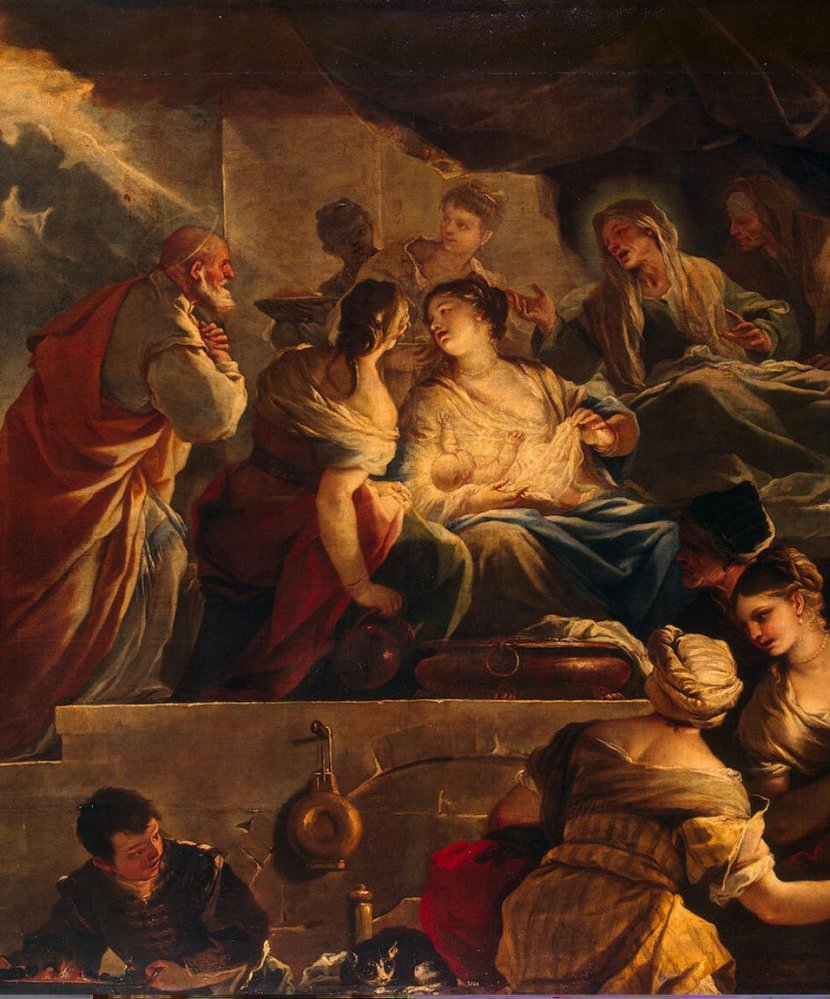
The Nativity of John the Baptist ~ Br. Michael Marshall, Novice
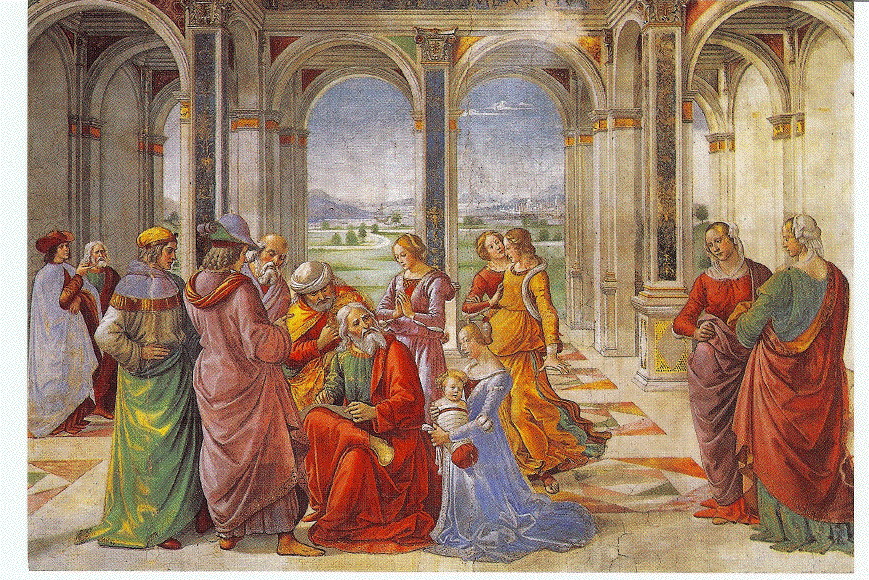
Prepare ye, the way of the Lord
Prepare ye, the way of the Lord”
This is a song from the musical Godspell, which is John the Baptist foretelling the birth of Jesus. Some people thought John was the One, yet he knew he was not. The story of John’s birth is accounted for in all of the Gospels yet in today’s readings we read the story according to Luke:
When the time arrived for Elizabeth to have her child
she gave birth to a son.
Her neighbors and relatives heard
that the Lord had shown his great mercy toward her,
and they rejoiced with her.
When they came on the eighth day to circumcise the child,
they were going to call him Zechariah after his father,
but his mother said in reply,
“No. He will be called John.”
But they answered her,
“There is no one among your relatives who has this name.”
So they made signs, asking his father what he wished him to be called.
He asked for a tablet and wrote, “John is his name,”
and all were amazed.
Immediately his mouth was opened, his tongue freed,
and he spoke blessing God.
Then fear came upon all their neighbors,
and all these matters were discussed
throughout the hill country of Judea.
All who heard these things took them to heart, saying,
“What, then, will this child be?”
For surely the hand of the Lord was with him.
The child grew and became strong in spirit,
and he was in the desert until the day
of his manifestation to Israel. (1:55-67, 80)
We can see a foretelling of John, even though John is not specifically stated in the first reading from Isaiah (49:1-6), so this is definitely a very important part of history for humanity. What we need to keep in mind is that if there had not been John the Baptist, there would have been no foretelling of Jesus coming to this world. This all is rather obvious for us. But how does this really apply to us today other than understanding the Scripture?
John was a herald, a messenger in his own way; trying to help others understand who was to come. We as Christians today are called to do the same thing, yet help others understand that Jesus will return. As much as some folks try to use a fear tactic of damnation to bring others to Christ, that really isn’t our purpose. Our purpose is to show love, the love of Christ through our actions and faith. We are to be heralds and messengers, and share the Good News!
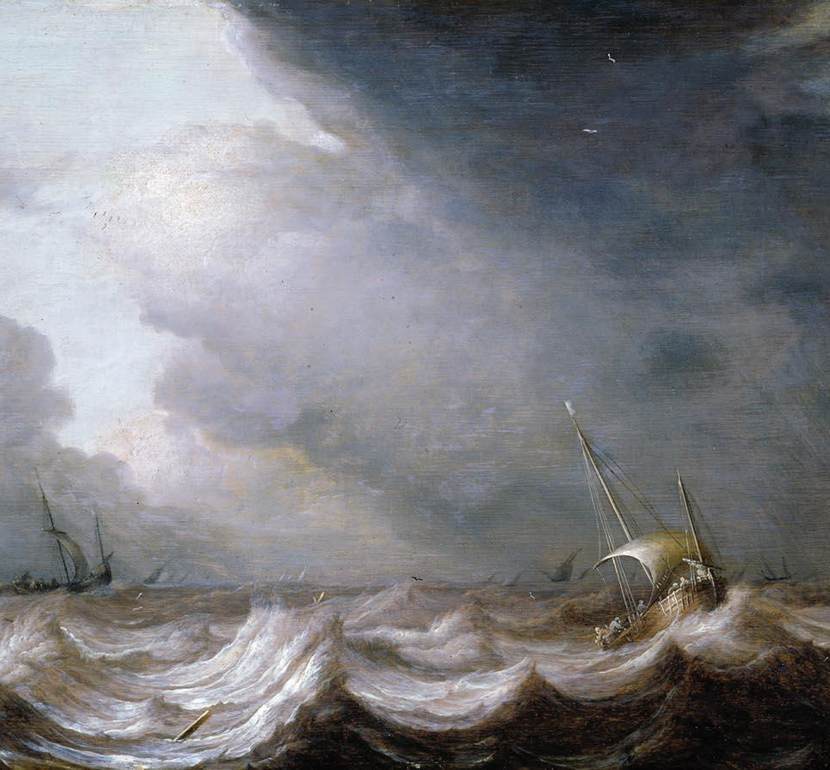
Stormy Weather ~ The Rt. Rev. Michael R. Beckett, OPI
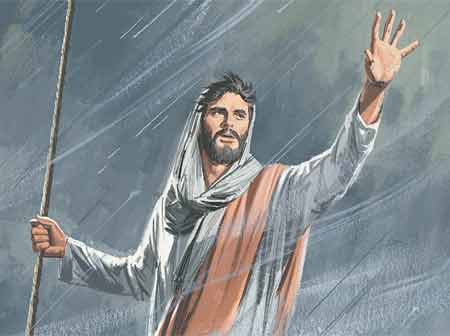
Did you ever have one of those days? You know, one of THOSE days when you were tired, when you had had enuf, when you just wanted a break? When you wanted to get away? Me, too. And apparently Jesus and the disciples had them on occasion. In the Gospel reading for today, we find that Jesus wanted to ‘cross over to the other side’ of the Sea, so that he could have some time alone, away from the crowds, and with his disciples for some quality time, I would imagine. The disciples were all for it, and away they went. Jesus needed a break. He gets in the boat, and goes to sleep.
And then it stormed….. Not just your average run of the mill storm, but a STORM…..at sea even. Thunder. BOOM! Lightening. FLASH! Waves so high over the little boat that it was tossed about. CRASH! And to top it off, the boat started filling up with water. SLOSH…..Sink? And Jesus slept on. And on. And on.
And then it happened. The disciples, those stalwart fishermen, panicked; so much so that they wanted Jesus to panic, too. So, they woke him.
Now, I dunno about Jesus, and I’m pretty sure they didn’t have a Keurig on that boat, but anyone who knows me well, knows, that no matter what, one does NOT speak to the Bishop when he first wakes up until after his (at least) second cup of coffee. Can you not see Jesus? He throws the blanket off and says, WHAT?
The disciples point out the storm, Jesus’s eyes focus, and then he gets it. He understands what all the fuss is about…..and then, like so many of us, he says,
“Really?”
I can just imagine him rolling his eyes. He quiets the storm, grumbles, and goes back to sleep…..and the disciples are tripped!
This past week, we have had a storm…a dreadful, dangerous, haunting storm. And we are still in the midst of that storm. This past week, the thunder of gunshots rang out at Emmanuel AME Church in Charleston, SC. This week, there have been torrents, waves of tears. This week there have been flashes of anger. This week, we have, many of us, felt that we were in danger of sinking. This week we have, all of us, felt the sense of being overwhelmed: with sadness; with grief; with disbelief; with horror. I am certain that this week there are those who wondered if God slept.
This week, we have seen evidence, proof, that God does not sleep. That God is very much awake, and involved, in our lives. This week we have seen the families of those martyred in Charleston demonstrate to the world what Love is all about: Forgiveness. Charity. Good will. Reaching out. Love. When we heard the victims’ families say to the young man who killed their family members things like, “I forgive you.” “We will pray for you,” we know that we have seen Christ in action. This week we have seen countless thousands come together to support each other, regardless of race, religion, creed, or any of the other differences that often divide us. This week we have seen, we pray, the beginning of the end of this storm of racial divide.
This storm is far from over. FAR from over. Before this storm ends, hearts will have to change, attitudes will have to change, laws, rules, regulations, the government, will have to change, society will have to change. And before any of that can happen, WE will have to change. We will, all of us, have to examine ourselves carefully, and honestly, to find the roots of our prejudice, our fears of those who are ‘other’ than ourselves. We will have to look with new eyes at all of those with whom we come into contact, ALL of them, EVERY ONE of them, and strive to find the Jesus in each of them. The Jesus in us must reach out to the Jesus in our brothers and sisters, regardless of race, creed, color, gender, gender identity, sexual preference, ability or disability, or any of the other million and one things we use to denigrate, disgrace, and damn our brothers and sisters.
Like the disciples, we will be afraid. Sometimes we may even panic. But I can assure you that, like the disciples, we can go to Jesus. And when we do, he will say to us, “Peace. Be still.” And in the calm and quiet that results from our trust in Him, we will be able, with full hearts, learn to love our neighbors as ourselves.
Amen.

1+1+1+1=1???? ~ Br. Chip Noon, Novice
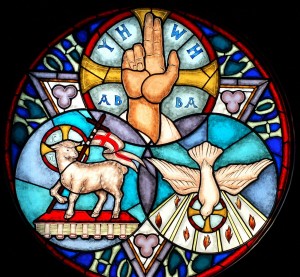
Holy, holy, holy! Lord God Almighty!
Early in the morning our song shall rise to thee.
Holy, holy, holy! Merciful and mighty,
God in three persons, blessed Trinity!
In the Baltimore Catechism, of ancient (and not so venerable) memory, I learned in Number 27:
- Q. What is the Blessed Trinity?
- The Blessed Trinity is one God in three Divine Persons.
I may have learned the words, and I knew I had to recite them, but this was one of the most difficult concepts for me…and for many others, as I have found out. How can there be three persons and still one person?
Unfortunately for those of us speaking English, “person” is not a proper translation from the Greek. This is not to say that the original Greek-speaking Christians were not also perplexed by the divinity and the humanity of Jesus.
Let me start again. There are two words in Greek that translate to “person”: prosopon and hypostasis. The first means the “self-manifestation of an individual” that can be extended by other means and the second means “being” or “substantive reality.” The early church fathers had as much trouble with the concepts as I do now. But the point is that we are not talking about three distinct human beings…
OK, let me start again. The philosopher Kierkegaard wrote that the dual nature of Christ is the “ultimate paradox.” God is perfectly wise, good, powerful who became fully human, tempted by sin, limited in goodness, knowledge, and understanding. This paradox, he believed, can only be resolved by a leap of faith, away from reason and understanding toward belief in God.
And so now, I will start for the fourth time. In the first reading, Moses is exhorting the Israelites to acknowledge that the Lord is God by reminding them of the manifestations that God performed to free them all from slavery in Egypt. In the Old Testament understanding, we are still relying on proof to come to the belief in one God. In the second reading, St. Paul is exhorting the Romans to recognize that as they received the Holy Spirit, they are then heirs of God and joint heirs with Christ. Not proof, but simply remembering and accepting the gift of the Spirit.
But here is where he throws in the kicker: “…if only we suffer with him so that we may also be glorified with him.”
In the early days of Christianity, to suffer was a real and present possibility. Today, some around the world still face this kind of physical suffering. But we, fortunate as we are, can only suffer with him in our prayer, our study, our life of preaching, our throwing aside proof and evidence; and through contemplation and proactive living accept in our minds, hearts, and souls the faith which we proclaim.
And Jesus said,
“All power in heaven and on earth has been given to me.
Go, therefore, and make disciples of all nations,
baptizing them in the name of the Father,
and of the Son, and of the Holy Spirit,
teaching them to observe all that I have commanded you.
And behold, I am with you always, until the end of the age.”
Ultimately, the Trinity is not about Greek words, theological concepts, metaphysical speculation, but about observing all that Jesus commanded – the heart of our salvation, and recognizing finally that he is with us always, until the end of the age.
Lord, as we celebrate the Solemnity of the Holy Trinity, may we enter into your peace with calm gratitude and joyful acceptance of your message, that we love you and we love our neighbors as ourselves. Help us in our faith and help us in our suffering to become one with you, your Son, and the Holy Spirit.
Amen.

The Unknown Disciple ~ The Rt. Rev. Michael Beckett, OPI
In Arlington National Cemetery, there is a tomb; a beautiful tomb, the Tomb of the Unknown Soldiers. In this tomb lie the remains of soldiers who were not able to be identified after their deaths from America’s wars since the 1st World War. Britain, Australia, France, Belgium, Bulgaria, Serbia, and a host of other countries also honor their unknown warriors. Those who lie in repose have no known names, no known family, no known history, but they are celebrated for what they did, for what they represent. They gave their all.
In the church, we don’t necessarily have a “Tomb of the Unknowns” but we do have a Feast Day to honor our unknown heroes. That day is, of course, 1 November, The Solemnity of All Saints, in honor of all the saints, known and unknown.
Now you’re saying to me, what in the world does All Saints Day have to do with the last Sunday in Eastertide???? Well, let’s think about that for a minute. In the first reading of the Scriptures appointed for today, from the first chapter of Acts, we learn that a new Apostle is chosen to replace Judas Iscariot. It would seem that there were two choices for the job. Matthias and Judas Barsabbas. Both of these men had been with Jesus FROM THE BEGINNING WHEN JESUS WAS BAPTIZED. What? There were more than the 12 original disciples? We tend to forget that, don’t we? In Luke 10: 1-24, we are told that Jesus sent out 70 men, 2 by 2 into every place that he was planning on going.
Church tradition holds that both of these men were 2 of that 70.
In the first sentence of our readings today, we learn that Peter was speaking to 120 folks.
Now, granted, you can ask just about anyone who knows me, and they will tell you that I’m pretty inept when it comes to math, but I DO know that 70 minus 2 is 68, and 120 – 2 is 118. Which leads me to ask, “Who are these people? Who are these 118 people who figured so prominently in spreading the Gospel? Who are these 118 people who were so devoted to Jesus that they risked imprisonment, some of them death; who risked losing everything to hang out in Jerusalem after the crucifixion and resurrection because Jesus told them to be there and to wait?”
Let’s think about that for a minute. We can whittle that number down some more…… Acts 1:13-15 says, “And when they were come in, they went up into an upper room, where abode both Peter, and James, and John, and Andrew, Philip, and Thomas, Bartholomew, and Matthew, James the son of Alphaeus, and Simon Zelotes, and Judas the brother of James. These all continued with one accord in prayer and supplication, with the women, and Mary the mother of Jesus, and with his brethren.” So there are a few of them. And then, we would expect that those mentioned in Acts 6:5 had been among the 70 and the 120 (Stephen, Philip, Prochorus, Nicanor, Timon, Parmenas, Nicolas), also Barnabas. These were men of good reputation, full of the Holy Spirit and wisdom.
Women were also identified to be among the 120. The wives of the apostles were there (1 Cor. 9:5 “Have we not power to lead about a sister, a wife, as well as other apostles, and as the brethren of the Lord, and Cephas?”). Each of the wives was a devout believer in Christ. Part of the number of women would be those mentioned in Luke 8:1-3. “And it came to pass afterward, that he went throughout every city and village, preaching and shewing the glad tidings of the kingdom of God: and the twelve were with him, And certain women, which had been healed of evil spirits and infirmities, Mary called Magdalene, out of whom went seven devils, And Joanna the wife of Chuza Herod’s steward, and Susanna, and many others, which ministered unto him of their substance.” See also Matt. 27:55-56; Luke 23:49,55. We would expect that the sisters of Jesus were also believers by this time, as His brothers had become.
Jesus brothers, had not been believers before the Crucifixion (John 7:3-5). Now they were firm in their faith and devotion to Him. These were: James, Joses, Simon, Judas (Matt. 13:55-56). James the Just was the leader of the Jerusalem Church in Acts 15:13. He is called an apostle in Gal. 1:19, although not one of the Twelve. James was the author of the Book of James. Judas was the author of the Book of Jude.
So….that leaves us with how many folks we don’t know? I lost count, I hate math, and it really doesn’t matter does it? What DOES matter is that we don’t know who, exactly, all of these people were. What we DO know, is what they did.
These were they who supported the Apostles. These were they who were in the upper room on the day of Pentecost. These were they who worked so diligently, some to the point of sacrificing their lives, to spread the message of the Gospel. These were they who were on fire for Christ. These were they to whom we look to be, or we should look to be, examples.
Who were they? Their names don’t matter. They lived 2000 years ago and they are lost to us. In 2000 years, in 100 years, most of our names will be lost. But what matters is what won’t be lost. What matters is what we do and say and proclaim, so that those who come after us will know, will experience, will be able to live, the truth and the joy of the Gospel.
My dear friends, we do not live in a vacuum. Everything that we do, everything that we say, has an effect on someone. And that someone has an effect on someone else. We see this everyday of our lives. You hear of things ‘going viral’ on the internet. Someone had to start it. Some ONE posted something that was liked….and liked….and shared and shared and shared. Is this not what those 120 people in the upper room did? Is this not what we are called to do?
In your everyday life, how often do you reference Christ? Now, I’m not talking about quoting Scripture. I’m talking about demonstrating who Christ is, showing the world Christ’s love, his Salvation? What is it that you do, or say, or write, or post, that will touch someone in a way you never imagined? I dare say you will never know. BUT, we all of us need to remember that we DO touch lives, lives we don’t even know exist. We touch lives that are unknown to us. We are touched by people who are unknown to us.
Besides those 100+ folks in the upper room, besides us, how many others have there been? How many saints? How many martyrs? How many unnamed, unwritten about people have left us with the legacy of Our Lord? Revelations 7 tells us: “I beheld, and, lo, a great multitude, which no man could number, of all nations, and kindreds, and people, and tongues, stood before the throne, and before the Lamb, clothed with white robes, and palms in their hands; These are they which came out of great tribulation, and have washed their robes, and made them white in the blood of the Lamb.” The unnamed disciples.
I plan on being in that ‘great multitude.’ I plan on being one of those “unnamed disciples.” Won’t you join me? Won’t you work to spread the love, the message, the salvation of our Lord and Savior? Amen.


You must be logged in to post a comment.