
Category: Lesson
St. James the Apostle (the Greater)
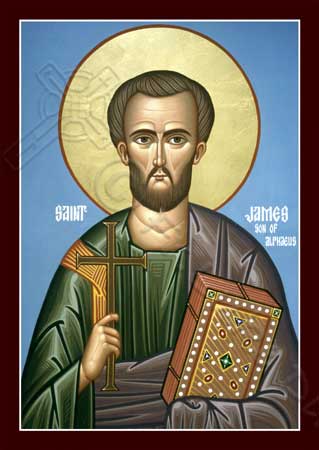 James, The Apostle – (Hebrew Yakob; N.T. Greek Iakobos)
Son of Zebedee and Salome, and brother of John the Apostle.
July 25
It was surely no coincidence that James and his brother John were sons of a fisherman and made their living off the Sea of Galilee. To live near and fish on a lake of that magnitude requires strength, knowledge, understanding, and at certain times of the year, bravery. It also takes fortitude, attention to detail, and temperance. Without all those qualities one could end up seriously hurt or worse yet, tangled in nets sinking to the bottom of the lake. James wasn’t alone in his calling – three others with whom he shared communal life were likewise called by Jesus to follow Him. Eventually they were even called upon to proclaim all they saw to the world. (Simon) Peter and Andrew who were coworkers, and his brother John were also called to follow Jesus around the same time as James. Jesus gathered together those He could trust who would witness the miracle of God’s love.
James was only one of three people Jesus invited to pray with Him in the Garden of Gethsemane. It was there James witnessed the transfiguration and was himself transformed in mind and spirit.
Saint James the apostle is sometimes referred to as the Greater to distinguish him from James the son of Joseph (who is sometimes called James the Lesser). Called to serve, he became a trusted friend and was instructed to serve and love those who followed our Lord. But there is more to James than his being a saint or follower of Jesus – he was first and foremost a hard worker, a friend, and a companion.
James was the first of the 12 apostles to be martyred for the newly forming community of believers. He was killed on the order of King Herod Agrippa I of Judea, about 44 A.D. (Acts 12:1-2) “1- It was about this time that King Herod arrested some who belonged to the church, intending to persecute them. 2 – He had James, the brother of John, put to death with the sword”.
Though we do not know much about the life of James the Greater, we know he was a man trusted by our Lord and he died for the early church. His strength and wisdom continue to guide and direct us all.
St. Benedict of Nursia
St Benedict was born around the year 480. He was the son of a Roman noble of Nursia and the twin brother of St. Scholastica. St. Benedict spent his childhood mainly living in Rome with his parents where he attended school until he reached his higher studies. He gave up life with his parents and their wealth, giving his books away and leaving Rome to seek a place where he might manage to attain the Holy purpose he had in mind of only serving God. It is supposed he left his childhood home in about A.D 500 aged about 19-20 years old. Benedict took with him his nurse as a servant and set off to leave the city. Benedict and his nurse settled in Enfide, close to a church which was dedicated to St. Peter, and in some way was associated with a company of virtuous men who shared the same sympathies, feelings, and views of life.
Enfide is in the Simbrucini mountains, about forty miles from Rome and two miles from Subiaco. It was there at Enfide where Benedict worked his first miracle by restoring to perfect condition an earthenware wheat-sifter which his old servant had accidentally broken. This miracle brought Benedict notoriety and this, in turn, drove Benedict to further withdraw from social life. He fled secretly from his old nurse and sought the more retired district of Subiaco.
Now Benedict chose to live the poor life and for the sake of God decided to take up a life of hardship, weariness and labour.On his way from Enfide, Benedict met a monk, Romanus, whose monastery was on the mountain above the cliff overhanging a cave. Here Benedict and Romanus discussed Benedict’s purpose for coming to Subiaco, and it was there that he received the monk’s habit. For a period of three years on the advice of Romanus, Benedict lived the life of a hermit and unknown to men in a cave above a lake. Romanus continued to serve Benedict in any way which he was able and visited the monk regularly. On set days would bring him food.
During these three years of solitude Benedict matured both in mind and in body. He gained much knowledge both of himself and also of his fellow men, and over time became known to and respected by those who knew him., to the extent that when an abbot of a monastery in the neighbourhood died, the community begged Benedict to become the new Abbot of the monastery. Benedict knowing the ways of the monastery life and its discipline, knew that it would be difficult to get all to live in harmony. He eventually Benedict consented, and after a period of time of managed things with their entreaty. Sadly the experiment failed after certain of the monks tried to poison, because they found his rule to be too strict.
He returned to living in his cave. From this time forward the miracles of Benedict seemed to happen frequently and many people, attracted by his sanctity and character, came to Subiaco to be under his guidance. For these Benedict built twelve monasteries in the valley and allocated to each one a superior and twelve monks. Benedict then built a thirteenth monastery in which he lived with a few chosen whom Benedict believed would profit and be better instructed by his presence. Although living in the thirteenth monastery, Benedict remained the Father and Abbot of all the monasteries and with the establishment of these monasteries began schools for children; amongst the first to be brought were Maurus and Placid.
The Reminder of Benedict’s life was spent realizing the ideal of monasticism and this is what became known as the Rule of St. Benedict, which is still followed in many monastery orders even today.
St, Benedict died of a fever on 21 March 543 or 547 in Monte Cassino, not long after the death of his sister St. Scholastica. He died on the day on which God had told him he was going to die, and Benedict was buried with his sister.
Benedict was named in 1964 by Pope Paul VI as the patron protector of Europe, and then in 1980 Benedict was declared co-patron of Europe by Pope John Paul II.
We Have a Job to Do. Git ‘er Done!!!!!!!!!
In the readings appointed for today, we find, from Psalm 48: 12 Walk about Zion, go all around it, count its towers, 13 consider well its ramparts; go through its citadels, that you may tell the next generation
14 that this is God, our God forever and ever. He will be our guide forever.
And then from Ezekiel: 2:3 He said to me, Mortal, I am sending you to the people of Israel, to a nation of rebels who have rebelled against me; they and their ancestors have transgressed against me to this very day.
2:4 The descendants are impudent and stubborn. I am sending you to them, and you shall say to them, “Thus says the Lord GOD.”
2:5 Whether they hear or refuse to hear (for they are a rebellious house), they shall know that there has been a prophet among them.
And finally, from the Gospel according to Mark: 6:7 He called the twelve and began to send them out two by two, and gave them authority over the unclean spirits. 6:8 He ordered them to take nothing for their journey except a staff; no bread, no bag, no money in their belts; 6:9 but to wear sandals and not to put on two tunics. 6:10 He said to them, “Wherever you enter a house, stay there until you leave the place. 6:11 If any place will not welcome you and they refuse to hear you, as you leave, shake off the dust that is on your feet as a testimony against them.” 6:12 So they went out and proclaimed that all should repent.
It would seem that we have a job to do. The constant theme throughout today’s readings is simple: Go and tell. Go and witness. Go and preach. Some of you may say, “Well this is fine, well, and good for those who are ministers, preachers, and priests. I am not called to preach, though. What am I supposed to do????” We will think about that in a few seconds.
Preaching is the very purpose of the Dominican Order, to which I belong. Our Order is even known as “The Order of Preachers.” And true, that in English, preaching means pulpit oratory, but St. Dominic did not name his Order in English, but in Latin – Ordo Praedicatores – meaning those who are engaged in “praedicatio.” If you look in a Latin dictionary you will find that “praedicatio” means “making known” or “proclamation.” This has a much broader, much wider meaning than mere pulpit oratory. ALL of us are called to preach, to proclaim. The very second that you accepted Christ into your heart, you were charged with the mission to become a preacher, a proclaimer, of the Gospel. Simply living your life as Christ has called you do live it is proclaiming the Gospel. We are not to be selfish, but to use what we are given to help each other, and to spread to the world the message of Christ’s redeeming love. This, as St. Dominic said, was essential for us if we were to give a good example to others. Nothing will win others more than our living our Christian lives, no matter how difficult it may be at times.
Another way of preaching that you can do, is the sharing of your faith with others. You are going to run into people, as I am sure you do all the time, who have a false and twisted idea of what true Christians believe. These people will challenge you. In these circumstances we should always follow St. Peter’s advice: Always be ready to give an explanation to anyone who asks you for a reason for your hope, but do it with gentleness and reverence. (I Peter 3: 16b-17a) But to do this effectively you really have to know your religion thoroughly. There are so many false ideas out there about the true meaning of being a Christian, and about what Christ taught, about the Scriptures and about morals. When they present all kinds of false ideas about the Bible, how are you going to answer them? There are answers and it is incumbent on you, as a Christian, to know them.
Admittedly, none of these are spectacular or glamorous ways of preaching, but they are most effective ways. You may not feel that you have been effective and you may think you have failed to make any impression at all and, of course, you may not have. But you never know how God is going to use what you say and how you say it. We must keep in mind that rarely is one person responsible for the conversion of another. The process of conversion is something like putting together a jigsaw puzzle. People along the way slip in a piece or two until finally the puzzle is complete, but the picture is not finished until every single piece is in place. God may be asking you to put in only a few pieces but they are necessary pieces. You will not know, however, until the Last Judgment when you will see the whole picture, completed and perfect, just what great influence you have had. That is, perhaps, the only way that any of us are going to be able to see the results of our preaching. Let each one of us take seriously the charge of St. Paul: Proclaim the word; be persistent whether it is convenient or inconvenient; convince, reprimand, encourage through all patience and teaching. But you, be self-possessed in all circumstances; put up with hardship, perform the work of an evangelist; fulfill your ministry. (II Timothy 3: 2-5) If we do this, then we can say with him: I have fought the good fight; I have finished the race; I have kept the faith. From now on the crown of righteousness awaits me, which the Lord, the just judge, will award me on that day, and not only to me, but to all who have longed for his appearance. (II Timothy 3: 7 & 8)
E Pluribus….WHAT? Trinity Sunday
Trinity Sunday is a difficult day for priests, who often feel they have to try to explain the idea of God as Trinity. It’s sometimes an even more difficult day for our parishioners, because they have to listen to us priests, trying to explain the Trinity. It’s a difficult day for priests because we find we have to talk about God. You may think we are always talking about God, but in my experience most of us actually talk rather little about God. We talk a lot about what God wants of us. We talk even more of what God has done for us and is doing for us. That, after all, is the Gospel. But we don’t talk very much about who God is. Perhaps they leave that to the liturgy and the hymns, which probably do it better than sermons usually can.
Have you ever tried to express your feelings when you feel something very deeply? That’s what usually happens when we talk about God, really talk about God, actually trying to say who God is – this is one of those times when language fails us. The only words you can find are terribly makeshift, totally inadequate, and not at all what you want to express, but you must use what you’ve got and try to express yourself. Not to say anything would be worse. You must say what you can and hope the words point to what you can’t really say. So it is with the Trinity. There are several Christian ways of trying to say who God is. The one that says the most about God is the one we use in the creeds, when we say we believe in God the Father, God the Son and God the Holy Spirit. God is those Three and the Three are one God. The Christian shorthand for that is: God is Trinity. But if that says the most about God, it is also the most difficult thing Christians say about God.
How to explain the Trinity? We haven’t done that yet, simply because we can’t wrap our heads around the concept. The story is told of St Augustine of Hippo, the great philosopher and theologian. He was preoccupied with the doctrine of the Trinity. He wanted so much to understand the doctrine of one God in three persons and to be able to explain it logically. One day he was walking along the sea shore and trying to understand just how one God can be in three persons. Suddenly, he saw a child all alone on the shore. The child made a hole in the sand, ran to the sea with a little cup, filled her cup with sea water, ran up and emptied the cup into the hole she had made in the sand. Back and forth she went to the sea, filled her cup and went and poured it into the hole. Augustine drew up and said to her, “Little child, what are you doing?” She replied, “I am trying to empty the sea into this hole.” “How do you think,” Augustine asked her, “that you can empty this immense sea into this tiny hole and with this tiny cup?” She answered back, “And you, how do you suppose that with your small head you can comprehend the immensity of God?” With that the child disappeared.
The doctrine of the inner relationship of the Father, Son and Holy Spirit in such a way that each of them is fully and equally God, yet there are not three Gods but one, cannot be fully comprehended by the human mind. It is a mystery. But, we continue to try. St. Patrick certainly did it his best. He gave us a visual example in the shamrock or three leaf clover. As the shamrock is one composed of three, so, he said, is the Trinity: Three in One and One in Three. In the story of salvation we usually attribute creation to the Father, redemption to the Son and sanctification to the Holy Spirit. Nevertheless, though they are distinct as persons, neither the Father nor the Son nor the Holy Spirit ever exists or acts in isolation from the other two persons of the Godhead, just as a three leaf clover without all three leaves is incomplete.
If we expected today’s readings to give us a clear and elaborate presentation of the doctrine of the Blessed Trinity, we have found out that they simply do not. The doctrine of three persons in one God, equal in divinity yet distinct in personality, is not explicitly spelled out in the Bible. In fact the very word “Trinity” is not found in the Bible. Early Christians arrived at the doctrine when they applied their God-given reason to the revelation which they had received in faith. Jesus spoke about the Father who sent him (the Son) and about the Holy Spirit whom he was going to send. He said that the Father had given him (the Son) all that he has and that he in turn has given to the Holy Spirit all that he has received from the Father. In this we see the unity of purpose among the three persons of the Trinity.
We believe in the Triune God, and to embrace a doctrine we cannot fully comprehend or explain. It is another thing entirely to base our understanding of God on what we see God doing. So, let me make the most important statement about the Trinity that I can make, and that is — Our understanding of the Trinity, or as much as we can understand of the Trinity, is based on what we see God has done and is doing in the world. Let me give you some examples.
In the Old Testament, God is Creator of both the world, and of the nation of Israel through whom he will bless the world. Of course, God is present as Spirit, and the Messiah is both prophesied and foreshadowed in various theophanies (appearances of God, such as the angel who wrestles with Jacob). But primary on the stage of the unfolding drama of the Old Testament is the God of Israel, Yahweh, El-Shaddai, Elohim, Adonai, and all the other names by which God is called and worshipped.
In the New Testament Gospel accounts, the emphasis is upon Jesus — his birth, his baptism, his message, his life, his death, and his resurrection. But God the Father approves his Son, and the Holy Spirit descends upon — anoints — Jesus for ministry.
In the New Testament Book of Acts and the epistles, the Holy Spirit is at the forefront, equipping, enabling, guiding, empowering the early church. In the Book of Revelation, God the Father, Son, and Spirit are all present, each featured in a way that is both consistent with the Old Testament, witnesses to the New Testament, and brings fully into being the Kingdom of God in its closing chapters.
Okay, that surveys the “What is the Trinity?” question, even though I am sure you probably have more questions now than when we began. But to keep this from being merely an academic exercise, we need to turn our attention to “Why do we care?” This is what’s important and what we need to understand. Doctrine is important, but doctrine comes from the lived experiences of God’s people as they interpret the work of God in the real world. First, the reason we should care about the Trinity, and be aware of the uniqueness of the One-in-Three and Three-in-One is this: Without a balanced view of all three persons of the Trinity, we can misinterpret the work of God in this world. For instance, if we emphasize some aspects of God in the Old Testament, and subordinate Jesus and the Spirit, then we come away with a picture of a god of wrath and judgment, who has little compassion. One very well known Baptist preacher did just that after the tornadoes in Oklahoma last week, when he compared the tornadoes that hit Oklahoma with the story of Job who lost all of his children to a mighty wind that collapsed Job’s house. If we emphasize the person of Jesus to the exclusion of God the Father and the Holy Spirit, we miss out on the fact that God sent Jesus because “God so loved the world…” The purpose of God is to redeem the world, not just the individuals in it. Salvation is the work of God, and that salvation extends not just to individuals but to God’s creation as well. Another famous and trendy preacher was quoted as saying that Jesus is coming back to burn up the world, so he can drive a huge SUV because he’s not worried about this physical earth. Not a good theological position, in my estimation. Finally, if we emphasize the Holy Spirit, and the charismatic experiences and gifts of the Spirit, it it is easy to loose sight of God as Creator, Son as Redeemer, and the role that the Holy Spirit played and plays in both of those aspects of God’s work.
Who is God? He is our heavenly Father who made us, takes cares of us and calls us his dear children.
Who is God? He is Jesus Christ who gave his life on the cross to re-establish our relationship with God. He reveals the way to God and to eternal life.
Who is God? God is the Spirit in you giving you faith in God and guiding you in your daily walk as a Christian.
Faith in the Triune God acknowledges the might and majesty of God but at the same trusts in a God who cares. Amen.
Towers to Heaven?
The Tower of Babel in Genesis 11:1-9 is one of those Bible stories that we tend to learn as children and rarely revisit. We remember the unsuccessful effort of the people to build a tower to heaven so they could get to God. Perhaps we were even given the chance to color this tower or build one with Popsicle sticks and glue. The lesson I remember learning from this as a child is that God punished the tower builders by making life more difficult for them. What is your memory from your first hearing of the Tower of Babel?
I am very grateful for the spiritual discipline of daily Bible reading which gives me the opportunity to return to stories like the Tower of Babel and bring my adult sense to bear on its meaning. The lesson I draw from it now is different from my Sunday school days.
What I find now in Genesis is an endearing depiction of both people and God as we figure out how life in community is going to work.
When the story starts, all people share one language with the same words. The people set about building a city and conceive the idea of building a tower by which they will “make a name for” themselves. Their fear is, if they don’t do this, then they “shall be scattered abroad upon the face of the earth” (Genesis 11:4). However, this tower building provokes exactly that response from God.
Seeing the city and the tower, God concludes, “This is only the beginning of what they will do; nothing that they propose to do will now be impossible to them.” God’s solution to limiting possibility is to “confuse their language so that they will not understand one another’s speech” and to scatter them abroad over the face of all the earth.
What are we to make of this encounter between God and us?
I find in the Tower of Babel an encouraging indication of how God holds together our unity and our diversity as God’s creation — God’s children. In order to keep us humble — that is, knowing that we are human beings and not God — God ends the period of one language. God then establishes within humanity the same diversity that was given to all creation in the opening chapters of Genesis, a wealth of variety that remains throughout Scripture.
In a nutshell – the key to humility is diversity. Wow!
Of course, God provides unity for human beings after restoring the covenant with us through Jesus’ death and resurrection. On the day of Pentecost in Acts 2, the inspiration of the Holy Spirit brings one understanding even as the people from different nations across the world continue to speak and hear their own language. Here is an amazing moment of both unity and diversity held together by God’s loving Spirit at work in us.
Of course, language is not the only thing that is different about people. We have come to understand that God has endowed human beings with diversity in race, gender identity, sexual orientation, culture and perspective. Future generations may discover other realms of diversity still not revealed to us. And the Holy Spirit gives us the means by which we find unity even as we delight, as God does, in such variety.
This is how the parable of the Tower of Babel informs my faith.
Divine Mercy~by Fr. Bryan Wolf
“I desire to grant unimaginable graces to those souls who trust in My mercy. Even a sinner most hardened, if only once recite the Chaplet, he will obtain grace from My infinite mercy.” The Diary of Sister Mary Faustina
The Sunday after Easter has been designated Divine Mercy Sunday, a devotion actively promoted by Pope John Paul II before his death and instituted edictally by him in 2000 when he Canonized Sister Mary Faustina a Saint. In fact it was Pope John Paul II, when being Archbishop of Krakow in 1965 began the informative process to certify the testaments of Sister Faustina.
Born in 1905 Maria Faustina Kowalska, became a nun at the young age of 20 after relating her many visions of a suffering Christ she had through her childhood and adolescents. So passionate were her claims that, even without much formal education, she so moved superiors to admit her to the Convent of the Sisters of Our Lady of Mercy. There in 1931, after having been diagnosed the year before with tuberculosis, she records in her spiritual diary of having mystic visitations from Jesus; who she described as appearing to her as the “King of Divine Mercy.”
In her diary, Sister Faustina details how Christ delegated to her a sacred mission to have people implore His Divine Mercy. Jesus commanded her to have painted His image, as it appears in Divine Mercy representations. Jesus told her to accompany the image with the prayerful words, “Jesus, I trust in you.” Lastly Jesus inspired Sister Faustina to compose a simple prayer that He begged people recite- The Chaplet of Divine Mercy. “Whoever will recite it will receive great mercy at the hour of death. When prayed in the presence of a dying person, truly I shall stand between them and My Father not as a judge, but as the Merciful Savior. Even a sinner most hardened, if only once recite the Chaplet, he will obtain grace from My infinite mercy. Truly I tell you, the greater the sin- the greater claim they have to My mercy and justice.”
This final thoughts are the ones that strike me as the most profound. No matter what transgressions, how far removed we might feel from the promise of salvation because of our own failings- through His Divine Mercy and the Chaplet to pray, Christ assures us of His infinite mercy. This is key.
Without doubt many of us- dare I say all of us, fall short in our desire to be a good Christian. We may pray, attend church and even do good works- but the road is narrow and difficult. Our tempers get the best of us. Pressed for time, our religious responsibilities become moved to “the back burner”. We procrastinate ( I know I do, often ) and waste away time on things that seem important at the moment and then, truly are not at all.
But through Sister Faustina, Christ tells us He knows this. He understands this. “Tell them to surrender to My mercy and to call upon Me. To trust in Me and My infinite mercy.” Almost knowing there would be many who will not even find the time or ability to recite the prayerful Chaplet, Jesus inspired Sister Faustina to record the one sentence summation- “Jesus, I trust in you.”
Furthermore, I am struck by the investigation of then Archbishop Wojtyla ( Pope John Paul II ) where he considers the writings of Sister Faustina and her claims of mystical visitation. “I feel obliged to believe. For one so simple, so inwardly reflective- ( Sister Faustina ) possessed a great knowledge. She knew of the Trisagion without any formal exposure. Indeed, Our Lord has spoken to her.” The Trisagion ( Holy Three Times ) is an introductory prayer of sorts used in the Divine Liturgies of the Eastern Orthodox and Byzatine Rite Churches. It are these words, “Holy God, Holy Mighty One, Holy Immortal One” that were written by Sister Faustina to conclude the Chaplet of Divine Mercy. Archbishop Wojityla discovered that these words dismayed Sister Faustina as she found them obscure, thought this evidence that Jesus desired to unify the many Christians religions unto himself. ( We ourselves should take example from the devotion of Pope John Paul II to Sister Faustina and The Divine Mercy Chaplet, as he himself today is to be Canonized Saint by Pope Francis.)
Sister Faustina died from her illness at the young age of 33, the same age as our Savior. She left us a beautiful prayer and legacy to impart Christ’s mercy upon even the most stubborn of us. In all the hectic moments of our day- in the constant whirlwind of unimportant things that seem to demand our attention, we are offered a moment of pause and reflection. A sublime prayer that offers up the Divine Mercy of Christ himself, as King of Divine Mercy, to stand- not before us, but with us- at our hour of greatest need.
“Eternal Father, I offer you the Body and Blood, Soul and Divinity of your dearly beloved Son, Our Lord Jesus Christ, in atonement for our sins and those of the whole world. For the sake of His sorrowful Passion, have mercy on us and on the whole world. Holy God, Holy Mighty One, Holy Immortal One, have mercy on us and on the whole world.” ( The basic foundation of The Divine Mercy Chaplet, though structure and recited to accord with Rosary beads. )
“Eternal God, in whom mercy is endless and the treasure of compassion inexhaustible, look kindly upon us and increase your mercy in us; that in difficult moments we might not despair nor become despondent, but with great confidence submit ourselves to your Holy will- which is love and mercy itself. Amen.”
Choices! Choices! Choices! ~ The Very Rev. Lady Sherwood, OPoc
Romans 8:6-118:6 To set the mind on the flesh is death, but to set the mind on the Spirit is life and peace. 8:7 For this reason the mind that is set on the flesh is hostile to God; it does not submit to God’s law– indeed it cannot, 8:8 and those who are in the flesh cannot please God. 8:9 But you are not in the flesh; you are in the Spirit, since the Spirit of God dwells in you. Anyone who does not have the Spirit of Christ does not belong to him. 8:10 But if Christ is in you, though the body is dead because of sin, the Spirit is life because of righteousness. 8:11 If the Spirit of him who raised Jesus from the dead dwells in you, he who raised Christ from the dead will give life to your mortal bodies also through his Spirit that dwells in you.
Do you like watching television? Perhaps you have digital TV, or cable in your home. Maybe you like to watch soaps, or a funny comedy, or even a weepy movie. There are so many different things we can choose to watch these days isn’t there? Or maybe you might like to have a pizza for a snack or meal. Which one out of all the varieties do you choose and set you mind upon having? Cheese and tomato perhaps, or hot and spicy, or ham, or pineapple, or even some other type? Choices, choices, choices!!
In our own lives, we also have a choice to make. This choice is to set our minds on flesh, or to set our minds on Spirit. Which do we choose? Is it the Flesh, which does not serve God, and does not have true peace or eternal salvation from death? Or do we choose to be in Spirit? Being in Spirit means we accept God into our whole selves, loving and following his teachings in all thoughts, words and actions, literally being one with God through the Holy Spirit in all things. If we are in flesh, then flesh alone is all we are and all we ever will be. Death for those in the flesh is simply that, the death of the flesh, meaning the final end. If we are in Spirit, then Spirit is what we are, the spirit of God. Yes even we who are in spirit have to suffer death of our flesh bodies, but as we are in the Spirit, our Spirit lives on with God our heavenly Father and creator in peace and joy for all eternity, and our physical death is merely a transition, the doorway to our true home with God.
When choosing which digital TV or cable programme we want to watch, we need to decide carefully that it is suitable to watch, as for example there may be children to consider or a person may be of a sensitive nature. With setting our minds to having a pizza, issues to consider could be things like food allergies for example. Likewise and even more vitally important is the choice of being in flesh or being in Spirit, as this choice we make determines whether we truly die or whether we eternally live on. I personally like various programmes and most types of pizza so on these much lesser decisions, I can vary depending on the situation at the time, however, In this vital choice of being in the flesh or in the Spirit, I have definitely chosen to be in the Spirit forever and this is my decision in which I truly rejoice! So what do you choose, Flesh equaling death, or Spirit equaling eternal life? Choices! Choices! Choices! The choice of course is yours, so choose wisely!!!
Blessed Sybil Biscossis
Sybillina’s parents died when she was tiny and as soon as she was old enough to be of use to anyone, the neighbors, who had taken her in at the time she was orphaned, put her out to work. She must have been very young when she started to work, because at the age of 12, when she became blind and could not work any more, she already had several years of work behind her.
The cause of her blindness is unknown, but the child was left doubly destitute with the loss of her sight. The local chapter of the Dominican tertiary sisters took compassion on the child and brought her home to live with them. After a little while of experiencing their kind help, she wanted to join them. They accepted her, young though she was, more out of pity than in any hope of her being able to carry on their busy and varied apostolate.
They were soon agreeably surprised to find out how much she could do. She learned to chant the Office quickly and sweetly, and to absorb their teaching about mental prayer as though she had been born for it. She imposed great obligations of prayer on herself, since she could not help them in other ways. Her greatest devotion was to Saint Dominic, and it was to him she addressed herself when she finally became convinced that she simply must have her sight back so that she could help the sisters with their work.
Praying earnestly for this intention, Sybillina waited for his feast day. Then, she was certain, he would cure her. Matins came and went with no miracle; little hours, Vespers–and she was still blind. With a sinking heart, Sybillina knelt before Saint Dominic’s statue and begged him to help her. Kneeling there, she was rapt in ecstasy, and she saw him come out of the darkness and take her by the hand.
He took her to a dark tunnel entrance, and she went into the blackness at his word. Terrified, but still clinging to his hand, she advanced past invisible horrors, still guided and protected by his presence. Dawn came gradually, and then light, then a blaze of glory. “In eternity, dear child,” he said. “Here, you must suffer darkness so that you may one day behold eternal light.”
Sybillina, the eager child, was replaced by a mature and thoughtful Sybillina who knew that there would be no cure for her, that she must work her way to heaven through the darkness. She decided to become a anchorite, and obtained the necessary permission. In 1302, at the age of 15, she was sealed into a tiny cell next to the Dominican church at Pavia. At first she had a companion, but her fellow recluse soon gave up the life. Sybillina remained, now alone, as well as blind.
The first seven years were the worst, she later admitted. The cold was intense, and she never permitted herself a fire. The church, of course, was not heated, and she wore the same clothes winter and summer. In the winter there was only one way to keep from freezing–keep moving–so she genuflected, and gave herself the discipline. She slept on a board and ate practically nothing. To the tiny window, that was her only communication with the outside world, came the troubled and the sinful and the sick, all begging for her help. She prayed for all of them, and worked many miracles in the lives of the people of Pavia.
One of the more amusing requests came from a woman who was terrified of the dark. Sybillina was praying for her when she saw her in a vision, and observed that the woman–who thought she was hearing things–put on a fur hood to shut out the noise. The next day the woman came to see her, and Sybillina laughed gaily. “You were really scared last night, weren’t you?” she asked. “I laughed when I saw you pull that hood over your ears.” The legend reports that the woman was never frightened again.
Sybillina had a lively sense of the Real Presence and a deep devotion to the Blessed Sacrament. One day a priest was going past her window with Viaticum for the sick; she knew that the host was not consecrated, and told him so. He investigated, and found he had indeed taken a host from the wrong container.
Sybillina lived as a recluse for 67 years. She followed all the Masses and Offices in the church, spending what few spare minutes she had working with her hands to earn a few alms for the poor (Attwater2, Benedictines, Dorcy).
Born: 1287 at Pavia, Lombardy, Italy
Died: 1367 of Natural Causes: Her body remains Incorrupt
Beatified: 1853 (Cultus confirmed); 1854 beautified
Patronage: Children whose parents are not married, illegitimacy, loss of parents
Blessed Isnard
Blessed Isnard is another very distinguished and saintly first disciple of Saint Dominic whom Father Touron somehow overlooked. Of Isnard’s life up to the time he entered the Order practically nothing is known with certainty; whilst some of the statements anent his debut as a Friar Preacher are irreconcilable among themselves, and contrary to facts which have been ascertained in later years. Chiampo, a small town not far from Vicenza, Italy, was most likely the place of his birth; yet there are those who give the latter city this honor. Some think he was born of poor parents, and spent his youth in poverty. Others suggest that he belonged to a wealthy family by the name of Isnardi, which has been long extinct.(1)
It is beyond doubt that the future wonder-worker received the habit in Bologna, from Saint Dominic, in 1219; for this is a point on which nearly all the early authors are in accord. This truth seems certainly to prove that he was a student at the university there, and far advanced in his studies, At that time only such applicants were accepted; and this fact is a strong proof that his parents were well-to-do, for only the sons of this kind were given a higher education. Without exception the writers tell us of his singular purity of heart and religious disposition. His mind had been carefully guarded against the evils of the day, and in Bologna he proved faithful to the lessons of his earlier youth. Association with the holy man from Caleruega quickened his efforts for holiness of life and the salvation of souls.
For ten years after he entered the Order of Saint Dominic, we have no positive knowledge of where Isnard made his home. Yet the indications are that he spent this time between Bologna and Milan. In which case, of course, he labored energetically in those parts of Italy. Although a quite corpulent man, we are told, he was endowed with extraordinary energy, and was very gracious in action as well as in word. San Eustorgio, Milan, was most likely his convent for the greater part of this decade. So at least thinks Rudolph Majocchi, Blessed Isnard’s latest hagiographer.(2)
In more than one of our sketches, but especially in that of Saint Peter of Verona, we have seen how the Albigenses and kindred sects overran northern Italy at that date. Milan was one of the centers of Dominican activity against them; and it was from Milan that the convent of the Order in Pavia was founded. At Pavia the heretics were long in the ascendancy. The city was also a stronghold of Frederic II, whose Ghibellines, always opposed to the Holy See, constantly persecuted those who favored the authority of the Church. When, in 1230, zealous Rodobald Cipolla became bishop of Pavia, he found religion in a sad plight in his diocese, and began at once to seek means for a reformation.
Blessed Isnard’s reputation for holiness of life, zeal, eloquence, power over the souls of others, and fearlessness was broadcast. Most likely he had already preached in the Diocese of Pavia — perhaps many times; for the Friars Preacher of Milan carried their work in every direction. Possibly, too, he and Bishop Cipolla, himself an energetic character, had become friends at a prior date. Anyway, one of the new prelate’s first steps for the spiritual betterment of his flock was to invite the subject of our narrative from Milan, that he might establish a house of the Order at Pavia. This was in 1231; and before the close of the year we find the fathers actively engaged in their apostolate under the leadership of the man of God from Chiampo.(3)
The convent, which Rodobald Cipolla generously helped to erect, stood in the little village of Ticino, a short distance outside the walls of Pavia, and was given the name of Saint Mary of Nazareth. Throughout Italy the Friars Preacher were known as an effective aid to the hierarchy against the evils of the day. Thus Bishop Cipolla felt that, at least under Isnard, they would be an immense help to him in putting an end to the inroads of the enemy, and in freeing his diocese from the many ills in which it was enmeshed. He had not long to wait before he saw that his choice of auxiliaries was no mistake.
However, the task proved difficult, trying, and full of danger. On the one hand, the faithful, through long bad associations, had become so cold, careless, and wayward in the practice of their religious duties that it was exceeding hard to arouse them to a sense of their obligations. On the other, the Ghibellines and sectarians, ever of stubborn mood as well as violent in their methods, were even less subject to management. These possessed little or no faith. Besides they were loath to change their views, to amend their lives, or to part with the earthly goods which they had obtained by robbery or dishonesty.
As is ever the case in such conditions, the Friar Preacher’s success began with the poor and the laboring classes. For these he had a special love. He gathered them around him at the conventual church, instructed them in their religion, and inspired them with a love of its practice. Although he met with much opposition at first, it was not long before he had completely changed their lives. Reports of the good thus effected soon spread near and far. Meanwhile, he and his confrères preached throughout the City of Pavia and its environments — in churches, public squares, market places, or wherever they could find a space large enough for an audience. Gradually the wealthier Guelfs, and even not a few of the Ghibellines, began to harken to the call of grace and to receive the sacraments.
Among the little band of missioners Isnard shone with special brilliancy for his saintliness, zeal, and eloquence. The influence which he soon began to wield over the people caused the leaders of the heretics to single him out for their hatred. They mocked and ridiculed him, publicly spurned him, laughed at his corpulent figure, defamed him, threatened him, did everything in their power either to bring him into disrepute or to make him desist from his tireless apostolate. All was in vain. His sermons were incessant. He challenged his enemies wherever he met them. If they undertook to answer him, his inexorable logic put them to shame, or reduced them to silence. Never was he known to be ill natured, or to lose his patience; yet he showed the fire of divine love that glowed within his breast.
No doubt as much to demonstrate the holiness of His faithful servant as for the benefit of those to whom he preached, God blessed Isnard with the gift of miracles. The early writers mention many wrought by him both before and after his death.(4) These, quite naturally, quickened and strengthened the faith of the Catholics. They also gradually undermined the influence and broke the spirit of the heretics, many of whom were brought into the Church. By the time of the holy man’s death, the Diocese of Pavia was free from attacks by Albigenses, Catharists, and similar sects. They bad gone to other parts, been converted, or held their peace. No one could be found who would profess their principles. It was a glorious apostolate brought to a successful termination.
The Ghibellines, or adherents of Emperor Frederic II, gave Christ’s ambassador no end of worry and trouble. These were the rich who were not guided by their consciences in the acquisition of wealth; politicians without scruples; and soldiers of fortune, whose restless spirits ever led them into the service in which they might expect the greatest booty, license, and excitement. The machinations of the German monarch helped to keep them in keen antagonism to ecclesiastical authority and the interests of religion; which, of course, rendered them less responsive to our blessed’s impelling eloquence or the strong influence of his holiness and miracles. We may judge of the contempt of these friends of Frederic for the Holy See from the fact that their acts more than once led to a papal interdict on Pavia.
Still these men, who could laugh at an excommunication and interdict from the highest authority in the Church, perforce loved and admired Father Isnard. His charity, his zeal, his gentle goodness, his purity of heart, his constant efforts for the right, which they witnessed day by day, simply wrung respect from them. His dealings with Frederic II must have been much like those of John of Wildeshausen. Even when Bishop Cipolla was driven into exile, Isnard and his band of missionaries were left to continue their fruitful labors. In the absence of the ordinary, the clergy who still remained in the diocese seem to have gathered around the subject of our sketch for guidance. Possibly the saintly prelate, at the time of his departure, placed him in charge of his spiritual vineyard.(5)
Despite the turbulence and the anti-ecclesiastical spirit of the day, the holy Friar Preacher from Chiampo effected untold good even among this class of citizens. Documents which have escaped the ravages of time show that some, who deferred conversion until on their deathbeds, made him the instrument of their restitution. Others entrusted him with their charity and benefactions. Historians call him an apostle of Pavia, and largely attribute the preservation of the faith in the city to his zeal.
Another proof of the respect and confidence which Isnard enjoyed among all classes, as well as of his reputation abroad, is found in the incident which we have now to tell. From early times the Diocese of Tours, France, possessed landed estates in and around Pavia. Because of the political disturbances and the Ghibelline spirit, to which we have referred, the canons of the Tours cathedral found it impossible to collect their rents. In this dilemma, they appointed our Friar Preacher their agent; for they felt that he was the only man in northern Italy who either could obtain their dues for them, or would dare undertake the task. This was in 1240, the year after the historic excommunication of Frederic 11 by Gregory IX. The affair shows bow wisely Isnard steered his course, how all venerated him at home, and how well his courage and prudence were known even in France.(6)
Like a number of the early disciples of Saint Dominic whose lives we have outlined, the apostle and reformer of Pavia did not feel that he had done his all for the benefit of religion until he established a community of Dominican Sisters. These he placed in the immediate vicinity of his own convent, that he might the better look after their spiritual welfare. Their house bore the same name as that of the fathers — Saint Mary of Nazareth. Although he had perhaps never seen Prouille, his double institution at Pavia must have been much like that with which the Order started in southern France. The dowries of many of these sisters indicate that he founded them, in part, so that wealthy worldly dames, whom he had converted, might have a place in which they could more completely give themselves to the service of God. Saint Dominic, it will be recalled, established the community of Prouille principally with women converted from Albigensianism. When, some years after our blessed’s death, the fathers moved into the city proper, the original Saint Mary of Nazareth was turned over to the sisters.
Isnard had a profound devotion towards the Mother of God. He perpetually preached her protection over the faithful. In every way he propagated love and veneration for her. Father Majocchi thinks that this apostolate was of immense aid to him in his work of reformation; for no other piety seems to be more congenital to the affectionate Italian character. He labored zealously on almost to the very last. At least the Lives of the Brethren (Vitae Fratrum) say his final sickness was a matter of only a few days. The manuscript annals, or chronicles, of the old Friar-Preacher convent at Pavia tell us that he surrendered his pure soul to God on March 19, 1244. He knew that the end was near, prepared for it, and died as holily as he had lived.(7)
We have no account of the funeral of the man of God. Yet the great love and admiration in which he was held justify one in the belief that the Pavians attended it in immense numbers. Perhaps the sad event plunged the city in no less grief than his own community. He was buried in the Church of Saint Mary of Nazareth, where his tomb became at once a place of pilgrimage for the city and province of Pavia. Not a few miracles were wrought in answer to prayers to him. The name Isnard was often given to children at their baptism.
Later, for various reasons, the fathers moved into the city proper. First (1281), they took possession of San Marino, but gave up this place the next year for Saint Andrew’s. There they remained until 1302, when they exchanged Saint Andrew’s for Saint Thomas’, which was better suited to their purposes. At this last location they at once began a splendid temple of prayer, which was completed between 1320 and 1330. The body of Blessed Isnard, which had been brought from the extra-urban Church of Saint Mary of Nazareth to Saint Andrew’s, while the fathers lived in the latter convent, was again translated and enshrined in a marble sarcophagus built for the purpose in a chapel of the new Saint Thomas’ Church. The devotion of the people followed his relies to both of these places of rest. Nor is it any stretch of fancy to imagine that the two translations were times of great fervor for all Pavia.
Unfortunately, in a spirit of zeal and friendship, the fathers gave the use of Blessed Isnard’s Chapel, as it was called, to the University of Pavia for religious functions. Although its walls were afterwards decorated with paintings commemorative of the chief events in his life, these academic associations tended rather to decrease veneration for the saintly Friar Preacher. The misfortunes of Pavia during the Spanish-Austrian reigns of Charles V and Philip III, which lasted almost throughout the sixteenth century, well-nigh caused him (or rather his final resting-place) to be forgotten even by some members of his own Order, and his relies to be scattered to the winds. Happily the researches of Pavian historians helped to avert such a disaster.
In spite of the most thorough identification, however, and to the great sorrow of the fathers, the rector and senate of the university, though without authority in the matter, later compelled our blessed’s sarcophagus to be taken from the chapel and destroyed. This was in 1763. But, before its removal, the community reverently gathered up his relies and placed them in a wooden chest. All this was done in the presence of Cardinal Charles Francis Durini, who then closed the box, and fastened it with his seal. Thence until the suppression of Saint Thomas’ Convent by Emperor Joseph II, in 1785, Isnard’s relies were carefully preserved in the archives. The fathers then took the chest, with its precious contents, to Saint Peter’s. When, in 1799, they were also forced to leave this abode, they gave their spiritual treasure to Bishop Joseph Bertieri, O. S. A. This prelate, after an official examination, not only entrusted Isnard’s relies to the Church of Saints Gervasius and Protasius, but even ordered them to be exposed for public veneration.
It looks providential that, under all these changes and difficulties, popular devotion for Saint Dominic’s early disciple did not completely die out. That it continued to exist shows the unalterable love in which the Pavians held him. Bishop Bertieri’s act gave it new life. In 1850 portions of his relies were given to Chiampo and Vicenza. Old paintings of him here and there, which represented him as a saint, also helped the cause. In 1907 the diocesan authorities of Pavia approved of his cult, and requested the Holy See to accept their decision. The late Benedict XV, of happy memory, after a thorough investigation by the Sacred Congregation of Rites (that is, in 1919), granted his office and mass to the Friars Preacher and the Diocese of Pavia. March 22 was appointed as his feast day.
Isnard is the last of the original disciples of Dominic to be accorded the honors of the altar. The late date of his beatification affords the hope that several others of them may yet he similarly dignified by the Church.
NOTES
1. ALBERTI, fol. 189 ff; Année Dominicaine, I (January), 633-635; BALME-LELAIDIER, Cartulaire de Saint Dominique, II, 359; BZOVIUS (Bzowski), XIII, col. 520; CASTILLO, pp. 238-239; FRACHET, Gerard de (Reichert ed.), pp. 227-228, 302-303; MAJOCCHI, Rudolph, Il Beato Isnardo da Vicenza; MALVENDA, pp. 664-665; MAMACHI, p. 545; PIO, col. 33. Father Marchese, strange to say, overlooks Blessed Isnard in his Sagro Diario Domenicano. Too much carelessness about their statements is shown by some of the other writers who speak of him. In this sketch we have followed the thorough and well documented little biography by Majocchi.
2. Il Beato Isnardo da Vicenza, pp. 35-36.
3. Some authors say that Isnard established the convent of Pavia in 1221, which certainly seems an error.
4. Some authors hardly say more about Isnard than give a list of the miracles he wrought.
5. Bishop Cipolla has been beatified. See Acta Sanctorum, LIV (6th vol. for October), 127 ff.
6. MAJOCCHI, op. cit., pp. 89 ff.
7. Vitae Fratrum (Reichert ed.), p. 228; MAJOCCHI, op. cit., p. 99. Some of the authors give no date for Isnard’s death; others simply place it in 1244; Majocchi tells us the exact time.
Born: at Chiampo, Diocese of Vicenza
Died: 1244
Beatified: 1919 (Cultus Confirmed)
Blessed Ambrose of Siena
Although his birth was attended by the prodigies also associated with Blessed James of Bevagna (of Mevania)–that of three brilliant stars bearing the image of a friar preacher–Ambrose Sansedoni got off to a very bad start by the world’s account. He was so badly deformed and so ugly that his own mother could hardly bear to look at him.
He was given into the care of a nurse, who daily took him with her to the Dominican church where she attended Mass. Here it was remarked that the baby, who fretted most of the time, was quiet and content when the nurse would hold him near the altar of relics, and that he cried violently when taken away.
One day, as the nurse was kneeling there with the baby’s face covered with a scarf, a pilgrim approached and said to her, “Do not cover that child’s face. He will one day be the glory of this city.” A few days later, at this same altar, a miracle occurred. The unfortunate child suddenly reached out his twisted limbs and quite distinctly pronounced the sacred name of Jesus. At once, all deformity left him, and he became a normal child.
So early marked with the favor of God, it was only natural that Ambrose would be pious. As a child of seven he would rise at night to pray and meditate, and he daily recited the Little Office of the Blessed Virgin. While still a child, he was charitable to a heroic degree, and busied himself with the poor, the abandoned, and the sick. When he was only two or three years old, his father, who was an illuminator of books, made two little books for him. One was on secular subjects, the other on the saints. Ambrose made no hesitation about choosing the latter as his favorite, and throughout his life he was to exhibit this same choice of the things of God.
Being a handsome and talented young man, Ambrose was beset with difficulties when he expressed his intention of becoming a member of the preaching friars. Parents and friends tried to change his mind, and the devil appeared in several different forms to counsel him against such a step. Ambrose courageously overcame all the obstacles in his path and joined the friars on his 17th birthday.
After his profession in 1237, Ambrose was sent to Paris to study under Saint Albert the Great. With his fellow pupil, Saint Thomas Aquinas, he returned to Cologne with Saint Albert, and thus was associated for some years with the two finest minds of the century. It is said that the humility of Ambrose, and his recognition of the true greatness of Saint Thomas’s writings, led him to devote his time to preaching rather than writing. He was sent on many peace-making missions during his 30 years of preaching, and was highly regarded by both popes and Dominicans.
Despite a very active apostolate of preaching in Germany, France, and Italy, Ambrose lived a life of almost uninterrupted prayer. He was often in ecstasy, and, shortly before his death, he was favored with several visions of great beauty. It is said that his death was hastened by the vehemence of his preaching. Sometimes when he preached he levitated and a circle of glory, in which birds of brilliant plumage flitted, surrounded him. Many miracles were reported at his tomb, and he has been popularly called “Saint Ambrose of Siena” since the time of his death (Benedictines, Dorcy).
Born: 1220 at Siena, Italy
Died: 1287 of natural causes
Beatified: 1622 (cultus confirmed)
Patronage: betrothed couples, affianced couples, engaged couples, Siena Italy
Representation: Dominican with a dove at his ear, holding a model of Siena, Italy, holding a book, preaching


You must be logged in to post a comment.