
Category: Member Posts
The Presentation of Mary ~ The Rev. Dn. Sr. Dollie Wilkinson, OPI
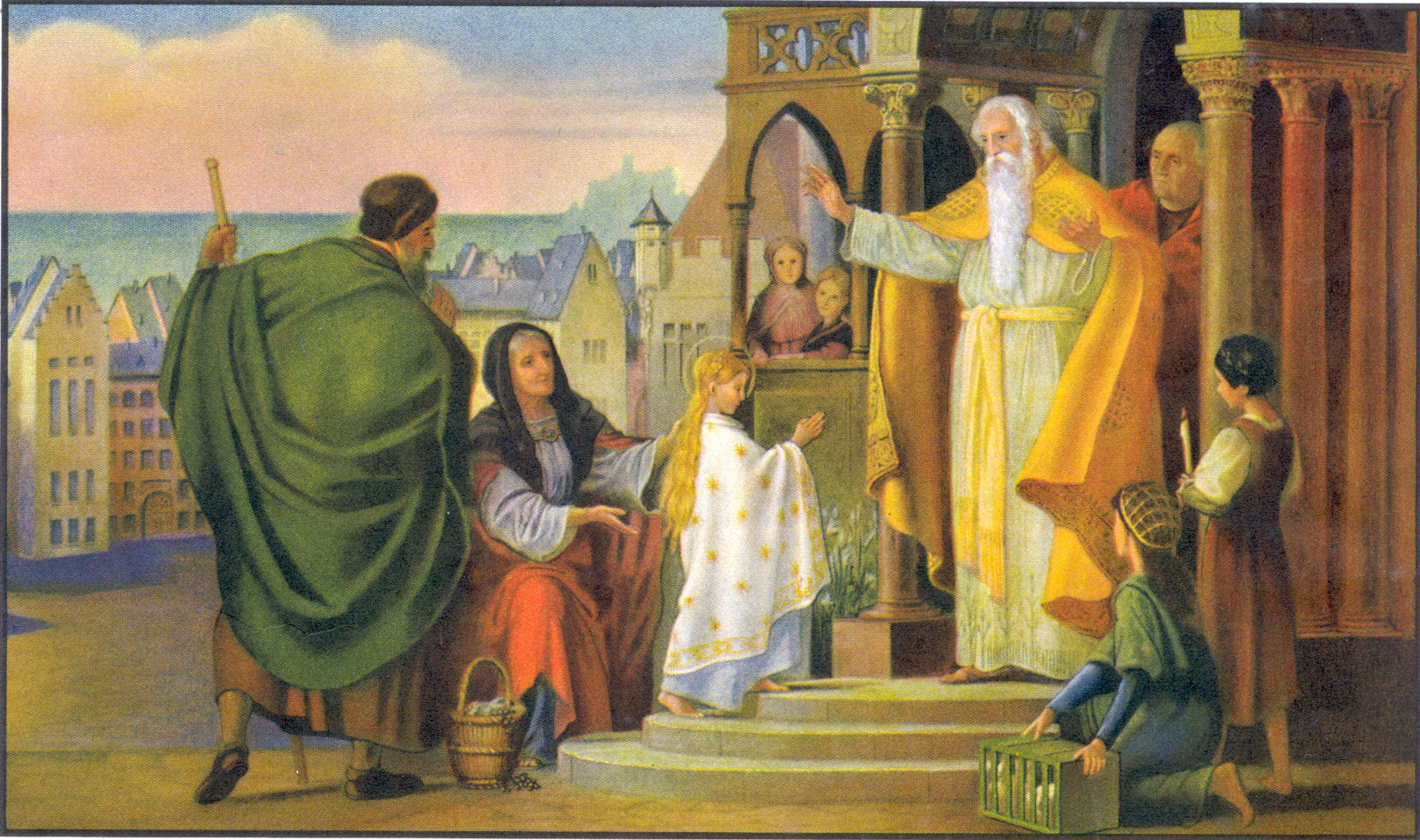
As most of you know, I have a four-year old granddaughter, who is one of the most precious things in my life. Every day she comes up with a new saying, funny action, or some random thoughts that only a young child could think up. She is a delight to her Mom, and family,and for most people who meet her. I cannot think what it would be like if she suddenly went away for several years. The loss would be too much to bear. Yet we learn this is exactly what Mary did. I can only imagine how her parents felt, even if what they were doing was in service to the Lord.
Today the Church celebrates the memorial of the Presentation of Mary. Many of the celebrations in honor of Mary are squarely based on Gospel texts. St. Luke tells of her acceptance of God’s invitation to be the mother of the Savior at the Annunciation. We know of her maternity and of her faithfulness to her son, Jesus, even, as St. John reports, standing at the side of His cross. But the Evangelists tells us nothing about Mary’s early life. The inspired Word makes no mention of the event celebrated each year on November 21st, her Presentation in the Temple. This devotion is testified by a tradition that comes from a century after her life. The Presentation of Our Lady in the Temple is told in the Apocryphal text, the Protoevangelium of James, which may be dated around the year 200 AD.
This book offers a colorful account of many aspects of Mary’s early life. Her father, Joachim, tells Anna his wife that he wishes to bring their child to serve in the Temple of the Lord in Jerusalem. Anna gets him to wait until the child is three years old, before having her live away from her parents. When the day arrived, a group of chaste Hebrew girls accompany Mary to the Temple, with their lamps burning. There the priest receives her, blesses her, and kisses her in welcome. He proclaims, “The Lord has magnified your name in all generations. In you, the Lord will manifest His redemption to the children of Israel.” Mary was placed on the third step of the Temple, where she “danced with joy and all the house of Israel loved her.” The story goes on to describe how she continued in the Temple, living in the service of the Lord, while her parents returned home, glorifying God. The focus of the book is clear: from her earliest childhood Mary was completely dedicated and given over to God. It is to this beautiful apocryphal account that we owe the Feast of the Presentation of Our Lady.
Here is a young child, who at the tender age of 3, welcomed the chance to live in service to the Lord, away from her parents. How many children do you know today who would do this? I almost know my granddaughter wouldn’t, especially if she learned there were no TV. But Mary was no ordinary child, as evidenced by the first thing she did upon entering the Temple. She “danced with joy”, knowing she was in the presence of our blessed Father.
In the 6th century the Emperor Justinian built a splendid church dedicated to Mary in the Temple area in Jerusalem. This basilica was dedicated in 543 but was destroyed by the Persians within a century. Several church Fathers such as Germanus, Patriarch of Constantinople (+730) and his contemporary John Damascene, preached homilies on this feast, referring to Mary as God’s special flower which was being nurtured for better things. “She was planted in the House of God, nourished by the Holy Spirit and kept her body and soul spotless to receive God in her bosom. He who is all-holy rests among the holy.”
In the Eastern Church the Presentation is one of the twelve great feasts of the liturgical year, as it celebrates the same belief that we in the West have focused on through the feast of the Immaculate Conception: Mary’s unique holiness. It appears that by the ninth century at least, the Presentation was treasured in the monasteries of southern Italy influenced by the Byzantine tradition. For this reason the day is dedicated to those who belong to contemplative religious orders, and the Pope said in a prior speech, “It’s a good opportunity to thank the Lord for the gift of so many people who, in monasteries and hermitages, dedicate themselves to God in prayer and silent work”. It is recorded that it was celebrated in Avignon, France in 1373. Its wider acceptance in the West was slow and only in the year 1472 did Pope Sixtus IV extend its celebration to the universal Church.
Prayer for the Presentation of Mary:
Almighty and ever living God,Today we honor the memory of the Blessed Virgin Mary, whose hidden life brings light and warmth to the Church in every place. Her presentation in the temple at Jerusalem reveals her as a temple where God truly lives among us. May Mary’s example give us the strength to radiate that light and warmth to the Church, and help us to be dwelling places of God’s joyful presence on earth. We ask this in the name of Jesus Christ our Lord who lives and reigns with you and the Holy Spirit, now and forever.
Amen.
Book Review:The All-Inclusive Christ by Witness Lee ~ The Rev. Lady Sherwood, OPI
The All Inclusive Christ, by Witness Lee, is a must read for anyone who truly wishes to have a fuller relationship with Our Lord Jesus Christ. This book is both very eye- opening and thought provoking.
It takes us on a wonderfully descriptive journey through the New Testament in the style of the good land and links it with the Gospels and the writings of Paul and shows us in depth of the many parts of Christ, and that to truly have a fuller and true relationship with him, we must live and relate to him and all these wonderful parts in every aspect of our lives. Jesus is the very valleys, hills and mountains of our lives. He is our constant refreshment through being the streams, fountains and deep waters of our lives. He is our food upon which we continually feed in him and t+e the food with which we feed all those that we serve. This book gives plenty of examples of the All inclusive Christ in action in every stage of our lives. There is no situation however bad it may be, that cannot be lived with joy if we apply the All inclusive Christ to each and every single part of our lives.
Be Prepared ~ Brother Johnpaul Casmir Ezeobinwa, Postulant

The first reading which is taken from the book of Daniel 12 vs 1-3:
In those days, I Daniel,
heard this word of the Lord:
“At that time there shall arise
Michael, the great prince,
guardian of your people;
it shall be a time unsurpassed in distress
since nations began until that time.
At that time your people shall escape,
everyone who is found written in the book.
“Many of those who sleep in the dust of the earth shall awake;
some shall live forever,
others shall be an everlasting horror and disgrace.
“But the wise shall shine brightly
like the splendor of the firmament,
and those who lead the many to justice
shall be like the stars forever.”
The first reading of today is a reminder of the last day, the events of the last day, the things that will take place on the last day when Michael, the guardian of the people of God, shall arise. The Michael here being referred to is the Archangel Michael. The phrase, “those who sleep in the dust of the earth shall awake,” invariably means some who are sleeping in the Lord shall awake in glory because they lived their life so well. “Upon those found guilty shall face everlasting horror and disgrace but the wise and righteous shall shine like the early morning star,”
is a reminder that we should have it at the back of our mind that there is a judgement day, this day awaits anybody that fails to keep the laws of the most high God.
The psalmist also reminds us that God is our inheritance, we should should set the Lord first in all that we do. Once we put God first in all we do, He will never abandon us, He will always be on our side so that we will not face horror.
The second reading: Brothers and sisters:
Every priest stands daily at his ministry,
offering frequently those same sacrifices
that can never take away sins.
But this one offered one sacrifice for sins,
and took his seat forever at the right hand of God;
now he waits until his enemies are made his footstool.
For by one offering
he has made perfect forever those who are being consecrated.
Where there is forgiveness of these,
there is no longer offering for sin.
In the second reading of today, we are told about the sacrifice of Christ, a selfless sacrifice, sacrifice that takes the sins of humankind away. Here, we can see that every priest offers sacrifice daily but Christ offered the greatest sacrifice by shedding His blood for the remission of sins. The sacrifice that makes us whole. The sacrifice of Christ has no comparison, Christ offered the sacrifice and was perfect forever in the glory of God the Father.
The Gospel: Jesus said to his disciples:
“In those days after that tribulation
the sun will be darkened,
and the moon will not give its light,
and the stars will be falling from the sky,
and the powers in the heavens will be shaken.
“And then they will see ‘the Son of Man coming in the clouds’
with great power and glory,
and then he will send out the angels
and gather his elect from the four winds,
from the end of the earth to the end of the sky.
“Learn a lesson from the fig tree.
When its branch becomes tender and sprouts leaves,
you know that summer is near.
In the same way, when you see these things happening,
know that he is near, at the gates.
Amen, I say to you,
this generation will not pass away
until all these things have taken place.
Heaven and earth will pass away,
but my words will not pass away.
“But of that day or hour, no one knows,
neither the angels in heaven, nor the Son, but only the Father.”
In today’s gospel periscope, it is reminding us about the end time, the signs which will show that the son of man is at the door post, the Bible makes it clear that so many things will happen as a clear sign that the coming of the son of God is almost at hand. Looking at what is happening on earth, war everywhere, nation fighting against nation, father against children and children against father.
Brothers and sisters let us know that the length of our lives on earth does not count, but rather what counts is how we lived our life. Did we live our life to please God or to please our fellow human beings? Let us get ready to account for the precious life that given to us, by living it well. Heaven is real, heaven is our permanent home.
Therefore my beloved one, let us strive for our salvation, let us prepare ourselves to meet the master of the universe, the creator.
GLORY TO JESUS.
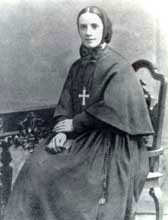
St. Frances Xavier Cabrini ~ The Rev. Lady Sherwood, OPI
 St. Frances Xavier Cabrini was born Maria Francesca Cabrini on July 15th, 1850 at Sant’Angelo Lodigiano. The young girl with was drawn to a life of religious service at an early age. She was influenced by her older sister, her uncle, a priest who captured her imagination with stories of missionary work, and also by the Daughters of the Sacred Heart, who prepared her for a normal school diploma in 1870.
Francesca who had already vowed herself to virginity at the age of 12, attempted to enter the Daughters of the Sacred Heart in 1872, but she was declined due to health reasons as had contracted smallpox whilst caring for the sick during an epidemic, and although she was healed from such, she still did not seem to be strong physically.
She found employment briefly as a teacher in Virdardo and then she was persuaded to do charity work at an orphanage at Codogno, and it was here that she took her vows in 1877.
In thissame year she was appointed to be Prioress of her new foundation, The Institute of Missionary Sisters of the Sacred Heart, which at the onset consisted of seven orphaned girls whom she had trained.
Mother Cabrini had much to do in Italy but very soon craved fulfillment ofa lifelong wish to do missionary work in China but Pope Leo XIII and Bishop Scalabrini of Piacenza instead urged her to carry her talents to Italian immigrants in the slums of the United States, and dutifully, but with reluctance, she sailed in 1889 with six sisters.
From modest beginnings in the New York City area, Mother Cabrini and her followers gradually built a national and international network of some 70 institutions.
In 1909 she became an American citizen. Her journeys on behalf of her mission, which included 30 crossings of the Atlantic, occupied much of her time and energy, although she remained frail physically throughout her life.
At the breakout of World War I in Europe, she dedicated her hospitals, and nuns in Italy to the war effort there.
On December 22nd, 1917, she after a brief illness, died of malaria in her own columbus Hospital in Chicago.
Cardinal George Mundelein of Chicago and others launched the process of her canonization in 1928. She was pronounced Venerable in 1933, was beatified in 1938, and was canonized in 1946.
Her remains originally at West Park in New York, are now enshrined in the Chapel of the Blessed Mother Cabrini High school in New York City.
St. Frances Xavier Cabrini, though declared to have effected the two miracles needed for canonization, is best remembered for her energetic labours among immigrants and the poor in the United States and for establishing and the staffing of orphanages, schools, hospitals, convents and other facilities throughout the world.
SAINT MARTIN OF TOURS ~ The Rev. Dn. Joshua Hatten, OPI
St. Martin of Tours was born in what is modern day Northern Yugoslavia and western Hungary. In about 316 A.D., when St. Martin was born, it was then known as Sabaria of Upper Pannonia. Saint Martin was born to pagan parents – his father being an officer of the Army of Rome. Due to a military transfer, Martin and his family relocated to Pavia in the north of Italy. It was here, at Pavia, that Martin first encountered Christianity. Being so drawn to the the faith, he soon became a catechumen, that is, one actively studying the faith before baptism into the Church.
During this time of study, Martin reached the age of 15 and, as his father was a Roman Officer, Martin was required to enter Roman Military service at this point. History and tradition are quick to point out that Martin never attempted to get around the requirement and did sign on as an officer, but lived “more like a monk than a soldier.”
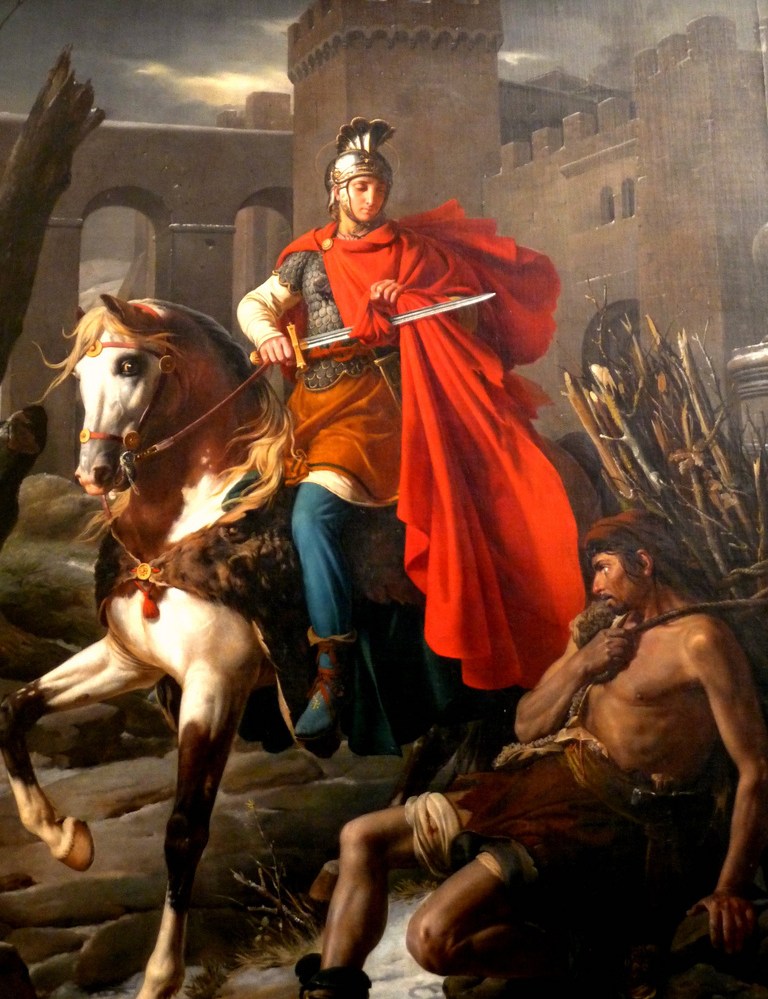
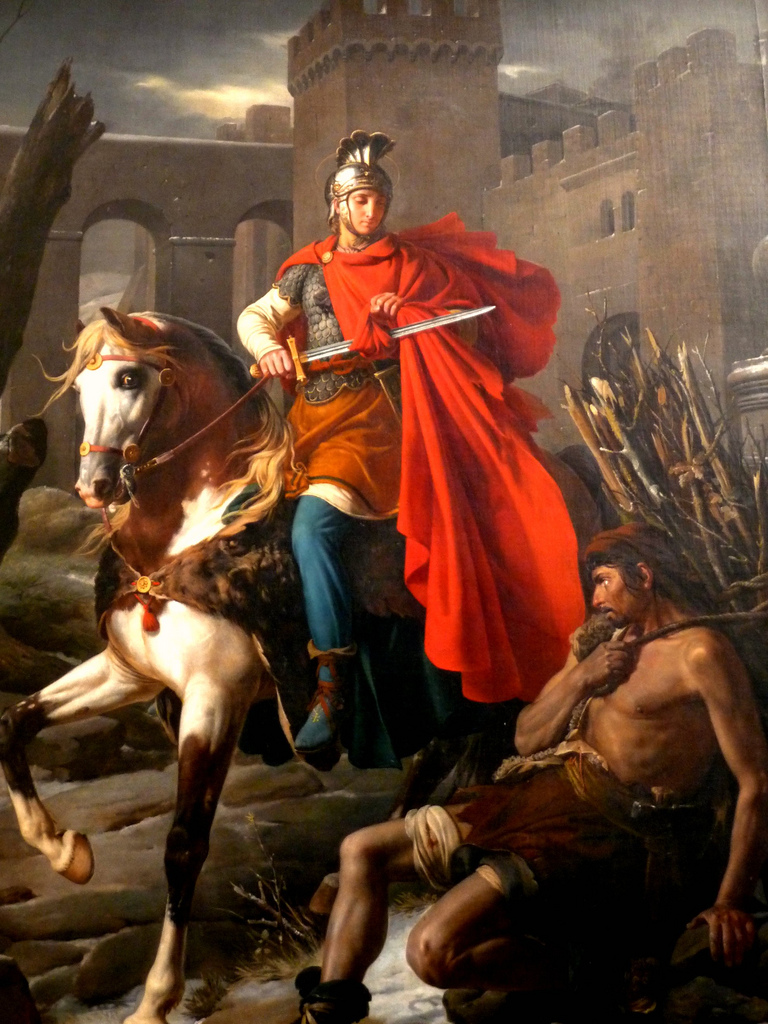
Saint Martin was stationed to a place then called Amiens, in Gaul (modern day France). Tradition hold that it was here that Martin had an experience that changed his life forever. The story goes that one day, whilst riding toward town one cold winter day, Martin noticed a beggar at the entrance gates. The man was dressed in threadbare rags, freezing and shivering from the elements and begging for alms. Martin also noticed that EVERYONE else passed the beggar by without any notice, neverminding any charity or love toward the man.
Martin’s heart was touched and the legend continue that he removed his heavy military issued cloak, and with his sword, cut the cloak in half. Keeping half for himself and giving the other half to the poor beggar. Later the following night, Martin, while sleeping, saw Christ surrounded by throngs of angels. And in this vision, Our Lord was wearing half of the cloak that Martin had given the beggar. Martin was then asked, in the vision, whether or not he recognized the piece of the cloak – which he did. Then Christ was heard to say to the surrounding angels: “Martin, not even yet baptized, has covered ME with his cloak.” Upon waking from the vision, Martin immediately looked to be baptized into the faith fully.
Closer to the age of twenty, Martin, with a few soldier-comrades, was summoned by the Emperor Julian and given orders to go and take care of the Teutonic invasions happening in Gaul. Martin’s conversion of heart kicked in and he was compelled to tell the emperor that he must refuse the order. Saying to Emperor Julian: “Up to now, I have served you as a soldier, allow me henceforth to serve Christ. Give the bounty and orders to others who are going out to battle. I am a soldier of Christ and it is not lawful for me to fight.” You might say that Saint Martin is one of our earliest Christian examples of a “conscientious objectors.”
However, Emperor Julian, not being accustomed to being refused ANYTHING, had Martin hauled off to prison. Fortunately his incarceration ended rather quickly with truces being put into place. Martin, now free and on the go, then travailed to Poitiers, and under the Bishop and friend, Hilary, was ordained a deacon into the church.
Other travels took Martin back toward his homeleand. There he converted his mother and many others to the Christian faith. To his dismay, Martin could not convince his father to give up his pagan beliefs. Martin later felt a religious calling to a life of solitude. His friend, the Bishop Hilary, gave him a small tract of land in what is now central France. There, in this place called Liguge, Martin was joined by hermits and other holy men and then established a monastery, said to be the fist established in Gaul. It survived until the early 17th Century.
For the next 10 years of his life, Martin lived as the Prior of the monastery – directing the other brothers lives and preaching in nearby areas. Around 371, the Bishop of Tours died, and so popular was Saint Martin with the locals, it was urged that he take up the vacant post. Reluctantly, and actually with a bit of trickery from the locals, Martin did accept the post as Bishop of Tours. But, even in this high post, Martin continued to live a strict and austere and simple life. Martin soon grew tired of the rigorous life as a bishop and longed to return to a simple monastic life. He retired from his post as Bishop and went Marmoutier, where he founded another simple monastery that later became a famous abbey of the region. In fact, later Bishops of Tours were often selected from among the brothers and priests of Saint Martin’s monastery.
During his life, Saint Martin was a true soldier for Christ. He stood up to Emperors and fought heretics. He won many souls for Christ and to him are attributed many, many other legends and miracles.
Closing in on the year 400, St. Martin began to have premonitions of his death and eventually sickness fell upon him. Ton the 8th of November, in the year 400, Saint Martin fell asleep in the Lord. He was buried 3 days later, at Tours. It is said that over two-thousand monks, nuns and religious attended his funeral. Soon after his burial, a chapel, then basilica where built upon Saint Martin’s grave. Both, long since destroyed, currently a modern church is built upon the site – which, still, annually has thousands of faithful pilgrims visit it.

Paying Attention ~ Br. Chip Noon, Novice

Though today’s Gospel is from Mark, let me refer us to Matthew’s beautiful passage of Jesus speaking about God’s care for us:
Look at the birds of the air; they do not sow or reap or store away in barns, and yet your heavenly Father feeds them. Are you not much more valuable than they?
And as God foretold through Elijah, the jar of flour did not go empty, nor the jug of oil run dry in the widow’s house.
So in the Gospel, Jesus admonishes those who are ostentatious in their wealth and commends the widow who gives all she had.
Is Jesus talking about money? Wealth? Poverty? Station in life? In an off-hand way, yes. All throughout the Gospels there are comparisons between the rich and the poor, the powerful and the powerless, the haves and the have-nots.
Luke, in the first two of the four Beatitudes from the Sermon on the Plain, quotes Jesus as saying:
Blessed be ye poor: for yours is the kingdom of God.
Blessed are ye that hunger now: for ye shall be filled.
And the first two woes that follow:
Woe to you who are rich, for you have already received your comfort.
Woe to you who are well fed now, for you will go hungry.
And also from Luke: You cannot serve both God and Money.
This teaching, then, seems to me to be what is behind today’s readings. And the question is, what are we to pay attention to?
Years ago, when I was working as a management consultant, we used to advise our clients that they could not improve their business if they were not paying attention to the things that were important. Pretty basic, huh? But you would be surprised how many companies paid very little attention to the things that would improve their bottom line. They measured hours worked, the number of products made, precisely how much each employee should receive as a wage…almost everything but how their customers thought they were doing, how satisfied they were, and whether they would buy from the company again.
How many of us are like the scribes in long robes seeking places of honor at banquets? And even if we are not manipulating the law to expropriate the houses of widows, are we not daily concerned with our livelihood, our income, our shelter?
But at this point we hear those persistent voices in our head saying we must plan for the future, take heed of our finances, and care for our families. And then this verse comes to mind: “I tell you the truth, it is hard for a rich man to enter the kingdom of heaven. Again I tell you, it is easier for a camel to go through the eye of a needle than for a rich man to enter the kingdom of God.”
So what is a person to do?
What do we pay attention to? Well, his yoke may be easy and his burden light…but taking them up is pretty tough, wouldn’t you say? No really, what do we pay attention to? Maybe in the case of money, security, shelter we should actually be thinking of Jesus’ words as exercises, just as we exercise to keep our strength. Maybe the answer is to work every day at paying attention to the things of heaven, and not of this earth.
No matter how good we are at multi-tasking, we can only pay attention to a few things at a time. So let’s resolve to exercise our love of God by paying attention to him throughout the day. We have St. Paul urging us on: “Rejoice always, pray continually, give thanks in all circumstances; for this is God’s will for you in Christ Jesus.” Let’s resolve to pay attention the things that really matter, those things that we know, deep in our souls, that bring us peace and comfort.
Sure, the stresses of the day will intrude. But we can only experience the easy yoke and the light burden if we take them up. It’s that taking up that we must give some effort to.
One last quote, from Jeremiah:
“Thus saith the LORD, Let not the wise man glory in his wisdom, neither let the mighty man glory in his might, let not the rich man glory in his riches: But let him that glorieth glory in this, that he understand and knoweth me, that I am the LORD which exercise loving kindness, judgment, and righteousness, in the earth: for in these things I delight, saith the LORD.”
Lord, help us to take up our cross and focus ahead on knowing and loving you. Let our thoughts and actions be in your direction and let us have faith that your yoke will be easy and your burden light. Amen.
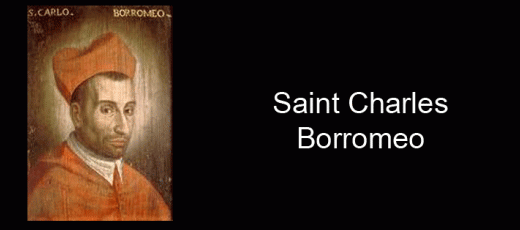
Saint Charles Borromeo ~ The Rev. Dn. Joshua Hatten, OPI
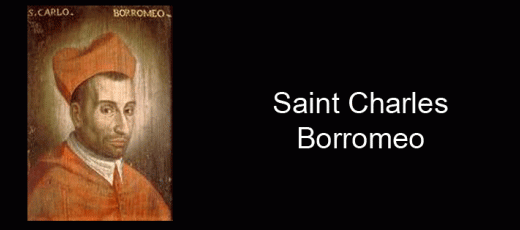
Saint Charles Borromeo was born on October 2, 1538, into a noble family of Milan and was also related to the powerful Medici family. But Charles desired to devote himself to the Church. His uncle, Cardinal de Medici, was elected pope in 1559( he took the name Pius IV). Pope Pius IV placed Charles in the office of cardinal deacon and made Charles the administrator of the Archdiocese of Milan – and all while he was still a layman and a student. But it is because of his intellectual gifts that he was entrusted with several important offices connected with the Vatican. Later in life, he was appointed secretary of state, which carries the responsibility for the papal states.
In the midst of all this, Charles’ older brother passed away. The death was untimely, but it is what brought Charles to his definite decision to become an ordained priest. His relative objected – they wished to see Charles marry and have children. But Charles was adamant about his calling, and, at the age of 25, he was ordained to the priesthood. Very soon after his ordination, he was consecrated as the Bishop of Milan.
St. Charles Borromeo lived during the tumultuous times of the Protestant Reformation and was also involved in the final years of the Council of Trent. Charles had encouraged the pope to renew the Council in 1562 after it had been suspended for 10 years. Using his mind and persuasion, much credit is due to St. Charles for keeping the Council of Trent going, when at many times it was on the verge of breaking up. For the Council, St Charles himself, took up the task of correspondence during the final phase – NOT AN EASY JOB!!
After the Council of Trent drew to a close, Saint Charles was allowed to devote his time to the Archdiocese of Milan, where religious and moral reform was needed from within. Saint Charles initiated a provincial council, made up of all the bishops under his leadership. This Council focused on every phase of Catholic life from among the laity to the clergy and the specific changes and reforms needed therein. Saint Charles new that the changes had to start with the clergy, if the laity were to change then they must first be given a good example of the desired reforms by the bishops and other clergy. The people needed a reformed Catholic example, and Saint Charles knew this.
Saint Charles took the initiative in being a Christ-like example. Most of his income went to various charities. He gave up all luxuries and imposed harsh penances on himself. He denounced honors, esteem and influence to become poor. During the plague and famine of 1576, he tried to feed 60,000 to 70,000 people DAILY!! This he accomplished by getting loans of large sums that required years to repay. Charles saw Christ in his neighbor and knew that charity done for the least of his flock was charity done for Christ. Whilst the civil authorities and powers fled during the height of the plague, Saint Charles Borromeo stayed in the city and he ministered to the sick and the dying and continued to help those in need.
By the age of 46, the overwhelming work and burdens of his office began to affect his health and Saint Charles gave up his ghost. The Church that he had worked so hard to make more human, recognized him as a saint in 1610. His feast day is celebrated on November 4th.
Feast of All Souls ~ The Rev. Dn., Sister Dollie Wilkinson
Is death the last sleep? No–it is the last and final awakening.
-Sir Walter Scott
“As (Saint) Dominic lay on his deathbed surrounded by his sorrowful brethren, he consoled them saying, “Do not weep. I will be of more use to you in Heaven.” Dominic’s words offered deep hope, extending beyond his death to the death of each member of the Order. “
We all have lost loved ones, some so early in their life, others who had been with us for a good long while. But for those left behind, the sense of loss can be almost too much to bear. Yet we know in our hearts that we shall see our loved ones again, that we will all be reunited with each other—in our heavenly Father’s kingdom. So until that time, we remember them with love, and offer up prayers for their soul.
Today, November 2nd, we celebrate the Feast of All Souls. On the day after All Saints, the Church reminds us of those who have not yet achieved the goal of their pilgrimage, the Kingdom of Heaven. As part of the communion of saints, they need our prayers. Today’s feast is an opportunity for us to pray in unity for our relatives and friends and for those who have no one to pray for them. All Soul’s Day (sometimes called the “Day of the Dead”) is always November 2 (November 3rd if the 2nd falls on a Sunday).
All Soul’s Day is a Roman Catholic day of remembrance for friends and loved ones who have passed away. This comes from the ancient Pagan Festival of the Dead, which celebrated the Pagan belief that the souls of the dead would return for a meal with the family. Candles in the window would guide the souls back home, and another place was set at the table. Children would come through the village, asking for food to be offered symbolically to the dead, then donated to feed the hungry.
The day purposely follows All Saint’s Day in order to shift the focus from those in heaven to those in purgatory. It is celebrated with Masses and festivities in honor of the dead. While the Feast of All Saints is a day to remember the glories of Heaven and those there, the Feast of All Souls reminds us of our obligations to live holy lives and that there will be purification of the souls of those destined for Heaven.
Upon death, it is believed that souls have not yet been cleansed of sin. Praying for souls of loved ones helps to remove the stain of sin, and allow the souls to enter the pearly gates of heaven. Through prayer and good works, living members of the church may help their departed friends and family. There are three Requiem Masses that are said by the clergy to assist the souls from Purgatory to Heaven: one for the celebrant, one for the departed, and one for the pope. One such reading for the Mass is included in the Book of Wisdom:
“The souls of the just are in the hand of God
and no torment shall touch them.
They seemed, in the view of the foolish, to be dead;
and their passing away was thought an affliction
and their going forth from us, utter destruction.
But they are in peace.
For if before men, indeed, they be punished,
yet is their hope full of immortality;
chastised a little, they shall be greatly blessed,
because God tried them
and found them worthy of himself.
As gold in the furnace, he proved them,
and as sacrificial offerings he took them to himself.
In the time of their visitation they shall shine,
and shall dart about as sparks through stubble;
they shall judge nations and rule over peoples,
and the Lord shall be their King forever.
Those who trust in him shall understand truth,
and the faithful shall abide with him in love:
because grace and mercy are with his holy ones,
and his care is with his elect.”
The traditions of the Feast of All Souls began independently of the Feast of All Saints. The Feast of All Souls owes its beginning to seventh century monks who decided to offer the mass on the day after Pentecost for their deceased community members. In the late tenth century, the Benedictine monastery in Cluny chose to move their Mass for their dead to November 2, the day after the Feast of all Saints. This custom spread and in the thirteenth century, Rome put the feast on the calendar of the entire Church. The date remained November 2 so that all in the Communion of the Saints might be celebrated together.
Other customs have arisen over time in the celebration of All Souls Day. The Dominicans in the 15th century instituted a custom of each priest offering three Masses on the Feast of All Souls. Pope Benedict XIV in 1748 approved this practice, and it rapidly spread throughout Spain, Portugal and Latin America. During World War I, Pope Benedict XV, recognizing the number of war dead and the numerous Masses that could not be fulfilled because of destroyed Churches, granted all priests the privilege of offering three Masses on All Souls Day: one for the particular intention, one for all of the faithful departed, and one for the intentions of the Holy Father.
Many more customs are associated with The Days of the Dead celebration. In the home an altar is made with an offering of food upon it. It is believed that the dead partake of the food in spirit and the living eat it later. The offerings are beautifully arranged with flowers such as marigolds, which are the traditional flower of the dead. There is a candle placed for each dead soul, and they are adorned in some manner. Incense is also often used, and mementos, photos, and other remembrances of the dead also adorn the offerings. Traditional Catholics still honor customs related to the relief of the souls suffering in purgatory. One custom is for persons to pray six Our Fathers, Hail Mary’s and Glory Be’s for the intentions of the Pope in a church, and thereby, receive a plenary indulgence for a soul in purgatory. This action may be repeated for another soul, by leaving the church and re-entering it to repeat the prayers.
All Soul’s Day lives on today, particularly in Mexico, where All Hallows’ Eve, All Saint’s Day and All Soul’s Day are collectively observed as “Los Dias de los Muertos” (The Days of the Dead). First and foremost, the Days of the Dead is a time when families fondly remember the deceased. But it is also a time marked by festivities, including spectacular parades of skeletons and ghouls. In one notable tradition, revelers lead a mock funeral procession with a live person inside a coffin.
As we all know, death is never final. We will be reunited with our loved ones. And for those in purgatory, let us pray for their souls to be cleansed, so we shall all live again in our Father’s house.
A prayer for all our departed brothers and sisters:
Merciful Father,
hear our prayer
and console us.
As we renew
our faith in Your Son,
whom You raised from the dead,
strengthen our hope
that all our departed brothers and sisters
will share in His resurrection,
who lives and reigns
with You and the Holy Spirit,
one God, for ever and ever.
Amen
Invocation for the Souls in Purgatory:
My God,
bestow Thy blessings and Thy mercies
on all persons
and on those souls in Purgatory,
for whom I am in charity, gratitude, or friendship bound
and have the desire to pray.
Amen

All Saints Day
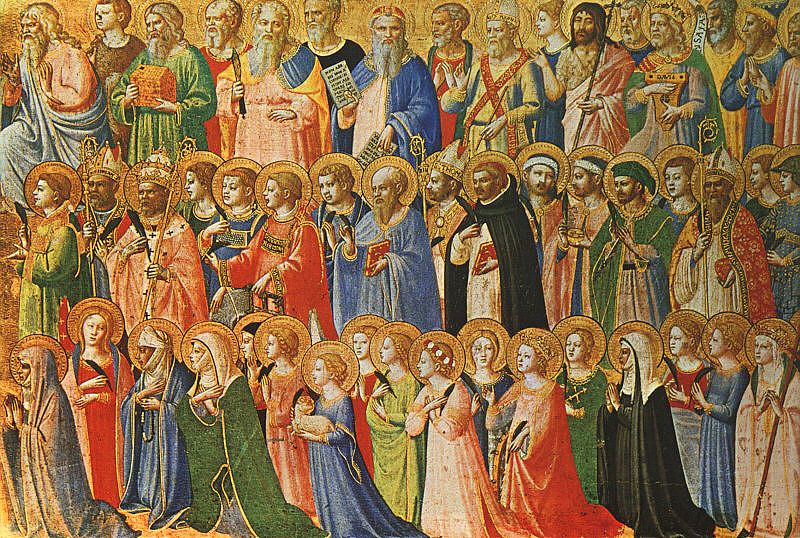
All Saints’ Day, All Hallows Day, or Hallowmas is solemnly celebrated on 1 November by many Western Liturgical Churches to honor, literally, all the saints, known and unknown; those individuals who have attained Heaven.
The saints are all the Holy men and women who have lived their lives for God and for his church, who now have attained Beatific vision and their reward of Heaven. In early Christian history it was usual to solemnize the anniversary of a Martyrs death for the Lord at the place of their martyrdom. Frequently there were multiple martyrs who would’ve suffered and died on the same day which led to multiple commemorations on the same day. Eventually,the numbers of martyrs became so great that it was impossible for a separate day to be assigned to each individually, but the church feeling that every martyr should be venerated, appointed a feast day to commemorate them all on the same day. At first, only Martyrs and St.John the Baptist were honoured with a special day but after a regular canonization had been established other saints were gradually also added and then were increased in number.
From Wikipedia: The origin of the festival of All Saints celebrated in the West dates to the month of May in the year 609 or 610, when Pope Boniface IV consecrated the Pantheon at Rome to the Blessed Virgin and all the martyrs. In the 730’s Pope Gregory III moved the Feast of All Saints to 1 November when he founded an oratory in St. Peter’s for the relics of the holy apostles and of all saints, martyrs and confessors, of all the just made perfect who are at rest throughout the world.”
Revelation 7:2-4, 9-14
I, John, saw another angel come up from the East, holding the seal of the living God. He cried out in a loud voice to the four angels who were given power to damage the land and the sea, “Do not damage the land or the sea or the trees
until we put the seal on the foreheads of the servants of our God.” I heard the number of those who had been marked with the seal, one hundred and forty-four thousand marked from every tribe of the children of Israel.
After this I had a vision of a great multitude, which no one could count, from every nation, race, people, and tongue. They stood before the throne and before the Lamb, wearing white robes and holding palm branches in their hands.
They cried out in a loud voice: “Salvation comes from our God, who is seated on the throne, and from the Lamb.”
All the angels stood around the throne and around the elders and the four living creatures. They prostrated themselves before the throne, worshiped God, and exclaimed:
“Amen. Blessing and glory, wisdom and thanksgiving, honor, power, and might be to our God forever and ever. Amen.”
Then one of the elders spoke up and said to me, “Who are these wearing white robes, and where did they come from?” I said to him, “My lord, you are the one who knows.” He said to me, “These are the ones who have survived the time of great
distress; they have washed their robes and made them white in the Blood of the Lamb.”
From the Book of Common Prayer, p. 194:
The Collect for All Saints’ Day
O Almighty God, who hast knit together thine elect in one communion and fellowship in the mystical body of they Son Christ our Lord: Grant us grace so to follow thy blessed saints in all virtuous and godly living, that we may come to those ineffable joys which thou has prepared for those who unfeigned love thee; through the same Jesus Christ our Lord, who with thee and the Holy Spirit liveth and reigneth, one God, in glory everlasting, Amen.
Hymn: For All the Saints
Text: William W. How, 1823-1897
Music: Ralph Vaughan Williams, 1872-1958
For all the saints, who from their labors rest,who thee by faith before the world confessed,thy name, O Jesus, be forever blest.Alleluia, Alleluia! Thou wast their rock, their fortress, and their might;thou Lord, their captain in the well-fought fight;thou in the darkness drear, their one true light.Alleluia, Alleluia! O may thy soldiers, faithful, true, and bold,fight as the saints who nobly fought of old,and win with them the victor’s crown of gold.Alleluia, Alleluia! O blest communion, fellowship divine!We feebly struggle, they in glory shine;yet all are one in thee, for all are thine.Alleluia, Alleluia! And when the strife is fierce, the warfare long,steals on the ear the distant triumph song,and hearts are brave again, and arms are strong.Alleluia, Alleluia! From earth’s wide bounds, from ocean’s farthest coast,through gates of pearl streams in the countless host,singing to Father, Son, and Holy Ghost:Alleluia, Alleluia!
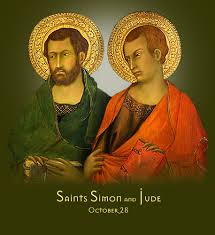
Sts Simon and Jude, Apostles ~ The Rev. Lady Sherwood, OPI

Today we as a church commemorate the joint feasts of St’s Simon and Jude. St Simon was called the Cananaen or Canaanite because he was born in the Galilean town of Cana. This is the town in which our Lord Jesus wrought his first miracle by changing water into wine as is known to us from the Gospel. Some including Nicephorous have the opinion that Simon was the bridegroom of this wedding at which Our Lord Jesus and his mother, the Blessed Virgin Mary honoured with their presence and that later with the consent of his bride, Simon left to follow Christ. This account though is disputed by others. St. Jude according to some traditions is believed to be the brother of Simon and is also named Thaddseus to distinguish him from Judas Iscariot who was the one who betrayed the Lord before his crucifixion. According to Nicephorous, Mary Cleophas was the mother to Simon and Jude and James the less was also their brother. Other writers and traditions however say that Simon and Jude were not brothers.
On the various lists of the twelve Apostles (Matthew 10:2=4, Mark 3:16=19, Luke 16:14=16, Acts 1:13), the tenth and eleventh places are occupied by St. Simon and St. Jude.
We are told in the Gospel that Our Lord Jesus chose both Simon and Jude to be his Apostles, but when and under what circumstances this took place, has not been recorded and none of the particulars of their works are known by us, however, we know for sure that like all the Apostles, they constantly followed Christ.
When the apostles separated to preach the Gospel, according to some traditions, Simon first travelled to Eygpt and St. Jude to Mesopotamia. Both also travelled to other lands preaching the Word of Christ and that after thirty years they met again in Persia. Other traditions say that both Simon and Jude went together as missionaries to Persia and were martyred there.
St. Jude is often referred to as the Patron of desperate causes, the ‘saint of last resort’, and is the one often asked for help when all else fails. Since his name reminds many of Judas of Iscariot, there is a tendency to ask for intercession from any of the other Apostles first.
Let us pray:
Father,
You revealed yourself to us through the preaching of your Apostles Simon and Jude. By their prayers, give your church continued growth and increase the number of those who believe in you. Through our Lord Jesus Christ, your Son, who lives and reigns with you and the Holy Spirit, one God, for ever and ever. Amen. Continue reading
 The Order of Preachers, Independent
You must be logged in to post a comment.