
Category: Member Posts
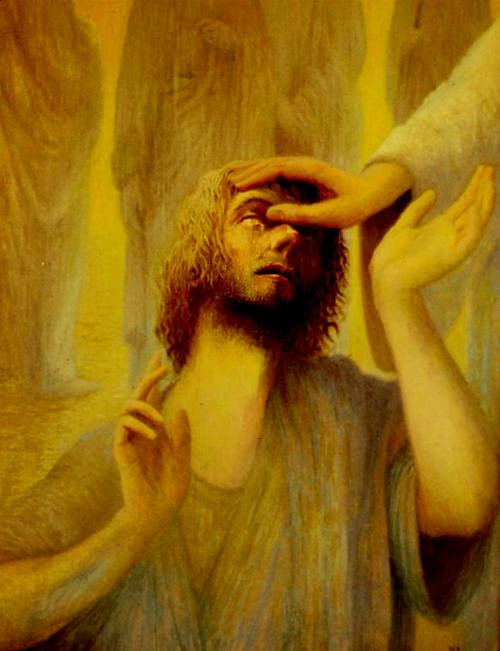
“And the Blind Shall See” ~ The Rev. Dn, Sister Dollie Wilkinson
As I was going about my day, like I normally do, rushing here and there to get everything done, I happened to notice an elderly lady struggling with a walker. She was also trying to carry several bags of groceries, but because she relied on a walker to get around, she was having a very hard time. Now understand this wasn’t an isolated incident, in a rural area, but in the middle of a busy city – a local bus station. There had to be at least twenty people around her, including myself, but no one seemed to notice this lady’s struggles. As I rushed to help this poor dear, I muttered to myself, “Are so many people blind?”.
Actually, there are many, many people of the world who are very blind. Blind to what is really right in front of them. Have we became so complacent in our society, that we ignore an elderly lady struggling just to get around? Have we become so immune to violence that we would rather post a violent video we caught with our I-phone on social media, than actually step in to help when we see someone being hurt? Have we so bought in to our culture of instant-gratification, that we expect our needs be met in a heartbeat, without actually putting in any work? What does it take to have our eyes opened? In Mark 10:46-52, Bartimaeus, the blind beggar, knew exactly what, or more importantly who, could grant him the gift of sight……could open his eyes.
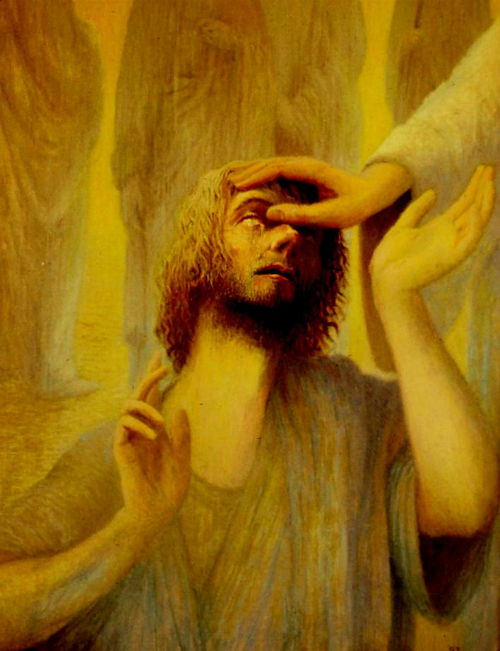
“They came to Jericho. As he and his disciples and a large crowd were leaving Jericho, Bartimaeus son of Timaeus, a blind beggar, was sitting by the roadside. When he heard that it was Jesus of Nazareth, he began to shout out and say, “Jesus, Son of David, have mercy on me!” Many sternly ordered him to be quiet, but he cried out even more loudly, “Son of David, have mercy on me!” Jesus stood still and said, “Call him here.” And they called the blind man, saying to him, “Take heart; get up, he is calling you.” So throwing off his cloak, he sprang up and came to Jesus. Then Jesus said to him, “What do you want me to do for you?” The blind man said to him, “My teacher, let me see again.” Jesus said to him, “Go; your faith has made you well.” Immediately he regained his sight and followed him on the way.”
How did a blind man recognize that this person, Jesus of Nazareth, could not only help him, but heal him? It took a blind man to see what was right in front of him. He recognized Jesus, and knew He was the ultimate healer. Yet, he couldn’t see. He starts by yelling very loud, much to the chagrin of those around him. They try to silence him, thinking him a fool, or not worth our blessed Savior’s time. But Jesus, in His infinite grace, calls the man over. He asks, “What do you want me to do for you?”. This is a very loaded question. If you had a magic genie that you knew could grant you any wish, what would you wish for? Wealth, fame, beauty? As we know, the blind beggar only wanted one thing…..to see again.
He could have asked for anything, but he asked for one thing. His wish was to have his sight restored. But, I think this dear soul saw more than anyone around him. He, though blind, recognized the Son, believed in Him and knew to trust that he would be healed. I’ve read a lot of commentary on this one little piece of scripture, and most focus on the miraculous healing of Bartimaeus, the fact that a blind man can finally see. But I think he saw more, though he was blind, than many folks can see now with perfect eyesight.
He recognized Jesus, knew he was the Son of David, and knew that He could heal him. He put his entire trust and faith in this person, whom he had never met. And Jesus, because He recognizes the strong faith in this young man, responds with, “Go; your faith has made you well.”. So, a blind man can see, and we can assume because of this, he no longer has to beg to live. So ask yourself this? Are you blind?
I’m not only talking about the elderly woman I saw today, struggling to carry groceries, who’s hardship appeared to go unnoticed by those around her. Would Jesus have ignored her struggles? But, I’m also talking about faith. If a blind man can recognize our blessed Savior, and know that all he had to do was ask, and his sight would be restored, can we not also put our trust in this same Savior? What does it take for you to recognize Jesus, throw off your cloak of doubt, and simply ask (through prayer), for what is your most crucial need? Must you be like this blind beggar, to really see???

Are You In The Game 100%??? – Br. Michael Marshall, Novice

Mark 10:35-45
James and John, the sons of Zebedee, came to Jesus and said to him,
“Teacher, we want you to do for us whatever we ask of you.”
He replied, “What do you wish me to do for you?”
They answered him, “Grant that in your glory
we may sit one at your right and the other at your left.”
Jesus said to them, “You do not know what you are asking.
Can you drink the cup that I drink
or be baptized with the baptism with which I am baptized?”
They said to him, “We can.”
Jesus said to them, “The cup that I drink, you will drink,
and with the baptism with which I am baptized, you will be baptized;
but to sit at my right or at my left is not mine to give
but is for those for whom it has been prepared.”
When the ten heard this, they became indignant at James and John.
Jesus summoned them and said to them,
“You know that those who are recognized as rulers over the Gentiles
lord it over them,
and their great ones make their authority over them felt.
But it shall not be so among you.
Rather, whoever wishes to be great among you will be your servant;
whoever wishes to be first among you will be the slave of all.
For the Son of Man did not come to be served
but to serve and to give his life as a ransom for many.”
A man goes off to college with a plan to study civil engineering, as much as his original desire was to be an architect. He was not accepted into architecture programs, so he felt civil engineering was the closest to architecture. He finds himself intrigued with the design and planning aspects of the program, but was not able to handle the math and science coursework so essentially gives up; and is at the point of nearly flunking out of college so he scrambles to find a major in which he would be able to remain in college. The man finds that urban planning is a great path which allows him to use his interest in design without the math and science, so he pursued a degree in urban planning.
As this man is studying, his time outside of the classroom leads him to discover Catholicism, and his faith deepens. He had the opportunity to take an elective course which was on the spirituality of Thomas Merton, and this sparked something within as to find a way to integrate ministry with urban planning. The integration did not come about until his first attempt of graduate school, and the man saw how urban economic development can go hand in hand with turning around a blighted neighborhood with the help of churches. As much as his advisor and the department faculty were interested in the idea, the man did not pass the comprehensive exam in order to finish his thesis.
He felt the tug to pursue priesthood, and after a few rejections he entered a religious order which felt he would be a good fit based upon his studies. In the end, things did not work out, but the priesthood calling was still there. Along a winding path of ministry and hurdles and discouragement which almost led the man to give up, came another opportunity to answer the call. There was a renewed zeal, even though more roadblocks were placed in front of him. The man began to question why the roadblocks were there, and started to withdraw from ministry while still saying he felt called. This statement of saying he was called is like James and John asking Jesus if they could sit at his right and left, while this man was not fully “in the game”, when Jesus point blank tells James and John that it takes more than wanting to be next to him; that there is a commitment and consequences to what they want.
The man realized that being called meant taking action instead of withdrawing from things, and searched for where he would be able to be of ministry. He found a new Church home, and another order. His desire to serve God returned, and was making progress toward ordination until personal issues in his life started taking over. His studies were put on the back burner, and he lost motivation. Great emotional pain set in, so he sought out hedonistic activities to ease the pain. It became a downward spiral of self-serving, instead of desiring to serve others; which Jesus strongly says that following him means to be of service to other regardless of all the consequences that shall result. The man said he was called to priesthood, but was not putting the effort into what it takes. Eventually the light bulb came on when reading the Gospel for today. He is going to get back on the ball and start doing what it takes…
Following Jesus takes more than saying that you are called, it takes more than popping in on Masses online, it takes more than chatting with the Bishop. It takes continual growth as a person, becoming the person God intends you to be because you put forth the effort. What is it that is stopping you from becoming the person God wants you to be? What are the things you hang on to that prevent you from fulfilling God’s will in your life? The question is: Are you “in the game” 100% to serve the Lord? Reflect upon that and decide.
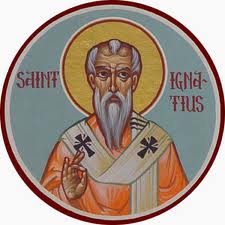
What’s Next? – St. Ignatius of Antioch ~ Br. Chip Noon, Novice

Many religions seek to answer the question of what becomes of us when we die. Many try to reconcile the inevitability of death with our fear of it. Many attempt to create a life beyond this one, at least to give us a hope that this world is not all there is.
As Christians we believe that God became man to teach us directly that there is indeed life after death and that as long as we acquit ourselves well in this life we shall attain that afterlife.
St. Ignatius of Antioch, one of the earliest church bishops, appointed by St. Peter himself, tried to teach us that the message of Jesus was much more than just saying there is life after death and that we can see God. He taught us to long for that time, to put aside all fears as not worthy of our calling after Jesus, and to eagerly seek whatever end we are destined for.
What a confusing time he lived in! Some of the twelve apostles were still alive, yet there was already dissention, schism, opportunism, false teachings. Not fifty years after the resurrection of our Savior, people abounded who used his Gospel as a means of dividing others, enriching themselves, and attaining as much power and prestige for themselves as they could achieve. Is this the real message of the early church fathers – that times will never change? Maybe. That could be one message we glean from their writings. And from the Gospels, for that matter.
But then comes St. Ignatius, a convert, a student of St. John the Apostle, and obviously a brilliant and devout Christian. What does he tell us?
There is one Physician who is possessed both of flesh and spirit; both made and not made; God existing in flesh; true life in death; both of Mary and of God; first passible and then impassible—even Jesus Christ our Lord.
He says that Jesus is God existing in the flesh. This is one of the first post apostolic writings that proclaims that Jesus is God, both man and spirit. And if this is so, then the prophets proclaiming that there is life after death must be correct. And he stressed that the Eucharist is the medicine of immortality. Therefore, we must partake of the Eucharist.
Then he says
Take care to do all things in harmony with God, with the bishop presiding in the place of God, and with the presbyters in the place of the council of the apostles, and with the deacons, who are most dear to me, entrusted with the business of Jesus Christ, who was with the Father from the beginning and is at last made manifest.
So if Jesus is God and vouchsafed his spirit and teachings upon us, we must also listen to him when he proclaims the Apostles and indicates an hierarchy within the church. So Ignatius is trying to secure those teachings and insure that the truth, the teachings of Jesus, are handed on. “Be not seduced by strange doctrines nor by antiquated fables, which are profitless.” He is trying to build up the authority of the local bishop, one bishop per city or diocese. This in order, again, to preserve correct teachings.
Then he says
I am writing to all the Churches and I enjoin all, that I am dying willingly for God’s sake, if only you do not prevent it. I beg you, do not do me an untimely kindness. Allow me to be eaten by the beasts, which are my way of reaching to God. I am God’s wheat, and I am to be ground by the teeth of wild beasts, so that I may become the pure bread of Christ.
And this all leads to a feeling of joy at death since we will see Jesus, God, the Holy Spirit and live forever. St. Ignatius not only believed this, he lived it. The hardships of his journey to face death in Rome were borne with grace…he even attempts to comfort his captors.
So in today’s reading from Romans, Paul is saying that it is not the law that will lead us to “inherit the world,” but faith, the gift from God. And in the Gospel, Jesus says, “When they take you before synagogues and before rulers and authorities, do not worry about how or what your defense will be or about what you are to say. For the Holy Spirit will teach you at that moment what you should say.” Faith.
So isn’t that all the message of St. Ignatius? That it does not matter what will happen to us, nor that we should concern ourselves with how we will comport ourselves at the end, even if it is a violent one. There is “even Jesus Christ our Lord” who will be leading us onward. St. Ignatius is showing us the direct lineage from Jesus to us, from chaos to peace, from fear to faith.
And if we listen to the Gospels and Epistles, we will have all we need to realize this lineage.
Finally, St. Ignatius was responsible for the first known use of the Greek word katholikos, meaning “universal”, “complete”, and “whole” to describe the church. And this concept permeates all his teachings and exhortations. One holy, catholic, and apostolic church. May it ever be so.
Lord, in today’s world there continues to be dissention, schism, opportunism, false teachings. Help us to hear your word and follow the teachings of your son. Let us replace fear with faith and spread that faith to all we meet. Amen.
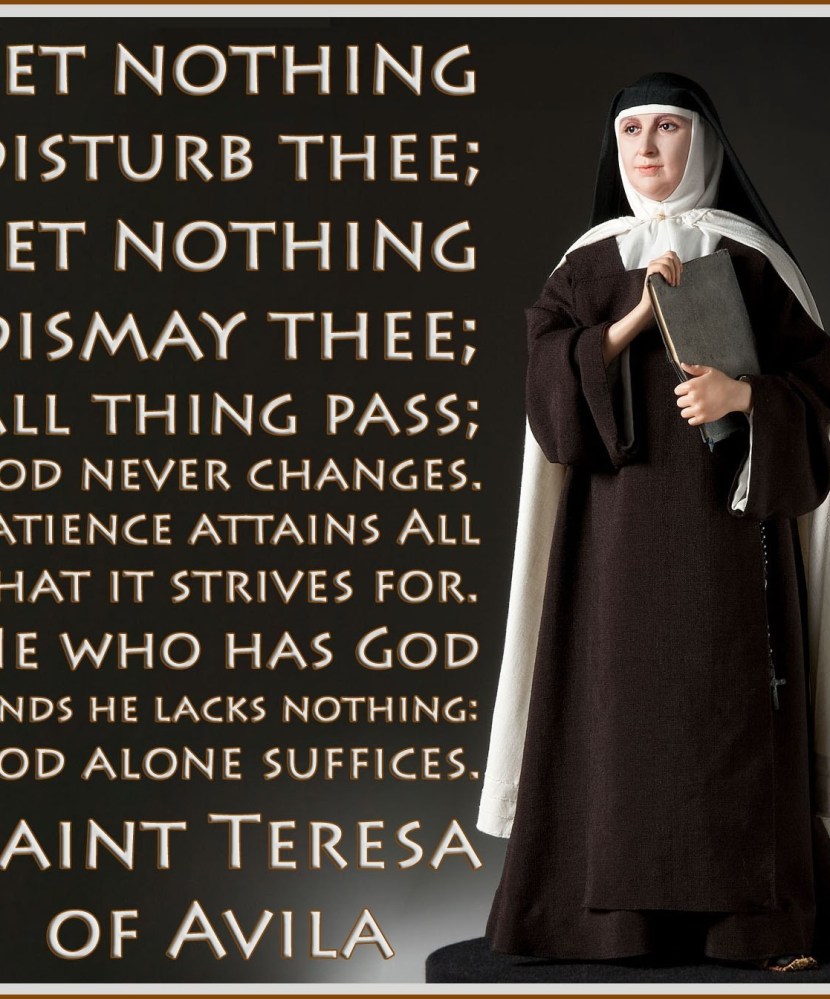
“God Alone Is Enough” St. Teresa of Avila ~ The Rev. Deacon, Sister Dollie Wilkinson, OPI

Saint Teresa of Avila (Saint Theresa of Jesus)
Born in Avila, Spain March 28, 1515; died in Alba de Tormes, October 4, 1582
Foundress of the Discalced Carmelites, 1560-62.
Canonized by Gregory XV, 1622; declared a Doctor of the Church in 1970.
Spanish mystic, writer and reformer of the Carmelite order.
St Terese of Avila was an influential and pivotal figure of her generation. St Teresa (Teresa de Cepeda y Ahumada) was born in Avila, Spain on 28th March 1515. Her parents were both pious Catholics and in some ways inspired their daughter to take up a life of prayer. As a young child Teresa showed signs of a deeply religious nature; she would often retreat into silence for prayer and would enjoy giving alms to the poor. She was very close to her Mother, who provided a warm counterbalance, to the strictness of her father. However in her teens, Teresa’s mother passed away, leaving the young Teresa distraught at the void she felt. The young St Teresa tells of her despair and how she turned instinctively to the Virgin Mary for comfort.
“I threw myself down in despair before an image of the Mother of God. With many tears, I implored the Holy Virgin to become my mother now. Uttered with the simplicity of a child, this prayer was heard. From that hour on, I never prayed to the Virgin in vain.”
During her later teen years Avila lost some of her early piety and religious zeal. She recounted how she became interested in worldly matters and enjoyed the company of a wide circle of friends. She had a natural charm and found it easy to make friends. In return she enjoyed the compliments and friendships of others. However, she was not at peace, considering herself to be a miserable sinner; later she would look back in guilt at her early life. However this sense of being a “miserable sinner” was probably the result of a harsh self-judgment, encouraged by her fathers exacting religious standards. At the age of 16, her father decided to send Teresa to a convent school to be educated.
This re-ignited in Avila an interest in following a spiritual life and after some deliberation resolved to become a nun of the Carmelite Order. At the time the convent rules were not very strict; it was probably more relaxed than living with her father. At the time the convent accepted many people into the order, often for financial reasons. The convent became overcrowded and people were often judged not on the basis of spiritual intensity but on material possessions. In this climate, Teresa struggled to find time for quiet reflection; although she did start teaching people on the virtues of mental prayer.
Shortly after becoming a nun, Avila experienced a severe illness (malaria), which left her in great pain for a long period. At one point it was feared that her illness was so severe that she would not be able to recover. However during this period of intense physical pain, she began to increasingly experience divine visions and an inner sense of peace. These inner experiences of joy and peace seemed to transcend the intense physical pain of the body.
When she was a little better she resumed her prayers with renewed vigor. However after telling others of her visions and spiritual experiences, she was dissuaded from persuading them. Certain clergy felt they were just delusions of the devil. As a result, for many years Teresa lost the confidence to pursue her prayers and her spiritual life was almost put on hold. However, when Teresa was 41, she met a Priest who convinced her to go back to her prayers and implore God to come back. Initially, she had some difficulty sitting through prayers. She wryly remarked the end of the hour’s prayer couldn’t come soon enough. However, in the course of time, she became absorbed in deep contemplation in which she felt an ever growing sense of oneness with God. At times she felt overwhelmed with divine love. The experiences were so transforming, she at times felt the illumining grace of God would wash her soul away. She was so filled with divine contemplation it is said at times her body would spontaneously levitate. Teresa, however was not keen on these public displays of “miracles”. When she felt it happening she would ask other nuns to sit on her to prevent her floating away.
Teresa was not a just a quiet, placid saint. She had an endearing, natural quality; her life energy attracted and inspired many who were close. They admired her for both her outer charm and inner serenity. But at the same time her religious ecstasies also caused jealousy and suspicion. Unfortunately she was born into the period of the Spanish inquisition, during this time any deviation from the orthodox religious experience came under the strict observation and scrutiny. On one occasion Teresa complained to God about her mistreatment from so many different people. God replied to her saying “That is how I always treat my friends” with good humor St Teresa replied “That must be why you have so few friends”. St Teresa struggled because there were few who could understand or appreciate her inner ecstasies. However on the one hand she felt these experiences to be more real than ordinary events.
At the age of 43, St Teresa decided she wanted to found a new order recommitting to the values of poverty and simplicity. She wanted to move away from her present convent which made a life of prayer more difficult. Initially her aims were greeted with widespread opposition from within the town of Avila. However, with the support of some priests, the opposition waned and she was allowed to set up her first convent. St Teresa proved to be an influential leader and founder. She guided the nuns not just through strict disciplines, but also through the power of love, and common sense. Her way was not the way of rigid asceticism and self denial. Although she underwent many tribulations herself, to others she stressed the importance of experiencing God’s love.
St Teresa devoted much of the rest of her life to traveling around Spain setting up new convents based along the ancient monastic traditions. Her travels and work were not always greeted with enthusiasm, many resented her reforms and the implied criticism of existing religious orders. She often met with criticism including the papal nuncio who used the rather descriptive phrase “a restless disobedient gadabout who has gone about teaching as though she were a professor” St Teresa also had to frequently contend with difficult living conditions and her frail health. However she never let these obstacles dissuade her from her life’s task. She eventually died on October 4 at the age of 67. In 1566 she wrote Camino de perfeccion (Way of Perfection), to tell the nuns how to reach their goal. In 1580 she wrote what is considered her greatest work; the Castillo interior/ Las moradas (Interior castle/ The mansions). This involved describing the various stages of spiritual evolution leading to full prayer; she wrote Las Fundaciones (Foundations) from 1573 to 1582, so they would remember the early history of their order.
St. Theresa’s most popularly known writing, is a brief poem, which is known as her “Bookmark”, because it was found in her prayer book after her death in 1582. It has been variously translated into English, and has been very widely circulated.
“God alone is enough.”
Let nothing disturb you,
Let nothing frighten you,
All things are passing away:
God never changes.
Patience obtains all things.
Whoever has God lacks nothing;
God alone suffices.
Teresa lived in an age of exploration as well as political, social and religious upheaval. It was the 16th century, a time of turmoil and reform. She was born before the Protestant Reformation and died almost 20 years after the closing of the Council of Trent.
The gift of God to Teresa in and through which she became holy and left her mark on the Church and the world is threefold: She was a woman; she was a contemplative; she was an active reformer.
As a woman, Teresa stood on her own two feet, even in the man’s world of her time. She was “her own woman,” entering the Carmelites despite strong opposition from her father. She is a person wrapped not so much in silence as in mystery. Beautiful, talented, outgoing, adaptable, affectionate, courageous, enthusiastic, she was totally human. Like Jesus, she was a mystery of paradoxes: wise, yet practical; intelligent, yet much in tune with her experience; a mystic, yet an energetic reformer. A holy woman, a womanly woman.
Teresa was a woman “for God,” a woman of prayer, discipline and compassion. Her heart belonged to God. Her ongoing conversion was an arduous lifelong struggle, involving ongoing purification and suffering. She was misunderstood, misjudged, opposed in her efforts at reform. Yet she struggled on, courageous and faithful; she struggled with her own mediocrity, her illness, her opposition. And in the midst of all this she clung to God in life and in prayer. Her writings on prayer and contemplation are drawn from her experience: powerful, practical and graceful. A woman of prayer; a woman for God.
Teresa was a woman “for others.” Though a contemplative, she spent much of her time and energy seeking to reform herself and the Carmelites, to lead them back to the full observance of the primitive Rule. She founded over a half-dozen new monasteries. She traveled, wrote, fought—always to renew, to reform. In her self, in her prayer, in her life, in her efforts to reform, in all the people she touched, she was a woman for others, a woman who inspired and gave life.
Her writings, especially the “Way of Perfection”and “The Interior Castle”, have helped generations of believers.
In 1970, the Church gave her the title she had long held in the popular mind: Doctor of the Church. She and St. Catherine of Siena were the first women so honored.

Riches… ~ The Rev. Deacon Scott Brown, OPI

Mark 10:17-30New International Version (NIV)
The Rich and the Kingdom of God
17 As Jesus started on his way, a man ran up to him and fell on his knees before him. “Good teacher,” he asked, “what must I do to inherit eternal life?” 18 “Why do you call me good?” Jesus answered. “No one is good—except God alone. 19 You know the commandments: ‘You shall not murder, you shall not commit adultery, you shall not steal, you shall not give false testimony, you shall not defraud, honor your father and mother.’[a]” 20 “Teacher,” he declared, “all these I have kept since I was a boy.” 21 Jesus looked at him and loved him. “One thing you lack,” he said. “Go, sell everything you have and give to the poor, and you will have treasure in heaven. Then come, follow me.” 22 At this the man’s face fell. He went away sad, because he had great wealth.
23 Jesus looked around and said to his disciples, “How hard it is for the rich to enter the kingdom of God!” 24 The disciples were amazed at his words. But Jesus said again, “Children, how hard it is[b] to enter the kingdom of God! 25 It is easier for a camel to go through the eye of a needle than for someone who is rich to enter the kingdom of God.” 26 The disciples were even more amazed, and said to each other, “Who then can be saved?” 27 Jesus looked at them and said, “With man this is impossible, but not with God; all things are possible with God.”
28 Then Peter spoke up, “We have left everything to follow you!”
29 “Truly I tell you,” Jesus replied, “no one who has left home or brothers or sisters or mother or father or children or fields for me and the gospel 30 will fail to receive a hundred times as much in this present age: homes, brothers, sisters, mothers, children and fields—along with persecutions—and in the age to come eternal life.
Jesus tells us that if we put aside our earthly possessions and follow him then we will be rewarded in the kingdom of God with 100 times as much. Now this does not mean that if we give up one car we will have 100 cars in heaven, nor does it mean that for every house we give away on earth we will get 100 houses in heaven. What He is trying to let us know is that our riches in heaven cannot be measured by dollars and cents, Mercedes or Chevy, or diamonds or emeralds. He is telling us that our rewards will be so wonderful that we cannot compare them to anything on earth. I believe that our rewards will be the eternal experience of the overwhelming love of our creator. There will be no stress there, we will have no sickness, cancer, diabetes, none of the earthly nuisances and bothers that we deal with on a daily basis here. We will walk in peace and tranquility with Jesus, without experiencing traffic jams, bosses that are irritable and cranky all the time. There will be no terrorists’ threats or school massacres. Overwhelming will be the feelings of joy and peace, to the degree that we cannot imagine here on earth. Bliss will be the norm; no stress headaches, no deadlines fast approaching, no such thing as overdrawn bank accounts and bounced checks. These things will all be but a memory. At the moment we enter into the kingdom of God we will be relieved of all sorrow and the weight of the world will be lifted off our shoulders. There will be beautiful soothing music sung by choirs of angels and happiness will abound everywhere. We will have eternal life without any worries or concerns to plague us as we have now. We will be reborn into a place where there is no stress, worries, or cares. So in essence this scripture tell us that when we enter the kingdom of heaven we will be starting our lives anew, fresh, unsoiled by the daily grinds that we experience here on earth today. It will be as if we have been showered in true love and cleansed of all our sins and transgressions. Starting over will be a joyous and wonderful experience that we all should be looking forward to. So when the traffic backs up, or the checking account is overdrawn, the neighbor is being a total jerk, or you have that desire to slap your boss and pour hot coffee down his pants, sit back and rejoice in the knowledge that soon, very soon these will be but distant memories and such things will never happen again for all eternity. One of my favorite classic gospel hymns is Beulah Land. The lyrics describe perfectly the rewards that await us on the other side.
- I’ve reached the land of corn and wine,
And all its riches freely mine;
Here shines undimmed one blissful day,
For all my night has passed away.- Refrain:
O Beulah Land, sweet Beulah Land,
As on thy highest mount I stand,
I look away across the sea,
Where mansions are prepared for me,
And view the shining glory shore,
My heaven, my home forevermore!
- Refrain:
- My Savior comes and walks with me,
And sweet communion here have we;
He gently leads me by His hand,
For this is Heaven’s borderland. - A sweet perfume upon the breeze,
Is borne from ever vernal trees,
And flow’rs that never fading grow
Where streams of life forever flow. - The zephyrs seem to float to me,
Sweet sounds of Heaven’s melody,
As angels with the white-robed throng
Join in the sweet redemption song.
Read the lyrics and be assured that these wonderful rewards are waiting for you on the other side.
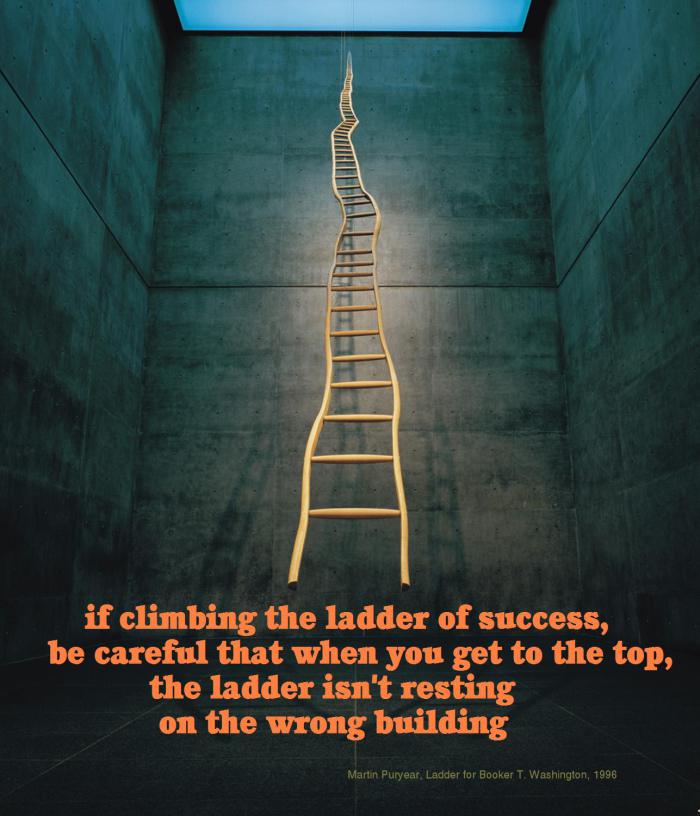
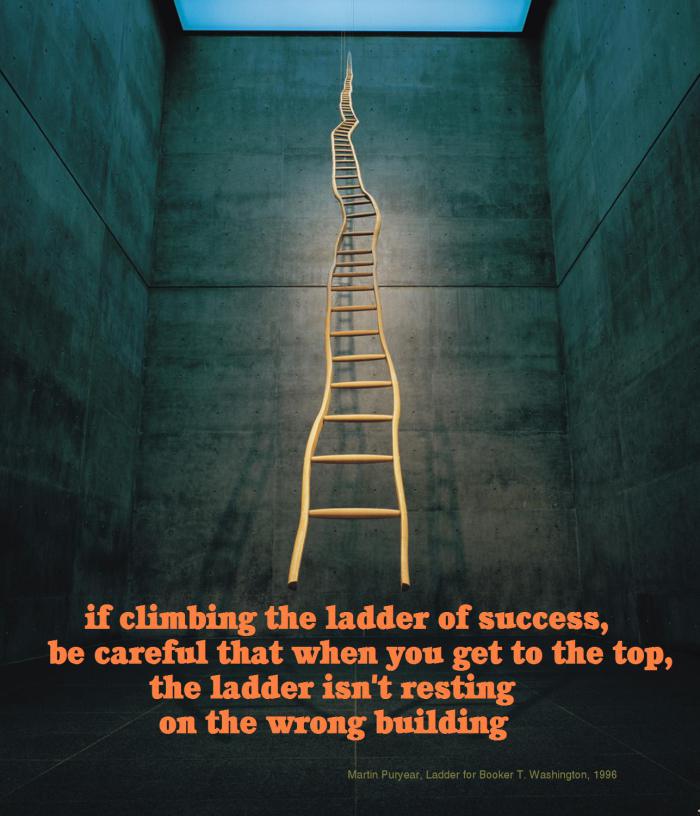
The Ladder of Success???? ~ Br. Chip Noon, Novice
POSTER_20B
How fitting that today, as the Bishop of Rome, Pope Francis, takes his leave of the richest country on earth…and in the history of the world…the second reading from today’s Mass is from James 5: 1-6:
You have lived on earth in luxury and pleasure; you have fattened your hearts for the day of slaughter.
In fact, all of this passage has at one time or another in Francis’ Papacy been addressed by him and flung out to the world as a warning and as a criticism. “It is easier for a camel to go through the eye of a needle than for someone who is rich to enter the kingdom of God.”
And the world has flocked to him – Roman Catholics and non-Catholics alike. But his message, as some think, including the young man Jesus told to sell all, is a hard one. How are we to give up all we have and still live in this world? Does Francis, like St. Francis, really mean to give away our inheritance and live in hair shirts? Are we supposed to go without shoes, even in the winter? What about when we get old, if we haven’t “saved up” how will we live?
But if we look at the first reading and at the Gospel, we see a nuanced story that is at the heart of what Jesus taught, and what Francis is proclaiming.
I think what we are seeing here is more profound than simply saying “the poor are better than the rich.” I think we are examining how Jesus viewed what we love, not what we have. In both the reading and the Gospel, the Holy Spirit is giving us the message that we are all equal, we are all children of God, and whether we are officially entitled or we are acting on our own, if what we are doing is loving God and our neighbor as ourselves, we are following the word of God…and we will enter the Kingdom.
Isn’t our life a constant sizing up? We compare ourselves with each other, with celebrities, with kings and queens – and don’t we usually find ourselves wanting? Moses asked Joshua, “Are you jealous for my sake?” And in that question, we can see the hierarchy that Joshua, and probably the whole people of the Exodus, had formed in his mind and tried to enforce: There’s Moses, then Aaron, then the 70 Elders…then maybe Joshua, then the heads of households, then the male children, etc., etc. Everyone was to know his or her place and act accordingly. And anyone who got out of line was to be censured, and of course Joshua and the other top dogs would do the censuring or meet out the punishments. The big guys vs. the little guys, or the worthy vs. the lesser beings.
Didn’t we read in Wisdom 2:11 “But let our strength be our norm of righteousness; for weakness proves itself useless.”? Again and again, God is telling us that no one is more worthy than any other. But further on in Wisdom we read: “Let us lie in wait for the righteous one, because he is annoying to us; he opposes our actions, Reproaches us for transgressions of the law and charges us with violations of our training.” This is echoed in the second reading:
You have condemned; you have murdered the righteous one;
he offers you no resistance.
And of course Jesus is the real subject here. But so also is St. Francis, and Pope Francis, both of whom have been reviled for speaking the words God has said to us in the Bible. And so have most reformers and seekers of justice for all. Reviled and condemned because they are really kicking away the ladder so many of us stand on. The higher the rung, the closer to…to what? Heaven, the giant’s castle in the clouds, the envy of our neighbors?
It’s really a simple message: there is one God and then there are the rest of us. Scrambling up the ladder of wealth and prestige will get us no closer to him.
And so should we really sign over our bank accounts and have a yard sale of all our possessions and put that money in the poor box? I suppose we should, if that would remove the beam from our eye. Still, that’s the same line of thought in reverse: the less we have, the better we are. It still precludes infatuation with hierarchy and position.
So what is the real answer? We know what it is. 1 Timothy 6:10 alludes to it. “For the love of money is the root of all evil: which while some coveted after, they have erred from the faith, and pierced themselves through with many sorrows.”
The real answer is “Love the Lord your God with all your heart and with all your soul and with all your mind and with all your strength. The second is this: Love your neighbor as yourself. There is no commandment greater than these.”
Lord, today as we contemplate these words and think on the poor and suffering, help us to remember that simply loving them and showing them the love of God is what they need most. Then, with differences of wealth and position aside, and in a spirit of your servants, we can begin to bestow what riches we may have on those who need them.
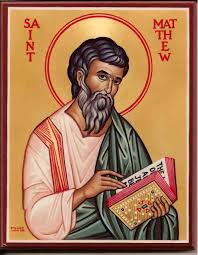
St Mathew, Apostle, Evangelist ~ The Rev. Lady Sherwood, OPI
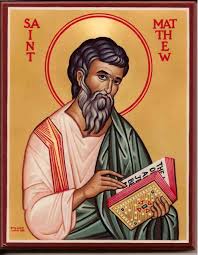
When our Lord Jesus called him to follow him, Mathew was a tax collector by profession for the Romans. His profession was hated by the devout Jews as it reminded them of their subjection and also the Pharisees saw his profession which was classed as publican, as work for the typical sinner.
St Mathew is one of the Lord Jesus’ twelve apostles and by christian tradition is also seen as one of the four Evangelists. He was the first to put down in writing as his Gospel the Lord’s teachings and the account of our Lord Jesus’ life. Mathew wrote his Gospel in Aramaic, which is the language which was spoken by Jesus himself.
No one was shunned more than a publican by the devout Jews because a publican was a Jew who worked for their enemy, the Romans and who robbed their own people making themselves large personal profits. Publicans were despised to the extent that they were not allowed to trade, eat or even to pray with other Jews.
One day when Mathew was seated at his table of books and money, Jesus looked at him and said unto him two words, “follow me”. For Mathew, these two words were all it took for him to immediately rise, leaving all his pieces of silver to follow our Lord Jesus Christ.
Mathew’s original name was ‘Levi’ which in Hebrew signified ‘Adhesion’ whilst his new name given to him by our Lord Jesus of Mathew means ‘Gift of God’.
The only other major mention of Mathew in the Gospels is regarding the dinner party for Jesus and his companions to which Mathew invited his fellow tax collectors.
The Jews showed surprise at seeing our Lord Jesus eating in the company of a publican, but Jesus explained to the Jews that he had come “not to call the just, but sinners.”
Not much else is known about the life of Mathew but according to tradition, he is reported to have preached in such places as Egypt, Ethiopia and other further Eastern areas.
Some say Mathew lived into his nineties before dying a natural death, but other Christian traditions say he died the death of a martyr.
The Gospel according to Matthew is one of the four canonical gospels, one of the three synoptic gospels, and is the first book of the New Testament. The narrative tells how Messiah, our Lord Jesus was rejected by Israel, and how he finally sends his disciples to preach his Gospel to the whole world. Most Scholars believe the Gospel of Matthew was composed between 80 and 90 CE, with the possibility of between 70110 CE. The Gospel of Matthew is a creative reinterpretation of Mark, stressing Jesus’ teachings as much as his acts, making subtle changes to reveal Jesus’ divine nature for example, Mark’s “young man” who appears at Jesus’ tomb becomes a radiant angel in the Gospel of Matthew. The Gospel of Matthew shows Jesus as the Son of God from his birth, the fulfillment of the Old Testament. The Gospel of Matthew was the favourite Gospel of St.Dominic de Guzman, who always would carry it wherever he went.
Let us pray to St Mathew to ask him to intercede on our behalf:
O Glorious St Mathew, in your Gospel you portray Jesus as the longed-for Messiah who fulfilled the prophets of the Old Covenant and as the new lawgiver who founded a church of the New Covenant. Obtain for us the grace to see Jesus living in his church and to follow his teachings in our lives on earth so that we may live forever with him in heaven. Amen.

Living the Call to Greatness – 25th Sunday of Kingdomtide ~ Br. Michael Marshall, Novice
 Wisdom 2:12, 17-20
The wicked say:
Let us beset the just one, because he is obnoxious to us;
he sets himself against our doings,
reproaches us for transgressions of the law
and charges us with violations of our training.
Let us see whether his words be true;
let us find out what will happen to him.
For if the just one be the son of God, God will defend him
and deliver him from the hand of his foes.
With revilement and torture let us put the just one to the test
that we may have proof of his gentleness
and try his patience.
Let us condemn him to a shameful death;
for according to his own words, God will take care of him.
James 3:16-4:3
Beloved:
Where jealousy and selfish ambition exist,
there is disorder and every foul practice.
But the wisdom from above is first of all pure,
then peaceable, gentle, compliant,
full of mercy and good fruits,
without inconstancy or insincerity.
And the fruit of righteousness is sown in peace
for those who cultivate peace.
Where do the wars
and where do the conflicts among you come from?
Is it not from your passions
that make war within your members?
You covet but do not possess.
You kill and envy but you cannot obtain;
you fight and wage war.
You do not possess because you do not ask.
You ask but do not receive,
because you ask wrongly, to spend it on your passions.
Mark 9:30-37
Jesus and his disciples left from there and began a journey through Galilee,
but he did not wish anyone to know about it.
He was teaching his disciples and telling them,
“The Son of Man is to be handed over to men
and they will kill him,
and three days after his death the Son of Man will rise.”
But they did not understand the saying,
and they were afraid to question him.
They came to Capernaum and, once inside the house,
he began to ask them,
“What were you arguing about on the way?”
But they remained silent.
They had been discussing among themselves on the way
who was the greatest.
Then he sat down, called the Twelve, and said to them,
“If anyone wishes to be first,
he shall be the last of all and the servant of all.”
Taking a child, he placed it in the their midst,
and putting his arms around it, he said to them,
“Whoever receives one child such as this in my name, receives me;
and whoever receives me,
receives not me but the One who sent me.”
Donald Trump… Bill Gates… They are probably the most well-known extremely wealthy people in the world. They are where they are because they worked hard and possibly made extremely risky decisions, yet both are necessarily the most popular people with some socio-economic classes of folks. Donald Trump has been thought to have trampled upon others to acquire more and more of his wealth, and his arrogance shows he is not concerned for anybody but himself. On the other hand, Bill Gates is a little different. He has taken a computer software company from infancy to becoming the only real competitor to Apple; to the point that a PC not only runs Windows but other programs are so integrated into Windows, where Microsoft essentially has a monopoly within the computer world. In light of the success of Bill Gates, he has given to charity. He has been part of community service, helping those in need. Both individuals possess success because of what they have accomplished, yet what sets them apart is what they have done with that success.
We read in the Gospel that Jesus has been listening into the conversation between his Apostles; a conversation about who is the greatest, yet Jesus does not scold them for having the conversation. He does not tell his Apostles that it is wrong to strive for greatness and success, wanting to excel. He says it is only human nature to possess those desires, but it is what they do, or how they carry out actions, that truly determine greatness. He explains that following what God has instructed is what greatness is all about. One is to make a positive difference in the world by being a witness of God’s love, to give of oneself rather than focusing on the material and stature greatness.
How many times have we dreamt about wanting a little more money, wanting a better job with distinction, thinking that we would be happier in life? It is human nature to have those thoughts, and it is not wrong or sinful to have those things. It is just what we do in life with what resources we DO have that truly brings happiness, happiness to us AND God. Is it our purpose to be like Donald Trump, to acquire more and more, and to push others around? Or should we help our neighbor in need, using part of what we have for others? God commanded us to love one another, and that living that way is where greatness lies.
So… How can we go about doing this??? Here are some examples… Volunteer to read to home-bound folks, buy lunch for the next person in line at McDonald’s, be the ear for someone who needs to talk about tough issues in their life, but even better yet, it can be a smile and a hello as you walk past someone one on the sidewalk. We are called to greatness through actions such as these!
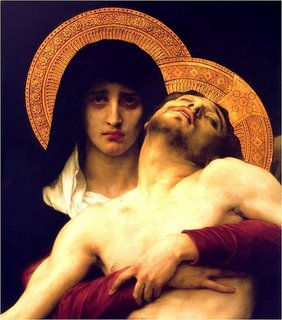
Our Lady of Sorrows ~ Br. Chip Noon, Novice
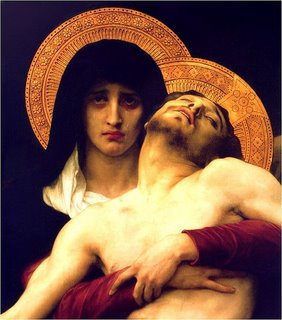
Is it nothing to you, all you that pass by? Behold, and see if there be any sorrow like unto my sorrow.
This familiar passage from Lamentations is so appropriate for today, isn’t it? Today is the Memorial of Our Lady of Sorrows. Mater Dolorosa. What a whirlwind of feelings she must have embodied! First, the loss of a child, one of the most heart-wrenching things that can happen to a parent…a child of any age.
Second, what, at the foot of the Cross, looked to be the contradiction of all that had gone before with such promise.
Third, the desertion by most of the Apostles while she and John and the women were left alone.
Our Lady of Sorrows.
But wasn’t she prepared for this? Wasn’t she told by Rabbi Simeon, as we hear in today’s Gospel,
“Behold, this child is destined
for the fall and rise of many in Israel,
and to be a sign that will be contradicted
and you yourself a sword will pierce
so that the thoughts of many hearts may be revealed.”
Artists through the ages have depicted Mary in her sorrow, some even with seven swords embedded in her representing her Seven Sorrows. And many musicians have set the sorrows to music, especially the Marian hymn:
Stabat mater dolorosa
juxta Crucem lacrimosa,
dum pendebat Filius.
At the Cross her station keeping,
stood the mournful Mother weeping,
close to her Son to the last.
Isn’t this heartbreaking?
What are we to make of this devotion to a sorrowing mother? We Christians who are invited to incomparable joy with our Lord, how are we to fall to weeping with Mary? Isn’t this its own contradiction for us?
But are we not human? Are we not allowed at times to fall into self-pity, sorrow, despair?
Then maybe that’s the value of the phenomenon of Our Lady of Sorrows. Here is a way to experience these feelings that will not bring us down into the pit, she is a safe haven for us to mourn, and to experience the catharsis of deep, deep sorrow.
We have only to read our Bible to find many cues to us that it is time to mourn: over the death of Absalom, over the Holy Innocents, over the martyrdom of John the Baptist. And we can mourn the losses in our own lives: our friends, our parents, and so sadly, yes, our child. And especially we can mourn with Mary over the torture and death of her son, our Lord.
And sorrowing with Mary, we can feel the pain in her heart and her hands and her feet and her brow as she contemplates the wounds inflicted on her son. We can let ourselves go and weep along with her, and for her, and for us and our own many sorrows.
The sorrows of everyday life that we all experience.
We can cry until our throats hurt and our body is wracked with despair.
With Mary.
And then, as we are in the midst of our lamentations, we can feel the hand of Mary. We can imagine the comfort that she can bring us. And we can see her as she intercedes for us with her son. She is our Blessed Mother and we can surrender ourselves to her comfort just as we used to with our own mothers.
Because that is the message we were given, and that we hope to give to others. As George Fox heard, “There is one, even Christ Jesus, that can speak to thy condition.” And as John says in his Gospel, “Peace I leave with you, my peace I give to you; not as the world gives do I give to you. Let not your heart be troubled, neither let it be afraid.”
Wasn’t Mary joyful as she heard these words from her risen son? Didn’t all her sorrow come to fruition with the Resurrection and Ascension?
So it can be with us, today and all our days. We can remember Mary’s sorrow and we can rest comforted. We can remember our own sorrow and we can go out and comfort others. Because we have Jesus and Mary as pure examples of how sorrow can and will turn to joy when we open our hearts to God and his promises.
Father, as you comforted Mary and your Son, comfort us as we go through the world. Help us to sustain others in their sorrow and help us to bring the light of gladness to all we meet today and into the future. In Jesus’ name, Amen.
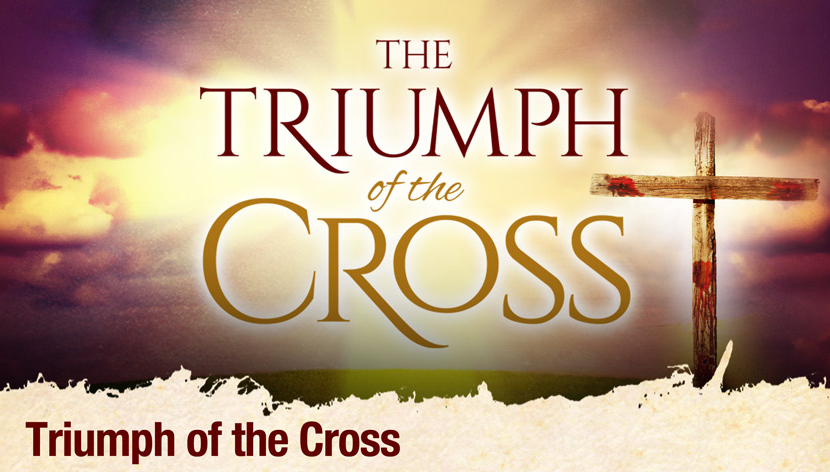
The Triumph of the Cross ~ The Rev. Deacon Joshua Hatten, OPI
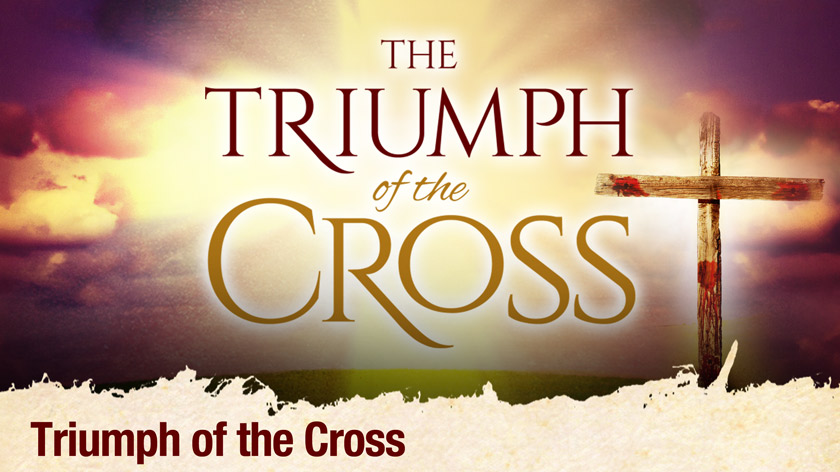
Today the celebrates the Feast of the Triumph of the Cross. Now, some of you may be asking what in the world is triumphant about an instrument of torture and death and WHY are we celebrating it?
What we celebrate today is the triumph of eternal life over death, infinite love over overwhelming evil. The VICTORY of our Lord, through humility, over the arrogance of Satan.
It seems so easy for us to make small sacrifices in small areas of our lives. We give up that candy bar, coffee, or profanity for the 40 days of Lent. We need to drop five pounds, so we don’t “biggie size” our burger and fries for a few weeks. We really want to see that particular movie next weekend, so we save up this week. But what about the bigger picture??
We do seem to have trouble, usually, of making, in the much more important and far greater purpose of our earthly existence… which is where we wind up AFTER it ends. The answer to WHERE we wind up AFTER starts in our here and now – in our daily life – in how we fight or give in to those daily spiritual battles. What our response, here and now, to the occasions of sin, innumerable temptations and other potential woes that are laid before us OFTEN, daily.
Do we value the things of the world over the values of God’s Kingdom? What aspects and pieces of our lives are we willing to nail to the cross, as often as is necessary, and let die so that we may live with victory? Are we willing to put on the humility, as our Lord did, to make us capable of bearing, overcoming and triumphing over these earthly parts of our lives to bring ourselves, through our faith in Christ Jesus, to life everlasting?
It all begins with the first step of KNOWING that we cannot do it of our own accord. WE MUST HUMBLE OURSELVES before ALMIGHTY GOD, assured that alone we are doomed to failure, and ask for his saving grace and guidance and Fatherly Love. It is only after taking this step, WITH FAITH, that we can even find ourselves on the beginning of the right path. It is a choice, and I encourage all of us to begin TODAY, EVERYDAY, AS OFTEN AS IS NECESSARY, to examine our spiritual states and take the hammer and nails to anything separating us from living life as a true disciple of Christ.
Is it easy? NO!! Is it worth it?? YES; the rewards are far beyond what we can begin to comprehend. We must be humble enough to trust God to be God and KNOW that His promises and assurances of recompense for living for him will not and cannot return void.
Let’s face it… none of us are getting out of this earth alive. Our days will end will a last breath or the return of our Blessed Lord, Jesus Christ. Either way, shall we be judged and rewarded as victors and receive a crown of eternal glory, or will we continue to live our here and now, falling into Satan’s snares, and have our days in this world end with eternal separation from God Almighty??
CHOOSE, HERE and NOW… take up your crosses and CARRY THEM TO VICTORY, to a TRIUMPHANT FINISH, through a humble way of living for and in GOD. Only this, through faith in our Blessed Lord, can we turn our woes into WOWS and our death into an eternal existence of heavenly happiness.
 The Order of Preachers, Independent
You must be logged in to post a comment.