
Category: Sermon
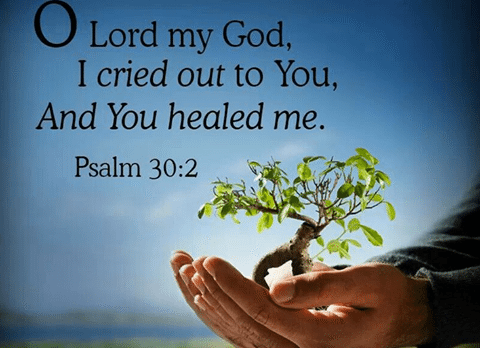
Jesus: The Medicine of God ~ The Rev. Frank Bellino

Jesus was guided by the Spirit into the wilderness and tested by the devil for forty days. During this time Jesus proved his love for his Father was stronger than everything else. Our love for Jesus leads us to want to draw closer to Jesus during Lent and overcome anything in our lives from the devil that keeps us apart from Jesus. Jesus in the desert is our model during Lent. If Jesus had given in to any temptation of the devil, he would have wrecked his Father’s plans. When we succumb to temptation, we wreck God’s plans for us. Sin separates us from what God intends for us. Sin separates us from God. It has been like that since Adam and Eve committed the first sin in the garden. Because of that sin Adam and Eve were kicked out of the garden. Sin separates us from Jesus. But our love for Jesus impels us to want to overcome sin during Lent so that we will not be separated from Jesus. Our love for Jesus impels us to take Lent seriously so that at the end of Lent we will be closer to Jesus. Do you love Jesus enough to fix whatever in your life is separating you from Jesus? Lent is the time to do it. Do we love Jesus enough to take Lent seriously so that at the end of Lent we can say we gave up this sin or overcame that sinful inclination so that we could be closer Jesus? Do we love Jesus enough so that when we celebrate the resurrection of Jesus at the end of Lent, we can also celebrate Jesus’ new life in us because we overcame sin during Lent? Do we love Jesus more than anything keeping us from Jesus? Lent is the time to draw closer to Jesus.
When we are ill, we go to the doctor and the doctor will give us medication. If we take medicine, we hope to get better. For centuries the Church has recommended medicine during Lent to help us get better, to bring us closer to Jesus and help us overcome sin. That medicine is the three things we heard in the Gospel on Ash Wednesday (Matt 6:1-6, 16-18); prayer, fasting and almsgiving. These are a remedy to help cure our soul. This remedy is the wisdom of centuries of experience; the experience of centuries of holy people who drew closer to God during Lent with the remedy of prayer, fasting and almsgiving. Not only is this remedy the wisdom of centuries of experience of holy people, it is the teaching of Jesus. As we heard in the Gospel on Ash Wednesday it is Jesus who taught us about prayer, who taught us the value of fasting, who taught us the value of almsgiving. Why would someone question what Jesus taught us and say there is a better way during Lent? Jesus in the desert is our model during Lent. Our love for Jesus leads us to want to draw closer to Jesus during Lent and overcome anything in our lives from the devil that keeps us apart from Jesus. We can do this through prayer, fasting and almsgiving.
We could say that the three Scripture quotations in today’s Gospel (Luke 4:1-13) that Jesus used to rebuke the devil when tempted in the desert are about prayer, fasting and almsgiving.
You shall worship the Lord, your God, and him alone shall you serve (Luke 4:8, see Deut 6:13) was Jesus teaching us to put God first in prayer and worship.
Man does not live by bread alone (Luke 4:4, see Deut 8:3) was Jesus reminding that fasting shows God is more important to us than any earthly thing we want.
You shall not put the Lord, your God to the test (Luke 4:12, see Deut 6:16) was Jesus reminding us not to test God by expecting God to intervene to look after those in need but instead to help them ourselves.
To pray we need quiet time. We cannot pray if the TV is turned on, or there are other distractions around us. We often read in the Gospels that Jesus went up into the mountains to pray (Matt 14:23; Mark 6:46; Luke 6:12; 9:28). It was quiet up there. If Jesus needed quiet for prayer, how much more do we need quiet for prayer? Can we find quiet time every day to spend with Jesus and Our Lady? We read that Elijah hid in a cave, and a windstorm went by, but God was not in the windstorm, there was an earthquake, but God was not in the earthquake, there was a fire, but God was not in the fire. Finally, a gentle breeze went by, and Elijah knew God was in the gentle breeze (1 Kings 19:11-13). To find God is to find a place of peace. A Church or Adoration Chapel is an obvious place but can we also as a family pray together for a significant length of time at least once day? The Rosary is a wonderful prayer for use together as a family.
Jesus was asked why his disciples did not fast while the Pharisees and the disciples of John the Baptist fasted. Jesus replied that the while the bridegroom was with them it was not the time to fast but when the bridegroom would be taken away then it would be time for them to fast (Matt 9:14-15; Mark 2:18-20; Luke 5:33-35). Now is that time. We can fast from TV for a time and that will give us more time for prayer so then we should be fasting and praying together. We could also fast from the internet for a time so spend more time with family. Above all of course Lent is all about giving up sin. All the fasting of Lent is to provide us with greater strength to fast from sin. Fasting is for Jesus.
Almsgiving is a demonstration of our love of God and love of others. When we love God, we love others in their need and give to them from our surplus because they are also children of God. That is why we begin the Lord’s Prayer saying, “Our Father…” because we are all children of one Father in heaven. Once when talking to the Pharisees when they were concerned about externals Jesus said that if they gave alms then they would be clean (Luke 11:41). On another occasion Jesus said that giving alms earns you a purse that never grows old and treasure in heaven (Luke 12:33). Jesus taught the parable about the rich man and Lazarus (Luke 16:19-31). Rich person did not even give the scraps to the poor man. But when they died the poor man was in heaven the rich man in agony.
We could say that the three Scripture quotations in today’s Gospel that Jesus used to rebuke the devil when tempted in the desert are about prayer, fasting and almsgiving.
You shall worship the Lord, your God, and him alone shall you serve (Luke 4:8, see Deut 6:13) was Jesus teaching us to put God first in prayer and worship.
Man does not live by bread alone (Luke 4:4, see Deut 8:3) was Jesus reminding that fasting shows God is more important to us than any earthly thing we want.
You shall not put the Lord, your God to the test (Luke 4:12, see Deut 6:16) was Jesus reminding us not to test God by expecting God to intervene to look after those in need but instead to help them ourselves.
When we’re ill, we go to the doctor and the doctor gives us medication. If we take medicine, we hope to get better. For centuries the Church has recommended medicine during Lent to help us get better. That medicine is prayer, fasting and almsgiving.
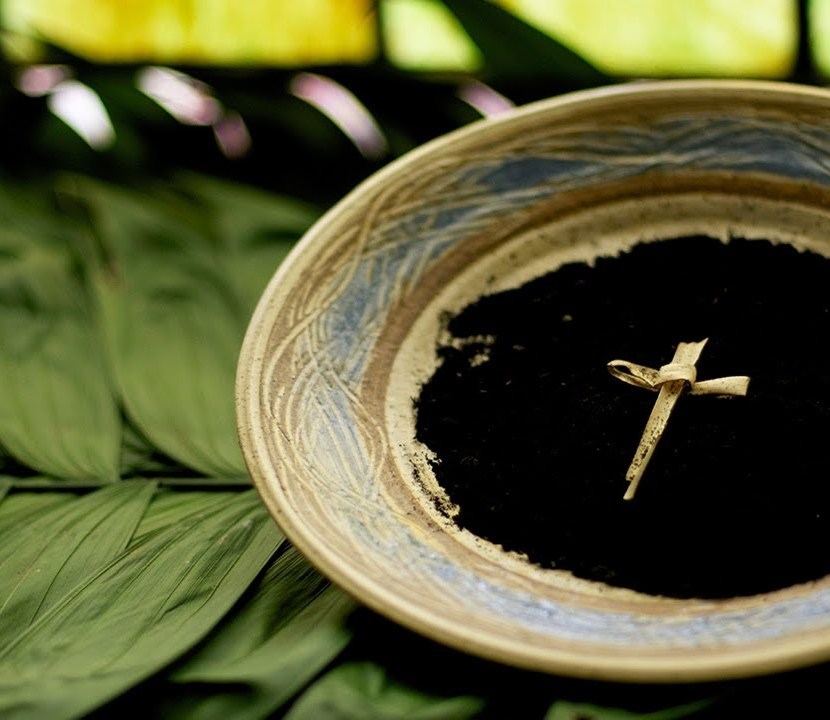
Fasting and Gratitude ~ The Rev. Frank Bellino
There is a Jewish folktale Fr. Ron Rolheiser, theologian and spiritual writer, shares in his book Against an Infinite Horizon.
It begins…
“There once was a young man who aspired to great holiness. After some time at working to achieve it, he went to see his rabbi.
‘Rabbi,’ he announced, ‘I think I have achieved sanctity.’
‘Why do you think that?’ asked the rabbi.
‘Well,’ responded the young man, ‘I’ve been practicing virtue and discipline for some time now and I have grown proficient at them. From the time the sun rises until it sets, I take no food or water. All day long, I do all kinds of hard work for others and never expect to be thanked. If I have temptations of the flesh, I roll in the snow or in thorn bushes until they go away, and then at night, before bed, I practice the ancient monastic discipline and administer lashes to my bare back. I have disciplined myself so as to become holy.’
The rabbi was silent for a time. Then he took the young man by the arm and led him to a window and pointed to an old horse which was just being led away by its master. ‘I have been observing that horse for some time,’ the rabbi said, ‘and I’ve noticed that it doesn’t get fed or watered from morning to night. All day long it has to do work for people, and it never gets thanked. I often see it rolling around in snow or in bushes, as horses are prone to do, and often I see it get whipped. But I ask you: Is that a saint or a horse?’”
Fr. Rolheiser comments, “This is a good parable because it shows how simplistic it is to simply identify sanctity and virtue with self-renunciation and the capacity to do what is difficult. In popular thought there is a common spiritual equation: saint = horse; what is more difficult is always better. But that can be wrong. To be a saint is to be motivated by gratitude, nothing more and nothing less”
Let me emphasize Fr. Rolheiser’s point here again, to be a saint is to be motivated by gratitude, nothing more and nothing less.
Jesus cautions his disciples to notice our attitudes and motivations when it comes to our Lenten practices. Jesus says, “Take care not to perform righteous deeds in order that people may see them; otherwise, you will have no recompense from your heavenly Father. When you give alms, do not blow a trumpet before you, as the hypocrites do to win the praise of others. Amen, I say to you, they have received their reward.”
St. Michael’s Family, why do we fast on Ash Wednesday and Good Friday? Why do we give up meat on Fridays? What is so important that we obey the Lenten practices? We do these easy rituals meant to make us reflect and shake us out of our everyday way of doing things, to take time and consider how grateful we are to God from whom the formidable gift of life comes, and to take time to deliberately care about others, specifically the less fortunate.
Family, on this day, Ash Wednesday we are called from the everyday, to be aware of the blessedness of the human lives around us, and to be a more thankful people, a people who do not take our life or the lives of others around us for granted.
During Lent, it is our duty to pray, fast and to perform acts of personal sacrifice to bring us into this new realization. Lent can be an opportunity to start our New Year’s resolution again. This can be a time to spend five minutes or more in prayer, perhaps with scripture or the rosary, if you only start with one Decade. Read and do the Lenten study and activities we have started. Lent can be time to aid the homeless or giving at a charity. Lent can be a time to make the effort to take part in some of our special devotions like the Stations of the Cross (Good Friday). There are as many ways to enter into Lent as there are baptized Christians.
We are called to complete spiritual exercises, not because we are horses. We do it because of our love for God, and because we are human. At times we humans need to be agitated from the ordinary, to be reminded that our time here is short, that “we are dust and to dust we will return”. We sometimes forget this great gift, life, can you imagine a world without you! I know the family here can’t.
We have so valuable little time to do our part for God, to give back just a meniscal of what He has given us. Ash Wednesday reminds us of our mortality, that time is fleeting, to shake us out of complacency and get to work on God’s Kingdom. We are all invited to accept St. Francis’ invitation to preach the Gospel at all times, if necessary, use words.

Judge Who??? ~ The Very Rev. Lady Sherwood, OPI

Reading I: Sir 27:4-7
Responsorial Psalm: Ps 92:2-3, 13-14, 15-16
Reading II: 1 Cor 15:54-58
Alleluia: Phil 2:15d, 16a
Gospel: Lk 6:39-45
My dearest brothers and sisters in Christ:
First, let’s take a look at our Gospel reading for Today of Lk 6:39-45 (NIV):
39 He also told them this parable: “Can the blind lead the blind? Will they not both fall into a pit? 40 The student is not above the teacher, but everyone who is fully trained will be like their teacher.
41 “Why do you look at the speck of sawdust in your brother’s eye and pay no attention to the plank in your own eye? 42 How can you say to your brother, ‘Brother, let me take the speck out of your eye,’ when you yourself fail to see the plank in your own eye? You hypocrite, first take the plank out of your eye, and then you will see clearly to remove the speck from your brother’s eye.
A Tree and Its Fruit
43 “No good tree bears bad fruit, nor does a bad tree bear good fruit. 44 Each tree is recognized by its own fruit. People do not pick figs from thornbushes, or grapes from briers. 45 A good man brings good things out of the good stored up in his heart, and an evil man brings evil things out of the evil stored up in his heart. For the mouth speaks what the heart is full of.
So what is this telling us and what can we learn from the Lord’s teaching of the Gospel today?
Each and every one of us at some point in our lives become prone to excuse our own faults and magnify the faults of others and to put our judgement upon them. You know how it goes: It could be things such as: “I’m quiet, you’re unassertive; he’s a wimp.” “I’m concerned; you’re curious; he or she is nosy.” “I’m thrifty; you’re a bit tight; that person is cheap.” “I drive with the flow of traffic; you go over the speed limit; that person is very reckless.”
Jesus knows our common propensity to justify ourselves and to blame others. As He concluded the section of His sermon dealing with the requirement of loving even our enemies, He knew that we would try to dodge its demands by judging our enemies and by excusing ourselves. So He gives a strong corrective by showing how we should focus on showing mercy, not judgement, even toward those who have wronged us (6:36-38). Then, to help us apply it, Jesus goes on to show that we must focus on judging our own sins or we will be like the blind trying to lead the blind (6:39-40). Only when we have judged our own sins can we then see clearly to help another person with their sins (6:41-42). In fact, we must judge ourselves down to the heart level, because only a good heart can produce good fruit (6:42-43). Thus Jesus is teaching us that …
To love as we ought to be doing, we should focus on showing mercy toward others but (also) on judging our own sins.
Let us pray:
Almighty God, sometimes we struggle with anger and with judgement. We see things and want to get revenge or we wish others to be punished for wrongdoing. We pray that you fill our hearts with compassion and forgiveness. Help us not to condemn but seek first to forgive others. Help us not to judge, but to serve. Amen.

Love Your Enemies ~ Milan Komadina, Novice

Who are our enemies? Do we have them? How should we behave toward our enemies? In today`s reading we remember how Jesus instructed us to love our enemies and not to judge others. This is a very difficult instruction to obey. We live in the world that is full of injustice. Many times when we try to be good and to do all the right things we experience by many other people inconveniences of various kind. At our workplace we might have an unfriendly boss, a jealous colleague or being surrounded with people who are discriminative against us. People who might not love us for no reason. People who mind our religion, or our sexual orientation, or our freedom, or some physical characteristics. They might behave very unfriendly. We all experienced having enemies at all levels. Since childhood, in the school, at the college or later on a workplace. One difficult thing to do as a Christian is to love your enemies. This can be very difficult if a person do something which is really evil to us. If you are a child who is bullied at school by your peer school mate, how could you love him? If you work somewhere and your colleague is irrespective, arrogant, talking negatively about you to other colleagues. How could you love him? Or if your neighbor has secretly broken your window just because you are different skin color, sexual orientation, a member of different religion, different nation and you feel hated and discriminated against, how can you love that person?
Have you ever wondered how could we really love our enemies? When Jesus said – love your enemies it was so easy for him to say. But in real life it seems to be much easier if he told us to do anything else like – ignore your enemies, curse your enemies or punish your enemies and revenge. Since this is not easy let`s see what the Bible says,
Lk 6:27-38:
“But to you who are listening I say: Love your enemies, do good to those who hate you,bless those who curse you, pray for those who mistreat you.If someone slaps you on one cheek, turn to them the other also. If someone takes your coat, do not withhold your shirt from them.Give to everyone who asks you, and if anyone takes what belongs to you, do not demand it back.Do to others as you would have them do to you.
“If you love those who love you, what credit is that to you? Even sinners love those who love them. And if you do good to those who are good to you, what credit is that to you? Even sinners do that.And if you lend to those from whom you expect repayment, what credit is that to you? Even sinners lend to sinners, expecting to be repaid in full.But love your enemies, do good to them, and lend to them without expecting to get anything back. Then your reward will be great, and you will be children of the Most High, because he is kind to the ungrateful and wicked.Be merciful, just as your Father is merciful.
“Do not judge, and you will not be judged. Do not condemn, and you will not be condemned. Forgive, and you will be forgiven.Give, and it will be given to you. A good measure, pressed down, shaken together and running over, will be poured into your lap. For with the measure you use, it will be measured to you.”
In the first part of this sermon we defined that we can have our enemies everywhere. In our neighborhood, at school, at work, and other places. We remembered that many people could be very unfriendly to us and do bad things to us. And we were wondering how we could love our enemies. We all know that this is really hard. And we should admit that. In my own experience being Christian is not easy because our nature is evil. We naturally want to revenge, we cannot simply love our enemies. And Jesus knew that. This is why He gave us an explanation on why should we love our enemies. And here in Jesus` words we might find the deeper meaning and the sense of why it is good and how we could successfully manage to love people who would we naturally hate. Take a look at those few sentences:
- Do to others as you would have them do to you…
- Then your reward will be great…
- Forgive, and you will be forgiven…
Does this makes sense to you now?
Loving our enemies is exactly what God has to do with us on the first place. Since the sin that we naturally do as being part of sinful nature makes us His enemies. He would naturally hate us, revenge to us and do bad to us because naturally we do things against God`s will on daily level. Consciously and unconsciously we sin. And our sin makes us God`s enemies. If we meditate on those tree sentences. First do to others as you would have them do to you. It moves to focus not to our enemies but to us. It shows us that it is good not for our enemies, but it is good for us when we love our enemies. Now there is even more sense in the next sentence when Jesus promises `your reward will be great`. It all makes sense now, right? We are not just fools who love our enemies that are treating us badly knowing that they will be treating us that way to eternity. We love them because we know that God is to revenge, not we. We forgive them because we know that God is to forgive and to them and to us. Next God promises `Forgive and you will be forgiven`. I remember the book that I read almost 15 years ago. The book was written by a Christian monk from the Holy Mount Atos in Greece. His name was Paisios. In his interview about loving enemies he said some things that were very useful for me and even today after 15 years I often remember his words. He said that everything happens with some reason. And even if God allows some enemies to come in our life that could also be happening with a reason. Sometimes it is not good for us something that we do, something that we want or that we are focus to and God let`s our enemies to damage our own plans. At the moment when that happens we are angry, we are furious and we want those enemies to be removed from our life. But Paisios advises us to wait and see what God will do. And always after some time in the future you will see and you will understand why God let those people in your life. As in the school. A child needs to have many lessons. Some lessons are interesting, super fun and very creative. Others seem to be boring, unpleasant, even not useful. A child would rather escape from those classes. But, all lessons are part of educational program. This is the same in our life. We meet people who we love and who love us, and we also meet people who behave as our enemies and people who do not love us. But they are all a part of our life experience. We could always learn something good through this experience. And let us wait to see what God will do. In the past when I was 20, 25 or 30 years old, loving my own enemies was a very unrealistic task. After I gained some life experience, now after my 35th birthday when I sit alone, think, and analyze many situations that I had in my life with my enemies. I can see that God was always there to intervene. I can see good things in things that looked very bad to me at that time. Those were all lessons. In the end, I don`t want to sound like a very wise super easy-to-do Christian. The truth is it is not easy. The truth is it is difficult. The truth is loving our enemies is something that we must learn through practice. But the truth is also that there is sense in doing so. We will be rewarded, we will be forgiven and God will deal with it. Whatever it is. Just wait for the God, and just leave it to God. As Greek monk Paisios advised.

God Made Me, Knows Me, Loves Me ~ Milan Komadina, Novice

In today’s reading from the Bible we read about the Lord’s Call of Jeremiah (Jer 1:4-5):
”The word of the Lord came to me, saying, `Before I formed you in the womb I knew you, before you were born I set you apart, I appointed you as a prophet to the nations`”.
While these words from the Bible were addressed to the prophet Jeremiah, we can also learn something very important for all people in what was written here. Lord said that he formed Jeremiah in the womb and he knew him before he was born. This is how great is our God, we can apply this to every one of us and to the all creatures. God is the one who set us all apart, He is the one who formed all of us in the womb. Sometimes among our Christian sisters and brothers it seems that we want to hide some natural characteristics. For example being born as an LGBT+ person. As medical science knows this is a natural personal characteristic that people do not choose. Like the eye color, the body constitution, hair color, etc. A sentence from the Bible which we previously mentioned teaches us that God is the one who creates people in their mothers’ wombs. God knew if we would have blue or green eyes, or black or brown hair before we were born. The same way he knew what our sexual orientation would be and our personal characteristics. It is really sad that we live in the era of discriminative Christianity when many churches push people to change, hide or feel bad about their natural God-given sexual orientation. As a result many young people, but also some older people face problems because they have Jesus in their hearts but they feel denied by their local church. In this sermon I am inspired to share a spiritual hug in Christ to all those Christians all around the world who are victims of any kind of discrimination. For being LGBT+ or for being women or for being in the situation when facing discrimination because they do not physically appear religious enough for the local churches to be accepted. This has nothing to do with Our Lord. What the Bible teaches is that The Lord knows exactly who we are, how he formed us in our mom’s womb and he does not want us to be changed because He is the one who created us just the way we are. Whenever you feel discrimination or any kind of unacceptance know that God loves you. God never discriminates and He loves you. I would also like to mention that it is very important not to judge those churches who are discriminative. Many people there might not be aware that what they do is not christian. Many people are also victims of false discriminative doctrine. This is just to understand and not to judge. For all of us it is good to remember that the love is the only sign of having Christ. The only miracle that will last forever. As it is written in 1 Cor 13. Let us read 1 Cor 13:4-13:
Love is patient, love is kind. It does not envy, it does not boast, it is not proud.It does not dishonor others, it is not self-seeking, it is not easily angered, it keeps no record of wrongs. Love does not delight in evil but rejoices with the truth.It always protects, always trusts, always hopes, always perseveres.Love never fails. But where there are prophecies, they will cease; where there are tongues, they will be stilled; where there is knowledge, it will pass away. For we know in part and we prophesy in part, but when completeness comes, what is in part disappears. When I was a child, I talked like a child, I thought like a child, I reasoned like a child. When I became a man, I put the ways of childhood behind me.For now we see only a reflection as in a mirror; then we shall see face to face. Now I know in part; then I shall know fully, even as I am fully known. And now these three remain: faith, hope and love. But the greatest of these is love.
This chapter is read in the weddings or life partnership blessings. This can be considered as one of the most important lessons from the Bible. The lesson about love. As we read in the end of this chapter the greatest is love, then faith and hope. In the modern era where we live how can we know if there is Jesus in Christians? The indicator is – the love. Being real Christian without love is impossible because God is love. Our faith is all about love. If we physically appear to be super religious, wearing huge cross, holding holy books wherever we go, reading Bible all day etc. but if we do not have enough love for our neighbors, this cannot satisfy God. Being religious is helpful. But it must include love. If we judge other people, if we discriminate or if we think that we are superior toward others – then we should really think if the Christ is really present in our hearts. We should always keep on our mind that there are two biggest commandments and they are both about love. The first one – Love God and the second one – Love people. And that’s a short summary of what means being Christian.
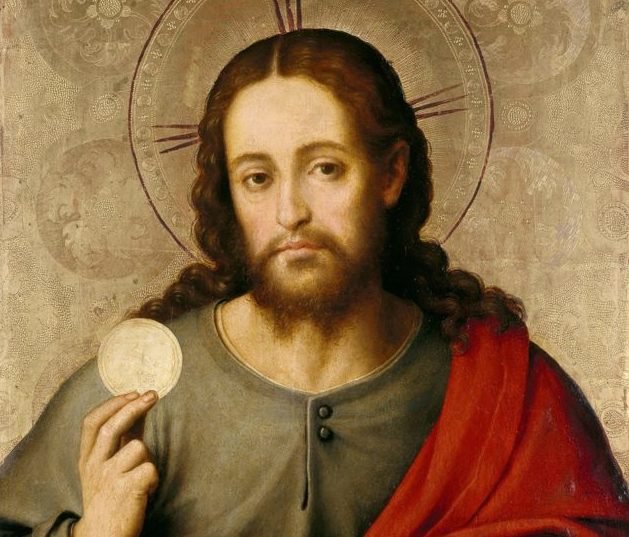
Coming to Mass, Coming to Christ ~ The Rev. Frank Bellino
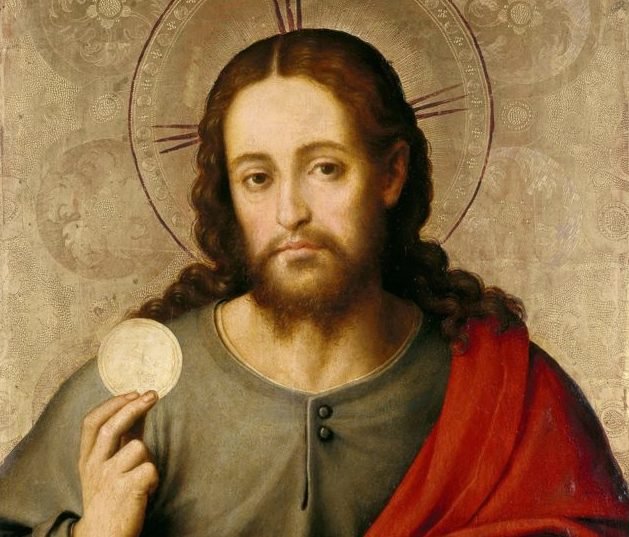
The leader of every celebration of the Mass is Jesus Christ Himself. He is the fundamental agent of the Eucharist. He is the High Priest of the New Covenant. It is He Himself who officiates invisibly over every Eucharistic celebration. It is in standing for Him that the bishop or priest presides over the congregation. It is in standing for Him that they preach after the readings. It is in standing for Him that they receive the offerings and recite the Eucharistic Prayer. The bishop or the priest act in the person of Christ! They act in the person of Christ during the Mass — the Liturgy of the Word and the Liturgy of the Eucharist (cf. CCC 1348).
During Mass, the Liturgy of the Word covers all the readings, the homily, the Creed, and the Prayers of the Faithful or General Intercessions. The Liturgy of the Word is an important part of sacramental celebrations. To encourage the faith of believers, the signs which go with the Word of God are emphasized. We sing Alleluia, we have the procession of the Book of the Gospels before its proclamation; and this emphasizes its importance and veneration. Even from where it’s proclaimed, the ambo also emphasizes that the Word of God is being decreed. The clear and intelligible reading, homily, and the responses of the people are more signs which go with the Word of God being highlighted (cf. CCC 1154).
The Liturgy of the Word during Mass is in our history all the way back to the time of Ezra. We heard from the Book of Nehemiah in the First Reading the description of what Ezra, the priest, did in the synagogue. It’s very similar to what we do at Mass, today. Ezra was standing at one end and standing higher up; that’s what the priest or deacon does: from the Ambo. As Ezra opened the scroll, the people rose; that’s what happened at the Gospel during the Mass, the people stand to listen the Gospel proclaimed. Then Ezra interpreted the reading for the people; and that’s what the priest or deacon or bishop does after the proclamation of the Gospel, he gives the homily.
Every time we read the Old Testament, try to keep in mind Jesus Christ because everything recorded in the Old Testament leads us to Jesus Christ. He is the completion of all prophecies in the Old Testament. Ezra, too, anticipates Jesus Christ, the Eternal High Priest, which we heard in the Gospel today. Jesus was handed the scroll of Isaiah to read and then He gave his “homily” by saying: Today, this passage is fulfilled in your hearing. Again, the Liturgy of the Word goes back all the way to Ezra’s and Our Lord’s time. The people were attentive in hearing the readings being interpreted by Ezra and by Our Lord.
So, the Liturgy of the Word is like a form of a conversation. God speaks to us through the readings and the homily; and we respond to Him by our profession of faith and interceding on behalf of the Church as His family.
Mother Angelica gives us her guidance on how to listen to sermons. She said: “Don’t shut off the Word, because you’re going to miss a lot of graces in your life. Don’t say, ‘I’ve heard all of this before.’ Listen to what the Spirit wants to say to you right now… Now, maybe you don’t like his interpretation. Fine. You don’t have to like it. There are a lot of speakers that I don’t like. But there have been times where the worst speaker will say something that hits me like a rock. So please don’t sit there with a Christian Science grin. Wake up and listen. Really listen! There is no sermon that you cannot get something out of. I don’t care who gives it. It’s not what they are saying. It’s the Word! You need to ask only one question when that homily begins: ‘What is Jesus going to say to me today?’”
For us, priests, preaching is undeniably an important office we’ve been given to deliver faithfully. We are being shaped through the preaching of the word of God. This is when we decide to leave sin behind during the preaching of the word of God. This is when we transform during the preaching of the word. It is during the preaching of the word that we decide to embrace the life of the Gospel and abandon the worldly life. It is during the preaching of the word that we decide to try for virtue and stop vices. So, know this anytime a Bishop, Priest or Deacon prepares and gives a homily he is talking to himself also, we are far from perfect.
St. Dominic also placed great emphasis on study. A preacher needed to be educated to know what he was talking about before he got into the pulpit. This is the origin of one of the 4 Pillars of the Dominican charism
I want to conclude with a discernment of St. John Marie Vianney, the patron of all priests, about preaching. Through his words, he speaks to us, priests, and to the rest of the People of God. First, he calls us, priests, to model after the good thief on the cross; and then, he speaks to the lay faithful.
Be like ministers who offer Jesus Christ to God his Father and make him the sacrifice of all they are and take as a good model the good thief on the cross. What an evolution he makes during the three hours that he finds himself in the company of his dying Savior! First, he opens the eyes of his soul to recognize his deliverer; then, fastened to the cross, and having nothing that still is free but his heart and tongue, he offers both to Jesus Christ. He consecrates his heart to him by faith and hope, and humbly asks of him a place in paradise; and he consecrates his tongue to him by proclaiming his innocence and holiness: “And we indeed justly; for we are receiving the due reward of our deeds; but this man has done nothing wrong. (Luke 23:41) …
My children, you listen when you like the preacher; but if the preacher does not suit you, you turn him into ridicule… We must not think so much about the man. It is not the body that we must deal with. No matter what you think of the person giving the homily, if he is a true person of God there is going to be a message. You may like the delivery of one over another but let me ask you this Duracell or Eveready they both will light up the same candle?
Bottom Line is be prepared for Mass! There is no chewing gum during Mass! Sit up, listen! When we come to Mass, we come to Christ. Let us ask Mother Mary, as Deacon said last week, to help us always prepare for the Mass. Let us ask Her every time we attend Mass, so we can do it with love and devotion. Ask our Holy Mother to bring us to her son, with the desire to know him, with a clear head and open heart.
Feast of the Holy Family…and us ~ Milan Komadina, Novice

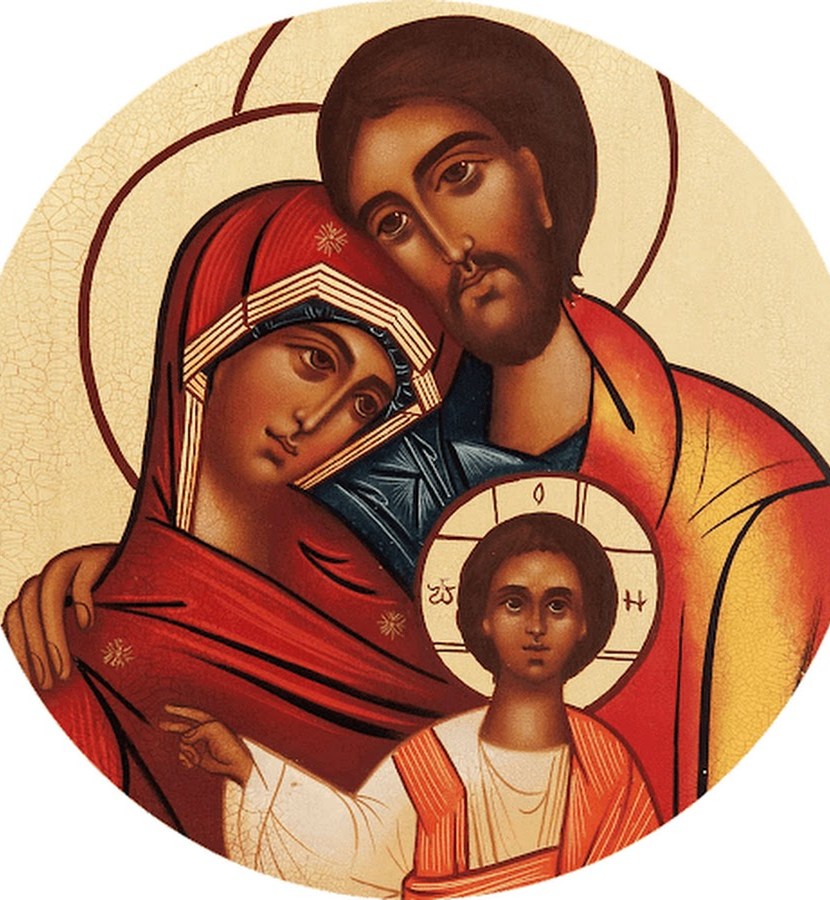
Yesterday we celebrated Christmas. In many churches worldwide in this Christmas season we can see pictures or icons of the holy family of Jesus. In catholic and some traditional protestant churches we can also see some Christmas pictures but mostly we can see the statues of Mary, Joseph and a baby Jesus. In some protestant denominations where icons or statues are not popular people usually imagine this holy family while reading the Bible story of the Jesus` birthday. What is very beautiful about this holiday is that ALL Christians regardless of their denomination are celebrating Jesus` birthday. Even people who are not religious traditionally celebrate this holiday by giving gifts, decorating their houses, preparing delicious food and enjoy gathering with their family members.
And here we come to this very sacred word – Family. This is the topic of today`s sermon and there are many things that we should learn about the importance of the family. This is the first lesson that Jesus taught the world, even though he was just a new-born baby not even knowing His mother tongue. Yet His birth is a big lesson to all people. He was born in a byre surrounded with animals and hay. He was not born in a luxurious palace even though He is a King of Heaven. His place of the birth teaches us that material treasure is not the most important thing in this world. As we read in the Bible he got gifts from wise men: gold, myrrh and incense.
Those three gifts have their meaning. Biblical scholars tell us that gold represented value, dignity, authority and everlasting kingship. It is a gift for a king (or a queen of course). Today, many of us yearn for a greater sense of value, dignity and authority in our own lives. Myrrh was an anointing oil used as gifts to kings in the Eastern cultures. The anointing of oil was an act that symbolized holiness. Holy in Hebrew means “set apart and different from all others.” In the Hebrew culture it began as a practice for priests, but was later accepted for prophets and kings. And incense. For the Jews, incense was to be a symbol of prayer, as David says, “May my prayer be set before you like incense” (Psalm 141:2). Incense is still used by priests within the Eastern Orthodox Church.
In the modern time that we live, I believe that it is still important to give the definition of what the family is because some people like to use this term to discriminate certain groups of other people. The traditional family is certainly the family of straight couple and their one or more children. Jesus` family was an example of the family that only looked as a traditional one but he was actually adopted son of Joseph, since we know that Joseph was not biological father of Jesus. So the families are also those families with adopted children. The family can be a family of same-sex partners and their adopted child. Or even if some couple cannot or do not want to have their biological child, they are still family. The family is about love not gender, biological characteristics or sexual orientation. But what I believe is one Family that is also important or the most important to all of us is the Family called The Church. Since all of us believe that we have our one heavenly father, God we believe that we are all children of God. And this is a very special blessing and a gift. We call each other brothers and sisters and this is a symbol that in a spiritual sense we are brothers and sisters. The importance of Our Heavenly Family is emphasized by Jesus when he was twelve in one interesting story from the Bible from Luke 2, 41-52 when Jesus went to Jerusalem at the feast of the Passover. He stayed in the town even though His parents had been going back home. They literally lost Jesus. But after three days they had finally found Him in the temple when Jesus replied to his step-father and mom: ”Did you not know that I must be in my Father`s house?”. This doesn`t mean that if our parents are not religious or they seem to be careless or for any other reason we should not be obedient to them. Jesus was an obedient child, He only wanted to teach us about the importance of Heavenly Family. This means that the Father`s house is an important place and to all of us as through Jesus we can also call Him Abba father, as it is written. What we also read in this chapter is that Jesus came to Nazareth and was obedient to His parents. So children should always be obedient to their parents.
In Colossians 3. 18-21 Bible gives us some instructions on how one healthy family members should treat each other. Partners should dedicate to each other, love each other and not to be harsh to each other and do what is fitting in the Lord. If they have children, they should obey parents in everything. But parents should not embitter their kids, or they will become discouraged. These are good pieces of advice given to our nuclear families but what I would like to put my focus to at the end of this sermon is our spiritual family. The family containing of our brothers and sisters in Christ. Especially when we grow old and if our parents died or if we lost our spouse or partner, people become aware that the family can be lost. But The Church is one big family and Christians will never be alone. They will always have millions and millions of Christian brothers and sisters worldwide and this is how beautiful our faith is. In Colossians 3: 12 -14 God is giving some instructions on how should we behave as being parts of the Big Family. It is written: ”Therefore, as God’s chosen people, holy and dearly loved, clothe yourselves with compassion, kindness, humility, gentleness and patience.Bear with each other and forgive one another if any of you has a grievance against someone. Forgive as the Lord forgave you. And over all these virtues put on love, which binds them all together in perfect unity.”
Let us thank to the Lord for giving us this treasure called family. Thank Him for our biological nuclear and extended family. For our parents, sisters, brothers and cousins. And also let us be thankful for the big spiritual family which is called The Church. Be obedient and love our biological family like Jesus did and also love and care for our spiritual family like Jesus did. Let He bless us all. Amen.

Leap for Joy! The Rev. Frank Bellino, Novice

LK 1:39-45 Charles Spurgeon was quoted as saying “And when the Lord Jesus has become your peace, remember, there is another thing: goodwill towards men. Do not try to keep Christmas without goodwill towards men.”
My family of God, I welcome you to this last Sunday before the awaited day of Christmas. Today we are asked to take Christ to others; To bring others to experience Christ by our helpful actions as our mother Mary showed in that generous and selfless visit to Elizabeth her relative. May you jump with joy in God’s presence today and always.
Today’s readings remind us that Jesus is reborn every day in ordinary people living ordinary lives, who have the willingness to respond to God’s call and the openness to do God’s will. They suggest that Christmas should inspire us to carry out God’s word as Mary and Jesus did, in perfect obedience to His will, in cheerful kindness and unselfish generosity.
Contrary to the belief of many that Christmas is a time to show off how much we have, a time of partaking in various forms of pleasurable and luxurious living or social activities, the readings of today’s highlight what should characterize everything we do in this period and that is taking Christ to others. A time we bring people to experience Christ by our way of living; this is the most important of all and the true spirit of Christmas. It does not matter whether you are an important person or not, God wants to use you to bring Himself to others.
In the Gospel, Luke tells us how two insignificant women met to celebrate the kindness and fidelity of God. It shows us how sensitive Mary was to the needs of Elizabeth, her older cousin who had miraculously become pregnant in her old age. For Luke, following Jesus consists of hearing God’s word and then doing it, (talking part) and Mary does both, to become the most perfect disciple. “At this Christmas when Christ comes, will He find a warm heart? – St. Theresa of Calcutta said, “Mark the season of Advent by loving and serving the others with God’s own love and concern.”
We need to carry Jesus to others as Mary did. Christmas is the ideal time for us to be filled with the spirit of Christ, allowing his rebirth within us. Once Christ is reborn in us, He enables us to share his love with all whom we encounter by offering them humble and committed service, unconditional forgiveness and compassionate, caring love. Let us take the time to visit others this during Christmas season, especially the sick and shut-ins, to bring some inspiration into their lives, and hopefully to bring them closer to God.
We need to bless and teach the younger generation. Elizabeth exhibits the responsibility of the older generation to motivate the young generation. Grandparents, Godparents and clergy have the responsibility of encouraging those around them. By complementing and encouraging one’s spouse, children and friends, let us make them know how valuable they are to us and to God.
God is faithful to His promises. The first reading from prophet Micah gives assurance to the Jews that God is faithful to His promises and that from the unimportant village of Bethlehem He will send them the long-expected ruler. From something insignificant, God brings out something significant. It does not matter how insignificant your virtuous deeds are, God always treasures them and makes something meaningful out of them. Anything you do for another, in this period of Christmas, is being Christ-like. The second reading encourages to be thanks to Christ who offered the sacrifice of perfect obedience that liberated us from sin. At Christmas, we celebrate that unique sacrificial gift of Christ to the world. May our lives be sacrificial in this period of Christmas to give back God’s gift of himself to us.
May you and your family leap for joy as Christ enters your home this Christmas period.
As always you all and your families are in my prayers.
Gaudete!!! ~ The Rev. Frank Bellino, Novice
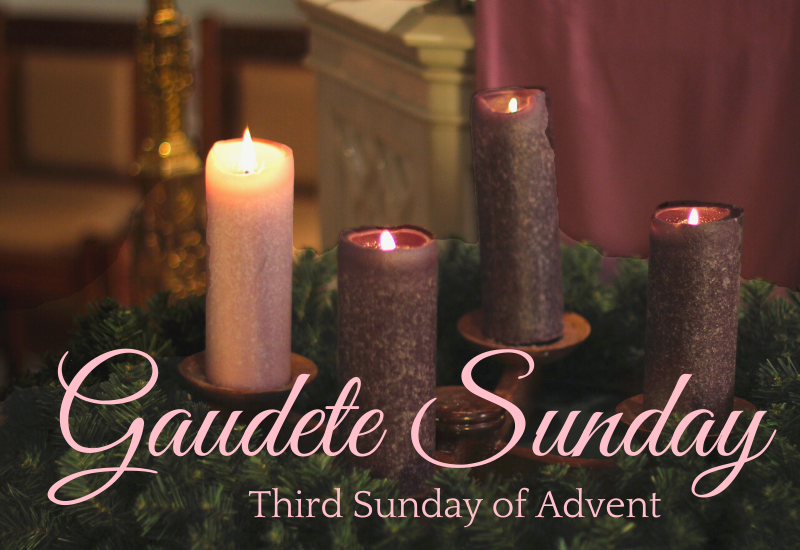
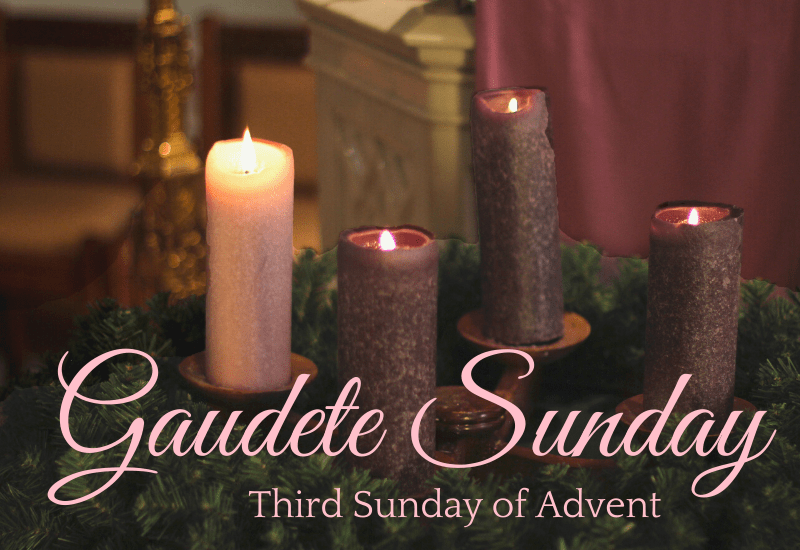
We lit the pink candle today, and as you can see, we wear rose vestments the third Sunday of Advent. The pink candle is identified as the “Candle of Joy.” Our lighting the candle is our prayer that God may replace our sadness with joy.
The third Sunday of Advent is known as Gaudete Sunday. Gaudete is the Latin word for rejoice. In the readings today from the third Sunday of Advent the words ‘joy’ and ‘rejoice’ appear twelve times and used in place of each other. One can, rightly, call the third Sunday of Advent “Baby Jesus Shower Sunday” since we are in the mood of joyful anticipation of the birth of Jesus Christ.
The first reading is a prophecy of Prophet Zephaniah to the people of Israel when infidelity to God was exceedingly high. The worship of God was at an exceptionally low level. However, there was a remnant who remained faithful to the worship of God. The prophecy was a prophecy of hope and encouragement to the remnant faithful.
There are too many desolate people who are going through various kinds of crisis that stifle joy in their life and leave them sad most times. May the prophecy of Zephaniah come to fulfillment in their lives. May God, in his infinite mercy, replace their sadness with joy. May God remove the judgement against them and turn away their enemies. May they no longer be afraid or discouraged. May they be renewed in God’s love. May they shout for joy and sing joyfully to God. May they exult with all their heart.
In times of crises and desolation, let us keep faith, and remain close to God. The psalmist says, “To be near God is my happiness” (Psalm 73:28). As we remain close to God, St. Paul prays for us in the second reading, “Then the peace of God that surpasses all understanding will guard [our] hearts and minds in Christ Jesus.”
Our reflection on the importance of spiritual preparation for Christmas continues today. The Advent season offers us three major spiritual invitations: (1) invitation to prayer, (2) invitation to repentance, (3) invitation to charity.
St. Paul highlights the invitation to prayer in the second reading. He says, “Have no anxiety at all, but in everything, by prayer and petition, with thanksgiving, make requests known to God.”
In the Gospel, John the Baptist emphasizes invitation to repentance and invitation to charity. John the Baptist said to the crowd, “Whoever has two cloaks should share with the person who has none. And whoever has food should do likewise.” This is an invitation to charity. We are the crowds. John the Baptist invites us to help, support and be charitable to those in need. Our acts of charity make us instruments of joy to others.
John the Baptist said to tax collectors, “Stop collecting more than what is prescribed.” This is an invitation to repentance. We are the tax collectors. John the Baptist invites us to repent from dishonesty and greed.
John the Baptist said to the soldiers, “Do not practice extortion, do not falsely accuse anyone, and be satisfied with your wages.” This is an invitation to repentance. We are the soldiers. John the Baptist invites us to be self-content and not bear false witness or accuse anyone falsely.
As our Advent journey continues and as we approach the celebration of Christmas, may the joy of the Lord be our strength (Nehemiah 8:10).

You Have to Do Your Part ~ The Rev. Frank Bellino, Novice

A soap salesperson and a priest were walking together down a street in a large city. The soap salesperson casually said, “The Gospel you preach hasn’t done much good, has it? Just observe. There is still a lot of evil in the world, and a lot of wicked people, too!” The priest made no reply until they passed a dirty little child making mud pies in the gutter. Seizing the opportunity, the priest said, “I see that soap hasn’t done much good in the world either; for there is much dirt still here, and many dirty people are still around.” The soap man said, “Oh, well, soap only works when it is applied.” And the priest said, “Exactly! So, it is with the Gospel.”
We handed out the Rejoice books for out Advent study, to prepare our hearts for the coming of our Lord and Savior, it only works if you read the material!
What is Advent? Why is it important? Lent is obvious: as Jesus makes His way to Jerusalem, to His trial and Cross and tomb, we travel with him with quieted voices, almost shameful faces, wearing the color of his bruises. Prayer, penance and alms giving come naturally to us in times of shame and grief like Lent.
But Advent’s time is different. First thing it is only half as long. And what comes at the end of our waiting is not a death but a birth. Whatever its challenges, pregnancy is not a period of despair. And even if we focus on the other aspect of Advent, the Second Coming, when Christ “will come again in glory to judge the living and the dead,” we joyfully greet this prospect with excitement, indeed we pray for it.
Our Advent readings today lack the gloomy mood of Lent. “Take off that dress of sorrow and distress,” says our First Reading, “and put on the beauty robe of God’s glory; wrap the cloak of God’s integrity around you; put the diadem of God’s splendor on your head” (Bar 5:1-9). Likewise, our Psalm promises those who go out ‘full of tears’ that they’ll come back ‘full of song,’ singing Advent carols. Hearing about the countless office parties and new year’s celebrations there is not much hope of Lenten sobriety in this country in any case. But what is it the liturgical calendar asking of us at this time of year?
“Wake up, take the high ground, look East,” says the Prophet, look towards the sun, because something wonderful is coming. “Purify yourselves in preparation for the Day of Christ,” says the Apostle (Phil 1:3-11). “Prepare,” says the Precursor (Lk 3:1-6). The mood of Advent is preparedness, excitement, eagerness: because something important is going to happen soon. So significant that Baruch says, “God has commanded the flattening of the mountains and the filling of the valleys.” So important that John the Baptist cries in the wilderness: “Prepare a way for the Lord, make his paths straight… so all may see the salvation of our God.” The Christmas decorations may hang up early in our city and with mixed motives; but the urge to announce the coming of the Lord is a sound one.
Excitement, about Christ’s coming at Christmas and return at the end of ages, fine: but readiness? Are we ever ready? How could we prepare for such a thing? Well, Jesus once told a story that helps us understand. A king held a wedding feast for His Son, but those who He first invited would not come (Mt 22:1-14). He asked repeatedly. But they stuck to their own concerns and treated the King’s messengers badly, even killing them. It is a parable, of course, about God’s repeated invitation to Israel to join the party that is life in His Kingdom. Finally, in frustration, the King invites strangers “both good and bad” from the streets and what we would consider ghettos – in other words, the less than holy Jews and even the Gentiles. But then we get a strange variation in the story: one guy has come to the feast dressed in flip-flops, a T-shirt and dirty old shorts. The King has had enough of all this disrespect. So, he gets the police to throw the guy out. You understand, even vagrants in the Kingdom of God are expected to put on their Sunday best. Though we might never be completely ready for Christ’s coming at Christmas and at the end of time – or our coming to Him at the end of our lives – we can at least do our part to prepare ourselves to join at the feast. Even the poor shepherds in the field, received a little teaching from the Angels and though they had no gifts to offer, they brought their lambs, carols, and adoration.
Which is why God sends us John the Baptist as an invitation card today. It is to let us know the party’s happening and tells us to prepare. “Prepare a way for the Lord,” he pleads to us in Advent. “Repent and believe the Good News – for the forgiveness of sins.” Straighten out the sins in your life-story through confession, prayer, the sacraments; remove the obstacles of your vices by conversion and the cultivation of virtues in their place; make a straight path for God in your hearts. Prepare yourselves for the wedding feast coming, not in a tuxedo or wedding gown, but with integrity and godliness, as our first reading proposed, ready for what God has waiting for us.
How do we change to what really matters? Paul’s prayer for us today is “that your love for each other may keep increasing, and your knowledge [of God], and your perceptiveness so that you can always recognize what is best.” That, he says, is the way to “prepare yourself for the Day of Christ,” to ready yourself and observe the Advent ways. Our hearts are made for caring, our brains for thinking, our senses for identifying so, all three come natural in the world for us; yet how easy it is for our cares to go astray, our minds to be confused, our vision to be distorted. Hatred, prejudice, egotism, indifference – you name it – these things block us for Christ’s coming, put-up barriers, hills and ravines. But knowing, loving and serving God and His divine image in our fellows: these things ‘straighten out’ the way for Jesus.
When a religious makes profession of their vows or a new priest is ordained, the Provincial or Bishop uses St Paul’s words from our epistle today: “May the Lord who has begun this good work in you bring it to fulfilment.” But Paul wrote this prayer for everyone. If we live with integrity and godliness, desiring to know, love and serve God and His people, we are living for God – between now and Christmas, now and the end of our lives, now and the end of time, the God, who has begun this good work in us, will bring it to conclusion.
 The Order of Preachers, Independent
You must be logged in to post a comment.