
Category: Sermon
HIdden in Plain Sight ~ The Rev. Dcn Scott Brown, OPI

That very day, the first day of the week,
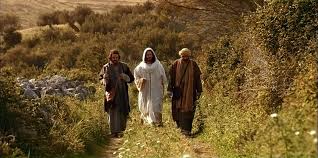
two of Jesus’ disciples were going
to a village seven miles from Jerusalem called Emmaus,
and they were conversing about all the things that had occurred.
And it happened that while they were conversing and debating,
Jesus himself drew near and walked with them,
but their eyes were prevented from recognizing him.
He asked them,
“What are you discussing as you walk along?”
They stopped, looking downcast.
One of them, named Cleopas, said to him in reply,
“Are you the only visitor to Jerusalem
who does not know of the things
that have taken place there in these days?”
And he replied to them, “What sort of things?”
They said to him,
“The things that happened to Jesus the Nazarene,
who was a prophet mighty in deed and word
before God and all the people,
how our chief priests and rulers both handed him over
to a sentence of death and crucified him.
But we were hoping that he would be the one to redeem Israel;
and besides all this,
it is now the third day since this took place.
Some women from our group, however, have astounded us:
they were at the tomb early in the morning
and did not find his body;
they came back and reported
that they had indeed seen a vision of angels
who announced that he was alive.
Then some of those with us went to the tomb
and found things just as the women had described,
but him they did not see.”
And he said to them, “Oh, how foolish you are!
How slow of heart to believe all that the prophets spoke!
Was it not necessary that the Christ should suffer these things
and enter into his glory?”
Then beginning with Moses and all the prophets,
he interpreted to them what referred to him
in all the Scriptures.
As they approached the village to which they were going,
he gave the impression that he was going on farther.
But they urged him, “Stay with us,
for it is nearly evening and the day is almost over.”
So he went in to stay with them.
And it happened that, while he was with them at table,
he took bread, said the blessing,
broke it, and gave it to them.
With that their eyes were opened and they recognized him,
but he vanished from their sight.
Then they said to each other,
“Were not our hearts burning within us
while he spoke to us on the way and opened the Scriptures to us?”
So they set out at once and returned to Jerusalem
where they found gathered together
the eleven and those with them who were saying,
“The Lord has truly been raised and has appeared to Simon!”
Then the two recounted
what had taken place on the way
and how he was made known to them in the breaking of bread.
Jesus walked with his disciples and disguised his appearance. Why? Did he want to know what they would say about him? Did he want to hear if they would gossip about him? Was he testing them? Was he just curious? We don’t know why he did this but, we can speculate that he wanted to take the temperature of his followers and disciples to see how they were reacting to his crucifixion and subsequent resurrection. Three days after his resurrection he must have been all the talk about the town. There couldn’t be much more interesting to talk about.
It is believed that Jesus remained on Earth for 40 days and the biblical narrative written by Luke in Chapter 1 of the Acts of the Apostles takes place 40 days after the resurrection. Acts 1 describes a meal at which Jesus commands the disciples to await the coming of the Holy Spirit. I believe that Jesus felt he had unfinished business here on earth; he continued to appear to his disciples and continued to teach them and let them know of the Fathers plans to come.
Acts 1:1-9
1In my former book, Theophilus, I wrote about all that Jesus began to do and to teach 2 until the day he was taken up to heaven, after giving instructions through the Holy Spirit to the apostles he had chosen. 3 After his suffering, he presented himself to them and gave many convincing proofs that he was alive. He appeared to them over a period of forty days and spoke about the kingdom of God. 4 On one occasion, while he was eating with them, he gave them this command: “Do not leave Jerusalem, but wait for the gift my Father promised, which you have heard me speak about. 5 For John baptized with[a] water, but in a few days you will be baptized with[b] the Holy Spirit.”
6 Then they gathered around him and asked him, “Lord, are you at this time going to restore the kingdom to Israel?”
7 He said to them: “It is not for you to know the times or dates the Father has set by his own authority. 8 But you will receive power when the Holy Spirit comes on you; and you will be my witnesses in Jerusalem, and in all Judea and Samaria, and to the ends of the earth.”
9 After he said this, he was taken up before their very eyes, and a cloud hid him from their sight.
The two followers were walking along the road, heading to Emmaus, deep in solemn and serious discussion, when Jesus met them. They could not recognize Jesus and saw him as a stranger. They did not, in fact, have faith in him, yet they were talking about him. The Lord, therefore, appeared to them but did not show them a face they could recognize. In this way, the Lord enacted outwardly, before their physical eyes, what was going on in them inwardly, before the eyes of their hearts. For inwardly they simultaneously loved him and doubted him; therefore the Lord was outwardly present to them, and at the same time did not reveal his identity. Since they were speaking about him, he showed them his presence, but since they doubted him, he hid from them the appearance by which they could have recognized him.
Jesus let them tell about their anxieties and pains; he let them grieve and mourn by expressing the root causes. Jesus emphatically listened to them, who poured out their crises and doubts, and used scriptures so that they could better understand “suffering and glory”. During the journey to Emmaus Jesus patiently guided the two disciples “from hopelessness to celebration” and also intended to nourish the two disciples’ faith to such an extent that they can see “his real presence in the breaking of the bread”.
So by hiding his true identity from them he allowed them to be themselves and express their true feelings. Through this action, the Lord wanted to communicate to His disciples that He is the truth, the way, and the life, and that His work of redeeming mankind had been successfully accomplished, and so they needn’t doubt, but should resolutely follow Him in their future path.
Lord, Have Mercy! Divine Mercy Sunday ~ The Very Rev. Lady Sherwood, OPI
Divine Mercy Sunday
Reading 1: ACTS 2:42-47
Responsorial Psalm: PS 118:2-4, 13-15, 22-24
Reading 2:1 PT 1:3-9
Gospel: JN 20:19-31
Liturgical colour: White.
Today we come together to honour and to celebrate the Divine Mercy of Our Lord.
We live in a worldly society in which mercy at times, is seen to be a detached idea. All too many sadly today, think that Mercy means that God doesn’t count our sins as being of importance. But Mercy is indeed a necessity because as humans, we are indeed all desperate sinners.
But the truth is that the fact of The Lord’s mercy means that sin does exist and is indeed important to God! Thanks be to God for the Glory, for the beauty, and for the wonderful gift of His Divine mercy for us! Without it, we certainly don’t stand a chance. I for one, am certainly aware that I’m going to need much grace and mercy to make it to eternal life, how about you?. It is only through this grace and mercy that can we be truly freed from our sins and healed from its effects, or ever hope to enter the presence of God’s Glory with Him in Eternal Life.
Mercy does not mean that there will be no judgement; mercy indeed exists because there is a day of judgement. Mercy does not mean that Hell doesn’t truly exist; mercy exists because Hell exists. Without mercy we are all forever totally lost. With it we stand a chance, but only if we accept our need for it.
Lord, Have Mercy upon us!
Let us look at today’s Holy Gospel reading:
JN 20:19-31
On the evening of that first day of the week,
when the doors were locked, where the disciples were,
for fear of the Jews,
Jesus came and stood in their midst
and said to them, “Peace be with you.”
When he had said this, he showed them his hands and his side.
The disciples rejoiced when they saw the Lord.
Jesus said to them again, “Peace be with you.
As the Father has sent me, so I send you.”
And when he had said this, he breathed on them and said to them,
“Receive the Holy Spirit.
Whose sins you forgive are forgiven them,
and whose sins you retain are retained.”
Thomas, called Didymus, one of the Twelve,
was not with them when Jesus came.
So the other disciples said to him, “We have seen the Lord.”
But he said to them,
“Unless I see the mark of the nails in his hands
and put my finger into the nailmarks
and put my hand into his side, I will not believe.”
Now a week later his disciples were again inside
and Thomas was with them.
Jesus came, although the doors were locked,
and stood in their midst and said, “Peace be with you.”
Then he said to Thomas, “Put your finger here and see my hands,
and bring your hand and put it into my side,
and do not be unbelieving, but believe.”
Thomas answered and said to him, “My Lord and my God!”
Jesus said to him, “Have you come to believe because you have seen me?
Blessed are those who have not seen and have believed.”
Now, Jesus did many other signs in the presence of his disciples
that are not written in this book.
But these are written that you may come to believe
that Jesus is the Christ, the Son of God,
and that through this belief you may have life in his name.
As we know from the Gospel today, The room where the Apostles are gathered in fear; has it’s doors locked. These are indeed broken, troubled, and disturbed men. All of them but John had fled, deserting the Lord. One of them had (Peter), had even denied knowing Jesus, not once but a total of three times. Here they are, feeling humiliated, downcast, and without faith. Never mind that Jesus had told them on numerous occasions that He would rise on the third day. Even though several women and two disciples from Emmaus had said they had seen Him alive, on this the third day, these men persist in rejecting this news that conformed to His promise. Yes, we enter a locked room of fearful men who are downcast, disgraced, and disbelieving.
The Lord appeared in their midst and says to them, “Peace be with you.” Now I don’t know about you, but if I had been hiding away, was denying Him, and was running from my responsibility at the critical moment, and then suddenly the Lord whom I had let down and offended appeared, I would be more than a little nervous, wouldn’t you? But what does the Lord say to these embarrassed and dejected men? The Lord says, “Peace be with you!”
The Lord does not merely say to them, “I will not punish you for what you have done.” He says, “Between you and my Father there is now peace, there is wholeness, there is completeness, there is present in the relationship all that should be there, there is justice.” The Lord does not merely overlook what a mess we indeed each are, He makes us whole and makes us pleasing to His Father.
All is well, all is complete, all that is necessary is supplied by my atoning death and resurrection!
Such Divine mercy, such a grace, such a wonderful gift!!
This is no mere passing happiness. This is total abiding astonishment at the sheer gift of God’s mercy and grace. The Apostles do not just feel happy for that moment; they are given the gift of a stable, peaceful, confident joy=the unfathomable gift of God’s mercy and goodness. They had sinned and yielded to fear; they had run from the Lord and ignored His teaching; but the Lord stands before them and says “Shalom, Peace be with you. May the full favour of the Lord be with you. May you experience that God is pleased that you are well and seeks to draw you more deeply into His love.”
Here is mercy; sweet, beautiful, soul-saving mercy; and astonishing and unexpected grace! There is shalom; there is peace; there is deep, abiding, and confident mercy. It is a joy and mercy that is unmerited. It is stable because it is rooted in the stable and abiding love of God.
However, one of the Apostles, Thomas, was missing. Here was the most wounded of all the Apostles, he felt so wounded that he drew back from the only place where true mercy could be found. Thomas blocked his blessings.
Will we call on our merciful Lord and saviour? There is only one requirement for mercy, it is that we ask for it. Jesus says, Behold, I stand at the door and knock. If anyone hears my voice and opens the door, I will come in to him and eat with him, and he with me (Rev 3:20). The door to our heart and to repentance must be opened from the inside. The Lord will not force His mercy. This is why there is a Hell. Without God’s mercy we are all doomed; we don’t stand a chance. His mercy is free for each of us except for this single price: we must surrender our pride, admit our need, and open the door.
Thanks be to God that St. Thomas did not persist in his impenitent stance, but instead rejoined the community where mercy and the Lord were to be found. Sure enough, where two or three were gathered the Lord appeared once again and St. Thomas found mercy. The Lord rebuked Thomas’ lack of faith but rewarded his penitence.
St. Thomas opened the door from deep inside of his heart. The Lord lovingly entered and built up his faith so that never again would Thomas think that he could find the Lord on his own terms. Rather, Thomas would seek the Lord where He could be found: in the Church, among those gathered in His name. Mercy is found where God is found. He knocks but it is we who must open the door and receive Him into our hearts on His terms not ours.
St. Thomas fell to his knees, astonished by the Lord’s mercy; such mercy, such a glorious gift. “My Lord and my God!” The Lord never stopped calling Thomas. The Lord did not give up but waited until Thomas answered the door. “Peace, Shalom, Thomas. I am glad you are here. Now never again stop believing in my mercy and love for you. Never again draw back thinking I am lost to you. I love you with an everlasting Love. I have called you and you are mine. Peace to you, and mercy, Thomas.”
Mercy! So great, so divine, so perfect. It is a mercy that does not deny the need for its own existence. When humbly received, it conveys peace through the common priesthood that Christ Himself established for each of us. It is a mercy which, as a prerequisite, respectfully knocks and waits for our “yes.” Lord, give us your perfect mercy.
Let us pray:
Eternal God, in whom mercy is endless and the treasury of compassion — inexhaustible, look kindly upon us and increase Your mercy in us, that in difficult moments we might not despair nor become despondent, but with great confidence submit ourselves to Your holy will, which is Love and Mercy itself.
Amen.
He’s Alive???? ~ The Rt. Rev. Michael Beckett, OPI

He’s Alive!!!!
Really? How so? Honestly, had I not been raised as a Christian, had I not had the example of loving, devout parents, had I not experienced firsthand the miracle that is Jesus, I have great doubts that Easter would mean a hill of beans to me. He’s alive? There are so many folks who are anti-church, anti-christian, anti God, and ya know, I really can’t blame them. Prove to me that Christ is alive and well in the midst of this pandemic outbreak, and show me just how so very many of our “Christian leaders” are following Christ’s words, “As I have loved you, love one another.” Certainly not by the following:
The Bishop of Springfield, MA has decided that, because of the corona virus, there will be no Anointing of the Sick or last rites given to the faithful who are dying.
Franklin Graham’s emergency hospital group asks health care workers and volunteers to adhere to a statement of faith, which opposes same-sex marriage and will refuse to treat gay patients.
Then there is the Christian-owned craft store Hobby Lobby that refused to shut down stores to protect their workers from COVID-19 unless states forced them to do it. CEO David Green even cited a dream about God that his wife had in making his decision to keep stores open. Now, in a move as cowardly as it is ruthless, the store has fired dozens of workers — via email — at some of its Oklahoma stores. These terminations are permanent, even after the shelter-in-place rules are lifted.
The House of Representatives finally passed a coronavirus relief bill this past Monday night, but one Republican, Rep. Andy Biggs (R-AZ), refused to vote for it because he said it “redefined family” by including sick leave to care for an unmarried partner’s children.
Pastor Steven Andrew, who claims to have “shared the Gospel with over 80 million people,” made the comments in a press release last week, the Advocate reports. “God’s love shows it is urgent to repent, because the Bible teaches homosexuals lose their souls and God destroys LGBT societies,” Andrew said. “Obeying God protects the USA from diseases, such as the coronavirus.” He added: “Our safety is at stake, since national disobedience of God’s laws brings danger and diseases, such as coronavirus, but obeying God brings covenant protection. God protects the USA from danger as the country repents of LGBT, false gods, abortion and other sins.”
A reverend who leads a weekly White House Bible study drew backlash after he appeared to suggest that gays and lesbians are among those to be blamed for the coronavirus pandemic. Rev. Ralph Drollinger wrote in a blog post the United States “is experiencing the forsaking wrath of God” because of homosexuals, environmentalists, atheists and “depraved minds.” “The coronavirus could be a form of God’s cataclysmic wrath,” he wrote.
Jerry Falwell, Jr., went on Fox & Friends to falsely compare COVID-19 to the flu. Falwell also blamed Trump’s political critics, initially refused to cancel classes at Liberty University, and called one parent a “dummy” for asking questions on Twitter. The New York Times is now reporting that multiple Liberty students now have coronavirus.
Televangelist Jim Bakker tried to peddle fake coronavirus cures.
A televangelist who supports conversion therapy and the death penalty for homosexuality said that God will “turn off” receptors in cells that allow in the virus that causes COVID-19… for people who are good enough Christians. Andrew Wommack is the founder of Andrew Wommack Ministries and Charis Bible College and hosts daily Gospel Truth television and radio shows. He said, “We were promised that no sickness would even come nigh our dwelling” and discussed a reference to “sickness” in the Old Testament.
It is up to EVERY one of us who is not in it for the money, in it for the fame, in it for the power, to prove to the world that He is, indeed, alive. It is up to EVERY ONE of us who proclaim Christ as our Savior to counteract, countermand, and prove to the world that Jesus is who He says he is, that Jesus is who WE say He is…….So here we go…
He’s Alive!!!!
Really? Is he? How can we prove this to the world? In what way do our lives reflect this? It is so easy for us to celebrate Easter, with all the accompanying fanfare, the music, the bunnies and chicks and eggs and ham….. We dress up in our best, go to church, and celebrate. And then what happens on Monday? We talk about how nice Easter was and go back to business as usual.
If Christ is alive as we proclaim he is, if Christ rose again from the grave to save us from our sins, to change our lives, then should our lives not reflect a profound change? One that is visible to all with whom we come into contact?
If Jesus Christ is the very God we claim, come in the flesh of humanity, if He is the Lord “through Whom all things were made,” as we recite in the Nicene Creed, it is up to us to proclaim this with all that we are, with all that we do. Think about those whom Jesus had following Him: sailors, insurgents, tax-farmers, prostitutes, widows, lepers, and, on occasion wealthy folks. Rulers, workers, and the dregs of society. Young and old. Their lives were changed in such a drastic measure that they died for their faith. Many of them left all that they had, the security of their homes, their jobs, their families, to follow Jesus. Would you? Our Christian brothers and sisters are under attack in the Mid East, in the Philippines, in Africa. Many of them have died in order to proclaim their faith. Would you do as much? Would you die for Christ?
If then, the answer is yes, would you not LIVE for Christ? You say to me, “Bishop Michael, how do you expect us to do that?” The answer to that was given to us by our Lord, Himself:
“As I have loved you, love one another.” He lived out the ultimate example of what this means. Then he said, “No greater love hath any man than this, that he lay down his life for his friends.” Then He did just that. But it was not only to save us from our sins, though it was most assuredly that. It was the sign, the seal, that proved He was Who He said He was and that His word was true.
If He really is risen, then we have an obligation one to another to serve our fellow man as He served us. And we have an obligation to share this Good News with our fellow man. We have to make the blessings we have gained available to every human. And we have an obligation to show that there really is truth to the old song, “And they’ll know we are Christians by our love, by our love. And they’ll know we are Christians by our love.” We have an obligation to reflect Christ’s goodness, His holiness, in our lives. By our speech, by our actions, by our very thoughts.
He is alive! Let us allow Him to live anew through our lives, reflecting His love and His promise in all that we do, in all that we say, in all that we are. He is alive!!!!! Amen.
Washing Feet and Loving Each Other ~ The Rev. Dcn. Scott Brown, OPI
John 13:1-15 New International Version (NIV)
Jesus Washes His Disciples’ Feet
13 It was just before the Passover Festival. Jesus knew that the hour had come for him to leave this world and go to the Father. Having loved his own who were in the world, he loved them to the end.
2 The evening meal was in progress, and the devil had already prompted Judas, the son of Simon Iscariot, to betray Jesus. 3 Jesus knew that the Father had put all things under his power, and that he had come from God and was returning to God; 4 so he got up from the meal, took off his outer clothing, and wrapped a towel around his waist. 5 After that, he poured water into a basin and began to wash his disciples’ feet, drying them with the towel that was wrapped around him.
6 He came to Simon Peter, who said to him, “Lord, are you going to wash my feet?”
7 Jesus replied, “You do not realize now what I am doing, but later you will understand.”
8 “No,” said Peter, “you shall never wash my feet.”
Jesus answered, “Unless I wash you, you have no part with me.”
9 “Then, Lord,” Simon Peter replied, “not just my feet but my hands and my head as well!”
10 Jesus answered, “Those who have had a bath need only to wash their feet; their whole body is clean. And you are clean, though not every one of you.” 11 For he knew who was going to betray him, and that was why he said not every one was clean.
12 When he had finished washing their feet, he put on his clothes and returned to his place. “Do you understand what I have done for you?” he asked them. 13 “You call me ‘Teacher’ and ‘Lord,’ and rightly so, for that is what I am. 14 Now that I, your Lord and Teacher, have washed your feet, you also should wash one another’s feet. 15 I have set you an example that you should do as I have done for you.
I always wondered what Maundy meant. I thought it was just the name of the service of foot washing, or the old Latin name of the foot washing service, or was it named after somebody with the last name of Maundy? A little research reveals that the word Maundy comes from the Latin for mandatum or mandate in our current English. So is this a mandate that we wash others feet on the Thursday before Good Friday? In a sense, “yes”.
In the gospel we read that Jesus had gone to Jerusalem for Passover and gathered his twelve disciples at the dinner table. He knew that by the end of the night one of them will betray Him to the authorities, one of them will deny Him three times, and all of them will leave him alone in his hour of greatest pain. And yet there He is breaking the bread and pouring the cup, eating with them, blessing them, getting down on His knees and washing their feet, showing them his love and grace and compassion in a time when his anger might have been better understood. Yet in the end He knew that He was not about to be thanked or praised, but killed, and mocked, and tortured. Why? Because in the end, the goodness, the kindness, and the compassion He had brought were more of a threat to the Roman authorities and clergy of his day than any weapon or army. Jesus so radically upset the status quo that they decided to get rid of him so that things might return to the way they had been before Him, when there were no “radicals”, no “troublemakers”, no “problem children”.
The night before he wasn’t running away from what He knew He was to face. He wasn’t preparing for a battle, and He wasn’t plotting revenge. Instead he was with the ones he loved the most, the ones who loved him, but were not perfect. The ones who knew who He was, what He had done, and would be his witnesses to His life and teachings after He was gone. This is where the word Maundy comes into effect. What do you do if you are Jesus? What do you do if you know you aren’t going to be around much longer and you have to tell the people you love the most how to keep moving forward after you are gone? You give a mandate or commandment – you tell your disciples exactly what you expect of them.
“I give you a new commandment, that you love one another. Just as I have loved you, you also should love one another. By this everyone will know that you are my disciples, if you have love for one another.”
We are still Jesus’s disciples and we are still under the mandate that he issued over two thousand years ago. His commandment, His mandate; Love one another as I have loved you. This is the only way we can separate ourselves from the modern day Romans. We must continue to be Jesus’s disciples, practice what he preached, and love each other even when anger might be expected of us.
Maybe Maundy need to be retired and we should rename this Thursday to something not as fancy – like – “Love One Another Thursday”, or “ The Last Thing Christ Really Wanted Us To Know Thursday”. Maybe more people would get the meaning if we put it in simpler terms and did away with the fancy name. This is a message all Christians need to hear, so let’s not hide it behind fancy names, or just check it off of our Holy Week calendar as just another night. We need to let others know that this is how Christ said other people would know us: by how we love one another. Maybe changing the name might help us to remember what this night is about, and what it means to be Christians. Maybe if we kept that reminder in the front of our head, kept Jesus’s commandment first and foremost in our lives, Christ’s dream for us would come true. Putting a fish sticker on your car doesn’t make you a Christian, any more than standing in a garage makes you a Buick. Following Christ’s teachings and mandate’s makes us Christians. That’s what Christ wants us to be known for.
Lord in your mercy, help us to achieve the mandate that Your Son Jesus left us. Help us to love each other as Jesus loved us. Guide us and show us the way to true Christianity. Lead us down the path of righteousness, grace and compassion. Let us wash the feet of our fellow man as Jesus did for his Disciples. Let us show our fellow man that we are capable of loving one another as commanded by Your Son. Amen.
Taking Up Our Cross! ~ The Very Rev. Lady Sherwood, OPI

Reading 1: IS 50:4-7
Responsorial Psalm: PS 22:8-9, 17-18, 19-20, 23-24.
Reading 2: PHIL 2:6-11
Gospel:MT 26:14—27:66 OR 27:11-54
Liturgical colour: Red.
Today, we come together as the church to celebrate a feast day that consists of 2 totally opposite double edges. On the one hand, we have all the pomp and glorious ceremony of our Lord Jesus arriving into Jerusalem as the King of Kings amongst all the palms that were laid down in his pathway, and also of those being waved to the glorious shouts of ‘Hosanna!’ and ‘Alleluia!’ by the joyful and excited crowds.
On the other hand, we have Jesus who is already focussing upon the cross, knowing that he will very soon be betrayed, denied by his own. Knowing and accepting that he will be tried, mocked, tortured and crucified to atone for our sins!
I have heard people asking, exactly what does this meaning pf Palm Sunday have in our lives today?
Well, as Christians, We are supposed to accept and honour our Lord, totally welcoming him with all that we are, into our lives, into our very hearts and soul. But do we do this wholeheartedly, or are we like the feast of today..having 2 opposite sides?
Do we truly welcome Jesus as Our Lord and Saviour, as our King of kings into every facet of our being, or do we only do this when things are good within our lives?
Do we all too often tend to celebrate, welcome and worship our Lord Jesus as our true Lord, Saviour and Heavenly King, when things are joyous within our lives, but yet, then betray and deny him and his truth, in times of sufferings?
As an example, let us look at the current situation within our lives of the Cov=19 virus. So many times, I have been seeing this virus as being said to be sent from God as a punishment. Sadly, and all too often, a punishment wrongly classed as God’s wrath against certain of our brothers and sisters within our society. Usually said due to personal human agenda that has crept into the teaching of the faith to many.
So, what could this example have to do with welcoming and celebrating our Lord Jesus, yet then denying and betraying him? This is only one example of many which I could’ve used here as sadly, this happens for a multitude of differing reasons.
It is simply that each time we use anything that is not of God, within our lives to justify things in His Holy Name for human purposes, , we are indeed both denying and betraying Our Lord and Saviour Jesus Christ! We are welcoming him in good times as if in the Joyous occasion of palm Sunday celebrations, but then Just as Judas did when he betrayed our Lord to the Romans, and when Peter denied knowing him 3 times, we are betraying and denying him when we are difficult times!
What we should be doing is always focussing on our Lord at all times and his teaching at all times, whether they be times of rejoicing, or indeed of sufferings.
Just as Our Lord Jesus went through the good times, he still always kept focused upon what he knew was coming, what he was there to do..the Will of God his Father. He gladly accepted all for our sakes!
If we are truly followers of Our Lord and Saviour Jesus Christ, we as he did, need to always be focused upon him and upon his Holy Cross. Just as Jesus did, we must take up our crosses and follow Jesus at all times, whether in good or in suffering.
So let us take up our crosses and follow our Lord at all times, and in all situations. Let us keep our eyes firmly on Him who willingly sacrificed all for each of us, and not let us become double-minded in our faith! Let us take up our crosses and follow with joy, as the sufferings of this world are only temporary and will flee away, but the salvation of Our Lord is eternal and shall never fade away!
May the Lord bless you this Palm Sunday!
Repent! ~ The Rev. Dcn. Igor Kalinski, OPI
Oratorium Sancti Sebastian & Peregrine Gevgelija Macedonia
As we approach closer to the feast of the Passion and Resurrection of our Lord Jesus Christ, let implore ourselves to the will of God.
We see many signs of His majesty, natural signs, earthquakes for the last 63 hours about 11 earthquakes in Zagreb, the pandemic in Italy, Spain, throughout Europe and now all over the globe.
God is talking to us, to repent and come close to Him, in his hands are all lives and destinies, he is warning us and reminding us of our sins, to turn to him, all that we have forgotten, now we are close in this lent, all of those signs are remind us that soon our lives going to end soon or later, and he wants all humanity to be saved, and never before the humanity haven’t been so distant from all that we see daily in the news or internet, as exist people that watching, hearing seeing and areas till stubborn, and many will praise and repent to God, and many will still be blind and deaf.
Will come time of tribulations for the church, but do not be afraid. Jesus have overcome the evil, and his promise for us Christians is that he will deliver us from hardship.
We need to endure perseverance, faithfulness and commitment to our vocation and our daily testimony to all people that ask us, that they will praise Lord seeing how we stay loyal to our Lord, serving him in adoration and love.
Hard times are coming for the humanity, but Jesus have overcome all negative evil devils work.
Now is time for repentance, now is the time for turning to God, now is the time for renewal of our spirit to become in unity with God as his bride, the Holy Church, the safe place for us as Jesus have given his promises in time for coming the worst, but that is not the end of humanity and civilization.
The individual will of all of us given to stay close to him and to not fear, despite what is coming in our present time, he will not be going to despise or reject us.
This is time for great exams for all of us.
He is alpha and omega, he has his ultimate word. In this worldwide lockdown when we socially distant ourselves from each other, is time for becoming closer to God in prayer and reflecting upon God’s word and promises.
We have better world in the heaven with the father and the son and the holy ghost. Amen
25.III.2020 the feast of the annunciation of BVM
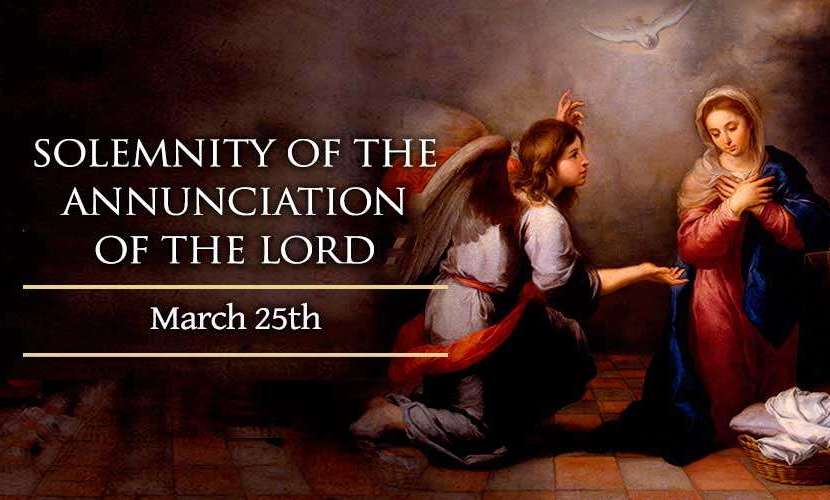
Discerning Our Vocation -The Annunciation of The Lord ~ The Very Rev. Lady Sherwood, OPI
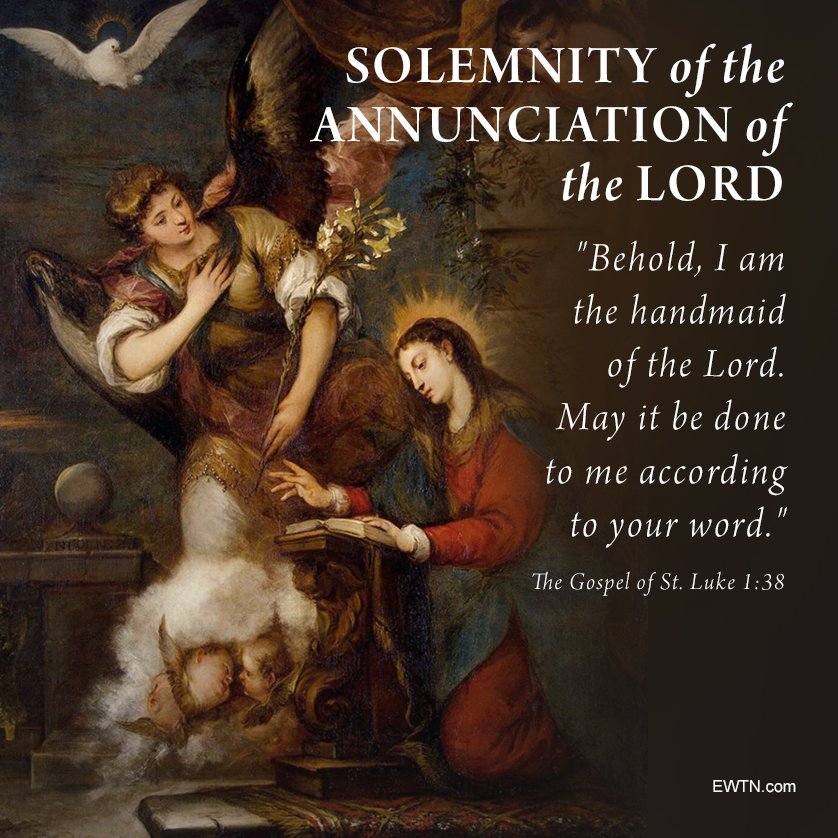
Reading 1: IS 7:10-14; 8:10
Responsorial Psalm: 40:7-8A, 8B-9, 10, 11
Reading 2: HEB 10:4-10
Gospel: LK 1:26-38.
Liturgical colour: White.
Today’s we celebrate the Annunciation of The Lord. I feel this is an excellent occasion for each of us to reflect upon our life vocations. Every single one of us, like Mary, have a predestined vocation in life. It is definitely not by chance, it was planned by God for us before we were born. God has created each one of us here upon the Earth for a purpose, that purpose being to manifest His glory and to share His love, so that at the end of our earthly journey, we can share the fullness of eternal life with Him. And so, each of us, just as Mary did, must ensure the time to discern our vocation in life, to find out exactly what it is which God is calling us to do. The way the Lord wants us to serve Him might change according to life’s situation. Therefore, we must endeavour to constantly be sensitive, like Mary indeed was, to the promptings of the Holy Spirit and how we should respond to God’s call. When Mary asked the angel, “But how can this come about, since I am a virgin?”, it was not with a similar response to that which was like Zechariah who asked in doubt. For Mary, she truly and devoutly wanted to know how the Lord would make use of her for the work of redemption.
So it is of vital importance to remind ourselves constantly within our lives, that we need to ask what exactly it is which the Lord is asking of us. Sadly, Many, unfortunately, instead of seeking their vocation, seek to do their own will, rather than the Will of God in their lives instead. When we do not consult God and are simply willful in going our own way, we will bring disaster not just to ourselves but also to those that God has placed under our care. Indeed, many of us, instead of discerning the will of God in whatever we do, turn to worldly answers instead.
Today, we actually come together to celebrate not just Mary alone in her Vocation, but we celebrate both our Lord Jesus and Mary for taking up their vocation in life. Originally, today was singly celebrated as the Annunciation of Mary only, but it the church changed this to the Annunciation of the Lord. The church amended this because it is in fact both our Lord Jesus’ and Mary’s vocations that are intertwined. Mary’s response to the call to be the Mother of God is what paved the way for our Lord and Saviour, Jesus, to be incarnated and for the work of redemption of humanity. Mary in saying “Yes” to God, considered herself as being “the handmaid of the Lord.”
Try to imagine the truthful immense scale of the decision of Mary to accept her vocation to be The mother of our Saviour. This certainly was anything but an easy decision, but Mary put her complete trust in the Will of the blessed vocation that God had willed for her. Let us consider the implications of her decision to be the mother of the Lord and saviour!. As any mother will know, it is not so difficult to give birth to a baby but to look after a baby for the rest of your life, that is a different matter altogether. Marriage is another example of a difficult decision because to get married is very easy but to remain faithful and loving to your spouse every day of your life requires tremendous sacrifices and sufferings. So when Mary gave her consent, she too consented to all that would follow after that big and fundamental “Yes.” So, this also applies, for all who chooses to follow the vocation God has willed for their life. Making our decision to follow the will of God for our lives, is truly only the beginning of a lifelong commitment. We accept God’s will for the entirety of our lives, So therefore, we should not complain and or have regret when we choose to be a priest, religious, a spouse or a church worker, or whatever vocation that God has willed for us to have in his service, because every vocation comes together with all its joys and sorrows. Quite often, when people face trials in their vocation, be it in their priestly or religious life, or in marriage and family life, they regret and complain. In accepting that vocation, it entails all the obligations and demands that flow from that commitment.
Both Jesus and Mary recognized that answering God’s call required total self-emptying. It is a sacrifice of oneself, the giving one’s mind, heart and body to God completely for His service.
That was exactly why Mary said to the angel, “Let what you have said be done to me.” She was totally disposed to the will of God. To do God’s will is to completely submit our lives to Him in obedience. It is to give ourselves wholly for the service of God and to empty our lives for humanity like both Jesus and Mary did. We are called to serve both justice and truth.
Let us pray:
Saying “Yes” to the vocation that God Wills for our lives is the only wise decision. This is what was predestinated by God for us before we were born. We ask Mary the Mother of Our Lord and Saviour, Jesus christ, to intercede for us with her prayers, so that, we, like she did, will have the courage and discipline to say “Yes” to God. We rejoice together with Mary that God’s will shall be done in our lives.
Amen.

Be the Light! ~ The Rev. Dcn. Scott Brown, OPI

EPH 5:8-14
Brothers and sisters:
You were once darkness,
but now you are light in the Lord.
Live as children of light,
for light produces every kind of goodness
and righteousness and truth.
Try to learn what is pleasing to the Lord.
Take no part in the fruitless works of darkness;
rather expose them, for it is shameful even to mention
the things done by them in secret;
but everything exposed by the light becomes visible,
for everything that becomes visible is light.
Therefore, it says:
“Awake, O sleeper,
and arise from the dead,
and Christ will give you light.”
Well I thought this would be a hard sermon to write but as usual I was wrong!
This is pretty much self explanatory and shouldn’t require much explanation but here goes. This may be the shortest sermon in history.
You were once darkness but now you are light in the lord – until you accepted the lord Jesus Christ as your savior you were dark and gloomy. Now you are filled with the light of his love and should be a beacon broadcasting your light for all to see.
Live as children of light, for light produces every kind of goodness and righteousness and truth. Live your life as a disciple of Christ, follow Christ’s teaching and his one commandment: love one another as I have loved you. If you live your life in the same manner as Christ lived his and as he commanded us, then you will produce goodness. Even more important today with everything going on in the world concerning the Corona virus – we need to love one another more now than ever. Share your supplies, check on your neighbor, don’t be greedy and leave something on the shelf for others to purchase. Make sure the elderly have enough to eat, make sure they have their needed medicines, and just ask them what they need to get through this crisis.
Try to learn what is pleasing to the Lord. Loving one another is pleasing to the Lord, showing kindness to others is pleasing to the Lord. Practice these every day. Be patient, be understanding, ask your neighbors if the need any help during this time of crisis and every day. Offer to help where needed, offer kind words of encouragement and love.
Take no part in the fruitless works of darkness; rather expose them, for it is shameful even to mention
the things done by them in secret – don’t waste your time on worthless things, dedicate all your available time to works that glorify the Lord and proclaim his love and goodness.
“Awake, O sleeper, and arise from the dead, and Christ will give you light.” If you are not proclaiming Christs love, you are dead and asleep. When you arise and awaken in Christs love, each day is like a new day. A new day to explore the world and proclaim his goodness. You will be led out of the darkness of sin and bathed in the loving light of the Lord.
Lord in your mercy, show us the path to the light, lead us our of the darkness and awaken us so that we may proclaim Your love, kindness and mercy. Help us to live as children of the light. Amen.
Solemnity of St. Joseph, Spouse of the Blessed Virgin Mary ~ The Very Rev. Lady Sherwood, OPI
 .
.
Reading 1: 2 SM 7:4-5A, 12-14A, 16
R Psalm: 89:2-3, 4-5, 27 AND 29
Reading 2: ROM 4:13, 16-18, 22
Gospel: MT 1:16, 18-21, 24A
Liturgical colour: White.
Today, we come together as the church to celebrate St. Joseph, the husband of the Blessed Virgin Mary and the step=father of Our Lord and Saviour Jesus Christ.
Where Joseph lived is not entirely clear in the scriptures as in Matthew, it implies that he lived in Bethlehem, whereas in John it states that Joseph actually originally came from Nazareth. When Joseph learned that Mary was pregnant, even though they hadn’t yet been wed but were currently bethrothed, he “planned to dismiss her quietly” because he was “unwilling to expose her to public disgrace.” But before he could cancel their wedding, “an angel of the Lord” appeared to him in a dream and said, “Joseph, son of David, do not be afraid to take Mary as your wife, for the child conceived in her is from the Holy Spirit” (Matthew 1:21).
Just imagine the seriousness of the situation which Mary and Joseph were in with Mary’s virgin pregnancy. In the days of Mary and Joseph, Jewish women in ancient Israel were passed from one male authority (their fathers) to another (their husbands) at a very young age. Most were betrothed by the time they were thirteen and married by fourteen. With such early marriages, premarital sex was most likely not a common occurrence, but indeed it did happen as we can see by the law set in place in the Old Testament and the punishment metered out for breaking this law:
If a man marries a girl who is claimed to be a virgin, and then finds that she is not, “they shall bring the girl to the entrance of her father’s house and there her townsmen shall stone her to death” (Deut. 22:20).
As you can clearly see from the holy scripturs,, the status of betrothal was almost identical to the status of actually being a married woman. A betrothed woman who lay with a man that was not her intended husband, was subject to the punishment of being stoned to death, it was considered to be the same as if she had actually committed adultery.
Mary knew the punishment she faced— that of death by stoning. She had nothing but the story of an angel to tell to her parents and also to Joseph, the man to whom she was betrothed to marry. Joseph would have been well within his rights—even within his duty of the time—to expose her sin and to witness her death by stoning.
It was only with the intervention of an angel and with Joseph’s own faith-filled acceptance of the angel’s message, that saved both Mary’s life and the life of her unborn baby, Our Lord and Saviour, Jesus christ, the Son of God.
From the Holy Scriptures we learn that St. Joseph’s great virtue was his obedient faith. “He did as the angel of the Lord had commanded him to do. Joseph took Mary as his wife.” (Mt. 1:24). He took her in the mystery of her motherhood and he acted in obedient faith, just as did Mary when she said, “Let it be done to me according to your word.” (Lk. 1:38).
St. Joseph proved himself to as a righteous man, as husband to Mary, and as an earthly father to Jesus. Joseph brought Jesus up as his own child, with all the natural love and affection of a father’s heart, even though he was only His stepfather (it is commonly said as foster father, but the husband of a wife with a child, is a stepfather). Joseph placed his entire life in the complete service of God in his self-giving for our Lord and Saviour who grew up in his house. And Jesus grew “in wisdom and in stature and in favour with God and man.” (Lk. 2:52.)
Such faith and devotion Joseph indeed had! He accepted the news from the angel about Mary’s pregnancy by the Holy Spirit, he took her wholeheartedly as his wife, sparing her from the certain disgrace and death as per the law in those days. Then Joseph accepted Jesus as his own son and raised him with all the love and care that a true father should.
Joseph is an excellent example as a righteous man, as a husband and as a loving Father. We can all take from this example within our own lives. He listened to the angel who spoke to him the will of God about Mary’s pregnancy. He accepted in faith without question. He accepted Mary when he could’ve abandoned her to certain death, and then also accepted Jesus, to be as though his own Son.
Do we follow the example of both Mary and indeed of Joseph within our own lives? Are we willing to believe even though we haven’t seen? Are we willing to follow the will of God in all circumstances, just as they did?
Let us pray:
Blessed Joseph, Husband of Mary,
Be with us this day.
You protected and cherished the virgin Mary;
Loving and accepting Jesus as your own son.
You saved both Mary and the unborn Lord Jesus from certain death by your faith and acceptance of God’s holy will.
We pray that you defend the church,
And all the household of God,
Which was purchased by the blood of Christ.
Amen.
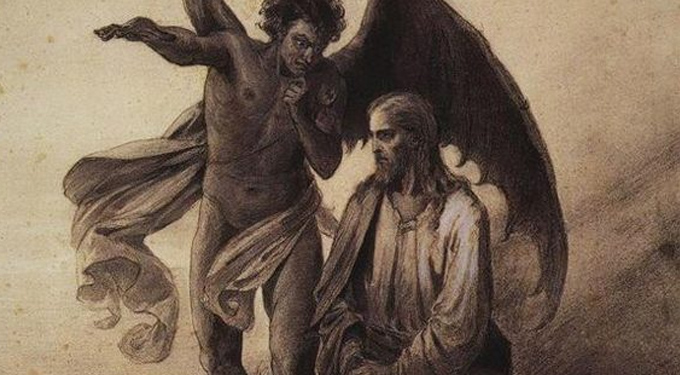
The Reality of Temptation ~ The Very Rev. Lady Sherwood,OPI

Reading 1: GN 2:7-9; 3:1-7
Responsorial Psalm: PS 51:3-4, 5-6, 12-13, 17
Reading 2: ROM 5:12-19 OR 5:12, 17-19
OR 5:12, 17-19
Gospel: MT 4:1-11
Liturgical colour: Purple/violet
Let us first read what we are being told in today’s Gospel of MT 4:1-11:
At that time Jesus was led by the Spirit into the desert to be tempted by the devil. He fasted for forty days and forty nights, and afterwards he was hungry. The tempter approached and said to him, “If you are the Son of God, command that these stones become loaves of bread.” He said in reply, “It is written: One does not live on bread alone, but on every word that comes forth from the mouth of God.”
Then the devil took him to the holy city and made him stand on the parapet of the temple, and said to him, “If you are the Son of God, throw yourself down. For it is written: He will command his angels concerning you and with their hands they will support you, lest you dash your foot against a stone.” Jesus answered him, “Again it is written, you shall not put the Lord, your God, to the test.”
Then the devil took him up to a very high mountain, and showed him all the kingdoms of the world in their magnificence, and he said to him, “All these I shall give to you, if you will prostrate yourself and worship me.” At this, Jesus said to him, “Get away, Satan! It is written: The Lord, your God, shall you worship and him alone shall you serve.”
Then the devil left him and, behold, angels came and ministered to him.
We see that in today’s Gospel, that Jesus was tempted by the devil in the desert.
We are told that whilst Jesus was in the desert, he heard the devil quote Psalm 91:11-12, challenging Jesus to take God at His word. The devil begins by saying, “If you are the Son of God….” The challenge is given for Jesus to prove his identity to himself — and to others — and to take advantage of his power. So, we can clearly see that Satan can cite Scripture for the purpose of his own personal agenda.
Even The church isn’t immune to this and can also fall prey to it, as sometimes, scripture is used to oppress people and to discriminate against them. We need to not only listen intently to the words that are being said but need to listen intently also to evaluate the person who is saying the words. We need to ascertain whether indeed we are truly listening to an adviser, or indeed if could it be a tempter? — Is the person a builder or are they a destroyer? Does the person possibly have a hidden agenda — or maybe a personal axe to grind?
It is actually possible to use Scripture to prove just about any position at all. The point is that finding the right path between what is true and what may be being used for the purposes of Temptation is not always obvious.
Now that is what many of the choices which you and I face are like that we may face in our life. It is very difficult to make the choice between what is truly good and that which is bad or a cause of temptation. Christians on either side of the fence on many issues often find themselves in complete disagreement as to what is good and what is bad, to what is wholesome truth and what is actually being used as a means of temptation.
Each of the temptations which Jesus faced could all have been seen as being ambiguous in nature because:
to feed hunger was a good thing,
to show everybody his power by throwing himself off a building would be a good thing,
to overthrow the might of Rome would have been a good thing.
Even our Lord Jesus needed to think very carefully about the decisions which he was to make. The choice between good true things and of bad ways of tempting sin is not always easy.
So, we seek that our Lenten observance leads us to a deeper awareness of the world in which we live and its challenges. So that indeed, we may be far better prepared to wrestle with the important issues of our world and avoid any temptations to conform to things which are incompatible with our faith in our Lord and Saviour, Jesus.
Temptation is VERY real!! We can and indeed, sometimes do, take the wrong path in our decision making.
The Temptations of Jesus were Very real temptations, he still but did not sin! For them to be real temptations, there must have been the possibility that Jesus would have chosen the wrong path, so there was danger and risk involved. Throughout his ministry Jesus faced these very real temptations.
We all know that Jesus did not overcome temptation only once, but indeed, he overcame temptation, that he would face throughout his ministry. In his life we all think about Gethsemane, when Jesus was really under immense pressure in the Garden. ‘Father let this cup pass from me’
So, what do we learn from this?
We learn that temptation might be ambiguous, but it is also a very real thing!!
Each of us can make the wrong decisions and we frequently do. This is not an academic exercise, some kind of theological enquiry. The message is that we always have to be vigilant! In 1 Peter Chapter 5, 8 we read
Discipline yourselves, keep alert. Like a roaring lion your adversary the devil prowls around, looking for someone to devour. Resist him, steadfast in your faith, for you know that your brothers and sisters in all the world are undergoing the same kinds of suffering.
To finish let me end of a message of hope and good news.
Lent is often viewed negatively as a time of don’ts, of having to give up things, of fasting, of abstinence or of the withdrawal of merriment.
But Lent is indeed supposed to be a time of hope!! Jesus confronted temptation and was able to say ‘no’ to wrong actions, just as in Gethsemane he said ‘yes’ when called upon to do God’s will. So now we know there is hope for us!!!
It is possible to resist temptation. It is possible to make the right choices, to resist the pressures of our culture and society and to be free. It is possible to turn away from consumerism, materialism, violence, racism, and all kinds of social and personal sin.
The fact that Jesus made the right decision is good for us, it is a sign of hope for us all.
Amen!!!


You must be logged in to post a comment.