
Category: Sermon

Singin’ In the Rain: The Feasts of St. Peter and Paul ~ Br. Jarred Smith, Postulant
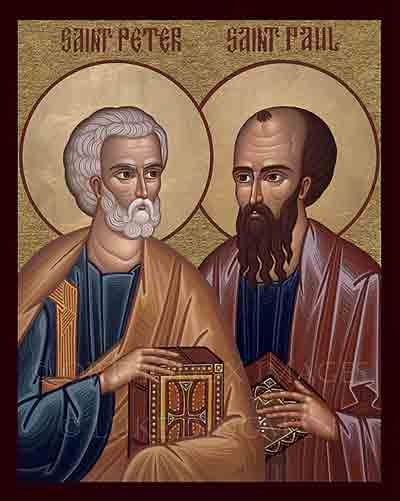
In today’s first two readings we find Peter and Paul in what looks to be in times of tribulation. They are both in prison, and in those days jail were not like the ones today. Most of the cells in those days were places where raw sewage would come in. There were no regular meals provided. There was no heat, no air conditioning. These were terrible conditions.
Peter is facing almost certain death. Paul is nearing the end of his race and his death takes place shortly after this passage was written.
What I find from these passages is that despite their surroundings and predicaments neither Peter nor Paul are complaining, or saying “why God?” But rather they are rejoicing!
Today on the Feast of Sts. Peter and Paul I would like to refer to this message as “singing in the rain”.
We all go through trials, tribulations, and hard times in life. It is often easy to say, “Why, God, am I going through this?” I am as guilty of this.
I suffer from anxiety and depression. My brain doesn’t produce enough serotonin. This simply means my brain doesn’t produce enough happy juice to surge through my brain. I go through trials of depression which often not only affects my mental state, but also affects me physically.
Back in November I started a deep depression which lasted till January. The whole time thoughts of, “Why God did you make me like this? I’ll never be happy or content.” Thoughts of worthlessness, and failure flooded me.
I tell you this because in those moments I doubted and wallowed in my own self-pity. I was asking, “Why God? How could God have created me like this?” Toward the end of this time period, I actually began to wonder, “Did God make a mistake when making me?”
When I actually gave voice to that question, and realized what I was feeling, it hit me hard. I realized that in asking that question I fully gave into my humanity and questioned God in his plan and his being God.
You see, God doesn’t make mistakes. Allowing trials to happen is God’s way of strengthening our faith, our resolve, and our relationship with him. Often it also is to give hope and to strengthen us, and to bring others to him.
It is so tough during these down and low times to find joy, or to say it’s been great, or to thank God for the persecution. Sometimes it is hard to praise God for all that you’ve been through or are going through. But Peter and Paul both point out that if we place our trust in God, he will see us through, and then he will do as he has promised.
What are we to learn from these scriptures?
We are not to dwell on the injustices that had befall us. Instead, we are to trust that God has us right where He wants us. Like Peter and Paul, we are to turn our attention to others, the church, and to God. You see, if we step back from our situations we might just see that no matter the outcome, God has provided us an opportunity to grow, to learn, and given us a chance to become closer to him. Romans 8:28 says, “All things work for the good for those who love the Lord and are called according to His purpose.” In Jeremiah 29:11 we hear, “I know the plans I have for you,” declares the Lord, “plans to give you hope and a future.” In John 16:33 Jesus Himself addressed this when he said, “Here on earth you will have many trials and sorrows; but cheer up! I have overcome the world!”
Cheer up! Jesus has this! Cheer up! God has you in His hand! Cheer up! Or, as the musical says “I’m singing in the rain! Oh, what a glorious feeling to be singing in the rain”.

Like Sands Through the Hourglass ~ The Rev. Deacon Scott Brown, OPI

Like sands through the hourglass:
So are the days of our lives.
As a kid I loved to watch Days of Our Lives with my grandmother. I didn’t really understand what the show was all about, but I loved the hourglass. As I got older I began to understand what the saying meant. Like sands through the hourglass, so are the days of our lives. Once the sand flows from the top portion of the hourglass to the bottom, it cannot get back to the top again without assistance. The hourglass must be turned over and restarted in order for the sand to flow again. Our lives are very much like that hourglass. We travel through life, getting chance after chance after chance to flow from the top of the hourglass to the bottom again. God flips us over time and time again, forgiving us for our sins, putting people in our lives to travel through the neck of the hourglass with us, giving us chance after chance. As we travel through the neck of the hourglass we should look around and see who is traveling with us. We should pay attention to the grains of sand that pass from top to bottom with us, and notice that when God flips the hourglass over each time we usually have the same people traveling with us. God puts these people in our lives for a reason. We should listen to what they have to say, discuss problems with them, open up to them about what is going on in our lives and see how we can influence them as they influence us. Open your hearts, open your minds, open your lives to the other sands that surround you. You may just find yourself free from the hourglass and on a beach, surrounded by sand for as far as the eye can see. Each grain of sand touches the other. Let’s use our lives to touch others. Matthew 5:16 says “In the same way, let your light shine before others, so that they may see your good works and give glory to your Father who is in heaven.” Let your light shine, let your grain of sand touch and mingle with the others around you. Do this because you truly want to spread the love of God, and not to draw attention to yourself but to spread the love of Christ. Matthew 6:1-34 says” Beware of practicing your righteousness before other people in order to be seen by them, for then you will have no reward from your Father who is in heaven. “Thus, when you give to the needy, sound no trumpet before you, as the hypocrites do in the synagogues and in the streets, that they may be praised by others. Truly, I say to you, they have received their reward. But when you give to the needy, do not let your left hand know what your right hand is doing, so that your giving may be in secret. And your Father who sees in secret will reward you. “And when you pray, you must not be like the hypocrites. For they love to stand and pray in the synagogues and at the street corners, that they may be seen by others. Truly, I say to you, they have received their reward….Our Lord demonstrated this Himself when he told Jarius and his family to keep quiet about raising the little girl from the dead. Should we not do the same?
And what about those grains of sand touching and Jesus? How does that figure in? In both the stories in the Gospel this morning, we read how the mere touch of our Lord changed lives. Forever. Remember, everything that you do, everything that you say, has an impact on someone, somehow. Let your light shine. Let your grain of sand touch others. Show, spread, and live the Word of God. Amen.
The Nativity of John the Baptist ~ Br. Michael Marshall, Novice
Prepare ye, the way of the Lord
Prepare ye, the way of the Lord”
This is a song from the musical Godspell, which is John the Baptist foretelling the birth of Jesus. Some people thought John was the One, yet he knew he was not. The story of John’s birth is accounted for in all of the Gospels yet in today’s readings we read the story according to Luke:
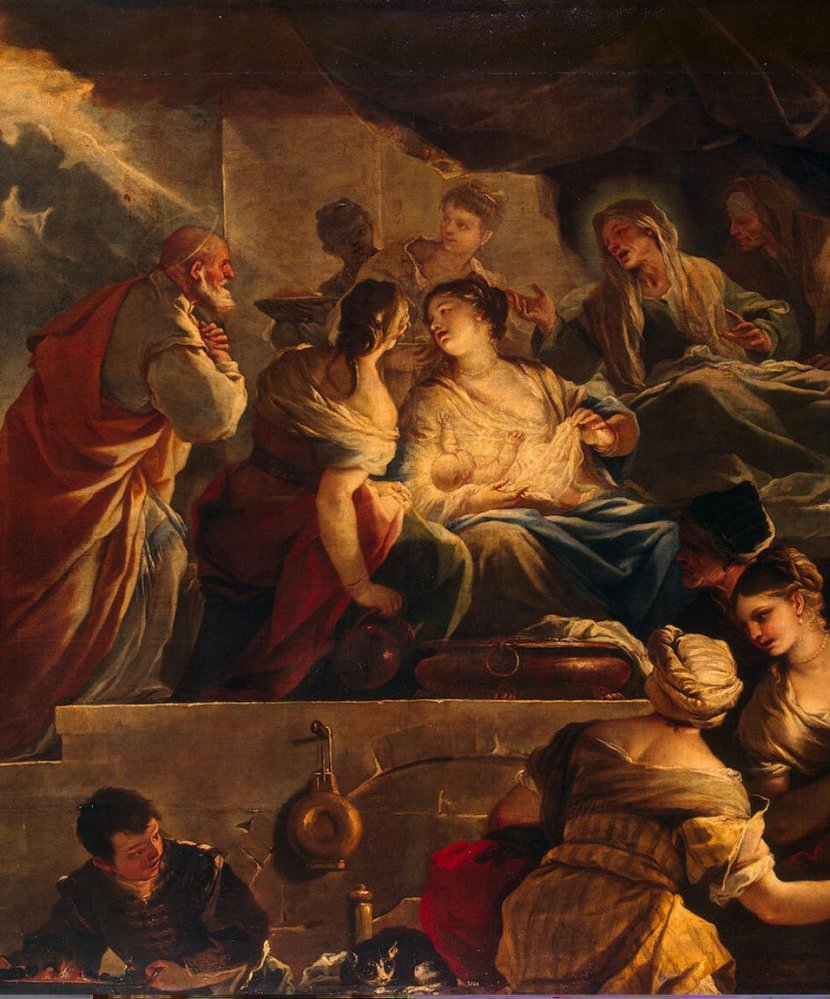
When the time arrived for Elizabeth to have her child
she gave birth to a son.
Her neighbors and relatives heard
that the Lord had shown his great mercy toward her,
and they rejoiced with her.
When they came on the eighth day to circumcise the child,
they were going to call him Zechariah after his father,
but his mother said in reply,
“No. He will be called John.”
But they answered her,
“There is no one among your relatives who has this name.”
So they made signs, asking his father what he wished him to be called.
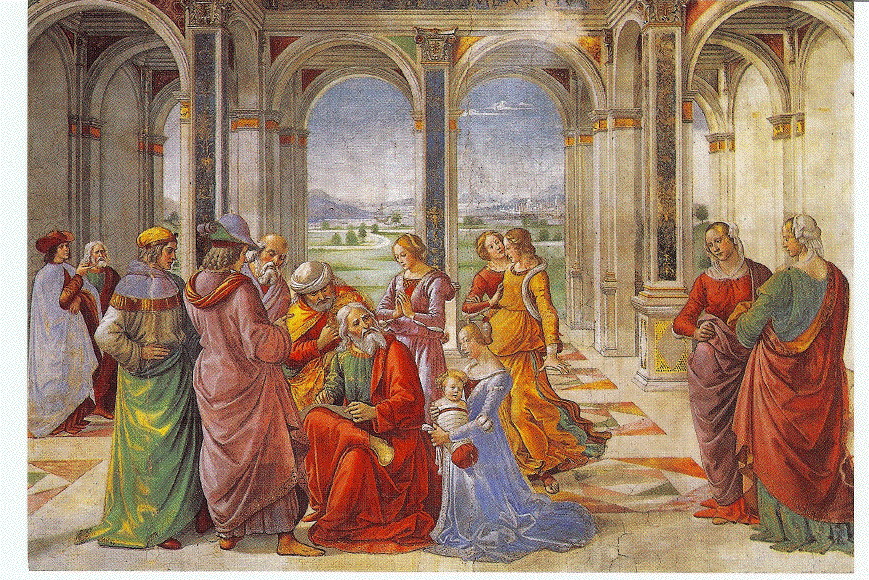
He asked for a tablet and wrote, “John is his name,”
and all were amazed.
Immediately his mouth was opened, his tongue freed,
and he spoke blessing God.
Then fear came upon all their neighbors,
and all these matters were discussed
throughout the hill country of Judea.
All who heard these things took them to heart, saying,
“What, then, will this child be?”
For surely the hand of the Lord was with him.
The child grew and became strong in spirit,
and he was in the desert until the day
of his manifestation to Israel. (1:55-67, 80)
We can see a foretelling of John, even though John is not specifically stated in the first reading from Isaiah (49:1-6), so this is definitely a very important part of history for humanity. What we need to keep in mind is that if there had not been John the Baptist, there would have been no foretelling of Jesus coming to this world. This all is rather obvious for us. But how does this really apply to us today other than understanding the Scripture?
John was a herald, a messenger in his own way; trying to help others understand who was to come. We as Christians today are called to do the same thing, yet help others understand that Jesus will return. As much as some folks try to use a fear tactic of damnation to bring others to Christ, that really isn’t our purpose. Our purpose is to show love, the love of Christ through our actions and faith. We are to be heralds and messengers, and share the Good News!
Stormy Weather ~ The Rt. Rev. Michael R. Beckett, OPI
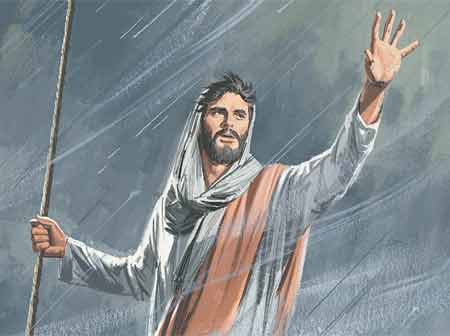
Did you ever have one of those days? You know, one of THOSE days when you were tired, when you had had enuf, when you just wanted a break? When you wanted to get away? Me, too. And apparently Jesus and the disciples had them on occasion. In the Gospel reading for today, we find that Jesus wanted to ‘cross over to the other side’ of the Sea, so that he could have some time alone, away from the crowds, and with his disciples for some quality time, I would imagine. The disciples were all for it, and away they went. Jesus needed a break. He gets in the boat, and goes to sleep.
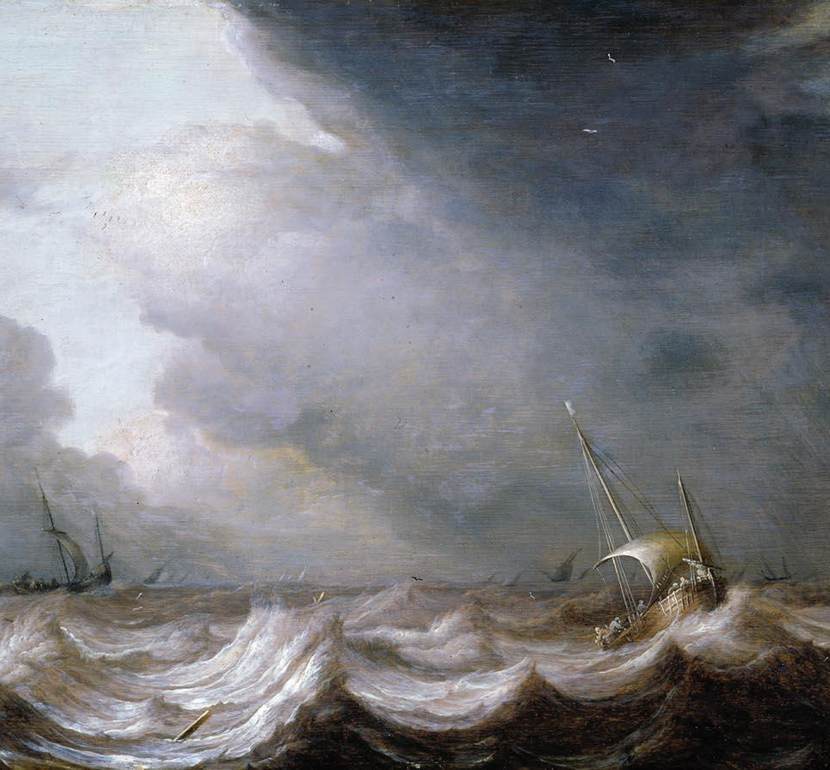
And then it stormed….. Not just your average run of the mill storm, but a STORM…..at sea even. Thunder. BOOM! Lightening. FLASH! Waves so high over the little boat that it was tossed about. CRASH! And to top it off, the boat started filling up with water. SLOSH…..Sink? And Jesus slept on. And on. And on.
And then it happened. The disciples, those stalwart fishermen, panicked; so much so that they wanted Jesus to panic, too. So, they woke him.
Now, I dunno about Jesus, and I’m pretty sure they didn’t have a Keurig on that boat, but anyone who knows me well, knows, that no matter what, one does NOT speak to the Bishop when he first wakes up until after his (at least) second cup of coffee. Can you not see Jesus? He throws the blanket off and says, WHAT?
The disciples point out the storm, Jesus’s eyes focus, and then he gets it. He understands what all the fuss is about…..and then, like so many of us, he says,
“Really?”
I can just imagine him rolling his eyes. He quiets the storm, grumbles, and goes back to sleep…..and the disciples are tripped!
This past week, we have had a storm…a dreadful, dangerous, haunting storm. And we are still in the midst of that storm. This past week, the thunder of gunshots rang out at Emmanuel AME Church in Charleston, SC. This week, there have been torrents, waves of tears. This week there have been flashes of anger. This week, we have, many of us, felt that we were in danger of sinking. This week we have, all of us, felt the sense of being overwhelmed: with sadness; with grief; with disbelief; with horror. I am certain that this week there are those who wondered if God slept.
This week, we have seen evidence, proof, that God does not sleep. That God is very much awake, and involved, in our lives. This week we have seen the families of those martyred in Charleston demonstrate to the world what Love is all about: Forgiveness. Charity. Good will. Reaching out. Love. When we heard the victims’ families say to the young man who killed their family members things like, “I forgive you.” “We will pray for you,” we know that we have seen Christ in action. This week we have seen countless thousands come together to support each other, regardless of race, religion, creed, or any of the other differences that often divide us. This week we have seen, we pray, the beginning of the end of this storm of racial divide.
This storm is far from over. FAR from over. Before this storm ends, hearts will have to change, attitudes will have to change, laws, rules, regulations, the government, will have to change, society will have to change. And before any of that can happen, WE will have to change. We will, all of us, have to examine ourselves carefully, and honestly, to find the roots of our prejudice, our fears of those who are ‘other’ than ourselves. We will have to look with new eyes at all of those with whom we come into contact, ALL of them, EVERY ONE of them, and strive to find the Jesus in each of them. The Jesus in us must reach out to the Jesus in our brothers and sisters, regardless of race, creed, color, gender, gender identity, sexual preference, ability or disability, or any of the other million and one things we use to denigrate, disgrace, and damn our brothers and sisters.
Like the disciples, we will be afraid. Sometimes we may even panic. But I can assure you that, like the disciples, we can go to Jesus. And when we do, he will say to us, “Peace. Be still.” And in the calm and quiet that results from our trust in Him, we will be able, with full hearts, learn to love our neighbors as ourselves.
Amen.
I’ve Got Confidence ~ Br. Igor Kalinski, Novice
This is what the Sovereign Lord says, “I myself will take a shoot from the very top of a cedar and plant it, I will break off a tender spring from its top most shoots and plant it on a high and lofty mountain. On the mountain heights of Israel I will plant it, it will produce branches and birds will nest in it, they will find shelter in the shade of its branches. All the trees of the field will know that I the Lord bring down of tall tree and make the low tree grow tall. I dry up the green tree and make the dry tree flourish, I the Lord have spoken and I will do it.”
Dear brothers and sisters after all the troubles that we all of us face in our everyday lives, we need to remember that God does not stop encouraging us to persevere in spite of our troubles. Life on earth is full of temptations, and His encouragement is necessary so that we may attain salvation. He doesn’t want us to be discouraged but confident! Temptations, persecutions, death, exile, the sufferings of this world: we know they are of limited time. Because of this, we should feel confident that we can count on God’s help and love. We are to maintain our faith, and to persevere. God will give us the strength to do so.
“in the body we are away from the Lord” 2cor5:6
These words are not contradictory but reminding us that in time of living here on earth, man is more in touch to the earthly things than the things of heaven. So we are warned from the word of God, dont be so self-confident in ourselves and to not be involved with the earthly pleasures that separate us far from God.
But in case someone thinks that the body is the reason we are separated from God, is also written:
”We live by faith, not by sight” 2Cor5:6
This mean that we cant have knowledge of God through the human body´s senses that are limited, that mean for example: although through looking we discover partially the world, yet to come to real knowledge of God, its necessary faith that is beyond the human senses.
Dear brothers and sisters: we have eternal home in Heaven, let us stop what separate us daily from our Lord, pray one for another, this thing don’t distract from our courage in this limited time. Eternity is the best ,and all of this worlds evils will not last for long. We to be confident in His love, in his mercy, and in His strength to help us.
Solemnity of Corpus Christi ~ The Rev. Lady Sherwood, OPI
Reading 1: EX 24:3-8 Resp Psalm: PS 116:12-13,15-16,17-18 Reading 2: HEB 9:11-15 Gospel: MK 12-16, 22-26
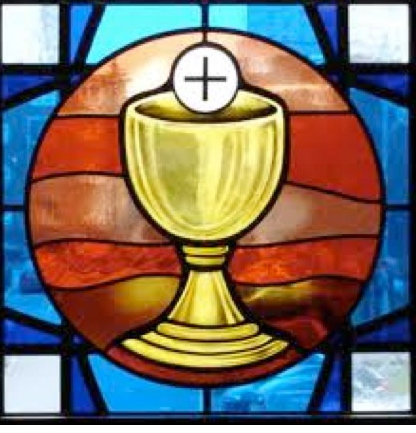
Today we celebrate the Great Feast of the Solemnity of Corpus Christi, an important feast observed by Christians throughout the world. We celebrate the fact that we as Catholics know that the Holy Eucharistic gifts of the bread and of the wine are not merely representing Christ, but truly are the body and blood of Our Lord Jesus Christ as instituted at the last supper by Our Lord Jesus and his disciples just prior to his passion.
Whilst the institution of the Eucharist occurred on Holy Thursday, the solemn nature of Holy Week and the focus on Good Friday somewhat overshadows that aspect of Holy Thursday. The Feast of Corpus Christi is held on the Thursday following Trinity Sunday, but many churches have now transferred this feast to today, the Sunday after Trinity Sunday.
The Feast of Corpus Christi, also often called The Feast of the Body and Blood of Christ, goes back to the 13th century. In 1246, Bishop Robert De Thorete of the Belgina Diocese of Liege, at the suggestion of St. Juliana of Mont, convened a synod, and at this synod the Feast of Corpus Christi was instituted from Liege. After this, the feast spread and on September 8th 1264, Pope Urban IV issued the papal “Transiturus” which established the Feast as a universal feast of the church.
At the request of Pope Urban IV, St. Thomas of Aquinas composed the office for the feast which is still used by many churches today. Until recent times, the Feast of Corpus Christi was celebrated with a Eucharist procession, in which the Host was carried throughout the town, accompanied by hymns and litanies and the faithful would venerate the Body of Christ as it passed by. Today this practice has almost but disappeared. However, some churches still hold a smaller version of the procession around the outside of their church.
In John 6:53-56 the Lord tells us: “Amen, amen, I say to you, unless you eat the flesh of the Son of man and drink his blood, you do not have life within you. Whoever eats my flesh and drinks my blood has eternal life, and I will raise him on the last day. For my flesh is true food and my blood is true drink. Whoever eats my flesh and drinks my blood remains in me and I in him.”
Let us offer to the lord this prayer of Anima Christi:
Soul of Christ, be my sanctification;
Body of Christ, be my salvation;
Blood of Christ, fill my veins;
Water of Christ’s side, wash out my stains;
Passion of Christ, my comfort be;
O good Jesu, listen to me;
In Thy wounds I fain would hide;
Ne’er to be parted from Thy side;
Guard me, should the for assail me;
Call me when my life shall fail me;
Bid me come to Thee above;
With Thy saints to sing Thy love,
World without end.
Amen.

1+1+1+1=1???? ~ Br. Chip Noon, Novice
Holy, holy, holy! Lord God Almighty!
Early in the morning our song shall rise to thee.
Holy, holy, holy! Merciful and mighty,
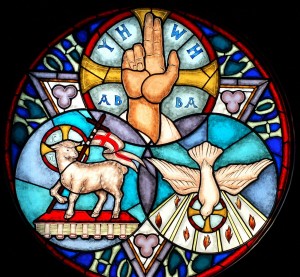
God in three persons, blessed Trinity!
In the Baltimore Catechism, of ancient (and not so venerable) memory, I learned in Number 27:
- Q. What is the Blessed Trinity?
- The Blessed Trinity is one God in three Divine Persons.
I may have learned the words, and I knew I had to recite them, but this was one of the most difficult concepts for me…and for many others, as I have found out. How can there be three persons and still one person?
Unfortunately for those of us speaking English, “person” is not a proper translation from the Greek. This is not to say that the original Greek-speaking Christians were not also perplexed by the divinity and the humanity of Jesus.
Let me start again. There are two words in Greek that translate to “person”: prosopon and hypostasis. The first means the “self-manifestation of an individual” that can be extended by other means and the second means “being” or “substantive reality.” The early church fathers had as much trouble with the concepts as I do now. But the point is that we are not talking about three distinct human beings…
OK, let me start again. The philosopher Kierkegaard wrote that the dual nature of Christ is the “ultimate paradox.” God is perfectly wise, good, powerful who became fully human, tempted by sin, limited in goodness, knowledge, and understanding. This paradox, he believed, can only be resolved by a leap of faith, away from reason and understanding toward belief in God.
And so now, I will start for the fourth time. In the first reading, Moses is exhorting the Israelites to acknowledge that the Lord is God by reminding them of the manifestations that God performed to free them all from slavery in Egypt. In the Old Testament understanding, we are still relying on proof to come to the belief in one God. In the second reading, St. Paul is exhorting the Romans to recognize that as they received the Holy Spirit, they are then heirs of God and joint heirs with Christ. Not proof, but simply remembering and accepting the gift of the Spirit.
But here is where he throws in the kicker: “…if only we suffer with him so that we may also be glorified with him.”
In the early days of Christianity, to suffer was a real and present possibility. Today, some around the world still face this kind of physical suffering. But we, fortunate as we are, can only suffer with him in our prayer, our study, our life of preaching, our throwing aside proof and evidence; and through contemplation and proactive living accept in our minds, hearts, and souls the faith which we proclaim.
And Jesus said,
“All power in heaven and on earth has been given to me.
Go, therefore, and make disciples of all nations,
baptizing them in the name of the Father,
and of the Son, and of the Holy Spirit,
teaching them to observe all that I have commanded you.
And behold, I am with you always, until the end of the age.”
Ultimately, the Trinity is not about Greek words, theological concepts, metaphysical speculation, but about observing all that Jesus commanded – the heart of our salvation, and recognizing finally that he is with us always, until the end of the age.
Lord, as we celebrate the Solemnity of the Holy Trinity, may we enter into your peace with calm gratitude and joyful acceptance of your message, that we love you and we love our neighbors as ourselves. Help us in our faith and help us in our suffering to become one with you, your Son, and the Holy Spirit.
Amen.

Happy Birthday!!! ~ Br. Michael Marshall, Novice
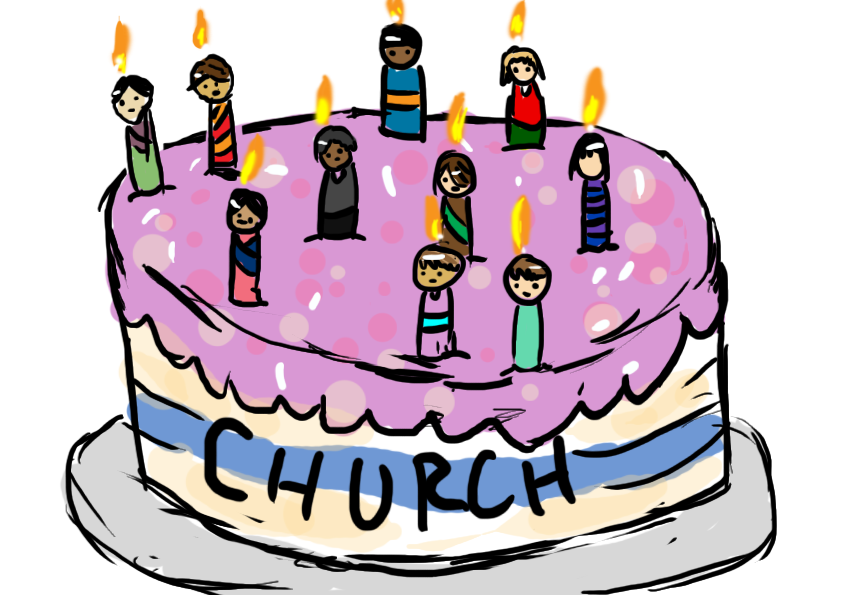
Let’s all sing…
Happy Birthday to You,
Happy Birthday to You,
Happy Birthday, Church,
Happy Birthday to You!!!
Streamers, balloons, a banner, people blowing through noise makers… and a big cake! Well okay, Pentecost is not that kind of birthday party, but it is a celebration of the beginning of the Church. Instead of these fun festive things, we remember things which took place that are even more awesome!
And they were all filled with the Holy Spirit and began to speak in different tongues, as the Spirit enabled them to proclaim. Now there were devout Jews from every nation under heaven staying in Jerusalem. At this sound, they gathered in a large crowd, but they were confused because each one heard them speaking in his own language. (Acts 2:3-6)
The Holy Spirit put things into motion for Christianity as it descended upon the Apostles and others present. If the Holy Spirit had not come down, the Church would not be what it is today because the Gospel would not have spread beyond Jesus’ closest followers. The fact the people received the gift of the ability to speak in various languages; they could go off to spread the Gospel to others than of their own native language. We would not be able to be a witness to others today. Jesus makes the point in the Gospel:
“I have much more to tell you, but you cannot bear it now. But when he comes, the Spirit of truth, he will guide you to all truth. He will not speak on his own, but he will speak what he hears, and will declare to you the things that are coming. He will glorify me, because he will take from what is mine and declare it to you. Everything that the Father has is mine; for this reason I told you that he will take from what is mine and declare it to you.” (John 16:12-15)
The message of Jesus is the truth, and because the disciples were given the gift to teach what Jesus instructed in languages other than their own, teaching the truth of what is yet to come has been passed on. The message was not to stay with the disciples. Because the Gospel has been spread throughout the world and through history, it is not intended to remain with us. We are called to be witnesses of the Gospel for others to spread the message so that they may also spread the message.
There are so many individuals and groups who need to hear the Gospel, and they often hear the opposite of the Gospel. They hear the message of ignorance, indifference, or even hate because of social status, ethnicity, gender preference, or disability. I have seen posters at “Christian” rallies which say, “God hates Gays” and “God is White”. I read a news article which was about a city making it illegal to aid the homeless, and it hurts me deeply to see people who claim they are Christian only turn away from the Gospel. Jesus did not avoid the leper and other “impure” people, but instead he reached out to also minister to them. It is not always easy to love our neighbor, but it is our call to be witnesses of the Gospel to everybody. Are you spreading the Gospel???

The Unknown Disciple ~ The Rt. Rev. Michael Beckett, OPI

In Arlington National Cemetery, there is a tomb; a beautiful tomb, the Tomb of the Unknown Soldiers. In this tomb lie the remains of soldiers who were not able to be identified after their deaths from America’s wars since the 1st World War. Britain, Australia, France, Belgium, Bulgaria, Serbia, and a host of other countries also honor their unknown warriors. Those who lie in repose have no known names, no known family, no known history, but they are celebrated for what they did, for what they represent. They gave their all.
In the church, we don’t necessarily have a “Tomb of the Unknowns” but we do have a Feast Day to honor our unknown heroes. That day is, of course, 1 November, The Solemnity of All Saints, in honor of all the saints, known and unknown.
Now you’re saying to me, what in the world does All Saints Day have to do with the last Sunday in Eastertide???? Well, let’s think about that for a minute. In the first reading of the Scriptures appointed for today, from the first chapter of Acts, we learn that a new Apostle is chosen to replace Judas Iscariot. It would seem that there were two choices for the job. Matthias and Judas Barsabbas. Both of these men had been with Jesus FROM THE BEGINNING WHEN JESUS WAS BAPTIZED. What? There were more than the 12 original disciples? We tend to forget that, don’t we? In Luke 10: 1-24, we are told that Jesus sent out 70 men, 2 by 2 into every place that he was planning on going.
Church tradition holds that both of these men were 2 of that 70.
In the first sentence of our readings today, we learn that Peter was speaking to 120 folks.
Now, granted, you can ask just about anyone who knows me, and they will tell you that I’m pretty inept when it comes to math, but I DO know that 70 minus 2 is 68, and 120 – 2 is 118. Which leads me to ask, “Who are these people? Who are these 118 people who figured so prominently in spreading the Gospel? Who are these 118 people who were so devoted to Jesus that they risked imprisonment, some of them death; who risked losing everything to hang out in Jerusalem after the crucifixion and resurrection because Jesus told them to be there and to wait?”
Let’s think about that for a minute. We can whittle that number down some more…… Acts 1:13-15 says, “And when they were come in, they went up into an upper room, where abode both Peter, and James, and John, and Andrew, Philip, and Thomas, Bartholomew, and Matthew, James the son of Alphaeus, and Simon Zelotes, and Judas the brother of James. These all continued with one accord in prayer and supplication, with the women, and Mary the mother of Jesus, and with his brethren.” So there are a few of them. And then, we would expect that those mentioned in Acts 6:5 had been among the 70 and the 120 (Stephen, Philip, Prochorus, Nicanor, Timon, Parmenas, Nicolas), also Barnabas. These were men of good reputation, full of the Holy Spirit and wisdom.
Women were also identified to be among the 120. The wives of the apostles were there (1 Cor. 9:5 “Have we not power to lead about a sister, a wife, as well as other apostles, and as the brethren of the Lord, and Cephas?”). Each of the wives was a devout believer in Christ. Part of the number of women would be those mentioned in Luke 8:1-3. “And it came to pass afterward, that he went throughout every city and village, preaching and shewing the glad tidings of the kingdom of God: and the twelve were with him, And certain women, which had been healed of evil spirits and infirmities, Mary called Magdalene, out of whom went seven devils, And Joanna the wife of Chuza Herod’s steward, and Susanna, and many others, which ministered unto him of their substance.” See also Matt. 27:55-56; Luke 23:49,55. We would expect that the sisters of Jesus were also believers by this time, as His brothers had become.
Jesus brothers, had not been believers before the Crucifixion (John 7:3-5). Now they were firm in their faith and devotion to Him. These were: James, Joses, Simon, Judas (Matt. 13:55-56). James the Just was the leader of the Jerusalem Church in Acts 15:13. He is called an apostle in Gal. 1:19, although not one of the Twelve. James was the author of the Book of James. Judas was the author of the Book of Jude.
So….that leaves us with how many folks we don’t know? I lost count, I hate math, and it really doesn’t matter does it? What DOES matter is that we don’t know who, exactly, all of these people were. What we DO know, is what they did.
These were they who supported the Apostles. These were they who were in the upper room on the day of Pentecost. These were they who worked so diligently, some to the point of sacrificing their lives, to spread the message of the Gospel. These were they who were on fire for Christ. These were they to whom we look to be, or we should look to be, examples.
Who were they? Their names don’t matter. They lived 2000 years ago and they are lost to us. In 2000 years, in 100 years, most of our names will be lost. But what matters is what won’t be lost. What matters is what we do and say and proclaim, so that those who come after us will know, will experience, will be able to live, the truth and the joy of the Gospel.
My dear friends, we do not live in a vacuum. Everything that we do, everything that we say, has an effect on someone. And that someone has an effect on someone else. We see this everyday of our lives. You hear of things ‘going viral’ on the internet. Someone had to start it. Some ONE posted something that was liked….and liked….and shared and shared and shared. Is this not what those 120 people in the upper room did? Is this not what we are called to do?
In your everyday life, how often do you reference Christ? Now, I’m not talking about quoting Scripture. I’m talking about demonstrating who Christ is, showing the world Christ’s love, his Salvation? What is it that you do, or say, or write, or post, that will touch someone in a way you never imagined? I dare say you will never know. BUT, we all of us need to remember that we DO touch lives, lives we don’t even know exist. We touch lives that are unknown to us. We are touched by people who are unknown to us.
Besides those 100+ folks in the upper room, besides us, how many others have there been? How many saints? How many martyrs? How many unnamed, unwritten about people have left us with the legacy of Our Lord? Revelations 7 tells us: “I beheld, and, lo, a great multitude, which no man could number, of all nations, and kindreds, and people, and tongues, stood before the throne, and before the Lamb, clothed with white robes, and palms in their hands; These are they which came out of great tribulation, and have washed their robes, and made them white in the blood of the Lamb.” The unnamed disciples.
I plan on being in that ‘great multitude.’ I plan on being one of those “unnamed disciples.” Won’t you join me? Won’t you work to spread the love, the message, the salvation of our Lord and Savior? Amen.
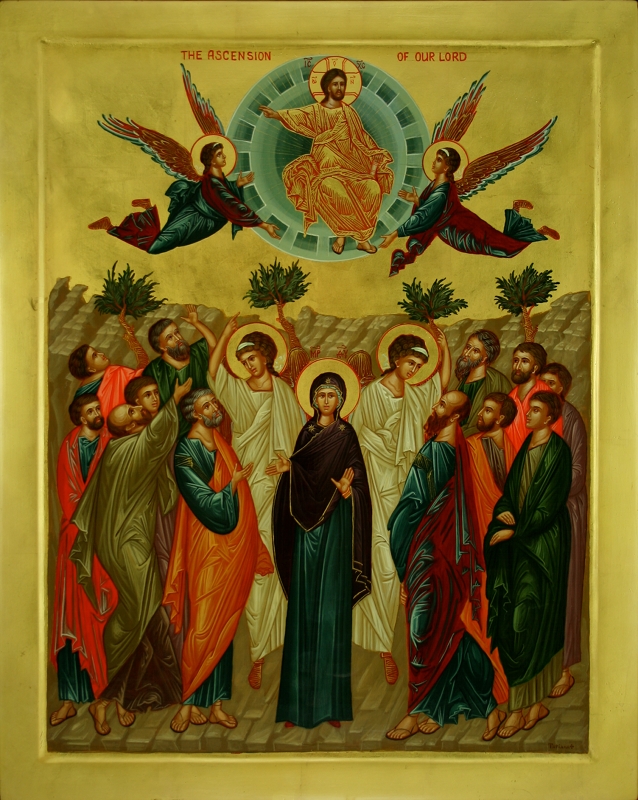
The Ascension of Our Lord ~ Br. Igor Kalinski
 Today is the Feast of the Ascension of our Lord. I want to respond of one question that some people are asking in regards to the ascension of our Lord. They are asking, “Why did the Lord have to ascend to heaven? Would it not be much better for him to have remained eternally here on Earth, helping the people in sadness and poverty?”
But brothers and sisters if it was necessary and more useful for us for Lord Jesus Christ to stay on the Earth, he would stay. We know His endless love for us, we know his sacrifice for us. We have to believe that if it was better for Him to stay forever on the Earth, He would have done just that, but he ascended, and that means that it better for us that He left the Earth. Why? Because he wanted to destroy that spiritual wall that separated Heaven from Earth, and to pour on the Earth those merciful gifts of the Holy Spirit which though was designed for humans, they were not yet made available.
All barriers to the reconciliation of humans with God were removed when our Savior ascended into the Heavens and he sent to the earth heavenly treasures, prepared since the creation of the world, in the form of the Gifts of the Spirit.
Jesus Christ says to his disciples in John 16:7 “But very truly I tell you, it is for your good that I am going away. Unless I go away, the Advocate will not come to you; but if I go, I will send him to you.” He left and on Pentecost he sent the Holy Spirit who came down upon the apostles and to those that believed (Acts 2:1-4). It is this Holy Spirit who now resides in the Holy Church, and his gifts we are given in the Holy Sacraments.
The other reason for the ascension of our Lord is revealed by our Lord Jesus Christ. At the last supper He told to his disciples “My Father’s house has many rooms; if that were not so, would I have told you that I am going there to prepare a place for you? (John 14:2). Humanity is not designed to live eternally on the earth. In Psalm 89 it says: 48 What man is he that liveth, and shall not see death? shall he deliver his soul from the hand of the grave? Ps 89:48
We are newcomers in that Earth. We are travelers. Saint Paul the Apostle Paul writes: For here we do not have an enduring city, but we are looking for the city that is to come (Hebrews 13:14). We travel in the city of Living God (Hebrew 12:22) to the home of Heavenly Father (John 14:2)
But that “home” was closed until we were redeemed by Jesus Christ. The Savior with his glorified (though human) body ascended into heaven; he went home to his Father.
There are, according to our Lord Jesus Christ: “many mansions” prepared for us. (John 14:2) (John 14:2-3)
Brothers and sisters, lets live well, let us work toward receiving those mansions. Let us work to show the love of our Lord to the world, so that we, too, may ascend to heaven to be with our Lord.
With thoughts, with feelings, with wishes, with aspirations, with acts, more and more to lift up high, let us strive to the pure, the holy, the heavenly, and the divine.
Amen.
 The Order of Preachers, Independent
You must be logged in to post a comment.