
Category: Sermon

Happy Birthday!!! ~ Br. Michael Marshall, Novice
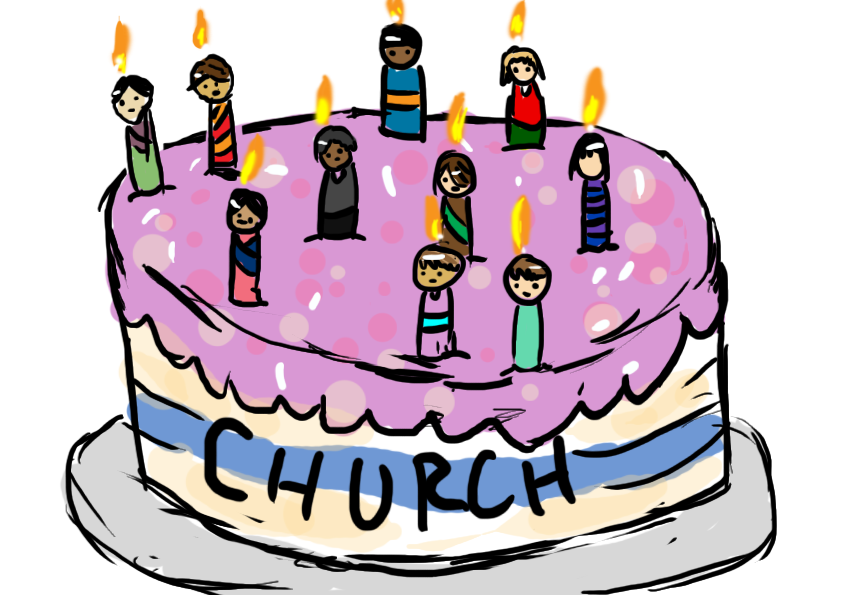
Let’s all sing…
Happy Birthday to You,
Happy Birthday to You,
Happy Birthday, Church,
Happy Birthday to You!!!
Streamers, balloons, a banner, people blowing through noise makers… and a big cake! Well okay, Pentecost is not that kind of birthday party, but it is a celebration of the beginning of the Church. Instead of these fun festive things, we remember things which took place that are even more awesome!
And they were all filled with the Holy Spirit and began to speak in different tongues, as the Spirit enabled them to proclaim. Now there were devout Jews from every nation under heaven staying in Jerusalem. At this sound, they gathered in a large crowd, but they were confused because each one heard them speaking in his own language. (Acts 2:3-6)
The Holy Spirit put things into motion for Christianity as it descended upon the Apostles and others present. If the Holy Spirit had not come down, the Church would not be what it is today because the Gospel would not have spread beyond Jesus’ closest followers. The fact the people received the gift of the ability to speak in various languages; they could go off to spread the Gospel to others than of their own native language. We would not be able to be a witness to others today. Jesus makes the point in the Gospel:
“I have much more to tell you, but you cannot bear it now. But when he comes, the Spirit of truth, he will guide you to all truth. He will not speak on his own, but he will speak what he hears, and will declare to you the things that are coming. He will glorify me, because he will take from what is mine and declare it to you. Everything that the Father has is mine; for this reason I told you that he will take from what is mine and declare it to you.” (John 16:12-15)
The message of Jesus is the truth, and because the disciples were given the gift to teach what Jesus instructed in languages other than their own, teaching the truth of what is yet to come has been passed on. The message was not to stay with the disciples. Because the Gospel has been spread throughout the world and through history, it is not intended to remain with us. We are called to be witnesses of the Gospel for others to spread the message so that they may also spread the message.
There are so many individuals and groups who need to hear the Gospel, and they often hear the opposite of the Gospel. They hear the message of ignorance, indifference, or even hate because of social status, ethnicity, gender preference, or disability. I have seen posters at “Christian” rallies which say, “God hates Gays” and “God is White”. I read a news article which was about a city making it illegal to aid the homeless, and it hurts me deeply to see people who claim they are Christian only turn away from the Gospel. Jesus did not avoid the leper and other “impure” people, but instead he reached out to also minister to them. It is not always easy to love our neighbor, but it is our call to be witnesses of the Gospel to everybody. Are you spreading the Gospel???

The Unknown Disciple ~ The Rt. Rev. Michael Beckett, OPI

In Arlington National Cemetery, there is a tomb; a beautiful tomb, the Tomb of the Unknown Soldiers. In this tomb lie the remains of soldiers who were not able to be identified after their deaths from America’s wars since the 1st World War. Britain, Australia, France, Belgium, Bulgaria, Serbia, and a host of other countries also honor their unknown warriors. Those who lie in repose have no known names, no known family, no known history, but they are celebrated for what they did, for what they represent. They gave their all.
In the church, we don’t necessarily have a “Tomb of the Unknowns” but we do have a Feast Day to honor our unknown heroes. That day is, of course, 1 November, The Solemnity of All Saints, in honor of all the saints, known and unknown.
Now you’re saying to me, what in the world does All Saints Day have to do with the last Sunday in Eastertide???? Well, let’s think about that for a minute. In the first reading of the Scriptures appointed for today, from the first chapter of Acts, we learn that a new Apostle is chosen to replace Judas Iscariot. It would seem that there were two choices for the job. Matthias and Judas Barsabbas. Both of these men had been with Jesus FROM THE BEGINNING WHEN JESUS WAS BAPTIZED. What? There were more than the 12 original disciples? We tend to forget that, don’t we? In Luke 10: 1-24, we are told that Jesus sent out 70 men, 2 by 2 into every place that he was planning on going.
Church tradition holds that both of these men were 2 of that 70.
In the first sentence of our readings today, we learn that Peter was speaking to 120 folks.
Now, granted, you can ask just about anyone who knows me, and they will tell you that I’m pretty inept when it comes to math, but I DO know that 70 minus 2 is 68, and 120 – 2 is 118. Which leads me to ask, “Who are these people? Who are these 118 people who figured so prominently in spreading the Gospel? Who are these 118 people who were so devoted to Jesus that they risked imprisonment, some of them death; who risked losing everything to hang out in Jerusalem after the crucifixion and resurrection because Jesus told them to be there and to wait?”
Let’s think about that for a minute. We can whittle that number down some more…… Acts 1:13-15 says, “And when they were come in, they went up into an upper room, where abode both Peter, and James, and John, and Andrew, Philip, and Thomas, Bartholomew, and Matthew, James the son of Alphaeus, and Simon Zelotes, and Judas the brother of James. These all continued with one accord in prayer and supplication, with the women, and Mary the mother of Jesus, and with his brethren.” So there are a few of them. And then, we would expect that those mentioned in Acts 6:5 had been among the 70 and the 120 (Stephen, Philip, Prochorus, Nicanor, Timon, Parmenas, Nicolas), also Barnabas. These were men of good reputation, full of the Holy Spirit and wisdom.
Women were also identified to be among the 120. The wives of the apostles were there (1 Cor. 9:5 “Have we not power to lead about a sister, a wife, as well as other apostles, and as the brethren of the Lord, and Cephas?”). Each of the wives was a devout believer in Christ. Part of the number of women would be those mentioned in Luke 8:1-3. “And it came to pass afterward, that he went throughout every city and village, preaching and shewing the glad tidings of the kingdom of God: and the twelve were with him, And certain women, which had been healed of evil spirits and infirmities, Mary called Magdalene, out of whom went seven devils, And Joanna the wife of Chuza Herod’s steward, and Susanna, and many others, which ministered unto him of their substance.” See also Matt. 27:55-56; Luke 23:49,55. We would expect that the sisters of Jesus were also believers by this time, as His brothers had become.
Jesus brothers, had not been believers before the Crucifixion (John 7:3-5). Now they were firm in their faith and devotion to Him. These were: James, Joses, Simon, Judas (Matt. 13:55-56). James the Just was the leader of the Jerusalem Church in Acts 15:13. He is called an apostle in Gal. 1:19, although not one of the Twelve. James was the author of the Book of James. Judas was the author of the Book of Jude.
So….that leaves us with how many folks we don’t know? I lost count, I hate math, and it really doesn’t matter does it? What DOES matter is that we don’t know who, exactly, all of these people were. What we DO know, is what they did.
These were they who supported the Apostles. These were they who were in the upper room on the day of Pentecost. These were they who worked so diligently, some to the point of sacrificing their lives, to spread the message of the Gospel. These were they who were on fire for Christ. These were they to whom we look to be, or we should look to be, examples.
Who were they? Their names don’t matter. They lived 2000 years ago and they are lost to us. In 2000 years, in 100 years, most of our names will be lost. But what matters is what won’t be lost. What matters is what we do and say and proclaim, so that those who come after us will know, will experience, will be able to live, the truth and the joy of the Gospel.
My dear friends, we do not live in a vacuum. Everything that we do, everything that we say, has an effect on someone. And that someone has an effect on someone else. We see this everyday of our lives. You hear of things ‘going viral’ on the internet. Someone had to start it. Some ONE posted something that was liked….and liked….and shared and shared and shared. Is this not what those 120 people in the upper room did? Is this not what we are called to do?
In your everyday life, how often do you reference Christ? Now, I’m not talking about quoting Scripture. I’m talking about demonstrating who Christ is, showing the world Christ’s love, his Salvation? What is it that you do, or say, or write, or post, that will touch someone in a way you never imagined? I dare say you will never know. BUT, we all of us need to remember that we DO touch lives, lives we don’t even know exist. We touch lives that are unknown to us. We are touched by people who are unknown to us.
Besides those 100+ folks in the upper room, besides us, how many others have there been? How many saints? How many martyrs? How many unnamed, unwritten about people have left us with the legacy of Our Lord? Revelations 7 tells us: “I beheld, and, lo, a great multitude, which no man could number, of all nations, and kindreds, and people, and tongues, stood before the throne, and before the Lamb, clothed with white robes, and palms in their hands; These are they which came out of great tribulation, and have washed their robes, and made them white in the blood of the Lamb.” The unnamed disciples.
I plan on being in that ‘great multitude.’ I plan on being one of those “unnamed disciples.” Won’t you join me? Won’t you work to spread the love, the message, the salvation of our Lord and Savior? Amen.
The Ascension of Our Lord ~ Br. Igor Kalinski
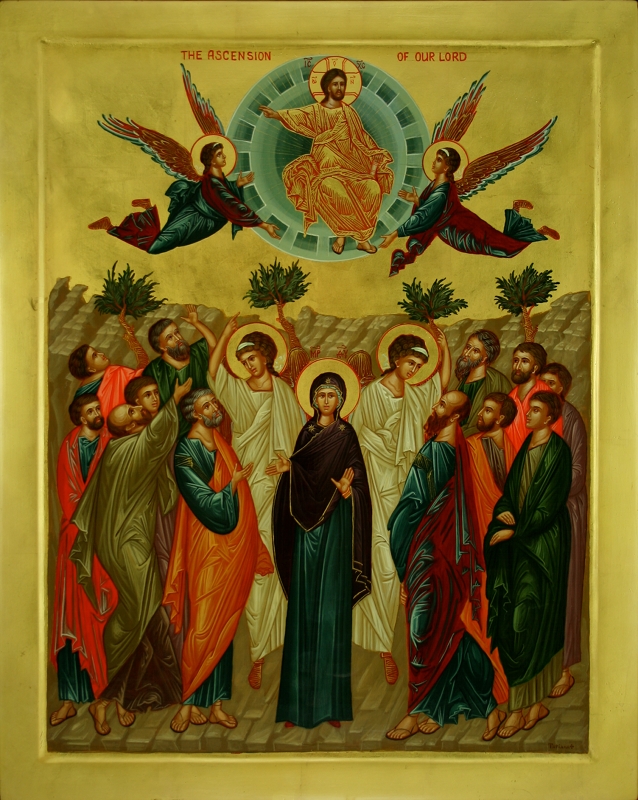
 Today is the Feast of the Ascension of our Lord. I want to respond of one question that some people are asking in regards to the ascension of our Lord. They are asking, “Why did the Lord have to ascend to heaven? Would it not be much better for him to have remained eternally here on Earth, helping the people in sadness and poverty?”
But brothers and sisters if it was necessary and more useful for us for Lord Jesus Christ to stay on the Earth, he would stay. We know His endless love for us, we know his sacrifice for us. We have to believe that if it was better for Him to stay forever on the Earth, He would have done just that, but he ascended, and that means that it better for us that He left the Earth. Why? Because he wanted to destroy that spiritual wall that separated Heaven from Earth, and to pour on the Earth those merciful gifts of the Holy Spirit which though was designed for humans, they were not yet made available.
All barriers to the reconciliation of humans with God were removed when our Savior ascended into the Heavens and he sent to the earth heavenly treasures, prepared since the creation of the world, in the form of the Gifts of the Spirit.
Jesus Christ says to his disciples in John 16:7 “But very truly I tell you, it is for your good that I am going away. Unless I go away, the Advocate will not come to you; but if I go, I will send him to you.” He left and on Pentecost he sent the Holy Spirit who came down upon the apostles and to those that believed (Acts 2:1-4). It is this Holy Spirit who now resides in the Holy Church, and his gifts we are given in the Holy Sacraments.
The other reason for the ascension of our Lord is revealed by our Lord Jesus Christ. At the last supper He told to his disciples “My Father’s house has many rooms; if that were not so, would I have told you that I am going there to prepare a place for you? (John 14:2). Humanity is not designed to live eternally on the earth. In Psalm 89 it says: 48 What man is he that liveth, and shall not see death? shall he deliver his soul from the hand of the grave? Ps 89:48
We are newcomers in that Earth. We are travelers. Saint Paul the Apostle Paul writes: For here we do not have an enduring city, but we are looking for the city that is to come (Hebrews 13:14). We travel in the city of Living God (Hebrew 12:22) to the home of Heavenly Father (John 14:2)
But that “home” was closed until we were redeemed by Jesus Christ. The Savior with his glorified (though human) body ascended into heaven; he went home to his Father.
There are, according to our Lord Jesus Christ: “many mansions” prepared for us. (John 14:2) (John 14:2-3)
Brothers and sisters, lets live well, let us work toward receiving those mansions. Let us work to show the love of our Lord to the world, so that we, too, may ascend to heaven to be with our Lord.
With thoughts, with feelings, with wishes, with aspirations, with acts, more and more to lift up high, let us strive to the pure, the holy, the heavenly, and the divine.
Amen.

All You Need Is Love ~ Br. Dominic Ferrante, Novice

Why is it so hard now a days to practice the main point in Jesus’ teaching. Recent events such as the riots in Baltimore and Ferguson show how far we are from living up to the standard Christ has set for us. Racial intolerance, homophobia, and general dislike of other people permeate our society today. So called Christians such as the Westboro Baptist Church will picket fallen military personnel’s funerals and had even planned to picket the funeral of nine Amish children who were killed in a fire in Pennsylvania. How can this be Christianity? These actions go against all Christ has taught us and exemplified in his life.
Is this love, is this following Christ’s teaching? In today’s gospel Christ says “ This is my commandment : Love one another as I love you. No one has greater love than this.” It sounds pretty simple doesn’t it? Christ’s commandment to us was love each other unconditionally as he loves us unconditionally. We may personally not like some of the things others do, but Christ implores us to love them and forgive them.
As true Christians we must enlighten people to the fact that Christ loves unconditionally. There is no “ I love you only if….” or “I love you only if you do this….” it is simply I love you and I accept you for who you are flaws and all because I myself am flawed. We can practice this in our daily lives by being more tolerant towards what we do not understand and by forgiving others short comings as we hope they will forgive them in us.
Just by showing kindness, acceptance, and love towards people of all religions and faiths we are helping to improve ourselves and truly practice what Christ teaches.
If we are truly to be disciples of Christ this would seem obvious wouldn’t it? To love one another with the purity and passion Christ has for us is the ultimate ideal. It takes much more emotional effort to hate and misunderstand then to love and accept. Love breeds love, hate breeds hate. Will we always be able to live up this ideal? Probably not, for we are human and not infallible like Christ was. All we can do is try to hold ourselves to Christ’s commandment and strive to succeed at all times.
Christ has chosen us to go forth and practice the love He has for us upon other people. By doing this we are tending a garden and by nurturing and loving this garden as He did we can insure that Christ’s message of love is spread and practiced throughout the world. “ This I command you : love one another.”
And in the words of Paul McCartney and John Lennon “ All you need is love!”
John 15: 9-17 Jesus said to his disciples: “As the Father loves me, so I also love you. Remain in my love. If you keep my commandments, you will remain in my love,
just as I have kept my Father’s commandments and remain in his love.
“I have told you this so that my joy may be in you and your joy might be complete. This is my commandment: love one another as I love you. No one has greater love than this,
to lay down one’s life for one’s friends. You are my friends if you do what I command you. I no longer call you slaves, because a slave does not know what his master is doing.
I have called you friends, because I have told you everything I have heard from my Father. It was not you who chose me, but I who chose you and appointed you to go and bear fruit that will remain,
so that whatever you ask the Father in my name he may give you.
This I command you: love one another.”

Got Fruit??? ~ The Rt. Rev. Michael Beckett, OPI

Late spring has come to the beach and Scott has planted a garden of sorts. Because our soil is mostly non-existent and mostly sand, he is doing the ‘container gardening thing.’ He has planted cucumbers, and squash (two kinds), and tomatoes (4 kinds). He has managed to put together a trellis system so that all of these vining plants can grow, and grow, and grow. He feeds, fertilizes, and waters, and really pays attention to these plants. Why? Why go through all that trouble?
So these plants can produce fruit. The goal of the garden is the fruit.
And so it is with God. Did you know that God is a farmer?
Jesus said to his disciples: “I am the true vine, and my Father is the vine grower. He takes away every branch in me that does not bear fruit, and every one that does he prunes so that it bears more fruit. You are already pruned because of the word that I spoke to you. Remain in me, as I remain in you. Just as a branch cannot bear fruit on its own unless it remains on the vine, so neither can you unless you remain in me. I am the vine, you are the branches. Whoever remains in me and I in him will bear much fruit, because without me you can do nothing. Anyone who does not remain in me will be thrown out like a branch and wither; people will gather them and throw them into a fire and they will be burned. If you remain in me and my words remain in you, ask for whatever you want and it will be done for you. By this is my Father glorified, that you bear much fruit and become my disciples.”
God has planted people. We are his garden, and he wants to produce fruit. You and I were created by God for a purpose—to produce fruit for God. But what kind of fruit is God looking for? He is looking for obedience, righteousness, worship, and glory from his creation. But if we are God’s garden, and if we are created to produce fruit for him, we arrive at a fundamental question: How can we be sure that God is pleased with our fruit?
Each and every religion has a different way of answering that question. What will it take for us to be acceptable to God? Do we need to follow a strict set of rules and regulations? Do we need to perform certain sacrifices and rituals? What do we do with the nagging feeling that we do not measure up?
Let’s talk about that.
In verse 1 of our reading today, Jesus says, “I am the true vine, and my Father is the vine grower.” Did you notice the “the” in there? Jesus did not say, “I am like a vine.” He is not just comparing himself to a vine. He is the vine. Similarly, he doesn’t say, “I am a vine,” as though there were many vines, and he is just one of them. No, Jesus says, “I am the vine,” the one and only vine.
But that is not all. Instead of simply saying, “I am the vine,” he says, “I am the true vine.” But what does that mean? How can a vine be true? The word true is the whole point. We then ask the question: If Jesus is the true vine, who or what is the untrue vine?
In today’s world, there are many “untrue vines:” money, popularity, power. All of these produce fruit. But is it fruit that matters?
Jesus is the vine, and He said that we are the branches. In verse 5 Jesus tells his disciples, “I am the vine, and you are the branches.” Jesus makes it clear that there are two different kinds of branches: fruitful branches and unfruitful branches.
Which one are you? Are you a fruitful branch? Do you produce what is pleasing to God? Or are you an unfruitful branch? How can you be sure of which one you are? This passage tells us there is only one difference between the two. Fruitful branches abide in the vine. Verses 5 and 6 explain this clearly:
Whoever abides in me and I in him, he it is that bears much fruit, for apart from me you can do nothing. If anyone does not abide in me he is thrown away like a branch and withers; and the branches are gathered, thrown into the fire, and burned.
So the secret of the fruitful branches is that they abide in Jesus. What does it mean to abide? Abide basically means “to remain,” “to stay put,” “to linger in one place,” “to dwell,” “to stay connected.” The most important thing for a branch to do is to stay connected to the vine. Only a branch that receives life-giving sap from the vine will live and bear fruit.
And so it is with us. Are you connected to Jesus? Picture a lamp. What is the purpose of a lamp? What is the “fruit” of the lamp? Light. What has to happen before that lamp can work? It has to have a bulb. It has to be turned on. It has to be connected to a power source. And you say to me, Bishop, what does this have to do with vines? Let me tell you. The bulb of the lamp is our soul, our faith. We have to turn on our faith by prayer and study….but does that shed any light? Not if the lamp isn’t plugged in it doesn’t. In order for the lamp to work properly, or at all, it must be plugged in to the power source. Like us. We must be “plugged in” to Jesus. Before we can bear any fruit at all, we must be connected to Jesus. He must be our Power, our Strength, our Source.
And what, exactly, is our fruit to be? We are told in Paul’s letter to the Galatians, Chapter 5, verses 22-23, “But the fruit of the Spirit is love, joy, peace, patience, kindness, goodness, faithfulness, gentleness and self-control.” The fruit of the Holy Spirit is the result of the Holy Spirit’s presence in the life of a Christian. And so, what is it that our Christ expects of us? He was pretty specific about it. In Matthew 22: 36-40, Jesus says, “’Love the Lord your God with all your heart and with all your soul and with all your mind.’ This is the first and greatest commandment. And the second is like it: ‘Love your neighbor as yourself.’ All the Law and the Prophets hang on these two commandments.”
How can you, how DO you, show the world Christ’s love? How do you show the world that our Christ IS love? DO you produce fruit? What kind of branch are you?
Father God, You are indeed the Supreme Gardener. We ask that you tend to us, nurture us, help us to grow and to bear fruit for You, that the world might see your love, and that we may bring others to the Light of your Salvation. Through Christ our Lord, Amen.
Jesus, The Good Shepherd ~ The Rev. Lady Sherwood, OPI
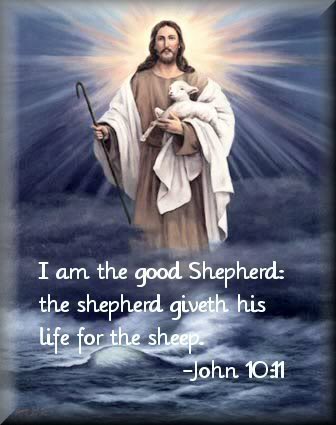
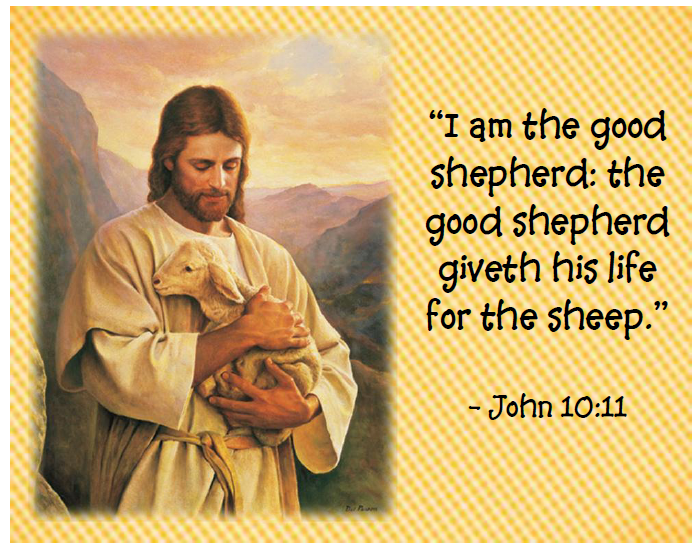 Good Shepherding is all about feeding the lambs and the sheep, bringing them together in good pastures. It is about making sure they have enough water, and that when needed the sheep are groomed, clipped and sheared. It is about delivering new lambs, and leading the sheep. It is about going to find them when they wander and returning them to the fold. It is about protecting the sheep from danger. Our Lord Jesus is the Good Shepherd and we as his people are his sheep. Just like sheep, we need feeding. Our Lord feeds and nourishes us by the true word in the Holy Scriptures. We are given water by baptism into the Holy Spirit.
The Lord grooms us by keeping us clean and free from the contamination of the world through his forgiveness of sins for all who truly love and believe in him. When we need it, we are sheared by discipline. He encourages and rebukes us so to prepare us more fully for eternal life with him. The Lord delivers new lambs as we are born again in newness of life in him. The Lord protects us and saves us from sin, the evil of the devil and from death. A Good Shepherd will lay down his life for his sheep just as the Lord Jesus willingly came to earth, was made man and willingly suffered death by being crucified on our behalf so that our sins would be forgiven and we could have the chance of eternal life in him. (JN 10: 11)-I am the good shepherd. A good shepherd lays down his life for his sheep.
Let us thank the Lord with all our hearts for Him being the Good Shepherd, who loves each and every one of us, even though we are not worthy.

Heartburn? ~ Br. Chip Noon, Novice

“Were not our hearts burning [within us] while he spoke to us on the way and opened the scriptures to us?”
Were not our hearts burning?…to me these are some of the most comforting words in all of the Bible. Were not our hearts burning? The intimations of immortality that each of us experience in our lives, if we are lucky, the knowledge that, yes, indeed He is Risen.
Poets have felt this, and perhaps unknowingly, set it to paper, this feeling that there is a truth and a comfort deep within us waiting for the right word, the right gesture, to bring us into the light. Wordsworth wrote:
O joy! that in our embers
Is something that doth live,
That nature yet remembers
What was so fugitive!
Yet we read, as the father of the stricken boy in Mark says to Jesus, “Lord, I believe; help thou mine unbelief.” And even here, in acknowledging doubt and the fear of having no faith at all, don’t we find the slightest light still burning? An ember never extinguished that will always be glowing deep within us – the promise of immortality shown us by Jesus?
In today’s reading from Acts, Peter goes even further and, teaching the people the Good News, reveals his own faith and even the small saving words “Now I know, brothers, that you acted out of ignorance….” Even here, we see the glow of salvation fanned by the Apostle and offered to the people. All he asked them to do was repent, as John in today’s second reading urges us to do as well: “The way we may be sure that we know him is to keep his commandments.”
And what are those commandments? The 10 Moses brought down from the mountain? The Laws in Leviticus? The observance of the rituals of piety?
Jesus gave us two commandments: “Love the Lord your God with all your heart and with all your soul and with all your strength and with all your mind’; and, ‘Love your neighbor as yourself.”
Two commandments. His task is easy and his burden is light. Love God and Love Your Neighbor.
Love God. Love Your Neighbor.
Don’t those words make your hearts burn within you? Don’t those words explain all the laws and the prophets found in the scriptures? Don’t those words release from you your unbelief and bring you boundless joy? This is the meaning of the teachings on this Third Sunday of Easter: that Jesus has suffered and died for us so that we might have eternal life. All we need to do is acclaim this through our Love of God and Love of Our Neighbor.
Lord, we come before you willing, longing for your peace this Easter Season. We trust that as we walk our own paths to Emmaus, you will teach us to love, and that you will help our unbelief. Amen.
Reference Scriptures:
Reading 1ACTS 3:13-15, 17-19
“The God of Abraham,
the God of Isaac, and the God of Jacob,
the God of our fathers, has glorified his servant Jesus,
whom you handed over and denied in Pilate’s presence
when he had decided to release him.
You denied the Holy and Righteous One
and asked that a murderer be released to you.
The author of life you put to death,
but God raised him from the dead; of this we are witnesses.
Now I know, brothers,
that you acted out of ignorance, just as your leaders did;
but God has thus brought to fulfillment
what he had announced beforehand
through the mouth of all the prophets,
that his Christ would suffer.
Repent, therefore, and be converted, that your sins may be wiped away.”
Reading 21 JN 2:1-5A
so that you may not commit sin.
But if anyone does sin, we have an Advocate with the Father,
Jesus Christ the righteous one.
He is expiation for our sins,
and not for our sins only but for those of the whole world.
The way we may be sure that we know him is to keep
his commandments.
Those who say, “I know him,” but do not keep his commandments
are liars, and the truth is not in them.
But whoever keeps his word,
the love of God is truly perfected in him.
GospelLK 24:35-48
The two disciples recounted what had taken place on the way,
and how Jesus was made known to them
in the breaking of bread.
While they were still speaking about this,
he stood in their midst and said to them,
“Peace be with you.”
But they were startled and terrified
and thought that they were seeing a ghost.
Then he said to them, “Why are you troubled?
And why do questions arise in your hearts?
Look at my hands and my feet, that it is I myself.
Touch me and see, because a ghost does not have flesh and bones
as you can see I have.”
And as he said this,
he showed them his hands and his feet.
While they were still incredulous for joy and were amazed,
he asked them, “Have you anything here to eat?”
They gave him a piece of baked fish;
he took it and ate it in front of them.
He said to them,
“These are my words that I spoke to you while I was still with you,
that everything written about me in the law of Moses
and in the prophets and psalms must be fulfilled.”
Then he opened their minds to understand the Scriptures.
And he said to them,
“Thus it is written that the Christ would suffer
and rise from the dead on the third day
and that repentance, for the forgiveness of sins,
would be preached in his name
to all the nations, beginning from Jerusalem.
You are witnesses of these things.”

Ya Gotta Have Faith!!! ~ Br. Dominic Ferrante, Novice
On the evening of that first day of the week, when the doors were locked, where the disciples were, for fear of the Jews,
Jesus came and stood in their midst and said to them, “Peace be with you.”
When he had said this, he showed them his hands and his side. The disciples rejoiced when they saw the Lord.
Jesus said to them again, “Peace be with you. As the Father has sent me, so I send you.”
And when he had said this, he breathed on them and said to them, “Receive the Holy Spirit.
Whose sins you forgive are forgiven them, and whose sins you retain are retained.”
Thomas, called Didymus, one of the Twelve, was not with them when Jesus came.
So the other disciples said to him, “We have seen the Lord.”
But he said to them, “Unless I see the mark of the nails in his hands and put my finger into the nailmarks
and put my hand into his side, I will not believe.”
Now a week later his disciples were again inside and Thomas was with them.
Jesus came, although the doors were locked, and stood in their midst and said, “Peace be with you.”
Then he said to Thomas, “Put your finger here and see my hands, and bring your hand and put it into my side,
and do not be unbelieving, but believe.”
Thomas answered and said to him, “My Lord and my God!”
Jesus said to him, “Have you come to believe because you have seen me? Blessed are those who have not seen and have believed.”
Now Jesus did many other signs in the presence of his disciples that are not written in this book.
But these are written that you may come to believe that Jesus is the Christ, the Son of God,
and that through this belief you may have life in his name. John 20:19-31
What is faith? Some people define it as belief without proof. Almost everyone, if you ask them will say they have faith in different things, whether it be Christ, a loved one, or even something as silly as a sports team. But what does it mean to truly have faith? While I was living alone in Ohio I always had faith that God would reunite me with my family. My faith may have wavered sometimes, but I truly did believe that God would provide and I took comfort in that.
In today’ s Gospel, Christ appears before the disciples, except for Thomas, who wasnt’ around. He proclaims to them peace be with you. Naturally the disciples are overjoyed to see their Lord and receive the Holy Spirit from him. After Jesus left and Thomas had returned, the disciples eagerly told him what happened; yet he refused to believe, stating he needed proof before he could accept this.
We could ask ourselves why couldn’t Thomas believe these men? Men he had lived with, traveled with, and became as close as brothers to? He needed proof he said. This shows an astonishing lack of faith on his behalf. After Christ appeared to him and he was shown proof, his faith was restored. Christ said, “You believe because you’ve seen, blessed are those who believe without seeing.”
There are times when our faith is sometimes overshadowed by doubt . Doubt makes things easy for us, it lets us second guess ourselves and leads us to easier choices than faith often does, even when those choices are not really in our best interests. Our faith in Christ must be unshakable. We must believe in His glory without having to have the burden of proof. Faith leads us down the path of salvation and to eternal life. Faith keeps us close to God and helps us to lead the life he has chosen for us.
So how do we as Christians keep unwavering faith amidst the challenges we face in the modern world? Financial trouble, sickness, tragedy, and an increase in inhumanity amongst the people of the world all pose serious challenges to one’s faith.
Ask God for more faith. Jesus instructed His disciples to ask, seek and to knock (Matthew 7:7–12). James offers the same advice (James 1:5). This is why the disciples asked Jesus to increase their faith. We can do the same. Pray earnestly about this.
Prove what you believe. Follow Paul’s admonition (1 Thessalonians 5:21) and prove that God exists, that the Bible is His inspired word, where the true Church is and who are God’s true ministers. Prove what the Bible actually says, and hold fast to what you prove to be the truth.
Study what the Bible reveals about faith. Read and meditate on the examples of faith described in Hebrews 11. Read the original accounts in the Old Testament.Determine what lessons you can draw from these accounts. Learn and grow.
Stir up God’s Spirit. Faith is a gift of the Holy Spirit. God gives His Spirit to those who repent and obey Him. Pray, study, meditate and fast regularly. Nourish and use God’s Spirit. Doubts will disappear as our faith grows (2 Timothy 1:6–7).
Live by faith. Put into practice what you read in the Scriptures. Trust God and His Word. If the Bible says to do it, then do it—don’t argue with the Scriptures. The American writer, Ralph Waldo Emerson stated, “We live by faith or we do not live at all. Either we venture or we vegetate. If we venture, we do so by faith simply because we cannot know the end of anything at its beginning. We risk marriage or we stay single. We prepare for a profession by faith or we give up before we start. By faith we move mountains of opposition or we are stopped by mole hills.”
Endure trials that will arise as you strive to live by every word of God. Enduring and overcoming the trials will help us build both faith and patience (James 1:2–4). It has been said, “If we desire to increase faith we must consent to its testing.” Remember that God has promised to get us through the trials (1 Corinthians 10:13) and the trials He allows are for our ultimate good (Romans 8:28).
Don’t compromise or deny the true faith. The Bible warns repeatedly about false teachers who will undermine and overthrow the faith of others by promoting misleading doctrines and ideas. We are also told many will depart from or discard the true faith. However, the Scriptures clearly state there is one faith and one body [church], and it is the job of the ministry to promote the unity of the faith (Ephesians 4:4–6, 12–13). The role of the church is to maintain true doctrines (1 Timothy 3:15–16, see also Acts 15). This is why it is so important to know where God’s true Church is today and what the Bible actually says. The Scriptures are not to be interpreted as each individual sees fit in his or her own mind (2 Peter 1:20). This only leads to confusion, which damages and destroys faith. As we approach the end of this age and Satan increases his attacks on true believers, we will have to “contend earnestly for the faith which was once and for all delivered to the saints” (Jude :3).
Faith is important to God. Faithfulness is as important in our physical life as it is for our eternal life. As the apostle Paul saw the end of his life approaching he concluded, “I have fought the good fight, I have finished the race, I have kept the faith” (2 Timothy 4:7–8). He knew—he had faith and total confidence—his reward awaited him. The God of this universe has big things in store for all mankind—especially for those He is calling to be His firstfruits—those who learn now to trust Him. Let’s make a diligent effort to grow in faith. Let’s hold on faithfully to the Truth God has revealed to His Church. Let’s strive to build an atmosphere of faith in the Living Church of God—so when Jesus Christ returns He will find real faith in those He has called.
So do not be a doubting Thomas keep your faith strong, and the Lord will provide for you. As our Savior told the disciples in the Garden of Gethsemene, watch and pray that ye might not be deceived. Reading and studying the Gospel gives us a solid foundation to build our faith upon. Remembering that God is with us at all times, even the dark ones, will help us to live and rejoice in the Glory of the Father. By attending mass and listening to what our wonderful clergy says is also an invaluable resource for us to infuse new vitality to our faith. Remember, keeping foremost in your mind: Ya gotta have faith!!!
He’s Alive!!! Really???

The gates and doors were barred
And all the windows fastened down
I spent the night in sleeplessness
And rose at every sound
Half in hope of sorrow
And half in fear the day
Would find the soldiers breakin’ through
To drag us all away
And just before the sunrise
I heard something at the wall
The gate began to rattle
And a voice began to call
I hurried to the window
Looked down into the street
Expecting swords and torches
And the sound of soldiers’ feet
But there was no one there but Mary
So I went down to let her in
John stood there beside me
As she told me where she’d been
She said they’ve moved Him in the night
And none of us know where
The stone’s been rolled away
And now His body isn’t there
We both ran towards the garden
Then John ran on ahead
We found the stone and empty tomb
Just the way that Mary said
But the winding sheet they wrapped Him in
Was just an empty shell
And how or where they’d taken Him
Was more than I could tell
Oh something strange had happened there
Just what I did not know
John believed a miracle
But I just turned to go
Circumstance and speculation
Couldn’t lift me very high
‘Cause I’d seen them crucify Him
Then I saw Him die
Back inside the house again
The guilt and anguish came
Everything I’d promised Him
Just added to my shame
When at last it came to choices
I denied I knew His name
And even if He was alive
It wouldn’t be the same
But suddenly the air was filled
With a strange and sweet perfume
Light that came from everywhere
Drove shadows from the room
And Jesus stood before me
With His arms held open wide
And I fell down on my knees
And I just clung to Him and cried
Then He raised me to my feet
And as I looked into His eyes
The love was shining out from Him
Like sunlight from the skies
Guilt in my confusion
Disappeared in sweet release
And every fear I ever had
Just melted into peace
He’s alive yes He’s alive
Yes He’s alive and I’m forgiven
Heaven’s gates are open wide
He’s alive yes He’s alive
Oh He’s alive and I’m forgiven
Heaven’s gates are open wide
He’s alive He’s alive
Hallelujah He’s alive
He’s alive and I’m forgiven
Heaven’s gates are open wide
He’s alive He’s alive He’s alive
I believe it He’s alive
Sweet Jesus
(words and music by Dolly Parton)
He’s Alive!!!!
Really? Is he? How can we prove this to the world? In what way do our lives reflect this? It is so easy for us to celebrate Easter, with all the accompanying fanfare, the music, the bunnies and chicks and eggs and ham….. We dress up in our best, go to church, and celebrate. And then what happens on Monday? We talk about how nice Easter was and go back to business as usual.
If Christ is alive as we proclaim he is, if Christ rose again from the grave to save us from our sins, to change our lives, then should our lives not reflect a profound change? One that is visible to all with whom we come into contact?
If Jesus Christ is the very God we claim, come in the flesh of humanity, if He is the Lord “through Whom all things were made,” as we recite in the Nicene Creed, it is up to us to proclaim this with all that we are, with all that we do. Think about those whom Jesus had following Him: sailors, insurgents, tax-farmers, prostitutes, widows, lepers, and, on occasion wealthy folks. Rulers, workers, and the dregs of society. Young and old. Their lives were changed in such a drastic measure that they died for their faith. Many of them left all that they had, the security of their homes, their jobs, their families, to follow Jesus. Would you? Our Christian brothers and sisters are under attack in the Mid East, in the Philippines, in Africa. Many of them have died in order to proclaim their faith. Would you do as much? Would you die for Christ?
If then, the answer is yes, would you not LIVE for Christ? You say to me, “Bishop Michael, how do you expect us to do that?” The answer to that was given to us by our Lord, Himself:
“As I have loved you, love one another.” He lived out the ultimate example of what this means. Then he said, “No greater love hath any man than this, that he lay down his life for his friends.” Then He did just that. But it was not only to save us from our sins, though it was most assuredly that. It was the sign, the seal, that proved He was Who He said He was and that His word was true.
If He really is risen, then we have an obligation one to another to serve our fellow man as He served us. And we have an obligation to share this Good News with our fellow man. We have to make the blessings we have gained available to every human. And we have an obligation to show that there really is truth to the old song, “And they’ll know we are Christians by our love, by our love. And they’ll know we are Christians by our love.” We have an obligation or reflect Christ’s goodness, His holiness, in our lives. By our speech, by our actions, by our very thoughts.
He is alive! Let us allow Him to live anew through our lives, reflecting His love and His promise in all that we do, in all that we say, in all that we are. He is alive!!!!! Amen.

The Ultimate Sacrifice of Love ~ The Rev. Lady Sherwood, OPI
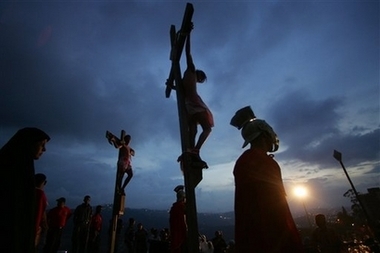
Today we come together as Christians and as Children of God to Celebrate Good Friday (also called Holy Friday), the beginning of the Holiest weekend, also known as the Triduum, within both the church and within our Christian lives. Today our dear Lord and Saviour Jesus Christ, out of such wonderous love for all of mankind, willingly sacrificed himself and was crucified upon the cross to atone for our sins. It is through this sacrifice of immeasurable love that we are able to have eternal salvation through him.
Jesus was hated by many of the Jewish high priests and scribes because he condemned their sins, and they were jealous of him. They did not want to accept the word of God that Jesus was preaching and they refused to return to God. They finally decided to have Jesus killed but needed the permission of the Roman Governor to do so. Jesus was arrested, and handed to Pilate who could not find any wrongdoing that Jesus had done, but he needed to please the people. He handed Jesus’s fate over to them who, encouraged by the chief priests, demanded Jesus was to be crucified.
The crucifixion was executed outside the city and before Jesus was crucified alongside two convicted criminals, he was severely scourged, beaten, spat upon, and mocked.
The crucifixion took place around 33 AD and was the most horrendous and cruel punishment of that time period. We cannot comprehend the scale of suffering that our Lord endured that day for you and I, and for all of mankind! Can you imagine on top of the severe scouging, and beating he had already endured then to have long iron spikes forcefully driven into his hands and feet upon the cross? Or how it felt to hanging upon the cross for six hours until his death, enduring violent spasms caused by the nails irritating his nerves and thrusting his body against the cross? Our Lord died a most horrendous, excruciatingly painful and cruel death without ever complaining because of his love for us!!! Jesus didn’t even apportion blame to those putting him through this…as he said “Father, forgive them.”
I am forever thankful for this sacrifice of love that out Lord endured on my behalf. But the question is: How thankful are you? Do you love and trust him in completeness? Do you give your full lives and soul to him and to the will of God? If not, today I invite you right now to allow him fully and completely into your lives!!


You must be logged in to post a comment.