
Category: Uncategorized

Blessed John Licci

Blessed John Licci, born to a poor farmer, his mother died in childbirth. His life from then on, all 111 years, was a tale of miracles. His father, who fed the baby on crushed pomegranates, had to work the fields, and was forced to leave the infant alone. The baby began crying, and a neighbor woman took him to her home to feed him. She laid the infant on the bed next to her paralyzed husband – and the man was instantly cured. The woman told John’s father of the miracle, but he was more concerned that she was meddling, and had taken his son without his permission. He took the child home to feed him more pomegranate pulp. As soon as the child was removed from the house, the neighbor’s paralysis returned; when John was brought back in, the man was healed. Even John’s father took this as a sign, and allowed the neighbors to care for John.
A precocious and emotional child, John began reciting the Daily Offices before age 10. While on a trip to Palermo, Italy at age 15, John went to Confession in the church of Saint Zita of Lucca where his confession was heard by Blessed Peter Geremia who suggested John consider a religious life. John considered himself unworthy, but Peter pressed the matter, John joined the Dominicans in 1415, and wore the habit for 96 years, the longest period known for anyone.
He founded the convent of Saint Zita in Caccamo, Italy. Lacking money for the construction, John prayed for guidance. During his prayer he had a vision of an angel who told him to “build on the foundations that were already built.” The next day in the nearby woods he found the foundation for a church called “Saint Mary of the Angels,” a church that had been started many years before, but had never been finished. John assumed this was the place indicated, and took over the site.
During the construction, workmen ran out of materials; the next day at dawn a large ox-drawn wagon arrived at the site. The driver unloaded a large quantity of stone, lime and sand – then promptly disappeared, leaving the oxen and wagon behind for the use of the convent. At another point a well got in the way of construction; John blessed it, and it immediately dried up; when construction was finished, he blessed it again, and the water began to flow. When roof beams were cut too short, John would pray over them, and they would stretch. There were days when John had to miraculously multiply bread and wine to feed the workers. Once a young boy came to the construction site to watch his uncle set stones; the boy fell from a wall, and was killed; John prayed over him, and restored him to life and health.
John and two brother Dominicans who were working on the convent were on the road near Caccamo when they were set upon by bandits. One of the thieves tried to stab John with a dagger; the man’s hand withered and became paralyzed. The gang let the brothers go, then decided to ask for their forgiveness. John made the Sign of the Cross at them, and the thief‘s hand was made whole.
One Christmas a nearby farmer offered to pasture the oxen that had come with the disappearing wagon-driver. John declined, saying the oxen had come far to be there, and there they should stay. Thinking he was doing good, the layman took them anyway. When he put them in the field with his own oxen, they promptly disappeared; he later found them at the construction site, contentedly munching dry grass near Father John.
While he did plenty of preaching in his 90+ years in the habit, usually on Christ’s Passion, he was not known as a great homilist. He was known, however, for his miracles and good works. His blessing caused the breadbox of a nearby widow to stay miraculously full, feeding her and her six children. His blessing prevented disease from coming to the cattle of his parishioners. A noted healer, curing at least three people whose heads had been crushed in accidents, he was Provincial of Sicily, and Prior of the abbey on several occasions.
Cleaning House With A Wee Little Man ~ Br. Chip Noon, Postulant
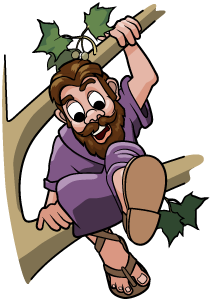
19 Jesus entered Jericho and was passing through. 2 A man was there by the name of Zacchaeus; he was a chief tax collector and was wealthy. 3 He wanted to see who Jesus was, but because he was short he could not see over the crowd. 4 So he ran ahead and climbed a sycamore-fig tree to see him, since Jesus was coming that way. 5 When Jesus reached the spot, he looked up and said to him, “Zacchaeus, come down immediately. I must stay at your house today.” 6 So he came down at once and welcomed him gladly. 7 All the people saw this and began to mutter, “He has gone to be the guest of a sinner.” 8 But Zacchaeus stood up and said to the Lord, “Look, Lord! Here and now I give half of my possessions to the poor, and if I have cheated anybody out of anything, I will pay back four times the amount.” 9 Jesus said to him, “Today salvation has come to this house, because this man, too, is a son of Abraham. 10 For the Son of Man came to seek and to save the lost.” Luke 19:1-10
There’s something in the Gospel today that is quite significant, but we usually skip right past it, since it’s in the first sentence: “Jesus entered Jericho and was passing through the town.”
Jericho.
Why should this Gospel story have meaning for us, aside from the salvation of the house of Zacchaeus, that clever little tax collector? First, tax collectors were collaborators with the might and power of Rome. They were seen as traitors to their people, stealing from them their hard earned gold and goods, unclean, sinners. And yet here was Jesus, once again, deigning to consort with this malefactor, even to the point of going into his house and staying there. The people began to complain and mutter at this effrontery of Jesus.
Second, Jesus grants salvation to this low-life! How can that be? Once again we find our Lord taking up with the worst classes of society, even disdaining the “good people” of the town. What did the tax collector do to gain salvation?
So in this little passage, we find that God’s grace was freely given and Zacchaeus acknowledges Jesus by given half of what he owns to the poor and paying back fourfold anyone he cheated.
But weren’t the walls of Jericho torn down by Joshua and the trumpets? What does Jericho have to do with this passage?
If we remember today’s other readings from Catholic Online, we find that they are about holy sites, the dwelling place of the Lord, God’s field and building, the foundation. Sturdy as the walls of Jericho were, they were no match for God’s people who forced them to crumble at the shout of the people. This is a foreshadowing of the message Jesus imparts time and time again: the place of worship does not matter…we are already in the courts of the house of the Lord. “The Son of man has nowhere to lay his head,” Jesus says in another passage. But he will stay in Jericho, at the home of a sinner, because “the Son of man has come to seek out and save what is lost.”
Isn’t this the message? Foundations made by humankind do not last. Temples made for the worship of God are not sufficient if Jesus is not the foundation, and finally as St. Paul says to the Corinthians, “Do you not realize that you are a temple of God with the Spirit of God living in you?”
Our job today is not to destroy the walls of Jericho, or build a pillar to the Lord, or polish up the handle on the big front door of the church. Because we are the church. We are the temple. Our job is to clean out our attics and basements, vacuum the floors of our soul, clean the windows and throw them open to the glory and the love of God and our neighbor. Jesus has told us that we are his temple. We are his house. What can we do today to make that house ready for him? How can we give him a place to lay his head in our hearts? We can love him.
Lord, we pray that today we meet each person as your temple, the holy of holies you have formed us into. We pray that we can keep our own temple spotless, worthy to welcome you into our presence, sinners though we are. We ask this in your Name. Amen.
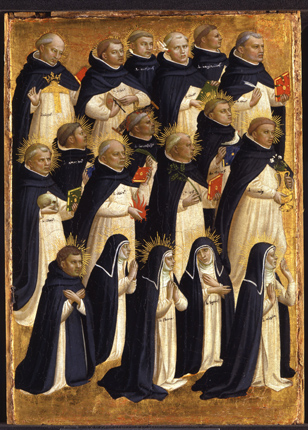
Feast Day of the Domican Saints of our Order
“
Blessed are the pure in heart, for they shall see God.”
(Mt. 5:8)
Why do we celebrate our Saints?
We come together as one Domican Family today to celebrate not only Our Saints, but also our many Blesseds, Holy Friars, Nuns, sisters and Laity who have lived over the past 800 years.
We are so priviledged to celebrate them as they provide us with an example by which we follow in our religious lives, by their wondorous fellowship in their communion and in their much needed aid to us by their intercessions to God on our behalf.
We include in our celebrations also all the “forgotten” saints because according to the General Chapter of Valencia in 1337, there were 13,370 martyrs between 1234 and 1335. There were another 26,000 in the 16th century alone. Martyrs, confessors, virgins, and holy men and women all have their place of honour in the Order. Friars, worn down through constant contemplation, study, and preaching; nuns who lived lives of great prayer, silence, and penance; sisters who educated 1000s of souls; and third order members who sanctified the world.
We celebrate our thanks to God on this Important feast day for our Order and turn to the examples of our Saints, their lives and their intercessions for us so that they may guide us on our spiritual Dominican lifes journey.
Our Order Father, Saint Dominic left us a wonderous legacy of teaching and preaching by word and example of how we should live our lives.It is, then, joyous and encouraging that so many of our Dominican brothers and sisters have been beatified and canonized.
Let us pray then in the example we have been taught to ask our dear saints to intercede for us, and to thank our God for all the saints of our Dominican Order and for the fruits of our order to be pleasing in his sight…..
God, the heavenly Father
have mercy on us.
God, the Son, Redeemer of the world
have mercy on us.
God, the Holy Spirit
have mercy on us.
Holy Trinity, one God
have mercy on us.
Holy Mary
pray for us.
Holy Mother of God
pray for us.
Holy Virgin of Virgins
pray for us.
All you holy angels and archangels
pray for us.
All you holy Patriarchs and Prophets
pray for us.
All you holy Apostles and Evangelists
pray for us.
All you holy martyrs
pray for us.
All you holy virgins and widows
pray for us.
All you holy men and women
pray for us.
Saint Michael
pray for us.
Saint Gabriel
pray for us.
Saint Raphael
pray for us.
Saint Joseph
pray for us.
Saint John the Baptist
pray for us.
Saint Mary Magdalen
pray for us.
Holy Father Augustine
pray for us.
Holy Father Francis
pray for us.
Blessed Jane of Aza
pray for us.
Blessed Reginald
pray for us.
Holy Father Dominic
pray for us.
Holy Father Dominic
pray for us.
Blessed Bertrand
pray for us.
Blessed Mannes
pray for us.
Blessed Diana
pray for us.
Blessed Jordan of Saxony
pray for us.
Blessed John of Salerno
pray for us.
Blessed William and Companions
pray for us.
Blessed Ceslaus
pray for us.
Blessed Isnard
pray for us.
Blessed Guala
pray for us.
Blessed Peter Gonzalez
pray for us.
Saint Zdislava
pray for us.
Saint Peter of Verona
pray for us.
Blessed Nicholas
pray for us.
Saint Hyacinth
pray for us.
Blessed Gonsalvo
pray for us.
Blessed Sadoc and Companions
pray for us.
Blessed Giles
pray for us.
Saint Margaret of Hungary
pray for us.
Blessed Batholomew of Vincenza
pray for us.
Saint Thomas Aquinas
pray for us.
Saint Raymond of Penyafort
pray for us.
Blessed Innocent V
pray for us.
Blessed Albert of Bergamo
pray for us.
Saint Albert the Great
pray for us.
Blessed John of Vercelli
pray for us.
Blessed Ambrose
pray for us.
Blessed Cecilia
pray for us.
Blessed Benvenuta
pray for us.
Blessed James of Varazze
pray for us.
Blessed James of Bevagna
pray for us.
lessed Jane of Orvieto
pray for us.
Blessed Jordan of Pisa
pray for us.
Saint Emily
pray for us.
Blessed James Salomonio
pray for us.
Saint Agnes of Montepulciano
pray for us.
Blessed Simon
pray for us.
Blessed Margaret of Castello
pray for us.
Blessed Augustine Kazotic
pray for us.
Blessed James Benefatti
pray for us.
Blessed Imelda
pray for us.
Blessed Dalmatius
pray for us.
Blessed Margaret Ebner
pray for us.
Blessed Villana
pray for us.
Blessed Peter Ruffia
pray for us.
Blessed Henry
pray for us.
Blessed Sibyllina
pray for us.
Blessed Anthony of Pavonio
pray for us.
Saint Catherine of Siena
pray for us.
Blessed Marcolino
pray for us.
Blessed Raymond of Capua
pray for us.
Blessed Andrew Franchi
pray for us.
Saint Vincent Ferrer
pray for us.
Blessed Clara
pray for us.
Blessed John Dominic
pray for us.
Blessed Alvarez
pray for us.
Blessed Maria
pray for us.
Blessed Peter of Castello
pray for us.
Blessed Andrew Abellon
pray for us.
Blessed Stephen
pray for us.
Blessed Peter Geremia
pray for us.
Blessed John of Fiesole
pray for us.
Blessed Lawrence of Ripafratta
pray for us.
Blessed Anthony della Chiesa
pray for us.
Saint Antoninus
pray for us.
Blessed Anthony Neyrot
pray for us.
Blessed Margaret of Savoy
pray for us.
Blessed Bartholomew of Cerverio
pray for us.
Blessed Matthew
pray for us.
Blessed Constantius
pray for us.
Blessed Christopher
pray for us.
Blessed Damian
pray for us.
Blessed Andrew of Peschiera
pray for us.
Blessed Bernard
pray for us.
Blessed Jane of Portugal
pray for us.
Blessed James of Ulm
pray for us.
Blessed Augustine of Biella
pray for us.
Blessed Aimo
pray for us.
Blessed Sebastian
pray for us.
Blessed Mark
pray for us.
Blessed Columba
pray for us.
Blessed Magdalen
pray for us.
Blessed Osanna of Mantua
pray for us.
Blessed John Liccio
pray for us.
Blessed Dominic Spadafora
pray for us.
Blessed Stephana
pray for us.
Saint Adrian
pray for us.
Blessed Lucy
pray for us.
Blessed Catherine Racconigi
pray for us.
Blessed Osanna of Kotor
pray for us.
Saint Pius V
pray for us.
Saint John of Cologne
pray for us.
Blessed Maria Bartholomew
pray for us.
Saint Louis Bertrand
pray for us.
Saint Catherine de Ricci
pray for us.
Blessed Robert
pray for us.
Blessed Alphonsus and Companions
pray for us.
Saint Rose
pray for us.
Saint Dominic Ibanez and Companions
pray for us.
Blessed Agnes of Jesus
pray for us.
Saint Lawrence Ruiz and Companions
pray for us.
Saint Martin de Porres
pray for us.
Blessed Peter Higgins
pray for us.
Blessed Francis de Capillas
pray for us.
Saint Juan Macias
pray for us.
Blessed Terence
pray for us.
Blessed Ann of the Angels
pray for us.
Blessed Francis de Posadas
pray for us.
Saint Louis de Montfort
pray for us.
Blessed Francis Gil
pray for us.
Saint Matteo
pray for us.
Blessed Peter Sanz and Companions
pray for us.
Saint Vincent Liem
pray for us.
Saint Hyacinth Castaneda
pray for us.
Blessed Marie
pray for us.
Blessed George
pray for us.
Blessed Catherine Jarrige
pray for us.
Saint Ignatius and Companions
pray for us.
Saint Dominic An-Kham and Companions
pray for us.
Saint Joseph Khang and Companions
pray for us.
Saint Francis Coll
pray for us.
Blessed Hyacinthe Cormier
pray for us.
Blessed Pier Giorgio
pray for us.
Blessed Bartolo
pray for us.
Blessed Michael Czartoryski
pray for us.
Blessed Julia Rodzinska
pray for us.
All holy Dominican brothers and sisters
pray for us.
Lamb of God, who takes away the sins of the world,
spare us, O Lord.
Lamb of God, who takes away the sins of the world,
graciously hear us, O Lord.
Lamb of God, who takes away the sins of the world,
have mercy on us.
Let us pray.–
God, source of all holiness, you have enriched your Church
with many gifts in the saints of the Order of Preachers.
By following the example of our brothers and sisters,
may we come to enjoy their company
for ever in the Kingdom of our Lord Jesus Christ,
Your Son, who lives and reigns with You
and the Holy Spirit, one God, for ever and ever.
Amen.
Blessed Jerome, Valentine, Francis, Hyacinth & Companions (Martyrs of Tonkin)

Between the arrival of the first Portuguese missionary in 1533, through the Dominicans and then the Jesuit missions of the 17th century, the politically inspired persecutions of the 19th century, and the Communist-led terrors of the twentieth, there have been many thousands upon thousands murdered for their faith in Vietnam. Some were priests, some nuns or brothers, some lay people; some were foreign missionaries, but most were native Vietnamese killed by their own government and people.
Jerome Hermosilla, a Dominican missionary to Manila, Philippines, and a priest, he went as a missionary to Vietnam in 1828 where he was the Vicar Apostolic of Eastern Tonking, Vietnam and titular bishop of Miletopolis. H was martyred with Saint Valentin Faustino Berri Ochoa.
Valentin Faustinao Berri Ochoa. Born in the Basque country, and ordained on June 14, 1851, Valentin was a missionary to the Philippines and then to Vietnam. He was appointed coadjutor vicar apostolic of Central Tonking, (the modern diocese of Bùi Chu) Vietnam and titular bishop of Centuria on December 25, 1857. He was martyred with Saint Jerome Hermosilla.
Francis Gil de Frederich was educated in Barcelona, Spain where he joined the Dominicans. He was a missionary to the Philippines first and then a missionary to Vietnam in 1732. He spent nine years in prison for his faith during which time he converted fellow prisoners and supervised evangelists on the outside.
Hyacinth Castaneda was a Dominican Priest and missionary to China. He then was sent as a missionary to Vietnam. He was beheaded for his faith in 1773 in Vietnam
Saint Martin de Porres
Saint Martin de Porres was born in the city of Lima, in the Viceroyalty of Peru, on December 9, 1579, the illegitimate son of a Spanish nobleman and a black former slave. He grew up in poverty; when his mother could not support him and his sister, Martin was confided to a primary school for two years, and then placed with a barber/surgeon to learn the medical arts. This caused him great joy, though he was only ten years old, for he could exercise charity to his neighbor while earning his living. Already he was spending hours of the night in prayer, a practice that increased rather than diminished as he grew older.

At the age of 15, he asked for admission to the Dominican Convent of the Rosary in Lima and was received first as a servant boy; as his duties grew, he was promoted to almoner. Eventually he felt the call to enter the Dominican Order, and was received as a tertiary. Years later, his piety and miraculous cures led his superiors to drop the racial limits on admission to the friars, and he was made a full Dominican. It is said that when his convent was in debt, he implored them: “I am only a poor mulatto, sell me.” Martin was deeply attached to the Blessed Sacrament, and he was praying in front of it one night when the step of the altar he was kneeling on caught fire. Throughout all the confusion and chaos that followed, he remained where he was, unaware of what was happening around him.
When he was 34, after he had been given the habit of a Coadjutor Brother, Martin was assigned to the infirmary, where he was placed in charge and would remain in service until his death at the age of sixty. His superiors saw in him the virtues necessary to exercise unfailing patience in this difficult role, and he never disappointed them. It was not long before miracles were attributed to him. Saint Martin also cared for the sick outside his convent, often bringing them healing with only a simple glass of water. He begged for alms to procure necessities the Convent could not provide, and Providence always supplied.
One day an aged beggar, covered with ulcers and almost naked, stretched out his hand, and Saint Martin, seeing the Divine Mendicant in him, took him to his own bed. One of his brethren reproved him. Saint Martin replied: “Compassion, my dear Brother, is preferable to cleanliness.”
When an epidemic struck Lima, there were in this single Convent of the Rosary sixty friars who were sick, many of them novices in a distant and locked section of the convent, separated from the professed. Saint Martin is said to have passed through the locked doors to care for them, a phenomenon which was reported in the residence more than once. The professed, too, saw him suddenly beside them without the doors having been opened. Martin continued to transport the sick to the convent until the provincial superior, alarmed by the contagion threatening the religious, forbade him to continue to do so. His sister, who lived in the country, offered her house to lodge those whom the residence of the religious could not hold. One day he found on the street a poor Indian, bleeding to death from a dagger wound, and took him to his own room until he could transport him to his sister’s hospice. The superior, when he heard of this, reprimanded his subject for disobedience. He was extremely edified by his reply: “Forgive my error, and please instruct me, for I did not know that the precept of obedience took precedence over that of charity.” The superior gave him liberty thereafter to follow his inspirations in the exercise of mercy.
Martin would not use any animal as food—he was a vegetarian.
In normal times, Saint Martin succeeded with his alms to feed 160 poor persons every day, and distributed a remarkable sum of money every week to the indigent. To Saint Martin the city of Lima owed a famous residence founded for orphans and abandoned children, where they were formed in piety for a creative Christian life. This lay brother had always wanted to be a missionary, but never left his native city; yet even during his lifetime he was seen elsewhere, in regions as far distant as Africa, China, Algeria and Japan. An African slave who had been in irons said he had known Martin when he came to relieve and console many like himself, telling them of heaven. When later the same slave saw him in Peru, he was very happy to meet him again and asked him if he had had a good voyage; only later did he learn that Saint Martin had never left Lima. A merchant from Lima was in Mexico and fell ill; he said aloud: “Oh, Brother Martin, if only you were here to care for me!” and immediately saw him enter his room. And again, this man did not know until later that he had never been in Mexico.
Martin was a friend of both Saint John de Massias and Saint Rose of Lima. When he died in Lima on November 3, 1639, Martin was known to the entire city. Word of his miracles had made him known as a saint throughout the region. As his body was displayed to allow the people of the city to pay their respects, each person snipped a tiny piece of his habit to keep as a relic. It is said that three habits were taken from the body. His body was then interred in the grounds of the monastery.
Pope Gregory XVI beatified Martin de Porres in 1837. Nearly one hundred and twenty-five years later, Blessed Martin was canonized in Rome by Pope John XXIII on May 6, 1962. His feast day is November 3. He is the Patron Saint of people of mixed race, innkeepers, barbers, public health and more besides.
In iconography, Martin de Porres is often depicted as a young mulatto friar (he was a Dominican brother, not a priest, as evidenced by the black scapular and capuce he wears, while priests of the Dominican order wear all white) with a broom, since he considered all work to be sacred no matter how menial. He is sometimes shown with a dog, a cat and a mouse eating in peace from the same dish.
The Feast of All Souls
Is death the last sleep? No–it is the last and final awakening. -Sir Walter Scott
“As (Saint) Dominic lay on his deathbed surrounded by his sorrowful brethren, he consoled them saying, “Do not weep. I will be of more use to you in Heaven.” Dominic’s words offered deep hope, extending beyond his death to the death of each member of the Order. “
We all have lost loved ones, some so early in their life, others who had been with us for a good long while. And though, for those left behind, the sense of loss can be almost too much to bear. But we know in our hearts that we shall see our loved ones again, that we will all be reunited with each other—in our heavenly Father’s kingdom. So until that time, we remember them with love, and offer up prayers for souls.
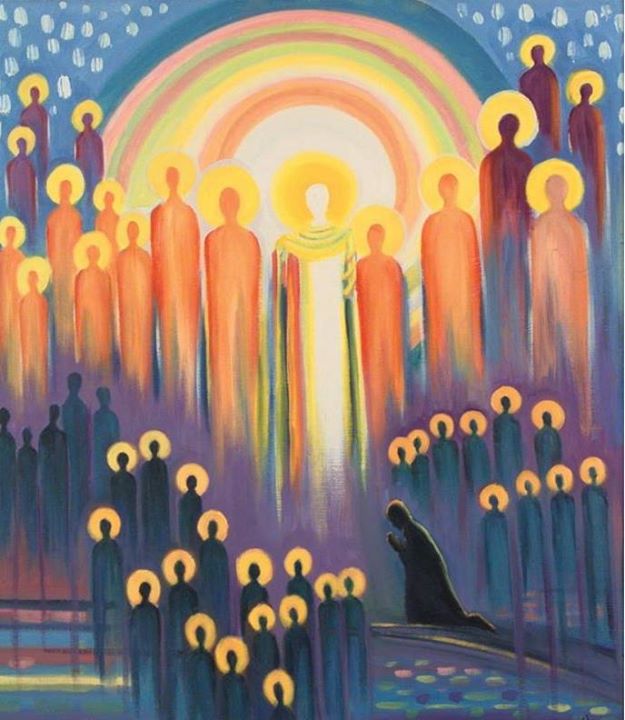
Today, November 2nd, we celebrate the feast of All Souls. On the day after All Saints, the Church reminds us of those who have not yet achieved the goal of their pilgrimage, the Kingdom of Heaven. As part of the communion of saints, they need our prayers. Today’s feast is an opportunity for us to pray in unity for our relatives and friends and for those who have no one to pray for them. All Soul’s Day (sometimes called the “Day of the Dead”) is always November 2 (November 3rd if the 2nd falls on a Sunday).
All Soul’s Day is a Roman Catholic day of remembrance for friends and loved ones who have passed away. This comes from the ancient Pagan Festival of the Dead, which celebrated the Pagan belief that the souls of the dead would return for a meal with the family. Candles in the window would guide the souls back home, and another place was set at the table. Children would come through the village, asking for food to be offered symbolically to the dead, then donated to feed the hungry.
The day purposely follows All Saint’s Day in order to shift the focus from those in heaven to those in purgatory. It is celebrated with masses and festivities in honor of the dead. While the Feast of All Saints is a day to remember the glories of Heaven and those who are there, the Feast of All Souls reminds us of our obligations to live holy lives and that there will be purification of the souls of those destined for Heaven.
Upon death, it is believed that souls have not yet been cleansed of sin. Praying for souls of loved ones helps to remove the stain of sin, and allow the souls to enter the pearly gates of heaven. Through prayer and good works, living members of the church may help their departed friends and family. There are three Requiem Masses that are said by the clergy to assist the souls from Purgatory to Heaven: one for the celebrant, one for the departed, and one for the pope. One such reading for the Mass is included in the Book of Wisdom:
“The souls of the just are in the hand of God
and no torment shall touch them.
They seemed, in the view of the foolish, to be dead;
and their passing away was thought an affliction
and their going forth from us, utter destruction.
But they are in peace.
For if before men, indeed, they be punished,
yet is their hope full of immortality;
chastised a little, they shall be greatly blessed,
because God tried them
and found them worthy of himself.
As gold in the furnace, he proved them,
and as sacrificial offerings he took them to himself.
In the time of their visitation they shall shine,
and shall dart about as sparks through stubble;
they shall judge nations and rule over peoples,
and the Lord shall be their King forever.
Those who trust in him shall understand truth,
and the faithful shall abide with him in love:
because grace and mercy are with his holy ones,
and his care is with his elect.”
The traditions of the Feast of All Souls began independently of the Feast of All Saints. The Feast of All Souls owes its beginning to seventh century monks who decided to offer the mass on the day after Pentecost for their deceased community members. In the late tenth century, the Benedictine monastery in Cluny chose to move their mass for their dead to November 2, the day after the Feast of all Saints. This custom spread and in the thirteenth century, Rome put the feast on the calendar of the entire Church. The date remained November 2 so that all in the Communion of the Saints might be celebrated together.
Other customs have arisen over time in the celebration of All Souls Day. The Dominicans in the 15th century instituted a custom of each priest offering three Masses on the Feast of All Souls. Pope Benedict XIV in 1748 approved this practice, and it rapidly spread throughout Spain, Portugal and Latin America. During World War I, Pope Benedict XV, recognizing the number of war dead and the numerous Masses that could not be fulfilled because of destroyed Churches, granted all priests the privilege of offering three Masses on All Souls Day: one for the particular intention, one for all of the faithful departed, and one for the intentions of the Holy Father.
Many more customs are associated with The Day of the Dead celebration. In the home an altar is made with an offering of food upon it. It is believed that the dead partake of the food in spirit and the living eat it later. The offerings are beautifully arranged with flowers such as marigolds, which are the traditional flower of the dead. There is a candle placed for each dead soul, and they are adorned in some manner. Incense is also often used, and mementos, photos, and other remembrances of the dead also adorn the offerings. Traditional Catholics still honor customs related to the relief of the souls suffering in purgatory. One custom is for persons to pray six Our Fathers, Hail Mary’s and Glory Be’s for the intentions of the Pope in a church, and thereby, receive a plenary indulgence for a soul in purgatory. This action may be repeated for another soul, by leaving the church and re-entering it to repeat the prayers.
All Soul’s Day lives on today, particularly in Mexico, where All Hallows’ Eve, All Saint’s Day and All Soul’s Day are collectively observed as “Los Dias de los Muertos” (The Days of the Dead). First and foremost, the Days of the Dead is a time when families fondly remember the deceased. But it is also a time marked by festivities, including spectacular parades of skeletons and ghouls. In one notable tradition, revelers lead a mock funeral procession with a live person inside a coffin.
As we all know, death is never final. We will be reunited with our loved ones. And for those in purgatory, let us pray for their souls to be cleansed, so we shall all live again in our Father’s house.
A prayer for all our departed brothers and sisters:
Merciful Father,
hear our prayer
and console us.
As we renew
our faith in Your Son,
whom You raised from the dead,
strengthen our hope
that all our departed brothers and sisters
will share in His resurrection,
who lives and reigns
with You and the Holy Spirit,
one God, for ever and ever.
Amen
Invocation for the Souls in Purgatory:
My God,
bestow Thy blessings and Thy mercies
on all persons
and on those souls in Purgatory,
for whom I am in charity, gratitude, or friendship bound
and have the desire to pray.
Amen

And the Winner Is??? ~ Br. Chip Noon, Postulant
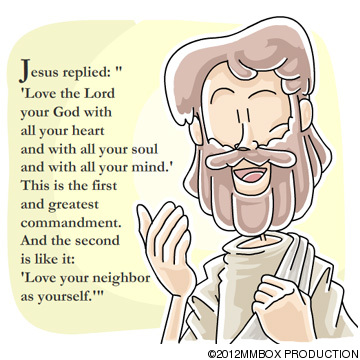
According to the Gospel Reading for today, Matthew 22: 36-40, when the Pharisees heard that Jesus had silenced the Sadducees, they gathered together, and one of them, a scholar of the law tested him by asking, “Teacher, which commandment in the law is the greatest?”
He said to him, “You shall love the Lord, your God, with all your heart, with all your soul, and with all your mind. This is the greatest and the first commandment. The second is like it: You shall love your neighbor as yourself.
The whole law and the prophets depend on these two commandments.”
So the Pharisees said, “OK then, Rabbi, what’s the THIRD greatest commandment? Hmmmm?”
You know them. They are all around us: people who want to win an argument rather than come to a mutual understanding of the truth. It’s probably ingrained into us from an early age: be sure to get your facts in a row and overpower your adversaries with words, with questions, with challenges.
“OK Rabbi, you won those…but what about the EIGHTH greatest commandment? What about THAT one?”
And now we’re in a game that nobody is going to win.
But we argue in that fashion too, don’t we? “Listen, God, I’m with you on all this, but what about that passage in First Timothy where Paul says ‘I permit no woman to teach or to have authority over men?’… How do I reconcile that?” Isn’t that what we’re saying today? Hasn’t that kind of questioning gotten a secure foothold in our minds?
Now we’re in “the silly season.” It will end on Election Day in November, but the echoes will reverberate for weeks after. Don’t you just dread it? Day after day of political commercials where the candidates say to each other, “Sure, but what about your position on the 47th greatest law? What do you say to that?” There’s no end. And there’s rarely a satisfactory answer, because we are not arguing to solve a problem or to help each other in this society. We’re arguing to score points with…with…with whom? “The Base.” “The Donors.” “That minority group.” “This constituent.”
I’ll tell you the worst politician of the last century: Mother Teresa. She said, “Never worry about numbers. Help one person at a time and always start with the person nearest you.” She’d lose an election by a record number; and probably a theological argument, too. Because she wasn’t in it to score points, but to sooth souls and bodies.
But what are we to do? Surely there will be those who want to assail us, to win us over, to knock us down. This isn’t a fairy tale; it’s real life. How are we to stand against those tempests?
“I love you, O LORD, my strength, O LORD, my rock, my fortress, my deliverer.” This is our faith. Is it not protection enough?
“For from you the word of the Lord has sounded forth…but in every place your faith in God has gone forth…” This is our hope. That we will all go forth with the Lord’s words on our lips.
“If you take your neighbor’s cloak as a pledge, you shall return it to him before sunset…” This is the love that we are enjoined to give and to show.
Because what is the right answer to reply with in the debate? Do we keep a Bible and a concordance by our side so that we can immediately find the right answer? Do we have our “talking points” all memorized and even on file cards so we can win any argument?
If you really want to have the final word on the subject…any subject…and you feel you need to express it, then what better quote to pull out of your Biblical quiver than the one we heard this morning: “You shall love the Lord, your God, with all your heart, with all your soul, and with all your mind. This is the greatest and the first commandment. The second is like it: You shall love your neighbor as yourself. The whole law and the prophets depend on these two commandments.”
“For this reason I bow my knees before the Father, from whom every family in heaven and on earth is named, that according to the riches of his glory he may grant you to be strengthened with power through his Spirit in your inner being, so that Christ may dwell in your hearts through faith—that you, being rooted and grounded in love, may have strength to comprehend with all the saints what is the breadth and length and height and depth, and to know the love of Christ that surpasses knowledge, that you may be filled with all the fullness of God.” Amen Ephesians 3:14-19
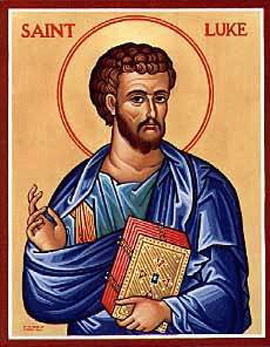
The Feast of St. Luke ~ Br. Igor Kalinski, Novice
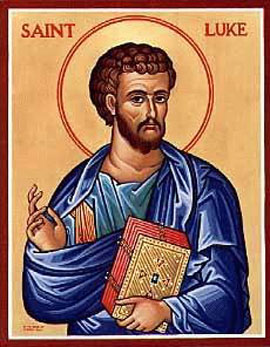 Saint Luke was born a Greek and a Gentile in Antioch , Syria. He was a physician and it is believed that he may also been a slave, as it was not uncommon in his day for slaves to be educated in medicine so the family would have a resident-physician. Luke became a close companion of Saint Paul of Tarsus and acompanied him on his missionary journeys.It is very possible that Luke provided medical assistance to Paul when he had been beaten, stoned, or nearly drowned while evangelizing to the Western Roman Empire. Luke is the only Gentile to have written books in the Bible. He is the writer of the third Gospel and the Acts of the Apostles and his writings have been proven to the historically accurate.
In the third Gospel is the Hymn of Blessed Virgin Mary of God, which is very special to me. What a beautiful sparkle of light for us to follow her example of how she followed Christ her Son! In his Gospel Luke writes very beautifully of the Nativity of our Lord Jesus Christ, and Luke emphasizes Christ´s compassion for sinners and for all those who suffer, with a strong emphasizes of the role woman played in Christ´s ministry.
By the Christian Tradition we know that he is the first one who painted icons of the Holy Mother. Saint Luke has made known to us a way how to follow Christ with examples of and adoration and veneration giving honor to the Mother that gave us her Son to be the salvation of all humanity. It is only of the Gospel of Luke that contains the stories of Mary´s Annunciation, her visit to Elizabeth; The Magnificat; The presentation, and Jesus remaining in Jerusalem. In Luke´s Gospel we learn the words to pray ” Hail Mary full of grace” and Elizabeth´s words to Mary “Blessed are you and blessed is the fruit of your womb, Jesus”.
It is believed that Luke lived a long life and died in c.74 in Greece. He is patron saint of physicians, surgeons, artists, doctors, painters, sculptors and unmarried men.
Prayer to Saint Luke:
Most charming and saintly Physician, you were animated by the heavenly Spirit of Love, In faithfully detailing the humanity of Jesus, you also showed his divinity and his genuine compassion for all human beings. Inspire our physicians with your professionalism and with the divine compassion for the patients. Enable them to cure the ills of both body and spirit and afflict so many in our day.Amen
Blessed Magdalen dei Panattieri
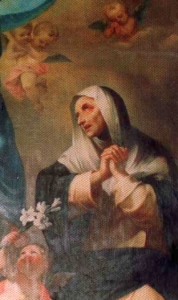 One hears so much about the detachment necessary for sanctity that it is refreshing to read about someone beatified who unblushingly loved her family, her country, her friends, and all little children.
Magdalen Pannatieri was born at Trino, near Vercelli, in 1443, of deeply religious parents. She was a devout child, who made a vow of virginity while she was quite young. Before she was twenty years old, she took her vows as a Dominican Tertiary, an exceptional circumstance, showing that she was held in high esteem. The Tertiary chapter was made up principally of widows and older woman who centered their apostolate of active charities around the Dominican Church. Magdalen fitted into this work with ease, and she brought to the chapter a spirit of penance that few of her companions could match . The delightful part of it all was that her penances never rendered her dreary; she was a cheerful, resourseful person to have around. People drew as much good from her spirit of joy as from any other feature of her spirtuality.
Magdalen had a special fondness for little children, and what we now call baby-sitting, and used her influence witht he children to bring their parents to a better way of life. Childless women won her sympathy , and several times her prayers brought the blessing of motherhood to such people. She taught catechism to children, and gradually the older folk of her acquaintance began to sit in on her classes. She was quite unaware that she had great powers of description and could make the truths of religion clear to simple people. The Dominican fathers allowed her to use a large room attached to the church for a class room, and the class grew. Not only the parents of the children and the simple folk of the neighborhood, but also a number of priest and religious were attending regularly.
When the reform movement started by Blessed Raymond of Capua got underway, Magdalen Parnatieri promoted it in Trino. Though her influence, Blessed Sebastian Maggio was invited to preach there, and he accomplished great good.
Magdalen was considered the protectress of the city of Trino. Whatever disaster threatened it, the citizens expected her to look out for their interests, and she usually did. In her life there is no mention of a “dark night of the soul” or of grim detachment from all things of earth. Her love of God kept her from attaching herself to any illegitimate pleasures, but she thoroughly enjoyed the lawful ones- she loved her family and her townspeople and was happy in their company. Her favorite brother was a good-for-nothing- he was always in trouble. When his conduct had gone beyond the patience of everyone but Magdalene, she threw herself on her knees in front of her crucifix, and she stayed there until our Lord assured her that He would take a hand with the black sheep: ” I cannot refuse you anything,” He said.
The Dominican fathers received her solitude when they were persecuted by a wealthy man of the town. This person carried his hatred so far that he was finally excommunicated for persecuting the Church. there was of course, a good deal of blood shed before the affair was over, and one of the reprobate’s followers made the mistake of hitting Magdalene and calling her names. Before the irate townspeople could deal out justice to him, God did; the man died a violent death.
God revealed to Magdalen the coming political troubles of Italy: the French invasion of the country. She did not live to see this prophecy accomplished, but she persistently asked God’s mercy for her people. During the violent quarrels and bloodshed of the time, Trino was always spared, though the villages all around were in a shambles. The townsfolk unhesitatingly gave credit to Magdalen.
Born: Trino, diocese of Vercelli, Piedmont, Italy, in 1443
Died: 1503
Beatified: beatified by Leo XIII
Blessed James of Ulm
 James was born at Ulm, and spent a fortunate childhood. He was thoroughly instructed both in his father’s trade of glass painting and in the practices of piety. He assisted his father in the making of stained glass, which was at the time a fine art in Germany, and he passed a sinless and happy youth in his native city. Wishing to make a pilgrimage to Rome, he asked his father’s blessing on the enterprise and set forth on his long journey, arriving in time to spend Lent in the holy city.
Having run out of funds, James enlisted with the army in Sicily. Here his pious nature received a rude shock from the soldiers with whom he lived. They were given to every manner of vice and resented any effort to change their lives. Disgusted with the corrupt morals and practices around him, James made haste to free himself as soon as his enlisted was up. He went into service with a lawyer, who soon entrusted him with his most important affairs and would gladly have adopted him as his own son. Having worked with this man for several years, James became anxious to return home to see his aging father, so he once more set forth on the road.
In Bologna, while he was praying before the tomb of Saint Dominic, an interior voice made known to him that his vocation was to be a Dominican. He sought no further, but went immediately to the prior to beg admission as a lay-brother in the Order.
James set for himself no extraordinary program of sanctity when he entered the Order, but resolved to keep the rule perfectly. He did this with great success. His humility and obedience were particularly remarkable.
James resumed his father’s trade of making stained-glass windows, and all his working time was devoted to making windows for the churches and convents that desired them. At one time, when he had a particularly large and elaborate window for firing in the furnace, the prior called for him to go out begging. Without a backward glance at his precious window, he went. He was gone all day, and it was only to be expected that his window would be in ashes when he returned, but God rewarded his obedience with a miracle-the window was more beautiful than he would ever hoped.
On another occasion, the prior, who had been telling a visiting bishop of James’ virtue, called him and told him to take a letter to Paris- a journey of some three weeks. James, bowing his head, asked only that he might first go to his cell to get his walking stick. The prior did not send him: he had only wished to try his obedience.
James was silent and recollected at his work, diligent and prayerful, and always ready to leave one kind of work for another when obedience called him, even though he had a craftsman’s regard for finishing for work well. His chief distinction was in keeping the rule perfectly, though he also performed a number of miracles.
Two windows made by Blessed James are still in existence; one in the chapel of the Bentivoglio palace, the other in the cathedral of St. Petronius in Bloogna.
Born: 1407 at Ulm, Swabia (modern Germany)
Died: 1491 of natural causes
Beatified: In 1825 by Pope Leo XII
 The Order of Preachers, Independent

You must be logged in to post a comment.