Like Sands Through the Hourglass ~ The Rev. Deacon Scott Brown, OPI

HOur glass

Like sands through the hourglass:

So are the days of our lives.

As a kid I loved to watch Days of Our Lives with my grandmother. I didn’t really understand what the show was all about, but I loved the hourglass. As I got older I began to understand what the saying meant. Like sands through the hourglass, so are the days of our lives. Once the sand flows from the top portion of the hourglass to the bottom, it cannot get back to the top again without assistance. The hourglass must be turned over and restarted in order for the sand to flow again. Our lives are very much like that hourglass. We travel through life, getting chance after chance after chance to flow from the top of the hourglass to the bottom again. God flips us over time and time again, forgiving us for our sins, putting people in our lives to travel through the neck of the hourglass with us, giving us chance after chance. As we travel through the neck of the hourglass we should look around and see who is traveling with us. We should pay attention to the grains of sand that pass from top to bottom with us, and notice that when God flips the hourglass over each time we usually have the same people traveling with us. God puts these people in our lives for a reason. We should listen to what they have to say, discuss problems with them, open up to them about what is going on in our lives and see how we can influence them as they influence us. Open your hearts, open your minds, open your lives to the other sands that surround you. You may just find yourself free from the hourglass and on a beach, surrounded by sand for as far as the eye can see. Each grain of sand touches the other. Let’s use our lives to touch others. Matthew 5:16 says “In the same way, let your light shine before others, so that they may see your good works and give glory to your Father who is in heaven.” Let your light shine, let your grain of sand touch and mingle with the others around you. Do this because you truly want to spread the love of God, and not to draw attention to yourself but to spread the love of Christ. Matthew 6:1-34 says” Beware of practicing your righteousness before other people in order to be seen by them, for then you will have no reward from your Father who is in heaven. “Thus, when you give to the needy, sound no trumpet before you, as the hypocrites do in the synagogues and in the streets, that they may be praised by others. Truly, I say to you, they have received their reward. But when you give to the needy, do not let your left hand know what your right hand is doing, so that your giving may be in secret. And your Father who sees in secret will reward you. “And when you pray, you must not be like the hypocrites. For they love to stand and pray in the synagogues and at the street corners, that they may be seen by others. Truly, I say to you, they have received their reward….Our Lord demonstrated this Himself when he told Jarius and his family to keep quiet about raising the little girl from the dead.  Should we not do the same?

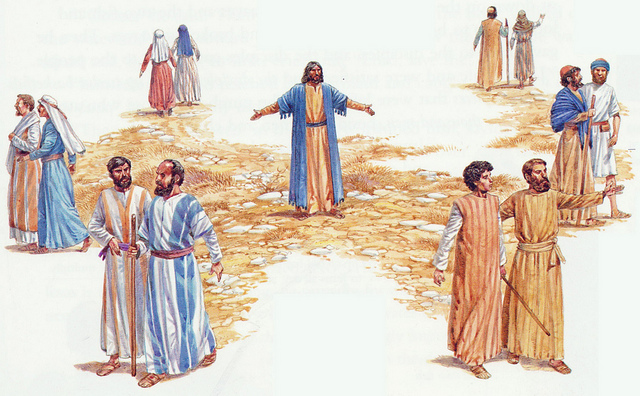
And what about those grains of sand touching and Jesus?  How does that figure in?  In both the stories in the Gospel this morning, we read how the mere touch of our Lord changed lives.  Forever.  Remember, everything that you do, everything that you say, has an impact on someone, somehow.  Let your light shine.  Let your grain of sand touch others.  Show, spread, and live the Word of God.  Amen.

The Nativity of John the Baptist ~ Br. Michael Marshall, Novice

Ghirlandaio_ZacahariasWritesDownName

Prepare ye, the way of the Lord
Prepare ye, the way of the Lord”

This is a song from the musical Godspell, which is John the Baptist foretelling the birth of Jesus.  Some people thought John was the One, yet he knew he was not.  The story of John’s birth is accounted for in all of the Gospels yet in today’s readings we read the story according to Luke:

When the time arrived for Elizabeth to have her child
she gave birth to a son.
Her neighbors and relatives heard
that the Lord had shown his great mercy toward her,
and they rejoiced with her.
When they came on the eighth day to circumcise the child,
they were going to call him Zechariah after his father,
but his mother said in reply,
“No. He will be called John.”
But they answered her,
“There is no one among your relatives who has this name.”
So they made signs, asking his father what he wished him to be called.
He asked for a tablet and wrote, “John is his name,”
and all were amazed.
Immediately his mouth was opened, his tongue freed,
and he spoke blessing God.
Then fear came upon all their neighbors,
and all these matters were discussed
throughout the hill country of Judea.
All who heard these things took them to heart, saying,
“What, then, will this child be?”
For surely the hand of the Lord was with him.
The child grew and became strong in spirit,
and he was in the desert until the day
of his manifestation to Israel. (1:55-67, 80)

We can see a foretelling of John, even though John is not specifically stated in the first reading from Isaiah (49:1-6), so this is definitely a very important part of history for humanity.  What we need to keep in mind is that if there had not been John the Baptist, there would have been no foretelling of Jesus coming to this world.  This all is rather obvious for us.  But how does this really apply to us today other than understanding the Scripture?

John was a herald, a messenger in his own way; trying to help others understand who was to come.  We as Christians today are called to do the same thing, yet help others understand that Jesus will return.  As much as some folks try to use a fear tactic of damnation to bring others to Christ, that really isn’t our purpose.  Our purpose is to show love, the love of Christ through our actions and faith.  We are to be heralds and messengers, and share the Good News!


Blessed Innocent V

Innocent-V-03

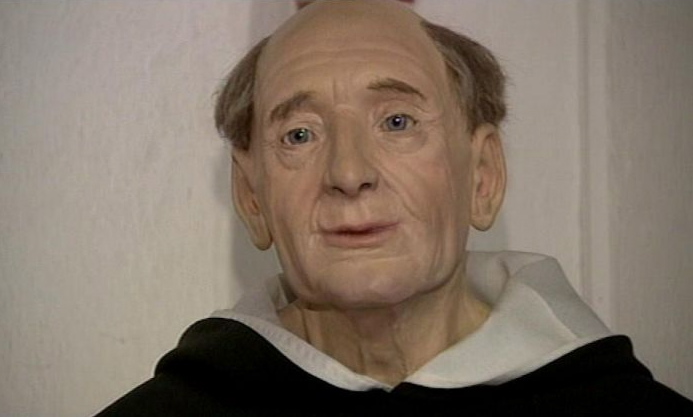
Peter of Tarentaise was barely 10 years old when he was admitted to the Dominican Order by Blessed Jordan of Saxony as a boy-novice and sent to Paris to study. Like Saint Thomas Aquinas, Blessed Ambrose of Siena, and other luminaries of the 13th century, he fell under the masterly tutelage of Saint Albert the Great.
He received his master’s degree in theology in 1259, then he taught for some years in Paris, where he contributed a great deal to the order’s reputation for learning. He wrote a number of commentaries on Scripture and the Commentary on the Sentences of Peter Lombard, but he devoted most of his time to the classroom. He soon became famous as a preacher and theologian, and in 1259, with a committee including his friend Thomas Aquinas, composed a plan of study that is still the basis of Dominican teaching.
At age 37, Peter began the long years of responsibility in the various offices he was to hold in his lifetime as prior provincial of France. He visited on foot all Dominican houses under his care, and was then sent to Paris to replace Thomas Aquinas at the University of Paris. Twice provincial, he was chosen archbishop of Lyons in 1272 and administered the affairs of the diocese for some time, though he was never actually consecrated for that see.
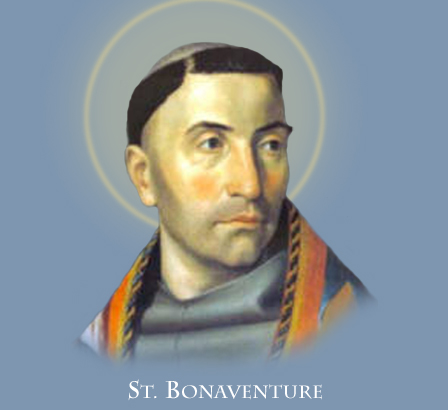
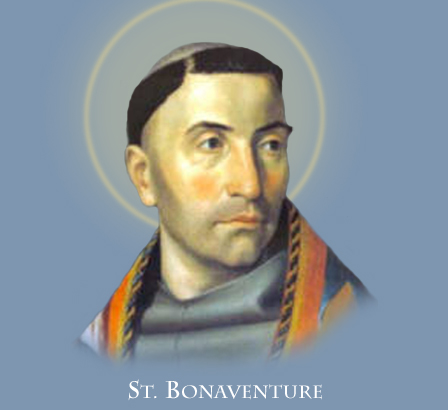
The next year Peter was appointed cardinal-archbishop of Ostia, Italy, while still administering the see of Lyons. With the great Franciscan, Saint Bonaventure, assumed much of the labor of the Council of Lyons to which Saint Thomas was hastening at the time of his death. To the problems of clerical reform and the healing of the Greek schism the two gifted friars devoted their finest talents. Before the council was over, Bonaventure died, and Peter of Tarentaise preached the funeral panegyric.
In January 1276, Peter was with Blessed Pope Gregory X when the latter died at Arezzo. The conclave was held in the following month. On January 21, 1276, Peter of Tarentaise received every vote except his own. With a sad heart, he left the seclusion of his religious home to ascend the Fisherman’s Throne as Pope Innocent V.
The reign of the new pope, which promised so much to a harassed people, was to be very brief. But, imbued with the spirit of the early apostles, he crowded a lifetime into the short space given him.
He instigated a new crusade against the Saracens and began reforms in the matter of regular observance. He actually succeeded in solving many of the questions of the Greek schism and in establishing a short-lived truce. He struggled to reconcile the Guelphs and Ghibellines, restored peace between Pisa and Lucca, and acted as mediator between Rudolph of Hapsburg and Charles of Anjou. He restored the custom of personally assisting at choral functions with the canons of the Lateran, and he inspired all with the love that animated his heart.
Had the measures begun by Innocent V had time to be fully realized, he might have accomplished great good for the Church; he did at least open the way for those who were to follow him. Death stopped the hand of the zealous pope when he had reigned only five months. Like his friends Saint Thomas and Saint Bonaventure, he was untouched by the honors and dignity with which he had been favored, and death found him exactly what he had been for more than 40 years–a simple, humble friar.
Born: 1245 at Tarentaise, Burgundy, France as Petrus a Tarentasia
Papal Ascension: 1276
Died: 1277 at Rome of natural causes
Beatified: cult was confirmed by Leo XIII in 1898

Stormy Weather ~ The Rt. Rev. Michael R. Beckett, OPI

36618_all_021_02

Did you ever have one of those days?  You know, one of THOSE days when you were tired, when you had had enuf, when you just wanted a break?  When you wanted to get away?  Me, too.  And apparently Jesus and the disciples had them on occasion.  In the Gospel reading for today, we find that Jesus wanted to ‘cross over to the other side’ of the Sea, so that he could have some time alone, away from the crowds, and with his disciples for some quality time, I would imagine.  The disciples were all for it, and away they went.  Jesus needed a break.  He gets in the boat, and goes to sleep.

And then it stormed…..  Not just your average run of the mill storm, but a STORM…..at sea even.  Thunder.  BOOM!  Lightening.  FLASH!  Waves so high over the little boat that it was tossed about.  CRASH!  And to top it off, the boat started filling up with water.  SLOSH…..Sink?  And Jesus slept on.  And on.  And on.

And then it happened.  The disciples, those stalwart fishermen, panicked; so much so that they wanted Jesus to panic, too.  So, they woke him.

Now, I dunno about Jesus, and I’m pretty sure they didn’t have a Keurig on that boat, but anyone who knows me well, knows, that no matter what, one does NOT speak to the Bishop when he first wakes up until after his (at least) second cup of coffee.  Can you not see Jesus?  He throws the blanket off and says, WHAT?

The disciples point out the storm, Jesus’s eyes focus, and then he gets it.  He understands what all the fuss is about…..and then, like so many of us, he says,

“Really?”

I can just imagine him rolling his eyes.  He quiets the storm, grumbles, and goes back to sleep…..and the disciples are tripped!

This past week, we have had a storm…a dreadful, dangerous, haunting storm.  And we are still in the midst of that storm.  This past week, the thunder of gunshots rang out at Emmanuel AME Church in Charleston, SC.  This week, there have been torrents, waves of tears.  This week there have been flashes of anger. This week, we have, many of us, felt that we were in danger of sinking.  This week we have, all of us, felt the sense of being overwhelmed: with sadness; with grief; with disbelief; with horror.  I am certain that this week there are those who wondered if God slept.

This week, we have seen evidence, proof, that God does not sleep.  That God is very much awake, and involved, in our lives.  This week we have seen the families of those martyred in Charleston demonstrate to the world what Love is all about:  Forgiveness. Charity.  Good will.  Reaching out. Love.  When we heard the victims’ families say to the young man who killed their family members things like, “I forgive you.”  “We will pray for you,” we know that we have seen Christ in action.  This week we have seen countless thousands come together to support each other, regardless of race, religion, creed, or any of the other differences that often divide us.  This week we have seen, we pray, the beginning of the end of this storm of racial divide.

This storm is far from over.  FAR from over.  Before this storm ends, hearts will have to change, attitudes will have to change, laws, rules, regulations, the government, will have to change, society will have to change.  And before any of that can happen, WE will have to change.  We will, all of us, have to examine ourselves carefully, and honestly, to find the roots of our prejudice, our fears of those who are ‘other’ than ourselves.  We will have to look with new eyes at all of those with whom we come into contact, ALL of them, EVERY ONE of them, and strive to find the Jesus in each of them.  The Jesus in us must reach out to the Jesus in our brothers and sisters, regardless of race, creed, color, gender, gender identity, sexual preference, ability or disability, or any of the other million and one things we use to denigrate, disgrace, and damn our brothers and sisters.

Like the disciples, we will be afraid.  Sometimes we may even panic.  But I can assure you that, like the disciples, we can go to Jesus.  And when we do, he will say to us, “Peace.  Be still.”  And in the calm and quiet that results from our trust in Him, we will be able, with full hearts, learn to love our neighbors as ourselves.


Amen.


Blessed Hosanna of Mantua

BlOsannaAndrea18-6b

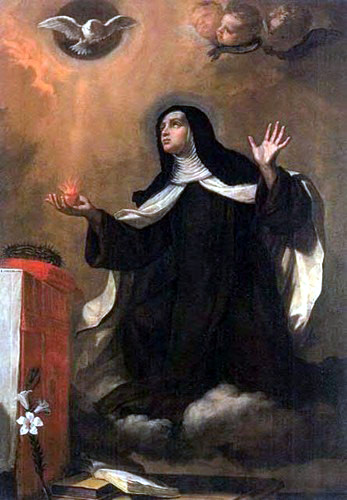
Osanna Andreassi was the daughter of the wealthy patrician Andreasio. She experienced visions from her early childhood, but kept the experiences to herself. At the age of six, she saw the Child Jesus carrying a cross and wearing a crown of thorns. He told her that He has a special love of children and purity. She was so impressed, as we all would be, that she immediately consecrated her entire life to God.

Osanna begged her father to allow her to learn to read so that she might be able to pray the Divine Office. He refused her request because it was a waste for a woman who was expected simply to raise a family. Osanna couldn’t explain why she wanted to learn; she couldn’t reveal her plans to him. When she was 14 and knew that he was arranging a marriage for her, she furtively went to the Dominican church and received the habit of its tertiaries. When she appeared at home in her religious garb, she explained that she had made a vow and must wear it until she had fulfilled her promise.

Now, this should not be understood as condoning deceit, but it served God’s purpose. Her pious father accepted her explanation for a time. As the months passed he began to suspect what had happened. He had already refused to give her permission to enter the convent, and he was displeased that she should try to live as a tertiary in his own home. Eventually, his father’s heart melted and he allowed Osanna to continue her routine of prayer, penance, and charity for the rest of her life. She was not professed until a few months before her death forty-two years later.

After the early death of both her parents, Osanna spent her fortune in the service of the poor. Her house became a center for people to discuss spiritual matters, for the needy and the sick, for the wealthy and the noble.

It is said that like Saint Catherine, she miraculously learned to read. One day she saw a piece of paper with two words and said, “Those words are ‘Jesus’ and ‘Mary.'” From that time she could read anything pertaining to spiritual matters. By the same sort of favor, she also learned to write.

At age 28 (1477), Osanna received the mark of the wound in Jesus’ side, caused by a long nail. For the next year various of the sacred wounds would appear, including the crown of thorns. Others saw them only on Wednesdays, Fridays, and during Holy Week, but it appears that they were visible to her and caused both pain and joy.

At this time Osanna felt the need for a spiritual director and prayed for one with wisdom, patience, and understanding. She found him during Mass when an interior voice said to her, “That’s the one you need, the one who is saying Mass.” Osanna thought he was too young, but, upon meeting him in the confessional a few days later, all doubts were erased.

Before her death, the soul of Blessed Columba of Rieti, another Dominican tertiary, appeared to her and told Osanna to prepare for death.

Born: January 17, 1449 at Mantua, Italy

Died: 1505 of natural causes

Beatified: November 24, 1694 Pope Innocent XII (cultus confirmed)

Representation: In art, Osanna is a Dominican tertiary wearing a crown of thorns, surrounded by rays of light (not the halo of a saint), a lily, a broken heart with a crucifix springing from it, the devil under her feet, two angels (one with a lily, one with a cross). This is similar to the image of Saint Catherine of Siena, who has a halo. Osanna is the patroness of school girls.

I’ve Got Confidence ~ Br. Igor Kalinski, Novice

This is what the Sovereign Lord says, “I myself will take a shoot from the very top of a cedar and plant it, I will break off a tender spring from its top most shoots and plant it on a high and lofty mountain. On the mountain heights of Israel I will plant it, it will produce branches and birds will nest in it, they will find shelter in the shade of its branches. All the trees of the field will know that I the Lord bring down of tall tree and make the low tree grow tall. I dry up the green tree and make the dry tree flourish, I the Lord have spoken and I will do it.”

Dear brothers and sisters after all the troubles that we all of us face in our everyday lives, we need to remember that God does not stop encouraging us to persevere in spite of our troubles.  Life on earth is full of temptations, and His encouragement is necessary   so that we may attain salvation.  He doesn’t want us to be discouraged but confident!   Temptations, persecutions, death, exile, the sufferings of this world:  we  know they are of limited time.  Because of this, we should feel confident that we can count on God’s help and love.  We are to maintain our faith, and to persevere.   God will give us the strength to do so.

“in the body we are away from the Lord” 2cor5:6

These words are not contradictory but reminding us that in time of living here on earth, man is more in touch to the earthly things than the things of heaven. So we are warned from the word of God, dont be so self-confident in ourselves and to not be involved with the earthly pleasures that separate us far from God.

But in case someone thinks that the body is the reason we are separated from God, is also written:

”We live by faith, not by sight” 2Cor5:6

This mean that we cant have knowledge of God through the human body´s senses that are limited, that mean for example: although through looking we discover partially the world, yet to come to real knowledge of God, its necessary faith that is beyond the human senses.

Dear brothers and sisters: we have eternal home in Heaven, let us stop what separate us daily from our Lord, pray one for another, this thing don’t distract from our courage in this limited time. Eternity is the best ,and all of this worlds evils will not last for long.  We to be confident in His love, in his mercy, and in His strength to help us.

Blessed Stephen Bandelli

Stephen Bandelli was born into a noble family. Little is known of his early years except that he applied for admission to the Dominicans in his hometown and received the habit while still very young.

Stephen earned a degree in canon law and a master’s degree in theology, and lectured at the University of Pavia. He was a man of superior intellect and a careful student. Tradition holds that he was “another Saint Paul,” and that his sermons were effective in bringing many Christians to a more fervent life and many sinners back into the fold. Aside from this, one reads only the traditional assurances–that he was prayerful, penitential, had a spirit of poverty, was charitable, and was a model religious.

When Stephen died, he was buried in the Dominican church of Saluzzo. Many miracles were worked at his tomb, and the citizens of Saluzzo invoked him, in 1487, when the town was attacked by one of their neighbors. Their preservation was attributed to Stephen’s intercession, as it was claimed that he had appeared in the sky above them while they were fighting. An annual feast was kept there in his honor for many years.

Blessed John Dominici

220px-Giovanni_Dominici

John is an example of the triumph of spirit over difficulty, and an indication that God can use any type of instrument He chooses, if He has a certain work to be done. John was almost rejected by the Dominicans because he had such a severe speech defect that the superior felt he would never be able to preach–a real impediment in the Order of Preachers.

The saint was born into a poor Florentine family. His early years were noted for piety. In fact, if anyone came looking for him, his mother would say, “Go and look in the church. He spends most of his time there.” He had a special love for the Dominican church of Santa Maria Novella, and he haunted it from early morning to late at night. It was not a surprise to anyone when, at the age of 17, he decided to enter the Dominican order.

Here several difficulties presented themselves. John had no background of education, which was absolutely necessary in an order of scholars. To make matters worse, he had the speech defect. Some of the fathers felt that he should support his parents, although they protested that this should not stand in the way of their son’s vocation. It was two years before John was allowed to begin his novitiate at Santa Maria Novella. The order soon discovered the treasure they had. John excelled in theology and Sacred Scripture, and so he was sent, with the other superior students, to finish his studies in Paris.

Now he was face to face with the difficulty that his superiors had seen from the beginning. An ordained priest, member of a preaching order, he must fulfill his vocation by preaching. His superiors attempted to forestall any embarrassment by assigning him work in the house. John felt that the intervention of heaven was required, so with the utmost simplicity he prayed to Saint Catherine of Siena, who had just died, to cure him. The impediment disappeared, and John joyfully began to preach. He became one of the most famous Dominican preachers.

In 1392, after years of successful missionary work in all the cities of Italy, John was appointed vicar-provincial of the Roman province. It was a task that, both intellectually and spiritually, called for a giant.

The plague had cut into the order with such devastating effect that regular life barely existed. The convent of Santa Maria Novella had lost 77 friars within a few months; other convents were in even worse condition. The mortality had been higher among the friars than anywhere else, because they had gone quite unselfishly to the aid of the stricken people. However, this misfortune had left the order perilously understaffed, and there were a good many members who believed quite sincerely that the conditions of the time called for a mitigated observance of the rule. Many of the houses were already operating in this fashion. It was to be the principal work of Blessed John Dominici to right this condition, and bring back the order to its first fervor.

He began his work with a foundation at Fiesole. Before he had even erected the new convent, four young men received the habit, one of whom was Antoninus–future saintly archbishop of Florence. Two years later, two of the most gifted young artists in Italy, whom history would know as Fra Angelico and his brother, Fra Benedetto, received the habit. With these and other earnest young men, John Dominici set about the difficult work of building anew an order that had suffered a diminution of its original fervor. Soon the house at Fiesole,and others modeled upon it, could be described, as the first houses of the order were, the “homes of angels.”

Difficult days were in preparation for John Dominici. He was appointed cardinal in 1407, named archbishop of Ragusa, and chosen as confessor to the pope. Due to schism, there were two claimants to the papacy. The situation grew even worse when, after another election, no less than three powerful men claimed to have been lawfully elected pope.

Largely through the diplomacy and wise counsel of John Cardinal Dominici, the rival claimants to the papal throne agreed to withdraw their claims, and the groundwork was laid for the election of a new and acceptable candidate. At this time, John Dominici publicly renounced his cardinalate, thus indicating to the enemies who accused him of political ambition that he cared nothing for honors in this world.

John was preaching in Hungary against the heresies of John Hus at the behest of the pope when he died. He was buried in the Church of Saint Paul the Hermit in Buda. Many miracles were worked at his tomb before it was destroyed by the Turks (Benedictines, Dorcy).

Born: 1356 at Florence, Italy

Died: June 10, 1419 of a fever at Buda, Hungary; buried in the Church of Saint Paul the Hermit in Buda; his tomb became noted for miracles, and was briefly a pilgrimage point; it was destroyed by the Turks

Beatified: 1832 (cultus confirmed); 1837 (beatified) by Pope Gregory XVI

Blessed Diane, Blessed Cicely & Blessed Amata

Blessed Diana, Blessed Cecilia, and Blessed Amata

Diana, Caecilia, and Amata were the first members of Saint Agnes Dominican Convent in Bologna, Italy. They all knew Saint Dominic personally. Little is known of Sister Amata except that she was a good friend of Saint Dominic, who, according to legend, gave her the name Amata (‘beloved’). Dominic either sent her to the reformed convent of Saint Sixtus when the nuns left Saint Mary’s across the Tiber during a time of drastic reform, or he was instrumental in allowing her to stay there. There was an Amata from whom Dominic cast out seven devils, but it was probably not this Amata.

Caecilia Caesarini was a high-spirited young Roman of an ancient family; she threw her considerable influence into the reform movement at the time Saint Dominic was attempting to get the sisters into Saint Sixtus and under a strict rule. When the saint came to speak to the sisters at Saint Mary’s, it was Caecilia (then 17) who urged the prioress to support his cause. She was the first to throw herself at Dominic’s feet and beg for the habit and the rule he was advocating, and her hand is evident in the eventual working out of the touchy situation. In 1224, Caecilia and three other sisters from Saint Sixtus, including Amata, went to Saint Agnes in Bologna to help with the new foundation. Sister Caecilia was the first prioress there and proved to be a very strict one.

Caecilia is responsible for relating nearly everything now known about the personal appearance and habits of Saint Dominic. In her extreme old age, she was asked by Theodore of Apoldia to give him all the details of the saint’s personality, and all that she could recall of the early days of the order, so that he could record them for posterity. Though nearly 90, her memory was keen and specific. She recalled how Dominic used his hands, the precise shade of his hair, the exact line of his tonsure. If she erred, there were still people alive who could have corrected her, though there was probably no one with her descriptive power left to tell the tale.

Through a woman’s eyes, she saw the founder from a different angle than his fellow preachers were apt to see, and remarked on his gentleness with the sisters, and the little touches of thoughtfulness so characteristic of him. While the men who worked with him would recall his great mind and his penances, and appreciate the structural beauty of the order he had founded, Caecilia saw the glow of humanity that so many historians miss.

The most colorful of the three was Sister Diana, the spoiled and beautiful daughter of the d’Andalo and Carbonesi families of Bologna, who lost her heart to the ideal of the Dominicans when listening to Reginald of Orléans preach. She espoused the cause of the friars, who were new in Bologna, and begged her father until she obtained from him the church of Saint Nicholas of the Vineyards, of which he had the patronage.

Having established the brethren, she wanted a convent of the Dominican sisters in Bologna. When Saint Dominic came there on his last journey, she talked with him, and all her worries departed. She knelt at his feet and made a vow to enter the Dominicans as soon as it should be possible to build a convent at Bologna. Saint Dominic, going away to Venice on a trip from which he would only return to die, made sure before leaving that the brethren understood about Diana. Four of the fathers from the community of Saint Nichola were under obedience to see that her convent was built.

In the meantime, Diana’s father refused her permission to enter the convent. Stealing a leaf from the life of Saint Clare, she ran away to the Augustinians outside the city. In full armor, her brothers came after he, and Diana was returned, battered but unconvinced, to the paternal home. She nursed a number of broken ribs and several explosive ideas in silence.

The death of Saint Dominic was a great grief to Diana, as she was still living in a state of siege at home, waiting for some action on the question of the new convent. However, she soon acquired a new friend, who was to be her greatest joy in the years of her mortal life–Jordan of Saxony, master general of the order following Dominic. Jordan, as provincial of Lombardy, inherited the job of building the Bologna convent, but his relations with Diana were not to be merely mundane. Their friendship, of which we have the evidence in Jordan’s letters, is a tribute to the beauty of all friendship, and a pledge of its place in religious life.

Diana was resourceful. She made another attempt to elope to the convent. This time her family gave up in despair. She remained peacefully with the Augustinians until the new convent was built. In 1223, Diana and several other young women received the Dominican habit from Jordan of Saxony. Diana was the prioress for a time, but perhaps Jordan felt that she was too volatile for ruling others, because, as soon as the sisters came from Saint Sixtus, he established Sister Caecilia as prioress. Diana, who was used to being not only her own boss, but the one who gave orders to others, seems to have made no protest.

If we had the letters written by Diana, we should possess a fascinating picture of the early years of the order and the people who made it what it is. We are indebted to Diana for what we do have of the correspondence, for she carefully saved all of Jordan’s letters. They tell us of the progress made by the friars in various lands, and ask her to remind the sisters to pray for the missionaries. Jordan counts the successes when many good novices have come into the order, begging her prayers in the low moments when promising novices leave.

More than this, these are letters of spiritual direction, which should give a pattern to all such correspondence, for they infer that Diana is a willing and energetic Christian who will follow the advice she is given, not simply keep the correspondence going for the joy of it.

Diana died in 1236. She was buried in the convent of Saint Agnes. Her remains were transferred when a new convent was built, and Sister Caecilia–who died 60 years later–was buried near her, along with Sister Amata. The relics were transferred several times, all three together. The head of Blessed Diana was placed in a reliquary near the tomb of Saint Dominic.

Born: twelfth century

Died: thirteenth century

Beatified: Pope Leo XIII confirmed their cult in 1891

Solemnity of Corpus Christi ~ The Rev. Lady Sherwood, OPI

Holy_Eucharist_241x300

Reading 1: EX 24:3-8  Resp Psalm: PS 116:12-13,15-16,17-18  Reading 2: HEB 9:11-15  Gospel: MK 12-16, 22-26

Today we celebrate the Great Feast of the Solemnity of Corpus Christi, an important feast observed by Christians throughout the world. We celebrate the fact that we as Catholics know that the Holy Eucharistic gifts of the bread and of the wine are not merely representing Christ, but truly are the body and blood of Our Lord Jesus Christ as instituted at the last supper by Our Lord Jesus and his disciples just prior to his passion.

Whilst the institution of the Eucharist occurred on Holy Thursday, the solemn nature of Holy Week and the focus on Good Friday somewhat overshadows that aspect of Holy Thursday. The Feast of Corpus Christi is held on the Thursday following Trinity Sunday, but many churches have now transferred this feast to today, the Sunday after Trinity Sunday.

The Feast of Corpus Christi, also often called The Feast of the Body and Blood of Christ, goes back to the 13th century.  In 1246, Bishop Robert De Thorete of the Belgina Diocese of Liege, at the suggestion of St. Juliana of Mont, convened a synod, and at this synod the Feast of Corpus Christi was instituted from Liege. After this, the feast spread and on September 8th 1264, Pope Urban IV issued the papal “Transiturus” which established the Feast as a universal feast of the church.

At the request of Pope Urban IV, St. Thomas of Aquinas composed the office for the feast which is still used by many churches today.  Until recent times, the Feast of Corpus Christi was celebrated with a Eucharist procession, in which the Host was carried throughout the town, accompanied by hymns and litanies and the faithful would venerate the Body of Christ as it passed by. Today this practice has almost but disappeared.  However, some churches still hold a smaller version of the procession around the outside of their church.

In John 6:53-56 the Lord tells us: “Amen, amen, I say to you, unless you eat the flesh of the Son of man and drink his blood, you do not have life within you. Whoever eats my flesh and drinks my blood has eternal life, and I will raise him on the last day. For my flesh is true food and my blood is true drink. Whoever eats my flesh and drinks my blood remains in me and I in him.”

Let us offer to the lord this prayer of Anima Christi:

Soul of Christ, be my sanctification;

Body of Christ, be my salvation;

Blood of Christ, fill my veins;

Water of Christ’s side, wash out my stains;

Passion of Christ, my comfort be;

O good Jesu, listen to me;

In Thy wounds I fain would hide;

Ne’er to be parted from Thy side;

Guard me, should the for assail me;

Call me when my life shall fail me;

Bid me come to Thee above;

With Thy saints to sing Thy love,

World without end.

Amen.