He’s Alive!!! Really???

maxresdefault

The gates and doors were barred
And all the windows fastened down
I spent the night in sleeplessness
And rose at every sound
Half in hope of sorrow
And half in fear the day
Would find the soldiers breakin’ through
To drag us all away

And just before the sunrise
I heard something at the wall
The gate began to rattle
And a voice began to call
I hurried to the window
Looked down into the street
Expecting swords and torches
And the sound of soldiers’ feet

But there was no one there but Mary
So I went down to let her in
John stood there beside me
As she told me where she’d been
She said they’ve moved Him in the night
And none of us know where
The stone’s been rolled away
And now His body isn’t there

We both ran towards the garden
Then John ran on ahead
We found the stone and empty tomb
Just the way that Mary said
But the winding sheet they wrapped Him in
Was just an empty shell
And how or where they’d taken Him
Was more than I could tell

Oh something strange had happened there
Just what I did not know
John believed a miracle
But I just turned to go
Circumstance and speculation
Couldn’t lift me very high
‘Cause I’d seen them crucify Him
Then I saw Him die

Back inside the house again
The guilt and anguish came
Everything I’d promised Him
Just added to my shame
When at last it came to choices
I denied I knew His name
And even if He was alive
It wouldn’t be the same

But suddenly the air was filled
With a strange and sweet perfume
Light that came from everywhere
Drove shadows from the room
And Jesus stood before me
With His arms held open wide
And I fell down on my knees
And I just clung to Him and cried

Then He raised me to my feet
And as I looked into His eyes
The love was shining out from Him
Like sunlight from the skies
Guilt in my confusion
Disappeared in sweet release
And every fear I ever had
Just melted into peace

He’s alive yes He’s alive
Yes He’s alive and I’m forgiven
Heaven’s gates are open wide
He’s alive yes He’s alive
Oh He’s alive and I’m forgiven
Heaven’s gates are open wide
He’s alive He’s alive
Hallelujah He’s alive
He’s alive and I’m forgiven
Heaven’s gates are open wide
He’s alive He’s alive He’s alive
I believe it He’s alive
Sweet Jesus

(words and music by Dolly Parton)

He’s Alive!!!!

Really?  Is he?  How can we prove this to the world?  In what way do our lives reflect this?  It is so easy for us to celebrate Easter, with all the accompanying fanfare, the music, the bunnies and chicks and eggs and ham…..  We dress up in our best, go to church, and celebrate.  And then what happens on Monday?  We talk about how nice Easter was and go back to business as usual.

If Christ is alive as we proclaim he is, if Christ rose again from the grave to save us from our sins, to change our lives, then should our lives not reflect a profound change?  One that is visible to all with whom we come into contact?

If Jesus Christ is the very God we claim, come in the flesh of humanity, if He is the Lord “through Whom all things were made,” as we recite in the Nicene Creed, it is up to us to proclaim this with all that we are, with all that we do.   Think about those whom Jesus had following Him: sailors, insurgents, tax-farmers, prostitutes, widows, lepers, and, on occasion wealthy folks. Rulers, workers, and the dregs of society. Young and old.  Their lives were changed in such a drastic measure that they died for their faith.   Many of them left all that they had, the security of their homes, their jobs, their families, to follow Jesus.  Would you?  Our Christian brothers and sisters are under attack in the Mid East, in the Philippines, in Africa.  Many of them have died in order to proclaim their faith.  Would you do as much?  Would you die for Christ?

If then, the answer is yes, would you not LIVE for Christ?  You say to me, “Bishop Michael, how do you expect us to do that?”  The answer to that was given to us by our Lord, Himself:

“As I have loved you, love one another.” He lived out the ultimate example of what this means. Then he said, “No greater love hath any man than this, that he lay down his life for his friends.” Then He did just that. But it was not only to save us from our sins, though it was most assuredly that. It was the sign, the seal,  that proved He was Who He said He was and that His word was true.

If He really is risen, then we have an obligation one to another to serve our fellow man as He served us.  And we have an obligation to share this Good News with our fellow man. We have to make the blessings we have gained available to every human. And we have an obligation to show that there really is truth to the old song, “And they’ll know we are Christians by our love, by our love. And they’ll know we are Christians by our love.”   We have an obligation or reflect Christ’s goodness, His holiness, in our lives.  By our speech, by our actions, by our very thoughts.

He is alive!  Let us allow Him to live anew through our lives, reflecting His love and His promise in all that we do, in all that we say, in all that we are.  He is alive!!!!!  Amen.


The Easter Vigil ~ Br. Michael Marshall, Novice

Easter-Vigil

I remember my first Easter Vigil.  It was a new beginning for me, in fact like a renewal in my faith journey.  I entered the Catholic Church in 1998.  I was baptized, confirmed, and received First Eucharist.  I was a Christian prior to becoming Catholic but was wandering from church to church because my parents changed churches several times when I was a boy.  I was not baptized because my parents allowed me to decide if, when, and where I wanted to be baptized instead of being baptized in the church which they were baptized.  Because of the several changes of churches, I was like a sheep lost in the pastures without a consistent shepherd.  One of my college roommates was a lifelong Catholic who invited me to several campus ministry functions, and I finally entered a pasture with a shepherd who would tend me as one of the flock.

Easter Vigil is like a second birthday for me because it is a celebration of being born into my faith, and has led me to continue to grow as a person.  It is a celebration of the beginning of my closer relationship with God, a celebration of receiving the Sacraments for the first time.  Becoming Catholic would lead me to entering seminary, and I went to every Easter Vigil because it has that very special place in my heart.  I witnessed many people entering the Catholic Church, seeing the joy on their faces as they were received into the Church.  Ten years after I entered the Church, my parents were received into the Church after wandering from church to church, and finding their home.  That Easter Vigil was very special because I was an acolyte at that Mass, closely assisting the priest as my parents received the Sacraments.

Several of the readings for Easter Vigil are also very special because I connect to the significance they have for us.  My relationship with God is much like the Creation story; I am one of God’s own born in His image and loved by God.  God has given me some tough things to handle, and I have felt tested by God, just as Abraham was tested.  I have been led by God through trying times when seeking where I belong in a church home, just as Moses was told to cross the parted Red Sea in order to be protected from the Egyptians.  I believe God was working through my college roommate guiding me to the Catholic Church.  I have faced much adversity in my life, and as Paul tells the Romans, we as Christians will face adversity, especially for being witnesses to the Gospel; but in the end we will also live his resurrection.

Yet in the end, as much as Easter Vigil touches me so deeply, Easter Vigil is so much more than about me.  Nor is the Community just receiving people into the Church to enter fully and receive Sacraments for the first time, but Easter Vigil is a complete story of the relationship between God and humanity through the readings.  We see how God has shown his love through asking tough things of people, while also protecting his people from harm.  Then God shows his ultimate love through dying on the cross to free humanity from sin.  Humanity did not understand and even rejected what was happening, and the finally it is revealed, revealed so we can celebrate.

People tend to fast forward from Good Friday to Easter Sunday, knowing the story of death to resurrection.  People do not take time to remember the story of how we even get to Good Friday before the fast forward to Easter Sunday.  Some people just think Easter Vigil is JUST about receiving people into the Church through a very long Mass, and do not experience all what Easter Vigil is about.  As much as most of us are not Roman Catholic, let me pose this question?  Have you ever been to an Easter Vigil Mass?  You should experience it at least once, and maybe it will be a very special experience which you want to share with others; seeing what it totally is about.

Now let us celebrate…  HE IS RISEN!!!  ALLELUIA!!!

Genesis 1:1, 26-31a

In the beginning, when God created the heavens and the earth,
God said: “Let us make man in our image, after our likeness.
Let them have dominion over the fish of the sea,
the birds of the air, and the cattle,
and over all the wild animals
and all the creatures that crawl on the ground.”
God created man in his image;
in the image of God he created him;
male and female he created them.
God blessed them, saying:
“Be fertile and multiply;
fill the earth and subdue it.
Have dominion over the fish of the sea, the birds of the air,
and all the living things that move on the earth.”
God also said:
“See, I give you every seed-bearing plant all over the earth
and every tree that has seed-bearing fruit on it to be your food;
and to all the animals of the land, all the birds of the air,
and all the living creatures that crawl on the ground,
I give all the green plants for food.”
And so it happened.
God looked at everything he had made, and found it very good.

Responsorial Psalm Psalm 104:1-2, 5-6, 10, 12, 13-14, 24, 35

  1. (30) Lord, send out your Spirit, and renew the face of the earth.
    Bless the LORD, O my soul!
    O LORD, my God, you are great indeed!
    You are clothed with majesty and glory,
    robed in light as with a cloak.
    R. Lord, send out your Spirit, and renew the face of the earth.
    You fixed the earth upon its foundation,
    not to be moved forever;
    with the ocean, as with a garment, you covered it;
    above the mountains the waters stood.
    R. Lord, send out your Spirit, and renew the face of the earth.
    You send forth springs into the watercourses
    that wind among the mountains.
    Beside them the birds of heaven dwell;
    from among the branches they send forth their song.
    R. Lord, send out your Spirit, and renew the face of the earth.
    You water the mountains from your palace;
    the earth is replete with the fruit of your works.
    You raise grass for the cattle,
    and vegetation for man’s use,
    Producing bread from the earth.
    R. Lord, send out your Spirit, and renew the face of the earth.
    How manifold are your works, O LORD!
    In wisdom you have wrought them all—
    the earth is full of your creatures.
    Bless the LORD, O my soul! Alleluia.
    R. Lord, send out your Spirit, and renew the face of the earth.


Genesis 22:1-2, 9a, 10-13, 15-18


God put Abraham to the test.
He called to him, “Abraham!”
“Here I am,” he replied.
Then God said:
“Take your son Isaac, your only one, whom you love,
and go to the land of Moriah.
There you shall offer him up as a holocaust
on a height that I will point out to you.”

When they came to the place of which God had told him,
Abraham built an altar there and arranged the wood on it.
Then he reached out and took the knife to slaughter his son.
But the LORD’s messenger called to him from heaven,
“Abraham, Abraham!”
“Here I am, “ he answered.
“Do not lay your hand on the boy,” said the messenger.
“Do not do the least thing to him.
I know now how devoted you are to God,
since you did not withhold from me your own beloved son.”
As Abraham looked about,
he spied a ram caught by its horns in the thicket.
So he went and took the ram
and offered it up as a holocaust in place of his son.

Again the LORD’s messenger called to Abraham from heaven and said:
“I swear by myself, declares the LORD,
that because you acted as you did
in not withholding from me your beloved son,
I will bless you abundantly
and make your descendants as countless
as the stars of the sky and the sands of the seashore;
your descendants shall take possession
of the gates of their enemies,
and in your descendants all the nations of the earth shall find blessing—
all this because you obeyed my command.”

Responsorial psalm Psalm 16:5, 8, 9-10, 11

  1. (1) You are my inheritance, O Lord.
    O LORD, my allotted portion and my cup,
    you it is who hold fast my lot.
    I set the LORD ever before me;
    with him at my right hand I shall not be disturbed.
    R. You are my inheritance, O Lord.
    Therefore my heart is glad and my soul rejoices,
    my body, too, abides in confidence;
    because you will not abandon my soul to the netherworld,
    nor will you suffer your faithful one to undergo corruption.
    R. You are my inheritance, O Lord.
    You will show me the path to life,
    fullness of joys in your presence,
    the delights at your right hand forever.
    R. You are my inheritance, O Lord.

Exodus 14:15—15:1

The LORD said to Moses, “Why are you crying out to me?
Tell the Israelites to go forward.
And you, lift up your staff and, with hand outstretched over the sea,
split the sea in two,
that the Israelites may pass through it on dry land.
But I will make the Egyptians so obstinate
that they will go in after them.
Then I will receive glory through Pharaoh and all his army,
his chariots and charioteers.
The Egyptians shall know that I am the LORD,
when I receive glory through Pharaoh
and his chariots and charioteers.”

The angel of God, who had been leading Israel’s camp,
now moved and went around behind them.
The column of cloud also, leaving the front,
took up its place behind them,
so that it came between the camp of the Egyptians
and that of Israel.
But the cloud now became dark, and thus the night passed
without the rival camps coming any closer together
all night long.
Then Moses stretched out his hand over the sea,
and the LORD swept the sea
with a strong east wind throughout the night
and so turned it into dry land.
When the water was thus divided,
the Israelites marched into the midst of the sea on dry land,
with the water like a wall to their right and to their left.

The Egyptians followed in pursuit;
all Pharaoh’s horses and chariots and charioteers went after them
right into the midst of the sea.
In the night watch just before dawn
the LORD cast through the column of the fiery cloud
upon the Egyptian force a glance that threw it into a panic;
and he so clogged their chariot wheels
that they could hardly drive.
With that the Egyptians sounded the retreat before Israel,
because the LORD was fighting for them against the Egyptians.

Then the LORD told Moses, “Stretch out your hand over the sea,
that the water may flow back upon the Egyptians,
upon their chariots and their charioteers.”
So Moses stretched out his hand over the sea,
and at dawn the sea flowed back to its normal depth.
The Egyptians were fleeing head on toward the sea,
when the LORD hurled them into its midst.
As the water flowed back,
it covered the chariots and the charioteers of Pharaoh’s whole army
which had followed the Israelites into the sea.
Not a single one of them escaped.
But the Israelites had marched on dry land
through the midst of the sea,
with the water like a wall to their right and to their left.
Thus the LORD saved Israel on that day
from the power of the Egyptians.
When Israel saw the Egyptians lying dead on the seashore
and beheld the great power that the LORD
had shown against the Egyptians,
they feared the LORD and believed in him and in his servant Moses.

Then Moses and the Israelites sang this song to the LORD:
I will sing to the LORD, for he is gloriously triumphant;
horse and chariot he has cast into the sea.

Responsorial psalm Exodus 15:1-2, 3-4, 5-6, 17-18

  1. (1b) Let us sing to the Lord; he has covered himself in glory.
    I will sing to the LORD, for he is gloriously triumphant;
    horse and chariot he has cast into the sea.
    My strength and my courage is the LORD,
    and he has been my savior.
    He is my God, I praise him;
    the God of my father, I extol him.
    R. Let us sing to the Lord; he has covered himself in glory.
    The LORD is a warrior,
    LORD is his name!
    Pharaoh’s chariots and army he hurled into the sea;
    the elite of his officers were submerged in the Red Sea.
    R. Let us sing to the Lord; he has covered himself in glory.
    The flood waters covered them,
    they sank into the depths like a stone.
    Your right hand, O LORD, magnificent in power,
    your right hand, O LORD, has shattered the enemy.
    R. Let us sing to the Lord; he has covered himself in glory.
    You brought in the people you redeemed
    and planted them on the mountain of your inheritance,
    the place where you made your seat, O LORD,
    the sanctuary, LORD, which your hands established.
    The LORD shall reign forever and ever.
    R. Let us sing to the Lord; he has covered himself in glory.

Isaiah 54:5-14

The One who has become your husband is your Maker;
his name is the LORD of hosts;
your redeemer is the Holy One of Israel,
called God of all the earth.
The LORD calls you back,
like a wife forsaken and grieved in spirit,
a wife married in youth and then cast off,
says your God.
For a brief moment I abandoned you,
but with great tenderness I will take you back.
In an outburst of wrath, for a moment
I hid my face from you;
but with enduring love I take pity on you,
says the LORD, your redeemer.
This is for me like the days of Noah,
when I swore that the waters of Noah
should never again deluge the earth;
so I have sworn not to be angry with you,
or to rebuke you.
Though the mountains leave their place
and the hills be shaken,
my love shall never leave you
nor my covenant of peace be shaken,
says the LORD, who has mercy on you.
O afflicted one, storm-battered and unconsoled,
I lay your pavements in carnelians,
and your foundations in sapphires;
I will make your battlements of rubies,
your gates of carbuncles,
and all your walls of precious stones.
All your children shall be taught by the LORD,
and great shall be the peace of your children.
In justice shall you be established,
far from the fear of oppression,
where destruction cannot come near you.

Responsorial psalm Psalm 30:2, 4, 5-6, 11-12, 13

  1. (2a) I will praise you, Lord, for you have rescued me.
    I will extol you, O LORD, for you drew me clear
    and did not let my enemies rejoice over me.
    O LORD, you brought me up from the netherworld;
    you preserved me from among those going down into the pit.
    R. I will praise you, Lord, for you have rescued me.
    Sing praise to the LORD, you his faithful ones,
    and give thanks to his holy name.
    For his anger lasts but a moment;
    a lifetime, his good will.
    At nightfall, weeping enters in,
    but with the dawn, rejoicing.
    R. I will praise you, Lord, for you have rescued me.
    Hear, O LORD, and have pity on me;
    O LORD, be my helper.
    You changed my mourning into dancing;
    O LORD, my God, forever will I give you thanks.
    R. I will praise you, Lord, for you have rescued me.

Isaiah 55:1-11

Thus says the LORD:
All you who are thirsty,
come to the water!
You who have no money,
come, receive grain and eat;
come, without paying and without cost,
drink wine and milk!
Why spend your money for what is not bread,
your wages for what fails to satisfy?
Heed me, and you shall eat well,
you shall delight in rich fare.
Come to me heedfully,
listen, that you may have life.
I will renew with you the everlasting covenant,
the benefits assured to David.
As I made him a witness to the peoples,
a leader and commander of nations,
so shall you summon a nation you knew not,
and nations that knew you not shall run to you,
because of the LORD, your God,
the Holy One of Israel, who has glorified you.

Seek the LORD while he may be found,
call him while he is near.
Let the scoundrel forsake his way,
and the wicked man his thoughts;
let him turn to the LORD for mercy;
to our God, who is generous in forgiving.
For my thoughts are not your thoughts,
nor are your ways my ways, says the LORD.
As high as the heavens are above the earth,
so high are my ways above your ways
and my thoughts above your thoughts.

For just as from the heavens
the rain and snow come down
and do not return there
till they have watered the earth,
making it fertile and fruitful,
giving seed to the one who sows
and bread to the one who eats,
so shall my word be
that goes forth from my mouth;
my word shall not return to me void,
but shall do my will,
achieving the end for which I sent it.

Responsorial psalm Isaiah 12:2-3, 4, 5-6

  1. (3) You will draw water joyfully from the springs of salvation.
    God indeed is my savior;
    I am confident and unafraid.
    My strength and my courage is the LORD,
    and he has been my savior.
    With joy you will draw water
    at the fountain of salvation.
    R. You will draw water joyfully from the springs of salvation.
    Give thanks to the LORD, acclaim his name;
    among the nations make known his deeds,
    proclaim how exalted is his name.
    R. You will draw water joyfully from the springs of salvation.
    Sing praise to the LORD for his glorious achievement;
    let this be known throughout all the earth.
    Shout with exultation, O city of Zion,
    for great in your midst
    is the Holy One of Israel!
    R. You will draw water joyfully from the springs of salvation.

Ezra 36:16-17a, 18-28

The word of the LORD came to me, saying:
Son of man, when the house of Israel lived in their land,
they defiled it by their conduct and deeds.
Therefore I poured out my fury upon them
because of the blood that they poured out on the ground,
and because they defiled it with idols.
I scattered them among the nations,
dispersing them over foreign lands;
according to their conduct and deeds I judged them.
But when they came among the nations wherever they came,
they served to profane my holy name,
because it was said of them: “These are the people of the LORD,
yet they had to leave their land.”
So I have relented because of my holy name
which the house of Israel profaned
among the nations where they came.
Therefore say to the house of Israel: Thus says the Lord GOD:
Not for your sakes do I act, house of Israel,
but for the sake of my holy name,
which you profaned among the nations to which you came.
I will prove the holiness of my great name, profaned among the nations,
in whose midst you have profaned it.
Thus the nations shall know that I am the LORD, says the Lord GOD,
when in their sight I prove my holiness through you.
For I will take you away from among the nations,
gather you from all the foreign lands,
and bring you back to your own land.
I will sprinkle clean water upon you
to cleanse you from all your impurities,
and from all your idols I will cleanse you.
I will give you a new heart and place a new spirit within you,
taking from your bodies your stony hearts
and giving you natural hearts.
I will put my spirit within you and make you live by my statutes,
careful to observe my decrees.
You shall live in the land I gave your fathers;
you shall be my people, and I will be your God.

Responsorial psalm Psalm 42:3, 5; 43:3, 4

When baptism is celebrated.

R. (42:2) Like a deer that longs for running streams, my soul longs for you, my God.
Athirst is my soul for God, the living God.
When shall I go and behold the face of God?
R. Like a deer that longs for running streams, my soul longs for you, my God.
I went with the throng
and led them in procession to the house of God,
Amid loud cries of joy and thanksgiving,
with the multitude keeping festival.
R. Like a deer that longs for running streams, my soul longs for you, my God.
Send forth your light and your fidelity;
they shall lead me on
And bring me to your holy mountain,
to your dwelling-place.
R. Like a deer that longs for running streams, my soul longs for you, my God.
Then will I go in to the altar of God,
the God of my gladness and joy;
then will I give you thanks upon the harp,
O God, my God!
R. Like a deer that longs for running streams, my soul longs for you, my God.

Romans 6:3-11

Brothers and sisters:
Are you unaware that we who were baptized into Christ Jesus
were baptized into his death?
We were indeed buried with him through baptism into death,
so that, just as Christ was raised from the dead
by the glory of the Father,
we too might live in newness of life.

For if we have grown into union with him through a death like his,
we shall also be united with him in the resurrection.
We know that our old self was crucified with him,
so that our sinful body might be done away with,
that we might no longer be in slavery to sin.
For a dead person has been absolved from sin.
If, then, we have died with Christ,
we believe that we shall also live with him.
We know that Christ, raised from the dead, dies no more;
death no longer has power over him.
As to his death, he died to sin once and for all;
as to his life, he lives for God.
Consequently, you too must think of yourselves as being dead to sin
and living for God in Christ Jesus.

Responsorial Psalm Psalm 118:1-2, 16-17, 22-23

  1. Alleluia, alleluia, alleluia.
    Give thanks to the LORD, for he is good,
    for his mercy endures forever.
    Let the house of Israel say,
    “His mercy endures forever.”
    R. Alleluia, alleluia, alleluia.
    The right hand of the LORD has struck with power;
    the right hand of the LORD is exalted.
    I shall not die, but live,
    and declare the works of the LORD.
    R. Alleluia, alleluia, alleluia.
    The stone the builders rejected
    has become the cornerstone.
    By the LORD has this been done;
    it is wonderful in our eyes.
    R. Alleluia, alleluia, alleluia.

Mark 16:1-7

When the sabbath was over,
Mary Magdalene, Mary, the mother of James, and Salome
bought spices so that they might go and anoint him.
Very early when the sun had risen,
on the first day of the week, they came to the tomb.
They were saying to one another,
“Who will roll back the stone for us
from the entrance to the tomb?”
When they looked up,
they saw that the stone had been rolled back;
it was very large.
On entering the tomb they saw a young man
sitting on the right side, clothed in a white robe,
and they were utterly amazed.
He said to them, “Do not be amazed!
You seek Jesus of Nazareth, the crucified.
He has been raised; he is not here.
Behold the place where they laid him.
But go and tell his disciples and Peter,
‘He is going before you to Galilee;
there you will see him, as he told you.’”


The Ultimate Sacrifice of Love ~ The Rev. Lady Sherwood, OPI

crucifixion-of-jesus-christ

Today we come together as Christians and as Children of God to Celebrate Good Friday (also called Holy Friday), the beginning of the Holiest weekend, also known as the Triduum, within both the church and within our Christian lives. Today our dear Lord and Saviour Jesus Christ, out of such wonderous love for all of mankind, willingly sacrificed himself and was crucified upon the cross to atone for our sins. It is through this sacrifice of immeasurable love that we are able to have eternal salvation through him.

Jesus was hated by many of the Jewish high priests and scribes because he condemned their sins, and they were jealous of him. They did not want to accept the word of God that Jesus was preaching and they refused to return to God. They finally decided to have Jesus killed but needed the permission of the Roman Governor to do so. Jesus was arrested, and handed to Pilate who could not find any wrongdoing that Jesus had done, but he needed to please the people. He handed Jesus’s fate over to them who, encouraged by the chief priests, demanded Jesus was to be crucified.

The crucifixion was executed outside the city and before Jesus was crucified alongside two convicted criminals, he was severely scourged, beaten, spat upon, and mocked.

The crucifixion took place around 33 AD and was the most horrendous and cruel punishment of that time period. We cannot comprehend the scale of suffering that our Lord endured that day for you and I, and for all of mankind! Can you imagine on top of the severe scouging, and beating he had already endured then to have long iron spikes forcefully driven into his hands and feet upon the cross? Or how it felt to hanging upon the cross for six hours until his death, enduring violent spasms caused by the nails irritating his nerves and thrusting his body against the cross? Our Lord died a most horrendous, excruciatingly painful and cruel death without ever complaining because of his love for us!!! Jesus didn’t even apportion blame to those putting him through this…as he said “Father, forgive them.”

I am forever thankful for this sacrifice of love that out Lord endured on my behalf.  But the question is:  How thankful are you? Do you love and trust him in completeness? Do you give your full lives and soul to him and to the will of God? If not, today I invite you right now to allow him fully and completely into your lives!!

Holy Thursday ~ Br. Igor Kalinski, Novice

On this day the holy church is reminding us of four events from the life of our Savior: washing the feet of the apostles of Jesus Christ; establishing the sacrament of the Holy Eucharist; the prayer of Jesus Christ in the Garden of Gethsemane, and the betrayal by Judas.

washing_feet_01

Before the last supper, the Lord Jesus Christ washed the feet of his disciples. Saint John the Apostle and Evangelist tells us: so he got up from the meal, took off his outer clothing and wrapped a towel around his waist. After that he poured water into a basin and began to wash his disciples feet, drying them with towel that was wrapped around him. When he had finished washing their feet, he put on his clothes and returned to his place. ”Do you understand what i have done for you?” he asked them. I have set you an example that you should do as i have done for you. (John13:4-6; 12 and 15)

Imagine brothers and sisters, the Lord has washed the feet of his disciples. What an example! What a serving of a man, serving for others!  ”I gave you example!” says our Saviour- By the example I gave you do not think of supremacy, or for ruling over the rest, but to be servants.

supper_01

After washing their feet, the Lord celebrated the Paschal meal with the disciples, according the law of Moses.  He then institutedthe new covenant Pascha- the Holy Mystery of the Holy Eucharist. The Gospel Writers tell us in Matthew 26:26-28; Mark 14:22-23; and Luke 22:19-20 that, while they were eating, Jesus took bread, gave thanks, and broke it, and gave it to his disciples, saying:  ”take and eat, this is my body. Then he took the cup, gave thanks and offered it to them, saying ”drink from it all of you.This is my blood of the covenant which is poured out for many for the forgiveness of sins.”

In the Holy Eucharist, in the Holy Communion, we unite with the Lord Jesus Christ, in it we receive the Lord into ourselves. What Grace is that brothers and sisters! Thats why he commands: ”This do until the end of this world:  ”Do this in my memory.” ( Luke22:19)

icon-garden

After the last supper, the Lord and his disciples went onto the Mount of Olives and into the Garden of Gethsemene (Matthew 26:30-36: Mark 14:26-31; Luke 22:39) There in Gethsemene began the Lord’s passions, his spiritual and his bodily sufferings. When he bowed his head and knelt, the Saviour prayed with bloody sweat streaming from his brow, and surrended to the will of God: ”Father if you are willing, take this cup from me: yet not my will but yours be done”. (Luke 22:42)

While praying in Gethsemene, Jesus Christ shows us that in temptations and sufferings, that prayer gives great and holy comfort and gives strength, even heroic strength in most the heaviest of tempations. He also shows us how, no matter what, we should surrender to God’s will.

Around midnight in the garden came the betrayel by Judas, one of the twelve.  He came with many people together, a crowd with weapons such as the swords and knifes of the Temple Guards ( Matthew 26:47; Mark 14:43) and also soldiers and their  servants.  (John18:3) The betrayer gave a signal: ” the one I kiss is the man.  Arrest him” (Matthew26:48) (Mark 14:44) Going at once to Jesus, Judas said ” Greetings Rabbi!” and kissed him. ( Matthew26:49)  From that moment the name of Judas Iscariot became hated and cursed.

The Church does not baptise children named Judas.  Even today we call those who have betrayed a friend a ”Judas.”  We call those who, under the guise of friendship, commit fraud, those who for this world’s materialisic treasures, become betrayers; those who  for avarice became extortionists, those allegoricaly or directly declare: ”What will you will give us?  We will and can surrender everyone and everything!”

Judas, as you know, hanged himself.  The Evangelist Saint Matthew says: ”So Judas threw the money into the temple and left. Then he went away and hanged himself ( Matthew27:5) And the writer of the Acts of Apostles, Saint Luke supplements ”he feel headlong, his body burst open and all his intestines spilled out.” (Acts 1:18)  What a horrific event!

Brothers and sisters, reminding ourselves for the four occasions or events of the earthly life of our Saviour, let us teach ourselves from them

  • to serve the others
  • To devote ourselves to the sacarments for forgiveness of sins and for everlasting life
  • -to surrend to the will of God
  • -to be mindful of ourselves and to never to be like Judas

Oh Lord help us these teachings not only to remember, but also to fulfill in our lives.  Amen

And Jesus Wept ~ Br. Igor Kalinski, Novice

Entrance into Jerusalem

Today we remind ourselves of the solemn entrance of Jesus Christ into the city Jerusalem as recorded in Matthew 21:1-17; Mark 11:1-11, Luke 19:29-44, and John 12:12-19.

Yes, this was a truly solemn entrance! Our savior is seated on a donkey like the ancient kings:  So Zadok the priest, Nathan the prophet, Benaiah son of Jehoiada, the Kerethites and the Pelethites went down and had Solomon mount King David’s mule, and they escorted him to Gihon. I Kings 1:38)

to fulfill the prophecy of the Prophet Zechariah 9:9:

“Rejoice greatly, O daughter of Zion!
Shout, O daughter of Jerusalem!
Behold, your King is coming to you;
He is just and having salvation,
Lowly and riding on a donkey,
A colt, the foal of a donkey.”

The Lord is traveling to the Mount of Olives in Jerusalem.  There are many people came in Jerusalem for the festivities of the Passover, and when they heard that Jesus is coming, they take palm branches and went in the city for reception, and they praise him.  There are lots of people going beside him, behind him, and many in front are laying their clothes in the path, on him to pass. Many are cutting branches from the trees and spreading them in the road, and the crowd walking in front is singing “Hosanna the Son of David, Blessed is the One who comes in the name of the Lord, Hosanna in the Highest!”

But something is happening, which does not fit with the greatness, the joy of the people, the celebrations of the entrance of a king, the joy of the Lord’s entrance into Jerusalem.  Saint Luke the Evangelist tells us in Luke19:41 that as Jesus approached Jerusalem, and saw the city, he wept over it.

Tears!  Listen brothers and sisters, the Lord is crying! Lord Jesus Christ is weeping with tears!

He who relieved the tears of many tears of people by a simple command, he whose heart went out to the widow of Nain when she was going to the funeral of her  only son, and said ”don’t cry”( Luke7:13),  is now crying himself.

What tremendous grief!  What tremendous pity!  We cannot begin to describe the depths of our Lord’s emotions. Only if our souls somehow could feel what Jesus felt, so that we could cry with him, as the child is weeping for his mother.

Tears- says Saint Augustine of Hippo, are the blood of the soul. They talk of very powerful spiritual feelings, tears of sadness, tears of joy, tears of anger and tears of repentance.

Why would the Lord weep over Jerusalem?  Saint Luke the Evangelist explains in Luke 19: 41-44:   41 as he approached Jerusalem and saw the city, he wept over it 42 and said, “If you, even you, had only known on this day what would bring you peace—but now it is hidden from your eyes. 43 The days will come upon you when your enemies will build an embankment against you and encircle you and hem you in on every side. 44 They will dash you to the ground, you and the children within your walls. They will not leave one stone on another, because you did not recognize the time of God’s coming to you.”

It is clear that the Lords tears are tears of deep unconditional sadness, of unconditional love!   Why is the Savior crying? He does not cry for himself, nor for his sacrificial act that must bring to completion, but for the tragic destiny of Jerusalem and its citizens.  The Lord has seen the horrific days when enemies will surround the city, will kill the children and destroy the city, and who will leave no stone unturned, something that indeed happened in 70 year AD as described by the historian Joseph Flavian.

Whose guilt will cause the suffering that will come?  The citizens of Jerusalem are they for whom the dear Lord weeps.  This is made clear for us in Luke19:44, and our Lord weeps because Jerusalem does not recognize that the Lord has come into their midst.  The Savior knows that his Grace has been rejected by the city.  The Pharisees and people’s leaders don’t care.  They are full of evil and envy.  And Jesus crying. He saw the betrayal of Jude, the scattering of his disciples, he saw how the most zealous and passionate Peter will deny him, the illegitimacy of the priests and leaders of the Jews, corruption of Pilate, the hesitation of the faith of the people. He saw all the sins, vices, and failings of mankind to the end of the world.

Of course Jesus wept.  Out of his great love for us, in his compassion, of course he wept.  But not only for Jerusalem.  He cried for all of us, for our sins, transgressions, for our bad unChristian life.

The tears of our Lord, brothers and sisters, are calling us to be sanctified, to come back to our Lord with penance and repentance, to new life, to crucify our bodily passions and lusts, to reject our old selves and to become new people.  New people in Christ our Lord, (Ephesians 4:22-24:  22 You were taught, with regard to your former way of life, to put off your old self, which is being corrupted by its deceitful desires; 23 to be made new in the attitude of your minds; 24 and to put on the new self, created to be like God in true righteousness and holiness.)


As we now conclude the 40 days of Great Lent, in which we have prayed and studied to ready our spiritual selves for the coming of Christ’s resurrection, and to the salvation of our souls, let us cry and weep for our sins. With repentance and tears to wash the spots of sins from our hearts, and with the joy of His forgiveness, let us come to the Lord, shouting and singing to the Lord, “Hosanna in the Highest, Hail to the King!”


The Annunciation ~ Br. Chip Noon, Novice

annuncia35


Yes, I see it all now:
I’m the Lord’s maid, ready to serve.
Let it be with me
just as you say.

What would we have said when we were around 14 years old? How would we have reacted?

Think back upon your youth. At 14 what was your focus in life? Boys? Girls? Friends? Adventure? The terrors of the day? The joys of the day?

But Mary said: “Let it be with me according to your word.”

How could that have happened?

We now know that young girls in Israel were betrothed to be married when they were 12 to 14. Today it seems unbelievable, but back then, it was common. Today we hardly know what life is all about when we are that age. But back then, life was what you were given day to day. There was no “What will I be when I grow up?” There was what you were.

Still, how could a young girl face such an imposing, impossible future? How could a young girl face an angel and converse with him and still have her wits about her?

This is such a joyous story told by Luke in the Gospel. Here is a child who is confronted by an otherworldly being telling her:

“Good morning!
You’re beautiful with God’s beauty,
Beautiful inside and out!
God be with you.”

And although she is “thoroughly shaken, wondering what was behind a greeting like that,” she simply asks “how can this be?” She doesn’t argue, she doesn’t protest, she simply asks, “how can this be?” And when the angel Gabriel tells her how it can be and that, in fact, her cousin Elizabeth, an old, barren woman, is also pregnant and that “nothing is impossible with God,” what does she say?

“Yes, I see it all now:
I’m the Lord’s maid, ready to serve.
Let it be with me
just as you say.”

Oh wouldn’t it be wonderful, miraculous, immensely comforting to be able to respond like that? Wouldn’t we be at such peace if we could say “Let it be with me just as you say.” Just think of Mary, a young girl, a virgin…a child, really…answering God’s call in such a forthright, obedient way. Imagine yourself answering God’s call like this. “Let it be with me just as you say.”

Isn’t that what Jesus is asking us every day? Isn’t that really our call? Isn’t that what you hear in your heart each time you hear this Gospel?

How can you answer? How can we all answer? How can we all have the faith that Mary had to give ourselves over to the will of God?

Lord, prepare us for the coming of your Son on Easter. Let this lesson of Mary’s complete and utter faith guide us as we seek your salvation, as we seek the eternal peace you have promised us. Let this young child give us strength, peace, and comfort, in Jesus’ name. Amen.

Blessed Sybil Biscossis

 arms-of-the-dominican-order Sybillina’s parents died when she was tiny and as soon as she was old enough to be of use to anyone, the neighbors, who had taken her in at the time she was orphaned, put her out to work. She must have been very young when she started to work, because at the age of 12, when she became blind and could not work any more, she already had several years of work behind her.

    The cause of her blindness is unknown, but the child was left doubly destitute with the loss of her sight. The local chapter of the Dominican tertiary sisters took compassion on the child and brought her home to live with them. After a little while of experiencing their kind help, she wanted to join them. They accepted her, young though she was, more out of pity than in any hope of her being able to carry on their busy and varied apostolate.

    They were soon agreeably surprised to find out how much she could do. She learned to chant the Office quickly and sweetly, and to absorb their teaching about mental prayer as though she had been born for it. She imposed great obligations of prayer on herself, since she could not help them in other ways. Her greatest devotion was to Saint Dominic, and it was to him she addressed herself when she finally became convinced that she simply must have her sight back so that she could help the sisters with their work.

    Praying earnestly for this intention, Sybillina waited for his feast day. Then, she was certain, he would cure her. Matins came and went with no miracle; little hours, Vespers–and she was still blind. With a sinking heart, Sybillina knelt before Saint Dominic’s statue and begged him to help her. Kneeling there, she was rapt in ecstasy, and she saw him come out of the darkness and take her by the hand.

    He took her to a dark tunnel entrance, and she went into the blackness at his word. Terrified, but still clinging to his hand, she advanced past invisible horrors, still guided and protected by his presence. Dawn came gradually, and then light, then a blaze of glory. “In eternity, dear child,” he said. “Here, you must suffer darkness so that you may one day behold eternal light.”

    Sybillina, the eager child, was replaced by a mature and thoughtful Sybillina who knew that there would be no cure for her, that she must work her way to heaven through the darkness. She decided to become a anchorite, and obtained the necessary permission. In 1302, at the age of 15, she was sealed into a tiny cell next to the Dominican church at Pavia. At first she had a companion, but her fellow recluse soon gave up the life. Sybillina remained, now alone, as well as blind.

    The first seven years were the worst, she later admitted. The cold was intense, and she never permitted herself a fire. The church, of course, was not heated, and she wore the same clothes winter and summer. In the winter there was only one way to keep from freezing–keep moving–so she genuflected, and gave herself the discipline. She slept on a board and ate practically nothing. To the tiny window, that was her only communication with the outside world, came the troubled and the sinful and the sick, all begging for her help. She prayed for all of them, and worked many miracles in the lives of the people of Pavia.

    One of the more amusing requests came from a woman who was terrified of the dark. Sybillina was praying for her when she saw her in a vision, and observed that the woman–who thought she was hearing things–put on a fur hood to shut out the noise. The next day the woman came to see her, and Sybillina laughed gaily. “You were really scared last night, weren’t you?” she asked. “I laughed when I saw you pull that hood over your ears.” The legend reports that the woman was never frightened again.

    Sybillina had a lively sense of the Real Presence and a deep devotion to the Blessed Sacrament. One day a priest was going past her window with Viaticum for the sick; she knew that the host was not consecrated, and told him so. He investigated, and found he had indeed taken a host from the wrong container.

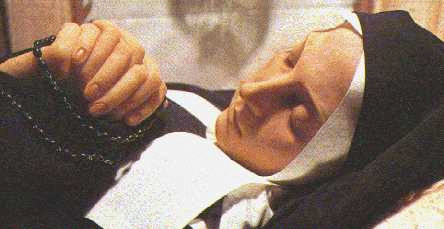
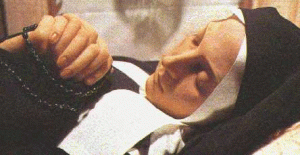
    Sybillina lived as a recluse for 67 years. She followed all the Masses and Offices in the church, spending what few spare minutes she had working with her hands to earn a few alms for the poor (Attwater2, Benedictines, Dorcy).

Born: 1287 at Pavia, Lombardy, Italy

Died: 1367 of Natural Causes: Her body remains Incorrupt

Beatified: 1853 (Cultus confirmed); 1854 beautified

Patronage: Children whose parents are not married, illegitimacy, loss of parents

Br. Dominic Ferrante, Novice

Gods-will

Following Jesus’ example of obeying the will of God can be a difficult thing.  I found out first hand just how hard it can be.  I had been offered a new job that was an incredible opportunity and blessing that God bestowed upon me.  That bad part was it was 400 miles from my home and that meant leaving my family and striking out on my own until our house could be sold and they could join me.

I was confident that God wanted me to follow this path.  I knew this was what God meant for me to do…even though I knew the loneliness and hardships of being away from my wife and son, for an undetermined amount of time, would be difficult to bear.  I cried almost every day that we were apart and pleaded with God to hasten our reunion.  I forgot that what is to be is in God’s time not my time.  It is “Thy will be done,” not “my” will be done.

God had given me, up to that point, the toughest test of my life and I nearly failed.  I nearly failed because I made the situation about me and my loneliness, and not the blessings and path God had chosen for me.

Jesus knew his time on earth was coming to an end.  His humanity was troubled and afraid of what was to come to pass.  Even though he was afraid of the prospect of facing death he knew there was no way to go against the will of his Father so he went willingly.

His death and resurrection had been predestined from the beginning of time and he was prepared to fulfill that prophecy.  He said to his disciples “Amen,  amen, I say to you, unless a grain of wheat falls to the ground and dies, it remains just a grain of wheat; but if it dies, it produces much fruit”.  Jesus knew that his death and resurrection would cleanse the sins of man and inspire many people to follow in the steps of fledgling Christianity.  Jesus knew his death and resurrection would be an almost irresistible call to people to follow his teachings and to live their lives closer to God and his covenants.

The challenge for us as Christians, is to accept whatever God has planned for us.  We may not understand his reasoning, but we must have unwavering faith, just as Jesus did.  We must learn that we are to follow God’s will no matter how difficult or frightening it may seem.  We must remember that God has only love for us, and has only the best intentions for us in our lives.

Therefore it is up to us to go forth and proclaim the joys of the gift of forgiveness. Christ died for us. We must also bear fruit in our lives but praising and preaching the word of God.

BLESSED ISNARD OF CHIAMPO

2013-0322-isnardo-de-chiampo1Blessed Isnard is another very distinguished and saintly first disciple of Saint Dominic whom Father Touron somehow overlooked. Of Isnard’s life up to the time he entered the Order practically nothing is known with certainty; whilst some of the statements anent his debut as a Friar Preacher are irreconcilable among themselves, and contrary to facts which have been ascertained in later years. Chiampo, a small town not far from Vicenza, Italy, was most likely the place of his birth; yet there are those who give the latter city this honor. Some think he was born of poor parents, and spent his youth in poverty. Others suggest that he belonged to a wealthy family by the name of Isnardi, which has been long extinct.(1)

It is beyond doubt that the future wonder-worker received the habit in Bologna, from Saint Dominic, in 1219; for this is a point on which nearly all the early authors are in accord. This truth seems certainly to prove that he was a student at the university there, and far advanced in his studies, At that time only such applicants were accepted; and this fact is a strong proof that his parents were well-to-do, for only the sons of this kind were given a higher education. Without exception the writers tell us of his singular purity of heart and religious disposition. His mind had been carefully guarded against the evils of the day, and in Bologna he proved faithful to the lessons of his earlier youth. Association with the holy man from Caleruega quickened his efforts for holiness of life and the salvation of souls.

For ten years after he entered the Order of Saint Dominic, we have no positive knowledge of where Isnard made his home. Yet the indications are that he spent this time between Bologna and Milan. In which case, of course, he labored energetically in those parts of Italy. Although a quite corpulent man, we are told, he was endowed with extraordinary energy, and was very gracious in action as well as in word. San Eustorgio, Milan, was most likely his convent for the greater part of this decade. So at least thinks Rudolph Majocchi, Blessed Isnard’s latest hagiographer.(2)

In more than one of our sketches, but especially in that of Saint Peter of Verona, we have seen how the Albigenses and kindred sects overran northern Italy at that date. Milan was one of the centers of Dominican activity against them; and it was from Milan that the convent of the Order in Pavia was founded. At Pavia the heretics were long in the ascendancy. The city was also a stronghold of Frederic II, whose Ghibellines, always opposed to the Holy See, constantly persecuted those who favored the authority of the Church. When, in 1230, zealous Rodobald Cipolla became bishop of Pavia, he found religion in a sad plight in his diocese, and began at once to seek means for a reformation.

Blessed Isnard’s reputation for holiness of life, zeal, eloquence, power over the souls of others, and fearlessness was broadcast. Most likely he had already preached in the Diocese of Pavia — perhaps many times; for the Friars Preacher of Milan carried their work in every direction. Possibly, too, he and Bishop Cipolla, himself an energetic character, had become friends at a prior date. Anyway, one of the new prelate’s first steps for the spiritual betterment of his flock was to invite the subject of our narrative from Milan, that he might establish a house of the Order at Pavia. This was in 1231; and before the close of the year we find the fathers actively engaged in their apostolate under the leadership of the man of God from Chiampo.(3)

The convent, which Rodobald Cipolla generously helped to erect, stood in the little village of Ticino, a short distance outside the walls of Pavia, and was given the name of Saint Mary of Nazareth. Throughout Italy the Friars Preacher were known as an effective aid to the hierarchy against the evils of the day. Thus Bishop Cipolla felt that, at least under Isnard, they would be an immense help to him in putting an end to the inroads of the enemy, and in freeing his diocese from the many ills in which it was enmeshed. He had not long to wait before he saw that his choice of auxiliaries was no mistake.

However, the task proved difficult, trying, and full of danger. On the one hand, the faithful, through long bad associations, had become so cold, careless, and wayward in the practice of their religious duties that it was exceeding hard to arouse them to a sense of their obligations. On the other, the Ghibellines and sectarians, ever of stubborn mood as well as violent in their methods, were even less subject to management. These possessed little or no faith. Besides they were loath to change their views, to amend their lives, or to part with the earthly goods which they had obtained by robbery or dishonesty.

As is ever the case in such conditions, the Friar Preacher’s success began with the poor and the laboring classes. For these he had a special love. He gathered them around him at the conventual church, instructed them in their religion, and inspired them with a love of its practice. Although he met with much opposition at first, it was not long before he had completely changed their lives. Reports of the good thus effected soon spread near and far. Meanwhile, he and his confrères preached throughout the City of Pavia and its environments — in churches, public squares, market places, or wherever they could find a space large enough for an audience. Gradually the wealthier Guelfs, and even not a few of the Ghibellines, began to harken to the call of grace and to receive the sacraments.

Among the little band of missioners Isnard shone with special brilliancy for his saintliness, zeal, and eloquence. The influence which he soon began to wield over the people caused the leaders of the heretics to single him out for their hatred. They mocked and ridiculed him, publicly spurned him, laughed at his corpulent figure, defamed him, threatened him, did everything in their power either to bring him into disrepute or to make him desist from his tireless apostolate. All was in vain. His sermons were incessant. He challenged his enemies wherever he met them. If they undertook to answer him, his inexorable logic put them to shame, or reduced them to silence. Never was he known to be ill natured, or to lose his patience; yet he showed the fire of divine love that glowed within his breast.

No doubt as much to demonstrate the holiness of His faithful servant as for the benefit of those to whom he preached, God blessed Isnard with the gift of miracles. The early writers mention many wrought by him both before and after his death.(4) These, quite naturally, quickened and strengthened the faith of the Catholics. They also gradually undermined the influence and broke the spirit of the heretics, many of whom were brought into the Church. By the time of the holy man’s death, the Diocese of Pavia was free from attacks by Albigenses, Catharists, and similar sects. They bad gone to other parts, been converted, or held their peace. No one could be found who would profess their principles. It was a glorious apostolate brought to a successful termination.

The Ghibellines, or adherents of Emperor Frederic II, gave Christ’s ambassador no end of worry and trouble. These were the rich who were not guided by their consciences in the acquisition of wealth; politicians without scruples; and soldiers of fortune, whose restless spirits ever led them into the service in which they might expect the greatest booty, license, and excitement. The machinations of the German monarch helped to keep them in keen antagonism to ecclesiastical authority and the interests of religion; which, of course, rendered them less responsive to our blessed’s impelling eloquence or the strong influence of his holiness and miracles. We may judge of the contempt of these friends of Frederic for the Holy See from the fact that their acts more than once led to a papal interdict on Pavia.

Still these men, who could laugh at an excommunication and interdict from the highest authority in the Church, perforce loved and admired Father Isnard. His charity, his zeal, his gentle goodness, his purity of heart, his constant efforts for the right, which they witnessed day by day, simply wrung respect from them. His dealings with Frederic II must have been much like those of John of Wildeshausen. Even when Bishop Cipolla was driven into exile, Isnard and his band of missionaries were left to continue their fruitful labors. In the absence of the ordinary, the clergy who still remained in the diocese seem to have gathered around the subject of our sketch for guidance. Possibly the saintly prelate, at the time of his departure, placed him in charge of his spiritual vineyard.(5)

Despite the turbulence and the anti-ecclesiastical spirit of the day, the holy Friar Preacher from Chiampo effected untold good even among this class of citizens. Documents which have escaped the ravages of time show that some, who deferred conversion until on their deathbeds, made him the instrument of their restitution. Others entrusted him with their charity and benefactions. Historians call him an apostle of Pavia, and largely attribute the preservation of the faith in the city to his zeal.

Another proof of the respect and confidence which Isnard enjoyed among all classes, as well as of his reputation abroad, is found in the incident which we have now to tell. From early times the Diocese of Tours, France, possessed landed estates in and around Pavia. Because of the political disturbances and the Ghibelline spirit, to which we have referred, the canons of the Tours cathedral found it impossible to collect their rents. In this dilemma, they appointed our Friar Preacher their agent; for they felt that he was the only man in northern Italy who either could obtain their dues for them, or would dare undertake the task. This was in 1240, the year after the historic excommunication of Frederic 11 by Gregory IX. The affair shows bow wisely Isnard steered his course, how all venerated him at home, and how well his courage and prudence were known even in France.(6)

Like a number of the early disciples of Saint Dominic whose lives we have outlined, the apostle and reformer of Pavia did not feel that he had done his all for the benefit of religion until he established a community of Dominican Sisters. These he placed in the immediate vicinity of his own convent, that he might the better look after their spiritual welfare. Their house bore the same name as that of the fathers — Saint Mary of Nazareth. Although he had perhaps never seen Prouille, his double institution at Pavia must have been much like that with which the Order started in southern France. The dowries of many of these sisters indicate that he founded them, in part, so that wealthy worldly dames, whom he had converted, might have a place in which they could more completely give themselves to the service of God. Saint Dominic, it will be recalled, established the community of Prouille principally with women converted from Albigensianism. When, some years after our blessed’s death, the fathers moved into the city proper, the original Saint Mary of Nazareth was turned over to the sisters.

Isnard had a profound devotion towards the Mother of God. He perpetually preached her protection over the faithful. In every way he propagated love and veneration for her. Father Majocchi thinks that this apostolate was of immense aid to him in his work of reformation; for no other piety seems to be more congenital to the affectionate Italian character. He labored zealously on almost to the very last. At least the Lives of the Brethren (Vitae Fratrum) say his final sickness was a matter of only a few days. The manuscript annals, or chronicles, of the old Friar-Preacher convent at Pavia tell us that he surrendered his pure soul to God on March 19, 1244. He knew that the end was near, prepared for it, and died as holily as he had lived.(7)

We have no account of the funeral of the man of God. Yet the great love and admiration in which he was held justify one in the belief that the Pavians attended it in immense numbers. Perhaps the sad event plunged the city in no less grief than his own community. He was buried in the Church of Saint Mary of Nazareth, where his tomb became at once a place of pilgrimage for the city and province of Pavia. Not a few miracles were wrought in answer to prayers to him. The name Isnard was often given to children at their baptism.

Later, for various reasons, the fathers moved into the city proper. First (1281), they took possession of San Marino, but gave up this place the next year for Saint Andrew’s. There they remained until 1302, when they exchanged Saint Andrew’s for Saint Thomas’, which was better suited to their purposes. At this last location they at once began a splendid temple of prayer, which was completed between 1320 and 1330. The body of Blessed Isnard, which had been brought from the extra-urban Church of Saint Mary of Nazareth to Saint Andrew’s, while the fathers lived in the latter convent, was again translated and enshrined in a marble sarcophagus built for the purpose in a chapel of the new Saint Thomas’ Church. The devotion of the people followed his relies to both of these places of rest. Nor is it any stretch of fancy to imagine that the two translations were times of great fervor for all Pavia.

Unfortunately, in a spirit of zeal and friendship, the fathers gave the use of Blessed Isnard’s Chapel, as it was called, to the University of Pavia for religious functions. Although its walls were afterwards decorated with paintings commemorative of the chief events in his life, these academic associations tended rather to decrease veneration for the saintly Friar Preacher. The misfortunes of Pavia during the Spanish-Austrian reigns of Charles V and Philip III, which lasted almost throughout the sixteenth century, well-nigh caused him (or rather his final resting-place) to be forgotten even by some members of his own Order, and his relies to be scattered to the winds. Happily the researches of Pavian historians helped to avert such a disaster.

In spite of the most thorough identification, however, and to the great sorrow of the fathers, the rector and senate of the university, though without authority in the matter, later compelled our blessed’s sarcophagus to be taken from the chapel and destroyed. This was in 1763. But, before its removal, the community reverently gathered up his relies and placed them in a wooden chest. All this was done in the presence of Cardinal Charles Francis Durini, who then closed the box, and fastened it with his seal. Thence until the suppression of Saint Thomas’ Convent by Emperor Joseph II, in 1785, Isnard’s relies were carefully preserved in the archives. The fathers then took the chest, with its precious contents, to Saint Peter’s. When, in 1799, they were also forced to leave this abode, they gave their spiritual treasure to Bishop Joseph Bertieri, O. S. A. This prelate, after an official examination, not only entrusted Isnard’s relies to the Church of Saints Gervasius and Protasius, but even ordered them to be exposed for public veneration.

It looks providential that, under all these changes and difficulties, popular devotion for Saint Dominic’s early disciple did not completely die out. That it continued to exist shows the unalterable love in which the Pavians held him. Bishop Bertieri’s act gave it new life. In 1850 portions of his relies were given to Chiampo and Vicenza. Old paintings of him here and there, which represented him as a saint, also helped the cause. In 1907 the diocesan authorities of Pavia approved of his cult, and requested the Holy See to accept their decision. The late Benedict XV, of happy memory, after a thorough investigation by the Sacred Congregation of Rites (that is, in 1919), granted his office and mass to the Friars Preacher and the Diocese of Pavia. March 22 was appointed as his feast day.

Isnard is the last of the original disciples of Dominic to be accorded the honors of the altar. The late date of his beatification affords the hope that several others of them may yet he similarly dignified by the Church.

St. Joseph ~ The Rev. Lady Sherwood, OPI

StJosephIcon

Just like our Heavenly Father gives us love, care, stability and the standard to live by with his holy word in the scriptures, he is a true Father to us who wants the very best for all his children.  St. Joseph follows our Father’s example, as both husband and step-father.  He gives us examples which men should follow in their lives. Joseph cared for and provided for the Holy Household. There are many qualities that Joseph had which we could use to be the role model for Christian husbands and fathers. Joseph was a very compassionate man.  We can see an example of this when he suspected his wife of infidelity; he planned to divorce her quietly rather than denounce her publicly and expose her to public shame and penalty.

Joseph was always obedient to God and did what he knew was God’s will without hesitation.  Examples of this are that he kept Mary as his wife; he protected and provided for his family when they had to flee to foreign lands to protect them from danger.

Joseph led a life of deep prayer and was in communion with God, and would always seek out that which was God’s will. God often told Joseph his will using dreams.

Joseph was a provider of care, When Jesus’s life was threatened, Joseph would take them out of danger. He took his family to Egypt and only returned when it was safe to do so, and when Jesus went missing ataged twelve, Joseph went searching for him bas both parents were obviously extremely worried about Jesus’s safety.

Joseph also brought much more to Jesus’s life, he taught him his trade which Jesus worked in for about twenty years, he gave Jesus love, stability and was his earthly male role model, which was and still is vitally important for a good father to give any child.

Sadly not all children are brought up in such a way today, but husbands and fathers truly should seek to follow this sincere man of God in the way they run their lives. Are you married? Do you give all the love, trust and respect to your spouse? Or with stresses and strains do you always argue or not truly make time for each other? If you have children, do you know where they are and if they are safe, or who they might be talking to online? Do you give emotional stability, patience and unconditional love? Do your children see you as the role model they need in a Father?  We should strive to be as our heavenly Father is to each of us, to our spouses, our children and in fact to all as our brothers and sisters.

While the Gospels do not shed much light on St. Joseph’s life, it is believed that he died before Jesus’ public ministry.

Over the years, many traditions and customs have sprung up in celebration of St. Joseph’s Feast Day.

According to legend, there was a famine in Sicily many centuries ago. The villagers prayed to St. Joseph, foster-father of the Infant Savior, and asked his intercession before the throne of God. Their prayers were answered. With the ending of the dreadful famine, a special feast of thanksgiving was held in commemoration of the Saint. This celebration became tradition. Wealth families prepared huge buffets. They then invited the less fortunate people of the village, especially the homeless and sick.

The celebration begins with a religious tableau. Selected villagers portray an elderly man, a lovely young woman, and a little child. The three are seated at the head table and remain there during the early part of the festivity. Others accompanying this “Holy Family” are twelve men or boys, representing the Apostles and other children, attired as angels. The village priest blesses the food, then the “Holy Family” is served first by the host and hostess.

All are free to come and go as they wish. The guests may eat what they choose and as much as pleases them. The festival lasts most of the day and well into the night. When all have been fed, they go on their way with thankful hearts and take the blessing of the host and hostess with them.

The effect of the table design is dignified, solemn, yet festive, grand and inspiring. Much symbolism is contained in its shape and decoration. The “steps” represent the ascent from earth to heaven. On the topmost step is a statue of St. Joseph or a picture of the Holy Family. White linen tablecloths cover the table. Vigil lights of green, brown and deep yellow, representing St. Joseph’s attire, are profusely placed. Palms placed nearby and around the room, as well as lily plants and white carnations give the table softness and the scents together with incense used in the opening of the ceremony are suggestive of the fragrance of heaven and the sweetness of salvation.

The food dishes represent the harvest, the created beauties of the world. Breads are baked in shapes of a staff, a carpenter’s implement, a hand, the cross and animals close to the Infant Child at birth. These shapes represent St. Joseph and the life of Christ. Minestras, very thick soups, are made of lentils, favas and other types of beans, together with escarole, broccoli or cauliflower. Other vegetables, celery, fennel stalks, boiled and stuffed artichokes are also served.

No cheese is eaten on St. Joseph’s day. The spaghetti is not sprinkled with grated Incanestrato, but in its place a traditional mixture of tasted dry bread crumbs with fresh sardines and fennel sauce is used. A dish of “sweet macaroni” with honey sauce is also served.

Then, the special dessert without which no St. Joseph’s Day buffet could ever be called by that name. It is St. Joseph’s Sfinge: a large round cream puff filled with ricotta (Italian cottage cheese) and topped with red cherries and glazed orange slices. Many dessert cookies are embellished with almonds. The almond tree is characteristic among the flora of the Mediterranean and a profoundly sacred symbol to those of Jewish, Moslem and Christian faiths alike.

All are free to come and go as they wish. The guests may eat what they choose and as much as pleases them. The festival lasts most of the day and well into the night. When all have been fed, they go on their way with thankful hearts and take the blessing of the host and hostess with them.

It is also customary for the village officials to arrange a public buffet in St. Joseph’s honor. The banquet table invariably stands in the piazza–public square–opposite the doors of the cathedral. The table is usually built around two sides of the piazza in the form of a right angle. These village tables in the public squares may not be as elaborately decorated as those in the homes, but they sage beneath the weight of choice foods and wines contributed by the wealthy villagers. All come to this public table at some time during the day to pay homage to the great saint.