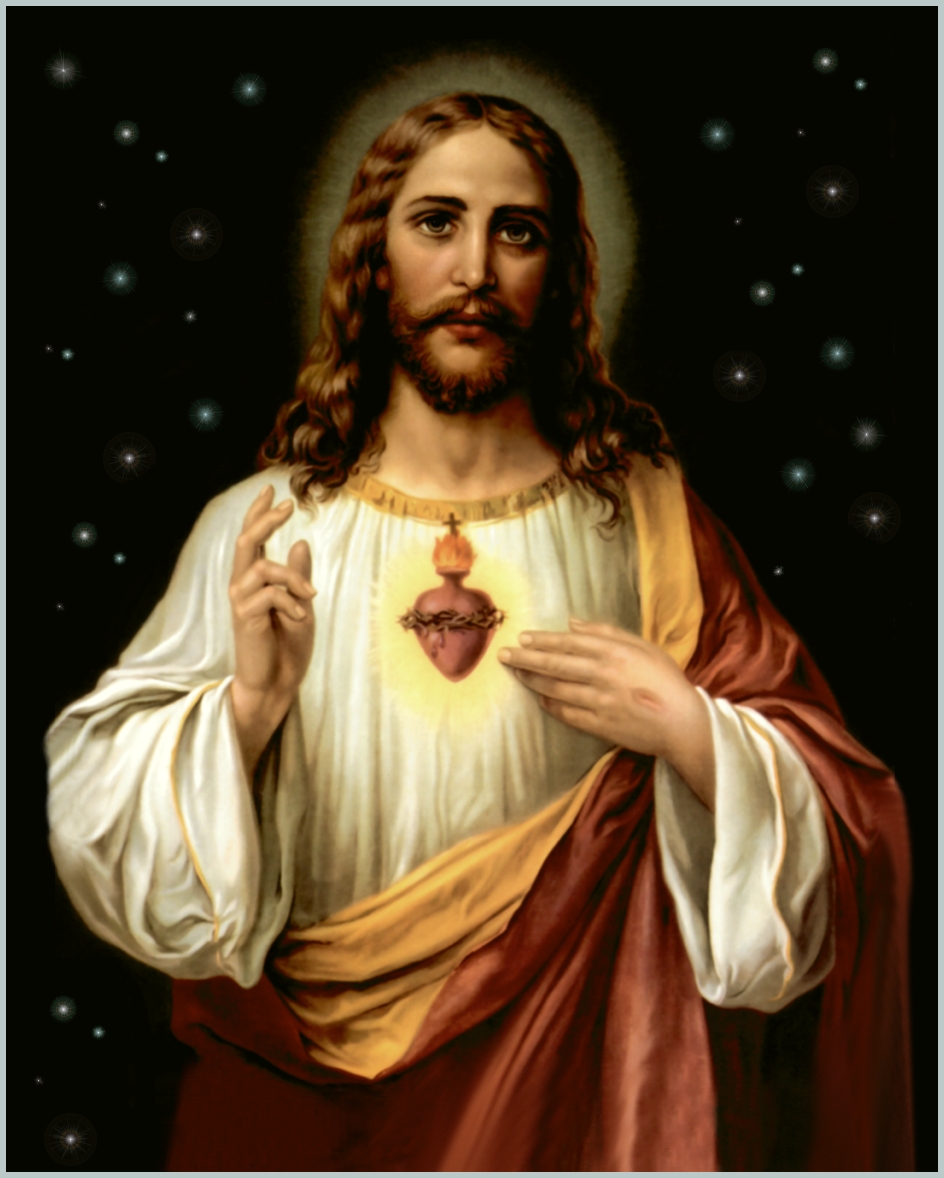
My dear brothers and sisters in Christ, today, we come together to celebrate the Solemnity of The Sacred Heart of Our Lord and Saviour, Jesus Christ.
Let us first look at today’s Holy Gospel Reading of Jn 19:31-37 (NIV):
31 Now it was the day of Preparation, and the next day was to be a special Sabbath. Because the Jewish leaders did not want the bodies left on the crosses during the Sabbath, they asked Pilate to have the legs broken and the bodies taken down. 32 The soldiers therefore came and broke the legs of the first man who had been crucified with Jesus, and then those of the other. 33 But when they came to Jesus and found that he was already dead, they did not break his legs. 34 Instead, one of the soldiers pierced Jesus’ side with a spear, bringing a sudden flow of blood and water. 35 The man who saw it has given testimony, and his testimony is true. He knows that he tells the truth, and he testifies so that you also may believe. 36 These things happened so that the scripture would be fulfilled: “Not one of his bones will be broken,” 37 and, as another scripture says, “They will look on the one they have pierced.”
So what are we being told today?
The scene in our Gospel Reading today is immediately after Jesus’ death. Jesus’ body is still hung upon the cross. However, since the Sabbath was upon them, the bodies of Jesus and the two men crucified alongside him needed to be taken down and buried. John tells us that the Jews asked Pilate to break the legs of Jesus and also of the two men who were crucified with him. However, when the soldiers came to Jesus’ body, he clearly was already dead so they decided not to break his legs. Rather they chose to pierce his side with a lance! And as we know blood and water flowed out. This fulfilled the prophecy in Exodus 12: “Not one of his bones will be broken.” Thus, Jesus fulfilled the prophecies of the Messiah. Jesus truly was indeed the “Lamb of God” who had been sacrificed for each and every one of us!!
Do we truly appreciate what Jesus did for every single one of us? Is Jesus’ passion, death and resurrection personal to us as indeed it truly ought to be? Or do we simply think of it merely as a historical story? Do we truly and deeply appreciate Jesus’ willingness to sacrifice his own life for us so that we can live fully?
Today’s Solemnity of the Sacred Heart of Jesus gives us the vital opportunity to ponder on all that Jesus freely chose to do for everyone, yes indeed, for you and for me! Do we realize how much Jesus continues to grace us within our lives today? Whether we are aware of it or not, we live deep within Jesus’ own heart. Truly there is no greater love than the love which Our Lord Jesus has for us!
Today I invite you to sit quietly with Jesus for a period of time. To take the time to truly thank Jesus for the depth and the tenderness of his love for us. What a wondrous and enduring gift He continually gives to us! Today may we truly celebrate Our Lord’s sacred and loving heart.
Let us pray:
O Sacred Heart of Jesus, font of love and mercy, and source of every blessing,
Pour out your love upon our wounded human hearts.
O Sacred Heart of Jesus, burning with the fire of charity for every soul,
Purify our hearts and draw us ever closer to your divine embrace.
O Sacred Heart of Jesus, wounded by our own sins, and familiar with all suffering,
Forgive us of our sins and restore us to life.
O Sacred Heart of Jesus, through which every heart finds solace and refuge,
Be our strength, our courage, our fortress, and our defender.
O Sacred Heart of Jesus, proof of the Father’s love and desire for us,
On the first day of the Feast of Unleavened Bread,
when they sacrificed the Passover lamb,
Jesus’ disciples said to him,
“Where do you want us to go
and prepare for you to eat the Passover?”
He sent two of his disciples and said to them,
“Go into the city and a man will meet you,
carrying a jar of water.
Follow him.
Wherever he enters, say to the master of the house,
‘The Teacher says, “Where is my guest room
where I may eat the Passover with my disciples?”‘
Then he will show you a large upper room furnished and ready.
Make the preparations for us there.”
The disciples then went off, entered the city,
and found it just as he had told them;
and they prepared the Passover.
While they were eating,
he took bread, said the blessing,
broke it, gave it to them, and said,
“Take it; this is my body.”
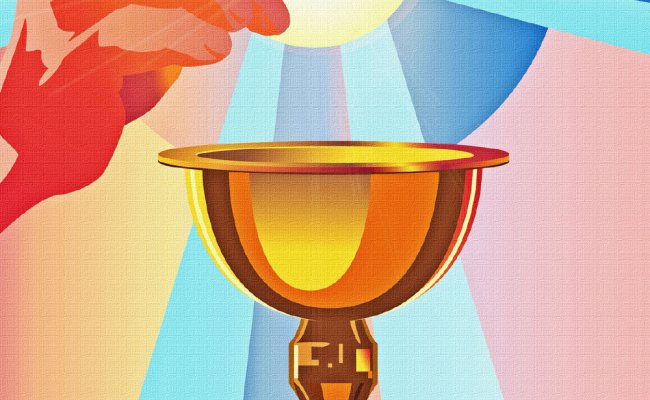
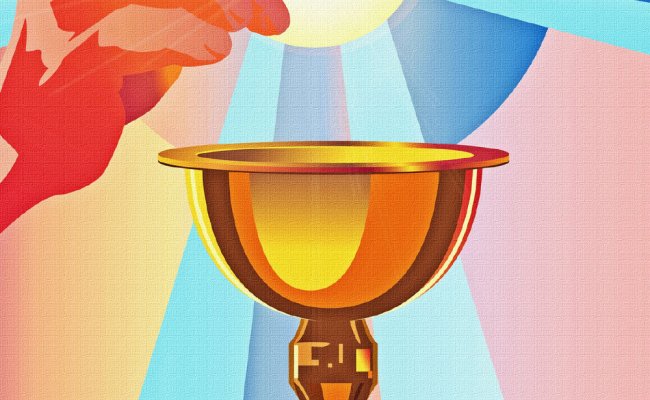
Then he took a cup, gave thanks, and gave it to them,
and they all drank from it.
He said to them,
“This is my blood of the covenant,
which will be shed for many.
Amen, I say to you,
I shall not drink again the fruit of the vine
until the day when I drink it new in the kingdom of God.”
Then, after singing a hymn,
they went out to the Mount of Olives.
The Passover was a tradition for the Jewish people that God had commanded them to follow. It was a special meal that was to help them remember how He saved them after hundreds of years of slavery in Egypt. And the Lord told the Israelites to have the Passover meal every year so that they wouldn’t forget who He was and who they were.
In Mark 14:12, it was time for the Passover. So the disciples asked Jesus, “Where will you have us go and prepare for you to eat the Passover?” And in the next few verses, Jesus tells them where to go and what to do (vv. 13-15).
About the Passover Meal
The Passover was not just a festive occasion to get together and eat stuff. You had to have some very specific things for the meal, each thing having a very specific symbolic purpose. It was precisely tailored to help people remember what God had done for them. So the disciples followed Jesus’ instructions and “they prepared the Passover” (v. 16).
I’m not going to go into detail for verses 17-21, but just note that the Passover had a regimented process to it. And by this time, Jesus and His disciples were going through this process
At the end of the Passover meal, the remainder of unleavened bread would be eaten. This is probably where they were in verse 22.
“And as they were eating, [Jesus] took bread, and after blessing it broke it and gave it to them, and said, ‘Take; this is my body.’”
What the Passover Points To
“Take; this is my body.” We’ve heard those words many times over the years. But we need to realize that Jesus was redirecting this powerful, long-held symbolism of the Passover. Jesus was saying, “This bread isn’t only meant to point you back to God’s faithfulness in the Exodus – it’s meant to point you to me. My body is about to be broken.” For us.
After Jesus passes the cup, He says, “This is my blood of the covenant, which is poured out for many” (v. 24). Here again the cup had always pointed back to the Exodus, but now Jesus tells us that it points to Himself. He just redefines the entire Passover tradition. No average person would dare to do this, but Jesus did – He had the authority to.
The evening would probably have closed with singing. This is what we see in verse 36: “And when they had sung a hymn, they went out to the Mount of Olives.” And that ends Mark’s account of the Lord’s Supper.
Why is the Lord’s Supper Important?
Ever since that night, Christians have regularly observed the Lord’s Supper. Different churches may do it different ways, but the question is: why is the Lord’s Supper so important?
As we read the Bible, we see that it’s all about memory. God’s people have always struggled with a sort of spiritual Alzheimer’s, forgetting who God was and who they were. This is one of the reasons He set up the Passover – so that His people would remember.
If we don’t hear about Jesus over and over again, we’ll forget He’s our Savior. We’ll forget He’s our Lord. And when we forget:
We start to worry, to be afraid of everything, to feel like we are all alone in the world.
We will start to go our own way, as though we are the lord of our own life, making prayerless decisions and depending on our own strength.
We begin to live the way we did before we were made new through Christ. Sin starts to settle into our hearts and habits, and we become vulnerable to temptation. We seek satisfaction and comfort in broken cisterns of the world, forgetting that we have rivers of life-giving water available to us.
We begin to forget our purpose, devoting ourselves to lesser purposes and trying to cobble together some kind of identity apart from Christ.
Our priorities start to match our non-Christian neighbors, and soon there’s nothing distinctive about us.
So when you partake in the Lord’s Supper, remember Jesus. It’s not magic bread or magic juice, but the Body and Blood of our Lord. And what they are is so powerful. Remember who Jesus is and who you are. Then ask yourself, “What will be different now that I remember Jesus is my Savior and Lord?”
Heavenly father thank you for the sacrifice of your son Jesus Christ. Let us remember through the sacrament, your sacrifice because of Your love for us. Let us be mindful each time we receive the bread and wine that we are receiving the body and blood of Your only son who died on the cross for our sins. Amen.
There are a few things about which I could not be more certain: Scott loves me truly, madly, deeply (I really like that song.) My Daddy was the wisest man on the planet. My Momma was the bestest woman to ever draw breath. Jesus loves me and my salvation is secure.
And, conversely, there are things in life that I will never, never fully grasp. Like, why do some people think it’s OK to wear stripes and plaid together? Pi or upper-level mathematics? How things travel a zillion miles a minute in space?
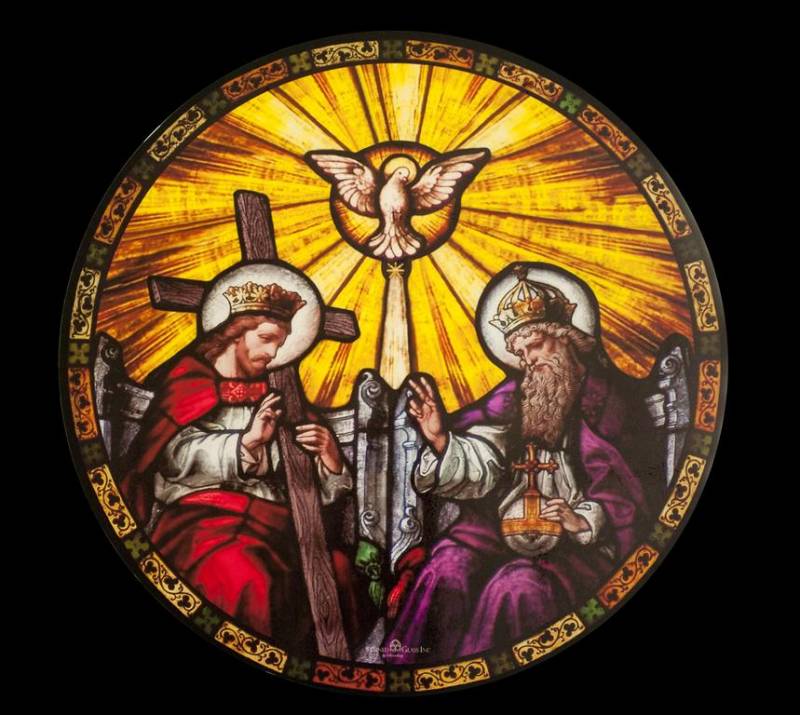
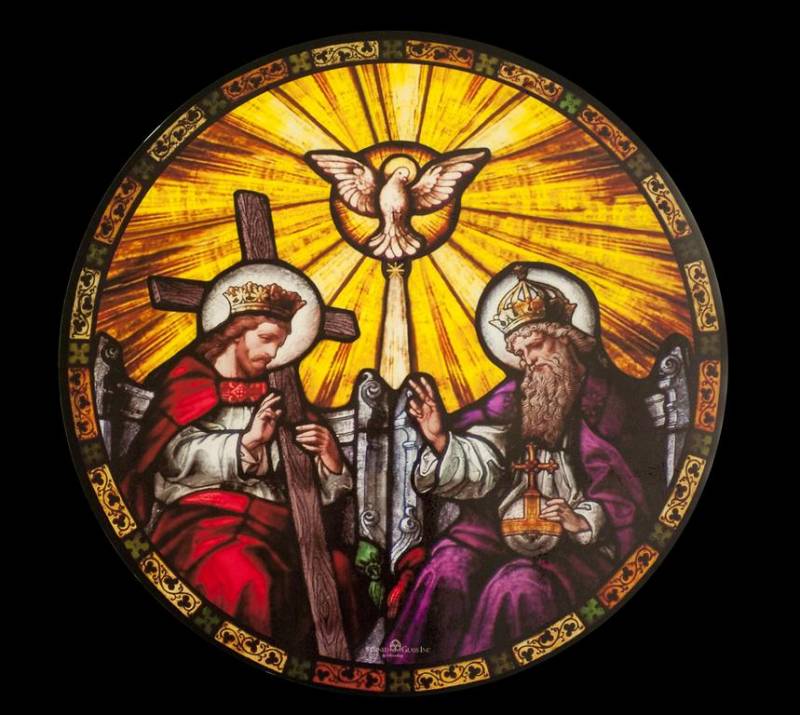
And the Holy Trinity is a mystery that we will never fully understand. The God of the Bible is one God. God has one essence – one substance. In other words, one “stuffness.” However, God exists in three Persons: the Father, the Son, and the Holy Spirit. Each Person in the Trinity (or the Godhead) is fully God and fully a Person. They are equally eternal, powerful, sovereign, and worthy of worship. But they are one God.
Got that? Me, neither, but it is central to our faith.
Many theologians and holy men and women of God have attempted to explain just how this Trinity Thing works. One God, Three Persons. Three in one and one in three. They have, of course, failed. It has been said that if you try to explain the Trinity, you will lose your mind. But if you deny it, you will lose your soul. There are several popular analogies often used to explain the Trinity, but, they don’t work and in reality are heresies. (Uh oh!) Here they are:
God is like water. Now, we know that water can be in three different forms: Liquid, Ice, and Vapor. But this doesn’t work and this particular heresy is called “modalism.” Modalism expresses the belief that God is not, in fact three separate persons, but one God expressed in three different forms. Now, if this were the case, then and the Trinity really is like water, then the story of Jesus (the Son) praying to the Father all those times in the Bible, is just Jesus talking to Himself. This belief denies something central to God that makes Him God. So comparing God to water isn’t really as helpful as one might think.
It’s also been said that The Trinity is like a man: A father, who is a son, who is a husband. Nope. Same as modalism. Won’t work.
Then there is the age-old story-legend-myth of St. Patrick using the shamrock. Or the more modernized versions using an egg or an apple. The shamrock has 3 leaves to make one whole plant, the yolk, shell, and white make up one egg, or the peel, flesh, and core of an apple make up one fruit. Umm…no. Won’t work, because any of these three things that make up one thing will not stand on their own to be a complete thing? Know what I mean? The egg yolk, shamrock leaf, and apple peel don’t make one complete whole. And this particular heresy is called Partialism. Sigh……
Moving on…
The sun has been used to explain the Trinity. This example says that the Father is like the sun. The Son is like the light rays that visibly reveal the sun, as Jesus is the visible image of the invisible God. The Holy Spirit is like the heat that emanates from the sun, unseen yet powerful and effective in making the sun felt. This makes sense, right??? Nope. Sorry. This explanation is fatally flawed in that is describes the Son and Spirit as creations of the Father. This is the error of Arianism (not to be confused with Aryanism, which is also bad). In Arianism, the Son is not eternally equal with the Father, but was the Father’s first and best creation. This would make Jesus something less than fully God. This little gem of heresy is called Subordinationism and was first espoused by Arius who lived in the late 200s/early 300s, and whose modern-day followers are now known as Jehovah’s Witnesses.
A couple more illustrations of the Trinity that aren’t quite so bad, but aren’t great either are these:
American Christian pastor, speaker, author, and widely syndicated radio and television broadcaster in the United States, Tony Evans, has said that the pretzel is a good illustration because it consists of one piece of dough with three holes. Take away any one of the holes and the pretzel isn’t really a pretzel anymore. (According to some people, the pretzel was actually invented in Europe several hundred years ago by a monk who wanted to illustrate the Trinity to the children of his village, so he took some dough, looped into the familiar three-hour shape, based it, and gave it to the children as an edible object lesson.)
Or this from noted scientist Dr. Henry Morris. He notes that the entire universe is trinitarian by design. The universe consists of three things: matter, space, and time. Take away any one of those three and the universe would cease to exist. But each one of those is itself a trinity.
Matter = mass + energy + motion
Space = length + height + breadth
Time = past + present + future
Are we having fun yet? No? OK, I’ll bring this to a close. In so doing I’m gonna end where I started. The Trinity is a doctrine that all Christians believe but no one really understands. That much should be clear from this message. If you try to explain the Trinity, you will lose your mind. But if you deny it, you will lose your soul.
Someone asked Daniel Webster, who happened to be a fervent Christian, “How can a man of your intellect believe in the Trinity?” He said, “I do not pretend fully to understand the arithmetic of heaven now,” he replied. How kewl is that little phrase??? “The arithmetic of heaven.”
The Trinity should cause us to bow in humble adoration before a God who is greater than our minds could ever comprehend.
Today, the Feast of the Holy Trinity, we rejoice that we have a Triune God who has provided for a Trinitarian salvation. When we were lost in sin, our God acted in every Person of his being to save us. The Father gave the Son, the Son offered himself on the Cross, and the Holy Spirit brought us to Jesus. We were so lost that it took every member of the Godhead to save us.
In 1774 a man named Ignaz Franz wrote a hymn of praise to the Trinity: Holy God, We Praise Your Name. This is the fourth verse:
“Holy Father, Holy Son, Holy Spirit, Three we name you;
While in essence only one, undivided God we claim you.
Then, adoring, bend the knee, and confess the mystery.”
Let us pray.
Holy God, above us, among us, within us: we rejoice this day that while you might have chosen to be unknown to us, you have revealed yourself in many ways. Each encounter with you calls us to return blessings with worship, compassion, and service. As we worship you today, we do so in gratitude for all your parental care for us through your creation. As we worship you today , we do so because, in love, you gave us Christ, that through him we might find eternal life. As we worship you today your Spirit leads your church to reach out in compassion, mercy, and grace to all your children everywhere. In gratitude, we celebrate you, three and yet one. Amen.
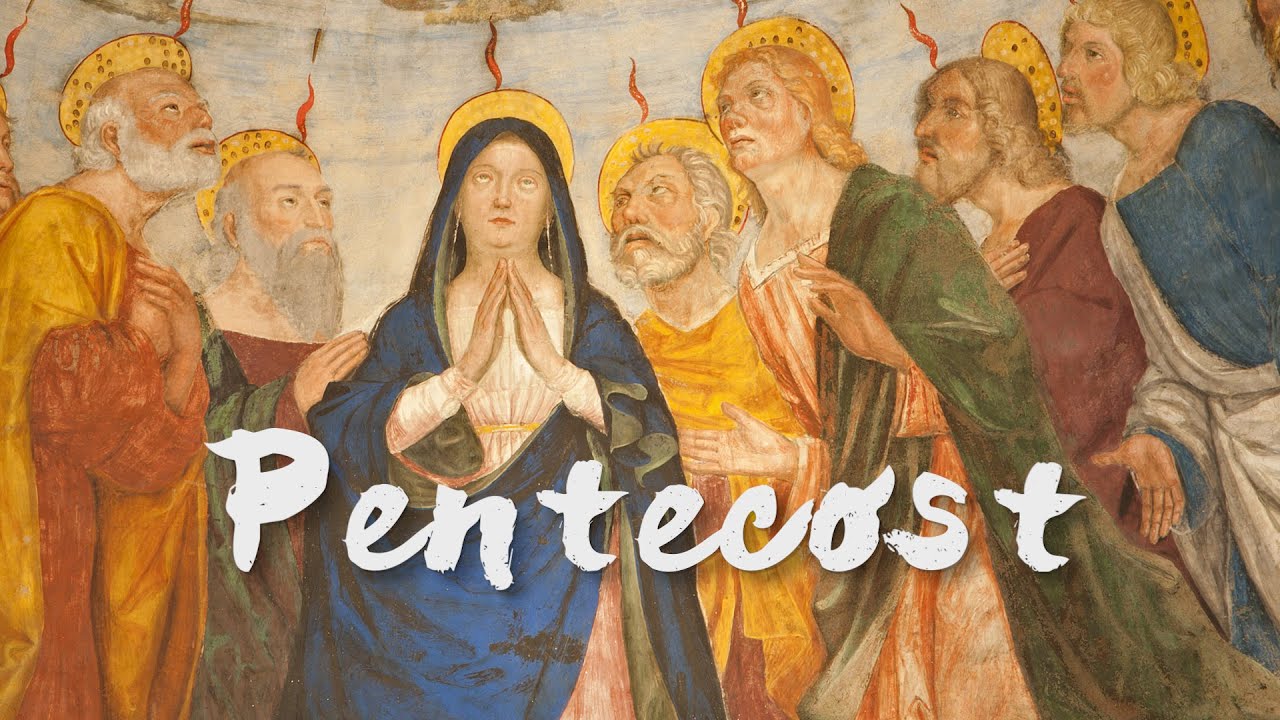
The time of the Church has begun. It is a time of our responsibility to witness in the world what Jesus taught us. Walk the way of the gospel and bring the Good News to others. This task is difficult because we are only human, and yet Jesus is the Son of God. We need help, we need the power of the Spirit of God to stir our hearts and enlighten our steps. That is why those present see it as glowing tongues that shine and warm. They feel it as the force of the wind pushing forward and giving strength in the path of good. It is up to us to develop the sails and direct our boat on this sea of life.
Thus the frightened apostles became zealous heralds of the cross and resurrection, of faith in God and of love for every man. And people, gathered in that square and all over the world, united by the Spirit, understand each other better and forgive more easily. It is these gifts that our families and parishes, the Church and society need most: To understand means to forgive!
The Church received her mission in this world from Jesus: You will be my witnesses! Thus all of us baptized, as its children and members, are called to be apostles of hope and witnesses of love. That is our calling and our mission, our mission.
We certainly strive for friendly, family, business and civic duties. We can call this the horizontal of our existence. Something like the foundations of a future house. But the walls must already be visible in the foundations. The foundations are there only to carry a horizontal that rises upward, toward heaven and God.
Sometimes we Christians lose sight of our spiritual mission, and we do not even know the meaning of this daily rush in which we are involved. More and more work is being done, earnings are never enough, the voids of the heart are too deep when they want to be filled only with earthly things. Here is the Holy Spirit and his seven gifts. He is a support to the mission of the Church, to explain the truth to us, to strengthen our decisions, so that our love does not cool down…
God’s call is often repeated in the Bible: Arise and go! Jesus says of himself: I am the way… So our human and religious life is a permanent journey. The complete truth is up there, we always discover it a little bit, the beauty of its flowering never ceases.
The Holy Spirit makes us free and creative, encourages us to row towards the open sea of life and God’s history. Man was not created to just keep the past, something acquired, old habits… It is our vocation to discover new seas of life. It is our task to spread the sails and the Holy Spirit will give us the strength of a suitable wind.
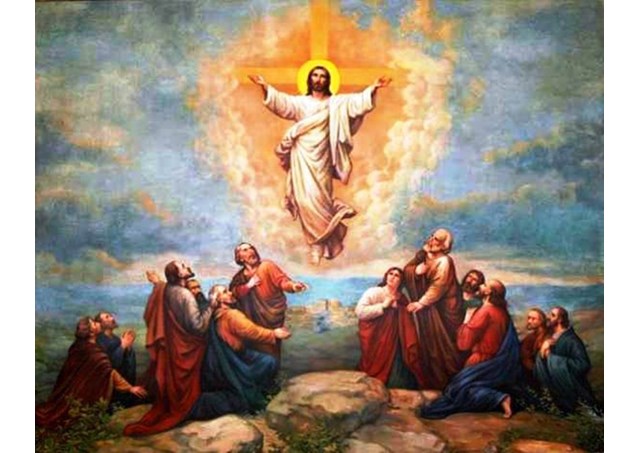
The Liturgical year of the Catholic Church is divided into six seasons – Advent, Christmas, Lent, Holy Week, Easter, and Ordinary Time. In addition, the Church observes memorials, feasts, and solemnities. The Solemnity of the Ascension of the Lord is one of the great solemnities. It occurs on the fortieth day after Easter Sunday, which always falls on a Thursday, and often passes unnoticed by most Christians. So, many churches move the Ascension Day to the following Sunday to ensure more people participate in the celebration.
What is the meaning and importance of the ascension of Jesus Christ?
Today’s readings, from the Book of Acts (1:9-11), the Gospel of Mark (16:15-20) and the Gospel of Luke (24:50-53) give a detailed account of Jesus’ ascension.
You may remember since Easter Sunday we have been reading several familiar stories of Jesus’ post resurrection appearances to his disciples. During his appearances Jesus greeted them with peace and talked to them. He walked with them to Emmaus and explained the scriptures to them. He showed them his wounds and asked them to touch him. He shared a meal with them. He dispelled their doubts and fears and proved to them that he is alive. He instructed them not to leave Jerusalem until they had received power from the Holy Spirit.
On the fortieth day, while the disciples had gathered in Jerusalem, Jesus appeared before them for the last time. They asked him whether he was going to “restore the kingdom of Israel” at the time. Jesus said to them that “it is not for them to know the times or seasons that the Father has established by His own authority but that they would be filled with the power of the Holy Spirit and bear witness to the gospel”. He then charged them to “go out into the whole world and proclaim the gospel to everyone, to heal the sick, to cast out demons and told them that no deadly or poisonous thing will harm them”.
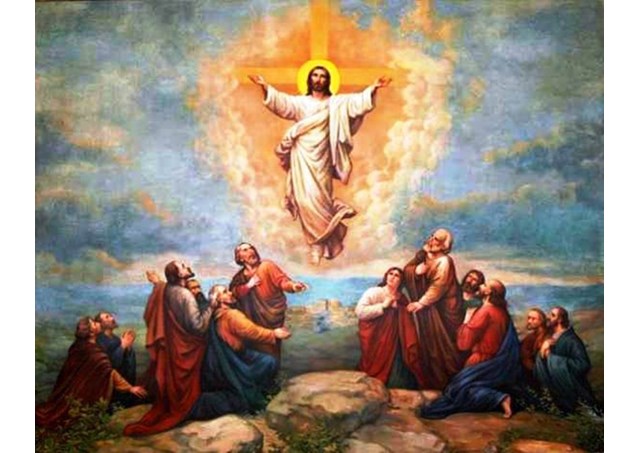
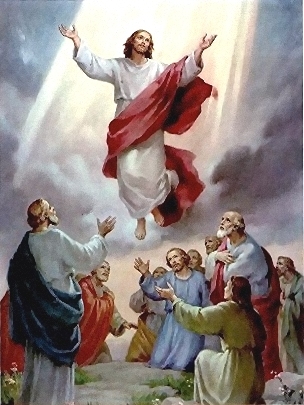
Jesus’ appearance ended with him being “taken up into heaven and seated at the right hand of God” in their sight. After Jesus had ascended to heaven, the disciples received the Holy Spirit, as Jesus had promised, and then they went everywhere preaching the gospel of Jesus, healing people and working many signs and wonders with the help of the Holy Spirit. This is the event we commemorate today.
The Ascension of the Lord is important for two reasons.
With the Ascension Jesus decisively ended his time on Earth and entered God’s heavenly domain, so that his own words should be fulfilled. He had told his disciples, “No one has gone up to heaven except the one who came down from heaven, the Son of Man”, John (3:13). He had said to Mary Magdalene at the tomb, “Do not hold on to me, for I have not yet ascended to the Father. Go instead to my brothers and tell them, I am ascending to my Father and your Father, to my God and your God”, John (20:17). Jesus had descended from heaven in the Incarnation and returned to heaven in the ascension.
However, he ascended to heaven not only to return to where he came from but also to prepare a place for those who believe in him. He said, “In my Father’s house there are many rooms. If it were not so, I would have told you. I am going to prepare a place for you”, John (14:2). Yes, the Ascension of the Lord is a great consolation to all who are afraid of death or afraid of dying. Let us, therefore, encourage one another to remember that Jesus descended, died, resurrected, and ascended into heaven for us. Let us believe and live in the hope of one day being with him in God’s kingdom forever.
Jesus Christ, having entered heaven once again, intercedes constantly for us for the power of the Holy Spirit which is very essential to the life of faith in Christ. Jesus said, “Nevertheless I tell you the truth: It is to your advantage that I go away, for if I don’t go away the Holy Spirit won’t come to you. But If I go, I will send him to you”, John (16:7). Jesus has not promised to restore to us our health, family, relationships, work, fortunes, and finances according to our own times, ways, thoughts, plans and desires but in God’s time. Meanwhile he has promised us the power of the Holy Spirit so that we can courageously preach his gospel, minister healing in his name, wisely deal with difficult people and take on evil and win.
Let us today, therefore, earnestly pray for ourselves and our Church that we may be blessed with all joy and peace in believing in the ascension of the Lord and continue to seek the gifts of the Holy Spirit – the fear of God, piety, knowledge, fortitude, counsel, understanding and wisdom.
Today we celebrate the Ascension of The Lord. This is when Our Lord and Saviour, after finishing his ministry here on earth, until he comes again in glory, returned to His Father in Heaven. Let us look at what God’s word of The Holy Gospel is telling us today:
Mark 16:15-20 (NIV)
15 He said to them, “Go into all the world and preach the gospel to all creation. 16 Whoever believes and is baptized will be saved, but whoever does not believe will be condemned. 17 And these signs will accompany those who believe: In my name they will drive out demons; they will speak in new tongues; 18 they will pick up snakes with their hands; and when they drink deadly poison, it will not hurt them at all; they will place their hands on sick people, and they will get well.”
19 After the Lord Jesus had spoken to them, he was taken up into heaven and he sat at the right hand of God. 20 Then the disciples went out and preached everywhere, and the Lord worked with them and confirmed his word by the signs that accompanied it.
The Gospel today seems to be focused more upon the apostles going out and spreading his Holy Gospel, than it does about Jesus going up to The Father. As Jesus goes to his Father, the message is to that we all must take over the spreading of Our Lord’s gospel now, and that we need to be witnesses to him. We are all called to share that which we have received, and to speak of what we have seen and heard.
We witness to Jesus in our lived in many ways. This includes by prayer, by reading and spreading the gospel and in our service of others in Christ’s love. Prayer is our time to be in personal touch with God who is constantly reaching out to us. The gospel is what feeds our souls, our minds, and our spirits, it is a daily opening to the true words and deeds of Jesus, Our Lord and Saviour. Our service in The Love of Christ to others, brings us to witness in the true way, the care of God as we give and receive care to each other.
NEW PRESENCE
This is what we give to our ascended Lord and is also what we receive from him. The word of God are the divine words of truth and
salvation, spoken in human words. All of our time with God is linking heaven and earth, and we are each sharers in his divinity as we are in Jesus and Jesus is also with us, he has shared in our humanity, . Far from being the absence of Jesus, it is his presence in a new way among us.
Indeed, Our Lord Jesus has gone back to The Father to make a heavenly place for us, and will return in Glory to bring us home. Until then, we are all called to continue our Lord’s ministry here upon the earth. We are the only Jesus that now can be seen, through our witnessing of him in our lives to others. Are you being a true witness of Christ in your life?
Let us pray:
Lord Jesus Christ, right before your Ascension into heaven you told your apostles to be your witnesses to the ends of the earth upon receiving the Holy Spirit. May we be similarly inspired to spread your Gospel message in word and deed, according to your will for us. And may we do so prudently and joyfully, with your help, your guidance, and your grace! And remembering this glorious event, help us to seek what is above, Heaven, where you are seated at the right hand of God the Father!
I have a really hard time with bigots. With ultra right folks. With folks who preach hate under the cover of their ‘christianity.’ I have a really hard time with child abusers, with spousal abusers. I have a really hard time with habitual criminals and crooked cops. Animal abusers. With politicians who say one thing and do another. And the list goes on. And on. And on.
I have a hard time with those who profess to be my friends, but prove themselves otherwise. With those who say they love me, but do whatever they can to denigrate those whom I love and prove themselves to be the antithesis of loving.
And sometimes I have a hard time with people in general. In the musical “Scrooge” by Leslie Bricusse, Scrooge sings, “I Hate People:”
Scavengers and sycophants and flatterers and fools
Pharisees and parasites and hypocrites and ghouls
Calculating swindlers, prevaricating frauds
Perpetrating evil as they roam the earth in hordes
Feeding on their fellow men
Reaping rich rewards
Contaminating everything they see
Corrupting honest me like me
Humbug! Poppycock! Balderdash! Bah!
I hate people! I hate people!
People are despicable creatures
Loathesome inexplicable creatures
Good-for-nothing kickable creatures
I hate people! I abhor them!
Sadly, I think we all of us feel that way about people at times.
But then, there’s this little quote that springs to mind:
You will never look into the eyes of someone God does not love.
Now, doesn’t that just knock the wind out of my sails and punch me right in the gut. In spite of everything, God loves those folks that we have a hard time with. God loves those whom we really, really have a hard time with. God loves those whom (gasp!) who don’t love US. Pretty humbling, huh?
The Scriptures appointed for today drive that point home. In our first reading today (Acts 10:25-26, 34-35, 44-48) we hear St. Peter teaching the Jewish Christians that the Gentiles are God’s people just as much as the Jewish ones. In our second reading, ( 1 Jn 4:7-10) St. John says to us “Beloved, let us love one another, because love is of God; everyone who loves is begotten by God and knows God. Whoever is without love does not know God, for God is love.” And in our Gospel reading for today, Jesus pulls no punches, spares no feelings, and takes no prisoners when he says, flat out: “This is my commandment: love one another as I love you.” Notice, not a suggestion. Not a subtle hint. A COMMANDMENT.
Oops.
SO, all those folks that I have a really hard time with? Love ‘em anyway. All those folks who have a hard time with me? Love ‘em anyway. Jesus teaches us to “Bless those who curse you. Pray for those who hurt you.” (Luke 6:28).
And it’s HARD. Living our lives as Jesus would have us to do ain’t no picnic at times. Not when we really and truly strive to be like Christ.
So, what IS this love? St. Paul teaches us in 1 Corinthians 13 that “Love is patient, love is kind. It does not envy, it does not boast, it is not proud. It does not dishonor others, it is not self-seeking, it is not easily angered, it keeps no record of wrongs. Love does not delight in evil but rejoices with the truth. It always protects, always trusts, always hopes, always perseveres.”
Oops again. More often than I want to admit, I fail at this. I seem to forget all about that “love” that I’m supposed to be showing. I don’t think Jesus, Paul, or Peter, expected us to be all buddy-buddy, welcome-to-my-inner-circle, be-my-best-friend with everyone, especially those folks with whom we have such a hard time. But what Jesus expects of us is to love everyone with that same love God loves us. And I’m not talking about that “love the sinner, hate the sin” crap. That, more often than not, is just an excuse for bigotry. What I AM talking about is this: We are called, as Christians, to love. Period.
Notice, I said “love,” not “like. There is a vast difference in the two. But what does it mean to love others? All too often, I’m afraid, we confuse liking someone with loving them. In other words, we think loving someone is similar to liking them, only much stronger. And this isn’t necessarily wrong, as far as it goes; a husband should genuinely like his wife and enjoy being in her company.
Does this mean we can’t love someone who’s difficult to like? No, it doesn’t, not if we understand the kind of love God has for us. God loves us not because we’re perfect, or even likeable, because we aren’t. We fall far short of what He wants us to be, yet the Bible says He still loves us.
So, reckon wonder, what do we do???? How do we love those folks we can’t stand?
Remember how much Jesus loves you. Read through the stories of his crucifixion and regain that sense of awe at all he gave up to secure your freedom.
Confess the limitations of your own love. Jesus knew none of us would measure up. That’s why he sent his Spirit to pour out his love in our hearts (Romans 5.5).
Surrender the difficult relationship to him. Place the person’s negative responses to you in his hands. Ask God to heal any emotional scarring you have from this person and enable you to totally forgive them.
Ask him to show you how to manifest his love to them. You don’t have what it takes, but he does. Trust that his Spirit will give you the words to say in times of conflict, and that he will show you what actions you can do to demonstrate his love.
And above all else, and perhaps the hardest to do is to:
Choose love. When pain and frustrations with this person surface, you need to choose to depend on the Spirit’s power to bless and not curse, to sacrifice your time and energy and not just retreat for self-preservation.
Choose love.
Let us pray.
Father, I have to thank You for looking beyond my faults and for loving me unconditionally. Forgive me when I fail to love others in the same way. Give me eyes to see the needs of the difficult people in my life, and show me how to meet those needs in a way that pleases You. Help me to love as you love. Help me to keep uppermost in my mind that we are, all of, your children. Help me to choose love. Amen.
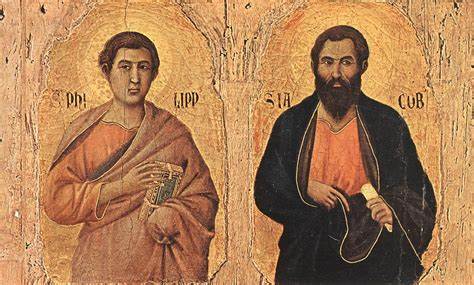
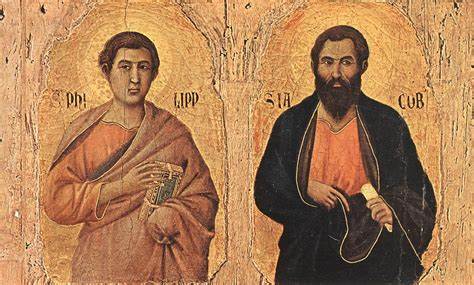
Saint Philip and James – witnesses of Jesus’ miracles
Whenever we celebrate the feast of an apostle, we are overwhelmed by the desire to learn as much as possible about his life. But this desire can only be modestly granted in this world because the information about most of the apostles is rather meager. This also applies to St. Philip and James the Younger, which we celebrate together today.
We find both apostles on all four apostolic lists in the Gospels of Matthew, Mark and Luke, and in the Acts of the Apostles. Philip is in fifth place, and James the younger, son of Alphaeus, in ninth place. According to the Gospel of John, Philip, like Andrew and Peter, came from Bethsaida on the Lake of Gennesaret. He is mentioned in five places in the Gospel of John.
“The next day Jesus decided to go to Galilee. However, he met Philip and said to him, ‘Follow me!’ Philip was from Bethsaida, the city of Peter and Andrew. Philip met Nathanael and said to him, ‘We have found the one about whom Moses wrote in the Law, and the Prophets too! This is Jesus, the son of Joseph of Nazareth. ‘-‘ Can anything good come out of Nazareth? ‘Nathanael told him. “Come and see,” replied Philip “(Jn 1: 43-46). Philip was a youthful friend of the writer of the fourth gospel, with whom he belonged together to the discipleship of John the Baptist. That is why in his Gospel he erected this wonderful monument to him, which speaks of Philip’s first encounter with Jesus, as well as of his zeal to win another zealous disciple for Jesus as the promised Messiah. In his Gospel, John brings Philip to the stage and describes how Jesus miraculously fed five thousand people.
Then Jesus lifted up his eyes, and when he saw a great multitude coming to him, he said to Philip, ‘Where shall we buy bread for these people to eat?’ Sam knew what he was going to do. Philip answered him, “Two hundred loaves of bread would not suffice for everyone to get a little” (John 6: 5-7). It is also a very beautiful scene in the gospel when the Gentiles seek Jesus. “Among the pilgrims who came to worship on the feast were some Greeks. They came to Philip, who was from Bethsaida in Galilee, and said to him, ‘Lord, we would like to see Jesus.’ Philip went to tell Andrew. Andrew and Philip went to tell Jesus ”(Jn 12: 20-30). And finally, at the farewell with the disciples, here again Philip comes to the fore. Jesus says, “No one comes to the Father except through me. If you knew me, you would know my Father. You already know him and have seen him! Philip said to him, ‘Lord, show us the Father, and we have had enough.’ He who has seen me has seen the Father. So how do you say: Show us the Father! Do you not believe that I am in the Father and that the Father is in me? I do not speak for myself the words that I say to you: The Father who dwells in me does his works. Believe me: I am in the Father and the Father is in me! If not, believe because of the works themselves ”(Jn 14: 6-11).
According to later tradition, Philip lived with his three daughters in Hierapolis in Asia Minor, where he died. Archaeologists even think they found his grave there. According to the church writers Polycrates and Papias, quoted by Eusebius, Philip’s daughters had the gift of prophecy. The relics of St. Philip the Apostle are worshiped in Rome in the Basilica of the Twelve Apostles, where the General Curia of the Franciscan-Conventuals is today.
St. James the Younger, son of Alphaeus, himself a writer of a New Testament scripture, except in the list of the apostles, is nowhere specifically mentioned in the Gospels. Sv. Paul in the Epistle to the Galatians mentions him as one of the most eminent figures of the early Church, while in the Acts of the Apostles he stands out as the bishop of Jerusalem. His message is very serious. It is full of admonition, rebuke and threat. In its 108 lines we find 60 imperatives. It can always serve us as a very useful and saving spiritual reading against the hardening of our conscience.
In the name of the Father, Son and Holy Ghost.
28.IV.2021 GEVGELIJA/MACEDONIA Dominican Hermitage & Oratory of St’s Sebastian and Peregrine
Are you a grape or are you a raisin? And before you decide that I’m nuts, bear with me and lemme do some ‘splainin’ here. Ever grown grapes? Been to a vineyard? Seen a grape vine? Grapes grow in bunches on vines…the vines come out of the ground and provide the nutrition and things that are needed to produce the fruit. Grapes have to stay attached to the branches and vines for them to keep growing. Right?
Now, what would happen if one of these grapes fell off of the vine and sat in the sun for a while? It wouldn’t be fresh and juicy anymore, would it? In fact, it would sort of wither and shrivel up…kinda like raisins! Now, don’t get me wrong, I like raisins, and they’re great for cookies or cereal or a quick snack, but again, stick with me here. Compared to big beautiful grapes though, raisins look pretty sad and icky, don’t they?
In today’s Gospel, (John 15:1-8) Jesus talks about vines and branches. People in those days knew a lot about farming and planting, and a lot of folks had vineyards where they grew grapes. Jesus said that He was the vine, and that we are the branches. What’s up with that? Jesus was explaining how important it is for us to stay connected to Him. Just as the vine provides nutrition that helps fruit grow on a plant, Jesus gives us all that we need to grow in our faith. The branches on a grape vine have to stay connected to the vine so that they can produce delicious fruit. Otherwise, they’ll dry up and wither like sad little raisins. If we walk away and abandon faith, we’ll “shrivel up”, too!
We need to stay close to Christ so that He can produce “fruit” in us. Spiritual fruit refers to things that help others and show that Jesus lives in and through us.
We are taught in Paul’s letter to the Galatians that things like love, joy, peace, patience, kindness, goodness, faithfulness, gentleness, and self-control are the fruits of the Spirit (Galatians 5:22-23). How do we make sure we are connected to Jesus? We read God’s Word and study the Bible. We pray, talking to God and listening, too. We go to church so we can be connected with other “branches” that also abide in Him. Most importantly, we recognize that Jesus is doing the work and producing fruit through us. We don’t have to do a special set of tasks or have “enough faith.” We stay connected to the “vine” of Jesus and let the Holy Spirit develop its fruit. We trust in God and rely on Him for all things, staying close to Him and thanking Him for giving us life and hope. In other words, we actually become disciples of Christ.
“Now,” you say, “I’m a Christian already.” Nuh huh. Nope. Not what I’m talking about. I’m talking about being a disciple, not a Christian. My friend, Rainbow Joseph, explained it best when he wrote:
“You were called by Christ to be a disciple, not a Christian. A disciple is an apprentice. A disciple learns from a teacher how to be like the teacher. A disciple learns by doing. A disciple practices the skill that is learned, over and over, improving a little more each day. Jesus THE Christ has called you to be a christ to those around in your own personal Israel. If you are not the Christ to those around you, then you do not serve THE Christ and you have learned nothing. If you are not the Christ to those around you, then you are not a disciple, and if not a disciple, you are certainly not a Christian.”
Like I’ve said before, you are the only Jesus some people will ever see. You are the only Bible some people will ever read. SO… are you a grape, or are you a raisin? Amen.
She was the youngest but one of a very large family. Her father, Giacomo di Benincasa, was a dyer; her mother, Lapa, the daughter of a local poet. They belonged to the lower middle-class faction of tradesmen and petty notaries, known as “the Party of the Twelve”, which between one revolution and another ruled the Republic of Siena from 1355 to 1368. From her earliest childhood Catherine began to see visions and to practice extreme austerities. At the age of seven she consecrated her virginity to Christ; in her sixteenth year she took the habit of the Dominican Tertiaries, and renewed the life of the anchorites of the desert in a little room in her father’s house. After three years of celestial visitations and familiar conversation with Christ, she underwent the mystical experience known as the “spiritual espousals”, probably during the carnival of 1366. She now rejoined her family, began to tend the sick, especially those afflicted with the most repulsive diseases, to serve the poor, and to labor for the conversion of sinners. Though always suffering terrible physical pain, living for long intervals on practically no food save the Blessed Sacrament, she was ever radiantly happy and full of practical wisdom no less than the highest spiritual insight. All her contemporaries bear witness to her extraordinary personal charm, which prevailed over the continual persecution to which she was subjected even by the friars of her own order and by her sisters in religion. She began to gather disciples round her, both men and women, who formed a wonderful spiritual fellowship, united to her by the bonds of mystical love. During the summer of 1370 she received a series of special manifestations of Divine mysteries, which culminated in a prolonged trance, a kind of mystical death, in which she had a vision of Hell, Purgatory, and Heaven, and heard a Divine command to leave her cell and enter the public life of the world. She began to dispatch letters to men and women in every condition of life, entered into correspondence with the princes and republics of Italy, was consulted by the papal legates about the affairs of the Church, and set herself to heal the wounds of her native land by staying the fury of civil war and the ravages of faction. She implored the pope, Gregory XI, to leave Avignon, to reform the clergy and the administration of the Papal States, and ardently threw herself into his design for a crusade, in the hopes of uniting the powers of Christendom against the infidels, and restoring peace to Italy by delivering her from the wandering companies of mercenary soldiers. While at Pisa, on the fourth Sunday of Lent, 1375, she received the Stigmata, although, at her special prayer, the marks did not appear outwardly in her body while she lived.
Mainly through the misgovernment of the papal officials, war broke out between Florence and the Holy See, and almost the whole of the Papal States rose in insurrection. Catherine had already been sent on a mission from the pope to secure the neutrality of Pisa and Lucca. In June, 1376, she went to Avignon as ambassador of the Florentines, to make their peace; but, either through the bad faith of the republic or through a misunderstanding caused by the frequent changes in its government, she was unsuccessful. Nevertheless she made such a profound impression upon the mind of the pope, that, in spite of the opposition of the French king and almost the whole of the Sacred College, he returned to Rome (17 January, 1377). Catherine spent the greater part of 1377 in effecting a wonderful spiritual revival in the country districts subject to the Republic of Siena, and it was at this time that she miraculously learned to write, though she still seems to have chiefly relied upon her secretaries for her correspondence. Early in 1378 she was sent by Pope Gregory to Florence, to make a fresh effort for peace. Unfortunately, through the factious conduct of her Florentine associates, she became involved in the internal politics of the city, and during a popular tumult (22 June) an attempt was made upon her life. She was bitterly disappointed at her escape, declaring that her sins had deprived her of the red rose of martyrdom. Nevertheless, during the disastrous revolution known as “the tumult of the Ciompi”, she still remained at Florence or in its territory until, at the beginning of August, news reached the city that peace had been signed between the republic and the new pope. Catherine then instantly returned to Siena, where she passed a few months of comparative quiet, dictating her “Dialogue”, the book of her meditations and revelations.
In the meanwhile the Great Schism had broken out in the Church. From the outset Catherine enthusiastically adhered to the Roman claimant, Urban VI, who in November, 1378, summoned her to Rome. In the Eternal City she spent what remained of her life, working strenuously for the reformation of the Church, serving the destitute and afflicted, and dispatching eloquent letters in behalf of Urban to high and low in all directions. Her strength was rapidly being consumed; she besought her Divine Bridegroom to let her bear the punishment for all the sins of the world, and to receive the sacrifice of her body for the unity and renovation of the Church; at last it seemed to her that the Bark of Peter was laid upon her shoulders, and that it was crushing her to death with its weight. After a prolonged and mysterious agony of three months, endured by her with supreme exultation and delight, from Sexagesima Sunday until the Sunday before the Ascension, she died. Her last political work, accomplished practically from her death-bed, was the reconciliation of Pope Urban VI with the Roman Republic (1380).
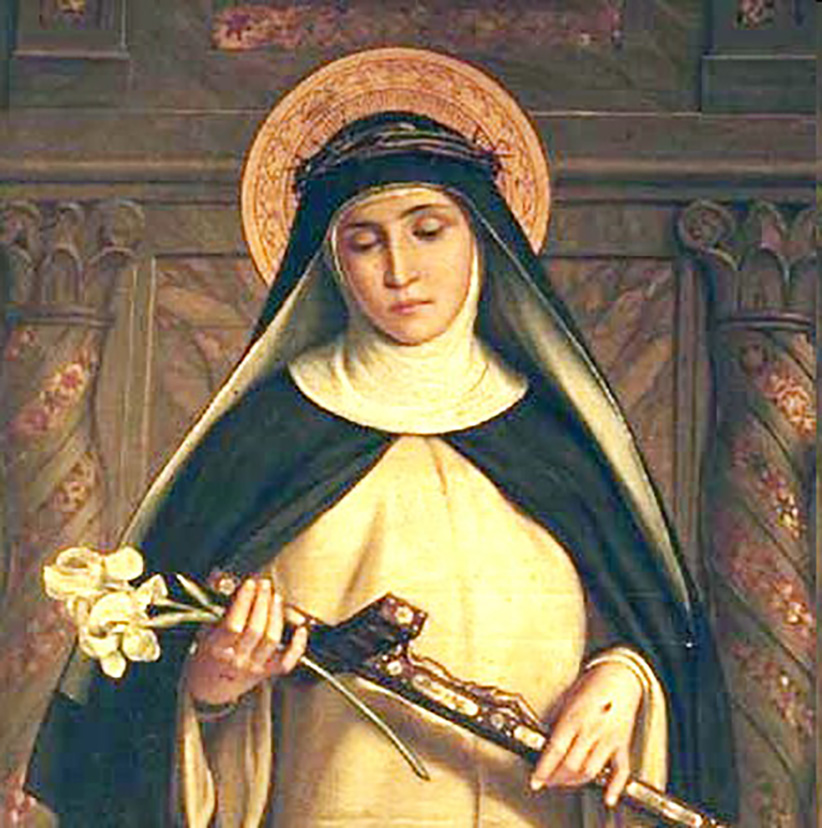
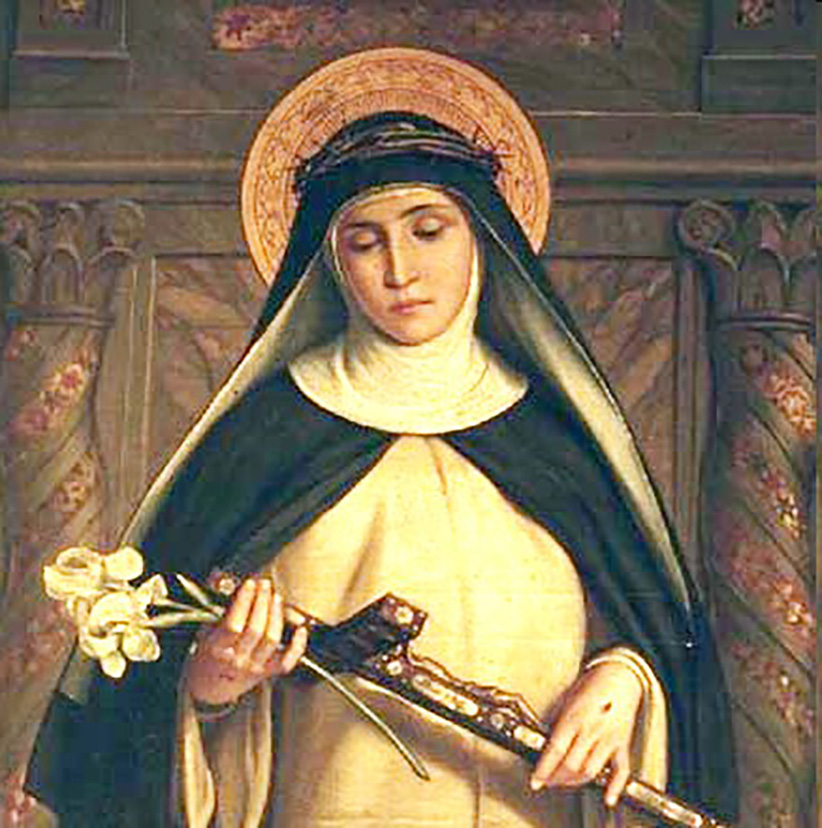
Among Catherine’s principal followers were Fra Raimondo delle Vigne, of Capua (d. 1399), her confessor and biographer, afterwards General of the Dominicans, and Stefano di Corrado Maconi (d. 1424), who had been one of her secretaries, and became Prior General of the Carthusians. Raimondo’s book, the “Legend”, was finished in 1395. A second life of her, the “Supplement”, was written a few years later by another of her associates, Fra Tomaso Caffarini (d. 1434), who also composed the “Minor Legend”, which was translated into Italian by Stefano Maconi. Between 1411 and 1413 the depositions of the surviving witnesses of her life and work were collected at Venice, to form the famous “Process”. Catherine was canonized by Pius II in 1461. The emblems by which she is known in Christian art are the lily and book, the crown of thorns, or sometimes a heart–referring to the legend of her having changed hearts with Christ. Her principal feast is on the 30th of April, but it is popularly celebrated in Siena on the Sunday following. The feast of her Espousals is kept on the Thursday of the carnival.
The works of St. Catherine of Siena rank among the classics of the Italian language, written in the beautiful Tuscan vernacular of the fourteenth century. Notwithstanding the existence of many excellent manuscripts, the printed editions present the text in a frequently mutilated and most unsatisfactory condition. Her writings consist of
the “Dialogue”, or “Treatise on Divine Providence”; a collection of nearly four hundred letters; and a series of “Prayers”.
The “Dialogue” especially, which treats of the whole spiritual life of man in the form of a series of colloquies between the Eternal Father and the human soul (represented by Catherine herself), is the mystical counterpart in prose of Dante’s “Divina Commedia”.
A smaller work in the dialogue form, the “Treatise on Consummate Perfection”, is also ascribed to her, but is probably spurious. It is impossible in a few words to give an adequate conception of the manifold character and contents of the “Letters”, which are the most complete expression of Catherine’s many-sided personality. While those addressed to popes and sovereigns, rulers of republics and leaders of armies, are documents of priceless value to students of history, many of those written to private citizens, men and women in the cloister or in the world, are as fresh and illuminating, as wise and practical in their advice and guidance for the devout Catholic today as they were for those who sought her counsel while she lived. Others, again, lead the reader to mystical heights of contemplation, a rarefied atmosphere of sanctity in which only the few privileged spirits can hope to dwell. The key-note to Catherine’s teaching is that man, whether in the cloister or in the world, must ever abide in the cell of self-knowledge, which is the stable in which the traveler through time to eternity must be born again.
Born: March 25, 1347 at Siena, Tuscany, Italy
Died: April 29, 1380 of a mysterious and painful illness that came on without notice, and was never properly diagnosed
Canonized: July 1461 by Pope Pius II
Representation: cross; crown of thorns; heart; lily; ring; stigmata
Patronage: against fire, bodily ills, diocese of Allentown, Pennsylvania, USA, Europe, fire prevention, firefighters, illness, Italy, miscarriages, nurses, nursing services, people ridiculed for their piety, sexual temptation, sick people, sickness, Siena Italy, temptations






 The Order of Preachers, Independent
You must be logged in to post a comment.