Rich Man, Poor Man~ The Rev. Deacon Dollie Wilkinson, OPI

wealth

When I was younger, living in a small town in West Virginia, we were considered poor. Like most of my friends’ parents, even though my Mom and Dad worked full time, we lived paycheck to paycheck. This meant that usually the money ran out before the end of the month. Though our bills were usually paid, there were some months that maybe the electric bill wasn’t paid, or we would get a cut off notice for the water. I remember many months where we would make an impromptu visit to the Salvation Army pantry, to pick up canned goods, dried beans, and if we were lucky, a canned ham. Being a child, and because most of my closest friends’ parents, or grandparents, also did this, I never thought much of it. It was only when I got older, going to junior high school, then high school, that I realized not everyone lived this way. I just assumed everyone wore hand-me-downs, and ate left-overs more than one day a week.

Now as an adult, I realize how poor we were. Though we didn’t have much money, we had plenty of things money couldn’t buy – family, love, contentment, joy, fun, friendship. But of course being a child, I did envy those children who would come back from Christmas break, bragging about the presents they got or where they spent their holiday vacation. When my daughters were growing up, I tried to give them all the material things I lacked as a child – newest, most popular toy, latest fashion in clothes, and any food stuff or snacks they wanted. While also providing them with a loving and safe home, I wished to make sure they never felt deprived, that they never went hungry, that they never wanted for anything (within reason and budget, of course). Now that they are adults, with good paying jobs, they can provide for themselves.

But as adults, we sometimes are like children – so we still want the newest, most popular toy, latest fashion in clothes, and any food stuff or snacks we crave. There isn’t anything wrong with this, as long as we understand that there must be a limit to our material possessions. That just like a child who understands limits, what he or she can or cannot do, or can or cannot have. As adults, especially as children of God, we must recognize that material wealth does have its limits. And that the value that we put on material possessions will hinder us from leading a life of goodness and faith. This is what we are cautioned about in 1 Timothy 6:6-19:


Of course, there is great gain in godliness combined with contentment; for we brought nothing into the world, so that we can take nothing out of it; but if we have food and clothing, we will be content with these. But those who want to be rich fall into temptation and are trapped by many senseless and harmful desires that plunge people into ruin and destruction. 
For the love of money is a root of all kinds of evil, and in their eagerness to be rich some have wandered away from the faith and pierced themselves with many pains. But as for you, man of God, shun all this; pursue righteousness, godliness, faith, love, endurance, gentleness. Fight the good fight of the faith; take hold of the eternal life, to which you were called and for which you made the good confession in the presence of many witnesses. In the presence of God, who gives life to all things, and of Christ Jesus, who in his testimony before Pontius Pilate made the good confession, I charge you to keep the commandment without spot or blame until the manifestation of our Lord Jesus Christ, which he will bring about at the right time–he who is the blessed and only Sovereign, the King of kings and Lord of lords. It is he alone who has immortality and dwells in unapproachable light, whom no one has ever seen or can see; to him be honor and eternal dominion. Amen. As for those who in the present age are rich, command them not to be haughty, or to set their hopes on the uncertainty of riches, but rather on God who richly provides us with everything for our enjoyment. They are to do good, to be rich in good works, generous, and ready to share, thus storing up for themselves the treasure of a good foundation for the future, so that they may take hold of the life that really is life.”

In Timothy, we are not told to always go around and be poor. Rather we are cautioned that if we have wealth, if we have a comfortable life with plenty of food on the table, clothed in the latest fashion, or surrounded by nice things, to not be boastful, To share with others as we can, to also “pursue righteousness, godliness, faith, love, endurance, gentleness”. While having nice things is not a sin, worshiping these things above God is. So we must use these material blessings from our heavenly Father to help others, to do good works. How do we do that? Volunteer your time in a soup kitchen, or animal shelter. Donate money to help orphanages overseas, or a local church charity. Offer to cut your neighbors grass, or sit with an elderly friend. Though you may not have wealth, you can still be rich. For as long as you do good works, it is in this richness that you “ may take hold of the life that really is life.”

Blessed Mark of Modena

83087-01

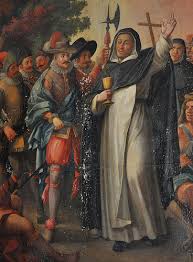
Mark was born in Modena and entered the convent of the order there in young manhood. He observed the rules with great fidelity, and became noted both for his learning and his holiness, which is a sentence that would fit into nearly every Dominican biography written, and tells us nothing in particular about Mark as a person. However, when we recall the times in which he lived , it becomes clearer to us that anyone who kept the Dominican Rule in its entirety is truly to our notice . The abuses which stirred Savonarola to thundering speech in the pulpits of Ferrara and Florence could not have been absent from all of Italy. It look solid virtue to hold out against the opulent worldliness of the times, and Mark of Modena apparently did a thorough job of it, since he has been beatified.

Mark was made prior of the convent of Pesaro, and the only miracle we have on record (he is supposed to have performed many) took place at his convent. A woman’s little boy had died, and she pleaded with Mark to restore the child’s life. After praying for awhile, Mark turned to her and said, “Madam, your little boy is in paradise. Do not try to get him back again, for his second loss will be worse than this one.” However, she insisted on his working the miracle, and he did so. The child returned to life, and, ten years later, covered with disgrace and opprobrium, died a second time, leaving his mother in worse grief than ever.

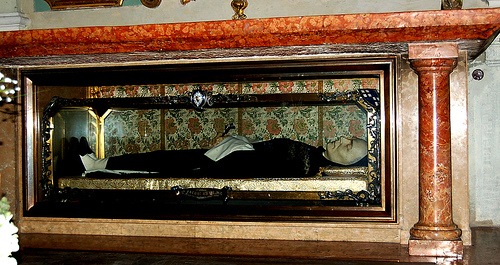
Mark of Modena died in 1498, the year that the city of Florence burned Savonarola at the stake. It was a time of terrible happenings in Italy and all Europe. The people of Modena mourned the death of Mark, and went to pray at his tomb. Many of their needs were answered there, and a number of prodigies were reported in connection with the translation of his relics to the Rosary chapel of the church. The bells were said to have rung by themselves, and sweet perfume filled the air. Until recently, his relics were still exposed yearly for veneration during the week of Whitsunday.

Born: in Modena at the beginning of the 15th century

Died: in at Pesaro in 1498

Beatified: by Pope Pius IX in 1857

Blessed Francis Posadas

81755-01

Few Dominicans have had more difficulty getting into the Order than Blessed Francis de Posadas, and he was one of the glories of the convent of the Scala Coeli, in Cordova. It is embarrassing for us to read that the reason for his exclusion was plain and simple snobbery on the part of the superiors of the convent of St. Paul, in Cordova.

Francis was born of a poor young couple who were war refugees, and who had been shunted from place to place until, when Francis was very small, his father’s health failed, and he died in Cordova. The young widow tried several types of work, and finally she was reduced to selling eggs and vegetables at a street stand. She tried to educate her child, for she knew he was very talented, but, without money, it simply was not possible to send him to school. She encourage him to go to the Dominican Church of St. Paul, and he served Mass there every morning from the time he was six or seven years old.

While he was still a very tiny child, he used to gather the other children together for rosary processions or other devotions. The smile of God seemed to rest upon him. For all his poverty, he was a very happy and attractive child, like by everyone; and he was a natural leader among his fellows. Twice during his childhood, he was miracuously saved from death. This fact and his undoubted piety, should have seemed sufficient reason for admitting him into a religious order. However, by the time Francis was old enough, there were two reasons to make his entry difficult: his mother had remarried, and the step-father would not permit him to enter. The Dominicans, moreover, would not have him. They said that they did not want the son of a street peddler.

Francis had friends in the Order, but the prior of the house he wished to enter took a violent dislike to him. It was several years before the young man could overcome the resistance of this man, who, having some influence with the provincial, was stubbornly determined that Francis should not be allowed to enter. Even when the fathers in the convent of Scala offered to take the boy and train him in Latin- so that he could qualify for clerical studies-the vindictive dislike of the prior followed him and almost prevented his acceptance.

Francis was finally accepted, made his novitiate, and gradually overcame all dislike and distrust by his charming manner and his unquestioned talents as student and preacher. After his ordination, he was sent out to preach, and he earned the reputation of being a second St, Vincent Ferrer. His talents as a preacher were rivaled only by his gifts as a confessor. He not only could read hearts and discover sins that had been willfully concealed, but sometimes he was called to one place or another by an interior spirit and shown someone badly in need of the sacraments.

Francis hated the thought of holding authority in the Order. When appointed prior of one of the convents, he remarked that he would much sooner be sentenced to the galleys. He twice refused a bishopric, and he skillfully eluded court honors.

Several remarkable conversions are credited to Francis Posadas. His last tears were a series of miracles wrought in the souls of his penitents. People followed him about to hear him preach, regarding him as a saint and miracle worker. One of his most noted converts was a woman more than one hundred years old- a Moor- with no intention of deserting Mohammedanism.

Francis of Posadas was the author of a number of books which he wrote to assist him in his apostolate. One was a life of St. Dominic. and several were biographies of other saintly people.

After a life filled with miracles, Francis died in 1713. Being forewarned of his death, he made private preparations, but to the last minute he was busy in the confessional before dying suddenly. By the time of his death, not only the Dominicans of Cordova, but the people of all Spain were happy to have him as a fellow countryman. He was beatified a century after his death, in 1818.

Born: Cordona in Spain in 1644

Died: In 1713 of natural causes

Beatified: He was declared Blessed by Pius VII in 1818

Got Stuff? ~ The Rev. Lady Sherwood, OPI

goodsteward-sermonarchive

Are we true Stewards of God?

Gospel LK 16:1-13

Jesus said to his disciples, “A rich man had a steward who was reported to him for squandering his property. He summoned him and said, ‘What is this I hear about you?  Prepare a full account of your stewardship, because you can no longer be my steward.’  The steward said  to himself, ‘What shall I do, now that my master is taking the position of steward away from me?  I am not strong enough to dig and I am  ashamed to beg.  I know what I shall do so that, when I am removed from the stewardship, they may welcome me into their homes.’  He  called in his master’s debtors one by one.  To the first he said, ‘How much do you owe my master?’  He replied, ‘One hundred measures of  olive oil.’  He said to him, ‘Here is your promissory note.  Sit down and quickly write one for fifty.’  Then to another the steward said, ‘And you, how much do you owe?’  He replied, ‘One hundred kors of wheat.’  The steward said to him, ‘Here is your promissory note; write one for eighty.’  And the master commended that dishonest steward for acting prudently.  “For the children of this world are more prudent in dealing with their own generation than are the children of light.  I tell you, make friends for yourselves with dishonest wealth, so that when it fails, you will be welcomed into eternal dwellings.  The person who is trustworthy in very small matters is also trustworthy in great ones;and the person who is dishonest in very small matters is also dishonest in great ones.  If, therefore, you are not trustworthy with dishonest wealth, who will trust you with true wealth?  If you are not trustworthy with what belongs to another, who will give you what is yours?  No servant can serve two masters.  He will either hate one and love the other,  or be devoted to one and despise the other. You cannot serve both God and mammon.”

In today’s Gospel we are hearing the Parable of the dishonest Steward. Each of us are also stewards to the Lord our God. A steward is a person who manages property or money for the true owner. We are all stewards because God created all and is the true owner of all. Are we true and honest stewards of God within our lives, or are we like the steward in the Gospel reading today?  How many times do we see the possessions and resources we have been charged with as our own?  How many times do we use these for our own human purposes instead of in the way that God who truly owns them, has entrusted us to use them for his glory?

Everything upon the earth belongs to God our heavenly Father, not only material things and resources, but also all of our brothers and sisters, who God also created.

In truth we are all less than worthy stewards because we each fall short of the Glory of God. We are called to love each other as God loves us, to feed and clothe the poor and to the spread the true word of the salvation of God to all upon his earthly Kingdom. Do we love all as we ought? Do we use all that has been entrusted to us to teach, feed and nourish the children of God as our Father asks of us, or do we wallow in materialism and Greed? We cannot serve two masters, both God our Father and earthly wealth and possessions. We shall all be brought to account for our way of undertaking the stewardship that we have been given. Let us pray to our heavenly Father to ask for his guidance in being the true stewards that he has called each of us to be:

Heavenly Father,

You are an amazing God—steadfast in your love, abundant in your mercy, and wise in your actions. You are a wonderful creator God who has provided a magnificent creation with abundant resources for us to enjoy. We recognize our sinfulness and thank you for your mercy and grace extended to us through Jesus on the cross.

Your word tells us in James 1:5 that those who ask for wisdom in faith will receive it. Today, we pray for wisdom and for understanding in how to best steward the resources you have given while demonstrating love toward our fellow brothers and sisters.

Lord, we desire to be good stewards. We do not want to waste resources or use them selfishly with sinful desires of personal gain. Yet, we understand that the second greatest commandment is to love others as ourselves. As we create policies that help us protect the environment and use our resources wisely, please grant us wisdom that we will not value the created earth over humans created in your image. Please allow us wisdom to create policies and practices that allow for human flourishing all across the globe.

Allow us to align our priorities with yours in valuing the souls for which you died more than the resources we steward. Allow us to have a greater passion for the Gospel and spreading the Good News that changes lives than we have for making sure the earth never changes. God grant us wisdom to know when to speak and when to act so that we live in such a way as to glorify you with all of our words and our deeds, and may your name be exalted among every tribe and tongue. In Jesus name we pray through the power of the Holy Spirit.

Amen.

Blessed John of Massias

918juan8

John Masias was born in Ribera, in Spain, and, when very small, he was left as orphan. He was adopted by a kindly uncle who set him to herding his sheep. The little boy was naturally pious, and passed his spare time in sayingthe Rosary. Our Lady and the Christ Child appeared to him several times, and he was often visited by his patron, St. John the Eveangelist, who once showed him a vision of heaven, telling him: “This is my country.”

When John was about twenty, he went to Mass in the church of the Dominicans in a neighboring city. For the moment, it seemed to him that vocation was joining the Friars Preachers now, but St. John appeared to him, telling him he must go elsewhere. In 1619 he embarked for the Indies, where many Spaniards were going, either to convert the natives or to seek a fortune. After a long and hazardous journey, he arrived in Lima.

There were at the time four convents of the Friar Preachers in Lima: the College of St. Thomas; the house of St. Rose, where Sister Rose of St. Mary had died just five years before; Santo Domingo or Holy Rosary, where the holy lay brother, Martin de Porres, was performing such astounding miracles; and the convent of St. Mary Magdalen, which was small and poor. John decided to enter St. Mary Magdalen and, in 1622, he received the habit of a lay brother there. On the night of his profession, devils appeared to tempt and reproach him. He was attacked bodily, and, although he was called on Jesus, Mary and Joseph for help, the demons continued what was to become twelve years of torture, by actually throwing him from one cloister to another.

John was appointed assistant to the porter, and lived in the gatehouse. There the poor came for food, and the rich for advice. He became adept at begging for the poor, always managing to find enough for the more than two hundred people who came daily for help. He had little use for the wealthy and curious, and would sometimes baffle them by simply disappearing while they were looking at hi,. Also, legend relates that he had a little burro that he would send out by itself, with a note asking for what was needed in one of the empty panniers on its back. Told where to go, the burro made his route faithfully; and if the rich man on whom he called was ungracious, or even hid himself to avoid giving alms, the little burro made quite a noise, and it quickly brought the desired results.

Rays of light streamed from the blessed’s face as he taught the catechism to the poor, or prayed by himself in the gatehouse. He said an amazing number of rosaries and made no less than twenty daily visits to the Blessed Sacrament. He is said to have liberated more than a million souls in purgatory, many of whom came back , while he was at prayer , to thank him for his help.

One day a certain ship captain came to the gatehouse and asked to look around. John took him by the arm and led him to the crucifix, warning him to look well on it and think of his sin. Terrified, the captain fell to his knees, confessing that he was an apostate religious, thirty years away from the sacraments, and he begged for a priest. On another occasion, the brothers were building a flight of steps and, having measured a beam wrong, they were annoyed because it did not fit. John took the beam in his hands and stretched it to fit their needs. These, and many other miracles, led people to venerate him as a saint during his lifetime. His recreation was to talk of the things of God with the other holy lay brother, Martin de Porres

At the time of his death, Our Lady, St. Dominic, his patron, St. John and many other saints, came to accompany him to heaven. They were seen by some of the brothers.

Born: March 2, 1585 at Ribera del Fresno, Estramadura, Spain

Died: September 16, 1645 in Lima, Peru of natural causes

Beatified: In 1837 by Pope Gregory XVI

Commemoration of Our Patriarch, Saint Dominic, in Soriano

7286f29d4391a04d38a6afb2b37614c3

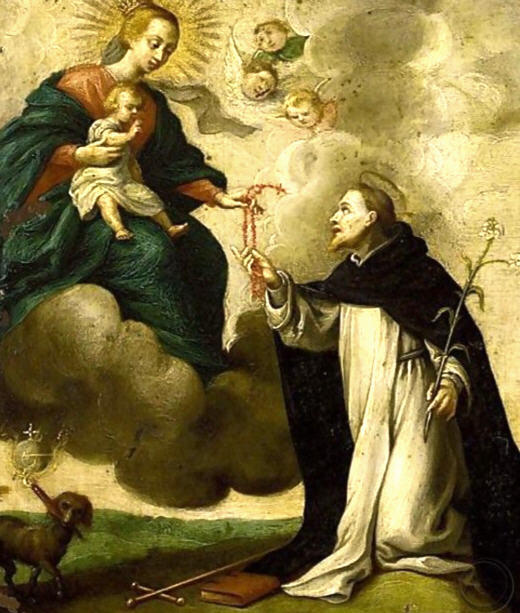
The event commemorated in this festival is the appearance in the Dominican Convent of Soriano, in the extreme south of Italy, of a miraculous picture of Saint Dominic, which is still preserved, and is held in the utmost veneration even in our own day. A certain Father Vincent of Catanzara in Calabria, in the year 1510, was thrice commanded by Saint Dominic in vision to found a Convent of the Order at Soriano, a work which he accomplished in spite of considerable obstacles which were not overcome without miraculous intervention. It had been decided that the Convent should be built on the plain, but the cross which had been planted to mark the destined site was found to have been mysteriously removed in the night to the hill on which the building was eventually erected, and where it still stands. Several years later, on September 15, A.D. 1530, just as the religious were assembling to chant Matins at midnight, the Sacristan suddenly beheld three ladies of majestic aspect enter the church, which he knew he had left locked before retiring to rest. One of them addressed him, asking to whom the church was dedicated and whether it contained a picture of its patron. The Friar replied that the church was dedicated to Saint Dominic, but that, owing to the great poverty of the Community, only a badly painted fresco of the Saint was to be found upon its walls. Then the unknown lady put into his hands a roll of canvas, which till then she had carried in her hand, and bade him take it to his Superior, who bore the title of Vicar, the little Convent not having yet been erected into a Priory. The Vicar, astonished at the sight of the picture, which proved to be a portrait of Saint Dominic, hastened to the church to thank the giver, but all three mysterious visitors had disappeared, though the outer doors still remained locked. The following night Saint Catharine of Alexandria appeared to one of the Fathers, who had a great devotion to her, and told him, in answer to his prayers, that the donor of the picture was no other than the Blessed Virgin, and that the two who had accompanied her were the patronesses of the Order, Saint Mary Magdalen and herself.

In obedience to the express command given by Our Lady to the Sacristan when bestowing the picture, it was placed over the High Altar; but, as the wall against which it hung was extremely damp, the Fathers afterwards decided on removing it to another altar, near the door of the church. The following morning, however, the picture was again found hanging over the High Altar. The Vicar, believing that it had been removed thither by the Sacristan from a desire to execute to the letter the orders given him by the Mother of God, severely reproved him, and had the picture carried back to the altar agreed upon. The next day, it once more appeared over the High Altar. Again the Sacristan was charged with obstinacy and disobedience. In vain he protested that he had never touched the picture. The Vicar ordered it to be replaced near the door, and on the following night locked the church himself and kept the keys in his own possession. Nevertheless on the third morning it was again discovered over the High Altar. Convinced at length that its removal was the work of no human hand, the Vicar allowed it to remain in the spot which Our Lady had chosen for it, and where it has ever since remained, miraculously preserved from being injured by the damp.

When the picture was exposed to public veneration, a multitude of prodigies took place, the account of which fills volumes. No less than sixteen hundred of these miracles, juridically attested, took place within the space of seventy-eight years. Pope Innocent XII., in the year 1644, granted a festival in commemoration of this event and of the vast number of miracles vouchsafed before the holy picture. On September 15,1870, just five days before the sacrilegious occupation of Rome by the troops of Victor Emmanuel, a new prodigy took place at Soriano. A wooden statue of our holy Father, Saint Dominic, of life-size, had been exposed in the sanctuary on occasion of the festival, and was to be carried in procession in the evening. This statue was suddenly seen to move like a preacher in the pulpit ; it advanced and drew back ; the right arm rose and fell; the countenance became animated, sometimes assuming a severe and threatening aspect, at other times appearing sad, or again full of sweetness and reverence as it turned towards the picture of our Lady of the Rosary. This extraordinary spectacle lasted for an hour and a half, and was witnessed by about two thousand persons. Some of the bystanders, to satisfy themselves that there was no trickery in the matter, removed all the surroundings of the statue and completely stripped the table on which it was standing. These measures only served to place the miraculous nature of the occurrence beyond the possibility of a doubt. A juridical inquiry was held by order of the Bishop of Mileto, in whose diocese Soriano is situated, and the extraordinary event was announced to the Order in a circular letter by the Most Reverend Father Alexander Vincent Jandel, who was then General. In a private letter written by his Paternity shortly afterwards he says : ” I think our holy Father, Saint Dominic, meant to warn us of the impending scourges, and to summon us to do penance; but this warning is in itself an act of mercy on the part of Him who strikes only to heal.”

Prayer

O God, who hast vouchsafed to enlighten Thy Church by the merits and teachings of Thy blessed Confessor, our holy Father, Saint Dominic, grant at his intercession that it may never be destitute of temporal help, and may always increase in spiritual growth. Through Christ our Lord. Amen.

Commemorations

First Vespers:

Ant. O great Father, Saint Dominic, at the hour of death take us to thyself and while here regard us always graciously.

  1. Pray for us Blessed Dominic,
  2. That we may be made worthy of the promises of Christ.


Lauds:

Ant. The body of a virgin, the mind of a martyr, the labors of an apostle, have at the end of thy course purchased for thee, O Mendicant of Christ, the reward of life.

  1. The just man shall blossom like the lily.
  2. And shall flourish forever before the Lord.


Second Vespers:

Ant. O light of the Church, doctor of patience, ivory of chasity, freely hast thou dispensed the water of wisdom: herald of grace, unite us to the blessed.

  1. Pray for us Blessed Dominic,
  2. That we may be made worthy of the promises of Christ.


Prayer:

Let us Pray: O God, who didst vouchsafe to enlighten Thy Church by the merits and teachings of Blessed Dominic, Thy Confessor and our Father, grant through his intercession, that it may never be destitute of temporal help, and may always increase in spiritual growth. through Christ our Lord. Amen.

Our Lady of Sorrows ~ The Rev. Dcn Dollie Wilkinson, OPI

sorrow

Devotion to the Seven Sorrows of Our Lady has its roots in Sacred Scripture and in Christian piety, which always associates the Blessed Mother with her suffering Son. Today’s feast was introduced by the Servites in order to intensify devotion to Our Lady’s Sorrows. In 1817 Pius VII — suffering grievously in exile but finally liberated by Mary’s intercession — extended the feast to the universal Church.

This feast dates back to the 12th century. It was especially promoted by the Cistercians and the Servites, so much so that in the 14th and 15th centuries it was widely celebrated throughout the Catholic Church. In 1482 the feast was added to the Missal under the title of “Our Lady of Compassion.” Pope Benedict XIII added it to the Roman Calendar in 1727 on the Friday before Palm Sunday. In 1913, Pope Pius X fixed the date on September 15. The title “Our Lady of Sorrows” focuses on Mary’s intense suffering during the passion and death of Christ. “The Seven Dolors,” the title by which it was celebrated in the 17th century, referred to the seven swords that pierced the Heart of Mary. It is dedicated to the spiritual martyrdom of Mary, Mother of God, and her compassion with the sufferings of her Divine Son, Jesus. In her suffering as co-redeemer, she reminds us of the tremendous evil of sin and shows us the way of true repentance. As Mary stood at the foot of the Cross on which Jesus hung, the sword of sorrow Simeon had foretold pierced her soul.

Below are the seven sorrows of Mary:
1. At the prophecy of Simeon: “You yourself shall be pierced with a sword – so that the thoughts of many hearts may be laid bare.” (Luke 2:35).
2. At the flight into Egypt; “Get up, take the child and his mother, and flee to Egypt.” (Mt 2:13).
3. Having lost the Holy Child at Jerusalem; “You see that your father and I have been searching for you in sorrow.” (Luke 2:48).
4. Meeting Jesus on his way to Calvary; (Luke 23:27-31; John 19:17)
5. Standing at the foot of the Cross; “Near the cross of Jesus there stood His mother.” (John 19:25).
6.The body of Jesus being taken from the Cross; (Psalm 130; Luke 23:50-54; John 19:31-37) 7. The burial of Jesus; (Isaiah 53:8; Luke 23:50-56; John 19:38-42; Mark 15:40-47)


Prior to the Second Vatican Council, there were two feasts devoted to the sorrows of Mary. The first feast was insitituted in Cologne in 1413 as an expiation for the sins of the iconoclast Hussites. The second is attributed to the Servite order whose principal devotion are the Seven Sorrows. It was instituted in 1668, though the devotion had been in existence since 1239 – five years after the founding of the order.

Symbols: heart pierced with a sword; heart pierced by seven swords; winged heart pierced with a sword; flowers: red rose, iris (meaning: “sword-lily”), cyclamen.

Patron: people named Dolores, Dolais, Deloris, Dolorita, Maria Dolorosa, Pia, and Pieta.

St. Madeleine Sophie’s Prayer to Our Lady of Sorrows

O, Mary, Mother who has known deepest sorrow and deepest love,
moved by profound gratitude for the innumerable gifts
you have poured out on this little Society,
we come together today as Province and Society
to acknowledge what we owe to your motherly protection,
and to the goodness of your Mother’s heart,
wounded by the sight of your suffering children everywhere.

Continue your work in and for us, dear Mother.
Love gave you the cross,
grant that the cross may give us love.
May there never be for Religious of the Sacred Heart of Jesus,
any other cross than the cross of Jesus.

May we have the courage
to bear His cross;
both the sufferings of His passion
and the remembrance of His woundedness for others,
so that in ministering to the wounded and torn of our world,
we may find in His cross
less the pain and suffering He experienced
than the height and depth of His love and compassion
for the Poor and Suffering of our world.

We ask this in and for Christ Jesus our Lord.

Amen!

Here are seven graces the Blessed Virgin Mary grants to souls who honor Her daily by saying seven Hail Marys and meditating on Her tears and Dolors. The devotion was passed to us by Saint Bridget.

  1. I will grant peace to their families.

  2. They will be enlightened about the divine mysteries.

  3. I will console them in their pains and I will accompany them in their work.

  4. I will give them as much as they ask for as long as it does not oppose the Adorable Will of my Divine Son or the sanctification of their souls.

  5. I will defend them in their spiritual battles with the infernal enemy and I will protect them at every instant of their lives.

  6. I will visibly help them at the moment of their death, they will see the face of their mother.

  7. I have obtained (this grace) from my Divine Son, that those who propagate this devotion to my tears and sorrows, will be taken directly from this earthly life to eternal happiness since all their sins will be forgiven and my Son will be their eternal consolation and joy.


Team Players ~ St. John Chrysostom ~ Br. Michael Marshall, Novice

icon_saintjohnchrysostom


Historical Background

Saint John Chrysostom was born around 347 C.E. in Antioch, and is a Doctor of the Church. He died in the year 407 C.E.  During his lifetime, he turned away from negative societal influences, and entered monastic religious life; in which that period he was ordained as a lector.  He was ordained a priest in the year 386 C.E. and much of his early ministry prior to the priesthood was instructing catechumens, as well as looking after the sick and poor.  After being ordained, over the next twelve years, he composed many important writings on the priestly life, as well as several impactful sermons about living a virtuous Christian life.  The three most significant aspects of his ministry were being a great preacher, a great exegete of Scripture, and a well versed dogmatic theologian.  As Dominicans, our charism is essentially the ministry of Saint John Chrysostom.

He was consecrated Bishop of Constantinople in 398 C.E. after the death of Nectarius.  His first important act as Bishop was reconciling with Rome, as well as enacting reform on the local level due to many scandalous acts taking place among clergy.  Even though there was some success with this reform, Saint John Chrysostom eventually faced tensions with members of society over wealth and Church leaders; which led him to be exiled from Constantinople, and died as was buried in Comona but his body was eventually transferred back to Constantinople to be put to final rest.

Sermon

The life of Saint John Chrysostom relates to the readings for today very well.  The stories within the readings practically parallel much of Saint John Chrysostom’s ministry. The first reading from First Corinthians speaks about the Body of Christ as a whole Community of believers, rather than divided groups; and Saint John Chrysostom was important in re-establishing a relationship with Rome.  Even though he was known for his preaching, he was also very gifted in other capacities, just as First Corinthians speaks about people having gifts and talents to help contribute to the Community.  In the Gospel, we see that Jesus is raising a man from the dead; and Saint John Chrysostom literally ministered to the sick, but he also brought the Christian Community in Constantinople back to new life through reforms and his ability to preach well.

So, what does all of this have to do with us as Christians today?  Let me share a little story.  Prior to my initial seminary studies I worked at a local retail store, and the department manager who hired me knew how to be a team leader, and had a vision for where the department could go beyond where it was.  Our department was essentially a well-oiled machine with everybody contributing in their own way; then the department manager took another position.  The new department manager shared the same vision as the previous manager, yet eventually hired someone who was not a team player.  The manager obviously did not see this coming because the situation only became evident after the person started on the job.  There was great distention between several staff in our department, and things fell apart.  Essentially, it takes only one person to destroy a “community”.

During my time with the Church which has become the UOCC, I have seen that same situation several times instead of leaders working together as a team; and fortunately, we are now moving in the right direction with working together with other Churches.  As much as the various Churches are now moving in a positive direction, we as individuals need to examine whether we can make an impact within the Christian Community to help spread the Gospel, and be the team player through giving of ourselves though our talents.  Not everyone is an eloquent preacher, nor is everyone an expert in dogmatic theology; but it is important to look to Saint John Chrysostom as an example of how to be effective people in ministry by using the gifts and talents we do have.


May we look to Saint John Chrysostom for guidance as how to be better Christians, and leaders within our own Communities.  This we ask through Christ, Our Lord. Amen.

Forgiven! ~ Br. Chip Noon, Novice

1-forgiven

Sin.

Abomination.

Depravity.

Disobedience.

There are some pretty heartbreaking things going on in today’s readings. The Israelites turn away from God and worship false gods, David sins with Bathsheba and has her husband killed, Paul relates once again his culpability as a persecutor of the followers of Jesus, and finally, the prodigal son, after a life of dissipation and debauchery, comes home to be forgiven.

Forgiven. This idea of God’s mercy is the heart of today’s readings, not sin.

We have been set up in several ways to recognize what displeases God, how we can reject him, and what we do to others that is worthy of shame. In fact, if we didn’t have the other parts of the Mass in between these messages, we might leave this Sunday’s celebration rather cast down by all the bad things that we can do and have done in the past.

Those of us who pray the Liturgy of the Hours daily will recognize today’s Psalm 51 (or 50 in the old enumeration) which we read every Friday at Morning Prayer. The antiphon is You alone have I grieved by my sin; have mercy on me, O Lord.

In this psalm David recognizes his guilt for his adultery with Bathsheba and the setting up of her husband to be killed in battle. He admits his guilt, admits that it is always with him, acknowledges before God his faults, asks God for forgiveness, and promises to proclaim God’s goodness and declare God’s praise as a sinner who has begged for mercy and been redeemed.

Look again at these readings. Each one speaks of something precious that has been lost through accident or deliberate actions: the sheep, the drachma, chastity, a life of service and work for others, self-respect. Something precious that is gone and that should be retrieved.

Scientists are now studying whether a sense of goodness, or conscience, or altruism is hard-wired into us or is something we learn from our parents and society. It will be interesting to know, but in fact, we don’t really need to know where this sense of the right thing to do comes from, do we? We know immediately and intrinsically the difference between right and wrong. And even though Paul says his misdeeds grew out of ignorance in today’s reading, we know that his transgressions against the early Christians troubled him greatly, or his conversion would not have been so complete.

So I suppose we don’t really need the Ten Commandments, or sermons, or homilies to show us the right path, because the moment we step off it, we know in our hearts that we are have lost our way.

But the greater message of the readings from today is more than just having us see that everybody, even David, is capable of sin. The greater message is that there is no sin that cannot be forgiven by God.

There is no sin we commit that God will not forgive. If only we confess the sin and ask for forgiveness.

Confess to God and ask his forgiveness.

“…there will be rejoicing among the angels of God over one sinner who repents.”

Let us pray. Lord we know there are times we have rejected the good and gone after the bad, whether by thoughts, words, or deeds. Help us on the right path and help us to ask forgiveness when we mis-step. And as Jeremiah tells us, “For I know the plans I have for you,” declares the Lord, “plans to prosper you and not to harm you, plans to give you hope and a future,” then let us rest in your loving kindness.

Amen.

Life-For the Purpose of God – The Nativity of the Blessed Virgin ~ The Rev. Lady Sherwood, OPI

nativity_of_bvm

Today we celebrate the nativity of the Mother of Our Lord Jesus Christ and our heavenly mother.

All parents are filled with such joy at the birth of their children. We try to bring them up to be the best which they can be in the world. Our heavenly Father who created us and who knows each of us before our birth is no different. He also is filled with joy at our birth and wants the best for us.

God already has plans for each of our lives and for exactly which role we shall fill within his kingdom on earth.

Some may eventually become Bishops, priests, ministers of the word or professed religious. For others, it may be growing up to work in the care profession, to be a Dr or nurse, carer and so on,or to teach our future adults in schools, colleges or universities. They may be in support roles such as social or charitable work. Whatever the role the Father has planned for us, all are valuable and necessary for his Kingdom on earth.

But just imagine if you can, that in this case, we have St Joachim and St Anne, who were both unable to bear children. Imagine the joy here when, because of their faith, they were given their daughter Mary. What such a special gift and blessing!!

However, not just St Joachim and St Anne were blessed by the birth of Mary, as indeed we all have been blessed!

God chose that Mary would grow up to become the Mother of Our Lord Jesus Christ, when he came down to earth as one of us. It is Mary who loved and nurtured Our Lord and who suffered so much incomprehensible sorrow and heartbreak when Jesus gave himself to be crucified for the atonement of our sins.

Through this most blessed role, Mary became our Mother in heaven who is there interceding with her Son on our behalf.

This innocent new baby, Mary, grew up so full of faith and gave herself totally and freely to the will of God our Father. When the angel Gabriel came to her to proclaim that she would bear a son and that he would be the Son of the Most High, Mary replied, “I am the Lord’s servant” May your word to me be fulfilled”.(LK 1:38 NIV)

Such Faith and devotion!

We can all learn so much in our lives from the life and faith of Mary. Her life clearly shows us how we should accept in true faith the plans that God our Father has for our lives, so that like Mary, we may be instruments of his glory.

With this in our hearts and minds, let us pray:

God Our Father, give your chosen people your help and strength. The birth of the Virgin Mary’s Son was the dawn of our salvation. May our celebration of her nativity bring us closer to lasting peace and may the virtues that she modelled develop in our lives,to love you and our neighbours more perfectly. Grant this we pray, through Christ our Lord.

Amen.