Heartbreak and Happiness, Compassion and Faith ~ Br. Chip Noon, Novice

images

What is a parent’s worst nightmare? Those of us who are parents know the answer immediately: the death of a child. What could be more heartbreaking? How could we live the rest of our lives with such grief? How could God let such a thing happen?

Two of today’s readings tell of the death of a child and its return to life. In the first, Elijah “stretched himself out upon the child three times and called out to the LORD: O LORD, my God, let the breath return to the body of this child.” And the child revived and Elijah gave him back to his mother.

In the second, Jesus sees a funeral cortège and stops the coffin bearers with the touch of his hand on the bier. He says to the mother, a widow of the town of Nain, “Do not weep.” And then he says to the dead man, “Young man, I tell you, arise!” And Jesus gave him to his mother.

How can this be? A worst nightmare comes true, and then is driven away by the resurrection of two dead children?

Now notice in the first reading, the mother berates Elijah. She thinks he has killed her son because of some past transgression of hers. She does not blame God, neither Elijah’s God nor her own, but accuses her guest, whom she acknowledges as a “man of God.”

Without being asked, Elijah takes the boy to the upper room and revives him. This is the first instance of a resurrection in Scripture and it causes the widow of Zarephath to recognize and acknowledge, ““Now I know that you truly are a man of God and that Jehovah’s word in your mouth is truth.”

God, through the actions of Elijah and the declaration of the widow, demonstrates his power on earth.

And so it was in Nain, where Jesus revives another widow’s son. In this Gospel story, Jesus approaches the dead man on his own volition. No one asked him to, no one accused him of causing the death of the young man. But he has pity on her and gives her back her son.

This story is from Luke, Chapter 7. You might remember in Luke 4 Jesus, talking to the people of Nazareth, says:

For instance, I tell you in truth: There were many widows in Israel in the days of Elijah when heaven was shut up for three years and six months, and a great famine came on all the land. Yet Elijah was sent to none of those women, but only to a widow in Zarephath in the land of Sidon.

Why were these women chosen? Why should they be the recipients of a divine miracle and not many others? How does God’s favor fall upon some while some suffer pain and death?

Let us turn to the second reading, Paul’s Epistle to the Galatians.  This story too is one of resurrection. Paul’s “revelation” that Jesus is the Christ and that Saul, who persecuted the Christians, will, under a new name, awaken in many a new life with the good news of Jesus Christ. Here also, Saul did not ask for divine assistance. It was thrust upon him as he falls to the ground.

Three different stories, three separate returns to new life, three unasked-for benefits from God.

What could be more joyful? How wonderful to live the rest of their lives with such astonishment? Why did God sanction such things to happen?

The same questions, in reverse, so to speak, we asked at the beginning of this sermon.

Perhaps there is an answer in the Responsorial Psalm:

Hear, O LORD, and have pity on me;

O LORD, be my helper.

You changed my mourning into dancing;

O LORD, my God, forever will I give you thanks.

But even here there is no answer…no clue as to why one is saved and another is thrust down into the pit.

The question that rings through all the ages: “Why me?” And its obverse, “Why not me?” For the good we bear in life and for the troubles we also know. Why? Why not?

But as we pray for an answer, let us go into our own rooms, shut the door, and contemplate. This is what we consider, as Tennyson speaks to us:

Her eyes are homes of silent prayer,

Nor other thought her mind admits

But, he was dead, and there he sits,

And he that brought him back is there.

That is what we know. That is all we know. The rest is faith, isn’t it? He that brought him back is there with her…and with us, is he not?

The readings these last few days in the Liturgy of the Hours have been following the story of Job. Didn’t his friends ask the same questions? But Job says simply, “I know that my redeemer liveth.” He has faith.

Perhaps some need proofs. Perhaps some need miracles. Perhaps some only need faith. What we do know is that God expects us to have faith. Jesus asks us to have faith, and that is what his followers preach to us. The peace that passeth all understanding.

And now, as my prayer, I should like to sing this song with you:

How Great Thou Art

O Lord my God, When I in awesome wonder,

Consider all the worlds Thy Hands have made;

I see the stars, I hear the rolling thunder,

Thy power throughout the universe displayed.

Then sings my soul, My Saviour God, to Thee,

How great Thou art, How great Thou art.

Then sings my soul, My Saviour God, to Thee,

How great Thou art, How great Thou art!

Amen.

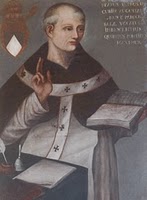
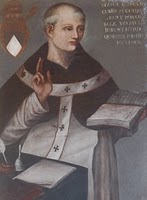
Blessed James Salomonio

beato_giacomo_salomoni

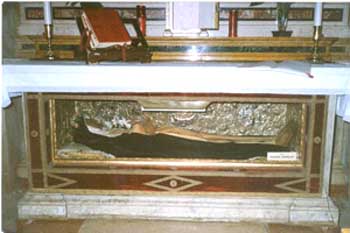
In a little chapel in Forli, built as a tomb for honored dead, there are three Dominicans laid in close proximity. One side is occupied by Blessed Marcolino of Forli. The center position is held by Carino of Balsamo, the assassin of saint Peter Martyr, whose long penance and popular holiness are now under consideration for his possible beatification; the third place is that of Blessed James of Saomomio, who was the spiritual director of Carino.

James was born in Venice, in 1231, the only child of noble parents. His father died when he was very small, and his mother became a Cistercian nun, leaving him to the care of his grandmother. She did well by her orphaned grandson, and James became a good and studious boy who responded eagerly to any spiritual suggestions. Under the direction of a Cistercian monk, he learned to meditate, and on the monk’s counsel, James became a Dominican at the convent of Sts. John and Paul, in Venice, as soon as he was old enough. He gave most of his money to the poor, and arrived at the convent with just enough left to buy a few books. Seeing that one of the lay brothers there was in need of clothing, he gave his small sum to the lay brother and entered empty-handed.

James wore the Dominican habit with dignity and piety, if not with any worldly distinction, for sixty-six years. He was humble and good and obedient, and there was nothing spectacular about his spirituality. He was well-known for his direction of souls, but he fled even from the distinction this work brought him.

Even his retiring habits did not protect him, for the people of Venice beat a path to his door. In self -defense, he transferred to another house, that of Forli. This was a house of strict observance and very poor. Nothing could suit him better. For the remainder of his life he worked and prayed in Forli, going out to visit the sick in the hospitals and spending long hours in the confessional. His charity to the poor and the sick gave him the name ” Father of the Poor.” He is represented in art surrounded by a horde of petitioners of this sort.


Born: 1231 at Venice, Italy

Died: March 31,1314 of cancer at Forli, Italy; buried in the chapel at Forli

Beatified: He was beatified in 1526 by Clement VII

Patronage: invoked against cancer

Representation: Dominican surrounded by a horde of petitioners; Dominican with a staff and book and the Christ-child over his heart; Dominican holding a heart with the letters “IHS” on it.

The Shepherd’s Sacred Heart ~ The Rev Dcn Dennis Klinzing, Novice

Sacred-Heart-Good-Shepherd

In our Gospel reading today Luke 15: 3-7, Jesus shares the parable of the lost sheep with us. Today we also celebrate the Sacred Heart of Jesus. I would like to take this chance to spend some time to explore today’s Gospel message with meaning of the Sacred Heart of Jesus. Jesus spoke to us today about a lost sheep. There is an additional parable that Jesus taught that I apply to the Sacred Heart of Jesus. That is the parable about the wedding necklace (Luke 15: 8-10).   In both parables we are able to see the Sacred Heart of Jesus each time. Those of us who are parents, or are in constant interaction with children, are able to easily understand the joy the heart feels and expresses when a child who is thought to have been lost is found. The heart’s expression is even more intense when a soul or child is truly lost and then found again.

The story about the lost sheep would touch the hearts of the men and boys in the crowd, and the women and girls would appreciate the story about the necklace that was lost.   Jesus sought to reach everybody’s heart.

The sheep was lost because of its foolishness. Sheep have a tendency to go astray, and that is why they need a shepherd. The scribes and Pharisees had no problem seeing the publicans and sinners as ‘lost sheep,’ but they would not apply that image to themselves! And yet the prophet made it clear that all of us have sinned and gone astray, and that includes religious people.

The shepherd was responsible for each sheep; if one was missing, the shepherd had to pay for it unless he could prove that it had been killed by a predator. This certainly explains why he would leave the flock with the other shepherds, go and search for the missing animal, and then rejoice when he found it. Not to find the lost sheep meant money out of his own pocket, plus the disgrace of being known as a careless shepherd.

By leaving the ninety-nine sheep, the shepherd was not saying they were unimportant to him. They were safe, but the lost sheep was in danger. The fact that the shepherd would go after one sheep is proof that each animal was dear to him.

There is a fourfold joy expressed when a lost sinner comes to the Savior. Though nothing is said in the story about how the sheep felt, there is certainly joy in the heart of the person found. Both Scripture (Acts 3:8; 8:39) and our own experience verify the love of salvation.

But there is also the joy of the person who does the finding. Whenever you assist in leading a lost soul to faith in Christ, you experience a wonderful joy within. Others join with us in rejoicing as we share the good news of a new child of God in the family, and there is also joy in heaven (Luke 15:7; 10). The angels know better than we do what are saved from and to, and they rejoice with us.

Jesus illustrates this joy of finding the lost in another way.  When a Jewish girl married, she began to wear a headband of ten silver coins to signify that she was now a wife. It was the Jewish version of our modern wedding ring, and it would be considered a calamity for her to lose one of those coins.  Palestinian houses were dark, so she had to light a lamp and search until she found the lost coin, and we can imagine her joy in finding it.

We must not press parabolic images too far, but it is worth noting that the coin would have on it the image of the ruler. The lost sinner bears the image of God, even though that image has been marred by sin. When a lost sinner is ‘found’ God begins to restore that divine image through the power of the Holy Spirit, and one day, the believer will be like Jesus Christ.

These two parables help us understand something of what it means to be lost. To begin with, it means being out of place. Sheep belong with the flock, coins belong on the chain, and lost sinners belong in fellowship with God. But to be lost also means being out of service. A lost sheep is of no value to the owner, and a lost sinner cannot experience the enriching fulfillment God has for them in Jesus Christ.

But to turn this around, to be ‘found’ (saved) means that you are back in place (reconciled with God), back in service (life has a purpose), and out of danger. No wonder the shepherd and the woman rejoiced and invited their friends to rejoice with them!

It is easy for us today to read these two parables and take their message for granted, but the people who first heard them must really have been shocked. Jesus was saying that God actually searches for sinners! No wonder the scribes and Pharisees were offended, for there was no place in their legalistic theology for a God like that. They had forgotten that God had sought out Adam and Eve when they had sinned and hidden from God. In spite of their supposed knowledge of Scripture, the scribes and Pharisees forgot that God was like a father who pitied his wayward children.

These are few joys that match the joy of finding love and bringing them to the Savior.

Why do these scriptures mean so much to us on the Feast of the Sacred Heart? The Solemnity of the Sacred Heart of Jesus presents us with the opportunity to reflect on the relevance of this venerable symbol in our daily lives. The image of the Sacred Heart is never mentioned as such in Sacred Scripture, but its meaning can be found spanning each page of Genesis to Revelation.

Today’s readings point to this fact and frame the Sacred Heart in terms of two central themes: love and closeness. They speak of the love of God as a shepherdly love, an involved loved, a powerful love; a love that is up-close and personal, that seeks out the lost, heals the afflicted, strengthens the contrite, upholds the humble, and calls mend and woman of every time and place to all they can be, to love in return, to have life in abundance: to be holy. We see here that the image of the Sacred Heart is intimately linked with the image of the Good Shepherd.


Blessed Peter Sanz, & Companions

martyrs-of-china

The viceroy of Peking wrote this about the five martyrs that included Peter Sanz: “What are we to do with these men? Their lives are certainly irreproachable; even in prison they convert men to their opinions, and their doctrines so seize upon the heart that their adepts fear neither torments nor captivity. They themselves are joyous in their chains. The jailors and their families become their disciples, and those condemned to death embrace their religion. To prolong this state is only to give them the opportunity of increasing the number of Christians.”

Peter Sanz was among the first group of martyrs in Tonkin, which also included Bishop Francis Serrano, Father Joachim Royo, Father John Alcober, and Father Francis Diaz.

Peter Sanz was professed a Dominican at Lerida when he was 18 (1697). He was ordained in 1704, volunteered for the Chinese missions, and was sent to Manila, The Philippines, in 1713. After studying the language for two years, he entered China where he spent 31 years evangelizing the Chinese before he was captured. In 1730, he was nominated vicar apostolic of Fukien and titular bishop of Mauricastro. When a renewed persecution of Christians flared up in 1746, he was accused of breaking the laws by converting thousands to Christianity by a man to whom he had refused to lend money, according to one account.

The five men, bound together by their vows and their work, were brought more closely together during their imprisonment at Foochow. Fathers Serrano, Alcober, and Diaz were captured first, and tortured to reveal the whereabouts of Bishop Sanz. They did not break down, but the bishop and Father Royo, hearing about the torture, surrendered in the hope of sparing their brothers’ suffering, says another account.

The five priests were dragged in chains to the emperor’s court, where they were subjected to frightful torments. All of them, with a catechist named Ambrose Kou, were sentenced to death in December 1746. During the long imprisonment, a Dominican, Father Thomas Sanchez, managed to see them. He brought them some clothes and a little money, and all the news he could find.

On May 25, 1747, Bishop Sanz was beheaded at Fu-tsheu. Even the pagans were impressed with his gentle demeanor as he was led out to die, and a fellow prisoner who had been converted in prison, followed him closely through the mob, openly proclaiming his sanctity. As the headsman prepared to swing the axe, the venerable bishop looked at him and said, “Rejoice with me, my friend; I am going to heaven!”

“I wish I were going with you!” blurted out the unhappy man.

Laying his head upon the block, the bishop preached his last sermon: “If you want to save your soul, my friend, you must obey the law of God!” Pagan friends of the priests scurried through the crowd, gathering up the relics which they saved for the Christians. Many of these people, including the executioner, were later baptized.

On October 20, 1747, after the death of Sanz, word arrived that Father Serrano was had been appointed titular bishop of Tipsa and coadjutor to Blessed Peter Sanz. At that point, he and the others were summarily executed at Fukien.

Born: September 22, 1680 in Ascó, Catalonia, Spain

Died: beheaded on May 26, 1747 in Fuzou, China

Beatified: May 14, 1893 by Pope Leo XIII

Blessed Sadoc & Companions

Bl-Sadoc-and-companions

Saint Dominic’s dreams of converting the Tartars found realization in his sons. Missionaries did, in fact, go to the North during his lifetime, and many more were sent out by Blessed Jordan of Saxony. The more settles tribes of Poland and Hungary readily accepted the Gospel, and the North was not long in blooming with Dominican convents. But, in the thirteenth century, the restless millions of the East were riding down upon the fertile plains of Central Europe. Wild Tartar tribes soon destroyed what has been done for their more peaceful relatives, and scarcely a missionary survived to preach his message of peace to them.

Paul of Hungary and his band of ninety died as martyrs, probably in 1241. They were popularly honored as saints from earliest times. Soon to follow was the group headed by Blessed Sadoc, which had its headquarters at Sandomir, in Poland. So tragic was the early history of the Dominicans in Poland that, even in that martyred country, it is remembered. Polish Dominicans today wear a red cincture to recall the martyred hundreds who shed their blood that Poland might receive the light of truth.

Blessed Sadoc was a student at the university of Bologna when he met Saint Dominic and was received unto the Order. Being himself a Slav, he was eager to go to the North to preach the word of God. This he was given a chance to do when he and Paul of Hungary were given charge of the northern mission band. He soon accumulated a number of eager young students and novices, and proceeded to Poland with them. On his first night in the mission field, so say the old chronicles, the devil appeared to Sadoc and reproached him for disturbing his works: “And with such children as these,” he said bitterly, pointing to the young novices. With such as these, Sadoc did make havoc with the kingdom of evil: he won many souls to God, and, in Sandomir, he soon had the satisfaction of seeing a large community working for the glory of God.

In 1260, the Tartars made a fresh invasion into Poland and attacked Sandomir. Blessed Sadoc and his community had assembled for midnight Matins when they received warning of their approaching deaths. A novice, reading the martyrology for the following day, was amazed to see, lettered in gold across the pages of the martyrology, the words: ” At Sandomir, the passion of forty-nine martyrs.” On investigation, it was discovered that it was not merely a novice’s mistake, but an actual warning which they understood to be from heaven.

They spent the day in preparation for death. During the singing of the “Salve Regina,” after Compline, the Tarttars broke into the church and the slaughter began. One novice, terrified at the thought of death, fled to the choir loft to hide, but hearing his brothers singing, he realized that they were going off to heaven without him, and he returned to the choir to die with the others.

From this martyrdom came the customs of singing the “Salve Regina” at the deathbed of a Dominican-priest, sister, or brother. It is fitting that a life dedicated to God and Our Lady should end thus, with the battle cry “HAIL HOLY QUEEN!” echoing up from this valley of tears to be joined by the voices of Dominicans in heaven, who can now see forever the clement, loving, and sweet Virgin Mary.

Born: Various years within the Thirteenth century

Died: died 1260

Beatified: Their cult was confirmed in 1807 by Pope Pius VI


Blessed Alphonsus Navarette & Companions

Alfonso

Dominicans were the first missionaries to Japan, and 1530 is given as the date of their martyrdom. However, no conclusive proof exists regarding their names or number, and Saint Francis Xavier rightly holds the title of apostle to this island kingdom.

Following in Xavier’s footsteps came other missionaries, and, for about 40 years, they worked with great results among the people. Then, in the closing years of the century, persecution flared, and the blood of martyrs cried out with a louder voice than that of the preachers.

Ferdinand took the Augustinian habit in Mentilla, and in 1603, was sent to Mexico, and thence to Japan in 1605 as vicar provincial. He worked at Osaka with great success until his capture and execution en route to Omura.

The first Dominican to die in the great persecution was Alphonsus Navarrete. When Alphonsus was very young, he gave up his inheritance to enter the Dominican Order in Valladolid and, after he had completed his studies, was sent to the Philippine missions. The great persecution had just begun in Japan. The year before Alphonsus left Spain, a group of 26 Christians, including many Franciscans and three Japanese Jesuits, were crucified in Nagasaki.

Despite the dangers, the Dominicans, who had been excluded from Japan for several years, yearned to go into the perilous mission field. Alphonsus in particular, after a trip to Europe to recruit missionaries in 1610, begged to be allowed to go to Japan. In the following year his offer was accepted and he was sent as superior of the missionary band. During the short interval of peace, they began their work, and, during six years of growing danger, they instructed the people and prepared them for the dreadful days to come.

The missionary career of Alphonsus was brief, and it was always overshadowed by the threat of death that beset the Christians in that unhappy country. However, in the few years of his apostolate, his accomplishment was immeasurable. Like his Divine Master, he went about teaching and baptizing the people. He is called the “Vincent de Paul of Japan,” because it was he who first began the tremendous task of caring for the abandoned babies there. He anticipated the work of the Holy Childhood Society by gathering up the homeless waifs and providing for their support from money he begged of wealthy Spaniards.

The warning bell of the great persecution was sounded with the martyrdom in Omura of two priests, a Franciscan and a Jesuit. Alphonus Navarrete and his Augustinian companion Ferdinand went to Omura with the intention of rescuing the relics of the martyrs and consoling the Christians. They were captured on the way, and with a young native catechist, were beheaded. Their bodies were thrown into the sea.

Five years later, on the hill of the holy martyrs of Nagasaki, more than 50 Christians sealed their faith with their blood. Some of the martyrs were beheaded, some were burned at the stake. In the group were nine Jesuits, including the famous Father Charles Spinola, nine Franciscans, and nine Dominicans, among whom were the Blesseds Alphonsus de Mena, Angelo Orsucci, and Hyacinth Orphanel. Louis Bertrand, a nephew of the saint of that same name, perished in the same persecution.

Thousands of Japanese Christians, from tiny children to old grandparents, died amid terrible torments in the profession of their faith. The anger of the persecutors was turned against all priests, brothers, and catechists, tertiaries, and Rosarians, and they made fearful attempts to stamp out all traces of the hated religion in the country. Pope Pius IX, in 1867, solemnly beatified 205 of the martyrs, among whom were 59 Dominicans of the first and third orders and 58 members of the Rosary Confraternity. Although all did not die at the same time nor place, they are listed under the name of Alphonsus Navarrete, who was the first to die.


Born: Various dates in the sixteenth century

Died: died the most terrible torments in Japan in 1617

Beatified: Pius IX beatified them in 1867

Blessed Andrew Franchi

BlAndrewFranchi26-5

Blessed Andrew was born into the noble dei Franchi Boccagni family. He entered the Dominican Order at Pistoia about 1351, when the Italian peninsula was still under the shadow of the plague and was deeply involved in fratricidal wars. Another theory has it that he entered at Florence in 1348, which was the year the plague reached its peak. Whichever date he entered, he did so to give attention to his immortal soul, at a time when the world around him was apparently falling to pieces.

Andrew proved to be a good religious and an able administrator. He served as prior in three convents while still quite young. In 1378, he was appointed bishop of Pistoia, an office he filled with distinction and holiness for 23 years.

It is written of Andrew that he devoted himself to the poor, and spent his revenues to relieve their misery and to rebuild the ruined churches. He had a great personal devotion to Our Lady, to the Holy Childhood, and to the Three Holy Kings. As bishop, he lived a life of extreme simplicity, retaining his religious habit, and as much as he could of the rule. A year before his death, he resigned his office and retired to die at his old convent of Pistoia.

Born: Born in Pistoia, Italy, in 1335

Died: died 1401

Beatified: Benedict XV in 1921 declared him Blessed


Blessed William Arnaud, O.P. & Companions, The Martyrs of Toulouse

wiliam-arnaud

Nothing is known about William’s early life. In 1234, he and two other Dominicans were commissioned as inquisitors by Pope Gregory IX to combat Albigensianism in Languedoc, France. He and his companions were driven out of Toulouse, Narbonne, and several other towns by the heretics.

With him on the preaching mission were a fellow Dominican, Bernard of Rochefort; the Franciscans, Steven of Narbonne and Raymond of Carbonier, and two unnamed others; the Benedictine, Prior Raymond; the clerks, Bernard Fortanier and Admer; and the Dominican lay brother, Garcia d’Aure; and Peter the Notary. There were others who worked with him through the long and difficult years in Toulouse, but these were the ones who died in the martyrdom of Avignonet.

After the death of Saint Dominic, the party of Count Raymond of Toulouse rose to power again. In a short time it regained possession of Toulouse and several armed strongholds nearby. When William Arnaud and his companions came into the vicinity, they found every gate closed against them. None of the cities under the command of Raymond’s troops would allow them to come in, and, by order of the heretic commander, the citizens of Toulouse were forbidden under pain of death to supply the inquisitor’s party with any food. They took refuge in a farmhouse outside of Avignonet and preached around the countryside for some time. Because they had some measure of success, the heretics intensified their efforts to entrap and kill the inquisitors.

The members of the commission realized that they were only one step from death. They might have escaped and gone safely to some other part of the country had they chosen to do so. Instead, they remained where obedience had assigned them, and at the end of May 1242, they were given a heavenly warning that they were about to receive the crown of martyrdom. William was absent from the rest of the group when the plot was formed to kill them. Being told of a vision of martyrdom by one of the brothers, he hurried back to rejoin his group. The heretics completed their plans to massacre the entire party.

Scheming carefully, they set the scene at the country castle of one of the wealthy members of their group. In order to make sure of getting the inquisitors into the trap, they sent word to William that a confirmed heretic of his acquaintance wished to abjure his heresy and return to the faith.

Knowing well that it was a trap, William still could not refuse to go. He and his eleven companions went, on the evening of the Ascension, May 28, to the castle of Count Raymond VII of Toulouse. The soldiers of Raymond were concealed in the great hall. They fell upon the helpless group and killed all but four of the members. These four were taken out by friends who had know about the plot and hurried to the church.

William Arnaud and Steven of Narbonne were murdered in the sanctuary of the church as they sang the Te Deum. This was a crime almost unparalleled in medieval times when the right of sanctuary was one of the few strongholds against barbarism. The bodies of the martyrs were thrown into a deep ravine, and rocks were rolled down on them. During the night, some hours after the martyrdom, bright lights radiating from the bodies of the martyrs brought the faithful to gather up the relics.

The church of Avignonet was placed under interdict because of the sacrilege, and for 40 years no Mass was said there. The doors remained closed. Finally, when the interdict was lifted, the bells rang of themselves, according to legend, to let people know that Avignonet was once more a member of the living Church.

There is a striking footnote to this story of martyrdom. Shortly after the interdict was lifted, there appeared one day on the steps of the church a fairly large statue of the Blessed Virgin. Who had put it there has never been discovered. It is difficult to see how anyone in such a small town could have successfully concealed a statue of that size, for small towns are notoriously poor places to hide secrets. The statue appeared on the steps in broad daylight, yet no one saw it being placed there. The people took it as a sign that they were forgiven for their part in the outrage, and also as a sign that they should rebuild the devotion to Our Lady, which the Dominicans had preached. The statue was named “Our Lady of Miracles,” and they petitioned for a special feast in honor of their own Miracle lady.

Until very recently, a beautiful little ceremony was held in the Church of Our Lady of Miracles on every May 28. It was a night ceremony, in memory of the night martyrdom of William Arnaud and his companions, and it was called “The Ceremony of the Vow.” Carrying lighted candles, the people proceeded across the entire width of the church on their knees, praying for forgiveness for the people who committed the massacre.

Born: ?

Died: 1242

Beatified: Pius IX confirmed their cult in 1866

Patronage: Blessed William Arnaud is invoked by people who suffer from neuralgia, in memory of a miracle of healing which he performed on one of the sisters of Prouille.

Remembrances and Reminders: The Feast of Corpus Christi ~ The Ven. Fr. Jay Van Lieshout, OPI

corpus christi

Souvenirs, mementos, remembrances, heirlooms, treasures, artifacts, chachkies, knickknacks, memories; tokens of the people, places and memories out of our past which we cling to and carry with us as we move on into the future.  Grandma’s handkerchief which she always carried in her purse, granddad’s which still smells of his favorite tobacco, the pressed violets you gave mom for Mother’s Day and she always kept in the family Bible, the note wishing you a good morning from a loved one who has gone home; to others they are just “things” but to you they are the most precious relics in the world.  We all have them, some more than others.  Personally, I do not like a lot of “stuff” but you would never know it.  My home is filled with the bits and pieces of the lives of loved ones who have passed on far to soon.  Of course I say I am going to clean out the house and attic and only keep the most important things and I start, but haven’t really made much progress these past few years.  It’s difficult; each item brings back memories of good times and laughter, and then comes the tears.  Why do we collect these mementos and why are they so hard to part with?  After all we always have our memories don’t we?

Memories are how we record our own history and where we keep our loved ones alive.  We hold their smiles, laughter, hugs and all the little things close to our heart, letting our mind’s eye relive and cherish them over and over. But, alas, we live in a world created by our senses of touch, smell, sight, sound and even taste; memories are ethereal wisps of images and echoes of sound which blur and fade.  Yet, when we hold these most sacred artifacts, our past springs back to life crisp and clear.  The faint sweet smell of granddad’s pipe transports us back to sitting on his knee while he told his silly stories.  Or the texture of grandma’s kerchief as we hold it against our cheek elicits the click of her purse opening up and the wafting smell of peppermint candies and face powder.    Yes, these seemingly simple objects are perform miracles in our hands, they erase the years, veil the present, allowing us to revisit our past and bringing our loved ones back to us as if they had never even left.

On this 2nd Sunday of Pentecost, we commemorate Corpus Christi-the solemnity of the most Holy Body and Blood of our Lord Jesus Christ.  It may seem odd to have a day set aside for that which we celebrate at each and every Eucharist, but it is important to remind us of the gift which we have been given.  We call to mind His promises, “I tell you truly that if two of you on the earth agree about anything you ask for, it will be done for you by My Father in heaven. For where two or three gather together in My name, there am I with them” (Matthew 18:20) and “be sure of this: I am with you always, even to the end of the age” (Matthew 28:20).  Jesus is with us always, our constant companion, our guide and protector; we carry Him inside us, in our hearts and minds for He is part of who we are as Christians.  Each Sunday we relive these promises in the sacrament of His Body and Blood, we hold Him in our hands, we see Him in the Bread and His blood in the Wine and we taste His presence on our tongues; and then, all too quickly, the reality of His presence fades and the Mass ends.  Unlike the saints, and the moments of our past, there are no relics of our Lord to cling to, no concrete evidence of Him once walking among us; He ascended into the sacred realm and, though still with us spiritually, we long for a physical presence.  Today, we bring to the forefront the reality of God’s covenant, the promise of the real presence of the Son of Man in the ritual of the Eucharist, the living presence of God in the flowing of our blood and His life giving spirit breathing life into us.  Today we do more than just eat the bread of life and drink from the cup of the new covenant, we stop, gaze upon, contemplate, adore and most importantly we remember the good news he brought us and gift we have been given in breaking of His body, the surrender of His blood, the redemption in His sacrifice and the hope in His resurrection:  Our Lord is with us here, now and always!


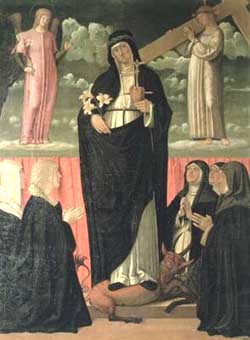
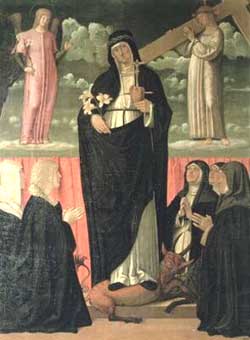
Blessed Maria Bartholomew Bagnesi

bl-mary-bartholomew-bagnesi

Marietta was a beautiful and appealing child, with big eyes and a constant smile. Because she was tiny, she was always called Marietta, rather than Mary. Her mother neglected her when she was a baby, leaving her to the casual care of others, and the little girl was often hungry and cold. She never protested, but was always gay and charming, and she was the special darling of her sister, who was a Dominican nun.

The sisters made quite a pet of the little girl, and she ran through the cloisters unhampered, singing for the sisters from the throne of the community-room table. What brought about her utter disgust with marriage is hard to tell. When her father proposed that she marry an eligible young man, she reacted with horror. She had been managing the household since the death of her mother, and her father felt that having a home of her own would be the best thing in the world for her. When he suggested this, Marietta fell into a faint, and she remained in that condition for days. When she recovered, she could not stand up, and had to be put to bed.

At this point a strange interlude brings, which can only be explained by the fact that God does not operate in the same fashion we do. Marietta’s father was fond of quack doctors, and quacks of the 16th century were really fantastic. Without protest the girl endured all the weird and frightful treatments they devised, suffering more from the treatments than she ever had from the malady. Today her ailment would probably be diagnosed as some type of spastic nerve malady. Packing her in mud and winding her in swaddling bands until she, according to her own account, “felt like a squashed raisin” could not have helped anything but the quack doctor’s purse. The ailments continued unabated for 34 years.

Marietta had hoped to be a nun; four of her sisters were already in the convent. Because such a life was, of course, impossible for an invalid, her father attempted to better her spirits by having her accepted into the Third Order. A priest came from Santa Maria Novella and received her into the order in 1544, but he excused her from the obligation of saying the Office because of the desperate nature of her illness. When he came the following year, she made her profession. For a little while after her profession, Marietta was able to get out of bed and could even walk a little. She could see and enjoy the beauties of the city. The she fell ill again and went back to bed; this time she had asthma, pleurisy, and a kidney ailment.

The doctors continued their experimentation through all the years of her life. A mystic, who sometimes conversed with the angels, saints, and devils, Marietta was suspected by the neighbors of being in league with the devil. Her protests that “she had seen him all right but he wasn’t a friend of hers,” fell on deaf ears; they obtained permission to have her exorcised. Her confessor left her; he was afraid of becoming involved. Another priest who came to her, mostly out of curiosity, stayed on as her confessor and directed her strange and troubled path for 22 years.

Marietta’s little room became a sort of oratory, and troubled people came there to find peace. She had an unusually soothing effect on animals; several pet cats made her the object of their affection. One of them used to sleep on the foot of her bed, and if she became sick during the night would go out to find someone to care for her. Once, when the cat felt that Marietta was being neglected, it went out and fetched her a large cheese. The cats, according to the legend, did not even glance at the songbirds that she had in a cage beside the bed.

Marietta’s spiritual life is hard to chronicle against such an odd background. In her last years, she was in almost constant ecstasy. The chaplain said Mass in her room, and she went to confession daily. She never discussed the sorrowful mysteries, because she could not do so without crying, but she often talked with great animation and a shining face, about the glorious mysteries. Once she was raised out of her bed in ecstasy. She shared her visions with another mystic, the Carmelite, Mary Magdalen de Pazzi. Because of her devotion to Saint Bartholomew, she added his name to her own, and usually used it instead of her family name.

Born: August 15, 1514 at Florence, Italy

Died: May 28, 1577 at Florence, Italy of natural causes

Beatified: July 11, 1804 by Pope Pius VII

Patronage: loss of parents, sick people, victims of abuse