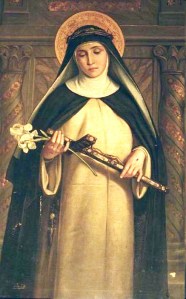
Blessed Margaret of Castello

marg-c1

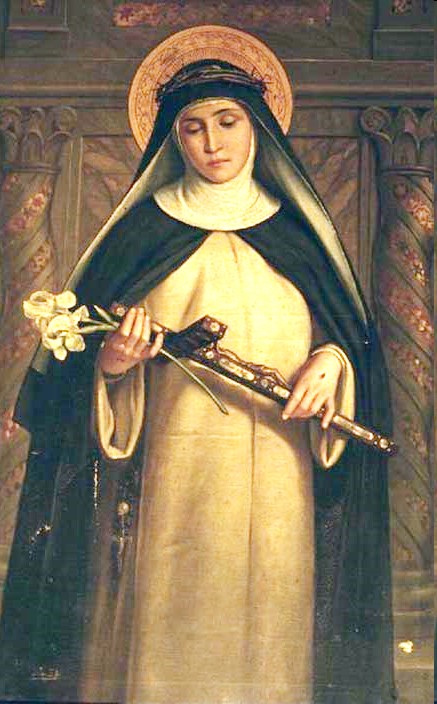
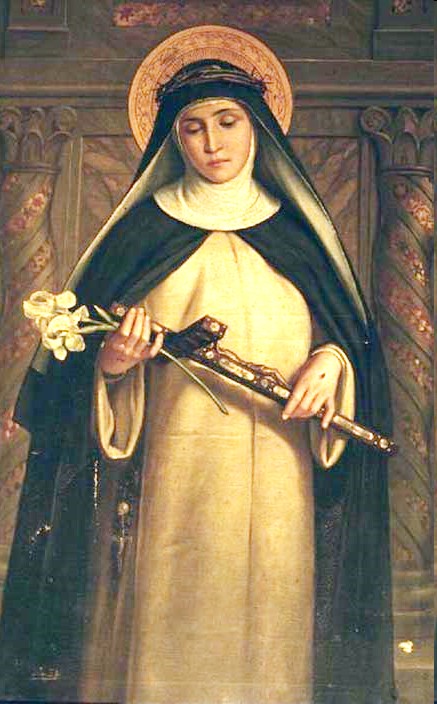
Margaret was born blind into a poor, mountain family, who were embittered by her affliction. When she was five years old, they made a pilgrimage to the tomb of a holy Franciscan at Castello to pray for a cure. The miracle failing, they abandoned their daughter in the church of Città-di-Castello and returned to their home.

Margaret was passed from family to family until she was adopted by a kindly peasant woman named Grigia, who had a large family of her own. Margaret’s natural sweetness and goodness soon made themselves felt, and she more than repaid the family for their kindness to her. She was an influence for good in any group of children. She stopped their quarrels, heard their catechism, told them stories, taught them Psalms and prayers. Busy neighbors were soon borrowing her to soothe a sick child or to establish peace in the house.

Her reputation for holiness was so great that a community of sisters in the town asked for her to become one of them. Margaret went happily to join them, but, unfortunately, there was little fervor in the house. The little girl who was so prayerful and penitential was a reproach to their lax lives, so Margaret returned to Grigia, who gladly welcomed her home.

Later, Margaret was received as a Dominican Tertiary and clothed with the religious habit. Grigia’s home became the rendezvous site of troubled souls seeking Margaret’s prayers. She said the Office of the Blessed Virgin and the entire Psalter by heart, and her prayers had the effect of restoring peace of mind to the troubled.

Denied earthly sight, Margaret was favored with heavenly visions. “Oh, if you only knew what I have in my heart!” she often said. The mysteries of the rosary, particularly the joyful mysteries, were so vivid to her that her whole person would light up when she described the scene. She was often in ecstasy, and, despite great joys and favors in prayer, she was often called upon to suffer desolation and interior trials of frightening sorts. The devil tormented her severely at times, but she triumphed over these sufferings.

A number of miracles were performed by Blessed Margaret. On one occasion, while she was praying in an upper room, Grigia’s house caught fire, and she called to Margaret to come down. The blessed, however, called to her to throw her cloak on the flames. This she did, and the blaze died out. At another time, she cured a sister who was losing her eyesight.

Beloved by her adopted family and by her neighbors and friends, Margaret died at the early age of 33. From the time of her death, her tomb in the Dominican church was a place of pilgrimage. Her body, even to this day, is incorrupt. More than 200 miracles have been credited to her intercession after her death. She was beatified in 1609. Thus the daughter that nobody wanted is one of the glories of the Church

After her death, the fathers received permission to have her heart opened. In it were three pearls, having holy figures carved upon them. They recalled the saying so often on the lips of Margaret: “If you only knew what I have in my heart!”.

Born: in 1287 at Meldola, Vado, Italy

Died: April 13th, 1320 of Natural Causes (Her body is incorrupt)

Beatified: October 19th, 1609 by Pope Paul V

Patronage: Against poverty, disabled people, handicapped people, impoverishment, people rejected by religious orders, physically challenged people, poverty.


Got Fruit? ~ Br. Chip Noon, Novice

Got Fruit Chip

“We must obey God rather than men.”

This sentence, spoken by Peter to the Sanhedrin in today’s first reading from Acts, gives us pause and makes us feel proud to be Christians who speak truth to power. We admire Peter’s courage, knowing that he had acted in a cowardly way before Jesus was crucified, and knowing that this was the same Sanhedrin, Jerusalem’s Supreme Court of the time, that could sentence him to death for blasphemy. In fact, they had already put him and some other disciples in prison for preaching “in his name.”

Yet we also remember that there have been many who have used God as the justification for their actions. So with this first reading on the Third Sunday of Easter, we are firmly set down in a conundrum that has perplexed the whole world, probably from the beginning.

Whom do we follow? And how do we know if they are truthful? And how do we know that what they are teaching and preaching is the truth?

Let’s take a look at the very next verses from this chapter of Acts:

33 When they heard this, they were furious and wanted to put them to death. 34 But a Pharisee named Gamaliel, a teacher of the law, who was honored by all the people, stood up in the Sanhedrin and ordered that the men be put outside for a little while. 35 Then he addressed the Sanhedrin: “Men of Israel, consider carefully what you intend to do to these men. 36 Some time ago Theudas appeared, claiming to be somebody, and about four hundred men rallied to him. He was killed, all his followers were dispersed, and it all came to nothing. 37 After him, Judas the Galilean appeared in the days of the census and led a band of people in revolt. He too was killed, and all his followers were scattered. 38 Therefore, in the present case I advise you: Leave these men alone! Let them go! For if their purpose or activity is of human origin, it will fail. 39 But if it is from God, you will not be able to stop these men; you will only find yourselves fighting against God.”

As Christians, we can look back on over 2,000 years of our history. Not many human enterprises last this long…nowhere near this long. So we must acknowledge the work of the Holy Spirit over this time; yes, even during the darkest days of the Inquisition, the subjugation of untold numbers of “unbelievers,” the holy wars fought against other Christians and Muslims and Jews. Somehow, the Holy Spirit has guided the righteous, in spite of the wicked, so that we can agree with Gamaliel that we cannot fight against the teachings of Jesus. God…and good…has always prevailed.

So let us look at the world today. Many religions, sects, causes, parties, and factions are using God as their justification for dubious and even despicable actions. What are we to do? Shouldn’t we oppose them?

Or then, are we to take the words of Gamaliel and “let them go”? Doesn’t that condone evil?

OK, let’s put that aside for a moment and look at today’s Gospel. The disciples were fishing and catching nothing. Jesus tells them where to throw the net. They catch so much they can’t pull the net into the boat. Peter, hearing from John that the person on the shore who told them where to fling their net is the Lord, puts on his clothes and jumps out of the boat and into the water. Peter gets to shore before the boat and greets the disciples, even helping to drag the net ashore.

And then…

They have breakfast and Jesus asks Peter if he loves him. Three times he answers yes, the third time, perhaps, with some unease that Jesus asks him three times.

And the Lord’s reply to Peter’s affirmation is to take care of his sheep and feed them.

Now let’s go back to the Sanhedrin and Gamaliel advice. What to do in the face of unquestioning belief and the preaching of this belief to the masses?

I think that today’s Gospel is teaching us how to respond to leaders – or would-be leaders, or factions that ask our allegiance and obedience.

We are told by Luke in the Gospel passage that we may be judged by our actions in following someone. We see the most enthusiastic follower, Peter, who jumps out of the boat to get to Jesus as fast as he can. He is a true believer. And at some times in our lives we are all true believers…to the point of hasty, maybe even foolish actions, like jumping into the Sea of Galilee. We see the evidence of our belief since we are rewarded: honor, position, power, so many fish we can’t ship them. And we all get together and have a feast with the leadership who feeds us.

But the Holy Spirit is teaching us through Gamaliel: Leave them alone. “For if their purpose or activity is of human origin, it will fail. But if it is from God, you will not be able to stop these men; you will only find yourselves fighting against God.”

But what is the proof of that? The answer is found in Jesus’ command to Peter: Feed my lambs; tend my sheep; feed my sheep. Take care of all of humanity, even those not of the present sheepfold, as Jesus tells us in John 10:16.

Our question then, to any leader, party, faction, group? Are you feeding and tending to all the sheep and the lambs? Or are you selecting just the special ones whom you want to be with? Does the leader, party, faction, or group make breakfast just for a few people, or for the whole world?

Feed the lambs. Tend the sheep. Feed the sheep.

Ye shall know them by their fruits.

Let us pray. Lord, help us today and every day to have the enthusiasm to jump into our own Seas of Galilee and make haste to feed the lambs of the world. Help us to gather the fruit of Jesus and share it with all we meet. In his name, Amen.

Blessed Anthony Neyrot

275px-Anthonyneyrot

Blessed Anthony Neyrot occupies a unique place in Dominican history, as he is the only one among the beautified who ever renounced the faith. He expiated his sin with an act of heroism that merited heaven, washing away in his own blood the denial that might have cost him his soul.

Of the childhood of Blessed Anthony, we know nothing that he was born at Rivoli, in Italy. He was accepted into the Order by Saint Antoninus, who must have been particularly fond of the young man, since he gave him his own name. Completing his studies, Anthony was ordained and lived for a time at San Marco, the famous Dominican convent in Florence. Then, becoming restless and dissatisfied, he asked for a change of mission. He was sent to Sicily, but this did not prove to his liking either so he set out for Naples.

Brother Anthony was sailing from Sicily to Naples when pirates captured the ship. Anthony was taken to Tunis and sold as a slave. He was able to win his freedom, but fell away from the Church. He denied his faith in Jesus and abandoned his religious vocation. He accepted the Koran, the diabolical book of the Muslims. For several months, he practiced the Muslim religion. He also married.

In the meantime, his former Dominican prior, the saintly Antoninus, died. This led Anthony to have a shocking experience. It seems that one night, Anthony had something like a dream. St. Antoninus appeared to him. The conversation between the two men was to lead to a radical change in Anthony. He became truly sorry for having betrayed the Lord. He knew that in his heart he could never give up his faith in Jesus. He knew that he could only be a Catholic. And he realized that he still wanted very much to be a Dominican brother.

Blessed Anthony sent his wife back to her family. He then put on his white Dominican habit. In spite of his fear, he went to see the ruler of Tunis. A large crowd gathered and the ruler came out to the courtyard. Brother Anthony publicly admitted he had made a terrible mistake becoming a Muslim. He was a Catholic. He believed in and loved Jesus. He was a Dominican and wanted to be so for all his life. The ruler was angry. He threatened and then made promises of rewards if only Anthony would take back what he was saying. But Anthony would not. He knew this meant his death.

Anthony knelt and began to pray for the courage to give his life for Jesus. Suddenly he felt the large stones pounding him. He just kept praying for the strength to remain true to the Lord. Then he lost consciousness. Anthony died a martyr in 1460. Some merchants from Genoa, Italy, took his remains back to his own country.

Born: 1420

Died: Martyred on Holy Thursday, 1460

Blessed Anthony Pavonius

img-blessed-antony-of-pavoni

Antony grew up to diately was engaged in combatting the heresies of the Lombards. be a pious, intelligent youth. At 15, he was received into the monastery of Savigliano, was ordained in 1351.

Pope Urban V, in 1360, appointed him inquisitor-general of Lombardy and Genoa, making him one of the youngest men ever to hold that office. It was a difficult and dangerous job for a young priest of 34. Besides being practically a death sentence to any man who held the office, it carried with it the necessity of arguing with the men most learned in a twisted and subtle heresy.

Antony worked untiringly in his native city, and his apostolate lasted 14 years. During this time, he accomplished a great deal by his preaching, and even more by his example of Christian virtue. He was elected prior of Savigliano, in 1368, and given the task of building a new abbey. This he accomplished without any criticism of its luxury–a charge that heretics were always anxious to make against any Catholic builders.

The consistent poverty of Antony’s life was a reproach to the heretics, who had always been able to gain ground with the poor by pointing out the wealth of religious houses. He went among the poor and let them see that he was one of them. This so discomfited the heretics that they decided they must kill him. He was preaching in a little village near Turin when they caught him.

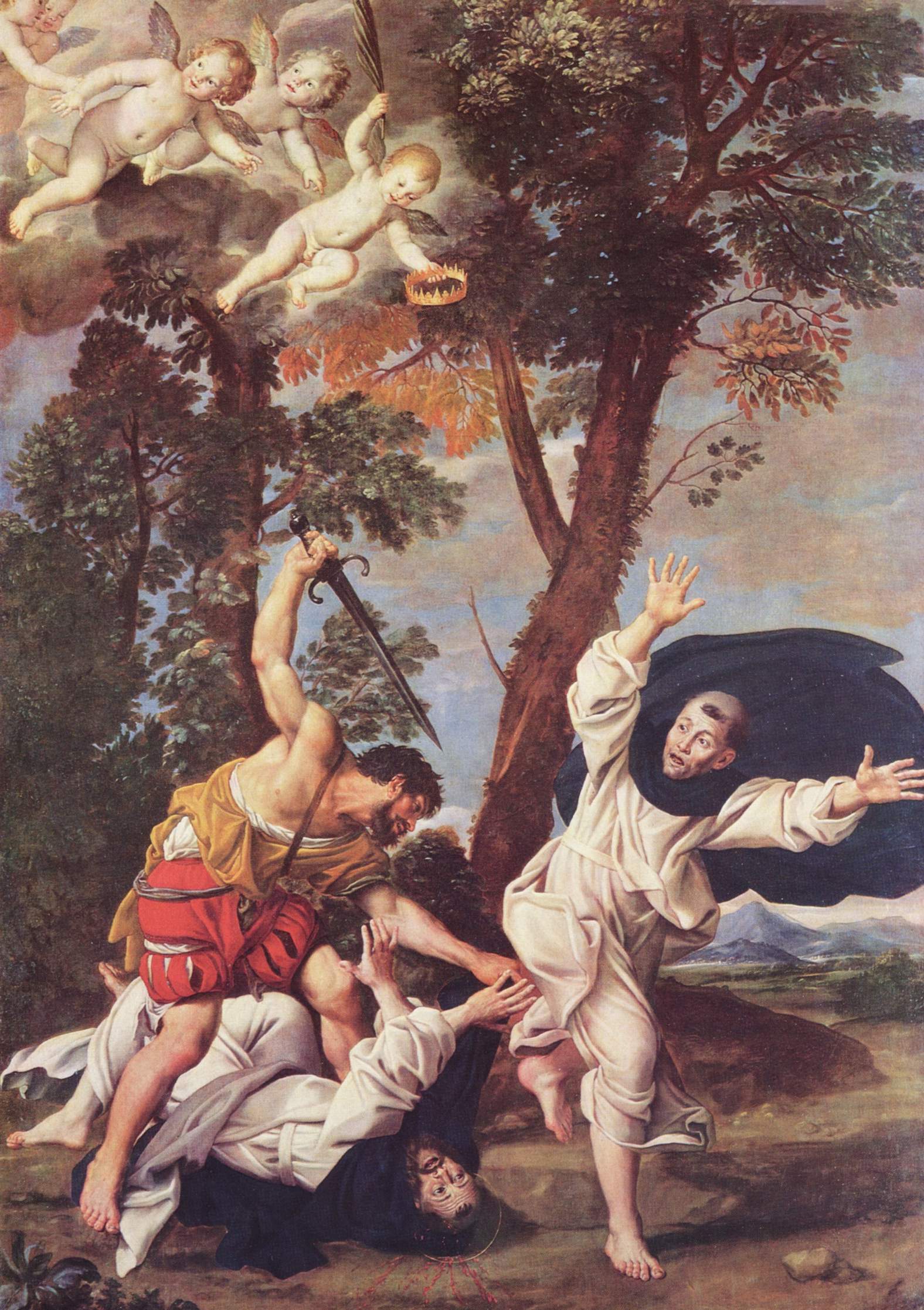
The martyrdom occurred in the Easter octave. On the Saturday after Easter, he asked the barber to do a good job on his tonsure because he was going to a wedding. Puzzled, the barber complied. On the Sunday after Easter, as he finished preaching a vigorous sermon against heresy at Brichera, seven heretics fell upon him with their daggers, and he hurried off to the promised “wedding.” He was buried in the Dominican church at Savigliano, where his tomb was a place of pilgrimage until 1827. At that time the relics were transferred to the Dominican church of Racconigi.

Oddly enough, this Dominican Antony takes after his Franciscan namesake. He is also invoked to find lost articles.

Born: 1326 at Savigliano, Italy

Died: Martyred in 1374 at Turino, Italy

Beatified: 1868

Patronage: Lost Articles

Saint Vincent Ferrer

st_vincent_ferrer

Born into a noble, pious family headed by the Englishman William Ferrer and the Spanish woman Constantia Miguel, Saint Vincent’s career of miracle-working began early. Prodigies attended his birth and baptism on the same day at Valencia, and, at age 5, he cured a neighbor child of a serious illness. These gifts and his natural beauty of person and character made him the center of attention very early in life.

His parents instilled into Vincent an intense devotion to our Lord and His Mother and a great love of the poor. He fasted regularly each Wednesday and Friday on bread and water from early childhood, abstained from meat, and learned to deny himself extravagances in order to provide alms for necessities. When his parents saw that Vincent looked upon the poor as the members of Christ and that he treated them with the greatest affection and charity, they made him the dispenser of their bountiful alms. They gave him for his portion a third part of their possessions, all of which he distributed among the poor in four days.

Vincent began his classical studies at the age of 8, philosophy at 12, and his theological studies at age 14. As everyone expected, he entered the Dominican priory of Valencia and received the habit on February 5, 1367. So angelic was his appearance and so holy his actions, that no other course seemed possible to him than to dedicate his life to God.

No sooner had he made his choice of vocation than the devil attacked him with the most dreadful temptations. Even his parents, who had encouraged his vocation, pleaded with him to leave the monastery and become a secular priest. By prayer and faith, especially prayer to Our Lady and his guardian angel, Vincent triumphed over his difficulties and finished his novitiate.

He was sent to Barcelona to study and was appointed reader in philosophy at Lerida, the most famous university in Catalonia, before he was 21. While there he published two treatises (Dialectic suppositions was one) that were well received.

In 1373, he was sent to Barcelona to preach, despite the fact that he held only deacon’s orders. The city, laid low by a famine, was desperately awaiting overdue shipments of corn. Vincent foretold in a sermon that the ships would come before night, and although he was rebuked by his superior for making such a prediction, the ships arrived that day. The joyful people rushed to the priory to acclaim Vincent a prophet. The prior, however, thought it would be wise to transfer him away from such adulation.

Another story tells us that some street urchins drew his attention to one of their gang who was stretched out in the dust, pretending to be dead, near the port of Grao: “He’s dead, bring him back to life!” they cried.

“Ah,” replied Vincent, “he was playing dead but the, look, he did die.” This is how one definitely nails a lie: by regarding it as a truth. And it turned out to be true, the boy was quite dead. Everyone was gripped with fear. They implored Vincent to do something. God did. He raised him up.

In 1376, Vincent was transferred to Toulouse for a year, and continued his education. Having made a particular study of Scripture and Hebrew, Vincent was well-equipped to preach to the Jews. He was ordained a priest at Barcelona in 1379, and became a member of Pedro (Peter) Cardinal de Luna’s court–the beginning of a long friendship that was to end in grief for both of them. (Cardinal de Luna had voted for Pope Urban VI in 1378, but convinced that the election had been invalid, joined a group of cardinals who elected Robert of Geneva as Pope Clement VII later in the same year; thus, creating a schism and the line of Avignon popes.)

After being recalled to his own country, Vincent preached very successfully at the cathedral in Valencia from 1385-1390, and became famed for his eloquence and effectiveness at converting Jews–Rabbi Paul of Burgos, the future bishop of Cartagena was one of Vincent’s 30,000 Jewish and Moorish converts–and reviving the faith of those who had lapsed. His numerous miracles, the strength and beauty of his voice, the purity and clarity of his doctrine, combined to make his preaching effective, based as it was on a firm foundation of prayer.

Of course, Vincent’s success as a preacher drew the envy of others and earned him slander and calumny. His colleagues believed that they could make amends for the calumny by making him prior of their monastery in Valencia. He did withdraw for a time into obscurity. But he was recalled to preach the Lenten sermons of 1381 in Valencia, and he could not refuse to employ the gift of speech which drew to him the good and simple people as well as the captious pastors, the canons, and the skeptical savants of the Church.

Peter de Luna, a stubborn and ambitious cardinal, made Vincent part of his baggage, so to speak; because from 1390 on, Vincent preached wherever Peter de Luna happened to be, including the court of Avignon, where Vincent enjoyed the advantage of being confessor to the pope, when Peter de Luna became the antipope Benedict XIII in 1394.

Two evils cried out for remedy in Saint Vincent’s day: the moral laxity left by the great plague, and the scandal of the papal schism. In regard to the first, he preached tirelessly against the evils of the time. That he espoused the cause of the wrong man in the papal disagreement is no argument against Vincent’s sanctity; at the time, and in the midst of such confusion, it was almost impossible to tell who was right and who was wrong. The memorable thing is that he labored, with all the strength he could muster, to bring order out of chaos. Eventually, Vincent came to believe that his friend’s claims were false and urged de Luna to reconcile himself to Urban VI.

He acted as confessor to Queen Yolanda of Aragon from 1391 to 1395. He was accused to the Inquisition of heresy because he taught that Judas had performed penance, but the charge was dismissed by the antipope Benedict XIII, who burned the Inquisition’s dossier on Vincent and made him his confessor.

Benedict offered Vincent a bishopric, but refused it. Distressed by the great schism and by Benedict’s unyielding position, he advised him to confer with his Roman rival. Benedict refused. Reluctantly, Vincent was obliged to abandon de Luna in 1398. The strain of this conflict between friendship and truth caused Vincent to become dangerously ill in 1398. During his illness, he experienced a vision in which Christ and Saints Dominic and Francis instructed him to preach penance whenever and wherever he was needed, and he was miraculously cured.

After recovering, he pleaded to be allowed to devote himself to missionary work. He preached in Carpetras, Arles, Aix, and Marseilles, with huge crowds in attendance. Between 1401 and 1403, the saint was preaching in the Dauphiné, in Savoy, and in the Alpine valleys: he continued on to Lucerne, Lausanne, Tarentaise, Grenoble, and Turin. He was such an effective speaker that, although he spoke only Spanish, he was thought by many to be multilingual (the gift of tongues?). His brother Boniface was the prior of the Grande Chartreuse, and as a result of Vincent’s preaching, several notable subjects entered the monastery.

Miracles were attributed to him. In 1405, Vincent was in Genoa and preached against the fantastic head-dresses worn by the Ligurian ladies, and they were modified–“the greatest of all his marvelous deeds, reports one of his biographers. From Genoa, he caught a ship to Flanders. Later, in the Netherlands, an hour each day was scheduled for his cures. In Catalonia, his prayer restored the withered limbs of a crippled boy, deemed incurable by his physicians, named John Soler, who later became the bishop of Barcelona. In Salamanca in 1412, he raised a dead man to life. Perhaps the greatest miracle occurred in the Dauphiné, in an area called Vaupute, or Valley of Corruption. The natives there were so savage that no minister would visit them. Vincent, ever ready to suffer all things to gain souls, joyfully risked his life among these abandoned wretches, converted them all from their errors and vices. Thereafter, the name of the valley was changed to Valpure, or Valley of Purity, a name that it has retained.

He preached indefatigably, supplementing his natural gifts with the supernatural power of God, obtained through his fasting, prayers, and penance. Such was the fame of Vincent’s missions, that King Henry IV of England sent a courtier to him with a letter entreating him to preach in his dominions. The king sent one of his own ships to fetch him from the coast of France, and received him with the greatest honors. The saint having employed some time in giving the king wholesome advice both for himself and his subjects, preached in the chief towns of England, Scotland, and Ireland. Returning to France, he did the same, from Gascony to Picardy.

The preaching of Saint Vincent became a strange but marvelously effective process. He attracted to himself hundreds of people–at one time, more than 10,000–who followed him from place to place in the garb of pilgrims. The priests of the company sang Mass daily, chanted the Divine Office, and dispensed the sacraments to those converted by Vincent’s preaching. Men and women travelled in separate companies, chanting litanies and prayers as they went barefoot along the road from city to city. They taught catechism where needed, founded hospitals, and revived a faith that had all but perished in the time of the plague.

The message of his preaching was penance, the Last Judgment, and eternity. Like another John the Baptist–who was also likened to an angel, as Saint Vincent is in popular art–he went through the wilderness crying out to the people to make straight the paths of the Lord. Fearing the judgment, if for no other reason, sinners listened to his startling sermons, and the most obstinate were led by him to cast off sin and love God. He worked countless miracles, some of which are remembered today in the proverbs of Spain. Among his converts were Saint Bernardine of Siena and Margaret of Savoy.

He returned to Spain in 1407. Despite the fact that Granada was under Moorish rule, he preached successfully, and thousands of Jews and Moors were said to have been converted and requested baptism. His sermons were often held in the open air because the churches were too small for all those who wished to hear him.

In 1414 the Council of Constance attempted the end the Great Schism, which had grown since 1409 with three claimants to the papal throne. The council deposed John XXIII, and demanded the resignation of Benedict XIII and Gregory XII so that a new election could be held. Gregory was willing, but Benedict was stubborn. Again, Vincent tried to persuade Benedict to abdicate. Again, he failed. But Vincent, who acted as a judge in the Compromise of Caspe to resolve the royal succession, influenced the election of Ferdinand as king of Castile. Still a friend of Benedict (Peter de Luna), King Ferdinand, basing his actions on Vincent’s opinion on the issue, engineered Benedict’s deposition in 1416, which ended the Western Schism.

(It is interesting to note that the edicts of the Council of Constance were thrown out by the succeeding pope. The council had mandated councils every ten years and claimed that such convocations had precedence over the pope.)

His book, Treatise on the Spiritual Life is still of value to earnest souls. In it he writes: “Do you desire to study to your advantage? Let devotion accompany all your studies, and study less to make yourself learned than to become a saint. Consult God more than your books, and ask him, with humility, to make you understand what you read. Study fatigues and drains the mind and heart. Go from time to time to refresh them at the feet of Jesus Christ under his cross. Some moments of repose in his sacred wounds give fresh vigor and new lights. Interrupt your application by short, but fervent and ejaculatory prayers: never begin or end your study but by prayer. Science is a gift of the Father of lights; do not therefore consider it as barely the work of your own mind or industry.”

It seems that Vincent practiced what he preached. He always composed his sermons at the foot of a crucifix, both to beg light from Christ crucified, and to draw from that object sentiments with which to animate his listeners to penance and the love of God.

Saint Vincent also preached to Saint Colette and her nuns, and it was she who told him that he would die in France. Indeed, Vincent spent his last three years in France, mainly in Normandy and Brittany, and he died on the Wednesday of Holy Week in Vannes, Brittany, after returning from a preaching trip to Nantes. The day of his burial was a great popular feast with a procession, music, sermons, songs, miracles, and even minor brawls.

Born: 1350 at Valencia, Spain

Died: April 5th in 1419 at Vannes, Brittany , France

Canonized: 1458

Patronage: brick makers; builders; Calamonaci, Italy; construction workers; pavement workers; plumbers; tile makers

Representation: cardinal’s hat; Dominican preacher with a flame on his hand; Dominican preacher with a flame on his head; Dominican holding an open book while preaching; Dominican with a cardinal’s hat; Dominican with a crucifix; Dominican with wings; flame; pulpit; trumpet

Got Doubts? ~ The Rev. Dcn. Michael Scott Brown, OPI

still have doubts

After the resurrection Jesus appears to his disciples, but Thomas was not there. When he does join his fellow disciples, they tell him that they have seen Jesus, yet Thomas has reservations about what they have told him. “Unless I see the nail holes and put my hands into his wounds I will not believe.” Jesus did not reappear to the disciples for another week; this time Thomas is with them. The week between Jesus’ appearances brands Thomas as a doubter and a skeptic. This wasn’t altogether fair to Thomas since Peter and John did not believe Jesus had been resurrected, and had to see the empty tomb for themselves. Perhaps Thomas just wanted to see if Jesus was true to his word, or maybe he wanted to prove his friends wrong. So he waited in the darkness of his own disbelief.

Maybe we have Thomas all wrong, maybe we should label him as Thomas the Bold, or Thomas the Brave, because earlier in John’s gospel Thomas is the only one to speak up and agree that Jesus should return to Bethany to mourn the death of his friend Lazarus. The other disciples were afraid that doing so would result in the death of them all. Thomas stands with Jesus and says: “Let us go with him so that we may die with him.” Are these the words of a doubter? These are the words of a believer and follower of Christ. Whenever Jesus speaks of his coming death,  his disciples try to talk him out of it, and one time Jesus rebukes Peter and calls him “not the rock upon whom the church was built, but his adversary. “Get behind me Satan” Jesus says to Peter. In any event. Thomas’ willingness to die for Jesus casts his doubts in a different light.

So Thomas chose to sit in a room full of believers with a head full of doubt. Maybe we should be just a little bit more like Thomas from time to time. Perhaps if we just believed in what the Lord wants us to believe, teach what the Lord wants us to teach, and go where the Lord wants us to go as Thomas did, our faith would grow stronger. Jesus was not upset that Thomas had doubts about the resurrection, Jesus simply allowed Thomas to do what was necessary to prove to Thomas that he was the Christ and that he had come back from the dead. Jesus did not love Thomas less because he had doubts, Jesus simply took away those doubts that were filling Thomas’ head. Jesus will not condemn you for having doubts either. Just open your hearts and allow Jesus to take away those doubts and fears, He will if you just give him the chance to just like Thomas did.

Most merciful Lord, take away our doubts as you did Thomas’ doubts, guide us and lead us with our sins forgiven so that we may stand with you as Thomas did. Keep us under your loving grace, and show us the path you want us to follow. We believe in you, we love you, and we praise you for your mercy and patience with us. In Jesus’ name we pray.  Amen.


Movie Review: RISEN ~ The Rev L.S.T. Sherwood & The Rt. Rev. M.R. Beckett

734546207001_4764236597001_7ci-risenthemovie-vstill

Risen is a 2016 American biblical drama film directed by Kevin Reynolds, and written by Reynolds and Paul Aiello. The film stars Joseph Fiennes, Tom Felton, Peter Firth, and Cliff Curtis, and was released by  Columbia Pictures  on February 19, 2016.

This is an excellent movie telling the Easter story from the sideways perspective not usually seen in movies and as such gives it a fresh and interesting perspective:  through the faith journey of a Roman Officer, the Tribune, Clavius.  The movie begins at an inn where the innkeeper, noticing Clavius` ring, brings Clavius to recount this story to him.  Clavius starts the moving story at the crucifixion scene with Jesus accompanied on either side by the thieves who are already on the crosses being crucified with Jesus.

Jesus`s mother, Mary was there among the large gathered crowd which consisted mostly of women. Clavius ordered the Roman Centurion at the scene to break the legs of the thieves but upon seeing Mary, Clavius decides to pierce Jesus through his side piercing his heart and lungs by himself instead. After Jesus and the thieves had succumbed to death, the bodies of the thieves were taken down and dragged to a pit where they were left to rot. In the film, I could almost imagine being stood there as the effects of the swarms of flies etc. made it appear very realistic.

Joseph of Arimathea, who was a secret disciple of Jesus, had sought and received permission from Pilate to take down Jesus` body and to place his body in a new family tomb he had. He took the letter of permission to Clavius and the body was given to Joseph.  The scribes however, were still very concerned about the stories going around told by Jesus` followers, namely that Jesus would rise again in three days.  They took it the Sanhedrin where they managed to get the Roman seal placed on the stone of Jesus` tomb and two Roman Guards were placed there to keep watch.

The Roman Guards had not slept in two days and had some wine with them which they drank and fell asleep, to be awakened by the noise of the ropes of the tomb blasting apart and the stone of the tomb rolling open. The guards saw Jesus in the body and panicked due to the fact that they, having fallen asleep, meant death by Roman law.  They fled to the sanctuary of the Jewish leaders who paid the only one who would speak to tell Clavius that the disciples of Jesus had stolen the body.  Clavius was ordered to search for the body of Jesus, and if necessary to find a body that could be identified as Jesus, so as to quash the rumors of Jesus’ resurrection.  All the recently executed dead were scrutinised to see if any could Jesus. None of the bodies that were looked would do.

Desperate to solve this riddle, Clavius hunted down first Mary Magdalen who had been seen near the tomb, then the other disciples. Clavius finally found the disciples all gathered together and Jesus was there amongst them. This part brought a smile to my heart, as this is where Clavius finally comes to believe and follows the disciples to Galilee where Jesus had stated they would see him again. The total change of heart and new found faith of Clavius was very realistically captured and was an extremely moving experience.

The disciples, together with Clavius, travelled to Galilee where they decided to do some fishing whilst waiting for Jesus but not one fish was caught. Then first thing in the morning, Peter saw someone walking along the beach and heard him tell them to try the right side, so out of faith Peter and the other disciples lowered the net as Jesus had instructed and the nets were over full with fish. When they came to the shore, they sat with Jesus and then watched as Jesus performed a miracle of healing on a man who was being kicked by others because he was a leper. After this, Jesus went to prepare a place for his disciples in his Fathers kingdom and he left the disciples the message that we still are told today, ”Go and tell tbe Gospel to all the world and to all nations”.

This film captured our hearts with the sheer beauty of the Lord’s love for us and what we should be doing today in his name for others. We are the disciples of today and are charged to do his works until his glorious return.  An inspiring story of faith, a fantastic movie, with the message given in a fresh and interesting perspective, we consider Risen to be a very moving and definiately worth watching film.  We give it 5 stars!!!!


The Lord is Risen! Alleluia! But…umm…Why? ~ The Rev. Jay Van Lieshout, OPI

empty_tomb11

The Lord is Risen! Alleluia!

Today we celebrate the anniversary of our Lord’s resurrection; we commemorate the victory of Christ over the bonds of death and joyously proclaim His return to us and to the world so that we, too, can all be renewed, reawakened from our own spiritual slumber, and be raised up into the loving arms of our Father just as Jesus did nearly 2 millennia ago.  And while we remember and give thanks for this auspicious event each and every Sunday, today we open ourselves up to the bewilderment and the overwhelming emotions felt by Mary as she saw the stone moved from the opening of the tomb and, bending down to look in, finding it empty.   And Peter and all the other disciples who looked in to only find burial linens heaped on the floor, and the soudarion, the face cloth, neatly rolled off to the side.  And then the joy and spiritual ecstasy when they see and finally recognize Jesus right there, in front of them, alive!  Oh what elation their hearts must have felt!

Oh it must have been a marvelous and great joy to have Jesus back with them; and we know He is with us here, now, each and every day— not only just in spirit but in the flesh. But have you ever asked yourself why; why did the son of man need to return in flesh?  The return manifested in spirit alone would have rocked the world and brought joy and salvation to the world; so why resurrect the frail flesh only to have it ascend into heaven and be gone once again?  Of course, the prophesies and Jesus Himself foretold this, but WHY?

The answer is surprisingly simple:  while you can destroy the temple, destroy the ark, destroy the tablets and even destroy the written Word of God in the Torah, the Word, this Logos of God, can never die or be destroyed for it is emblazoned on the hearts of the faithful, it lives in the words of our mouth and the actions of our hands.  It is in everything we see around us from the light of the sun, to the fish in the sea.  It can be twisted and beaten, ripped and bathed in the blood of innocents, it can be dragged in the dust of the streets and soaked with the sweat of the oppressed, it can be nailed up, burned by the rays of the sun, stiffened, faded and crumbled back into dust, but it cannot be erased, it cannot be changed, it cannot die.  It is a Living Word of a Living God, a word made into the flesh of the Son of Man, and as the Word made flesh, this flesh cannot be erased or destroyed, for even if it is tangled in the chains of death, it breaks free and is resurrected to live again.

Our God is a Living and Loving God!  The God of our ancestors is not found in statues made of clay or fine metal, He doesn’t reside locked in a shrine or temple; nor does He have a name, for names are static nouns and stagnant adjectives. When Moses asked “who shall I say sent me”, the reply was a VERB, the state of being: “I am”.  How profound, our God exists in time and space, our God moves and can be seen in actions!  He is a creator, a life sustainer, one who moves in our lives but not as pagan gods who played with humans as one plays with dolls or as pawns in some game, but as a parent, a caregiver, as one who gives life, nurtures it and envelops it in love.  Our Creator lives in us and we are alive through Him; He is our parent and we are His children.  We are brought into life by sacrament of living water of baptism.  Living water which flows and bubbles and gurgles, like a great river which runs over barren ground and brings forth new life and new beginnings, it fills the soil with nutrients, it protects the crops from withering and provides for a bountiful harvest. Our God is a creator and His Word is the Word of creation, of truth, of LIFE and of LOVE.

Our Lord, the Son of Man, was the physical embodiment of God’s Word, a living testament to God’s promise to His people, a living example of what God wishes in return for all that we have been given, the light of truth in a world of lies and darkness.  Jesus came to show us how to forgive, so that we may be forgiven, how to love so that we may be loved, how to be faithful so that we might be living examples of the Gospel, the good news, the TRUTH in the Word of God.  Jesus forgave His detractors, His prosecutors, His false judges and His executioners.  In a final act of altruism and faith He willingly gave Himself to be sacrificed as a benevolent example of God’s love for us and desire to for us to be a part of His kingdom.

Jesus died so that we might be spared the pain and suffering brought by arrogance, self-righteousness and ignorance such as the prodigal son had to endure before he opened his eyes to the truth and was able walk the path of humility and repentance and return home to his father’s embrace.  Jesus was resurrected to show the world that our God lives and His Word lives as an eternal flame of truth and a balm of salvation, and even when made manifest in the frailty of mortal flesh, it cannot be dimmed or suppressed or destroyed, not by time, not by man and not even by death!

Yes, today we celebrate Christ’s resurrection from death’s grip, we celebrate His return to us, we celebrate the fulfillment of the scriptures and yes, we even celebrate the renewal God brings us each Sunday and especially on this Sunday in springtime.  But Christ’s resurrection brings more blessings to light than just these.  It bears evidence to our living God’s eternal and unchanging promise.  It reveals His being moved by even the smallest of needs of His creation whether it be a breeze to carry the downy seeds of a dandelion to fertile soil, nectar for a hungry butterfly, dew on the blades of grass to quench the thirst of a lamb or the feeling of a warm embrace for those who mourn the loss of a loved one.  Yes, even the simple needs of His creation move the Living God.  Psalm 91 tells us “He will order his angels to protect you wherever you go. They will hold you up with their hands so you won’t even hurt your foot on a stone. [He] will rescue those who love Him, protect those who trust in His name.  When they call on me, I will answer; I will be with them in trouble. I will rescue and honor them. I will reward them with a long life and give them my salvation.

Today we celebrate the Father’s promise of forgiveness, compassion and love which is so beyond our comprehension that His son gave His very own life so that we might see the truth, forgo the suffering of the prodigal son and directly walk path of the faithful straight into the arms of our loving Father and forever LIVE as His beloved children.


What Now? ~ The Rt. Rev. Michael Beckett, OPI

9 Jesus in the Tomb

When it was evening, there came a rich man from Arimathea, named Joseph, who was also a disciple of Jesus. He went to Pilate and asked for the body of Jesus; then Pilate ordered it to be given to him. So Joseph took the body and wrapped it in a clean linen cloth and laid it in his own new tomb, which he had hewn in the rock. He then rolled a great stone to the door of the tomb and went away. Mary Magdalene and the other Mary were there, sitting opposite the tomb. The next day, that is, after the day of Preparation, the chief priests and the Pharisees gathered before Pilate and said, “Sir, we remember what that impostor said while he was still alive, ‘After three days I will rise again.’ Therefore command the tomb to be made secure until the third day; otherwise his disciples may go and steal him away, and tell the people, ‘He has been raised from the dead,’ and the last deception would be worse than the first.” Pilate said to them, “You have a guard of soldiers; go, make it as secure as you can.” So they went with the guard and made the tomb secure by sealing the stone. (Matthew 27:  57-66_

I went back to the cemetery the day after Daddy was buried and just sat on the ground beside his grave, trying to absorb the enormity of what had happened.  He was gone.  This man who had been so strong, so faith filled, so always there to make things better, whose piercing blue eyes communicated for than his voice ever did.  He was gone.  The man who held the reins in our family, our rock, our hero.  Could this have really happened?  How could this man die?  We thought he was invincible.  What now?

How much more so did the Disciples feel, those men and women whose lives had been totally centered around Jesus?  How could this have happened?  In spite of raising the dead, in spite of healing lepers and changing water into wine and feeding thousands of people with a couple of fish, in spite of the belief that he was the Messiah, that he was believed to be the son of God, that he was supposed to be invincible, he was gone…

Emptiness.

Confusion.

Fear.

Emptiness.

And this is where we are today.  All of us have experienced “Holy Saturdays” in our lives.

Holy Saturday is the in between time. The tragedy of the crucifixion is past but the glories of the resurrection are not yet here. We are neither here nor there. We are stuck in the middle. What was is no more and what will be is not yet clear or known. It feels as if there is nowhere to go and nothing to do.

Holy Saturday comes to us in many ways but it always seems to involve death; the death of Jesus, the death of a loved one, the death of a relationship, the death of hopes and dreams. In the church calendar Holy Saturday is only one dreaded day a year. Not so in life. Those of you us who have suffered the death of a loved one know that you do not move from Good Friday to Easter Sunday in just one day. Holy Saturday can last months, years, even a lifetime. Holy Saturday calls us to the tomb. Where else is there to go?

That’s where Mary Magdalene and the other Mary are today. Joseph of Arimathea took Jesus’ body wrapped it in a clean linen cloth, laid it in the tomb, rolled a great stone to the door of the tomb, and went away. He left. Some will do that in the Holy Saturday of life. They will close up the tomb and walk away as if there is nothing there, no possibilities for anything new. The two women, however, Mary Magdalene and the other Mary, are sitting opposite the tomb. They are silent. There is not much to say on Holy Saturday. What can be said? There are no answers.

Emptiness.

Confusion.

Fear.

Emptiness.

Holy Saturday is a day of silence and stillness, waiting and wondering, remembering and hoping. Perhaps that is what faithfulness looks like on Holy Saturday. There is not much to do except be present to what is, to sit beside the tomb.

“Media vita in morte sumus ; quem quaerimus adjutorem, nisi te Domine, qui pro peccatis nostris juste irasceris? Sancte Deus, sancte fortis, sancte et misericors Salvator, amarae morti ne tradas nos.”

“In the midst of life we are in death: of whom may we seek for succour, but of thee, O Lord, who for our sins art justly displeased? Yet, O Lord God most holy, O Lord most mighty, O holy and most merciful Saviour, deliver us not into the bitter pains of eternal death.”

Holy Saturday is a difficult day. We so much want joy to replace sorrow. That’s not what Jesus does. Instead, sorrow is transformed into joy, the tomb becomes a womb, and death gives birth to new life. Christ’s triumph is not apart from death but within death. Christ is trampling down death by death and giving life to those in the tombs.

The two women of Holy Saturday will become the first people Jesus greets on Easter Sunday. So trust the silence and the waiting. Be still. Remember, wonder, hope. Pray. It is Holy Saturday and your Lord who loves you is at work.

Good Friday: The Day Death Died ~ The Rev. Lady Sherwood, OPI

goodfriday

Today`s readings:

1st Reading:  Isaiah 52:13-53:12

Responsorial Psalm:  31: 2,6,12-13,15-16,17, 25

2nd Reading:  Hebrews 4: 14-16, 5:7-9

Gospel Reading:  JN 18:1-19:42

Today we are called to remember the Passion of our dear Lord Jesus Christ.   Today, he took the sins of the whole world upon his shoulders and out of his love for each and every one of us, he gave himself willing as the ultimate sacrifice.  Our dear Lord suffered beyond our human comprehension. He was totured by scourging and beating, he was spat upon, mocked and humiliated, he had a crown of thorns pushed deep into his head and he suffered death nailed upon the cross so that our sins may be forgiven and that we may have the chance of eternal life.

Let us now spiritually accompany our Lord on this his sacrifice of ultimate love.

Jesus Is Tried by the Sanhedrin:

After Jesus was betrayed by Judas in the Garden of Gethsemane, he was taken to the house of the High priest Caiaphas.  Even though Peter had vowed to Jesus that he would never desert him, Jesus said to him, “Before the rooster crows you will deny me three times.”  When Jesus was arrested and taken to the house of the High priest,all the disciples fled in fear except for Peter, who followed to the courtyard at a distance.  It was there that three people recognised him as one of Jesus` disciples, but each time Peter strongly denied the fact. Then a rooster crowed, and Peter remembered what Jesus had told him. Peter felt very ashamed of what he had done and he began to cry.

The High priest, together with the chief priests, the elders and the scribes were at the High priests house waiting. This was a meeting of the Jewish ruling council-the Sanhedrin-which had been called to put Jesus on trial.   The trial was to be anything but a fair trial as the religious leaders had the agenda of looking for evidence to justify sentencing Jesus to death. However hard they tried, the leaders were unable to find any evidence against Jesus and although many witnesses were called to testify against Jesus,none of them were able to agree with each other.

Eventually the High priest demanded to Jesus, “Tell us if you are the Messiah, the Son of God.” To this Jesus replied, “I am, and you will see me, the Son of Man, sitting at God`s right hand and coming back on clouds of heaven.”  To this response the High priest said, “You have just heard this blasphemy! why do we need anymore witnesses?” He asked the leaders for their verdict and they all shouted, “He deserves death!” Then they spat on Jesus` face and beat him.

Jesus is Tried by Pilate:

In their mockery of a trial, the religious leaders had agreed that Jesus should be put to death. However under Roman law, they did not have the authority to put anyone to death so they took Jesus to the Roman Governor, Pontius Pilate. To Pontius Pilate, the leaders falsely accused Jesus of treason against the Roman Empire for claiming to be the King of  the Jews and for urging people not to pay their taxes.  Pilate could see that Jesus was innocent of any crime and wanted to release him but he didnt want any problems with the religious leaders so he asked Jesus, “Are you the King of the Jews?” Jesus replied, “My kingdom is not of this world. If it were, my followers would have fought to prevent my arrest by the Jewish leaders. But my kingdom is from another place.”

At that time, it was the governor`s custom to release one prisoner at the Passover Feast-anyone the people chose to be released. The Jewish religious leaders knew this, so they had persuaded the gathered people to demand the release of Barabbas and to demand the crucifixion of Jesus.  Pilate asked the crowd of people who they wanted to be released and this was answered by shouts for Barabbas. Pilate then asked the crowd what he should do with Jesus and this was met with yells of “Crucify him, crucify him!” So Pilate ordered the Roman soldiers to crucify Jesus.

Jesus is crucified:

Crucifixion was a very cruel form of execution reserved both for criminals and for slaves.  First Jesus was beaten and scourged by the Roman soldiers and he had a crown of the sharpest thorns forced around his head.  Then weak from his scourging and from hunger, he was made to carry his own cross to the place of his crucifixion.  Jesus was obviously far too weak from the scourging and beatings to carry the cross all the way himself, and after Jesus fell several times on the journey to his death, the soldiers forced a man named Simon of Cyrene to carry it the rest of the way.  Jesus`s cross was placed between two convicted criminals who were also to be crucified alongside him.  The soldiers nailed Jesus to the cross and left him hanging there to die. They put a sign on the cross to mock Jesus that said, “Jesus of Nazareth, the King of the Jews.”

Around noon, darkness came over the land for three hours. Then finally, Jesus cried out, “Father, into your hands I commend my Spirit”, and with that Jesus died.

One of Jesus` followers, a man from Arimathea named Joseph, went to Pilate and asked for the body of Jesus. He took Jesus`body and hastily placed it in a new tomb carved out of rock and he rolled a large stone into the opening to seal it.  Jesus` death was an essential part of God`s plan for our salvation.  Jesus was the ultimate sacrifice to atone for the sins of all people.

Through the death of Jesus, we are freed from the deadly grip of sin and from death.

Without the death of Jesus upon the cross for our sins, no-one would have eternal life. “No one comes to the Father except through me”(JN 14:6).
In this statement, Jesus is telling us the reason for his birth, death and resurrection-to provide the way to heaven for sinful mankind, who could never manage to get their by themselves.

As a result of our past sins, all mankind is subject to both physical and eternal death by virtue of our sinful nature. But Jesus came and willingly died to become the ultimate perfect and unblemished sacrifice for our sins (Col 1:22, 1 peter1:19). Through him, the promise of eternal life with God becomes effective through faith to all who believe in Jesus.
“So that what was promised, being given to those who believe”(Gal 3:22).  It is through our believing in the shed blood of Christ for our sins that death is forever banished and that we receive eternal life.

Let us pray:

Remember your mercies, O Lord, and with your eternal protection sanctify your servants for whom Christ your Son, by shedding of his Blood, established the Paschal Mystery.
Who lives and reigns for ever and ever.

Amen.