
Category: Article

Gifts ~ The Rt. Rev. Michael R. Beckett, OPI

What you are is God’s gift to you.
What you become is your gift to God.
During this time of the year, many of our thoughts turn to gifts: giving and receiving, what we want to give, what we want to receive, what will please those we love, the shopping, the ordering, the wrapping, the general hustle and bustle of the Christmas season centering around gifts ad infinitum, donating to the people with the red kettles and bells so the less fortunate can have gifts…..
And then there’s the practice of ‘re-gifting,’ passing along that unwanted or unusable gift that we were given, to someone else, so that they will have SOMETHING, and so that they too, can possibly pass that pink and orange and green plaid scarf along, re-gifting it themselves to someone else who won’t use it either….and sometimes by some freak chance that unwanted item comes back to us several years later….and not much too worse for the wear…. And is re-gifting, as amusing (and cheap) as it may seem, necessarily a bad thing?
Why all this focus on gift-giving and gift-receiving at this time of year? The union of Christmas and gift giving was a gradual one; actually, the full story of the bright packages beneath the tree, like most of our Christmas customs, begins in the days before the birth of Christ. In ancient Rome, gifts were exchanged during the New Year’s celebrations. At first these gifts were simple, such as a few twigs from a sacred grove and small items of food. Many gifts were in the form of vegetables in honor of the fertility goddess Strenia. During the Northern European Yule, (yep, the yuletide season is a pagan thing) fertility was celebrated with gifts made of wheat products, such as bread and alcohol.
Like many of the old and pagan customs, exchanging gifts was difficult to get rid of even as Christianity spread and gained official status. Early church leaders tried to outlaw the custom, but the people cherished it too much to let it go. St. John Chrysostom urged no compromise with heathen abominations, but he, too, failed in this tenacity of hanging on to the tradition of gift giving. Since there was no general agreement about the exact date of the birth of Jesus, it must have seemed helpful to have it supersede the Saturnalia, so the rebirth of the sun became instead the birth of the Son of God, and the church leaders looked for a Christian justification for the practice of all this gift giving. This justification was found in the Magi’s act of bearing gifts to the infant Jesus, and in the concept that Christ was a gift from God to the world, bringing in turn the gift of redemption and everlasting life.
What you are is God’s gift to you.
What you become is your gift to God.
Wikipedia defines a gift as the transfer of something without the expectation of receiving something in return. Although gift-giving might involve an expectation of reciprocity, a gift is meant to be free. By extension the term “gift” can refer to anything that makes the other happier or less sad, especially as a favor, including forgiveness and kindness.
God’s gifts to us are free and clear. He has given us the gift of His Son, Our Lord and Savior Jesus Christ. He has given us the gift of eternal life: “For the wages of sin is death, but the gift of God is eternal life in Christ Jesus our Lord.” Romans 6:23 (NIV); The gift of salvation: “For it is by grace you have been saved, through faith—and this is not from yourselves, it is the gift of God.” Ephesians 2:8 (NIV); And the gifts that are unique to each of us: “We each of us have our own individual gifts: But each of you has your own gift from God; one has this gift, another has that.” 1Corinthians 7:7 (NIV)
Besides the obvious gift of His Son, and the forgiveness that we receive through Him whom we receive by faith, what other gifts has God given specifically to you? What talents have you received? What blessings have been given to you?
We learn about the 7 Gifts of the Spirit in Isaiah 11:2-3: “2 The Spirit of the LORD will rest on him— the Spirit of wisdom and of understanding, the Spirit of counsel and of might, the Spirit of the knowledge and fear of the LORD— 3 and he will delight in the fear of the LORD. He will not judge by what he sees with his eyes, or decide by what he hears with his ears;” (NIV)
And more importantly, what are you doing with those gifts? What are you giving back to God? What are you “becoming” as you use your gifts and talents? Which of the gifts that you have been given are you “regifting?” In other words, when we’ve received a gift from God, do we share that gift with others? Do we “regift?” We are told in 1 Peter 4:10, “Each one should use whatever gift he has received to serve others, faithfully administering God’s grace in its various forms.” (NIV) Jesus himself addresses this very thing in the parable of the talents in Matthew 25:14-30. By using our gifts, they multiply and we bring others to know God, and by recognizing what we have been given and using them for God’s glory, we are giving back to God.
What is the most precious thing we can give to God? The most precious gift we can give is what God wants the most. God wants us to make the fervent attempt to repent, get right with Him, and not lead a double life, trying to follow two contradictory paths, but living our lives according to His will. God simply wants us to give ourselves to Him. This is the best gift we can give! Our gift to Him is how we respond to the gifts He has given us which are the gifts of life and of grace. We can best do this when we are headed in His direction, following His precepts with a grateful, willing heart and mindset, and by striving to be the best that we can be by becoming what it is that He wants us to be.
Barbara Streisand sings in “The Best Gift:”
The best gift
That I ever got
Didn’t really weigh a lot
It didn’t have a ribbon ’round
And it sometimes made a terrible sound
The best of all it seems to me
It wasn’t ‘neath the Christmas tree
And yet, I guess I’d have to say
That it made all the other presents twice as gay
The best gift that I’ve ever known
I’d always wanted most to own
Yet in my dreams of sugar and spice
I never thought it could be so nice
The best gift that I ever get
Was sometimes dry and sometimes wet
Was usually pink but oftentimes red
As it lay so innocently in it’s bed
The best gift of the year to me
The one I hold most dear to me
A gift that simply drove me wild
Was a tiny new born child…
As we celebrate the birth of THE tiny newborn Child, God’s greatest and best Gift to us, let us strive to make ourselves the best gift we can give to others, and to God. Amen.

St Andrew the Apostle ~ The Rev. Mthr Lady Sherwood, OPI
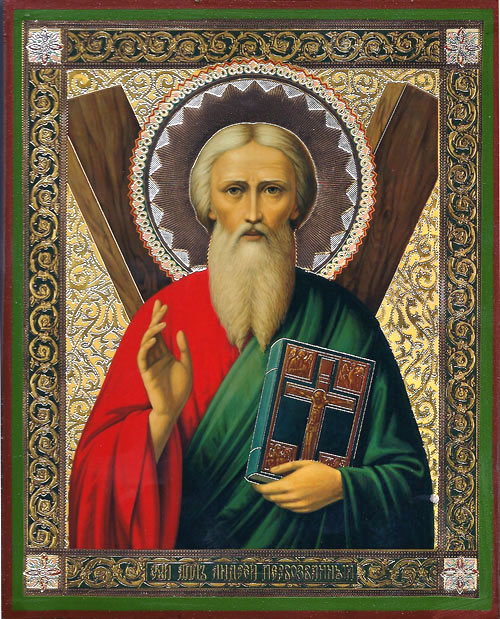
The New Testament tells us that Andrew was the brother of Simon Peter. He was born in the village of Bethsaida on the sea of Galilee. Both Andrew and his brother were fishermen by trade, hence the tradition that Jesus called them to be his disciples by saying that he would make them “fishers of men”.
In the Gospel of Matthew (Matt 4:18=22) and in the Gospel of Mark (Mark 1:16=20), Simon Peter and Andrew were both called together to become disciples of Jesus and “fishers of men”. These narratives record for us that Jesus was walking along the shore of the sea of Galilee, saw Simon Peter and Andrew fishing, and called them to discipleship.
However, in parallel in this incident in the Gospel of Luke (Luke 5:1=11) Andrew is actually not named, and nor is there any mention of Simon Peter having a brother. In this, Jesus used a boat described as belonging to Simon, as a preaching platform for preaching to the multitudes on the shore, and then after as a way of achieving a huge catch of fish on a night which had hitherto proved to be fruitless. There is an indication that Simon was not the only fisherman present (they signalled to their partners in the other boat (Luke 5:7) but it is not until the next chapter that Andrew is named as Simon’s brother (Luke 6:14). Although it is generally understood that both Andrew and Simon were fishing on that night.
In contrast however, the Gospel of John (John 1:35=42) states that Andrew was original a disciple of John the Baptist before being led to follow Jesus.
Andrew is referred to in the Gospels as being present on some important occasions as one of the closest of Jesus’s disciples. Andrew told Jesus about the boy with the loaves and fishes (John 6:8), and when Philip wanted to tell Jesus about certain Greeks that were seeking him, he informed Andrew first (John 12:20=22). Andrew was also present at the last supper.
Andrew is said to have been martyred by crucifixion at the city of Patras in Achaea, on the northern coast of the Peloponnese. Early texts such as the Acts of Andrew known to Gregory of Tours, tell us Andrew was tied not nailed to a cross of the type on which Jesus is said to have been crucified, yet a tradition emerged that Andrew was crucified on a Crux decussata (an x=shaped cross), now commonly known as a St. Andrew’s cross. They say this was at his own request, as he deemed himself to be unworthy to be crucified on the same type as on which Jesus died.
Andrew is the patron saint of several countries and cities including : Barbados, Romania, Russia, Scotland, Ukraine, Amalfi in Italy, Esgueira in Portugal, Luga in Malta, Paranaque in the Philippines, and Patras in Greece. He was also the patron saint of Prussia and of the Order of the Golden Fleece.
The feast of Andrew is observed on the 30th November in Eastern and Western churches, and it is also the national day of Scotland.
In the traditional liturgical books of the Catholic Church, the feast of St. Andrew is the first feast day in the Proper of Saints.
Feast of All Souls ~ The Rev. Dn., Sister Dollie Wilkinson
Is death the last sleep? No–it is the last and final awakening.
-Sir Walter Scott
“As (Saint) Dominic lay on his deathbed surrounded by his sorrowful brethren, he consoled them saying, “Do not weep. I will be of more use to you in Heaven.” Dominic’s words offered deep hope, extending beyond his death to the death of each member of the Order. “
We all have lost loved ones, some so early in their life, others who had been with us for a good long while. But for those left behind, the sense of loss can be almost too much to bear. Yet we know in our hearts that we shall see our loved ones again, that we will all be reunited with each other—in our heavenly Father’s kingdom. So until that time, we remember them with love, and offer up prayers for their soul.
Today, November 2nd, we celebrate the Feast of All Souls. On the day after All Saints, the Church reminds us of those who have not yet achieved the goal of their pilgrimage, the Kingdom of Heaven. As part of the communion of saints, they need our prayers. Today’s feast is an opportunity for us to pray in unity for our relatives and friends and for those who have no one to pray for them. All Soul’s Day (sometimes called the “Day of the Dead”) is always November 2 (November 3rd if the 2nd falls on a Sunday).
All Soul’s Day is a Roman Catholic day of remembrance for friends and loved ones who have passed away. This comes from the ancient Pagan Festival of the Dead, which celebrated the Pagan belief that the souls of the dead would return for a meal with the family. Candles in the window would guide the souls back home, and another place was set at the table. Children would come through the village, asking for food to be offered symbolically to the dead, then donated to feed the hungry.
The day purposely follows All Saint’s Day in order to shift the focus from those in heaven to those in purgatory. It is celebrated with Masses and festivities in honor of the dead. While the Feast of All Saints is a day to remember the glories of Heaven and those there, the Feast of All Souls reminds us of our obligations to live holy lives and that there will be purification of the souls of those destined for Heaven.
Upon death, it is believed that souls have not yet been cleansed of sin. Praying for souls of loved ones helps to remove the stain of sin, and allow the souls to enter the pearly gates of heaven. Through prayer and good works, living members of the church may help their departed friends and family. There are three Requiem Masses that are said by the clergy to assist the souls from Purgatory to Heaven: one for the celebrant, one for the departed, and one for the pope. One such reading for the Mass is included in the Book of Wisdom:
“The souls of the just are in the hand of God
and no torment shall touch them.
They seemed, in the view of the foolish, to be dead;
and their passing away was thought an affliction
and their going forth from us, utter destruction.
But they are in peace.
For if before men, indeed, they be punished,
yet is their hope full of immortality;
chastised a little, they shall be greatly blessed,
because God tried them
and found them worthy of himself.
As gold in the furnace, he proved them,
and as sacrificial offerings he took them to himself.
In the time of their visitation they shall shine,
and shall dart about as sparks through stubble;
they shall judge nations and rule over peoples,
and the Lord shall be their King forever.
Those who trust in him shall understand truth,
and the faithful shall abide with him in love:
because grace and mercy are with his holy ones,
and his care is with his elect.”
The traditions of the Feast of All Souls began independently of the Feast of All Saints. The Feast of All Souls owes its beginning to seventh century monks who decided to offer the mass on the day after Pentecost for their deceased community members. In the late tenth century, the Benedictine monastery in Cluny chose to move their Mass for their dead to November 2, the day after the Feast of all Saints. This custom spread and in the thirteenth century, Rome put the feast on the calendar of the entire Church. The date remained November 2 so that all in the Communion of the Saints might be celebrated together.
Other customs have arisen over time in the celebration of All Souls Day. The Dominicans in the 15th century instituted a custom of each priest offering three Masses on the Feast of All Souls. Pope Benedict XIV in 1748 approved this practice, and it rapidly spread throughout Spain, Portugal and Latin America. During World War I, Pope Benedict XV, recognizing the number of war dead and the numerous Masses that could not be fulfilled because of destroyed Churches, granted all priests the privilege of offering three Masses on All Souls Day: one for the particular intention, one for all of the faithful departed, and one for the intentions of the Holy Father.
Many more customs are associated with The Days of the Dead celebration. In the home an altar is made with an offering of food upon it. It is believed that the dead partake of the food in spirit and the living eat it later. The offerings are beautifully arranged with flowers such as marigolds, which are the traditional flower of the dead. There is a candle placed for each dead soul, and they are adorned in some manner. Incense is also often used, and mementos, photos, and other remembrances of the dead also adorn the offerings. Traditional Catholics still honor customs related to the relief of the souls suffering in purgatory. One custom is for persons to pray six Our Fathers, Hail Mary’s and Glory Be’s for the intentions of the Pope in a church, and thereby, receive a plenary indulgence for a soul in purgatory. This action may be repeated for another soul, by leaving the church and re-entering it to repeat the prayers.
All Soul’s Day lives on today, particularly in Mexico, where All Hallows’ Eve, All Saint’s Day and All Soul’s Day are collectively observed as “Los Dias de los Muertos” (The Days of the Dead). First and foremost, the Days of the Dead is a time when families fondly remember the deceased. But it is also a time marked by festivities, including spectacular parades of skeletons and ghouls. In one notable tradition, revelers lead a mock funeral procession with a live person inside a coffin.
As we all know, death is never final. We will be reunited with our loved ones. And for those in purgatory, let us pray for their souls to be cleansed, so we shall all live again in our Father’s house.
A prayer for all our departed brothers and sisters:
Merciful Father,
hear our prayer
and console us.
As we renew
our faith in Your Son,
whom You raised from the dead,
strengthen our hope
that all our departed brothers and sisters
will share in His resurrection,
who lives and reigns
with You and the Holy Spirit,
one God, for ever and ever.
Amen
Invocation for the Souls in Purgatory:
My God,
bestow Thy blessings and Thy mercies
on all persons
and on those souls in Purgatory,
for whom I am in charity, gratitude, or friendship bound
and have the desire to pray.
Amen

All Saints Day
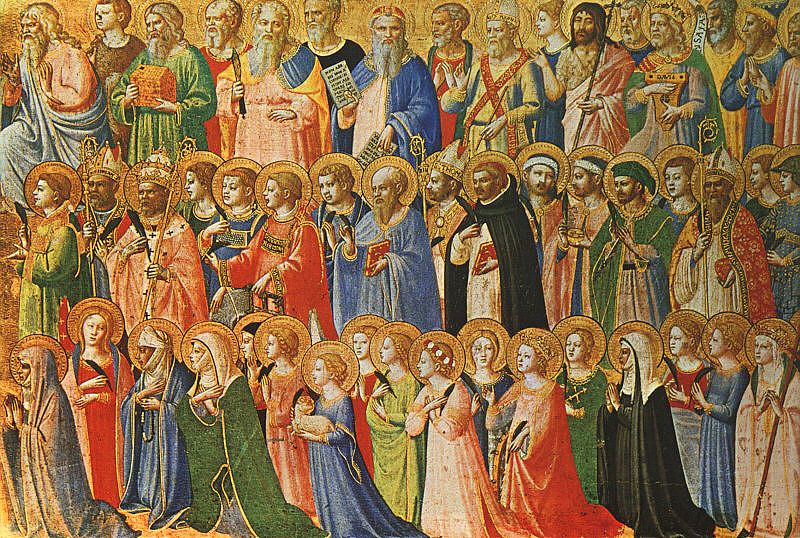
All Saints’ Day, All Hallows Day, or Hallowmas is solemnly celebrated on 1 November by many Western Liturgical Churches to honor, literally, all the saints, known and unknown; those individuals who have attained Heaven.
The saints are all the Holy men and women who have lived their lives for God and for his church, who now have attained Beatific vision and their reward of Heaven. In early Christian history it was usual to solemnize the anniversary of a Martyrs death for the Lord at the place of their martyrdom. Frequently there were multiple martyrs who would’ve suffered and died on the same day which led to multiple commemorations on the same day. Eventually,the numbers of martyrs became so great that it was impossible for a separate day to be assigned to each individually, but the church feeling that every martyr should be venerated, appointed a feast day to commemorate them all on the same day. At first, only Martyrs and St.John the Baptist were honoured with a special day but after a regular canonization had been established other saints were gradually also added and then were increased in number.
From Wikipedia: The origin of the festival of All Saints celebrated in the West dates to the month of May in the year 609 or 610, when Pope Boniface IV consecrated the Pantheon at Rome to the Blessed Virgin and all the martyrs. In the 730’s Pope Gregory III moved the Feast of All Saints to 1 November when he founded an oratory in St. Peter’s for the relics of the holy apostles and of all saints, martyrs and confessors, of all the just made perfect who are at rest throughout the world.”
Revelation 7:2-4, 9-14
I, John, saw another angel come up from the East, holding the seal of the living God. He cried out in a loud voice to the four angels who were given power to damage the land and the sea, “Do not damage the land or the sea or the trees
until we put the seal on the foreheads of the servants of our God.” I heard the number of those who had been marked with the seal, one hundred and forty-four thousand marked from every tribe of the children of Israel.
After this I had a vision of a great multitude, which no one could count, from every nation, race, people, and tongue. They stood before the throne and before the Lamb, wearing white robes and holding palm branches in their hands.
They cried out in a loud voice: “Salvation comes from our God, who is seated on the throne, and from the Lamb.”
All the angels stood around the throne and around the elders and the four living creatures. They prostrated themselves before the throne, worshiped God, and exclaimed:
“Amen. Blessing and glory, wisdom and thanksgiving, honor, power, and might be to our God forever and ever. Amen.”
Then one of the elders spoke up and said to me, “Who are these wearing white robes, and where did they come from?” I said to him, “My lord, you are the one who knows.” He said to me, “These are the ones who have survived the time of great
distress; they have washed their robes and made them white in the Blood of the Lamb.”
From the Book of Common Prayer, p. 194:
The Collect for All Saints’ Day
O Almighty God, who hast knit together thine elect in one communion and fellowship in the mystical body of they Son Christ our Lord: Grant us grace so to follow thy blessed saints in all virtuous and godly living, that we may come to those ineffable joys which thou has prepared for those who unfeigned love thee; through the same Jesus Christ our Lord, who with thee and the Holy Spirit liveth and reigneth, one God, in glory everlasting, Amen.
Hymn: For All the Saints
Text: William W. How, 1823-1897
Music: Ralph Vaughan Williams, 1872-1958
For all the saints, who from their labors rest,who thee by faith before the world confessed,thy name, O Jesus, be forever blest.Alleluia, Alleluia! Thou wast their rock, their fortress, and their might;thou Lord, their captain in the well-fought fight;thou in the darkness drear, their one true light.Alleluia, Alleluia! O may thy soldiers, faithful, true, and bold,fight as the saints who nobly fought of old,and win with them the victor’s crown of gold.Alleluia, Alleluia! O blest communion, fellowship divine!We feebly struggle, they in glory shine;yet all are one in thee, for all are thine.Alleluia, Alleluia! And when the strife is fierce, the warfare long,steals on the ear the distant triumph song,and hearts are brave again, and arms are strong.Alleluia, Alleluia! From earth’s wide bounds, from ocean’s farthest coast,through gates of pearl streams in the countless host,singing to Father, Son, and Holy Ghost:Alleluia, Alleluia!
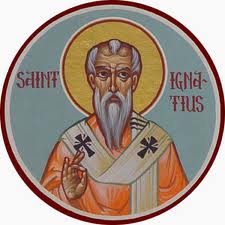
What’s Next? – St. Ignatius of Antioch ~ Br. Chip Noon, Novice

Many religions seek to answer the question of what becomes of us when we die. Many try to reconcile the inevitability of death with our fear of it. Many attempt to create a life beyond this one, at least to give us a hope that this world is not all there is.
As Christians we believe that God became man to teach us directly that there is indeed life after death and that as long as we acquit ourselves well in this life we shall attain that afterlife.
St. Ignatius of Antioch, one of the earliest church bishops, appointed by St. Peter himself, tried to teach us that the message of Jesus was much more than just saying there is life after death and that we can see God. He taught us to long for that time, to put aside all fears as not worthy of our calling after Jesus, and to eagerly seek whatever end we are destined for.
What a confusing time he lived in! Some of the twelve apostles were still alive, yet there was already dissention, schism, opportunism, false teachings. Not fifty years after the resurrection of our Savior, people abounded who used his Gospel as a means of dividing others, enriching themselves, and attaining as much power and prestige for themselves as they could achieve. Is this the real message of the early church fathers – that times will never change? Maybe. That could be one message we glean from their writings. And from the Gospels, for that matter.
But then comes St. Ignatius, a convert, a student of St. John the Apostle, and obviously a brilliant and devout Christian. What does he tell us?
There is one Physician who is possessed both of flesh and spirit; both made and not made; God existing in flesh; true life in death; both of Mary and of God; first passible and then impassible—even Jesus Christ our Lord.
He says that Jesus is God existing in the flesh. This is one of the first post apostolic writings that proclaims that Jesus is God, both man and spirit. And if this is so, then the prophets proclaiming that there is life after death must be correct. And he stressed that the Eucharist is the medicine of immortality. Therefore, we must partake of the Eucharist.
Then he says
Take care to do all things in harmony with God, with the bishop presiding in the place of God, and with the presbyters in the place of the council of the apostles, and with the deacons, who are most dear to me, entrusted with the business of Jesus Christ, who was with the Father from the beginning and is at last made manifest.
So if Jesus is God and vouchsafed his spirit and teachings upon us, we must also listen to him when he proclaims the Apostles and indicates an hierarchy within the church. So Ignatius is trying to secure those teachings and insure that the truth, the teachings of Jesus, are handed on. “Be not seduced by strange doctrines nor by antiquated fables, which are profitless.” He is trying to build up the authority of the local bishop, one bishop per city or diocese. This in order, again, to preserve correct teachings.
Then he says
I am writing to all the Churches and I enjoin all, that I am dying willingly for God’s sake, if only you do not prevent it. I beg you, do not do me an untimely kindness. Allow me to be eaten by the beasts, which are my way of reaching to God. I am God’s wheat, and I am to be ground by the teeth of wild beasts, so that I may become the pure bread of Christ.
And this all leads to a feeling of joy at death since we will see Jesus, God, the Holy Spirit and live forever. St. Ignatius not only believed this, he lived it. The hardships of his journey to face death in Rome were borne with grace…he even attempts to comfort his captors.
So in today’s reading from Romans, Paul is saying that it is not the law that will lead us to “inherit the world,” but faith, the gift from God. And in the Gospel, Jesus says, “When they take you before synagogues and before rulers and authorities, do not worry about how or what your defense will be or about what you are to say. For the Holy Spirit will teach you at that moment what you should say.” Faith.
So isn’t that all the message of St. Ignatius? That it does not matter what will happen to us, nor that we should concern ourselves with how we will comport ourselves at the end, even if it is a violent one. There is “even Jesus Christ our Lord” who will be leading us onward. St. Ignatius is showing us the direct lineage from Jesus to us, from chaos to peace, from fear to faith.
And if we listen to the Gospels and Epistles, we will have all we need to realize this lineage.
Finally, St. Ignatius was responsible for the first known use of the Greek word katholikos, meaning “universal”, “complete”, and “whole” to describe the church. And this concept permeates all his teachings and exhortations. One holy, catholic, and apostolic church. May it ever be so.
Lord, in today’s world there continues to be dissention, schism, opportunism, false teachings. Help us to hear your word and follow the teachings of your son. Let us replace fear with faith and spread that faith to all we meet. Amen.
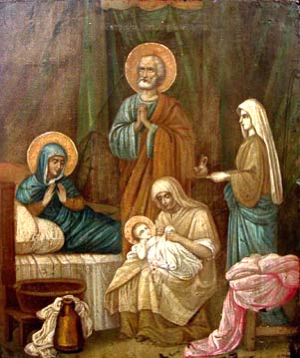
The Birth of the Blessed Virgin Mary~The Rev. Lady Sherwood, OPI
 Today we celebrate the birth of the mother of our Lord and Saviour, the Blessed Virgin Mary.
The earliest known account of Mary’s birth is to be found in the protoevangelium of James (5:2), an apocryphal text from the late second century, with her parents Saint Anne and Saint Joachim.
Usually in the case of saints, the church commemorates their date of death, but both the births of saint John the Baptist and the feast of the blessed virgin Mary’s birth which we celebrate today, are traditionally celebrated because besides the prophet Jeremiah, (Jer 1:5), these alone were holy in their very birth.
The feast of the birth of Mary, as with the feast of her Assumption, originated in Jerusalem. It actually first began as the feast of the Basilica sancte Maria ubi nata est, which is now named the Basilica of Saint Anne.
The original church which was built in the fifth century, was a Marian basilica erected on a spot that was known as the Shepherd’s pool and this is believed to have been the home of Mary’s parents.
The feast began to be celebrated in Rome towards the latter end of the seventh century and it was first established their when brought there by Eastern monks.
The wine growers in France called this feast “Our Lady of the Grape Harvest”. This is because the best grapes would be brought to the local church, they would be blessed and some of the bunches of these grapes would be attached to the hands of the statue of Mary.
A festival meal which includes these grapes is part of the tradition for this day.
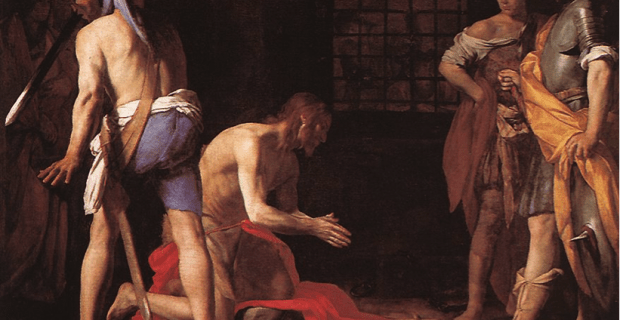
The Beheading of St. John the Baptist ~ The Rev. Lady Sherwood
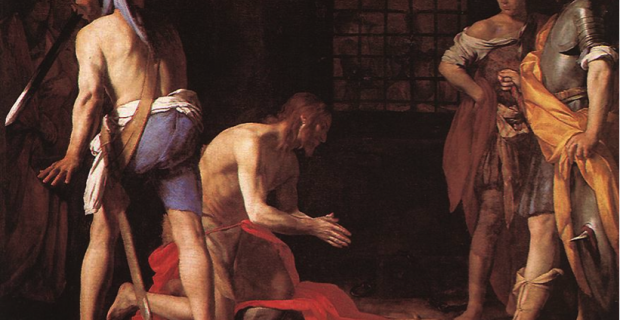
The Beheading of St. John the Baptist is a feast day that commemorates his martyrdom when John was beheaded upon the orders of Herod Antipas through the vengeful request of his step-daughter Salome and her mother Herodias.
Herod was a tetrarch of Galilee under the Roman Empire and he had imprisoned John in 27 AD because John the Baptist had reproved Him for divorcing his wife Phasaelis, and unlawfully taking Herodias, the wife of his brother, Herod Philip I.
On Herod’s birthday, Herodias’s daughter Salome, danced for the King and his guests. Her dancing pleased Herod to such an extent that in his drunkenness, he promised to give her anything for which she asked including up to half of his Kingdom.
When Salome asked her mother Herodias for what she should request, her mother told her to ask for the head of St. John the Baptist to be presented to her on a platter.
Herod was appalled by Salome’s request but as he had promised she could have anything for which she asked, he reluctantly granted her request and he had John executed in prison and delivered to Salome in the manner she had requested.
None of the sources give an exact date for the beheading of John the Baptist, but it is believed to have taken place around 28-29 AD at the fortress of Machaerus.
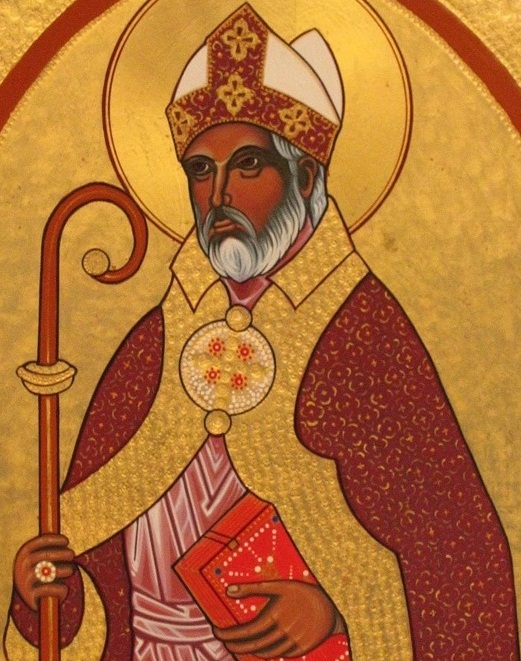
Memorial of Saint Augustine ~ Br. Michael Marshall, Novice
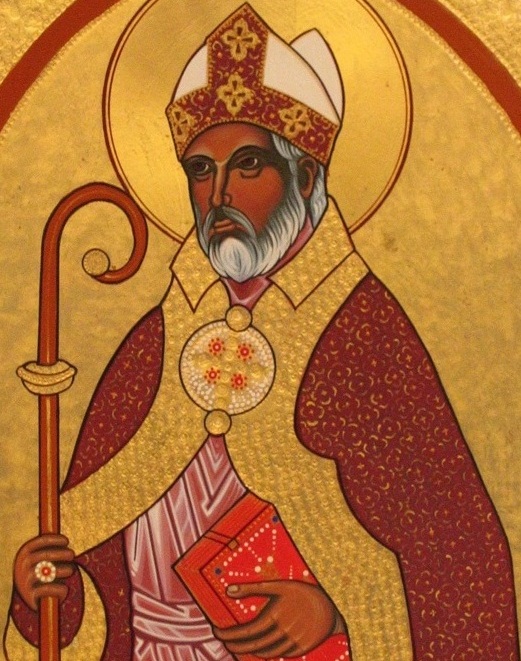
Augustine of Hippo lived from 354 to 430, and was an early Christian theologian and philosopher whose writings influenced the development of Western Christianity and Western philosophy. He was the bishop of Hippo Regius. He is viewed as one of the most important Church Fathers in Western Christianity for his writings in the Patristic Era. Among his most important works are City of God and Confessions. In the Catholic Church and the Anglican Communion, he is a saint, a preeminent Doctor of the Church, and the patron of the Augustinians. His memorial is celebrated on 28 August, the day of his death. He is the patron saint of brewers, printers, theologians, the alleviation of sore eyes, and a number of cities and dioceses. Many Protestants, especially Calvinists, consider him to be one of the theological fathers of the Protestant Reformation due to his teachings on salvation and divine grace.
In the summer of 386, at the age of 31, after having heard and been inspired and moved by the story of Ponticianus’s and his friends’ first reading of the life of Saint Anthony of the Desert, Augustine converted to Christianity. As Augustine later told it, his conversion was prompted by a childlike voice he heard telling him to “take up and read” which he took as a divine command to open the Bible and read the first thing he saw. Augustine read from Paul’s Epistle to the Romans – the so-called “Transformation of Believers” section, consisting of chapters 12 through 15 – wherein Paul outlines how the Gospel transforms believers, and the believers’ resulting behavior.
In 391 Augustine was ordained a priest and became a famous preacher (more than 350 preserved sermons are believed to be authentic), and was noted for combating the Manichaean religion, to which he had formerly adhered.
In 395 he was made coadjutor Bishop of Hippo, and became full Bishop shortly thereafter, hence the name “Augustine of Hippo”; and he gave his property to the church of Thagaste. He remained in that position until his death in 430. He wrote his autobiographical Confessions in 397-398. His work The City of God was written to console his fellow Christians shortly after the Visigoths had sacked Rome in 410. Augustine worked tirelessly in trying to convince the people of Hippo to convert to Christianity. Though he had left his monastery, he continued to lead a monastic life in the episcopal residence. He left a regula for his monastery that led to his designation as the “patron saint of regular clergy.”
Shortly before Augustine’s death the Vandals, a Germanic tribe that had converted to Arianism, invaded Roman Africa. The Vandals besieged Hippo in the spring of 430, when Augustine entered his final illness. According to Possidius, one of the few miracles attributed to Augustine, the healing of an ill man, took place during the siege. According to Possidius, Augustine spent his final days in prayer and repentance, requesting that the penitential Psalms of David be hung on his walls so that he could read them. He directed that the library of the church in Hippo and all the books therein should be carefully preserved. He died on 28 August 430. Shortly after his death, the Vandals lifted the siege of Hippo, but they returned not long thereafter and burned the city. They destroyed all of it but Augustine’s cathedral and library, which they left untouched. Augustine was canonized by popular acclaim, and later recognized as a Doctor of the Church in 1298 by Pope Boniface VIII. His feast day is 28 August, the day on which he died. His prominence as a Doctor of the Church is mostly due to the many topics in which he took a theological stance. Here is a list of key topics: Creation, ecclesiology, eschatology, just war, Mariology, natural knowledge and biblical interpretation, original sin, free will, sacramental theology, and views on sexuality.
1 Thessalonians 4:1-8
Brothers and sisters,
we earnestly ask and exhort you in the Lord Jesus that,
as you received from us
how you should conduct yourselves to please God–
and as you are conducting yourselves–
you do so even more.
For you know what instructions we gave you through the Lord Jesus.
This is the will of God, your holiness:
that you refrain from immorality,
that each of you know how to acquire a wife for himself
in holiness and honor, not in lustful passion
as do the Gentiles who do not know God;
not to take advantage of or exploit a brother or sister in this matter,
for the Lord is an avenger in all these things,
as we told you before and solemnly affirmed.
For God did not call us to impurity but to holiness.
Therefore, whoever disregards this,
disregards not a human being but God,
who also gives his Holy Spirit to you.
Matthew 25:1-13
Jesus told his disciples this parable:
“The Kingdom of heaven will be like ten virgins
who took their lamps and went out to meet the bridegroom.
Five of them were foolish and five were wise.
The foolish ones, when taking their lamps,
brought no oil with them,
but the wise brought flasks of oil with their lamps.
Since the bridegroom was long delayed,
they all became drowsy and fell asleep.
At midnight, there was a cry,
‘Behold, the bridegroom! Come out to meet him!’
Then all those virgins got up and trimmed their lamps.
The foolish ones said to the wise,
‘Give us some of your oil,
for our lamps are going out.’
But the wise ones replied,
‘No, for there may not be enough for us and you.
Go instead to the merchants and buy some for yourselves.’
While they went off to buy it,
the bridegroom came
and those who were ready went into the wedding feast with him.
Then the door was locked.
Afterwards the other virgins came and said,
‘Lord, Lord, open the door for us!’
But he said in reply,
‘Amen, I say to you, I do not know you.’
Therefore, stay awake,
for you know neither the day nor the hour.”
The familiar image of an angel and the devil sitting on a person’s shoulders has been shown in movies and television many times. An angel and the devil have not literally sat on my shoulders, but I can identify with that image. A thought of wanting to do something that may not be the best idea comes to my mind… I think about it, and I hear the devil say to me something like, “Life’s short, do it!” Then look over at the angel which is waving its finger at me and saying, “Oh no! You know better than that!!!” I eventually weigh the consequences of both actions, and 99% of the time I do the right thing because I know what is responsible and right.
The readings for today speak to the subject of responsibility and doing what is right. Paul is instructing the Thessalonians on how to live according to how God intends humanity to live if they truly are to follow the teachings of Jesus. Following Jesus means letting go of any immoral behavior. The parable which Jesus tells is about being responsible enough to take time to be prepared, knowing that negative consequences will result if one is not prepared. This preparedness is about living a life in which one desires to follow God instead of going astray.
We know that God loves us unconditionally, but it is our responsibility to live according to his commandments and teachings given to us through Jesus. We cannot allow the devil sitting on our left shoulder tell us it is okay to do things which we know are not of God. When the angel is saying, “You know better!” we need to listen to the angel.
How do we do the right thing? We do not put ourselves in a position which presents the opportunity for the devil to convince us that it is okay to do something; we spend time around positive and responsible people, we take time to read Scripture, we pray, we recognize our vices in life and stay away from them. Are you doing the right thing?
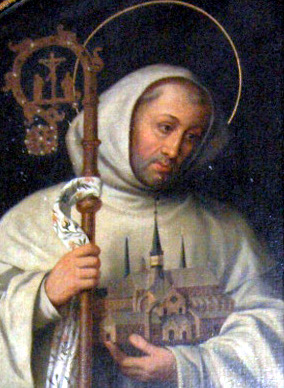
St. Bernard of Clairvaux ~ Br. Michael Marshall, Novice
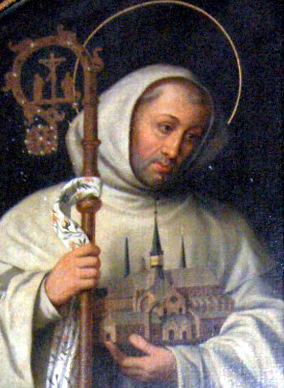
Memorial of Saint Bernard, Doctor of the Church – August 20th
Saint Bernard was born in 1090. Early in life, he studied Scripture and was well-versed in it. He sought admission into a religious order which we know as the Cistercians today, and eventually established an Abbey in Clairvaux. The abbey struggled initially but eventually men entered in numbers. Saint Bernard was instrumental in addressing issues between local royalty and Church affairs, by defending the rights of the Church. In 1130, a schism occurred and during that time two popes (Innocent II and Anacletus II) were elected; and Saint Bernard was selected by King Louis de Gros with consent of the bishops to be a judge of the rivalry between the popes. He was in favor of Innocent II, which caused him to be recognized by all the great Catholic powers, and went to Italy with Innocent II, and later returned to France to further progress of resolution of the conflict which led to the schism. While still in France, another schism took place due to William X, and Saint Bernard was able to resolve this conflict by inviting William to the Mass which he celebrated in the Church of La Couldre. At the moment of the Communion, placing the Sacred Host upon the paten, he went to the door of the church where William was, and pointing to the Host, he adjured the Duke not to despise God as he did His servants. William yielded and the schism ended. Saint Bernard then travelled to Italy to face more tension within the local church, and then finally returned to Clairvaux where he spent time in his cloister to compose many important writings which led him to be declared a Doctor of the Church. Because of conflict and turmoil in the East, Saint Bernard was sent to preach a new Crusade which failed. Bernard died in the sixty-third year of his age, after forty years spent in the cloister. He founded one hundred and sixty-three monasteries in different parts of Europe; at his death they numbered three hundred and forty-three. He was the first Cistercian monk placed on the calendar of saints and was canonized by Alexander III, 18 January 1174. Pope Pius VIII bestowed on him the title of Doctor of the Church. The Cistercians honor him as only the founders of orders are honored, because of the wonderful and widespread activity which he gave to the Order of Citeux.
Matthew 22:1-14
Jesus again in reply spoke to the chief priests and the elders of the people in parables saying, “The Kingdom of heaven may be likened to a king who gave a wedding feast for his son. He dispatched his servants to summon the invited guests to the feast, but they refused to come. A second time he sent other servants, saying, ‘Tell those invited: “Behold, I have prepared my banquet, my calves and fattened cattle are killed, and everything is ready; come to the feast.”’ Some ignored the invitation and went away, one to his farm, another to his business. The rest laid hold of his servants, mistreated them, and killed them. The king was enraged and sent his troops, destroyed those murderers, and burned their city. Then the king said to his servants, ‘The feast is ready, but those who were invited were not worthy to come. Go out, therefore, into the main roads and invite to the feast whomever you find.’ The servants went out into the streets and gathered all they found, bad and good alike, and the hall was filled with guests. But when the king came in to meet the guests he saw a man there not dressed in a wedding garment. He said to him, ‘My friend, how is it that you came in here without a wedding garment?’ But he was reduced to silence. Then the king said to his attendants, ‘Bind his hands and feet, and cast him into the darkness outside, where there will be wailing and grinding of teeth.’ Many are invited, but few are chosen.”.
This Gospel reading is a very challenging one to digest. The parable which Jesus is presenting to the people is about preparedness for entering the Kingdom of Heaven. I would say that the majority of Christians approach this from the viewpoint of what is considered moral versus what is considered as immoral. But I will not go down that path. In the parable, Jesus is using the King to represent God, and that God has invited humanity to the reward of heaven.
“Some ignored the invitation and went away, one to his farm, another to his business. The rest laid hold of his servants, mistreated them, and killed them. The king was enraged and sent his troops, destroyed those murderers, and burned their city.”
In this passage from the reading, Jesus is trying to explain that God will put people in their place because of their actions which go against what God wants of humanity, as much as they believe they are doing what God wants. The parable goes onto tell that the king has kept the invitation open even though some do not show up, but many do show up. When the person who does not show up fully prepared due to not being appropriately dressed, he is cast out and not allowed into the feast.
I am challenging you to look at the message in a different way other than from the perspective of morality. I am challenging all of us to think about how we treat others; whether we help those in need when possible, or if we just avoid the situation; if we spend time with God in prayer; and if we are self-absorbed. Being prepared pertains to every aspect of our lives. Are we doing what we need to in order to be prepared?
Do we pray? Do we read and study our Bibles. Do we spend time in Christian fellowship? I challenge to you spend a period of time in honest self-reflection, in honest self-evaluation, and then, with all haste, make yourselves prepared for the wedding feast. Amen.
The Feast of St. Martha ~ The Rev. Deacon Dollie Wilkinson, OPI

The Kitchen Prayer
Lord of all pots and pans and things,
Since I’ve not time to be a saint by doing lovely things
or watching late with Thee
Or dreaming in the dawn light or storming Heaven’s gates
Make me a saint by getting meals and
Washing up the plates.
Although I must have Martha’s hands,
I have a Mary mind
And when I black the boots and shoes,
Thy sandals Lord I find.
I think of how they trod the earth what time I scrub the floor.
Accept this meditation Lord,
I haven’t time for more.
Warm all the kitchen with Thy love and light it with Thy peace
Forgive me all my worrying and make my grumbling cease.
Thou who didst love to give men food,
In room or by the sea
Accept this service that I do, I do it unto Thee.
St. Martha
Died 84 A.D
Feast day: July 29
Patron saint of cooks, wait staff, and homemakers
Today, July 29, is the Feast of St. Martha, sister of Mary Magdalene and Lazarus. We find her in the Scriptures three times, twice directly and once indirectly. In the first instance, Martha questions Jesus about her sister, who was sitting listening at the Lord’s feet while Martha was busy preparing the meal.
“Martha was busy about much serving. She stood and said: ‘Lord hast thou no care that my sister hath left me alone to serve? Speak to her therefore, that she help me. And the Lord answering, said to her: ‘Martha, Martha, thou art careful and art troubled about many things. But one thing is necessary. Mary has chosen the best part, which shall not be taken away from her’” (Luke 10:40-42).
Jesus is telling Martha that each person has a role to serve, whether cooking or cleaning, or sitting at the Lord’s feet, listening to His holy word. I can sympathize with Martha. Too many times I’ve grumbled about some chore, or task, that I did not want to do. But the work must be done, and as long as it is always done to the Glory of the Father, then no task or job is too trivial.
We also find her questioning Jesus about the death of her brother, Lazarus, in John 11:20-27, where she comes to a deeper faith in the divinity of Christ. When Lazarus, the brother of Mary and Martha, had died, Jesus came to Bethany. Martha, upon being told that He was approaching, went out to meet Him, while Mary sat still in the house until He sent for her.
“Then said Martha unto Jesus, Lord, if thou hadst been here, my brother had not died. But I know, that even now, whatsoever thou wilt ask of God, God will give it thee.Jesus saith unto her, Thy brother shall rise again. Martha saith unto him, I know that he shall rise again in the resurrection at the last day. Jesus said unto her, I am the resurrection, and the life: he that believeth in me, though he were dead, yet shall he live: And whosoever liveth and believeth in me shall never die. Believest thou this? She saith unto him, Yea, Lord: I believe that thou art the Christ, the Son of God, which should come into the world.”
Here we have Martha doing something that most Christians, even today would hesitate to do – she questioned the actions of Jesus. He patiently reassures her that her brother, Lazarus, will rise again. Again, Martha takes an active role in her wish to understand more, to come to know that Jesus is really the Son of God.
Again, about a week before the crucifixion, as Jesus reclined at the table, Mary poured oil over Jesus’ feet. Mary was criticized for wasting what might have been sold to raise money for the poor, and again Jesus spoke on her behalf. (John 12:1-8)
“Six days before the Passover, Jesus arrived at Bethany, where Lazarus lived, whom Jesus had raised from the dead. Here a dinner was given in Jesus’ honor. Martha served, while Lazarus was among those reclining at the table with him. Then Mary took about a pint of pure nard, an expensive perfume; she poured it on Jesus’ feet and wiped his feet with her hair. And the house was filled with the fragrance of the perfume. But one of his disciples, Judas Iscariot, who was later to betray him, objected, “Why wasn’t this perfume sold and the money given to the poor? It was worth a year’s wages. He did not say this because he cared about the poor but because he was a thief; as keeper of the money bag, he used to help himself to what was put into it. “Leave her alone,”Jesus replied.”[It was intended] that she should save this perfume for the day of my burial. You will always have the poor among you, but you will not always have me.”
By now, I imagine Martha is fed up with seemingly doing all the work, while Mary, her sister, seems to be the favorite of Jesus. I know I would be……but through these bible passages, we learn that everyone who is called to serve, will not do so in the same way. Nothing would get done if this were true. And on the flip side of this, thinking we had to do it all, as Martha must have first thought, would result in a very tired person. We all have roles, or parts, to play in the worship of our Lord. So do your part with gladness, as Mary and Martha did. As we can see on the basis of these incidents, many Christian writers have seen Mary as representing Contemplation (prayer and devotion), and Martha as representing Action (good works, helping others); or love of God and love of neighbor respectively.
 The Order of Preachers, Independent
You must be logged in to post a comment.