
Category: Dominican Saints
Blessed John Licci
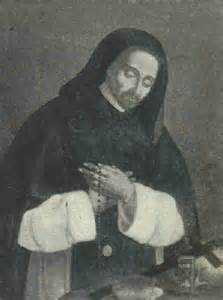
Blessed John Licci, born to a poor farmer, his mother died in childbirth. His life from then on, all 111 years, was a tale of miracles. His father, who fed the baby on crushed pomegranates, had to work the fields, and was forced to leave the infant alone. The baby began crying, and a neighbor woman took him to her home to feed him. She laid the infant on the bed next to her paralyzed husband – and the man was instantly cured. The woman told John’s father of the miracle, but he was more concerned that she was meddling, and had taken his son without his permission. He took the child home to feed him more pomegranate pulp. As soon as the child was removed from the house, the neighbor’s paralysis returned; when John was brought back in, the man was healed. Even John’s father took this as a sign, and allowed the neighbors to care for John.
A precocious and emotional child, John began reciting the Daily Offices before age 10. While on a trip to Palermo, Italy at age 15, John went to Confession in the church of Saint Zita of Lucca where his confession was heard by Blessed Peter Geremia who suggested John consider a religious life. John considered himself unworthy, but Peter pressed the matter, John joined the Dominicans in 1415, and wore the habit for 96 years, the longest period known for anyone.
He founded the convent of Saint Zita in Caccamo, Italy. Lacking money for the construction, John prayed for guidance. During his prayer he had a vision of an angel who told him to “build on the foundations that were already built.” The next day in the nearby woods he found the foundation for a church called “Saint Mary of the Angels,” a church that had been started many years before, but had never been finished. John assumed this was the place indicated, and took over the site.
During the construction, workmen ran out of materials; the next day at dawn a large ox-drawn wagon arrived at the site. The driver unloaded a large quantity of stone, lime and sand – then promptly disappeared, leaving the oxen and wagon behind for the use of the convent. At another point a well got in the way of construction; John blessed it, and it immediately dried up; when construction was finished, he blessed it again, and the water began to flow. When roof beams were cut too short, John would pray over them, and they would stretch. There were days when John had to miraculously multiply bread and wine to feed the workers. Once a young boy came to the construction site to watch his uncle set stones; the boy fell from a wall, and was killed; John prayed over him, and restored him to life and health.
John and two brother Dominicans who were working on the convent were on the road near Caccamo when they were set upon by bandits. One of the thieves tried to stab John with a dagger; the man’s hand withered and became paralyzed. The gang let the brothers go, then decided to ask for their forgiveness. John made the Sign of the Cross at them, and the thief‘s hand was made whole.
One Christmas a nearby farmer offered to pasture the oxen that had come with the disappearing wagon-driver. John declined, saying the oxen had come far to be there, and there they should stay. Thinking he was doing good, the layman took them anyway. When he put them in the field with his own oxen, they promptly disappeared; he later found them at the construction site, contentedly munching dry grass near Father John.
While he did plenty of preaching in his 90+ years in the habit, usually on Christ’s Passion, he was not known as a great homilist. He was known, however, for his miracles and good works. His blessing caused the breadbox of a nearby widow to stay miraculously full, feeding her and her six children. His blessing prevented disease from coming to the cattle of his parishioners. A noted healer, curing at least three people whose heads had been crushed in accidents, he was Provincial of Sicily, and Prior of the abbey on several occasions.
Blessed Peter Cambiano of Ruffia.
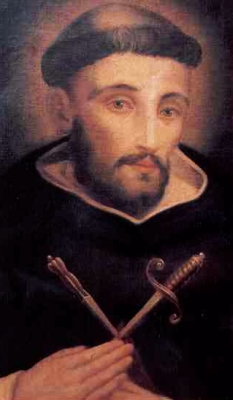
Blessed Peter Cambiano of Ruffia. Peter’s father was a city councilor, his mother was from a noble family, and the boy was raised in a pious household. He received a good education, and was drawn early to religious life, with a personal devotion to Our Lady of the Rosary. He joined the Dominicans in Piedmont, Italy at age 16. He continued his studies, and was ordained at age 25, and was a noted preacher throughout northern Italy. He worked to bring the heretical Waldensians back to the Church, and was appointed inquisitor-general of the Piedmont.
In January 1365 Peter and two Dominican brothers went on a preaching mission through the mountains between Italy and Switzerland, working from the Franciscan friary at Susa, Italy. Peter’s preaching brought many back to the faith, which earned him the anger of the Waldensians. Three of the heretics came to the friary, asked to see Peter, and then murdered him at the gate.
. Blessed Jerome, Valentine, Francis, Hyacinth & Companions (Martyrs of Tonkin)

Blessed Jerome, Valentine, Francis, Hyacinth & Companions (Martyrs of Tonkin) Between the arrival of the first Portuguese missionary in 1533, through the Dominicans and then the Jesuit missions of the 17th century, the politically inspired persecutions of the 19th century, and the Communist-led terrors of the twentieth, there have been many thousands upon thousands murdered for their faith in Vietnam. Some were priests, some nuns or brothers, some lay people; some were foreign missionaries, but most were native Vietnamese killed by their own government and people.
Jerome Hermosilla, a Dominican missionary to Manila, Philippines, and a priest, he went as a missionary to Vietnam in 1828 where he was the Vicar Apostolic of Eastern Tonking, Vietnam and titular bishop of Miletopolis. H was martyred with Saint Valentin Faustino Berri Ochoa.
Valentin Faustinao Berri Ochoa. Born in the Basque country, and ordained on June 14, 1851, Valentin was a missionary to the Philippines and then to Vietnam. He was appointed coadjutor vicar apostolic of Central Tonking, (the modern diocese of Bùi Chu) Vietnam and titular bishop of Centuria on December 25, 1857. He was martyred with Saint Jerome Hermosilla.
Francis Gil de Frederich was educated in Barcelona, Spain where he joined the Dominicans. He was a missionary to the Philippines first and then a missionary to Vietnam in 1732. He spent nine years in prison for his faith during which time he converted fellow prisoners and supervised evangelists on the outside.
Hyacinth Castaneda was a Dominican Priest and missionary to China. He then was sent as a missionary to Vietnam. He was beheaded for his faith in 1773 in Vietnam

Blessed Simon Ballachi

Blessed Simon Ballachi was born to the nobility in 1240, the son of Count Ballachi. His family had a close association with the Church clergy; two of his uncles became archbishops of Rimini, Italy, and a younger brother was a priest. Trained as a soldier and in administration, he was expected to take over the family estates. Against his family wishes, he joined the Dominicans as a lay brother at age 27.
Assigned to work in the garden of his friary, something he knew nothing about but which he loved instantly. He saw God in everything, and prayed constantly as he worked. Noted for his simple life, his strict adherence to the Dominican Rule, and his excellent work as a catechist to children. A visionary, Simon was visited by the devil, by Saint Catherine of Alexandria, Saint Dominic de Guzman, Saint Peter Martyr, and the Blessed Virgin Mary; other brothers saw his cell glowing, and heard angelic voices. Blinded at age 57, he was nearly helpless during the last years of his life; he never despaired, and used the extra free time for prayer. He died on 5 November in 1391.
Martin de Porres
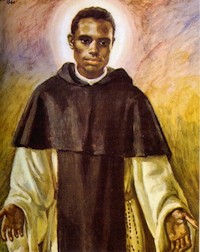
Martin de Porres was born in the city of Lima, in the Viceroyalty of Peru, on December 9, 1579, the illegitimate son of a Spanish nobleman and a black former slave. He grew up in poverty; when his mother could not support him and his sister, Martin was confided to a primary school for two years, and then placed with a barber/surgeon to learn the medical arts. This caused him great joy, though he was only ten years old, for he could exercise charity to his neighbor while earning his living. Already he was spending hours of the night in prayer, a practice that increased rather than diminished as he grew older.
At the age of 15, he asked for admission to the Dominican Convent of the Rosary in Lima and was received first as a servant boy; as his duties grew, he was promoted to almoner. Eventually he felt the call to enter the Dominican Order, and was received as a tertiary. Years later, his piety and miraculous cures led his superiors to drop the racial limits on admission to the friars, and he was made a full Dominican. It is said that when his convent was in debt, he implored them: “I am only a poor mulatto, sell me.” Martin was deeply attached to the Blessed Sacrament, and he was praying in front of it one night when the step of the altar he was kneeling on caught fire. Throughout all the confusion and chaos that followed, he remained where he was, unaware of what was happening around him.
When he was 34, after he had been given the habit of a Coadjutor Brother, Martin was assigned to the infirmary, where he was placed in charge and would remain in service until his death at the age of sixty. His superiors saw in him the virtues necessary to exercise unfailing patience in this difficult role, and he never disappointed them. It was not long before miracles were attributed to him. Saint Martin also cared for the sick outside his convent, often bringing them healing with only a simple glass of water. He begged for alms to procure necessities the Convent could not provide, and Providence always supplied.
One day an aged beggar, covered with ulcers and almost naked, stretched out his hand, and Saint Martin, seeing the Divine Mendicant in him, took him to his own bed. One of his brethren reproved him. Saint Martin replied: “Compassion, my dear Brother, is preferable to cleanliness.”
When an epidemic struck Lima, there were in this single Convent of the Rosary sixty friars who were sick, many of them novices in a distant and locked section of the convent, separated from the professed. Saint Martin is said to have passed through the locked doors to care for them, a phenomenon which was reported in the residence more than once. The professed, too, saw him suddenly beside them without the doors having been opened. Martin continued to transport the sick to the convent until the provincial superior, alarmed by the contagion threatening the religious, forbade him to continue to do so. His sister, who lived in the country, offered her house to lodge those whom the residence of the religious could not hold. One day he found on the street a poor Indian, bleeding to death from a dagger wound, and took him to his own room until he could transport him to his sister’s hospice. The superior, when he heard of this, reprimanded his subject for disobedience. He was extremely edified by his reply: “Forgive my error, and please instruct me, for I did not know that the precept of obedience took precedence over that of charity.” The superior gave him liberty thereafter to follow his inspirations in the exercise of mercy.
Martin would not use any animal as food—he was a vegetarian.
In normal times, Saint Martin succeeded with his alms to feed 160 poor persons every day, and distributed a remarkable sum of money every week to the indigent. To Saint Martin the city of Lima owed a famous residence founded for orphans and abandoned children, where they were formed in piety for a creative Christian life. This lay brother had always wanted to be a missionary, but never left his native city; yet even during his lifetime he was seen elsewhere, in regions as far distant as Africa, China, Algeria and Japan. An African slave who had been in irons said he had known Martin when he came to relieve and console many like himself, telling them of heaven. When later the same slave saw him in Peru, he was very happy to meet him again and asked him if he had had a good voyage; only later did he learn that Saint Martin had never left Lima. A merchant from Lima was in Mexico and fell ill; he said aloud: “Oh, Brother Martin, if only you were here to care for me!” and immediately saw him enter his room. And again, this man did not know until later that he had never been in Mexico.
Martin was a friend of both Saint John de Massias and Saint Rose of Lima. When he died in Lima on November 3, 1639, Martin was known to the entire city. Word of his miracles had made him known as a saint throughout the region. As his body was displayed to allow the people of the city to pay their respects, each person snipped a tiny piece of his habit to keep as a relic. It is said that three habits were taken from the body. His body was then interred in the grounds of the monastery.
Pope Gregory XVI beatified Martin de Porres in 1837. Nearly one hundred and twenty-five years later, Blessed Martin was canonized in Rome by Pope John XXIII on May 6, 1962. His feast day is November 3. He is the Patron Saint of people of mixed race, innkeepers, barbers, public health and more besides.
In iconography, Martin de Porres is often depicted as a young mulatto friar (he was a Dominican brother, not a priest, as evidenced by the black scapular and capuce he wears, while priests of the Dominican order wear all white) with a broom, since he considered all work to be sacred no matter how menial. He is sometimes shown with a dog, a cat and a mouse eating in peace from the same dish.
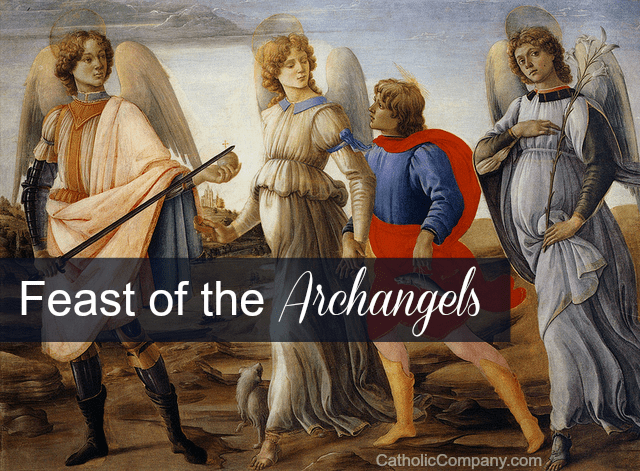
The Feast of the Archangels ~ The Very Rev. Lady Sherwood, OPI
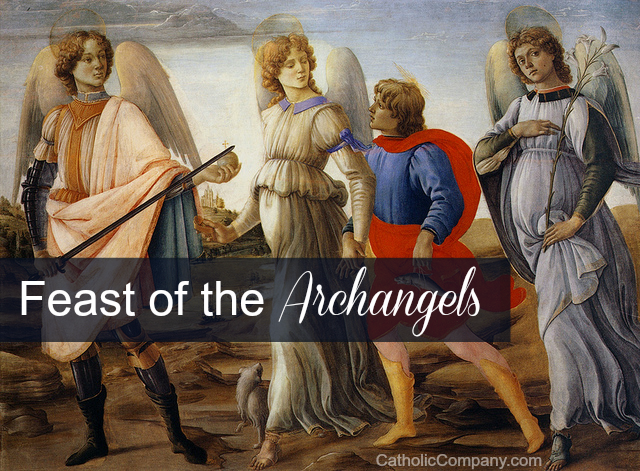
Feast of Sts Michael, Gabriel, and Raphael, Archangels.
R1: DN 7:9-10,13-14
or RV 12:7-12AB
R Psalm: PS 138:1-2AB, 2CDE-3,4-5
Gospel: JN 1: 47-51
Today we gather as a church to honour and commemorate the Feast of the Archangels, Michael, Gabriel and Raphael, the Archangels of God’s Heavenly Hosts. We only know the names of these three, even though there are believed to be seven Archangels if not more. Let us take a look at what we know from the Holy Scriptures about these three Archangels of God. As St. Michael is the Prince of the heavenly hosts, let us begin with him.
St Michael:
His name means “Who is like God”. (This is a rhetorical question, as obviously means nobody is like God as God is the highest there ever was or ever can be).
St. Michael is mentioned by his name in three books of Holy Scripture:
In Daniel, he is described as “one of the chief princes” in the heavenly hierarchy (Dan. 10:13). He is also described to Daniel as “your prince” (Dan. 10:12). The meaning of this phrase is later clarified, and Michael is described as “the great prince who has charge of your people” (Dan. 12:1). He is thus depicted as the guardian angel of Israel. These same passages also refer to Michael doing battle against the spiritual forces at work against Israel.
In Jude 9, Michael is said to have contended with the devil over the body of Moses. On this occasion, we are told, “he did not presume to pronounce a reviling judgment upon him, but said, ‘The Lord rebuke you.’”
In Revelation, Michael and his angels are depicted fighting the devil and casting them out of heaven (Rev. 12:7-8). He is also commonly identified as the angel who binds the devil and seals him in the bottomless pit for a thousand years (Rev. 20:1-3), though the name “Michael” is not given on this occasion.
St. Gabriel:
His name means “God is my warrior” (meaning, essentially, “God is my defender”).
St. Gabriel is mentioned in two books of Holy Scripture:
In Daniel, he is assigned to help Daniel understand the meaning of a vision he has seen (Dan. 8:16). Later, while Daniel is in a prolonged period of prayer, Gabriel comes to him (Dan. 9:21) and gives him the prophecy of “seventy weeks of years” concerning Israel’s future (Dan. 9:24-27).In Luke, he appears to Zechariah the priest and announces the conception and birth of John the Baptist (Luke 1:13-19). Later, he appears to the Virgin Mary and announces the conception and birth of Jesus Christ (Luke 1:26-33).
St. Raphael:
His name means “God heals.”
St. Raphael is mentioned in only book of Scripture: Tobit.
In Tobit, the blind Tobit and the maid Sarah, whose seven husbands have been killed by the demon Asmodeus, pray to God.
The prayer of both was heard in the presence of the glory of the great God. And Raphael was sent to heal the two of them: to scale away the white films of Tobit’s eyes; to give Sarah the daughter of Raguel in marriage to Tobias the son of Tobit, and to bind Asmodeus the evil demon, because Tobias was entitled to possess her (Tob. 3:16-17).
Raphael thus becomes a travelling companion of Tobias, posing as a relative named Azarias son of Ananias (Tob. 5:12). He eventually binds the demon, enabling Tobias to safely marry Sarah, and provides the means for Tobit to be healed of his blindness.
Afterward, he reveals his true identity, saying:
I am Raphael, one of the seven holy angels who present the prayers of the saints and enter into the presence of the glory of the Holy One (Tob. 12:15).
These Archangels serve the will of God by protecting , guarding and healing us at God’s request. God has ensured his children always have the full protection not only of God himself, but also from all the hosts of heaven. Our Father loves and protects his children, only ensuring all is best for them. Let us give our thanks and praise for the wonderful gift of His Archangels, and of all the hosts of heaven to our God and heavenly Father.
Let us end with the prayer of St Michael:
St. Michael the Archangel, defend us in battle.
Be our defense against the wickedness and snares of the Devil.
May God rebuke him, we humbly pray,
and do thou, O Prince of the heavenly hosts,
by the power of God, thrust into hell Satan, and all the evil spirits,
who prowl about the world
seeking the ruin of souls. Amen.
Blessed Lawrence of Ripafratta
One of the outstanding characters in the Dominican reform of the late fourteenth century was Blessed Lawrence of Ripafratta, who was novice-master of several saints and blesseds of our Order.
Lawrence was born in the fortified city of Ripafratta, in 1359. His noble family had the duty of guarding the outer defenses of the city of Pisa against the depredations of its powerful neighbor cities. It was a warlike place and time to come into the world, but Lawrence gave early evidence of being a man of peace. At the age of twenty, after innocent and promising youth, he entered the convent of Saint Catherine, in Pisa. He made rapid progress, both in prayer and in study, and busied himself with the works of the Order for several years before being called upon to help in the reform movement that was headed by Blessed John Dominici.
In 1402, Lawrence was made novice-master in the novitiate of the reformed congregation of Tuscany, in Cortona. Here the novices were to be trained in the primitive rigor of the Order, in an attempt to by-pass the destructive elements of the past half century, which had reduced religious observance to an alarming state of indifference. Plague and schism had taken toll both in numbers and quality of the religious orders, and the remaining houses were living under a relaxed observance of the rule, in a struggle for survival. John Dominici, under the inspiration of Raymond of Capua, felt that the time had come to tighten up the observance once more and return to the first practices of penance and silence. His suggestions were not popular among those who lived in the relaxed convents. The only alternative was to begin again, with a new novitiate, and hope that the idea would take hold gradually and effect internal reform among the other houses.
Excellent novices soon made their appearances at Cortona: Saint Antoninus and Blessed Peter Capucci, and the artist brothers, Fra Angelico and Fra Benedetto. Several others who were to attain fame in the order came under Lawrence’s influence and were shaped by him and to saintly and useful members of the apostolate, not all in the same fashion- Saint Antoninus was to become Archbishop of Florence, Fra Angelico and his brother made San Marco world famous for its art. Blessed Lawrence is, indeed, an interesting study; a severe and exacting man when it came to keeping the rule, a man of broad vision and great resourcefulness in carrying out the work of preaching. He was obviously not at all afraid of talented people going astray if they were allowed to use their talents for God, and he displayed great insight into the development of each of his novices as individuals.
Eventually, Blessed Lawrence was appointed vicar-general of the reformed congregation and moved to the convent of St. Dominic of Pistoia. Here he preached almost continually, and had a reputation for compassion to the poor whom he tended, taught and visited, even in time of plague.
Lawrence of Ripafratta lived to be ninety-eight, and in his old age we have a touching picture of his novices-now men of distinction and authority- coming back to consult him about this or that detail of their work. He wrote often to St. Antoninus, perhaps feeling that being archbishop of Florence was a job with many worries.
Lawrence of Ripafratta died in 1457, and was beatified, after a long history of miracles at his tomb in 1851.
Born: in Ripafratta in 1359
Died: He died at Pistoia in his 98th year in 1457
Beatified: Pope Gregory XVI confirmed his cult in 1851
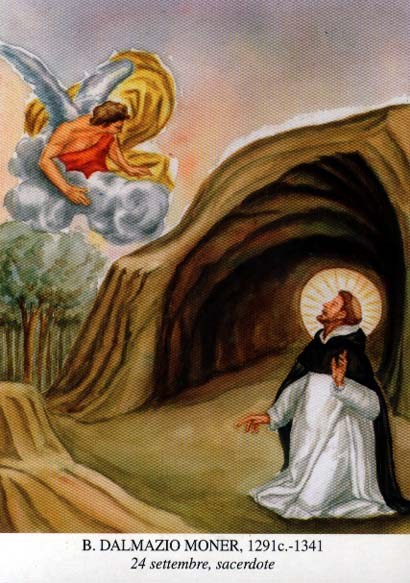
Blessed Dalmatius Moner
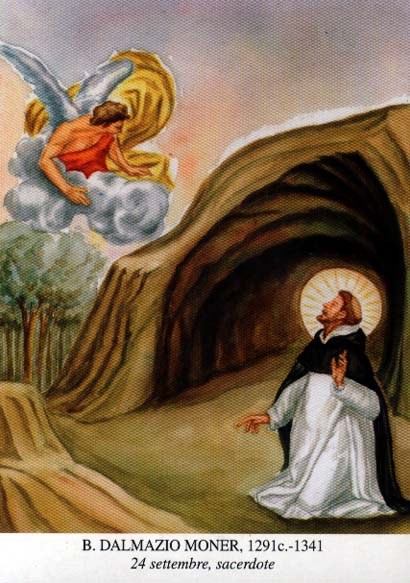
This Dominican Blessed, who was noted particularly for his observance of poverty, lived in the early years of the Order and helped to establish the high reputation of the Spanish religious.
Blessed Dalmatius was born in Aragon, in 1291, and we know nothing else about his life before he entered the Order. He was a member of the province of Aragon and gave a perfect example of strict observance of the rule and the spirit of religious detachment from things of earth. All that we know about him, are a few anecdotes, none of which can be fixed with certainty as to date or place.
We read that his spirit of poverty was so extreme that he never wore a habit or cappa that was not in tatters. He picked up his wardrobe from the cast-offs of his brethren, and, since the spirit of poverty was quite rigid in this providence, the cast-off clothes must have looked a sight. Dalmatius seemed to make a virtue of this, since all the records we have make mention of it. As to food, he never ate fish or eggs, and lived on a diet of hard bread and unseasoned vegetables, to which he added a few ashes during Lent. The beds in the house were hard enough for most people, but not for him. He slept on the bare earth when he could not get into the church to pray and take an occasional nap, his head rested on the altar step.
Dalamtius is credited with several miracles, which included healing and spiritual assistance. At one time, a novice was tempted to leave the Order. Dalmatius, going about it without being told, sought out the novice and solved his difficulties. At another time, a mother whose small child had a serious eye disease came looking for Dalmatius to heal her child. The friar refused, because, he said, this affliction would save her child from serious sin, and that God was waiting till some time in the future to heal him.
During the last forty years of his life, Dalmatius lived in the cave of Saint Mary Magdalene, in the south of France, where he had gone on a pilgrimage of devotion. Here he was favored with numerous ecstasies and great spiritual insight. One time, while he was in the cave, a group of friars from his own province where lost in the woods in a bad storm. They prayed to him to help them, and a young man came with a lantern and guided them home.
Dalmatius died in his own convent in the presence of all the friars and provincials who had gathered for a chapter. He was declared blessed in 1721.
Born: in 1291 near Gerona in Spain
Died: 1341
Beatified: Pope Innocent XIII confirmed his cult in 1721
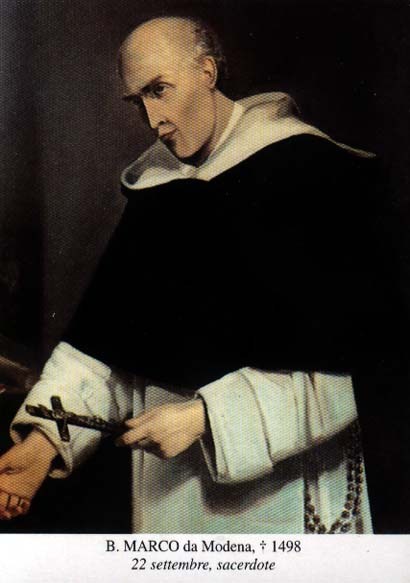
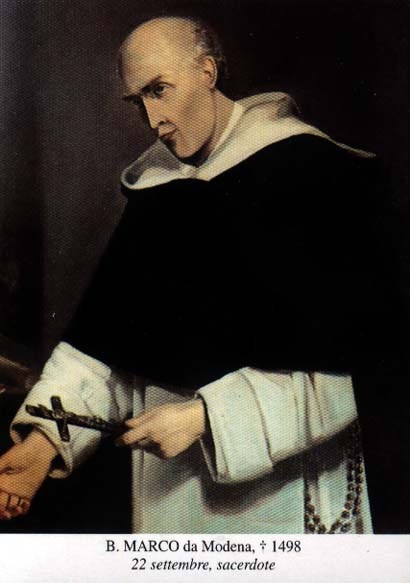
Mark was born in Modena and entered the convent of the order there in young manhood. He observed the rules with great fidelity, and became noted both for his learning and his holiness, which is a sentence that would fit into nearly every Dominican biography written, and tells us nothing in particular about Mark as a person. However, when we recall the times in which he lived , it becomes clearer to us that anyone who kept the Dominican Rule in its entirety is truly to our notice . The abuses which stirred Savonarola to thundering speech in the pulpits of Ferrara and Florence could not have been absent from all of Italy. It look solid virtue to hold out against the opulent worldliness of the times, and Mark of Modena apparently did a thorough job of it, since he has been beatified.
Mark was made prior of the convent of Pesaro, and the only miracle we have on record (he is supposed to have performed many) took place at his convent. A woman’s little boy had died, and she pleaded with Mark to restore the child’s life. After praying for awhile, Mark turned to her and said, “Madam, your little boy is in paradise. Do not try to get him back again, for his second loss will be worse than this one.” However, she insisted on his working the miracle, and he did so. The child returned to life, and, ten years later, covered with disgrace and opprobrium, died a second time, leaving his mother in worse grief than ever.
Mark of Modena died in 1498, the year that the city of Florence burned Savonarola at the stake. It was a time of terrible happenings in Italy and all Europe. The people of Modena mourned the death of Mark, and went to pray at his tomb. Many of their needs were answered there, and a number of prodigies were reported in connection with the translation of his relics to the Rosary chapel of the church. The bells were said to have rung by themselves, and sweet perfume filled the air. Until recently, his relics were still exposed yearly for veneration during the week of Whitsunday.
Born: in Modena at the beginning of the 15th century
Died: in at Pesaro in 1498
Beatified: by Pope Pius IX in 1857
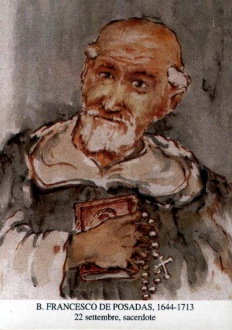
Blessed Francis Posadas
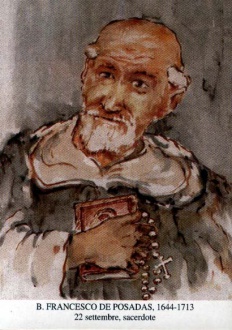
Few Dominicans have had more difficulty getting into the Order than Blessed Francis de Posadas, and he was one of the glories of the convent of the Scala Coeli, in Cordova. It is embarrassing for us to read that the reason for his exclusion was plain and simple snobbery on the part of the superiors of the convent of St. Paul, in Cordova.
Francis was born of a poor young couple who were war refugees, and who had been shunted from place to place until, when Francis was very small, his father’s health failed, and he died in Cordova. The young widow tried several types of work, and finally she was reduced to selling eggs and vegetables at a street stand. She tried to educate her child, for she knew he was very talented, but, without money, it simply was not possible to send him to school. She encourage him to go to the Dominican Church of St. Paul, and he served Mass there every morning from the time he was six or seven years old.
While he was still a very tiny child, he used to gather the other children together for rosary processions or other devotions. The smile of God seemed to rest upon him. For all his poverty, he was a very happy and attractive child, like by everyone; and he was a natural leader among his fellows. Twice during his childhood, he was miracuously saved from death. This fact and his undoubted piety, should have seemed sufficient reason for admitting him into a religious order. However, by the time Francis was old enough, there were two reasons to make his entry difficult: his mother had remarried, and the step-father would not permit him to enter. The Dominicans, moreover, would not have him. They said that they did not want the son of a street peddler.
Francis had friends in the Order, but the prior of the house he wished to enter took a violent dislike to him. It was several years before the young man could overcome the resistance of this man, who, having some influence with the provincial, was stubbornly determined that Francis should not be allowed to enter. Even when the fathers in the convent of Scala offered to take the boy and train him in Latin- so that he could qualify for clerical studies-the vindictive dislike of the prior followed him and almost prevented his acceptance.
Francis was finally accepted, made his novitiate, and gradually overcame all dislike and distrust by his charming manner and his unquestioned talents as student and preacher. After his ordination, he was sent out to preach, and he earned the reputation of being a second St, Vincent Ferrer. His talents as a preacher were rivaled only by his gifts as a confessor. He not only could read hearts and discover sins that had been willfully concealed, but sometimes he was called to one place or another by an interior spirit and shown someone badly in need of the sacraments.
Francis hated the thought of holding authority in the Order. When appointed prior of one of the convents, he remarked that he would much sooner be sentenced to the galleys. He twice refused a bishopric, and he skillfully eluded court honors.
Several remarkable conversions are credited to Francis Posadas. His last tears were a series of miracles wrought in the souls of his penitents. People followed him about to hear him preach, regarding him as a saint and miracle worker. One of his most noted converts was a woman more than one hundred years old- a Moor- with no intention of deserting Mohammedanism.
Francis of Posadas was the author of a number of books which he wrote to assist him in his apostolate. One was a life of St. Dominic. and several were biographies of other saintly people.
After a life filled with miracles, Francis died in 1713. Being forewarned of his death, he made private preparations, but to the last minute he was busy in the confessional before dying suddenly. By the time of his death, not only the Dominicans of Cordova, but the people of all Spain were happy to have him as a fellow countryman. He was beatified a century after his death, in 1818.
Born: Cordona in Spain in 1644
Died: In 1713 of natural causes
Beatified: He was declared Blessed by Pius VII in 1818
 The Order of Preachers, Independent
You must be logged in to post a comment.