
Category: Dominican Saints
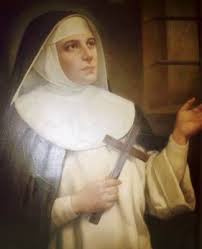
Blessed Hosanna of Catharo
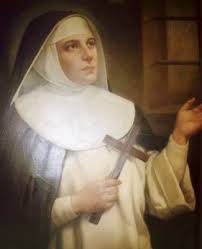
Catherine Kosic (Cosie) was baptized in the Greek Orthodox Church. As a young girl, when tending her family’s sheep; thus, left alone for long periods of time, she developed a habit of contemplative prayer. One day while watching the flocks, she saw a pretty child lying asleep on the grass. Attracted by its beauty, she went to pick up the baby, but it disappeared, leaving Catherine with a feeling of great loneliness.
She told her mother about the incident but received little understanding; her mother told her that God didn’t appear to such poor people, and that the Christ Child was simply a figment of her imagination. After several more apparitions of which she wisely said nothing, Catherine developed a desire to visit Cattaro because there were several churches there in which she felt that she could pray better. Her mother thought this urge was unreasonable, but she finally arranged for Catherine to go to Cattaro as a servant of a wealthy woman. Her mother gave little thought to the fact that the woman was a pious Catholic, but the girl rejoiced in her good luck. At the age of 12, Catherine settled down as a servant to the kindly woman who made no objection to the fact that Catherine’s errands invariably led her past the church, where she would stop for a visit.
After a few years of the pleasant life, Catherine consulted her spiritual director about becoming a recluse. He thought her too young, but she continued to insist. After much prayer and discussion, they decided that she should follow the life of a hermit. In the Middle Ages, it was common for every church or place of pilgrimage to have one or more cells in which solitaries dwelt in prayer and penance. Such a cell was built near the Saint Bartholomew’s in Cattaro. It had a window through which the anchorite could hear Mass and another tiny window to which people would come occasionally to ask for prayers or to give food. Catherine was conducted to her cell in solemn ceremony, and, after making promises of stability, the door was sealed.
In response to a vision, she was later transferred to a cell at the Church of St. Paul, where she followed the rule of the tertiaries of Saint Dominic for 52 years. Upon becoming a Dominican, she chose the name Osanna, in honor of Blessed Osanna of Mantua, a Dominican tertiary who had died in 1505. The life of an anchorite is barren of comforts and replete with penances. Even without the spiritual punishments that she endured, it was a rugged life. Osanna wore the coarsest of clothes, ate almost nothing, and endured the heat and cold and misery of enclosure in a small space for half a century. Her tiny cell, however, was often bright with heavenly visitors. Our Lord appeared to her many times, usually in the form of the beautiful baby she had seen while tending her flocks. Our Lady visited, too, with several of the saints, as well as demons who attempted to distract her from prayer. Once the devil appeared to her in the form of the Blessed Virgin and told her to modify her penances. By obedience to her confessor, she managed to penetrate this clever disguise and vanquish her enemy.
Although she lived alone, there was nothing selfish about Osanna’s spirituality. A group of her Dominican sisters, who considered her their leader, consulted her frequently and sought her prayers. A convent of sisters founded at Cattaro regarded her as their foundress, because of her prayers, although she never saw the place. When the city was attacked by the Turks, the people ran to her for help, and they credited their deliverance to her prayers. Another time, her prayers saved them from the plague.
Born: 1493 at Kumano, Montenegro as Catherine Cosie
Died: 1565 of natural causes
Beatified: 1928 (cultus confirmed); 1934 (beautified)
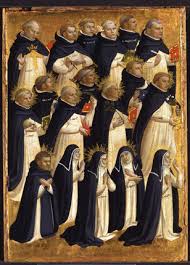
Blessed Gregory & Blessed Dominic
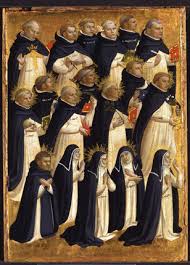
Very little is known about these two Dominican preachers. Their legend tells us that they evangelized the mountainous Somontano region of Moorish Spain near Barbastro, Aragon. One day they were caught in a storm as they traveled from one village to another. The storm loosed the rocks of the cave in which they had sought shelter and they were buried in a landslide. The bells of Perarúa rang out of their own accord, indicating that something remarkable was afoot, and villagers, who ventured out after the storm, found the cave surrounded by lights and angelic music. Digging into the rubble, they found the two Dominicans crushed to death. Miracles surrounded their burials and their tombs at Besians in the diocese of Barbastro, where pilgrims came to pray, especially against the danger from storms. Formerly on Rogation days, and in times of drought, their relics were carried in procession.
Born: 11th Century
Died: Martyred about 1300
Beatified: Pius IX approved their cult in 1854
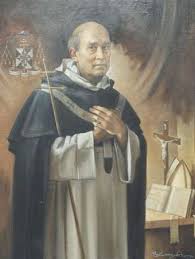
Blessed Bartholomew Cerveri
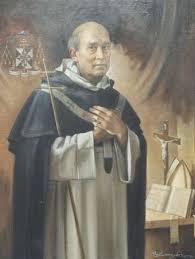
Carrying on the glorious tradition of death in the cause of truth. Blessed Bartholomew of Cerveri was the fourth Dominican inquisitor to win his crown in Piedmont, in the stronghold of thee Catharists, who had taken the lives of Peter of Verona, Peter of Ruffia, and Anthony of Pavonio.
Bartholomew was born at Savigliano, in 1420 , and, even in his early years, displayed precocious solemnity and piety. He entered the Order in the convent of his native town, and progressed rapidly in his studies. on May 8th , 1452, he distinguished he himself by obtaining the licentiate, the doctorate and master’s degree from the capital university of Turin; the only time in the history of the university that anyone had acquired three degrees in one day.
Bartholomew taught for a year at the university, and then he was made prior of the convent at Savigilano. In his short apostolate of 12 years, he converted many heretics and worked steadfastly to eradicate heresy. He was appointed inquisitor in Piedmont, which made it clear to him that a martyr’s death was marked out for him. Being a Dominican in Lombardy was a dangerous business, at best; too be appointed inquisitor meant the heretics were given a target for their hatred.
In many ways the murder of Bartholomew and his companions repeats the martyrdom of Peter of Verona. Bartholomew knew beforehand that he was to die, and he made a general confession before starting out on his last trip. He remarked to his confessor, “They will call me , Bartholomew of Cerverio, though I have never set foot there. Today I go there as a inquisitor and there I must die.” On the road entering Cerverio, he and his party were attacked by five heretics. His companions were wounded, but escaped. Bartholomew died, riddled with dagger wounds, before they could get help.
Some people of Savigliano saw a bright light in the sky over Cerverio and surmised what had happened. They went out and brought home the relics, marveling back, despite all the wounds, the martyr had not bled. Laying him down in the church of the Dominicans, they saw his wounds bleed, and the hastily rescued the blood for relics. He was buried n a Dominican Church of Savigliano, and , later, when the church was ruined by revolution, the relics were moved to the parish church.
A chapel was built at the sight of the martyrdom and richly decorated with narrative frescoes. Processions were made there several times a year by the people of Savigliano and Cerverio, invoking Bartholomew against thunder and hail especially. At The same place a fig tree was honored for many years for its connection with Capital Blessed Bartholomew; it was supposed to have sprung up at the time of the martyrdom, at the very place the martyr fell.
Born: 1420
Died: Martyred in 1466
Beatified: Pope Pius IX beatified Bartholomew of Cerverio in 1853
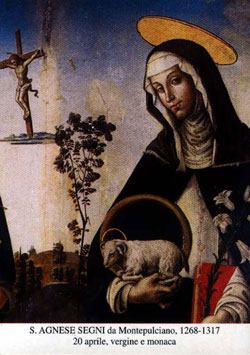
Saint Agnes of Montepulciano
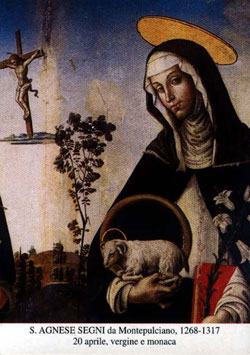
Agnes was not a child martyr like her Roman patroness but she exhibited the same simplicity, and some of her best-known legends concern her childhood. Her birth into the wealthy de Segni family was announced by great lights surrounding the house where she was born. From her infancy she was especially marked for dedication to God: she would spend hours reciting Pater Nosters and Ave Marias on her knees in the corner of some room.
By the time Agnes was six, she was already urging her parents to let her enter the convent. When they assured her that she was much too young, she begged them to move to nearby Montepulciano, so she could make frequent visits to the convent. Because of the local political instability, her father was unwilling to move from his safe haven but did allow his little girl to visit with the sisters occasionally.
On one of these visits an event occurred that all the chroniclers record as being prophetic. Little Agnes was traveling in Montepulciano with her mother and the women of the household, and, as they passed a hill on which stood a bordello, a flock of crows swooped down and attacked the girl. Screaming and plunging, they managed to scratch and frighten her badly before the women drove them away. Upset by the incident, but devoutly sure of themselves, the women said that the birds must have been devils, and that they resented the purity and goodness of little Agnes, who would one day drive them from that hilltop. Agnes did, in fact, build a convent there in later years.
When she was nine, Agnes insisted that the time had come to enter the convent del Sacco. She was allowed to go to a group of Franciscans in Montepulciano, whose dress was the ultimate in primitive simplicity: they were known, from the cut of the garment, as the Sacchine or ‘sisters of the sack.’ The high-born daughter of the Segni was not at all appalled at the crude simplicity with which they followed their Father Francis; she rejoiced in it. Her religious formation was entrusted to an experienced older sister named Margaret, and Agnes soon edified the whole house by her exceptional progress. For five years she enjoyed the only complete peace she would ever have; she was appointed bursar at the age of 14, and she never again was without some responsibility to others.
During this time Agnes reached a high degree of contemplative prayer and was favored with many visions. One of the loveliest is the one for which her legend is best known: the occasion of a visit from the Blessed Virgin. Our Lady came with the Holy Infant in her arms, and allowed Agnes to hold Him and caress Him. Unwilling to let Him go, Agnes hung on when Our Lady reached to take Him back. When she awakened from the ecstasy, Our Lady and her Holy Child were gone, but Agnes was still clutching tightly the little gold cross He had worn on a chain about His neck. She kept it as a precious treasure.
Another time, Our Lady gave her three small stones and told her that she should use them to build a convent some day. Agnes was not at the moment even thinking about going elsewhere, and said so, but Our Lady told her to keep the stones–three, in honor of the Blessed Trinity–and one day she would need them.
Some time after this, a new Franciscan convent opened in Procena, near Orvieto, and the sisters there asked the ones of Montepulciano to send them a mother superior. Sister Margaret was selected, but stipulated that Agnes must be allowed to come to help her in the foundation of the new community. There Agnes served as housekeeper–a highly responsible position for a 14-year-old! Soon many other girls joined the convent at Procena simply became they knew that Agnes was there.
To the distress of young Agnes, she was elected abbess. Since she was only 15, a special dispensation was needed–and provided by Pope Nicholas IV–to allow her to take the office. On the day when she was consecrated abbess, great showers of tiny white crosses fluttered down on the chapel and the people in it. It seemed to show the favor of heaven on this somewhat extraordinary situation.
For 20 years, Agnes lived in Procena, happy in her retreat and privileged to penetrate the secrets of God in her prayer. She was a careful superior, as well as a mystic; several times she worked miracles to increase the house food supply when it was low. The nun’s self-discipline was legendary. She lived on bread and water for fifteen years. She slept on the floor with a stone for a pillow. It is said that in her visions angels gave her Holy Communion.
Once her visions of Christ, the Blessed Virgin, and angels had become known, the citizens of Montepulciano called her back for a short stay. She went willingly enough, though she hated leaving the peace of her cloister for the confusion of traveling. She had just settled down, on her return, with the hope that she had made her last move and could now stay where she was, when obedience again called her back to Montepulciano–this time to build a new convent. A revelation had told her that she was to leave the Franciscans, among whom she had been very happy, and that she and her future sisters should become Dominicans.
In 1306, Agnes returned to Montepulciano to put the Lord’s request into action: she was to build a convent on the former site of the brothels. All she had for the building of the convent were the three little stones given her by the Blessed Virgin, and Agnes–who had been bursar and knew something about money–realized that she was going to have to rely heavily on the support of heaven in her building project.
After a long quarrel with the inhabitants of the hilltop she wanted for her foundation, the land was finally secured, and the Servite prior laid the first stone, leaving her to worry about from where the rest of the stones would come. Agnes saw the project to its completion. The church and convent of Santa Maria Novella were ready for dedication in record time, and a growing collection of aspirants pleaded for admittance to the new convent.
Agnes had become convinced that the community must be anchored in an established Rule in order to attain permanence. She explained that the rule was to be Dominican, not Franciscan. All the necessary arrangements were made, she was established as prioress, the Dominicans agreed to provide chaplains and direction, and the new community settled down. They had barely established the regular life when one of the walls of the new building collapsed. It was discovered that the builders had cheated, and that the whole convent was in danger of falling on top of them. Agnes met the new problem with poise. She had many friends in Montepulciano by this time, and they rallied to rebuild the house.
When the convent was once again completed, and had become, as hoped, a dynamo of prayer and penance, Agnes decided to go to Rome on pilgrimage. It is interesting to note that Second Order convents of the 14th century were so flexible in the matter of enclosure. She made the trip to Rome and visited the shrines of the martyrs. The pope was at Avignon, so she did not have the happiness of talking to him. But she returned to Montepulciano full of happiness for having seen the holy places of Rome.
At the age of 49, Agnes’s health began to fail rapidly. She was taken for treatment to the baths at Chianciano–accompanied, as it says in the rule, by ‘two or three sisters’–but the baths did her no good. She did perform a miracle while there, restoring to life a child who had fallen into the baths and drowned.
Agnes returned to Montepulciano to die in the night. When she knew she was dying after a long and painful illness, Agnes told her grieving nuns that they should rejoice, for, she said, “You will discover that I have not abandoned you. You will possess me for ever.” The children of the city wakened and cried out, “Holy Sister Agnes is dead!” She was buried in Montepulciano, where her tomb soon became a place of pilgrimage.
One of the most famous pilgrims to visit her tomb was Saint Catherine of Siena, who went to venerate the saint and also, probably, to visit her niece, Eugenia, who was a nun in the convent there. As she bent over the body of Saint Agnes to kiss the foot, she was amazed to see Agnes raise her foot so that Catherine did not have to stoop so far!
In 1435, her incorrupt body was translated to the Dominican church at Orvieto, where it remains today. Clement VIII approved her office for the use of the order of St. Dominic, and inserted her name in the Roman Martyrology.
Many stories grew up around Agnes.
Her birth was announced by flying lights surrounding her family’s house.
As a child, while walking through a field, she was attacked by a large murder of crows; she announced that they were devils, trying to keep her away from the land; years later, it was the site of her convent.
She was known to levitate up to two feet in the air while praying.
She received Communion from an angel, and had visions of the Virgin Mary.
She held the infant Jesus in one of these visions; when she woke from her trance she found she was holding the small gold crucifix the Christ child had worn.
On the day she was chosen abbess as a teenager, small white crosses showered softly onto her and the congregation.
She could feed the convent with a handful of bread, once she’d prayed over it.
Where she knelt to pray, violets, lilies and roses would suddenly bloom.
While being treated for her terminal illness, she brought a drowned child back from the dead.
At the site of her treatment, a spring welled up that did not help her health, but healed many other people.
Born:1268 at Gracchiano-Vecchio, Tuscany, Italy
Died: at Montepulciano, Tuscany, on April 20, 1317. Legend says that at the moment of her death, all the babies in the region, no matter how young, began to speak of Agnes, her piety, and her passing; miracles reported at her tomb; body incorrupt; relics translated to the Dominican church at Orvieto in 1435
Beatified: 1534
Canonized:1726 by Pope Benedict XIII
Representation: In art, Saint Agnes is a Dominican abbess (white habit, black mantle) with a lamb, lily, and book. She might also be portrayed (1) gazing at the Cross, a lily at her feet, (2) with the Virgin and Child appearing to her; (3) with the sick healed at her tomb (Roeder); (4) with Saint Catherine of Siena; or (5) as patroness of Montepulciano, of which she holds a model in her hand. Tiepolo presents Agnes as one of the saints surrounding the Blessed Virgin in the Jesuit church at Venice, Italy. She is venerated at Montepulciano.
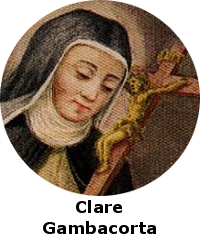
Blessed Clare Gambacorta
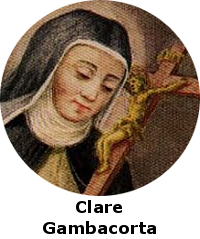
Clare, baptized Victoria, was the only daughter of the pre-eminent family of Pisa, which was in political exile at the time of her birth. When Victoria was seven, the family returned triumphantly to Pisa, and her father, Peter Gambacorta, was installed as chief magistrate of the city, a position full of both glory and uncertainty.
Victoria, a pretty and pious child, used to gather the children together to recite the Rosary. She was both devout and penitential; therefore, she did not relish the marriage her father had arranged for her. Nevertheless, as a dutiful daughter she married and became a dutiful, loving wife. When her young husband died of the plague just three years after their marriage, Victoria was grief-stricken. She did truly love him. But now that she was free, she determined that no one was going to urge her to marry again.
In the first year of her marriage, when she was 13, Victoria had met the famous and saintly Catherine of Siena, who had come to Pisa to talk to Victoria’s father about he league of cities. The saint had advised the lovely young bride to give her heart to God and her husband.
Now that he was dead, Catherine wrote to the 15-year-old widow saying: “Strip yourself of self. Love God with a free and loyal love.” Victoria knew that another marriage was being arranged for her, and before the contract could be concluded she fled to the Poor Clares and took the habit and the religious name Sister Clare.
Her brothers forcibly took her home. They locked her up in a dark little room in her own home. For five months she could neither talk to her friends nor receive the sacraments, but she retained the name Clare, and she wore the Franciscan habit.
The pretty, young prisoner was a daughter of her times, and she managed to get errands done by her friends. One by one, her jewels were sent out and sold, and the money was given to the poor. It was the only active charity she could manage from a prison cell. Finally, on Saint Dominic’s day, when her father and brothers were away, her mother got her out and took her to Mass. It was the first time in months that she had been able to receive Communion.
Shortly thereafter, a Spanish bishop came to visit the family, and Clare’s father asked him to try to talk some sense into the girl. He apparently did not know that the Spaniard had been confessor to Saint Bridget of Sweden, and that he was highly in sympathy with women who wished to dedicate themselves to God. In the end, Clare’s family relented and allowed her to make plans to enter a convent. Her contact with Saint Catherine had convinced her that she could be nothing but a Dominican, so she took refuge with the local community until she could build a convent of her own.
Due to the ravages of plague and schism, many convents, including that of the Dominicans of Pisa, were weak in observance and did not live the common life. Clare wanted a strictly religious form of life, and, within four years, with the help of her stepmother, the new convent was built for her and Blessed Mary Mancini. It was first blessed in 1385, and a strict canonical cloister was imposed upon it, forbidding any man but the bishop and the master general from entering.
Eight years later, this strict enclosure was to cost Sister Clare a terrible loss. Her father was betrayed by a man who had always been his friend, and the volatile public turn against him and killed him in the street outside her convent. One of her brothers also fell in the fight, and a second, wounded, begged to be let into the convent. Clare had to tell him, through the window, that she could not open the door to him. While she watched in horror, he was dragged away and killed.
Some time after this, Sister Clare fell seriously ill and was thought to be dying. She made a curious request: some food from the table of the man who had betrayed and killed her father and brothers. The wife of the guilty man sent a basket of bread and fruit; Sister Clare ate the bread and was cured. Shortly afterwards the man who had seized the power unjustly was killed himself, and she offered sanctuary to his widow and daughters.
Clare’s brother, Peter, who had fled from the court to become a hermit about the time she went to the Poor Clares, converted a band of highwaymen and began a community of hermits. When his father and brothers were murdered, he wished to go back to secular life and seek revenge, and Clare talked him out of it.
Clare Gamacorta died after a holy life. Many prodigies were reported at her tomb, and there is an interesting little legend to the effect that every time a sister in her house is about to die, the bones of Blessed Clare rattle in her coffin. This gives the sister warning.
Born: in Venice(?), Italy, in 1362;
Died: 1419
Beatified: by Pope Pius VIII in 1830.
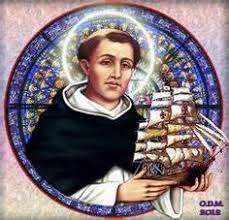
Saint Peter Gonzalez

The parents of Peter Gonzales were wealthy and apparently expected their son to become a priest so that he might in time obtain some rank. It was a period in history when this sort of thing was a trial to the Church, and Peter’s worldly youth was only one of many examples. He was educated by his uncle, the bishop of Astorga, who invested him with a canonry at Palencia and deanery when he was still quite young.
Full of pride, for a special Bull had been procured so that he might obtain the deanery while he was under age, he resolved to be installed with great pomp, and for his state entry into Astorga chose Christmas Day when the streets were likely to be crowded. He wanted to impress his flock with his fine clothes and vivid personality.
He paraded through the town on horseback, magnificently equipped, but in the noise and excitement the animal reared and threw him upon a dung heap. The Spanish people, who have a fine sense of comedy, responded with loud gusts of laughter. Picking himself up in shame, he cried: “If the world mocks me, henceforth, I will mock the world.” Covered with filth and confusion, Peter withdrew to clean up and ponder his sins.
Surprisingly enough, when his wounded feelings had healed, Peter reformed his pointless life and immediately entered the Dominican monastery at Palencia. He was never to forget to weep for his sins, and his life was spent in prayer and penance to offset the wasted years of his youth.
Peter’s friends did not allow this to happen without protest. They had been amused by his accident, but not converted by it as he was, and they did their best to talk him into leaving religious life and returning to the luxurious world he had left behind. It was probably a serious temptation to the young man, for it is not easy to reform overnight. But he did not turn back. Instead, he said to his friends, “If you love me, follow me! If you cannot follow me, forget me!” He became, by close application to the rule, one of the shining exemplars of this difficult way of life.
After his studies were completed, Peter entered into his apostolate. It was to take him into places where his worldly background would be a help rather than a hindrance, for he could well understand the temptations and troubles of worldly people. He was first of all a military chaplain with the royal army. He also began to preach in the region. He did not talk about trivia, his sermons drew large crowds. The recitation of the Psalms was his most constant prayer.
The fame of his piety and zeal spread throughout Spain and reached the ears of King Saint Ferdinand of Castile, who sent for him and attached him to his court as chaplain and as his confessor. Appalled by its licentiousness, Gonzales immediately set about reforming it, which so displeased the younger courtiers that they tried to corrupt him; but he was proof against all temptations and won the confidence of the saintly king.
Peter did much to foster the crusade against the Moors. When Ferdinand finally acted, Peter accompanied him on his expedition against the Moors. Upon the capture of Cordova and Seville, Peter used his influence and authority on the side of the vanquished and was instrumental in reducing rape and bloodshed. He also took over the Moorish mosques and converted them into Christian churches.
He was showered with favors by the king, who had the utmost confidence in him. Fearing honors, however, Peter quit the king’s service upon his return to Spain. Instead, moved by compassion, he lived among the poor peasants and sought to evangelize them. Although he was met everywhere with ignorance and brutality, his work proved efficacious. He penetrated the wildest and most inaccessible areas, seeking out the peasants in villages and the shepherds in the mountains of the Asturias. His preaching brought about reconciliation between neighbors and between men and God. He gave reassurance to the dismayed and the perplexed.
Most of the anecdotes of his life come from this period, and they have to do with miracles that he worked for these people. At his prayer, storms ceased, droughts were ended, bottles were refilled with wine, bread was found in the wilderness. The bridge that he built across the swift river Minho made his name famous throughout Spain, and it existed up until recent times. During the time he was directing work on this bridge, he used to call the fish to come and be caught; it was a way of helping to feed the workers.
He visited also the seaports of Galicia–boarding ships and preaching on their open decks. He had a great liking for sailors, and is often portrayed in the habit of his Order, holding a blue candle which symbolized Saint Elmo’s fire, the blue electrical discharge which sometimes appears in thunder storms at the mast- heads of ships, and which was supposed to be a sign that the vessel was under the saint’s protection. (The name of Saint Elmo is of earlier origin. Peter Gonzales, in the popular devotion of the sailors of the Mediterranean, has replaced the name and memory of the older saints associated with the sea, particularly the 4th century Saint Erasmus.)
He retired finally to Tuy in a state of extreme exhaustion. During Lent he preached each day in the cathedral, on Palm Sunday he foretold his death, and on the Sunday after Easter, he died at Santiago de Compostella. Bishop Luke of Tuy, his great admirer and friend, attended him to his last breath and buried him honorably in his cathedral. In his last will, the bishop gave directions for his own body to be laid near Peter’s remains, which were placed in a silver shrine and honored with many miracles.
Born: 1190 at Astorga, Spain
Died: April 15,1246 at Saintiago de Compostela, Tuy; buried in the cathedral at Tuy
Beatified: 1254 by Pope Innocent IV
Canonized: December 13, 1741 by Pope Benedict XIV (cultus confirmed)
Representation: Dominican holding a blue candle or a candle with a blue flame; Dominican lying on his cloak which is spread over hot coals; Dominican holding fire in his bare hands; Dominican catching fish with his bare hands; Dominican beside the ocean, often holding or otherwise protecting a ship.
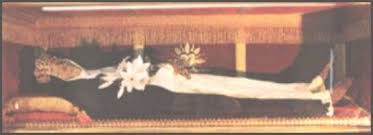
Blessed Margaret of Castello
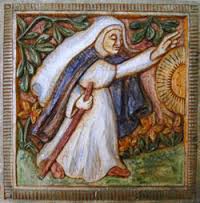
Margaret was born blind into a poor, mountain family, who were embittered by her affliction. When she was five years old, they made a pilgrimage to the tomb of a holy Franciscan at Castello to pray for a cure. The miracle failing, they abandoned their daughter in the church of Città-di-Castello and returned to their home.
Margaret was passed from family to family until she was adopted by a kindly peasant woman named Grigia, who had a large family of her own. Margaret’s natural sweetness and goodness soon made themselves felt, and she more than repaid the family for their kindness to her. She was an influence for good in any group of children. She stopped their quarrels, heard their catechism, told them stories, taught them Psalms and prayers. Busy neighbors were soon borrowing her to soothe a sick child or to establish peace in the house.
Her reputation for holiness was so great that a community of sisters in the town asked for her to become one of them. Margaret went happily to join them, but, unfortunately, there was little fervor in the house. The little girl who was so prayerful and penitential was a reproach to their lax lives, so Margaret returned to Grigia, who gladly welcomed her home.
Later, Margaret was received as a Dominican Tertiary and clothed with the religious habit. Grigia’s home became the rendezvous site of troubled souls seeking Margaret’s prayers. She said the Office of the Blessed Virgin and the entire Psalter by heart, and her prayers had the effect of restoring peace of mind to the troubled.
Denied earthly sight, Margaret was favored with heavenly visions. “Oh, if you only knew what I have in my heart!” she often said. The mysteries of the rosary, particularly the joyful mysteries, were so vivid to her that her whole person would light up when she described the scene. She was often in ecstasy, and, despite great joys and favors in prayer, she was often called upon to suffer desolation and interior trials of frightening sorts. The devil tormented her severely at times, but she triumphed over these sufferings.
A number of miracles were performed by Blessed Margaret. On one occasion, while she was praying in an upper room, Grigia’s house caught fire, and she called to Margaret to come down. The blessed, however, called to her to throw her cloak on the flames. This she did, and the blaze died out. At another time, she cured a sister who was losing her eyesight.
Beloved by her adopted family and by her neighbors and friends, Margaret died at the early age of 33. From the time of her death, her tomb in the Dominican church was a place of pilgrimage. Her body, even to this day, is incorrupt. More than 200 miracles have been credited to her intercession after her death. She was beatified in 1609. Thus the daughter that nobody wanted is one of the glories of the Church
After her death, the fathers received permission to have her heart opened. In it were three pearls, having holy figures carved upon them. They recalled the saying so often on the lips of Margaret: “If you only knew what I have in my heart!”.
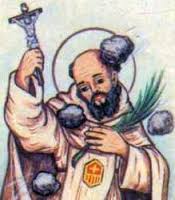
Blessed Anthony Neyrot

Blessed Anthony Neyrot occupies a unique place in Dominican history, as he is the only one among the beautified who ever renounced the faith. He expiated his sin with an act of heroism that merited heaven, washing away in his own blood the denial that might have cost him his soul.
Of the childhood of Blessed Anthony, we know nothing that he was born at Rivoli, in Italy. He was accepted into the Order by Saint Antoninus, who must have been particularly fond of the young man, since he gave him his own name. Completing his studies, Anthony was ordained and lived for a time at San Marco, the famous Dominican convent in Florence. Then, becoming restless and dissatisfied, he asked for a change of mission. He was sent to Sicily, but this did not prove to his liking either so he set out for Naples.
Brother Anthony was sailing from Sicily to Naples when pirates captured the ship. Anthony was taken to Tunis and sold as a slave. He was able to win his freedom, but fell away from the Church. He denied his faith in Jesus and abandoned his religious vocation. He accepted the Koran, the diabolical book of the Muslims. For several months, he practiced the Muslim religion. He also married.
In the meantime, his former Dominican prior, the saintly Antoninus, died. This led Anthony to have a shocking experience. It seems that one night, Anthony had something like a dream. St. Antoninus appeared to him. The conversation between the two men was to lead to a radical change in Anthony. He became truly sorry for having betrayed the Lord. He knew that in his heart he could never give up his faith in Jesus. He knew that he could only be a Catholic. And he realized that he still wanted very much to be a Dominican brother.
Blessed Anthony sent his wife back to her family. He then put on his white Dominican habit. In spite of his fear, he went to see the ruler of Tunis. A large crowd gathered and the ruler came out to the courtyard. Brother Anthony publicly admitted he had made a terrible mistake becoming a Muslim. He was a Catholic. He believed in and loved Jesus. He was a Dominican and wanted to be so for all his life. The ruler was angry. He threatened and then made promises of rewards if only Anthony would take back what he was saying. But Anthony would not. He knew this meant his death.
Anthony knelt and began to pray for the courage to give his life for Jesus. Suddenly he felt the large stones pounding him. He just kept praying for the strength to remain true to the Lord. Then he lost consciousness. Anthony died a martyr in 1460. Some merchants from Genoa, Italy, took his remains back to his own country.
Born: 1420
Died: Martyred on Holy Thursday, 1460
Blessed Anthony Pavonius

Antony grew up to diately was engaged in combatting the heresies of the Lombards. be a pious, intelligent youth. At 15, he was received into the monastery of Savigliano, was ordained in 1351.
Pope Urban V, in 1360, appointed him inquisitor-general of Lombardy and Genoa, making him one of the youngest men ever to hold that office. It was a difficult and dangerous job for a young priest of 34. Besides being practically a death sentence to any man who held the office, it carried with it the necessity of arguing with the men most learned in a twisted and subtle heresy.
Antony worked untiringly in his native city, and his apostolate lasted 14 years. During this time, he accomplished a great deal by his preaching, and even more by his example of Christian virtue. He was elected prior of Savigliano, in 1368, and given the task of building a new abbey. This he accomplished without any criticism of its luxury–a charge that heretics were always anxious to make against any Catholic builders.
The consistent poverty of Antony’s life was a reproach to the heretics, who had always been able to gain ground with the poor by pointing out the wealth of religious houses. He went among the poor and let them see that he was one of them. This so discomfited the heretics that they decided they must kill him. He was preaching in a little village near Turin when they caught him.
The martyrdom occurred in the Easter octave. On the Saturday after Easter, he asked the barber to do a good job on his tonsure because he was going to a wedding. Puzzled, the barber complied. On the Sunday after Easter, as he finished preaching a vigorous sermon against heresy at Brichera, seven heretics fell upon him with their daggers, and he hurried off to the promised “wedding.” He was buried in the Dominican church at Savigliano, where his tomb was a place of pilgrimage until 1827. At that time the relics were transferred to the Dominican church of Racconigi.
Oddly enough, this Dominican Antony takes after his Franciscan namesake. He is also invoked to find lost articles.
Born: 1326 at Savigliano, Italy
Died: Martyred in 1374 at Turino, Italy
Beatified: 1868
Patronage: Lost Articles
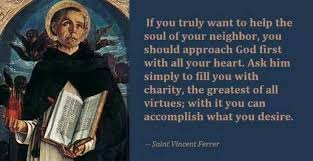
Saint Vincent Ferrer
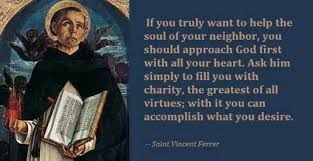
Born into a noble, pious family headed by the Englishman William Ferrer and the Spanish woman Constantia Miguel, Saint Vincent’s career of miracle-working began early. Prodigies attended his birth and baptism on the same day at Valencia, and, at age 5, he cured a neighbor child of a serious illness. These gifts and his natural beauty of person and character made him the center of attention very early in life.
His parents instilled into Vincent an intense devotion to our Lord and His Mother and a great love of the poor. He fasted regularly each Wednesday and Friday on bread and water from early childhood, abstained from meat, and learned to deny himself extravagances in order to provide alms for necessities. When his parents saw that Vincent looked upon the poor as the members of Christ and that he treated them with the greatest affection and charity, they made him the dispenser of their bountiful alms. They gave him for his portion a third part of their possessions, all of which he distributed among the poor in four days.
Vincent began his classical studies at the age of 8, philosophy at 12, and his theological studies at age 14. As everyone expected, he entered the Dominican priory of Valencia and received the habit on February 5, 1367. So angelic was his appearance and so holy his actions, that no other course seemed possible to him than to dedicate his life to God.
No sooner had he made his choice of vocation than the devil attacked him with the most dreadful temptations. Even his parents, who had encouraged his vocation, pleaded with him to leave the monastery and become a secular priest. By prayer and faith, especially prayer to Our Lady and his guardian angel, Vincent triumphed over his difficulties and finished his novitiate.
He was sent to Barcelona to study and was appointed reader in philosophy at Lerida, the most famous university in Catalonia, before he was 21. While there he published two treatises (Dialectic suppositions was one) that were well received. In 1373, he was sent to Barcelona to preach, despite the fact that he held only deacon’s orders. The city, laid low by a famine, was desperately awaiting overdue shipments of corn. Vincent foretold in a sermon that the ships would come before night, and although he was rebuked by his superior for making such a prediction, the ships arrived that day. The joyful people rushed to the priory to acclaim Vincent a prophet. The prior, however, thought it would be wise to transfer him away from such adulation.
Another story tells us that some street urchins drew his attention to one of their gang who was stretched out in the dust, pretending to be dead, near the port of Grao: “He’s dead, bring him back to life!” they cried.
“Ah,” replied Vincent, “he was playing dead but the, look, he did die.” This is how one definitely nails a lie: by regarding it as a truth. And it turned out to be true, the boy was quite dead. Everyone was gripped with fear. They implored Vincent to do something. God did. He raised him up.
In 1376, Vincent was transferred to Toulouse for a year, and continued his education. Having made a particular study of Scripture and Hebrew, Vincent was well-equipped to preach to the Jews. He was ordained a priest at Barcelona in 1379, and became a member of Pedro (Peter) Cardinal de Luna’s court–the beginning of a long friendship that was to end in grief for both of them. (Cardinal de Luna had voted for Pope Urban VI in 1378, but convinced that the election had been invalid, joined a group of cardinals who elected Robert of Geneva as Pope Clement VII later in the same year; thus, creating a schism and the line of Avignon popes.)
After being recalled to his own country, Vincent preached very successfully at the cathedral in Valencia from 1385-1390, and became famed for his eloquence and effectiveness at converting Jews–Rabbi Paul of Burgos, the future bishop of Cartagena was one of Vincent’s 30,000 Jewish and Moorish converts–and reviving the faith of those who had lapsed. His numerous miracles, the strength and beauty of his voice, the purity and clarity of his doctrine, combined to make his preaching effective, based as it was on a firm foundation of prayer.
Of course, Vincent’s success as a preacher drew the envy of others and earned him slander and calumny. His colleagues believed that they could make amends for the calumny by making him prior of their monastery in Valencia. He did withdraw for a time into obscurity. But he was recalled to preach the Lenten sermons of 1381 in Valencia, and he could not refuse to employ the gift of speech which drew to him the good and simple people as well as the captious pastors, the canons, and the skeptical savants of the Church.
Peter de Luna, a stubborn and ambitious cardinal, made Vincent part of his baggage, so to speak; because from 1390 on, Vincent preached wherever Peter de Luna happened to be, including the court of Avignon, where Vincent enjoyed the advantage of being confessor to the pope, when Peter de Luna became the antipope Benedict XIII in 1394.
Two evils cried out for remedy in Saint Vincent’s day: the moral laxity left by the great plague, and the scandal of the papal schism. In regard to the first, he preached tirelessly against the evils of the time. That he espoused the cause of the wrong man in the papal disagreement is no argument against Vincent’s sanctity; at the time, and in the midst of such confusion, it was almost impossible to tell who was right and who was wrong. The memorable thing is that he labored, with all the strength he could muster, to bring order out of chaos. Eventually, Vincent came to believe that his friend’s claims were false and urged de Luna to reconcile himself to Urban VI.
He acted as confessor to Queen Yolanda of Aragon from 1391 to 1395. He was accused to the Inquisition of heresy because he taught that Judas had performed penance, but the charge was dismissed by the antipope Benedict XIII, who burned the Inquisition’s dossier on Vincent and made him his confessor.
Benedict offered Vincent a bishopric, but refused it. Distressed by the great schism and by Benedict’s unyielding position, he advised him to confer with his Roman rival. Benedict refused. Reluctantly, Vincent was obliged to abandon de Luna in 1398. The strain of this conflict between friendship and truth caused Vincent to become dangerously ill in 1398. During his illness, he experienced a vision in which Christ and Saints Dominic and Francis instructed him to preach penance whenever and wherever he was needed, and he was miraculously cured.
After recovering, he pleaded to be allowed to devote himself to missionary work. He preached in Carpetras, Arles, Aix, and Marseilles, with huge crowds in attendance. Between 1401 and 1403, the saint was preaching in the Dauphiné, in Savoy, and in the Alpine valleys: he continued on to Lucerne, Lausanne, Tarentaise, Grenoble, and Turin. He was such an effective speaker that, although he spoke only Spanish, he was thought by many to be multilingual (the gift of tongues?). His brother Boniface was the prior of the Grande Chartreuse, and as a result of Vincent’s preaching, several notable subjects entered the monastery.
Miracles were attributed to him. In 1405, Vincent was in Genoa and preached against the fantastic head-dresses worn by the Ligurian ladies, and they were modified–“the greatest of all his marvelous deeds, reports one of his biographers. From Genoa, he caught a ship to Flanders. Later, in the Netherlands, an hour each day was scheduled for his cures. In Catalonia, his prayer restored the withered limbs of a crippled boy, deemed incurable by his physicians, named John Soler, who later became the bishop of Barcelona. In Salamanca in 1412, he raised a dead man to life. Perhaps the greatest miracle occurred in the Dauphiné, in an area called Vaupute, or Valley of Corruption. The natives there were so savage that no minister would visit them. Vincent, ever ready to suffer all things to gain souls, joyfully risked his life among these abandoned wretches, converted them all from their errors and vices. Thereafter, the name of the valley was changed to Valpure, or Valley of Purity, a name that it has retained.
He preached indefatigably, supplementing his natural gifts with the supernatural power of God, obtained through his fasting, prayers, and penance. Such was the fame of Vincent’s missions, that King Henry IV of England sent a courtier to him with a letter entreating him to preach in his dominions. The king sent one of his own ships to fetch him from the coast of France, and received him with the greatest honors. The saint having employed some time in giving the king wholesome advice both for himself and his subjects, preached in the chief towns of England, Scotland, and Ireland. Returning to France, he did the same, from Gascony to Picardy.
The preaching of Saint Vincent became a strange but marvelously effective process. He attracted to himself hundreds of people–at one time, more than 10,000–who followed him from place to place in the garb of pilgrims. The priests of the company sang Mass daily, chanted the Divine Office, and dispensed the sacraments to those converted by Vincent’s preaching. Men and women travelled in separate companies, chanting litanies and prayers as they went barefoot along the road from city to city. They taught catechism where needed, founded hospitals, and revived a faith that had all but perished in the time of the plague.
The message of his preaching was penance, the Last Judgment, and eternity. Like another John the Baptist–who was also likened to an angel, as Saint Vincent is in popular art–he went through the wilderness crying out to the people to make straight the paths of the Lord. Fearing the judgment, if for no other reason, sinners listened to his startling sermons, and the most obstinate were led by him to cast off sin and love God. He worked countless miracles, some of which are remembered today in the proverbs of Spain. Among his converts were Saint Bernardine of Siena and Margaret of Savoy.
He returned to Spain in 1407. Despite the fact that Granada was under Moorish rule, he preached successfully, and thousands of Jews and Moors were said to have been converted and requested baptism. His sermons were often held in the open air because the churches were too small for all those who wished to hear him.
In 1414 the Council of Constance attempted the end the Great Schism, which had grown since 1409 with three claimants to the papal throne. The council deposed John XXIII, and demanded the resignation of Benedict XIII and Gregory XII so that a new election could be held. Gregory was willing, but Benedict was stubborn. Again, Vincent tried to persuade Benedict to abdicate. Again, he failed. But Vincent, who acted as a judge in the Compromise of Caspe to resolve the royal succession, influenced the election of Ferdinand as king of Castile. Still a friend of Benedict (Peter de Luna), King Ferdinand, basing his actions on Vincent’s opinion on the issue, engineered Benedict’s deposition in 1416, which ended the Western Schism.
(It is interesting to note that the edicts of the Council of Constance were thrown out by the succeeding pope. The council had mandated councils every ten years and claimed that such convocations had precedence over the pope.)
His book, Treatise on the Spiritual Life is still of value to earnest souls. In it he writes: “Do you desire to study to your advantage? Let devotion accompany all your studies, and study less to make yourself learned than to become a saint. Consult God more than your books, and ask him, with humility, to make you understand what you read. Study fatigues and drains the mind and heart. Go from time to time to refresh them at the feet of Jesus Christ under his cross. Some moments of repose in his sacred wounds give fresh vigor and new lights. Interrupt your application by short, but fervent and ejaculatory prayers: never begin or end your study but by prayer. Science is a gift of the Father of lights; do not therefore consider it as barely the work of your own mind or industry.”
It seems that Vincent practiced what he preached. He always composed his sermons at the foot of a crucifix, both to beg light from Christ crucified, and to draw from that object sentiments with which to animate his listeners to penance and the love of God.
Saint Vincent also preached to Saint Colette and her nuns, and it was she who told him that he would die in France. Indeed, Vincent spent his last three years in France, mainly in Normandy and Brittany, and he died on the Wednesday of Holy Week in Vannes, Brittany, after returning from a preaching trip to Nantes. The day of his burial was a great popular feast with a procession, music, sermons, songs, miracles, and even minor brawls.
Born: 1350 at Valencia, Spain
Died: April 5th in 1419 at Vannes, Brittany , France
Canonized: 1458
Patronage: brick makers; builders; Calamonaci, Italy; construction workers; pavement workers; plumbers; tile makers
Representation: cardinal’s hat; Dominican preacher with a flame on his hand; Dominican preacher with a flame on his head; Dominican holding an open book while preaching; Dominican with a cardinal’s hat; Dominican with a crucifix; Dominican with wings; flame; pulpit; trumpet
 The Order of Preachers, Independent
You must be logged in to post a comment.